Post-Judgment Interest Rates by State (2026), Plus Prejudgment Rules
By ClauseAudit Research · 53 sources ·
What is the post-judgment interest rate by state?
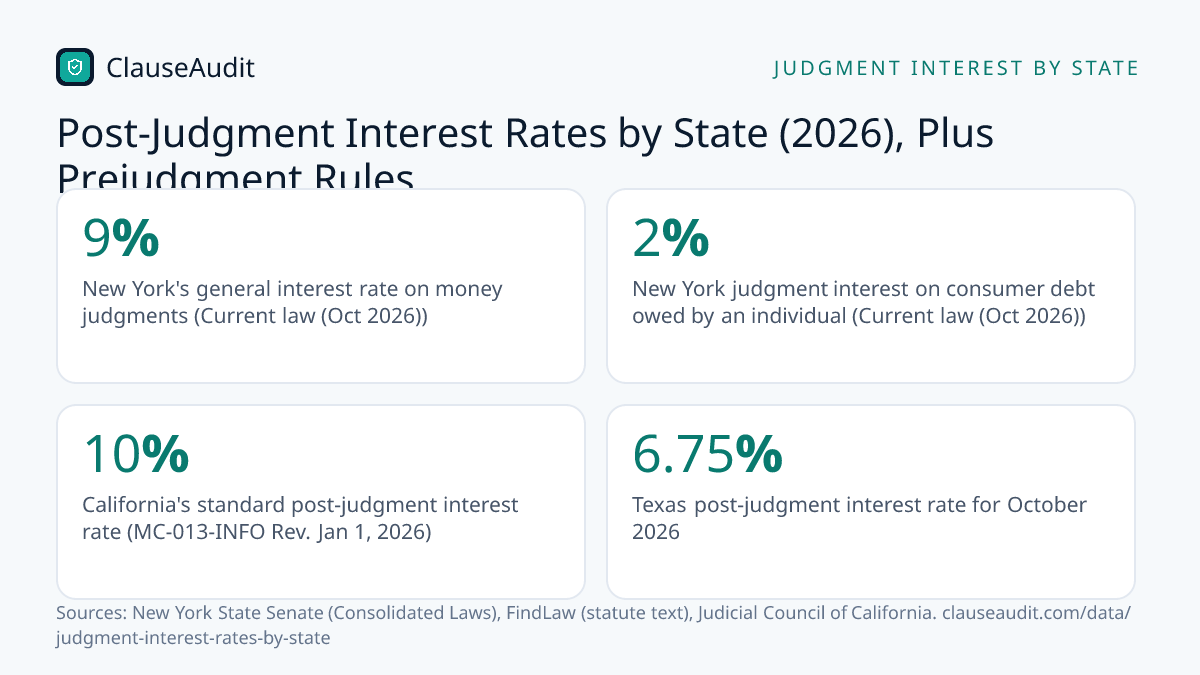
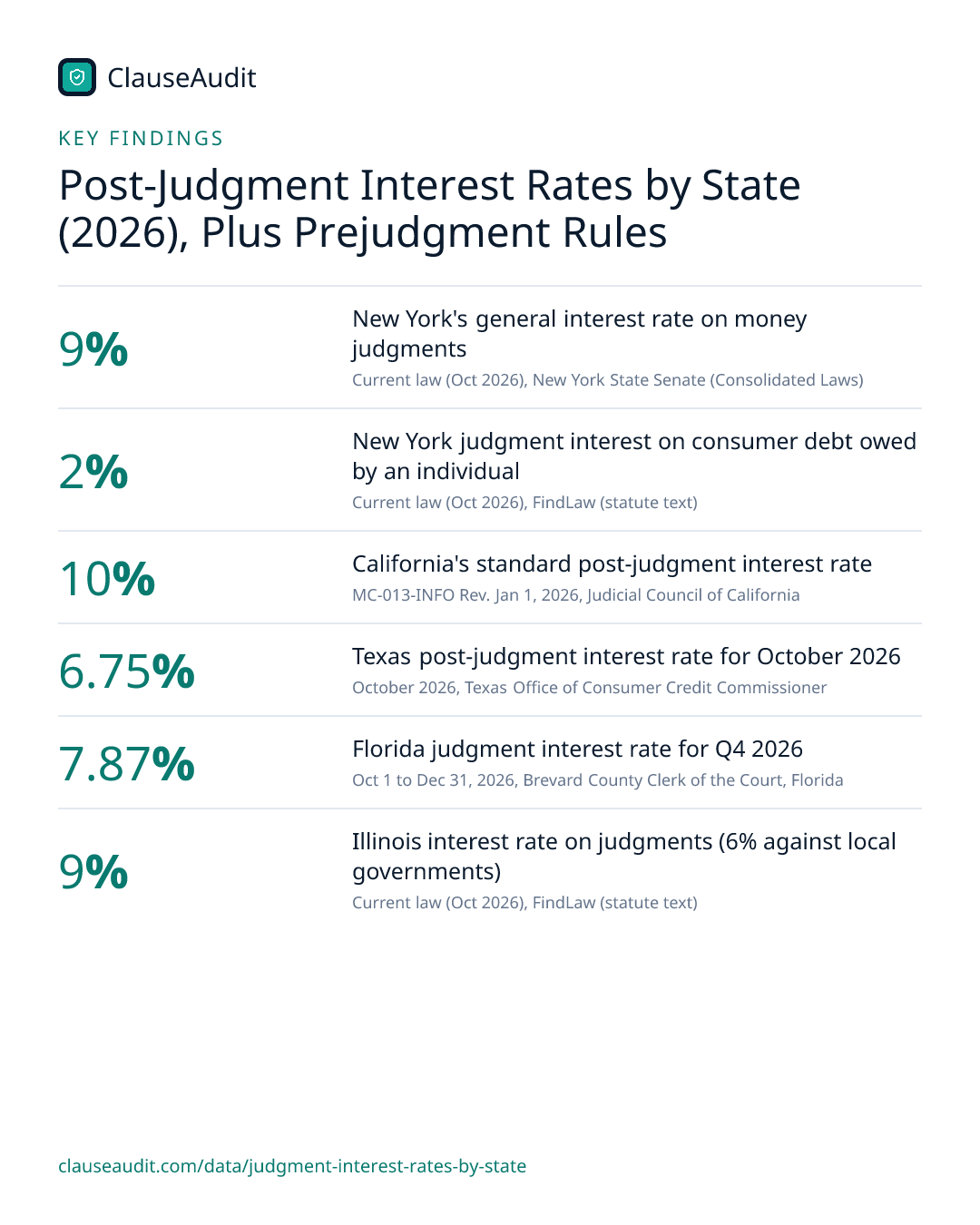
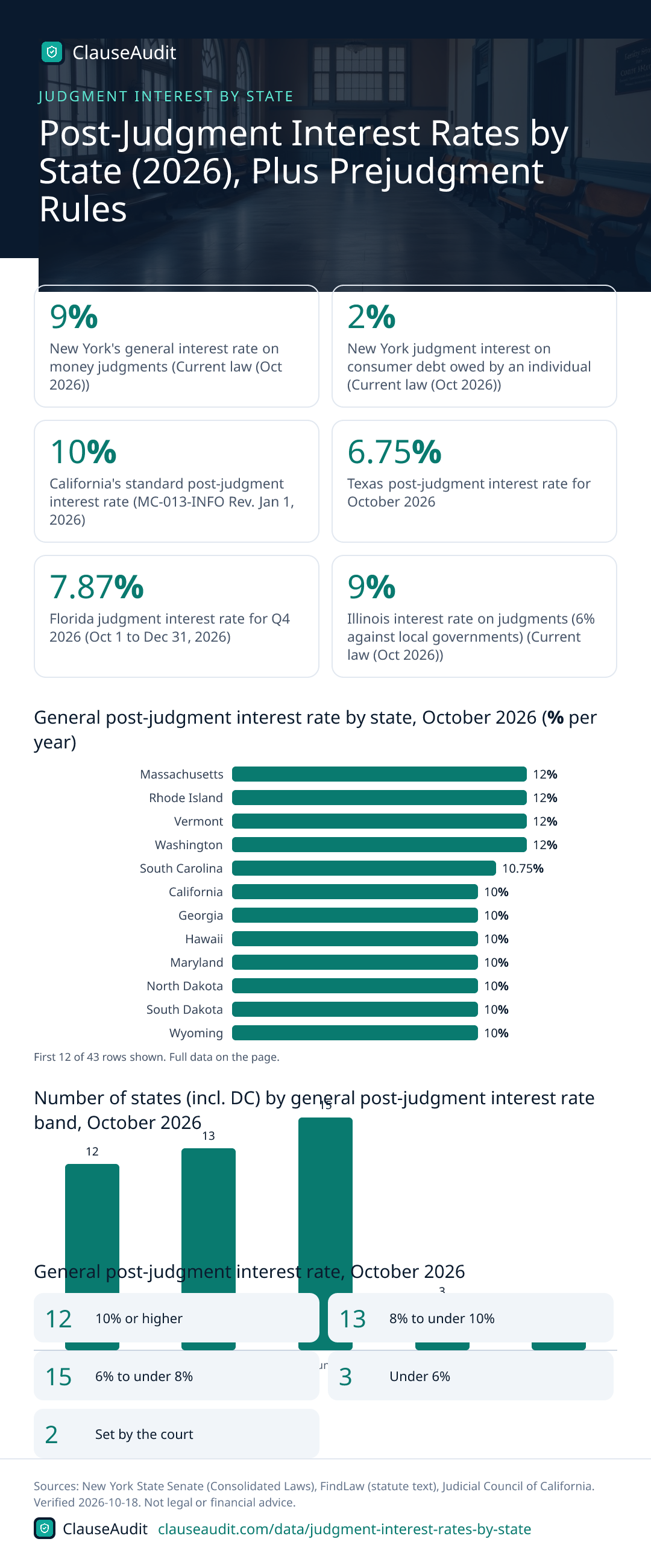
It depends heavily on the state. In October 2026 the general post-judgment rate runs from 4% in Minnesota (judgments of $50,000 or less) to 12% in Massachusetts, Rhode Island, Vermont and Washington. California charges 10%, New York 9%, Florida 7.87% and Texas 6.75%. Federal judgments entered Oct 12-16, 2026 carry 4.45%.

- New York's general interest rate on money judgments (Current law (Oct 2026), New York State Senate (Consolidated Laws))
- 9%
- New York judgment interest on consumer debt owed by an individual (Current law (Oct 2026), FindLaw (statute text))
- 2%
- California's standard post-judgment interest rate (MC-013-INFO Rev. Jan 1, 2026, Judicial Council of California)
- 10%
- Texas post-judgment interest rate for October 2026 (October 2026, Texas Office of Consumer Credit Commissioner)
- 6.75%
- Florida judgment interest rate for Q4 2026 (Oct 1 to Dec 31, 2026, Brevard County Clerk of the Court, Florida)
- 7.87%
- Illinois interest rate on judgments (6% against local governments) (Current law (Oct 2026), FindLaw (statute text))
- 9%
- Highest general rate found (Massachusetts, Rhode Island, Vermont, Washington) (Current law (Oct 2026), FindLaw (statute text))
- 12%
- Federal post-judgment rate for judgments entered Oct 12-16, 2026 (Week ending Oct 9, 2026, Federal Reserve Bank of St. Louis (FRED))
- 4.45%
Winning a judgment does not mean you get paid. Plenty of people who lose a lawsuit simply wait, hoping the other side gives up. Post-judgment interest is the law's answer to that stall. The unpaid amount keeps growing until it is paid, at a rate your state sets.
That rate is far from uniform. Some states write a flat number into the statute and leave it alone for years. Others tie it to the prime rate or Treasury yields, so it moves every month, quarter or year. Below we explain what the numbers mean in practice, how prejudgment interest differs, and what to put in your contracts so you are not stuck with whatever default your state happens to use.
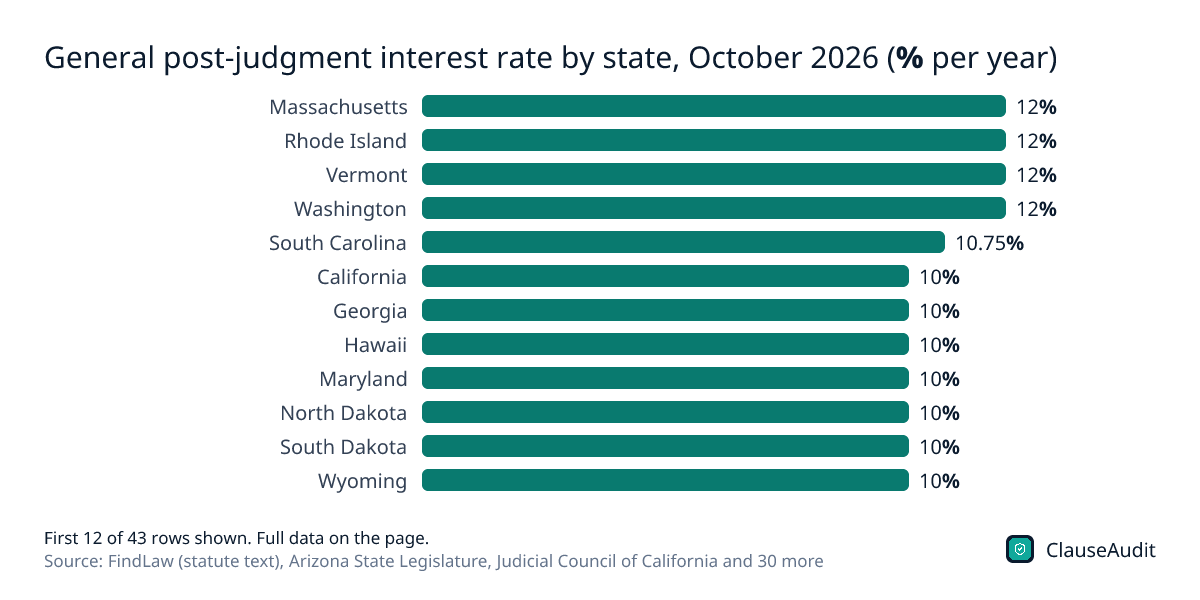
General post-judgment interest rate by state, October 2026 (% per year)
Chart data
| Label | Value |
|---|---|
| Massachusetts | 12% |
| Rhode Island | 12% |
| Vermont | 12% |
| Washington | 12% |
| South Carolina | 10.75% |
| California | 10% |
| Georgia | 10% |
| Hawaii | 10% |
| Maryland | 10% |
| North Dakota | 10% |
| South Dakota | 10% |
| Wyoming | 10% |
| Montana | 9.75% |
| Maine | 9.51% |
| Delaware | 9% |
| Illinois | 9% |
| Missouri | 9% |
| New York | 9% |
| Oregon | 9% |
| Nevada | 8.75% |
| New Mexico | 8.75% |
| Arizona | 8% |
| Colorado | 8% |
| Indiana | 8% |
| North Carolina | 8% |
| Florida | 7.87% |
| Kansas | 7.75% |
| Wisconsin | 7.75% |
| Alabama | 7.5% |
| Louisiana | 7.5% |
| Ohio | 7% |
| Alaska | 6.75% |
| Texas | 6.75% |
| Iowa | 6.47% |
| Nebraska | 6.441% |
| West Virginia | 6.25% |
| Arkansas | 6% |
| Kentucky | 6% |
| Pennsylvania | 6% |
| Virginia | 6% |
| Utah | 5.51% |
| District of Columbia | 5% |
| Minnesota (judgments of $50,000 or less) | 4% |
The top of the chart is dominated by states with fixed rates written into statute, like Massachusetts and Rhode Island at 12%. Most states that track market rates sit lower, between 6% and under 10%.
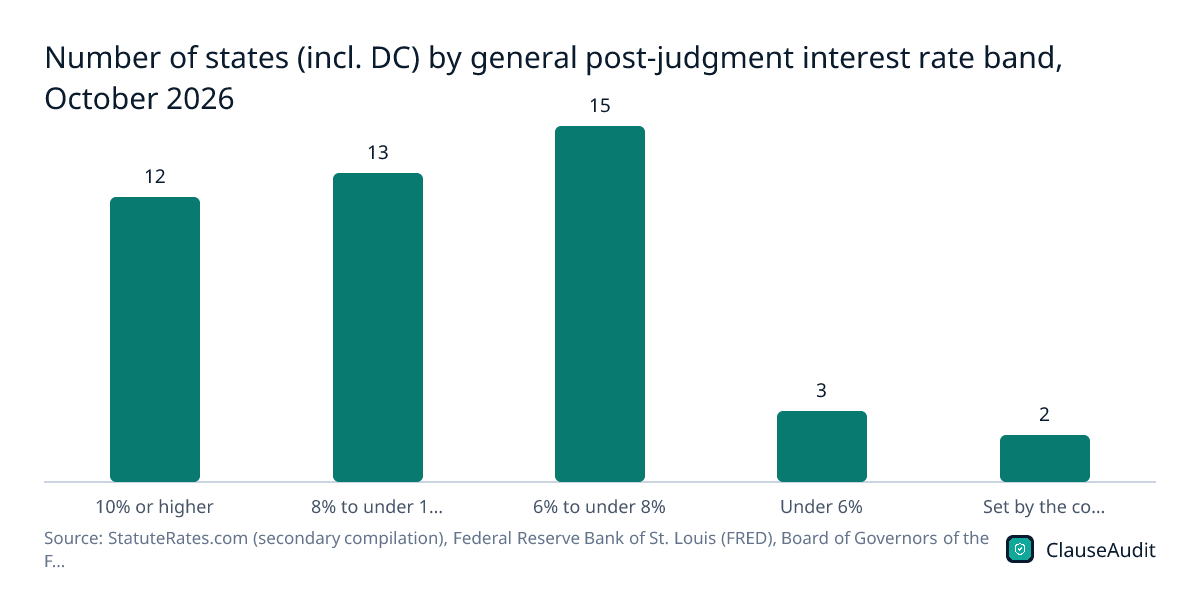
Download this chart (PNG)Number of states (incl. DC) by general post-judgment interest rate band, October 2026
Chart data
| Label | Value |
|---|---|
| 10% or higher | 12 |
| 8% to under 10% | 13 |
| 6% to under 8% | 15 |
| Under 6% | 3 |
| Set by the court | 2 |
Of the 45 jurisdictions confirmed, 15 fall in the 6% to under 8% band, the most common range. Only 3 sit under 6%, and 2 leave the rate to the judge.
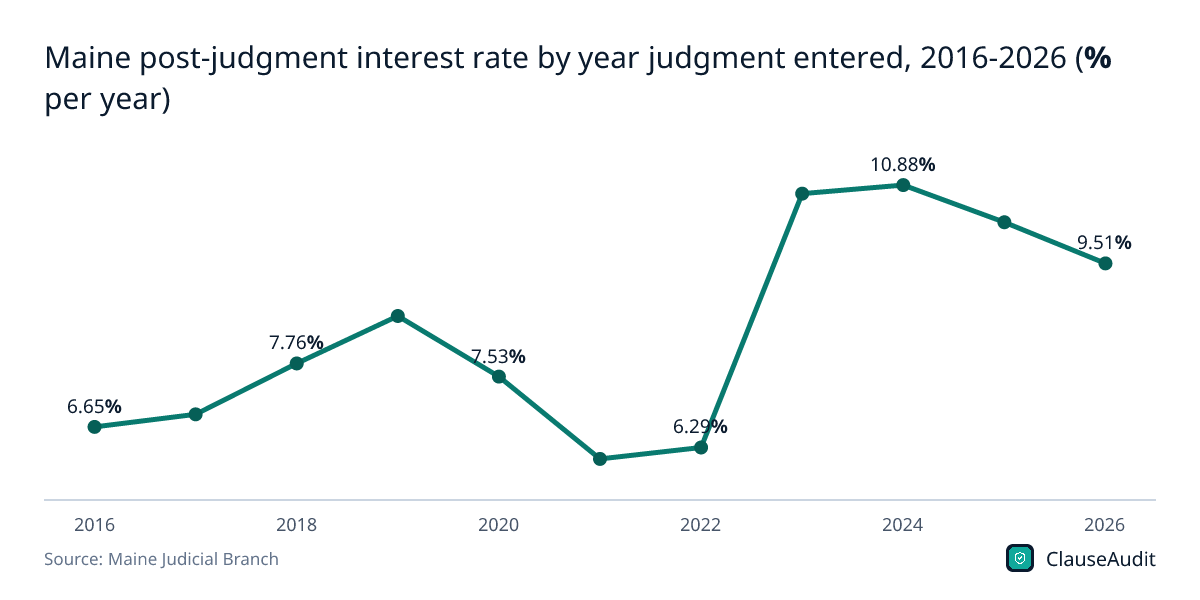
Download this chart (PNG)Maine post-judgment interest rate by year judgment entered, 2016-2026 (% per year)
Chart data
| Label | Value (% per year) |
|---|---|
| 2016 | 6.65% |
| 2017 | 6.87% |
| 2018 | 7.76% |
| 2019 | 8.59% |
| 2020 | 7.53% |
| 2021 | 6.09% |
| 2022 | 6.29% |
| 2023 | 10.73% |
| 2024 | 10.88% |
| 2025 | 10.23% |
| 2026 | 9.51% |
Maine shows how formula states swing. A judgment entered in 2022 earns 6.29% for its whole life, while one entered in 2024 earns 10.88%, because the rate locks in by the year of entry.
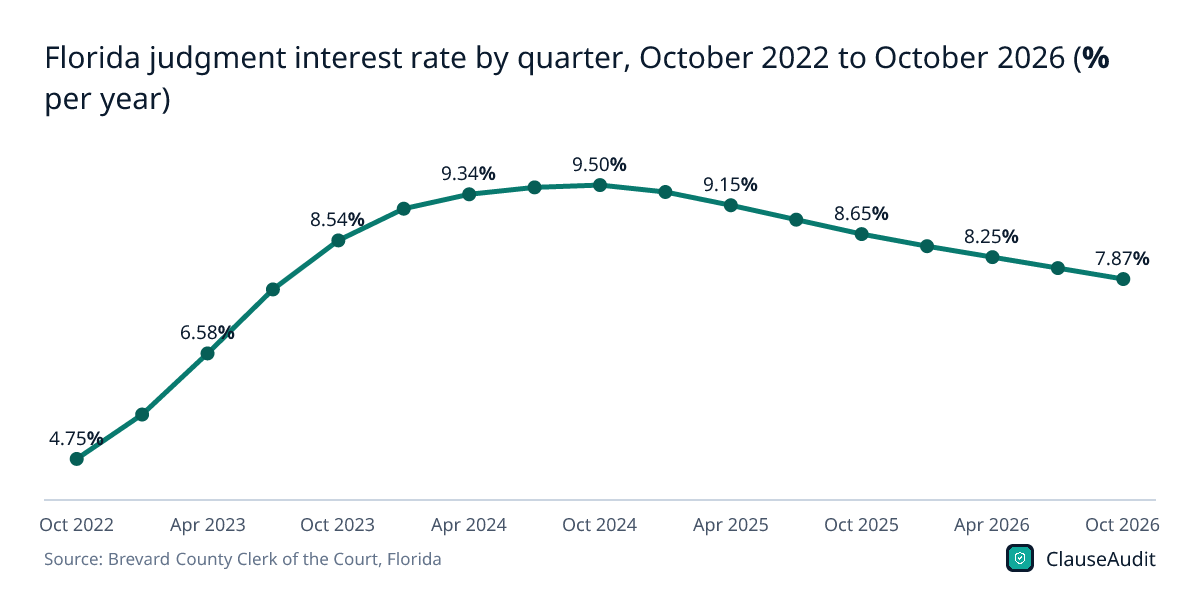
Download this chart (PNG)Florida judgment interest rate by quarter, October 2022 to October 2026 (% per year)
Chart data
| Label | Value (% per year) |
|---|---|
| Oct 2022 | 4.75% |
| Jan 2023 | 5.52% |
| Apr 2023 | 6.58% |
| Jul 2023 | 7.69% |
| Oct 2023 | 8.54% |
| Jan 2024 | 9.09% |
| Apr 2024 | 9.34% |
| Jul 2024 | 9.46% |
| Oct 2024 | 9.50% |
| Jan 2025 | 9.38% |
| Apr 2025 | 9.15% |
| Jul 2025 | 8.90% |
| Oct 2025 | 8.65% |
| Jan 2026 | 8.44% |
| Apr 2026 | 8.25% |
| Jul 2026 | 8.06% |
| Oct 2026 | 7.87% |
Florida's rate climbed for two years, peaked at 9.50% in October 2024, and has eased every quarter since, down to 7.87% for Q4 2026.
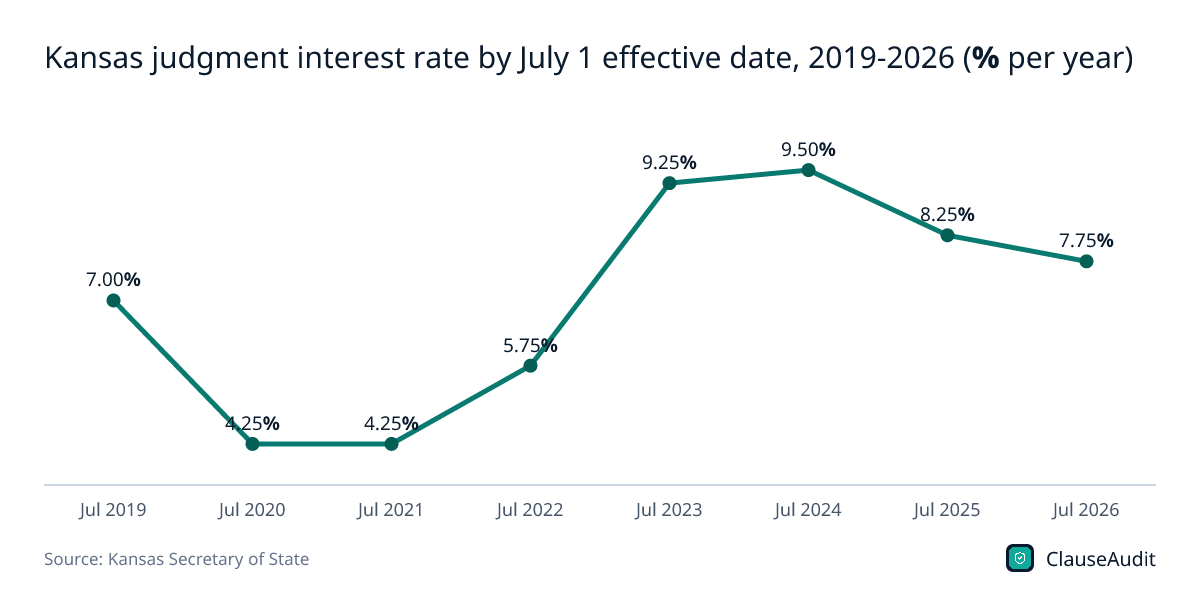
Download this chart (PNG)Kansas judgment interest rate by July 1 effective date, 2019-2026 (% per year)
Chart data
| Label | Value (% per year) |
|---|---|
| Jul 2019 | 7.00% |
| Jul 2020 | 4.25% |
| Jul 2021 | 4.25% |
| Jul 2022 | 5.75% |
| Jul 2023 | 9.25% |
| Jul 2024 | 9.50% |
| Jul 2025 | 8.25% |
| Jul 2026 | 7.75% |
Kansas sat at 4.25% in July 2020 and July 2021, then more than doubled to 9.50% by July 2024. It is 7.75% for judgments from July 1, 2026.
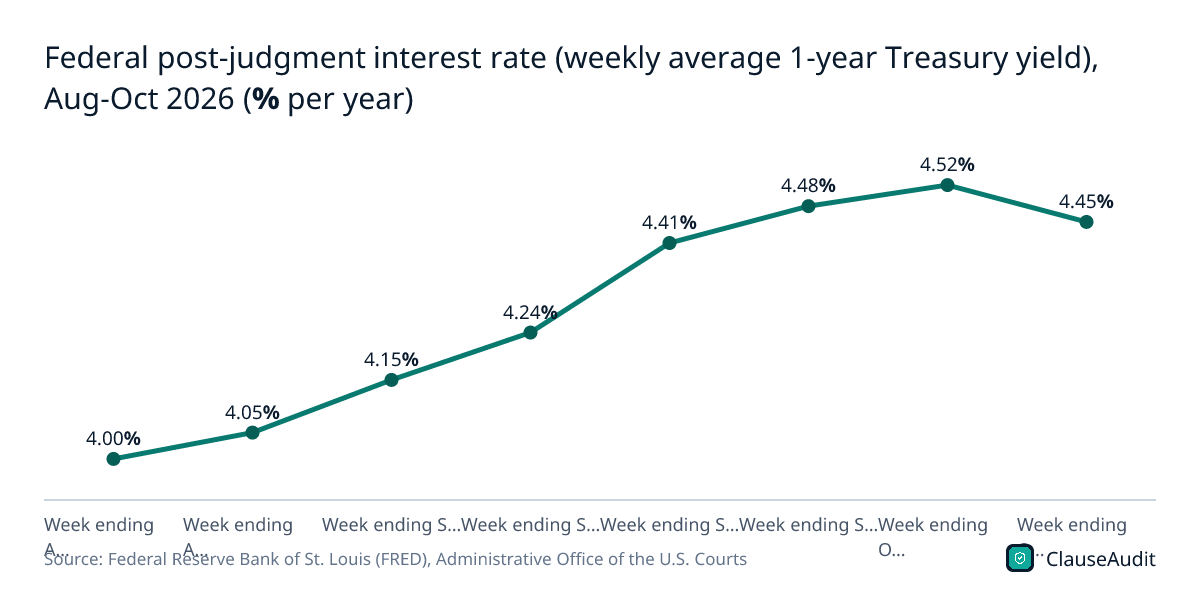
Download this chart (PNG)Federal post-judgment interest rate (weekly average 1-year Treasury yield), Aug-Oct 2026 (% per year)
Chart data
| Label | Value (% per year) |
|---|---|
| Week ending Aug 21, 2026 | 4.00% |
| Week ending Aug 28, 2026 | 4.05% |
| Week ending Sep 4, 2026 | 4.15% |
| Week ending Sep 11, 2026 | 4.24% |
| Week ending Sep 18, 2026 | 4.41% |
| Week ending Sep 25, 2026 | 4.48% |
| Week ending Oct 2, 2026 | 4.52% |
| Week ending Oct 9, 2026 | 4.45% |
Federal judgments use the average yield for the week before judgment, so timing matters. The rate rose from 4.00% in late August to 4.52% for the week ending Oct 2, 2026, then dipped to 4.45%.
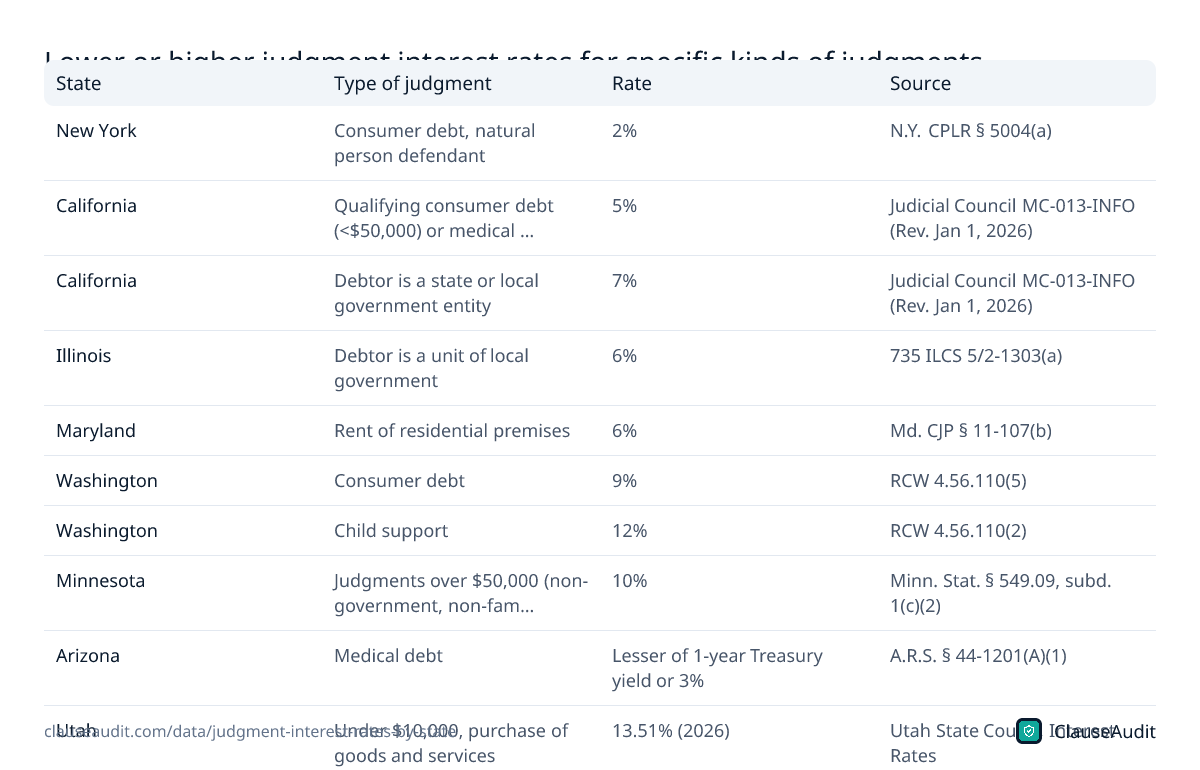
Download this chart (PNG)Lower or higher judgment interest rates for specific kinds of judgments
| State | Type of judgment | Rate | Source |
|---|---|---|---|
| New York | Consumer debt, natural person defendant | 2% | N.Y. CPLR § 5004(a) |
| California | Qualifying consumer debt (<$50,000) or medical expenses (<$200,000) against an individual | 5% | Judicial Council MC-013-INFO (Rev. Jan 1, 2026) |
| California | Debtor is a state or local government entity | 7% | Judicial Council MC-013-INFO (Rev. Jan 1, 2026) |
| Illinois | Debtor is a unit of local government | 6% | 735 ILCS 5/2-1303(a) |
| Maryland | Rent of residential premises | 6% | Md. CJP § 11-107(b) |
| Washington | Consumer debt | 9% | RCW 4.56.110(5) |
| Washington | Child support | 12% | RCW 4.56.110(2) |
| Minnesota | Judgments over $50,000 (non-government, non-family) | 10% | Minn. Stat. § 549.09, subd. 1(c)(2) |
| Arizona | Medical debt | Lesser of 1-year Treasury yield or 3% | A.R.S. § 44-1201(A)(1) |
| Utah | Under $10,000, purchase of goods and services | 13.51% (2026) | Utah State Courts, Interest Rates |
Source: New York State Senate (Consolidated Laws), N.Y. CPLR § 5004 - Rate of interest; FindLaw (statute text), New York Civil Practice Law and Rules § 5004; Judicial Council of California, Information Sheet for Calculating Interest and Amount Owed on a Judgment (MC-013-INFO); FindLaw (statute text), 735 ILCS 5/2-1303 Interest on judgment; Maryland General Assembly, Md. Code, Courts and Judicial Proceedings § 11-107; Washington State Legislature, RCW 4.56.110 Interest on judgments; Minnesota Office of the Revisor of Statutes, Minn. Stat. § 549.09 Interest on verdicts, awards, and judgments; Arizona State Legislature, A.R.S. § 44-1201 Rate of interest for loan or indebtedness; interest on judgments; Utah State Courts, Interest Rates (post judgment, Utah Code 15-1-4). Download as image
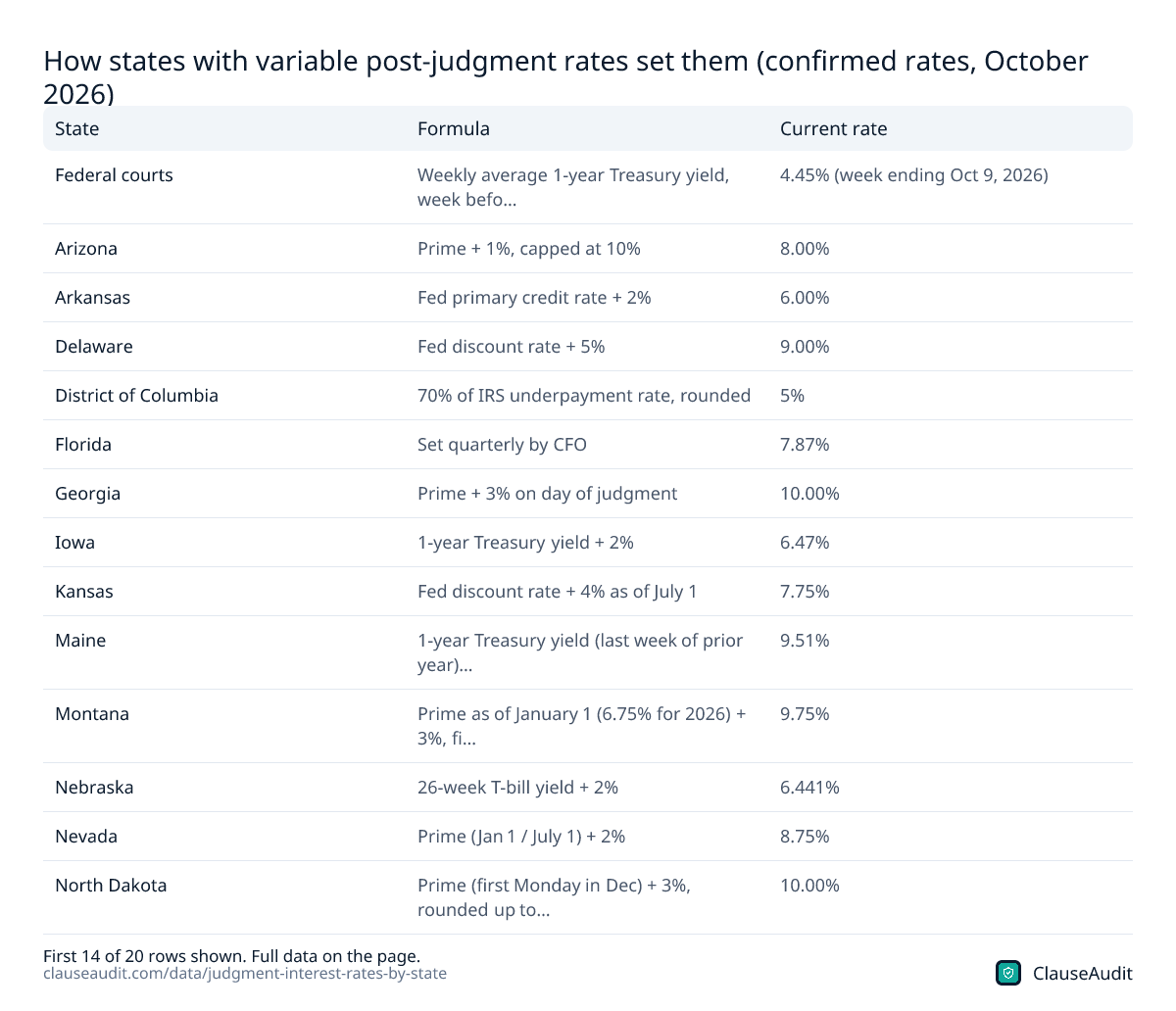
How states with variable post-judgment rates set them (confirmed rates, October 2026)
| State | Formula | Current rate |
|---|---|---|
| Federal courts | Weekly average 1-year Treasury yield, week before judgment | 4.45% (week ending Oct 9, 2026) |
| Arizona | Prime + 1%, capped at 10% | 8.00% |
| Arkansas | Fed primary credit rate + 2% | 6.00% |
| Delaware | Fed discount rate + 5% | 9.00% |
| District of Columbia | 70% of IRS underpayment rate, rounded | 5% |
| Florida | Set quarterly by CFO | 7.87% |
| Georgia | Prime + 3% on day of judgment | 10.00% |
| Iowa | 1-year Treasury yield + 2% | 6.47% |
| Kansas | Fed discount rate + 4% as of July 1 | 7.75% |
| Maine | 1-year Treasury yield (last week of prior year) + 6% | 9.51% |
| Montana | Prime as of January 1 (6.75% for 2026) + 3%, fixed for the calendar year | 9.75% |
| Nebraska | 26-week T-bill yield + 2% | 6.441% |
| Nevada | Prime (Jan 1 / July 1) + 2% | 8.75% |
| North Dakota | Prime (first Monday in Dec) + 3%, rounded up to 0.5 | 10.00% |
| Ohio | Federal short-term rate + 3% | 7% |
| South Carolina | Prime (first WSJ of year) + 4% | 10.75% |
| Texas | Prime, 5% floor, 15% ceiling | 6.75% |
| Utah | Federal post-judgment rate on Jan 1 + 2% | 5.51% |
| West Virginia | Fifth District secondary discount rate + 2% (4% to 9%) | 6.25% |
| Wisconsin | Prime (Jan 1 / July 1) + 1% | 7.75% |
Source: Administrative Office of the U.S. Courts, Post Judgment Interest Rate; Federal Reserve Bank of St. Louis (FRED), Market Yield on U.S. Treasury Securities at 1-Year Constant Maturity, Weekly, Ending Friday (WGS1YR; source: Board of Governors H.15); Arizona State Legislature, A.R.S. § 44-1201 Rate of interest for loan or indebtedness; interest on judgments; FindLaw (statute text), Ark. Code § 16-65-114 Interest on judgments; State of Delaware (Delaware Code Online), 6 Del. C. § 2301 Legal rate; Council of the District of Columbia, D.C. Code § 28-3302 Rate of interest not expressed and on judgments; Internal Revenue Service, Interest rates for the fourth quarter of 2026 (IR-2026-98); Brevard County Clerk of the Court, Florida, Civil Judgment Interest Rates (rates set by the Florida CFO under s. 55.03); FindLaw (statute text), O.C.G.A. § 7-4-12 Interest on judgments; Iowa Judicial Branch, Post Judgment Interest Table; Kansas Secretary of State, Finance Rates - Judgment Rate (K.S.A. 16-204); Maine Judicial Branch, 2026 Post-Judgment Interest Rate Chart (OTH-156); Montana Legislature, MCA 25-9-205 Amount of interest; Nebraska Judicial Branch, Judgment Interest Rate (and table pursuant to 45-103); Nevada Financial Institutions Division, Prime Interest Rate, July 1, 2026; North Dakota Legislative Branch, N.D.C.C. ch. 28-20 (§ 28-20-34 Interest rate on judgments); Ohio Department of Taxation, Administrative Journal Entry: Determination of Interest Rates Pursuant to R.C. 5703.47; South Carolina Legislature, S.C. Code Title 34 Chapter 31 (§ 34-31-20); Texas Office of Consumer Credit Commissioner, Texas Credit Letter rate ceilings notice (Postjudgment Interest Rate, Sec. 304.003); Utah State Courts, Interest Rates (post judgment, Utah Code 15-1-4); Supreme Court of Appeals of West Virginia, Administrative Order: Rate of Interest on Judgments and Decrees for the Year 2026; Federal Reserve Bank of St. Louis (FRED), Bank Prime Loan Rate (DPRIME; source: Board of Governors H.15); Board of Governors of the Federal Reserve System, H.15 Selected Interest Rates; StatuteRates.com (secondary compilation), 2026 Judgment Interest Rates by State (50-State Table) and linked state pages. Download as image
General post-judgment interest rate, October 2026 by state
- 1210% or higher
- 138% to under 10%
- 156% to under 8%
- 3Under 6%
- 2Set by the court
- 10% or higher12
- 8% to under 10%13
- 6% to under 8%15
- Under 6%3
- Set by the court2
- Not yet confirmed6
| State | Post-judgment rate | How it is set | Resets | Statute | Source |
|---|---|---|---|---|---|
| Alabama | 7.5% | Fixed by statute | Fixed | Ala. Code § 8-8-10(a) | Ala. Code § 8-8-10(a) |
| Alaska | 6.75% (judgments entered in 2026) | Variable formula | Yearly (Jan 2) | Alaska Stat. § 09.30.070(a) | Alaska Stat. § 09.30.070(a) |
| Arizona | 8.00% (judgments entered on or after Sept 17, 2026) | Variable formula | At date of judgment | A.R.S. § 44-1201(B) | A.R.S. § 44-1201(B) |
| Arkansas | 6.00% (judgments entered on or after Sept 17, 2026) | Variable formula | At date of judgment | Ark. Code § 16-65-114(a) | Ark. Code § 16-65-114(a) |
| California | 10% | Fixed by statute | Fixed | Cal. Code Civ. Proc. § 685.010 | Cal. Code Civ. Proc. § 685.010 |
| Colorado | 8% (compounded annually) | Fixed by statute | Fixed | C.R.S. § 5-12-102(4)(b) | C.R.S. § 5-12-102(4)(b) |
| Connecticut | Up to 10% (court discretion) | Court-set, capped | Case by case | Conn. Gen. Stat. §§ 37-3a, 37-3b | Conn. Gen. Stat. §§ 37-3a, 37-3b |
| Delaware | 9.00% (legal rate from Sept 17, 2026) | Variable formula | Rate as of the date interest is due | 6 Del. C. § 2301(a) | 6 Del. C. § 2301(a) |
| District of Columbia | 5% (Q4 2026) | Variable formula | Quarterly | D.C. Code § 28-3302(c) | D.C. Code § 28-3302(c) |
| Florida | 7.87% (Oct 1 to Dec 31, 2026) | Variable formula | Quarterly (set by CFO) | Fla. Stat. § 55.03 | Fla. Stat. § 55.03 |
| Georgia | 10.00% (judgments entered on or after Sept 17, 2026) | Variable formula | At date of judgment | O.C.G.A. § 7-4-12(a) | O.C.G.A. § 7-4-12(a) |
| Hawaii | 10% | Fixed by statute | Fixed | Haw. Rev. Stat. § 478-3 | Haw. Rev. Stat. § 478-3 |
| Idaho | Not yet confirmed: check the source | Idaho Code § 28-22-104(2) | |||
| Illinois | 9% | Fixed by statute | Fixed | 735 ILCS 5/2-1303(a) | 735 ILCS 5/2-1303(a) |
| Indiana | 8% | Fixed by statute | Fixed | Ind. Code § 24-4.6-1-101 | Ind. Code § 24-4.6-1-101 |
| Iowa | 6.47% (from Oct 7, 2026 table entry) | Variable formula | Monthly table | Iowa Code §§ 535.3, 668.13 | Iowa Code §§ 535.3, 668.13 |
| Kansas | 7.75% (July 1, 2026 to June 30, 2027) | Variable formula | Yearly (July 1) | K.S.A. 16-204 | K.S.A. 16-204 |
| Kentucky | 6% (compounded annually) | Fixed by statute | Fixed | KRS 360.040(1) | KRS 360.040(1) |
| Louisiana | 7.50% (2026) | Variable formula | Yearly (Jan 1) | La. R.S. 13:4202(B) | La. R.S. 13:4202(B) |
| Maine | 9.51% (judgments entered in 2026) | Variable formula | Yearly (Jan 1) | 14 M.R.S. § 1602-C | 14 M.R.S. § 1602-C |
| Maryland | 10% | Fixed by statute | Fixed | Md. Code, Cts. & Jud. Proc. § 11-107(a) | Md. Code, Cts. & Jud. Proc. § 11-107(a) |
| Massachusetts | 12% | Fixed by statute | Fixed | M.G.L. c. 235, § 8 (rate per c. 231, § 6B/6C) | M.G.L. c. 235, § 8 (rate per c. 231, § 6B/6C) |
| Michigan | Not yet confirmed: check the source | MCL 600.6013(8) | |||
| Minnesota | 4% (judgments of $50,000 or less); 10% (over $50,000) | Variable formula (small judgments) | Yearly (set by Dec 20) | Minn. Stat. § 549.09, subd. 1(c) | Minn. Stat. § 549.09, subd. 1(c) |
| Mississippi | Set by the judge (contract rate for contract judgments) | Court-set | Case by case | Miss. Code § 75-17-7 | Miss. Code § 75-17-7 |
| Missouri | 9% (non-tort); tort: intended Fed funds rate + 5% | Fixed (non-tort) / variable (tort) | Fixed / at judgment | Mo. Rev. Stat. § 408.040 | Mo. Rev. Stat. § 408.040 |
| Montana | 9.75% (judgments entered in 2026) | Variable formula | Annually (prime as of January 1) | MCA § 25-9-205(1) | MCA § 25-9-205(1) |
| Nebraska | 6.441% (from Oct 15, 2026) | Variable formula | Quarterly | Neb. Rev. Stat. § 45-103 | Neb. Rev. Stat. § 45-103 |
| Nevada | 8.75% (July 1 to Dec 31, 2026) | Variable formula | Every 6 months (Jan 1, July 1) | NRS 17.130(2) | NRS 17.130(2) |
| New Hampshire | Not yet confirmed: check the source | RSA 336:1, II | |||
| New Jersey | Not yet confirmed: check the source | N.J. Ct. R. 4:42-11 | |||
| New Mexico | 8.75% (15% for certain judgments) | Fixed by statute | Fixed | NMSA 1978 § 56-8-4 | NMSA 1978 § 56-8-4 |
| New York | 9% | Fixed by statute | Fixed | N.Y. CPLR § 5004(a) | N.Y. CPLR § 5004(a) |
| North Carolina | 8% | Fixed by statute | Fixed | N.C. Gen. Stat. §§ 24-1, 24-5 | N.C. Gen. Stat. §§ 24-1, 24-5 |
| North Dakota | 10.00% (judgments entered in 2026) | Variable formula | Yearly (Jan 1) | N.D.C.C. § 28-20-34 | N.D.C.C. § 28-20-34 |
| Ohio | 7% (2026) | Variable formula | Yearly (Jan 1) | Ohio Rev. Code §§ 1343.03(A), 5703.47 | Ohio Rev. Code §§ 1343.03(A), 5703.47 |
| Oklahoma | Not yet confirmed: check the source | 12 O.S. § 727.1 | |||
| Oregon | 9% | Fixed by statute | Fixed | ORS 82.010(2) | ORS 82.010(2) |
| Pennsylvania | 6% | Fixed by statute | Fixed | 42 Pa.C.S. § 8101; 41 P.S. § 202 | 42 Pa.C.S. § 8101; 41 P.S. § 202 |
| Rhode Island | 12% | Fixed by statute | Fixed | R.I. Gen. Laws § 9-21-10 | R.I. Gen. Laws § 9-21-10 |
| South Carolina | 10.75% (2026) | Variable formula | Yearly (Jan) | S.C. Code § 34-31-20(B) | S.C. Code § 34-31-20(B) |
| South Dakota | 10% | Fixed by statute | Fixed | SDCL §§ 54-3-5.1, 54-3-16 | SDCL §§ 54-3-5.1, 54-3-16 |
| Tennessee | Not yet confirmed: check the source | Tenn. Code § 47-14-121 | |||
| Texas | 6.75% (October 2026) | Variable formula | Monthly | Tex. Fin. Code § 304.003 | Tex. Fin. Code § 304.003 |
| Utah | 5.51% (2026) | Variable formula | Yearly (Jan 1) | Utah Code § 15-1-4(3)(a) | Utah Code § 15-1-4(3)(a) |
| Vermont | 12% | Fixed by statute | Fixed | 9 V.S.A. § 41a(a) | 9 V.S.A. § 41a(a) |
| Virginia | 6% | Fixed by statute | Fixed | Va. Code § 6.2-302 | Va. Code § 6.2-302 |
| Washington | 12% (general); tort: prime + 2%; consumer debt: 9% | Variable formula | At date of entry | RCW 4.56.110 | RCW 4.56.110 |
| West Virginia | 6.25% (2026) | Variable formula | Yearly (Jan 2) | W. Va. Code § 56-6-31 | W. Va. Code § 56-6-31 |
| Wisconsin | 7.75% (July 1 to Dec 31, 2026) | Variable formula | Every 6 months (Jan 1, July 1) | Wis. Stat. § 815.05(8) | Wis. Stat. § 815.05(8) |
| Wyoming | 10% | Fixed by statute | Fixed | Wyo. Stat. § 1-16-102(a) | Wyo. Stat. § 1-16-102(a) |
What is post-judgment interest, and how is it different from prejudgment interest?
Post-judgment interest starts the day a court enters a money judgment and keeps running until the debt is paid. It is automatic in most states. You usually do not need to ask for it, because the statute adds it to the judgment.
Prejudgment interest covers the earlier stretch: the time between when the money was owed and when the court ruled. Think of an invoice due in March, a lawsuit filed in the fall, and a judgment the following summer. Prejudgment interest compensates you for those months you went without the money.
The rules for prejudgment interest are messier. Many states award it on contract claims where the amount owed was clear, and are stingier on injury claims where the number was in dispute until trial. Some states use the same legal rate for both periods. Delaware's courts, for example, say pre- and post-judgment interest both use the legal rate in effect when the claim arose. The biggest factor is usually your contract. If it names an interest rate on late payments, that rate often controls before judgment, and in some states after it too.
Which states have the highest post-judgment interest rates?
Massachusetts, Rhode Island, Vermont and Washington share the top spot at 12%. South Carolina follows at 10.75%, then a cluster at 10%: California, Georgia, Hawaii, Maryland, North Dakota, South Dakota and Wyoming. Altogether, 12 jurisdictions sit at 10% or higher.
Most of the high-rate states use a flat number set by statute. That matters because fixed rates were often written when market rates were much higher, and legislatures rarely revisit them. In a year when savings accounts pay far less, a 10% or 12% judgment is one of the better returns available to a creditor, and an expensive debt for anyone sitting on it.
At the low end, Minnesota charges 4% on judgments of $50,000 or less, the District of Columbia 5% for Q4 2026, and Utah 5.51%. Federal court judgments, at 4.45% for mid-October 2026, sit below every state on the chart except Minnesota's small-judgment rate. If you can choose where to sue, that gap is worth a thought.
Why your rate depends on when the judgment was entered
In formula states, the date of judgment can move the rate more than the state you are in. Maine locks the rate by the year the judgment is entered. A 2023 judgment earns 10.73% for good, while a 2026 judgment earns 9.51%. Georgia uses prime plus 3% on the day of judgment, so it was 9.75% through Sept 16, 2026 and 10.00% from the next day.
Other states let the rate float. Florida resets quarterly and Texas monthly, so check the rate for the exact period before you calculate anything. Texas has a 5% floor and a 15% ceiling, which keeps its rate within a band no matter where prime goes.
The practical lesson is simple. Never assume the number you looked up last year still applies, and never assume a judgment from a few years ago uses today's rate. Pull the rate for the date your judgment was entered.
Does a contract interest rate override the state rate?
Often, yes. Several states say a judgment on a contract carries the contract's own rate when it is higher, or simply follow the contract rate. Arkansas, Maine, Missouri, Virginia and Wyoming all have versions of this rule, and Texas handles contract judgments under a separate section of its code.
This is why the late-payment clause in your agreement matters long after the invoice goes unpaid. A clear, lawful interest rate can follow the debt into court and beyond. A vague clause, or none at all, leaves you with the statutory default, which could be the 6% Virginia and Pennsylvania use. Keep the rate within your state's usury limits, though. A rate set too high can be cut down or thrown out.
A quick example. Say a client signs your agreement with a monthly late charge, never pays, and you win in a 6% state. If the contract rate is lawful and higher, you may be able to ask for it instead of the statutory rate. Without that clause, the statutory 6% is what the judgment earns.
Special rates for consumers, renters and governments
The general rate is not the only rate. Several states carve out lower ones for people they want to protect. New York drops to 2% on consumer-debt judgments against an individual. California uses 5% for qualifying consumer-debt and medical-expense judgments against an individual, and 7% when the debtor is a government entity. Maryland applies 6% to judgments for residential rent, and Washington uses 9% for consumer debt.
If you are the one who owes, check if your case fits one of these categories. A lender or landlord applying the general rate when a lower one applies is overcharging you. If you are the creditor, the same check keeps your payoff letters accurate and keeps you out of a dispute over the balance.
What to do if you are owed money, or owe it
- Find the rate for the exact date of your judgment, using the state table above and the court's own published notice.
- Read your contract's late-payment and interest clause. If it sets a lawful rate higher than the statutory one, you may be entitled to it.
- Ask for prejudgment interest in your complaint. Many courts will not add it unless you request it.
- If you owe on a judgment, pay it or settle it early. In a 12% state the balance grows quickly, and partial payments usually go to interest first.
- Check for special lower rates for consumer debt, medical debt, residential rent or government debtors before you accept anyone's payoff figure.
- Pair the interest rate with a plan to actually collect. Interest only helps if the debtor has wages, accounts or property you can reach.
How ClauseAudit helps
The interest you can recover on an unpaid bill is decided long before anyone goes to court. It is decided in the payment section of the contract you signed. An automated review reads that section and flags what is missing or one-sided.
Upload a financing agreement, client contract or vendor deal and get a plain-English report on the terms that control what happens when payment stops.
- Whether the contract sets a late-payment interest rate, and whether it is likely within state usury limits
- Late fees that stack on top of interest or look like a penalty a court could strike
- Attorney fee and collection cost clauses, and whether they run both ways
- Governing law and venue, which decide which state's judgment rate applies
- Confession of judgment or waiver of defense clauses that let a lender skip the lawsuit
- Personal guarantees that put your own assets behind a business judgment
Frequently asked questions
What is the post-judgment interest rate in California?
California's standard rate is 10% a year under the Judicial Council's guidance revised Jan 1, 2026. It drops to 7% when the debtor is a state or local government entity, and to 5% for qualifying consumer-debt and medical-expense judgments against an individual. The 10% rate is fixed by statute, so it does not move with market rates.
What is the federal post-judgment interest rate right now?
For federal civil judgments entered Oct 12-16, 2026, the rate is 4.45%, based on the average one-year Treasury yield for the week ending Oct 9, 2026. The rate changes weekly, so a judgment entered a week later can carry a different rate. Once set, it stays fixed for that judgment.
Is post-judgment interest simple or compound?
In most states it is simple interest on the judgment amount. A few states compound it. Colorado's 8% rate compounds annually, as do Kentucky's 6% and South Carolina's 10.75%. Montana's statute says its rate is not compounded. Check your state's statute in the table above before running numbers.
What is the post-judgment interest rate in New York?
New York's general rate is 9% a year under CPLR 5004(a), and it is fixed by statute rather than tied to market rates. The big exception is consumer debt: when an individual is the defendant on a consumer-debt judgment, the rate is 2%. Creditors who apply 9% to those judgments are overcharging.
How often does the Texas post-judgment interest rate change?
Texas sets it monthly. The rate follows prime, with a 5% floor and a 15% ceiling. For October 2026 it is 6.75%. Judgments based on a contract that sets its own interest rate follow a different section of the Texas Finance Code, so check the contract first.
Can I get prejudgment interest on an unpaid invoice?
Often, yes, especially when the amount owed was clear and fixed. Many states allow prejudgment interest on contract claims, and a contract that sets a late-payment rate makes the claim much stronger. You usually need to request it in your lawsuit. Many courts will not add it unless asked, and the rules differ widely between states.
Which states let the judge set the interest rate?
Connecticut and Mississippi. Connecticut allows interest of up to 10% a year in civil actions, with the court choosing the rate. Mississippi leaves it to the judge, though contract judgments generally carry the contract rate. In both states, argue for the rate you want rather than assuming a default.
Why are some states marked not yet confirmed?
We leave a rate blank when we could not confirm it. For Idaho, Michigan, New Hampshire, New Jersey, Oklahoma and Tennessee, the official rate notice could not be opened during verification. All 6 use formulas that change over time, so check the state court or treasury website for the current figure.
Does interest stop if the debtor files for bankruptcy?
Generally, the automatic stay halts collection, and interest on unsecured claims usually stops accruing as part of the bankruptcy case. Secured creditors and debts that survive bankruptcy can be treated differently. Bankruptcy rules are federal and fact-specific, so talk to a lawyer before assuming your judgment balance keeps growing.
Use this data
Every chart and card below is free to reuse under CC BY 4.0. Download what you need and link back to this page.
 Stat cards
 Key findings card
 Infographic
 General post-judgment interest rate by state, October 2026 (% per year)
 Number of states (incl. DC) by general post-judgment interest rate band, October 2026
 Maine post-judgment interest rate by year judgment entered, 2016-2026 (% per year)
 Florida judgment interest rate by quarter, October 2022 to October 2026 (% per year)
 Kansas judgment interest rate by July 1 effective date, 2019-2026 (% per year)
 Federal post-judgment interest rate (weekly average 1-year Treasury yield), Aug-Oct 2026 (% per year)
 Lower or higher judgment interest rates for specific kinds of judgments
 How states with variable post-judgment rates set them (confirmed rates, October 2026)
Embed the infographic
Free to share on your site, blog or slides under CC BY 4.0. Please keep the credit link.
Sources and method
Every number on this page comes from the sources below, each opened and read on or before October 18, 2026. A second, independent review checked every figure against its source and corrected anything that did not match. 45 of 51 state entries were confirmed; any that could not be are marked "Not yet confirmed" and left out of every count and chart.
- Administrative Office of the U.S. Courts, Post Judgment Interest Rate (Current page, accessed 2026-10-18)
- Federal Reserve Bank of St. Louis (FRED), Market Yield on U.S. Treasury Securities at 1-Year Constant Maturity, Weekly, Ending Friday (WGS1YR; source: Board of Governors H.15) (Data through week ending October 9, 2026)
- Federal Reserve Bank of St. Louis (FRED), Bank Prime Loan Rate (DPRIME; source: Board of Governors H.15) (Daily data through October 13, 2026)
- Federal Reserve Bank of St. Louis (FRED), Market Yield on U.S. Treasury Securities at 1-Year Constant Maturity, Monthly (GS1) (Monthly data through September 2026)
- Federal Reserve Bank of St. Louis (FRED), Discount Window Primary Credit Rate (DPCREDIT) (Daily data through October 2026)
- Board of Governors of the Federal Reserve System, H.15 Selected Interest Rates (Release date: October 16, 2026)
- New York State Senate (Consolidated Laws), N.Y. CPLR § 5004 - Rate of interest (Current text, accessed 2026-10-18)
- FindLaw (statute text), New York Civil Practice Law and Rules § 5004 (Current text as shown, accessed 2026-10-18)
- Judicial Council of California, Information Sheet for Calculating Interest and Amount Owed on a Judgment (MC-013-INFO) (Rev. January 1, 2026)
- Texas Office of Consumer Credit Commissioner, Texas Credit Letter rate ceilings notice (Postjudgment Interest Rate, Sec. 304.003) (Issued September 16, 2026)
- Texas Office of Consumer Credit Commissioner, Interest Rates (Current page, accessed 2026-10-18 (October 2026 rate))
- Brevard County Clerk of the Court, Florida, Civil Judgment Interest Rates (rates set by the Florida CFO under s. 55.03) (Current page through the October 1, 2026 rate)
- Maine Judicial Branch, 2026 Post-Judgment Interest Rate Chart (OTH-156) (2026 edition)
- Kansas Secretary of State, Finance Rates - Judgment Rate (K.S.A. 16-204) (Current page, July 1, 2026 rate)
- Kansas Office of Revisor of Statutes, K.S.A. 16-204 Interest on judgments (Current text, accessed 2026-10-18)
- Louisiana Office of Financial Institutions, Judicial Interest Rates (Current page, 2026 rate)
- Iowa Judicial Branch, Post Judgment Interest Table (Current page, through October 7, 2026 entry)
- Nebraska Judicial Branch, Judgment Interest Rate (and table pursuant to 45-103) (Current page, October 15, 2026 rate)
- Nebraska Judicial Branch, Judgment Interest Table Provided Pursuant to 45-103 (Table through October 15, 2026)
- Nevada Financial Institutions Division, Prime Interest Rate, July 1, 2026 (July 1, 2026)
- Utah State Courts, Interest Rates (post judgment, Utah Code 15-1-4) (Calendar year 2026 rates)
- Supreme Court of Appeals of West Virginia, Administrative Order: Rate of Interest on Judgments and Decrees for the Year 2026 (Entered January 1, 2026)
- Ohio Department of Taxation, Administrative Journal Entry: Determination of Interest Rates Pursuant to R.C. 5703.47 (October 15, 2025 (rate for calendar year 2026))
- Colorado Secretary of State, Certificate of annual rate of interest on appealed money judgments (January 2026 certificate)
- Council of the District of Columbia, D.C. Code § 28-3302 Rate of interest not expressed and on judgments (Current text, accessed 2026-10-18)
- Internal Revenue Service, Interest rates for the fourth quarter of 2026 (IR-2026-98) (August 21, 2026)
- Arizona State Legislature, A.R.S. § 44-1201 Rate of interest for loan or indebtedness; interest on judgments (Current text, accessed 2026-10-18)
- State of Delaware (Delaware Code Online), 6 Del. C. § 2301 Legal rate (Current text, accessed 2026-10-18)
- Delaware Courts, Interest Rates (how the legal interest rate is calculated) (Undated court guidance, accessed 2026-10-18)
- Maryland General Assembly, Md. Code, Courts and Judicial Proceedings § 11-107 (Current text, accessed 2026-10-18)
- Virginia Law (Division of Legislative Services), Va. Code § 6.2-302 Judgment rate of interest (Current text dated 10/18/2026)
- Montana Legislature, MCA 25-9-205 Amount of interest (Montana Code Annotated 2025)
- South Carolina Legislature, S.C. Code Title 34 Chapter 31 (§ 34-31-20) (Current text, accessed 2026-10-18)
- Washington State Legislature, RCW 4.56.110 Interest on judgments (Current text, accessed 2026-10-18)
- Washington State Legislature, RCW 19.52.020 Highest rate permissible (Current text, accessed 2026-10-18)
- Wyoming Legislature, Wyoming Statutes Title 1 (W.S. 1-16-102 Interest on judgments) (Current compiled title, accessed 2026-10-18)
- Hawaii State Legislature, HRS § 478-3 On judgment (Current text, accessed 2026-10-18)
- South Dakota Legislature, SDCL 54-3-5.1 Interest on judgments, statutory liens and inverse condemnations (Current text, accessed 2026-10-18)
- South Dakota Legislature, SDCL 54-3-16 Categories of interest rates (Current text, accessed 2026-10-18)
- Kentucky General Assembly, 2017 Ky. Acts ch. 17 (HB 223), amending KRS 360.040 (2017 Regular Session)
- Minnesota Office of the Revisor of Statutes, Minn. Stat. § 549.09 Interest on verdicts, awards, and judgments (2025 Minnesota Statutes)
- North Dakota Legislative Branch, N.D.C.C. ch. 28-20 (§ 28-20-34 Interest rate on judgments) (Current text, accessed 2026-10-18)
- FindLaw (statute text), 735 ILCS 5/2-1303 Interest on judgment (Current text as shown, accessed 2026-10-18)
- FindLaw (statute text), O.C.G.A. § 7-4-12 Interest on judgments (Current text as shown, accessed 2026-10-18)
- FindLaw (statute text), Miss. Code § 75-17-7 Interest on judgments and decrees (Current text as shown, accessed 2026-10-18)
- FindLaw (statute text), N.C. Gen. Stat. § 24-1 Legal rate is eight percent (Current text as shown, accessed 2026-10-18)
- FindLaw (statute text), Mo. Rev. Stat. § 408.040 Judgments, rate of interest (Current text as shown, accessed 2026-10-18)
- FindLaw (statute text), Conn. Gen. Stat. § 37-3a Rate of interest recoverable as damages (Current text as shown, accessed 2026-10-18)
- FindLaw (statute text), Ark. Code § 16-65-114 Interest on judgments (Current text as shown, accessed 2026-10-18)
- FindLaw (statute text), Idaho Code § 28-22-104 Legal rate of interest (Current text as shown, accessed 2026-10-18)
- FindLaw (statute text), 9 V.S.A. § 41a Rates of interest (Current text as shown, accessed 2026-10-18)
- FindLaw (statute text), R.I. Gen. Laws § 9-21-10 Interest in civil actions (Current text as shown, accessed 2026-10-18)
- StatuteRates.com (secondary compilation), 2026 Judgment Interest Rates by State (50-State Table) and linked state pages (Compiled October 8, 2026)
Cite this page
ClauseAudit, “Post-Judgment Interest Rates by State (2026), Plus Prejudgment Rules”, updated October 18, 2026, https://clauseaudit.com/data/judgment-interest-rates-by-state. Free to reuse with a link back (CC BY 4.0).
This page summarises published data and law as checked on October 18, 2026. Figures are updated as new editions are released, and your own situation may differ. It is general information, not legal, tax or financial advice.