Small Business Loan Approval Rates by Lender Type: Banks, Credit Unions, Online Lenders and CDFIs
By ClauseAudit Research · 2 sources ·
What are the small business loan approval rates?
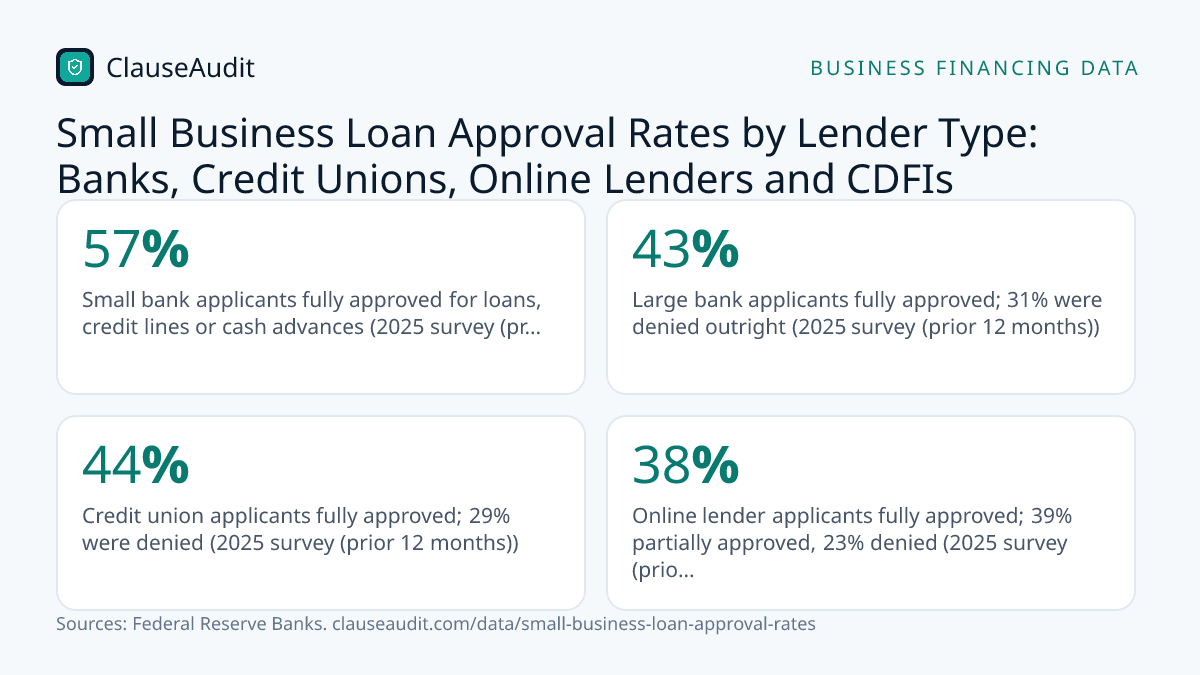
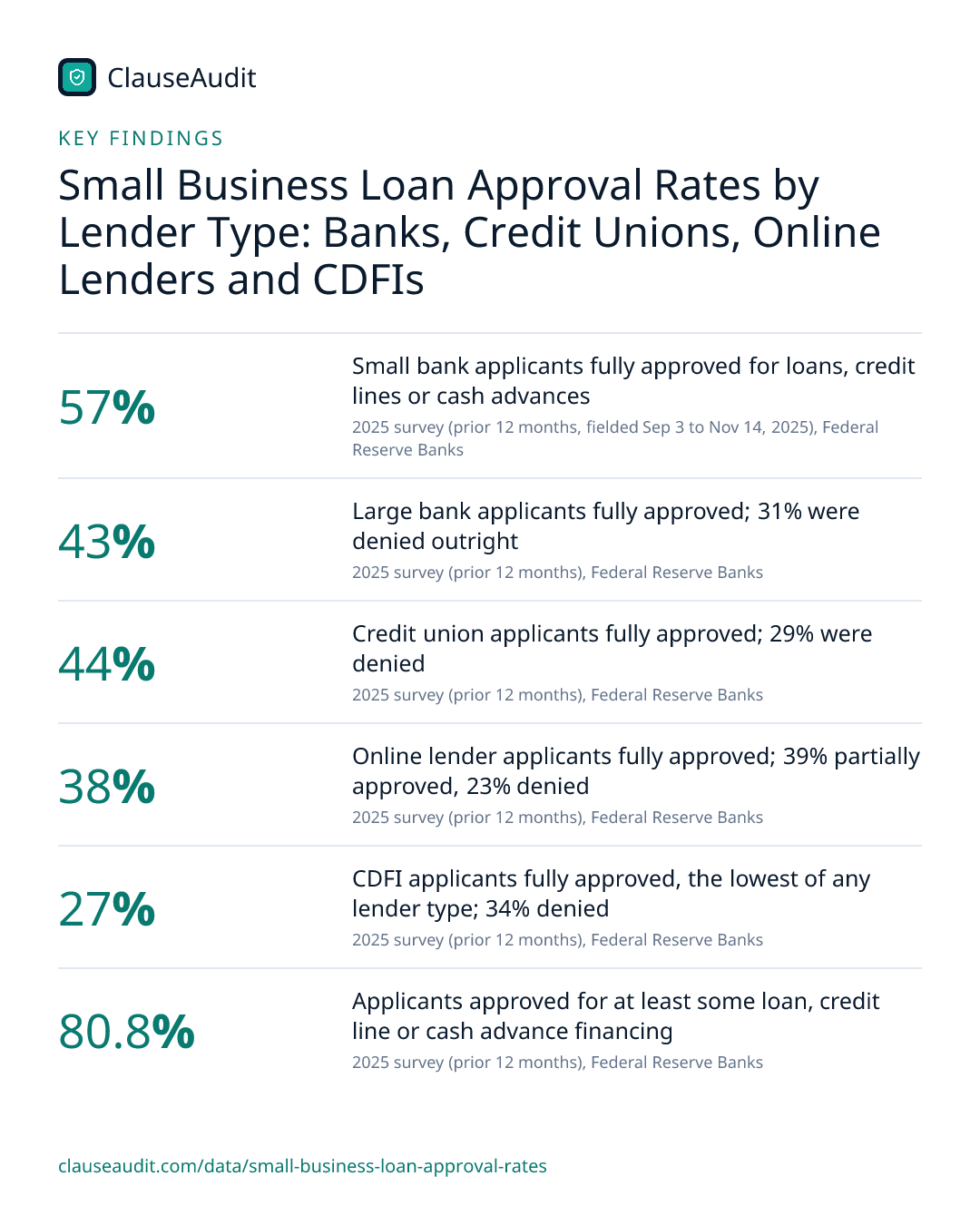
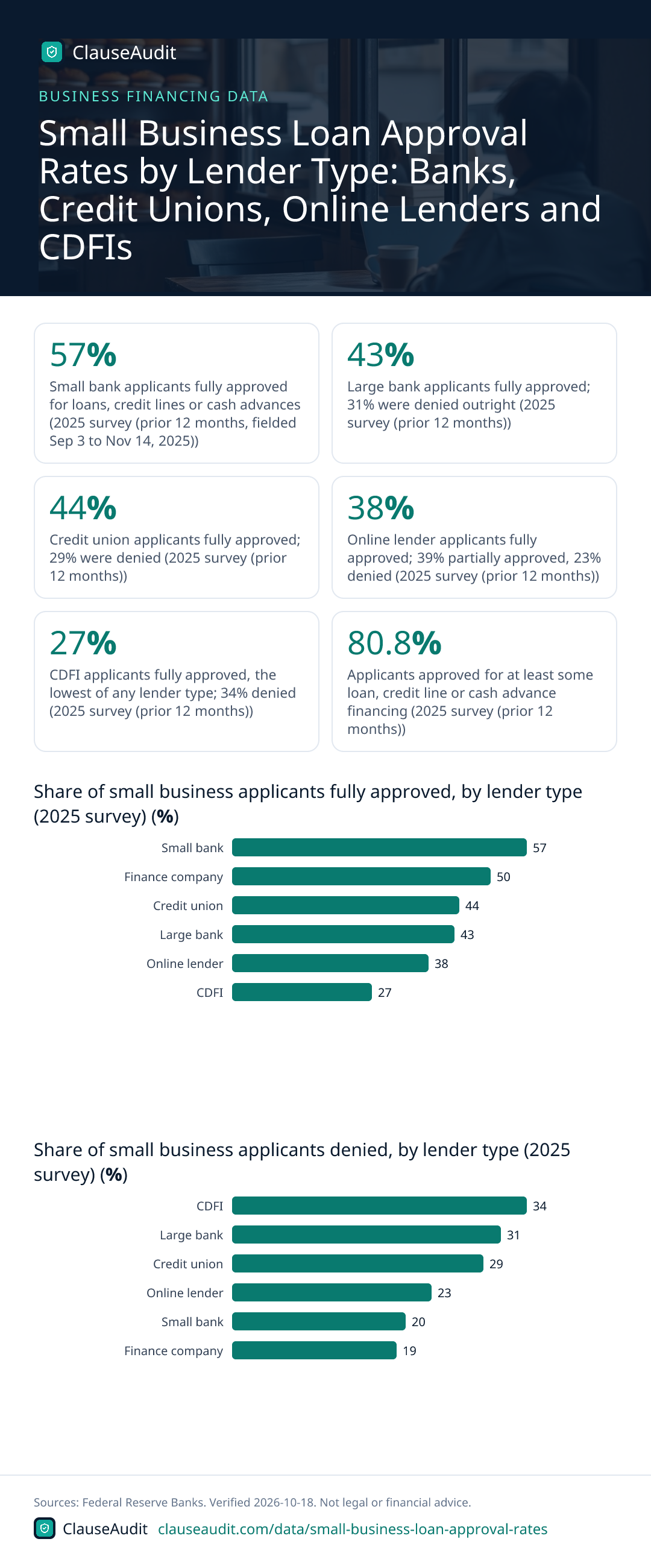
Most small businesses that apply get something: 80.8% were approved for at least some financing in the 2025 Federal Reserve survey. Full approval is harder. Small banks fully approved 57% of applicants, large banks 43%, credit unions 44%, online lenders 38% and CDFIs just 27%.

- Small bank applicants fully approved for loans, credit lines or cash advances (2025 survey (prior 12 months, fielded Sep 3 to Nov 14, 2025), Federal Reserve Banks)
- 57%
- Large bank applicants fully approved; 31% were denied outright (2025 survey (prior 12 months), Federal Reserve Banks)
- 43%
- Credit union applicants fully approved; 29% were denied (2025 survey (prior 12 months), Federal Reserve Banks)
- 44%
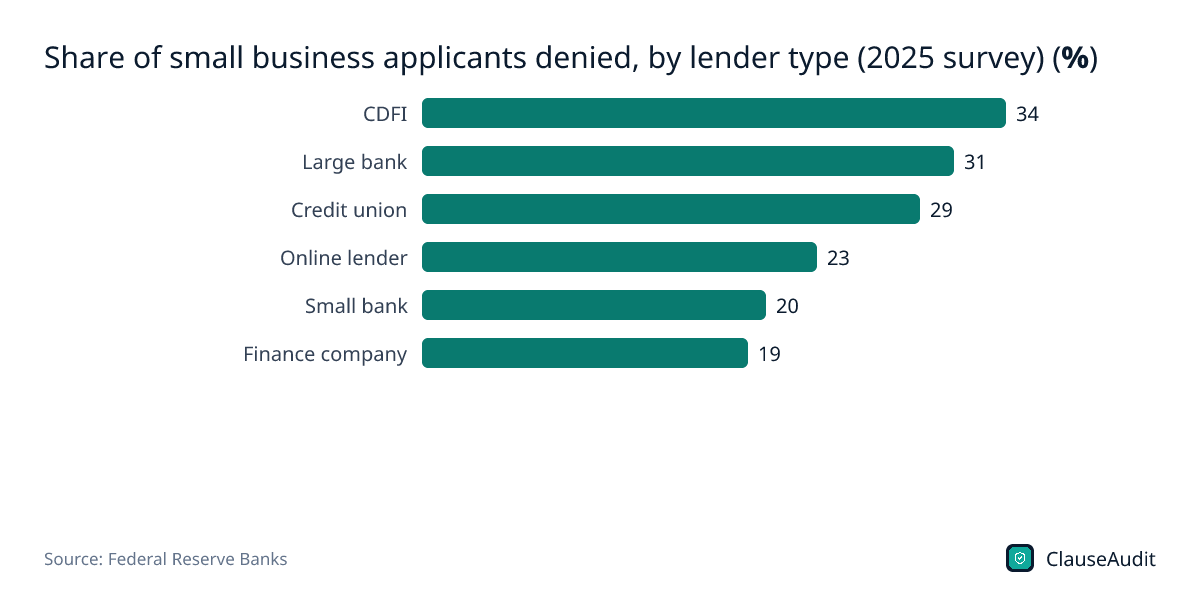
- Online lender applicants fully approved; 39% partially approved, 23% denied (2025 survey (prior 12 months), Federal Reserve Banks)
- 38%
- CDFI applicants fully approved, the lowest of any lender type; 34% denied (2025 survey (prior 12 months), Federal Reserve Banks)
- 27%
- Applicants approved for at least some loan, credit line or cash advance financing (2025 survey (prior 12 months), Federal Reserve Banks)
- 80.8%
- SBA loan or line of credit applicants fully approved; 40% denied (2025 survey (prior 12 months), Federal Reserve Banks)
- 32%
- Share of loan applicants that applied at online lenders, up from 17% in 2020 (2025 survey, Federal Reserve Banks)
- 29%
Where you apply matters almost as much as what your numbers look like. In the latest Small Business Credit Survey from the Federal Reserve Banks, small banks fully approved 57% of applicants. Large banks approved 43% in full and turned down 31% outright.
This page breaks those results down by lender type and product, then shows what to do with them. If you are about to apply, or you just got a partial offer, approval is just the first question. The second is what you are agreeing to when the yes comes.
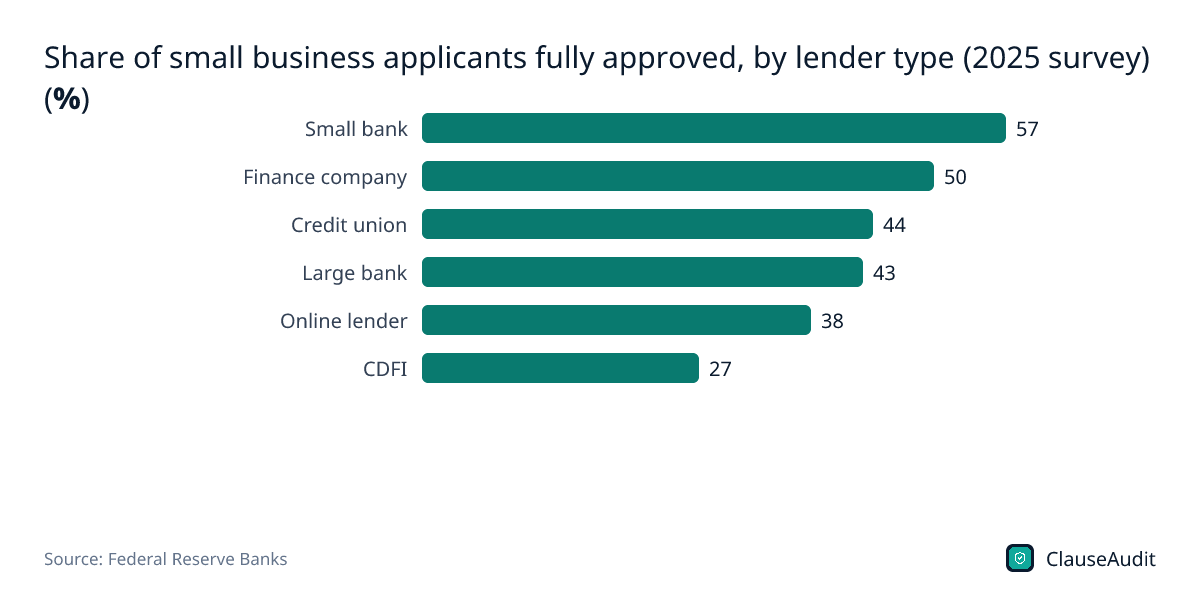
Share of small business applicants fully approved, by lender type (2025 survey) (%)
Chart data
| Label | Value |
|---|---|
| Small bank | 57 |
| Finance company | 50 |
| Credit union | 44 |
| Large bank | 43 |
| Online lender | 38 |
| CDFI | 27 |
Small banks lead by a wide margin, and finance companies come second at 50%. The credit union and CDFI bars rest on small samples, so read them as direction rather than precision.
Download this chart (PNG)Share of small business applicants denied, by lender type (2025 survey) (%)
Chart data
| Label | Value |
|---|---|
| CDFI | 34 |
| Large bank | 31 |
| Credit union | 29 |
| Online lender | 23 |
| Small bank | 20 |
| Finance company | 19 |
Denial is the flip side of full approval, but not a mirror. Online lenders fully approved fewer applicants than large banks yet denied fewer too, 23% against 31%, because 39% of their applicants got a partial yes.
Download this chart (PNG)Share of all small business loan, credit line and cash advance applicants fully approved, by survey year (%)
Chart data
| Label | Value (%) |
|---|---|
| 2018 | 58 |
| 2019 | 62 |
| 2020 | 50 |
| 2021 | 46 |
| 2022 | 53 |
| 2023 | 51 |
| 2024 | 52 |
| 2025 | 52 |
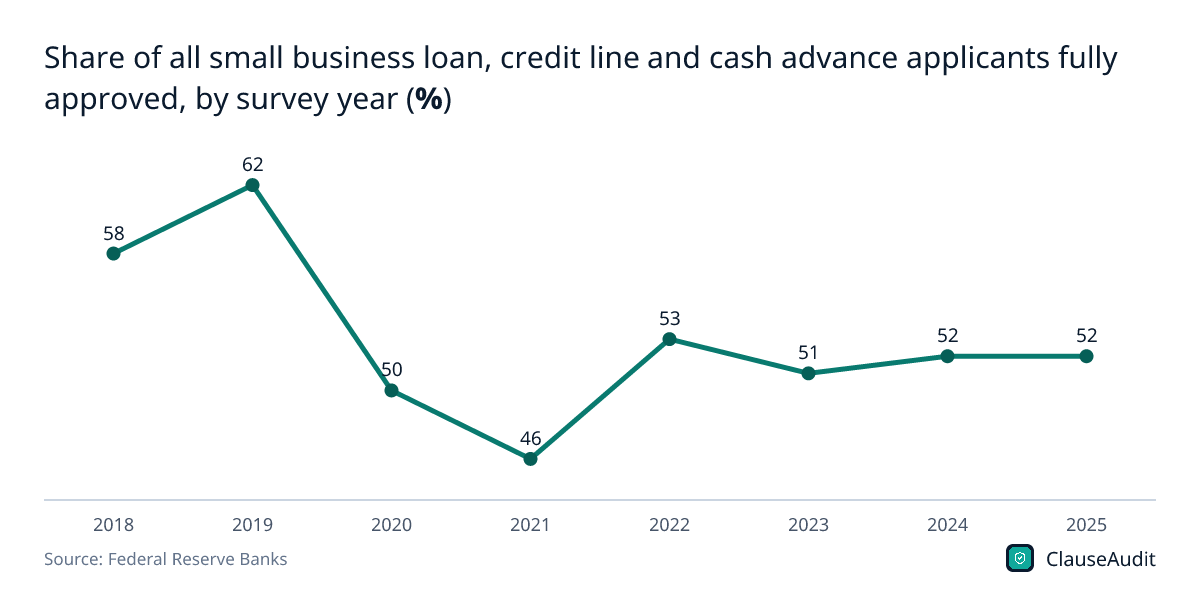
Full approval fell from 62% in 2019 to 46% in 2021 and has held between 51% and 53% since 2022. Credit is easier to get than at the pandemic low, but not back to where it was.
Download this chart (PNG)Share of large bank applicants at least partially approved, by survey year (%)
Chart data
| Label | Value (%) |
|---|---|
| 2019 | 65 |
| 2020 | 61 |
| 2021 | 49 |
| 2022 | 68 |
| 2023 | 66 |
| 2024 | 69 |
| 2025 | 69 |
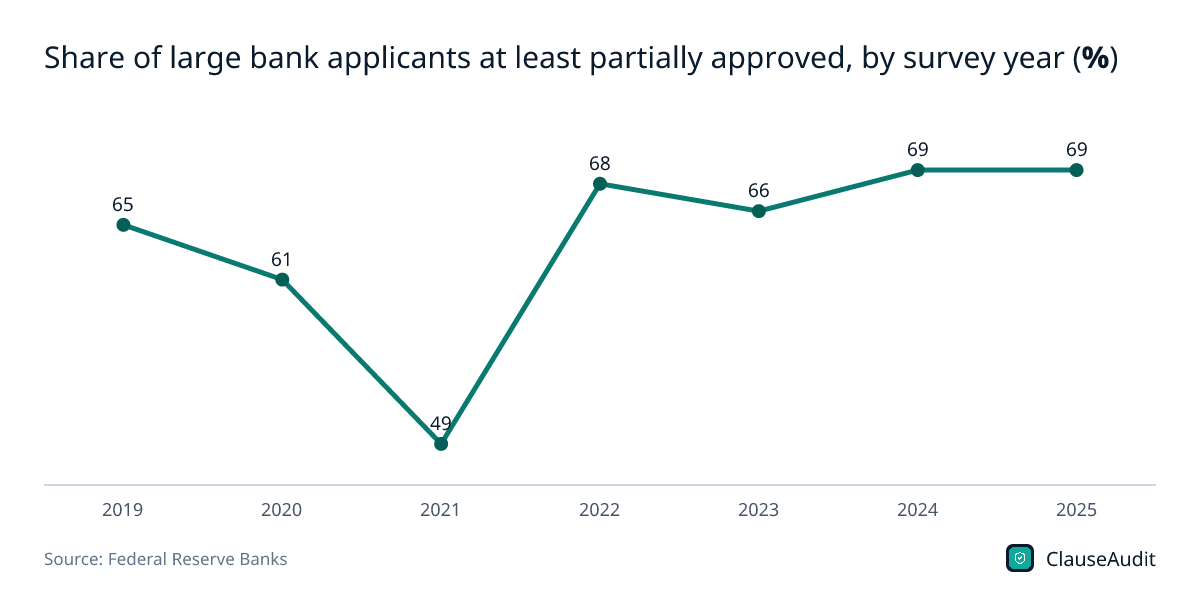
Large banks have recovered from 49% in 2021 to 69% in 2024 and 2025. That counts full and partial approvals, and large banks still trailed the other three lender types tracked in every survey year.
Download this chart (PNG)Share of small business applicants fully approved, by financing product (2025 survey) (%)
Chart data
| Label | Value |
|---|---|
| Auto or equipment loan | 71 |
| Mortgage | 55 |
| Merchant cash advance | 48 |
| Business line of credit | 45 |
| Personal loan | 40 |
| Business loan | 37 |
| Home equity line of credit | 35 |
| SBA loan/line of credit | 32 |
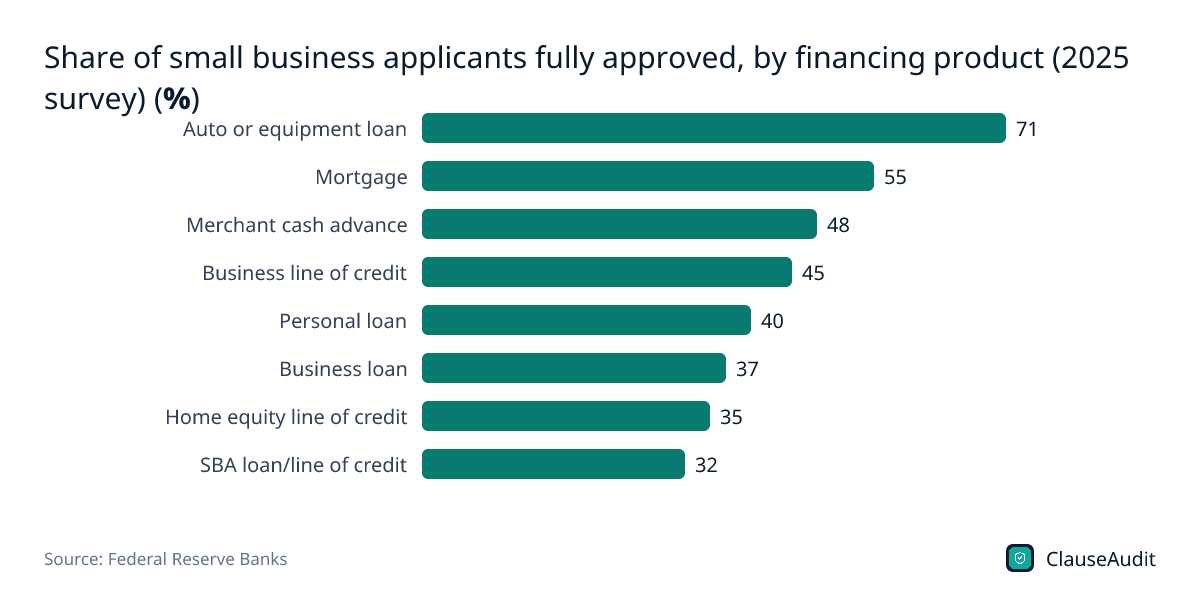
Auto and equipment loans, where the vehicle or machine secures the debt, were fully approved 71% of the time. SBA loans, at 32%, were the hardest product to get in full.
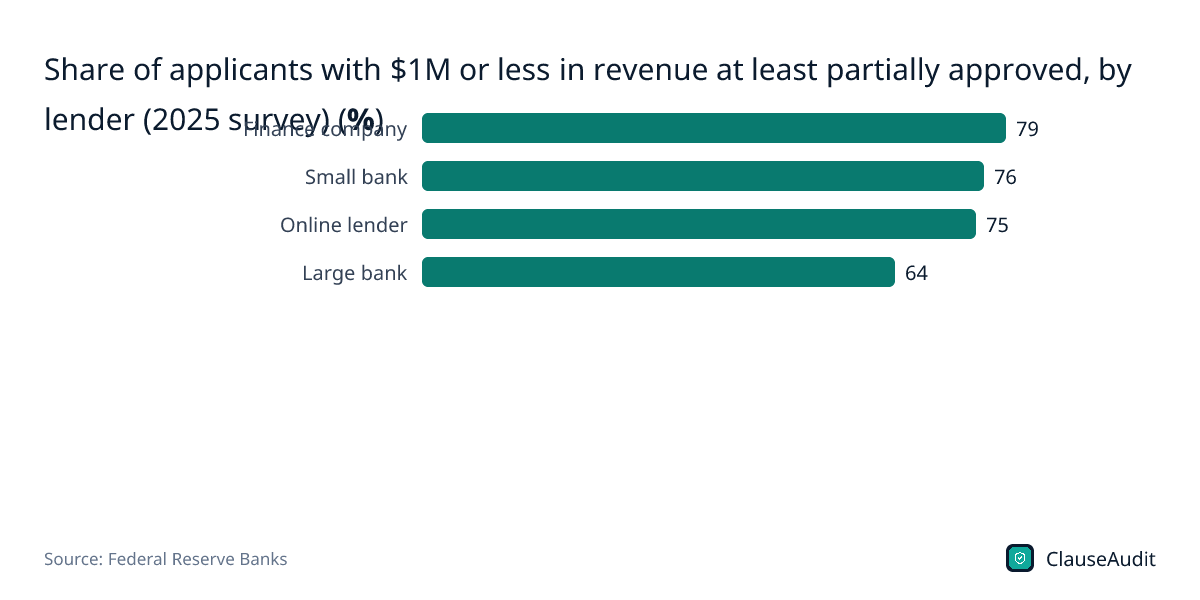
Download this chart (PNG)Share of applicants with $1M or less in revenue at least partially approved, by lender (2025 survey) (%)
Chart data
| Label | Value |
|---|---|
| Finance company | 79 |
| Small bank | 76 |
| Online lender | 75 |
| Large bank | 64 |
Revenue size matters most at large banks. Firms with $1M or less got at least partial approval 64% of the time there, against 81% for larger firms.
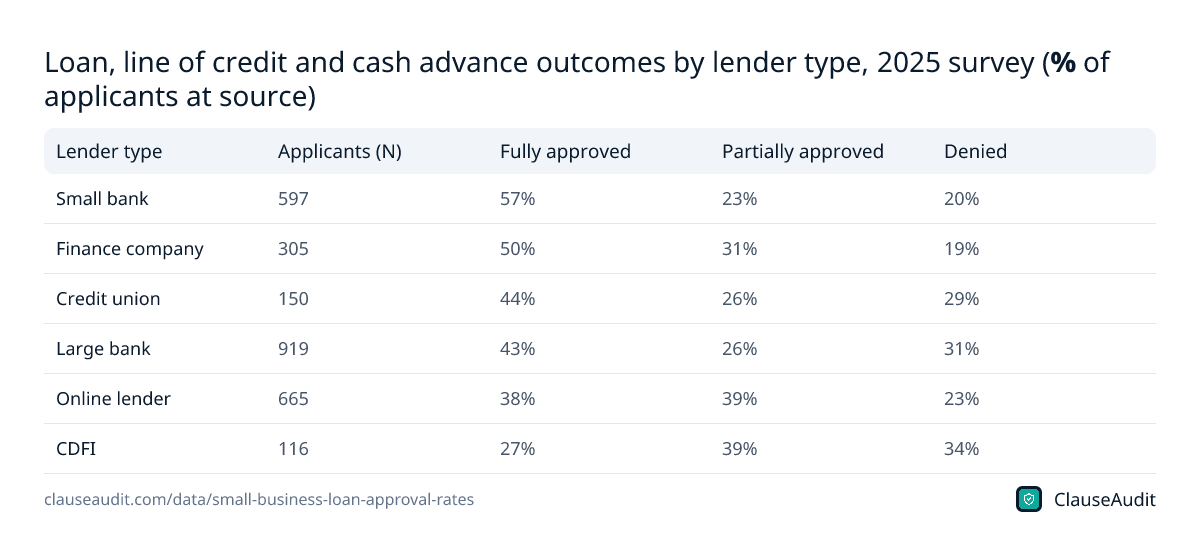
Download this chart (PNG)Loan, line of credit and cash advance outcomes by lender type, 2025 survey (% of applicants at source)
| Lender type | Applicants (N) | Fully approved | Partially approved | Denied |
|---|---|---|---|---|
| Small bank | 597 | 57% | 23% | 20% |
| Finance company | 305 | 50% | 31% | 19% |
| Credit union | 150 | 44% | 26% | 29% |
| Large bank | 919 | 43% | 26% | 31% |
| Online lender | 665 | 38% | 39% | 23% |
| CDFI | 116 | 27% | 39% | 34% |
Source: Federal Reserve Banks, Small Business Credit Survey: 2026 Report on Employer Firms (PDF; findings from the 2025 survey). Download as image
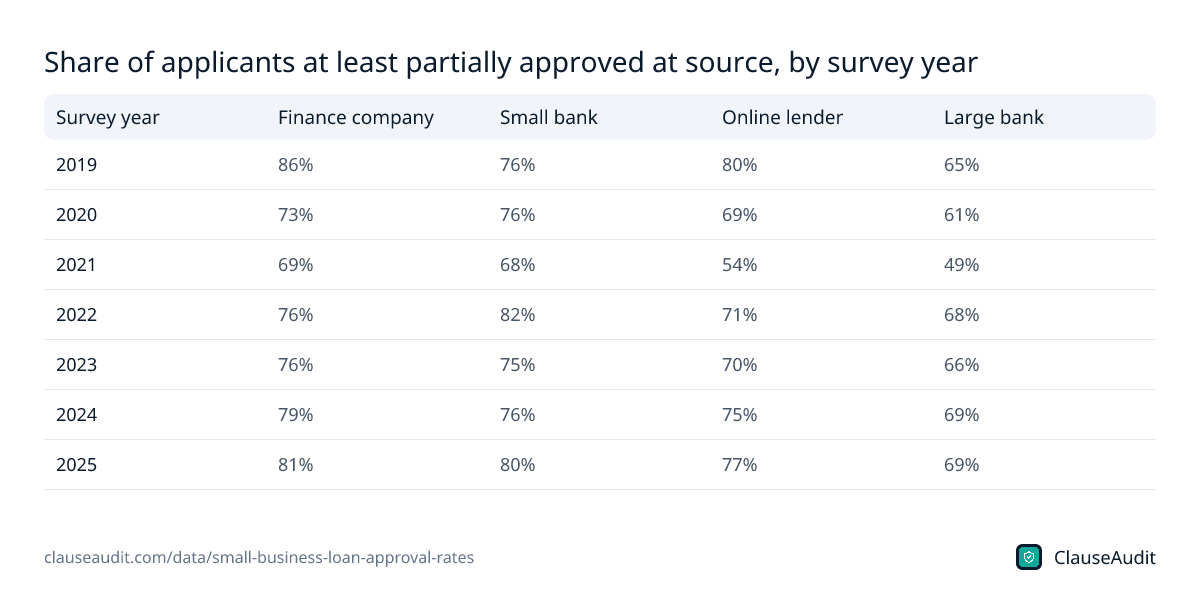
Share of applicants at least partially approved at source, by survey year
| Survey year | Finance company | Small bank | Online lender | Large bank |
|---|---|---|---|---|
| 2019 | 86% | 76% | 80% | 65% |
| 2020 | 73% | 76% | 69% | 61% |
| 2021 | 69% | 68% | 54% | 49% |
| 2022 | 76% | 82% | 71% | 68% |
| 2023 | 76% | 75% | 70% | 66% |
| 2024 | 79% | 76% | 75% | 69% |
| 2025 | 81% | 80% | 77% | 69% |
Source: Federal Reserve Banks, Small Business Credit Survey: 2026 Report on Employer Firms (PDF; findings from the 2025 survey). Download as image
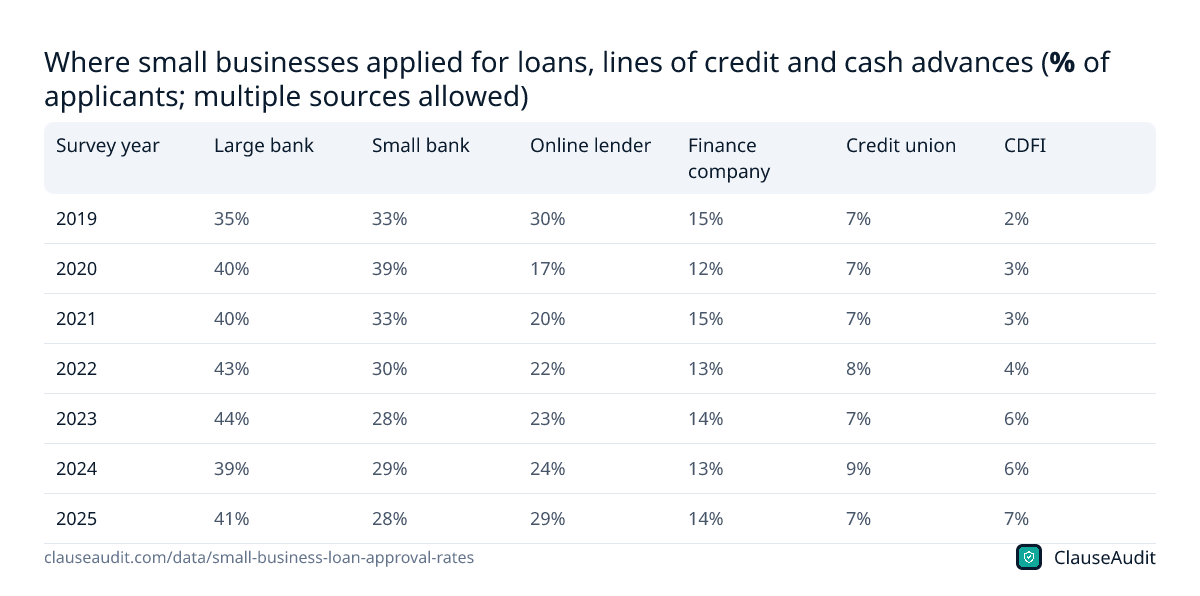
Where small businesses applied for loans, lines of credit and cash advances (% of applicants; multiple sources allowed)
| Survey year | Large bank | Small bank | Online lender | Finance company | Credit union | CDFI |
|---|---|---|---|---|---|---|
| 2019 | 35% | 33% | 30% | 15% | 7% | 2% |
| 2020 | 40% | 39% | 17% | 12% | 7% | 3% |
| 2021 | 40% | 33% | 20% | 15% | 7% | 3% |
| 2022 | 43% | 30% | 22% | 13% | 8% | 4% |
| 2023 | 44% | 28% | 23% | 14% | 7% | 6% |
| 2024 | 39% | 29% | 24% | 13% | 9% | 6% |
| 2025 | 41% | 28% | 29% | 14% | 7% | 7% |
Source: Federal Reserve Banks, Small Business Credit Survey: 2026 Report on Employer Firms (PDF; findings from the 2025 survey). Download as image
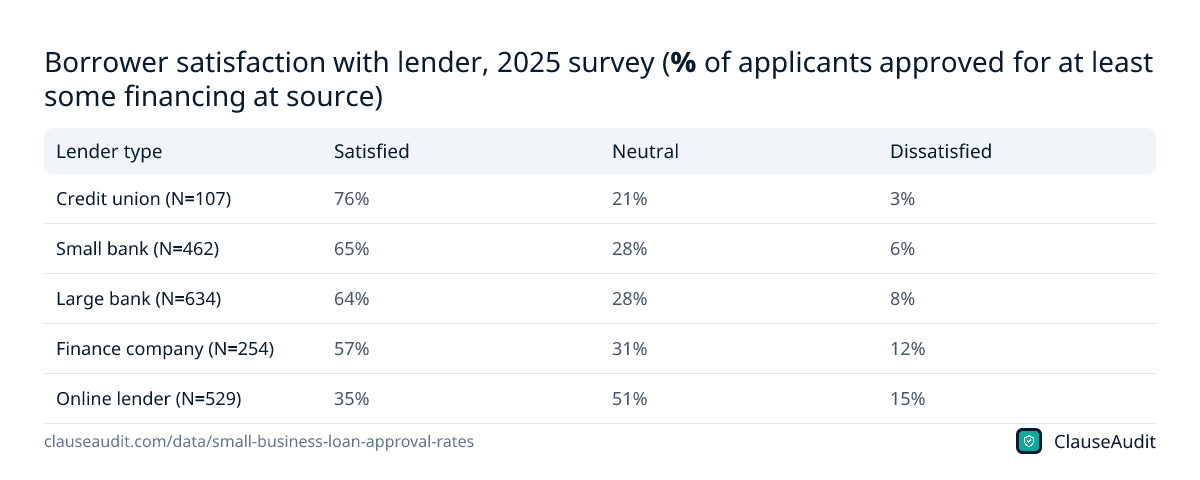
Borrower satisfaction with lender, 2025 survey (% of applicants approved for at least some financing at source)
| Lender type | Satisfied | Neutral | Dissatisfied |
|---|---|---|---|
| Credit union (N=107) | 76% | 21% | 3% |
| Small bank (N=462) | 65% | 28% | 6% |
| Large bank (N=634) | 64% | 28% | 8% |
| Finance company (N=254) | 57% | 31% | 12% |
| Online lender (N=529) | 35% | 51% | 15% |
Source: Federal Reserve Banks, Small Business Credit Survey: 2026 Report on Employer Firms (PDF; findings from the 2025 survey). Download as image
What are the odds of getting a small business loan approved?
Better than most owners expect, as long as you count partial approvals. Across all lenders, 80.8% of applicants got at least some of the financing they asked for. Only 19% walked away with nothing.
The catch is the middle group. About 29% were partially approved, meaning they got some of the money they asked for but not all of it. Say you asked for enough to buy a second delivery van and hire a driver. A partial approval might cover the van and nothing else, and leave you paying for a vehicle you cannot staff. Full approval across all lenders was 52%, so roughly one applicant in two got the whole amount.
Plan for that. Before you apply, decide the smallest amount that still makes the project work, and what you will cut if the offer comes in low.
Which type of lender is easiest to get a business loan from?
On full approval, small banks win clearly at 57%. Finance companies follow at 50%, then credit unions at 44% and large banks at 43%. Online lenders fully approved 38%, and CDFIs 27%.
Small banks tend to lend on relationships. A loan officer who knows your deposit history and has seen your shop can stretch where a large bank's scoring model will not. That shows in the denial rates too: 20% at small banks against 31% at large ones.
The CDFI number needs context. Community development lenders exist to serve borrowers that banks often pass on, such as newer firms, owners with thin credit files and businesses in low-income areas. A tougher applicant pool pulls the rate down. Many CDFI applicants still got something, since 39% were partially approved. And with only 116 CDFI applicants and 150 credit union applicants in the survey, small swings in those groups move the percentages a lot.
Why is it so hard to get an SBA loan approved?
SBA loans and credit lines had the lowest full approval rate of any product in the survey, at 32%, and 40% of applicants were denied. The government guarantee makes lenders more willing to say yes to some borrowers, but the paperwork and eligibility rules are heavy, and the lender still has to underwrite the deal.
Compare that with auto and equipment loans at 71%. When the lender can repossess a truck or a CNC machine, the risk is easier to price. A plain business loan sat at 37% and a business line of credit at 45%.
The lesson: match the product to the purpose. If you need equipment, ask for equipment financing rather than a general term loan. If you need working capital and can wait, an SBA loan may still be the cheapest money available, but apply knowing the odds.
Are online lenders worth it if they approve more people?
Online lenders are growing fast. 29% of applicants went to one in the 2025 survey, up from 17% in 2020. They are quick, and 77% of their applicants got at least partial approval.
Satisfaction tells a different story. Only 35% of approved online lender borrowers said they were satisfied, against 76% at credit unions and 65% at small banks. Approval is easy to measure. The price, the repayment schedule and the fine print are where people get burned.
Online products often come with daily or weekly debits, short terms and prepayment rules that make an early payoff worth little. Some are merchant cash advances rather than loans at all. Before you sign, convert the cost to an annual rate and read the default section line by line.
Does the size of your business change your chances?
Yes, and most of all at large banks. Among firms with $1M or less in revenue, 64% of large bank applicants got at least partial approval. For firms above that line the figure was 81%. At finance companies, small banks and online lenders the gap was 4 to 9 points, against 17 at large banks.
Large banks run on standardized underwriting. A two-year-old lawn care company with uneven monthly sales and one owner on the tax return looks thin on a scorecard, even if the business is healthy. A local banker can look at the contracts you have lined up for spring and make a judgment call. A model usually cannot.
So if you are a smaller firm, do not take one large bank denial as a verdict on your business. It may only mean you applied at the lender least suited to your size. Try a community bank, a credit union where you hold your accounts, or a finance company that specializes in your kind of equipment.
What to do after a denial or partial approval
Under the Equal Credit Opportunity Act, a lender that turns down your business credit application generally has to give you the reasons or tell you how to ask for them. Ask. Common reasons are a short operating history, too much existing debt, weak cash flow, a low personal credit score or no collateral.
A partial approval or counteroffer carries information too. If the lender cut the amount, it probably doubts your cash flow can carry the full payment. If it offered the amount but raised the rate or added a personal guarantee, it is pricing in risk it sees in your file. Either way, you now know what the market thinks of your numbers, and you can fix the weak spot before you apply again or take the offer with your eyes open.
Then use what you learned. The steps below raise your odds on the next try and keep a yes from turning into a bad deal.
- Start with a small bank, ideally one where you already keep your business account. Small banks had the highest full approval rate in the survey, at 57%.
- If your revenue is $1M or less, expect a harder time at large banks. Those firms were at least partially approved 64% of the time there, against 79% at finance companies and 76% at small banks.
- Ask for the product that fits the use. Auto and equipment loans were fully approved 71% of the time, against 37% for general business loans.
- Apply to more than one lender type in the same window so you can compare offers instead of taking the only one on the table.
- Treat a partial approval as a new deal. Recheck the amount, rate, term, collateral and guarantee before you accept.
- Get every offer in writing and compare the total cost, not the monthly or daily payment.
How ClauseAudit helps with business loan agreements
Getting approved is only half the job. The loan agreement decides what the money really costs and what happens if a slow quarter hits.
Upload your loan, credit line or cash advance agreement and the automated review flags the clauses that put your business or your personal assets at risk, with plain English explanations and suggested changes to ask for.
- Personal guarantee scope, including unlimited guarantees and spouse signatures
- Interest rate, fees and prepayment penalties, converted to a true annual cost
- Default triggers, cross-default and acceleration clauses
- Collateral and blanket UCC liens that cover all business assets
- Daily or weekly automatic debits and what happens when revenue drops
- Covenants, reporting duties and confession of judgment terms
Frequently asked questions
What percentage of small business loan applications get approved?
In the 2025 Small Business Credit Survey, 80.8% of applicants received at least some of the financing they sought. Full approval was lower, at 52% across all lenders, with 29% partially approved and 19% denied. A partial approval means you got some, but not all, of the money you asked for.
Which lender has the highest small business loan approval rate?
Small banks, defined as banks with less than $10B in assets. They fully approved 57% of applicants, compared with 50% at finance companies, 44% at credit unions, 43% at large banks, 38% at online lenders and 27% at CDFIs. Small banks also had one of the lowest denial rates, at 20%.
Is it easier to get a business loan from a credit union or a bank?
It depends on the bank. Credit unions fully approved 44% of applicants, about the same as large banks at 43%, but well behind small banks at 57%. Credit union borrowers were the most satisfied group, at 76%. The credit union sample was small, so treat the comparison as a rough guide.
Why do online lenders deny fewer applicants but fully approve fewer too?
Online lenders often offer part of what you asked for instead of a flat no. They fully approved 38% of applicants, partially approved 39% and denied 23%. A smaller offer can come with a short term or high cost, which may help explain why only 35% of their approved borrowers were satisfied.
What is the approval rate for SBA loans?
SBA loans and lines of credit were fully approved for 32% of applicants in the 2025 survey, the lowest of any product, and 40% were denied. The guarantee helps lenders, but eligibility rules and documentation are demanding. Build in extra time and have tax returns, financial statements and a clear use of funds ready.
Why are CDFI loan approval rates so low?
CDFIs are mission lenders certified by the US Treasury CDFI Fund to serve markets banks often skip. Their applicants tend to be riskier on paper, so full approval was 27% and denial 34%. Another 39% were partially approved, and the sample was only 116 firms, so the numbers carry more uncertainty than the bank figures.
Are small business loans harder to get than a few years ago?
Yes, compared with before the pandemic. Full approval across all lenders was 62% in 2019, dropped to 46% in 2021, and was 52% in both 2024 and 2025. Conditions have improved from the low point but have not returned to earlier levels.
Should I accept a partial loan approval?
Only after you reread the offer as a new deal. A partial approval can change the amount, rate, term, collateral or guarantee, and the agreement may differ from what you discussed. Check that the smaller amount still funds your plan, compare the total cost with other offers, and review the default and guarantee clauses before signing.
Use this data
Every chart and card below is free to reuse under CC BY 4.0. Download what you need and link back to this page.
 Stat cards
 Key findings card
 Infographic
 Share of small business applicants fully approved, by lender type (2025 survey) (%)
 Share of small business applicants denied, by lender type (2025 survey) (%)
 Share of all small business loan, credit line and cash advance applicants fully approved, by survey year (%)
 Share of large bank applicants at least partially approved, by survey year (%)
 Share of small business applicants fully approved, by financing product (2025 survey) (%)
 Share of applicants with $1M or less in revenue at least partially approved, by lender (2025 survey) (%)
 Loan, line of credit and cash advance outcomes by lender type, 2025 survey (% of applicants at source)
 Share of applicants at least partially approved at source, by survey year
 Where small businesses applied for loans, lines of credit and cash advances (% of applicants; multiple sources allowed)
 Borrower satisfaction with lender, 2025 survey (% of applicants approved for at least some financing at source)
Embed the infographic
Free to share on your site, blog or slides under CC BY 4.0. Please keep the credit link.
Sources and method
Every number on this page comes from the sources below, each opened and read on or before October 18, 2026. A second, independent review checked every figure against its source and corrected anything that did not match. Figures that could not be confirmed were left out.
- Federal Reserve Banks, Small Business Credit Survey: 2026 Report on Employer Firms (PDF; findings from the 2025 survey) (March 3, 2026 (2026 edition, 2025 survey fielded Sep 3 to Nov 14, 2025))
- Federal Reserve Banks (fedsmallbusiness.org), 2026 Report on Employer Firms (report landing page) (March 3, 2026)
Cite this page
ClauseAudit, “Small Business Loan Approval Rates by Lender Type: Banks, Credit Unions, Online Lenders and CDFIs”, updated October 18, 2026, https://clauseaudit.com/data/small-business-loan-approval-rates. Free to reuse with a link back (CC BY 4.0).
This page summarises published data and law as checked on October 18, 2026. Figures are updated as new editions are released, and your own situation may differ. It is general information, not legal, tax or financial advice.