How Long Does an Eviction Take? State-by-State Timeline From Notice to Lockout
By ClauseAudit Research · 36 sources ·
How long does eviction take?
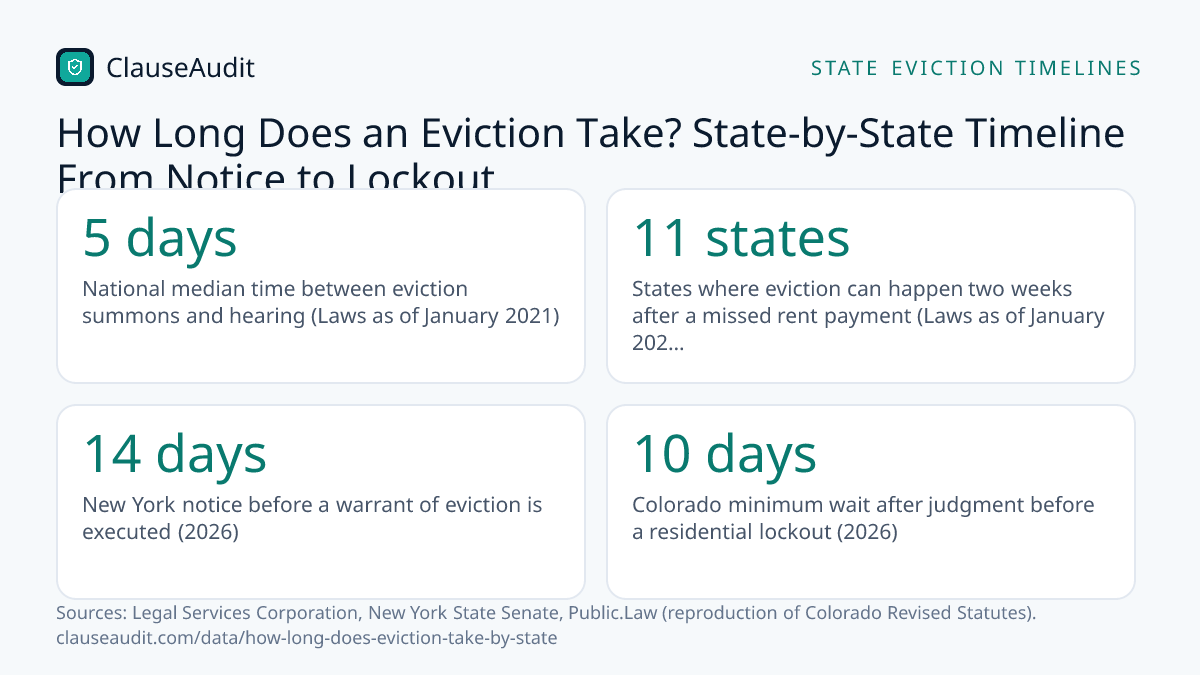
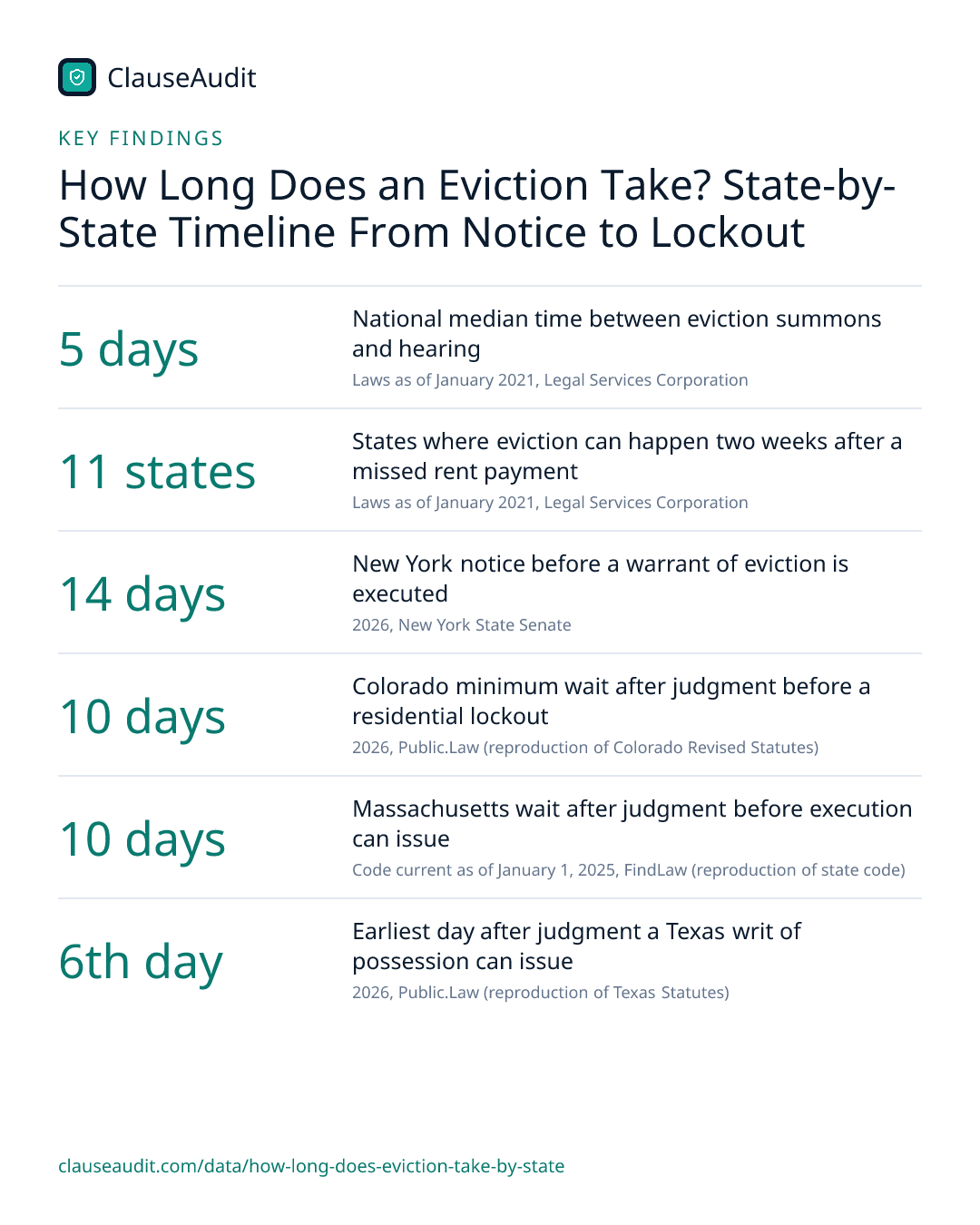
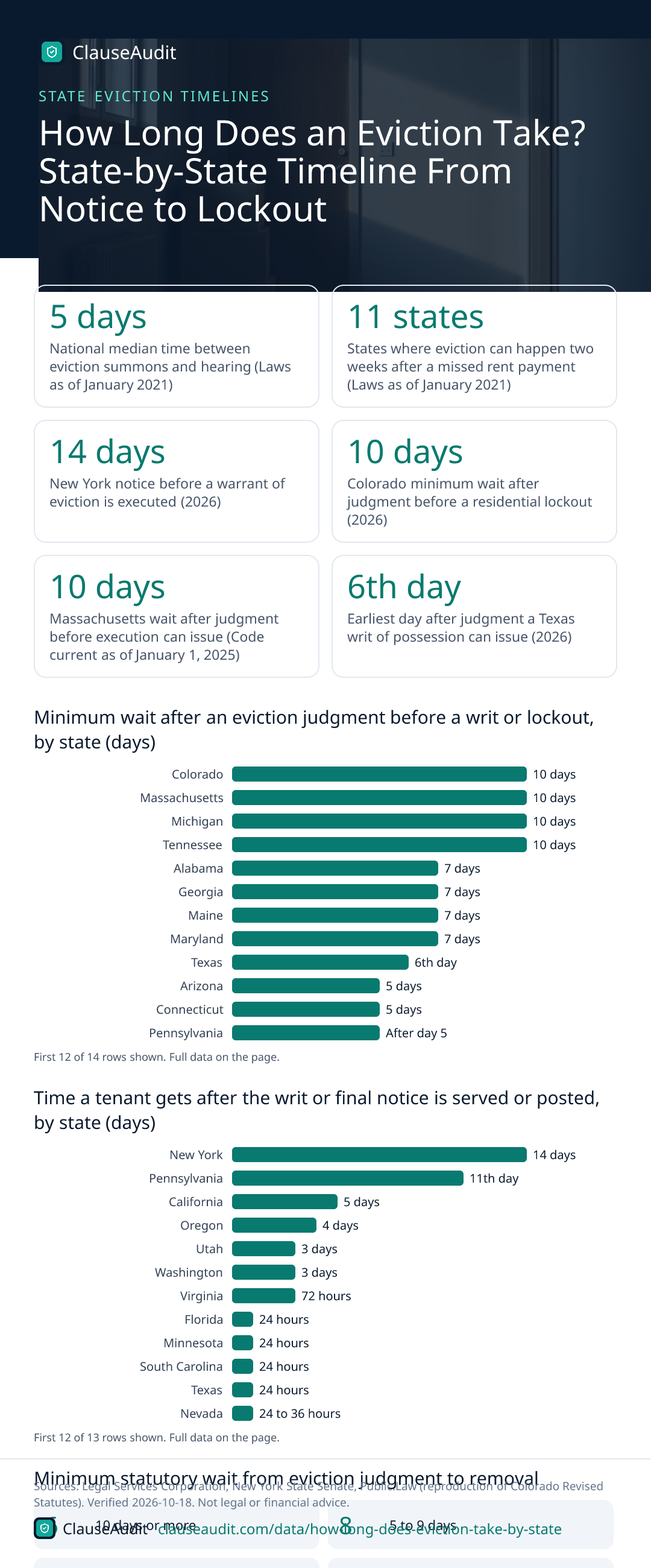
Faster than most renters expect. In 11 states a tenant can be evicted about two weeks after missing rent, and the national median gap between summons and hearing is just 5 days. After judgment, statutes allow anywhere from 24 hours (Florida) to 14 days of notice (New York) before the lockout.

- National median time between eviction summons and hearing (Laws as of January 2021, Legal Services Corporation)
- 5 days
- States where eviction can happen two weeks after a missed rent payment (Laws as of January 2021, Legal Services Corporation)
- 11 states
- New York notice before a warrant of eviction is executed (2026, New York State Senate)
- 14 days
- Colorado minimum wait after judgment before a residential lockout (2026, Public.Law (reproduction of Colorado Revised Statutes))
- 10 days
- Massachusetts wait after judgment before execution can issue (Code current as of January 1, 2025, FindLaw (reproduction of state code))
- 10 days
- Earliest day after judgment a Texas writ of possession can issue (2026, Public.Law (reproduction of Texas Statutes))
- 6th day
- California time to vacate after the writ of possession is served (2026, Public.Law (reproduction of California Codes))
- 5 days
- Florida posted notice before the sheriff hands the landlord possession (2026 Florida Statutes, Florida Legislature)
- 24 hours
An eviction is a chain of deadlines, not a single event. There is a notice, a court filing, a hearing, a judgment, a writ, and finally a sheriff at the door. Each link has its own clock, and each state sets those clocks differently.
This page focuses on the back end of the process: how long the law makes a landlord wait after winning in court, and how much warning you get before removal. The map and table show your state. Below, we explain what those numbers mean in practice and what to do at each stage.
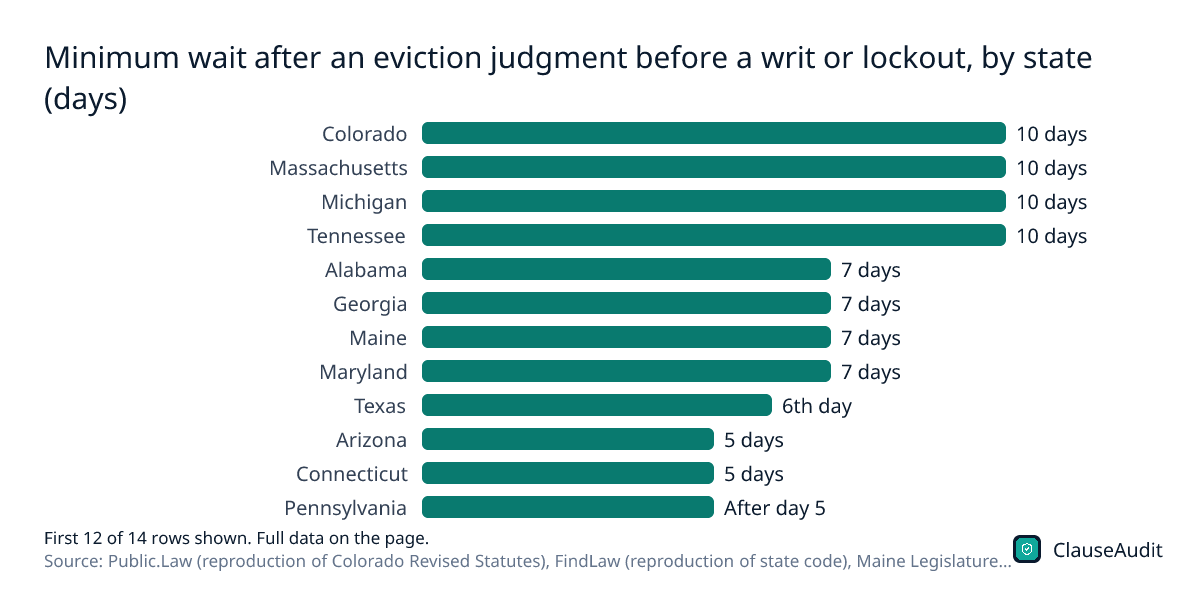
Minimum wait after an eviction judgment before a writ or lockout, by state (days)
Chart data
| Label | Value |
|---|---|
| Colorado | 10 days |
| Massachusetts | 10 days |
| Michigan | 10 days |
| Tennessee | 10 days |
| Alabama | 7 days |
| Georgia | 7 days |
| Maine | 7 days |
| Maryland | 7 days |
| Texas | 6th day |
| Arizona | 5 days |
| Connecticut | 5 days |
| Pennsylvania | After day 5 |
| New Jersey | 3 days |
| Idaho | 3 days |
Colorado, Massachusetts, Michigan and Tennessee build in the longest pause, 10 days, between judgment and the next step. Idaho and New Jersey sit at the short end with 3 days. These are floors, so a busy court or sheriff's office can stretch them.
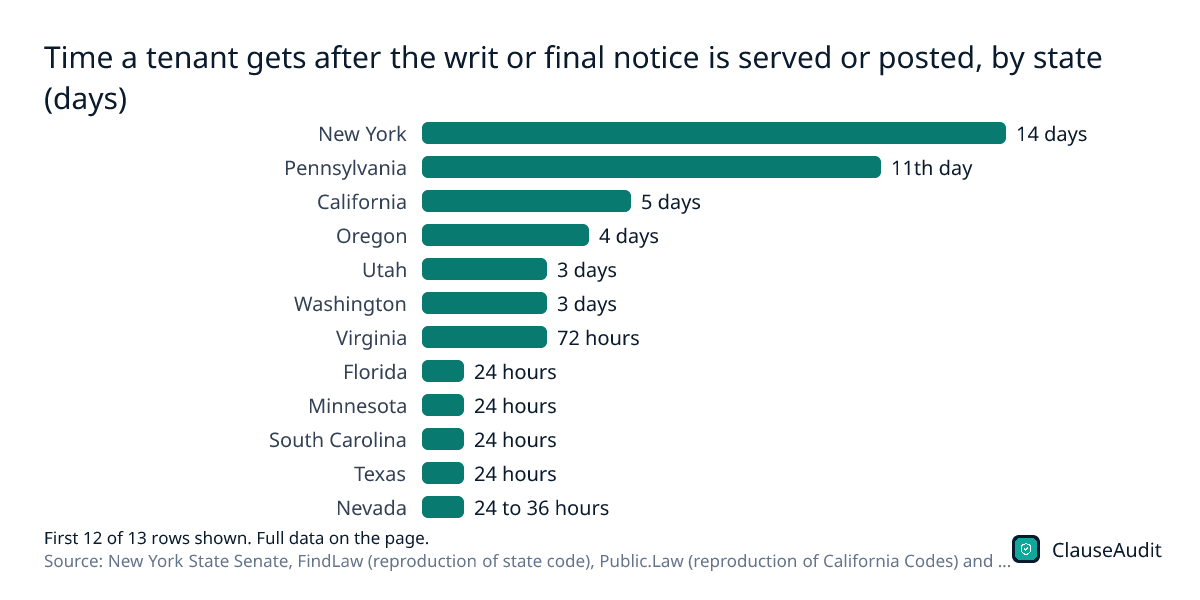
Download this chart (PNG)Time a tenant gets after the writ or final notice is served or posted, by state (days)
Chart data
| Label | Value |
|---|---|
| New York | 14 days |
| Pennsylvania | 11th day |
| California | 5 days |
| Oregon | 4 days |
| Utah | 3 days |
| Washington | 3 days |
| Virginia | 72 hours |
| Florida | 24 hours |
| Minnesota | 24 hours |
| South Carolina | 24 hours |
| Texas | 24 hours |
| Nevada | 24 to 36 hours |
| Delaware | 24 hours |
New York stands apart with 14 days of written notice before a warrant is carried out. In Florida, Minnesota, Nevada, South Carolina, Texas and Delaware, the final warning can be as short as 24 hours.
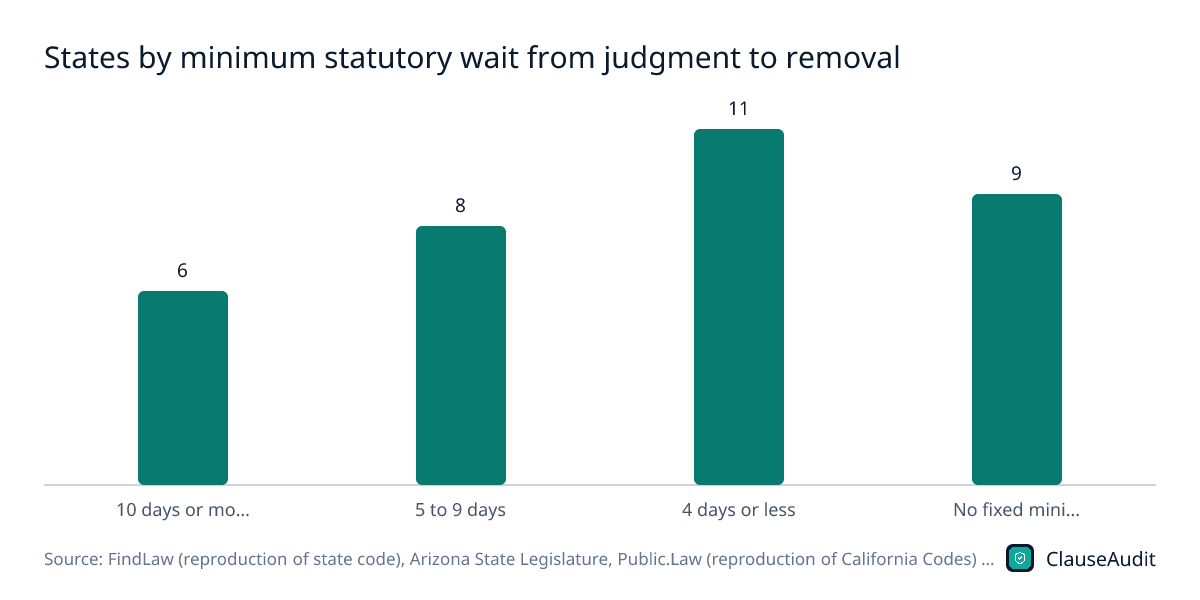
Download this chart (PNG)States by minimum statutory wait from judgment to removal
Chart data
| Label | Value |
|---|---|
| 10 days or more | 6 |
| 5 to 9 days | 8 |
| 4 days or less | 11 |
| No fixed minimum | 9 |
Of the states confirmed here, 11 allow removal 4 days or less after the relevant step, and 9 set no fixed minimum at all. Only 6 give 10 days or more.
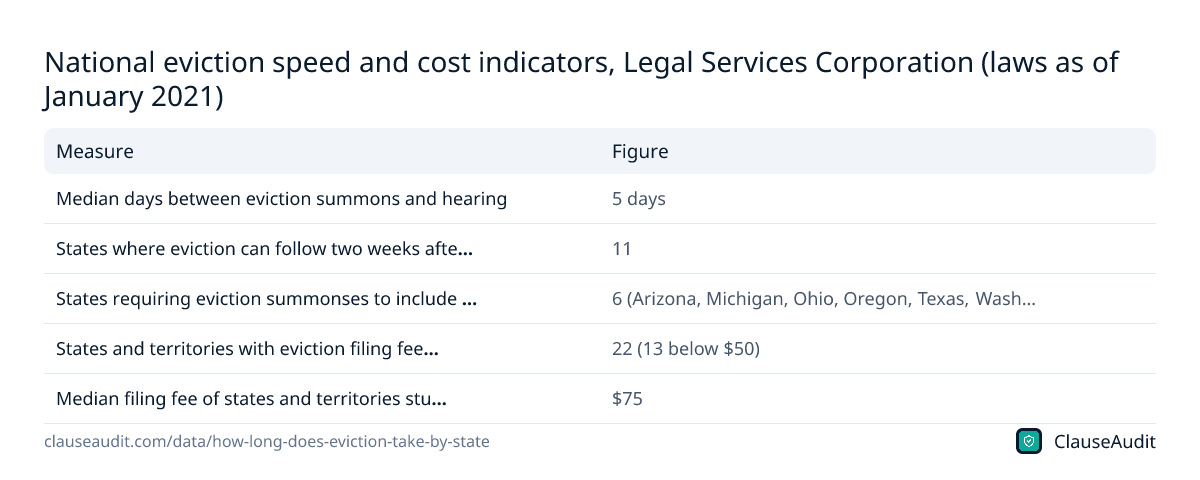
Download this chart (PNG)National eviction speed and cost indicators, Legal Services Corporation (laws as of January 2021)
| Measure | Figure |
|---|---|
| Median days between eviction summons and hearing | 5 days |
| States where eviction can follow two weeks after a missed rent payment | 11 |
| States requiring eviction summonses to include legal-services information | 6 (Arizona, Michigan, Ohio, Oregon, Texas, Washington) |
| States and territories with eviction filing fees below $100 | 22 (13 below $50) |
| Median filing fee of states and territories studied | $75 |
Source: Legal Services Corporation, "Fast and Cheap" Evictions Help Fuel Housing Crisis, New LSC Brief Finds. Download as image
Minimum statutory wait from eviction judgment to removal by state
- 610 days or more
- 85 to 9 days
- 114 days or less
- 9No fixed minimum in statute
- 10 days or more6
- 5 to 9 days8
- 4 days or less11
- No fixed minimum in statute9
- Not yet confirmed17
| State | After judgment | After writ or final notice | Source |
|---|---|---|---|
| Alabama | Writ of possession stayed 7 days after judgment | No separate post-writ period in this section | Ala. Code § 35-9A-461 |
| Alaska | Not yet confirmed: check the source | LSC Eviction Laws Database (State and Territory Dataset) | |
| Arizona | No writ of restitution until 5 calendar days after judgment | No separate post-writ period in this section | A.R.S. § 12-1178 |
| Arkansas | Writ issues immediately if the tenant files no written objection within 5 days of service (Sundays and holidays excluded) | Sheriff delivers possession without delay | Ark. Code § 18-60-307 |
| California | No fixed wait in this section | Occupants have 5 days from service (or posting) of the writ to vacate | Cal. Code Civ. Proc. § 715.010 |
| Colorado | Writ cannot issue until 48 hours after judgment; residential writ cannot be executed until at least 10 days after judgment | No separate post-writ period in this section | C.R.S. § 13-40-122 |
| Connecticut | Execution stayed 5 days after judgment (Sundays and legal holidays excluded) | No separate post-writ period in this section | Conn. Gen. Stat. § 47a-35 |
| Delaware | Writ cannot issue before the time to appeal or move to vacate has expired | Officer gives at least 24 hours' notice before removal | Del. Code tit. 25, § 5715 |
| District of Columbia | Not yet confirmed: check the source | LSC Eviction Laws Database (State and Territory Dataset) | |
| Florida | No fixed wait in this section | Sheriff puts landlord in possession after 24 hours' notice posted on the premises | Florida Statutes § 83.62 |
| Georgia | Writ of possession effective 7 days after judgment is entered | No separate post-writ period in this section | O.C.G.A. § 44-7-55 |
| Hawaii | No statutory waiting period; execution issues once judgment for possession is entered | No separate post-writ period in this section | HRS § 666-11 |
| Idaho | Residential tenant has 72 hours to remove belongings; sheriff restores possession 3 days after the court's finding | No separate post-writ period in this section | Idaho Code § 6-316 |
| Illinois | Not yet confirmed: check the source | LSC Eviction Laws Database (State and Territory Dataset) | |
| Indiana | Not yet confirmed: check the source | LSC Eviction Laws Database (State and Territory Dataset) | |
| Iowa | Execution for removal issues within 3 days of judgment (a deadline, not a minimum wait) | No separate post-writ period in this section | Iowa Code § 648.22 |
| Kansas | Not yet confirmed: check the source | LSC Eviction Laws Database (State and Territory Dataset) | |
| Kentucky | Not yet confirmed: check the source | LSC Eviction Laws Database (State and Territory Dataset) | |
| Louisiana | Not yet confirmed: check the source | LSC Eviction Laws Database (State and Territory Dataset) | |
| Maine | Court issues writ of possession 7 calendar days after judgment | No separate post-writ period in this section | 14 M.R.S. § 6005 |
| Maryland | Warrant of restitution may issue after the 7 days the tenant has to comply with the judgment | No separate post-writ period in this section | Md. Code, Real Prop. § 8-401 |
| Massachusetts | Execution cannot issue until 10 days after entry of judgment | No separate post-writ period in this section | Mass. Gen. Laws ch. 239, § 5 |
| Michigan | Writ of restitution cannot issue until 10 days after judgment for possession | No separate post-writ period in this section | MCL § 600.5744 |
| Minnesota | No fixed wait in this section | Officer demands tenant leave within 24 hours of service of the writ | Minn. Stat. § 504B.365 |
| Mississippi | Not yet confirmed: check the source | LSC Eviction Laws Database (State and Territory Dataset) | |
| Missouri | Not yet confirmed: check the source | LSC Eviction Laws Database (State and Territory Dataset) | |
| Montana | Not yet confirmed: check the source | LSC Eviction Laws Database (State and Territory Dataset) | |
| Nebraska | Writ issues on the landlord's request after judgment | Officer restores possession on a date no more than 10 days after the writ issues | Neb. Rev. Stat. § 76-1446 |
| Nevada | No fixed wait in this section | Removal not earlier than 24 hours and not later than 36 hours after the order is posted | NRS 40.253 |
| New Hampshire | Not yet confirmed: check the source | LSC Eviction Laws Database (State and Territory Dataset) | |
| New Jersey | No warrant of removal until 3 days after judgment for possession | No separate period in this section | N.J.S.A. 2A:18-57 |
| New Mexico | Writ sets a date 3 to 7 days after judgment (owner-filed cases) | No separate post-writ period in this section | N.M. Stat. § 47-8-46 |
| New York | No fixed wait in this section | Officer must give at least 14 days' written notice before executing the warrant of eviction | N.Y. RPAPL § 749 |
| North Carolina | No fixed wait in this section | Sheriff executes the writ no more than 5 days after receiving it | N.C. Gen. Stat. § 42-36.2 |
| North Dakota | Judgment for immediate restitution; court may stay for hardship up to 5 days | No separate post-writ period in this chapter; judgment is for immediate restitution via special execution | N.D. Cent. Code ch. 47-32 (§§ 47-32-02, 47-32-04) |
| Ohio | No waiting period in this section | Officer restores possession within 10 days after receiving the writ | Ohio Rev. Code § 1923.14 |
| Oklahoma | Not yet confirmed: check the source | LSC Eviction Laws Database (State and Territory Dataset) | |
| Oregon | Notice of restitution may issue after judgment | Writ of execution only after the 4-day period in the notice of restitution | ORS 105.151 |
| Pennsylvania | Writ of possession may issue after the 5th day after judgment | Writ executed on the 11th day after service on the tenant | 68 P.S. § 250.503 |
| Rhode Island | Not yet confirmed: check the source | LSC Eviction Laws Database (State and Territory Dataset) | |
| South Carolina | No fixed wait in this section | Occupants get 24 hours to vacate after service, then removal 24 hours after posting | S.C. Code § 27-37-160 |
| South Dakota | Not yet confirmed: check the source | LSC Eviction Laws Database (State and Territory Dataset) | |
| Tennessee | No writ of possession until 10 days after judgment | No separate post-writ period in this section | Tenn. Code § 29-18-126 |
| Texas | Writ of possession cannot issue before the 6th day after judgment | Officer posts a warning at least 24 hours before execution | Tex. Prop. Code § 24.0061 |
| Utah | No fixed wait in this section | 3 calendar days to vacate after service of the order of restitution | Utah Code § 78B-6-812 |
| Vermont | Not yet confirmed: check the source | LSC Eviction Laws Database (State and Territory Dataset) | |
| Virginia | No fixed wait in this section | Sheriff serves notice at least 72 hours before executing the writ of eviction | Va. Code § 8.01-470 |
| Washington | No fixed wait in this section | Sheriff may not execute the writ for 3 days after service | RCW 59.18.390 |
| West Virginia | Court order sets the time the tenant must vacate | Sheriff removes the tenant forthwith after that time | W. Va. Code § 55-3A-3 |
| Wisconsin | Not yet confirmed: check the source | LSC Eviction Laws Database (State and Territory Dataset) | |
| Wyoming | Not yet confirmed: check the source | LSC Eviction Laws Database (State and Territory Dataset) |
How long does an eviction take from start to finish?
There is no single national answer, because the timeline is the sum of several steps and states shorten or stretch each one. The Legal Services Corporation looked at state laws as of January 2021 and found that in 11 states a renter can be out about two weeks after a missed payment. That is the fast end of the range, and it assumes nothing slows the case down.
The front of the process is usually the shortest part. Nationally, the median time between being served a summons and the court hearing was 5 days. That is barely enough time to read the papers, find a lawyer and gather receipts. If you miss that hearing, most courts enter a default judgment and the clock jumps straight to the removal stage.
After judgment, state law decides how fast things move. Massachusetts will not let an execution issue until 10 days after judgment. Texas lets a writ of possession issue on the 6th day. Hawaii and North Dakota set no fixed waiting period. Then comes the final warning, which ranges from 24 hours in Florida to 14 days in New York.
What happens after a landlord wins an eviction case?
Winning a judgment does not let a landlord change the locks. In every state covered here, removal goes through a court order, usually called a writ of possession, writ of restitution or warrant of eviction, and an officer such as a sheriff or marshal carries it out.
Some states pause before the writ can issue. Alabama, Georgia, Maine and Maryland each build in 7 days. Arizona and Connecticut use 5. Colorado lets the writ issue 48 hours after judgment but bars a residential lockout until at least 10 days have passed, and 30 days for some tenants on SSI, SSDI or Colorado Works cash assistance.
Other states skip the pause and put the time at the end instead. California gives occupants 5 days after the writ is served or posted. Oregon uses a 4-day period in its notice of restitution. Washington bars the sheriff from acting for 3 days after service, and Virginia requires at least 72 hours of notice. Pennsylvania does both: the writ can issue after day 5, and it is executed on the 11th day after it is served on the tenant.
Why do some evictions take months when the law says days?
The numbers on this page are statutory minimums. They tell you the earliest a step can happen, not when it will. Real cases often run longer for reasons that have nothing to do with the statute.
Court calendars fill up. Sheriff's offices schedule lockouts in batches. A tenant may file an answer, ask for a jury, appeal or request a hardship stay, and each of those can add weeks. Some states also cap the other side: Ohio says the officer must restore possession within 10 days of receiving the writ, and North Carolina says the sheriff executes it no more than 5 days after getting it. Those are deadlines for the officer, not breathing room for you.
So plan around the short number. If your state allows lockout 24 hours after a posted notice, assume that is what will happen, and treat any extra time as luck.
Which states give tenants the most time at the end?
Look at both columns in the table, because a state can be slow at one step and quick at the next. New York sets no fixed wait after judgment, yet its 14 days of written notice before a warrant is executed is the longest final warning confirmed here. Pennsylvania stacks a wait after judgment with an 11th-day execution date, which makes it one of the slower states overall.
At the other end, Minnesota tells the tenant to leave within 24 hours of service of the writ. Nevada's summary process allows removal between 24 and 36 hours after the order is posted. South Carolina gives 24 hours to vacate after service, then removal 24 hours after posting.
Several states are still marked Not yet confirmed on this page. If yours is one of them, call the clerk of the court that handles evictions in your county. They can tell you how the local process runs, even if they cannot give legal advice.
What should you do if you get an eviction notice?
- Read the notice for its type and deadline. A notice to pay is different from a notice to leave, and the fix for each is different.
- Do not ignore court papers. With a median of 5 days between summons and hearing, a few days of waiting can cost you the case.
- Go to the hearing with your lease, payment records, texts and photos. Skipping the hearing usually means a default judgment, the quickest way to lose.
- Ask about legal aid right away. Arizona, Michigan, Ohio, Oregon, Texas and Washington require the summons to include legal-services information, so check your papers for it.
- If you lose, find out the exact post-judgment wait in your state and use it to move your belongings, arrange storage and line up a place to stay.
- Never assume a landlord can lock you out without an officer. Self-help lockouts are not how the process works in these statutes.
What this means for small businesses, freelancers and landlords
If you run a business from a rented storefront or studio, the timeline can differ. Idaho, for example, gives residential tenants 3 days after the court's finding but commercial tenants 7. Many states give commercial tenants fewer protections, so a short lease default can turn into a lost location fast. Check the commercial rules for your state before you assume the residential numbers apply.
Freelancers and gig workers with uneven income face a specific risk: a late client payment can turn into a late rent payment, and in 11 states that can mean eviction within about two weeks. If your cash flow is lumpy, talk to your landlord before the due date, not after, and get any payment plan in writing.
If you are the landlord, the same minimums apply to you. Filing is cheap in many places (the LSC found a median filing fee of $75, and 22 states and territories charged under $100), but a mistake in the notice or a skipped waiting period can send you back to the start.
How ClauseAudit helps
Most evictions start with a lease term, usually rent timing, late fees or a default clause, long before anyone goes to court. An automated review of your lease flags the terms that can push a missed payment toward an eviction filing, and explains them in plain English.
Run your lease through the checker before you sign, or as soon as a payment problem looks likely, so you know what the landlord can claim and when.
- Rent due date, grace period and how payment is counted as received
- Late fees and whether they stack daily or compound
- Default and cure clauses: what counts as a breach and how long you have to fix it
- Waivers of notice or court process that your state may not allow
- Who pays the landlord's attorney fees and court costs if a case is filed
- Commercial terms such as personal guarantees and acceleration of the remaining rent
Frequently asked questions
Can I be evicted in two weeks?
In some states, yes. The Legal Services Corporation found that under laws as of January 2021, tenants in 11 states could be evicted about two weeks after missing a rent payment. That assumes a short notice, a quick hearing and no delays from the tenant or the court. Most cases take longer, but you should not count on it.
How long do I have to move out after an eviction judgment?
It depends on your state. Massachusetts, Michigan, Tennessee and Colorado require a 10-day wait before the next step. Alabama, Georgia, Maine and Maryland use 7 days. Some states, like Hawaii and North Dakota, set no fixed wait. Check the table for your state and read your judgment, since a court can set its own date.
How much notice does the sheriff give before a lockout?
Again, it varies. Florida posts a notice and the sheriff can act 24 hours later. Virginia requires at least 72 hours. California gives 5 days after the writ is served or posted, and New York requires at least 14 days of written notice before a warrant of eviction is executed.
How long does an eviction take in Texas?
Under the Texas Property Code, a writ of possession cannot issue before the 6th day after judgment. Once the writ issues, the officer must post a warning at least 24 hours before carrying it out. Court scheduling and any appeal can add time on top of those minimums.
How long does an eviction take in California?
California's statute on writs does not set a fixed wait after judgment, but occupants have 5 days from service or posting of the writ of possession to leave. Earlier stages, such as the notice period and the court case itself, add to the total. An appeal or a request for a stay can extend it further.
Can my landlord change the locks without going to court?
The statutes on this page all route removal through a court order and an officer such as a sheriff or marshal. A landlord who changes the locks or removes your belongings on their own is skipping that process. If it happens, document everything, call local legal aid, and ask the court about your options right away.
Does filing an answer or appeal slow down an eviction?
Often, yes. Responding to the summons, asking for a hearing, or appealing a judgment can each add time, and some states tie the writ to the appeal deadline. Delaware, for example, will not issue a writ until the time to appeal or move to vacate has run. Missing your hearing usually has the opposite effect.
Are commercial evictions faster than residential ones?
Sometimes, though not always. Idaho gives residential tenants 3 days after the court's finding but gives commercial tenants 7. Many states offer business tenants fewer protections overall, so read your commercial lease's default and cure terms closely and check your state's commercial eviction rules.
How much does it cost a landlord to file an eviction?
Less than many people think. The Legal Services Corporation found a median filing fee of $75 across the states and territories it studied, with 22 charging under $100 and 13 under $50. Low filing costs are one reason evictions can move so quickly.
Use this data
Every chart and card below is free to reuse under CC BY 4.0. Download what you need and link back to this page.
 Stat cards
 Key findings card
 Infographic
 Minimum wait after an eviction judgment before a writ or lockout, by state (days)
 Time a tenant gets after the writ or final notice is served or posted, by state (days)
 States by minimum statutory wait from judgment to removal
 National eviction speed and cost indicators, Legal Services Corporation (laws as of January 2021)
Embed the infographic
Free to share on your site, blog or slides under CC BY 4.0. Please keep the credit link.
Sources and method
Every number on this page comes from the sources below, each opened and read on or before October 18, 2026. A second, independent review checked every figure against its source and corrected anything that did not match. 34 of 51 state entries were confirmed; any that could not be are marked "Not yet confirmed" and left out of every count and chart.
- Legal Services Corporation, "Fast and Cheap" Evictions Help Fuel Housing Crisis, New LSC Brief Finds (December 1, 2021 (laws as of January 2021))
- Legal Services Corporation, LSC Eviction Laws Database (State and Territory Dataset) (Laws in effect as of January 1, 2021)
- FindLaw (reproduction of state code), Ala. Code § 35-9A-461 (Current as of December 30, 2024)
- Arizona State Legislature, A.R.S. § 12-1178 (Current Arizona Revised Statutes, read 2026-10-18)
- FindLaw (reproduction of state code), Ark. Code § 18-60-307 (Current as of March 28, 2024)
- Public.Law (reproduction of California Codes), Cal. Code Civ. Proc. § 715.010 (Current California Codes, read 2026-10-18)
- Public.Law (reproduction of Colorado Revised Statutes), C.R.S. § 13-40-122 (Current Colorado Revised Statutes, read 2026-10-18)
- FindLaw (reproduction of state code), Conn. Gen. Stat. § 47a-35 (Current as of January 1, 2025)
- FindLaw (reproduction of state code), Del. Code tit. 25, § 5715 (Current as of January 1, 2026)
- Florida Legislature, Florida Statutes § 83.62 (2026 Florida Statutes)
- FindLaw (reproduction of state code), O.C.G.A. § 44-7-55 (Current as of March 28, 2024)
- Hawaii State Legislature, HRS § 666-11 (Current Hawaii Revised Statutes, read 2026-10-18)
- FindLaw (reproduction of state code), Idaho Code § 6-316 (Current as of January 1, 2024)
- Iowa Legislature, Iowa Code § 648.22 (Iowa Code 2026)
- Maine Legislature, 14 M.R.S. § 6005 (Current Maine Revised Statutes, read 2026-10-18)
- FindLaw (reproduction of state code), Md. Code, Real Prop. § 8-401 (Current as of January 1, 2025)
- FindLaw (reproduction of state code), Mass. Gen. Laws ch. 239, § 5 (Current as of January 1, 2025)
- FindLaw (reproduction of state code), MCL § 600.5744 (Current as of January 1, 2025)
- Minnesota Office of the Revisor of Statutes, Minn. Stat. § 504B.365 (2025 Minnesota Statutes)
- FindLaw (reproduction of state code), Neb. Rev. Stat. § 76-1446 (Current as of January 1, 2024)
- FindLaw (reproduction of state code), NRS 40.253 (Current as of January 1, 2025)
- FindLaw (reproduction of state code), N.J.S.A. 2A:18-57 (Current as of January 1, 2024)
- FindLaw (reproduction of state code), N.M. Stat. § 47-8-46 (Current as of January 1, 2024)
- New York State Senate, N.Y. RPAPL § 749 (Current New York Consolidated Laws, read 2026-10-18)
- FindLaw (reproduction of state code), N.C. Gen. Stat. § 42-36.2 (Current as of January 1, 2023)
- North Dakota Legislative Branch, N.D. Cent. Code ch. 47-32 (§§ 47-32-02, 47-32-04) (Current North Dakota Century Code, read 2026-10-18)
- FindLaw (reproduction of state code), Ohio Rev. Code § 1923.14 (Current as of January 1, 2026)
- Public.Law (reproduction of Oregon Revised Statutes), ORS 105.151 (Current Oregon Revised Statutes, read 2026-10-18)
- FindLaw (reproduction of state code), 68 P.S. § 250.503 (Current as of January 1, 2026)
- South Carolina Legislature, S.C. Code § 27-37-160 (Current South Carolina Code, read 2026-10-18)
- FindLaw (reproduction of state code), Tenn. Code § 29-18-126 (Current as of January 2, 2024)
- Public.Law (reproduction of Texas Statutes), Tex. Prop. Code § 24.0061 (Current Texas Property Code, read 2026-10-18)
- FindLaw (reproduction of state code), Utah Code § 78B-6-812 (Current as of January 1, 2025)
- Virginia General Assembly (Legislative Information System), Va. Code § 8.01-470 (Current Code of Virginia, read 2026-10-18)
- Washington State Legislature, RCW 59.18.390 (Current Revised Code of Washington, read 2026-10-18)
- FindLaw (reproduction of state code), W. Va. Code § 55-3A-3 (Current as of January 1, 2024)
Cite this page
ClauseAudit, “How Long Does an Eviction Take? State-by-State Timeline From Notice to Lockout”, updated October 18, 2026, https://clauseaudit.com/data/how-long-does-eviction-take-by-state. Free to reuse with a link back (CC BY 4.0).
This page summarises published data and law as checked on October 18, 2026. Figures are updated as new editions are released, and your own situation may differ. It is general information, not legal, tax or financial advice.