Just Cause Eviction Laws by State and City (2026)
By ClauseAudit Research · 20 sources ·
Which states have just cause eviction laws?
Most states still let a landlord decline to renew a lease without giving a reason. California, Colorado, New Jersey, Oregon, Washington and DC require just cause statewide, and New York's Good Cause law covers NYC plus 19 opt-in towns as of May 4, 2026. Cities like Los Angeles, Seattle and Philadelphia add their own rules.

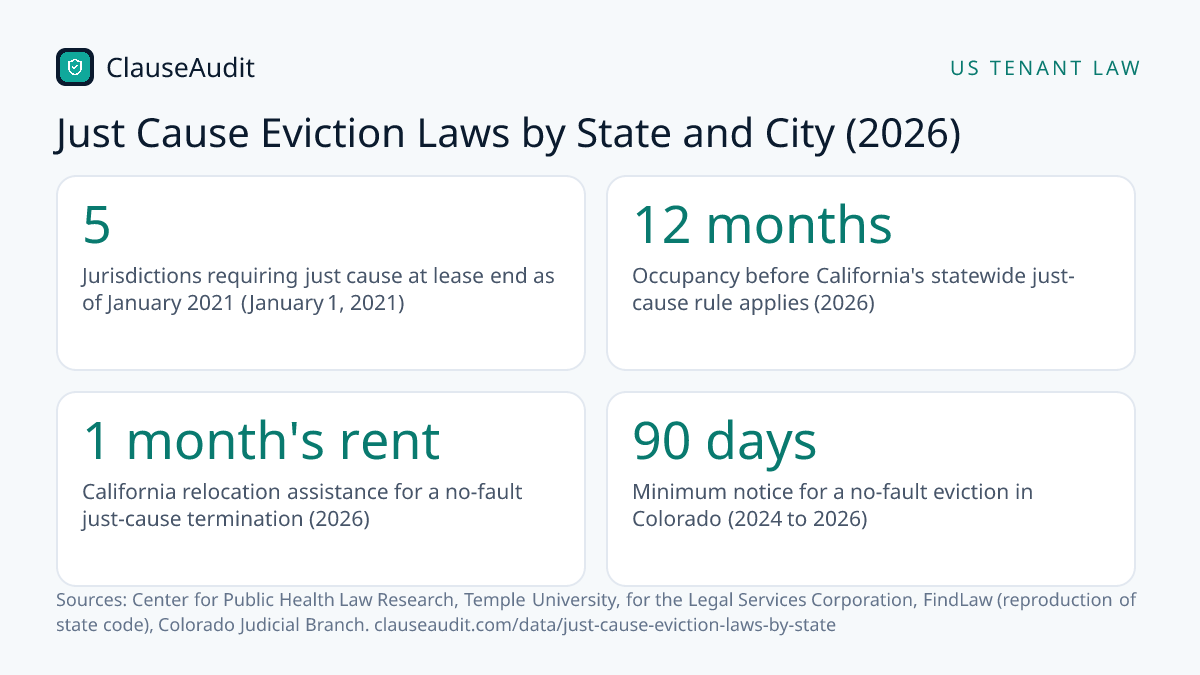
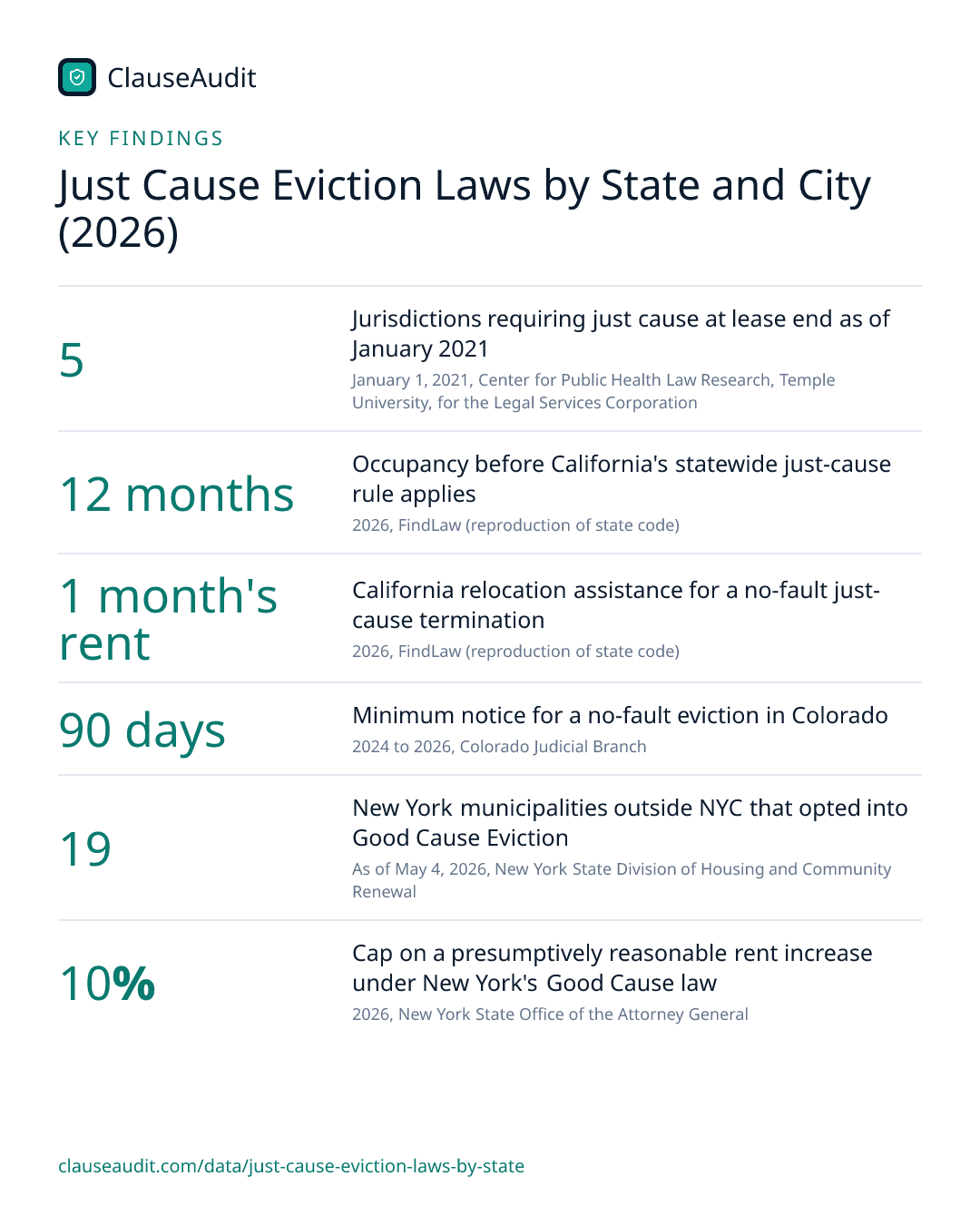
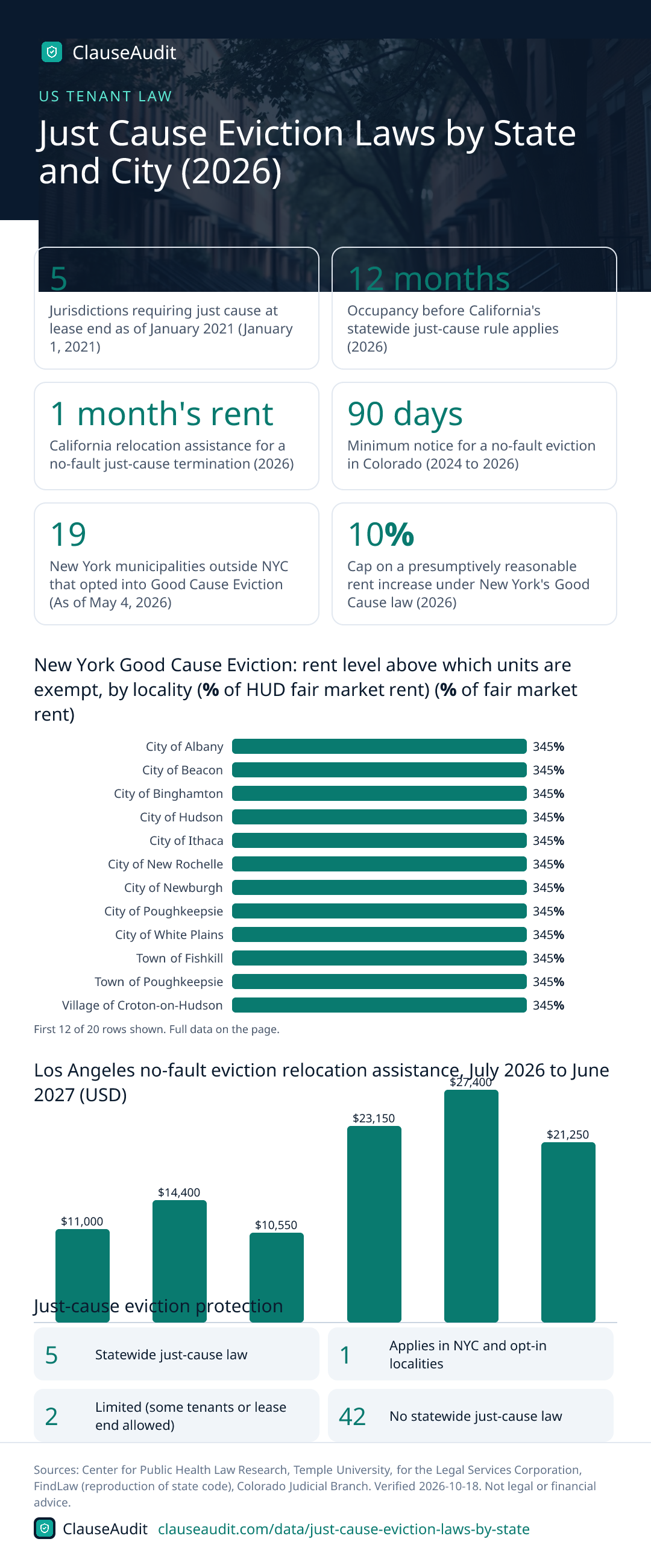
- Jurisdictions requiring just cause at lease end as of January 2021 (January 1, 2021, Center for Public Health Law Research, Temple University, for the Legal Services Corporation)
- 5
- Occupancy before California's statewide just-cause rule applies (2026, FindLaw (reproduction of state code))
- 12 months
- California relocation assistance for a no-fault just-cause termination (2026, FindLaw (reproduction of state code))
- 1 month's rent
- Minimum notice for a no-fault eviction in Colorado (2024 to 2026, Colorado Judicial Branch)
- 90 days
- New York municipalities outside NYC that opted into Good Cause Eviction (As of May 4, 2026, New York State Division of Housing and Community Renewal)
- 19
- Cap on a presumptively reasonable rent increase under New York's Good Cause law (2026, New York State Office of the Attorney General)
- 10%
- Date Philadelphia's good-cause rule extends to leases of any length (2026, City of Philadelphia (via American Legal Publishing))
- November 1, 2026
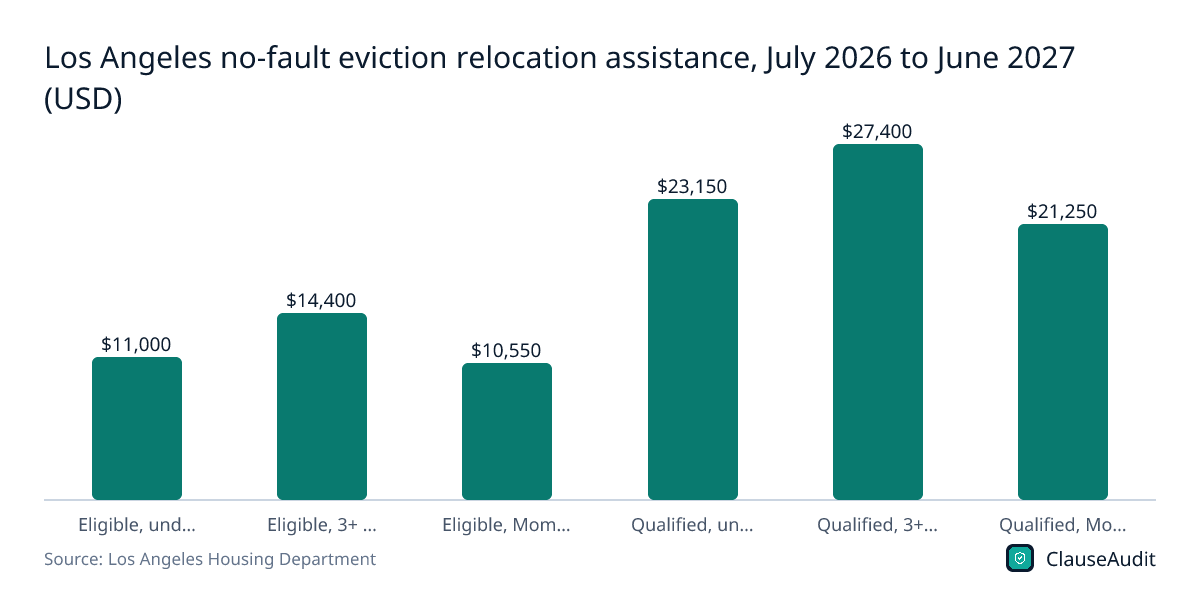
- Los Angeles no-fault relocation payment, eligible household under 3 years (July 1, 2026 to June 30, 2027, Los Angeles Housing Department)
- $11,000
In most of the country, your lease ending is reason enough for a landlord to ask you to leave. Just-cause laws change that. Under them, a landlord needs a reason from a list written into the law, such as unpaid rent, a serious lease breach, or the owner moving in. Some of those reasons are your fault. Others are not, and those usually come with longer notice and sometimes a cash payment.
The protection is patchy. As of January 1, 2021, only 5 jurisdictions required just cause at the end of a lease. Washington, Colorado and New York have joined since, and cities keep adding layers on top. The map and tables show who is covered. Below, we explain how these rules play out when your lease is up for renewal, and what to look for in the lease itself.
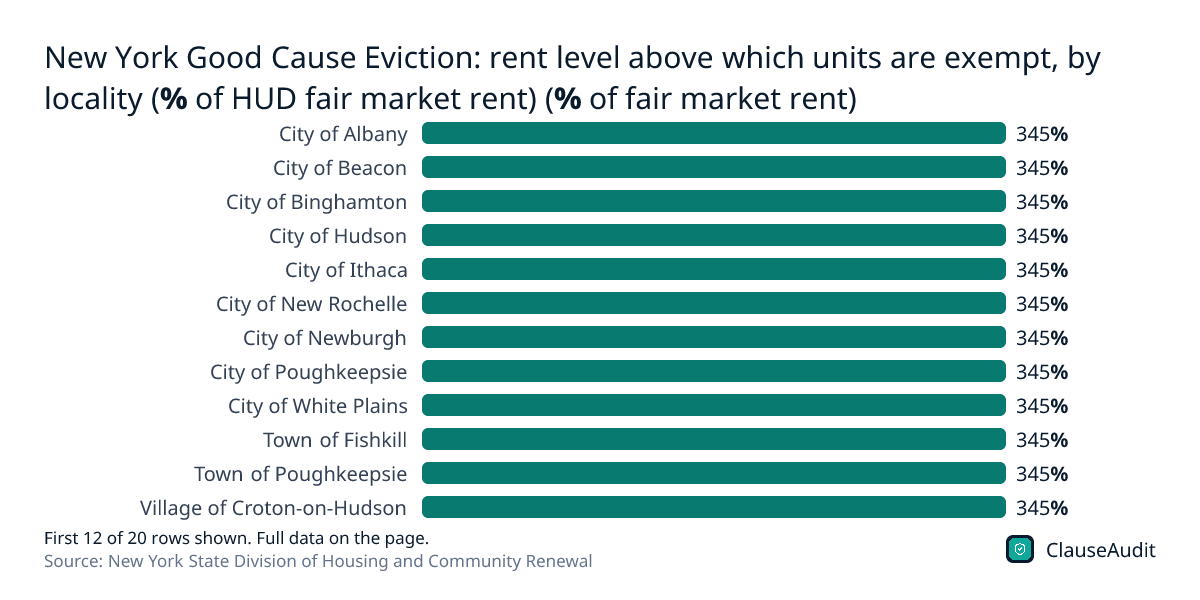
New York Good Cause Eviction: rent level above which units are exempt, by locality (% of HUD fair market rent) (% of fair market rent)
Chart data
| Label | Value |
|---|---|
| City of Albany | 345% |
| City of Beacon | 345% |
| City of Binghamton | 345% |
| City of Hudson | 345% |
| City of Ithaca | 345% |
| City of New Rochelle | 345% |
| City of Newburgh | 345% |
| City of Poughkeepsie | 345% |
| City of White Plains | 345% |
| Town of Fishkill | 345% |
| Town of Poughkeepsie | 345% |
| Village of Croton-on-Hudson | 345% |
| Village of New Paltz | 345% |
| Village of Nyack | 345% |
| Village of Tarrytown | 345% |
| City of Kingston | 300% |
| Village of Catskill | 275% |
| New York City | 245% |
| City of Middletown | 245% |
| City of Rochester | 245% |
Most opt-in towns set the cutoff at 345% of fair market rent, well above New York City's 245% default. A higher cutoff means more apartments fall inside the law, so a unit renting at 300% of local fair market rent is covered in Albany or White Plains but would be exempt in NYC.
Download this chart (PNG)Los Angeles no-fault eviction relocation assistance, July 2026 to June 2027 (USD)
Chart data
| Label | Value (USD) |
|---|---|
| Eligible, under 3 years | $11,000 |
| Eligible, 3+ years or low income | $14,400 |
| Eligible, Mom & Pop owner move-in | $10,550 |
| Qualified, under 3 years | $23,150 |
| Qualified, 3+ years or low income | $27,400 |
| Qualified, Mom & Pop owner move-in | $21,250 |
The jump from $11,000 to $23,150 for a tenant under 3 years shows how much the household matters. If you are 62 or older, disabled, or have minor children at home, Los Angeles roughly doubles what a landlord owes for a no-fault eviction.
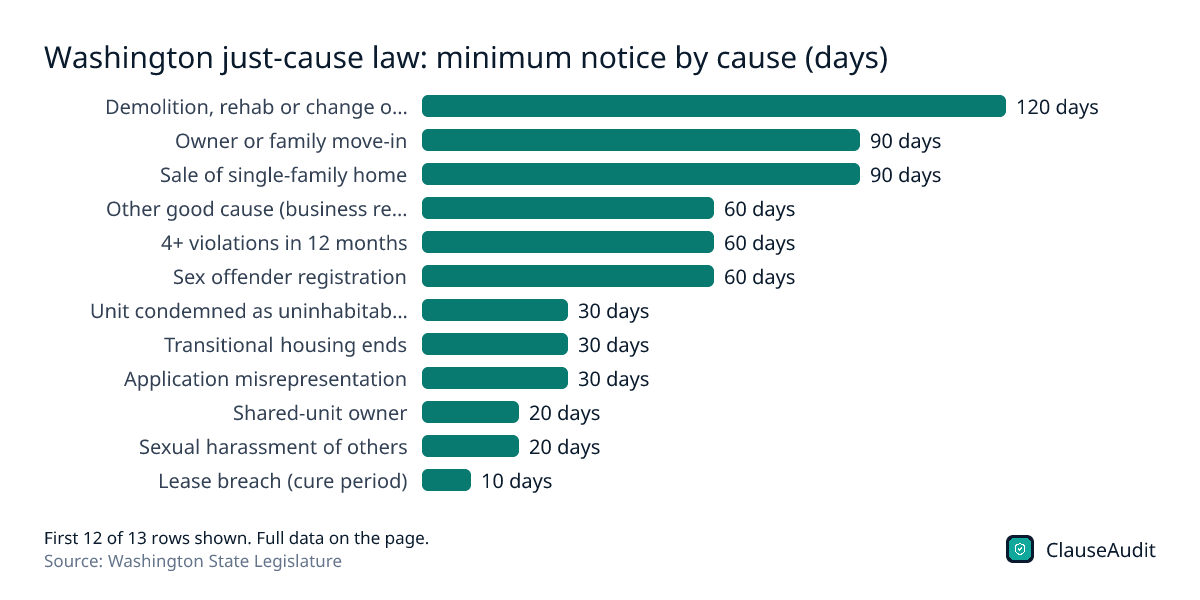
Download this chart (PNG)Washington just-cause law: minimum notice by cause (days)
Chart data
| Label | Value |
|---|---|
| Demolition, rehab or change of use | 120 days |
| Owner or family move-in | 90 days |
| Sale of single-family home | 90 days |
| Other good cause (business reason) | 60 days |
| 4+ violations in 12 months | 60 days |
| Sex offender registration | 60 days |
| Unit condemned as uninhabitable | 30 days |
| Transitional housing ends | 30 days |
| Application misrepresentation | 30 days |
| Shared-unit owner | 20 days |
| Sexual harassment of others | 20 days |
| Lease breach (cure period) | 10 days |
| Waste, nuisance or unlawful activity | 3 days |
Washington ties notice to the reason. A tenant accused of waste or nuisance gets 3 days, while a building slated for demolition or a change of use gets 120.
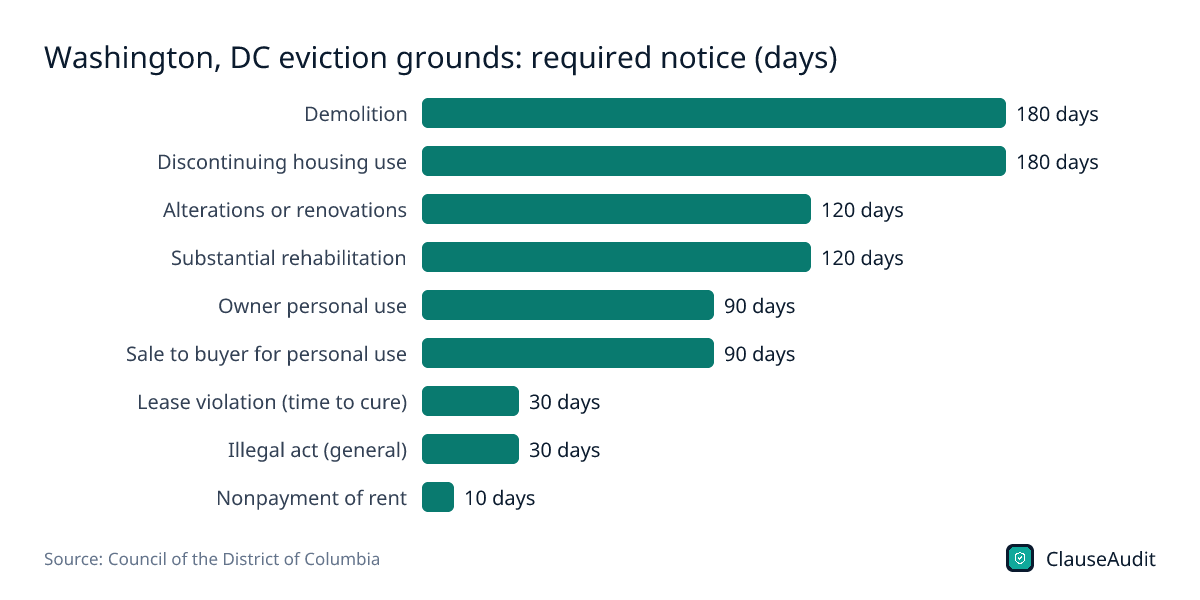
Download this chart (PNG)Washington, DC eviction grounds: required notice (days)
Chart data
| Label | Value |
|---|---|
| Demolition | 180 days |
| Discontinuing housing use | 180 days |
| Alterations or renovations | 120 days |
| Substantial rehabilitation | 120 days |
| Owner personal use | 90 days |
| Sale to buyer for personal use | 90 days |
| Lease violation (time to cure) | 30 days |
| Illegal act (general) | 30 days |
| Nonpayment of rent | 10 days |
DC gives long notice for no-fault endings, up to 180 days for demolition. Nonpayment notice is 10 days, and it is not required at all if unpaid rent is under $600.
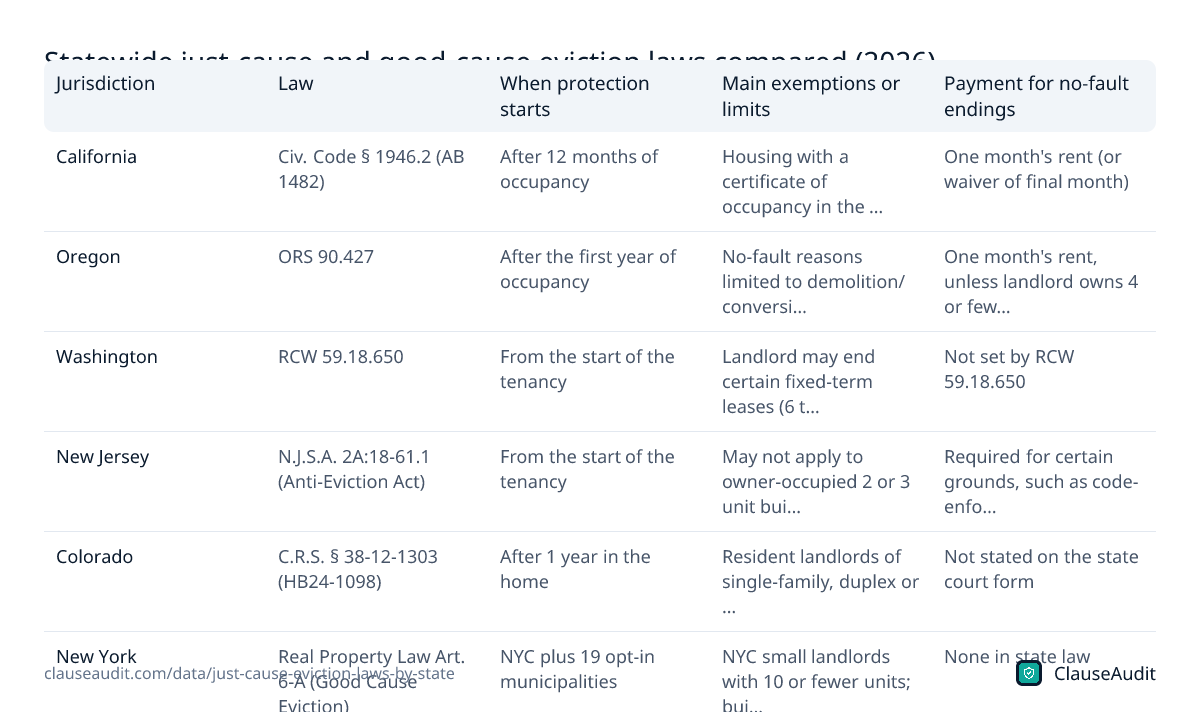
Download this chart (PNG)Statewide just-cause and good-cause eviction laws compared (2026)
| Jurisdiction | Law | When protection starts | Main exemptions or limits | Payment for no-fault endings |
|---|---|---|---|---|
| California | Civ. Code § 1946.2 (AB 1482) | After 12 months of occupancy | Housing with a certificate of occupancy in the past 15 years; owner-occupied single-family homes renting up to 2 units; law repeals Jan 1, 2030 | One month's rent (or waiver of final month) |
| Oregon | ORS 90.427 | After the first year of occupancy | No-fault reasons limited to demolition/conversion, repairs, owner or family move-in, sale to an owner-occupant; generally 90 days notice (2025 amendments changed the sale rules) | One month's rent, unless landlord owns 4 or fewer units (pre-2025 text) |
| Washington | RCW 59.18.650 | From the start of the tenancy | Landlord may end certain fixed-term leases (6 to 12 months converting to month-to-month, or 12+ months) without cause on 60 days notice | Not set by RCW 59.18.650 |
| New Jersey | N.J.S.A. 2A:18-61.1 (Anti-Eviction Act) | From the start of the tenancy | May not apply to owner-occupied 2 or 3 unit buildings with 2 or fewer rental units; transient and seasonal rentals excluded | Required for certain grounds, such as code-enforcement removals |
| Colorado | C.R.S. § 38-12-1303 (HB24-1098) | After 1 year in the home | Resident landlords of single-family, duplex or triplex homes; employer housing, mobile home spaces, short-term rentals; 90 days notice for no-fault | Not stated on the state court form |
| New York | Real Property Law Art. 6-A (Good Cause Eviction) | NYC plus 19 opt-in municipalities | NYC small landlords with 10 or fewer units; buildings with a certificate of occupancy on or after Jan 1, 2009; rent above 245% of FMR (higher in some opt-ins) | None in state law |
| District of Columbia | D.C. Code § 42-3505.01 | From the start of the tenancy | Only listed grounds; 90 to 180 days notice for owner use, renovation, demolition or discontinuance | Not set by this section |
| New Hampshire | RSA 540:2 (restricted property) | Good cause required during tenancy | From July 1, 2026, HB 60 adds lease expiration as a ground, with at least 60 days notice | None |
| Connecticut | C.G.S. § 47a-23c | Seniors and tenants with disabilities only | 2026 bill (SB 257) to cover all tenants in 5+ unit buildings was not voted on | None |
Source: FindLaw (reproduction of state code), California Civil Code § 1946.2 (Tenant Protection Act of 2019, AB 1482); Oregon Laws (oregon.public.law, reproduction of ORS), Oregon Revised Statutes § 90.427; Washington State Legislature, Revised Code of Washington 59.18.650; New Jersey Department of Community Affairs, Truth in Renting: A guide to the rights and responsibilities of residential tenants and landlords in New Jersey; Colorado Judicial Branch, JDF 99C Notice of No-Fault Eviction (C.R.S. § 38-12-1303); Colorado General Assembly, HB24-1098 Prohibit Residential Evictions Without Cause; New York State Division of Housing and Community Renewal, Good Cause Eviction Law: Required DHCR Notice; New York State Office of the Attorney General, New York State Good Cause Eviction Law; Council of the District of Columbia, D.C. Code § 42-3505.01 Evictions; Runyon Law Office, When the Lease Ends: New Hampshire's New No-Fault Termination Law; NHPR / Keene Sentinel (Granite State News Collaborative), End-of-lease evictions allowed under new state law; Connecticut Public, CT's expansion of the Just Cause eviction bill is one step closer to becoming law; Connecticut Public, A look at CT housing bills that did and didn't pass this legislative session. Download as image
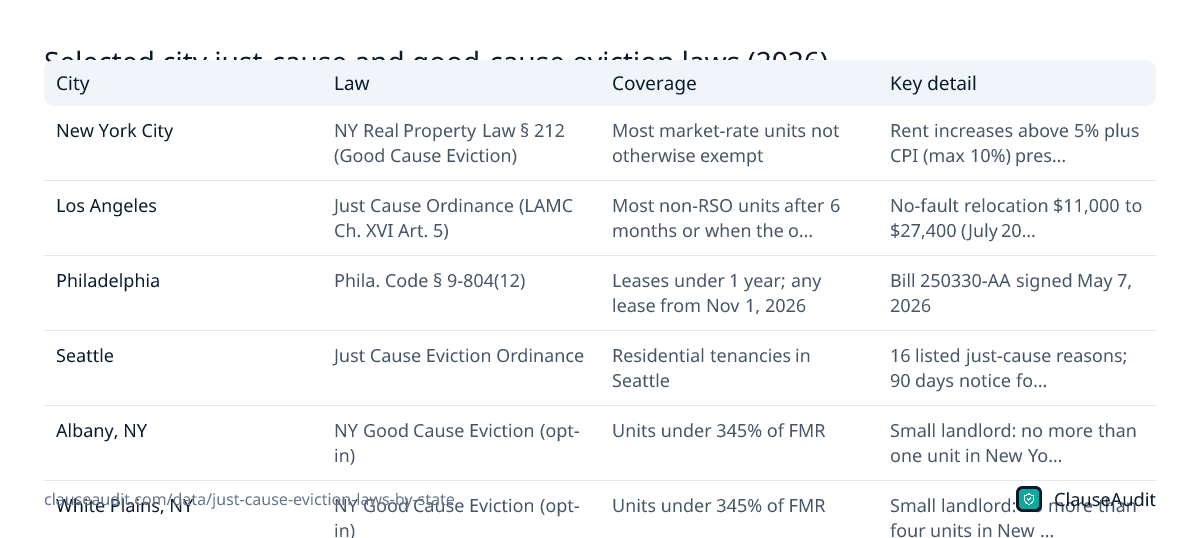
Selected city just-cause and good-cause eviction laws (2026)
| City | Law | Coverage | Key detail |
|---|---|---|---|
| New York City | NY Real Property Law § 212 (Good Cause Eviction) | Most market-rate units not otherwise exempt | Rent increases above 5% plus CPI (max 10%) presumed unreasonable |
| Los Angeles | Just Cause Ordinance (LAMC Ch. XVI Art. 5) | Most non-RSO units after 6 months or when the original lease expires | No-fault relocation $11,000 to $27,400 (July 2026 to June 2027) |
| Philadelphia | Phila. Code § 9-804(12) | Leases under 1 year; any lease from Nov 1, 2026 | Bill 250330-AA signed May 7, 2026 |
| Seattle | Just Cause Eviction Ordinance | Residential tenancies in Seattle | 16 listed just-cause reasons; 90 days notice for family move-in or sale |
| Albany, NY | NY Good Cause Eviction (opt-in) | Units under 345% of FMR | Small landlord: no more than one unit in New York |
| White Plains, NY | NY Good Cause Eviction (opt-in) | Units under 345% of FMR | Small landlord: no more than four units in New York |
Source: New York State Office of the Attorney General, New York State Good Cause Eviction Law; New York State Division of Housing and Community Renewal, Good Cause Eviction Law: Required DHCR Notice; Los Angeles Housing Department, Just Cause For Eviction Ordinance (JCO); Los Angeles Housing Department, Relocation Assistance Bulletins A and B: No-Fault Evictions Under the RSO & JCO; City of Philadelphia (via American Legal Publishing), Philadelphia Bill No. 250330-AA (Certified Copy), amending Chapter 9-800 Landlord and Tenant; City of Philadelphia, Fair Housing Commission, Unfair rental practices; City of Seattle, Just Cause Eviction Ordinance (Renting in Seattle). Download as image
Just-cause eviction protection by state
- 5Statewide just-cause law
- 1Applies in NYC and opt-in localities
- 2Limited (some tenants or lease end allowed)
- 42No statewide just-cause law
- Statewide just-cause law5
- Applies in NYC and opt-in localities1
- Limited (some tenants or lease end allowed)2
- No statewide just-cause law42
- Not yet confirmed1
| State | Law | Who is covered | No-fault endings | Source |
|---|---|---|---|---|
| Alabama | None statewide | No statewide just-cause requirement | Lease can generally end without a stated reason, subject to notice rules | State/Territory Eviction Laws: Final Summary Report (LSC Eviction Laws Database) |
| Alaska | None statewide | No statewide just-cause requirement | Lease can generally end without a stated reason, subject to notice rules | State/Territory Eviction Laws: Final Summary Report (LSC Eviction Laws Database) |
| Arizona | None statewide | No statewide just-cause requirement | Lease can generally end without a stated reason, subject to notice rules | State/Territory Eviction Laws: Final Summary Report (LSC Eviction Laws Database) |
| Arkansas | None statewide | No statewide just-cause requirement | Lease can generally end without a stated reason, subject to notice rules | State/Territory Eviction Laws: Final Summary Report (LSC Eviction Laws Database) |
| California | Tenant Protection Act (AB 1482) | Tenants after 12 months; many newer and owner-occupied homes exempt | One month's rent relocation; law repeals Jan 1, 2030 | Cal. Civ. Code § 1946.2 |
| Colorado | HB24-1098 | Tenants after 1 year in the home | 6 no-fault grounds; 90 days notice | C.R.S. § 38-12-1303 |
| Connecticut | Protected-tenant good-cause rule | Seniors and tenants with disabilities only | Others can be refused renewal without a reason; 2026 expansion bill not voted on | C.G.S. § 47a-23c |
| Delaware | None statewide | No statewide just-cause requirement | Lease can generally end without a stated reason, subject to notice rules | State/Territory Eviction Laws: Final Summary Report (LSC Eviction Laws Database) |
| District of Columbia | Rental Housing Act eviction rules | Tenants may be evicted only on listed grounds | 90 days (owner use or sale) to 180 days (demolition) | D.C. Code § 42-3505.01 |
| Florida | None statewide | No statewide just-cause requirement | Lease can generally end without a stated reason, subject to notice rules | State/Territory Eviction Laws: Final Summary Report (LSC Eviction Laws Database) |
| Georgia | None statewide | No statewide just-cause requirement | Lease can generally end without a stated reason, subject to notice rules | State/Territory Eviction Laws: Final Summary Report (LSC Eviction Laws Database) |
| Hawaii | None statewide | No statewide just-cause requirement | Lease can generally end without a stated reason, subject to notice rules | State/Territory Eviction Laws: Final Summary Report (LSC Eviction Laws Database) |
| Idaho | None statewide | No statewide just-cause requirement | Lease can generally end without a stated reason, subject to notice rules | State/Territory Eviction Laws: Final Summary Report (LSC Eviction Laws Database) |
| Illinois | None statewide | No statewide just-cause requirement | Lease can generally end without a stated reason, subject to notice rules | State/Territory Eviction Laws: Final Summary Report (LSC Eviction Laws Database) |
| Indiana | None statewide | No statewide just-cause requirement | Lease can generally end without a stated reason, subject to notice rules | State/Territory Eviction Laws: Final Summary Report (LSC Eviction Laws Database) |
| Iowa | None statewide | No statewide just-cause requirement | Lease can generally end without a stated reason, subject to notice rules | State/Territory Eviction Laws: Final Summary Report (LSC Eviction Laws Database) |
| Kansas | None statewide | No statewide just-cause requirement | Lease can generally end without a stated reason, subject to notice rules | State/Territory Eviction Laws: Final Summary Report (LSC Eviction Laws Database) |
| Kentucky | None statewide | No statewide just-cause requirement | Lease can generally end without a stated reason, subject to notice rules | State/Territory Eviction Laws: Final Summary Report (LSC Eviction Laws Database) |
| Louisiana | None statewide | No statewide just-cause requirement | Lease can generally end without a stated reason, subject to notice rules | State/Territory Eviction Laws: Final Summary Report (LSC Eviction Laws Database) |
| Maine | None statewide | No statewide just-cause requirement | Lease can generally end without a stated reason, subject to notice rules | State/Territory Eviction Laws: Final Summary Report (LSC Eviction Laws Database) |
| Maryland | None statewide | No statewide just-cause requirement | Lease can generally end without a stated reason, subject to notice rules | State/Territory Eviction Laws: Final Summary Report (LSC Eviction Laws Database) |
| Massachusetts | None statewide | No statewide just-cause requirement | Lease can generally end without a stated reason, subject to notice rules | State/Territory Eviction Laws: Final Summary Report (LSC Eviction Laws Database) |
| Michigan | None statewide | No statewide just-cause requirement | Lease can generally end without a stated reason, subject to notice rules | State/Territory Eviction Laws: Final Summary Report (LSC Eviction Laws Database) |
| Minnesota | None statewide | No statewide just-cause requirement | Lease can generally end without a stated reason, subject to notice rules | State/Territory Eviction Laws: Final Summary Report (LSC Eviction Laws Database) |
| Mississippi | None statewide | No statewide just-cause requirement | Lease can generally end without a stated reason, subject to notice rules | State/Territory Eviction Laws: Final Summary Report (LSC Eviction Laws Database) |
| Missouri | None statewide | No statewide just-cause requirement | Lease can generally end without a stated reason, subject to notice rules | State/Territory Eviction Laws: Final Summary Report (LSC Eviction Laws Database) |
| Montana | None statewide | No statewide just-cause requirement | Lease can generally end without a stated reason, subject to notice rules | State/Territory Eviction Laws: Final Summary Report (LSC Eviction Laws Database) |
| Nebraska | None statewide | No statewide just-cause requirement | Lease can generally end without a stated reason, subject to notice rules | State/Territory Eviction Laws: Final Summary Report (LSC Eviction Laws Database) |
| Nevada | None statewide | No statewide just-cause requirement | Lease can generally end without a stated reason, subject to notice rules | State/Territory Eviction Laws: Final Summary Report (LSC Eviction Laws Database) |
| New Hampshire | Restricted property good-cause rule | Tenants of 'restricted property' as defined in RSA 540:1-a | From July 1, 2026 lease expiration is a ground, with 60 days notice | N.H. RSA 540:2; 2025 HB 60 |
| New Jersey | Anti-Eviction Act | Most residential rentals, including single-family homes | Only statutory grounds; may not apply to owner-occupied 2-3 unit buildings with 2 or fewer rentals | N.J.S.A. 2A:18-61.1 |
| New Mexico | None statewide | No statewide just-cause requirement | Lease can generally end without a stated reason, subject to notice rules | State/Territory Eviction Laws: Final Summary Report (LSC Eviction Laws Database) |
| New York | Good Cause Eviction Law (2024) | New York City plus 19 opt-in municipalities (as of May 4, 2026) | Exemptions for small landlords, post-2009 buildings and high-rent units | N.Y. Real Prop. Law Art. 6-A (§§ 211-216) |
| North Carolina | None statewide | No statewide just-cause requirement | Lease can generally end without a stated reason, subject to notice rules | State/Territory Eviction Laws: Final Summary Report (LSC Eviction Laws Database) |
| North Dakota | None statewide | No statewide just-cause requirement | Lease can generally end without a stated reason, subject to notice rules | State/Territory Eviction Laws: Final Summary Report (LSC Eviction Laws Database) |
| Ohio | None statewide | No statewide just-cause requirement | Lease can generally end without a stated reason, subject to notice rules | State/Territory Eviction Laws: Final Summary Report (LSC Eviction Laws Database) |
| Oklahoma | None statewide | No statewide just-cause requirement | Lease can generally end without a stated reason, subject to notice rules | State/Territory Eviction Laws: Final Summary Report (LSC Eviction Laws Database) |
| Oregon | Not yet confirmed: check the source | ORS 90.427 | ||
| Pennsylvania | None statewide | No statewide just-cause requirement | Philadelphia requires good cause by local ordinance | State/Territory Eviction Laws: Final Summary Report (LSC Eviction Laws Database) |
| Rhode Island | None statewide | No statewide just-cause requirement | Lease can generally end without a stated reason, subject to notice rules | State/Territory Eviction Laws: Final Summary Report (LSC Eviction Laws Database) |
| South Carolina | None statewide | No statewide just-cause requirement | Lease can generally end without a stated reason, subject to notice rules | State/Territory Eviction Laws: Final Summary Report (LSC Eviction Laws Database) |
| South Dakota | None statewide | No statewide just-cause requirement | Lease can generally end without a stated reason, subject to notice rules | State/Territory Eviction Laws: Final Summary Report (LSC Eviction Laws Database) |
| Tennessee | None statewide | No statewide just-cause requirement | Lease can generally end without a stated reason, subject to notice rules | State/Territory Eviction Laws: Final Summary Report (LSC Eviction Laws Database) |
| Texas | None statewide | No statewide just-cause requirement | Lease can generally end without a stated reason, subject to notice rules | State/Territory Eviction Laws: Final Summary Report (LSC Eviction Laws Database) |
| Utah | None statewide | No statewide just-cause requirement | Lease can generally end without a stated reason, subject to notice rules | State/Territory Eviction Laws: Final Summary Report (LSC Eviction Laws Database) |
| Vermont | None statewide | No statewide just-cause requirement | Lease can generally end without a stated reason, subject to notice rules | State/Territory Eviction Laws: Final Summary Report (LSC Eviction Laws Database) |
| Virginia | None statewide | No statewide just-cause requirement | Lease can generally end without a stated reason, subject to notice rules | State/Territory Eviction Laws: Final Summary Report (LSC Eviction Laws Database) |
| Washington | RCW 59.18.650 | Most tenancies from the start; some fixed-term leases may end without cause | Owner move-in or sale: 90 days notice | RCW 59.18.650 |
| West Virginia | None statewide | No statewide just-cause requirement | Lease can generally end without a stated reason, subject to notice rules | State/Territory Eviction Laws: Final Summary Report (LSC Eviction Laws Database) |
| Wisconsin | None statewide | No statewide just-cause requirement | Lease can generally end without a stated reason, subject to notice rules | State/Territory Eviction Laws: Final Summary Report (LSC Eviction Laws Database) |
| Wyoming | None statewide | No statewide just-cause requirement | Lease can generally end without a stated reason, subject to notice rules | State/Territory Eviction Laws: Final Summary Report (LSC Eviction Laws Database) |
What is just cause eviction?
A just-cause law limits the reasons a landlord can use to end your tenancy, including at the end of a lease. Without one, a landlord can usually let a lease run out or send a notice to end a month-to-month rental, and they don't have to say why.
The reasons in these laws fall into two groups. At-fault reasons are things the tenant did: not paying rent, breaking a material lease term, damaging the unit, or criminal activity. No-fault reasons are about the owner's plans: moving in, selling, renovating, or taking the unit off the rental market. No-fault endings are where tenants get the most help, through longer notice and, in some places, relocation money.
Just cause is not rent control, though some states pair the two. California's Tenant Protection Act has a separate annual rent cap, and New York's Good Cause law treats a rent increase above 5% plus CPI, capped at 10%, as presumptively unreasonable, and an unreasonable increase can't be used to push you out.
If you freelance or run a small business from your apartment, this matters more than it might seem. Losing your home also means losing your office, your mailing address and maybe your client calls for a few weeks. Knowing if your landlord needs a reason, and how much notice you'd get, tells you how much time you'd have to line up a new place without losing work.
Which states have just cause eviction laws in 2026?
California, Colorado, New Jersey, Oregon, Washington and the District of Columbia have statewide rules. They differ a lot in who they cover and when protection starts.
California's Tenant Protection Act kicks in after 12 months of occupancy. Many homes are exempt, including housing with a certificate of occupancy issued in the past 15 years. The law is set to repeal on January 1, 2030 unless lawmakers extend it. Colorado's law, approved April 19, 2024, covers tenants after 1 year in the home and lists 6 no-fault grounds, each requiring 90 days notice. Washington and New Jersey protect tenants from the first day of the tenancy, and DC limits evictions to listed grounds from the start.
New York is a special case. Its Good Cause law applies in New York City and only in other towns that opt in by local law. Connecticut and New Hampshire sit in the limited category. Connecticut's rule covers seniors and tenants with disabilities, and a 2026 bill to reach all tenants in 5+ unit buildings was not voted on. New Hampshire went the other way. Since July 1, 2026, lease expiration has been a valid ground, with at least 60 days notice.
Oregon's law covers tenants after the first year of occupancy, and it appears on the map as statewide. A 2025 law changed its rules for sales to owner-occupants, and we haven't yet checked those changes against the current statute. If you rent in Oregon, confirm the details before you rely on them.
Do cities have their own just cause rules?
Yes, and the city rule can matter more than the state one. Los Angeles applies its Just Cause Ordinance to most units not under rent stabilization after 6 months or when the original lease expires, which can be sooner than California's 12-month trigger. For most tenants, its relocation payments for July 2026 to June 2027 run from $11,000 to $27,400, compared with 1 month's rent under state law.
Seattle has its own ordinance with 16 listed just-cause reasons and 90 days notice for a family move-in or sale. Philadelphia has protected tenants on leases under one year, and from November 1, 2026 that protection extends to leases of any length.
So check your city before you assume the state rule is the whole story. A tenant more than 6 months into a Los Angeles lease can be covered by the city ordinance while a neighbor just outside city limits, on the same timeline, is not yet covered by state law.
Can a landlord refuse to renew your lease without a reason?
In most states, yes. If your state isn't on the map as covered and your city has no ordinance, a landlord can generally let the lease end without explaining, as long as they follow the notice rules and don't act out of discrimination or retaliation.
Inside a just-cause area, the answer depends on the details. In Washington, a landlord can still end certain fixed-term leases without cause on 60 days notice, such as a 6 to 12 month lease that converts to month-to-month, or a lease of 12 months or more. In New York, the law doesn't reach small landlords, buildings with a certificate of occupancy on or after January 1, 2009, or units with rent above the local cutoff. In NYC, a small landlord means 10 or fewer units. In Albany it means no more than one unit in New York, and in White Plains no more than four.
Here is a common case. You work from home in Rochester, which uses the 245% cutoff, and your building's certificate of occupancy is dated after January 1, 2009. The law exists in your city, but your building is exempt. Before you plan around protection, confirm both the place and the building.
What to do if you get a no-fault notice
- Check the stated reason against your state or city list. A notice that gives no reason, or a reason not on the list, may be invalid where just cause applies.
- Count the days. Colorado requires at least 90 days for no-fault endings, and DC ranges from 90 to 180 days depending on the ground.
- Look at your building, not just your city. Exemptions for newer buildings, owner-occupied homes and small landlords knock a lot of units out of coverage.
- Ask about relocation money in writing. California requires 1 month's rent for a no-fault ending, and Los Angeles owes far more.
- Keep every notice, text and email, and note the date you received each one.
- Contact a local tenant group or legal aid office before you move out. Leaving early can waive rights you would otherwise keep.
How ClauseAudit helps
A just-cause law protects you, but your lease decides a lot of what happens in practice: when the term ends, how renewal works, and what the landlord can claim when you leave. Some leases also try to get tenants to give up rights the law gives them, which usually doesn't hold up but can scare people into leaving.
Upload your lease and the automated review flags the clauses that matter most when a landlord wants the unit back.
- Lease term and renewal language, including whether it converts to month-to-month or ends outright
- Termination and notice clauses that set shorter notice than your state or city requires
- Waivers of tenant rights, such as giving up just-cause protection or relocation assistance
- Owner move-in, sale or renovation clauses that let the landlord end the lease early
- Rent increase terms on renewal that could be used to force you out
- Late fee and default clauses that turn a small missed payment into grounds for eviction
Frequently asked questions
Is just cause eviction the same as rent control?
No. Just cause limits why a landlord can end your tenancy, while rent control limits how much rent can go up. Some places combine both ideas. New York's Good Cause law treats rent increases above 5% plus CPI, capped at 10%, as presumptively unreasonable, so a landlord can't use a huge increase to get around the eviction rules.
How long do I have to live in a California rental before just cause applies?
Under the state Tenant Protection Act, you need to have lived in the unit continuously and lawfully for 12 months. Many homes are exempt, including housing built under a certificate of occupancy issued in the past 15 years. Your city may have a stronger rule. Los Angeles applies its ordinance after 6 months or when the original lease expires.
How much relocation money do Los Angeles tenants get in 2026?
For July 1, 2026 to June 30, 2027, an eligible household that has lived in the unit under 3 years gets $11,000 for a no-fault eviction, and $14,400 with 3 or more years or low income. Qualified tenants, meaning those 62 or older, disabled, or with minor children, get $23,150 to $27,400.
Which New York towns have opted into Good Cause Eviction?
As of May 4, 2026, state housing officials listed 19 municipalities outside New York City that opted in, including Albany, Beacon, Ithaca, Kingston, New Rochelle, Rochester and White Plains. The law does not apply statewide, so if your town is not on that list, check with your local government whether it has opted in since.
How much notice does Colorado require for a no-fault eviction?
At least 90 days. Colorado's law covers tenants who have been in the home for 1 year and lists 6 no-fault grounds. Some landlords are exempt, including resident landlords of single-family, duplex or triplex homes, along with employer housing, mobile home spaces and short-term rentals.
Can a Washington landlord end my lease without a reason?
Sometimes. Washington's just-cause law protects most tenancies from the start, but a landlord can end certain fixed-term leases without cause on 60 days notice, including a 6 to 12 month lease that converted to month-to-month or a lease of 12 months or more. For owner move-in or sale of a single-family home, notice is 90 days.
What changes in Philadelphia on November 1, 2026?
Philadelphia's good-cause rule has covered leases under one year. A bill signed May 7, 2026 removes that limit, so from November 1, 2026 the rule extends to leases of any length. If you rent in Philadelphia on a one-year or longer lease, your landlord will need good cause to end or refuse to renew it.
What happened to New Hampshire's just-cause rule?
New Hampshire required good cause for tenants of restricted property. A 2025 bill, HB 60, made lease expiration a valid ground from July 1, 2026, as long as the landlord gives at least 60 days notice. In practice, that weakens the old rule for tenants whose leases are ending.
Can my lease waive just-cause protection?
Generally, a lease clause that tries to waive rights a statute gives you is not enforceable, and some laws say so directly. Don't rely on that alone, though. Read the waiver, compare it with your state or city rule, and get local legal advice before you agree to leave because of it.
Use this data
Every chart and card below is free to reuse under CC BY 4.0. Download what you need and link back to this page.
 Stat cards
 Key findings card
 Infographic
 New York Good Cause Eviction: rent level above which units are exempt, by locality (% of HUD fair market rent) (% of fair market rent)
 Los Angeles no-fault eviction relocation assistance, July 2026 to June 2027 (USD)
 Washington just-cause law: minimum notice by cause (days)
 Washington, DC eviction grounds: required notice (days)
 Statewide just-cause and good-cause eviction laws compared (2026)
 Selected city just-cause and good-cause eviction laws (2026)
Embed the infographic
Free to share on your site, blog or slides under CC BY 4.0. Please keep the credit link.
Sources and method
Every number on this page comes from the sources below, each opened and read on or before October 18, 2026. A second, independent review checked every figure against its source and corrected anything that did not match. 50 of 51 state entries were confirmed; any that could not be are marked "Not yet confirmed" and left out of every count and chart.
- Center for Public Health Law Research, Temple University, for the Legal Services Corporation, State/Territory Eviction Laws: Final Summary Report (LSC Eviction Laws Database) (Laws in effect as of January 1, 2021)
- FindLaw (reproduction of state code), California Civil Code § 1946.2 (Tenant Protection Act of 2019, AB 1482) (Current as of January 1, 2026)
- Oregon Laws (oregon.public.law, reproduction of ORS), Oregon Revised Statutes § 90.427 (2023 edition of ORS with 2024 session changes (does not include 2025 session amendments))
- Washington State Legislature, Revised Code of Washington 59.18.650 (Version effective until January 1, 2028 (2021 c 212 s 2))
- Washington State Legislature, Revised Code of Washington 59.18.200 (Current code as read October 2026)
- New Jersey Department of Community Affairs, Truth in Renting: A guide to the rights and responsibilities of residential tenants and landlords in New Jersey (Current edition (PDF file revised August 2025))
- Colorado Judicial Branch, JDF 99C Notice of No-Fault Eviction (C.R.S. § 38-12-1303) (Revised May 6, 2024)
- Colorado General Assembly, HB24-1098 Prohibit Residential Evictions Without Cause (Approved by Governor April 19, 2024)
- New York State Division of Housing and Community Renewal, Good Cause Eviction Law: Required DHCR Notice (Posted July 16, 2026; reposted August 17, 2026)
- New York State Office of the Attorney General, New York State Good Cause Eviction Law (2026 (page copyright 2026))
- NHPR / Keene Sentinel (Granite State News Collaborative), End-of-lease evictions allowed under new state law (August 5, 2025)
- Runyon Law Office, When the Lease Ends: New Hampshire's New No-Fault Termination Law (October 7, 2026)
- Connecticut Public, CT's expansion of the Just Cause eviction bill is one step closer to becoming law (March 12, 2026)
- Connecticut Public, A look at CT housing bills that did and didn't pass this legislative session (May 20, 2026)
- Council of the District of Columbia, D.C. Code § 42-3505.01 Evictions (As amended by D.C. Law 26-108 (April 16, 2026))
- City of Philadelphia (via American Legal Publishing), Philadelphia Bill No. 250330-AA (Certified Copy), amending Chapter 9-800 Landlord and Tenant (Passed April 23, 2026; signed May 7, 2026)
- City of Philadelphia, Fair Housing Commission, Unfair rental practices (Undated; read October 2026)
- Los Angeles Housing Department, Just Cause For Eviction Ordinance (JCO) (Undated; read October 2026)
- Los Angeles Housing Department, Relocation Assistance Bulletins A and B: No-Fault Evictions Under the RSO & JCO (Amounts effective July 1, 2026 through June 30, 2027)
- City of Seattle, Just Cause Eviction Ordinance (Renting in Seattle) (Undated; read October 2026)
Cite this page
ClauseAudit, “Just Cause Eviction Laws by State and City (2026)”, updated October 18, 2026, https://clauseaudit.com/data/just-cause-eviction-laws-by-state. Free to reuse with a link back (CC BY 4.0).
This page summarises published data and law as checked on October 18, 2026. Figures are updated as new editions are released, and your own situation may differ. It is general information, not legal, tax or financial advice.