Month-to-Month Lease Termination Notice by State (Notice to Vacate)
By ClauseAudit Research · 56 sources ·
How much notice to vacate is required by state?
Most states require 30 days. In 29 jurisdictions a landlord ends a month-to-month lease with 30 days' notice or one full rental period. The outliers matter: North Carolina allows just 7 days, Delaware requires 60 days from either side, and Oregon can require 90 days plus a qualifying reason after the first year.

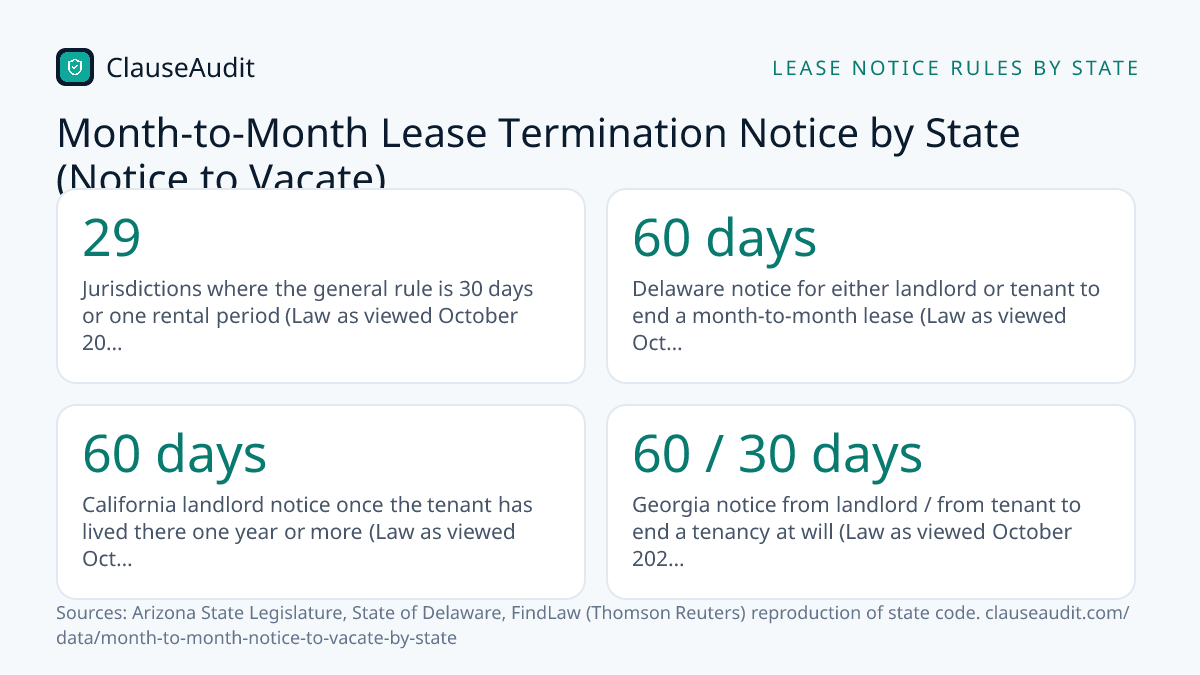
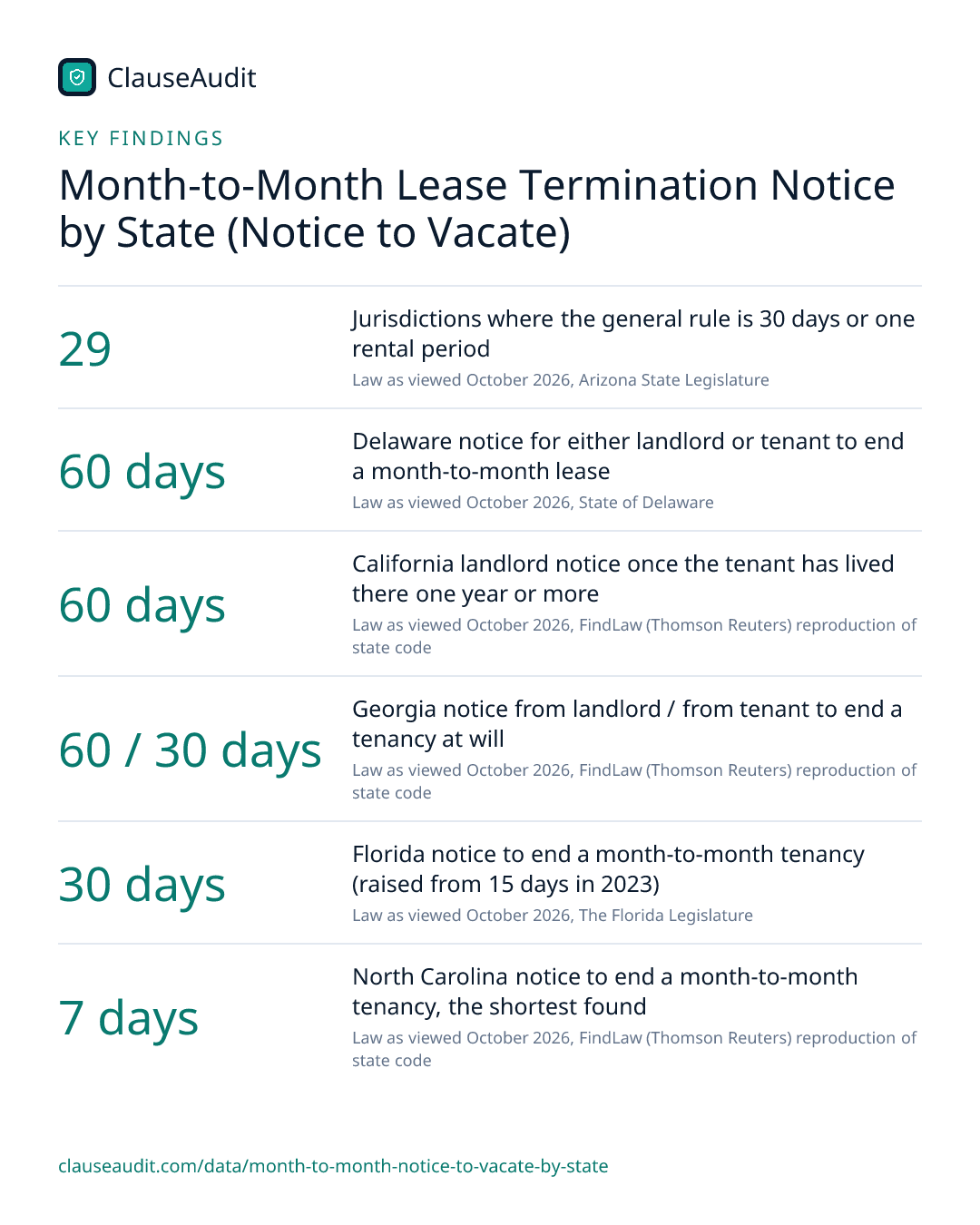
- Jurisdictions where the general rule is 30 days or one rental period (Law as viewed October 2026, Arizona State Legislature)
- 29
- Delaware notice for either landlord or tenant to end a month-to-month lease (Law as viewed October 2026, State of Delaware)
- 60 days
- California landlord notice once the tenant has lived there one year or more (Law as viewed October 2026, FindLaw (Thomson Reuters) reproduction of state code)
- 60 days
- Georgia notice from landlord / from tenant to end a tenancy at will (Law as viewed October 2026, FindLaw (Thomson Reuters) reproduction of state code)
- 60 / 30 days
- Florida notice to end a month-to-month tenancy (raised from 15 days in 2023) (Law as viewed October 2026, The Florida Legislature)
- 30 days
- North Carolina notice to end a month-to-month tenancy, the shortest found (Law as viewed October 2026, FindLaw (Thomson Reuters) reproduction of state code)
- 7 days
- Washington tenant notice to end a month-to-month tenancy (Law as viewed October 2026, Washington State Legislature)
- 20 days
- Oregon landlord notice after the first year, and only for a qualifying reason (Law as viewed October 2026, Public.Law reproduction of Oregon Revised Statutes)
- 90 days
A month-to-month lease feels loose. No end date, no long commitment, and you can leave whenever you want. That is half true. Either side can end it, but only by giving written notice, and the amount of notice depends on where the home sits.
The map and table show the rule in each state for both landlords and tenants. This page explains why the numbers differ so much, how to count the days so your notice actually works, and what to look for in your rental agreement before you rely on any of it.
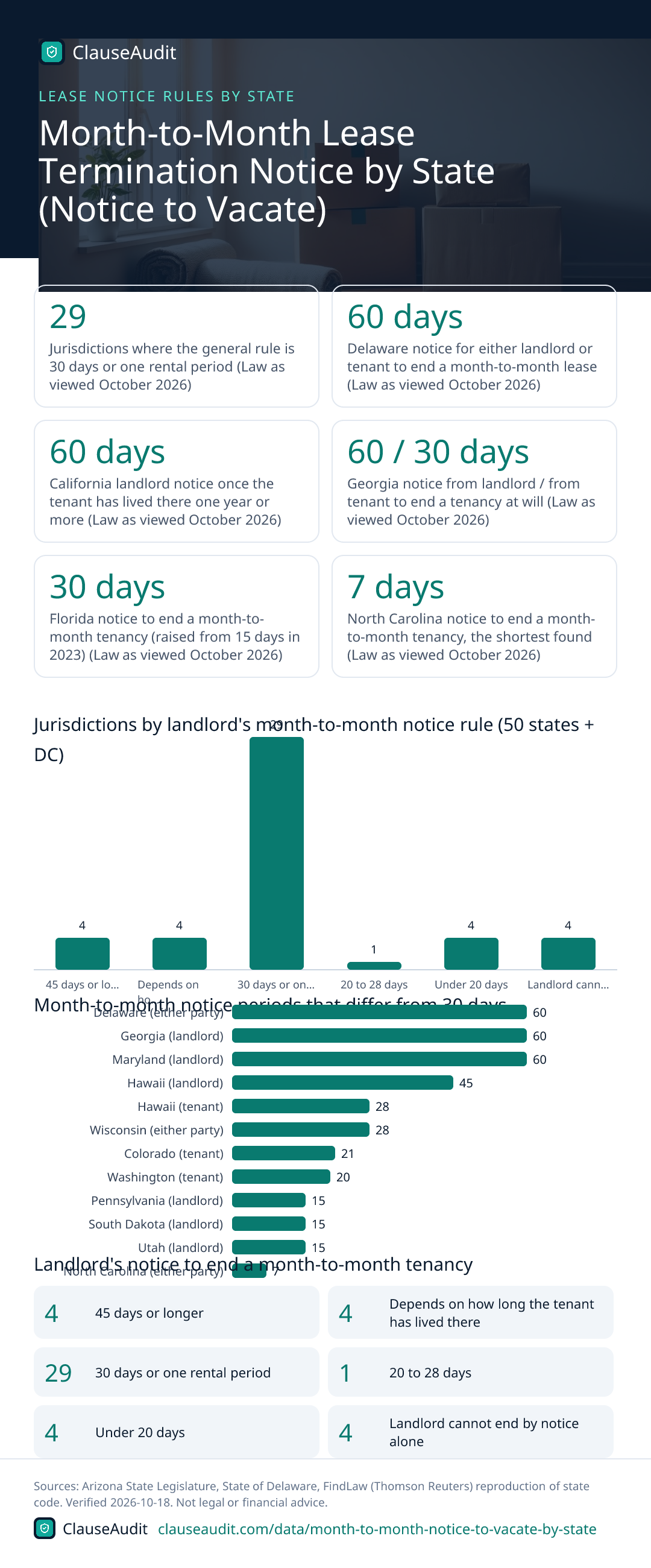
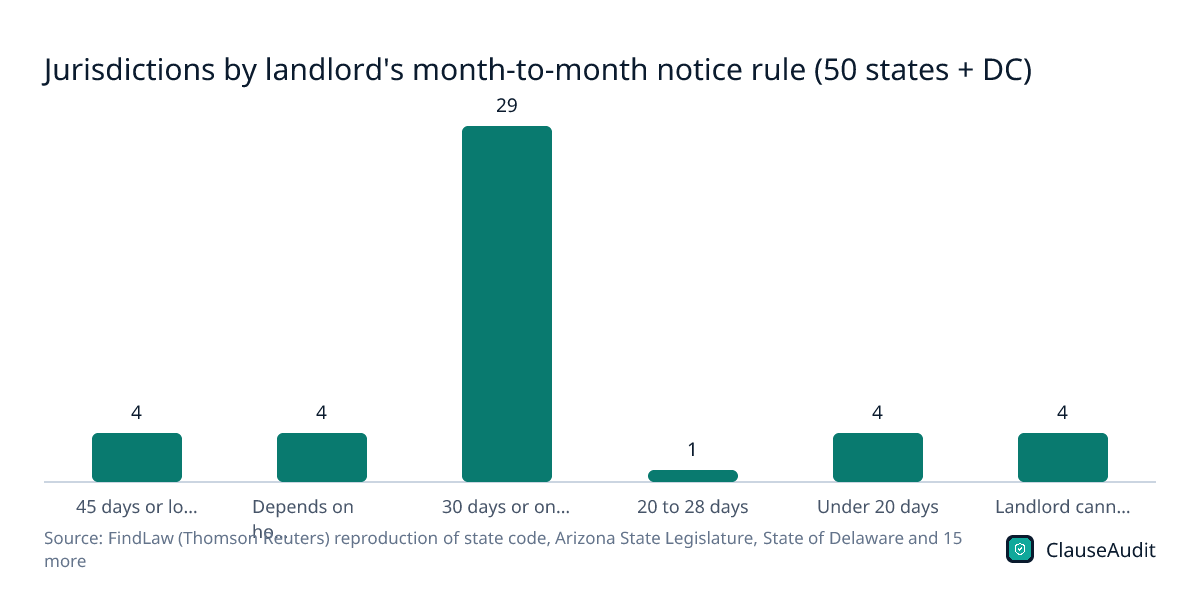
Jurisdictions by landlord's month-to-month notice rule (50 states + DC)
Chart data
| Label | Value |
|---|---|
| 45 days or longer | 4 |
| Depends on how long the tenant has lived there | 4 |
| 30 days or one rental period | 29 |
| 20 to 28 days | 1 |
| Under 20 days | 4 |
| Landlord cannot end by notice alone | 4 |
The 30-day rule is the clear majority at 29 jurisdictions. The more interesting groups are the edges: 4 where a landlord needs a stated cause and cannot end the tenancy with notice alone, and 4 where the period grows the longer you stay.
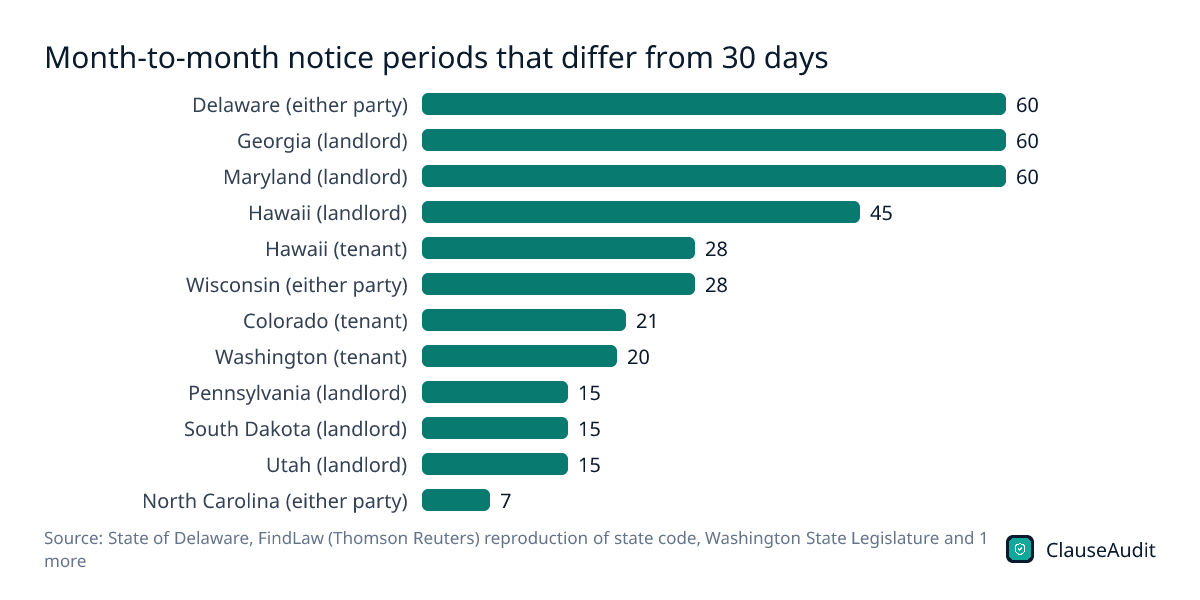
Download this chart (PNG)Month-to-month notice periods that differ from 30 days
Chart data
| Label | Value |
|---|---|
| Delaware (either party) | 60 |
| Georgia (landlord) | 60 |
| Maryland (landlord) | 60 |
| Hawaii (landlord) | 45 |
| Hawaii (tenant) | 28 |
| Wisconsin (either party) | 28 |
| Colorado (tenant) | 21 |
| Washington (tenant) | 20 |
| Pennsylvania (landlord) | 15 |
| South Dakota (landlord) | 15 |
| Utah (landlord) | 15 |
| North Carolina (either party) | 7 |
These are the states that break from 30 days. Notice the split between landlord and tenant in Hawaii, 45 days versus 28, and how far North Carolina sits from everyone else at 7 days.
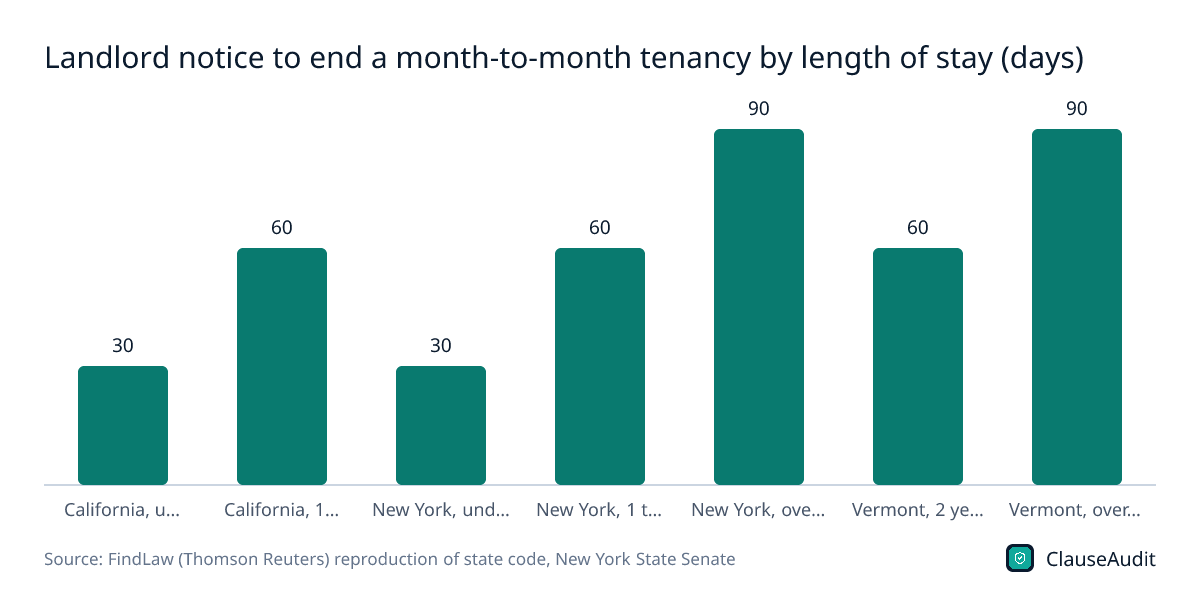
Download this chart (PNG)Landlord notice to end a month-to-month tenancy by length of stay (days)
Chart data
| Label | Value (days) |
|---|---|
| California, under 1 year | 30 |
| California, 1 year or more | 60 |
| New York, under 1 year | 30 |
| New York, 1 to 2 years | 60 |
| New York, over 2 years | 90 |
| Vermont, 2 years or less | 60 |
| Vermont, over 2 years | 90 |
In these states, time in the home buys you time to move. A New York tenant past 2 years gets 90 days, compared with 30 for a first-year tenant.
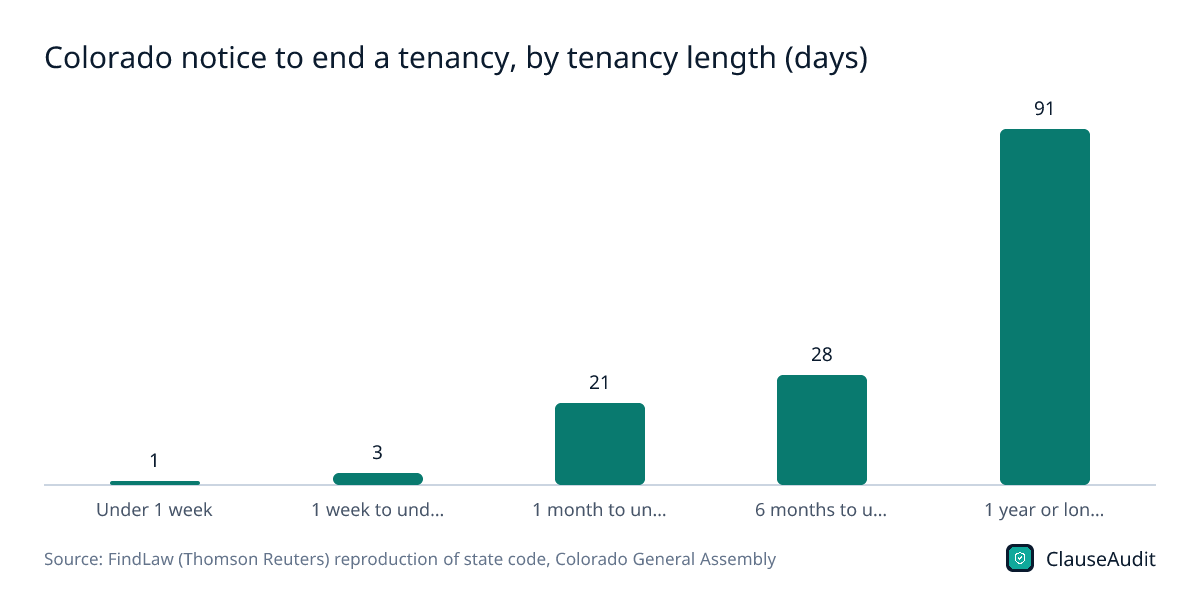
Download this chart (PNG)Colorado notice to end a tenancy, by tenancy length (days)
Chart data
| Label | Value (days) |
|---|---|
| Under 1 week | 1 |
| 1 week to under 1 month | 3 |
| 1 month to under 6 months | 21 |
| 6 months to under 1 year | 28 |
| 1 year or longer | 91 |
A month-to-month tenancy usually falls in the 21-day tier. For most residential landlords, though, these periods no longer apply on their own since HB24-1098, so a reason is now required.
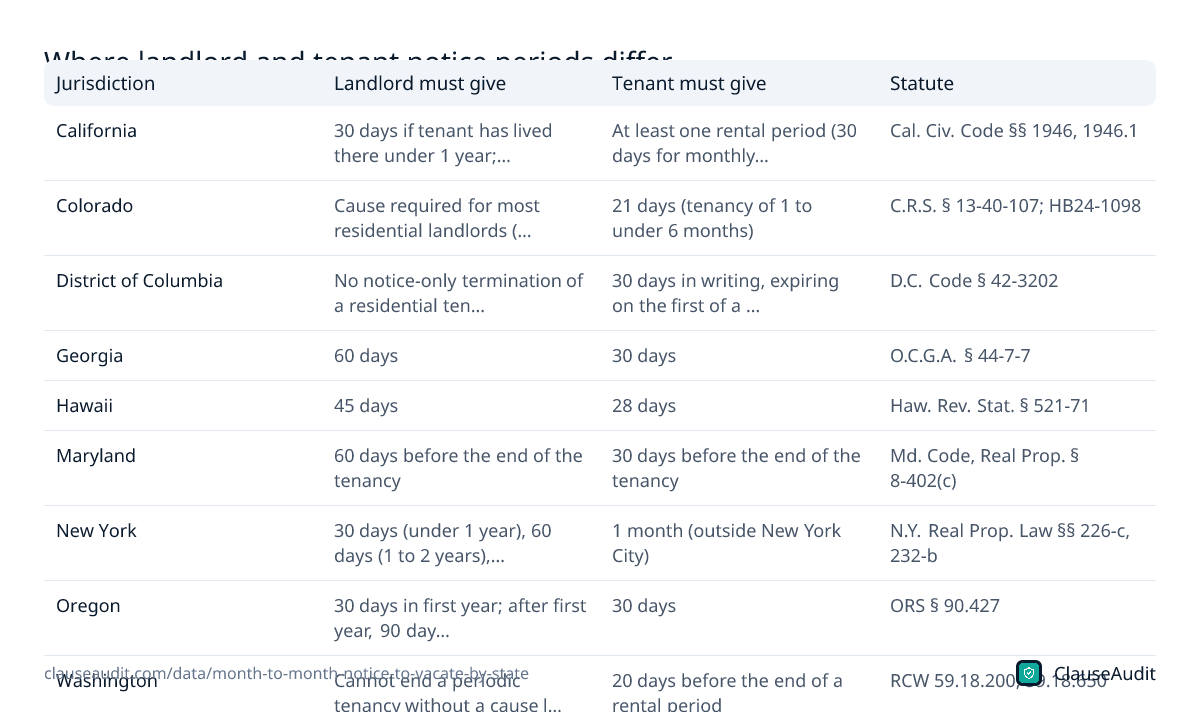
Download this chart (PNG)Where landlord and tenant notice periods differ
| Jurisdiction | Landlord must give | Tenant must give | Statute |
|---|---|---|---|
| California | 30 days if tenant has lived there under 1 year; 60 days if 1 year or more | At least one rental period (30 days for monthly rent) | Cal. Civ. Code §§ 1946, 1946.1 |
| Colorado | Cause required for most residential landlords (HB24-1098); 21 days only for nonresidential property and premises listed in § 38-12-1302(1) | 21 days (tenancy of 1 to under 6 months) | C.R.S. § 13-40-107; HB24-1098 |
| District of Columbia | No notice-only termination of a residential tenancy by the housing provider | 30 days in writing, expiring on the first of a month | D.C. Code § 42-3202 |
| Georgia | 60 days | 30 days | O.C.G.A. § 44-7-7 |
| Hawaii | 45 days | 28 days | Haw. Rev. Stat. § 521-71 |
| Maryland | 60 days before the end of the tenancy | 30 days before the end of the tenancy | Md. Code, Real Prop. § 8-402(c) |
| New York | 30 days (under 1 year), 60 days (1 to 2 years), 90 days (2+ years) | 1 month (outside New York City) | N.Y. Real Prop. Law §§ 226-c, 232-b |
| Oregon | 30 days in first year; after first year, 90 days and only for a qualifying reason | 30 days | ORS § 90.427 |
| Washington | Cannot end a periodic tenancy without a cause listed in RCW 59.18.650(2) | 20 days before the end of a rental period | RCW 59.18.200, 59.18.650 |
Source: FindLaw (Thomson Reuters) reproduction of state code, Cal. Civ. Code § 1946.1; FindLaw (Thomson Reuters) reproduction of state code, Cal. Civ. Code § 1946; Council of the District of Columbia, D.C. Code § 42-3202; FindLaw (Thomson Reuters) reproduction of state code, O.C.G.A. § 44-7-7; FindLaw (Thomson Reuters) reproduction of state code, Haw. Rev. Stat. § 521-71; FindLaw (Thomson Reuters) reproduction of state code, Md. Code, Real Prop. § 8-402; New York State Senate, N.Y. Real Prop. Law § 226-c; New York State Senate, N.Y. Real Prop. Law § 232-b; Public.Law reproduction of Oregon Revised Statutes, Or. Rev. Stat. § 90.427; FindLaw (Thomson Reuters) reproduction of state code, Colo. Rev. Stat. § 13-40-107; Colorado General Assembly, Colorado HB24-1098 (Prohibit Residential Evictions Without Cause); Washington State Legislature, RCW 59.18.200; Washington State Legislature, RCW 59.18.650. Download as image
Landlord's notice to end a month-to-month tenancy by state
- 445 days or longer
- 4Depends on how long the tenant has lived there
- 2930 days or one rental period
- 120 to 28 days
- 4Under 20 days
- 4Landlord cannot end by notice alone
- 45 days or longer4
- Depends on how long the tenant has lived there4
- 30 days or one rental period29
- 20 to 28 days1
- Under 20 days4
- Landlord cannot end by notice alone4
- Not yet confirmed5
| State | Landlord's notice | Tenant's notice | Source |
|---|---|---|---|
| Alabama | 30 days before the periodic rental date | 30 days before the periodic rental date | Ala. Code § 35-9A-441 |
| Alaska | 30 days before the rental due date | 30 days before the rental due date | Alaska Stat. § 34.03.290(b) |
| Arizona | 30 days before the periodic rental date | 30 days before the periodic rental date | A.R.S. § 33-1375(B) |
| Arkansas | 30 days before the termination date | 30 days before the termination date | Ark. Code § 18-17-704 |
| California | 30 days if tenant has lived there under 1 year; 60 days if 1 year or more | At least one rental period (30 days for monthly rent) | Cal. Civ. Code §§ 1946, 1946.1 |
| Colorado | Most residential landlords need cause (HB24-1098, effective April 19, 2024); 21 days applies only to nonresidential property and residential premises listed in C.R.S. § 38-12-1302(1) | 21 days | C.R.S. § 13-40-107; HB24-1098 |
| Connecticut | Not yet confirmed: check the source | Conn. Gen. Stat. § 47a-23 (notice to quit) | |
| Delaware | 60 days, starting the first day of the month after notice | 60 days, starting the first day of the month after notice | 25 Del. C. § 5106(d) |
| District of Columbia | No notice-only termination of a residential tenancy by the housing provider | 30 days in writing, expiring on the first of a month | D.C. Code § 42-3202 |
| Florida | 30 days before the end of a monthly period | 30 days before the end of a monthly period | Fla. Stat. § 83.57(3) |
| Georgia | 60 days | 30 days | O.C.G.A. § 44-7-7 |
| Hawaii | 45 days | 28 days | Haw. Rev. Stat. § 521-71 |
| Idaho | Not less than 1 month | Not less than 1 month | Idaho Code § 55-208 |
| Illinois | 30 days in writing | Not set by this section | 735 ILCS 5/9-207(b) |
| Indiana | Notice equal to one rental period (one month for monthly rent) | Not set by this section | Ind. Code § 32-31-1-4 |
| Iowa | 30 days before the periodic rental date | 30 days before the periodic rental date | Iowa Code § 562A.34(2) |
| Kansas | 30 days after receipt, ending on a rent-paying date | 30 days after receipt, ending on a rent-paying date | K.S.A. § 58-2570(b) |
| Kentucky | 30 days before the periodic rental date | 30 days before the periodic rental date | KRS § 383.695(2) |
| Louisiana | Not yet confirmed: check the source | La. Civ. Code art. 2728 | |
| Maine | 30 days in writing | 30 days in writing | 14 M.R.S. § 6002 |
| Maryland | 60 days before the end of the tenancy | 30 days before the end of the tenancy | Md. Code, Real Prop. § 8-402(c) |
| Massachusetts | Interval between rent days or 30 days, whichever is longer | Interval between rent days or 30 days, whichever is longer | M.G.L. c. 186, § 12 |
| Michigan | 1 month, or the interval between rent payments | 1 month, or the interval between rent payments | MCL § 554.134(1) |
| Minnesota | Interval between rent due dates or 3 months, whichever is less | Interval between rent due dates or 3 months, whichever is less | Minn. Stat. § 504B.135 |
| Mississippi | 30 days before the termination date | 30 days before the termination date | Miss. Code § 89-8-19(3) |
| Missouri | Not yet confirmed: check the source | Mo. Rev. Stat. § 441.060 | |
| Montana | 30 days in writing | 30 days in writing | MCA § 70-24-441(2) |
| Nebraska | 30 days before the periodic rental date | 30 days before the periodic rental date | Neb. Rev. Stat. § 76-1437(2) |
| Nevada | 30 days | Not set by this section | NRS § 40.251 |
| New Hampshire | Not yet confirmed: check the source | RSA 540:2 | |
| New Jersey | Most residential tenants can be removed only for a good cause listed in N.J.S.A. 2A:18-61.1; 1 month's notice to quit (2A:18-56(b)) applies only to premises outside that Act, such as owner-occupied premises with not more than two rental units | Not set by this section | N.J.S.A. § 2A:18-56(b); N.J.S.A. § 2A:18-61.1 |
| New Mexico | 30 days before the periodic rental date | 30 days before the periodic rental date | NMSA § 47-8-37(B) |
| New York | 30 days (under 1 year), 60 days (1 to 2 years), 90 days (2+ years) | 1 month (outside New York City) | N.Y. Real Prop. Law §§ 226-c, 232-b |
| North Carolina | 7 days | 7 days | N.C. Gen. Stat. § 42-14 |
| North Dakota | 1 calendar month in writing | 1 calendar month in writing | N.D.C.C. § 47-16-15(2) |
| Ohio | 30 days before the periodic rental date | 30 days before the periodic rental date | R.C. § 5321.17(B) |
| Oklahoma | 30 days in writing | 30 days in writing | 41 O.S. § 111(A) |
| Oregon | 30 days in first year; after first year, 90 days and only for a qualifying reason | 30 days | ORS § 90.427 |
| Pennsylvania | 15 days (lease of 1 year or less or indeterminate) | Not set by this section | 68 P.S. § 250.501(b) |
| Rhode Island | 30 days before the date in the notice | 30 days before the date in the notice | R.I. Gen. Laws § 34-18-37(b) |
| South Carolina | 30 days before the termination date | 30 days before the termination date | S.C. Code § 27-40-770(b) |
| South Dakota | Not less than 15 days | Not set by this section | SDCL § 43-8-8 |
| Tennessee | 30 days before the periodic rental date | 30 days before the periodic rental date | Tenn. Code § 66-28-512(b) |
| Texas | 1 month (tenancy ends on the later of the notice date or 1 month after notice) | 1 month (same rule) | Tex. Prop. Code § 91.001 |
| Utah | 15 calendar days before the end of the rental period | Not set by this section | Utah Code § 78B-6-802(1)(b)(i) |
| Vermont | No written agreement: 60 days (2 years or less), 90 days (over 2 years) | Not set by this section | 9 V.S.A. § 4467(c) |
| Virginia | 30 days before the next rent due date | 30 days before the next rent due date | Va. Code § 55.1-1253(A) |
| Washington | Cannot end a periodic tenancy without one of the causes in RCW 59.18.650(2) (e.g. 90 days' written notice for owner move-in or sale of a single-family home) | 20 days before the end of a rental period | RCW 59.18.200(1)(a); RCW 59.18.650 |
| West Virginia | One full rental period before the end of a period | One full rental period before the end of a period | W. Va. Code § 37-6-5 |
| Wisconsin | At least 28 days, ending at the end of a rental period | At least 28 days, ending at the end of a rental period | Wis. Stat. § 704.19(3) |
| Wyoming | Not yet confirmed: check the source | LSC Eviction Laws Database |
How much notice does a landlord have to give to end a month-to-month lease?
In most of the country, 30 days. Our count found 29 jurisdictions where the general rule is 30 days or one rental period, and for a lease with monthly rent those usually come out the same.
The exceptions run in both directions. On the long side, Delaware requires 60 days from landlord or tenant, and Georgia and Maryland require 60 days from the landlord. Hawaii sits at 45. On the short side, North Carolina allows 7 days, and Pennsylvania, South Dakota and Utah set 15-day minimums for landlords.
Then there are the states where the answer is "it depends." California asks for 30 days if you have lived there under 1 year and 60 days after that. New York climbs from 30 to 60 to 90 days as your stay passes 1 and 2 years. Oregon jumps to 90 days after the first year, and the landlord also needs a qualifying reason.
Can a landlord end a month-to-month lease without a reason?
In most states, yes. If the landlord gives proper notice, the tenancy ends, and no explanation is owed. That surprises a lot of renters who assume a good payment history protects them.
A handful of places say no. In Washington, a landlord cannot end a periodic tenancy without one of the causes listed in RCW 59.18.650(2). Colorado's HB24-1098, in effect since April 19, 2024, requires cause for most residential landlords. The District of Columbia does not let a housing provider end a residential tenancy by notice alone, and New Jersey's Anti-Eviction Act limits removal of most residential tenants to listed good-cause grounds.
California's statewide Tenant Protection Act and some city ordinances can also require a reason, so a 60-day notice there is not always the whole story. If you rent in one of these places, a bare notice to vacate with no stated reason may not be valid at all.
How much notice does a tenant have to give?
Usually the same as the landlord: 30 days or one rental period. But the rules are not always symmetrical, and a few states make it easier for the tenant to leave than for the landlord to push.
Georgia and Maryland ask 60 days of landlords and 30 of tenants. Hawaii asks 45 and 28. Washington tenants can leave on 20 days' notice before the end of a rental period, and Colorado tenants on 21 days. In some states, like Illinois, Nevada, Pennsylvania and Utah, the statute we checked sets the landlord's period but not the tenant's, which pushes you back to your rental agreement.
Delaware is the one to watch if you plan to move. Its 60-day rule binds tenants too, so a renter who gives the usual 30 days can end up owing another month of rent.
How to give a notice to vacate that actually works
Most disputes over notice come down to timing, not the number of days. Many statutes count back from a rent date, not from the day you hand over the letter. Arizona, Alabama and Ohio, for example, measure 30 days before the periodic rental date. Wisconsin's 28 days must end at the end of a rental period.
Here is how that plays out. Rent is due on the first of the month, and you hand in notice several days after the due date. In a state that counts from the rental date, the earliest clean end date is usually the first day of the month after next, not 30 days from your letter. Miss that and you may owe rent for the extra weeks.
Landlords run into the same trap in reverse. A notice that lands a day late can push the end date back a full month, and in a state with a 60-day rule, that means rebuilding the whole timeline.
- Put it in writing, even where the statute does not demand it. Date it and keep a copy.
- Name the exact day you will move out and hand back the keys.
- Count from the rent due date if your state's rule says "periodic rental date" or "end of a rental period."
- Use the delivery method your lease names, and keep proof such as a mail receipt or a dated email reply.
- Check your lease for a longer notice period. Texas and Virginia let a written agreement change the period, and North Dakota lets one set a longer period.
- Ask for a move-out inspection so the security deposit conversation starts on your terms.
Moving for a new job or a contract? Plan the notice first
People on month-to-month leases are often the ones most likely to move fast: a worker starting a new job across the state, a freelancer chasing a short-term contract, a small business owner who rents a room near a client site. The notice period is the hidden cost in that plan.
Work backward from your start date. If you rent in Delaware, you need 60 days of lead time, and since the clock starts on the first day of the month after notice, it can stretch longer. In most states, 30 days counted from a rent date often means well over a month of real planning.
If the new role comes with relocation money, ask whether it covers overlapping rent. Paying rent on two places for a few weeks is easy to fall into, and it is simpler to negotiate that before you sign the offer than after. If your landlord is flexible, get any early release in writing, with the end date and the deposit terms spelled out.
What this means for landlords and small property owners
If you own a rental or two, the notice period is part of your business plan. A sale, a renovation or a family member moving in all need lead time, and in places like New York or Oregon, a long-term tenant may be entitled to 90 days.
Write the notice period into the lease in plain words and match it to your state's rule, or longer. A clause shorter than the statute may not hold, and a notice that is a few days short can force you to start over. Where cause is required, as in Washington or Colorado, keep records of the reason before you send anything.
Mind the special cases too. North Carolina's 7-day rule does not apply to manufactured-home lot rentals, which get 60 days. Maryland's tenant rule does not apply in Baltimore City. Virginia adds a 60-day period for large-scale non-renewals in multifamily buildings. A quick look at the statute in the table beats relying on what worked at your last property.
How ClauseAudit helps
Your rental agreement can add to the state's notice rules, change how notice must be delivered, or tie your move-out to fees you did not expect. An automated review of your lease reads those clauses and flags the ones that clash with your state's law.
Upload or paste your lease, pick your state, and you get a plain-English list of the terms worth questioning before you sign or before you give notice.
- Notice period for each side, and whether it is shorter than your state allows
- How notice must be delivered and when it counts as received
- Automatic conversion to month-to-month, or automatic renewal, at the end of the term
- Early termination or lease-break fees that kick in if notice is short
- Rent charged for the notice period and any proration on move-out
- Security deposit deductions and move-out cleaning charges
Frequently asked questions
What is a notice to vacate?
It is a written notice from a landlord or tenant saying the tenancy will end on a set date. For a month-to-month lease, it is how either side ends the arrangement. It is different from an eviction notice for unpaid rent, which follows its own shorter deadlines and court process.
Is 30 days' notice enough everywhere?
No. It is the rule in 29 jurisdictions, but Delaware requires 60 days from both sides, Georgia and Maryland require 60 days from landlords, and California, New York, Oregon and Vermont lengthen the period for tenants who have stayed longer. North Carolina sits far below at 7 days.
How much notice does a California landlord need to give?
For a month-to-month tenant who has lived there under 1 year, 30 days. After 1 year or more, 60 days. The state's Tenant Protection Act and local just-cause ordinances may also require the landlord to give a valid reason, so check whether those apply to your building.
Does my lease override the state notice period?
Sometimes. Texas and Virginia let a written agreement set a different period, and North Dakota lets the parties agree in writing to longer notice. Elsewhere, a lease clause that gives a tenant less notice than the statute may not hold. Read both, and follow the longer one when in doubt.
Can I give notice by text or email?
Many statutes simply say written notice, and some leases name a specific method. A text may count as writing, but it is the easiest thing to dispute later. Send it the way your lease requires, and keep proof of delivery, such as a dated email reply or a mail receipt.
What happens if I give too little notice?
It depends on the state. Some treat a short notice as ending the tenancy at the first date the statute allows, so you can owe rent until then. Others may treat the notice as invalid, and you have to send a new one. In Delaware, giving 30 days instead of 60 could leave you paying an extra month for a place you have already left.
Can my landlord end my lease in Washington or Colorado without a reason?
Generally no. Washington landlords need one of the causes listed in RCW 59.18.650(2) to end a periodic tenancy. In Colorado, HB24-1098 requires cause for most residential landlords. Tenants in both states can still leave on short notice: 20 days in Washington and 21 days in Colorado.
Do seniors or people with disabilities get extra time?
In Nevada, a tenant aged 60 or older or with a disability can ask in writing for an extra 30 days. South Dakota gives tenants on active military service two months. Elsewhere, look for local rules and any accommodation rights under fair housing law.
Use this data
Every chart and card below is free to reuse under CC BY 4.0. Download what you need and link back to this page.
 Stat cards
 Key findings card
 Infographic
 Jurisdictions by landlord's month-to-month notice rule (50 states + DC)
 Month-to-month notice periods that differ from 30 days
 Landlord notice to end a month-to-month tenancy by length of stay (days)
 Colorado notice to end a tenancy, by tenancy length (days)
 Where landlord and tenant notice periods differ
Embed the infographic
Free to share on your site, blog or slides under CC BY 4.0. Please keep the credit link.
Sources and method
Every number on this page comes from the sources below, each opened and read on or before October 18, 2026. A second, independent review checked every figure against its source and corrected anything that did not match. 46 of 51 state entries were confirmed; any that could not be are marked "Not yet confirmed" and left out of every count and chart.
- FindLaw (Thomson Reuters) reproduction of state code, Alabama Code § 35-9A-441 (Code as viewed 2026-10-18)
- FindLaw (Thomson Reuters) reproduction of state code, Alaska Stat. § 34.03.290 (Code as viewed 2026-10-18)
- Arizona State Legislature, Ariz. Rev. Stat. § 33-1375 (Code as viewed 2026-10-18)
- FindLaw (Thomson Reuters) reproduction of state code, Ark. Code § 18-17-704 (Code as viewed 2026-10-18)
- FindLaw (Thomson Reuters) reproduction of state code, Cal. Civ. Code § 1946.1 (Code as viewed 2026-10-18)
- FindLaw (Thomson Reuters) reproduction of state code, Colo. Rev. Stat. § 13-40-107 (Code as viewed 2026-10-18)
- FindLaw (Thomson Reuters) reproduction of state code, Conn. Gen. Stat. § 47a-23 (Code as viewed 2026-10-18)
- State of Delaware, Delaware Code Title 25, Chapter 51, Subchapter I (Code as viewed 2026-10-18)
- Council of the District of Columbia, D.C. Code § 42-3202 (Code as viewed 2026-10-18)
- The Florida Legislature, Fla. Stat. § 83.57 (Florida Statutes as viewed 2026-10-18)
- FindLaw (Thomson Reuters) reproduction of state code, O.C.G.A. § 44-7-7 (Code as viewed 2026-10-18)
- FindLaw (Thomson Reuters) reproduction of state code, Haw. Rev. Stat. § 521-71 (Code as viewed 2026-10-18)
- FindLaw (Thomson Reuters) reproduction of state code, Idaho Code § 55-208 (Code as viewed 2026-10-18)
- FindLaw (Thomson Reuters) reproduction of state code, 735 ILCS 5/9-207 (Code as viewed 2026-10-18)
- FindLaw (Thomson Reuters) reproduction of state code, Ind. Code § 32-31-1-4 (Code as viewed 2026-10-18)
- Iowa Legislature, Iowa Code § 562A.34 (Code as viewed 2026-10-18)
- FindLaw (Thomson Reuters) reproduction of state code, K.S.A. § 58-2570 (Code as viewed 2026-10-18)
- FindLaw (Thomson Reuters) reproduction of state code, Ky. Rev. Stat. § 383.695 (Code as viewed 2026-10-18)
- Louisiana State Legislature, La. Civ. Code art. 2728 (Code as viewed 2026-10-18)
- Maine Legislature, 14 M.R.S. § 6002 (Code as viewed 2026-10-18)
- FindLaw (Thomson Reuters) reproduction of state code, Md. Code, Real Prop. § 8-402 (Code as viewed 2026-10-18)
- FindLaw (Thomson Reuters) reproduction of state code, Mass. Gen. Laws ch. 186, § 12 (Code as viewed 2026-10-18)
- FindLaw (Thomson Reuters) reproduction of state code, Mich. Comp. Laws § 554.134 (Code as viewed 2026-10-18)
- Minnesota Office of the Revisor of Statutes, Minn. Stat. § 504B.135 (2025) (2025 Minnesota Statutes)
- FindLaw (Thomson Reuters) reproduction of state code, Miss. Code § 89-8-19 (Code as viewed 2026-10-18)
- Missouri Revisor of Statutes, Mo. Rev. Stat. § 441.060 (Code as viewed 2026-10-18)
- Montana Legislature, Mont. Code Ann. § 70-24-441 (Code as viewed 2026-10-18)
- FindLaw (Thomson Reuters) reproduction of state code, Neb. Rev. Stat. § 76-1437 (Code as viewed 2026-10-18)
- FindLaw (Thomson Reuters) reproduction of state code, Nev. Rev. Stat. § 40.251 (Code as viewed 2026-10-18)
- New Hampshire General Court, N.H. Rev. Stat. § 540:2 (Code as viewed 2026-10-18)
- FindLaw (Thomson Reuters) reproduction of state code, N.J. Stat. § 2A:18-56 (Code as viewed 2026-10-18)
- FindLaw (Thomson Reuters) reproduction of state code, N.M. Stat. § 47-8-37 (Code as viewed 2026-10-18)
- New York State Senate, N.Y. Real Prop. Law § 226-c (Code as viewed 2026-10-18)
- FindLaw (Thomson Reuters) reproduction of state code, N.C. Gen. Stat. § 42-14 (Code as viewed 2026-10-18)
- North Dakota Legislative Branch, N.D. Cent. Code ch. 47-16 (Code as viewed 2026-10-18)
- FindLaw (Thomson Reuters) reproduction of state code, Ohio Rev. Code § 5321.17 (Code as viewed 2026-10-18)
- Oklahoma Real Estate Commission, Oklahoma Residential Landlord and Tenant Act (OREC reprint) (Code as viewed 2026-10-18)
- Public.Law reproduction of Oregon Revised Statutes, Or. Rev. Stat. § 90.427 (Code as viewed 2026-10-18)
- FindLaw (Thomson Reuters) reproduction of state code, 68 P.S. § 250.501 (Code as viewed 2026-10-18)
- FindLaw (Thomson Reuters) reproduction of state code, R.I. Gen. Laws § 34-18-37 (Code as viewed 2026-10-18)
- South Carolina Legislature, S.C. Code Title 27, Chapter 40 (Code as viewed 2026-10-18)
- South Dakota Legislature, S.D. Codified Laws § 43-8-8 (Code as viewed 2026-10-18)
- FindLaw (Thomson Reuters) reproduction of state code, Tenn. Code § 66-28-512 (Code as viewed 2026-10-18)
- FindLaw (Thomson Reuters) reproduction of state code, Tex. Prop. Code § 91.001 (Code as viewed 2026-10-18)
- FindLaw (Thomson Reuters) reproduction of state code, Utah Code § 78B-6-802 (Code as viewed 2026-10-18)
- FindLaw (Thomson Reuters) reproduction of state code, 9 V.S.A. § 4467 (Code as viewed 2026-10-18)
- Virginia General Assembly, Va. Code § 55.1-1253 (Code as viewed 2026-10-18)
- Washington State Legislature, RCW 59.18.200 (Code as viewed 2026-10-18)
- FindLaw (Thomson Reuters) reproduction of state code, W. Va. Code § 37-6-5 (Code as viewed 2026-10-18)
- FindLaw (Thomson Reuters) reproduction of state code, Wis. Stat. § 704.19 (Code as viewed 2026-10-18)
- Legal Services Corporation, LSC Eviction Laws Database (Code as viewed 2026-10-18)
- FindLaw (Thomson Reuters) reproduction of state code, Cal. Civ. Code § 1946 (Code as viewed 2026-10-18)
- New York State Senate, N.Y. Real Prop. Law § 232-b (Code as viewed 2026-10-18)
- Washington State Legislature, RCW 59.18.650 (Code as viewed 2026-10-18 (version effective until January 1, 2028))
- Colorado General Assembly, Colorado HB24-1098 (Prohibit Residential Evictions Without Cause) (Approved and effective April 19, 2024; page viewed 2026-10-18)
- FindLaw (Thomson Reuters) reproduction of state code, N.J. Stat. § 2A:18-61.1 (Code as viewed 2026-10-18)
Cite this page
ClauseAudit, “Month-to-Month Lease Termination Notice by State (Notice to Vacate)”, updated October 18, 2026, https://clauseaudit.com/data/month-to-month-notice-to-vacate-by-state. Free to reuse with a link back (CC BY 4.0).
This page summarises published data and law as checked on October 18, 2026. Figures are updated as new editions are released, and your own situation may differ. It is general information, not legal, tax or financial advice.