Rent Increase Notice Requirements by State: How Much Warning Your Landlord Must Give
By ClauseAudit Research · 27 sources ·
How much rent increase notice is required by state?
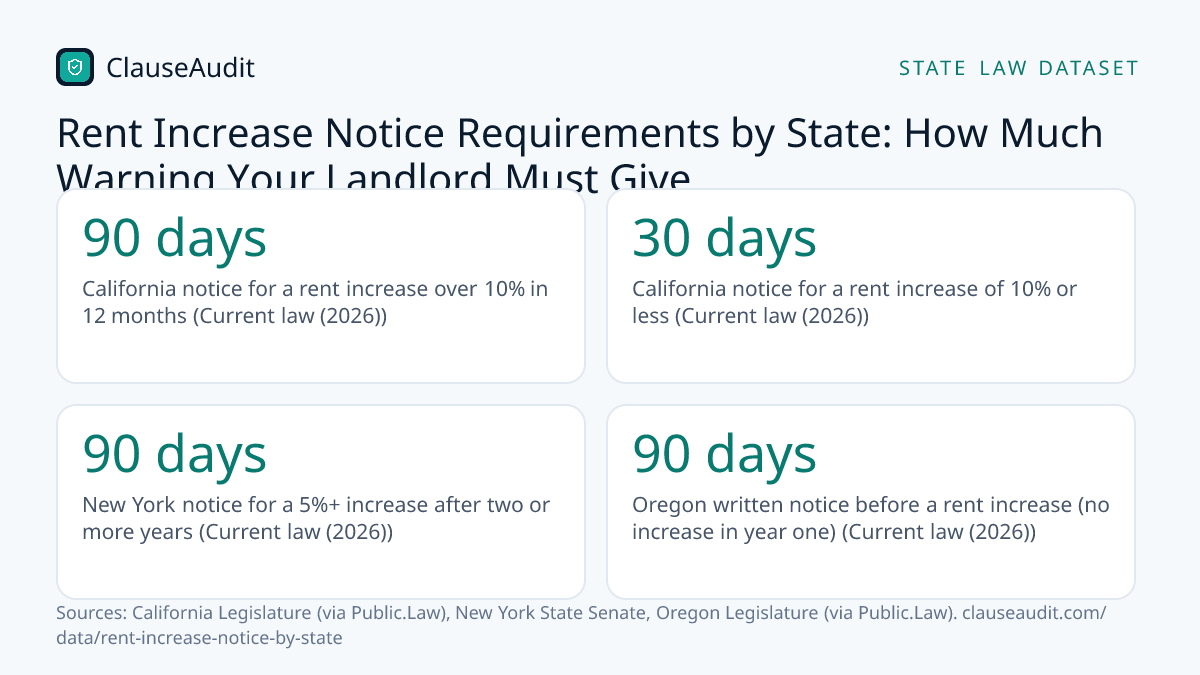
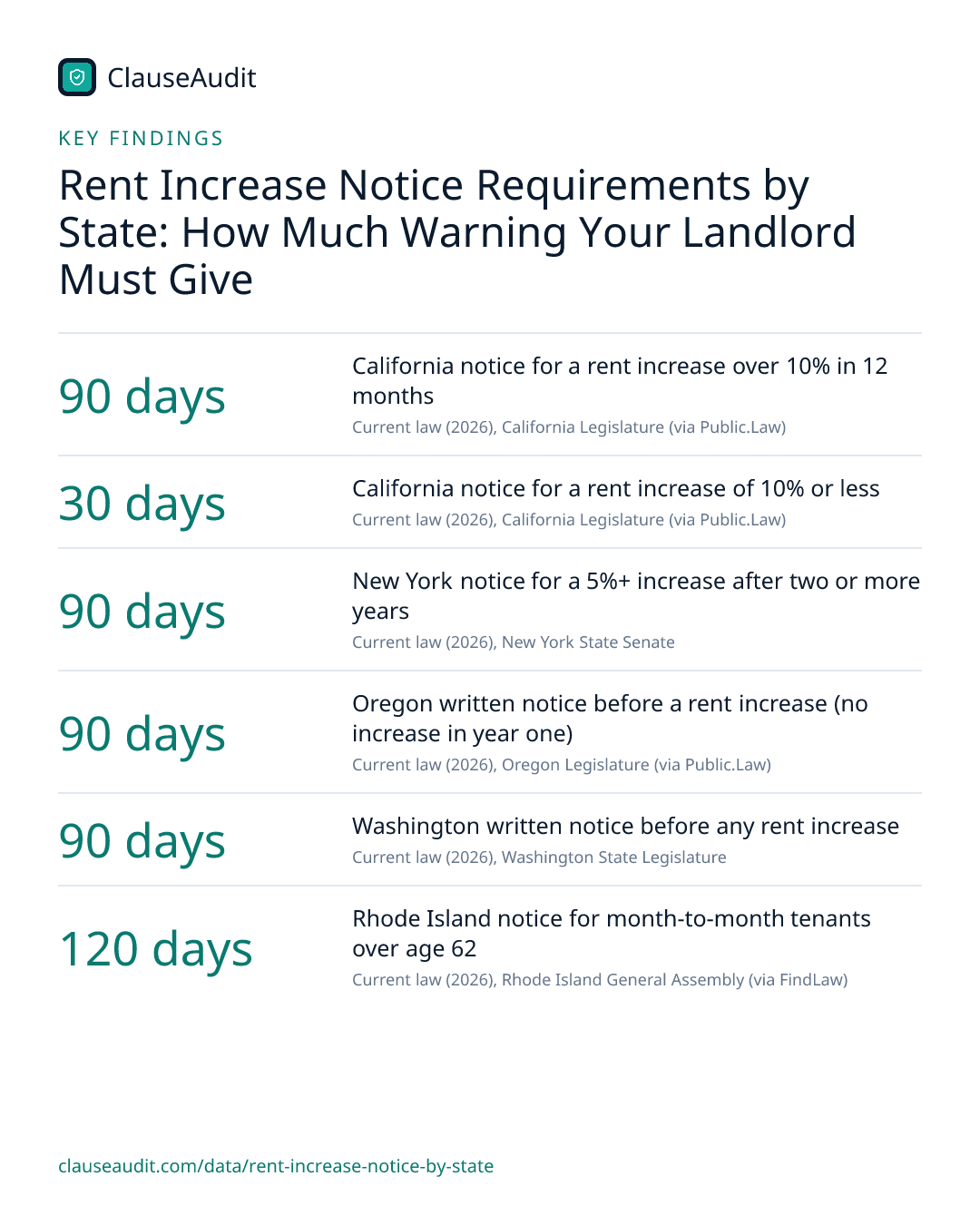
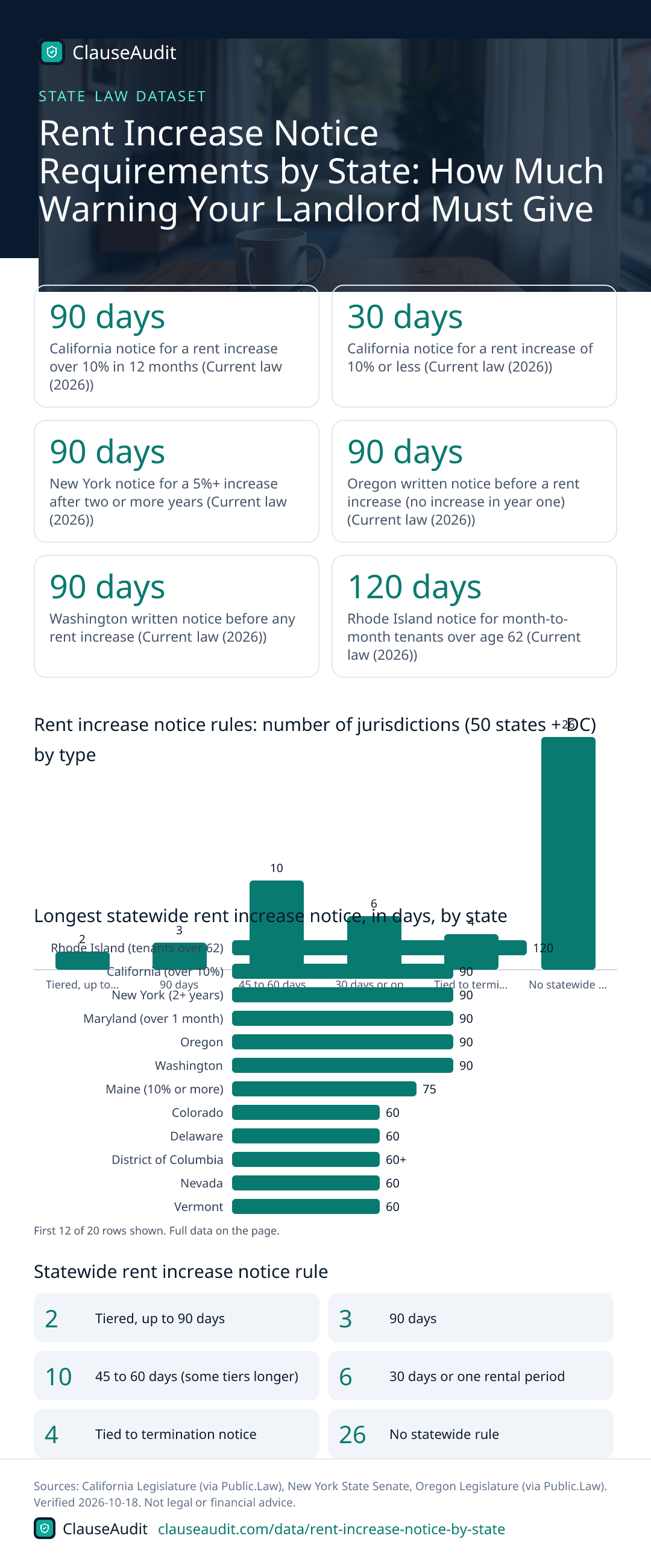
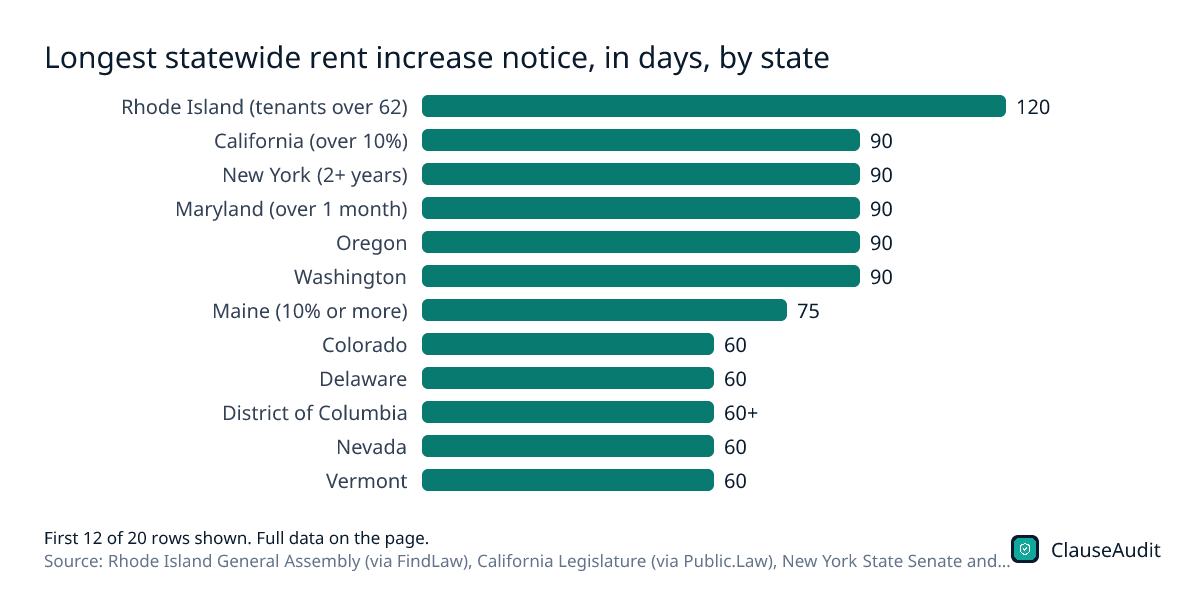
It depends on your state. 26 states have no statewide rule at all, so your lease decides. Where a law exists, the longest notice is 90 days in California (over 10%), New York, Maryland, Oregon and Washington, and Rhode Island requires 120 days for month-to-month tenants over 62.

- California notice for a rent increase over 10% in 12 months (Current law (2026), California Legislature (via Public.Law))
- 90 days
- California notice for a rent increase of 10% or less (Current law (2026), California Legislature (via Public.Law))
- 30 days
- New York notice for a 5%+ increase after two or more years (Current law (2026), New York State Senate)
- 90 days
- Oregon written notice before a rent increase (no increase in year one) (Current law (2026), Oregon Legislature (via Public.Law))
- 90 days
- Washington written notice before any rent increase (Current law (2026), Washington State Legislature)
- 90 days
- Rhode Island notice for month-to-month tenants over age 62 (Current law (2026), Rhode Island General Assembly (via FindLaw))
- 120 days
- Maine notice when rent rises 10% or more (Current law (2026), Maine Legislature)
- 75 days
- Virginia renewal rent-increase notice from July 1, 2027 (larger landlords) (Effective July 1, 2027, Virginia General Assembly)
- 90 days
A rent increase is easy to miss until the letter lands in your mailbox. How much warning you get depends almost entirely on where you rent, and the gap is wide: some states want 90 days or more, some want 30, and many say nothing at all.
The map and table below give you each state's rule. This page explains how to read them, why the size of the increase can change the clock, what happens when your state has no rule, and what to check in your lease before you sign or renew.
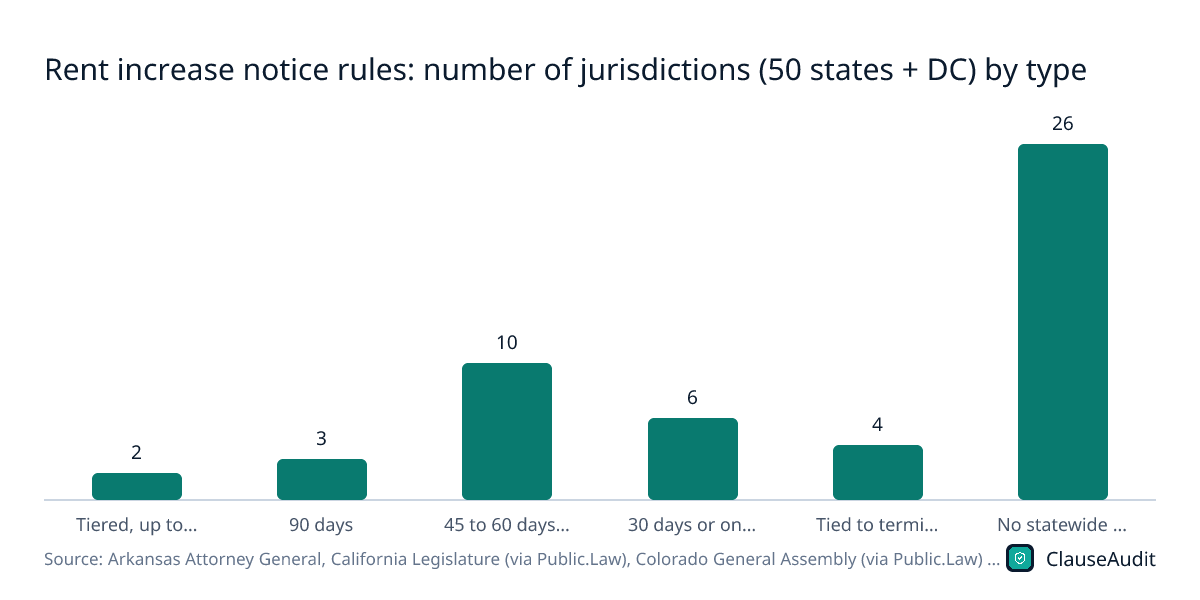
Rent increase notice rules: number of jurisdictions (50 states + DC) by type
Chart data
| Label | Value |
|---|---|
| Tiered, up to 90 days | 2 |
| 90 days | 3 |
| 45 to 60 days (some tiers longer) | 10 |
| 30 days or one rental period | 6 |
| Tied to termination notice | 4 |
| No statewide rule | 26 |
26 states have no statewide rule and leave notice to the lease. Only 5 states have a flat 90-day rule or a tiered rule that tops out at 90 days.
Download this chart (PNG)Longest statewide rent increase notice, in days, by state
Chart data
| Label | Value |
|---|---|
| Rhode Island (tenants over 62) | 120 |
| California (over 10%) | 90 |
| New York (2+ years) | 90 |
| Maryland (over 1 month) | 90 |
| Oregon | 90 |
| Washington | 90 |
| Maine (10% or more) | 75 |
| Colorado | 60 |
| Delaware | 60 |
| District of Columbia | 60+ |
| Nevada | 60 |
| Vermont | 60 |
| Virginia (covered landlords) | 60 |
| Connecticut | 45 |
| Hawaii | 45 |
| Idaho | 30 |
| New Hampshire (restricted property) | 30 |
| New Mexico | 30 |
| North Dakota | 30 |
| South Dakota | 30 |
These are the longest notices each state allows, not the usual ones. California's 90 days applies only to increases over 10%, and Rhode Island's 120 days is reserved for month-to-month tenants over 62.
Download this chart (PNG)New York notice for rent increases of 5% or more, by length of occupancy (days)
Chart data
| Label | Value (days) |
|---|---|
| Under 1 year | 30 |
| 1 to 2 years | 60 |
| 2 years or more | 90 |
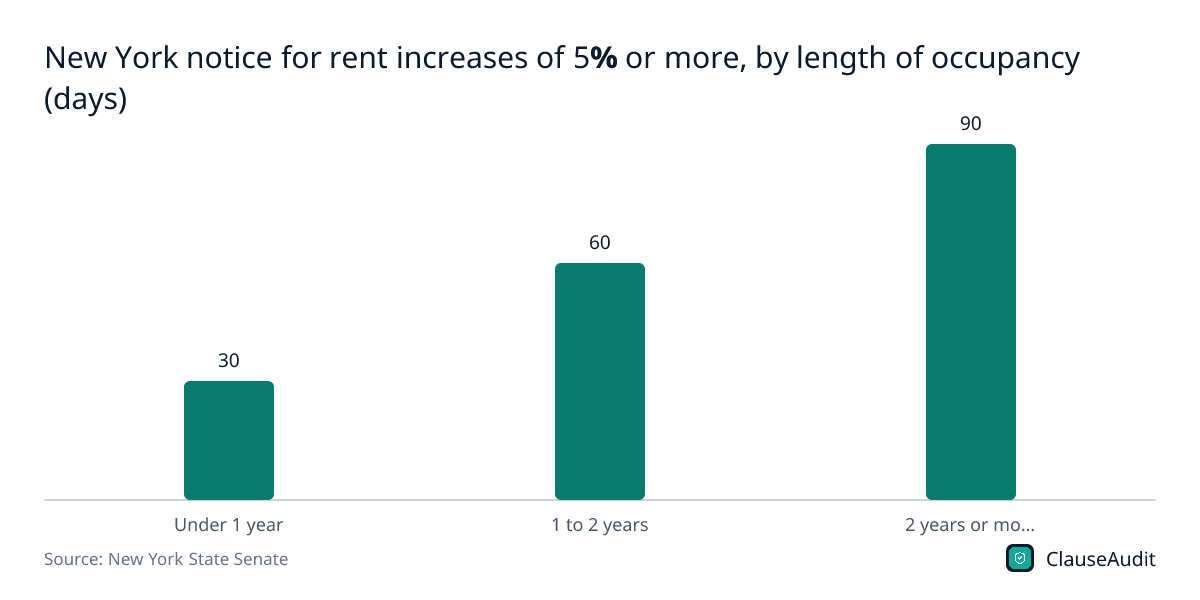
In New York, the longer you have lived in the unit, the more warning you get for an increase of 5% or more. A tenant of 2 years or more gets 90 days, while someone under 1 year gets 30.
Download this chart (PNG)Maryland rent increase notice by tenancy term (days)
Chart data
| Label | Value (days) |
|---|---|
| 1 week or less, written lease | 7 |
| 1 week or less, no written lease | 21 |
| Over 1 week to 1 month | 60 |
| Over 1 month | 90 |
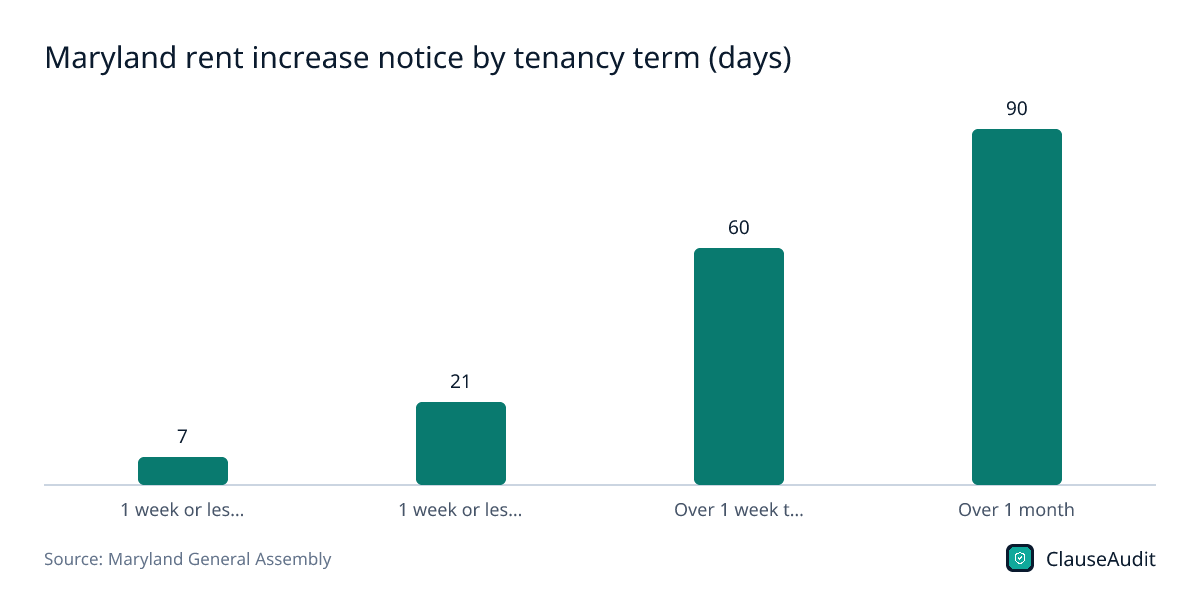
Maryland ties notice to how often rent is paid. A tenancy longer than 1 month gets 90 days, while a weekly tenancy with no written lease gets 21 days.
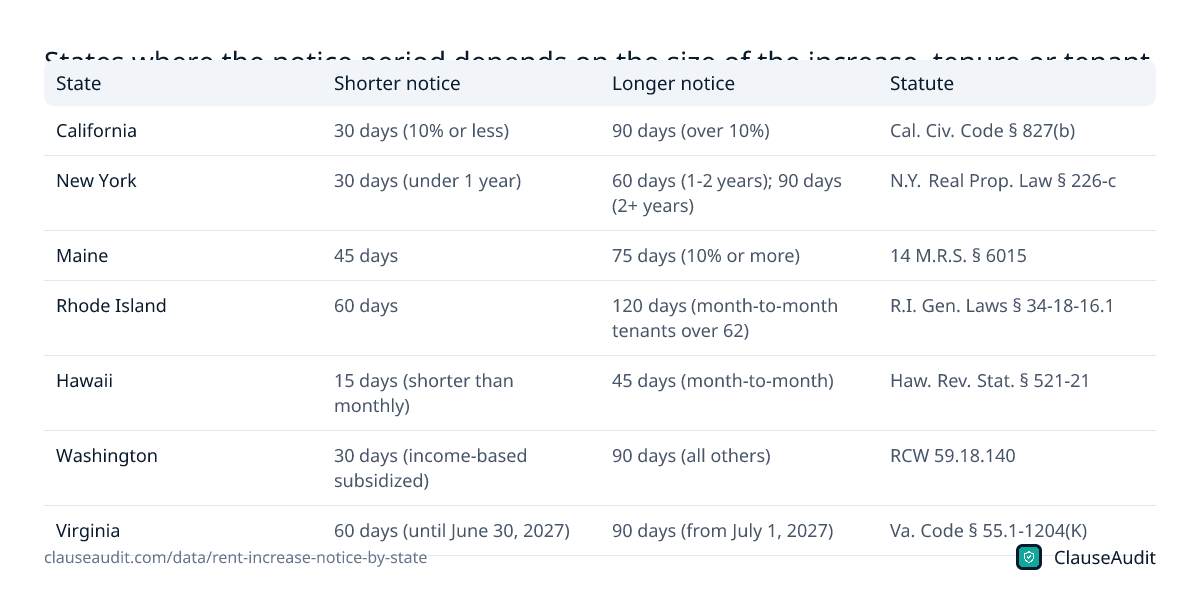
Download this chart (PNG)States where the notice period depends on the size of the increase, tenure or tenant
| State | Shorter notice | Longer notice | Statute |
|---|---|---|---|
| California | 30 days (10% or less) | 90 days (over 10%) | Cal. Civ. Code § 827(b) |
| New York | 30 days (under 1 year) | 60 days (1-2 years); 90 days (2+ years) | N.Y. Real Prop. Law § 226-c |
| Maine | 45 days | 75 days (10% or more) | 14 M.R.S. § 6015 |
| Rhode Island | 60 days | 120 days (month-to-month tenants over 62) | R.I. Gen. Laws § 34-18-16.1 |
| Hawaii | 15 days (shorter than monthly) | 45 days (month-to-month) | Haw. Rev. Stat. § 521-21 |
| Washington | 30 days (income-based subsidized) | 90 days (all others) | RCW 59.18.140 |
| Virginia | 60 days (until June 30, 2027) | 90 days (from July 1, 2027) | Va. Code § 55.1-1204(K) |
Source: California Legislature (via Public.Law), California Civil Code § 827; New York State Senate, N.Y. Real Property Law § 226-c; Maine Legislature, 14 M.R.S. § 6015, Notice of rent increase; Rhode Island General Assembly (via FindLaw), R.I. Gen. Laws § 34-18-16.1; Hawaii State Legislature, Haw. Rev. Stat. § 521-21; Washington State Legislature, RCW 59.18.140; Virginia General Assembly, Va. Code § 55.1-1204. Download as image
Statewide rent increase notice rule by state
- 2Tiered, up to 90 days
- 390 days
- 1045 to 60 days (some tiers longer)
- 630 days or one rental period
- 4Tied to termination notice
- 26No statewide rule
- Tiered, up to 90 days2
- 90 days3
- 45 to 60 days (some tiers longer)10
- 30 days or one rental period6
- Tied to termination notice4
- No statewide rule26
| State | Required notice | Conditions | Source |
|---|---|---|---|
| Alabama | No statewide rule | No statewide rent-increase notice statute; the lease controls, and a month-to-month increase in practice needs the state's termination notice | Ala. Code §§ 35-9A-441, 35-9A-501 (no increase-notice rule) |
| Alaska | No statewide rule | No statewide rent-increase notice statute; the lease controls, and a month-to-month increase in practice needs the state's termination notice | AS 34.03.020, .290, .310 (no increase-notice rule) |
| Arizona | No statewide rule | No statewide rent-increase notice statute; the lease controls, and a month-to-month increase in practice needs the state's termination notice | A.R.S. §§ 33-1314, 33-1329 (no increase-notice rule) |
| Arkansas | At least one rental period | Applies to oral and written leases (Attorney General guidance) | Arkansas Attorney General guidance |
| California | 30 days (increase of 10% or less); 90 days (over 10%) | Measured against the lowest rent charged in the prior 12 months, counting all increases in that period | Cal. Civ. Code § 827(b) |
| Colorado | 60 days (residential, no written agreement) | No more than one increase in any 12-month period of consecutive occupancy; 21 days for some nonresidential tenancies | C.R.S. §§ 38-12-701, 38-12-702 |
| Connecticut | 45 days | One full lease term for leases of 1 month or less; agreements entered into, renewed or extended on or after Oct. 1, 2024 | Conn. Gen. Stat. § 47a-4e |
| Delaware | 60 days before the rental agreement expires | Notice must state the new rent and effective date when renewing with changed terms | 25 Del. C. § 5107 |
| District of Columbia | More than 60 days | Increase takes effect on the first rent due date more than 60 calendar days after notice | D.C. Code § 42-3509.04(b) |
| Florida | No statewide rule | No statewide rent-increase notice statute; the lease controls, and a month-to-month increase in practice needs the state's termination notice | Fla. Stat. § 83.57 (termination only) |
| Georgia | 60 days (tenancy at will, via termination notice) | No separate rent-increase statute; landlord must give 60 days to end a tenancy at will | O.C.G.A. § 44-7-7 |
| Hawaii | 45 days (month-to-month) | 15 days for tenancies shorter than month-to-month | Haw. Rev. Stat. § 521-21(d), (e) |
| Idaho | 30 days | Applies to residential rent increases | Idaho Code § 55-304(2) |
| Illinois | No statewide rule | No statewide rent-increase notice statute; the lease controls, and a month-to-month increase in practice needs the state's termination notice | 735 ILCS 5/9-207 (termination only) |
| Indiana | No statewide rule | No statewide rent-increase notice statute; the lease controls, and a month-to-month increase in practice needs the state's termination notice | IC 32-31-1-1 (no increase-notice rule) |
| Iowa | No statewide rule | No statewide rent-increase notice statute; the lease controls, and a month-to-month increase in practice needs the state's termination notice | Iowa Code §§ 562A.9, 562A.34 (no increase-notice rule) |
| Kansas | No statewide rule | No statewide rent-increase notice statute; the lease controls, and a month-to-month increase in practice needs the state's termination notice | K.S.A. 58-2545, 58-2570 (no increase-notice rule) |
| Kentucky | No statewide rule | No statewide rent-increase notice statute; the lease controls, and a month-to-month increase in practice needs the state's termination notice | KRS 383.565, 383.695 (no increase-notice rule) |
| Louisiana | No statewide rule | No statewide rent-increase notice statute; the lease controls, and a month-to-month increase in practice needs the state's termination notice | La. Civ. Code arts. 2676, 2728 (rent set by the lease) |
| Maine | 45 days; 75 days for an increase of 10% or more | Covers rent and mandatory recurring fees; waivers are void | 14 M.R.S. § 6015 |
| Maryland | 90 days (tenancy over 1 month) | 60 days for tenancies over 1 week up to 1 month; 7 days (written lease) or 21 days (no written lease) for 1 week or less | Md. Code, Real Prop. § 8-209(b)(3) |
| Massachusetts | Rent interval or 30 days, whichever is longer (tenancy at will) | Via the notice to end a tenancy at will; 3 months where rent is paid quarterly or less often | Mass. Gen. Laws ch. 186, § 12 |
| Michigan | No statewide rule | No statewide rent-increase notice statute; the lease controls, and a month-to-month increase in practice needs the state's termination notice | MCL 554.134 (termination only) |
| Minnesota | No shorter than the lease's tenant notice-to-quit period | No fixed day count in state law | Minn. Stat. § 504B.147, subd. 3 |
| Mississippi | No statewide rule | No statewide rent-increase notice statute; the lease controls, and a month-to-month increase in practice needs the state's termination notice | Miss. Code §§ 89-8-17, 89-8-19 (no increase-notice rule) |
| Missouri | No statewide rule | No statewide rent-increase notice statute; the lease controls, and a month-to-month increase in practice needs the state's termination notice | Mo. Rev. Stat. § 441.060 (termination only) |
| Montana | No statewide rule | No statewide rent-increase notice statute; the lease controls, and a month-to-month increase in practice needs the state's termination notice | MCA § 70-24-441 (termination only) |
| Nebraska | No statewide rule | No statewide rent-increase notice statute; the lease controls, and a month-to-month increase in practice needs the state's termination notice | Neb. Rev. Stat. § 76-1437 (60-day rule covers mobile-home parks only) |
| Nevada | 60 days | 30 days for periodic tenancies of less than 1 month | NRS 118A.300 |
| New Hampshire | 30 days (restricted property only) | No general rule for nonrestricted property (e.g., some owner-occupied buildings) | RSA 540:2(IV) |
| New Jersey | No fixed day count | Removal for refusing an increase needs a valid notice to quit plus a separate notice of rent increase; local rent control may add rules | N.J.S.A. 2A:18-61.1(f) |
| New Mexico | 30 days | Before the periodic rental date (month-to-month) or before the end of a fixed term; one rental period for shorter tenancies | N.M. Stat. § 47-8-15(F) |
| New York | 30, 60 or 90 days for increases of 5% or more | 30 days if under 1 year of occupancy; 60 days for 1 to 2 years; 90 days for 2+ years or a 2+ year lease | N.Y. Real Prop. Law § 226-c |
| North Carolina | No statewide rule | No statewide rent-increase notice statute; the lease controls, and a month-to-month increase in practice needs the state's termination notice | N.C. Gen. Stat. § 42-14 (termination only) |
| North Dakota | 30 days before the month ends (month-to-month) | Change takes effect at the end of the month | N.D. Cent. Code § 47-16-07 |
| Ohio | No statewide rule | No statewide rent-increase notice statute; the lease controls, and a month-to-month increase in practice needs the state's termination notice | Ohio Rev. Code § 5321.17 (termination only) |
| Oklahoma | No statewide rule | No statewide rent-increase notice statute; the lease controls, and a month-to-month increase in practice needs the state's termination notice | 41 O.S. § 111 (termination only) |
| Oregon | 90 days | No increase in the first year of the tenancy and no more than once in 12 months; 7 days for week-to-week | ORS 90.323 |
| Pennsylvania | No statewide rule | No statewide rent-increase notice statute; the lease controls, and a month-to-month increase in practice needs the state's termination notice | 68 P.S. § 250.501 (possession notices only) |
| Rhode Island | 60 days; 120 days for month-to-month tenants over 62 | Does not apply to independent living, assisted living or congregate care facilities | R.I. Gen. Laws § 34-18-16.1 |
| South Carolina | No statewide rule | No statewide rent-increase notice statute; the lease controls, and a month-to-month increase in practice needs the state's termination notice | S.C. Code § 27-40-770 (termination only) |
| South Dakota | 30 days before the month ends (month-to-month) | Tenant may end the tenancy by notice within 15 days of receiving the change | SDCL § 43-32-13 |
| Tennessee | No statewide rule | No statewide rent-increase notice statute; the lease controls, and a month-to-month increase in practice needs the state's termination notice | Tenn. Code § 66-28-512 (termination only) |
| Texas | No statewide rule | No statewide rent-increase notice statute; the lease controls, and a month-to-month increase in practice needs the state's termination notice | Tex. Prop. Code (no increase-notice rule; lease controls) |
| Utah | No statewide rule | No statewide rent-increase notice statute; the lease controls, and a month-to-month increase in practice needs the state's termination notice | Utah Code § 57-22-2 (no increase-notice rule) |
| Vermont | 60 days' actual notice | Increase takes effect on the first day of the next rental period after the 60 days | 9 V.S.A. § 4455(b) |
| Virginia | 60 days before lease term ends (90 days from July 1, 2027) | Applies to landlords owning more than four rental units (or over a 10% interest in more than four) | Va. Code § 55.1-1204(K) |
| Washington | 90 days | 30 days for subsidized tenancies where rent is based on income | RCW 59.18.140(3) |
| West Virginia | No statewide rule | No statewide rent-increase notice statute; the lease controls, and a month-to-month increase in practice needs the state's termination notice | W. Va. Code §§ 37-6-5 (termination only) |
| Wisconsin | No statewide rule | No statewide rent-increase notice statute; the lease controls, and a month-to-month increase in practice needs the state's termination notice | Wis. Stat. § 704.19 (termination only) |
| Wyoming | No statewide rule | No statewide rent-increase notice statute; the lease controls, and a month-to-month increase in practice needs the state's termination notice | W.S. § 1-21-1201 (no increase-notice rule) |
How much notice does a landlord have to give before raising rent?
There is no national answer. Federal law does not set a notice period for private rentals, so each state writes its own rule or leaves it to the lease.
Sort the states into rough groups and the picture gets clearer. 3 states (Maryland, Oregon and Washington) set a flat 90 days for most tenancies. 2 more, California and New York, use tiers that top out at 90 days. Another 10 jurisdictions sit between 45 and 60 days, including Colorado, Delaware, Nevada, Vermont, Virginia and DC. 6 require 30 days or one rental period. 4 handle it through the notice needed to end a tenancy. The remaining 26 have no statewide rule.
Read the conditions column, not just the number. Washington's 90 days drops to 30 for subsidized units where rent is based on income. Hawaii gives 45 days to month-to-month tenants but only 15 for shorter tenancies. A single headline figure can hide the rule that actually applies to you.
Does a bigger rent increase mean more notice?
In a handful of states, yes. California is the best-known example. A raise of 10% or less needs 30 days. Anything over 10% needs 90 days. The 10% is measured against the lowest rent charged in the prior 12 months, and every increase in that window counts. So two smaller raises that add up past 10% can trigger the longer notice.
Maine works the same way: 45 days normally, 75 days when rent climbs 10% or more, and the rule covers mandatory recurring fees too, not just base rent. New York only applies its 30, 60 and 90 day tiers to increases of 5% or more, with the clock tied to how long you have lived there.
Some tiers turn on who the tenant or landlord is. Rhode Island gives month-to-month tenants over 62 a full 120 days. Virginia's rule applies only to landlords who own more than four rental units, and their renewal notice rises from 60 days to 90 days on July 1, 2027.
What if my state has no rent increase notice law?
Texas, Florida, Illinois, Pennsylvania, Ohio and many other states have no statewide rent-increase notice statute. That does not mean your landlord can raise rent overnight. It means the rules come from two other places.
First, your lease. If you have a fixed-term lease, the rent is usually locked for the term unless the lease itself allows an increase. If the lease has an escalation clause or a renewal notice clause, that clause controls the timing.
Second, the termination rule. On a month-to-month tenancy, a landlord who wants new rent in practice has to give the same notice needed to end the tenancy, because you can always choose to leave instead of paying more. Check your city too. Local ordinances, especially in rent-control cities, can require more notice than the state.
Can a landlord raise rent in the middle of a lease?
Usually not, unless you agreed to it. A fixed-term lease is a contract for a set rent over a set period. The landlord can propose new rent for the renewal, but changing it mid-term generally needs a clause in the lease that allows it.
That clause is what to look for. Watch for wording like "rent may be adjusted upon notice" or a fee schedule the landlord can update at any time. Those lines turn a fixed lease into something closer to month-to-month.
A few states also limit how often rent can go up. Oregon bars increases during the first year of a tenancy and allows no more than one in 12 months. Colorado also limits residential increases to one in any 12-month period of continuous occupancy.
Why the notice period matters more than the increase
Most renters focus on the new number. The date matters just as much. Notice is the time you have to decide, compare other units, line up movers and, if you move out, give your own notice without overlapping rent on two places.
Run the timeline backward. Say your lease requires you to give notice before moving out, and your landlord gives you only 30 days of warning on new rent. By the time you read the letter, your own deadline may already be close or past. That squeeze is where people end up paying the higher rent for a month or two they never meant to stay.
This hits hardest when income is uneven. A freelance designer waiting on two late invoices, or a contractor between projects, has less room to absorb a jump on short notice. A small business owner who rents a home and works from it faces the same math, with a home office to move as well.
The fix is mostly done at signing. Ask for a renewal notice period that is longer than your own move-out notice, and get the landlord's renewal offer in writing well before your lease ends.
What to do when a rent increase notice arrives
- Count the days. Measure from the day you received the notice to the effective date, then compare it with your state's rule and your lease. If it falls short, the increase may not take effect on that date.
- Check the form. Several states, including Oregon and Washington, require written notice. A text or a verbal heads-up may not count.
- Check the size. In California, Maine and New York, the size of the increase changes the required notice. In California, add up every increase in the past 12 months.
- Look up your city. Local rent-control or just-cause rules can add notice, cap the increase, or both.
- Reply in writing. If you accept, push back or plan to move, put it in an email or letter so there is a dated record.
- Plan for the real deadline. If your income is uneven, as it is for many freelancers and gig workers, a 30-day notice leaves little room to save or find a new place. Ask for a longer runway when you renew.
- Know the limits of this table. These rules cover residential rentals. A commercial lease for a shop or office is usually governed by its own escalation clause, not these statutes.
How ClauseAudit helps
Most rent surprises are written into the lease long before the notice arrives. Our automated lease review reads every clause and flags the ones that let rent or fees change, so you know your real notice window before you sign or renew.
Paste your lease or upload a PDF and you get a plain-English report with a risk score and suggested wording to ask for.
- Rent adjustment or escalation clauses that allow increases during a fixed term
- Renewal and auto-renewal terms, including how much notice you get of new rent
- Fee schedules the landlord can change on notice, such as parking, pet or utility fees
- Late fee amounts and grace periods that kick in if a higher rent strains your budget
- Notice clauses that allow delivery by text, email or posting instead of written notice
- Waivers of state tenant rights, which are often void but still worth flagging
Frequently asked questions
How much notice does a landlord need to give to raise rent?
It depends on the state. The longest statewide notices are 90 days in California (for increases over 10%), New York (after 2 years), Maryland, Oregon and Washington, and 120 days in Rhode Island for month-to-month tenants over 62. Many states sit at 30 to 60 days, and 26 jurisdictions have no statewide rule.
Can my landlord raise the rent without any notice?
Almost never in practice. Even in states with no rent-increase statute, a month-to-month landlord generally has to give the notice required to end the tenancy, and a fixed-term lease usually locks the rent until it ends. A sudden increase with no notice is worth challenging in writing.
How much notice is required in California?
California requires 30 days for an increase of 10% or less and 90 days for an increase over 10%. The 10% is measured against the lowest rent charged in the prior 12 months, counting every increase in that period, so several small raises can add up to the 90-day threshold.
What is the rule in New York?
New York requires notice for increases of 5% or more. You get 30 days if you have lived there under 1 year, 60 days for 1 to 2 years, and 90 days for 2 years or more or on a lease of 2 years or longer.
Does Texas or Florida require notice for a rent increase?
Neither has a statewide rent-increase notice statute. Your lease sets the rules, and on a month-to-month tenancy the landlord in practice needs to give the notice required to end the tenancy. Check your lease for a renewal or rent adjustment clause, since that is where the timing usually lives.
Does the notice have to be in writing?
In several states, yes. Oregon and Washington both require written notice, and Delaware requires the notice to state the new rent and the date it takes effect. Even where the law is silent, ask for the increase in writing so you have a dated record.
Can my landlord raise rent during a fixed-term lease?
Generally only if the lease allows it. A fixed-term lease sets the rent for the whole term. Look for an escalation clause or wording that lets rent change on notice. If none exists, the landlord usually has to wait until renewal to propose new rent.
Do these rules apply to commercial leases?
Mostly no. The statutes on this page cover residential tenancies. Colorado, for example, sets a separate 21 days for some nonresidential tenancies, but most commercial rent increases are governed by the escalation and renewal clauses in the lease itself, so read those closely before you sign.
What if my city has its own rule?
Local law can give you more protection than the state. Rent-control and just-cause cities often require longer notice or cap the size of an increase. If you rent in a large city, check its housing department's rules alongside the state rule shown here.
Use this data
Every chart and card below is free to reuse under CC BY 4.0. Download what you need and link back to this page.
 Stat cards
 Key findings card
 Infographic
 Rent increase notice rules: number of jurisdictions (50 states + DC) by type
 Longest statewide rent increase notice, in days, by state
 New York notice for rent increases of 5% or more, by length of occupancy (days)
 Maryland rent increase notice by tenancy term (days)
 States where the notice period depends on the size of the increase, tenure or tenant
Embed the infographic
Free to share on your site, blog or slides under CC BY 4.0. Please keep the credit link.
Sources and method
Every number on this page comes from the sources below, each opened and read on or before October 18, 2026. A second, independent review checked every figure against its source and corrected anything that did not match. 51 of 51 state entries were confirmed; any that could not be are marked "Not yet confirmed" and left out of every count and chart.
- California Legislature (via Public.Law), California Civil Code § 827 (Accessed 2026-10-18 (current text))
- Colorado General Assembly (via Public.Law), C.R.S. § 38-12-701, Notice of rent increase (Accessed 2026-10-18 (current text))
- Colorado General Assembly (via Public.Law), C.R.S. § 38-12-702, Limit on frequency of residential rent increases (Accessed 2026-10-18 (current text))
- Delaware General Assembly, 25 Del. C. § 5107 (Accessed 2026-10-18 (current text))
- Council of the District of Columbia, D.C. Code § 42-3509.04 (Accessed 2026-10-18 (current text))
- Georgia General Assembly (via FindLaw), O.C.G.A. § 44-7-7 (Accessed 2026-10-18 (current text))
- Hawaii State Legislature, Haw. Rev. Stat. § 521-21 (Accessed 2026-10-18 (current text))
- Maine Legislature, 14 M.R.S. § 6015, Notice of rent increase (Current text as amended by PL 2023, c. 594; accessed 2026-10-18)
- Maryland General Assembly, Md. Code, Real Property § 8-209 (Accessed 2026-10-18 (current text))
- Massachusetts Legislature (via FindLaw), Mass. Gen. Laws ch. 186, § 12 (Accessed 2026-10-18 (current text))
- Minnesota Office of the Revisor of Statutes, Minn. Stat. § 504B.147 (Accessed 2026-10-18 (current text))
- Nevada Legislature (via FindLaw), NRS 118A.300 (Accessed 2026-10-18 (current text))
- New Mexico Legislature (via FindLaw), N.M. Stat. § 47-8-15 (Accessed 2026-10-18 (current text))
- New York State Senate, N.Y. Real Property Law § 226-c (Accessed 2026-10-18 (current text))
- North Dakota Legislative Branch, N.D. Cent. Code § 47-16-07 (Accessed 2026-10-18 (current text))
- Oregon Legislature (via Public.Law), ORS 90.323 (Accessed 2026-10-18 (current text))
- Rhode Island General Assembly (via FindLaw), R.I. Gen. Laws § 34-18-16.1 (As amended by P.L. 2024, chs. 243 and 244; accessed 2026-10-18)
- South Dakota Legislature, SDCL § 43-32-13 (Accessed 2026-10-18 (current text))
- Vermont Legislature (via FindLaw), 9 V.S.A. § 4455 (Accessed 2026-10-18 (current text))
- Virginia General Assembly, Va. Code § 55.1-1204 (Version effective until July 1, 2027 and version effective July 1, 2027; accessed 2026-10-18)
- Washington State Legislature, RCW 59.18.140 (Accessed 2026-10-18 (current text))
- Arkansas Attorney General, Landlord and Tenant Rights (Accessed 2026-10-18 (current text))
- Ezel, Connecticut: Rent Increase Notice Requirements (Conn. Gen. Stat. § 47a-4e) (Statute checked July 12, 2026)
- Ezel, Idaho: Rent Increase Notice Requirements (Idaho Code § 55-304(2)) (Statute checked July 12, 2026)
- Ezel, New Hampshire: Rent Increase Notice Requirements (RSA 540:2(IV)) (Statute checked July 12, 2026)
- Ezel, New Jersey: Rent Increase Notice Requirements (N.J.S.A. 2A:18-61.1(f)) (Statute checked July 12, 2026)
- Ezel, Rent Increase Notice Requirements by State (State entries verified July 12 to October 1, 2026)
Cite this page
ClauseAudit, “Rent Increase Notice Requirements by State: How Much Warning Your Landlord Must Give”, updated October 18, 2026, https://clauseaudit.com/data/rent-increase-notice-by-state. Free to reuse with a link back (CC BY 4.0).
This page summarises published data and law as checked on October 18, 2026. Figures are updated as new editions are released, and your own situation may differ. It is general information, not legal, tax or financial advice.