Landlord Entry Notice Laws by State: How Much Warning You Get
By ClauseAudit Research · Verified against official sources ·
How much notice does a landlord have to give before entering?
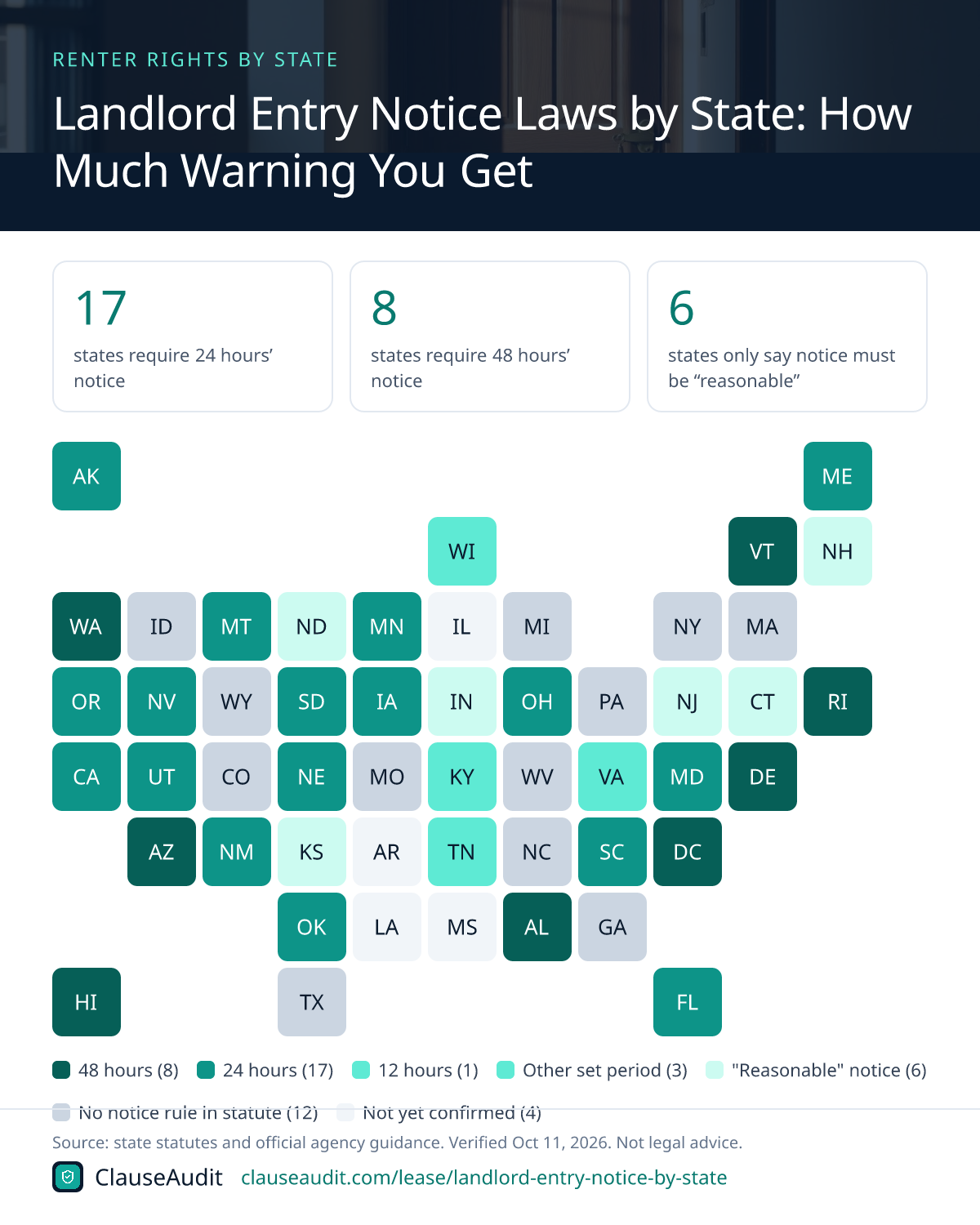
It depends on your state. 17 states set 24 hours, 8 jurisdictions including D.C. set 48 hours, and Wisconsin sets 12. Another 6 only require "reasonable" notice, and 12 have no statutory notice period, so your lease controls. Nearly every state with a rule lets landlords enter without notice in a real emergency.
- states require 24 hours’ notice
- 17
- states require 48 hours’ notice
- 8
- states only say notice must be “reasonable”
- 6
- states set no notice period in statute
- 12
Your landlord owns the building, but you have the right to possession of the unit. Most states square that by letting landlords in for repairs, inspections and showings only after some warning. How much warning varies more than most renters expect.
In Delaware you get 48 hours and a visit only between 8 a.m. and 9 p.m. In Texas, state law says nothing at all, and the lease decides. Below you will find how the rules work, where the exceptions sit, and what to do if someone lets themselves in without asking.
- 48 hours8
- 24 hours17
- 12 hours1
- Other set period3
- "Reasonable" notice6
- No notice rule in statute12
- Not yet confirmed4
Landlord entry notice rules in every state
| State | Notice required | Emergency entry without notice | When entry is allowed | Law |
|---|---|---|---|---|
| Alabama | At least 2 days' notice | Yes | reasonable times | Ala. Code § 35-9A-303 |
| Alaska | At least 24 hours' notice | Yes | reasonable times | Alaska Stat. § 34.03.140 |
| Arizona | At least 2 days' notice | Yes | reasonable times | Ariz. Rev. Stat. § 33-1343 |
| Arkansas | Not yet confirmed: check the statute linked in the sources | Ark. Code Ann. § 18-17-602 | ||
| California | 24 hours' written notice (presumed reasonable); 6 days if mailed | Yes | normal business hours | Cal. Civ. Code § 1954 |
| Colorado | No general statutory notice period (48 hours for bed bug inspection or treatment) | Not stated | Not stated | No general statute; C.R.S. § 38-12-1004 (bed bugs) |
| Connecticut | Reasonable written or oral notice | Yes | reasonable times | Conn. Gen. Stat. § 47a-16 |
| Delaware | At least 48 hours' notice | Yes | 8:00 a.m. to 9:00 p.m. | 25 Del. C. § 5509 |
| District of Columbia | At least 48 hours' written notice | Yes | 9:00 a.m. to 5:00 p.m., not Sundays or federal holidays | D.C. Code § 42-3505.51 |
| Florida | At least 24 hours' notice for repairs; reasonable notice otherwise | Yes | 7:30 a.m. to 8:00 p.m. (repairs) | Fla. Stat. § 83.53 |
| Georgia | No statutory notice period | Not stated | Not stated | No entry statute (O.C.G.A. Title 44, Ch. 7 silent) |
| Hawaii | At least 2 days' notice | Yes | reasonable hours | Haw. Rev. Stat. § 521-53 |
| Idaho | No statutory notice period | Not stated | Not stated | No entry statute (Idaho Code Title 6, Ch. 3 silent) |
| Illinois | Not yet confirmed: check the statute linked in the sources | No statewide statute | ||
| Indiana | Reasonable written or oral notice | Yes | reasonable times | Ind. Code § 32-31-5-6 |
| Iowa | At least 24 hours' notice | Yes | reasonable times | Iowa Code § 562A.19 |
| Kansas | Reasonable notice | Yes | reasonable hours | Kan. Stat. Ann. § 58-2557 |
| Kentucky | At least 2 days' notice, only where URLTA is locally adopted | Yes | reasonable times | Ky. Rev. Stat. § 383.615 |
| Louisiana | Not yet confirmed: check the statute linked in the sources | No entry statute (Civil Code lease articles silent) | ||
| Maine | Reasonable notice; 24 hours presumed reasonable | Yes | reasonable times | Me. Rev. Stat. tit. 14, § 6025 |
| Maryland | At least 24 hours' written notice | Yes | 7:00 a.m. to 7:00 p.m., Monday through Saturday | Md. Code Ann., Real Prop. § 8-221 |
| Massachusetts | No statutory notice period; entry limited to listed purposes | Not stated | Not stated | Mass. Gen. Laws ch. 186, § 15B(1)(a) |
| Michigan | No statutory notice period | Not stated | Not stated | No entry statute |
| Minnesota | Good-faith effort to give at least 24 hours' notice | Yes | 8:00 a.m. to 8:00 p.m. | Minn. Stat. § 504B.211 |
| Mississippi | Not yet confirmed: check the statute linked in the sources | No entry statute | ||
| Missouri | No statutory notice period | Not stated | Not stated | No general entry statute |
| Montana | At least 24 hours' notice | Yes | reasonable times | Mont. Code Ann. § 70-24-312 |
| Nebraska | At least 24 hours' written notice | Yes | reasonable times | Neb. Rev. Stat. § 76-1423 |
| Nevada | At least 24 hours' notice | Yes | reasonable times during normal business hours | Nev. Rev. Stat. § 118A.330 |
| New Hampshire | Notice adequate under the circumstances | Yes | reasonable times | N.H. Rev. Stat. Ann. § 540-A:3 |
| New Jersey | Reasonable notice, ordinarily one day (multiple dwellings) | Yes | Not stated | N.J.A.C. 5:10-5.1(c); N.J.S.A. 2A:39-1 |
| New Mexico | 24 hours' written notice | Yes | reasonable times | N.M. Stat. Ann. § 47-8-24 |
| New York | No statewide statutory notice period | Not stated | Not stated | No statewide entry statute |
| North Carolina | No statutory notice period | Not stated | Not stated | No entry statute (N.C. Gen. Stat. ch. 42 silent) |
| North Dakota | Notice of entry at a specific time; consent presumed if tenant does not object | Yes | reasonable hours | N.D. Cent. Code § 47-16-07.3 |
| Ohio | Reasonable notice; 24 hours presumed reasonable | Yes | reasonable times | Ohio Rev. Code § 5321.04(A)(8) |
| Oklahoma | At least 1 day's notice | Yes | reasonable times | Okla. Stat. tit. 41, § 128 |
| Oregon | At least 24 hours' actual notice | Yes | reasonable times | Or. Rev. Stat. § 90.322 |
| Pennsylvania | No statutory notice period | Not stated | Not stated | No entry statute (Landlord and Tenant Act of 1951 silent) |
| Rhode Island | At least 2 days' notice | Yes | reasonable times | R.I. Gen. Laws § 34-18-26 |
| South Carolina | At least 24 hours' notice | Yes | reasonable times for 24-hour-notice entries; without notice 9 a.m. to 6 p.m. for scheduled services if the lease says so, 8 a.m. to 8 p.m. for tenant-requested services | S.C. Code Ann. § 27-40-530 |
| South Dakota | Reasonable notice; 24 hours' written notice presumed reasonable | Yes | normal business hours | S.D. Codified Laws § 43-32-32 |
| Tennessee | No general notice period (24 hours for showings in last 30 days, if lease allows) | Yes | Not stated | Tenn. Code Ann. § 66-28-403 |
| Texas | No statutory notice period | Not stated | Not stated | No entry statute (Tex. Prop. Code ch. 92 silent) |
| Utah | At least 24 hours' notice unless the lease says otherwise | Not stated | Not stated | Utah Code Ann. § 57-22-4(2) |
| Vermont | At least 48 hours' notice | Yes | 9:00 a.m. to 9:00 p.m. | Vt. Stat. Ann. tit. 9, § 4460 |
| Virginia | Notice of intent to enter; 72 hours for routine maintenance the tenant did not request | Yes | reasonable times | Va. Code Ann. § 55.1-1229(A) |
| Washington | At least 2 days' written notice (1 day for showings) | Yes | reasonable times | Wash. Rev. Code § 59.18.150(6) |
| West Virginia | No statutory notice period | Not stated | Not stated | No entry statute (W. Va. Code ch. 37, art. 6 silent) |
| Wisconsin | At least 12 hours' advance notice | Yes | reasonable times | Wis. Stat. § 704.05(2); Wis. Admin. Code ATCP 134.09(2) |
| Wyoming | No statutory notice period | Not stated | Not stated | No entry-notice statute (Wyo. Stat. §§ 1-21-1201 to -1211 set no notice period; § 1-21-1205(a)(iii) bars renters from unreasonably denying access) |
How much notice does a landlord have to give in my state?
States fall into a few clear groups. The most common rule is 24 hours, used in 17 states including Iowa, Montana, Oregon and Nevada. A smaller group of 8 jurisdictions asks for two full days: Alabama, Arizona, Delaware, Hawaii, Rhode Island, Vermont, Washington and Washington, D.C.
Wisconsin stands alone at 12 hours. A few states set notice in a different way: Virginia requires notice of intent to enter and 72 hours for routine maintenance you did not ask for, while Kentucky's two day rule only applies in places that adopted the uniform landlord tenant act, such as Louisville and Lexington.
Then there are the softer rules. 6 states, such as Connecticut, Indiana and Kansas, say only that notice must be "reasonable" without naming a number of hours. And 12 states, including Texas, Georgia, Michigan, Pennsylvania and North Carolina, have no entry notice statute. There, your lease sets the terms, along with your general right to quiet enjoyment of the home.
The full table on this page lists each state's rule and statute. Of 51 jurisdictions reviewed, 47 were confirmed against statute text or reliable quotations of it.
Does notice have to be in writing, and what counts as reasonable?
Several states define "reasonable" with a presumption. California, Maine, Ohio and South Dakota all treat 24 hours as presumed reasonable. California adds a twist: if your landlord mails the notice, it has to go out six days before the visit.
Written notice is required in some states and optional in others. California, Maryland, New Mexico, Washington and D.C. call for written notice. Connecticut and Indiana accept written or oral notice. Alabama and Montana let a landlord post the notice on your main door.
Some states also say what the notice must contain. Maryland's rule, in effect since October 1, 2025, requires the date, time and purpose. New Mexico wants the purpose, date and expected time. Washington's notice must include the time window and a phone number you can call.
In states with only a reasonableness standard, there is no hour count to point to. Asking in writing for at least a day's notice gives you and your landlord a clear standard.
What hours can a landlord enter?
Say your landlord wants to check the smoke detectors on a Tuesday afternoon. In Washington, they need to give you written notice two days ahead, with a time window and a phone number. In Minnesota, they must make a good-faith effort to give 24 hours' notice and arrive between 8 a.m. and 8 p.m.
Now move the same visit to North Dakota. There, the landlord tells you a specific time during reasonable hours, and if you do not object, the law treats your silence as consent. In Missouri, with no entry statute, the answer sits entirely in your lease.
South Carolina layers its rules. A routine visit needs 24 hours' notice. If you asked for the service, the work may happen between 8 a.m. and 8 p.m., and scheduled routine services may run 9 a.m. to 6 p.m. when the lease provides for them. The same building can be on three clocks at once.
Most statutes just say "reasonable times." A handful get specific, and those limits matter as much as the notice period:
- Delaware: 8 a.m. to 9 p.m.
- Washington, D.C.: 9 a.m. to 5 p.m., never on Sundays or federal holidays, unless you agree otherwise
- Florida: 7:30 a.m. to 8 p.m. for repair visits
- Maryland: 7 a.m. to 7 p.m., Monday through Saturday
- Minnesota: 8 a.m. to 8 p.m., unless you agree otherwise
- Vermont: 9 a.m. to 9 p.m.
- California, Nevada and South Dakota: normal business hours
Can a landlord enter without notice in an emergency?
Yes, in almost every state that has an entry rule. A burst pipe, a gas smell or a fire lets the landlord in without the usual warning. Some states use tighter language than "emergency." Kansas allows entry without consent for an extreme hazard to life or property, and Vermont speaks of imminent danger.
Other exceptions show up too. In Arizona, a repair request from you counts as permission for that work. Oregon gives the landlord seven days of access after your written repair request, and New Mexico exempts entries tied to a repair request made in the past week. Rhode Island allows entry when you have been away more than seven days, and Wisconsin allows it to protect a unit that appears empty.
Utah is an outlier worth knowing. Its 24 hour rule applies unless the rental agreement says otherwise, so a lease can shorten or change it. Read the access clause before you sign.
What should I do if my landlord enters without notice?
Start calmly, and build a record as you go. A polite note that cites the rule is often enough to reset expectations.
- Write down each entry: date, time, who came in, and how you know. Save texts, doorbell or camera footage, and statements from neighbors.
- Check your lease's access clause and your state's rule in the table above. If your state has no statute, the lease is the standard you hold the landlord to.
- Send a short, dated written request asking for advance notice that meets your state's rule. Cite the statute by number. Keep a copy.
- If entries continue, contact your local housing agency, a tenant union or legal aid office. Cities often add rules of their own: Chicago and New York City both have local requirements beyond state law.
- For repeated or harassing entries, talk to a local tenant attorney about remedies. Do not change the locks or withhold rent on your own without advice, since that can put your tenancy at risk.
Is there a federal rule on landlord entry?
For most private rentals, no. Entry notice is a matter of state and local law. Public housing is the exception. Federal rules for public housing agencies require the lease to spell out when the agency may enter. Written notice at least two days ahead counts as reasonable for routine inspections, maintenance and showings, under 24 C.F.R. § 966.4(j).
Those same rules let the agency enter without notice when there is reasonable cause to believe an emergency exists. If no adult is home during an entry, the agency must leave a written statement giving the date, time and purpose of the visit. That last detail is a good model to ask for in any lease.
Lease clauses about access to look for before you sign
The access clause tells you how your landlord reads the law. In the 12 states with no notice statute, it is usually the main rule you get. Look for a stated notice period, the method of notice, and hours. A clause allowing entry "at any time" or "without notice" deserves a question, especially in a state with a statute that says otherwise.
Massachusetts shows how a statute can limit the clause itself: a lease there may only allow entry to inspect, repair, show the unit, under court order, or if the unit appears abandoned. Asking for 24 hours' written notice and daytime visits is a modest, common request even where the law is silent. Many standard Texas leases already require 24 hours' notice.
Frequently asked questions
Can my landlord enter without telling me?
Only in limited cases. In states with an entry statute, a landlord generally needs advance notice unless there is an emergency, you consent, or another listed exception applies, such as a repair you requested. In states with no statute, the lease governs, but you still have a right to quiet enjoyment of your home.
Is 24 hours' notice required in every state?
No. Twenty-four hours is the most common rule, used in 17 states, but 8 jurisdictions, counting D.C., require two days and Wisconsin requires 12 hours. Some states only say notice must be reasonable, and 12 have no statutory notice period, which leaves it to your lease.
Does a landlord's notice have to be in writing?
In some states, yes. California, Maryland, New Mexico, Washington and Washington, D.C. call for written notice. Connecticut and Indiana accept written or oral notice. Alabama and Montana allow a notice posted on the main door. Check your lease too, since it may require written notice even where the statute does not.
Can a landlord show my apartment to new tenants?
Usually, yes, with proper notice. Showings are a standard purpose for entry in most statutes. Washington allows one day's notice for showings instead of the usual two. In Tennessee's covered counties, showings in the last 30 days of a lease need 24 hours' notice if the lease allows them.
What is considered an emergency for landlord entry?
Think fire, flooding, a gas leak or anything posing an immediate threat to people or the building. Some statutes use narrower words: Kansas refers to an extreme hazard to life or property, and Vermont to imminent danger. A routine repair or a scheduled inspection is not an emergency.
Can my landlord enter if I am not home?
Generally yes, if proper notice was given and the visit falls within allowed hours. Your presence is not usually required. Some states also allow entry during long absences, such as Rhode Island when a tenant has been away more than seven days. Ask that your landlord leave a note describing what was done.
What can I do if my landlord keeps entering without notice?
Document every entry, send a dated written request citing your state's rule, and keep copies. If it continues, contact a local housing agency, tenant union or legal aid office. A tenant attorney can explain remedies under your state's law. Avoid self-help steps like changing locks without advice.
Can a lease waive my right to entry notice?
It depends on the state. Utah's 24 hour rule applies unless the rental agreement says otherwise, so the lease can change it. In states with a fixed rule, a clause giving the landlord unlimited access may conflict with the statute. Have the access clause checked before signing.
Check the access clause in your lease
Upload your lease and see whether its entry, notice and access terms match your state's rules, along with deposit, late fee and other clauses that may not hold up.
Review my leaseUse this infographic
Free to share on your site, blog or slides under CC BY 4.0. Please keep the credit link.
How we built this data
We built this dataset from the law in each state, then had a second, independent review re-check every entry against primary sources and correct anything that did not match. Each row links to its source.
Of the 51 entries, 39 were confirmed directly against the statute itself or the state agency that enforces it. 8 rest on several secondary sources that agree, usually because the official site could not be reached or because there is no statute to read where the answer is that no law exists. 4 could not be confirmed; they are marked "Not yet confirmed" in the table and left out of every count and chart. Data verified on October 11, 2026.
Sources
- Alabama: Alabama Legislature, Code of Alabama
- Alaska: Alaska Legislature, Alaska Statutes
- Arizona: Arizona State Legislature, Arizona Revised Statutes
- Arkansas: Arkansas Code of 1987, free public access hosted by LexisNexis for the State of Arkansas, § 18-17-602
- California: California Legislative Information, Civil Code
- Colorado: C.R.S. § 38-12-1004 via colorado.public.law (official text at leg.colorado.gov)
- Connecticut: Connecticut General Assembly, General Statutes
- Delaware: Delaware Code Online, Title 25, Chapter 55
- District of Columbia: Council of the District of Columbia, D.C. Code
- Florida: Florida Legislature, Online Sunshine
- Georgia: Georgia Department of Community Affairs, Georgia Landlord-Tenant Handbook (revised 8-29-24)
- Hawaii: Hawaii State Legislature, Hawaii Revised Statutes
- Idaho: Idaho Attorney General, Landlord and Tenant Manual (July 2026)
- Illinois: Third-party survey (ezel.ai); no government source confirmed
- Indiana: Indiana General Assembly, Indiana Code Title 32 (IC 32-31-5-6)
- Iowa: Iowa Legislature, Iowa Code 2026
- Kansas: Kansas Office of Revisor of Statutes
- Kentucky: Kentucky General Assembly, KRS 383.615
- Louisiana: Third-party survey (ezel.ai); no government source confirmed
- Maine: Maine Legislature, Maine Revised Statutes
- Maryland: Maryland General Assembly, Statutes Text
- Massachusetts: Massachusetts Legislature, General Laws
- Michigan: Michigan Legislature
- Minnesota: Minnesota Office of the Revisor of Statutes
- Mississippi: Third-party survey (ezel.ai); no government source confirmed
- Missouri: Missouri Revisor of Statutes
- Montana: Montana Legislature, Montana Code Annotated 2025
- Nebraska: Nebraska Legislature, Revised Statutes
- Nevada: Nevada Legislature, Nevada Revised Statutes
- New Hampshire: New Hampshire General Court, RSA
- New Jersey: New Jersey Department of Community Affairs, Right of Entry bulletin
- New Mexico: NMOneSource, New Mexico Statutes Annotated 1978 (official), § 47-8-24
- New York: New York State Attorney General
- North Carolina: North Carolina General Assembly
- North Dakota: North Dakota Legislative Branch, Century Code
- Ohio: Ohio Laws and Administrative Rules
- Oklahoma: Oklahoma State Senate, Oklahoma Statutes Title 41 compilation (PDF), § 41-128(C)
- Oregon: Oregon State Legislature, ORS Chapter 90
- Pennsylvania: Pennsylvania General Assembly, Landlord and Tenant Act of 1951 (Act 20)
- Rhode Island: Rhode Island General Assembly, General Laws
- South Carolina: South Carolina Legislature, Code of Laws Title 27 Ch. 40
- South Dakota: South Dakota Legislature, Codified Laws
- Tennessee: Tennessee Code Annotated, free public access hosted by LexisNexis for the State of Tennessee, § 66-28-403
- Texas: Texas Legislature, Property Code Chapter 92
- Utah: Utah State Legislature, Utah Code
- Vermont: Vermont General Assembly, Vermont Statutes Online
- Virginia: Virginia Law, Code of Virginia
- Washington: Washington State Legislature, RCW
- West Virginia: West Virginia Legislature, W. Va. Code Chapter 37, Article 6
- Wisconsin: Wisconsin Legislature, Administrative Code ATCP 134
- Wyoming: Wyoming Legislature, Wyoming Statutes Title 1 (official PDF)
Cite this data
ClauseAudit, “Landlord Entry Notice Laws by State: How Much Warning You Get”, updated October 11, 2026, https://clauseaudit.com/lease/landlord-entry-notice-by-state. Free to reuse with a link back (CC BY 4.0).
This page summarises the law as verified on October 11, 2026. Laws change, cities and counties can add their own rules, and the details of your situation matter. It is general information, not legal advice.