Rent Late Fee Laws by State: Caps, Grace Periods and What Counts as Reasonable
By ClauseAudit Research · Verified against official sources ·
How much can a landlord charge for a late rent fee?
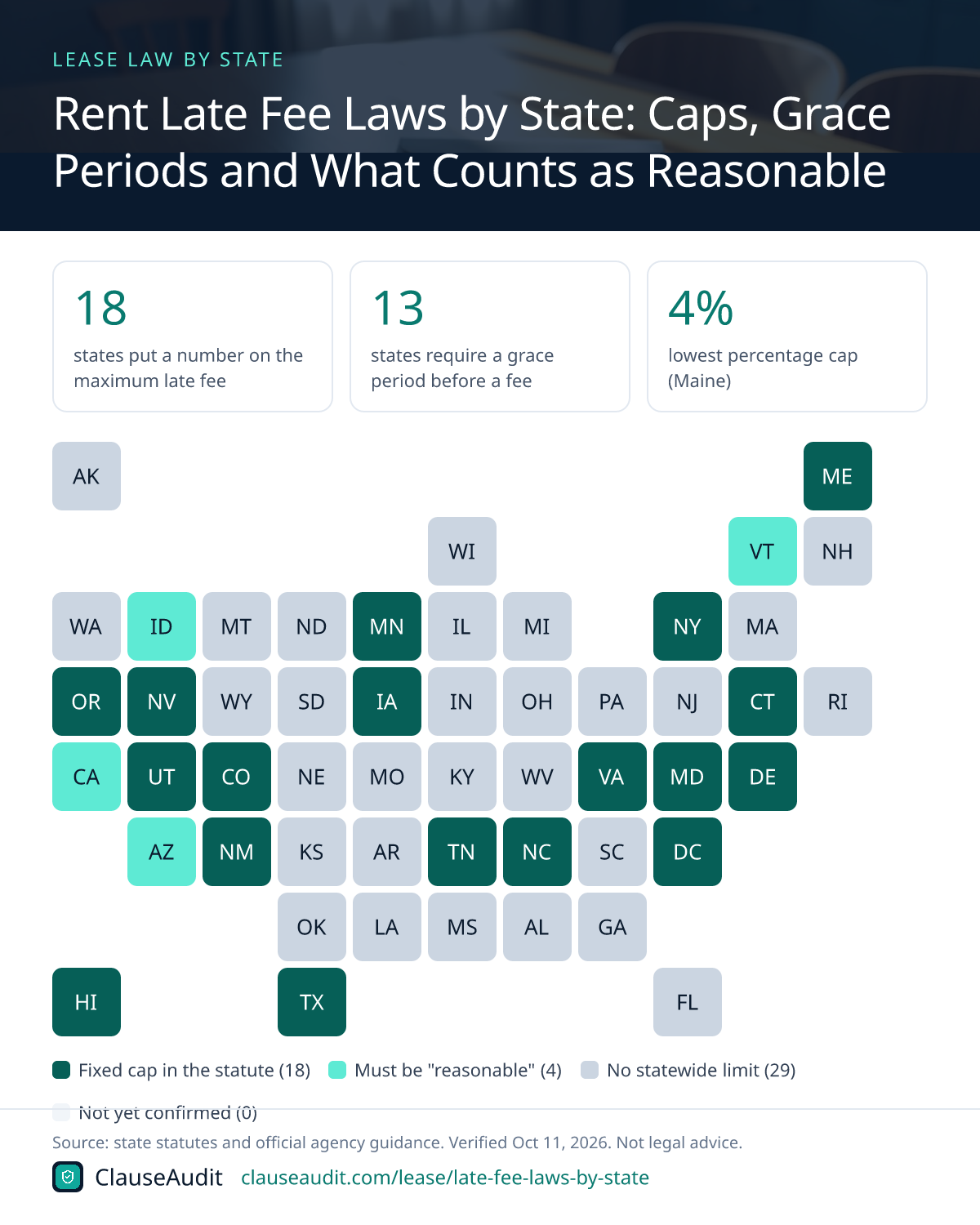
It depends on your state. 18 states, counting DC, set a hard cap, usually 5% of rent, ranging from 4% in Maine to a 12% safe harbor in Texas. 4 more require the fee to be reasonable. The other 29 set no statewide limit, so your lease and court review for unfair penalties control.

- states put a number on the maximum late fee
- 18
- states require a grace period before a fee
- 13
- lowest percentage cap (Maine)
- 4%
- states set no statewide limit
- 29
A late fee is the one lease clause almost every tenant triggers at some point. Pay rent a week late in New York and the most you can owe is $50 or 5% of the rent, whichever is less. Pay three days late there and you owe no fee at all. Do the same in Florida and the answer is whatever your lease says, as long as a court would not call it a penalty.
This page sorts out where your state falls. We checked each rule against the statute and recent bill records, verified it a second time and flagged the rules that changed in 2025 and 2026. The map and full table below show every state. The sections here explain how the rules work, where tenants get tripped up and what to do if your fee looks too high.
- Fixed cap in the statute18
- Must be "reasonable"4
- No statewide limit29
- Not yet confirmed0
Percentage caps on rent late fees
Late fee limits and grace periods in every state
| State | Maximum late fee | Grace period | Law |
|---|---|---|---|
| Alabama | No statutory cap | None required by statute; the lease controls | Ala. Code §§ 35-9A-143, 35-9A-161 (Alabama Uniform Residential Landlord and Tenant Act) |
| Alaska | No statutory cap | None required by statute; the lease controls | Alaska Stat. ch. 34.03 (Uniform Residential Landlord and Tenant Act) |
| Arizona | A reasonable late fee set forth in a written rental agreement | None required by statute; the lease controls | Ariz. Rev. Stat. § 33-1368(B) |
| Arkansas | No statutory cap | None required by statute; the lease controls | Ark. Code Ann. tit. 18, ch. 17 (Arkansas Residential Landlord-Tenant Act of 2007) |
| California | No fixed cap; a late fee is valid only if it is a reasonable estimate of the landlord's actual loss | None required by statute; the lease controls | Cal. Civ. Code § 1671(c)(2), (d); Orozco v. Casimiro, 121 Cal. App. 4th Supp. 7 (2004) |
| Colorado | Greater of $50 or 5% of the past due rent payment | No fee until rent is at least 7 calendar days late | Colo. Rev. Stat. § 38-12-105 |
| Connecticut | Lesser of $5 per day up to $50, or 5% of the delinquent rent payment | 9 days for monthly rent; 4 days for week to week; plus 5 more days if the landlord's own online payment system blocked payment | Conn. Gen. Stat. § 47a-15a |
| Delaware | 5% of monthly rent | No late charge within 5 days of the due date; 3 extra days if the landlord has no payment office in the county | 25 Del. C. § 5501(d) |
| District of Columbia | 5% of the full amount of rent due | Fee allowed only if rent is unpaid more than 5 days, or any longer lease grace period | D.C. Code § 42-3505.31 |
| Florida | No statutory cap | None required by statute; the lease controls | Fla. Stat. ch. 83, Part II (§§ 83.40-83.683) |
| Georgia | No statutory cap | None required by statute; the lease controls | O.C.G.A. tit. 44, ch. 7; O.C.G.A. § 13-6-7 (liquidated damages) |
| Hawaii | 8% of the amount of rent due | None required by statute; the lease controls | Haw. Rev. Stat. § 521-21(f) |
| Idaho | Fees, including late fees, must be reasonable; no dollar or percent cap | None required by statute; the lease controls | Idaho Code § 55-305 (added 2023 as § 55-314 by S.B. 1039, 2023 ch. 67; redesignated § 55-305 by 2025 ch. 65, § 14) |
| Illinois | No statutory cap | None required by statute; the lease controls | 765 ILCS 705 (Landlord and Tenant Act); HB 3564 (2026) effective Jan. 1, 2027 |
| Indiana | No statutory cap | None required by statute; the lease controls | Ind. Code tit. 32, art. 31 |
| Iowa | Rent up to $700: $12 per day, max $60 per month. Rent over $700: $20 per day, max $100 per month | None required by statute; the lease controls | Iowa Code § 562A.9(4) |
| Kansas | No statutory cap | None required by statute; the lease controls | Kan. Stat. Ann. § 58-2540 et seq. (Residential Landlord and Tenant Act) |
| Kentucky | No statutory cap | None required by statute; the lease controls | Ky. Rev. Stat. ch. 383 (URLTA, KRS 383.500-383.705, applies only where locally adopted) |
| Louisiana | No statutory cap | None required by statute; the lease controls | La. Civ. Code arts. 2668 et seq. (lease); arts. 2005-2012 (stipulated damages) |
| Maine | 4% of one month's rent | Rent is late only if not paid within 15 days of the due date | 14 M.R.S. § 6028 |
| Maryland | 5% of the unpaid rent due for the late rental period; weekly leases: $3 per week, $12 per month | None required by statute; the lease controls | Md. Code, Real Prop. § 8-208(d)(3) |
| Massachusetts | No statutory dollar or percent cap | No late fee or interest until rent is 30 days overdue | Mass. Gen. Laws ch. 186, § 15B(1)(c) |
| Michigan | No statutory cap | None required by statute; the lease controls | Mich. Comp. Laws §§ 554.601 et seq., 554.631 et seq. |
| Minnesota | 8% of the overdue rent payment | None in statute; the written lease must state when a late fee applies | Minn. Stat. § 504B.177 |
| Mississippi | No statutory cap | None required by statute; the lease controls | Miss. Code Ann. tit. 89, ch. 8 (Residential Landlord and Tenant Act) |
| Missouri | No statutory cap | None required by statute; the lease controls | Mo. Rev. Stat. chs. 441, 535 |
| Montana | No statutory cap | None required by statute; the lease controls | Mont. Code Ann. tit. 70, ch. 24 (Residential Landlord and Tenant Act of 1977) |
| Nebraska | No statutory cap | None required by statute; the lease controls | Neb. Rev. Stat. §§ 76-1401 to 76-1449 (Uniform Residential Landlord and Tenant Act) |
| Nevada | Reasonable late fee not exceeding 5% of the periodic rent | No fee until at least 3 calendar days after rent is due (tenancies longer than week to week) | Nev. Rev. Stat. § 118A.210 |
| New Hampshire | No statutory cap | None required by statute; the lease controls | N.H. Rev. Stat. Ann. chs. 540, 540-A |
| New Jersey | No statutory cap | 5 business days, only for tenants receiving Social Security, SSI, SSDI or certain other government benefits or pensions | N.J.S.A. 2A:42-6.1 to 6.3 |
| New Mexico | 5% of the rent for each rental period in default | None in statute; owner must give notice of the fee by the last day of the next rental period | N.M. Stat. Ann. § 47-8-15(D), as amended by 2025 N.M. Laws ch. 122 (SB 267) |
| New York | Lesser of $50 or 5% of monthly rent | No fee unless rent is unpaid 5 days after the due date | N.Y. Real Prop. Law § 238-a(2) |
| North Carolina | Monthly rent: greater of $15 or 5% of monthly rent. Weekly rent: greater of $4 or 5% of weekly rent | No fee until rent is 5 days past due | N.C. Gen. Stat. § 42-46(a) |
| North Dakota | No statutory cap | None required by statute; the lease controls | N.D. Cent. Code ch. 47-16 |
| Ohio | No statutory cap | None required by statute; the lease controls | Ohio Rev. Code ch. 5321 |
| Oklahoma | No statutory cap | None required by statute; the lease controls | Okla. Stat. tit. 41, §§ 101-136 (Residential Landlord and Tenant Act) |
| Oregon | One of: a reasonable flat fee once per period; a daily fee up to 6% of that flat fee; or 5% of periodic rent per 5 day period | Fee only if rent is not received by the 4th day of the rental period, so charges start on day 5 | Or. Rev. Stat. § 90.260 |
| Pennsylvania | No statutory cap | None required by statute; the lease controls | Landlord and Tenant Act of 1951, 68 P.S. § 250.101 et seq. |
| Rhode Island | No statutory cap | None required by statute; the lease controls | R.I. Gen. Laws ch. 34-18 (Residential Landlord and Tenant Act) |
| South Carolina | No statutory cap | None required by statute; the lease controls | S.C. Code Ann. tit. 27, ch. 40 (Residential Landlord and Tenant Act) |
| South Dakota | No statutory cap | None required by statute; the lease controls | S.D. Codified Laws ch. 43-32 |
| Tennessee | 10% of the amount of rent past due (counties covered by the URLTA) | No fee until 5 days after rent is due, counting the due date; extends to next business day if day 5 is a Sunday or legal holiday | Tenn. Code Ann. § 66-28-201(d); § 66-28-102 (coverage) |
| Texas | Presumed reasonable up to 12% of monthly rent (buildings of 4 units or fewer) or 10% (more than 4 units); higher only if not more than uncertain damages related to the late payment | No fee unless rent remains unpaid 2 full days after the due date | Tex. Prop. Code § 92.019 |
| Utah | Greater of 10% of the rent agreed to in the rental agreement or $75 | None required by statute; the lease controls | Utah Code Ann. § 57-22-4(5) |
| Vermont | No statutory cap; case law requires a late fee to be a reasonable estimate of the landlord's actual damages | None required by statute; the lease controls | 9 V.S.A. ch. 137; Highgate Associates, Ltd. v. Merryfield, 157 Vt. 313 (1991) |
| Virginia | Lesser of 10% of the periodic rent or 10% of the remaining balance due | None for written leases; without a written agreement, rent is late after the 5th of the month | Va. Code Ann. § 55.1-1204(E) |
| Washington | No statewide dollar or percent cap | No late fee for rent paid within 5 days of the due date | Rev. Code Wash. § 59.18.170(2) |
| West Virginia | No statutory cap | None required by statute; the lease controls | W. Va. Code chs. 37-6, 37-6A |
| Wisconsin | No statutory cap | None required by statute; the lease controls | Wis. Admin. Code ATCP 134.09(8) |
| Wyoming | No statutory cap | None required by statute; the lease controls | Wyo. Stat. Ann. §§ 1-21-1201 to 1-21-1211 |
How do rent late fee laws work?
State late fee rules come in three flavors. The strictest put a number in the statute. Delaware caps the fee at 5% of monthly rent. Hawaii and Minnesota allow up to 8%. Iowa uses dollar amounts instead: $12 a day up to $60 a month when rent is $700 or less, and $20 a day up to $100 a month above that.
Some states mix the two. Colorado lets a landlord charge the greater of $50 or 5% of the past due amount. Connecticut flips it, allowing the lesser of $5 a day up to $50, or 5% of the delinquent payment. Utah allows the greater of 10% of rent or $75.
The second group has no number at all, only a standard. Arizona allows "a reasonable late fee" written into the lease. California treats a late fee as valid only when it is a reasonable estimate of the landlord's actual loss, under Civil Code § 1671. Idaho added a reasonableness rule in 2023.
Everywhere else, the statute is silent. That does not mean anything goes. Courts in Georgia, Louisiana, Michigan and other silent states can still throw out a fee that works as a penalty instead of a fair estimate of what late payment costs the landlord.
What is a grace period, and does your state require one?
A grace period is the stretch after the due date when rent is technically late but no fee can be charged. 13 states, counting DC, require one by law. The lengths vary a lot.
- Texas: no fee unless rent is still unpaid 2 full days after the due date.
- Nevada: no fee until at least 3 calendar days after rent is due.
- New York, North Carolina, Delaware, DC and Washington: 5 days.
- Tennessee: 5 days counting the due date, pushed to the next business day if day 5 is a Sunday or legal holiday. This applies only in counties covered by the state's landlord tenant act.
- Colorado: 7 calendar days.
- Connecticut: 9 days for monthly rent, 4 for week to week.
- Oregon: no fee unless rent is still unpaid on the 4th day of the rental period, so charges start on day 5.
- Maine: 15 days.
- Massachusetts: 30 days, and the lease cannot waive it.
What counts as a "reasonable" late fee?
In states without a fixed cap, the test is usually whether the fee is a fair guess at what late rent actually costs the landlord. Think bank charges, extra bookkeeping, the time spent chasing payment. A fee that looks designed to punish rather than compensate is the kind courts strike down.
California is the clearest example. There is no 4% or 6% cap there, despite what some landlord blogs claim. A 2025 bill that proposed limits, AB 1248, did not pass. So a California late fee stands or falls on whether it reasonably estimates the landlord's loss.
Vermont gets to the same place through case law. Its Supreme Court held in Highgate Associates v. Merryfield (1991) that a late fee must reasonably match actual damages. Massachusetts courts apply a similar test on top of the 30 day rule.
A practical way to judge your own fee: compare it to the caps in states that have one. Most fixed caps sit at 5% of rent, and the highest percentage figure in our data is a 12% safe harbor in Texas. A fee well above that range in a silent state is worth questioning.
What changed in 2025 and 2026
New Mexico made the biggest cut. SB 267, effective June 20, 2025, lowered the cap from 10% to 5% and limited the base to rent only, not deposits or utilities.
Maryland's HB 273, effective October 1, 2025, changed the 5% cap so it runs on the unpaid rent instead of the full amount due. If you paid most of your rent on time, the fee shrinks accordingly.
Connecticut added a tenant protection that starts January 1, 2026. If the landlord's own online payment system blocked your payment, you get 5 extra grace days. Washington, under a 2025 law, made any lease clause allowing fees inside the 5 day window unenforceable.
Illinois has a new rental fee law, HB 3564, signed in June 2026 and taking effect January 1, 2027. Until then the state has no statewide cap. Early drafts included a late fee formula, but reports indicate the final version dropped it, so check the enacted text before relying on it. Chicago already has its own limit: $10 on the first $500 of rent plus 5% of the rest.
Some proposals went nowhere. Kansas bills in 2026 would have capped late fees at 5% of rent, and none passed. Michigan bills signed in September 2026 require a no fee way to pay rent, but they deal with payment processing charges, not late fees.
Your landlord charged too much. What should you do?
- Find the late fee clause in your lease. In Colorado, DC, Minnesota, Oregon, Texas and Virginia, among others, the fee has to be written into the lease or rental agreement to be charged at all.
- Check the due date and your state's grace period. A fee charged on day 3 in New York or day 6 in Colorado is premature.
- Do the math on the right base. In Maryland the cap runs on the unpaid rent only. In New Mexico it runs on rent alone, not utilities, deposits or other charges. In Colorado it runs on the past due amount, not the full month's rent.
- Count how many fees were stacked. Colorado, Connecticut and North Carolina allow only one late fee per late payment.
- Write to your landlord. Quote the statute, show your calculation and ask for a credit. Keep a copy.
- If that fails, call your local tenant rights group or legal aid office. Colorado adds a $50 penalty per violation, so an overcharge there can cost the landlord more than the fee itself.
Can a landlord evict you over unpaid late fees?
Some states say no outright. Colorado and DC both bar eviction for unpaid late fees alone. DC also bans interest on late fees and any fee on the part of rent paid by a subsidy.
Oregon has a related rule: a landlord cannot quietly take an unpaid late fee out of your next rent check and then call that rent short. That trick creates a new default out of an old fee, and the statute forbids it.
Oklahoma treats a late fee as damages, not rent. That means a landlord there cannot fold the fee into a 5 day notice for nonpayment of rent.
In states without these protections, read your lease carefully. Some leases define late fees as "additional rent," which can blur the line between a fee dispute and an eviction case. If you get a notice, pay the rent itself first and dispute the fee in writing.
Federal law and city rules
We found no federal law that caps rent late fees on private housing. The limits come from state statutes and, in some places, local ordinances. City rules can be stricter than the state's. Chicago, Philadelphia, Seattle, Tacoma and Burien all have their own late fee rules.
Location inside a state matters too. Tennessee's 10% cap and 5 day grace period apply only in counties covered by its landlord tenant act. Texas sets a 12% safe harbor for buildings of 4 or fewer units and 10% for larger ones. Washington's 2025 caps under HB 1217 cover manufactured home lots, not apartments.
Frequently asked questions
What is the maximum late fee a landlord can charge for rent?
It depends on the state. Where a cap exists it is usually 5% of rent. Maine is the lowest at 4%, while Texas presumes up to 12% reasonable for buildings of 4 or fewer units. In the 29 states with no statewide limit, the lease sets the amount, but courts can still refuse a fee that acts as a penalty.
Is a 10% late fee on rent legal?
In some states, yes. Utah allows the greater of 10% or $75, Virginia allows up to 10%, and Tennessee allows 10% in covered counties. In New York, Delaware, DC, New Mexico and other 5% states it would be over the limit. In Maine the cap is just 4%.
How many days late can rent be before a landlord charges a late fee?
Only 13 states, counting DC, set a minimum by law. Texas requires 2 full days, Nevada 3, New York and Washington 5, Colorado 7, Connecticut 9, Maine 15 and Massachusetts 30. Elsewhere the lease usually decides, so a fee can start the day after rent is due.
Does California cap rent late fees?
No. California has no fixed percentage cap, and claims of a 4% or 6% limit are wrong. Under Civil Code § 1671, a late fee holds up only if it is a reasonable estimate of the landlord's actual loss from late payment. A 2025 bill that proposed limits, AB 1248, did not pass.
Can my landlord charge a late fee every day rent is late?
Some states allow daily fees within a ceiling. Iowa permits $12 or $20 a day with a monthly maximum of $60 or $100, depending on rent. Connecticut allows $5 a day up to $50. Oregon allows a daily fee up to 6% of the flat fee. Colorado, Connecticut and North Carolina limit landlords to one fee per late payment.
Can a landlord charge a late fee that is not in the lease?
Usually not. Many statutes, including those in Colorado, DC, Minnesota, Oregon, Texas and Virginia, require the fee to appear in the written lease. Wisconsin bars late fees not stated in the written agreement. In Idaho, a fee missing from a written agreement can be added only after 30 days' written notice.
Can I be evicted for not paying a late fee?
In Colorado and DC, no. Both bar eviction for unpaid late fees alone. Oregon forbids landlords from applying your rent to an old late fee to create a new default. In other states, pay the rent first and dispute the fee in writing, since some leases call fees additional rent.
Did any states change their rent late fee laws in 2025 or 2026?
Yes. New Mexico cut its cap from 10% to 5% in June 2025. Maryland tied its 5% cap to unpaid rent in October 2025. Connecticut added 5 extra grace days in 2026 when a landlord's payment portal blocks payment. Illinois passed a rental fee law that takes effect January 1, 2027.
Check the late fee clause in your lease
Upload your lease and see whether its late fee, grace period and other terms line up with your state's rules before you sign or pay.
Review my leaseUse this infographic
Free to share on your site, blog or slides under CC BY 4.0. Please keep the credit link.
How we built this data
We built this dataset from the law in each state, then had a second, independent review re-check every entry against primary sources and correct anything that did not match. Each row links to its source.
Of the 51 entries, 48 were confirmed directly against the statute itself or the state agency that enforces it. 3 rest on several secondary sources that agree, usually because the official site could not be reached or because there is no statute to read where the answer is that no law exists. Data verified on October 11, 2026.
Sources
- Alabama: Alabama Legislature, Code of Alabama (ALISON)
- Alaska: Alaska Legislature, Alaska Statutes
- Arizona: Arizona Legislature, Arizona Revised Statutes
- Arkansas: Arkansas Code (via Justia; official code is published through LexisNexis)
- California: California Legislative Information, Civil Code § 1671
- Colorado: Colorado Revised Statutes § 38-12-105 (via colorado.public.law; official code published through LexisNexis)
- Connecticut: Connecticut General Assembly, General Statutes ch. 830
- Delaware: Delaware Code Online, Title 25 ch. 55
- District of Columbia: Council of the District of Columbia, D.C. Code
- Florida: Florida Legislature, Online Sunshine
- Georgia: Georgia Department of Community Affairs, Georgia Landlord Tenant Handbook
- Hawaii: Hawaii State Legislature, Hawaii Revised Statutes
- Idaho: Idaho Legislature, Idaho Statutes
- Illinois: Illinois General Assembly, HB 3564 (104th GA)
- Indiana: Indiana General Assembly, Indiana Code
- Iowa: Iowa Legislature, Iowa Code 2026
- Kansas: Kansas Legislature, Kansas Statutes ch. 58 art. 25
- Kentucky: Kentucky General Assembly, Kentucky Revised Statutes ch. 383
- Louisiana: Louisiana State Legislature, Louisiana Laws
- Maine: Maine Legislature, Maine Revised Statutes
- Maryland: Maryland General Assembly, Real Property Article § 8-208
- Massachusetts: Massachusetts Legislature, General Laws
- Michigan: Michigan Legislature, Michigan Compiled Laws
- Minnesota: Minnesota Office of the Revisor of Statutes
- Mississippi: Mississippi Code (via Justia; official code published through LexisNexis)
- Missouri: Missouri Revisor of Statutes
- Montana: Montana Legislature, Montana Code Annotated
- Nebraska: Nebraska Legislature, Nebraska Revised Statutes
- Nevada: Nevada Legislature, Nevada Revised Statutes ch. 118A
- New Hampshire: New Hampshire General Court, Revised Statutes
- New Jersey: New Jersey Department of Community Affairs, Truth in Renting
- New Mexico: New Mexico Legislature, SB 267 (2025), final version
- New York: New York State Senate, Consolidated Laws
- North Carolina: North Carolina General Assembly, General Statutes
- North Dakota: North Dakota Legislative Branch, Century Code
- Ohio: Ohio Laws and Administrative Rules, Revised Code ch. 5321
- Oklahoma: Oklahoma State Courts Network, Oklahoma Statutes Title 41
- Oregon: Oregon State Legislature, Oregon Revised Statutes ch. 90
- Pennsylvania: Pennsylvania General Assembly, Landlord and Tenant Act of 1951
- Rhode Island: Rhode Island General Assembly, General Laws ch. 34-18
- South Carolina: South Carolina Legislature, Code of Laws Title 27 ch. 40
- South Dakota: South Dakota Legislature, Codified Laws
- Tennessee: Tennessee Code (via Justia; official code published through LexisNexis)
- Texas: Texas Constitution and Statutes, Property Code ch. 92
- Utah: Utah State Legislature, Utah Code
- Vermont: Vermont General Assembly, Vermont Statutes Title 9 ch. 137
- Virginia: Virginia Law (Legislative Information System), Code of Virginia
- Washington: Washington State Legislature, Revised Code of Washington
- West Virginia: West Virginia Legislature, West Virginia Code
- Wisconsin: Wisconsin Legislature, Administrative Code ATCP 134
- Wyoming: Wyoming Legislature, Wyoming Statutes Title 1
Cite this data
ClauseAudit, “Rent Late Fee Laws by State: Caps, Grace Periods and What Counts as Reasonable”, updated October 11, 2026, https://clauseaudit.com/lease/late-fee-laws-by-state. Free to reuse with a link back (CC BY 4.0).
This page summarises the law as verified on October 11, 2026. Laws change, cities and counties can add their own rules, and the details of your situation matter. It is general information, not legal advice.