Security Deposit Return Deadlines by State (2026)
By ClauseAudit Research · Verified against official sources ·
How long does a landlord have to return a security deposit?
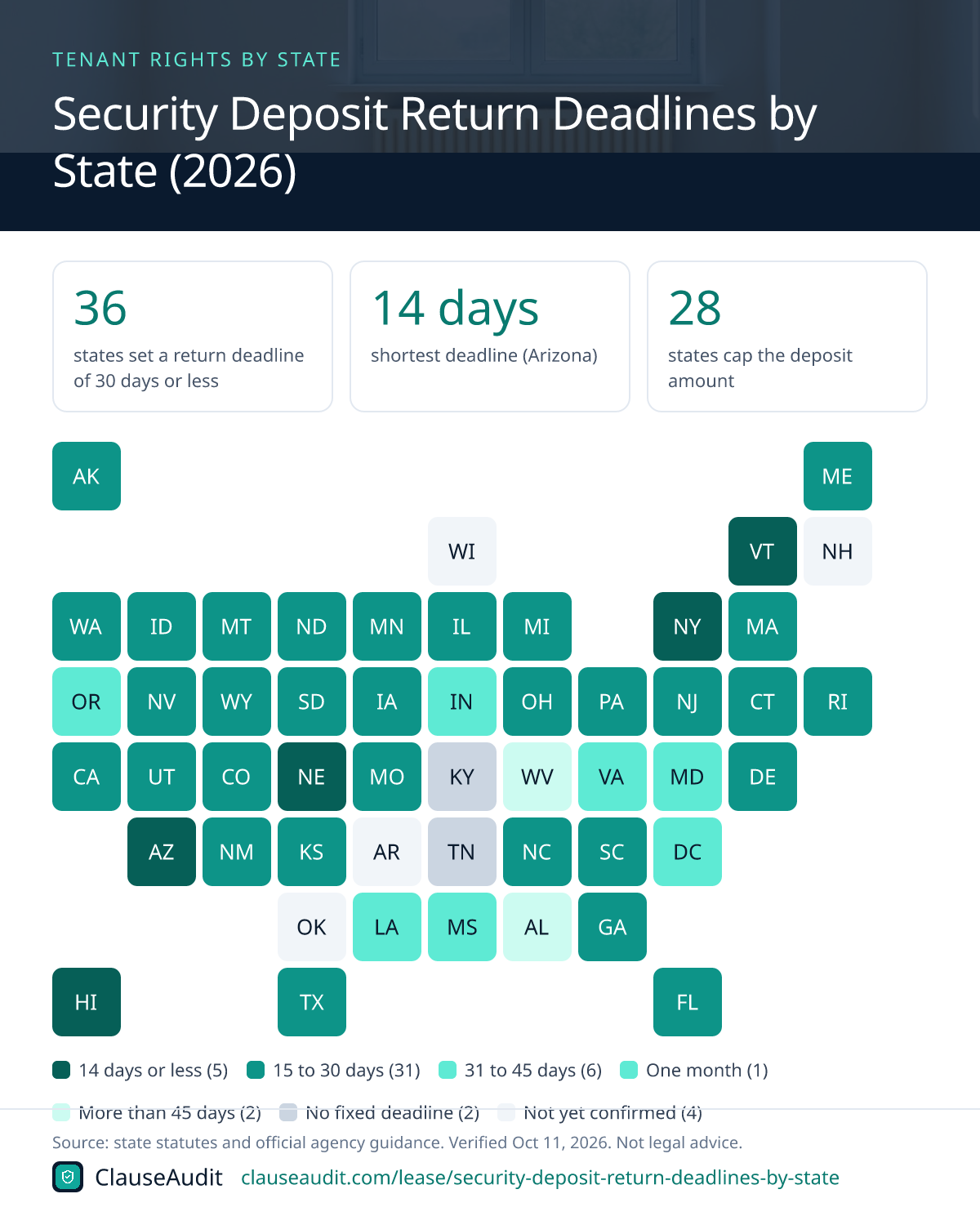
Usually 30 days or less. In 36 of the 47 jurisdictions we confirmed, the landlord must refund or itemize within 30 days after the tenancy ends. Arizona (14 business days), Hawaii, Nebraska, New York and Vermont allow only 14 days, while Alabama and West Virginia allow 60. Miss the deadline and many states impose double or triple damages.

- states set a return deadline of 30 days or less
- 36
- shortest deadline (Arizona)
- 14 days
- states cap the deposit amount
- 28
- states require interest on deposits
- 12
You moved out, handed back the keys and left the place clean. Now you're waiting on a check. How long you wait isn't up to your landlord. Almost every state sets a hard clock, and the clock usually starts the day you give up possession.
This page covers the back end of a deposit: return deadlines, what the itemized list has to say, which states make landlords pay interest, and what a landlord owes when they blow the deadline. If you want to know how much a landlord can collect up front, that's on our state lease guide.
- 14 days or less5
- 15 to 30 days31
- 31 to 45 days6
- One month1
- More than 45 days2
- No fixed deadline2
- Not yet confirmed4
Security deposit return deadline (days)
Security deposit return deadlines and caps in every state
| State | Return deadline | Deposit cap | Penalty for late return | Law |
|---|---|---|---|---|
| Alabama | Within 60 days after the tenancy ends and the tenant gives up possession, the landlord must refund the deposit or send an itemized list of amounts withheld. | 1 month's rent. Extra deposits allowed for pets, alterations to the unit and activities that increase the landlord's liability. | Double the tenant's original deposit if the landlord misses the 60-day deadline. | Ala. Code § 35-9A-201 |
| Alaska | 14 days after the tenancy ends and possession is delivered if the tenant gave proper notice; 30 days if the tenant did not, or if the landlord deducts for damage. | 2 months' rent. No cap where monthly rent is over $2,000. A separate pet deposit of up to 1 month's rent is allowed (not for service animals). | Up to twice the amount withheld if the landlord willfully fails to refund or itemize. | Alaska Stat. § 34.03.070 |
| Arizona | Within 14 days, excluding weekends and legal holidays, after the tenancy ends, possession is delivered and the tenant demands the deposit, the landlord must return it with an itemized list of deductions. | 1.5 months' rent, including prepaid rent. Nonrefundable fees must be stated in writing. | Twice the amount wrongfully withheld, plus the amount due. | Ariz. Rev. Stat. § 33-1321 |
| Arkansas | Not yet confirmed: check the statute linked in the sources | Ark. Code Ann. §§ 18-16-303 to 18-16-306 | ||
| California | Within 21 calendar days after the tenant vacates, the landlord must return the deposit with an itemized statement of deductions. If rent or the deposit was paid electronically, the refund must generally be made electronically. | 1 month's rent for most landlords since July 1, 2024 (AB 12). A small landlord (a natural person or family LLC/trust owning no more than 2 rental properties with 4 or fewer units total) may charge 2 months, but not to a service member. | Up to twice the amount of the deposit in statutory damages for bad-faith retention, plus actual damages. | Cal. Civ. Code § 1950.5 |
| Colorado | Within 30 days after the lease ends or the tenant surrenders the unit, unless the lease sets a longer period of up to 60 days. The landlord must send a written statement of exact reasons for any amount kept. | 2 months' rent (since Aug 7, 2023). | Landlord who misses the deadline forfeits the right to keep any of it; bad-faith or wrongful withholding can bring three times the amount withheld plus attorney fees and costs. Tenant must give 7 days' notice before suing. | Colo. Rev. Stat. §§ 38-12-102.5, 38-12-103, 38-12-104 |
| Connecticut | Within 21 days after the tenancy ends, or 15 days after the landlord receives the tenant's written forwarding address, whichever is later, with accrued interest and an itemized statement of deductions. | 2 months' rent; 1 month's rent if the tenant is 62 or older. | Twice the amount of the deposit (or the greater of $10 or twice the interest if only interest is unpaid); knowing and willful failure can also bring a fine of up to $250 per offense. | Conn. Gen. Stat. § 47a-21 |
| Delaware | Within 20 days after the lease ends or terminates, the landlord must return the deposit or send an itemized list of damages with estimated repair costs and pay the difference. | 1 month's rent for leases of one year or more; for month-to-month tenancies the 1-month limit applies after the first year. Furnished units are exempt. A separate pet deposit of up to 1 month's rent is allowed. | Double the amount wrongfully withheld. | Del. Code Ann. tit. 25, § 5514 |
| District of Columbia | Within 45 days after the tenancy ends, the landlord must return the deposit with interest or give written notice of intent to withhold; any balance and an itemized statement are then due within 30 days of that notice. | 1 month's rent. Deposit must be held in an interest-bearing escrow account in DC. | Amount wrongfully withheld; treble damages for bad-faith withholding under the DC regulations. | D.C. Code § 42-3502.17; 14 DCMR §§ 308-311 |
| Florida | If no claim, return the deposit within 15 days after the lease ends. To claim any part, send written notice by certified mail or email within 30 days; tenant has 15 days to object, and the balance is due within 30 days of the notice. | No statutory cap. | Landlord who misses the 30-day notice forfeits the right to claim against the deposit; prevailing party recovers court costs and attorney fees. | Fla. Stat. § 83.49 |
| Georgia | Within 30 days after the landlord obtains possession, the landlord must return the deposit or send a written statement of reasons with an itemized damage list and any balance. | 2 months' rent for leases entered into or renewed on or after July 1, 2024 (Safe at Home Act, HB 404). | Three times the sum improperly withheld plus reasonable attorney fees (limited to the amount withheld for a proven bona fide error). | O.C.G.A. §§ 44-7-30.1, 44-7-34, 44-7-35 |
| Hawaii | Within 14 days after the rental agreement ends, the landlord must return the deposit or give written notice with itemized grounds for any amount kept. | 1 month's rent, plus a separate pet deposit of up to 1 month's rent (not for assistance animals). | Amount wrongfully retained plus costs; up to three times the amount if retention was wrongful and willful. | Haw. Rev. Stat. § 521-44 |
| Idaho | Within 21 days after the tenant surrenders the unit, or up to 30 days if the lease says so, with a signed itemized statement for any amount kept. | No statutory cap. | No specific multiplier; tenant may sue for the amount owed, and attorney fees may be awarded under Idaho Code § 6-324. | Idaho Code § 6-321 |
| Illinois | Itemized statement of damages with receipts within 30 days after the tenant vacates; if no statement is sent, the full deposit is due within 45 days of move-out. | No statewide cap. Chicago and some other cities add their own rules. | Twice the amount of the deposit due, plus court costs and attorney fees, if the landlord fails to comply in bad faith. | 765 ILCS 710/1; 765 ILCS 715 (interest) |
| Indiana | Within 45 days after the lease ends and possession is delivered, the landlord must send an itemized notice of damages and any balance. The tenant must give a written forwarding address. | No statutory cap. | Return of the full deposit plus reasonable attorney fees. | Ind. Code §§ 32-31-3-12, 32-31-3-16 |
| Iowa | Within 30 days after the tenancy ends and the landlord receives the tenant's mailing address, the landlord must return the deposit or send a written statement of specific reasons for withholding. | 2 months' rent. | Forfeiture of the right to withhold; bad-faith retention brings punitive damages of up to twice the monthly rent plus actual damages. | Iowa Code § 562A.12 |
| Kansas | Balance due within 14 days after the deduction amount is set, but no later than 30 days after the tenancy ends, possession is delivered and the tenant demands it, with an itemized list. | 1 month's rent unfurnished; 1.5 months furnished; plus up to half a month's rent as a pet deposit. | Amount due plus damages of 1.5 times the amount wrongfully withheld. | Kan. Stat. Ann. § 58-2550 |
| Kentucky | Applies where a local government adopted the URLTA. No fixed refund deadline. If the tenant owes no rent, the landlord must notify the tenant of the refund due; if no response within 60 days, the landlord may keep it. If the tenant skips the last month's rent and makes no demand, the landlord may apply the deposit after 30 days. | No statutory cap. | Where the URLTA applies, the landlord cannot keep any part of the deposit if it was not held in a separate account and the move-in and move-out damage lists were not provided. | Ky. Rev. Stat. §§ 383.500, 383.580 |
| Louisiana | Within one month after the lease ends, the landlord must return the deposit. If part of it is kept, the itemized statement of reasons may be sent within one month, or within 15 days after the date one month after the tenancy ends (Acts 2026, No. 63). | No statutory cap. | The amount wrongfully kept plus the greater of $300 or twice the amount wrongfully kept, for willful failure; failure to pay within 30 days of written demand counts as willful. | La. Rev. Stat. §§ 9:3251, 9:3252 |
| Maine | Written lease: within the period the lease sets, but no more than 30 days. Tenancy at will: within 21 days after the tenancy ends or the unit is surrendered, whichever is later. Itemized statement required for any amount kept. | 2 months' rent. | Double the amount wrongfully withheld plus attorney fees and costs; the tenant must give 7 days' notice before suing. | Me. Rev. Stat. tit. 14, §§ 6032, 6033, 6034 |
| Maryland | Within 45 days after the tenancy ends, the landlord must return the deposit with interest, and mail an itemized list of damages for any amount kept. | 1 month's rent per unit (since Oct 1, 2024). Up to 2 months if the tenant qualifies for state utility assistance and the lease has the tenant pay utilities to the landlord. A tenant may choose a surety bond instead, capped at 2 months combined. | Up to three times the amount withheld without a reasonable basis, plus attorney fees; up to three times any excess charged over the cap. | Md. Code Ann., Real Prop. § 8-203 |
| Massachusetts | Within 30 days after the tenancy ends, the landlord must return the deposit with interest, minus deductions listed in a sworn, itemized statement. | Security deposit up to 1 month's rent, in addition to first month's rent, last month's rent and a lock change fee. | Three times the deposit owed plus 5% interest, court costs and attorney fees. | Mass. Gen. Laws ch. 186, § 15B |
| Michigan | Within 30 days after the tenant moves out, the landlord must mail an itemized list of damages with a check for any balance. | 1.5 months' rent. | Waiver of all claimed damages and liability for double the amount of the deposit retained. | Mich. Comp. Laws §§ 554.602, 554.609, 554.613 |
| Minnesota | Within three weeks after the tenancy ends and the landlord receives the tenant's mailing address, the landlord must return the deposit with interest or give a written statement of reasons; within 5 days if the building is condemned. | No statutory cap. | Amount wrongfully withheld plus an equal penalty amount with interest; bad-faith retention adds punitive damages of up to $500 per deposit. | Minn. Stat. § 504B.178 |
| Mississippi | Within 45 days after the tenancy ends, the tenant delivers possession and the tenant demands the deposit, the landlord must return it with a written itemized list of any deductions. | No statutory cap. | Up to $200 in damages for bad-faith retention, plus actual damages. | Miss. Code Ann. § 89-8-21 |
| Missouri | Within 30 days after the tenancy ends, the landlord must return the full deposit or an itemized list of damages with any balance. | 2 months' rent. | Up to twice the amount wrongfully withheld. | Mo. Rev. Stat. § 535.300 |
| Montana | Within 30 days after the tenancy ends or the unit is surrendered (whichever is first), the landlord must send an itemized list of charges with any balance. If there are no damages, cleaning, unpaid rent or utilities, the deposit is due within 10 days. | No statutory cap. | Amount wrongfully withheld, with attorney fees at the court's discretion; a landlord who sends no list forfeits the right to deduct for damage or cleaning. | Mont. Code Ann. §§ 70-25-201 to 70-25-204 |
| Nebraska | Within 14 days after the tenancy ends, the landlord must deliver or mail the balance with a written itemization. If the tenant leaves no address, the landlord mails it first-class to the last-known address. | 1 month's rent, plus a pet deposit of up to one quarter of a month's rent. | Amount due, costs and attorney fees; if willful and not in good faith, liquidated damages of the lesser of 1 month's rent or twice the deposit. | Neb. Rev. Stat. § 76-1416 |
| Nevada | Within 30 days after the tenancy ends, the landlord must return the remaining deposit with an itemized written accounting. | 3 months' rent, counting the deposit, any surety bond and last month's rent together. | The deposit due plus up to the full deposit amount again, set by the court based on the landlord's good faith and harm to the tenant. | Nev. Rev. Stat. § 118A.242 |
| New Hampshire | Not yet confirmed: check the statute linked in the sources | N.H. Rev. Stat. Ann. §§ 540-A:6, 540-A:7, 540-A:8 | ||
| New Jersey | Within 30 days after the lease ends, by personal delivery or registered or certified mail, with interest and an itemized list of deductions; within 5 business days after displacement by fire, flood, condemnation or evacuation. | 1.5 months' rent. Any yearly increase in the deposit may not exceed 10% of the current deposit. Owner-occupied two- or three-family dwellings (no more than 2 rental units) are excluded unless the tenant opts in by written request. | Double the amount owed, plus costs and possible attorney fees. | N.J. Stat. Ann. §§ 46:8-21.1, 46:8-21.2 |
| New Mexico | Within 30 days after the lease ends or the tenant leaves, whichever is later, the landlord must send an itemized list of deductions and the balance. | 1 month's rent for leases under one year. For leases of a year or more a larger deposit is allowed, but the landlord must pay yearly interest on it. | Landlord who misses the deadline forfeits the right to withhold and may owe costs and attorney fees; bad-faith retention brings a $250 civil penalty. | N.M. Stat. Ann. § 47-8-18 |
| New York | Within 14 days after the tenant vacates, the landlord must send an itemized statement and return any balance, or lose the right to keep any part of the deposit. | 1 month's rent. | Actual damages; punitive damages of up to twice the deposit for willful violations. | N.Y. Gen. Oblig. Law §§ 7-103, 7-108 |
| North Carolina | Within 30 days after the tenancy ends and the landlord recovers possession, the landlord must return the deposit with an itemized list of damages. If the claim cannot be finalized, an interim accounting is due in 30 days and a final one within 60 days. | 2 weeks' rent for week-to-week, 1.5 months' rent for month-to-month, 2 months' rent for longer terms. | Willful failure to account and refund bars the landlord from keeping any of the deposit and allows the court to award attorney fees. | N.C. Gen. Stat. §§ 42-51, 42-52, 42-55 |
| North Dakota | Within 30 days after the lease ends and the tenant gives up possession, the landlord must mail the balance with interest and an itemized list of deductions. | 1 month's rent; up to 2 months for a tenant with a felony conviction or a prior judgment for breaking a lease. Separate pet deposit up to the greater of $2,500 or 2 months' rent (not for service or assistance animals). | Treble damages for any deposit withheld without reasonable justification. | N.D. Cent. Code § 47-16-07.1 |
| Ohio | Within 30 days after the lease ends and possession is delivered, the landlord must send an itemized list of deductions with any balance. The tenant must provide a forwarding address in writing. | No statutory cap. | Amount wrongfully withheld plus an equal amount in damages, plus reasonable attorney fees. | Ohio Rev. Code § 5321.16 |
| Oklahoma | Not yet confirmed: check the statute linked in the sources | Okla. Stat. tit. 41, § 115 | ||
| Oregon | Within 31 days after the tenancy ends and the tenant delivers possession, the landlord must return the deposit or give a written accounting of amounts claimed. | No statutory cap. A landlord generally may not add or raise a deposit in the first year. | Twice the amount withheld without a written accounting or withheld in bad faith. | Or. Rev. Stat. § 90.300 |
| Pennsylvania | Within 30 days after the lease ends or the unit is surrendered and accepted, whichever is first, the landlord must send a written list of damages and pay any balance. | 2 months' rent in the first year of a lease; 1 month's rent from the second year on, including renewals. | Double the amount by which the deposit exceeds actual damages; a landlord who sends no list forfeits the right to withhold or sue for damages. | 68 P.S. §§ 250.511a, 250.511b, 250.512 |
| Rhode Island | Within 20 days after the latest of lease termination, delivery of possession or the tenant giving a forwarding address, with an itemized written notice of deductions. | 1 month's rent. A separate furniture deposit of up to 1 month's rent is allowed if the furniture is worth $5,000 or more. | Amount due plus twice the amount wrongfully withheld, plus reasonable attorney fees. | R.I. Gen. Laws § 34-18-19 |
| South Carolina | Within 30 days after the tenancy ends and possession is delivered, or after the tenant's demand, whichever is later, with an itemized written notice. Tenant must give a forwarding address. | No statutory cap. Landlords with more than four adjoining units who vary deposit standards must disclose them. | Three times the amount wrongfully withheld plus reasonable attorney fees. | S.C. Code Ann. § 27-40-410 |
| South Dakota | Within 21 days after the tenancy ends and the landlord receives the tenant's mailing address, the landlord must return the deposit or give a written statement of reasons. On request, an itemized accounting is due within 45 days. | 1 month's rent, unless special conditions justify more. | Forfeiture of the right to withhold; up to $200 in punitive damages for bad-faith retention or failure to provide the statement. | S.D. Codified Laws §§ 43-32-6.1, 43-32-24 |
| Tennessee | Applies only in counties covered by the URLTA. No fixed refund deadline. If the tenant owes nothing, the landlord must send notice of the refund due; if no response within 60 days, the landlord may keep it. Damage charges must be found within 30 days of move-out or 7 days after a new tenant moves in, whichever is first. | No statutory cap. | In URLTA counties, the landlord cannot keep any part of the deposit if it was not held in a separate account and the required damage listings were not provided. | Tenn. Code Ann. §§ 66-28-102, 66-28-301 |
| Texas | On or before the 30th day after the tenant surrenders the premises, the landlord must refund the deposit with a written itemized list of deductions. The tenant must give a forwarding address. | No statutory cap. | For bad faith: $100 plus three times the amount wrongfully withheld, plus attorney fees. Missing the 30-day deadline creates a presumption of bad faith. | Tex. Prop. Code §§ 92.103, 92.104, 92.109 |
| Utah | Within 30 days after the renter vacates and returns possession, the landlord must send the balance with a written itemization. If late, the renter may serve a statutory notice giving the owner 5 business days to comply. | No statutory cap. | Full deposit plus a $100 civil penalty; court costs and attorney fees if the other side acted in bad faith. | Utah Code Ann. §§ 57-17-3, 57-17-5 |
| Vermont | Within 14 days after the tenant vacates or abandons the unit (or the landlord learns of it), with an itemized statement; 60 days for seasonal rentals that are not a primary residence. | No statutory cap. | Forfeiture of the right to withhold; double the amount wrongfully withheld plus attorney fees and costs if willful. | Vt. Stat. Ann. tit. 9, § 4461 |
| Virginia | Within 45 days after the tenancy ends or the tenant vacates, whichever is later, the landlord must give an itemized written notice and any balance. The landlord gets 15 more days only if the damage costs more than the deposit, needs a third-party contractor, and the tenant is told in writing within the 45 days. | 2 months' rent. Landlord may accept damage insurance or a surety bond in place of a deposit. | Return of the deposit plus actual damages and reasonable attorney fees for willful failure to comply. | Va. Code Ann. § 55.1-1226 |
| Washington | Within 30 days after the rental agreement ends and the tenant vacates (or the landlord learns of abandonment), the landlord must give a full statement of reasons for any amount kept, with receipts or estimates, plus any refund. | No statutory cap for ordinary residential tenancies. Since May 7, 2025, manufactured or mobile home lot tenancies cap move-in fees plus deposits at 1 month's rent (2 with pets). | Full deposit; up to twice the deposit at the court's discretion for intentional refusal; prevailing party gets attorney fees. | Wash. Rev. Code § 59.18.280; RCW 59.20.170 (as amended by Laws of 2025, ch. 209) |
| West Virginia | Within 60 days after the tenancy ends, or within 45 days after a new tenant moves in, whichever is shorter. The landlord gets 15 extra days to itemize if damages exceed the deposit and need a contractor. | No statutory cap. | Unreturned deposit plus damages of 1.5 times the amount wrongfully withheld, if willful or not in good faith. | W. Va. Code §§ 37-6A-1, 37-6A-2, 37-6A-5 |
| Wisconsin | Not yet confirmed: check the statute linked in the sources | Wis. Stat. §§ 704.28, 100.20(5); Wis. Admin. Code ATCP § 134.06 | ||
| Wyoming | Within 30 days after the rental agreement ends or 15 days after receiving the renter's new address, whichever is later; extended by 30 more days if there is damage. Separate utility deposits follow their own timeline. | No statutory cap. Any nonrefundable portion must be stated in the lease and in writing when taken. | Full deposit plus court costs if the owner unreasonably fails to comply. | Wyo. Stat. Ann. §§ 1-21-1207, 1-21-1208 |
How does the security deposit return deadline work?
The deadline is a count of days after the tenancy ends. In most states the trigger is two things together: the lease is over and you've handed back possession. Some states add a third trigger, like your forwarding address or a written demand.
Within that window the landlord has two jobs. Refund what you're owed, and send a written, itemized list of anything kept. In many states, a landlord who sends no list loses the right to keep anything at all.
The clock runs from the trigger, not from the day the landlord gets around to inspecting. In Texas the refund and itemized list are due on or before the 30th day after you surrender the premises, and missing that date creates a presumption of bad faith. In California the window is 21 calendar days after you vacate.
Which states have the shortest and longest deadlines?
36 jurisdictions require the refund or itemization within 30 days. A handful move much faster, and a few give landlords two months.
- Arizona: 14 days, excluding weekends and legal holidays, after the tenancy ends, possession is delivered and you ask for the deposit.
- New York: 14 days after you vacate. A landlord who misses it loses the right to keep any part of the deposit.
- Hawaii and Nebraska: 14 days. Nebraska's clock starts when the tenancy ends; if you leave no address, the landlord mails it to your last-known address.
- Vermont: 14 days after you vacate, but 60 days for seasonal rentals that aren't a primary residence.
- California: 21 calendar days. Minnesota: three weeks, and the refund has to include interest.
- Maryland, Virginia, Indiana, Mississippi and the District of Columbia: 45 days.
- Alabama and West Virginia: 60 days. West Virginia shortens that to 45 days after a new tenant moves in, if that comes first.
What has to be on the itemized list of deductions?
Nearly every state in our data also expects a written accounting for money kept. The details vary, and they matter, because a sloppy list can cost the landlord the whole deduction.
Massachusetts requires a sworn, itemized statement. Washington wants a full statement of reasons with receipts or estimates. Delaware asks for an itemized list of damages with estimated repair costs. California requires an itemized statement within the same 21 days.
A good list names each problem, where it is, and what it cost to fix. "Cleaning: $400" with nothing else is weak. "Carpet stain, back bedroom, professional cleaning, invoice attached" is what the law usually has in mind.
Some states give extra time for big repairs. Virginia allows 15 more days to itemize when damage exceeds the deposit, needs a third-party contractor, and you're told in writing within the 45 days. West Virginia allows 15 extra days when damages exceed the deposit and need a contractor. North Carolina allows an interim accounting at 30 days and a final one within 60.
What can you do if your landlord misses the deadline?
Penalties are where this law has teeth. Most states don't just make the landlord pay back what they owe. They add a multiple on top.
Double damages are common. Alabama charges double the original deposit for missing the 60-day deadline. Delaware, Maine, Michigan, Missouri and New Jersey all use some version of double. Triple damages show up in Georgia, Massachusetts, North Dakota and South Carolina. Texas adds $100 plus three times the amount wrongfully withheld for bad faith.
Other states use forfeiture. Colorado, Iowa, New Mexico, South Dakota and Vermont take away the landlord's right to withhold once the deadline or the paperwork is missed. Montana is narrower: a landlord who sends no list loses the right to deduct for damage or cleaning. Florida's landlord must send notice of any claim by certified mail or email within 30 days, or lose the right to claim against the deposit.
Watch for pre-suit steps. Colorado and Maine require you to give 7 days' notice before suing. Utah lets you serve a notice giving the owner 5 business days to comply. Louisiana treats failure to pay within 30 days of a written demand as willful.
Here is the order that works best:
- Find your trigger. Check if your state's clock needs a forwarding address or a written demand, and send both the day you leave.
- Document move-out. Take dated photos and video of every room, appliance and wall.
- Count the days. Use our security deposit return calculator to find your exact deadline.
- Check the list when it arrives. Compare each deduction to your photos and to normal wear.
- Send a demand letter. Cite the statute from the table below, the date the deadline passed and the penalty your state allows.
- File in small claims if needed. Bring the lease, photos, your letter and proof of delivery.
Three tenants, three states: how the rules play out
Say you rent in Los Angeles and move out on June 1. Your landlord has 21 calendar days to return the deposit with an itemized statement. California also has photo rules now: move-out photos since April 2025, and move-in photos for tenancies starting on or after July 1, 2025. If you paid rent electronically, expect the refund the same way.
Now say you're in Austin. The 30-day clock starts when you surrender the unit, but Texas also expects a forwarding address from you. Give it in writing. If day 30 passes with no refund and no list, the law presumes the landlord acted in bad faith, which opens the door to $100 plus three times the amount wrongfully withheld.
Last, picture a tenant leaving a Florida apartment. If the landlord isn't claiming anything, the deposit is due within 15 days. If they are, they must send written notice by certified mail or email within 30 days. You then have 15 days to object. Watch your mail and email so you can object in time.
Which states require interest on security deposits?
12 jurisdictions in our confirmed data require landlords to pay interest on deposits. That means part of your refund isn't the landlord's money to hold for free.
Massachusetts, New Jersey, Maryland, Minnesota and Connecticut all return interest with the deposit. Connecticut's deadline is 21 days after the tenancy ends or 15 days after the landlord gets your written forwarding address, whichever is later, with accrued interest included. If only the interest goes unpaid, Connecticut still allows the greater of $10 or twice the interest.
Rules on rate and which buildings are covered differ. Illinois, for example, requires interest only in buildings with 25 or more units when the deposit is held over six months. Read the statute linked in the table for your state.
Is there a federal security deposit law?
No general federal statute sets a deadline for returning a residential security deposit. State law controls, and in a few places local law does too.
Kentucky and Tennessee are the clearest examples. Kentucky's deposit rules apply only where a city or county has adopted the Uniform Residential Landlord and Tenant Act. Tennessee's version of that act covers only its larger counties. Neither sets a fixed refund deadline. Instead, a landlord must hold deposits in a separate account and give move-in and move-out damage lists, or lose the right to keep any of it.
Cities can add rules on top of state law, so check your city code too if you rent in a large metro.
Frequently asked questions
Can my landlord keep my deposit for normal wear and tear?
Deposits are meant for unpaid rent and real damage, not the slow wear of ordinary living. Colorado has barred keeping a deposit for normal wear and tear for years, and a 2025 law effective January 1, 2026 widened what counts as wear and tear, added a bar on charging for pre-existing damage and limited carpet and paint charges. Elsewhere, read your state statute and compare each deduction against your move-out photos.
When does the deposit return clock start?
Usually when the tenancy ends and you hand back possession. Some states add conditions. Arizona starts the clock only after you deliver possession and demand the deposit, Mississippi likewise needs possession and a demand, and Iowa and Minnesota tie it to the landlord receiving your mailing address. Send your forwarding address in writing on move-out day so you never give the landlord an excuse.
What happens if my landlord never sends an itemized list?
In many states the landlord loses the right to keep anything. New York, Colorado, Iowa, Pennsylvania and New Mexico all tie forfeiture to missing the deadline or the paperwork. You may also be able to claim a penalty on top, such as double the amount retained in Michigan or the amount due plus twice what was withheld in Rhode Island.
How much can I sue for if my deposit is withheld in bad faith?
It depends on the state. Texas allows $100 plus three times the amount wrongfully withheld, plus attorney fees. Georgia allows three times the sum improperly withheld. Minnesota adds up to $500 in punitive damages per deposit for bad faith. California allows up to twice the deposit in statutory damages, plus actual damages.
Do I need a lawyer to get my security deposit back?
Usually not. Deposit cases are a common fit for small claims court, where you can file on your own. Many states also let a winning tenant recover attorney fees, including Georgia, Maine, Ohio and South Carolina, which makes it easier to find a lawyer if you do want one.
Does my landlord have to pay interest on my deposit?
Only in some states. 12 jurisdictions in our verified data require it, including Massachusetts, New Jersey, Maryland, Minnesota, Connecticut, Ohio and Pennsylvania. Some states have it paid yearly, like Connecticut and Massachusetts, while others add it to the refund, like Maryland and Minnesota. Check the statute for your state on rate and building size rules.
Can my lease give the landlord more time to return the deposit?
Only where the statute allows it. Colorado lets a lease extend the 30-day window to as long as 60 days. Idaho allows up to 30 days instead of 21 if the lease says so. Maine works the other way: a written lease can set the period, but no more than 30 days.
How do I calculate my exact deposit return deadline?
Start from the date your tenancy ended and you returned the keys, then add your state's day count. Watch for quirks like Arizona excluding weekends and holidays. Our free security deposit return calculator does the math and shows the penalty your state allows if the landlord is late.
Find your exact deposit deadline
Enter your move-out date and state to see the day your landlord's refund is due and what they owe if they miss it.
Open the deposit calculatorUse this infographic
Free to share on your site, blog or slides under CC BY 4.0. Please keep the credit link.
How we built this data
We built this dataset from the law in each state, then had a second, independent review re-check every entry against primary sources and correct anything that did not match. Each row links to its source.
Of the 51 entries, 29 were confirmed directly against the statute itself or the state agency that enforces it. 18 rest on several secondary sources that agree, usually because the official site could not be reached or because there is no statute to read where the answer is that no law exists. 4 could not be confirmed; they are marked "Not yet confirmed" in the table and left out of every count and chart. Data verified on October 11, 2026.
Sources
- Alabama: Code of Alabama (Alabama Legislature)
- Alaska: Alaska Statutes (Alaska Legislature)
- Arizona: Arizona Revised Statutes (Arizona Legislature)
- Arkansas: Arkansas Code (Arkansas General Assembly)
- California: California Civil Code (California Legislative Information)
- Colorado: Colorado General Assembly, HB25-1249 (2025 Session Laws ch. 401, effective January 1, 2026)
- Connecticut: Connecticut General Statutes (Connecticut General Assembly)
- Delaware: Delaware Code (Delaware General Assembly)
- District of Columbia: Code of the District of Columbia (DC Council)
- Florida: 2026 Florida Statutes (Florida Legislature)
- Georgia: Official Code of Georgia (Georgia General Assembly)
- Hawaii: Hawaii Revised Statutes (Hawaii State Legislature)
- Idaho: Idaho Statutes (Idaho Legislature)
- Illinois: Illinois Compiled Statutes (Illinois General Assembly)
- Indiana: Indiana Code (Indiana General Assembly)
- Iowa: Iowa Code 2026 (Iowa Legislature)
- Kansas: Kansas Statutes (Kansas Revisor of Statutes)
- Kentucky: Kentucky Revised Statutes (Kentucky General Assembly)
- Louisiana: Louisiana Revised Statutes (Louisiana State Legislature)
- Maine: Maine Revised Statutes (Maine Legislature)
- Maryland: Maryland Code (Maryland General Assembly)
- Massachusetts: General Laws of Massachusetts (Massachusetts Legislature)
- Michigan: Michigan Compiled Laws (Michigan Legislature)
- Minnesota: Minnesota Statutes (Minnesota Revisor of Statutes)
- Mississippi: Mississippi Code (Mississippi Legislature)
- Missouri: Missouri Revised Statutes (Missouri Revisor of Statutes)
- Montana: Montana Code Annotated 2025 (Montana Legislature)
- Nebraska: Nebraska Revised Statutes (Nebraska Legislature)
- Nevada: Nevada Revised Statutes (Nevada Legislature)
- New Hampshire: New Hampshire Revised Statutes (New Hampshire General Court)
- New Jersey: Truth in Renting (New Jersey Department of Community Affairs)
- New Mexico: New Mexico Statutes Annotated (NMOneSource, New Mexico Compilation Commission)
- New York: New York General Obligations Law (New York State Senate)
- North Carolina: North Carolina General Statutes (North Carolina General Assembly)
- North Dakota: North Dakota Century Code (North Dakota Legislative Branch)
- Ohio: Ohio Revised Code (Ohio Legislative Service Commission)
- Oklahoma: Oklahoma Statutes (Oklahoma State Courts Network)
- Oregon: Oregon Revised Statutes (Oregon State Legislature)
- Pennsylvania: Landlord and Tenant Act of 1951 (Pennsylvania General Assembly)
- Rhode Island: Rhode Island General Laws (Rhode Island General Assembly)
- South Carolina: South Carolina Code of Laws (South Carolina Legislature)
- South Dakota: South Dakota Codified Laws (South Dakota Legislature)
- Tennessee: Tennessee Code (Tennessee General Assembly)
- Texas: Texas Property Code (Texas Legislature)
- Utah: Utah Code (Utah State Legislature)
- Vermont: Vermont Statutes (Vermont General Assembly)
- Virginia: Code of Virginia (Virginia General Assembly LIS)
- Washington: Revised Code of Washington (Washington State Legislature)
- West Virginia: West Virginia Code (West Virginia Legislature)
- Wisconsin: Wisconsin Statutes and Administrative Code (Wisconsin Legislature)
- Wyoming: Wyoming Statutes Title 1 (Wyoming Legislature)
Cite this data
ClauseAudit, “Security Deposit Return Deadlines by State (2026)”, updated October 11, 2026, https://clauseaudit.com/lease/security-deposit-return-deadlines-by-state. Free to reuse with a link back (CC BY 4.0).
This page summarises the law as verified on October 11, 2026. Laws change, cities and counties can add their own rules, and the details of your situation matter. It is general information, not legal advice.