Rent Control Laws by State (2026): Statewide Caps, Local Ordinances and the States That Ban Rent Control
By ClauseAudit Research · 21 sources ·
What are the rent control laws by state?
Most states block it. As of September 2026, the National Apartment Association counts 33 states that preempt local rent control. Only 3 states cap increases statewide: California, Oregon and Washington, and none of them allows more than 10% a year. New York, New Jersey, Maryland, Maine, Minnesota and DC permit local programs.
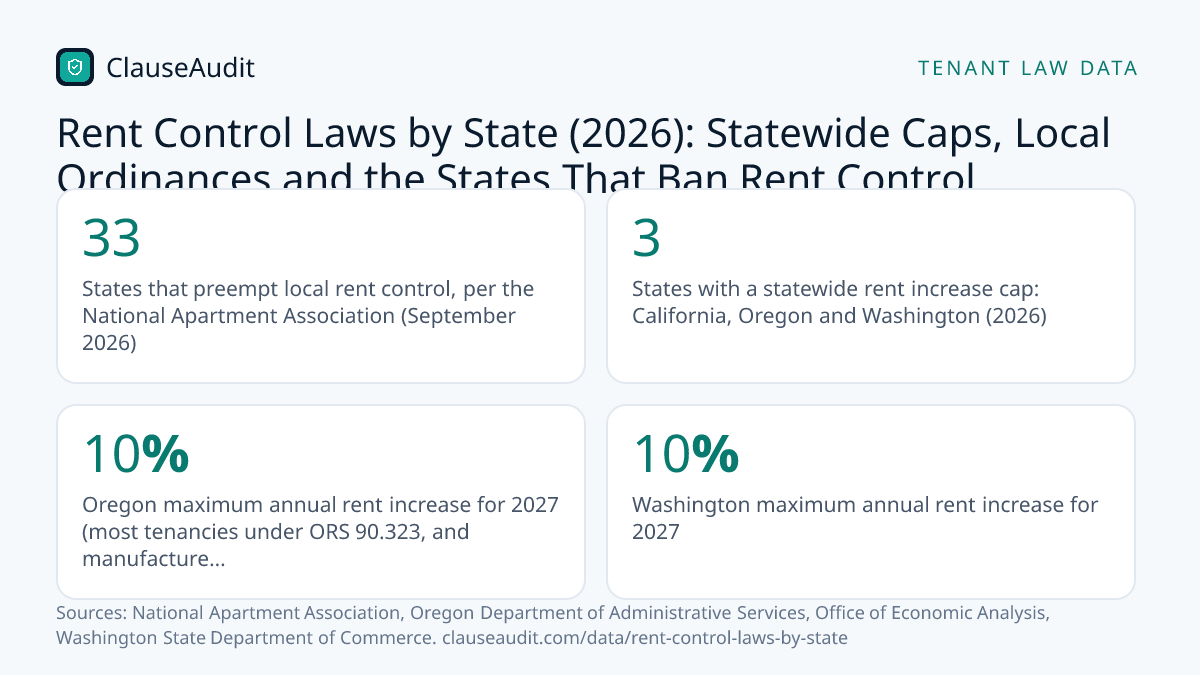
- States that preempt local rent control, per the National Apartment Association (September 2026, National Apartment Association)
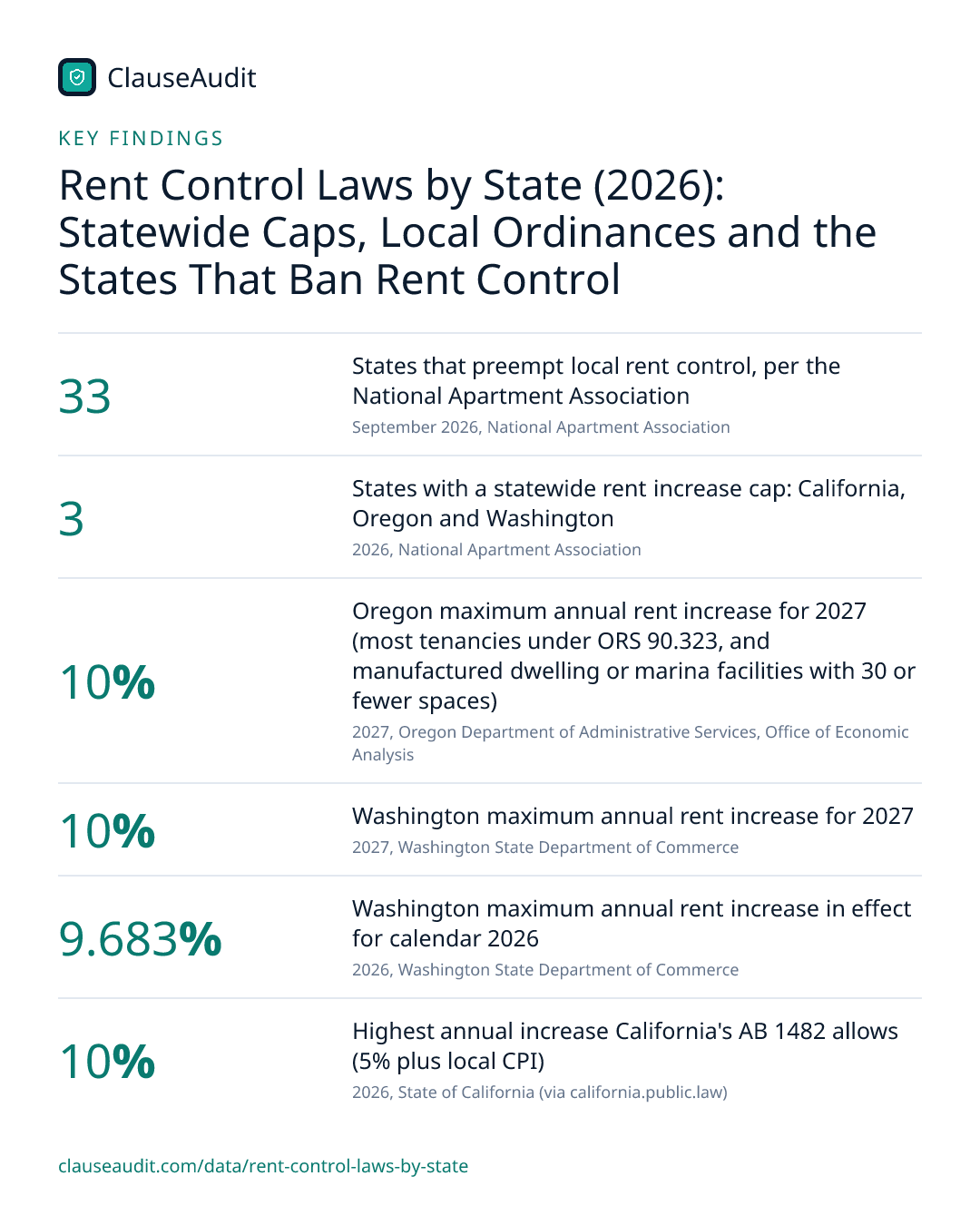
- 33
- States with a statewide rent increase cap: California, Oregon and Washington (2026, National Apartment Association)
- 3
- Oregon maximum annual rent increase for 2027 (most tenancies under ORS 90.323, and manufactured dwelling or marina facilities with 30 or fewer spaces) (2027, Oregon Department of Administrative Services, Office of Economic Analysis)
- 10%
- Washington maximum annual rent increase for 2027 (2027, Washington State Department of Commerce)
- 10%
- Washington maximum annual rent increase in effect for calendar 2026 (2026, Washington State Department of Commerce)
- 9.683%
- Highest annual increase California's AB 1482 allows (5% plus local CPI) (2026, State of California (via california.public.law))
- 10%
- NYC rent-stabilized increase for 1- and 2-year leases starting Oct 2026 (Oct 1, 2026 to Sept 30, 2027, New York City Rent Guidelines Board)
- 0%
- Washington, DC maximum rent-stabilized increase from May 1, 2026 (May 2026, District of Columbia Rental Housing Commission)
- 4.1%
Rent control in the US is mostly a local question that state legislatures have answered for the cities. In 33 states, by one industry count, state law blocks or tightly limits local rent caps, even if voters want one. In a handful of others, the rules are set by a city board or by the state itself.
That patchwork matters when your lease comes up for renewal. This page shows which camp your state falls in, what the current caps are, and which lease clauses decide how much your rent can actually move.
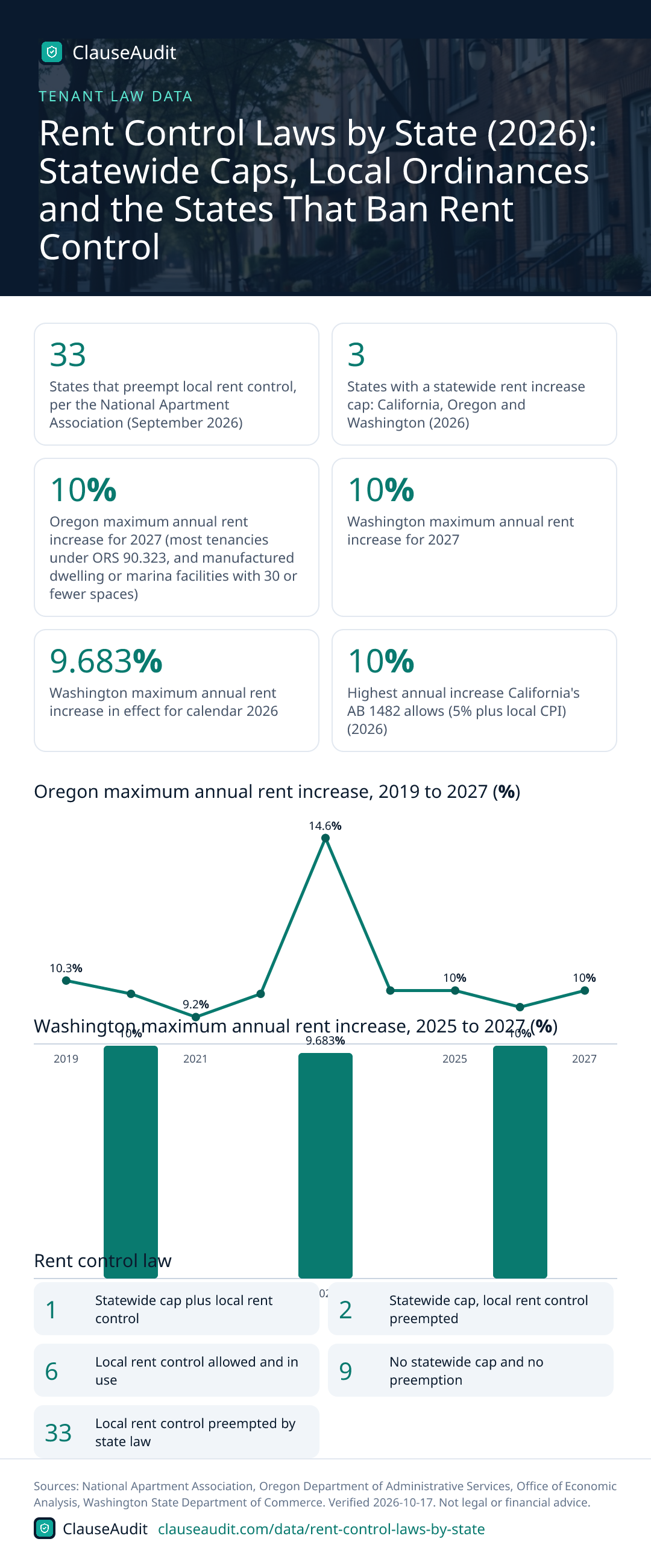
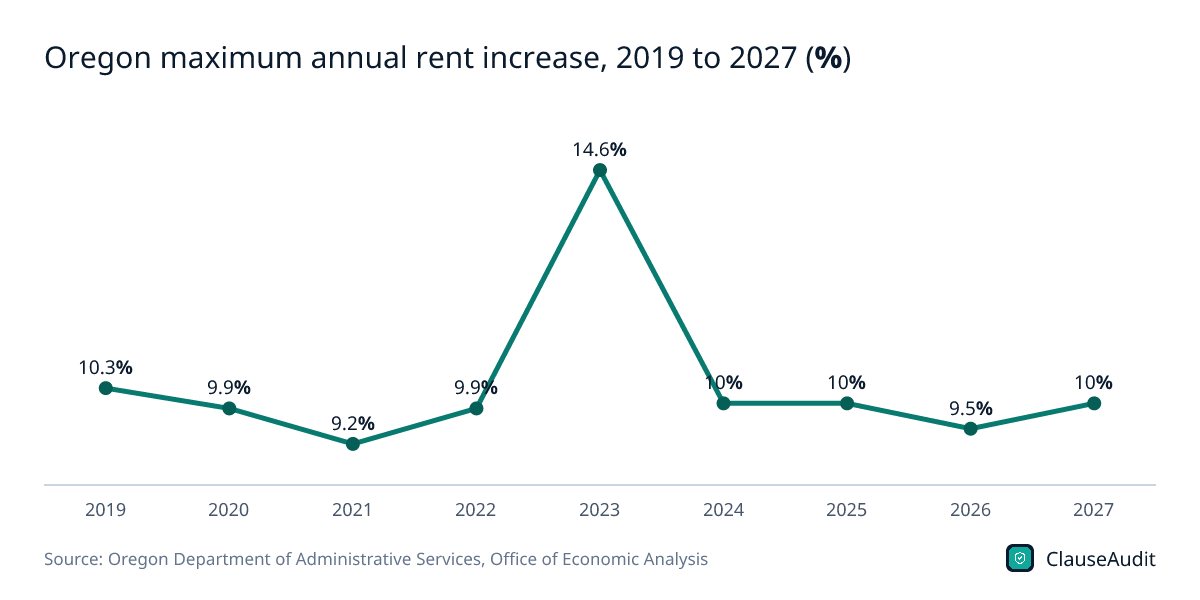
Oregon maximum annual rent increase, 2019 to 2027 (%)
Chart data
| Label | Value (%) |
|---|---|
| 2019 | 10.3% |
| 2020 | 9.9% |
| 2021 | 9.2% |
| 2022 | 9.9% |
| 2023 | 14.6% |
| 2024 | 10% |
| 2025 | 10% |
| 2026 | 9.5% |
| 2027 | 10% |
Oregon's cap floats with inflation, which is why it spiked to 14.6% for early 2023 increases before lawmakers added a hard 10% ceiling. For 2027 the formula tops that ceiling again, so the cap is 10%.
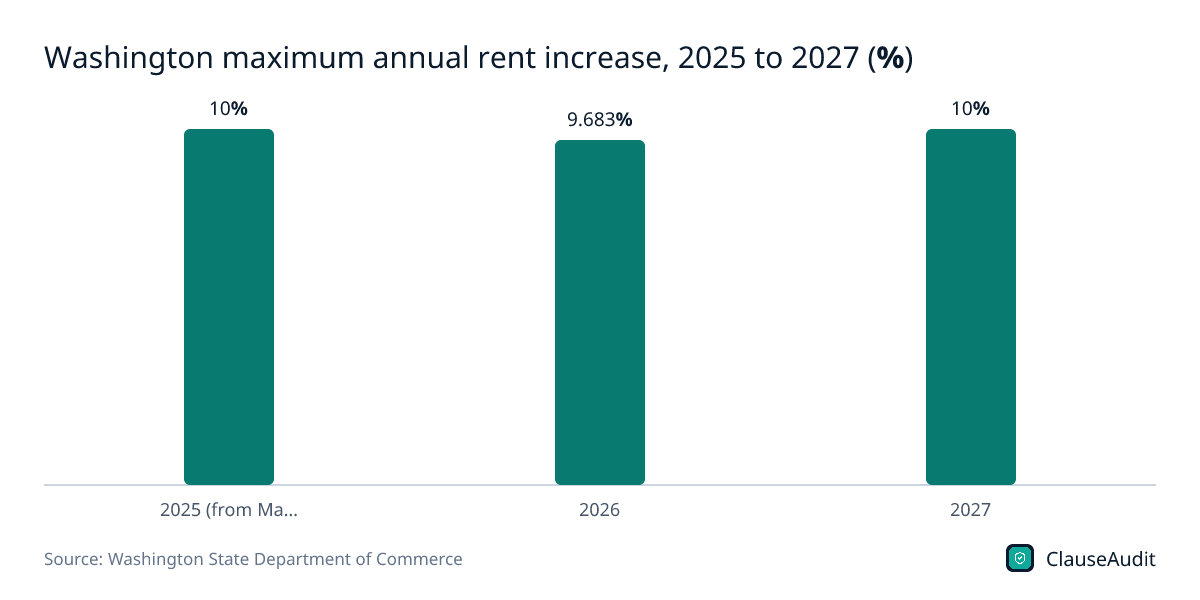
Download this chart (PNG)Washington maximum annual rent increase, 2025 to 2027 (%)
Chart data
| Label | Value (%) |
|---|---|
| 2025 (from May 7) | 10% |
| 2026 | 9.683% |
| 2027 | 10% |
Washington's law is young, and the formula has already hit the 10% ceiling twice. The 2026 figure of 9.683% is the only year so far that came in under it.
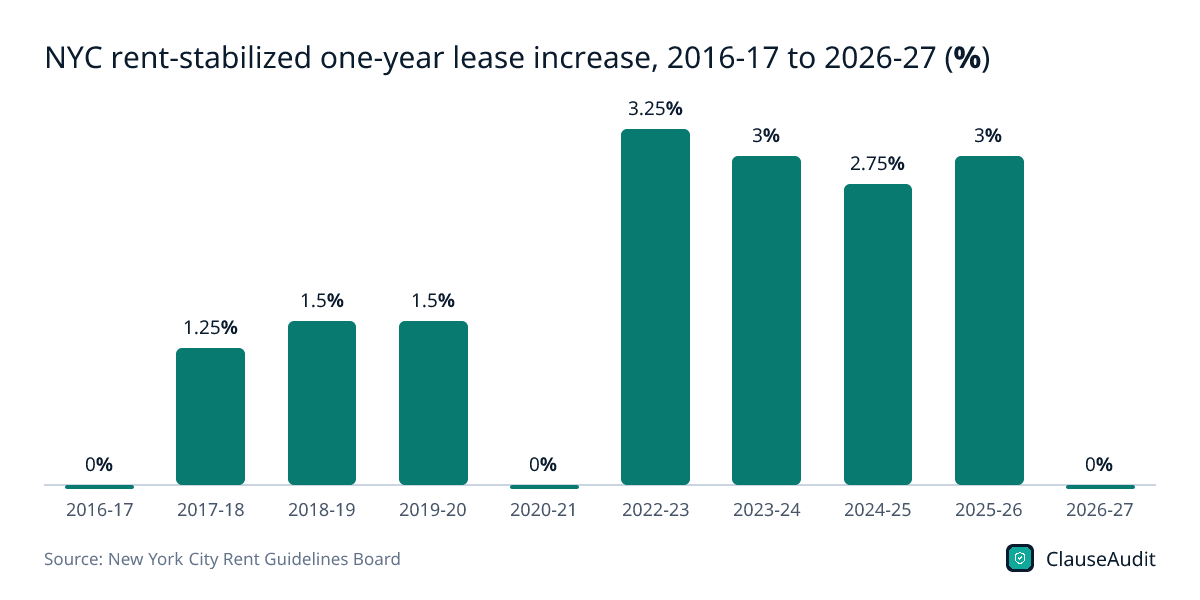
Download this chart (PNG)NYC rent-stabilized one-year lease increase, 2016-17 to 2026-27 (%)
Chart data
| Label | Value (%) |
|---|---|
| 2016-17 | 0% |
| 2017-18 | 1.25% |
| 2018-19 | 1.5% |
| 2019-20 | 1.5% |
| 2020-21 | 0% |
| 2022-23 | 3.25% |
| 2023-24 | 3% |
| 2024-25 | 2.75% |
| 2025-26 | 3% |
| 2026-27 | 0% |
The Rent Guidelines Board has frozen one-year leases three times in this span, most recently for leases starting on or after October 1, 2026. Freezes apply only to rent-stabilized units, not to market-rate apartments in the same building.
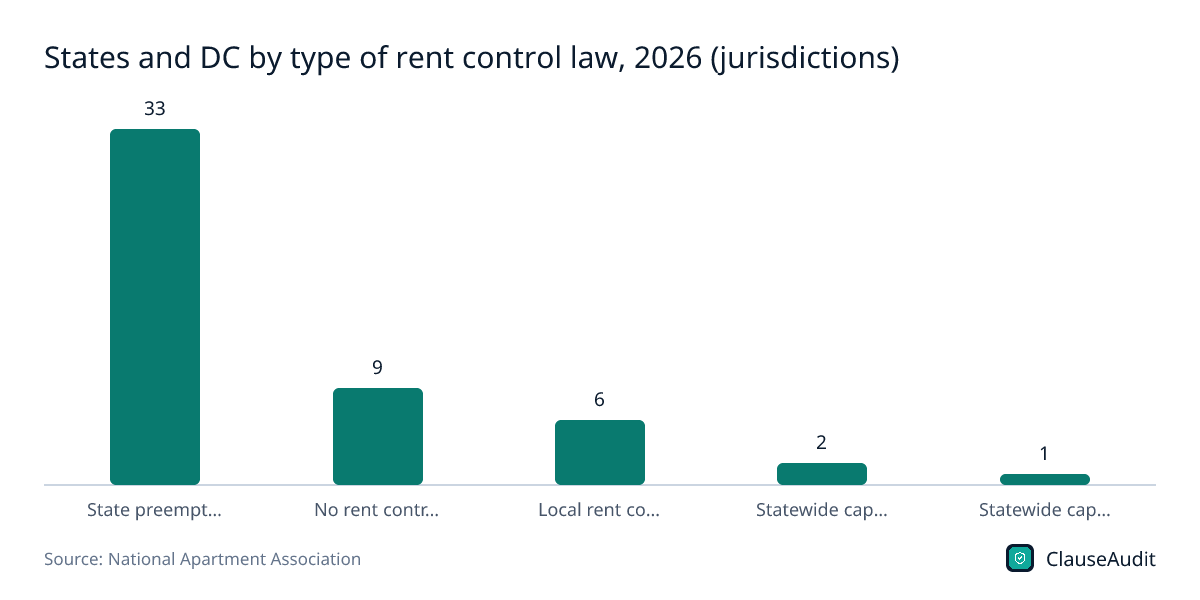
Download this chart (PNG)States and DC by type of rent control law, 2026 (jurisdictions)
Chart data
| Label | Value (jurisdictions) |
|---|---|
| State preempts local rent control | 33 |
| No rent control or preemption | 9 |
| Local rent control only (incl. DC) | 6 |
| Statewide cap, local preempted | 2 |
| Statewide cap plus local | 1 |
Preemption is the most common answer. Only 1 state, California, layers a statewide cap on top of local ordinances.
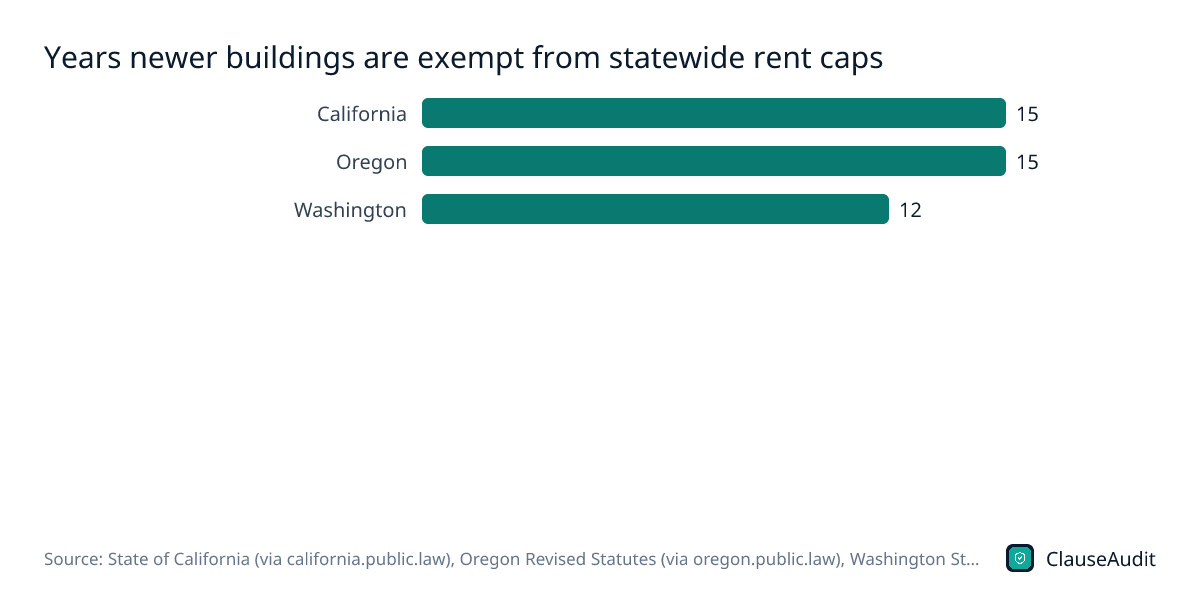
Download this chart (PNG)Years newer buildings are exempt from statewide rent caps
Chart data
| Label | Value |
|---|---|
| California | 15 |
| Oregon | 15 |
| Washington | 12 |
All three statewide caps skip newer buildings. If your building got its certificate of occupancy recently, the cap probably does not protect you, whatever the state.
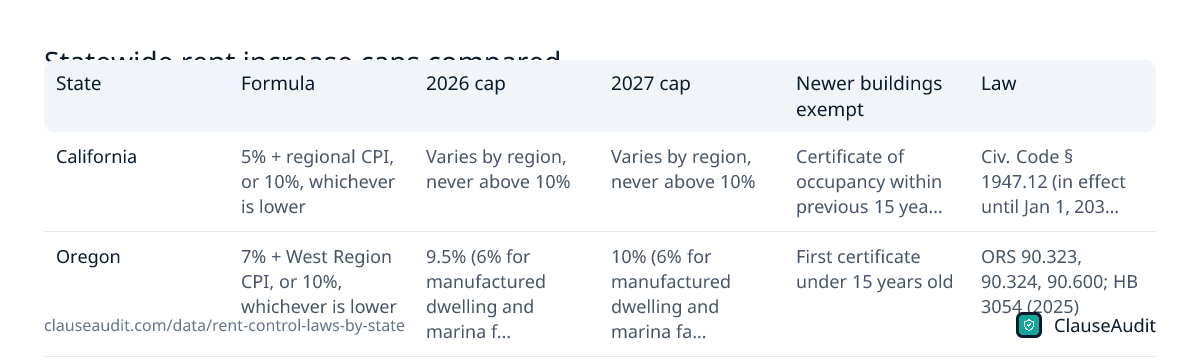
Download this chart (PNG)Statewide rent increase caps compared
| State | Formula | 2026 cap | 2027 cap | Newer buildings exempt | Law |
|---|---|---|---|---|---|
| California | 5% + regional CPI, or 10%, whichever is lower | Varies by region, never above 10% | Varies by region, never above 10% | Certificate of occupancy within previous 15 years | Civ. Code § 1947.12 (in effect until Jan 1, 2030) |
| Oregon | 7% + West Region CPI, or 10%, whichever is lower | 9.5% (6% for manufactured dwelling and marina facilities with more than 30 spaces) | 10% (6% for manufactured dwelling and marina facilities with more than 30 spaces) | First certificate under 15 years old | ORS 90.323, 90.324, 90.600; HB 3054 (2025) |
| Washington | 7% + Seattle-area CPI, or 10%, whichever is lower | 9.683% | 10% | First certificate 12 years old or less | RCW 59.18.700, 59.18.710 (expires July 1, 2040) |
Source: State of California (via california.public.law), California Civil Code § 1947.12 (Tenant Protection Act of 2019, AB 1482); Oregon Department of Administrative Services, Office of Economic Analysis, Rent Stabilization: Maximum Annual Rent Increase Percentage for 2027; Oregon Department of Administrative Services, Office of Economic Analysis, Oregon Maximum Annual Rent Increase 2027 (methodology and history workbook); Oregon Revised Statutes (via oregon.public.law), ORS 90.323 Maximum rent increase; Washington State Department of Commerce, HB 1217 Landlord Resource Center: maximum annual rent increase; Washington State Legislature, RCW 59.18.700 Rent increases: limitations; Washington State Legislature, RCW 59.18.710 Rent increase limitations: exemptions. Download as image
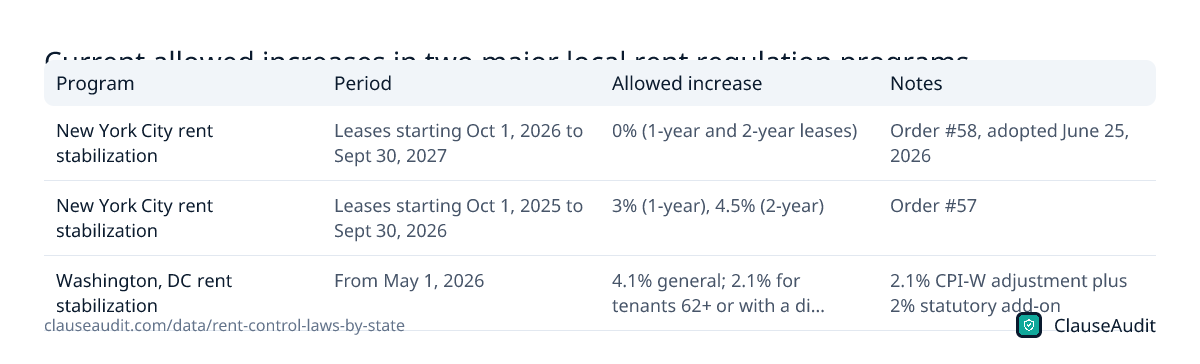
Current allowed increases in two major local rent regulation programs
| Program | Period | Allowed increase | Notes |
|---|---|---|---|
| New York City rent stabilization | Leases starting Oct 1, 2026 to Sept 30, 2027 | 0% (1-year and 2-year leases) | Order #58, adopted June 25, 2026 |
| New York City rent stabilization | Leases starting Oct 1, 2025 to Sept 30, 2026 | 3% (1-year), 4.5% (2-year) | Order #57 |
| Washington, DC rent stabilization | From May 1, 2026 | 4.1% general; 2.1% for tenants 62+ or with a disability | 2.1% CPI-W adjustment plus 2% statutory add-on |
Source: New York City Rent Guidelines Board, 2026-27 Apartment/Loft Order #58; New York City Rent Guidelines Board, Rent Guidelines Board Apartment Orders #1 through #58 (summary chart); District of Columbia Rental Housing Commission, Certification and Notice of Rent Adjustment of General Applicability, effective May 1, 2026. Download as image
Rent control law by state
- 1Statewide cap plus local rent control
- 2Statewide cap, local rent control preempted
- 6Local rent control allowed and in use
- 9No statewide cap and no preemption
- 33Local rent control preempted by state law
- Statewide cap plus local rent control1
- Statewide cap, local rent control preempted2
- Local rent control allowed and in use6
- No statewide cap and no preemption9
- Local rent control preempted by state law33
Which states have rent control in 2026?
Fewer than most people think. Only California, Oregon and Washington cap rent increases across the whole state. California is the only one that also lets cities run their own, stricter programs, which is why places like Los Angeles and San Francisco can go further than the state law.
Oregon and Washington took the opposite route. They set one statewide cap and bar cities from adding their own. A tenant in Portland and a tenant in a small eastern Oregon town face the same ceiling.
Then there are the local-only places: New York, New Jersey, Maryland, Maine, Minnesota and DC. None has a statewide cap, but some cities and counties regulate rent. Minnesota adds a twist, because a local ordinance needs approval from voters at a general election. In New York, the best-known program is New York City rent stabilization, which covers certain buildings, mostly older ones with six or more units, rather than every apartment in the city.
Which states ban rent control?
The National Apartment Association counts 33 states that preempt local rent control as of September 2026. Preemption means the state legislature has taken the decision away from cities. Florida, Texas, Colorado, Illinois, Massachusetts and Arizona are all in this group.
The count is an industry tally, and the edges are fuzzy. Texas and Connecticut are listed as partial preemption, and Connecticut relies on local fair rent commissions rather than caps. Other trackers draw the lines differently, so you may see a slightly different number elsewhere.
Nine states sit in between. Alaska, Delaware, Hawaii, Nevada, Pennsylvania, Rhode Island, Vermont, West Virginia and Wyoming have neither a cap nor a ban. In practice, most renters there have no legal rent limit today, though state law does not expressly rule one out.
How much can a landlord raise rent in a capped state?
Each statewide cap uses a formula, then puts a hard ceiling on top. California allows 5% plus the regional inflation change, or 10%, whichever is lower. Oregon uses 7% plus West Region inflation, capped at 10%. Washington uses 7% plus Seattle-area inflation, also capped at 10%.
For 2027, both Oregon and Washington land at the full 10%. Oregon's formula gave 7% plus 3.1%, which tops the ceiling. Washington's produced 11.53%, so the 10% limit applies. If you rent in either state, expect a landlord who wants the maximum to ask for exactly that.
Local programs tend to run much lower. New York City set 0% for one- and two-year stabilized leases starting between October 1, 2026 and September 30, 2027. DC allows 4.1% from May 1, 2026, or 2.1% for tenants aged 62 or older or with a disability.
Rent control vs rent stabilization: is there a difference?
The terms get used loosely, and the difference is mostly about how strict the limit is. Classic rent control set the rent for a specific unit and kept increases very tight, often for as long as the same tenant stayed. Very little of that survives today, though New York City still has a small number of these units.
What most renters deal with now is rent stabilization: a yearly percentage that a board or a formula sets. New York City's Rent Guidelines Board voted on June 25, 2026 to set the allowed increase for stabilized leases. DC's Rental Housing Commission ties its number to inflation plus a fixed add-on. The statewide caps in California, Oregon and Washington work the same way, just at a higher ceiling.
California's AB 1482 is often called an anti-rent-gouging law, and the Oregon and Washington caps work the same way: they stop the worst jumps rather than holding rents flat. A 10% ceiling still lets rent climb fast, and it can happen every single year. Over a few renewals, that adds up to a very different monthly bill.
So read the word on your lease or notice carefully. A stabilized unit, a capped unit and an exempt unit in the same city can see very different increases.
Does rent control apply to my apartment?
Not always, even in a capped state. The biggest carve-out is new construction. California and Oregon exempt units whose certificate of occupancy is under 15 years old. Washington exempts units 12 or fewer years old at the time of the notice.
Timing rules matter too. Oregon bars any increase in the first year of a tenancy, and Washington bars one in the first 12 months. Two of the caps also have end dates: California's runs until January 1, 2030, and Washington's until July 1, 2040. Oregon's has no sunset date.
Here is a quick way to check your own unit:
- Find out when your building got its first certificate of occupancy. The city or county building department usually has the record.
- Ask the landlord in writing whether they claim an exemption, and on what basis.
- In New York City or DC, confirm the unit is actually registered as stabilized. A building can hold both stabilized and market-rate units.
- Keep every rent increase notice. The date and amount are what you will need if you challenge one.
What this means for freelancers, small businesses and remote workers
If your income moves month to month, a predictable rent ceiling is worth real money. A remote worker choosing between Portland and Boise, for example, is choosing between a statewide cap of up to 10% and no cap at all, since Idaho preempts local rent control.
Small business owners should know that these caps cover housing. A storefront or office lease is a commercial contract, and your protection there comes almost entirely from the escalation clause you negotiate. The same goes for a home-based business that rents a separate studio or workshop.
Where the law is silent, the lease does the work. In the 33 preemption states and the 9 states with no rules either way, a fixed-term lease with a written cap on renewal increases is usually the only limit you will have. Ask for it before you sign, not when the renewal letter arrives.
How ClauseAudit helps
State caps set the outer limit, but your lease decides the details: when rent can rise, how it is calculated and what else gets folded in. Upload your lease and the automated review flags the clauses that control your real cost.
- Rent increase and renewal terms, including any formula or fixed escalation
- Exemption claims, such as a building being too new for the state cap
- Automatic renewal language that rolls you into a higher rate
- Fees and charges added outside base rent, like utilities or amenity fees
- Late fees and how they stack on top of an increase
- Early termination penalties if a raise pushes you to move
Frequently asked questions
How many states have rent control?
Only California, Oregon and Washington cap rent statewide. Six more jurisdictions, New York, New Jersey, Maryland, Maine, Minnesota and DC, allow local rent control without a statewide cap. Everywhere else, either the state bans or limits local rent control, or no rules exist at all.
How many states ban rent control?
The National Apartment Association counts 33 states that preempt local rent control as of September 2026. That count treats Texas and Connecticut as partial preemption and lists Oregon and Washington separately, since those two block local rules but have a statewide cap. Other trackers may count differently.
What is the Oregon rent increase cap for 2027?
Oregon's maximum annual increase for 2027 is 10%, up from 9.5% in 2026. It comes from 7% plus the West Region inflation change of 3.1%, capped at 10%. Manufactured dwelling and marina facilities with more than 30 spaces have a fixed 6% cap for 2026 and 2027.
What is the Washington rent cap for 2027?
Washington's cap for 2027 is 10%. The formula of 7% plus Seattle-area inflation produced 11.53%, so the 10% ceiling applies. For 2026 the cap is 9.683%. Landlords also cannot raise rent in the first 12 months of a tenancy. The cap law itself runs until July 1, 2040.
How does California's AB 1482 rent cap work?
California allows annual increases of 5% plus the regional inflation change, or 10%, whichever is lower. The cap varies by region but never exceeds 10%. Units with a certificate of occupancy issued within the previous 15 years are exempt, and cities may keep stricter local ordinances. The law runs until January 1, 2030.
Did New York City freeze rent for stabilized apartments?
Yes. The Rent Guidelines Board set 0% for one- and two-year leases on rent-stabilized apartments starting between October 1, 2026 and September 30, 2027. The year before, it allowed 3% for one-year leases and 4.5% for two-year leases. Market-rate apartments are not covered.
How much can rent go up in Washington, DC?
For rent-stabilized units, the maximum increase from May 1, 2026 is 4.1%, made up of a 2.1% inflation adjustment plus a 2% statutory add-on. Tenants aged 62 or older or with a disability are limited to 2.1%. Units outside the stabilization program are not covered by these limits.
Does rent control apply to commercial leases?
No. The statewide caps and local programs on this page cover residential housing. If you rent an office, shop or warehouse, your rent increases are governed by the escalation and renewal terms in your lease, so negotiate those before signing.
Is a new apartment covered by rent control?
Usually not. California and Oregon exempt units with a certificate of occupancy under 15 years old, and Washington exempts units 12 or fewer years old. Ask your landlord in writing if they claim an exemption, and check the building's first occupancy date yourself.
Use this data
Every chart and card below is free to reuse under CC BY 4.0. Download what you need and link back to this page.
 Stat cards
 Key findings card
 Infographic
 Oregon maximum annual rent increase, 2019 to 2027 (%)
 Washington maximum annual rent increase, 2025 to 2027 (%)
 NYC rent-stabilized one-year lease increase, 2016-17 to 2026-27 (%)
 States and DC by type of rent control law, 2026 (jurisdictions)
 Years newer buildings are exempt from statewide rent caps
 Statewide rent increase caps compared
 Current allowed increases in two major local rent regulation programs
Embed the infographic
Free to share on your site, blog or slides under CC BY 4.0. Please keep the credit link.
Sources and method
Every number on this page comes from the sources below, each opened and read on or before October 17, 2026. A second, independent review checked every figure against its source and corrected anything that did not match. 51 of 51 state entries were confirmed; any that could not be are marked "Not yet confirmed" and left out of every count and chart.
- National Apartment Association, Rent Control Laws by State (page and map) (Map dated September 2026 (page undated))
- Oregon Department of Administrative Services, Office of Economic Analysis, Rent Stabilization: Maximum Annual Rent Increase Percentage for 2027 (September 30, 2026)
- Oregon Department of Administrative Services, Office of Economic Analysis, Oregon Maximum Annual Rent Increase 2027 (methodology and history workbook) (September 30, 2026)
- Oregon Revised Statutes (via oregon.public.law), ORS 90.323 Maximum rent increase (Current code as of October 2026)
- Oregon Revised Statutes (via oregon.public.law), ORS 91.225 Local rent control prohibited (Current code as of October 2026)
- Washington State Department of Commerce, HB 1217 Landlord Resource Center: maximum annual rent increase (Viewed October 2026 (2027 cap listed))
- Washington State Department of Commerce, Commerce announces 9.683% rent cap for 2026 (July 18, 2025)
- Washington State Department of Commerce, Commerce announces 10% rent cap for the rest of 2025 (May 30, 2025)
- Washington State Legislature, RCW 59.18.700 Rent increases: limitations (2025 c 209 s 101)
- Washington State Legislature, RCW 59.18.710 Rent increase limitations: exemptions (2025 c 209)
- Washington State Legislature, RCW 35.21.830 Controls on rent for residential structures: prohibited (Current code as of October 2026)
- State of California (via california.public.law), California Civil Code § 1947.12 (Tenant Protection Act of 2019, AB 1482) (Current code as of October 2026)
- New York City Rent Guidelines Board, 2026-27 Apartment/Loft Order #58 (Adopted June 25, 2026)
- New York City Rent Guidelines Board, Rent Guidelines Board Apartment Orders #1 through #58 (summary chart) (Updated through Order #58 (2026))
- District of Columbia Rental Housing Commission, Certification and Notice of Rent Adjustment of General Applicability, effective May 1, 2026 (January 2026)
- Minnesota Office of the Revisor of Statutes, Minnesota Statutes § 471.9996 Rent control prohibited (Current code as of October 2026)
- Colorado Revised Statutes (via colorado.public.law), C.R.S. § 38-12-301 Control of rents by counties and municipalities prohibited (Current code as of October 2026)
- Kansas Office of Revisor of Statutes, K.S.A. 12-16,120 Prohibiting rent control by political subdivisions (Current code as of October 2026)
- The Florida Senate, Florida Statutes § 125.0103 Ordinances and rules imposing price controls (2026 Florida Statutes)
- Texas Local Government Code (via texas.public.law), Texas Local Government Code § 214.902 Rent control (Current code as of October 2026)
- Virginia Legislative Information System, Code of Virginia § 55.1-1201 Applicability of chapter (Current code as of October 2026)
Cite this page
ClauseAudit, “Rent Control Laws by State (2026): Statewide Caps, Local Ordinances and the States That Ban Rent Control”, updated October 17, 2026, https://clauseaudit.com/data/rent-control-laws-by-state. Free to reuse with a link back (CC BY 4.0).
This page summarises published data and law as checked on October 17, 2026. Figures are updated as new editions are released, and your own situation may differ. It is general information, not legal, tax or financial advice.