Tenant-Friendly vs Landlord-Friendly States (2026): A 50-State Index Built From Statute Data
By ClauseAudit Research · 230 sources ·
Which states are the most tenant friendly?
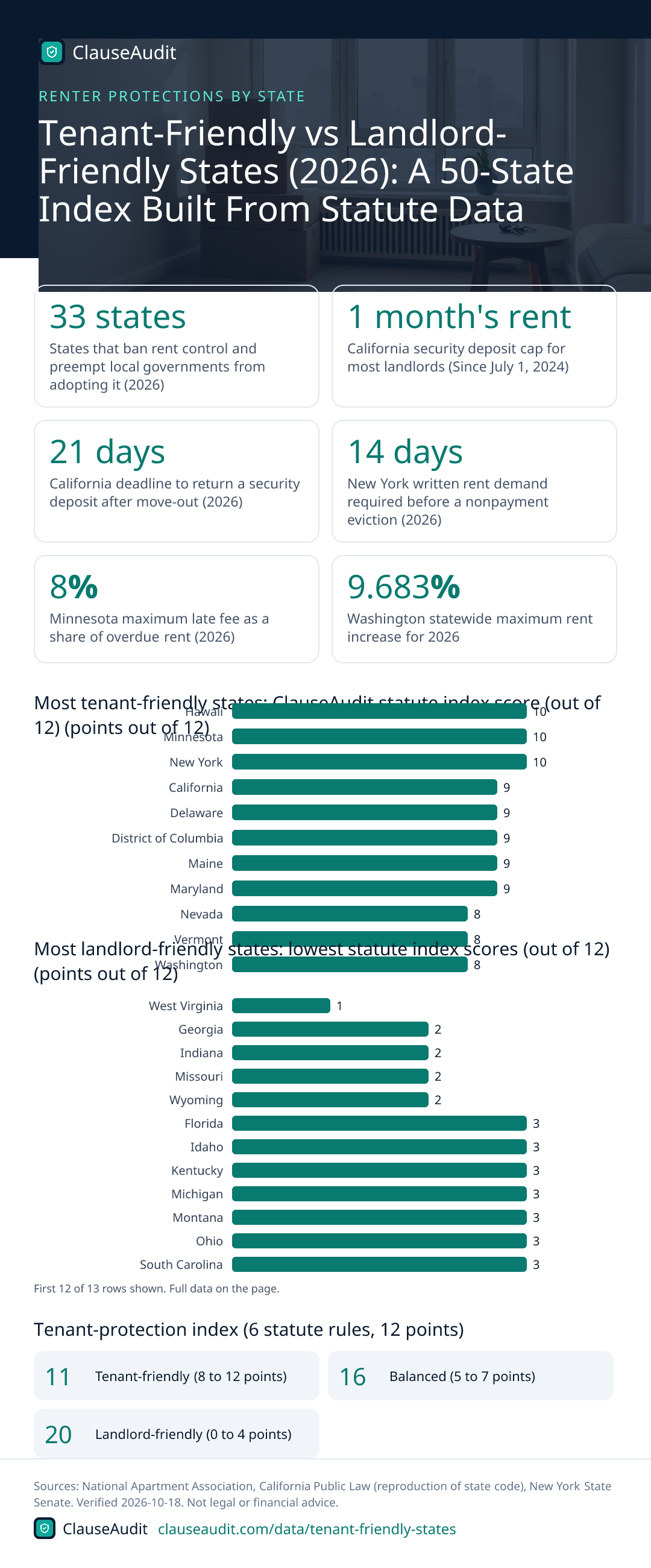
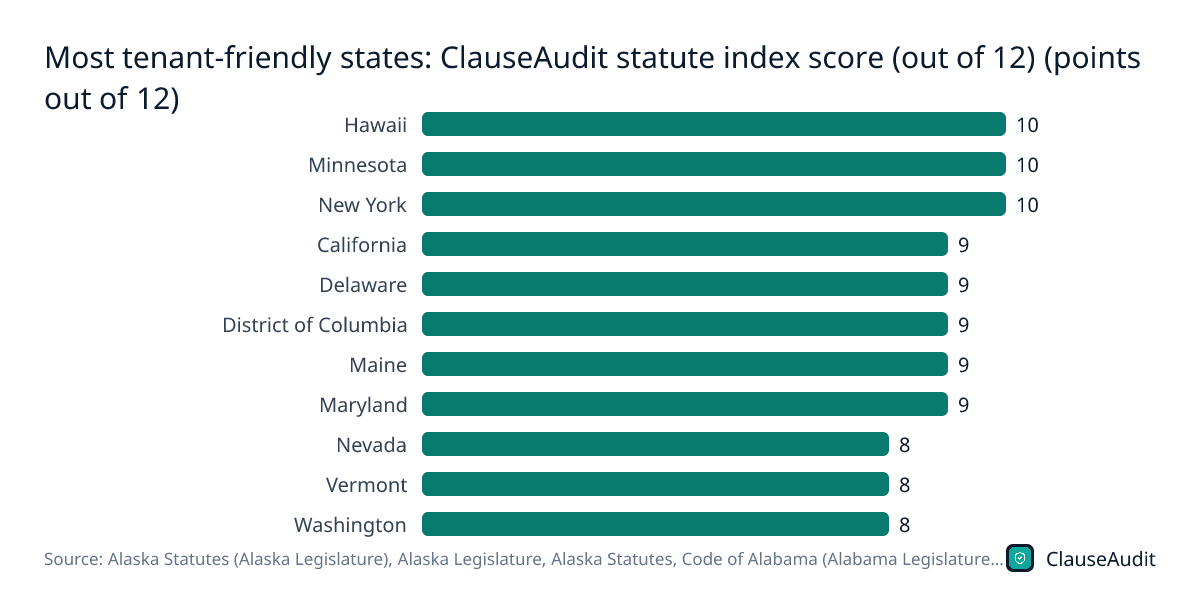
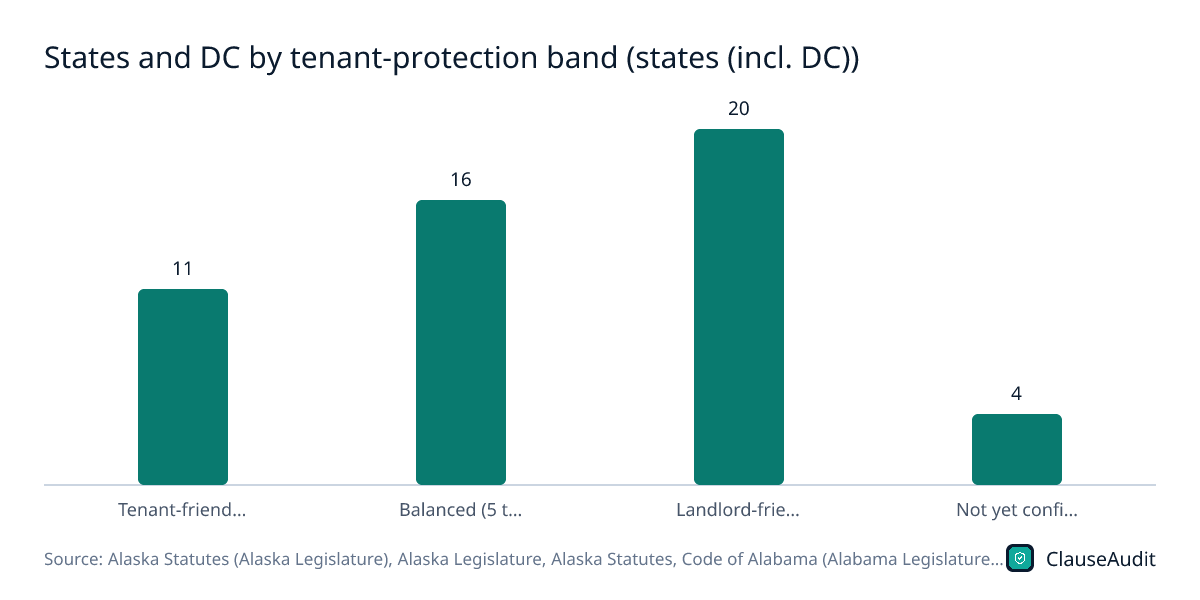
Hawaii, Minnesota and New York are the most tenant-friendly states in our 2026 index, each scoring 10 of 12 across six statute rules. West Virginia has the lowest confirmed score, at 1. In total, 11 jurisdictions land in the tenant-friendly band, 16 are balanced, 20 lean landlord-friendly and 4 are not yet confirmed.

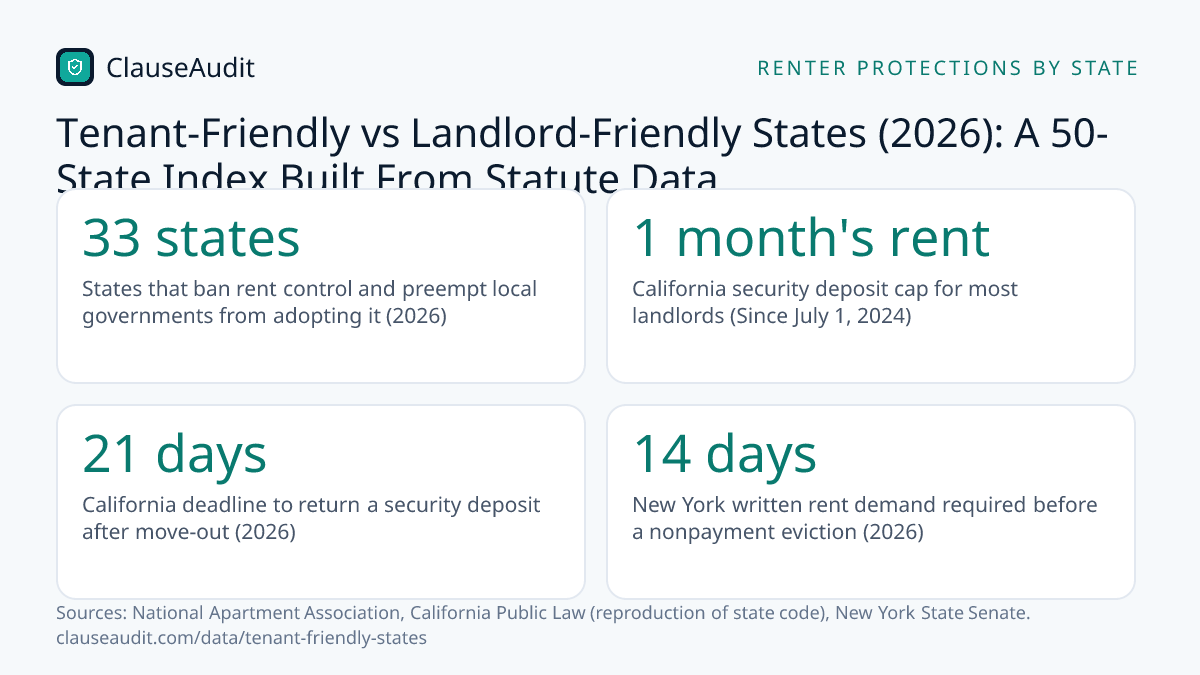
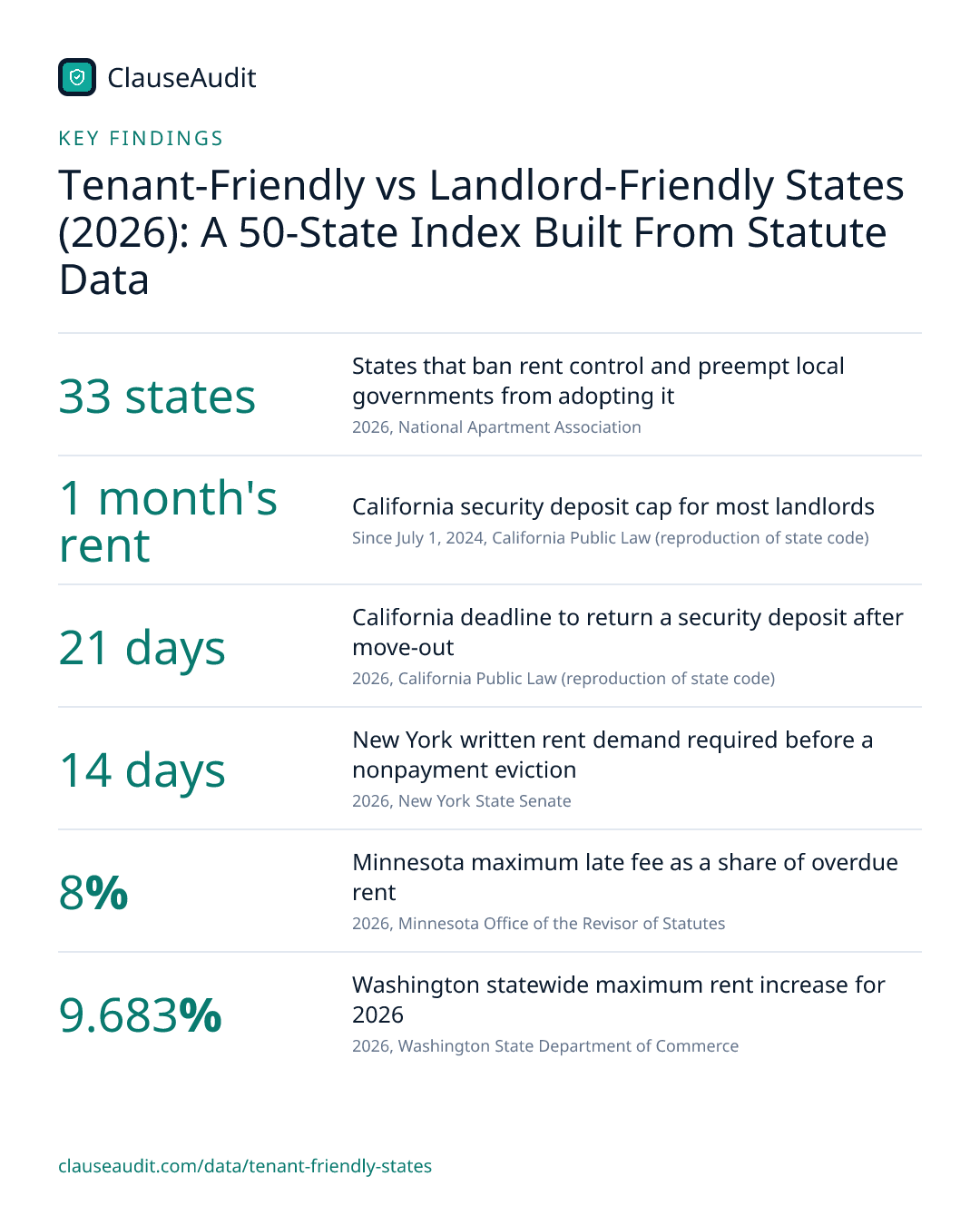
- States that ban rent control and preempt local governments from adopting it (2026, National Apartment Association)
- 33 states
- California security deposit cap for most landlords (Since July 1, 2024, California Public Law (reproduction of state code))
- 1 month's rent
- California deadline to return a security deposit after move-out (2026, California Public Law (reproduction of state code))
- 21 days
- New York written rent demand required before a nonpayment eviction (2026, New York State Senate)
- 14 days
- Minnesota maximum late fee as a share of overdue rent (2026, Minnesota Office of the Revisor of Statutes)
- 8%
- Washington statewide maximum rent increase for 2026 (2026, Washington State Department of Commerce)
- 9.683%
- Oregon maximum annual rent increase for 2027 (9.5% in 2026) (2027, Oregon Department of Administrative Services, Office of Economic Analysis)
- 10%
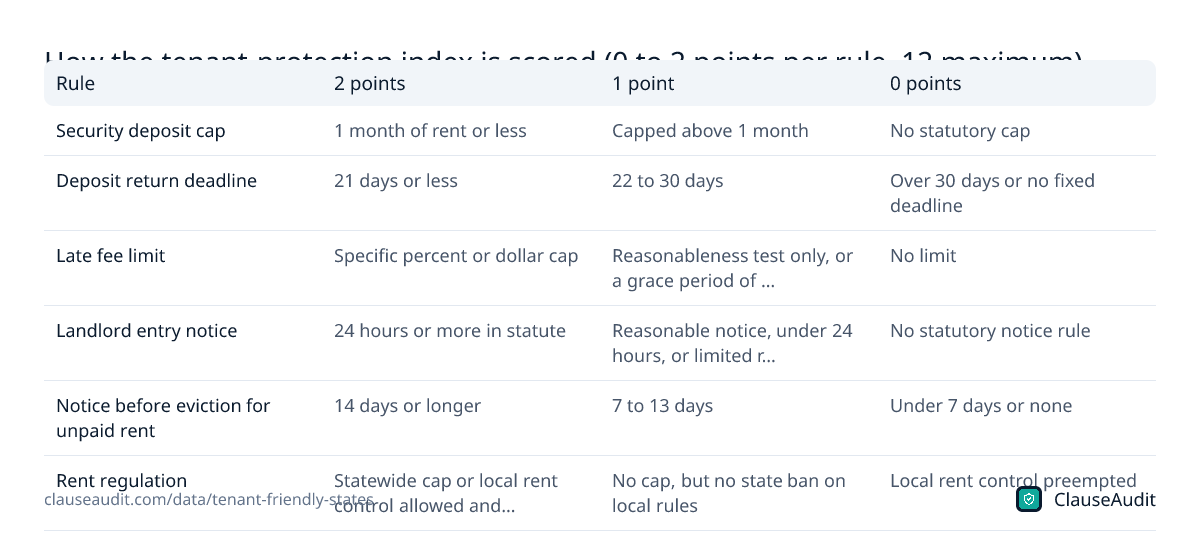
"Tenant-friendly" gets thrown around a lot, usually as a vibe. We wanted a number you could check. So we read the statutes in every state plus DC and scored six rules that decide how a lease plays out in real life: the deposit cap, how fast the deposit comes back, late fee limits, entry notice, notice before an eviction for unpaid rent, and whether rent regulation is allowed.
Each rule is worth 0 to 2 points, for 12 in all. The score tells you what the law guarantees when your lease is silent or unfair. It does not tell you how good your landlord is. That part lives in the contract you sign.
Most tenant-friendly states: ClauseAudit statute index score (out of 12) (points out of 12)
Chart data
| Label | Value |
|---|---|
| Hawaii | 10 |
| Minnesota | 10 |
| New York | 10 |
| California | 9 |
| Delaware | 9 |
| District of Columbia | 9 |
| Maine | 9 |
| Maryland | 9 |
| Nevada | 8 |
| Vermont | 8 |
| Washington | 8 |
The top of the list is mostly coastal, but Minnesota ties for first with no deposit cap at all. It wins on an 8% late fee limit, a 21-day deposit return and 14 days to catch up on rent.
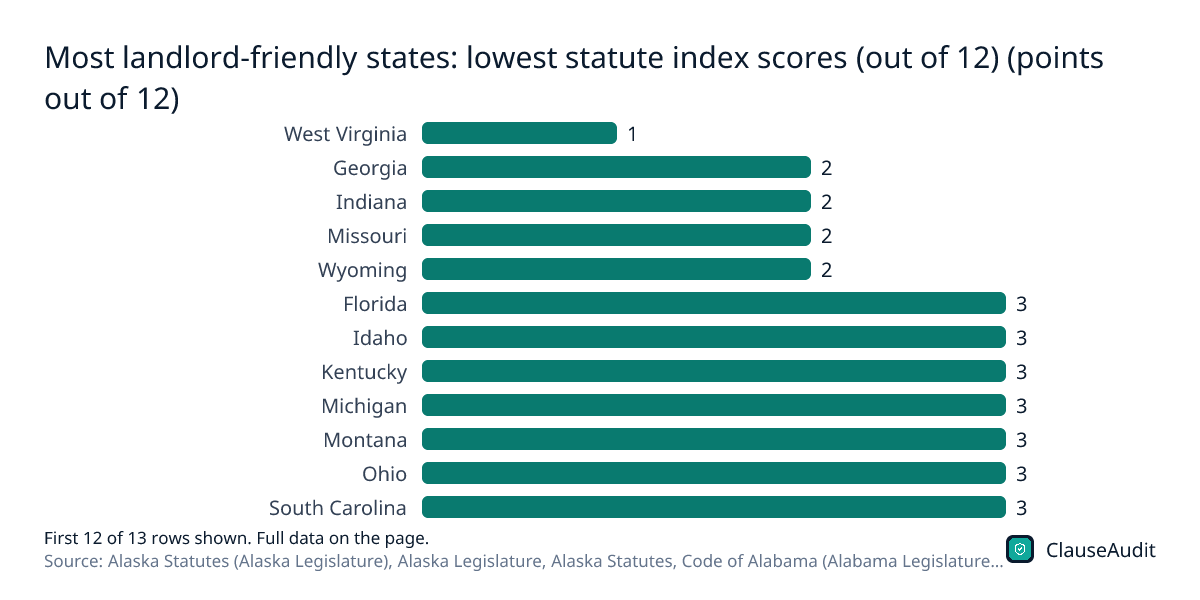
Download this chart (PNG)Most landlord-friendly states: lowest statute index scores (out of 12) (points out of 12)
Chart data
| Label | Value |
|---|---|
| West Virginia | 1 |
| Georgia | 2 |
| Indiana | 2 |
| Missouri | 2 |
| Wyoming | 2 |
| Florida | 3 |
| Idaho | 3 |
| Kentucky | 3 |
| Michigan | 3 |
| Montana | 3 |
| Ohio | 3 |
| South Carolina | 3 |
| Texas | 3 |
West Virginia scores 1 because the statute is silent on most of what we measured: no deposit cap, no late fee cap, no entry notice rule. Texas and Florida sit at 3, held down mostly by uncapped deposits and short notice periods.
Download this chart (PNG)States and DC by tenant-protection band (states (incl. DC))
Chart data
| Label | Value (states (incl. DC)) |
|---|---|
| Tenant-friendly (8 to 12) | 11 |
| Balanced (5 to 7) | 16 |
| Landlord-friendly (0 to 4) | 20 |
| Not yet confirmed | 4 |
More jurisdictions fall in the landlord-friendly band (20) than in the tenant-friendly band (11). The middle is thick, so a single rule change can move a state across a line.
Download this chart (PNG)Security deposit cap by state (states plus DC) (states (incl. DC))
Chart data
| Label | Value (states (incl. DC)) |
|---|---|
| 1 month or less | 14 |
| Over 1 to 2 months | 13 |
| Over 2 months | 1 |
| No statutory cap | 19 |
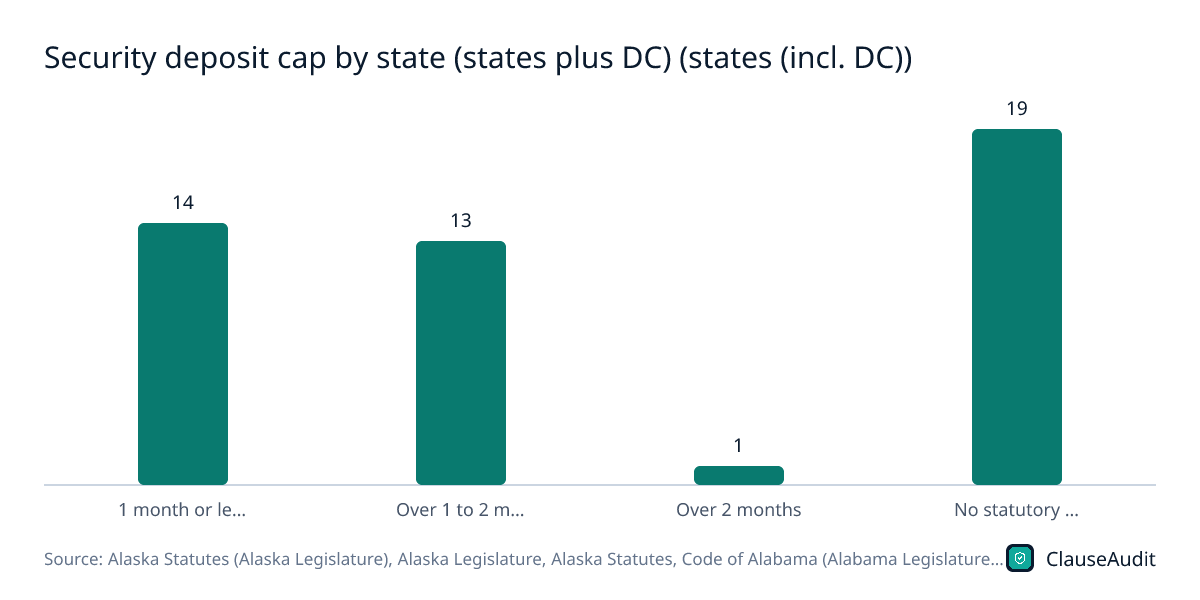
No statutory cap is the single most common answer, at 19. If you rent in one of those states, the deposit amount is whatever you agree to in the lease.
Download this chart (PNG)Notice before eviction filing for unpaid rent (states plus DC) (states (incl. DC))
Chart data
| Label | Value (states (incl. DC)) |
|---|---|
| 14 days or longer | 7 |
| 7 to 13 days | 15 |
| 3 to 6 days | 24 |
| No set period | 4 |
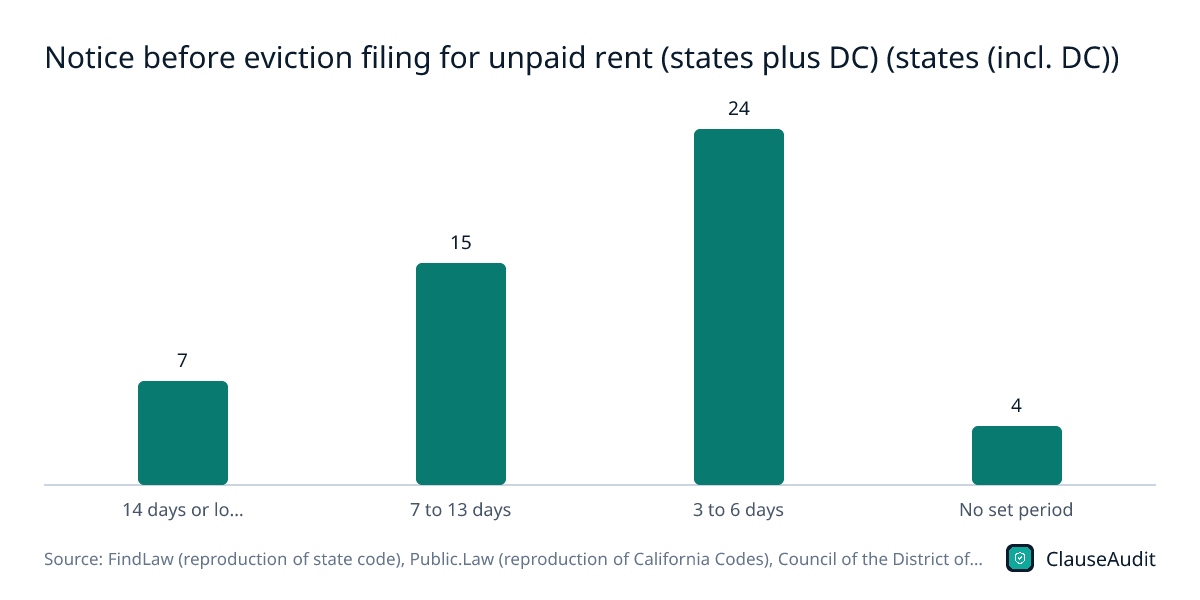
In 24 jurisdictions, a tenant behind on rent gets just 3 to 6 days before the landlord can file. Only 7 give 14 days or longer.
Download this chart (PNG)How states limit residential rent late fees (states plus DC) (states (incl. DC))
Chart data
| Label | Value (states (incl. DC)) |
|---|---|
| Specific % or $ cap | 18 |
| Reasonableness only | 4 |
| No cap | 29 |
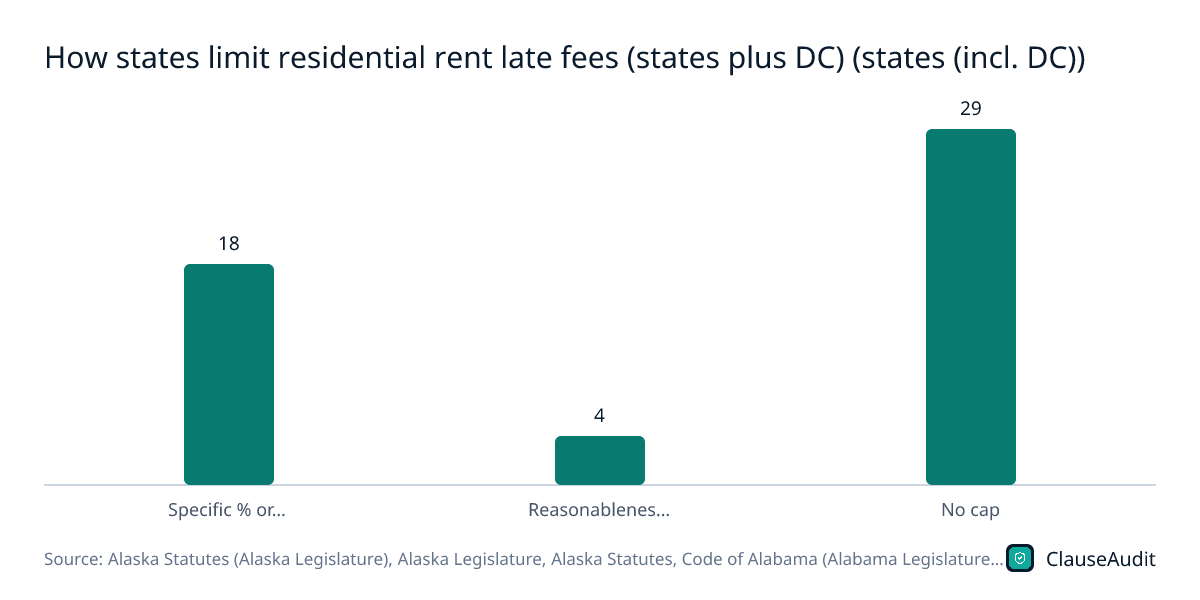
29 jurisdictions set no cap on late fees. In those places, the late fee clause in your lease is the only limit, so read it before you sign rather than after a late payment.
Download this chart (PNG)How the tenant-protection index is scored (0 to 2 points per rule, 12 maximum)
| Rule | 2 points | 1 point | 0 points |
|---|---|---|---|
| Security deposit cap | 1 month of rent or less | Capped above 1 month | No statutory cap |
| Deposit return deadline | 21 days or less | 22 to 30 days | Over 30 days or no fixed deadline |
| Late fee limit | Specific percent or dollar cap | Reasonableness test only, or a grace period of 5+ days | No limit |
| Landlord entry notice | 24 hours or more in statute | Reasonable notice, under 24 hours, or limited rule | No statutory notice rule |
| Notice before eviction for unpaid rent | 14 days or longer | 7 to 13 days | Under 7 days or none |
| Rent regulation | Statewide cap or local rent control allowed and in use | No cap, but no state ban on local rules | Local rent control preempted |
Source: Alaska Statutes (Alaska Legislature), Alaska Stat. § 34.03.070; Alaska Legislature, Alaska Statutes, Alaska Stat. ch. 34.03 (Uniform Residential Landlord and Tenant Act); Alaska Legislature, Alaska Statutes, Alaska Stat. § 34.03.140; Code of Alabama (Alabama Legislature), Ala. Code § 35-9A-201; Alabama Legislature, Code of Alabama (ALISON), Ala. Code §§ 35-9A-143, 35-9A-161 (Alabama Uniform Residential Landlord and Tenant Act); Alabama Legislature, Code of Alabama, Ala. Code § 35-9A-303; Arkansas Code (Arkansas General Assembly), Ark. Code Ann. §§ 18-16-303 to 18-16-306; Arkansas Code (via Justia; official code is published through LexisNexis), Ark. Code Ann. tit. 18, ch. 17 (Arkansas Residential Landlord-Tenant Act of 2007); Arkansas Code of 1987, free public access hosted by LexisNexis for the State of Arkansas, § 18-17-602, Ark. Code Ann. § 18-17-602; Arizona Revised Statutes (Arizona Legislature), Ariz. Rev. Stat. § 33-1321; Arizona Legislature, Arizona Revised Statutes, Ariz. Rev. Stat. § 33-1368(B); Arizona State Legislature, Arizona Revised Statutes, Ariz. Rev. Stat. § 33-1343; California Civil Code (California Legislative Information), Cal. Civ. Code § 1950.5; California Legislative Information, Civil Code § 1671, Cal. Civ. Code § 1671(c)(2), (d); Orozco v. Casimiro, 121 Cal. App. 4th Supp. 7 (2004); California Legislative Information, Civil Code, Cal. Civ. Code § 1954; Colorado General Assembly, HB25-1249 (2025 Session Laws ch. 401, effective January 1, 2026), Colo. Rev. Stat. §§ 38-12-102.5, 38-12-103, 38-12-104; Colorado Revised Statutes § 38-12-105 (via colorado.public.law; official code published through LexisNexis), Colo. Rev. Stat. § 38-12-105; C.R.S. § 38-12-1004 via colorado.public.law (official text at leg.colorado.gov), No general statute; C.R.S. § 38-12-1004 (bed bugs); Connecticut General Statutes (Connecticut General Assembly), Conn. Gen. Stat. § 47a-21; Connecticut General Assembly, General Statutes ch. 830, Conn. Gen. Stat. § 47a-15a; Connecticut General Assembly, General Statutes, Conn. Gen. Stat. § 47a-16; Code of the District of Columbia (DC Council), D.C. Code § 42-3502.17; 14 DCMR §§ 308-311; Council of the District of Columbia, D.C. Code, D.C. Code § 42-3505.31; Council of the District of Columbia, D.C. Code, D.C. Code § 42-3505.51; Delaware Code (Delaware General Assembly), Del. Code Ann. tit. 25, § 5514; Delaware Code Online, Title 25 ch. 55, 25 Del. C. § 5501(d); Delaware Code Online, Title 25, Chapter 55, 25 Del. C. § 5509; 2026 Florida Statutes (Florida Legislature), Fla. Stat. § 83.49; Florida Legislature, Online Sunshine, Fla. Stat. ch. 83, Part II (§§ 83.40-83.683); Florida Legislature, Online Sunshine, Fla. Stat. § 83.53; Official Code of Georgia (Georgia General Assembly), O.C.G.A. §§ 44-7-30.1, 44-7-34, 44-7-35; Georgia Department of Community Affairs, Georgia Landlord Tenant Handbook, O.C.G.A. tit. 44, ch. 7; O.C.G.A. § 13-6-7 (liquidated damages); Georgia Department of Community Affairs, Georgia Landlord-Tenant Handbook (revised 8-29-24), No entry statute (O.C.G.A. Title 44, Ch. 7 silent); Hawaii Revised Statutes (Hawaii State Legislature), Haw. Rev. Stat. § 521-44; Hawaii State Legislature, Hawaii Revised Statutes, Haw. Rev. Stat. § 521-21(f); Hawaii State Legislature, Hawaii Revised Statutes, Haw. Rev. Stat. § 521-53; Iowa Code 2026 (Iowa Legislature), Iowa Code § 562A.12; Iowa Legislature, Iowa Code 2026, Iowa Code § 562A.9(4); Iowa Legislature, Iowa Code 2026, Iowa Code § 562A.19; Idaho Statutes (Idaho Legislature), Idaho Code § 6-321; Idaho Legislature, Idaho Statutes, Idaho Code § 55-305 (added 2023 as § 55-314 by S.B. 1039, 2023 ch. 67; redesignated § 55-305 by 2025 ch. 65, § 14); Idaho Attorney General, Landlord and Tenant Manual (July 2026), No entry statute (Idaho Code Title 6, Ch. 3 silent); Illinois Compiled Statutes (Illinois General Assembly), 765 ILCS 710/1; 765 ILCS 715 (interest); Illinois General Assembly, HB 3564 (104th GA), 765 ILCS 705 (Landlord and Tenant Act); HB 3564 (2026) effective Jan. 1, 2027; Third-party survey (ezel.ai); no government source confirmed, No statewide statute; Indiana Code (Indiana General Assembly), Ind. Code §§ 32-31-3-12, 32-31-3-16; Indiana General Assembly, Indiana Code, Ind. Code tit. 32, art. 31; Indiana General Assembly, Indiana Code Title 32 (IC 32-31-5-6), Ind. Code § 32-31-5-6; Kansas Statutes (Kansas Revisor of Statutes), Kan. Stat. Ann. § 58-2550; Kansas Legislature, Kansas Statutes ch. 58 art. 25, Kan. Stat. Ann. § 58-2540 et seq. (Residential Landlord and Tenant Act); Kansas Office of Revisor of Statutes, Kan. Stat. Ann. § 58-2557; Kentucky Revised Statutes (Kentucky General Assembly), Ky. Rev. Stat. §§ 383.500, 383.580; Kentucky General Assembly, Kentucky Revised Statutes ch. 383, Ky. Rev. Stat. ch. 383 (URLTA, KRS 383.500-383.705, applies only where locally adopted); Kentucky General Assembly, KRS 383.615, Ky. Rev. Stat. § 383.615; Louisiana Revised Statutes (Louisiana State Legislature), La. Rev. Stat. §§ 9:3251, 9:3252; Louisiana State Legislature, Louisiana Laws, La. Civ. Code arts. 2668 et seq. (lease); arts. 2005-2012 (stipulated damages); Third-party survey (ezel.ai); no government source confirmed, No entry statute (Civil Code lease articles silent); General Laws of Massachusetts (Massachusetts Legislature), Mass. Gen. Laws ch. 186, § 15B; Massachusetts Legislature, General Laws, Mass. Gen. Laws ch. 186, § 15B(1)(c); Massachusetts Legislature, General Laws, Mass. Gen. Laws ch. 186, § 15B(1)(a); Maryland Code (Maryland General Assembly), Md. Code Ann., Real Prop. § 8-203; Maryland General Assembly, Real Property Article § 8-208, Md. Code, Real Prop. § 8-208(d)(3); Maryland General Assembly, Statutes Text, Md. Code Ann., Real Prop. § 8-221; Maine Revised Statutes (Maine Legislature), Me. Rev. Stat. tit. 14, §§ 6032, 6033, 6034; Maine Legislature, Maine Revised Statutes, 14 M.R.S. § 6028; Maine Legislature, Maine Revised Statutes, Me. Rev. Stat. tit. 14, § 6025; Michigan Compiled Laws (Michigan Legislature), Mich. Comp. Laws §§ 554.602, 554.609, 554.613; Michigan Legislature, Michigan Compiled Laws, Mich. Comp. Laws §§ 554.601 et seq., 554.631 et seq.; Michigan Legislature, No entry statute; Minnesota Statutes (Minnesota Revisor of Statutes), Minn. Stat. § 504B.178; Minnesota Office of the Revisor of Statutes, Minn. Stat. § 504B.177; Minnesota Office of the Revisor of Statutes, Minn. Stat. § 504B.211; Missouri Revised Statutes (Missouri Revisor of Statutes), Mo. Rev. Stat. § 535.300; Missouri Revisor of Statutes, Mo. Rev. Stat. chs. 441, 535; Missouri Revisor of Statutes, No general entry statute; Mississippi Code (Mississippi Legislature), Miss. Code Ann. § 89-8-21; Mississippi Code (via Justia; official code published through LexisNexis), Miss. Code Ann. tit. 89, ch. 8 (Residential Landlord and Tenant Act); Third-party survey (ezel.ai); no government source confirmed, No entry statute; Montana Code Annotated 2025 (Montana Legislature), Mont. Code Ann. §§ 70-25-201 to 70-25-204; Montana Legislature, Montana Code Annotated, Mont. Code Ann. tit. 70, ch. 24 (Residential Landlord and Tenant Act of 1977); Montana Legislature, Montana Code Annotated 2025, Mont. Code Ann. § 70-24-312; North Carolina General Statutes (North Carolina General Assembly), N.C. Gen. Stat. §§ 42-51, 42-52, 42-55; North Carolina General Assembly, General Statutes, N.C. Gen. Stat. § 42-46(a); North Carolina General Assembly, No entry statute (N.C. Gen. Stat. ch. 42 silent); North Dakota Century Code (North Dakota Legislative Branch), N.D. Cent. Code § 47-16-07.1; North Dakota Legislative Branch, Century Code, N.D. Cent. Code ch. 47-16; North Dakota Legislative Branch, Century Code, N.D. Cent. Code § 47-16-07.3; Nebraska Revised Statutes (Nebraska Legislature), Neb. Rev. Stat. § 76-1416; Nebraska Legislature, Nebraska Revised Statutes, Neb. Rev. Stat. §§ 76-1401 to 76-1449 (Uniform Residential Landlord and Tenant Act); Nebraska Legislature, Revised Statutes, Neb. Rev. Stat. § 76-1423; New Hampshire Revised Statutes (New Hampshire General Court), N.H. Rev. Stat. Ann. §§ 540-A:6, 540-A:7, 540-A:8; New Hampshire General Court, Revised Statutes, N.H. Rev. Stat. Ann. chs. 540, 540-A; New Hampshire General Court, RSA, N.H. Rev. Stat. Ann. § 540-A:3; Truth in Renting (New Jersey Department of Community Affairs), N.J. Stat. Ann. §§ 46:8-21.1, 46:8-21.2; New Jersey Department of Community Affairs, Truth in Renting, N.J.S.A. 2A:42-6.1 to 6.3; New Jersey Department of Community Affairs, Right of Entry bulletin, N.J.A.C. 5:10-5.1(c); N.J.S.A. 2A:39-1; New Mexico Statutes Annotated (NMOneSource, New Mexico Compilation Commission), N.M. Stat. Ann. § 47-8-18; New Mexico Legislature, SB 267 (2025), final version, N.M. Stat. Ann. § 47-8-15(D), as amended by 2025 N.M. Laws ch. 122 (SB 267); NMOneSource, New Mexico Statutes Annotated 1978 (official), § 47-8-24, N.M. Stat. Ann. § 47-8-24; Nevada Revised Statutes (Nevada Legislature), Nev. Rev. Stat. § 118A.242; Nevada Legislature, Nevada Revised Statutes ch. 118A, Nev. Rev. Stat. § 118A.210; Nevada Legislature, Nevada Revised Statutes, Nev. Rev. Stat. § 118A.330; New York General Obligations Law (New York State Senate), N.Y. Gen. Oblig. Law §§ 7-103, 7-108; New York State Senate, Consolidated Laws, N.Y. Real Prop. Law § 238-a(2); New York State Attorney General, No statewide entry statute; Ohio Revised Code (Ohio Legislative Service Commission), Ohio Rev. Code § 5321.16; Ohio Laws and Administrative Rules, Revised Code ch. 5321, Ohio Rev. Code ch. 5321; Ohio Laws and Administrative Rules, Ohio Rev. Code § 5321.04(A)(8); Oklahoma Statutes (Oklahoma State Courts Network), Okla. Stat. tit. 41, § 115; Oklahoma State Courts Network, Oklahoma Statutes Title 41, Okla. Stat. tit. 41, §§ 101-136 (Residential Landlord and Tenant Act); Oklahoma State Senate, Oklahoma Statutes Title 41 compilation (PDF), § 41-128(C), Okla. Stat. tit. 41, § 128; Oregon Revised Statutes (Oregon State Legislature), Or. Rev. Stat. § 90.300; Oregon State Legislature, Oregon Revised Statutes ch. 90, Or. Rev. Stat. § 90.260; Oregon State Legislature, ORS Chapter 90, Or. Rev. Stat. § 90.322; Landlord and Tenant Act of 1951 (Pennsylvania General Assembly), 68 P.S. §§ 250.511a, 250.511b, 250.512; Pennsylvania General Assembly, Landlord and Tenant Act of 1951, Landlord and Tenant Act of 1951, 68 P.S. § 250.101 et seq.; Pennsylvania General Assembly, Landlord and Tenant Act of 1951 (Act 20), No entry statute (Landlord and Tenant Act of 1951 silent); Rhode Island General Laws (Rhode Island General Assembly), R.I. Gen. Laws § 34-18-19; Rhode Island General Assembly, General Laws ch. 34-18, R.I. Gen. Laws ch. 34-18 (Residential Landlord and Tenant Act); Rhode Island General Assembly, General Laws, R.I. Gen. Laws § 34-18-26; South Carolina Code of Laws (South Carolina Legislature), S.C. Code Ann. § 27-40-410; South Carolina Legislature, Code of Laws Title 27 ch. 40, S.C. Code Ann. tit. 27, ch. 40 (Residential Landlord and Tenant Act); South Carolina Legislature, Code of Laws Title 27 Ch. 40, S.C. Code Ann. § 27-40-530; South Dakota Codified Laws (South Dakota Legislature), S.D. Codified Laws §§ 43-32-6.1, 43-32-24; South Dakota Legislature, Codified Laws, S.D. Codified Laws ch. 43-32; South Dakota Legislature, Codified Laws, S.D. Codified Laws § 43-32-32; Tennessee Code (Tennessee General Assembly), Tenn. Code Ann. §§ 66-28-102, 66-28-301; Tennessee Code (via Justia; official code published through LexisNexis), Tenn. Code Ann. § 66-28-201(d); § 66-28-102 (coverage); Tennessee Code Annotated, free public access hosted by LexisNexis for the State of Tennessee, § 66-28-403, Tenn. Code Ann. § 66-28-403; Texas Property Code (Texas Legislature), Tex. Prop. Code §§ 92.103, 92.104, 92.109; Texas Constitution and Statutes, Property Code ch. 92, Tex. Prop. Code § 92.019; Texas Legislature, Property Code Chapter 92, No entry statute (Tex. Prop. Code ch. 92 silent); Utah Code (Utah State Legislature), Utah Code Ann. §§ 57-17-3, 57-17-5; Utah State Legislature, Utah Code, Utah Code Ann. § 57-22-4(5); Utah State Legislature, Utah Code, Utah Code Ann. § 57-22-4(2); Code of Virginia (Virginia General Assembly LIS), Va. Code Ann. § 55.1-1226; Virginia Law (Legislative Information System), Code of Virginia, Va. Code Ann. § 55.1-1204(E); Virginia Law, Code of Virginia, Va. Code Ann. § 55.1-1229(A); Vermont Statutes (Vermont General Assembly), Vt. Stat. Ann. tit. 9, § 4461; Vermont General Assembly, Vermont Statutes Title 9 ch. 137, 9 V.S.A. ch. 137; Highgate Associates, Ltd. v. Merryfield, 157 Vt. 313 (1991); Vermont General Assembly, Vermont Statutes Online, Vt. Stat. Ann. tit. 9, § 4460; Revised Code of Washington (Washington State Legislature), Wash. Rev. Code § 59.18.280; RCW 59.20.170 (as amended by Laws of 2025, ch. 209); Washington State Legislature, Revised Code of Washington, Rev. Code Wash. § 59.18.170(2); Washington State Legislature, RCW, Wash. Rev. Code § 59.18.150(6); Wisconsin Statutes and Administrative Code (Wisconsin Legislature), Wis. Stat. §§ 704.28, 100.20(5); Wis. Admin. Code ATCP § 134.06; Wisconsin Legislature, Administrative Code ATCP 134, Wis. Admin. Code ATCP 134.09(8); Wisconsin Legislature, Administrative Code ATCP 134, Wis. Stat. § 704.05(2); Wis. Admin. Code ATCP 134.09(2); West Virginia Code (West Virginia Legislature), W. Va. Code §§ 37-6A-1, 37-6A-2, 37-6A-5; West Virginia Legislature, West Virginia Code, W. Va. Code chs. 37-6, 37-6A; West Virginia Legislature, W. Va. Code Chapter 37, Article 6, No entry statute (W. Va. Code ch. 37, art. 6 silent); Wyoming Statutes Title 1 (Wyoming Legislature), Wyo. Stat. Ann. §§ 1-21-1207, 1-21-1208; Wyoming Legislature, Wyoming Statutes Title 1, Wyo. Stat. Ann. §§ 1-21-1201 to 1-21-1211; Wyoming Legislature, Wyoming Statutes Title 1 (official PDF), No entry-notice statute (Wyo. Stat. §§ 1-21-1201 to -1211 set no notice period; § 1-21-1205(a)(iii) bars renters from unreasonably denying access); FindLaw (reproduction of state code), Alabama Code § 35-9A-421; FindLaw (reproduction of state code), Alaska Stat. § 34.03.220; FindLaw (reproduction of state code), Ariz. Rev. Stat. § 33-1368; FindLaw (reproduction of state code), Ark. Code § 18-60-304; Public.Law (reproduction of California Codes), Cal. Code Civ. Proc. § 1161; FindLaw (reproduction of state code), Colo. Rev. Stat. § 13-40-104; FindLaw (reproduction of state code), Conn. Gen. Stat. § 47a-23; FindLaw (reproduction of state code), Del. Code tit. 25, § 5502; Council of the District of Columbia, D.C. Code § 42-3505.01; Florida Legislature, Florida Statutes § 83.56; FindLaw (reproduction of state code), Idaho Code § 6-303; FindLaw (reproduction of state code), 735 ILCS 5/9-209; FindLaw (reproduction of state code), Ind. Code § 32-31-1-6; FindLaw (reproduction of state code), Kan. Stat. § 58-2564; FindLaw (reproduction of state code), Ky. Rev. Stat. § 383.660; Maine Legislature, Maine Rev. Stat. tit. 14, § 6002; FindLaw (reproduction of state code), Md. Code, Real Prop. § 8-401; FindLaw (reproduction of state code), Mich. Comp. Laws § 600.5714; Minnesota Office of the Revisor of Statutes, Minn. Stat. § 504B.321; FindLaw (reproduction of state code), Miss. Code § 89-8-13; FindLaw (reproduction of state code), Mo. Rev. Stat. § 535.020; Montana Legislature, Mont. Code Ann. § 70-24-422; FindLaw (reproduction of state code), Neb. Rev. Stat. § 76-1431; FindLaw (reproduction of state code), Nev. Rev. Stat. § 40.2512; FindLaw (reproduction of state code), N.J. Stat. § 2A:18-61.2; FindLaw (reproduction of state code), N.M. Stat. § 47-8-33; New York State Senate, N.Y. Real Property Actions and Proceedings Law § 711; FindLaw (reproduction of state code), N.C. Gen. Stat. § 42-3; North Dakota Legislative Branch, N.D. Century Code ch. 47-32 (§§ 47-32-01, 47-32-02); FindLaw (reproduction of state code), Ohio Rev. Code § 1923.04; Public.Law (reproduction of Oregon Revised Statutes), Or. Rev. Stat. § 90.394; FindLaw (reproduction of state code), 68 P.S. § 250.501; FindLaw (reproduction of state code), R.I. Gen. Laws § 34-18-35; South Carolina Legislature, S.C. Code § 27-40-710; South Dakota Legislature, S.D. Codified Laws §§ 21-16-1, 21-16-2; FindLaw (reproduction of state code), Tenn. Code § 66-28-505; Texas Legislature, Texas S.B. 38 (89th Legislature), enrolled text amending Property Code § 24.005; FindLaw (reproduction of state code), Utah Code § 78B-6-802; FindLaw (reproduction of state code), Vt. Stat. tit. 9, § 4467; Virginia Legislative Information System, Code of Virginia § 55.1-1245; Washington State Legislature, RCW 59.12.030; FindLaw (reproduction of state code), W. Va. Code § 55-3A-1; FindLaw (reproduction of state code), Wyo. Stat. § 1-21-1003; Legal Information Institute, Cornell Law School, 15 U.S.C. § 9058 (CARES Act § 4024); Legal Services Corporation and Temple University Center for Public Health Law Research, LSC Eviction Laws Database (State and Territory Dataset); Georgia Department of Community Affairs, Georgia Landlord-Tenant Handbook; Hawaii State Legislature, Haw. Rev. Stat. § 521-68; Iowa Legislature, Iowa Code § 562A.27; Louisiana State Legislature, La. Code Civ. Proc. art. 4701; FindLaw (reproduction of state code), Mass. Gen. Laws ch. 186, § 11; Oklahoma Real Estate Commission, Oklahoma Landlord and Tenant Act (41 Okla. Stat. §§ 131, 132); South Dakota Legislature, SB 90, Session Laws 2024, Chapter 75; FindLaw (reproduction of state code), Wis. Stat. § 704.17; National Apartment Association, Rent Control Laws by State (page and map); Oregon Department of Administrative Services, Office of Economic Analysis, Rent Stabilization: Maximum Annual Rent Increase Percentage for 2027; Oregon Department of Administrative Services, Office of Economic Analysis, Oregon Maximum Annual Rent Increase 2027 (methodology and history workbook); Oregon Revised Statutes (via oregon.public.law), ORS 90.323 Maximum rent increase; Oregon Revised Statutes (via oregon.public.law), ORS 91.225 Local rent control prohibited; Washington State Department of Commerce, HB 1217 Landlord Resource Center: maximum annual rent increase; Washington State Department of Commerce, Commerce announces 9.683% rent cap for 2026; Washington State Department of Commerce, Commerce announces 10% rent cap for the rest of 2025; Washington State Legislature, RCW 59.18.700 Rent increases: limitations; Washington State Legislature, RCW 59.18.710 Rent increase limitations: exemptions; Washington State Legislature, RCW 35.21.830 Controls on rent for residential structures: prohibited; State of California (via california.public.law), California Civil Code § 1947.12 (Tenant Protection Act of 2019, AB 1482); New York City Rent Guidelines Board, 2026-27 Apartment/Loft Order #58; New York City Rent Guidelines Board, Rent Guidelines Board Apartment Orders #1 through #58 (summary chart); District of Columbia Rental Housing Commission, Certification and Notice of Rent Adjustment of General Applicability, effective May 1, 2026; Minnesota Office of the Revisor of Statutes, Minnesota Statutes § 471.9996 Rent control prohibited; Colorado Revised Statutes (via colorado.public.law), C.R.S. § 38-12-301 Control of rents by counties and municipalities prohibited; Kansas Office of Revisor of Statutes, K.S.A. 12-16,120 Prohibiting rent control by political subdivisions; The Florida Senate, Florida Statutes § 125.0103 Ordinances and rules imposing price controls; Texas Local Government Code (via texas.public.law), Texas Local Government Code § 214.902 Rent control; Virginia Legislative Information System, Code of Virginia § 55.1-1201 Applicability of chapter. Download as image
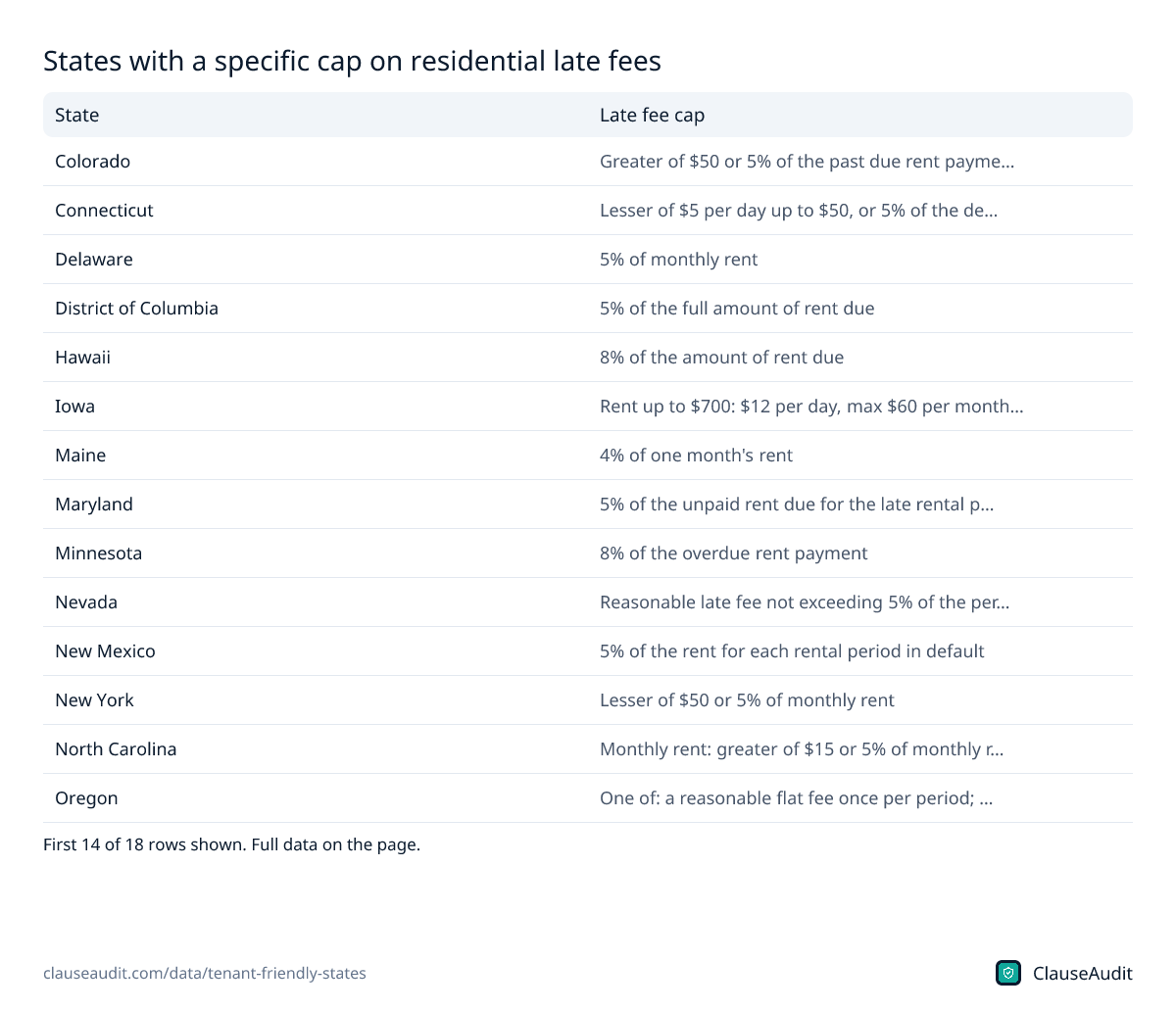
States with a specific cap on residential late fees
| State | Late fee cap |
|---|---|
| Colorado | Greater of $50 or 5% of the past due rent payment |
| Connecticut | Lesser of $5 per day up to $50, or 5% of the delinquent rent payment |
| Delaware | 5% of monthly rent |
| District of Columbia | 5% of the full amount of rent due |
| Hawaii | 8% of the amount of rent due |
| Iowa | Rent up to $700: $12 per day, max $60 per month. Rent over $700: $20 per day, max $100 per month |
| Maine | 4% of one month's rent |
| Maryland | 5% of the unpaid rent due for the late rental period; weekly leases: $3 per week, $12 per month |
| Minnesota | 8% of the overdue rent payment |
| Nevada | Reasonable late fee not exceeding 5% of the periodic rent |
| New Mexico | 5% of the rent for each rental period in default |
| New York | Lesser of $50 or 5% of monthly rent |
| North Carolina | Monthly rent: greater of $15 or 5% of monthly rent. Weekly rent: greater of $4 or 5% of weekly rent |
| Oregon | One of: a reasonable flat fee once per period; a daily fee up to 6% of that flat fee; or 5% of periodic rent per 5 day period |
| Tennessee | 10% of the amount of rent past due (counties covered by the URLTA) |
| Texas | Presumed reasonable up to 12% of monthly rent (buildings of 4 units or fewer) or 10% (more than 4 units); higher only if not more than uncertain damages related to the late payment |
| Utah | Greater of 10% of the rent agreed to in the rental agreement or $75 |
| Virginia | Lesser of 10% of the periodic rent or 10% of the remaining balance due |
Source: Colorado Revised Statutes § 38-12-105 (via colorado.public.law; official code published through LexisNexis), Colo. Rev. Stat. § 38-12-105; Connecticut General Assembly, General Statutes ch. 830, Conn. Gen. Stat. § 47a-15a; Delaware Code Online, Title 25 ch. 55, 25 Del. C. § 5501(d); Council of the District of Columbia, D.C. Code, D.C. Code § 42-3505.31; Hawaii State Legislature, Hawaii Revised Statutes, Haw. Rev. Stat. § 521-21(f); Iowa Legislature, Iowa Code 2026, Iowa Code § 562A.9(4); Maine Legislature, Maine Revised Statutes, 14 M.R.S. § 6028; Maryland General Assembly, Real Property Article § 8-208, Md. Code, Real Prop. § 8-208(d)(3); Minnesota Office of the Revisor of Statutes, Minn. Stat. § 504B.177; Nevada Legislature, Nevada Revised Statutes ch. 118A, Nev. Rev. Stat. § 118A.210; New Mexico Legislature, SB 267 (2025), final version, N.M. Stat. Ann. § 47-8-15(D), as amended by 2025 N.M. Laws ch. 122 (SB 267); New York State Senate, Consolidated Laws, N.Y. Real Prop. Law § 238-a(2); North Carolina General Assembly, General Statutes, N.C. Gen. Stat. § 42-46(a); Oregon State Legislature, Oregon Revised Statutes ch. 90, Or. Rev. Stat. § 90.260; Tennessee Code (via Justia; official code published through LexisNexis), Tenn. Code Ann. § 66-28-201(d); § 66-28-102 (coverage); Texas Constitution and Statutes, Property Code ch. 92, Tex. Prop. Code § 92.019; Utah State Legislature, Utah Code, Utah Code Ann. § 57-22-4(5); Virginia Law (Legislative Information System), Code of Virginia, Va. Code Ann. § 55.1-1204(E). Download as image
Tenant-protection index (6 statute rules, 12 points) by state
- 11Tenant-friendly (8 to 12 points)
- 16Balanced (5 to 7 points)
- 20Landlord-friendly (0 to 4 points)
- Tenant-friendly (8 to 12 points)11
- Balanced (5 to 7 points)16
- Landlord-friendly (0 to 4 points)20
- Not yet confirmed4
| State | Index score | Deposit cap | Deposit return deadline | Late fee limit | Entry notice | Notice before eviction (unpaid rent) | Rent regulation | Source |
|---|---|---|---|---|---|---|---|---|
| Alabama | 5 of 12 | 1 month's rent | 60 days | No statutory cap | At least 2 days' notice | 7 business days to pay; tenant can cure by paying | Preempted by state law | Ala. Code § 35-9A-201; Ala. Code §§ 35-9A-143, 35-9A-161 (Alabama Uniform Residential Landlord and Tenant Act); Ala. Code § 35-9A-303; Ala. Code § 35-9A-421 |
| Alaska | 6 of 12 | 2 months' rent; cap does not apply where rent exceeds $2,000 a month | 30 days | No statutory cap | At least 24 hours' notice | 7 days to pay in full | No state preemption and no local rent control in effect (per NAA) | Alaska Stat. § 34.03.070; Alaska Stat. ch. 34.03 (Uniform Residential Landlord and Tenant Act); Alaska Stat. § 34.03.140; Alaska Stat. § 34.03.220 |
| Arizona | 6 of 12 | 1.5 months' rent, including prepaid rent | 14 days | A reasonable late fee set forth in a written rental agreement | At least 2 days' notice | 5 days to pay | Preempted by state law | Ariz. Rev. Stat. § 33-1321; Ariz. Rev. Stat. § 33-1368(B); Ariz. Rev. Stat. § 33-1343; A.R.S. § 33-1368 |
| Arkansas | Not yet confirmed: check the source | Ark. Code Ann. §§ 18-16-303 to 18-16-306; Ark. Code Ann. tit. 18, ch. 17 (Arkansas Residential Landlord-Tenant Act of 2007); Ark. Code Ann. § 18-17-602; Ark. Code § 18-60-304 | ||||||
| California | 9 of 12 | 1 month's rent for most landlords since July 1, 2024 (AB 12) | 21 days | No fixed cap; a late fee is valid only if it is a reasonable estimate of the landlord's actual loss | 24 hours' written notice (presumed reasonable); 6 days if mailed | 3 days, excluding Saturdays, Sundays and judicial holidays | 5% plus regional CPI, or 10%, whichever is lower (AB 1482) | Cal. Civ. Code § 1950.5; Cal. Civ. Code § 1671(c)(2), (d); Orozco v. Casimiro, 121 Cal. App. 4th Supp. 7 (2004); Cal. Civ. Code § 1954; Cal. Code Civ. Proc. § 1161; Cal. Civ. Code § 1947.12 |
| Colorado | 5 of 12 | 2 months' rent (since Aug 7, 2023) | 30 days | Greater of $50 or 5% of the past due rent payment | No general statutory notice period (48 hours for bed bug inspection or treatment) | 10 days' written demand (5 days for exempt residential agreements) | Preempted by state law | Colo. Rev. Stat. §§ 38-12-102.5, 38-12-103, 38-12-104; Colo. Rev. Stat. § 38-12-105; No general statute; C.R.S. § 38-12-1004 (bed bugs); C.R.S. § 13-40-104(1)(d), (e); C.R.S. § 38-12-301 |
| Connecticut | 6 of 12 | 2 months' rent; 1 month's rent if the tenant is 62 or older | 21 days | Lesser of $5 per day up to $50, or 5% of the delinquent rent payment | Reasonable written or oral notice | 3 days' notice to quit, served only after the residential grace period runs | Partially preempted (per NAA) | Conn. Gen. Stat. § 47a-21; Conn. Gen. Stat. § 47a-15a; Conn. Gen. Stat. § 47a-16; Conn. Gen. Stat. § 47a-23 |
| Delaware | 9 of 12 | 1 month's rent for leases of one year or more; for month-to-month tenancies the 1-month limit applies after the first year | 20 days | 5% of monthly rent | At least 48 hours' notice | 5 days to pay | No state preemption and no local rent control in effect (per NAA) | Del. Code Ann. tit. 25, § 5514; 25 Del. C. § 5501(d); 25 Del. C. § 5509; Del. Code tit. 25, § 5502 |
| District of Columbia | 9 of 12 | 1 month's rent | 45 days | 5% of the full amount of rent due | At least 48 hours' written notice | Notice of intent to file at least 10 days before filing; no filing for less than $600 owed | District-wide rent stabilization: up to 4.1% from May 1, 2026 (2.1% for tenants 62+ or with a disability) | D.C. Code § 42-3502.17; 14 DCMR §§ 308-311; D.C. Code § 42-3505.31; D.C. Code § 42-3505.51; D.C. Code § 42-3505.01(a-1), (b); D.C. Official Code §§ 42-3502.06, 42-3502.08(h)(2)(A) |
| Florida | 3 of 12 | No statutory cap | 30 days | No statutory cap | At least 24 hours' notice for repairs; reasonable notice otherwise | 3 days, excluding Saturdays, Sundays and court-observed holidays | Preempted by state law | Fla. Stat. § 83.49; Fla. Stat. ch. 83, Part II (§§ 83.40-83.683); Fla. Stat. § 83.53; Fla. Stat. § 83.56; Fla. Stat. § 125.0103 (2026) |
| Georgia | 2 of 12 | 2 months' rent for leases entered into or renewed on or after July 1, 2024 (Safe at Home Act, HB 404) | 30 days | No statutory cap | No statutory notice period | Written notice to pay at least 3 business days before filing | Preempted by state law | O.C.G.A. §§ 44-7-30.1, 44-7-34, 44-7-35; O.C.G.A. tit. 44, ch. 7; O.C.G.A. § 13-6-7 (liquidated damages); No entry statute (O.C.G.A. Title 44, Ch. 7 silent); O.C.G.A. § 44-7-50 (as amended effective July 1, 2024) |
| Hawaii | 10 of 12 | 1 month's rent, plus a separate pet deposit of up to 1 month's rent (not for assistance animals) | 14 days | 8% of the amount of rent due | At least 2 days' notice | 10 calendar days to pay (notice also goes to a state-funded mediation center) | No state preemption and no local rent control in effect (per NAA) | Haw. Rev. Stat. § 521-44; Haw. Rev. Stat. § 521-21(f); Haw. Rev. Stat. § 521-53; Haw. Rev. Stat. § 521-68 (version effective February 5, 2026) |
| Idaho | 3 of 12 | No statutory cap | 21 days | Fees, including late fees, must be reasonable; no dollar or percent cap | No statutory notice period | 3 days' written notice to pay | Preempted by state law | Idaho Code § 6-321; Idaho Code § 55-305 (added 2023 as § 55-314 by S.B. 1039, 2023 ch. 67; redesignated § 55-305 by 2025 ch. 65, § 14); No entry statute (Idaho Code Title 6, Ch. 3 silent); Idaho Code § 6-303 |
| Illinois | 1 of 12 | No statewide cap | 30 days | No statutory cap | Not yet confirmed | 5 days after written demand | Preempted by state law | 765 ILCS 710/1; 765 ILCS 715 (interest); 765 ILCS 705 (Landlord and Tenant Act); HB 3564 (2026) effective Jan. 1, 2027; No statewide statute; 735 ILCS 5/9-209 |
| Indiana | 2 of 12 | No statutory cap | 45 days | No statutory cap | Reasonable written or oral notice | 10 days, unless the lease says otherwise | Preempted by state law | Ind. Code §§ 32-31-3-12, 32-31-3-16; Ind. Code tit. 32, art. 31; Ind. Code § 32-31-5-6; Ind. Code § 32-31-1-6 |
| Iowa | 6 of 12 | 2 months' rent | 30 days | Rent up to $700: $12 per day, max $60 per month. Rent over $700: $20 per day, max $100 per month | At least 24 hours' notice | 3 days after written notice to pay | Preempted by state law | Iowa Code § 562A.12; Iowa Code § 562A.9(4); Iowa Code § 562A.19; Iowa Code § 562A.27(1), (2) |
| Kansas | 4 of 12 | 1 month's rent unfurnished; 1.5 months furnished; plus up to half a month's rent as a pet deposit | 30 days | No statutory cap | Reasonable notice | 3 days to pay (counted as consecutive 24-hour periods; 2 extra days if mailed) | Preempted by state law | Kan. Stat. Ann. § 58-2550; Kan. Stat. Ann. § 58-2540 et seq. (Residential Landlord and Tenant Act); Kan. Stat. Ann. § 58-2557; Kan. Stat. § 58-2564; K.S.A. 12-16,120 |
| Kentucky | 3 of 12 | No statutory cap | No fixed deadline | No statutory cap | At least 2 days' notice, only where URLTA is locally adopted | 7 days to pay | Preempted by state law | Ky. Rev. Stat. §§ 383.500, 383.580; Ky. Rev. Stat. ch. 383 (URLTA, KRS 383.500-383.705, applies only where locally adopted); Ky. Rev. Stat. § 383.615; Ky. Rev. Stat. § 383.660 |
| Louisiana | 1 of 12 | No statutory cap | 30 days | No statutory cap | Not yet confirmed | At least 5 days to vacate after written notice (lease may waive notice) | Preempted by state law | La. Rev. Stat. §§ 9:3251, 9:3252; La. Civ. Code arts. 2668 et seq. (lease); arts. 2005-2012 (stipulated damages); No entry statute (Civil Code lease articles silent); La. Code Civ. Proc. art. 4701 |
| Maine | 9 of 12 | 2 months' rent | 30 days | 4% of one month's rent | Reasonable notice; 24 hours presumed reasonable | 7 days, once rent is 7 or more days late | Allowed; in effect in some cities (per NAA) | Me. Rev. Stat. tit. 14, §§ 6032, 6033, 6034; 14 M.R.S. § 6028; Me. Rev. Stat. tit. 14, § 6025; 14 M.R.S. § 6002 |
| Maryland | 9 of 12 | 1 month's rent per unit (since Oct 1, 2024) | 45 days | 5% of the unpaid rent due for the late rental period; weekly leases: $3 per week, $12 per month | At least 24 hours' written notice | 10 days to cure after written notice on the Judiciary form | Allowed; in effect in some localities (per NAA) | Md. Code Ann., Real Prop. § 8-203; Md. Code, Real Prop. § 8-208(d)(3); Md. Code Ann., Real Prop. § 8-221; Md. Code, Real Prop. § 8-401(c) |
| Massachusetts | 6 of 12 | Security deposit up to 1 month's rent, in addition to first month's rent, last month's rent and a lock change fee | 30 days | No statutory dollar or percent cap | No statutory notice period; entry limited to listed purposes | 14 days' notice to quit (written lease); tenant can cure by paying in full by the answer date | Preempted by state law | Mass. Gen. Laws ch. 186, § 15B; Mass. Gen. Laws ch. 186, § 15B(1)(c); Mass. Gen. Laws ch. 186, § 15B(1)(a); Mass. Gen. Laws ch. 186, § 11 |
| Michigan | 3 of 12 | 1.5 months' rent | 30 days | No statutory cap | No statutory notice period | 7 days after written demand for possession | Preempted by state law | Mich. Comp. Laws §§ 554.602, 554.609, 554.613; Mich. Comp. Laws §§ 554.601 et seq., 554.631 et seq.; No entry statute; Mich. Comp. Laws § 600.5714 |
| Minnesota | 10 of 12 | No statutory cap | 21 days | 8% of the overdue rent payment | Good-faith effort to give at least 24 hours' notice | 14 days to correct the delinquency (longer if a local law requires) | Allowed only if approved by voters at a general election | Minn. Stat. § 504B.178; Minn. Stat. § 504B.177; Minn. Stat. § 504B.211; Minn. Stat. § 504B.321, subd. 1a; Minn. Stat. § 471.9996 |
| Mississippi | 0 of 12 | No statutory cap | 45 days | No statutory cap | Not yet confirmed | 3 days to pay | Preempted by state law | Miss. Code Ann. § 89-8-21; Miss. Code Ann. tit. 89, ch. 8 (Residential Landlord and Tenant Act); No entry statute; Miss. Code § 89-8-13 |
| Missouri | 2 of 12 | 2 months' rent | 30 days | No statutory cap | No statutory notice period | No set period; a demand for payment is required before filing | Preempted by state law | Mo. Rev. Stat. § 535.300; Mo. Rev. Stat. chs. 441, 535; No general entry statute; Mo. Rev. Stat. § 535.020 |
| Montana | 3 of 12 | No statutory cap | 30 days | No statutory cap | At least 24 hours' notice | 3 days to pay | Preempted by state law | Mont. Code Ann. §§ 70-25-201 to 70-25-204; Mont. Code Ann. tit. 70, ch. 24 (Residential Landlord and Tenant Act of 1977); Mont. Code Ann. § 70-24-312; Mont. Code Ann. § 70-24-422 |
| Nebraska | 7 of 12 | 1 month's rent, plus a pet deposit of up to one quarter of a month's rent | 14 days | No statutory cap | At least 24 hours' written notice | 7 calendar days to pay | Preempted by state law | Neb. Rev. Stat. § 76-1416; Neb. Rev. Stat. §§ 76-1401 to 76-1449 (Uniform Residential Landlord and Tenant Act); Neb. Rev. Stat. § 76-1423; Neb. Rev. Stat. § 76-1431 |
| Nevada | 8 of 12 | 3 months' rent, counting the deposit, any surety bond and last month's rent together | 30 days | Reasonable late fee not exceeding 5% of the periodic rent | At least 24 hours' notice | 7 judicial days (5 days for commercial premises) | No state preemption and no local rent control in effect (per NAA) | Nev. Rev. Stat. § 118A.242; Nev. Rev. Stat. § 118A.210; Nev. Rev. Stat. § 118A.330; Nev. Rev. Stat. § 40.2512 |
| New Hampshire | Not yet confirmed: check the source | N.H. Rev. Stat. Ann. §§ 540-A:6, 540-A:7, 540-A:8; N.H. Rev. Stat. Ann. chs. 540, 540-A; N.H. Rev. Stat. Ann. § 540-A:3; N.H. Rev. Stat. § 540:3 | ||||||
| New Jersey | 5 of 12 | 1.5 months' rent | 30 days | No statutory cap | Reasonable notice, ordinarily one day (multiple dwellings) | No notice to quit required for nonpayment | Allowed; in effect in many municipalities (per NAA) | N.J. Stat. Ann. §§ 46:8-21.1, 46:8-21.2; N.J.S.A. 2A:42-6.1 to 6.3; N.J.A.C. 5:10-5.1(c); N.J.S.A. 2A:39-1; N.J. Stat. § 2A:18-61.2 |
| New Mexico | 7 of 12 | 1 month's rent for leases under one year | 30 days | 5% of the rent for each rental period in default | 24 hours' written notice | 3 days to pay | Preempted by state law | N.M. Stat. Ann. § 47-8-18; N.M. Stat. Ann. § 47-8-15(D), as amended by 2025 N.M. Laws ch. 122 (SB 267); N.M. Stat. Ann. § 47-8-24; N.M. Stat. § 47-8-33 |
| New York | 10 of 12 | 1 month's rent | 14 days | Lesser of $50 or 5% of monthly rent | No statewide statutory notice period | 14 days' written demand | Allowed; New York City rent stabilization set 0% for 1- and 2-year leases starting Oct 1, 2026 to Sept 30, 2027 | N.Y. Gen. Oblig. Law §§ 7-103, 7-108; N.Y. Real Prop. Law § 238-a(2); No statewide entry statute; N.Y. RPAPL § 711(2) |
| North Carolina | 5 of 12 | 2 weeks' rent for week-to-week, 1.5 months' rent for month-to-month, 2 months' rent for longer terms | 30 days | Monthly rent: greater of $15 or 5% of monthly rent. Weekly rent: greater of $4 or 5% of weekly rent | No statutory notice period | 10 days after demand | Preempted by state law | N.C. Gen. Stat. §§ 42-51, 42-52, 42-55; N.C. Gen. Stat. § 42-46(a); No entry statute (N.C. Gen. Stat. ch. 42 silent); N.C. Gen. Stat. § 42-3 |
| North Dakota | 4 of 12 | 1 month's rent; up to 2 months for a tenant with a felony conviction or a prior judgment for breaking a lease | 30 days | No statutory cap | Notice of entry at a specific time; consent presumed if tenant does not object | 3 days' written notice of intention to evict | Preempted by state law | N.D. Cent. Code § 47-16-07.1; N.D. Cent. Code ch. 47-16; N.D. Cent. Code § 47-16-07.3; N.D. Cent. Code §§ 47-32-01, 47-32-02 |
| Ohio | 3 of 12 | No statutory cap | 30 days | No statutory cap | Reasonable notice; 24 hours presumed reasonable | 3 days' notice to leave | Preempted by state law | Ohio Rev. Code § 5321.16; Ohio Rev. Code ch. 5321; Ohio Rev. Code § 5321.04(A)(8); Ohio Rev. Code § 1923.04 |
| Oklahoma | Not yet confirmed: check the source | Okla. Stat. tit. 41, § 115; Okla. Stat. tit. 41, §§ 101-136 (Residential Landlord and Tenant Act); Okla. Stat. tit. 41, § 128; 41 Okla. Stat. §§ 131(B), 132(B) | ||||||
| Oregon | 7 of 12 | No statutory cap | 31 days | One of: a reasonable flat fee once per period; a daily fee up to 6% of that flat fee; or 5% of periodic rent per 5 day period | At least 24 hours' actual notice | 10 days (served on or after day 8) or 13 days (served on or after day 5); 72 hours for week-to-week | 7% plus CPI, or 10%, whichever is lower: 9.5% for 2026 and 10% for 2027. Manufactured dwelling and marina facilities with more than 30 spaces: 6% for 2026 and 2027 | Or. Rev. Stat. § 90.300; Or. Rev. Stat. § 90.260; Or. Rev. Stat. § 90.322; Or. Rev. Stat. § 90.394; ORS 90.323, 90.324, 90.600; ORS 91.225; HB 3054 (2025) |
| Pennsylvania | 4 of 12 | 2 months' rent in the first year of a lease; 1 month's rent from the second year on, including renewals | 30 days | No statutory cap | No statutory notice period | 10 days to remove | No state preemption and no local rent control in effect (per NAA) | 68 P.S. §§ 250.511a, 250.511b, 250.512; Landlord and Tenant Act of 1951, 68 P.S. § 250.101 et seq.; No entry statute (Landlord and Tenant Act of 1951 silent); 68 P.S. § 250.501 |
| Rhode Island | 7 of 12 | 1 month's rent | 20 days | No statutory cap | At least 2 days' notice | 5 days to cure, once rent is 15 days in arrears | No state preemption and no local rent control in effect (per NAA) | R.I. Gen. Laws § 34-18-19; R.I. Gen. Laws ch. 34-18 (Residential Landlord and Tenant Act); R.I. Gen. Laws § 34-18-26; R.I. Gen. Laws § 34-18-35 |
| South Carolina | 3 of 12 | No statutory cap | 30 days | No statutory cap | At least 24 hours' notice | 5 days from the due date (notice may be in the written lease) | Preempted by state law | S.C. Code Ann. § 27-40-410; S.C. Code Ann. tit. 27, ch. 40 (Residential Landlord and Tenant Act); S.C. Code Ann. § 27-40-530; S.C. Code § 27-40-710 |
| South Dakota | 6 of 12 | 1 month's rent, unless special conditions justify more | 21 days | No statutory cap | Reasonable notice; 24 hours' written notice presumed reasonable | No notice to quit required; action allowed once rent is 3 days past due | Preempted by state law | S.D. Codified Laws §§ 43-32-6.1, 43-32-24; S.D. Codified Laws ch. 43-32; S.D. Codified Laws § 43-32-32; S.D. Codified Laws § 21-16-1(4); § 21-16-2 repealed by SL 2024, ch 75 |
| Tennessee | 4 of 12 | No statutory cap | No fixed deadline | 10% of the amount of rent past due (counties covered by the URLTA) | No general notice period (24 hours for showings in last 30 days, if lease allows) | 14 days to cure (lease may waive notice in 12-point bold type) | Preempted by state law | Tenn. Code Ann. §§ 66-28-102, 66-28-301; Tenn. Code Ann. § 66-28-201(d); § 66-28-102 (coverage); Tenn. Code Ann. § 66-28-403; Tenn. Code § 66-28-505 |
| Texas | 3 of 12 | No statutory cap | 30 days | Presumed reasonable up to 12% of monthly rent (buildings of 4 units or fewer) or 10% (more than 4 units); higher only if not more than uncertain damages related to the late payment | No statutory notice period | 3 days' written notice to vacate unless the lease sets another period; first-time late payers must get a notice to pay rent or vacate | Allowed only in a disaster-related housing emergency with the governor's approval | Tex. Prop. Code §§ 92.103, 92.104, 92.109; Tex. Prop. Code § 92.019; No entry statute (Tex. Prop. Code ch. 92 silent); Tex. Prop. Code § 24.005 (as amended by S.B. 38, effective Jan. 1, 2026); Tex. Local Gov't Code § 214.902 |
| Utah | 5 of 12 | No statutory cap | 30 days | Greater of 10% of the rent agreed to in the rental agreement or $75 | At least 24 hours' notice unless the lease says otherwise | 3 business days to pay or vacate | Preempted by state law | Utah Code Ann. §§ 57-17-3, 57-17-5; Utah Code Ann. § 57-22-4(5); Utah Code Ann. § 57-22-4(2); Utah Code § 78B-6-802 |
| Vermont | 8 of 12 | No statutory cap | 14 days | No statutory cap; case law requires a late fee to be a reasonable estimate of the landlord's actual damages | At least 48 hours' notice | 14 days | No state preemption and no local rent control in effect (per NAA) | Vt. Stat. Ann. tit. 9, § 4461; 9 V.S.A. ch. 137; Highgate Associates, Ltd. v. Merryfield, 157 Vt. 313 (1991); Vt. Stat. Ann. tit. 9, § 4460; 9 V.S.A. § 4467 |
| Virginia | 6 of 12 | 2 months' rent | 45 days | Lesser of 10% of the periodic rent or 10% of the remaining balance due | Notice of intent to enter; 72 hours for routine maintenance the tenant did not request | 14 days to pay | Preempted by state law | Va. Code Ann. § 55.1-1226; Va. Code Ann. § 55.1-1204(E); Va. Code Ann. § 55.1-1229(A); Va. Code § 55.1-1245(A), (F); Va. Code § 55.1-1201(E) |
| Washington | 8 of 12 | No statutory cap for ordinary residential tenancies | 30 days | No statewide dollar or percent cap | At least 2 days' written notice (1 day for showings) | 14 days to pay or surrender | 7% plus Seattle-area CPI, or 10%, whichever is lower: 9.683% for 2026 and 10% for 2027 | Wash. Rev. Code § 59.18.280; RCW 59.20.170 (as amended by Laws of 2025, ch. 209); Rev. Code Wash. § 59.18.170(2); Wash. Rev. Code § 59.18.150(6); RCW 59.12.030(3), (4); RCW 59.18.700, 59.18.710; RCW 35.21.830 |
| West Virginia | 1 of 12 | No statutory cap | 60 days | No statutory cap | No statutory notice period | No pre-filing notice period in the statute; hearing set 5 to 10 judicial days after request | No state preemption and no local rent control in effect (per NAA) | W. Va. Code §§ 37-6A-1, 37-6A-2, 37-6A-5; W. Va. Code chs. 37-6, 37-6A; No entry statute (W. Va. Code ch. 37, art. 6 silent); W. Va. Code § 55-3A-1 |
| Wisconsin | Not yet confirmed: check the source | Wis. Stat. §§ 704.28, 100.20(5); Wis. Admin. Code ATCP § 134.06; Wis. Admin. Code ATCP 134.09(8); Wis. Stat. § 704.05(2); Wis. Admin. Code ATCP 134.09(2); Wis. Stat. § 704.17(1p), (2) | ||||||
| Wyoming | 2 of 12 | No statutory cap | 30 days | No statutory cap | No statutory notice period | 3 days' notice to quit | No state preemption and no local rent control in effect (per NAA) | Wyo. Stat. Ann. §§ 1-21-1207, 1-21-1208; Wyo. Stat. Ann. §§ 1-21-1201 to 1-21-1211; No entry-notice statute (Wyo. Stat. §§ 1-21-1201 to -1211 set no notice period; § 1-21-1205(a)(iii) bars renters from unreasonably denying access); Wyo. Stat. § 1-21-1003 |
Which states are the most tenant-friendly in 2026?
Hawaii, Minnesota and New York share the top score of 10. California, Delaware, DC, Maine and Maryland follow at 9, then Nevada, Vermont and Washington at 8. That makes 11 jurisdictions in the tenant-friendly band.
They get there in different ways. New York pairs a 1 month's rent deposit cap with a 14-day deposit return and a late fee capped at the lesser of $50 or 5% of monthly rent. It also requires a 14-day written rent demand before a nonpayment eviction. Hawaii caps late fees at 8% of the rent due and gives tenants 10 calendar days to pay.
California is a good example of how fast these rankings can move. Since July 1, 2024, most landlords there can't take more than 1 month's rent as a deposit, and they have 21 days to return it. Its 3-day notice to pay rent is short, though, which keeps it out of the top spot.
Minnesota is the surprise. It sets no statutory cap on deposits, which costs it 2 points. It makes that back with a firm 8% late fee limit, a 21-day return deadline and 14 days for a tenant to correct a late payment before an eviction case moves forward.
Washington made the band partly on rent regulation. Its statewide cap on increases is 9.683% for 2026 and 10% for 2027. Oregon has a similar cap, 9.5% for 2026 and 10% for 2027, but no deposit cap and a 31-day return window keep it in the balanced band.
What makes a state landlord-friendly?
Mostly silence. The lowest scorers rarely have rules that favor landlords on paper. They just have fewer rules, and that leaves the lease to fill the gap.
Three patterns show up again and again. First, 19 jurisdictions set no cap on security deposits. Second, 29 put no limit on late fees. Third, 24 give a tenant only 3 to 6 days before an eviction filing for unpaid rent. Stack a few of those together and you get states like Texas, Florida, Ohio and Montana at 3 of 12, and Georgia, Indiana, Missouri and Wyoming at 2.
Rent control is the other lever. According to the National Apartment Association, a landlord trade group, 33 states ban rent control and stop cities from adopting it. In those states, the main thing standing between you and a big renewal increase is what your lease says about renewal.
None of this makes a landlord-friendly state a bad place to rent. It just shifts the work to you. A fair landlord in Ohio can offer a better deal than a careless one in Maryland. The difference is that in Ohio, you have to get the fair terms written into the lease yourself.
Does living in a tenant-friendly state mean your lease is safe?
No. A high score means the floor is higher. Your lease can still ask for things the law doesn't allow, and plenty of tenants pay because they assume a signed clause is binding.
Take entry notice. New York ties for the top spot, yet it has no statewide statutory notice period for landlord entry. So the entry clause in a New York lease matters more than you'd guess from the score. In California, there's no fixed late fee cap. A fee is valid only if it's a reasonable estimate of the landlord's actual loss, which means a steep flat fee in your lease may not hold up.
It works the other way, too. A tenant in a low-scoring state can negotiate a deposit cap, a grace period or a longer cure window into the lease. The statute sets the minimum. It doesn't stop you from asking for more.
What should you do if you're moving to a landlord-friendly state?
Treat the lease as your rulebook, because in many of these states it effectively is. A few habits help.
- Ask for the deposit amount in writing before you apply. Where there's no cap, it's a negotiating point, not a fixed fee.
- Look for a late fee stated as a flat dollar amount or a percent, plus a grace period. If the clause says "fees as determined by landlord," push back.
- Find the entry clause. If the statute is silent, ask for 24 hours' written notice except in emergencies.
- Check what happens if you fall behind. Some leases waive notice entirely where the law allows it, and Tennessee lets that happen only in 12-point bold type.
- Read the renewal and rent increase terms closely if your state preempts rent control.
Does this index apply to a home office, studio or small business lease?
Mostly no. Every rule scored here covers residential tenancies. If you sign a commercial lease for a shop, studio or office, most of these protections fall away, and the contract carries nearly all the weight. Nevada shows the gap clearly: residential tenants get 7 judicial days on an unpaid rent notice, commercial tenants get 5.
If you freelance from your apartment, you're still a residential tenant, but read the use clause. Some leases ban business activity or client visits. That's not a statute issue, it's a contract issue, and you'll want it settled before you set up a desk.
Relocating for a job? Look up the destination state before you sign anything remotely. Moving from New York to Texas, for example, means going from a 14-day written rent demand to a 3-day notice to vacate unless the lease says otherwise. That gap is worth knowing about before your first rent payment is ever late.
Why are some states marked not yet confirmed?
Arkansas, New Hampshire, Oklahoma and Wisconsin each have rules we couldn't verify against current statute text, and the missing pieces could change their band. Rather than guess, we left their scores blank. Illinois, Louisiana and Mississippi also have one unverified rule, but their scores are so low that full points wouldn't lift them out of the landlord-friendly band. Check the table for each state's cited statute before relying on any single cell.
How ClauseAudit helps
Your state's score tells you where the legal floor sits. Your lease tells you whether the landlord is trying to go below it. An automated review of the lease flags clauses that conflict with common state rules and points out terms you can negotiate when the statute is silent.
Upload a residential lease and you'll get each risky clause in plain English, with a severity rating and a suggested fix.
- Security deposit amount compared with your state's cap, and the stated return timeline
- Late fee amount, grace period and whether the fee is a fixed dollar figure or percent
- Landlord entry clause and how much notice it promises
- Default and cure terms, including any waiver of notice before eviction
- Rent increase and renewal terms, especially where rent control is preempted
- Repair responsibilities and any waiver of habitability rights
Frequently asked questions
What is the most tenant-friendly state in 2026?
Three states tie at the top of our index: Hawaii, Minnesota and New York, each with 10 of 12 points. They combine capped late fees, quick deposit returns or caps, and longer notice before an eviction for unpaid rent. California, Delaware, DC, Maine and Maryland are close behind at 9.
What is the most landlord-friendly state?
West Virginia has the lowest confirmed score, at 1 of 12. Its statute sets no deposit cap, no late fee cap and no entry notice period, and the deposit return deadline is 60 days. Georgia, Indiana, Missouri and Wyoming follow at 2.
Is Texas a landlord-friendly state?
Yes, by this measure. Texas scores 3 of 12. It has no statutory deposit cap or entry notice period, and the standard notice to vacate is 3 days unless the lease sets another period. Late fees are presumed reasonable only up to 12% of monthly rent for small buildings or 10% for larger ones.
Is California tenant-friendly?
Yes. California scores 9 of 12. Since July 1, 2024, most landlords can collect no more than 1 month's rent as a deposit, and they must return it within 21 days. Statewide limits on rent increases also cover many units. Its short 3-day notice to pay rent keeps it below the top three.
How many states ban rent control?
The National Apartment Association counts 33 states that prohibit rent control and preempt local governments from adopting it. Keep in mind the NAA is a landlord trade group. Oregon and Washington also preempt local rules but set their own statewide caps on increases.
How is the tenant-protection index scored?
We score six statute rules from 0 to 2 points each, for 12 in total: deposit cap, deposit return deadline, late fee limit, entry notice, notice before eviction for unpaid rent, and rent regulation. Scores of 8 to 12 are tenant-friendly, 5 to 7 balanced, and 0 to 4 landlord-friendly. The rubric table shows every cutoff.
Can my lease override my state's tenant protections?
Usually not. Most state protections set a minimum that a lease can't waive, so a clause demanding a bigger deposit or a shorter return window than the statute allows is generally unenforceable. Some rules do let the lease change the default, like Texas notice periods, so read the statute cited for your state.
Does a high score mean rent will be cheaper?
No. The index measures legal protections, not prices. Several top-scoring states are among the more expensive places to rent. What a high score buys you is predictability: clearer limits on deposits and fees, and more time to fix a problem before you lose your home.
Use this data
Every chart and card below is free to reuse under CC BY 4.0. Download what you need and link back to this page.
 Stat cards
 Key findings card
 Infographic
 Most tenant-friendly states: ClauseAudit statute index score (out of 12) (points out of 12)
 Most landlord-friendly states: lowest statute index scores (out of 12) (points out of 12)
 States and DC by tenant-protection band (states (incl. DC))
 Security deposit cap by state (states plus DC) (states (incl. DC))
 Notice before eviction filing for unpaid rent (states plus DC) (states (incl. DC))
 How states limit residential rent late fees (states plus DC) (states (incl. DC))
 How the tenant-protection index is scored (0 to 2 points per rule, 12 maximum)
 States with a specific cap on residential late fees
Embed the infographic
Free to share on your site, blog or slides under CC BY 4.0. Please keep the credit link.
Sources and method
Every number on this page comes from the sources below, each opened and read on or before October 18, 2026. A second, independent review checked every figure against its source and corrected anything that did not match. 47 of 51 state entries were confirmed; any that could not be are marked "Not yet confirmed" and left out of every count and chart.
- FindLaw (reproduction of state code), Alabama Code § 35-9A-421 (Current as of December 30, 2024)
- FindLaw (reproduction of state code), Alaska Stat. § 34.03.220 (Current as of January 1, 2025)
- FindLaw (reproduction of state code), Ariz. Rev. Stat. § 33-1368 (Current as of January 1, 2025)
- FindLaw (reproduction of state code), Ark. Code § 18-60-304 (Current as of March 28, 2024)
- Public.Law (reproduction of California Codes), Cal. Code Civ. Proc. § 1161 (Updated January 1, 2025 (version operative February 1, 2025))
- FindLaw (reproduction of state code), Colo. Rev. Stat. § 13-40-104 (Current as of January 1, 2025)
- FindLaw (reproduction of state code), Conn. Gen. Stat. § 47a-23 (Current as of January 1, 2025)
- FindLaw (reproduction of state code), Del. Code tit. 25, § 5502 (Current as of January 1, 2026)
- Council of the District of Columbia, D.C. Code § 42-3505.01 (History through D.C. Law 26-108 (April 16, 2026))
- Florida Legislature, Florida Statutes § 83.56 (2026 Florida Statutes)
- FindLaw (reproduction of state code), Idaho Code § 6-303 (Current as of January 1, 2024)
- FindLaw (reproduction of state code), 735 ILCS 5/9-209 (Current as of January 1, 2025)
- FindLaw (reproduction of state code), Ind. Code § 32-31-1-6 (Current as of January 1, 2026)
- FindLaw (reproduction of state code), Kan. Stat. § 58-2564 (Current as of January 1, 2025)
- FindLaw (reproduction of state code), Ky. Rev. Stat. § 383.660 (Current as of January 1, 2025)
- Maine Legislature, Maine Rev. Stat. tit. 14, § 6002 (Text through PL 2017, c. 103 (page generated October 5, 2026))
- FindLaw (reproduction of state code), Md. Code, Real Prop. § 8-401 (Current as of January 1, 2025)
- FindLaw (reproduction of state code), Mich. Comp. Laws § 600.5714 (Current as of January 1, 2025)
- Minnesota Office of the Revisor of Statutes, Minn. Stat. § 504B.321 (Current edition (history includes 2024 c 80))
- FindLaw (reproduction of state code), Miss. Code § 89-8-13 (Current as of January 1, 2025)
- FindLaw (reproduction of state code), Mo. Rev. Stat. § 535.020 (Current as of January 1, 2025)
- Montana Legislature, Mont. Code Ann. § 70-24-422 (Current MCA)
- FindLaw (reproduction of state code), Neb. Rev. Stat. § 76-1431 (Current as of January 1, 2024)
- FindLaw (reproduction of state code), Nev. Rev. Stat. § 40.2512 (Current as of January 1, 2025)
- FindLaw (reproduction of state code), N.J. Stat. § 2A:18-61.2 (Current as of January 1, 2024)
- FindLaw (reproduction of state code), N.M. Stat. § 47-8-33 (Current as of January 1, 2024)
- New York State Senate, N.Y. Real Property Actions and Proceedings Law § 711 (Revision dated December 13, 2024)
- FindLaw (reproduction of state code), N.C. Gen. Stat. § 42-3 (Current as of January 1, 2023)
- North Dakota Legislative Branch, N.D. Century Code ch. 47-32 (§§ 47-32-01, 47-32-02) (Current Century Code PDF)
- FindLaw (reproduction of state code), Ohio Rev. Code § 1923.04 (Current as of January 1, 2026)
- Public.Law (reproduction of Oregon Revised Statutes), Or. Rev. Stat. § 90.394 (2023 Edition with 2024 session changes)
- FindLaw (reproduction of state code), 68 P.S. § 250.501 (Current as of January 1, 2026)
- FindLaw (reproduction of state code), R.I. Gen. Laws § 34-18-35 (Current as of January 1, 2026)
- South Carolina Legislature, S.C. Code § 27-40-710 (Current Code of Laws, Title 27 Chapter 40)
- South Dakota Legislature, S.D. Codified Laws §§ 21-16-1, 21-16-2 (Current; § 21-16-2 shown as repealed (SL 2024, ch 75))
- FindLaw (reproduction of state code), Tenn. Code § 66-28-505 (Current as of January 2, 2024)
- Texas Legislature, Texas S.B. 38 (89th Legislature), enrolled text amending Property Code § 24.005 (Signed June 20, 2025; effective January 1, 2026)
- FindLaw (reproduction of state code), Utah Code § 78B-6-802 (Current as of January 1, 2025)
- FindLaw (reproduction of state code), Vt. Stat. tit. 9, § 4467 (Current as of January 1, 2024)
- Virginia Legislative Information System, Code of Virginia § 55.1-1245 (Version effective until July 1, 2027)
- Washington State Legislature, RCW 59.12.030 (Current RCW (last amended 2021 c 212 s 6))
- FindLaw (reproduction of state code), W. Va. Code § 55-3A-1 (Current as of January 1, 2024)
- FindLaw (reproduction of state code), Wyo. Stat. § 1-21-1003 (Current as of January 1, 2024)
- Legal Information Institute, Cornell Law School, 15 U.S.C. § 9058 (CARES Act § 4024) (Current U.S. Code)
- Legal Services Corporation and Temple University Center for Public Health Law Research, LSC Eviction Laws Database (State and Territory Dataset) (Laws in effect as of January 1, 2021)
- Georgia Department of Community Affairs, Georgia Landlord-Tenant Handbook (Revised 8-29-24)
- Hawaii State Legislature, Haw. Rev. Stat. § 521-68 (Current HRS; version effective February 5, 2026 (L 2025, c 278))
- Iowa Legislature, Iowa Code § 562A.27 (Iowa Code 2026)
- Louisiana State Legislature, La. Code Civ. Proc. art. 4701 (Current text (amended by Acts 1981, No. 713))
- FindLaw (reproduction of state code), Mass. Gen. Laws ch. 186, § 11 (Current as of January 1, 2025)
- Oklahoma Real Estate Commission, Oklahoma Landlord and Tenant Act (41 Okla. Stat. §§ 131, 132) (2026 contract forms edition)
- South Dakota Legislature, SB 90, Session Laws 2024, Chapter 75 (Signed March 14, 2024)
- FindLaw (reproduction of state code), Wis. Stat. § 704.17 (Current as of January 1, 2025)
- National Apartment Association, Rent Control Laws by State (page and map) (Map dated September 2026 (page undated))
- Oregon Department of Administrative Services, Office of Economic Analysis, Rent Stabilization: Maximum Annual Rent Increase Percentage for 2027 (September 30, 2026)
- Oregon Department of Administrative Services, Office of Economic Analysis, Oregon Maximum Annual Rent Increase 2027 (methodology and history workbook) (September 30, 2026)
- Oregon Revised Statutes (via oregon.public.law), ORS 90.323 Maximum rent increase (Current code as of October 2026)
- Oregon Revised Statutes (via oregon.public.law), ORS 91.225 Local rent control prohibited (Current code as of October 2026)
- Washington State Department of Commerce, HB 1217 Landlord Resource Center: maximum annual rent increase (Viewed October 2026 (2027 cap listed))
- Washington State Department of Commerce, Commerce announces 9.683% rent cap for 2026 (July 18, 2025)
- Washington State Department of Commerce, Commerce announces 10% rent cap for the rest of 2025 (May 30, 2025)
- Washington State Legislature, RCW 59.18.700 Rent increases: limitations (2025 c 209 s 101)
- Washington State Legislature, RCW 59.18.710 Rent increase limitations: exemptions (2025 c 209)
- Washington State Legislature, RCW 35.21.830 Controls on rent for residential structures: prohibited (Current code as of October 2026)
- State of California (via california.public.law), California Civil Code § 1947.12 (Tenant Protection Act of 2019, AB 1482) (Current code as of October 2026)
- New York City Rent Guidelines Board, 2026-27 Apartment/Loft Order #58 (Adopted June 25, 2026)
- New York City Rent Guidelines Board, Rent Guidelines Board Apartment Orders #1 through #58 (summary chart) (Updated through Order #58 (2026))
- District of Columbia Rental Housing Commission, Certification and Notice of Rent Adjustment of General Applicability, effective May 1, 2026 (January 2026)
- Minnesota Office of the Revisor of Statutes, Minnesota Statutes § 471.9996 Rent control prohibited (Current code as of October 2026)
- Colorado Revised Statutes (via colorado.public.law), C.R.S. § 38-12-301 Control of rents by counties and municipalities prohibited (Current code as of October 2026)
- Kansas Office of Revisor of Statutes, K.S.A. 12-16,120 Prohibiting rent control by political subdivisions (Current code as of October 2026)
- The Florida Senate, Florida Statutes § 125.0103 Ordinances and rules imposing price controls (2026 Florida Statutes)
- Texas Local Government Code (via texas.public.law), Texas Local Government Code § 214.902 Rent control (Current code as of October 2026)
- Virginia Legislative Information System, Code of Virginia § 55.1-1201 Applicability of chapter (Current code as of October 2026)
- Alaska Statutes (Alaska Legislature), Alaska Stat. § 34.03.070 (Statute text as checked October 11, 2026)
- Alaska Legislature, Alaska Statutes, Alaska Stat. ch. 34.03 (Uniform Residential Landlord and Tenant Act) (Statute text as checked October 11, 2026)
- Alaska Legislature, Alaska Statutes, Alaska Stat. § 34.03.140 (Statute text as checked October 11, 2026)
- Code of Alabama (Alabama Legislature), Ala. Code § 35-9A-201 (Statute text as checked October 11, 2026)
- Alabama Legislature, Code of Alabama (ALISON), Ala. Code §§ 35-9A-143, 35-9A-161 (Alabama Uniform Residential Landlord and Tenant Act) (Statute text as checked October 11, 2026)
- Alabama Legislature, Code of Alabama, Ala. Code § 35-9A-303 (Statute text as checked October 11, 2026)
- Arkansas Code (Arkansas General Assembly), Ark. Code Ann. §§ 18-16-303 to 18-16-306 (Statute text as checked October 11, 2026)
- Arkansas Code (via Justia; official code is published through LexisNexis), Ark. Code Ann. tit. 18, ch. 17 (Arkansas Residential Landlord-Tenant Act of 2007) (Statute text as checked October 11, 2026)
- Arkansas Code of 1987, free public access hosted by LexisNexis for the State of Arkansas, § 18-17-602, Ark. Code Ann. § 18-17-602 (Statute text as checked October 11, 2026)
- Arizona Revised Statutes (Arizona Legislature), Ariz. Rev. Stat. § 33-1321 (Statute text as checked October 11, 2026)
- Arizona Legislature, Arizona Revised Statutes, Ariz. Rev. Stat. § 33-1368(B) (Statute text as checked October 11, 2026)
- Arizona State Legislature, Arizona Revised Statutes, Ariz. Rev. Stat. § 33-1343 (Statute text as checked October 11, 2026)
- California Civil Code (California Legislative Information), Cal. Civ. Code § 1950.5 (Statute text as checked October 11, 2026)
- California Legislative Information, Civil Code § 1671, Cal. Civ. Code § 1671(c)(2), (d); Orozco v. Casimiro, 121 Cal. App. 4th Supp. 7 (2004) (Statute text as checked October 11, 2026)
- California Legislative Information, Civil Code, Cal. Civ. Code § 1954 (Statute text as checked October 11, 2026)
- Colorado General Assembly, HB25-1249 (2025 Session Laws ch. 401, effective January 1, 2026), Colo. Rev. Stat. §§ 38-12-102.5, 38-12-103, 38-12-104 (Statute text as checked October 11, 2026)
- Colorado Revised Statutes § 38-12-105 (via colorado.public.law; official code published through LexisNexis), Colo. Rev. Stat. § 38-12-105 (Statute text as checked October 11, 2026)
- C.R.S. § 38-12-1004 via colorado.public.law (official text at leg.colorado.gov), No general statute; C.R.S. § 38-12-1004 (bed bugs) (Statute text as checked October 11, 2026)
- Connecticut General Statutes (Connecticut General Assembly), Conn. Gen. Stat. § 47a-21 (Statute text as checked October 11, 2026)
- Connecticut General Assembly, General Statutes ch. 830, Conn. Gen. Stat. § 47a-15a (Statute text as checked October 11, 2026)
- Connecticut General Assembly, General Statutes, Conn. Gen. Stat. § 47a-16 (Statute text as checked October 11, 2026)
- Code of the District of Columbia (DC Council), D.C. Code § 42-3502.17; 14 DCMR §§ 308-311 (Statute text as checked October 11, 2026)
- Council of the District of Columbia, D.C. Code, D.C. Code § 42-3505.31 (Statute text as checked October 11, 2026)
- Council of the District of Columbia, D.C. Code, D.C. Code § 42-3505.51 (Statute text as checked October 11, 2026)
- Delaware Code (Delaware General Assembly), Del. Code Ann. tit. 25, § 5514 (Statute text as checked October 11, 2026)
- Delaware Code Online, Title 25 ch. 55, 25 Del. C. § 5501(d) (Statute text as checked October 11, 2026)
- Delaware Code Online, Title 25, Chapter 55, 25 Del. C. § 5509 (Statute text as checked October 11, 2026)
- 2026 Florida Statutes (Florida Legislature), Fla. Stat. § 83.49 (Statute text as checked October 11, 2026)
- Florida Legislature, Online Sunshine, Fla. Stat. ch. 83, Part II (§§ 83.40-83.683) (Statute text as checked October 11, 2026)
- Florida Legislature, Online Sunshine, Fla. Stat. § 83.53 (Statute text as checked October 11, 2026)
- Official Code of Georgia (Georgia General Assembly), O.C.G.A. §§ 44-7-30.1, 44-7-34, 44-7-35 (Statute text as checked October 11, 2026)
- Georgia Department of Community Affairs, Georgia Landlord Tenant Handbook, O.C.G.A. tit. 44, ch. 7; O.C.G.A. § 13-6-7 (liquidated damages) (Statute text as checked October 11, 2026)
- Georgia Department of Community Affairs, Georgia Landlord-Tenant Handbook (revised 8-29-24), No entry statute (O.C.G.A. Title 44, Ch. 7 silent) (Statute text as checked October 11, 2026)
- Hawaii Revised Statutes (Hawaii State Legislature), Haw. Rev. Stat. § 521-44 (Statute text as checked October 11, 2026)
- Hawaii State Legislature, Hawaii Revised Statutes, Haw. Rev. Stat. § 521-21(f) (Statute text as checked October 11, 2026)
- Hawaii State Legislature, Hawaii Revised Statutes, Haw. Rev. Stat. § 521-53 (Statute text as checked October 11, 2026)
- Iowa Code 2026 (Iowa Legislature), Iowa Code § 562A.12 (Statute text as checked October 11, 2026)
- Iowa Legislature, Iowa Code 2026, Iowa Code § 562A.9(4) (Statute text as checked October 11, 2026)
- Iowa Legislature, Iowa Code 2026, Iowa Code § 562A.19 (Statute text as checked October 11, 2026)
- Idaho Statutes (Idaho Legislature), Idaho Code § 6-321 (Statute text as checked October 11, 2026)
- Idaho Legislature, Idaho Statutes, Idaho Code § 55-305 (added 2023 as § 55-314 by S.B. 1039, 2023 ch. 67; redesignated § 55-305 by 2025 ch. 65, § 14) (Statute text as checked October 11, 2026)
- Idaho Attorney General, Landlord and Tenant Manual (July 2026), No entry statute (Idaho Code Title 6, Ch. 3 silent) (Statute text as checked October 11, 2026)
- Illinois Compiled Statutes (Illinois General Assembly), 765 ILCS 710/1; 765 ILCS 715 (interest) (Statute text as checked October 11, 2026)
- Illinois General Assembly, HB 3564 (104th GA), 765 ILCS 705 (Landlord and Tenant Act); HB 3564 (2026) effective Jan. 1, 2027 (Statute text as checked October 11, 2026)
- Third-party survey (ezel.ai); no government source confirmed, No statewide statute (Statute text as checked October 11, 2026)
- Indiana Code (Indiana General Assembly), Ind. Code §§ 32-31-3-12, 32-31-3-16 (Statute text as checked October 11, 2026)
- Indiana General Assembly, Indiana Code, Ind. Code tit. 32, art. 31 (Statute text as checked October 11, 2026)
- Indiana General Assembly, Indiana Code Title 32 (IC 32-31-5-6), Ind. Code § 32-31-5-6 (Statute text as checked October 11, 2026)
- Kansas Statutes (Kansas Revisor of Statutes), Kan. Stat. Ann. § 58-2550 (Statute text as checked October 11, 2026)
- Kansas Legislature, Kansas Statutes ch. 58 art. 25, Kan. Stat. Ann. § 58-2540 et seq. (Residential Landlord and Tenant Act) (Statute text as checked October 11, 2026)
- Kansas Office of Revisor of Statutes, Kan. Stat. Ann. § 58-2557 (Statute text as checked October 11, 2026)
- Kentucky Revised Statutes (Kentucky General Assembly), Ky. Rev. Stat. §§ 383.500, 383.580 (Statute text as checked October 11, 2026)
- Kentucky General Assembly, Kentucky Revised Statutes ch. 383, Ky. Rev. Stat. ch. 383 (URLTA, KRS 383.500-383.705, applies only where locally adopted) (Statute text as checked October 11, 2026)
- Kentucky General Assembly, KRS 383.615, Ky. Rev. Stat. § 383.615 (Statute text as checked October 11, 2026)
- Louisiana Revised Statutes (Louisiana State Legislature), La. Rev. Stat. §§ 9:3251, 9:3252 (Statute text as checked October 11, 2026)
- Louisiana State Legislature, Louisiana Laws, La. Civ. Code arts. 2668 et seq. (lease); arts. 2005-2012 (stipulated damages) (Statute text as checked October 11, 2026)
- Third-party survey (ezel.ai); no government source confirmed, No entry statute (Civil Code lease articles silent) (Statute text as checked October 11, 2026)
- General Laws of Massachusetts (Massachusetts Legislature), Mass. Gen. Laws ch. 186, § 15B (Statute text as checked October 11, 2026)
- Massachusetts Legislature, General Laws, Mass. Gen. Laws ch. 186, § 15B(1)(c) (Statute text as checked October 11, 2026)
- Massachusetts Legislature, General Laws, Mass. Gen. Laws ch. 186, § 15B(1)(a) (Statute text as checked October 11, 2026)
- Maryland Code (Maryland General Assembly), Md. Code Ann., Real Prop. § 8-203 (Statute text as checked October 11, 2026)
- Maryland General Assembly, Real Property Article § 8-208, Md. Code, Real Prop. § 8-208(d)(3) (Statute text as checked October 11, 2026)
- Maryland General Assembly, Statutes Text, Md. Code Ann., Real Prop. § 8-221 (Statute text as checked October 11, 2026)
- Maine Revised Statutes (Maine Legislature), Me. Rev. Stat. tit. 14, §§ 6032, 6033, 6034 (Statute text as checked October 11, 2026)
- Maine Legislature, Maine Revised Statutes, 14 M.R.S. § 6028 (Statute text as checked October 11, 2026)
- Maine Legislature, Maine Revised Statutes, Me. Rev. Stat. tit. 14, § 6025 (Statute text as checked October 11, 2026)
- Michigan Compiled Laws (Michigan Legislature), Mich. Comp. Laws §§ 554.602, 554.609, 554.613 (Statute text as checked October 11, 2026)
- Michigan Legislature, Michigan Compiled Laws, Mich. Comp. Laws §§ 554.601 et seq., 554.631 et seq. (Statute text as checked October 11, 2026)
- Michigan Legislature, No entry statute (Statute text as checked October 11, 2026)
- Minnesota Statutes (Minnesota Revisor of Statutes), Minn. Stat. § 504B.178 (Statute text as checked October 11, 2026)
- Minnesota Office of the Revisor of Statutes, Minn. Stat. § 504B.177 (Statute text as checked October 11, 2026)
- Minnesota Office of the Revisor of Statutes, Minn. Stat. § 504B.211 (Statute text as checked October 11, 2026)
- Missouri Revised Statutes (Missouri Revisor of Statutes), Mo. Rev. Stat. § 535.300 (Statute text as checked October 11, 2026)
- Missouri Revisor of Statutes, Mo. Rev. Stat. chs. 441, 535 (Statute text as checked October 11, 2026)
- Missouri Revisor of Statutes, No general entry statute (Statute text as checked October 11, 2026)
- Mississippi Code (Mississippi Legislature), Miss. Code Ann. § 89-8-21 (Statute text as checked October 11, 2026)
- Mississippi Code (via Justia; official code published through LexisNexis), Miss. Code Ann. tit. 89, ch. 8 (Residential Landlord and Tenant Act) (Statute text as checked October 11, 2026)
- Third-party survey (ezel.ai); no government source confirmed, No entry statute (Statute text as checked October 11, 2026)
- Montana Code Annotated 2025 (Montana Legislature), Mont. Code Ann. §§ 70-25-201 to 70-25-204 (Statute text as checked October 11, 2026)
- Montana Legislature, Montana Code Annotated, Mont. Code Ann. tit. 70, ch. 24 (Residential Landlord and Tenant Act of 1977) (Statute text as checked October 11, 2026)
- Montana Legislature, Montana Code Annotated 2025, Mont. Code Ann. § 70-24-312 (Statute text as checked October 11, 2026)
- North Carolina General Statutes (North Carolina General Assembly), N.C. Gen. Stat. §§ 42-51, 42-52, 42-55 (Statute text as checked October 11, 2026)
- North Carolina General Assembly, General Statutes, N.C. Gen. Stat. § 42-46(a) (Statute text as checked October 11, 2026)
- North Carolina General Assembly, No entry statute (N.C. Gen. Stat. ch. 42 silent) (Statute text as checked October 11, 2026)
- North Dakota Century Code (North Dakota Legislative Branch), N.D. Cent. Code § 47-16-07.1 (Statute text as checked October 11, 2026)
- North Dakota Legislative Branch, Century Code, N.D. Cent. Code ch. 47-16 (Statute text as checked October 11, 2026)
- North Dakota Legislative Branch, Century Code, N.D. Cent. Code § 47-16-07.3 (Statute text as checked October 11, 2026)
- Nebraska Revised Statutes (Nebraska Legislature), Neb. Rev. Stat. § 76-1416 (Statute text as checked October 11, 2026)
- Nebraska Legislature, Nebraska Revised Statutes, Neb. Rev. Stat. §§ 76-1401 to 76-1449 (Uniform Residential Landlord and Tenant Act) (Statute text as checked October 11, 2026)
- Nebraska Legislature, Revised Statutes, Neb. Rev. Stat. § 76-1423 (Statute text as checked October 11, 2026)
- New Hampshire Revised Statutes (New Hampshire General Court), N.H. Rev. Stat. Ann. §§ 540-A:6, 540-A:7, 540-A:8 (Statute text as checked October 11, 2026)
- New Hampshire General Court, Revised Statutes, N.H. Rev. Stat. Ann. chs. 540, 540-A (Statute text as checked October 11, 2026)
- New Hampshire General Court, RSA, N.H. Rev. Stat. Ann. § 540-A:3 (Statute text as checked October 11, 2026)
- Truth in Renting (New Jersey Department of Community Affairs), N.J. Stat. Ann. §§ 46:8-21.1, 46:8-21.2 (Statute text as checked October 11, 2026)
- New Jersey Department of Community Affairs, Truth in Renting, N.J.S.A. 2A:42-6.1 to 6.3 (Statute text as checked October 11, 2026)
- New Jersey Department of Community Affairs, Right of Entry bulletin, N.J.A.C. 5:10-5.1(c); N.J.S.A. 2A:39-1 (Statute text as checked October 11, 2026)
- New Mexico Statutes Annotated (NMOneSource, New Mexico Compilation Commission), N.M. Stat. Ann. § 47-8-18 (Statute text as checked October 11, 2026)
- New Mexico Legislature, SB 267 (2025), final version, N.M. Stat. Ann. § 47-8-15(D), as amended by 2025 N.M. Laws ch. 122 (SB 267) (Statute text as checked October 11, 2026)
- NMOneSource, New Mexico Statutes Annotated 1978 (official), § 47-8-24, N.M. Stat. Ann. § 47-8-24 (Statute text as checked October 11, 2026)
- Nevada Revised Statutes (Nevada Legislature), Nev. Rev. Stat. § 118A.242 (Statute text as checked October 11, 2026)
- Nevada Legislature, Nevada Revised Statutes ch. 118A, Nev. Rev. Stat. § 118A.210 (Statute text as checked October 11, 2026)
- Nevada Legislature, Nevada Revised Statutes, Nev. Rev. Stat. § 118A.330 (Statute text as checked October 11, 2026)
- New York General Obligations Law (New York State Senate), N.Y. Gen. Oblig. Law §§ 7-103, 7-108 (Statute text as checked October 11, 2026)
- New York State Senate, Consolidated Laws, N.Y. Real Prop. Law § 238-a(2) (Statute text as checked October 11, 2026)
- New York State Attorney General, No statewide entry statute (Statute text as checked October 11, 2026)
- Ohio Revised Code (Ohio Legislative Service Commission), Ohio Rev. Code § 5321.16 (Statute text as checked October 11, 2026)
- Ohio Laws and Administrative Rules, Revised Code ch. 5321, Ohio Rev. Code ch. 5321 (Statute text as checked October 11, 2026)
- Ohio Laws and Administrative Rules, Ohio Rev. Code § 5321.04(A)(8) (Statute text as checked October 11, 2026)
- Oklahoma Statutes (Oklahoma State Courts Network), Okla. Stat. tit. 41, § 115 (Statute text as checked October 11, 2026)
- Oklahoma State Courts Network, Oklahoma Statutes Title 41, Okla. Stat. tit. 41, §§ 101-136 (Residential Landlord and Tenant Act) (Statute text as checked October 11, 2026)
- Oklahoma State Senate, Oklahoma Statutes Title 41 compilation (PDF), § 41-128(C), Okla. Stat. tit. 41, § 128 (Statute text as checked October 11, 2026)
- Oregon Revised Statutes (Oregon State Legislature), Or. Rev. Stat. § 90.300 (Statute text as checked October 11, 2026)
- Oregon State Legislature, Oregon Revised Statutes ch. 90, Or. Rev. Stat. § 90.260 (Statute text as checked October 11, 2026)
- Oregon State Legislature, ORS Chapter 90, Or. Rev. Stat. § 90.322 (Statute text as checked October 11, 2026)
- Landlord and Tenant Act of 1951 (Pennsylvania General Assembly), 68 P.S. §§ 250.511a, 250.511b, 250.512 (Statute text as checked October 11, 2026)
- Pennsylvania General Assembly, Landlord and Tenant Act of 1951, Landlord and Tenant Act of 1951, 68 P.S. § 250.101 et seq. (Statute text as checked October 11, 2026)
- Pennsylvania General Assembly, Landlord and Tenant Act of 1951 (Act 20), No entry statute (Landlord and Tenant Act of 1951 silent) (Statute text as checked October 11, 2026)
- Rhode Island General Laws (Rhode Island General Assembly), R.I. Gen. Laws § 34-18-19 (Statute text as checked October 11, 2026)
- Rhode Island General Assembly, General Laws ch. 34-18, R.I. Gen. Laws ch. 34-18 (Residential Landlord and Tenant Act) (Statute text as checked October 11, 2026)
- Rhode Island General Assembly, General Laws, R.I. Gen. Laws § 34-18-26 (Statute text as checked October 11, 2026)
- South Carolina Code of Laws (South Carolina Legislature), S.C. Code Ann. § 27-40-410 (Statute text as checked October 11, 2026)
- South Carolina Legislature, Code of Laws Title 27 ch. 40, S.C. Code Ann. tit. 27, ch. 40 (Residential Landlord and Tenant Act) (Statute text as checked October 11, 2026)
- South Carolina Legislature, Code of Laws Title 27 Ch. 40, S.C. Code Ann. § 27-40-530 (Statute text as checked October 11, 2026)
- South Dakota Codified Laws (South Dakota Legislature), S.D. Codified Laws §§ 43-32-6.1, 43-32-24 (Statute text as checked October 11, 2026)
- South Dakota Legislature, Codified Laws, S.D. Codified Laws ch. 43-32 (Statute text as checked October 11, 2026)
- South Dakota Legislature, Codified Laws, S.D. Codified Laws § 43-32-32 (Statute text as checked October 11, 2026)
- Tennessee Code (Tennessee General Assembly), Tenn. Code Ann. §§ 66-28-102, 66-28-301 (Statute text as checked October 11, 2026)
- Tennessee Code (via Justia; official code published through LexisNexis), Tenn. Code Ann. § 66-28-201(d); § 66-28-102 (coverage) (Statute text as checked October 11, 2026)
- Tennessee Code Annotated, free public access hosted by LexisNexis for the State of Tennessee, § 66-28-403, Tenn. Code Ann. § 66-28-403 (Statute text as checked October 11, 2026)
- Texas Property Code (Texas Legislature), Tex. Prop. Code §§ 92.103, 92.104, 92.109 (Statute text as checked October 11, 2026)
- Texas Constitution and Statutes, Property Code ch. 92, Tex. Prop. Code § 92.019 (Statute text as checked October 11, 2026)
- Texas Legislature, Property Code Chapter 92, No entry statute (Tex. Prop. Code ch. 92 silent) (Statute text as checked October 11, 2026)
- Utah Code (Utah State Legislature), Utah Code Ann. §§ 57-17-3, 57-17-5 (Statute text as checked October 11, 2026)
- Utah State Legislature, Utah Code, Utah Code Ann. § 57-22-4(5) (Statute text as checked October 11, 2026)
- Utah State Legislature, Utah Code, Utah Code Ann. § 57-22-4(2) (Statute text as checked October 11, 2026)
- Code of Virginia (Virginia General Assembly LIS), Va. Code Ann. § 55.1-1226 (Statute text as checked October 11, 2026)
- Virginia Law (Legislative Information System), Code of Virginia, Va. Code Ann. § 55.1-1204(E) (Statute text as checked October 11, 2026)
- Virginia Law, Code of Virginia, Va. Code Ann. § 55.1-1229(A) (Statute text as checked October 11, 2026)
- Vermont Statutes (Vermont General Assembly), Vt. Stat. Ann. tit. 9, § 4461 (Statute text as checked October 11, 2026)
- Vermont General Assembly, Vermont Statutes Title 9 ch. 137, 9 V.S.A. ch. 137; Highgate Associates, Ltd. v. Merryfield, 157 Vt. 313 (1991) (Statute text as checked October 11, 2026)
- Vermont General Assembly, Vermont Statutes Online, Vt. Stat. Ann. tit. 9, § 4460 (Statute text as checked October 11, 2026)
- Revised Code of Washington (Washington State Legislature), Wash. Rev. Code § 59.18.280; RCW 59.20.170 (as amended by Laws of 2025, ch. 209) (Statute text as checked October 11, 2026)
- Washington State Legislature, Revised Code of Washington, Rev. Code Wash. § 59.18.170(2) (Statute text as checked October 11, 2026)
- Washington State Legislature, RCW, Wash. Rev. Code § 59.18.150(6) (Statute text as checked October 11, 2026)
- Wisconsin Statutes and Administrative Code (Wisconsin Legislature), Wis. Stat. §§ 704.28, 100.20(5); Wis. Admin. Code ATCP § 134.06 (Statute text as checked October 11, 2026)
- Wisconsin Legislature, Administrative Code ATCP 134, Wis. Admin. Code ATCP 134.09(8) (Statute text as checked October 11, 2026)
- Wisconsin Legislature, Administrative Code ATCP 134, Wis. Stat. § 704.05(2); Wis. Admin. Code ATCP 134.09(2) (Statute text as checked October 11, 2026)
- West Virginia Code (West Virginia Legislature), W. Va. Code §§ 37-6A-1, 37-6A-2, 37-6A-5 (Statute text as checked October 11, 2026)
- West Virginia Legislature, West Virginia Code, W. Va. Code chs. 37-6, 37-6A (Statute text as checked October 11, 2026)
- West Virginia Legislature, W. Va. Code Chapter 37, Article 6, No entry statute (W. Va. Code ch. 37, art. 6 silent) (Statute text as checked October 11, 2026)
- Wyoming Statutes Title 1 (Wyoming Legislature), Wyo. Stat. Ann. §§ 1-21-1207, 1-21-1208 (Statute text as checked October 11, 2026)
- Wyoming Legislature, Wyoming Statutes Title 1, Wyo. Stat. Ann. §§ 1-21-1201 to 1-21-1211 (Statute text as checked October 11, 2026)
- Wyoming Legislature, Wyoming Statutes Title 1 (official PDF), No entry-notice statute (Wyo. Stat. §§ 1-21-1201 to -1211 set no notice period; § 1-21-1205(a)(iii) bars renters from unreasonably denying access) (Statute text as checked October 11, 2026)
- California Public Law (reproduction of state code), California Civil Code § 1950.5 (Current code, read October 18, 2026)
- New York State Senate, New York Real Property Actions and Proceedings Law § 711 (Version in effect until June 15, 2034)
- Minnesota Office of the Revisor of Statutes, Minnesota Statutes § 504B.177 Late fees (2025 Minnesota Statutes)
Cite this page
ClauseAudit, “Tenant-Friendly vs Landlord-Friendly States (2026): A 50-State Index Built From Statute Data”, updated October 18, 2026, https://clauseaudit.com/data/tenant-friendly-states. Free to reuse with a link back (CC BY 4.0).
This page summarises published data and law as checked on October 18, 2026. Figures are updated as new editions are released, and your own situation may differ. It is general information, not legal, tax or financial advice.