Security Deposit Interest Laws by State: Which States Make Landlords Pay Interest
By ClauseAudit Research · 18 sources ·
Which states require interest on a security deposit?
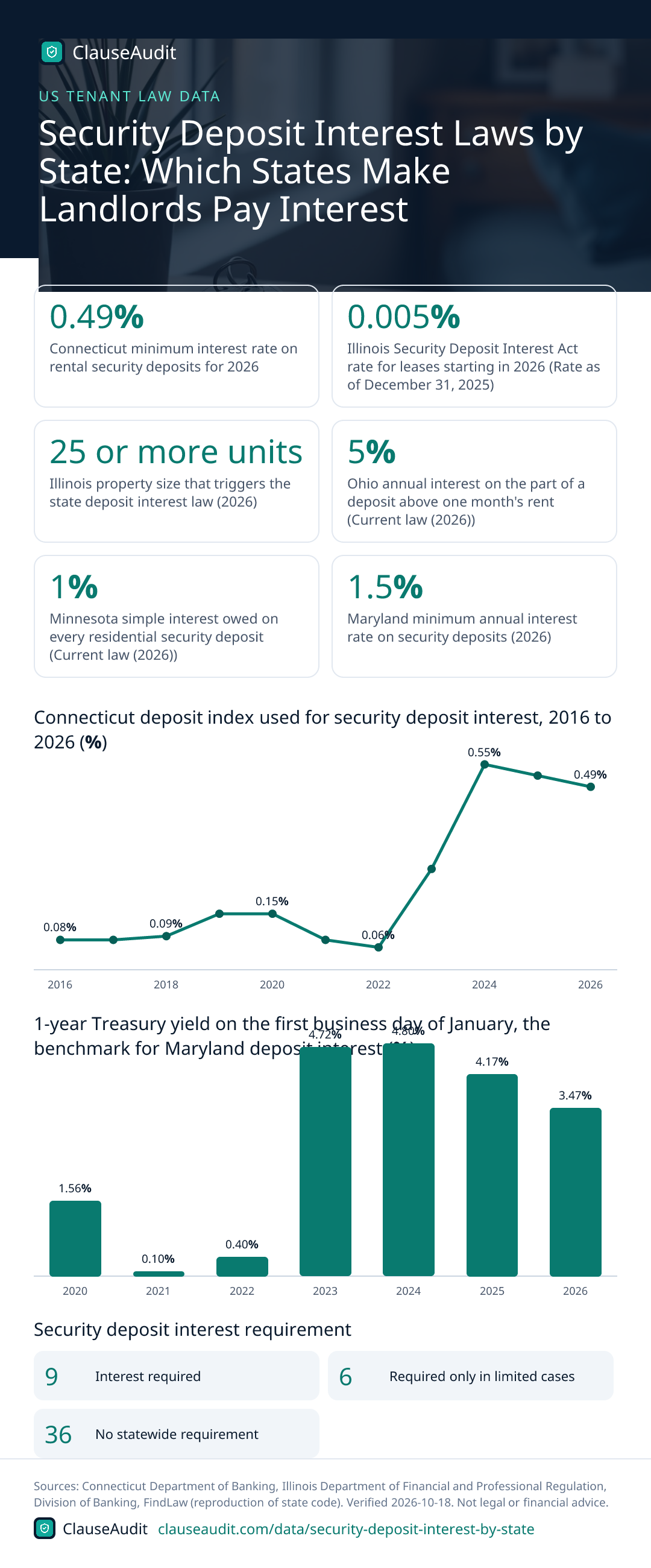
Most states do not make landlords pay interest on a security deposit. In our count, 9 jurisdictions require it on standard deposits, 6 require it only in limited cases, and 36 have no statewide rule. Where it applies in 2026, rates run from 5% in Ohio (on the excess over one month's rent) down to 0.005% under the Illinois act.

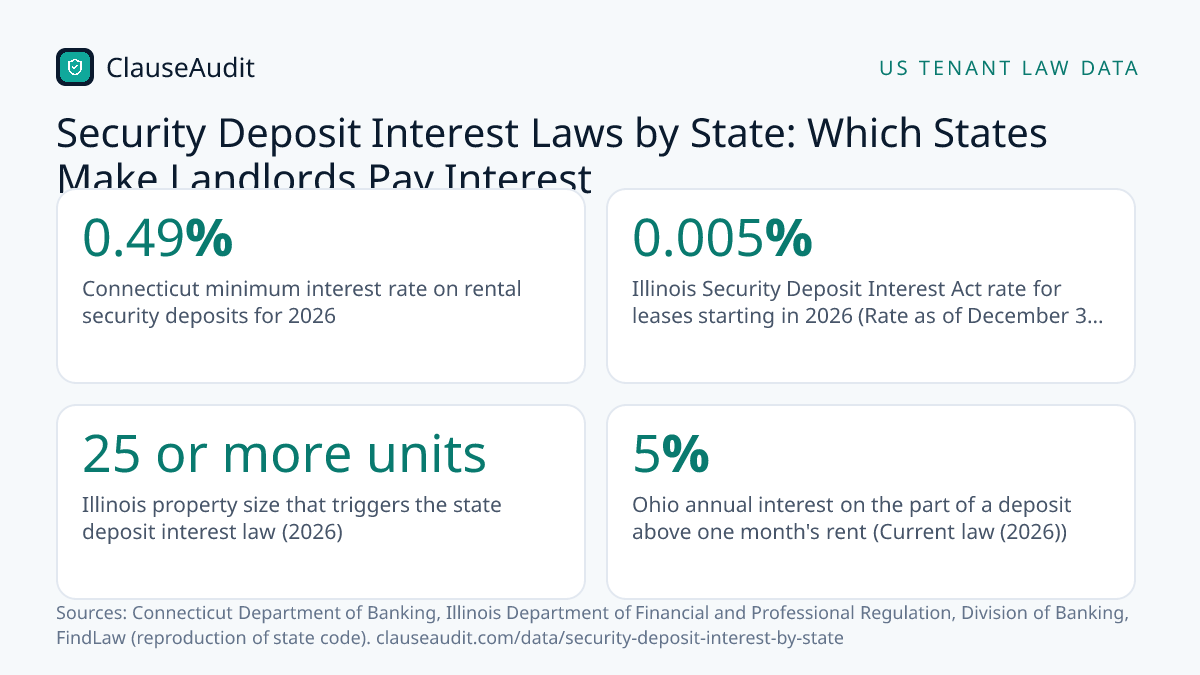
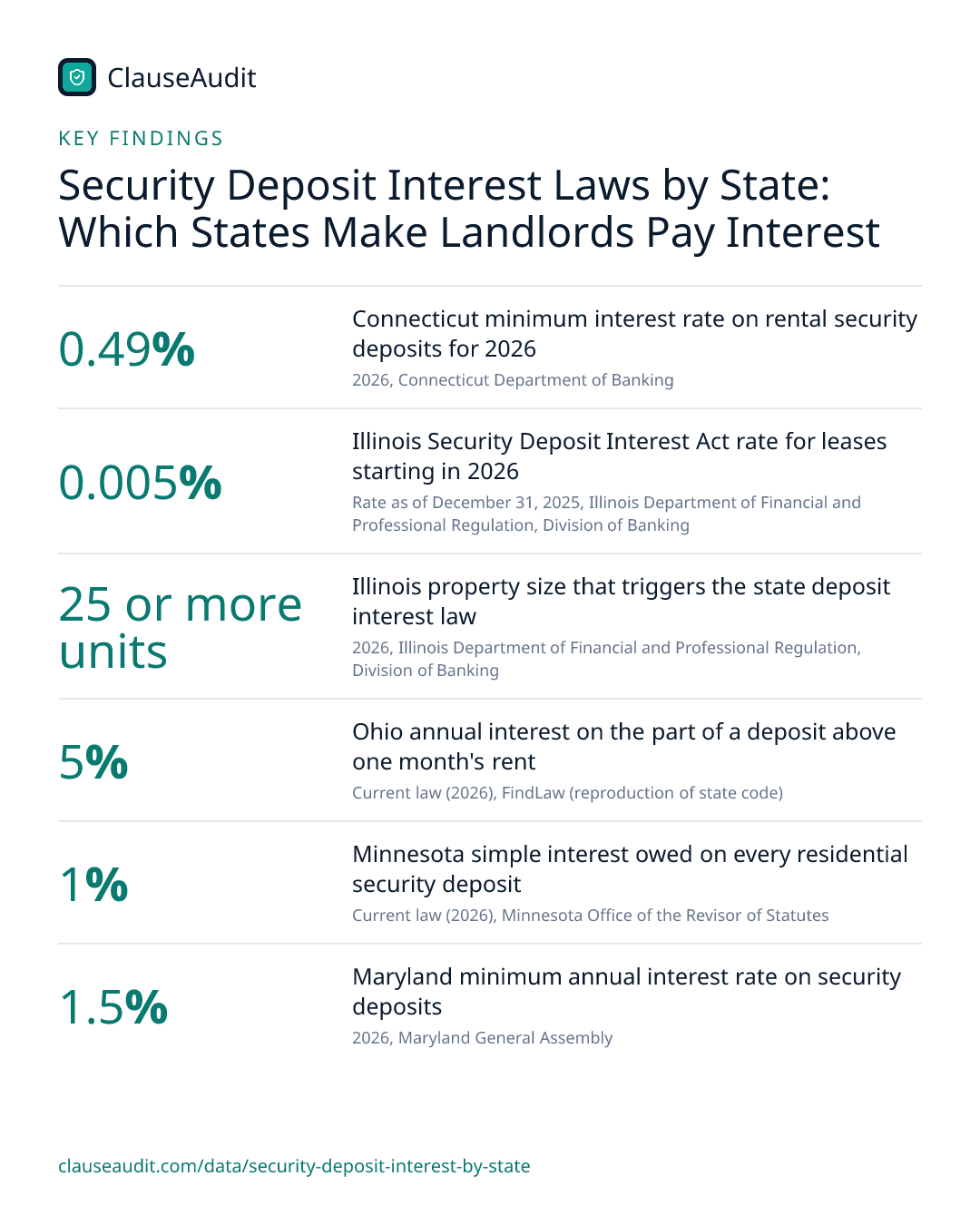
- Connecticut minimum interest rate on rental security deposits for 2026 (2026, Connecticut Department of Banking)
- 0.49%
- Illinois Security Deposit Interest Act rate for leases starting in 2026 (Rate as of December 31, 2025, Illinois Department of Financial and Professional Regulation, Division of Banking)
- 0.005%
- Illinois property size that triggers the state deposit interest law (2026, Illinois Department of Financial and Professional Regulation, Division of Banking)
- 25 or more units
- Ohio annual interest on the part of a deposit above one month's rent (Current law (2026), FindLaw (reproduction of state code))
- 5%
- Minnesota simple interest owed on every residential security deposit (Current law (2026), Minnesota Office of the Revisor of Statutes)
- 1%
- Maryland minimum annual interest rate on security deposits (2026, Maryland General Assembly)
- 1.5%
- Share of deposit a New York landlord may keep yearly from account interest (Current law (2026), New York State Senate)
- 1%
- San Francisco deposit interest rate, March 2026 to February 2027 (March 1, 2026 to February 28, 2027, San Francisco Tenants Union (reprinting the San Francisco Rent Board notice))
- 4.2%
Your security deposit sits in a landlord's account for the whole lease, sometimes for years. In a handful of states, the law says the interest it earns, or a set rate, belongs to you. Everywhere else, the landlord keeps whatever the money makes.
We checked the deposit interest rule for all 50 states and DC, then pulled the 2026 rates where a state or city publishes one. The map and table show each state's rule. Below, we explain how the formulas work, why some rates look like rounding errors, and what to look for in your lease so you collect what you're owed.
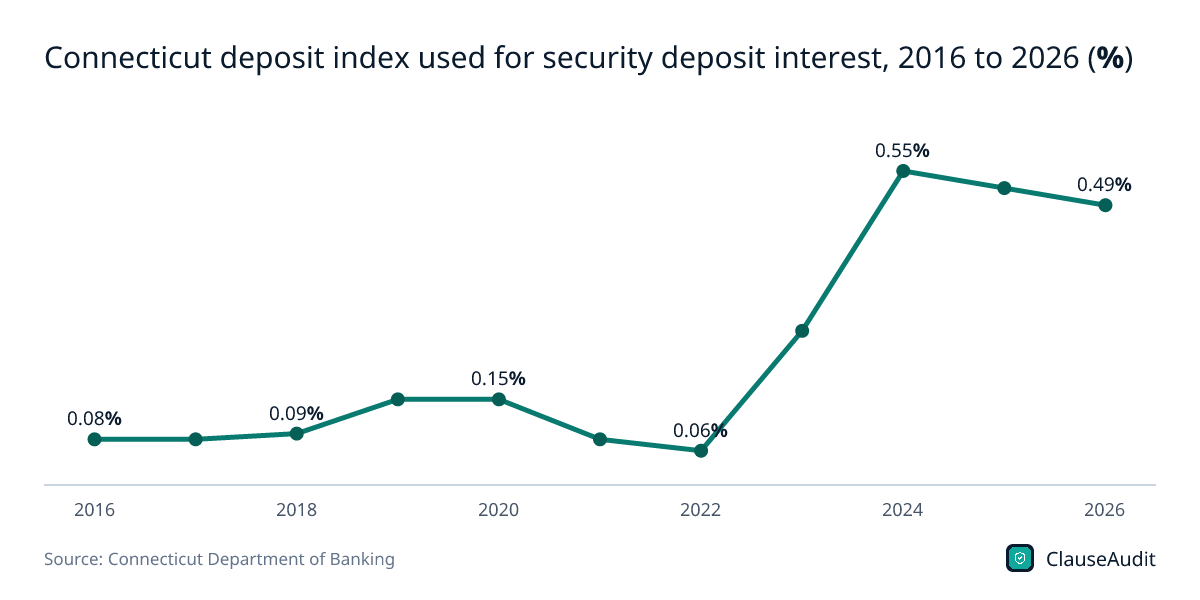
Connecticut deposit index used for security deposit interest, 2016 to 2026 (%)
Chart data
| Label | Value (%) |
|---|---|
| 2016 | 0.08% |
| 2017 | 0.08% |
| 2018 | 0.09% |
| 2019 | 0.15% |
| 2020 | 0.15% |
| 2021 | 0.08% |
| 2022 | 0.06% |
| 2023 | 0.27% |
| 2024 | 0.55% |
| 2025 | 0.52% |
| 2026 | 0.49% |
Connecticut's rate tracks bank savings rates, so it sat near zero for years, from 0.08% in 2016 to 0.06% in 2022. It jumped to 0.55% in 2024 and has eased to 0.49% for 2026.
Download this chart (PNG)1-year Treasury yield on the first business day of January, the benchmark for Maryland deposit interest (%)
Chart data
| Label | Value (%) |
|---|---|
| 2020 | 1.56% |
| 2021 | 0.10% |
| 2022 | 0.40% |
| 2023 | 4.72% |
| 2024 | 4.80% |
| 2025 | 4.17% |
| 2026 | 3.47% |
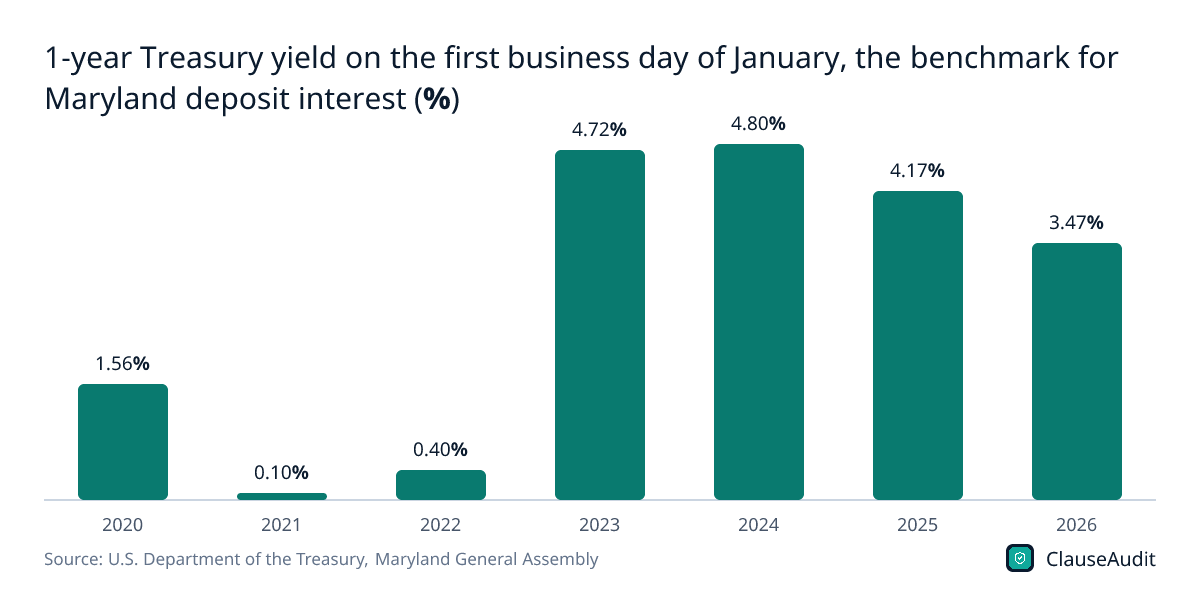
Maryland pays the greater of this Treasury yield or 1.5%. In 2021 and 2022 the floor did the work; since 2023 the Treasury rate has been higher, at 3.47% for 2026.
Download this chart (PNG)Security deposit interest rates in effect in 2026, selected states and cities (% per year)
Chart data
| Label | Value |
|---|---|
| Ohio (statute, on excess over one month's rent) | 5% |
| San Francisco (Mar 2026 to Feb 2027) | 4.2% |
| Maryland 2026: 1-yr Treasury on Jan 2, 2026 | 3.47% |
| Minnesota (statute) | 1% |
| Connecticut (2026) | 0.49% |
| Chicago RLTO (2026) | 0.01% |
| Illinois Security Deposit Interest Act (2026) | 0.005% |
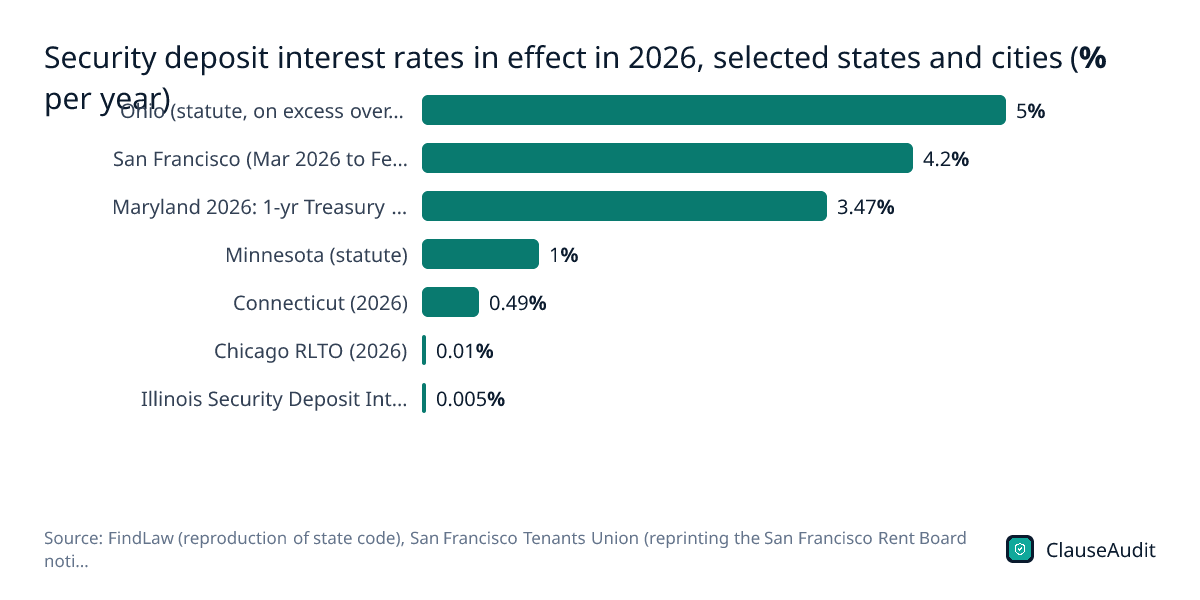
Fixed statutory rates and Treasury-linked rates pay far more than bank-linked ones. Ohio's 5% only reaches the part of a deposit above one month's rent, so the headline rate overstates what most Ohio tenants see.
Download this chart (PNG)How many states require landlords to pay interest on security deposits (50 states + DC) (jurisdictions)
Chart data
| Label | Value (jurisdictions) |
|---|---|
| Interest required on standard deposits | 9 |
| Required only in limited cases | 6 |
| No statewide interest requirement | 36 |
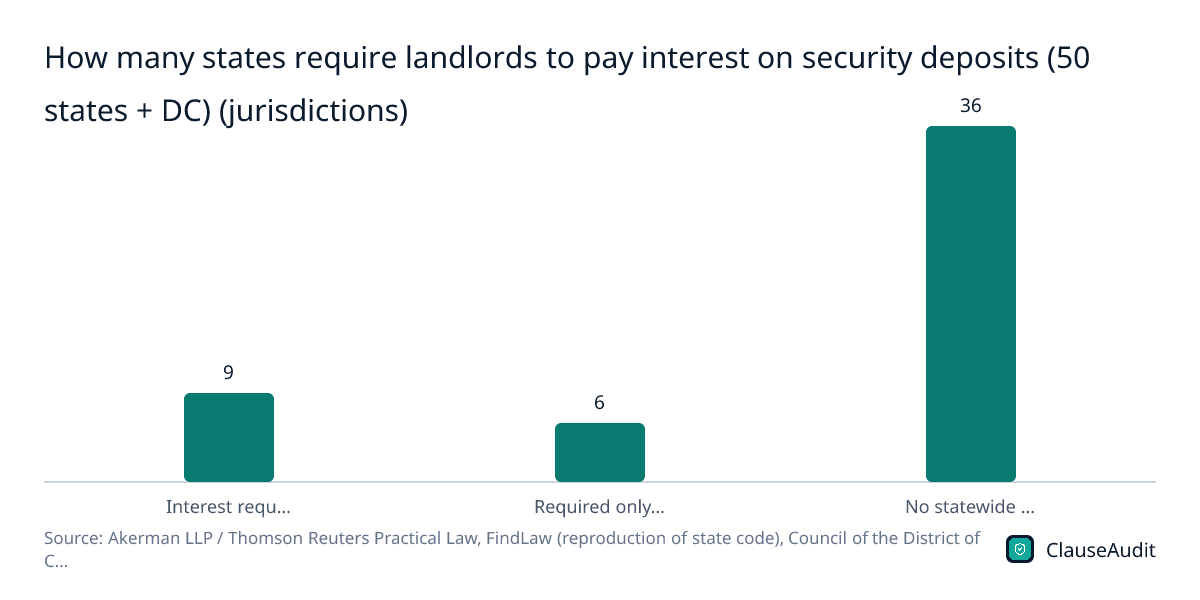
Only 9 jurisdictions require interest on an ordinary deposit. Another 6 require it in narrow cases, such as Illinois buildings with 25 or more units, and 36 have no statewide rule at all.
Download this chart (PNG)How deposit interest is calculated where it is required
| Jurisdiction | Rate or formula | Main condition |
|---|---|---|
| Connecticut | Deposit index: 0.49% for 2026 | All residential deposits |
| Maryland | Greater of 1-year Treasury rate (first business day of the year) or 1.5% | Deposits of $50 or more held 6 months |
| Massachusetts | 5% or the lower amount the bank paid | Deposit held one year or longer |
| Minnesota | 1% simple | All residential deposits |
| Ohio | 5% on the excess | Part above $50 or one month's rent; tenant stays 6 months |
| Illinois (state) | 0.005% for 2026 leases | 25 or more units; deposit held 6 months |
| Chicago (RLTO) | 0.01% for 2026 | City ordinance |
| San Francisco | 4.2% (Mar 1, 2026 to Feb 28, 2027) | City ordinance |
| New York | Bank rate less 1% a year fee | Six or more units, or any interest-bearing account |
| Pennsylvania | Bank rate less 1% fee | Deposits over $100, from the third year |
| New Jersey, North Dakota | Whatever the account earns | Deposit must be in an interest-bearing account |
| District of Columbia | Statement savings rate, reset Jan 1 and Jul 1 | Interest-bearing escrow account |
| Florida | 75% of account rate or 5% simple; 5% if surety bond | Only if landlord uses an interest account or bond |
Source: Connecticut Department of Banking, Banking Commissioner Announces 2026 Deposit Index; Maryland General Assembly, Maryland Code, Real Property § 8-203 (Security deposits); Akerman LLP / Thomson Reuters Practical Law, Security Deposit Laws (Residential Lease): State Comparison Chart (Akerman LLP with Practical Law); Minnesota Office of the Revisor of Statutes, Minnesota Statutes § 504B.178 (Interest on deposits); FindLaw (reproduction of state code), Ohio Revised Code § 5321.16 (Security deposits); Illinois Department of Financial and Professional Regulation, Division of Banking, Interest Rates Affecting the Security Deposit Interest Act; Chicagoland Apartment Association, 2026 Illinois and Chicago Security Deposit Interest Rates; San Francisco Tenants Union (reprinting the San Francisco Rent Board notice), New Interest Rate for Security Deposits Effective 3/1/26; New York State Senate, New York General Obligations Law § 7-103; New Jersey Department of Community Affairs, Truth in Renting: A guide to the rights and responsibilities of residential tenants and landlords in New Jersey; North Dakota Legislative Branch, North Dakota Century Code ch. 47-16, § 47-16-07.1; Council of the District of Columbia, Interest on Rental Security Deposits Amendment Act of 2006 (D.C. Act 16-276); Florida Legislature, Florida Statutes § 83.49 (Deposit money or advance rent). Download as image
Security deposit interest requirement by state
- 9Interest required
- 6Required only in limited cases
- 36No statewide requirement
- Interest required9
- Required only in limited cases6
- No statewide requirement36
| State | Rule | Rate | When paid | Source |
|---|---|---|---|---|
| Alabama | No statewide requirement to pay interest | None required | Not applicable | Security Deposit Laws (Residential Lease): State Comparison Chart (Akerman LLP with Practical Law) |
| Alaska | No statewide requirement to pay interest | None required | Not applicable | Security Deposit Laws (Residential Lease): State Comparison Chart (Akerman LLP with Practical Law) |
| Arizona | No statewide requirement to pay interest | None required | Not applicable | Security Deposit Laws (Residential Lease): State Comparison Chart (Akerman LLP with Practical Law) |
| Arkansas | No statewide requirement to pay interest | None required | Not applicable | Security Deposit Laws (Residential Lease): State Comparison Chart (Akerman LLP with Practical Law) |
| California | No statewide requirement to pay interest | None required statewide | Not applicable | Security Deposit Laws (Residential Lease): State Comparison Chart (Akerman LLP with Practical Law) |
| Colorado | No statewide requirement to pay interest | None required | Not applicable | Security Deposit Laws (Residential Lease): State Comparison Chart (Akerman LLP with Practical Law) |
| Connecticut | Interest required on all residential deposits | At least the deposit index: 0.49% for 2026 | Each lease anniversary (paid or credited to rent) and at move-out | Conn. Gen. Stat. § 47a-21(i) |
| Delaware | No statewide requirement to pay interest | None required | Not applicable | Security Deposit Laws (Residential Lease): State Comparison Chart (Akerman LLP with Practical Law) |
| District of Columbia | Deposit must be held in an interest-bearing escrow account; interest goes to tenant | At least the statement savings rate of the D.C. bank holding the account, reset January 1 and July 1 | At move-out, with the deposit | 14 DCMR §§ 308 to 311 (as amended by D.C. Act 16-276) |
| Florida | Interest owed only if the landlord holds the deposit in an interest-bearing account or posts a surety bond | Interest account: at least 75% of the account's annualized rate or 5% simple (landlord elects); surety bond: 5% simple | Annually and at the end of the tenancy | Fla. Stat. § 83.49(1) |
| Georgia | No statewide requirement to pay interest | None required | Not applicable | Security Deposit Laws (Residential Lease): State Comparison Chart (Akerman LLP with Practical Law) |
| Hawaii | No statewide requirement to pay interest | None required | Not applicable | Security Deposit Laws (Residential Lease): State Comparison Chart (Akerman LLP with Practical Law) |
| Idaho | No statewide requirement to pay interest | None required | Not applicable | Security Deposit Laws (Residential Lease): State Comparison Chart (Akerman LLP with Practical Law) |
| Illinois | Interest required only for buildings or complexes with 25 or more units | 0.005% for leases starting in 2026 (largest Illinois bank's savings rate on Dec 31, 2025) | Within 30 days after each 12-month rental period | 765 ILCS 715/1 to 715/3 |
| Indiana | No statewide requirement to pay interest | None required | Not applicable | Security Deposit Laws (Residential Lease): State Comparison Chart (Akerman LLP with Practical Law) |
| Iowa | Interest-bearing account is optional; interest earned in the first five years belongs to the landlord | Whatever the account earns, after year five only | At the end of the tenancy | Iowa Code § 562A.12(2) |
| Kansas | No statewide requirement to pay interest | None required | Not applicable | Security Deposit Laws (Residential Lease): State Comparison Chart (Akerman LLP with Practical Law) |
| Kentucky | No statewide requirement to pay interest | None required | Not applicable | Security Deposit Laws (Residential Lease): State Comparison Chart (Akerman LLP with Practical Law) |
| Louisiana | No statewide requirement to pay interest | None required | Not applicable | Security Deposit Laws (Residential Lease): State Comparison Chart (Akerman LLP with Practical Law) |
| Maine | No statewide requirement to pay interest | None required | Not applicable | Security Deposit Laws (Residential Lease): State Comparison Chart (Akerman LLP with Practical Law) |
| Maryland | Interest required on deposits of $50 or more held at least 6 months | Greater of the 1-year Treasury rate on the first business day of the year or 1.5%; simple interest | Within 45 days after the tenancy ends | Md. Code, Real Prop. § 8-203(e) |
| Massachusetts | Deposit held in a separate interest-bearing account; interest owed to tenant | 5% a year or the lower amount the bank actually paid | Each year and at the end of the tenancy | M.G.L. c. 186, § 15B(3) |
| Michigan | No statewide requirement to pay interest | None required | Not applicable | Security Deposit Laws (Residential Lease): State Comparison Chart (Akerman LLP with Practical Law) |
| Minnesota | Interest required on all residential deposits | 1% simple, noncompounded | At move-out, with the deposit | Minn. Stat. § 504B.178, subd. 2 |
| Mississippi | No statewide requirement to pay interest | None required | Not applicable | Security Deposit Laws (Residential Lease): State Comparison Chart (Akerman LLP with Practical Law) |
| Missouri | No requirement to pay interest; any interest earned belongs to the landlord | None required | Not applicable | Mo. Rev. Stat. § 535.300(2) |
| Montana | No statewide requirement to pay interest | None required | Not applicable | Security Deposit Laws (Residential Lease): State Comparison Chart (Akerman LLP with Practical Law) |
| Nebraska | No statewide requirement to pay interest | None required | Not applicable | Security Deposit Laws (Residential Lease): State Comparison Chart (Akerman LLP with Practical Law) |
| Nevada | No statewide requirement to pay interest | None required | Not applicable | Security Deposit Laws (Residential Lease): State Comparison Chart (Akerman LLP with Practical Law) |
| New Hampshire | Interest owed on deposits held one year or longer | Rate paid on regular savings accounts by the bank holding the deposit | After one year; tenant can also request accrued interest | N.H. RSA 540-A:6(IV)(a) |
| New Jersey | Deposit must be in an interest-bearing account; interest belongs to tenant | Whatever the account earns | Yearly in cash or rent credit (lease anniversary or January 31) and at move-out | N.J.S.A. 46:8-19 |
| New Mexico | Interest owed only when a deposit above one month's rent is taken on an annual lease | Passbook rate set for New Mexico savings and loan associations | Annually | NMSA 1978, § 47-8-18(A)(1) |
| New York | Interest-bearing account required for buildings with six or more units; interest goes to tenant | Prevailing bank rate, less a 1% per year administrative fee the landlord may keep | Annually or at the end of the tenancy | N.Y. Gen. Oblig. Law § 7-103(2), (2-a) |
| North Carolina | No statewide requirement to pay interest | None required | Not applicable | Security Deposit Laws (Residential Lease): State Comparison Chart (Akerman LLP with Practical Law) |
| North Dakota | Deposit must be in a federally insured interest-bearing account for the tenant | Whatever the account earns | At the end of the lease, with the deposit | N.D.C.C. § 47-16-07.1(1) |
| Ohio | Interest owed only on the part of a deposit above $50 or one month's rent, whichever is greater | 5% a year | Computed and paid annually, if the tenant stays six months or more | Ohio Rev. Code § 5321.16(A) |
| Oklahoma | No statewide requirement to pay interest | None required | Not applicable | Security Deposit Laws (Residential Lease): State Comparison Chart (Akerman LLP with Practical Law) |
| Oregon | No statewide requirement to pay interest | None required | Not applicable | Security Deposit Laws (Residential Lease): State Comparison Chart (Akerman LLP with Practical Law) |
| Pennsylvania | Interest owed on deposits over $100 held more than two years | Account interest, less a 1% administrative fee the landlord may keep | Annually on the lease anniversary from the third year | 68 P.S. § 250.511b |
| Rhode Island | No statewide requirement to pay interest | None required | Not applicable | Security Deposit Laws (Residential Lease): State Comparison Chart (Akerman LLP with Practical Law) |
| South Carolina | No statewide requirement to pay interest | None required | Not applicable | Security Deposit Laws (Residential Lease): State Comparison Chart (Akerman LLP with Practical Law) |
| South Dakota | No statewide requirement to pay interest | None required | Not applicable | Security Deposit Laws (Residential Lease): State Comparison Chart (Akerman LLP with Practical Law) |
| Tennessee | No statewide requirement to pay interest | None required | Not applicable | Security Deposit Laws (Residential Lease): State Comparison Chart (Akerman LLP with Practical Law) |
| Texas | No statewide requirement to pay interest | None required | Not applicable | Security Deposit Laws (Residential Lease): State Comparison Chart (Akerman LLP with Practical Law) |
| Utah | No statewide requirement to pay interest | None required | Not applicable | Security Deposit Laws (Residential Lease): State Comparison Chart (Akerman LLP with Practical Law) |
| Vermont | No statewide requirement to pay interest | None required statewide | Not applicable | 9 V.S.A. § 4461(g) |
| Virginia | No statewide requirement to pay interest | None required | Not applicable | Va. Code § 55.1-1226 |
| Washington | No statewide requirement to pay interest | None required | Not applicable | Security Deposit Laws (Residential Lease): State Comparison Chart (Akerman LLP with Practical Law) |
| West Virginia | No statewide requirement to pay interest | None required | Not applicable | Security Deposit Laws (Residential Lease): State Comparison Chart (Akerman LLP with Practical Law) |
| Wisconsin | No statewide requirement to pay interest | None required | Not applicable | Security Deposit Laws (Residential Lease): State Comparison Chart (Akerman LLP with Practical Law) |
| Wyoming | No statewide requirement to pay interest | None required | Not applicable | Security Deposit Laws (Residential Lease): State Comparison Chart (Akerman LLP with Practical Law) |
Do landlords have to pay interest on security deposits?
Usually not. In 36 jurisdictions there is no statewide rule, so the landlord can hold your deposit in a regular account and keep any interest. A lease can still promise interest, and if it does, that promise is enforceable like any other term.
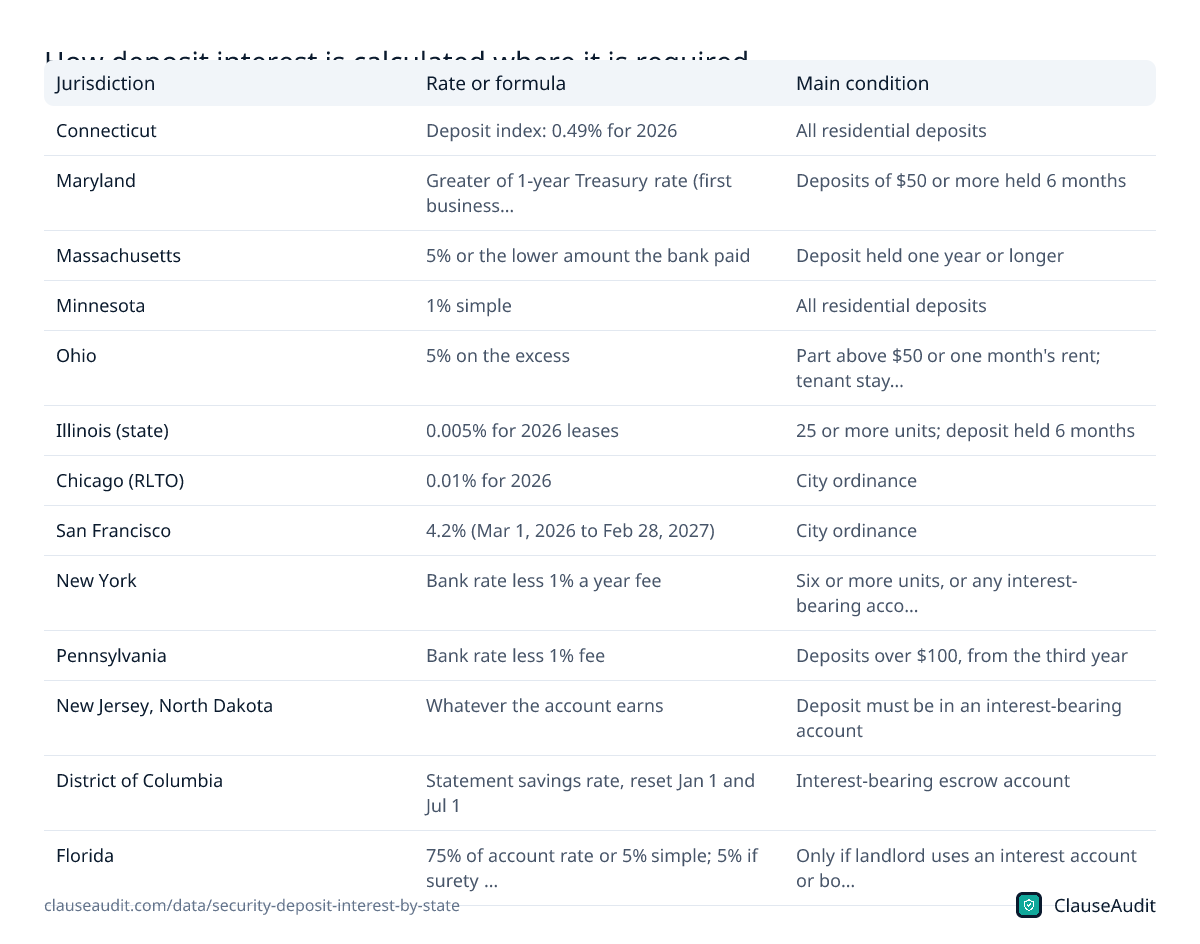
Where interest is required, the rule takes one of three shapes. Some states set a fixed rate in the statute: Minnesota pays 1% simple and Ohio pays 5% on the excess. Some tie the rate to a published benchmark: Connecticut uses a yearly deposit index and Maryland uses the 1-year Treasury yield with a 1.5% floor. The rest just say the deposit must sit in an interest-bearing account and the tenant gets what it earns. New Jersey, North Dakota and DC work that way.
Cities can add their own rules. San Francisco and Chicago both require interest even though California has no statewide requirement and the Illinois act only covers larger buildings.
Which states pay the most interest on a security deposit?
On paper, Ohio's 5% looks like the best deal. But Ohio only pays on the part of the deposit above $50 or one month's rent, whichever is greater, and only if you stay six months or more. If your deposit equals one month's rent, you get nothing. If your landlord took more than that, write down the excess and check that 5% on it shows up each year.
Maryland is the strongest broad rule right now. Tenants get the greater of the 1-year Treasury rate on the first business day of the year or 1.5%. For 2026 that benchmark was 3.47%. It applies to deposits of $50 or more held at least six months, and the landlord has 45 days after the tenancy ends to pay it with the deposit.
San Francisco's rate for March 2026 through February 2027 is 4.2%, down from 5.0% the year before. At the other end, the Illinois act pays 0.005% for 2026 leases and Chicago's ordinance pays 0.01%. The Illinois figure comes from a bank savings rate, which is why it barely registers.
Why are some deposit interest rates so low?
Any rule that follows a bank savings rate moves with it. Connecticut's deposit index sat near zero for most of the last decade, then rose to 0.55% in 2024 as rates climbed. The 2026 figure is 0.49%.
The New York and Pennsylvania rules cut it further. In both, the landlord may keep a 1% yearly fee out of the account's interest. When the account earns less than that fee, the tenant's share can be close to zero. That is legal, but only if the landlord follows the account rules, which in New York apply to buildings with six or more units.
Low rates do not mean the law is pointless. Many of these statutes also require a separate account, written notice of where the money is held, and in some states a yearly interest statement. Those requirements protect the deposit itself, and in New Jersey a landlord who skips them can end up owing the tenant 7% interest.
Small print that decides whether you get paid
- Holding period. Maryland, Ohio and Illinois need six months, Pennsylvania starts paying from the third year, and New Hampshire after one year.
- Building size. The Illinois act covers only 25 or more units. New York's mandatory account rule starts at six units. New Jersey exempts owner-occupied buildings with two or fewer rental units unless the tenant gives 30 days' written notice.
- Deposit size. Maryland needs $50 or more, Pennsylvania covers deposits over $100, and Minnesota skips interest amounts under $1.
- Late rent. Connecticut drops interest for a month in which rent was more than 10 days late, unless the landlord charged a late fee.
- Landlord choice. Florida owes interest only if the landlord picks an interest-bearing account or a surety bond. Iowa lets the landlord keep account interest for the first five years.
What should small landlords and property managers do?
If you own a few rental units, deposit interest is easy to get wrong because the rule can change with the size of your building, the length of the tenancy and the city. A landlord with a duplex in New Jersey and a fourplex in Chicago faces two different systems.
Set up a separate account for deposits in any state that requires one, and keep a simple ledger by tenant: deposit amount, date received, account, and the rate that applies each year. Rate-linked rules change every year, so put a reminder on your calendar. Connecticut announces its index in December, and Maryland's rate follows the Treasury yield on the first business day of January.
Write the rule into your lease in plain terms. Tell tenants where the deposit is held, what it earns, and when you will pay or credit the interest. A clear clause heads off a lot of arguments, and in states with notice rules it is part of complying with the law.
Finally, show the interest as its own line on every move-out statement. Tenants can see what they got, and you have a record if anyone asks later.
How do you collect security deposit interest?
Start with your state row on the map. If your state requires interest, note when it is paid: some states pay or credit it each year, others only at move-out.
Then read your lease and any deposit receipt. Look for the bank name, the account type and the interest rate. Several states require landlords to tell you this in writing. If nothing is there, ask for it by email so you have a record.
At move-out, check the itemized statement. The interest should appear as its own line, added to whatever deposit is returned. If it is missing, send a short written request citing your state law. In New Jersey, a tenant may apply the deposit plus 7% interest to rent if the required notices or interest are not provided, which shows how seriously some states treat this.
Business tenants should know these statutes are written for residential leases. On a commercial lease, interest on a deposit is a negotiating point, not a right, so put it in the lease if you want it.
How ClauseAudit helps
Deposit interest disputes almost always start with a lease that is vague about where the money sits and who keeps what it earns. Our automated review reads your lease, flags deposit terms that conflict with your state's rules, and explains each issue in plain English.
Upload your lease before you sign or before you move out, and you will know what to ask for.
- Whether the lease says where the deposit is held and if the account pays interest
- Clauses that let the landlord keep all interest or charge an account fee
- Deposit amount and any part above one month's rent that may earn interest
- When interest is paid or credited: yearly, on renewal, or at move-out
- Late fee and late rent terms that can cancel interest for a month
- Deduction and return terms that leave interest off the final statement
Frequently asked questions
Which states require interest on security deposits?
In our count, 9 jurisdictions require interest on standard deposits: Connecticut, DC, Maryland, Massachusetts, Minnesota, New Hampshire, New Jersey, North Dakota and Pennsylvania. Another 6 require it only in limited cases: Florida, Illinois, Iowa, New Mexico, New York and Ohio. The other 36 have no statewide rule, though a lease or a city ordinance can still require it.
What is the Connecticut security deposit interest rate for 2026?
It is 0.49%, set from the state deposit index announced by the Connecticut Department of Banking. The 2025 rate was 0.52%. Landlords pay or credit it each lease anniversary and at move-out. You lose the interest for any month your rent was more than 10 days late, unless the landlord charged you a late fee for it.
How is Maryland security deposit interest calculated?
Maryland uses simple interest at the greater of 1.5% or the 1-year Treasury yield on the first business day of the year. For 2026 that yield was 3.47%. The rule applies to deposits of $50 or more held at least six months, and the landlord must pay it within 45 days after your tenancy ends.
Do landlords in California have to pay interest on security deposits?
Not under state law. California has no statewide interest requirement. Some cities do, though. San Francisco requires interest, and its rate for March 2026 through February 2027 is 4.2%. If you rent elsewhere in California, check your city's rent rules and your lease, since either can create a duty to pay.
Does Illinois require interest on security deposits?
Only in buildings or complexes with 25 or more units, for deposits held six months or more. The rate for leases starting in 2026 is 0.005%, and it is paid within 30 days after each 12-month rental period. Chicago has its own ordinance that covers more rentals, with a 2026 rate of 0.01%.
Can a New York landlord keep part of the deposit interest?
Yes. In buildings with six or more units the deposit must be in an interest-bearing account, and the landlord may keep 1% a year as an administrative fee. The rest of the interest belongs to you and is paid yearly or at the end of the tenancy. Smaller buildings follow the same rules if the landlord picks an interest-bearing account.
Is security deposit interest paid every year or at move-out?
It depends on the state. Connecticut, New Jersey, Massachusetts and Ohio pay or credit it yearly. Minnesota, North Dakota and DC pay it with the deposit when you move out, and Maryland pays within 45 days after the tenancy ends. Your lease may also offer a rent credit instead of a cash payment.
Do commercial tenants get interest on their security deposit?
Generally no. The state deposit interest laws on this page are written for residential rentals. A business tenant gets interest only if the lease says so. If your deposit is large, ask for it to be held in an interest-bearing account with the interest credited to you, and get that written into the lease.
Use this data
Every chart and card below is free to reuse under CC BY 4.0. Download what you need and link back to this page.
 Stat cards
 Key findings card
 Infographic
 Connecticut deposit index used for security deposit interest, 2016 to 2026 (%)
 1-year Treasury yield on the first business day of January, the benchmark for Maryland deposit interest (%)
 Security deposit interest rates in effect in 2026, selected states and cities (% per year)
 How many states require landlords to pay interest on security deposits (50 states + DC) (jurisdictions)
 How deposit interest is calculated where it is required
Embed the infographic
Free to share on your site, blog or slides under CC BY 4.0. Please keep the credit link.
Sources and method
Every number on this page comes from the sources below, each opened and read on or before October 18, 2026. A second, independent review checked every figure against its source and corrected anything that did not match. 51 of 51 state entries were confirmed; any that could not be are marked "Not yet confirmed" and left out of every count and chart.
- Connecticut Department of Banking, Banking Commissioner Announces 2026 Deposit Index (December 9, 2025)
- Connecticut Department of Banking, Deposit Index and Interest Rates (2026 rates page, read October 2026)
- FindLaw (reproduction of state code), Connecticut General Statutes § 47a-21 (Security deposits) (Current as of January 1, 2025)
- Illinois Department of Financial and Professional Regulation, Division of Banking, Interest Rates Affecting the Security Deposit Interest Act (January 5, 2026)
- Chicagoland Apartment Association, 2026 Illinois and Chicago Security Deposit Interest Rates (January 6, 2026)
- Minnesota Office of the Revisor of Statutes, Minnesota Statutes § 504B.178 (Interest on deposits) (Current statutes, read October 2026)
- FindLaw (reproduction of state code), Ohio Revised Code § 5321.16 (Security deposits) (Current as of January 1, 2026)
- Maryland General Assembly, Maryland Code, Real Property § 8-203 (Security deposits) (2026 Regular Session statute text)
- New York State Senate, New York General Obligations Law § 7-103 (Current law, read October 2026)
- Council of the District of Columbia, Interest on Rental Security Deposits Amendment Act of 2006 (D.C. Act 16-276) (Enrolled original, 2006)
- North Dakota Legislative Branch, North Dakota Century Code ch. 47-16, § 47-16-07.1 (Current code PDF, read October 2026)
- New Jersey Department of Community Affairs, Truth in Renting: A guide to the rights and responsibilities of residential tenants and landlords in New Jersey (PDF revised August 2025)
- Florida Legislature, Florida Statutes § 83.49 (Deposit money or advance rent) (The 2026 Florida Statutes)
- Iowa Legislature, Iowa Code § 562A.12 (Rental deposits) (Iowa Code 2026)
- Virginia Legislative Information System, Code of Virginia § 55.1-1226 (Security deposits) (Current code, read October 2026)
- Akerman LLP / Thomson Reuters Practical Law, Security Deposit Laws (Residential Lease): State Comparison Chart (Akerman LLP with Practical Law) (2020 (Resource ID W-024-4620))
- San Francisco Tenants Union (reprinting the San Francisco Rent Board notice), New Interest Rate for Security Deposits Effective 3/1/26 (January 21, 2026)
- U.S. Department of the Treasury, Daily Treasury Par Yield Curve Rates (1 Yr column), 2020 to 2026 (Daily data; first business day of January 2020 to 2026)
Cite this page
ClauseAudit, “Security Deposit Interest Laws by State: Which States Make Landlords Pay Interest”, updated October 18, 2026, https://clauseaudit.com/data/security-deposit-interest-by-state. Free to reuse with a link back (CC BY 4.0).
This page summarises published data and law as checked on October 18, 2026. Figures are updated as new editions are released, and your own situation may differ. It is general information, not legal, tax or financial advice.