Eviction Notice Periods by State: Pay-or-Quit, Cure-or-Quit and No-Cause Notices (2026)
By ClauseAudit Research · 53 sources ·
What are the eviction laws by state?
Most states give tenants a short window to pay late rent before a landlord can file. California, Florida and Texas allow 3 days, while New York, Washington, Minnesota and Virginia allow 14. Check how your state counts days: some skip weekends, holidays or non-business days, so the real deadline can run longer.
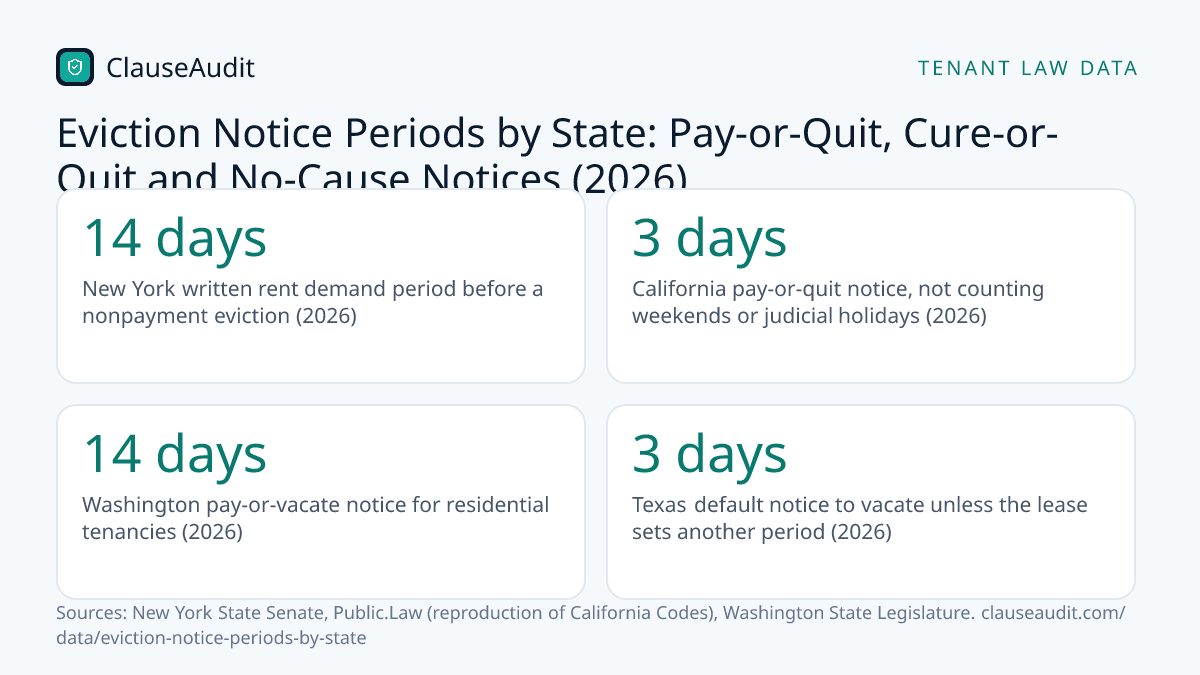
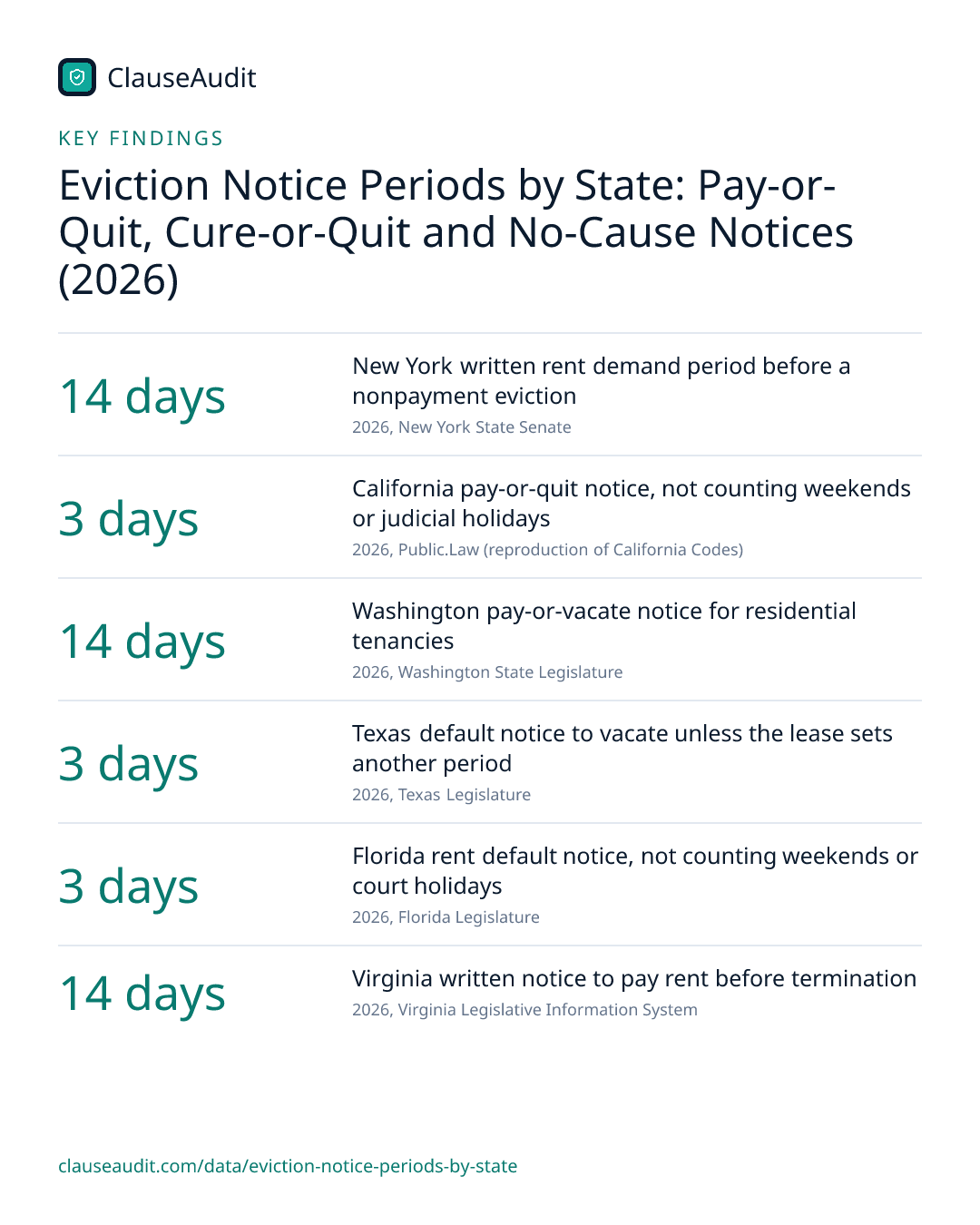
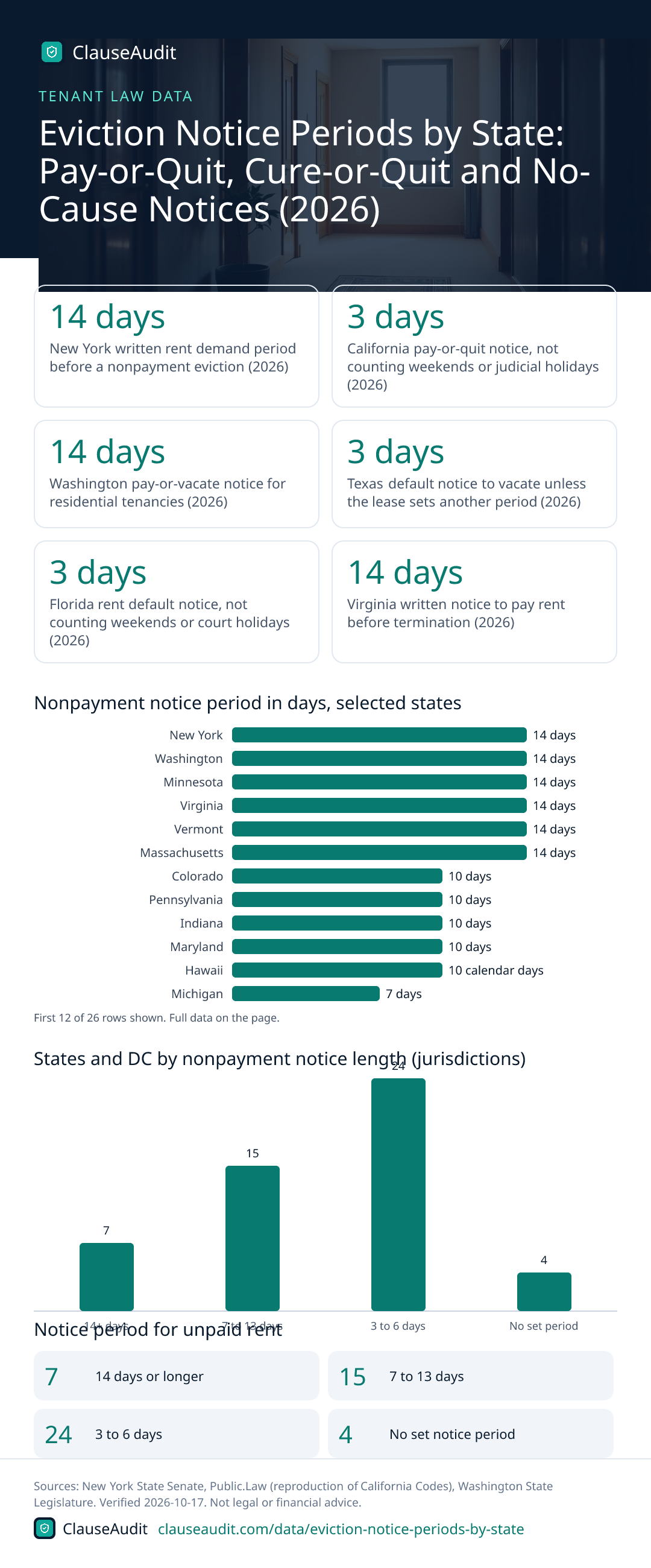
- New York written rent demand period before a nonpayment eviction (2026, New York State Senate)
- 14 days
- California pay-or-quit notice, not counting weekends or judicial holidays (2026, Public.Law (reproduction of California Codes))
- 3 days
- Washington pay-or-vacate notice for residential tenancies (2026, Washington State Legislature)
- 14 days
- Texas default notice to vacate unless the lease sets another period (2026, Texas Legislature)
- 3 days
- Florida rent default notice, not counting weekends or court holidays (2026, Florida Legislature)
- 3 days
- Virginia written notice to pay rent before termination (2026, Virginia Legislative Information System)
- 14 days
- Federal notice to vacate for CARES Act covered properties (2026, Legal Information Institute, Cornell Law School)
- 30 days
- Hawaii nonpayment notice since February 5, 2026, up from 5 business days (2026, Hawaii State Legislature)
- 10 calendar days
An eviction almost never starts in court. It starts with a written notice taped to a door or dropped in the mail, and that notice sets a clock. Pay what you owe, fix the problem, or move out before it runs down, and in most states the case never gets filed.
The length of that clock depends on where the property sits. This page lays out the notice a landlord must give for unpaid rent and for other lease violations in each state, how the days are counted, and what you can do with the time you have.
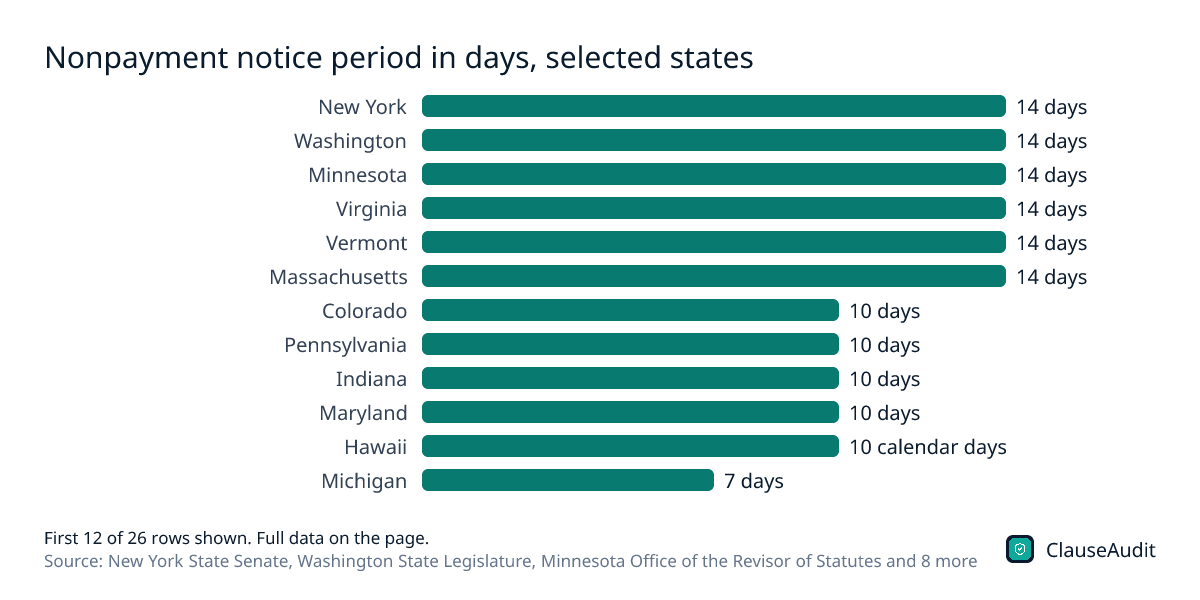
Nonpayment notice period in days, selected states
Chart data
| Label | Value |
|---|---|
| New York | 14 days |
| Washington | 14 days |
| Minnesota | 14 days |
| Virginia | 14 days |
| Vermont | 14 days |
| Massachusetts | 14 days |
| Colorado | 10 days |
| Pennsylvania | 10 days |
| Indiana | 10 days |
| Maryland | 10 days |
| Hawaii | 10 calendar days |
| Michigan | 7 days |
| Alaska | 7 days |
| Alabama | 7 business days |
| Nevada | 7 judicial days |
| Illinois | 5 days |
| Arizona | 5 days |
| Delaware | 5 days |
| Oklahoma | 5 days |
| Wisconsin | 5 days |
| California | 3 days (excl. weekends, holidays) |
| Florida | 3 days (excl. weekends, holidays) |
| Texas | 3 days |
| Ohio | 3 days |
| Utah | 3 business days |
| Iowa | 3 days |
The longest rent notices here run 14 days and the shortest run 3. Watch the units, though: Utah's 3 business days and Nevada's 7 judicial days skip weekends, so they last longer on a calendar than the bar suggests.
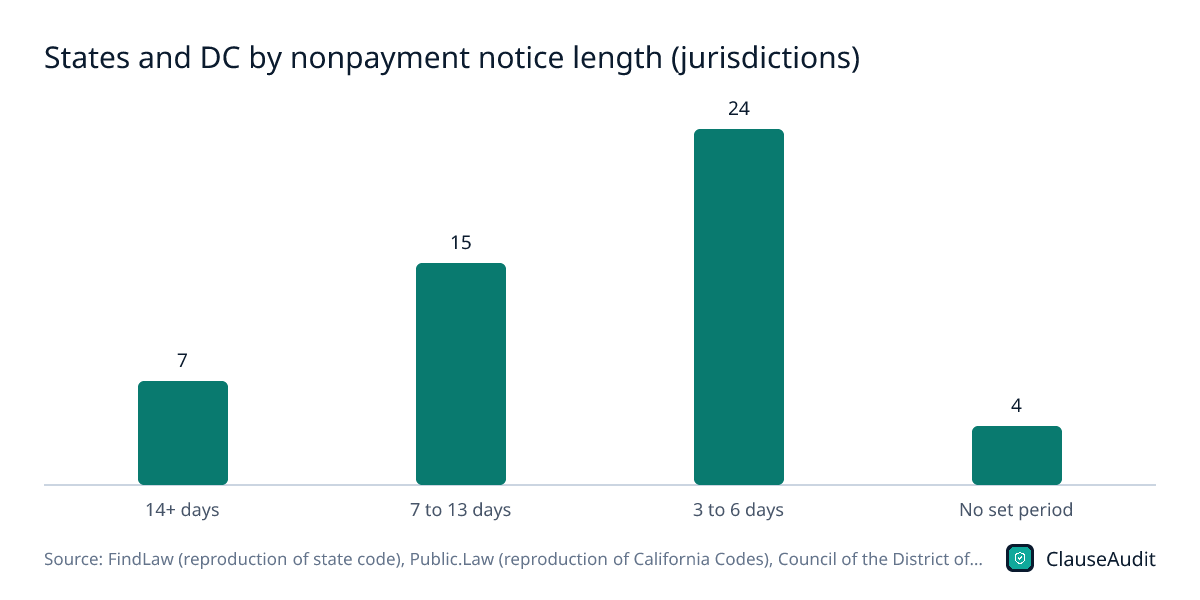
Download this chart (PNG)States and DC by nonpayment notice length (jurisdictions)
Chart data
| Label | Value (jurisdictions) |
|---|---|
| 14+ days | 7 |
| 7 to 13 days | 15 |
| 3 to 6 days | 24 |
| No set period | 4 |
The 3 to 6 day group is the largest at 24 jurisdictions, so a short notice is the norm, not the exception. New Hampshire is left out because its current statute text could not be confirmed.
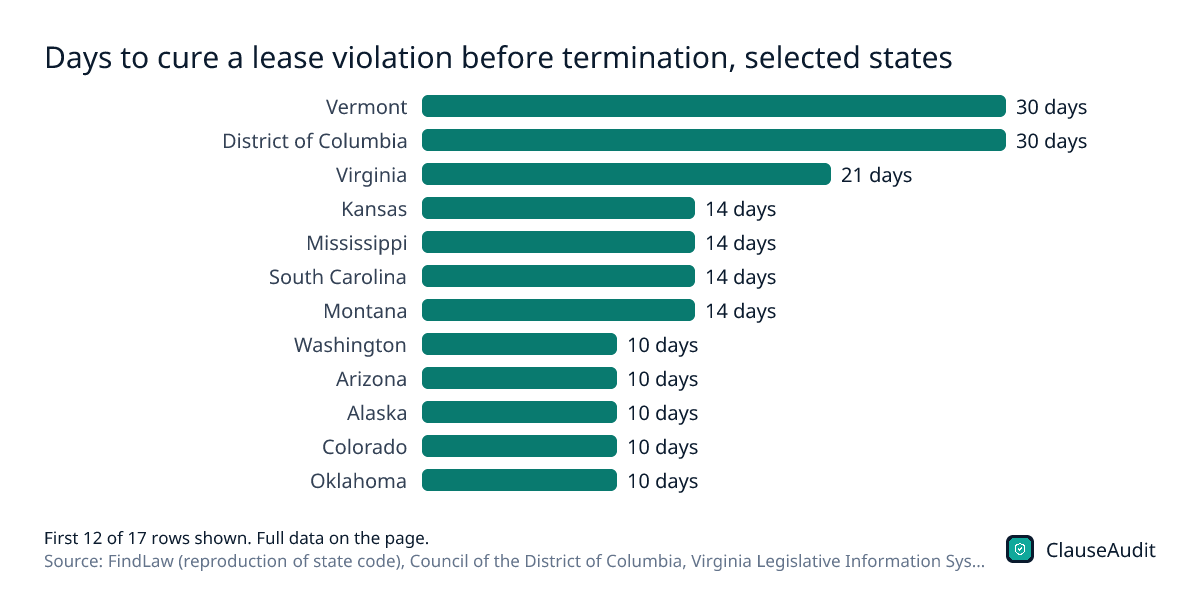
Download this chart (PNG)Days to cure a lease violation before termination, selected states
Chart data
| Label | Value |
|---|---|
| Vermont | 30 days |
| District of Columbia | 30 days |
| Virginia | 21 days |
| Kansas | 14 days |
| Mississippi | 14 days |
| South Carolina | 14 days |
| Montana | 14 days |
| Washington | 10 days |
| Arizona | 10 days |
| Alaska | 10 days |
| Colorado | 10 days |
| Oklahoma | 10 days |
| Florida | 7 days |
| Alabama | 7 business days |
| Iowa | 7 days |
| California | 3 days (excl. weekends, holidays) |
| Utah | 3 calendar days |
Cure periods for breaking a lease rule tend to run longer than rent notices. Virginia allows 21 days to cure, Kansas 14, and Washington 10, but California still holds tenants to 3 days to perform.
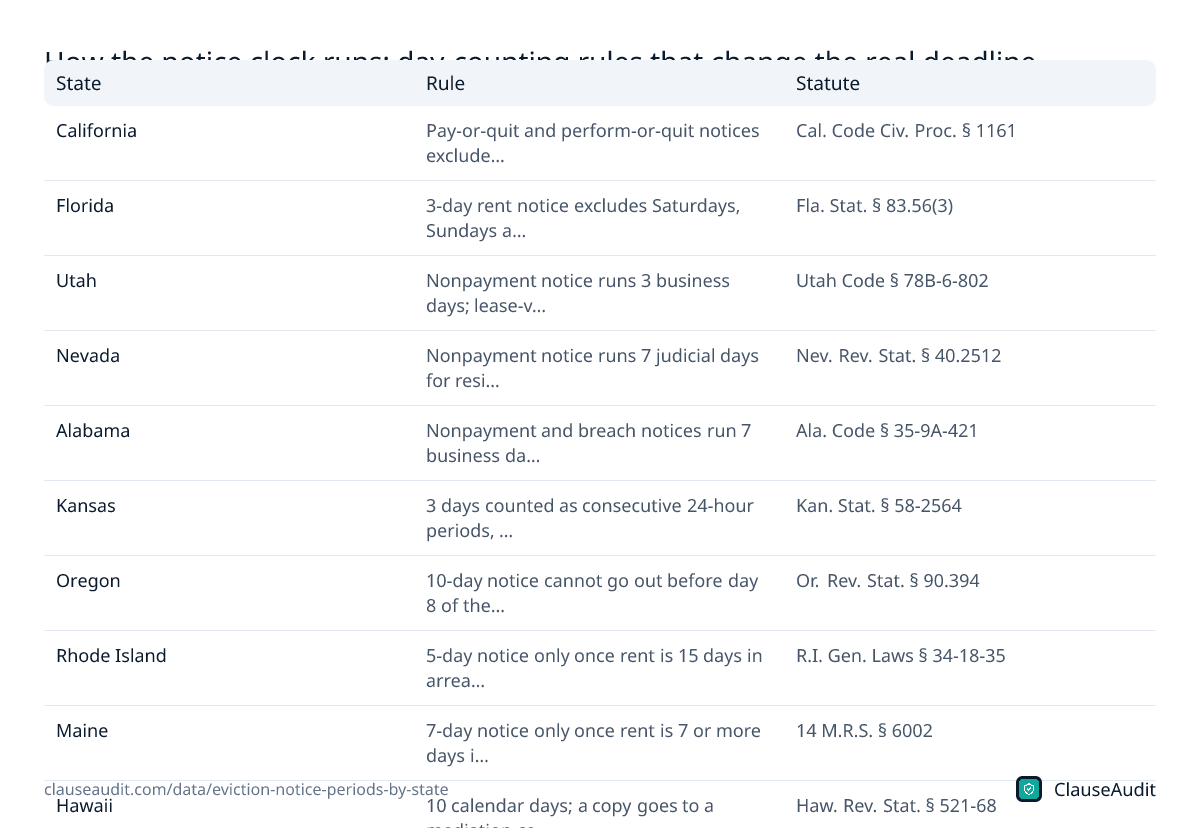
Download this chart (PNG)How the notice clock runs: day-counting rules that change the real deadline
| State | Rule | Statute |
|---|---|---|
| California | Pay-or-quit and perform-or-quit notices exclude Saturdays, Sundays and judicial holidays | Cal. Code Civ. Proc. § 1161 |
| Florida | 3-day rent notice excludes Saturdays, Sundays and court-observed holidays | Fla. Stat. § 83.56(3) |
| Utah | Nonpayment notice runs 3 business days; lease-violation notice runs 3 calendar days | Utah Code § 78B-6-802 |
| Nevada | Nonpayment notice runs 7 judicial days for residential property | Nev. Rev. Stat. § 40.2512 |
| Alabama | Nonpayment and breach notices run 7 business days | Ala. Code § 35-9A-421 |
| Kansas | 3 days counted as consecutive 24-hour periods, plus 2 days if mailed | Kan. Stat. § 58-2564 |
| Oregon | 10-day notice cannot go out before day 8 of the rental period; 13-day notice not before day 5 | Or. Rev. Stat. § 90.394 |
| Rhode Island | 5-day notice only once rent is 15 days in arrears | R.I. Gen. Laws § 34-18-35 |
| Maine | 7-day notice only once rent is 7 or more days in arrears | 14 M.R.S. § 6002 |
| Hawaii | 10 calendar days; a copy goes to a mediation center, and filing waits 20 days if mediation is scheduled | Haw. Rev. Stat. § 521-68 |
| Wisconsin | A repeat rent default within one year allows a 14-day notice with no right to pay and stay | Wis. Stat. § 704.17 |
Source: Public.Law (reproduction of California Codes), Cal. Code Civ. Proc. § 1161; Florida Legislature, Florida Statutes § 83.56; FindLaw (reproduction of state code), Utah Code § 78B-6-802; FindLaw (reproduction of state code), Nev. Rev. Stat. § 40.2512; FindLaw (reproduction of state code), Alabama Code § 35-9A-421; FindLaw (reproduction of state code), Kan. Stat. § 58-2564; Public.Law (reproduction of Oregon Revised Statutes), Or. Rev. Stat. § 90.394; FindLaw (reproduction of state code), R.I. Gen. Laws § 34-18-35; Maine Legislature, Maine Rev. Stat. tit. 14, § 6002; Hawaii State Legislature, Haw. Rev. Stat. § 521-68; FindLaw (reproduction of state code), Wis. Stat. § 704.17. Download as image
Notice period for unpaid rent by state
- 714 days or longer
- 157 to 13 days
- 243 to 6 days
- 4No set notice period
- 14 days or longer7
- 7 to 13 days15
- 3 to 6 days24
- No set notice period4
- Not yet confirmed1
| State | Nonpayment (pay or quit) | Lease violation (cure or quit) | Source |
|---|---|---|---|
| Alabama | 7 business days to pay; tenant can cure by paying | 7 business days to cure most breaches | Ala. Code § 35-9A-421 |
| Alaska | 7 days to pay in full | 10 days to remedy material noncompliance | Alaska Stat. § 34.03.220 |
| Arizona | 5 days to pay | 10 days to remedy (5 days for health and safety breaches) | A.R.S. § 33-1368 |
| Arkansas | 3 days' notice to quit | Not covered in the section reviewed | Ark. Code § 18-60-304 |
| California | 3 days, excluding Saturdays, Sundays and judicial holidays | 3 days to perform, same day-count rule | Cal. Code Civ. Proc. § 1161 |
| Colorado | 10 days' written demand (5 days for exempt residential agreements) | 10 days to comply (5 days for exempt residential agreements) | C.R.S. § 13-40-104(1)(d), (e) |
| Connecticut | 3 days' notice to quit, served only after the residential grace period runs | Not covered in the section reviewed | Conn. Gen. Stat. § 47a-23 |
| Delaware | 5 days to pay | Not covered in the section reviewed | Del. Code tit. 25, § 5502 |
| District of Columbia | Notice of intent to file at least 10 days before filing; no filing for less than $600 owed | 30 days to correct after notice | D.C. Code § 42-3505.01(a-1), (b) |
| Florida | 3 days, excluding Saturdays, Sundays and court-observed holidays | 7 days to cure (7 days to vacate for non-curable breaches) | Fla. Stat. § 83.56 |
| Georgia | Written notice to pay at least 3 business days before filing | Not covered in the source reviewed | O.C.G.A. § 44-7-50 (as amended effective July 1, 2024) |
| Hawaii | 10 calendar days to pay (notice also goes to a state-funded mediation center) | Not covered in the section reviewed | Haw. Rev. Stat. § 521-68 (version effective February 5, 2026) |
| Idaho | 3 days' written notice to pay | 3 days to perform | Idaho Code § 6-303 |
| Illinois | 5 days after written demand | Not covered in the section reviewed | 735 ILCS 5/9-209 |
| Indiana | 10 days, unless the lease says otherwise | Not covered in the section reviewed | Ind. Code § 32-31-1-6 |
| Iowa | 3 days after written notice to pay | 7 days to remedy material noncompliance | Iowa Code § 562A.27(1), (2) |
| Kansas | 3 days to pay (counted as consecutive 24-hour periods; 2 extra days if mailed) | 14 days to cure, termination at least 30 days after notice | Kan. Stat. § 58-2564 |
| Kentucky | 7 days to pay | Termination at least 14 days after notice if the breach is not remedied in 15 days | Ky. Rev. Stat. § 383.660 |
| Louisiana | At least 5 days to vacate after written notice (lease may waive notice) | Same 5-day notice to vacate applies | La. Code Civ. Proc. art. 4701 |
| Maine | 7 days, once rent is 7 or more days late | 7 days for listed causes (damage, nuisance, violence); 30 days otherwise for tenancies at will | 14 M.R.S. § 6002 |
| Maryland | 10 days to cure after written notice on the Judiciary form | Not covered in the section reviewed | Md. Code, Real Prop. § 8-401(c) |
| Massachusetts | 14 days' notice to quit (written lease); tenant can cure by paying in full by the answer date | Not covered in the section reviewed | Mass. Gen. Laws ch. 186, § 11 |
| Michigan | 7 days after written demand for possession | 7 days for health hazards or property damage | Mich. Comp. Laws § 600.5714 |
| Minnesota | 14 days to correct the delinquency (longer if a local law requires) | Not covered in the section reviewed | Minn. Stat. § 504B.321, subd. 1a |
| Mississippi | 3 days to pay | 14 days to remedy | Miss. Code § 89-8-13 |
| Missouri | No set period; a demand for payment is required before filing | Not covered in the section reviewed | Mo. Rev. Stat. § 535.020 |
| Montana | 3 days to pay | 14 days (3 days for unauthorized pets or occupants) | Mont. Code Ann. § 70-24-422 |
| Nebraska | 7 calendar days to pay | 14 days to cure, termination at least 30 days after notice | Neb. Rev. Stat. § 76-1431 |
| Nevada | 7 judicial days (5 days for commercial premises) | Not covered in the section reviewed | Nev. Rev. Stat. § 40.2512 |
| New Hampshire | Not yet confirmed: check the source | N.H. Rev. Stat. § 540:3 | |
| New Jersey | No notice to quit required for nonpayment | Written notice required; period depends on the ground | N.J. Stat. § 2A:18-61.2 |
| New Mexico | 3 days to pay | 7 days to remedy | N.M. Stat. § 47-8-33 |
| New York | 14 days' written demand | Not covered in the section reviewed | N.Y. RPAPL § 711(2) |
| North Carolina | 10 days after demand | Not covered in the section reviewed | N.C. Gen. Stat. § 42-3 |
| North Dakota | 3 days' written notice of intention to evict | 3 days (material lease term violations) | N.D. Cent. Code §§ 47-32-01, 47-32-02 |
| Ohio | 3 days' notice to leave | Not covered in the section reviewed | Ohio Rev. Code § 1923.04 |
| Oklahoma | 5 days after written demand for payment | 10 days to remedy; termination at least 15 days after notice | 41 Okla. Stat. §§ 131(B), 132(B) |
| Oregon | 10 days (served on or after day 8) or 13 days (served on or after day 5); 72 hours for week-to-week | Not covered in the section reviewed | Or. Rev. Stat. § 90.394 |
| Pennsylvania | 10 days to remove | Not a separate period; lease-end notices are 15 days (1 year or less) or 30 days (over 1 year) | 68 P.S. § 250.501 |
| Rhode Island | 5 days to cure, once rent is 15 days in arrears | Not covered in the section reviewed | R.I. Gen. Laws § 34-18-35 |
| South Carolina | 5 days from the due date (notice may be in the written lease) | 14 days to cure | S.C. Code § 27-40-710 |
| South Dakota | No notice to quit required; action allowed once rent is 3 days past due | No notice period in § 21-16-1(7) | S.D. Codified Laws § 21-16-1(4); § 21-16-2 repealed by SL 2024, ch 75 |
| Tennessee | 14 days to cure (lease may waive notice in 12-point bold type) | 14 days | Tenn. Code § 66-28-505 |
| Texas | 3 days' written notice to vacate unless the lease sets another period; first-time late payers must get a notice to pay rent or vacate | 3 days' notice to vacate unless the lease sets another period | Tex. Prop. Code § 24.005 (as amended by S.B. 38, effective Jan. 1, 2026) |
| Utah | 3 business days to pay or vacate | 3 calendar days to cure | Utah Code § 78B-6-802 |
| Vermont | 14 days | 30 days (14 days for criminal, drug or violent activity) | 9 V.S.A. § 4467 |
| Virginia | 14 days to pay | 21 days to cure, termination at least 30 days after notice | Va. Code § 55.1-1245(A), (F) |
| Washington | 14 days to pay or surrender | 10 days to comply | RCW 59.12.030(3), (4) |
| West Virginia | No pre-filing notice period in the statute; hearing set 5 to 10 judicial days after request | Not covered in the section reviewed | W. Va. Code § 55-3A-1 |
| Wisconsin | 5 days to pay or vacate (14-day no-cure notice for a repeat default within a year) | 5 days to remedy (14-day no-cure notice for a repeat breach within a year) | Wis. Stat. § 704.17(1p), (2) |
| Wyoming | 3 days' notice to quit | 3 days (same notice applies) | Wyo. Stat. § 1-21-1003 |
How many days does a landlord have to give before an eviction?
For unpaid rent, the answer ranges from 3 days to 14 days in most states, and a handful set no fixed notice at all. California, Florida, Texas, Ohio and Iowa sit at the short end with 3 days. New York, Washington, Minnesota and Virginia give 14.
The middle is crowded. Colorado, Pennsylvania, Indiana and Maryland use 10 days. Michigan and Alaska use 7. Illinois, Arizona, Delaware and Oklahoma use 5.
A few states set no pre-filing notice period for nonpayment. Missouri requires a demand for payment before filing but sets no fixed waiting time. South Dakota lets a landlord file once rent is 3 days past due, without a separate notice to quit.
Hawaii changed this year. Since February 5, 2026, landlords there must give 10 calendar days, up from 5 business days, and a copy of the notice goes to a mediation center. If mediation is scheduled in time, the landlord has to wait 20 days before filing.
Does a 3-day notice include weekends?
It depends on the state, and this is where a lot of tenants and landlords get the math wrong. A printed "3 days" can mean very different things on the calendar.
California's pay-or-quit notice skips Saturdays, Sundays and judicial holidays. Florida's 3-day rent notice skips weekends and court-observed holidays. Say a California tenant is served on a Thursday before a Monday holiday: Friday counts as day one, the weekend and Monday do not, and the deadline lands on Wednesday.
Other states use their own units. Utah counts 3 business days for unpaid rent. Alabama gives 7 business days. Nevada gives 7 judicial days for a residential tenant. Kansas counts 3 days as consecutive 24-hour periods and adds 2 days if the notice was mailed.
Some states also control when a notice can be served at all. In Oregon, a 10-day notice cannot go out before day 8 of the rental period, and a 13-day notice not before day 5. Rhode Island's 5-day notice only applies once rent is 15 days in arrears, and Maine's 7-day notice only once rent is 7 or more days late.
If you are a landlord, a notice that miscounts the days can get a case dismissed, and you have to start over. If you are a tenant, write down the date you received the notice and count forward using your state's rule, not the date printed on the page.
What is the difference between pay-or-quit and cure-or-quit?
A pay-or-quit notice is about money. It tells you to pay the rent owed or leave by the deadline. In most states, paying in full within the window ends the matter for that month.
A cure-or-quit notice covers everything else: an unauthorized pet, an extra occupant, noise, damage, a parking violation. It gives you time to fix the problem. These periods usually run longer than rent notices. Virginia allows 21 days to cure, and the tenancy can end no sooner than 30 days after notice. Kansas and Montana allow 14 days. Washington, Arizona, Alaska, Colorado and Oklahoma allow 10.
Serious breaches are different. Illegal activity, violence or major damage often get a much shorter notice, or no chance to cure at all. Florida, for example, gives 7 days to cure most breaches but 7 days to vacate for ones that cannot be fixed. Arizona cuts its 10-day cure period to 5 days for health and safety breaches. Montana drops to 3 days for unauthorized pets or occupants.
What about no-cause notices and federal rules?
A no-cause notice ends a tenancy without accusing the tenant of anything. It usually applies when a fixed-term lease expires or a month-to-month arrangement is being wound down. Whether a landlord can use one at all depends on state and local just-cause rules, which this page does not cover in detail.
Pennsylvania shows how the length can tie to the lease itself: a lease-end notice is 15 days for a lease of 1 year or less and 30 days for a lease over 1 year.
Federal law adds a floor for some buildings. Under the CARES Act, properties with federally backed mortgages and federally assisted housing must give tenants 30 days' notice to vacate. It is not always obvious whether a building qualifies. If your landlord hands you a 3-day notice and the property has a federally backed loan, that 30-day rule may control.
What to do if you get an eviction notice
- Write down the date and how you received it. Hand delivery, posting and mail can start the clock on different days.
- Count the deadline using your state's rule. Check whether weekends, holidays or non-business days are excluded.
- Read what the notice demands. A pay-or-quit notice should state an amount. Compare it against your ledger, and question late fees or charges that are not rent.
- If you can pay or fix the problem, do it before the deadline and get a receipt or written confirmation.
- Check whether your building is covered by federal rules or a local just-cause ordinance. Either can lengthen the notice or limit the reasons a landlord can use.
- Contact local legal aid or a tenant hotline early. The notice period is the cheapest time to resolve a dispute.
What these notice periods mean for small landlords and business tenants
If you rent out a unit or two, the notice is the step most likely to sink your case. Use the right form, serve it the right way and count the days correctly. Maryland, for example, requires its 10-day notice on the Judiciary's form, and Texas, under S.B. 38, now requires a notice to pay rent or vacate for a tenant who has not been late before.
Commercial tenants should not assume residential rules apply. Nevada gives residential tenants 7 judicial days but commercial tenants only 5 days. Many commercial leases also shorten or waive notice by contract where the state allows it. Read the default and notice sections of your lease before you sign, because that is where your real cushion is set.
How ClauseAudit helps
State law sets the minimum notice, but your lease decides a lot of what happens before and after it. Late fees, grace periods and the way notices must be delivered all live in the contract.
Upload your lease for an automated review before you sign or renew. It flags default and notice clauses that conflict with your state's rules and explains each one in plain English.
- Rent due date and grace period: when is rent late, and when can a notice be served?
- Late fees: is the amount allowed in your state, and does it stack up daily?
- Notice delivery: does the lease allow email or posting, and when does the clock start?
- Default and cure: does the lease give you time to fix a violation, or try to waive notice entirely?
- Attorney fees: who pays legal costs if a dispute goes to court?
- Renewal and termination: how much notice is needed to end or renew the lease?
Frequently asked questions
What is the shortest eviction notice for unpaid rent?
Several states use 3 days, including California, Florida, Texas, Ohio, Iowa, Mississippi and Montana. South Dakota goes further and requires no notice to quit at all; a landlord can file once rent is 3 days past due. Missouri also sets no fixed period, though it requires a demand for payment before filing.
Which states give tenants the most time to pay late rent?
New York, Washington, Minnesota and Virginia each give 14 days, and Vermont, Massachusetts and Tennessee also land at 14. New York requires a 14-day written rent demand before a nonpayment case. Minnesota's 14 days can run longer where a local law requires it.
Can my landlord evict me if I pay within the notice period?
In most states, paying the full amount demanded before the deadline ends that nonpayment case. Get a receipt. There are exceptions: in Wisconsin, a repeat rent default within one year can lead to a 14-day notice with no right to pay and stay. Read the notice carefully to see which type you received.
Does a 3-day notice in California include weekends?
No. California's pay-or-quit and perform-or-quit notices exclude Saturdays, Sundays and judicial holidays. A notice served on a Friday does not reach its third day until the following Wednesday. Florida uses a similar rule for its 3-day rent notice, excluding weekends and court-observed holidays.
What changed in Texas eviction notices in 2026?
Texas S.B. 38 took effect January 1, 2026. The default notice to vacate is still 3 days unless the lease sets another period, but tenants who have not been late before must first get a notice to pay rent or vacate. That gives a first-time late payer a chance to catch up.
What is the CARES Act 30-day notice?
It is a federal rule requiring 30 days' notice to vacate for tenants in covered properties: federally assisted housing and properties with federally backed mortgage loans. It applies on top of state law. If your state allows a shorter notice but your building is covered, the 30-day notice may still be required.
How long do I have to fix a lease violation?
Cure periods vary more than rent notices. Virginia allows 21 days, Kansas and Montana 14 days, and Washington, Arizona, Alaska, Colorado and Oklahoma 10 days. Florida and Iowa allow 7 days. California and Utah allow 3. Serious breaches, such as illegal activity, often get a shorter period or none.
Can a lease shorten the state's eviction notice period?
Sometimes. Indiana's 10-day notice applies unless the lease says otherwise, Texas leases can set a different period, and a written waiver in a Louisiana lease can remove the 5-day notice to vacate. Tennessee lets a lease waive notice only in 12-point bold type. Where the statute sets no lease exception, assume the state minimum applies and check before you sign.
Use this data
Every chart and card below is free to reuse under CC BY 4.0. Download what you need and link back to this page.
 Stat cards
 Key findings card
 Infographic
 Nonpayment notice period in days, selected states
 States and DC by nonpayment notice length (jurisdictions)
 Days to cure a lease violation before termination, selected states
 How the notice clock runs: day-counting rules that change the real deadline
Embed the infographic
Free to share on your site, blog or slides under CC BY 4.0. Please keep the credit link.
Sources and method
Every number on this page comes from the sources below, each opened and read on or before October 17, 2026. A second, independent review checked every figure against its source and corrected anything that did not match. 50 of 51 state entries were confirmed; any that could not be are marked "Not yet confirmed" and left out of every count and chart.
- FindLaw (reproduction of state code), Alabama Code § 35-9A-421 (Current as of December 30, 2024)
- FindLaw (reproduction of state code), Alaska Stat. § 34.03.220 (Current as of January 1, 2025)
- FindLaw (reproduction of state code), Ariz. Rev. Stat. § 33-1368 (Current as of January 1, 2025)
- FindLaw (reproduction of state code), Ark. Code § 18-60-304 (Current as of March 28, 2024)
- Public.Law (reproduction of California Codes), Cal. Code Civ. Proc. § 1161 (Updated January 1, 2025 (version operative February 1, 2025))
- FindLaw (reproduction of state code), Colo. Rev. Stat. § 13-40-104 (Current as of January 1, 2025)
- FindLaw (reproduction of state code), Conn. Gen. Stat. § 47a-23 (Current as of January 1, 2025)
- FindLaw (reproduction of state code), Del. Code tit. 25, § 5502 (Current as of January 1, 2026)
- Council of the District of Columbia, D.C. Code § 42-3505.01 (History through D.C. Law 26-108 (April 16, 2026))
- Florida Legislature, Florida Statutes § 83.56 (2026 Florida Statutes)
- FindLaw (reproduction of state code), Idaho Code § 6-303 (Current as of January 1, 2024)
- FindLaw (reproduction of state code), 735 ILCS 5/9-209 (Current as of January 1, 2025)
- FindLaw (reproduction of state code), Ind. Code § 32-31-1-6 (Current as of January 1, 2026)
- FindLaw (reproduction of state code), Kan. Stat. § 58-2564 (Current as of January 1, 2025)
- FindLaw (reproduction of state code), Ky. Rev. Stat. § 383.660 (Current as of January 1, 2025)
- Maine Legislature, Maine Rev. Stat. tit. 14, § 6002 (Text through PL 2017, c. 103 (page generated October 5, 2026))
- FindLaw (reproduction of state code), Md. Code, Real Prop. § 8-401 (Current as of January 1, 2025)
- FindLaw (reproduction of state code), Mich. Comp. Laws § 600.5714 (Current as of January 1, 2025)
- Minnesota Office of the Revisor of Statutes, Minn. Stat. § 504B.321 (Current edition (history includes 2024 c 80))
- FindLaw (reproduction of state code), Miss. Code § 89-8-13 (Current as of January 1, 2025)
- FindLaw (reproduction of state code), Mo. Rev. Stat. § 535.020 (Current as of January 1, 2025)
- Montana Legislature, Mont. Code Ann. § 70-24-422 (Current MCA)
- FindLaw (reproduction of state code), Neb. Rev. Stat. § 76-1431 (Current as of January 1, 2024)
- FindLaw (reproduction of state code), Nev. Rev. Stat. § 40.2512 (Current as of January 1, 2025)
- FindLaw (reproduction of state code), N.J. Stat. § 2A:18-61.2 (Current as of January 1, 2024)
- FindLaw (reproduction of state code), N.M. Stat. § 47-8-33 (Current as of January 1, 2024)
- New York State Senate, N.Y. Real Property Actions and Proceedings Law § 711 (Revision dated December 13, 2024)
- FindLaw (reproduction of state code), N.C. Gen. Stat. § 42-3 (Current as of January 1, 2023)
- North Dakota Legislative Branch, N.D. Century Code ch. 47-32 (§§ 47-32-01, 47-32-02) (Current Century Code PDF)
- FindLaw (reproduction of state code), Ohio Rev. Code § 1923.04 (Current as of January 1, 2026)
- Public.Law (reproduction of Oregon Revised Statutes), Or. Rev. Stat. § 90.394 (2023 Edition with 2024 session changes)
- FindLaw (reproduction of state code), 68 P.S. § 250.501 (Current as of January 1, 2026)
- FindLaw (reproduction of state code), R.I. Gen. Laws § 34-18-35 (Current as of January 1, 2026)
- South Carolina Legislature, S.C. Code § 27-40-710 (Current Code of Laws, Title 27 Chapter 40)
- South Dakota Legislature, S.D. Codified Laws §§ 21-16-1, 21-16-2 (Current; § 21-16-2 shown as repealed (SL 2024, ch 75))
- FindLaw (reproduction of state code), Tenn. Code § 66-28-505 (Current as of January 2, 2024)
- Texas Legislature, Texas S.B. 38 (89th Legislature), enrolled text amending Property Code § 24.005 (Signed June 20, 2025; effective January 1, 2026)
- FindLaw (reproduction of state code), Utah Code § 78B-6-802 (Current as of January 1, 2025)
- FindLaw (reproduction of state code), Vt. Stat. tit. 9, § 4467 (Current as of January 1, 2024)
- Virginia Legislative Information System, Code of Virginia § 55.1-1245 (Version effective until July 1, 2027)
- Washington State Legislature, RCW 59.12.030 (Current RCW (last amended 2021 c 212 s 6))
- FindLaw (reproduction of state code), W. Va. Code § 55-3A-1 (Current as of January 1, 2024)
- FindLaw (reproduction of state code), Wyo. Stat. § 1-21-1003 (Current as of January 1, 2024)
- Legal Information Institute, Cornell Law School, 15 U.S.C. § 9058 (CARES Act § 4024) (Current U.S. Code)
- Legal Services Corporation and Temple University Center for Public Health Law Research, LSC Eviction Laws Database (State and Territory Dataset) (Laws in effect as of January 1, 2021)
- Georgia Department of Community Affairs, Georgia Landlord-Tenant Handbook (Revised 8-29-24)
- Hawaii State Legislature, Haw. Rev. Stat. § 521-68 (Current HRS; version effective February 5, 2026 (L 2025, c 278))
- Iowa Legislature, Iowa Code § 562A.27 (Iowa Code 2026)
- Louisiana State Legislature, La. Code Civ. Proc. art. 4701 (Current text (amended by Acts 1981, No. 713))
- FindLaw (reproduction of state code), Mass. Gen. Laws ch. 186, § 11 (Current as of January 1, 2025)
- Oklahoma Real Estate Commission, Oklahoma Landlord and Tenant Act (41 Okla. Stat. §§ 131, 132) (2026 contract forms edition)
- South Dakota Legislature, SB 90, Session Laws 2024, Chapter 75 (Signed March 14, 2024)
- FindLaw (reproduction of state code), Wis. Stat. § 704.17 (Current as of January 1, 2025)
Cite this page
ClauseAudit, “Eviction Notice Periods by State: Pay-or-Quit, Cure-or-Quit and No-Cause Notices (2026)”, updated October 17, 2026, https://clauseaudit.com/data/eviction-notice-periods-by-state. Free to reuse with a link back (CC BY 4.0).
This page summarises published data and law as checked on October 17, 2026. Figures are updated as new editions are released, and your own situation may differ. It is general information, not legal, tax or financial advice.