Commercial Eviction Laws by State: Notice Periods, Lockouts and Self-Help for Business Tenants
By ClauseAudit Research · 50 sources ·
How does the commercial eviction process work?
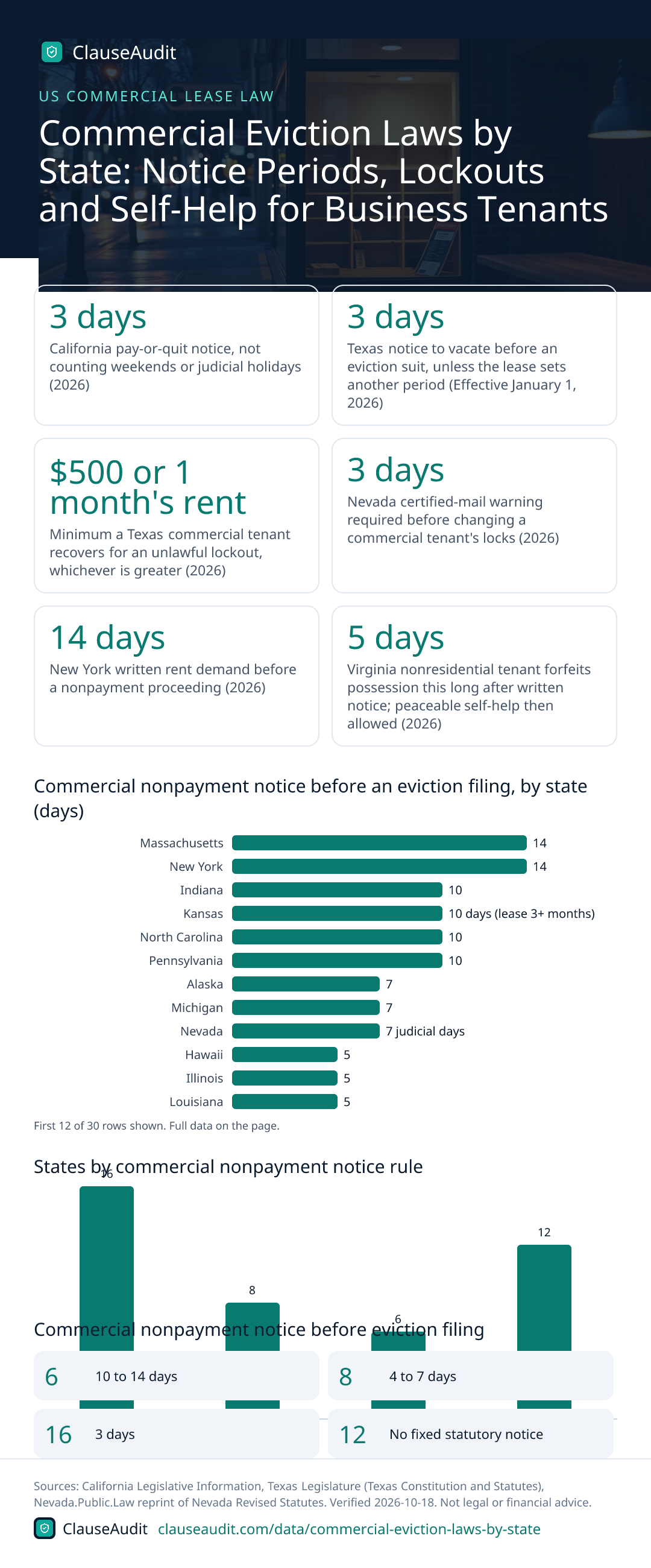
A commercial eviction usually starts with a short written notice and then a court case. In 16 of the 42 jurisdictions we confirmed, a business tenant gets just 3 days to pay or leave. New York and Massachusetts give 14 days. Texas and Nevada go further and let a landlord change the locks for unpaid rent.

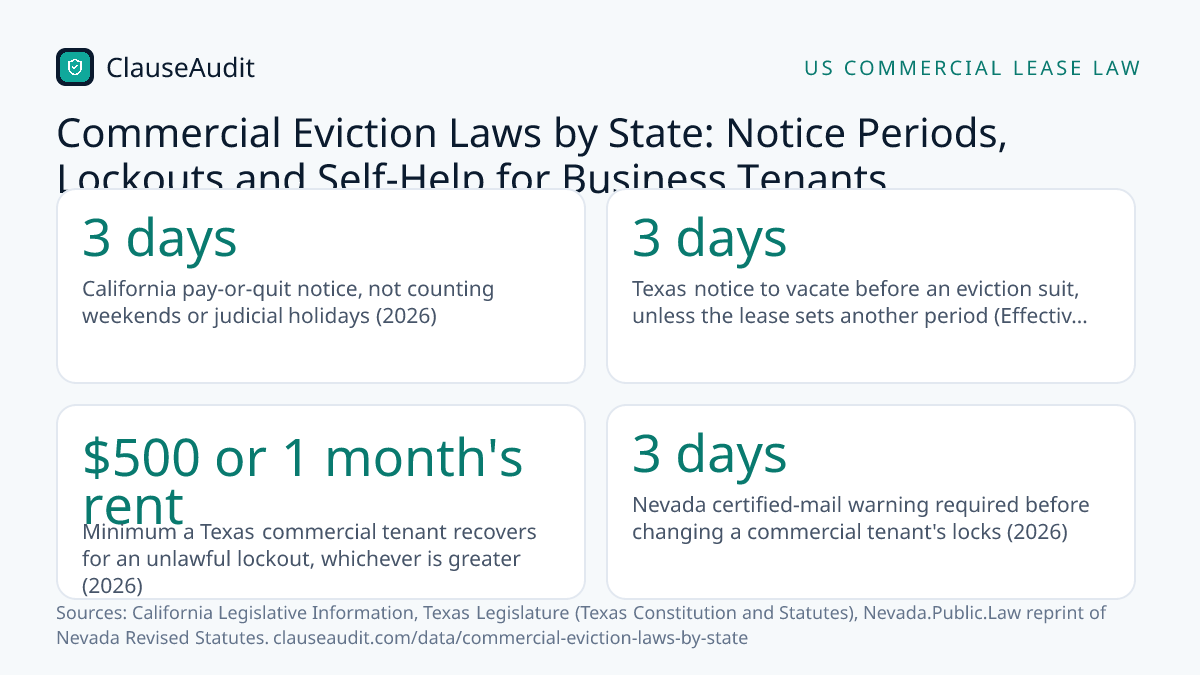
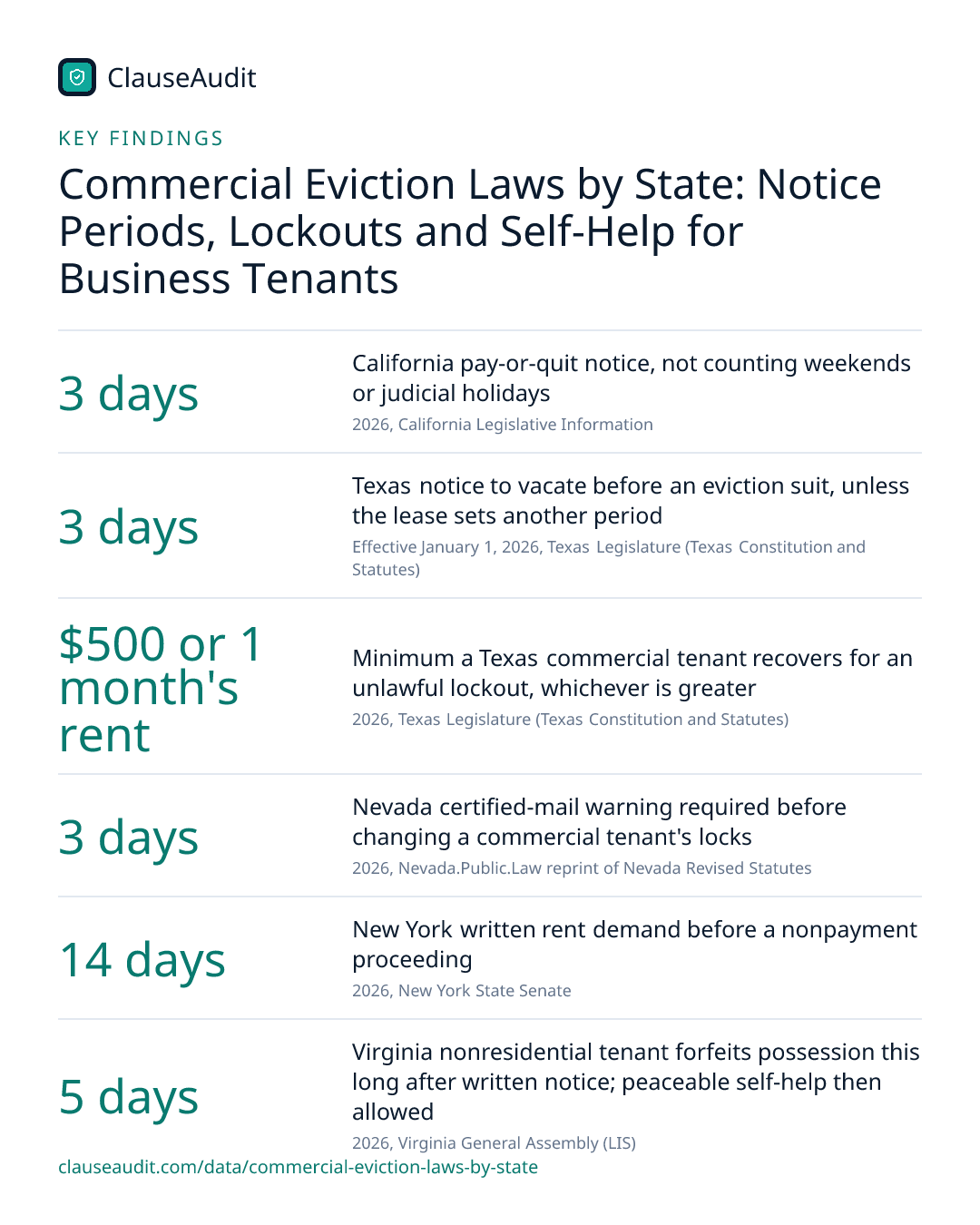
- California pay-or-quit notice, not counting weekends or judicial holidays (2026, California Legislative Information)
- 3 days
- Texas notice to vacate before an eviction suit, unless the lease sets another period (Effective January 1, 2026, Texas Legislature (Texas Constitution and Statutes))
- 3 days
- Minimum a Texas commercial tenant recovers for an unlawful lockout, whichever is greater (2026, Texas Legislature (Texas Constitution and Statutes))
- $500 or 1 month's rent
- Nevada certified-mail warning required before changing a commercial tenant's locks (2026, Nevada.Public.Law reprint of Nevada Revised Statutes)
- 3 days
- New York written rent demand before a nonpayment proceeding (2026, New York State Senate)
- 14 days
- Virginia nonresidential tenant forfeits possession this long after written notice; peaceable self-help then allowed (2026, Virginia General Assembly (LIS))
- 5 days
- Absence that lets a Florida landlord presume a nonresidential tenant abandoned the premises (2026, The Florida Legislature (Online Sunshine))
- 30 days
If you rent an office, shop or warehouse, you have far less protection than an apartment tenant. Most of the rules that slow down an eviction only apply to homes. Business tenants get the leftovers: short notice periods, fewer required warnings and, in a few states, a landlord who can change the locks without a judge.
We read the eviction statutes state by state and recorded two things for each: how much notice a commercial tenant gets for unpaid rent before a case is filed, and whether the statute says anything about lockouts or self-help. The map and table show every state. Below, we explain what those rules mean once rent is late, and what to fix in your lease before it ever gets there.
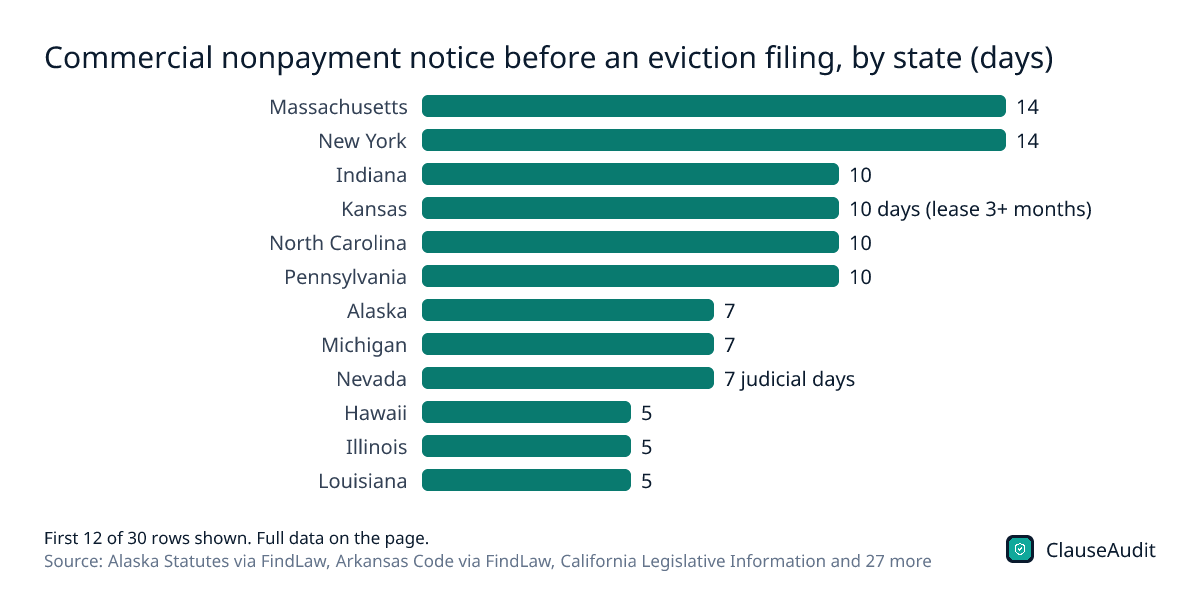
Commercial nonpayment notice before an eviction filing, by state (days)
Chart data
| Label | Value |
|---|---|
| Massachusetts | 14 |
| New York | 14 |
| Indiana | 10 |
| Kansas | 10 days (lease 3+ months) |
| North Carolina | 10 |
| Pennsylvania | 10 |
| Alaska | 7 |
| Michigan | 7 |
| Nevada | 7 judicial days |
| Hawaii | 5 |
| Illinois | 5 |
| Louisiana | 5 |
| Virginia | 5 |
| Wisconsin | 5 days (lease 1 yr or less) |
| Arkansas | 3 |
| California | 3 days (excl. weekends, holidays) |
| Colorado | 3 days (nonresidential) |
| Connecticut | 3 |
| Florida | 3 |
| Idaho | 3 |
| Iowa | 3 |
| Mississippi | 3 |
| Montana | 3 |
| Nebraska | 3 |
| North Dakota | 3 |
| Ohio | 3 |
| Texas | 3 |
| Utah | 3 business days |
| Washington | 3 |
| Wyoming | 3 |
New York and Massachusetts sit at the top with 14 days, and most of the list clusters at 3. Watch the fine print: Utah counts business days, Nevada counts judicial days, and in Texas, Indiana and Pennsylvania your lease can change the number. In Louisiana you can waive the notice in the lease.
Download this chart (PNG)States by commercial nonpayment notice rule
Chart data
| Label | Value |
|---|---|
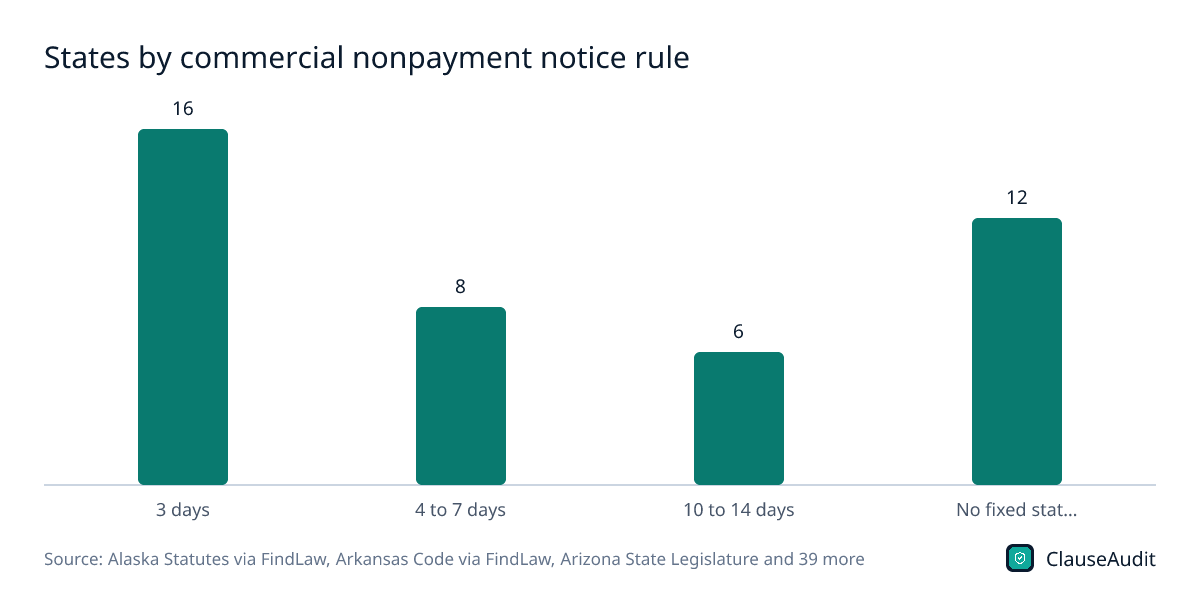
| 3 days | 16 |
| 4 to 7 days | 8 |
| 10 to 14 days | 6 |
| No fixed statutory notice | 12 |
A 3-day notice is the most common rule, covering 16 states. Another 12 set no fixed notice at all, so your lease decides how much warning you get, or you may get no warning at all before a filing.
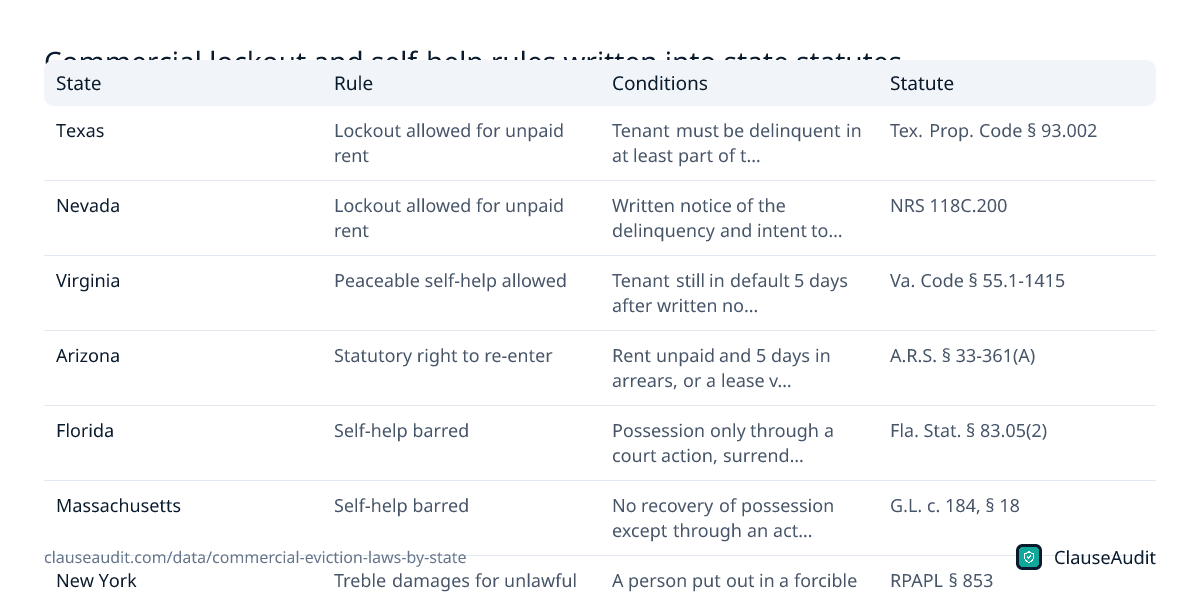
Download this chart (PNG)Commercial lockout and self-help rules written into state statutes
| State | Rule | Conditions | Statute |
|---|---|---|---|
| Texas | Lockout allowed for unpaid rent | Tenant must be delinquent in at least part of the rent; written notice on the front door saying where to get the new key; key given only during business hours and only if the rent is paid. Lease overrides the section. | Tex. Prop. Code § 93.002 |
| Nevada | Lockout allowed for unpaid rent | Written notice of the delinquency and intent to change locks by certified mail at least 3 days before; key notice on the front door. Lease overrides the section. | NRS 118C.200 |
| Virginia | Peaceable self-help allowed | Tenant still in default 5 days after written notice forfeits possession; eviction must not incite a breach of the peace. | Va. Code § 55.1-1415 |
| Arizona | Statutory right to re-enter | Rent unpaid and 5 days in arrears, or a lease violation: landlord may reenter and take possession or sue without formal demand. | A.R.S. § 33-361(A) |
| Florida | Self-help barred | Possession only through a court action, surrender, or abandonment. | Fla. Stat. § 83.05(2) |
| Massachusetts | Self-help barred | No recovery of possession except through an action under chapter 239 or other proceedings authorized by law. | G.L. c. 184, § 18 |
| New York | Treble damages for unlawful entry | A person put out in a forcible or unlawful manner may recover three times their damages. | RPAPL § 853 |
Source: Texas Legislature (Texas Constitution and Statutes), Texas Property Code § 93.002, Interruption of Utilities, Removal of Property, and Exclusion of Commercial Tenant; Nevada.Public.Law reprint of Nevada Revised Statutes, NRS 118C.200, Right to exclude commercial tenant; remedies; Virginia General Assembly (LIS), Code of Virginia § 55.1-1415, Failure to pay certain rents after five days' notice forfeits right of possession; Arizona State Legislature, A.R.S. § 33-361, Violation of lease by tenant; right of landlord to reenter; The Florida Legislature (Online Sunshine), Florida Statutes § 83.05, Right of possession upon default in rent; Massachusetts General Laws via FindLaw, Massachusetts General Laws c. 184, § 18; New York State Senate, New York RPAPL § 853, Action for forcible or unlawful entry or detainer. Download as image
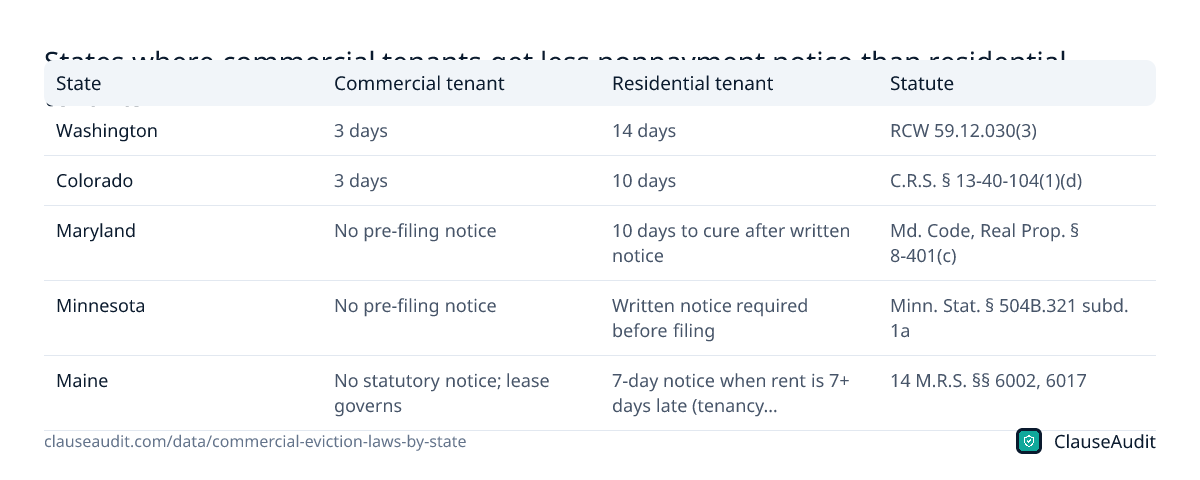
States where commercial tenants get less nonpayment notice than residential tenants
| State | Commercial tenant | Residential tenant | Statute |
|---|---|---|---|
| Washington | 3 days | 14 days | RCW 59.12.030(3) |
| Colorado | 3 days | 10 days | C.R.S. § 13-40-104(1)(d) |
| Maryland | No pre-filing notice | 10 days to cure after written notice | Md. Code, Real Prop. § 8-401(c) |
| Minnesota | No pre-filing notice | Written notice required before filing | Minn. Stat. § 504B.321 subd. 1a |
| Maine | No statutory notice; lease governs | 7-day notice when rent is 7+ days late (tenancy at will) | 14 M.R.S. §§ 6002, 6017 |
Source: Washington State Legislature, RCW 59.12.030, Unlawful detainer defined; Colorado.Public.Law reprint of Colorado Revised Statutes, C.R.S. § 13-40-104, Unlawful detention defined; Maryland Code via FindLaw, Md. Code, Real Property § 8-401; Minnesota Office of the Revisor of Statutes, Minnesota Statutes § 504B.321, Eviction action; procedure; Maine Legislature, Office of the Revisor of Statutes, 14 M.R.S. § 6002, Tenancy at will (Subchapter 1, Residential Landlords and Tenants); Maine Legislature, Office of the Revisor of Statutes, 14 M.R.S. § 6017, Commercial leases. Download as image
Commercial nonpayment notice before eviction filing by state
- 610 to 14 days
- 84 to 7 days
- 163 days
- 12No fixed statutory notice
- 10 to 14 days6
- 4 to 7 days8
- 3 days16
- No fixed statutory notice12
- Not yet confirmed9
| State | Nonpayment notice (commercial) | Lockout / self-help in statute | Source |
|---|---|---|---|
| Alabama | Not yet confirmed: check the source | Code of Alabama (Alabama Legislature) | |
| Alaska | 7 days after written demand (property outside the residential act) | Not reviewed; check case law | AS 09.45.090(b)(1) |
| Arizona | No formal demand required once rent is 5 days in arrears | Statute lets landlord re-enter and take possession (A.R.S. 33-361) | A.R.S. § 33-361(A) |
| Arkansas | 3 days' written notice to quit | Not reviewed; check case law | Ark. Code § 18-60-304(3) |
| California | 3 days, excluding Saturdays, Sundays and judicial holidays | Not reviewed; check case law | Cal. Code Civ. Proc. § 1161(2) |
| Colorado | 3 days for a nonresidential agreement (10 days residential) | Not reviewed; check case law | C.R.S. § 13-40-104(1)(d) |
| Connecticut | 3 days' notice to quit | Not reviewed; check case law | Conn. Gen. Stat. § 47a-23 |
| Delaware | No fixed statutory notice; commercial lease supplies the grounds | Not reviewed; check case law | 25 Del. C. §§ 5702(10), 5705(a) |
| District of Columbia | Not yet confirmed: check the source | Code of the District of Columbia (DC Council) | |
| Florida | 3 days' written notice to pay or deliver possession | Court action, surrender or abandonment only (Fla. Stat. 83.05) | Fla. Stat. §§ 83.20(2), 83.05 |
| Georgia | Demand for possession; no set number of days | Not reviewed; check case law | O.C.G.A. § 44-7-50(a) |
| Hawaii | 5 days' written notice to vacate (periodic tenancies) | Not reviewed; check case law | HRS § 666-2 |
| Idaho | 3 days' written notice to pay or deliver possession | Not reviewed; check case law | Idaho Code § 6-303(2) |
| Illinois | 5 days after written demand | Not reviewed; check case law | 735 ILCS 5/9-209 |
| Indiana | 10 days' notice unless the parties agree otherwise | Not reviewed; check case law | Ind. Code § 32-31-1-6 |
| Iowa | 3 days' written notice to quit | Not reviewed; check case law | Iowa Code § 648.3 |
| Kansas | 10 days (lease of 3 months or longer); 3 days (shorter tenancy) | Not reviewed; check case law | K.S.A. 58-2507, 58-2508 |
| Kentucky | Not yet confirmed: check the source | Kentucky Revised Statutes (Kentucky General Assembly) | |
| Louisiana | 5 days' notice to vacate (tenant can waive it in the lease) | Not reviewed; check case law | La. Code Civ. Proc. art. 4701 |
| Maine | No statutory notice period for commercial leases; lease terms govern | Not reviewed; check case law | 14 M.R.S. § 6017 |
| Maryland | No pre-filing notice for nonresidential property (10-day notice is residential only) | Not reviewed; check case law | Md. Code, Real Prop. § 8-401 |
| Massachusetts | 14 days' notice to quit (tenancy at will) | Court action only (G.L. c. 184, § 18) | G.L. c. 186, § 12; c. 184, § 18 |
| Michigan | 7-day written notice to quit | Not reviewed; check case law | MCL § 554.134(2) |
| Minnesota | No pre-filing notice for nonresidential tenants (written notice rule covers residential tenants) | Not reviewed; check case law | Minn. Stat. §§ 504B.291, 504B.321 |
| Mississippi | 3 days' written notice (premises that are not a dwelling unit) | Not reviewed; check case law | Miss. Code § 89-7-27 |
| Missouri | Not yet confirmed: check the source | Missouri Revised Statutes (Missouri Revisor of Statutes) | |
| Montana | 3 days' written notice requiring payment | Not reviewed; check case law | MCA 70-27-108(2) |
| Nebraska | 3 days' notice before commencing the action | Not reviewed; check case law | Neb. Rev. Stat. § 25-21,221 |
| Nevada | 7 judicial days to pay or surrender (unless agreed otherwise in writing) | Lockout allowed after 3-day certified-mail notice (NRS 118C.200) | NRS 40.2542; NRS 118C.200 |
| New Hampshire | Not yet confirmed: check the source | RSA 540:3 (New Hampshire General Court) | |
| New Jersey | No notice required for nonpayment removal | Not reviewed; check case law | N.J.S.A. 2A:18-53(b) |
| New Mexico | No notice period stated for nonpayment | Not reviewed; check case law | NMSA § 35-10-1(A)(3) |
| New York | 14-day written rent demand | Forcible or unlawful entry: treble damages (RPAPL 853) | N.Y. RPAPL §§ 711(2), 853 |
| North Carolina | 10 days after demand for past-due rent | Not reviewed; check case law | N.C. Gen. Stat. § 42-3 |
| North Dakota | 3 days' written notice of intention to evict | Not reviewed; check case law | N.D.C.C. §§ 47-32-01(4), 47-32-02 |
| Ohio | 3 days' notice to leave the premises | Not reviewed; check case law | Ohio Rev. Code § 1923.04(A) |
| Oklahoma | Not yet confirmed: check the source | Oklahoma Statutes (OSCN) | |
| Oregon | No notice to quit; tenancy ends 10 days after rent is due unless lease sets another period | Not reviewed; check case law | ORS 91.090 |
| Pennsylvania | 10 days (lease may shorten or waive) | Not reviewed; check case law | 68 P.S. § 250.501(b), (e) |
| Rhode Island | Not yet confirmed: check the source | R.I. Gen. Laws ch. 34-18.1 (Rhode Island General Assembly) | |
| South Carolina | No set notice period; ejectment when rent is not paid when due or demanded | Not reviewed; check case law | S.C. Code § 27-37-10(A) |
| South Dakota | No notice to quit; action lies once rent is 3 days past due | Not reviewed; check case law | SDCL 21-16-1(4) |
| Tennessee | Not yet confirmed: check the source | Tenn. Code § 29-18-104 via FindLaw | |
| Texas | 3 days' written notice to vacate unless the lease sets a shorter or longer period | Lockout allowed for unpaid rent; key notice on front door (Prop. Code 93.002) | Tex. Prop. Code §§ 24.005, 93.002 |
| Utah | 3 business days | Not reviewed; check case law | Utah Code § 78B-6-802 |
| Vermont | Not yet confirmed: check the source | 12 V.S.A. § 4773 (Vermont General Assembly) | |
| Virginia | 5 days after written notice | Peaceable self-help allowed after forfeiture (Va. Code 55.1-1415) | Va. Code § 55.1-1415 |
| Washington | 3 days (14 days for residential tenancies under RCW 59.18) | Not reviewed; check case law | RCW 59.12.030(3) |
| West Virginia | No fixed pre-filing notice; hearing set 5 to 10 judicial days after request | Not reviewed; check case law | W. Va. Code § 55-3A-1 |
| Wisconsin | 5 days (lease of 1 year or less); 30 days (lease over 1 year) | Not reviewed; check case law | Wis. Stat. § 704.17(2)(a), (3)(a) |
| Wyoming | 3 days' notice before commencing the action | Not reviewed; check case law | Wyo. Stat. § 1-21-1003 |
How does a commercial eviction work?
In most states the steps look like this. Rent goes unpaid. The landlord serves a written notice to pay or leave. When that notice runs out, the landlord files an eviction case, often called unlawful detainer or forcible detainer. A judge rules, and if the landlord wins, a sheriff or marshal hands back possession.
The notice is the step you have the most control over, because it is your last clean chance to pay before a court filing shows up on public record. In California you get 3 days, and weekends and judicial holidays don't count. In New York the landlord must make a 14-day written rent demand first. In Illinois it is 5 days after written demand, and in North Carolina 10 days after a demand for past-due rent.
Some states tie the notice to the length of your lease. Kansas gives 10 days on a lease of 3 months or longer and 3 days on a shorter one. Wisconsin gives 5 days on a lease of 1 year or less and 30 days on a longer lease. Oregon skips the notice to quit, and the tenancy ends 10 days after rent is due unless the lease sets another period. So two tenants on the same street can face very different clocks depending on what they signed.
Some states skip the warning almost entirely. Arizona lets a landlord re-enter or sue without formal demand once rent is 5 days in arrears. New Jersey requires no notice for a nonpayment removal. South Dakota lets the action go forward once rent is 3 days past due. If you rent space in one of those states, the first formal paper you see may be a court summons.
Can a commercial landlord change the locks?
The safest assumption is no, not without a court order. But the law is not uniform, and a few statutes say yes outright.
Texas lets a landlord change the locks on a business tenant who is behind on even part of the rent. The landlord has to post a notice on the front door saying where to get the new key, and the key is handed over only during business hours and only if you pay. Nevada allows the same thing after a written warning sent by certified mail at least 3 days before the locks change. In both states, your lease overrides the statute, so the lease can make the rule better or worse for you.
Virginia allows peaceable self-help once a tenant is still in default 5 days after written notice, as long as the lockout does not cause a breach of the peace. Arizona gives landlords a statutory right to re-enter.
On the other side, Florida and Massachusetts bar self-help for commercial space. Possession comes through a court case, a surrender or, in Florida, an abandonment. New York lets a tenant who is put out in a forcible or unlawful manner recover three times their damages. For the other states we did not review lockout rules, and court decisions often settle the question. That is why our table marks them for a case-law check rather than guessing.
Why do business tenants get less notice than residential tenants?
The usual reasoning is that a business can read its lease, hire a lawyer and absorb a short gap. Home tenants get extra time because losing housing is harder to recover from. The result is a two-tier system, and it can be stark.
In Washington a commercial tenant gets 3 days for unpaid rent, against 14 days for a residential tenant. In Colorado it is 3 days against 10. Maryland requires no pre-filing notice at all for nonresidential property, while home tenants there get 10 days to cure after written notice. Minnesota also requires no pre-filing notice for nonresidential tenants, and Maine sets no statutory notice for commercial leases, so the lease governs.
For a small business, this matters most when you run your company out of space that feels personal: a studio, a clinic, a single storefront. You are a commercial tenant in the eyes of the statute, even if the business is just you.
What happens if I stop showing up at the space?
Leaving can count against you. In Florida, a landlord can presume a nonresidential tenant has abandoned the premises after a 30-day absence, if rent is also unpaid and 10 days have passed since a notice under the eviction statute. Once abandonment is presumed, the landlord can retake the space without a court case.
If you are moving out slowly, closing for a season or working remotely while you sort out a dispute, put that in writing to the landlord and keep paying what you can. Silence plus unpaid rent is the pattern these rules are built to catch.
What to do when rent is late or a notice arrives
- Read the notice date and count the days the way your state counts them. Business days, judicial days and calendar days give different deadlines.
- Check your lease before the statute. In Texas, Indiana and Pennsylvania the lease can change the notice period, and in Louisiana you can waive the notice in the lease.
- Pay in a way you can prove, such as a bank transfer or certified check, and keep the receipt. A partial payment may or may not stop the clock, so ask the landlord in writing whether it does.
- If the locks change, write down the date, photograph the door and any posted notice, and talk to a lawyer quickly. In Texas, a landlord who skips the lockout rules owes at least $500 or 1 month's rent, whichever is greater, plus actual damages and fees.
- Get anything you negotiate, such as a payment plan or a later deadline, signed by the landlord. An oral promise not to evict will not help you in court.
- If your state is marked not yet confirmed or not reviewed, check the current statute and local court rules before relying on any number here.
How ClauseAudit helps
In many states the statute only sets a floor, and in Texas, Nevada, Indiana and Pennsylvania the lease can change the notice rules. That means the clauses you signed often decide how fast you can lose the space.
Upload your commercial lease and the automated review flags the default and remedy clauses, explains each in plain English, and suggests wording you can take back to the landlord before you sign or renew.
- Default and cure: how many days do you get to fix late rent after written notice, and does the lease waive the notice your state would otherwise give?
- Lockout and re-entry: does the lease let the landlord change the locks or re-enter without a court order?
- Late fees and interest: how much is charged when rent is late, and when does the charge start?
- Personal guarantee: if the business is evicted, are you personally on the hook for the rest of the term?
- Acceleration: can the landlord demand all remaining rent at once after a default?
- Abandoned property: what happens to your equipment and inventory if you are locked out or leave?
Frequently asked questions
How long does a commercial landlord have to give notice for unpaid rent?
It depends on the state. The most common rule is 3 days, used by 16 states including California, Texas, Florida and Washington. New York and Massachusetts give 14 days. Indiana, North Carolina and Pennsylvania give 10, and so does Kansas on a lease of 3 months or longer. Another 12 states set no fixed statutory notice, so the lease decides or no notice is needed.
Can a landlord lock out a commercial tenant without going to court?
In a few states, yes. Texas and Nevada allow a lockout for unpaid rent if the landlord follows notice rules, and Virginia allows peaceable self-help once a tenant stays in default 5 days after written notice. Florida and Massachusetts bar it. In many other states court decisions decide the question, so check with a local lawyer before assuming either way.
What can I recover if my landlord locks me out illegally in Texas?
Texas sets the minimum at $500 or 1 month's rent, whichever is greater, plus actual damages, reasonable attorney's fees and court costs, less any rent you owe. This applies when the landlord does not follow the statute's rules. Because a lease overrides the section, read your lease's lockout clause too.
Does a 3-day notice include weekends?
Not always. California excludes Saturdays, Sundays and judicial holidays from its 3-day count. Utah counts 3 business days. Nevada's notice runs 7 judicial days. Elsewhere, read the exact wording of your state's statute and its general rules for counting days before you assume a deadline.
Can my commercial lease waive the eviction notice?
Sometimes. Texas lets the lease set a shorter or longer period than 3 days, Pennsylvania lets the lease shorten or waive its 10-day notice, and Louisiana tenants can waive the 5-day notice. Colorado is an exception: its notice requirement cannot be waived in the agreement. Check the default section of your lease before signing.
Is a commercial eviction faster than a residential one?
Usually the notice stage is shorter. Washington gives commercial tenants 3 days against 14 days for residential tenants, and Colorado gives 3 against 10. Maryland and Minnesota require no pre-filing notice for nonresidential tenants. Court timelines vary by county, so the total time depends on local dockets as well.
Can a landlord treat my space as abandoned if I am away?
In Florida, a landlord can presume abandonment after a 30-day absence, if rent is unpaid and 10 days have passed since the statutory notice. Then the landlord can retake the space without a court case. If you will be away, tell the landlord in writing and stay current on rent.
Why does my state show as not yet confirmed?
We only publish a notice period when we could read it in the statute itself. For 9 jurisdictions, including Alabama, DC and Tennessee, we could not confirm the commercial rule from an accessible source, so they are not counted in the charts. Check your state code or a local attorney for those.
Use this data
Every chart and card below is free to reuse under CC BY 4.0. Download what you need and link back to this page.
 Stat cards
 Key findings card
 Infographic
 Commercial nonpayment notice before an eviction filing, by state (days)
 States by commercial nonpayment notice rule
 Commercial lockout and self-help rules written into state statutes
 States where commercial tenants get less nonpayment notice than residential tenants
Embed the infographic
Free to share on your site, blog or slides under CC BY 4.0. Please keep the credit link.
Sources and method
Every number on this page comes from the sources below, each opened and read on or before October 18, 2026. A second, independent review checked every figure against its source and corrected anything that did not match. 42 of 51 state entries were confirmed; any that could not be are marked "Not yet confirmed" and left out of every count and chart.
- Texas Legislature (Texas Constitution and Statutes), Texas Property Code § 24.005, Notice Required Before Filing Certain Eviction Suits (As amended by S.B. 38 (2025), eff. January 1, 2026)
- Texas Legislature (Texas Constitution and Statutes), Texas Property Code § 93.002, Interruption of Utilities, Removal of Property, and Exclusion of Commercial Tenant (Current text (last amended 1993), read October 2026)
- California Legislative Information, California Code of Civil Procedure § 1161 (Current text, read October 2026)
- The Florida Legislature (Online Sunshine), Florida Statutes § 83.20, Causes for removal of tenants (Part I, Nonresidential Tenancies) (Current text, read October 2026)
- The Florida Legislature (Online Sunshine), Florida Statutes § 83.05, Right of possession upon default in rent (Current text, read October 2026)
- Washington State Legislature, RCW 59.12.030, Unlawful detainer defined (Current text, read October 2026)
- Illinois Compiled Statutes via FindLaw, 735 ILCS 5/9-209, Demand for rent (FindLaw reprint, read October 2026)
- Massachusetts General Laws via FindLaw, Massachusetts General Laws c. 186, § 12 (FindLaw reprint, current as of January 1, 2025)
- Massachusetts General Laws via FindLaw, Massachusetts General Laws c. 184, § 18 (FindLaw reprint, current as of January 1, 2025)
- New York State Senate, New York RPAPL § 711, Grounds where landlord-tenant relationship exists (Current text, read October 2026)
- New York State Senate, New York RPAPL § 853, Action for forcible or unlawful entry or detainer (Current text, read October 2026)
- Arizona State Legislature, A.R.S. § 33-361, Violation of lease by tenant; right of landlord to reenter (Current text, read October 2026)
- Kansas Office of Revisor of Statutes, K.S.A. 58-2507, Termination of lease for three months or longer; notice (Current text, read October 2026)
- Kansas Office of Revisor of Statutes, K.S.A. 58-2508, Termination of tenancy of less than three months for nonpayment of rent (Current text, read October 2026)
- Maine Legislature, Office of the Revisor of Statutes, 14 M.R.S. § 6017, Commercial leases (Data extracted October 5, 2026)
- Maine Legislature, Office of the Revisor of Statutes, 14 M.R.S. § 6002, Tenancy at will (Subchapter 1, Residential Landlords and Tenants) (Current text, read October 2026)
- Minnesota Office of the Revisor of Statutes, Minnesota Statutes § 504B.291, Eviction action for nonpayment (Current text, read October 2026)
- Minnesota Office of the Revisor of Statutes, Minnesota Statutes § 504B.321, Eviction action; procedure (Current text, read October 2026)
- Montana Legislature, MCA 70-27-108, Unlawful detainer defined (Montana Code Annotated 2025)
- OregonLaws (Oregon.Public.Law) reprint of Oregon Revised Statutes, ORS 91.090, Termination of tenancy by failure to pay rent (Reprint of oregonlegislature.gov text accessed May 26, 2025)
- South Carolina Legislature, S.C. Code § 27-37-10, Grounds for ejectment of tenant (Current text, read October 2026)
- Virginia General Assembly (LIS), Code of Virginia § 55.1-1415, Failure to pay certain rents after five days' notice forfeits right of possession (Page dated October 19, 2026)
- Delaware Code Online, 25 Del. C. ch. 57, Summary Possession (Current text, read October 2026)
- Colorado.Public.Law reprint of Colorado Revised Statutes, C.R.S. § 13-40-104, Unlawful detention defined (Reprint, read October 2026)
- Nevada.Public.Law reprint of Nevada Revised Statutes, NRS 40.2542, Commercial premises: notice to pay rent or surrender (Reprint, read October 2026)
- Nevada.Public.Law reprint of Nevada Revised Statutes, NRS 118C.200, Right to exclude commercial tenant; remedies (Reprint, read October 2026)
- Alaska Statutes via FindLaw, Alaska Statutes § 09.45.090 (FindLaw reprint, current as of January 1, 2025)
- Arkansas Code via FindLaw, Arkansas Code § 18-60-304 (FindLaw reprint, current as of March 28, 2024)
- Connecticut General Statutes via FindLaw, Connecticut General Statutes § 47a-23 (FindLaw reprint, current as of January 1, 2025)
- Hawaii Revised Statutes via FindLaw, Hawaii Revised Statutes § 666-2 (FindLaw reprint, current as of January 1, 2025)
- Georgia Code via FindLaw, O.C.G.A. § 44-7-50 (FindLaw reprint, current as of March 28, 2024)
- Idaho Statutes via FindLaw, Idaho Code § 6-303 (FindLaw reprint, current as of January 1, 2024)
- Indiana Code via FindLaw, Indiana Code § 32-31-1-6 (FindLaw reprint, current as of January 1, 2026)
- Louisiana Code of Civil Procedure via FindLaw, Louisiana Code of Civil Procedure art. 4701 (FindLaw reprint, current as of January 1, 2023)
- Michigan Compiled Laws via FindLaw, MCL § 554.134 (FindLaw reprint, current as of January 1, 2025)
- Utah Code via FindLaw, Utah Code § 78B-6-802 (FindLaw reprint, current as of January 1, 2025)
- Iowa Legislature, Iowa Code § 648.3, Notice to quit (Current code PDF, read October 2026)
- Mississippi Code via FindLaw, Mississippi Code § 89-7-27 (FindLaw reprint, current as of January 1, 2025)
- North Carolina General Statutes via FindLaw, N.C. Gen. Stat. § 42-3 (FindLaw reprint, current as of January 1, 2023)
- Ohio Revised Code via FindLaw, Ohio Revised Code § 1923.04 (FindLaw reprint, current as of January 1, 2026)
- New Jersey Statutes via FindLaw, N.J.S.A. 2A:18-53 (FindLaw reprint, current as of January 1, 2024)
- Nebraska Revised Statutes via FindLaw, Neb. Rev. Stat. § 25-21,221 (FindLaw reprint, current as of January 1, 2024)
- Wyoming Statutes via FindLaw, Wyo. Stat. § 1-21-1003 (FindLaw reprint, current as of January 1, 2024)
- Wisconsin Statutes via FindLaw, Wis. Stat. § 704.17 (FindLaw reprint, current as of January 1, 2025)
- South Dakota Legislature, SDCL 21-16-1, Grounds for maintenance of action (and 21-16-2, Repealed) (Current text, read October 2026)
- North Dakota Legislative Branch, N.D.C.C. ch. 47-32, Eviction (§§ 47-32-01, 47-32-02) (Current chapter PDF, read October 2026)
- Pennsylvania Statutes via FindLaw, Landlord and Tenant Act of 1951, § 501 (68 P.S. § 250.501) (FindLaw reprint, current as of January 1, 2026)
- New Mexico Statutes via FindLaw, NMSA § 35-10-1 (FindLaw reprint, current as of January 1, 2024)
- Maryland Code via FindLaw, Md. Code, Real Property § 8-401 (FindLaw reprint, current as of January 1, 2025)
- West Virginia Code via FindLaw, W. Va. Code § 55-3A-1 (FindLaw reprint, current as of January 1, 2024)
Cite this page
ClauseAudit, “Commercial Eviction Laws by State: Notice Periods, Lockouts and Self-Help for Business Tenants”, updated October 18, 2026, https://clauseaudit.com/data/commercial-eviction-laws-by-state. Free to reuse with a link back (CC BY 4.0).
This page summarises published data and law as checked on October 18, 2026. Figures are updated as new editions are released, and your own situation may differ. It is general information, not legal, tax or financial advice.