How Much Does Rent Go Up Each Year? Average Annual Rent Increase Statistics 2026
By ClauseAudit Research · 8 sources ·
What is the average rent increase per year?
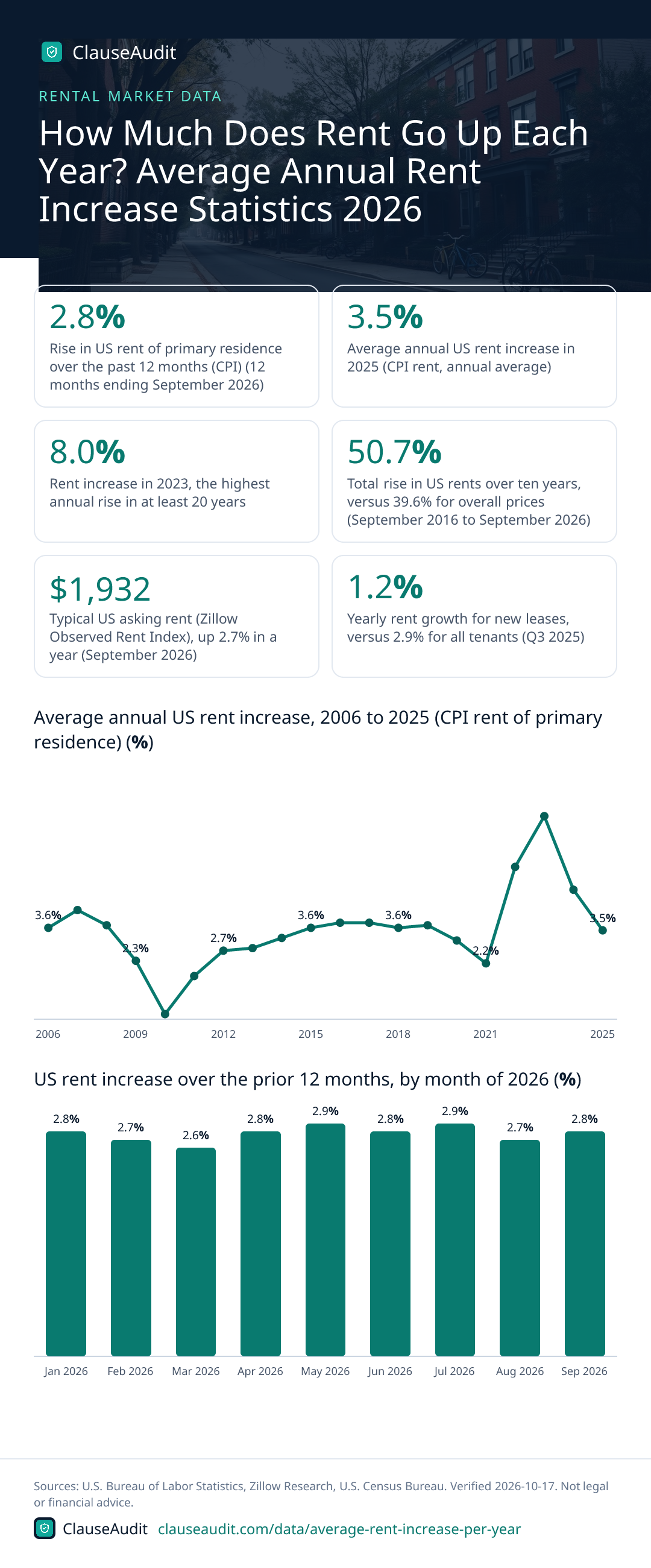
US rents rose 2.8% in the 12 months ending September 2026, according to the Consumer Price Index. That is slower than recent years: rent climbed 3.5% in 2025 and peaked at 8.0% in 2023. Over the ten years to September 2026, rents rose 50.7% in total, faster than overall prices.
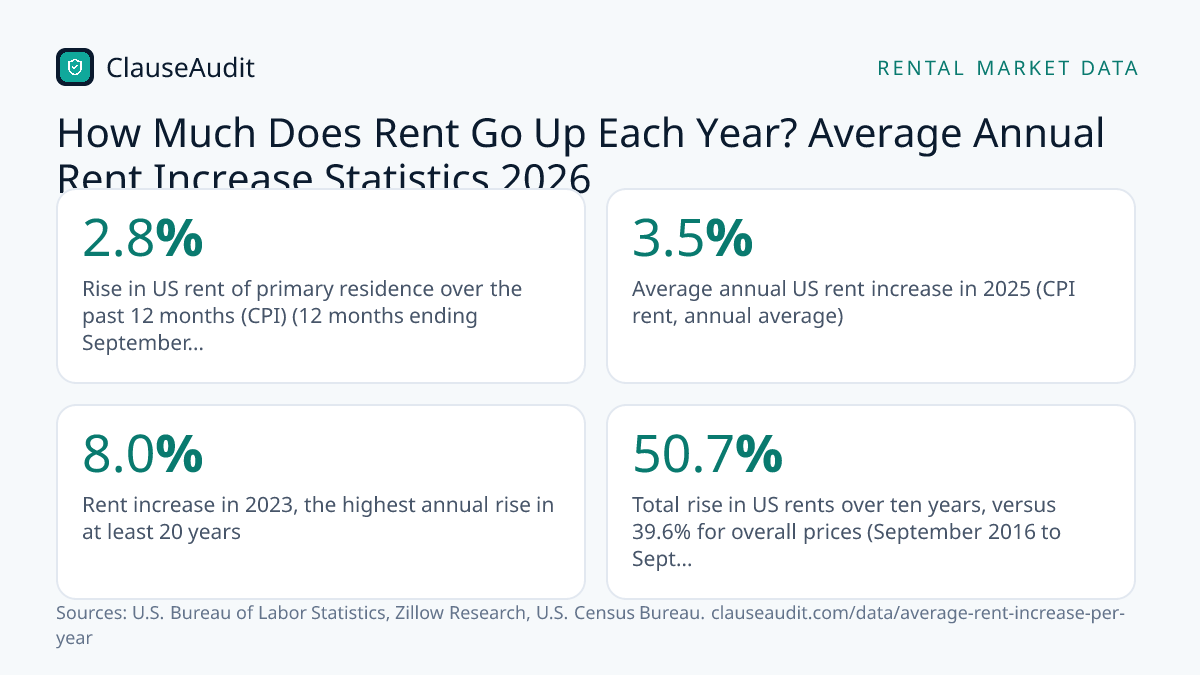
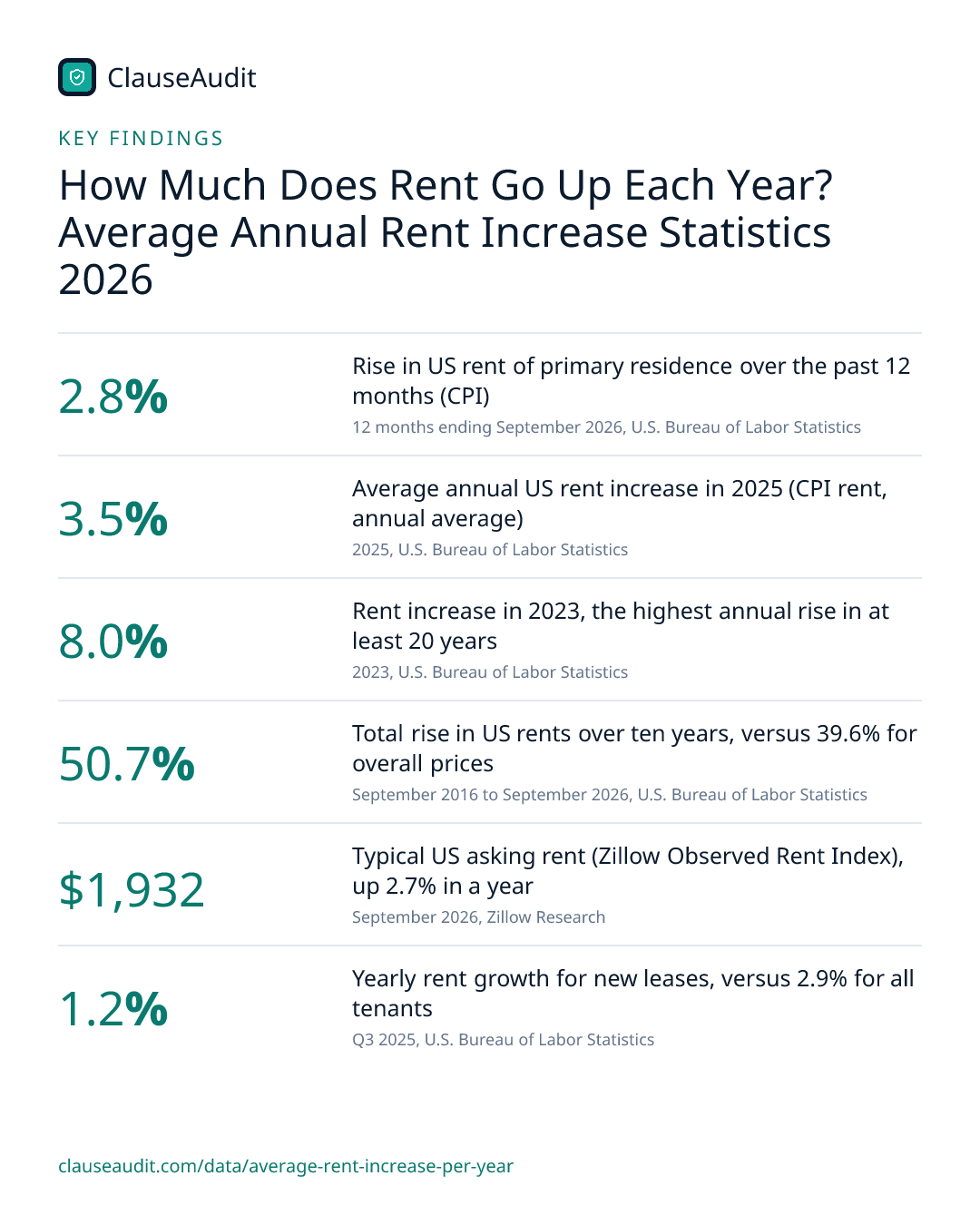
- Rise in US rent of primary residence over the past 12 months (CPI) (12 months ending September 2026, U.S. Bureau of Labor Statistics)
- 2.8%
- Average annual US rent increase in 2025 (CPI rent, annual average) (2025, U.S. Bureau of Labor Statistics)
- 3.5%
- Rent increase in 2023, the highest annual rise in at least 20 years (2023, U.S. Bureau of Labor Statistics)
- 8.0%
- Total rise in US rents over ten years, versus 39.6% for overall prices (September 2016 to September 2026, U.S. Bureau of Labor Statistics)
- 50.7%
- Typical US asking rent (Zillow Observed Rent Index), up 2.7% in a year (September 2026, Zillow Research)
- $1,932
- Yearly rent growth for new leases, versus 2.9% for all tenants (Q3 2025, U.S. Bureau of Labor Statistics)
- 1.2%
- US rental vacancy rate, up from 7.0% a year earlier (Q2 2026, U.S. Census Bureau)
- 7.3%
Most renters find out what the market is doing the day a renewal letter arrives. The national figures give you a yardstick. If your landlord asks for far more than the typical rise, you have a reason to push back, or at least to shop around before you sign.
This page pulls together the government rent index, Zillow's asking rent data and the Census vacancy survey. Below the charts, we explain how to read the gap between new leases and renewals, what counts as a normal increase, and which lease clauses decide how much your rent can move.
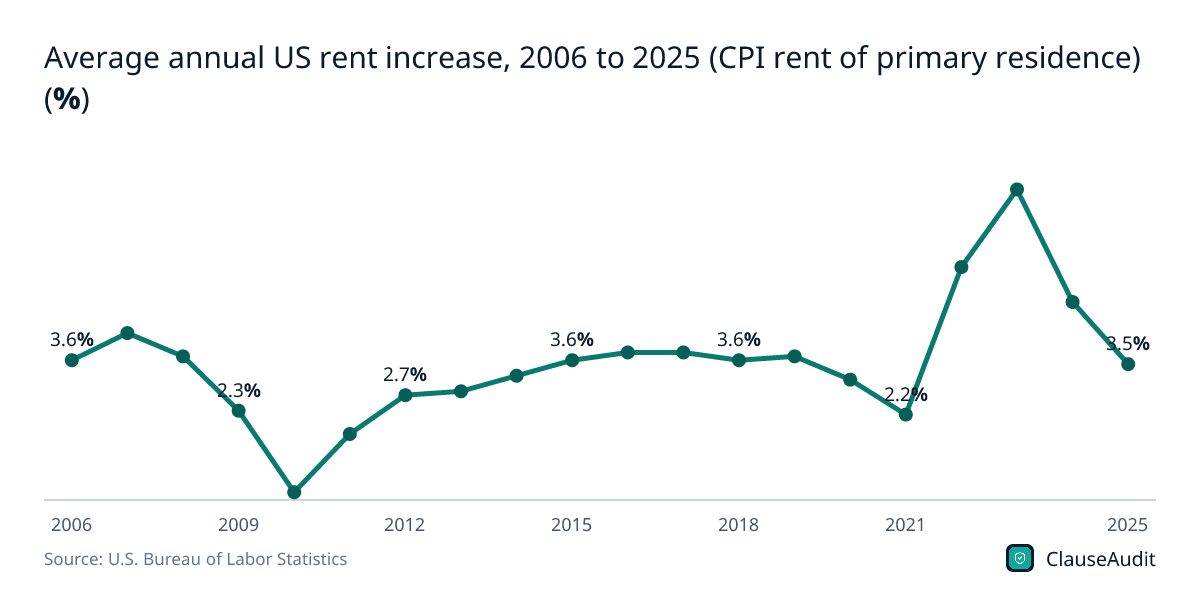
Average annual US rent increase, 2006 to 2025 (CPI rent of primary residence) (%)
Chart data
| Label | Value (%) |
|---|---|
| 2006 | 3.6% |
| 2007 | 4.3% |
| 2008 | 3.7% |
| 2009 | 2.3% |
| 2010 | 0.2% |
| 2011 | 1.7% |
| 2012 | 2.7% |
| 2013 | 2.8% |
| 2014 | 3.2% |
| 2015 | 3.6% |
| 2016 | 3.8% |
| 2017 | 3.8% |
| 2018 | 3.6% |
| 2019 | 3.7% |
| 2020 | 3.1% |
| 2021 | 2.2% |
| 2022 | 6.0% |
| 2023 | 8.0% |
| 2024 | 5.1% |
| 2025 | 3.5% |
Rent rose every year in this series, even in 2010 when growth slowed to 0.2%. The spike to 8.0% in 2023 was the outlier, and 2025 at 3.5% looks much closer to the pre-pandemic pattern.
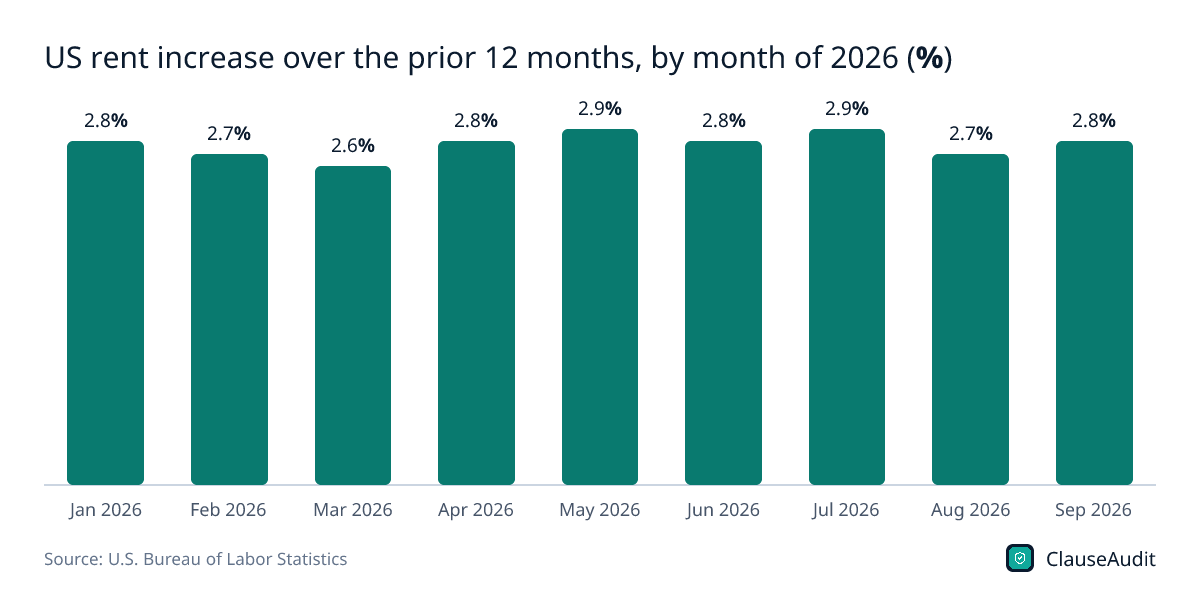
Download this chart (PNG)US rent increase over the prior 12 months, by month of 2026 (%)
Chart data
| Label | Value (%) |
|---|---|
| Jan 2026 | 2.8% |
| Feb 2026 | 2.7% |
| Mar 2026 | 2.6% |
| Apr 2026 | 2.8% |
| May 2026 | 2.9% |
| Jun 2026 | 2.8% |
| Jul 2026 | 2.9% |
| Aug 2026 | 2.7% |
| Sep 2026 | 2.8% |
The 12-month rate has barely moved in 2026, staying between 2.6% and 2.9% every month. That kind of stability makes a large renewal increase harder for a landlord to justify with market data.
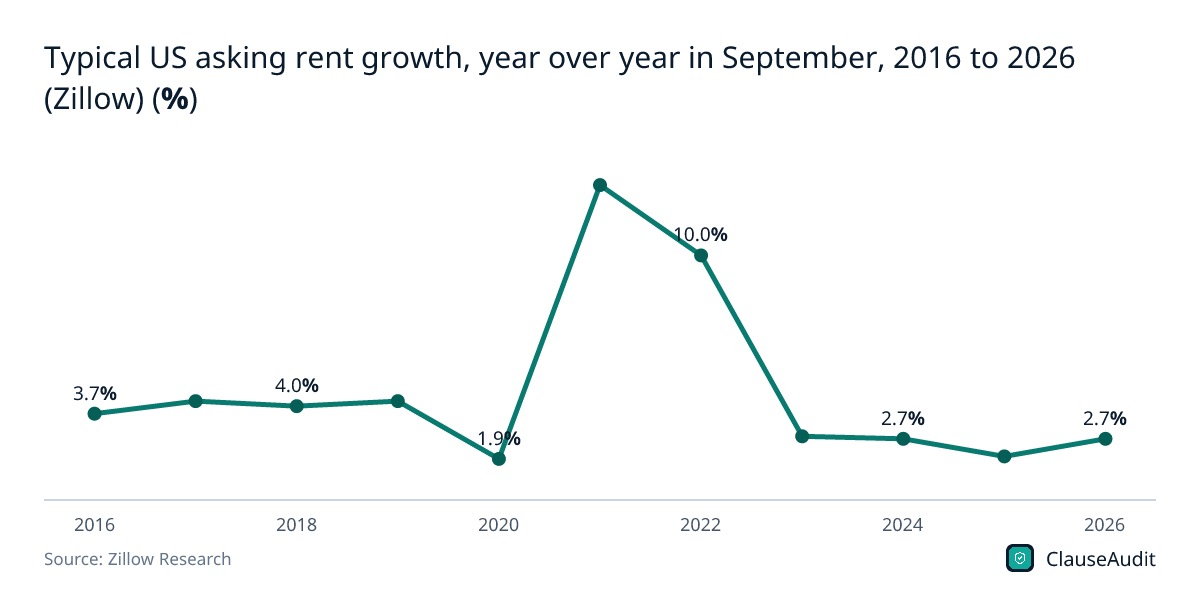
Download this chart (PNG)Typical US asking rent growth, year over year in September, 2016 to 2026 (Zillow) (%)
Chart data
| Label | Value (%) |
|---|---|
| 2016 | 3.7% |
| 2017 | 4.2% |
| 2018 | 4.0% |
| 2019 | 4.2% |
| 2020 | 1.9% |
| 2021 | 12.8% |
| 2022 | 10.0% |
| 2023 | 2.8% |
| 2024 | 2.7% |
| 2025 | 2.0% |
| 2026 | 2.7% |
Asking rents on listings swing much harder than the rent people actually pay. They jumped 12.8% in 2021 and 10.0% in 2022, then settled near 2.7% in 2026.
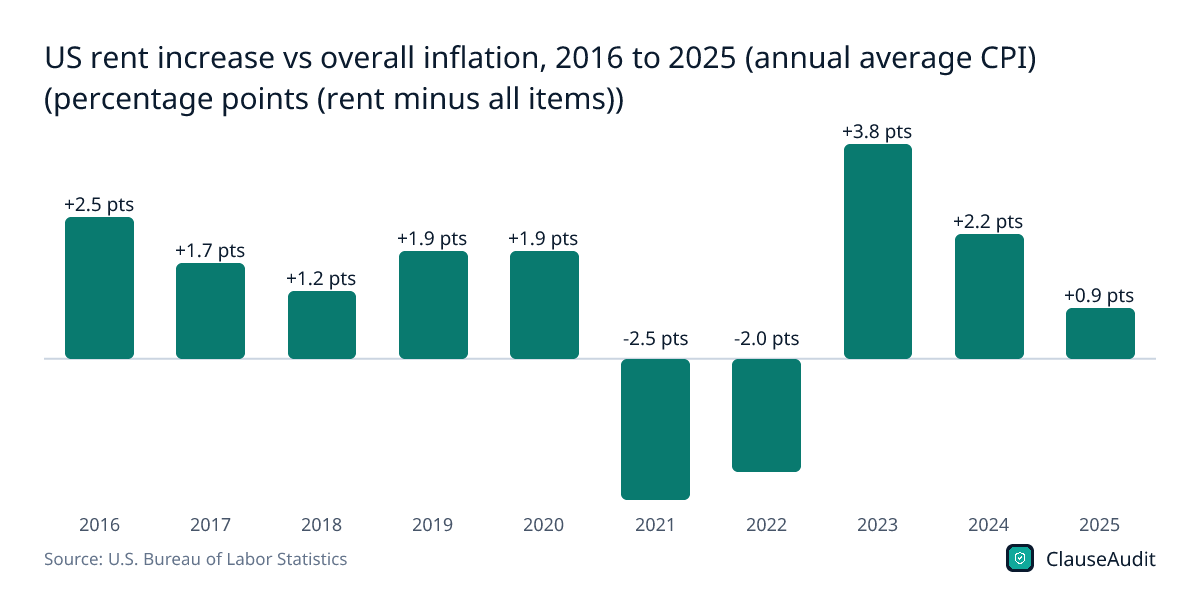
Download this chart (PNG)US rent increase vs overall inflation, 2016 to 2025 (annual average CPI) (percentage points (rent minus all items))
Chart data
| Label | Value (percentage points (rent minus all items)) |
|---|---|
| 2016 | +2.5 pts |
| 2017 | +1.7 pts |
| 2018 | +1.2 pts |
| 2019 | +1.9 pts |
| 2020 | +1.9 pts |
| 2021 | -2.5 pts |
| 2022 | -2.0 pts |
| 2023 | +3.8 pts |
| 2024 | +2.2 pts |
| 2025 | +0.9 pts |
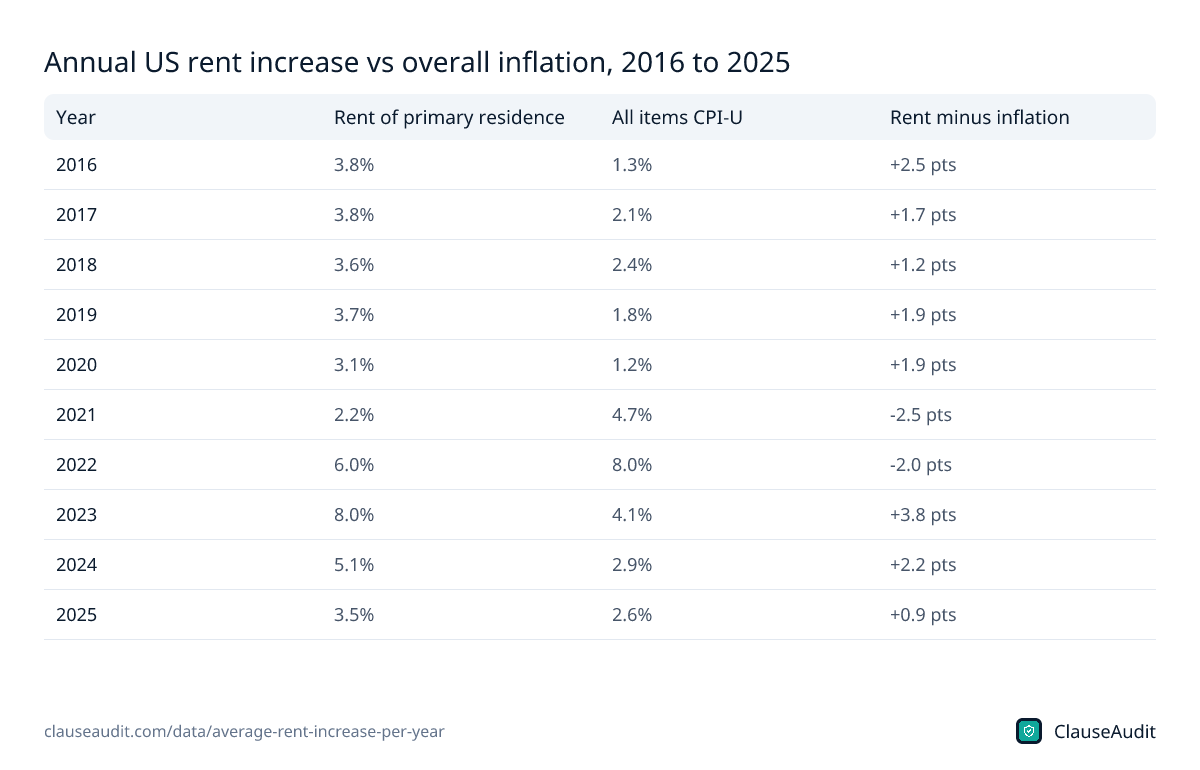
In most years rent beat general inflation. The two exceptions were 2021 and 2022, when overall prices ran ahead, and rent caught up afterward with a 3.8 point gap in 2023.
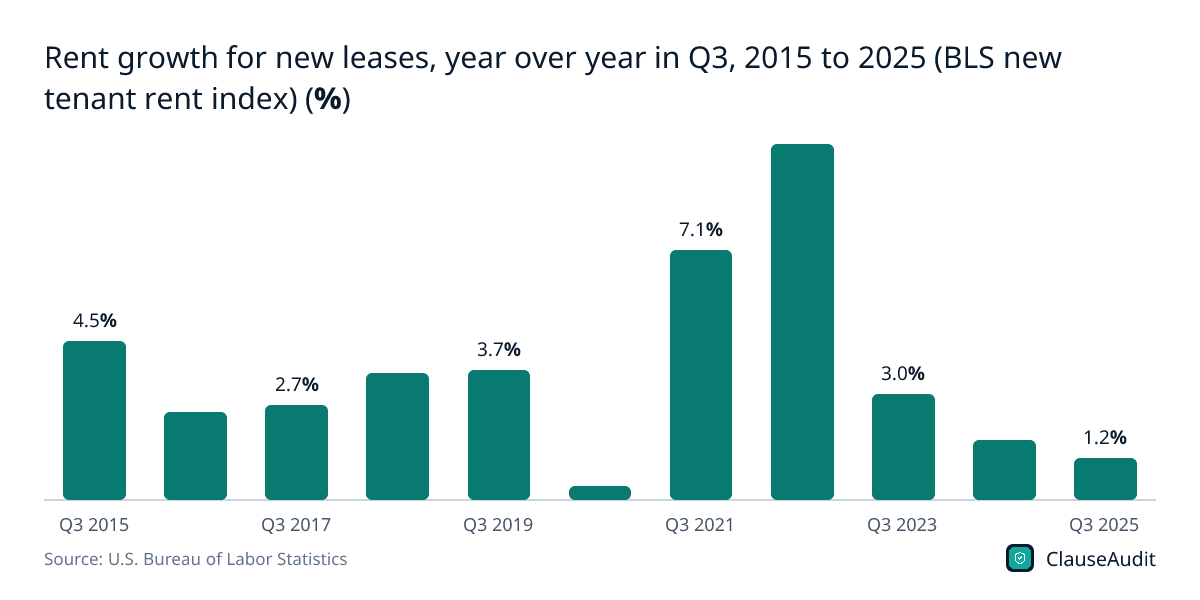
Download this chart (PNG)Rent growth for new leases, year over year in Q3, 2015 to 2025 (BLS new tenant rent index) (%)
Chart data
| Label | Value (%) |
|---|---|
| Q3 2015 | 4.5% |
| Q3 2016 | 2.5% |
| Q3 2017 | 2.7% |
| Q3 2018 | 3.6% |
| Q3 2019 | 3.7% |
| Q3 2020 | 0.4% |
| Q3 2021 | 7.1% |
| Q3 2022 | 10.1% |
| Q3 2023 | 3.0% |
| Q3 2024 | 1.7% |
| Q3 2025 | 1.2% |
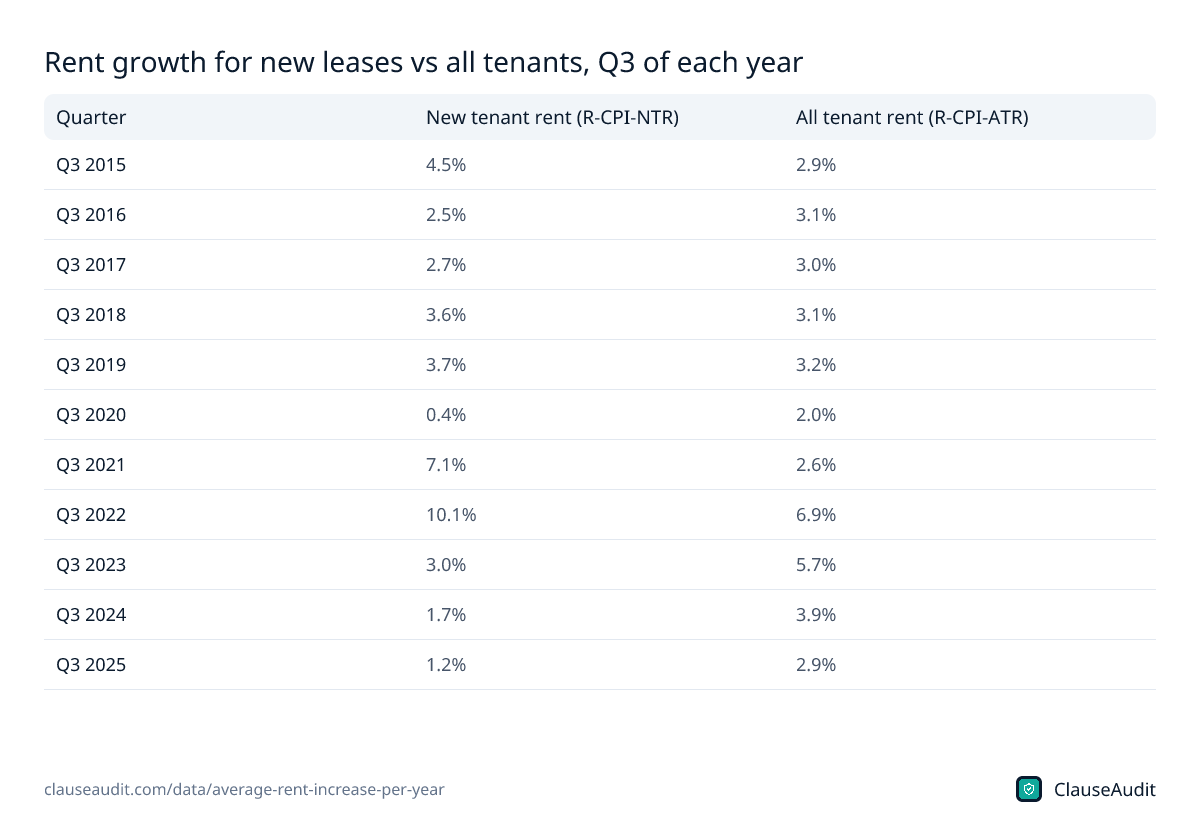
New lease rents lead the overall index by a year or so. They hit 10.1% in Q3 2022 and had cooled to 1.2% by Q3 2025, which helps explain why the broader index has slowed since.
Download this chart (PNG)Annual US rent increase vs overall inflation, 2016 to 2025
| Year | Rent of primary residence | All items CPI-U | Rent minus inflation |
|---|---|---|---|
| 2016 | 3.8% | 1.3% | +2.5 pts |
| 2017 | 3.8% | 2.1% | +1.7 pts |
| 2018 | 3.6% | 2.4% | +1.2 pts |
| 2019 | 3.7% | 1.8% | +1.9 pts |
| 2020 | 3.1% | 1.2% | +1.9 pts |
| 2021 | 2.2% | 4.7% | -2.5 pts |
| 2022 | 6.0% | 8.0% | -2.0 pts |
| 2023 | 8.0% | 4.1% | +3.8 pts |
| 2024 | 5.1% | 2.9% | +2.2 pts |
| 2025 | 3.5% | 2.6% | +0.9 pts |
Source: U.S. Bureau of Labor Statistics, CPI-U, U.S. city average: Rent of primary residence (CUUR0000SEHA) and All items (CUUR0000SA0), not seasonally adjusted. Download as image
Rent growth for new leases vs all tenants, Q3 of each year
| Quarter | New tenant rent (R-CPI-NTR) | All tenant rent (R-CPI-ATR) |
|---|---|---|
| Q3 2015 | 4.5% | 2.9% |
| Q3 2016 | 2.5% | 3.1% |
| Q3 2017 | 2.7% | 3.0% |
| Q3 2018 | 3.6% | 3.1% |
| Q3 2019 | 3.7% | 3.2% |
| Q3 2020 | 0.4% | 2.0% |
| Q3 2021 | 7.1% | 2.6% |
| Q3 2022 | 10.1% | 6.9% |
| Q3 2023 | 3.0% | 5.7% |
| Q3 2024 | 1.7% | 3.9% |
| Q3 2025 | 1.2% | 2.9% |
Source: U.S. Bureau of Labor Statistics, Research CPI for New Tenant Rent (R-CPI-NTR) and All Tenant Regressed Rent (R-CPI-ATR). Download as image
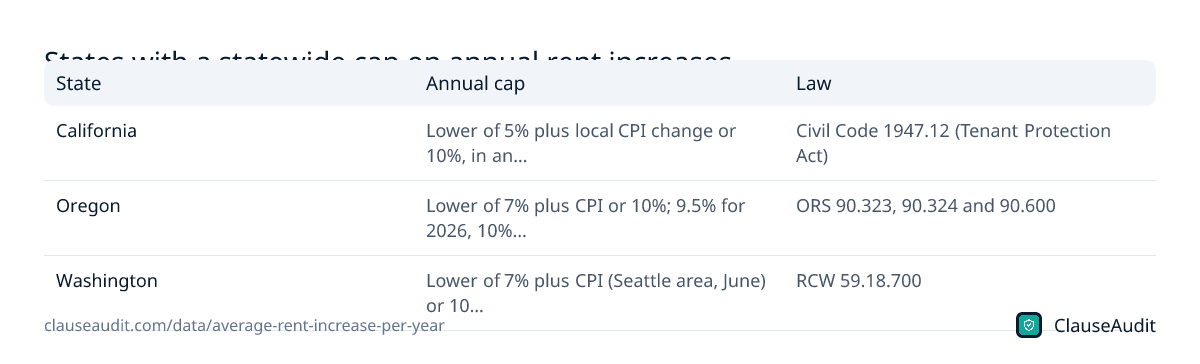
States with a statewide cap on annual rent increases
| State | Annual cap | Law |
|---|---|---|
| California | Lower of 5% plus local CPI change or 10%, in any 12 months | Civil Code 1947.12 (Tenant Protection Act) |
| Oregon | Lower of 7% plus CPI or 10%; 9.5% for 2026, 10% for 2027. Manufactured dwelling park spaces in parks with more than 30 spaces: 6% | ORS 90.323, 90.324 and 90.600 |
| Washington | Lower of 7% plus CPI (Seattle area, June) or 10%, in any 12 months | RCW 59.18.700 |
Source: California Department of Justice, Office of the Attorney General, Landlord-Tenant Issues (Tenant Protection Act rent cap, Civil Code 1947.12); Oregon Department of Administrative Services, Office of Economic Analysis, Rent Stabilization: maximum annual rent increase percentage; Washington State Legislature, RCW 59.18.700, Rent increases: limits. Download as image
What is a normal rent increase per year?
Going by the long-run government data, an ordinary year for American renters meant an increase somewhere between 3.6% and 3.8%. That was the range every year from 2015 to 2019. The years since then were anything but ordinary, and the latest reading of 2.8% for the 12 months ending September 2026 is a little below that old baseline.
So if your renewal letter asks for something near the current national figure, you are looking at a market rate increase. If it asks for several times that, the national numbers do not back it up. Your local market might, so check what similar units nearby are listed for before you decide anything.
One caveat. These are averages across millions of leases. Some landlords hold rent flat for good tenants. Others catch up on several years of below-market pricing in one jump. An average tells you what is typical, not what is legal or fair in your building.
Why do renewals go up more than new leases right now?
This is the pattern that surprises people. The BLS research index for new leases showed rent growth of just 1.2% in Q3 2025, while rents for all tenants rose 2.9%. In plain terms, someone signing a fresh lease was seeing much slower rent growth than the typical sitting tenant.
The reason is timing. The broad rent index tracks what every tenant pays, and most leases reset only once a year. When new lease rents surged to 10.1% in Q3 2022, sitting tenants felt it gradually over the next couple of years. Now the reverse is happening. New lease growth has cooled, but renewals are still catching up.
Vacancy points the same way. The national rental vacancy rate was 7.3% in Q2 2026, against 7.0% a year earlier, though Census says that change is not statistically significant. More empty units generally means landlords compete harder for new tenants than for the ones already in place.
The practical takeaway: before you accept a renewal, compare it with what your landlord is advertising for vacant units. If the listed price for an identical apartment is lower than your proposed renewal rent, say so. Turnover costs a landlord money, and many will meet you partway.
Does rent go up faster than inflation?
Usually, yes. Over the ten years from September 2016 to September 2026, rent rose 50.7% while overall consumer prices rose 39.6%. Every year from 2016 to 2025 saw rent outpace general inflation, except 2021 and 2022.
The recent picture is closer. In the 12 months ending September 2026, rent rose 2.8% while overall prices rose 3.7%, so rent was the slower of the two. For a household budget, that is a small break after three straight years in which rent outpaced overall prices.
If you work for yourself, this matters when you set your rates. A freelancer who holds prices flat while rent keeps climbing is taking a pay cut every year without noticing. Building an annual review into client contracts is a simple fix.
Landlords watch the same numbers. When overall inflation runs hot, expect renewal letters to cite rising taxes, insurance and maintenance. Those costs are real, but they do not all land on one building in the same year, and a blanket appeal to inflation is not a reason to accept any figure put in front of you.
How much can a landlord legally raise rent?
In most of the country, there is no statewide limit on the size of an increase once a lease ends. The landlord must give proper notice, and the increase cannot be retaliatory or discriminatory, but the dollar amount itself is mostly up to the market.
Three states set a statewide cap on annual increases for many rentals. California allows the lower of 5% plus local CPI or 10% in any 12 months. Oregon uses the lower of 7% plus CPI or 10%, which works out to 9.5% for 2026. Washington uses the lower of 7% plus CPI or 10%. Each law has exemptions, so confirm your unit is covered before you rely on it.
Some cities have their own rent control on top of state law, and the rules for notice periods vary widely. Our related pages on rent control and rent increase notice by state cover those details.
What rising rent means for freelancers, workers and small businesses
Rent is the biggest fixed cost for most renting households, so a steady annual rise works like a slow cut to your income. If your pay or your rates stay flat, a renewal at the national pace still leaves you with less each month.
For employees, the useful comparison is your raise against your rent. If your landlord asks for more than your employer gave you, that is a sign to negotiate the lease, look at other units, or raise the issue at your next pay review.
Freelancers and contractors have more control. Put a yearly rate review in your client agreements, and avoid fixed prices that run for years without any adjustment. A small annual bump is easier to sell to clients than a large one after several flat years.
Small businesses that rent space face a different problem. Commercial leases often build the increase in from day one, through a fixed annual escalator or a link to CPI. Those clauses keep running even when market rents soften, so the time to negotiate them is before you sign, not at year three.
What renters and business tenants should do before signing
- Find the rent increase clause in your current lease. A fixed-term lease usually locks the rent until it ends, while a month-to-month tenancy can change with notice.
- Look up current listings for comparable units. If asking rents nearby are flat, use that in your conversation with the landlord.
- Ask for a longer lease in exchange for a smaller increase. Landlords value predictable occupancy, especially when more units sit empty.
- Check if your state or city caps increases, and if your unit is exempt.
- For a commercial lease, read the escalation clause closely. A fixed annual bump or a CPI-linked increase can compound for years, and it rarely comes down when the market softens.
- Get any agreed increase in writing, with the new amount and the date it starts.
How ClauseAudit helps
The size of next year's rent increase is often decided by a few sentences in the lease you sign today. Upload your lease and our automated review flags the clauses that control rent changes, renewal and fees, and explains each one in plain English.
You get a risk score, a list of the terms worth negotiating and suggested wording you can take back to the landlord.
- Rent increase and escalation clauses, including fixed percentage and CPI-linked bumps
- Automatic renewal terms and how much notice you must give to leave
- Late fees and grace periods, and whether they look excessive for your state
- Early termination penalties if a big increase pushes you to move
- Clauses letting the landlord change rules or charges mid-lease
- Repair and maintenance duties that shift costs onto you
Frequently asked questions
What is the average rent increase per year in the US?
US rent rose 2.8% in the 12 months ending September 2026, based on the Consumer Price Index for rent of primary residence. For the full year 2025, the average increase was 3.5%. Those figures cover rents that all tenants pay, including people who renewed, not just new listings.
Is a 5% rent increase normal?
It is above the current national pace. Rent rose 2.8% over the year to September 2026 and 3.5% in 2025. A 5% increase was close to the national figure in 2024, when rent rose 5.1%, but today it sits on the high side. Local demand can justify it in some areas, so compare nearby listings.
Is a 10% rent increase reasonable?
By national standards, no. Even in 2023, the worst year in at least two decades, the average was 8.0%. A 10% increase may still be legal in most states. In California, Oregon and Washington, though, 10% is the outer limit of the statewide caps, and the actual limit is often lower.
What was the highest rent increase in recent years?
In the government index, 2023 saw the biggest jump, with rent up 8.0% on an annual average basis. That was the highest yearly rise in at least 20 years. Asking rents on new listings surged sooner, rising 12.8% in the year to September 2021 by Zillow's measure.
How much is the typical rent in the US right now?
Zillow's Observed Rent Index put the typical US asking rent at $1,932 in September 2026, up 2.7% in a year from $1,881 in September 2025. That reflects listed prices for homes and apartments on the market, so your current rent may be higher or lower.
Why did my renewal go up more than the national average?
Renewals have been catching up with the sharp rises in new lease rents from a few years ago. The BLS research index showed all tenant rents up 2.9% in Q3 2025, compared with just 1.2% for new leases. Your landlord may also be pricing to your local market, which can run hotter than the national figure.
Can I negotiate a rent increase?
Yes, and it often works. Turnover means cleaning, repairs and empty months for the landlord. Bring listings for similar units nearby, mention your payment history, and offer a longer lease term in exchange for a smaller increase. A national rental vacancy rate of 7.3% in Q2 2026, up slightly from 7.0% a year earlier, gives renters a bit more room to ask.
Which states limit annual rent increases?
California, Oregon and Washington have statewide caps. California allows the lower of 5% plus local CPI or 10%. Oregon allows the lower of 7% plus CPI or 10%, set at 9.5% for 2026. Washington allows the lower of 7% plus CPI or 10%. Each has exemptions, and some cities add their own rules.
Use this data
Every chart and card below is free to reuse under CC BY 4.0. Download what you need and link back to this page.
 Stat cards
 Key findings card
 Infographic
 Average annual US rent increase, 2006 to 2025 (CPI rent of primary residence) (%)
 US rent increase over the prior 12 months, by month of 2026 (%)
 Typical US asking rent growth, year over year in September, 2016 to 2026 (Zillow) (%)
 US rent increase vs overall inflation, 2016 to 2025 (annual average CPI) (percentage points (rent minus all items))
 Rent growth for new leases, year over year in Q3, 2015 to 2025 (BLS new tenant rent index) (%)
 Annual US rent increase vs overall inflation, 2016 to 2025
 Rent growth for new leases vs all tenants, Q3 of each year
 States with a statewide cap on annual rent increases
Embed the infographic
Free to share on your site, blog or slides under CC BY 4.0. Please keep the credit link.
Sources and method
Every number on this page comes from the sources below, each opened and read on or before October 17, 2026. A second, independent review checked every figure against its source and corrected anything that did not match. Figures that could not be confirmed were left out.
- U.S. Bureau of Labor Statistics, Consumer Price Index News Release, September 2026 (Table 2) (October 14, 2026)
- U.S. Bureau of Labor Statistics, CPI-U, U.S. city average: Rent of primary residence (CUUR0000SEHA) and All items (CUUR0000SA0), not seasonally adjusted (Data through September 2026, retrieved October 15, 2026 via the BLS Public Data API)
- Zillow Research, Zillow Observed Rent Index (ZORI), all homes plus multifamily, smoothed, metro and U.S. (Data through September 2026, retrieved October 16, 2026)
- U.S. Bureau of Labor Statistics, Research CPI for New Tenant Rent (R-CPI-NTR) and All Tenant Regressed Rent (R-CPI-ATR) (Data through 2025 Q3; page last modified April 24, 2026 (publication paused))
- U.S. Census Bureau, Quarterly Residential Vacancies and Homeownership, Second Quarter 2026 (July 28, 2026)
- California Department of Justice, Office of the Attorney General, Landlord-Tenant Issues (Tenant Protection Act rent cap, Civil Code 1947.12) (Accessed October 15, 2026)
- Oregon Department of Administrative Services, Office of Economic Analysis, Rent Stabilization: maximum annual rent increase percentage (2027 calculation (published by September 30, 2026))
- Washington State Legislature, RCW 59.18.700, Rent increases: limits (Current code, accessed October 15, 2026)
Cite this page
ClauseAudit, “How Much Does Rent Go Up Each Year? Average Annual Rent Increase Statistics 2026”, updated October 17, 2026, https://clauseaudit.com/data/average-rent-increase-per-year. Free to reuse with a link back (CC BY 4.0).
This page summarises published data and law as checked on October 17, 2026. Figures are updated as new editions are released, and your own situation may differ. It is general information, not legal, tax or financial advice.