Commercial Lease Concessions Benchmarks: Tenant Improvement Allowance, Free Rent and Fit-Out Costs (2026)
By ClauseAudit Research · 10 sources ·
What is the average tenant improvement allowance?
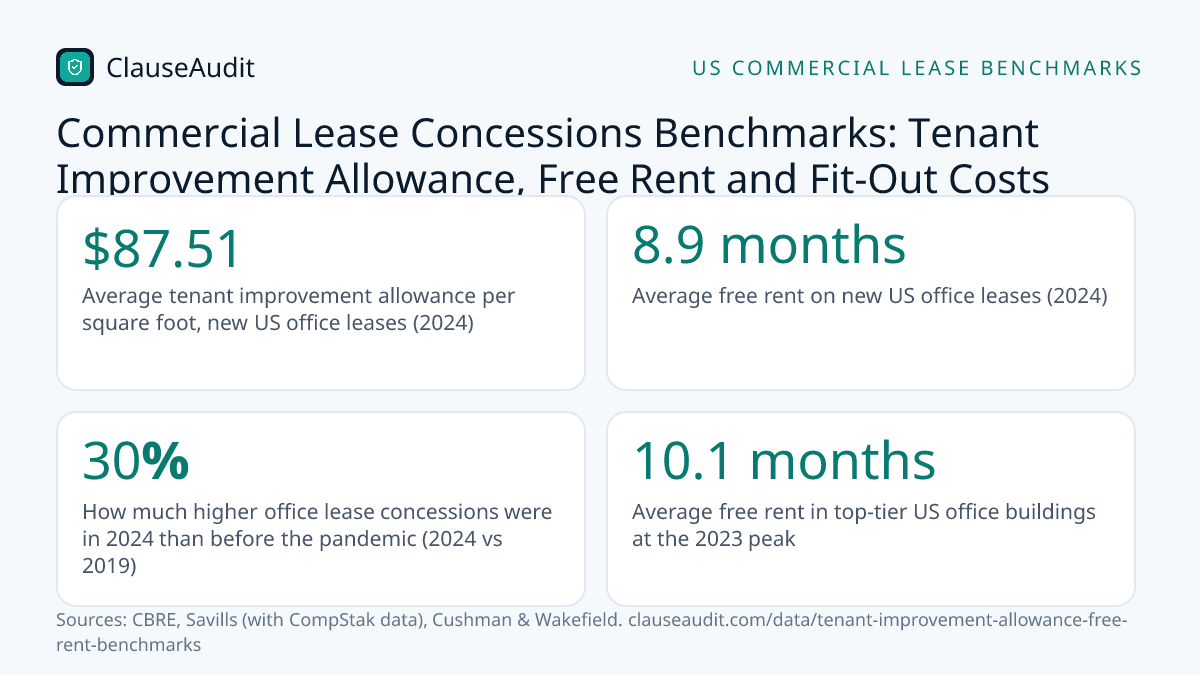
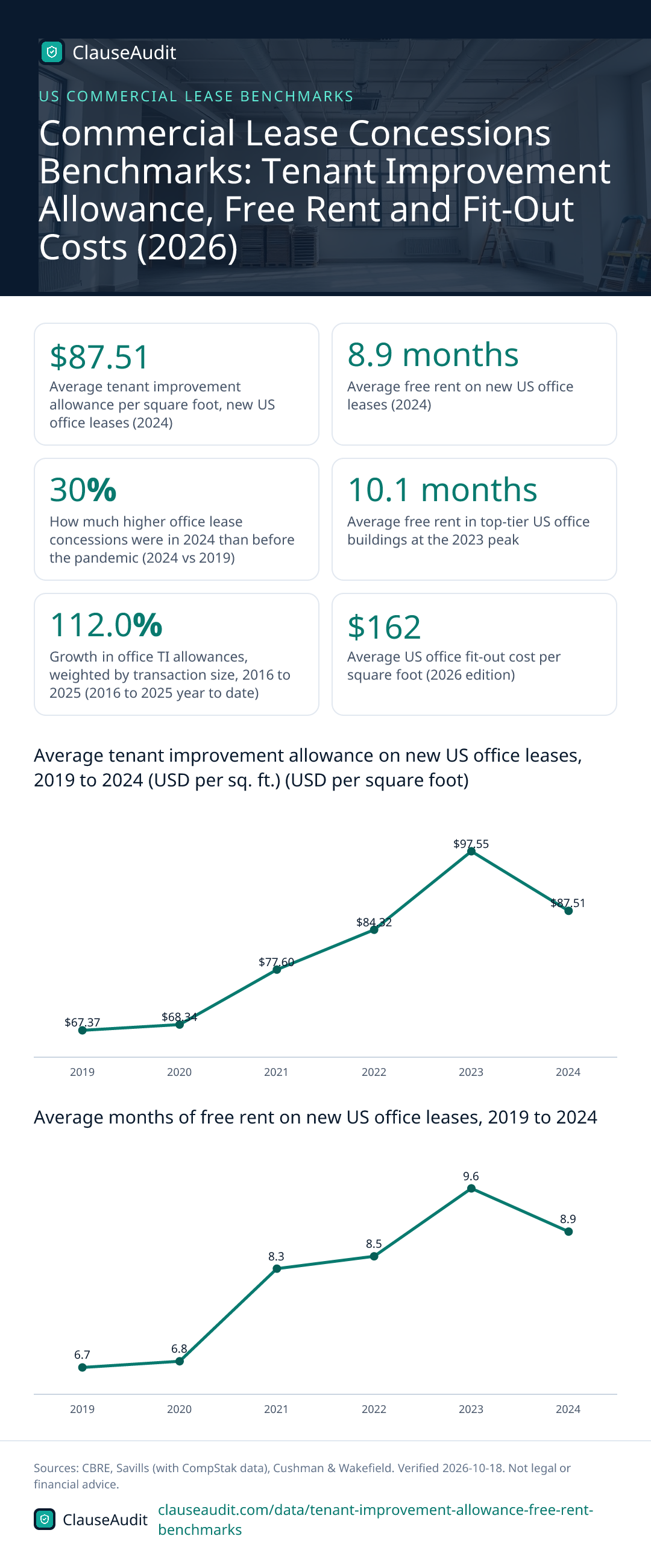
The average tenant improvement allowance on new US office leases was $87.51 per square foot in 2024, down from a peak of $97.55 in 2023, based on CBRE data from 12 major markets. Tenants also got 8.9 months of free rent on average. Concessions still ran 30% higher than before the pandemic.
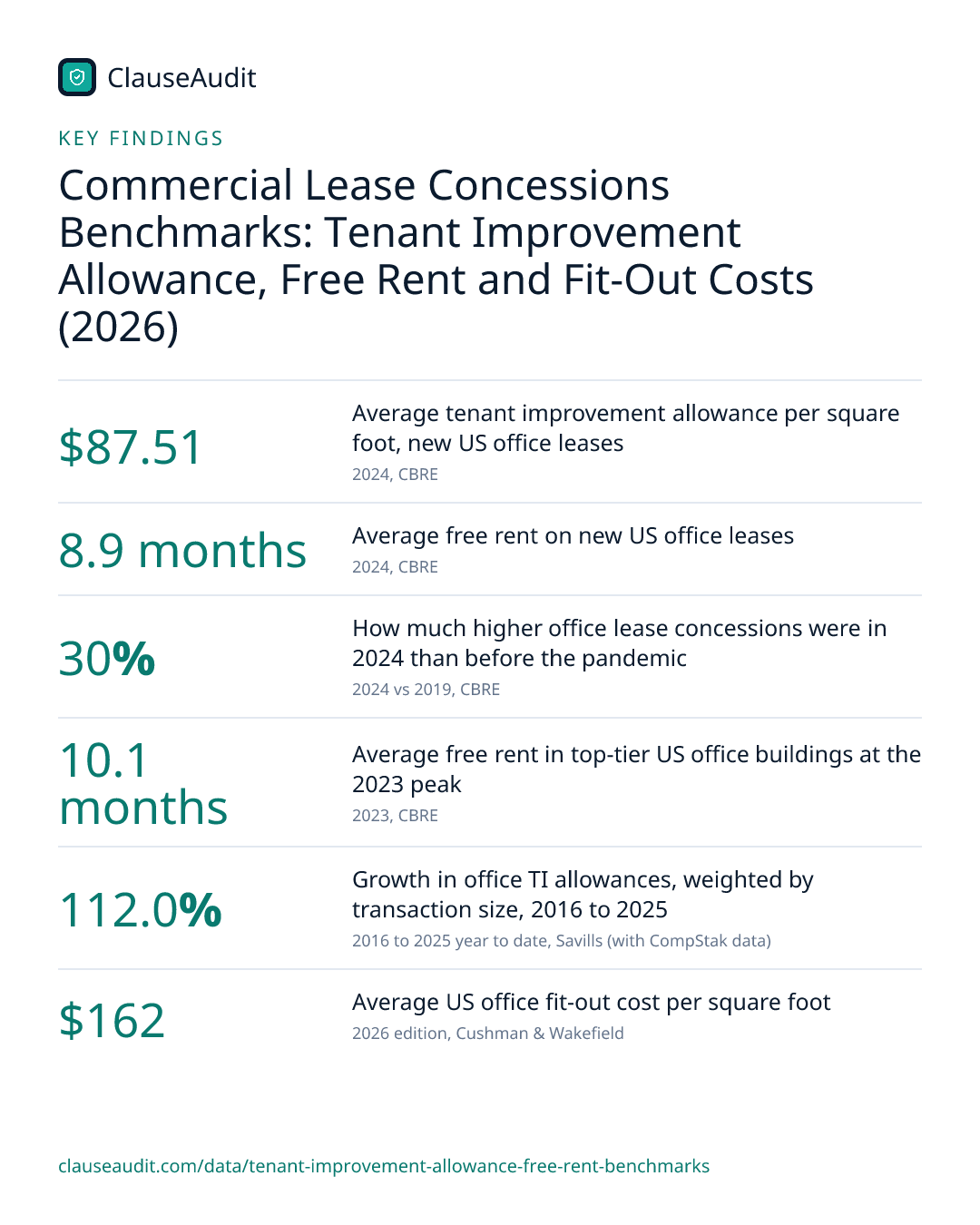
- Average tenant improvement allowance per square foot, new US office leases (2024, CBRE)
- $87.51
- Average free rent on new US office leases (2024, CBRE)
- 8.9 months
- How much higher office lease concessions were in 2024 than before the pandemic (2024 vs 2019, CBRE)
- 30%
- Average free rent in top-tier US office buildings at the 2023 peak (2023, CBRE)
- 10.1 months
- Growth in office TI allowances, weighted by transaction size, 2016 to 2025 (2016 to 2025 year to date, Savills (with CompStak data))
- 112.0%
- Average US office fit-out cost per square foot (2026 edition, Cushman & Wakefield)
- $162
- Year-over-year rise in office fit-out costs across the Americas (2026 edition vs 2025 edition, Cushman & Wakefield)
- 5.5%
When a landlord offers you money to build out your space, the first question is whether the offer is any good. The honest answer depends on the building, the market and how long you commit. But there is a benchmark, and it is a useful one: new office leases in major US markets carried an average allowance of $87.51 per square foot in 2024, plus 8.9 months of free rent.
That allowance rarely covers the whole job. Office fit-outs in the US averaged $162 per square foot in the 2026 cost guide, and contractors expect prices to keep rising. The gap between what the landlord pays and what the build costs is where most tenants lose money, and it is mostly decided by a few lines in the lease.
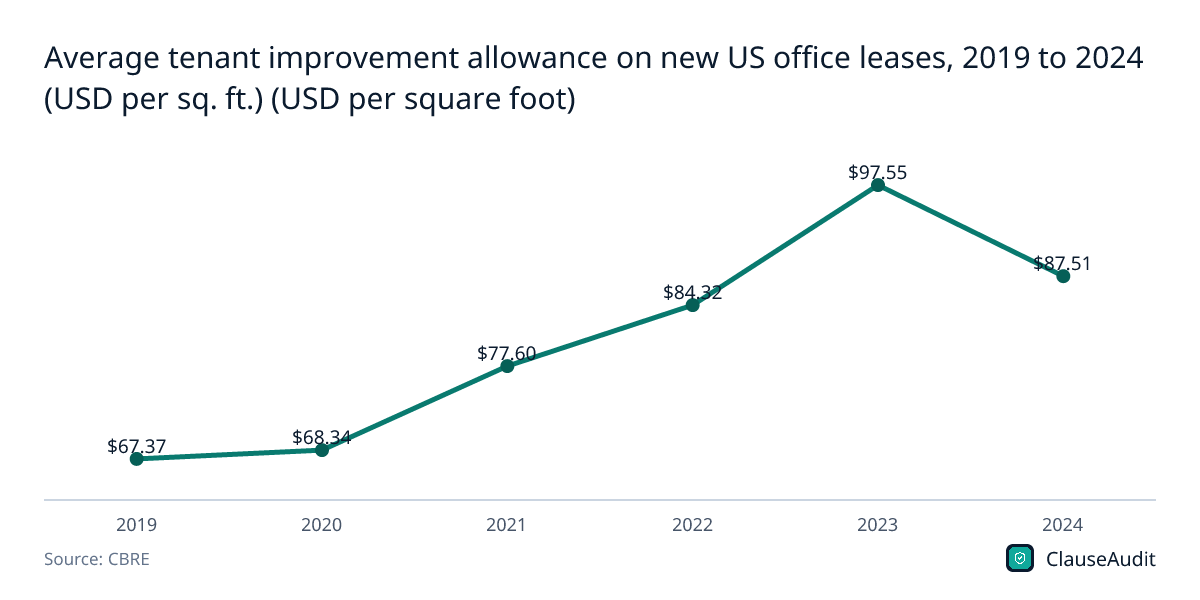
Average tenant improvement allowance on new US office leases, 2019 to 2024 (USD per sq. ft.) (USD per square foot)
Chart data
| Label | Value (USD per square foot) |
|---|---|
| 2019 | $67.37 |
| 2020 | $68.34 |
| 2021 | $77.60 |
| 2022 | $84.32 |
| 2023 | $97.55 |
| 2024 | $87.51 |
Allowances climbed every year from $67.37 in 2019 to a peak of $97.55 in 2023, then fell to $87.51 in 2024. Landlords have started pulling back, but they are still far more generous than before the pandemic.
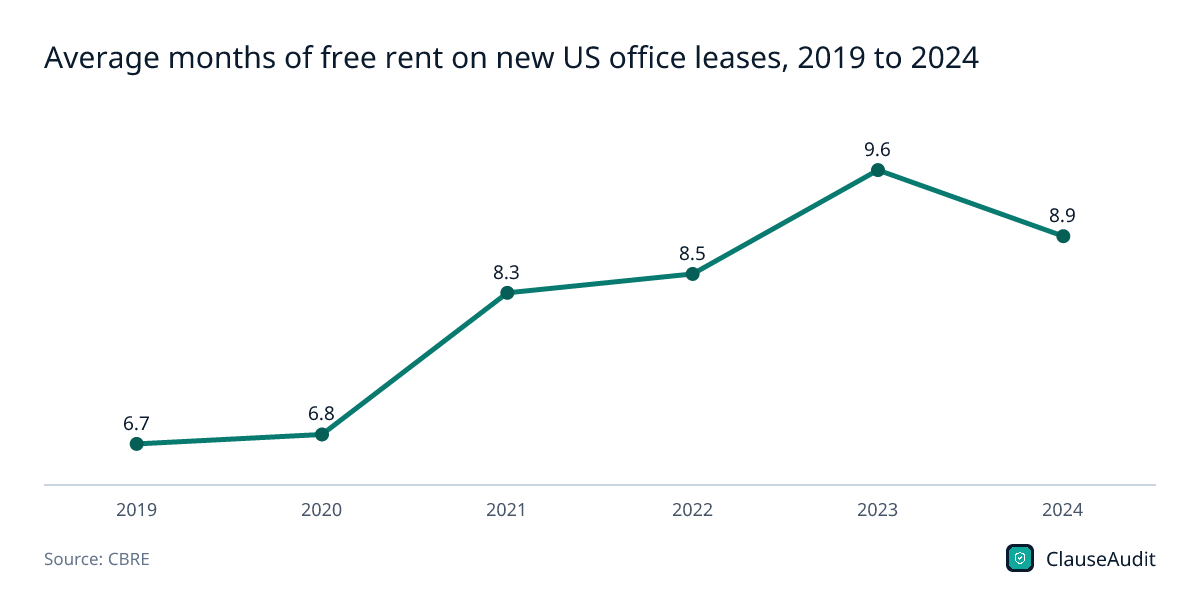
Download this chart (PNG)Average months of free rent on new US office leases, 2019 to 2024
Chart data
| Label | Value |
|---|---|
| 2019 | 6.7 |
| 2020 | 6.8 |
| 2021 | 8.3 |
| 2022 | 8.5 |
| 2023 | 9.6 |
| 2024 | 8.9 |
Free rent followed the same arc, rising from 6.7 months in 2019 to 9.6 months in 2023 before easing to 8.9 months in 2024. These months are not adjusted for lease length, so a longer lease usually explains a bigger number.
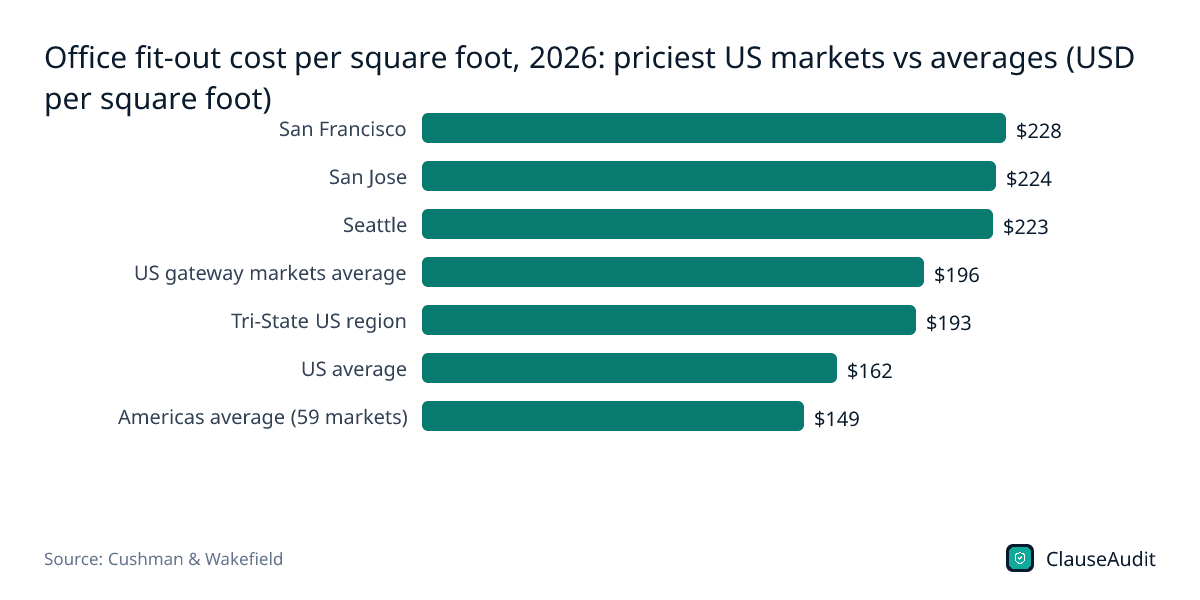
Download this chart (PNG)Office fit-out cost per square foot, 2026: priciest US markets vs averages (USD per square foot)
Chart data
| Label | Value |
|---|---|
| San Francisco | $228 |
| San Jose | $224 |
| Seattle | $223 |
| US gateway markets average | $196 |
| Tri-State US region | $193 |
| US average | $162 |
| Americas average (59 markets) | $149 |
San Francisco, San Jose and Seattle top the list at $228, $224 and $223 per square foot. The US average of $162 sits well above the 2024 average allowance, which tells you who usually pays the difference.
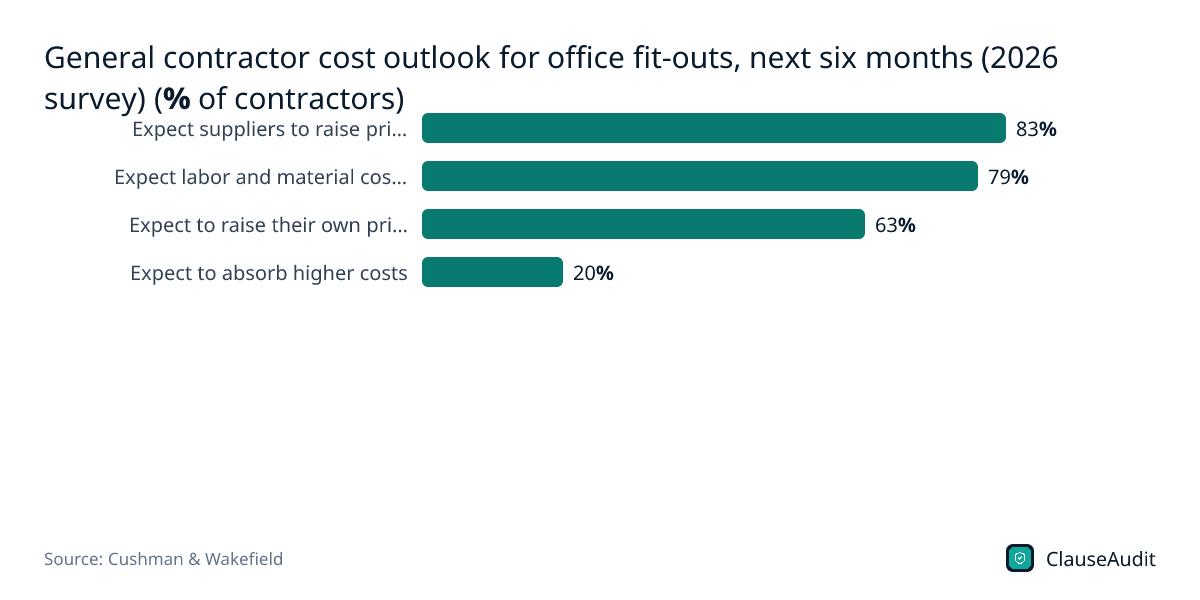
Download this chart (PNG)General contractor cost outlook for office fit-outs, next six months (2026 survey) (% of contractors)
Chart data
| Label | Value |
|---|---|
| Expect suppliers to raise prices | 83% |
| Expect labor and material costs to rise | 79% |
| Expect to raise their own pricing | 63% |
| Expect to absorb higher costs | 20% |
83% of contractors expect suppliers to raise prices and 63% plan to raise their own. Only 20% expect to absorb higher costs, so a bid you get today may not hold for long.
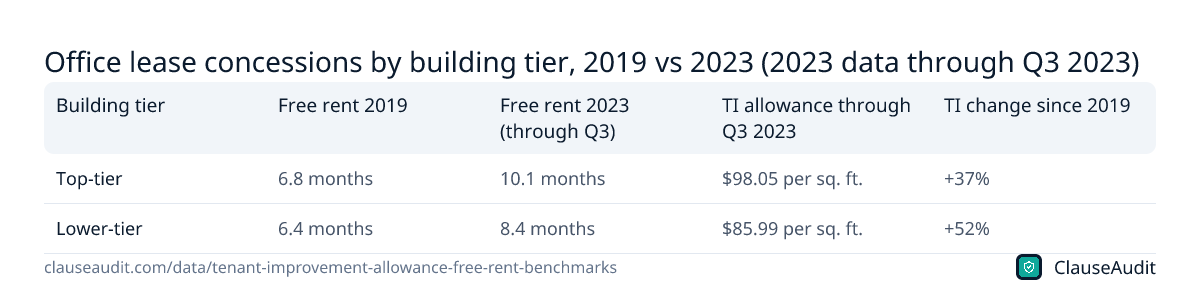
Download this chart (PNG)Office lease concessions by building tier, 2019 vs 2023 (2023 data through Q3 2023) (CBRE)
| Building tier | Free rent 2019 | Free rent 2023 (through Q3) | TI allowance through Q3 2023 | TI change since 2019 |
|---|---|---|---|---|
| Top-tier | 6.8 months | 10.1 months | $98.05 per sq. ft. | +37% |
| Lower-tier | 6.4 months | 8.4 months | $85.99 per sq. ft. | +52% |
Source: CBRE, Office Effective Rents Have Declined; CBRE, Growth of Office Effective Rents Limited by Record-High Concessions. Download as image
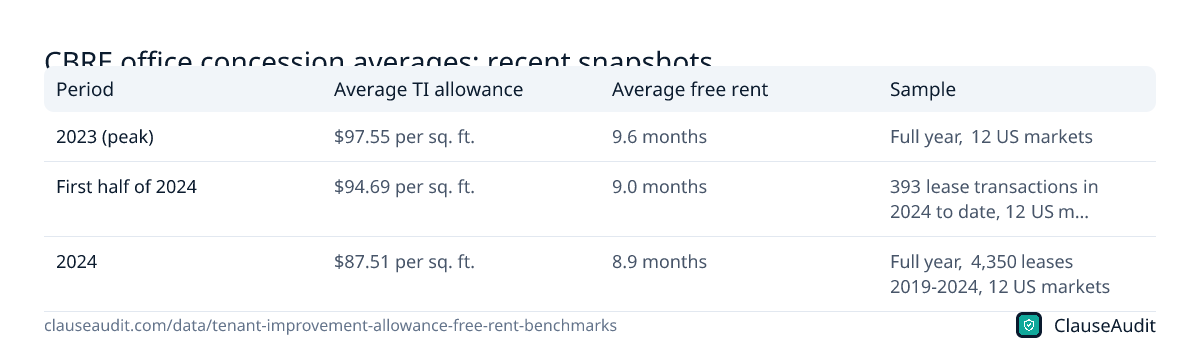
CBRE office concession averages: recent snapshots
| Period | Average TI allowance | Average free rent | Sample |
|---|---|---|---|
| 2023 (peak) | $97.55 per sq. ft. | 9.6 months | Full year, 12 US markets |
| First half of 2024 | $94.69 per sq. ft. | 9.0 months | 393 lease transactions in 2024 to date, 12 US markets |
| 2024 | $87.51 per sq. ft. | 8.9 months | Full year, 4,350 leases 2019-2024, 12 US markets |
Source: CBRE, Office Building Owners Offering Fewer Concessions to Tenants; CBRE, Office Lease Concessions Like Free Rent and Tenant-Improvement Allowances Declined for First Time in 4 Years. Download as image
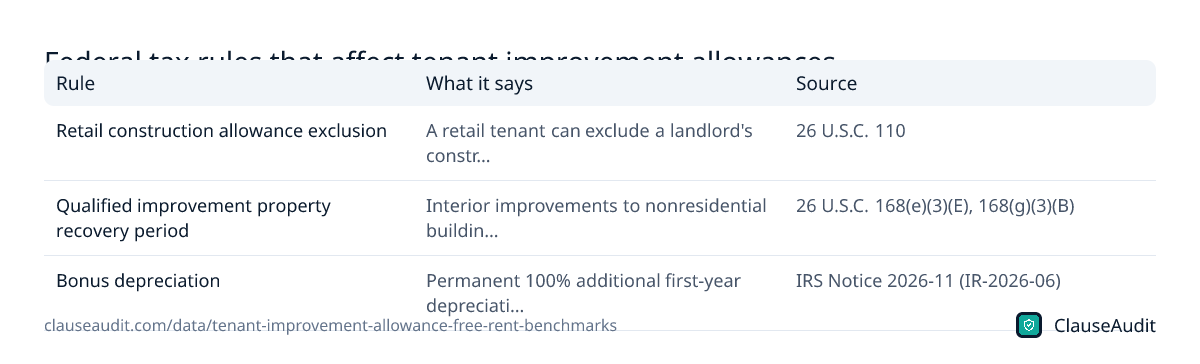
Federal tax rules that affect tenant improvement allowances
| Rule | What it says | Source |
|---|---|---|
| Retail construction allowance exclusion | A retail tenant can exclude a landlord's construction allowance from income, up to the amount spent, under a retail lease of 15 years or less | 26 U.S.C. 110 |
| Qualified improvement property recovery period | Interior improvements to nonresidential buildings are 15-year property (20 years under the alternative depreciation system) | 26 U.S.C. 168(e)(3)(E), 168(g)(3)(B) |
| Bonus depreciation | Permanent 100% additional first-year depreciation for qualified property acquired after January 19, 2025 | IRS Notice 2026-11 (IR-2026-06) |
Source: Legal Information Institute, Cornell Law School (U.S. Code), 26 U.S. Code § 110 - Qualified lessee construction allowances for short-term leases; Legal Information Institute, Cornell Law School (U.S. Code), 26 U.S. Code § 168 - Accelerated cost recovery system; Internal Revenue Service, Treasury, IRS issue guidance on the additional first year depreciation deduction amended as part of the One, Big, Beautiful Bill (Notice 2026-11). Download as image
What is a good tenant improvement allowance in 2026?
Start with the 2024 average of $87.51 per square foot for new office leases in 12 big markets: Atlanta, Boston, Chicago, Dallas/Fort Worth, Denver, Houston, Los Angeles, Manhattan, Philadelphia, San Francisco, Seattle and Washington, D.C. If you are leasing in one of those cities and the offer comes in well below that, you have room to push.
Building quality matters. Through Q3 2023, top-tier buildings averaged $98.05 per square foot and lower-tier buildings $85.99. Lower-tier buildings had actually grown their allowances faster since 2019, up 52% against 37% for the best buildings. Owners of weaker space have had to spend more to compete.
Treat these as office benchmarks. Retail and industrial deals work differently, and a small suite in a suburban market will rarely see big-city numbers. Use the figures to frame your ask, not as a promise.
How many months of free rent should you get on a commercial lease?
The 2024 average on new office leases was 8.9 months, down slightly from 9.6 months in 2023. Top-tier buildings went further at the 2023 peak, averaging 10.1 months, while lower-tier buildings averaged 8.4 months.
Free rent scales with term. CBRE does not publish the average lease length behind these numbers, so do not compare your offer to the average without asking how long you are signing for. A short lease with a few free months can be a better deal than a long one with many.
Also check what free means in your draft. Many leases abate base rent only, so you still owe operating expenses, taxes and CAM charges during the free period. Some landlords take the free months back if you default later. Read the abatement clause line by line.
Does the TI allowance cover the full build-out?
Usually not. The US average fit-out cost in the 2026 guide was $162 per square foot, and gateway markets averaged $196. The allowance and the cost figures come from different samples and years, so the comparison is rough. Still, the direction is clear: in most deals, you fund part of the build yourself.
Costs are also moving. Fit-out prices across the Americas rose 5.5% in the 2026 edition, with US costs up about 5%. The Northeast led at 7%, and the Midwest was lowest at 2.1%. Get your contractor bid before you sign, and ask the landlord to fix the allowance against that bid, not against a guess.
Watch for a construction management fee charged against the allowance, a requirement to use the landlord's contractor, and a short deadline to spend the money. Each one shrinks what you actually receive.
Here is a simple way to size the gap. Take your contractor's price per square foot, subtract the allowance per square foot, and multiply by your rentable area. That is the cash you need on day one, before furniture, cabling or moving costs. If the number makes you wince, that is your cue to ask for a bigger allowance or a rent credit instead of more free months.
Are landlords cutting concessions?
A little. In 2024 both the allowance and free rent fell, the first decline in four years. Even so, concessions were still 30% higher than in 2019. Savills, using CompStak lease data, found office allowances weighted by deal size grew 112.0% from 2016 to 2025, though growth has slowed for four years in a row.
For you, that means the window for very rich packages is narrowing, especially in the best buildings. It does not mean landlords stopped paying. Ask for both money and time, then trade one against the other.
The mid-year numbers show how fast it turned. In the first half of 2024 the average allowance was still $94.69 per square foot with 9.0 months of free rent. By the full-year count it was $87.51 and 8.9 months. If a broker quotes you a number from the 2023 peak, ask which year it came from.
How do you negotiate a better concession package?
Landlords expect tenants to negotiate concessions. The ones who get the most usually show up with facts: a market benchmark, a real construction bid and a clear sense of what they would accept elsewhere. Here is the order that tends to work.
Small businesses often skip these steps because the lease feels standard. It is not. Every concession is a number someone chose, and the draft you receive is the landlord's opening position.
- Get a contractor bid or at least a test fit before you negotiate, so the allowance is tied to your real cost.
- Ask for the allowance as a fixed amount per square foot, payable directly to your contractor or reimbursed within a set number of days after you submit invoices.
- Push for free rent to start when your build is finished and you can open, not when you sign.
- Ask that free rent cover gross rent, including operating expenses and CAM, or at least spell out what you still owe.
- Cap or remove the landlord's supervision fee, and keep the right to pick your own contractor from an approved list.
- Ask that any unused allowance convert to a rent credit instead of disappearing.
- Limit restoration so you are not paying to tear out the same improvements the landlord helped fund.
How taxes change the value of an allowance
Under 26 U.S.C. 110, a retail tenant on a lease of 15 years or less can exclude a landlord's construction allowance from income, up to what it spends on the work. Interior improvements to nonresidential buildings are generally 15-year property, or 20 years under the alternative system, and IRS Notice 2026-11 covers the permanent 100% bonus depreciation for qualified property acquired after January 19, 2025.
Who owns the improvements on paper affects who claims the depreciation. Settle that in the lease and run it past your accountant before you sign.
How ClauseAudit helps
The headline allowance is only part of the deal. The clauses around it decide how much of that money reaches your build, and if you keep the free rent at all. Upload your draft lease and the automated review flags the terms that quietly shrink your concessions.
You get each risky clause in plain English, with a suggested change you can send back to the landlord.
- Allowance terms: a fixed dollar amount per square foot, what costs it covers, and the deadline to use it
- Free rent: whether abatement covers base rent only or operating expenses too, and any clawback on default
- Construction rules: required landlord contractors, management fees charged against the allowance, and approval rights
- Cost overruns: who pays when the build costs more than the allowance
- Restoration and ownership: who owns the improvements, and if you must remove them at move-out
- Personal guarantee and default: how unamortized allowance and free rent get added to what you owe if things go wrong
Frequently asked questions
What is a tenant improvement allowance?
It is money a landlord agrees to spend, or reimburse you for, to build out or remodel your space. It is usually stated per square foot. It pays for things like walls, flooring, lighting and finishes. In new US office leases, the average allowance was $87.51 per square foot in 2024. Anything above the allowance usually comes out of your pocket.
Is a TI allowance free money?
Not really. Landlords build the allowance into the rent over the lease term, so you pay for it over time. That is why leaving early or defaulting can make the unamortized balance due. Ask how the allowance is amortized and what happens to it if the lease ends early before you treat it as a gift.
Should I ask for more TI allowance or more free rent?
It depends on your cash position. If the build-out is expensive, more allowance cuts what you spend up front. If your space needs little work, free rent may be worth more. Landlords often trade one for the other, so price both. In 2024 averages were $87.51 per square foot and 8.9 months of free rent on new office leases.
Can I get the unused TI allowance as cash or a rent credit?
Only if the lease says so. Many leases state that any unspent allowance is forfeited after a deadline. Ask for a clause that lets you apply leftover funds to rent, furniture, cabling or moving costs. Get it in writing, because a verbal promise from the leasing agent will not help you later.
How much does an office build-out cost per square foot in 2026?
The US average was $162 per square foot in the 2026 Cushman & Wakefield guide. Gateway markets averaged $196, and San Francisco was highest at $228. Costs rose about 5% in the US year over year, so budget for increases if construction will start months after you sign.
Do lower-tier buildings offer bigger concessions?
They offer lower allowances in dollars but have been increasing them faster. Through Q3 2023, lower-tier buildings averaged $85.99 per square foot against $98.05 for top-tier space, but their allowances rose 52% since 2019 compared with 37%. Free rent was lower in lower-tier buildings, at 8.4 months against 10.1 months.
Do I still pay CAM charges during free rent?
Often yes. Many leases abate only base rent, leaving operating expenses, property taxes and CAM charges due from day one. Read the abatement clause closely. If you want gross rent abated, ask for it specifically, and make sure the free period starts after the build is done, not on lease signing.
What happens to the allowance if I default on the lease?
Many leases let the landlord recover the unamortized allowance and any free rent you received, on top of unpaid rent. If you signed a personal guarantee, that amount can land on you personally. Look for these recapture clauses and try to limit them or cap them before you sign.
Use this data
Every chart and card below is free to reuse under CC BY 4.0. Download what you need and link back to this page.
 Stat cards
 Key findings card
 Infographic
 Average tenant improvement allowance on new US office leases, 2019 to 2024 (USD per sq. ft.) (USD per square foot)
 Average months of free rent on new US office leases, 2019 to 2024
 Office fit-out cost per square foot, 2026: priciest US markets vs averages (USD per square foot)
 General contractor cost outlook for office fit-outs, next six months (2026 survey) (% of contractors)
 Office lease concessions by building tier, 2019 vs 2023 (2023 data through Q3 2023) (CBRE)
 CBRE office concession averages: recent snapshots
 Federal tax rules that affect tenant improvement allowances
Embed the infographic
Free to share on your site, blog or slides under CC BY 4.0. Please keep the credit link.
Sources and method
Every number on this page comes from the sources below, each opened and read on or before October 18, 2026. A second, independent review checked every figure against its source and corrected anything that did not match. Figures that could not be confirmed were left out.
- CBRE, Office Building Owners Offering Fewer Concessions to Tenants (March 6, 2025 (2024 lease data))
- CBRE, Office Lease Concessions Like Free Rent and Tenant-Improvement Allowances Declined for First Time in 4 Years (August 29, 2024 (first half of 2024 lease data))
- CBRE, Office Effective Rents Have Declined (December 20, 2023)
- Savills (with CompStak data), How construction costs and TI allowances are reshaping office leases amid tariffs (October 16, 2025)
- Cushman & Wakefield, Office Fit-Out Costs Across the Americas Rise 5.5% as Contractors Expect Further Increases, According to Cushman & Wakefield's 2026 Cost Guide (March 2026 (Office Fit Out Cost Guide Americas 2026))
- Cushman & Wakefield, Office Fit Out Cost Guide Americas 2026 (March 2026 edition)
- Legal Information Institute, Cornell Law School (U.S. Code), 26 U.S. Code § 110 - Qualified lessee construction allowances for short-term leases (Current U.S. Code as read October 2026)
- Legal Information Institute, Cornell Law School (U.S. Code), 26 U.S. Code § 168 - Accelerated cost recovery system (Current U.S. Code as read October 2026)
- Internal Revenue Service, Treasury, IRS issue guidance on the additional first year depreciation deduction amended as part of the One, Big, Beautiful Bill (Notice 2026-11) (January 14, 2026 (IR-2026-06))
- CBRE, Growth of Office Effective Rents Limited by Record-High Concessions (December 20, 2023 (data through Q3 2023))
Cite this page
ClauseAudit, “Commercial Lease Concessions Benchmarks: Tenant Improvement Allowance, Free Rent and Fit-Out Costs (2026)”, updated October 18, 2026, https://clauseaudit.com/data/tenant-improvement-allowance-free-rent-benchmarks. Free to reuse with a link back (CC BY 4.0).
This page summarises published data and law as checked on October 18, 2026. Figures are updated as new editions are released, and your own situation may differ. It is general information, not legal, tax or financial advice.