How Long Are Commercial Leases? Average Lease Term Statistics by Property Type
By ClauseAudit Research · 10 sources ·
What is the average commercial lease length?
Most US commercial leases run five to ten years. New office leases in gateway markets averaged 89.6 months in Q2 2026, about 7.5 years. Industrial leases under 200,000 sq. ft. averaged 59.7 months in Q1 2026, and retail leases averaged 96 months in early 2024. Renewals tend to be shorter.
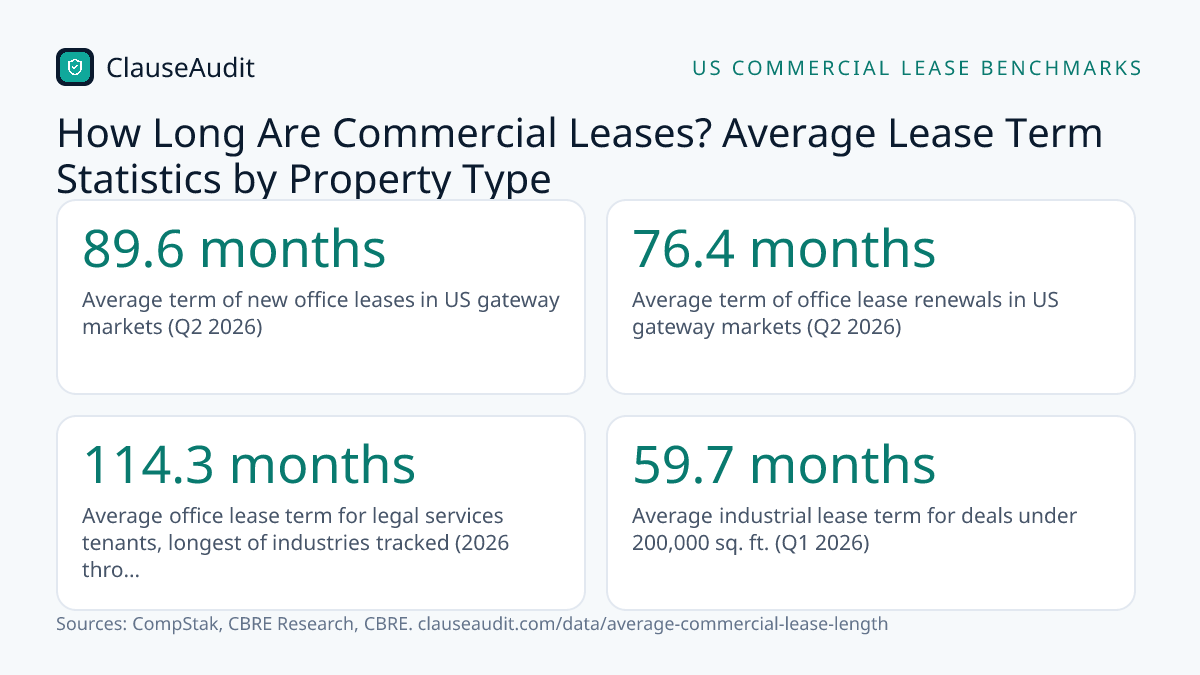
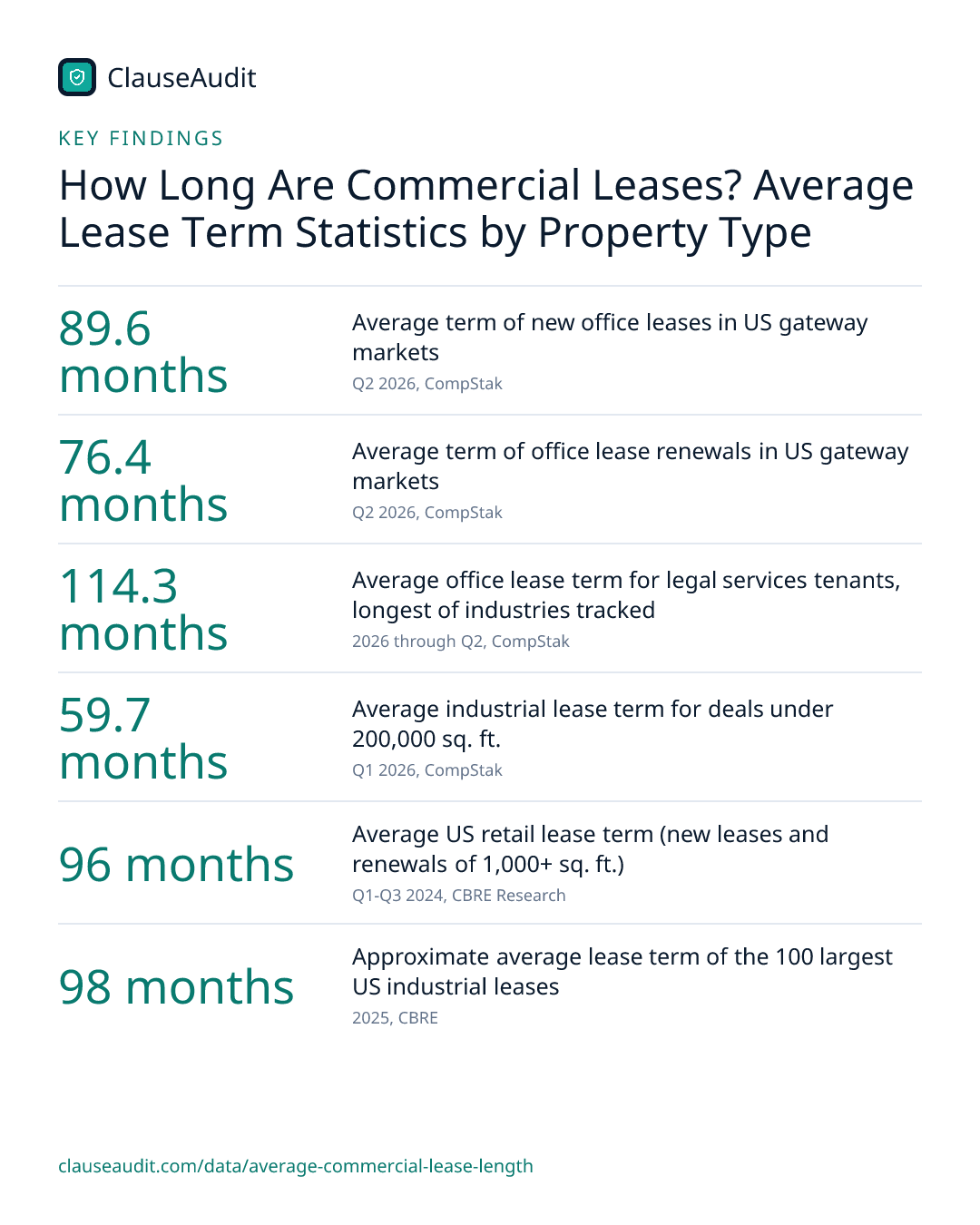
- Average term of new office leases in US gateway markets (Q2 2026, CompStak)
- 89.6 months
- Average term of office lease renewals in US gateway markets (Q2 2026, CompStak)
- 76.4 months
- Average office lease term for legal services tenants, longest of industries tracked (2026 through Q2, CompStak)
- 114.3 months
- Average industrial lease term for deals under 200,000 sq. ft. (Q1 2026, CompStak)
- 59.7 months
- Average US retail lease term (new leases and renewals of 1,000+ sq. ft.) (Q1-Q3 2024, CBRE Research)
- 96 months
- Approximate average lease term of the 100 largest US industrial leases (2025, CBRE)
- 98 months
- Average headquarters office lease term in US buildings over 150,000 sq. ft. (12 months to March 2026, Avison Young)
- 168 months
If a landlord hands you a ten-year lease, it can feel like an unusual ask. It isn't. Across offices, warehouses and shops, the average term for a new commercial lease sits somewhere between five and eight years, and big headquarters deals go much longer.
The numbers below come from lease comps and broker research, broken out by property type, tenant industry and building size. The point of reading them is simple: know what normal looks like before you sign a term that outlasts your business plan.
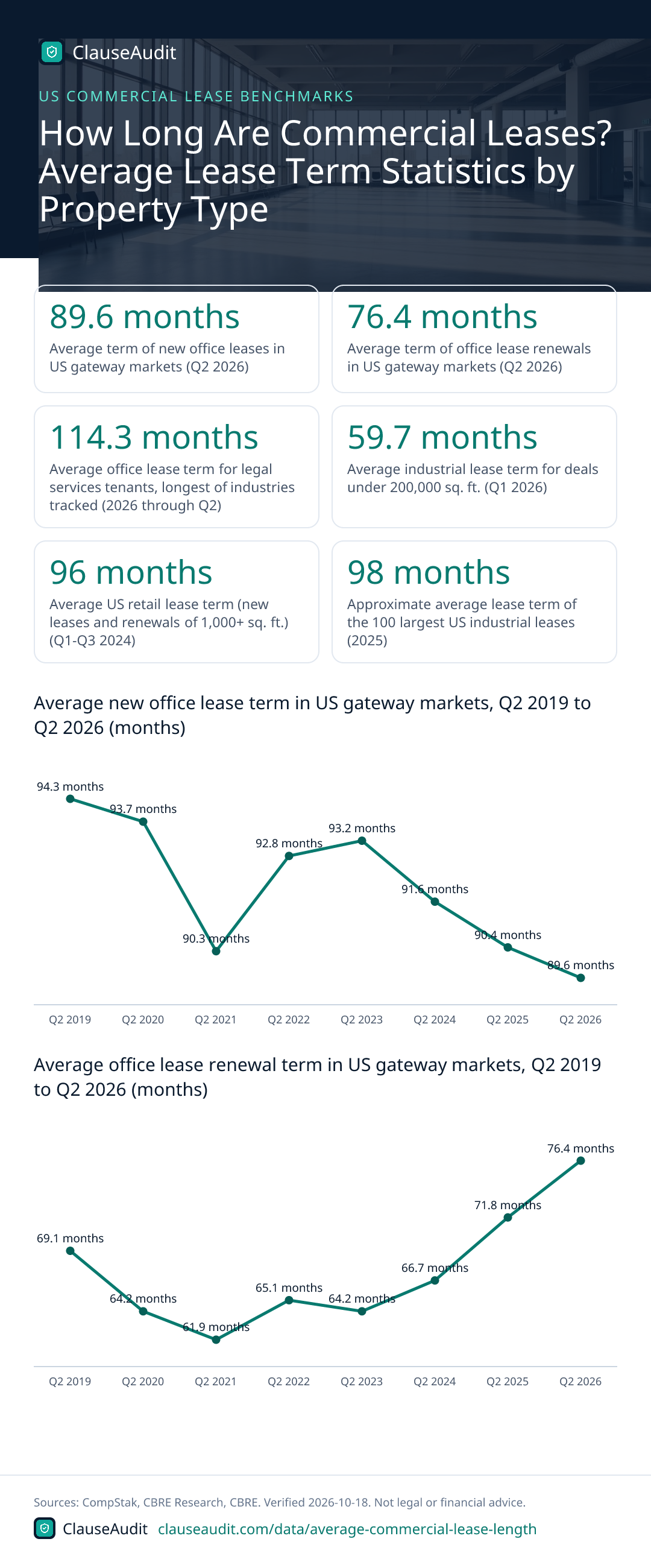
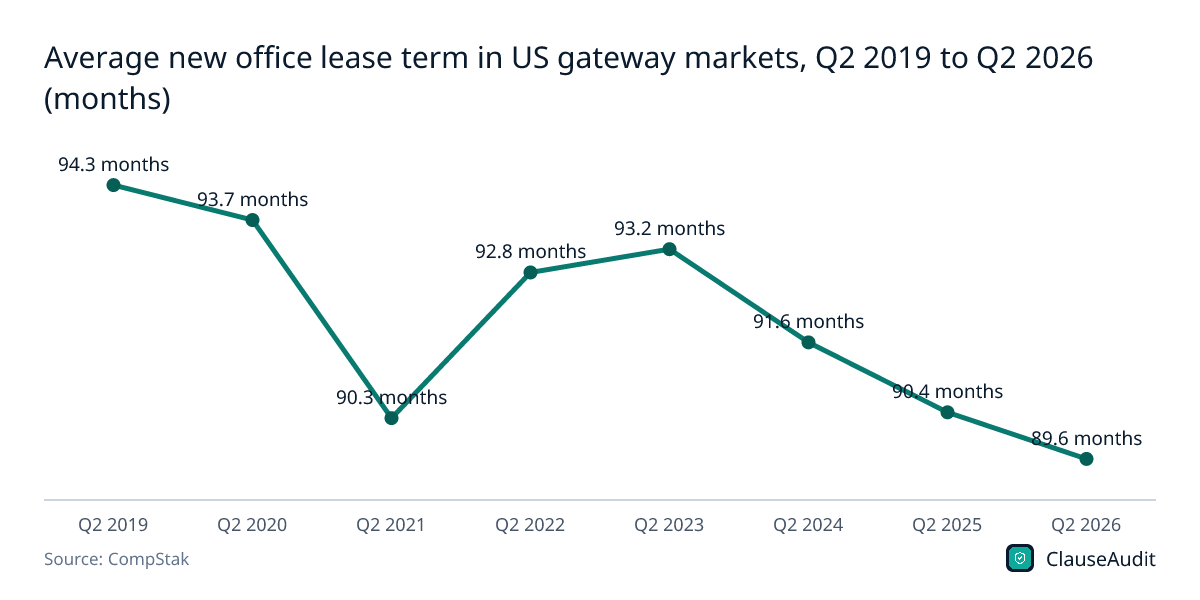
Average new office lease term in US gateway markets, Q2 2019 to Q2 2026 (months)
Chart data
| Label | Value (months) |
|---|---|
| Q2 2019 | 94.3 months |
| Q2 2020 | 93.7 months |
| Q2 2021 | 90.3 months |
| Q2 2022 | 92.8 months |
| Q2 2023 | 93.2 months |
| Q2 2024 | 91.6 months |
| Q2 2025 | 90.4 months |
| Q2 2026 | 89.6 months |
New office terms have slid slowly, from 94.3 months in Q2 2019 to 89.6 months in Q2 2026. Tenants are committing for a little less time, but not by much.
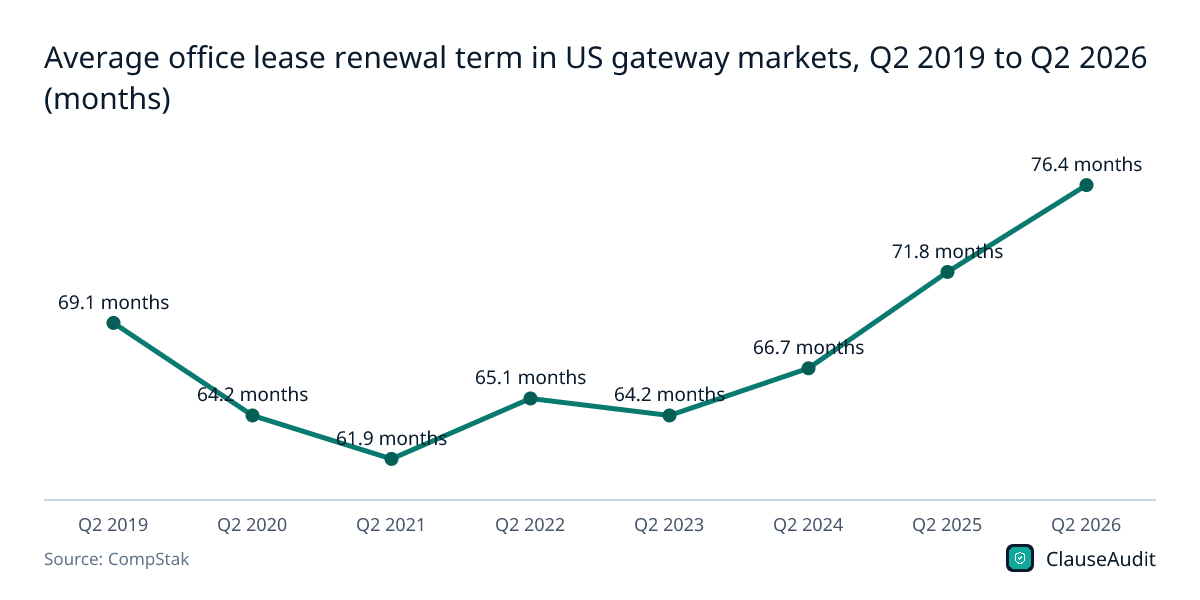
Download this chart (PNG)Average office lease renewal term in US gateway markets, Q2 2019 to Q2 2026 (months)
Chart data
| Label | Value (months) |
|---|---|
| Q2 2019 | 69.1 months |
| Q2 2020 | 64.2 months |
| Q2 2021 | 61.9 months |
| Q2 2022 | 65.1 months |
| Q2 2023 | 64.2 months |
| Q2 2024 | 66.7 months |
| Q2 2025 | 71.8 months |
| Q2 2026 | 76.4 months |
Renewals moved the other way, climbing from 61.9 months in Q2 2021 to 76.4 months in Q2 2026. Tenants who stay are now signing up for longer.
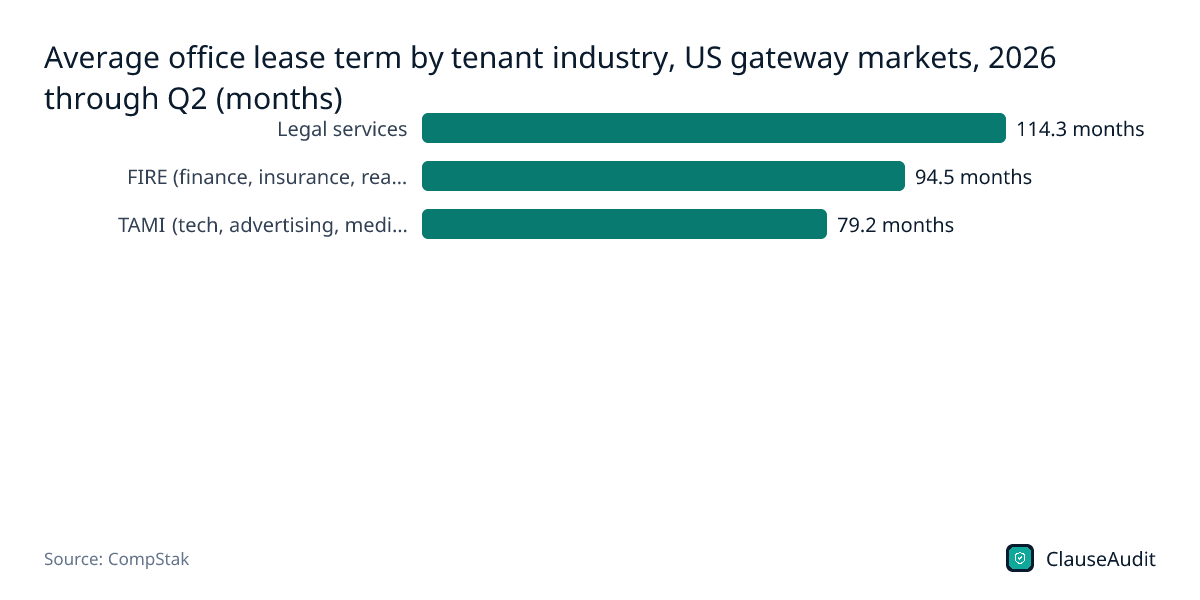
Download this chart (PNG)Average office lease term by tenant industry, US gateway markets, 2026 through Q2 (months)
Chart data
| Label | Value |
|---|---|
| Legal services | 114.3 months |
| FIRE (finance, insurance, real estate) | 94.5 months |
| TAMI (tech, advertising, media, information) | 79.2 months |
Law firms sign the longest office leases at 114.3 months, while tech, advertising and media tenants averaged 79.2 months. Your industry shapes what a landlord expects.
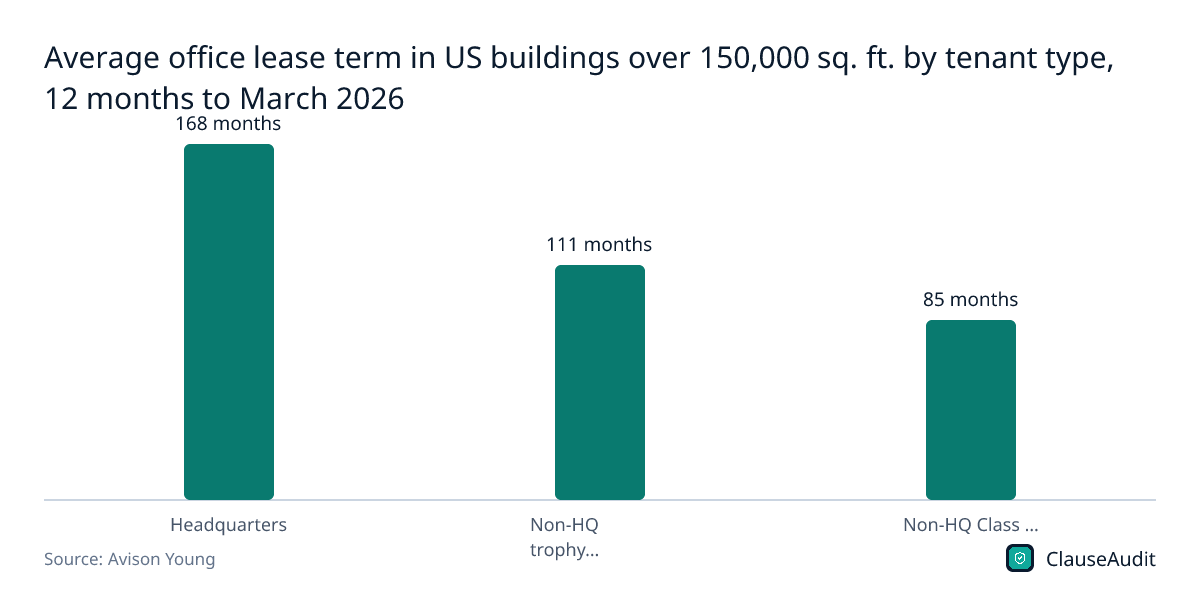
Download this chart (PNG)Average office lease term in US buildings over 150,000 sq. ft. by tenant type, 12 months to March 2026
Chart data
| Label | Value |
|---|---|
| Headquarters | 168 months |
| Non-HQ trophy/Class A | 111 months |
| Non-HQ Class B/C | 85 months |
Headquarters leases in big buildings averaged 168 months, roughly double the 85 months for Class B/C space. Trophy and Class A tenants fell in between at 111 months.
Download this chart (PNG)Average industrial lease term for deals under 200,000 sq. ft., Q1 2019 to Q1 2026 (months)
Chart data
| Label | Value (months) |
|---|---|
| Q1 2019 | 60.8 months |
| Q1 2020 | 60.6 months |
| Q1 2021 | 60.5 months |
| Q1 2022 | 66.1 months |
| Q1 2023 | 62.3 months |
| Q1 2024 | 60.5 months |
| Q1 2025 | 59.7 months |
| Q1 2026 | 59.7 months |
Smaller industrial leases have held near five years for most of the period, at 59.7 months in Q1 2026. The one jump came in Q1 2022, at 66.1 months.
Download this chart (PNG)Average industrial lease term for deals of 200,000 sq. ft. and larger, Q1 2019 to Q1 2026 (months)
Chart data
| Label | Value (months) |
|---|---|
| Q1 2019 | 80.6 months |
| Q1 2020 | 88.3 months |
| Q1 2021 | 86.1 months |
| Q1 2022 | 89.6 months |
| Q1 2023 | 81.4 months |
| Q1 2024 | 80.5 months |
| Q1 2025 | 79.5 months |
Deals of 200,000 sq. ft. and larger run longer. In the first quarters of 2023 through 2025 they averaged between 79.5 and 81.4 months, close to seven years.
Download this chart (PNG)Average US retail lease term by format and space size (CBRE, new leases and renewals of 1,000+ sq. ft.)
| Segment | Q1-Q3 2024 | Same period 2023 |
|---|---|---|
| All retail | 96 months | Not stated (2024 was six months longer) |
| Power centers | 100 months | 94 months |
| Neighborhood, community and strip centers | 92 months | 83 months |
| Spaces of 1,000 to 4,999 sq. ft. | 95 months | 84 months |
Source: CBRE Research, Low Supply, Changing Consumer Preferences Lead to Longer Retail Lease Terms. Download as image
Other US commercial lease term benchmarks by source and period
| Benchmark | Period | Average term | Source |
|---|---|---|---|
| 100 largest US industrial leases | H1 2026 | 89 months (84 months in H1 2025) | CBRE |
| 100 largest US industrial leases | 2025 | About 98 months (92 months in 2024) | CBRE |
| US office buildings, new leases/relocations vs renewals | Q3 2023 to Q2 2024 | 75 months vs 64 months | Avison Young |
| US office buildings, new leases/relocations vs renewals | 2023 | 74 months vs 60 months | Avison Young |
| Office headquarters leases, 150,000+ sq. ft. buildings | Q1 2026 vs 10 years earlier | Up 34.2% | Avison Young |
| All US office leases | 2020 | 4.3 years (4.7 years in 2019) | CBRE |
| US office lease renewals | 2020 | 3.6 years (4.0 years in 2019) | CBRE |
Source: CBRE, 1 Million-Sq.-Ft. Industrial Leases More Than Double in H1 2026; CBRE, The Inland Empire Leads the Nation in Large Industrial Leases for 2025; Avison Young, Renewal vs. relocation: trends in lease lengths in major U.S. office-using industries; Avison Young, Do certain office-using industries across the U.S. commit to longer lease terms than others?; Avison Young, A split market: Large U.S. office headquarters lease terms lengthen as non-headquarters opt for slightly shorter terms; CBRE Research, U.S. Office MarketFlash: Lease Term Contraction in 2020 Likely More Cyclical than Structural. Download as image
How long is a typical commercial lease?
Short answer: five to ten years, depending on what you are renting. A new office lease in a gateway market averaged 89.6 months in Q2 2026. A warehouse or flex space under 200,000 sq. ft. averaged 59.7 months in Q1 2026. Retail leases of 1,000 sq. ft. or more averaged 96 months through the first three quarters of 2024.
The three-year lease you might hope for exists, but it is not the norm for anything bigger than a small suite. Landlords price their deals around longer commitments, so a short term usually costs you something else: higher rent, a smaller build-out budget, or less free rent up front.
Treat these averages as a starting point, not a rule. A dentist building out exam rooms has different needs from a two-person design studio taking a finished suite. Both will hear the word "standard" from a broker. Neither has to accept it.
Why do office renewals run shorter than new leases?
When you move into a new space, the landlord usually pays for part of the build-out and gives you some months of free rent. They need a long term to earn that money back. When you renew, there is far less to pay for, so a shorter term makes sense to both sides.
That gap is narrowing. In Q2 2026 renewals averaged 76.4 months against 89.6 months for new leases, a difference of 13.2 months. In Q1 2019 the gap was 24.5 months. Renewal terms are now 9% above their 2019 level, while new-lease terms are 5% below theirs.
For you, this means a landlord may push for a longer renewal than you expect. If they offer a better rent for a seven-year renewal than a three-year one, run the numbers on what happens if you need to leave in year four. A cheaper rate can turn expensive fast if the exit clause is weak.
Does your industry or building change the expected term?
Yes, a lot. Legal services tenants averaged 114.3 months on office leases in 2026 through Q2, and they have lengthened terms every year since 2020. Finance, insurance and real estate tenants averaged 94.5 months. Tech, advertising and media tenants came in shortest of the three groups at 79.2 months.
Building size and quality matter too. In US buildings over 150,000 sq. ft., headquarters leases averaged 168 months in the 12 months to March 2026. That is 14 years. Non-headquarters tenants in trophy or Class A space averaged 111 months, and Class B/C tenants averaged 85 months.
If you run a small business in an older building, you have more room to ask for a shorter term than a firm taking a full floor in a new tower. Use the comparison that matches your space, not the headline average.
How long are retail and warehouse leases compared with offices?
Retail leases have been getting longer. CBRE put the national average at 96 months for Q1-Q3 2024, six months longer than the same stretch of 2023. Power center leases averaged 100 months, up from 94. Neighborhood, community and strip center leases reached 92 months, up from 83. Even smaller shops of 1,000 to 4,999 sq. ft. averaged 95 months.
Much of the reason is supply. Good storefronts were scarce, so tenants locked in locations and landlords had little need to offer short deals. If you are opening a café or a boutique, expect a landlord to start the conversation at eight years or more.
Industrial is the shortest of the three. Leases under 200,000 sq. ft. averaged 59.7 months in Q1 2026, the same as a year earlier. Bigger deals of 200,000 sq. ft. and up ran 79.5 months in Q1 2025. The very largest leases sit in a class of their own: the 100 biggest US industrial leases averaged about 98 months in 2025, with an average size of 988,000 sq. ft.
So a small contractor renting a modest workshop should compare against the five-year figure, not the headlines about giant logistics centers.
Is a short-term commercial lease a bad idea?
Not if your business is young or your headcount could change. The risk with a long lease is simple: you owe rent for the whole term even if you outgrow the space or close. Many small business leases also come with a personal guarantee, which can put your own savings on the hook for those years.
The cost of a short lease shows up elsewhere. Expect a higher starting rent, a smaller tenant improvement allowance, and less free rent. Some tenants solve this with a middle path, such as a five-year term with an option to renew for five more. You get the option to stay without the obligation.
- Ask for a renewal option at a set rent or a capped increase, so staying does not mean starting from scratch.
- Ask for an early termination right after a set number of years, even if it carries a fee.
- Ask for the right to sublease or assign if you need to move, without the landlord being able to refuse for no reason.
- Limit any personal guarantee to a fixed number of months of rent, or have it fall away after a period of on-time payments.
What to do before you agree to a lease term
Start with your own plan. If you cannot say with some confidence where the business will be in five years, a ten-year lease is a bet, not a formality. Write down the earliest point you might need to leave, then check whether the draft gives you a way out at that point.
Next, read every clause that ties into the term. Rent escalations compound, so a yearly increase that looks small in year one adds up by year eight. Renewal options often require notice many months before expiry, and missing that window can cost you the option entirely.
Finally, compare the offer with the averages for your property type and tenant group on this page. If a landlord wants a far longer term than the norm, ask what you get in return. A longer term is something you give up, so it should buy you a lower rent, more free months or a bigger build-out budget.
How ClauseAudit helps
The length of a commercial lease matters less than what the lease lets you do during it. A ten-year term with a fair exit clause can be safer than a five-year term with a broad personal guarantee and no way to sublease.
Upload your commercial lease and the automated review flags the clauses tied to the term, explains each in plain English, and suggests wording you can take back to the landlord.
- Term and renewal: how long is the initial term, is there a renewal option, and how much notice do you need to give to use it?
- Rent escalation: how much does rent rise each year, and is the increase fixed, tied to an index or left open?
- Early termination: can you end the lease before the term is up, and what fee or notice does that require?
- Personal guarantee: are you personally liable for rent for the full term, or is the guarantee capped or limited?
- Assignment and subletting: can you transfer or sublease the space if you move, and can the landlord refuse without a reason?
- Auto-renewal and holdover: does the lease renew on its own, and what rent applies if you stay past the end date?
Frequently asked questions
What is the average length of a commercial lease?
It depends on the property type. New office leases in US gateway markets averaged 89.6 months in Q2 2026, about 7.5 years. Industrial leases under 200,000 sq. ft. averaged 59.7 months in Q1 2026. Retail leases averaged 96 months, or 8 years, in the first three quarters of 2024. Small suites and older buildings usually allow shorter terms.
How long is a typical office lease?
New office leases in gateway markets averaged 89.6 months in Q2 2026, while renewals averaged 76.4 months. Industry makes a big difference: legal services tenants averaged 114.3 months in 2026 through Q2, and tech, advertising and media tenants averaged 79.2 months. Large headquarters deals run far longer, at 168 months in big buildings over the 12 months to March 2026.
How long are retail leases?
US retail leases of 1,000 sq. ft. or more averaged 96 months in Q1-Q3 2024. Power center leases averaged 100 months, and neighborhood, community and strip center leases averaged 92 months. Terms grew from the same period in 2023, as landlords had little new space and tenants wanted to hold onto good locations.
How long are warehouse and industrial leases?
Industrial leases under 200,000 sq. ft. averaged 59.7 months in Q1 2026, or about 5 years. Deals of 200,000 sq. ft. and up run longer, at 79.5 months in Q1 2025. The 100 largest US industrial leases averaged about 98 months in 2025 and 89 months in H1 2026, but those are huge distribution deals, not typical warehouse space.
Are commercial lease renewals shorter than new leases?
Usually, yes. Office renewals in gateway markets averaged 76.4 months in Q2 2026, against 89.6 months for new leases. The gap has shrunk to 13.2 months from 24.5 months in Q1 2019, because renewal terms have grown while new-lease terms have slipped. Landlords spend less on renewals, so they need less time to recover their costs.
Can I negotiate a shorter commercial lease term?
Often, yes, especially for smaller spaces or older buildings where landlords compete for tenants. Expect a trade-off: a shorter term usually means higher rent, less free rent and a smaller build-out allowance. A common middle ground is a shorter initial term with one or more renewal options, which keeps your exit open without losing the space.
What happens if I need to leave before my commercial lease ends?
Unless the lease gives you an early termination right, you generally owe rent for the rest of the term. Your options are usually to negotiate a buyout, sublease the space, or assign the lease to a new tenant if the lease allows it. If you signed a personal guarantee, the landlord may be able to come after you personally for unpaid rent.
Is a 10-year commercial lease normal?
For some tenants it is. Legal services firms averaged 114.3 months on office leases in 2026 through Q2, and headquarters leases in large buildings averaged 168 months. For a small business in a modest space, ten years is longer than most averages on this page. Only agree to it if the rent, build-out budget and exit terms justify the commitment.
Use this data
Every chart and card below is free to reuse under CC BY 4.0. Download what you need and link back to this page.
 Stat cards
 Key findings card
 Infographic
 Average new office lease term in US gateway markets, Q2 2019 to Q2 2026 (months)
 Average office lease renewal term in US gateway markets, Q2 2019 to Q2 2026 (months)
 Average office lease term by tenant industry, US gateway markets, 2026 through Q2 (months)
 Average office lease term in US buildings over 150,000 sq. ft. by tenant type, 12 months to March 2026
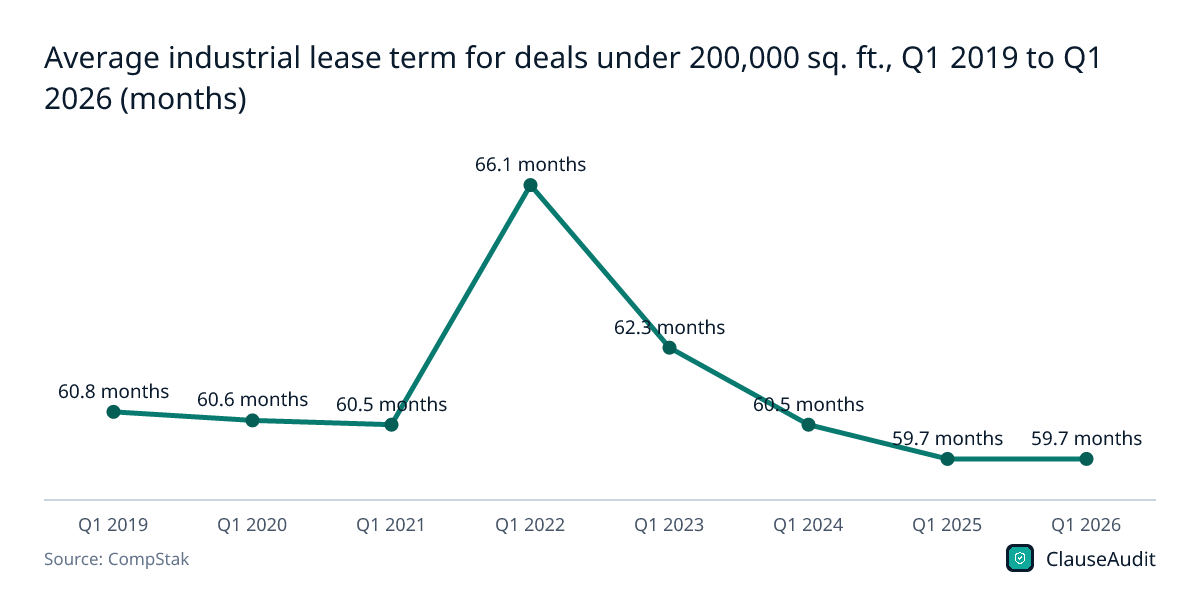 Average industrial lease term for deals under 200,000 sq. ft., Q1 2019 to Q1 2026 (months)
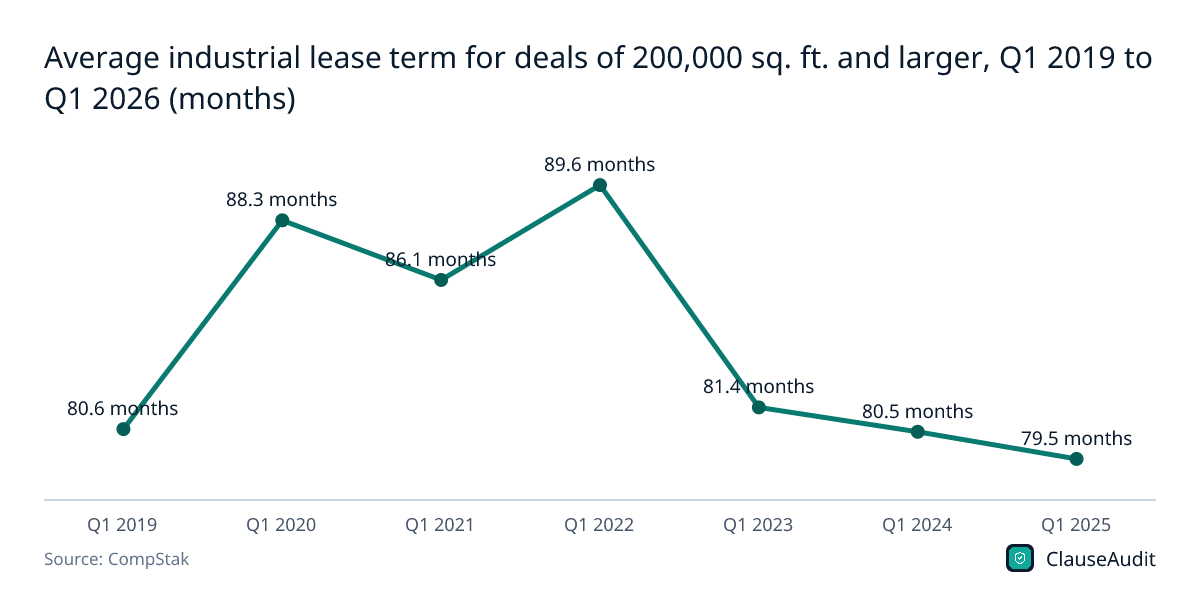 Average industrial lease term for deals of 200,000 sq. ft. and larger, Q1 2019 to Q1 2026 (months)
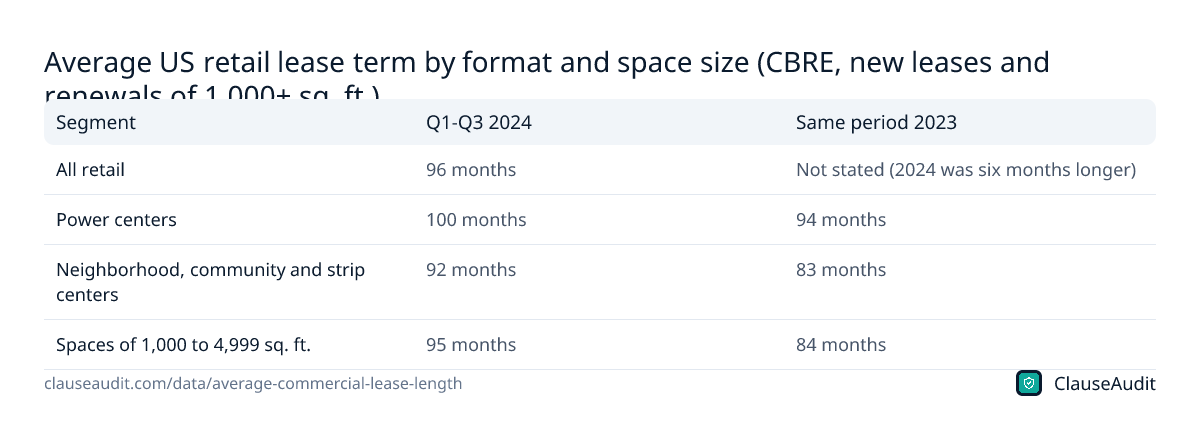 Average US retail lease term by format and space size (CBRE, new leases and renewals of 1,000+ sq. ft.)
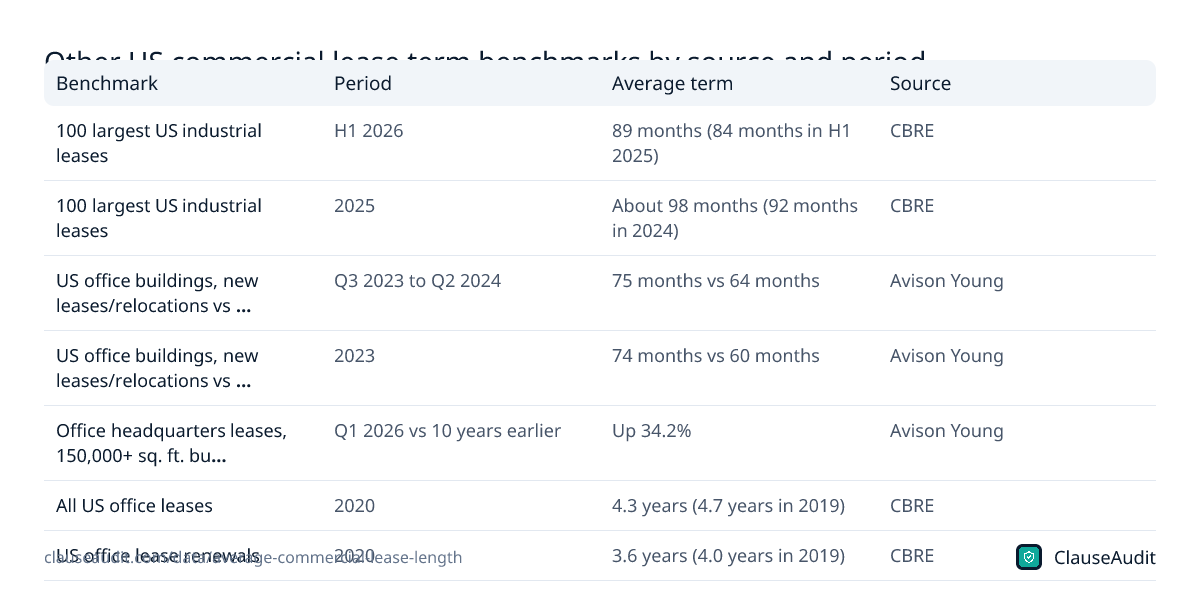 Other US commercial lease term benchmarks by source and period
Embed the infographic
Free to share on your site, blog or slides under CC BY 4.0. Please keep the credit link.
Sources and method
Every number on this page comes from the sources below, each opened and read on or before October 18, 2026. A second, independent review checked every figure against its source and corrected anything that did not match. Figures that could not be confirmed were left out.
- CompStak, 2026 Biannual Office Market Report: Part Two (October 2, 2026 (data through Q2 2026))
- CompStak, 2026 Biannual Industrial Market Overview: Part Four (July 9, 2026 (data through Q1 2026))
- CompStak, 2026 Industrial Gateway Market Overview: Rents, Concessions, and the Lease Expiration Wall (August 7, 2026)
- CBRE Research, Low Supply, Changing Consumer Preferences Lead to Longer Retail Lease Terms (November 12, 2024 (data through Q3 2024))
- CBRE, The Inland Empire Leads the Nation in Large Industrial Leases for 2025 (February 1, 2026)
- CBRE, 1 Million-Sq.-Ft. Industrial Leases More Than Double in H1 2026 (July 27, 2026)
- Avison Young, A split market: Large U.S. office headquarters lease terms lengthen as non-headquarters opt for slightly shorter terms (April 30, 2026 (data through March 2026))
- Avison Young, Renewal vs. relocation: trends in lease lengths in major U.S. office-using industries (August 30, 2024 (data Q3 2023 to Q2 2024))
- Avison Young, Do certain office-using industries across the U.S. commit to longer lease terms than others? (February 26, 2024 (2023 data))
- CBRE Research, U.S. Office MarketFlash: Lease Term Contraction in 2020 Likely More Cyclical than Structural (April 2, 2021)
Cite this page
ClauseAudit, “How Long Are Commercial Leases? Average Lease Term Statistics by Property Type”, updated October 18, 2026, https://clauseaudit.com/data/average-commercial-lease-length. Free to reuse with a link back (CC BY 4.0).
This page summarises published data and law as checked on October 18, 2026. Figures are updated as new editions are released, and your own situation may differ. It is general information, not legal, tax or financial advice.