Rental Application Fee Laws by State: Caps, Refunds and Screening Fee Rules
By ClauseAudit Research · 33 sources ·
Which states cap rental application fees?
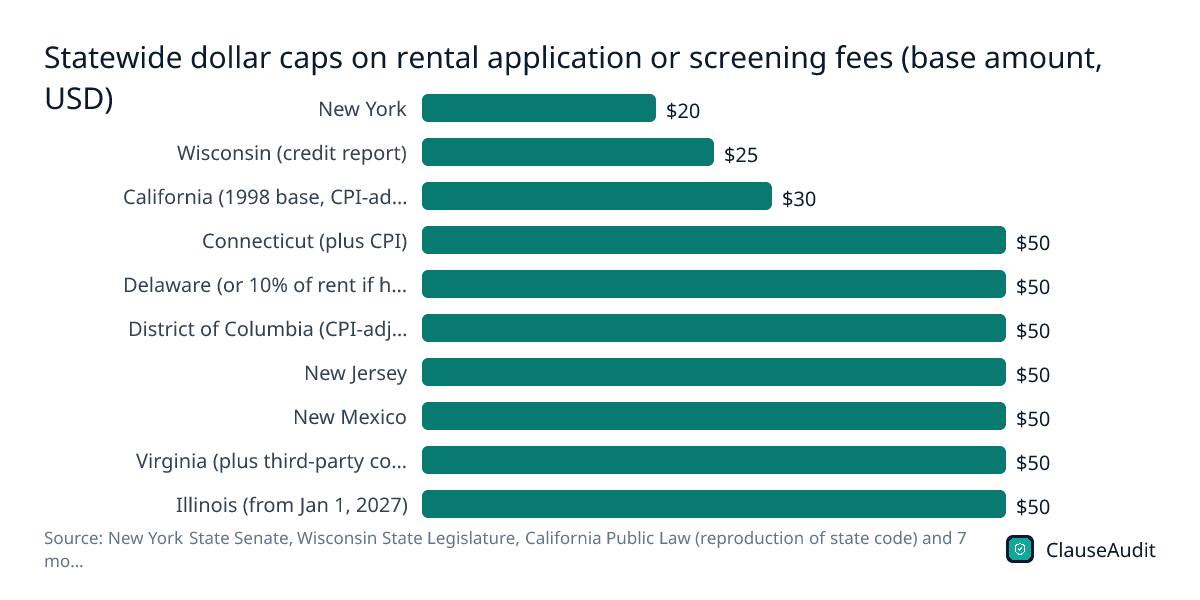
Most states have no cap. Only 9 jurisdictions set a statewide dollar limit, and New York's is the lowest at $20 or the actual cost of the checks, whichever is less. California's base is $30 per applicant, and most of the others stop at $50. Four states ban application fees outright, while 23 have no statewide rule.
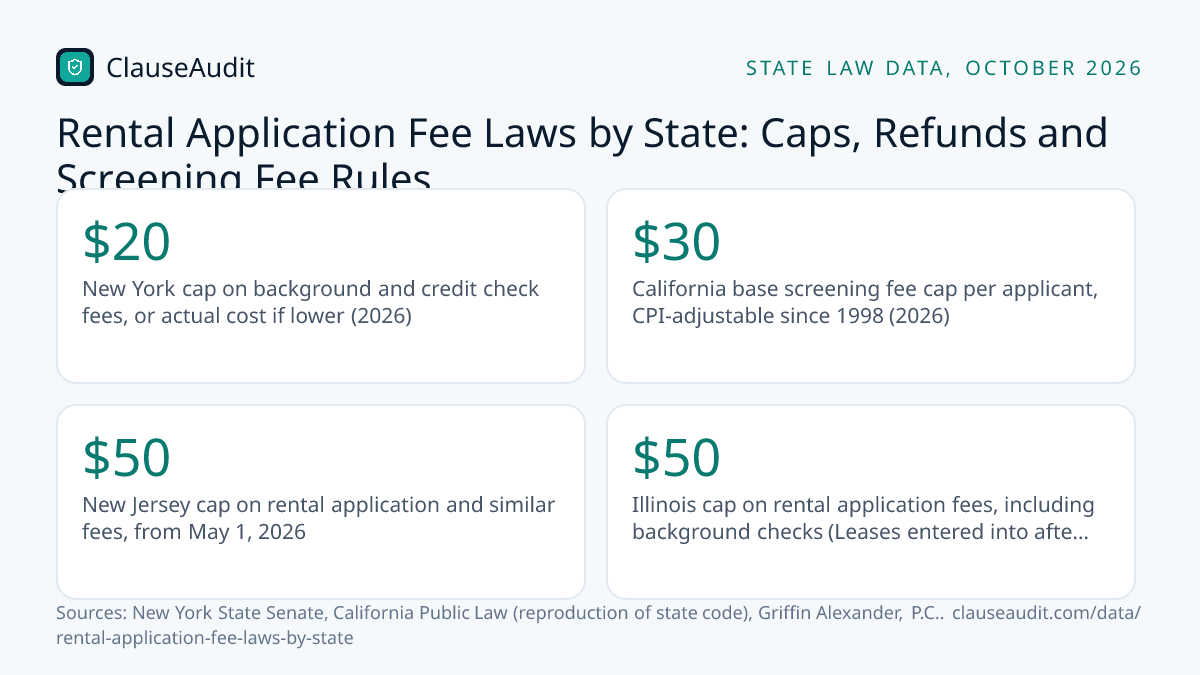
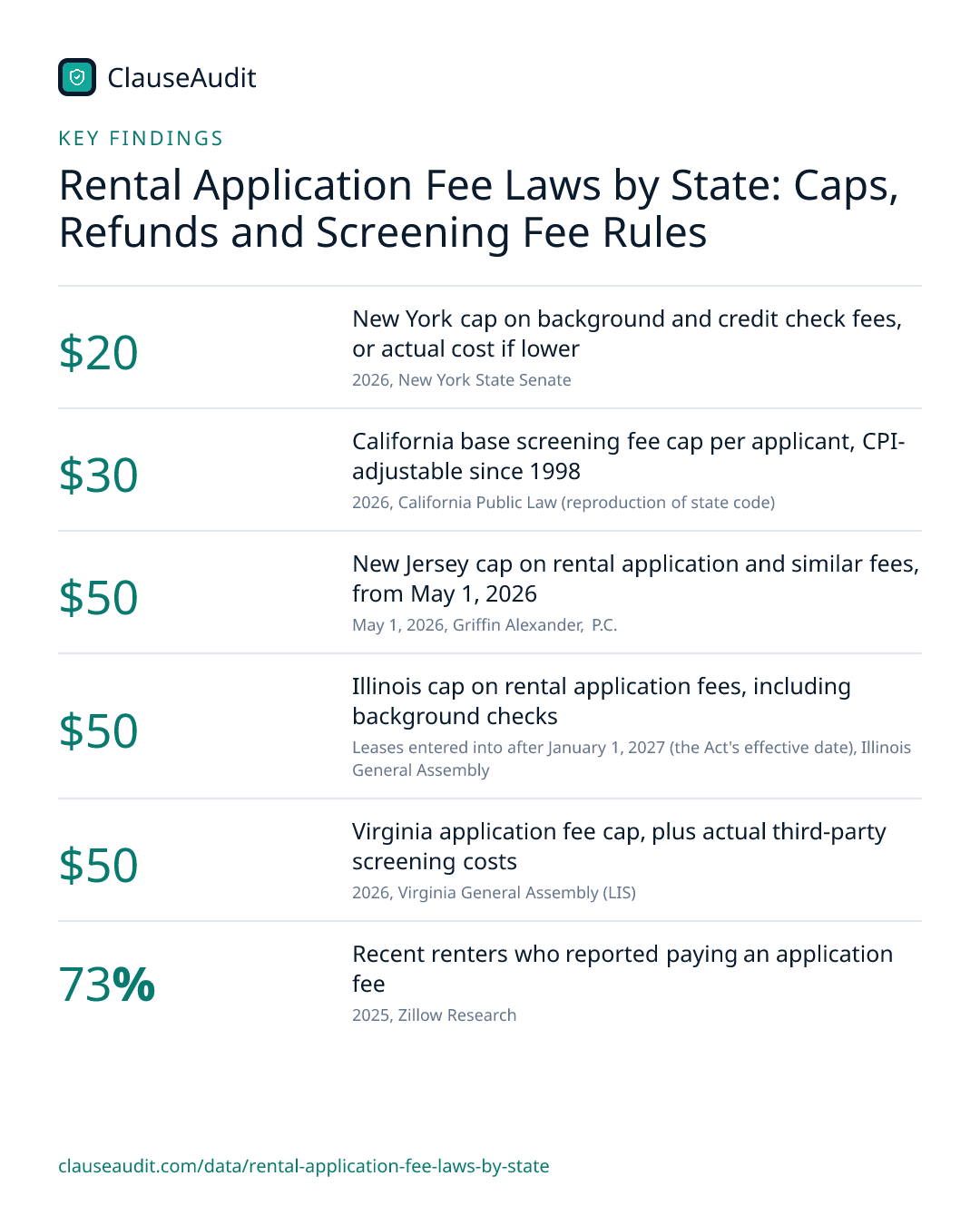
- New York cap on background and credit check fees, or actual cost if lower (2026, New York State Senate)
- $20
- California base screening fee cap per applicant, CPI-adjustable since 1998 (2026, California Public Law (reproduction of state code))
- $30
- New Jersey cap on rental application and similar fees, from May 1, 2026 (May 1, 2026, Griffin Alexander, P.C.)
- $50
- Illinois cap on rental application fees, including background checks (Leases entered into after January 1, 2027 (the Act's effective date), Illinois General Assembly)
- $50
- Virginia application fee cap, plus actual third-party screening costs (2026, Virginia General Assembly (LIS))
- $50
- Recent renters who reported paying an application fee (2025, Zillow Research)
- 73%
- Median application fee among recent renters who paid one (2025, Zillow Research)
- $75
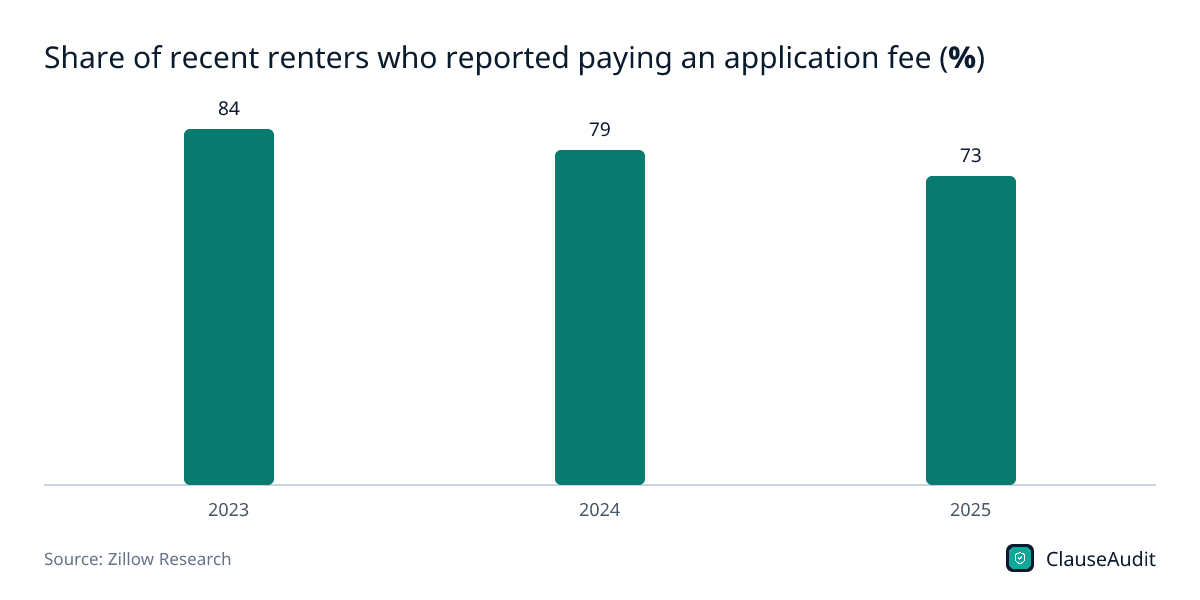
A rental application fee feels small until you pay it four or five times in one search. In 2025, 73% of recent renters said they paid one, and the median among those who did was $75. Whether a landlord can charge that much depends almost entirely on your state.
This page sorts every state and DC by the rule that applies: an outright ban, a dollar cap, a limit to actual screening cost, refund or disclosure rules only, or nothing at all. Below the map and tables you will find what those rules mean in practice and what to check before you hand over money.
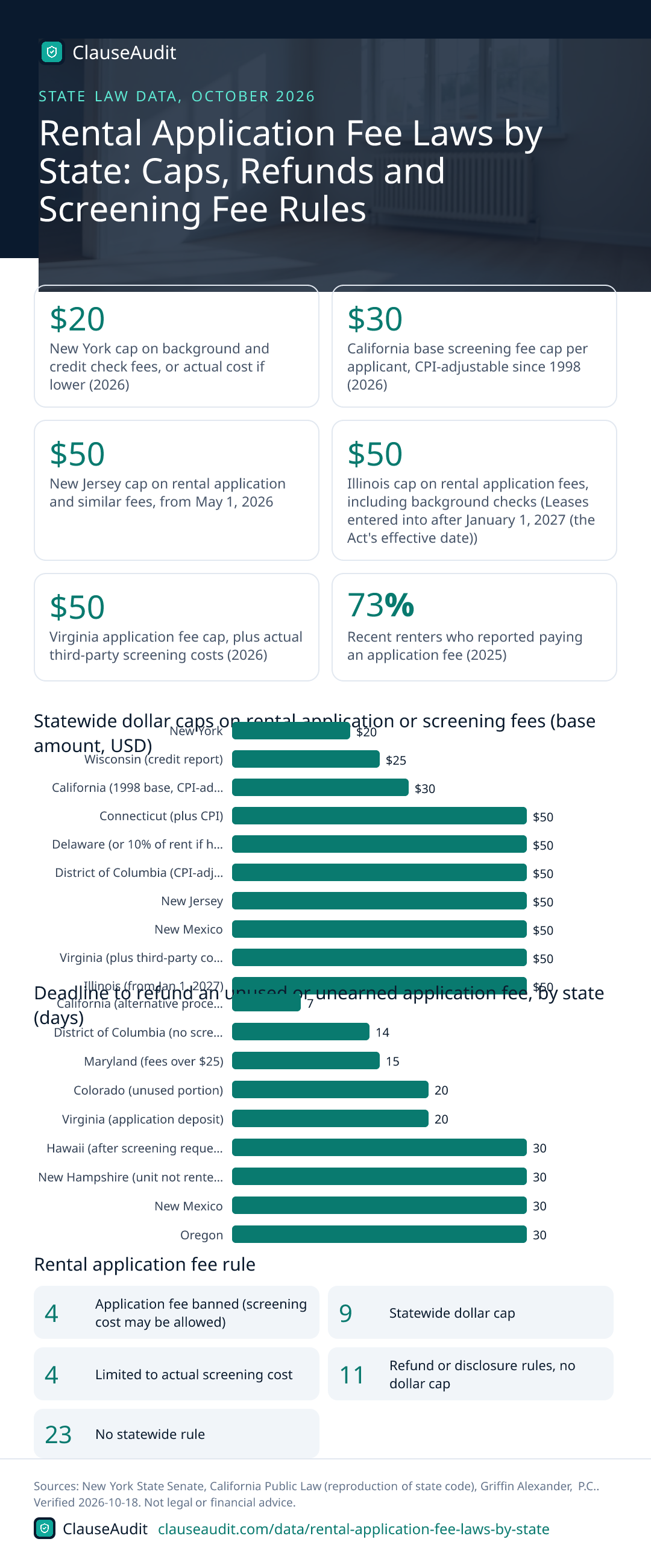
Statewide dollar caps on rental application or screening fees (base amount, USD)
Chart data
| Label | Value |
|---|---|
| New York | $20 |
| Wisconsin (credit report) | $25 |
| California (1998 base, CPI-adjustable) | $30 |
| Connecticut (plus CPI) | $50 |
| Delaware (or 10% of rent if higher) | $50 |
| District of Columbia (CPI-adjustable) | $50 |
| New Jersey | $50 |
| New Mexico | $50 |
| Virginia (plus third-party costs) | $50 |
| Illinois (from Jan 1, 2027) | $50 |
New York's $20 limit is the strictest dollar cap in the country, and $50 has become the common ceiling. Watch the fine print: Virginia allows third-party screening costs on top, and Delaware lets landlords use 10% of monthly rent if that is higher.
Download this chart (PNG)Deadline to refund an unused or unearned application fee, by state (days)
Chart data
| Label | Value |
|---|---|
| California (alternative process, 7 days after selection) | 7 |
| District of Columbia (no screening done) | 14 |
| Maryland (fees over $25) | 15 |
| Colorado (unused portion) | 20 |
| Virginia (application deposit) | 20 |
| Hawaii (after screening requests sent) | 30 |
| New Hampshire (unit not rented to applicant) | 30 |
| New Mexico | 30 |
| Oregon | 30 |
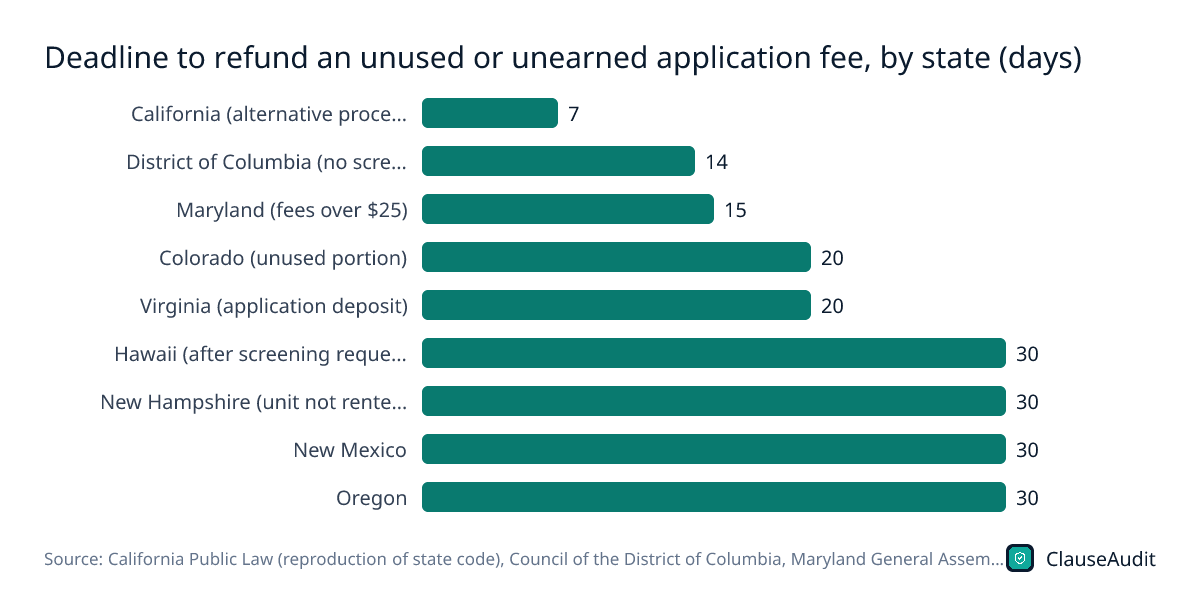
These are deadlines, not guarantees. Each state ties the refund to a specific trigger, such as no screening being done or the unit going to someone else, so read your state's row before you ask for money back.
Download this chart (PNG)The share of renters paying a fee fell from 84% in 2023 to 73% in 2025. That is a real drop, but most renters still pay one.
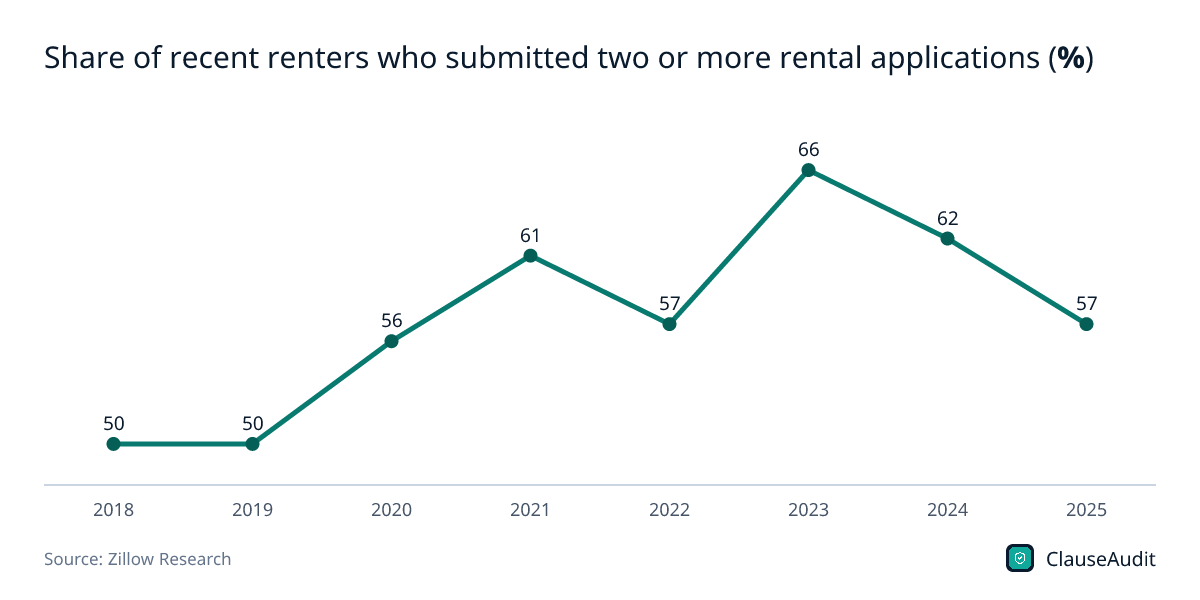
Download this chart (PNG)Share of recent renters who submitted two or more rental applications (%)
Chart data
| Label | Value (%) |
|---|---|
| 2018 | 50 |
| 2019 | 50 |
| 2020 | 56 |
| 2021 | 61 |
| 2022 | 57 |
| 2023 | 66 |
| 2024 | 62 |
| 2025 | 57 |
Since 2020, more than half of recent renters in every year applied to two or more places. Every extra application is another fee in states without a cap.
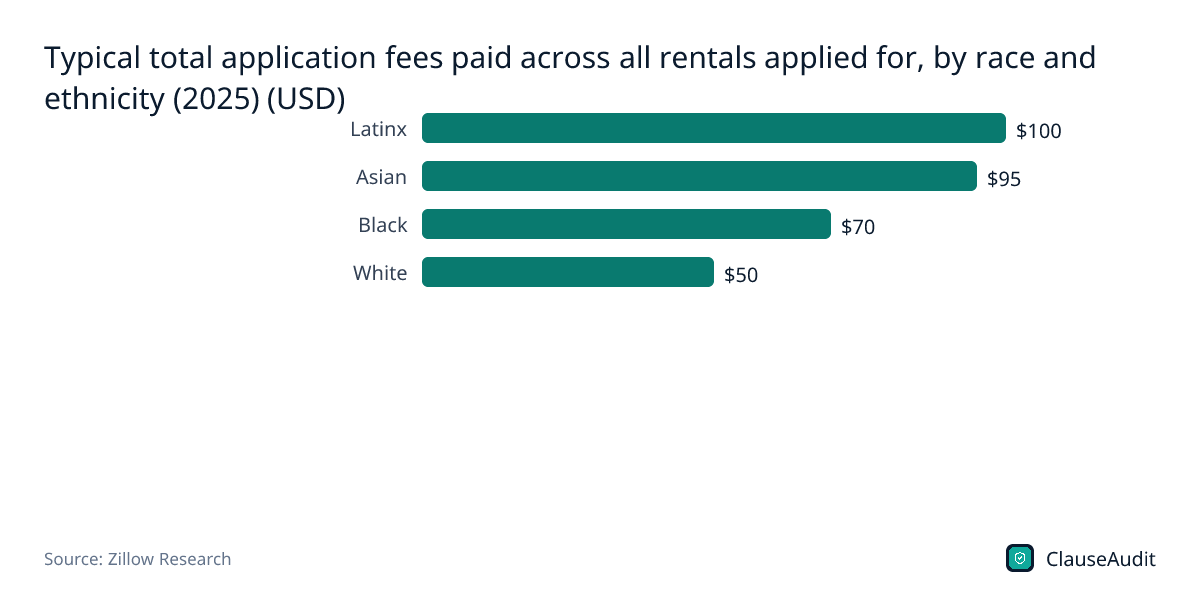
Download this chart (PNG)Typical total application fees paid across all rentals applied for, by race and ethnicity (2025) (USD)
Chart data
| Label | Value |
|---|---|
| Latinx | $100 |
| Asian | $95 |
| Black | $70 |
| White | $50 |
Latinx renters typically paid $100 in total application fees in 2025, double the $50 typical for white renters. Every extra application adds another fee to the total.
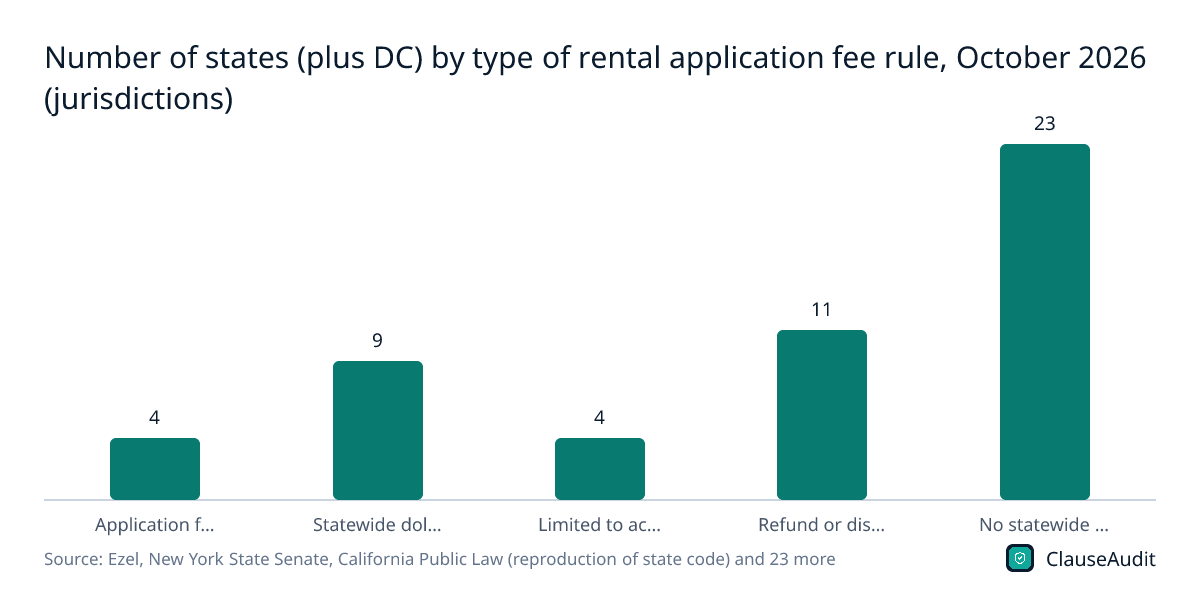
Download this chart (PNG)Number of states (plus DC) by type of rental application fee rule, October 2026 (jurisdictions)
Chart data
| Label | Value (jurisdictions) |
|---|---|
| Application fee banned (screening cost may be allowed) | 4 |
| Statewide dollar cap | 9 |
| Limited to actual screening cost | 4 |
| Refund or disclosure rules, no dollar cap | 11 |
| No statewide rule | 23 |
Only four states ban the fee and nine jurisdictions cap it in dollars. The largest group, 23 states, has no statewide rule at all, which leaves the amount to the landlord and any local ordinance.
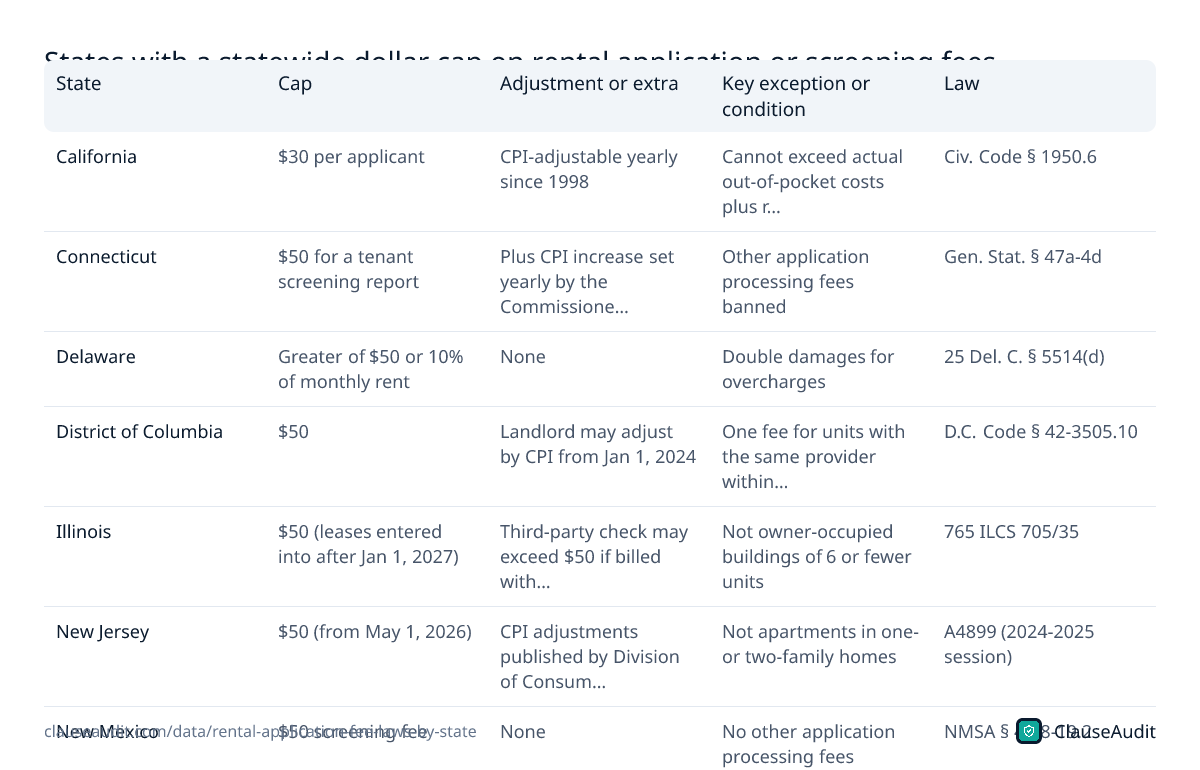
Download this chart (PNG)States with a statewide dollar cap on rental application or screening fees
| State | Cap | Adjustment or extra | Key exception or condition | Law |
|---|---|---|---|---|
| California | $30 per applicant | CPI-adjustable yearly since 1998 | Cannot exceed actual out-of-pocket costs plus reasonable time | Civ. Code § 1950.6 |
| Connecticut | $50 for a tenant screening report | Plus CPI increase set yearly by the Commissioner of Housing | Other application processing fees banned | Gen. Stat. § 47a-4d |
| Delaware | Greater of $50 or 10% of monthly rent | None | Double damages for overcharges | 25 Del. C. § 5514(d) |
| District of Columbia | $50 | Landlord may adjust by CPI from Jan 1, 2024 | One fee for units with the same provider within 30 days | D.C. Code § 42-3505.10 |
| Illinois | $50 (leases entered into after Jan 1, 2027) | Third-party check may exceed $50 if billed with receipts within 14 days | Not owner-occupied buildings of 6 or fewer units | 765 ILCS 705/35 |
| New Jersey | $50 (from May 1, 2026) | CPI adjustments published by Division of Consumer Affairs | Not apartments in one- or two-family homes | A4899 (2024-2025 session) |
| New Mexico | $50 screening fee | None | No other application processing fees | NMSA § 47-8-19.2 |
| New York | $20 or actual cost, whichever is less | None | Waived if applicant gives a check from the past 30 days | Real Prop. Law § 238-a |
| Virginia | $50 ($32 for HUD-regulated units) | Plus actual third-party screening costs | Separate refundable application deposit allowed | Va. Code § 55.1-1203 |
| Wisconsin | Actual cost up to $25 for a credit report | Same cap for background check of a nonresident | No charge if applicant gives a credit report under 30 days old | Wis. Stat. § 704.085 |
Source: California Public Law (reproduction of state code), California Civil Code § 1950.6; Connecticut General Assembly, Connecticut General Statutes § 47a-4d (Fees for tenant screening reports); Delaware General Assembly, Delaware Code Title 25, § 5514(d); Council of the District of Columbia, D.C. Code § 42-3505.10 (Tenant screening); Illinois General Assembly, Illinois Public Act 104-0479 (765 ILCS 705/35, Rental fee transparency and limitations); Griffin Alexander, P.C., New Jersey Caps Residential Rental Application Fees at $50 (Assembly Bill No. 4899); New Mexico Compilation Commission (NMOneSource), NMSA 1978 § 47-8-19.2 (Dwelling unit applicant screening fee); New York State Senate, New York Real Property Law § 238-a; Virginia General Assembly (LIS), Code of Virginia § 55.1-1203; Wisconsin State Legislature, Wisconsin Statutes § 704.085. Download as image
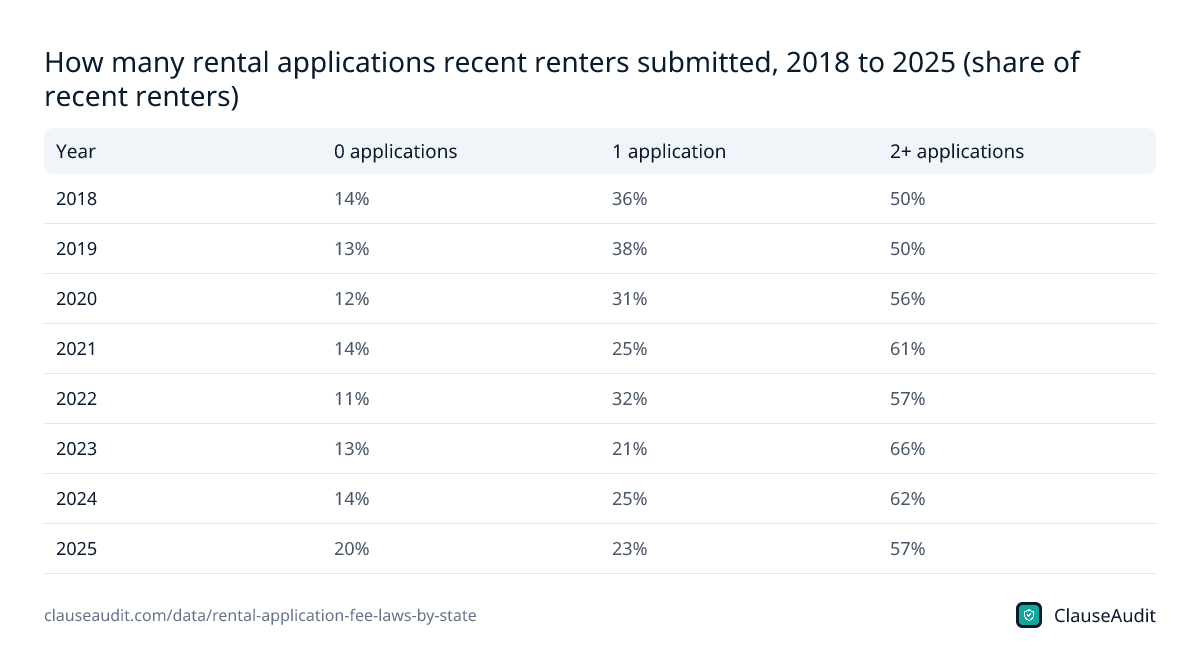
How many rental applications recent renters submitted, 2018 to 2025 (share of recent renters)
| Year | 0 applications | 1 application | 2+ applications |
|---|---|---|---|
| 2018 | 14% | 36% | 50% |
| 2019 | 13% | 38% | 50% |
| 2020 | 12% | 31% | 56% |
| 2021 | 14% | 25% | 61% |
| 2022 | 11% | 32% | 57% |
| 2023 | 13% | 21% | 66% |
| 2024 | 14% | 25% | 62% |
| 2025 | 20% | 23% | 57% |
Source: Zillow Research, Renters: Results from the Zillow Consumer Housing Trends Report 2025. Download as image
Rental application fee rule by state
- 4Application fee banned (screening cost may be allowed)
- 9Statewide dollar cap
- 4Limited to actual screening cost
- 11Refund or disclosure rules, no dollar cap
- 23No statewide rule
- Application fee banned (screening cost may be allowed)4
- Statewide dollar cap9
- Limited to actual screening cost4
- Refund or disclosure rules, no dollar cap11
- No statewide rule23
| State | Law | Fee limit | Refund and other rules | Source |
|---|---|---|---|---|
| Alabama | No statewide application fee statute | No statewide cap | No statewide refund rule | Rental Application and Tenant-Screening Fee Requirements by State |
| Alaska | No statewide application fee statute | No statewide cap | No statewide refund rule | Rental Application and Tenant-Screening Fee Requirements by State |
| Arizona | A.R.S. § 33-1321(B) | No cap | Purpose of any nonrefundable fee must be stated in writing; fees not designated nonrefundable are refundable | A.R.S. § 33-1321(B) |
| Arkansas | No statewide application fee statute | No statewide cap | No statewide refund rule | Rental Application and Tenant-Screening Fee Requirements by State |
| California | Civ. Code § 1950.6 | $30 per applicant base, CPI-adjustable since 1998; no more than actual costs | Unused portion returned; under the alternative process, full refund to applicants not selected within 7 days of selection or 30 days of application | Cal. Civ. Code § 1950.6 |
| Colorado | C.R.S. § 38-12-903 | Actual or average cost of processing only; same fee for all applicants | Unused amount returned within 20 calendar days after processing | C.R.S. § 38-12-903 |
| Connecticut | Gen. Stat. § 47a-4d | $50 for a tenant screening report, plus CPI adjustment set yearly | Application processing fees banned; copy of report and receipt must be given | Conn. Gen. Stat. § 47a-4d |
| Delaware | 25 Del. C. § 5514(d) | Greater of $50 or 10% of monthly rent | Receipt required; double damages for overcharge | 25 Del. C. § 5514(d) |
| District of Columbia | D.C. Code § 42-3505.10 | $50, adjustable by CPI from Jan 1, 2024 | Refund within 14 days if no screening done; one fee for same provider's units within 30 days | D.C. Code § 42-3505.10 |
| Florida | No statewide application fee statute | No statewide cap | No statewide refund rule | Rental Application and Tenant-Screening Fee Requirements by State |
| Georgia | No statewide application fee statute | No statewide cap | No statewide refund rule | Rental Application and Tenant-Screening Fee Requirements by State |
| Hawaii | HRS § 521-46 | Only the cost of obtaining information about the applicant; adults and emancipated minors only | Unused amount returned within 30 days after screening requests are submitted | Haw. Rev. Stat. § 521-46 |
| Idaho | No statewide application fee statute | No statewide cap | No statewide refund rule | Rental Application and Tenant-Screening Fee Requirements by State |
| Illinois | 765 ILCS 705/30; 705/35 (from 2027) | No current cap; $50 cap for leases entered into after Jan 1, 2027 (the Act's effective date) | No screening fee if applicant supplies a qualifying reusable report under 30 days old | 765 ILCS 705/30; 765 ILCS 705/35 |
| Indiana | No statewide application fee statute | No statewide cap | No statewide refund rule | Rental Application and Tenant-Screening Fee Requirements by State |
| Iowa | No statewide application fee statute | No statewide cap | No statewide refund rule | Rental Application and Tenant-Screening Fee Requirements by State |
| Kansas | No statewide application fee statute | No statewide cap | No statewide refund rule | Rental Application and Tenant-Screening Fee Requirements by State |
| Kentucky | No statewide application fee statute | No statewide cap | No statewide refund rule | Rental Application and Tenant-Screening Fee Requirements by State |
| Louisiana | La. R.S. 9:3258.1 | No cap; written notice of the fee amount and screening factors required before payment | No statutory refund rule | La. R.S. 9:3258.1 |
| Maine | 14 M.R.S. § 6030-H | Application fees banned; actual cost of one background, credit or other screening check allowed | No more than one screening fee per 12 months; complete copy of results must be given | 14 M.R.S. § 6030-H |
| Maryland | Real Prop. § 8-213 | No cap; fees over $25 must be returned except amounts actually spent | Return within 15 days of occupancy or of a decision that no tenancy will occur; else twice the fees | Md. Code, Real Prop. § 8-213 |
| Massachusetts | G.L. c. 186, § 15B(1)(b) | Not a permitted charge: only first and last month's rent, security deposit and lock cost may be required | Not applicable | Mass. Gen. Laws ch. 186, § 15B(1)(b) |
| Michigan | No statewide application fee statute | No statewide cap | No statewide refund rule | Rental Application and Tenant-Screening Fee Requirements by State |
| Minnesota | Minn. Stat. § 504B.173 | No dollar cap; no fee when no unit is available | Fee returned if rejected for an undisclosed reason or an earlier applicant takes the unit; unused amount returned | Minn. Stat. § 504B.173 |
| Mississippi | No statewide application fee statute | No statewide cap | No statewide refund rule | Rental Application and Tenant-Screening Fee Requirements by State |
| Missouri | No statewide application fee statute | No statewide cap | No statewide refund rule | Rental Application and Tenant-Screening Fee Requirements by State |
| Montana | MCA § 37-56-109 | No cap; fee portions must be itemized in writing | Property managers of 4+ units refund the fee, less costs of services actually performed, if the applicant does not sign a lease | Mont. Code Ann. § 37-56-109 |
| Nebraska | No statewide application fee statute | No statewide cap | No statewide refund rule | Rental Application and Tenant-Screening Fee Requirements by State |
| Nevada | NRS 118A.306 | No cap; no application, credit or background fee for a minor in the household | Refund if the unit goes to another applicant and the paid-for activity was not done | NRS 118A.306 |
| New Hampshire | RSA 540-A:3, VIII | No cap; fee amount must be disclosed in writing before collection | If the unit is not rented to the applicant, amounts beyond documented check costs and reasonable administrative costs returned within 30 days | N.H. RSA 540-A:3, VIII |
| New Jersey | A4899 (2024-2025 session) | $50 for application or similar fees from May 1, 2026; CPI-adjustable | No statewide refund rule found | New Jersey Caps Residential Rental Application Fees at $50 (Assembly Bill No. 4899) |
| New Mexico | NMSA § 47-8-19.2 | $50 screening fee; no other application processing fees | Returned within 30 calendar days if an earlier applicant takes the unit or no screening is done | NMSA 1978 § 47-8-19.2 |
| New York | Real Prop. Law § 238-a | Background and credit checks: actual cost or $20, whichever is less; other fees banned | Fee waived if applicant gives a check from the past 30 days | N.Y. Real Prop. Law § 238-a(1) |
| North Carolina | No statewide application fee statute | No statewide cap | No statewide refund rule | Rental Application and Tenant-Screening Fee Requirements by State |
| North Dakota | No statewide application fee statute | No statewide cap | No statewide refund rule | Rental Application and Tenant-Screening Fee Requirements by State |
| Ohio | No statewide application fee statute | No statewide cap | No statewide refund rule | Rental Application and Tenant-Screening Fee Requirements by State |
| Oklahoma | No statewide application fee statute | No statewide cap | No statewide refund rule | Rental Application and Tenant-Screening Fee Requirements by State |
| Oregon | ORS 90.295 | No more than the landlord's average actual screening cost or the customary screening company charge | Refund within 30 days in listed cases; one charge per 60 days for multiple units | ORS 90.295 |
| Pennsylvania | No statewide application fee statute | No statewide cap | No statewide refund rule | Rental Application and Tenant-Screening Fee Requirements by State |
| Rhode Island | R.I. Gen. Laws § 34-18-59 | Application fees banned; actual cost of a required state background check or credit report allowed | No charge if applicant supplies a report issued within 90 days; copy must be given | R.I. Gen. Laws § 34-18-59 |
| South Carolina | No statewide application fee statute | No statewide cap | No statewide refund rule | Rental Application and Tenant-Screening Fee Requirements by State |
| South Dakota | No statewide application fee statute | No statewide cap | No statewide refund rule | Rental Application and Tenant-Screening Fee Requirements by State |
| Tennessee | No statewide application fee statute | No statewide cap | No statewide refund rule | Rental Application and Tenant-Screening Fee Requirements by State |
| Texas | Prop. Code § 92.3515 | No cap; tenant selection criteria notice required with the application | Fee and deposit returned if the applicant is rejected and the notice was not made available | Tex. Prop. Code § 92.3515 |
| Utah | Utah Code § 57-22-4 | No cap; eligibility criteria and cost estimates disclosed in writing before any payment | Refund within 5 business days in limited disclosure-mismatch cases | Utah Code § 57-22-4 |
| Vermont | 9 V.S.A. § 4456a | Application fees banned for residential units | Not applicable | 9 V.S.A. § 4456a(a) |
| Virginia | Va. Code § 55.1-1203 | $50 ($32 for HUD-regulated units), plus actual third-party screening costs | Refundable application deposit: excess returned within 20 days | Va. Code § 55.1-1203 |
| Washington | RCW 59.18.257 | Costs of a screening report only; self-screening at actual cost, not above customary local screening charges | Screening criteria and reusable report policy must be disclosed first | RCW 59.18.257 |
| West Virginia | W. Va. Code § 37-6A-1 (definitions only) | No statewide cap | Application fee is excluded from the security-deposit definition as nonrefundable only if the parties expressly agree in writing | W. Va. Code § 37-6A-1 |
| Wisconsin | Wis. Stat. § 704.085; ATCP 134.05 | Credit report: actual cost up to $25; nonresident background check: actual cost up to $25 | No credit report charge if applicant gives one under 30 days old; copy must be given | Wis. Stat. § 704.085 |
| Wyoming | No statewide application fee statute | No statewide cap | No statewide refund rule | Rental Application and Tenant-Screening Fee Requirements by State |
How much can a landlord charge for a rental application?
It depends on which of five groups your state falls into. Maine, Massachusetts, Rhode Island and Vermont ban application fees. Maine and Rhode Island still let a landlord pass along the actual cost of a screening check, but nothing extra for processing your paperwork.
Nine jurisdictions set a dollar cap. New York is the lowest at $20 or the real cost of the background and credit checks, whichever is less. Wisconsin limits a credit report charge to actual cost up to $25. California's base is $30 per applicant, adjustable for inflation since 1998, and it can never exceed the landlord's actual out-of-pocket costs plus the reasonable value of time spent. Connecticut, DC, New Jersey, New Mexico and Virginia sit at $50, Delaware allows $50 or 10% of monthly rent, whichever is greater, and Illinois joins them for leases entered into after January 1, 2027.
Colorado, Hawaii, Oregon and Washington skip the dollar figure and tie the fee to what screening actually costs. In practice this can be tighter than a cap, because a landlord who pays a screening company a modest amount cannot round up to a convenient number.
Can I get my rental application fee back?
Often, yes, but only when a specific trigger is met. The refund chart shows how fast money must come back: 14 days in DC if no screening was done, 15 days in Maryland for fees over $25, 20 days in Colorado and Virginia, and 30 days in Hawaii, New Hampshire, New Mexico and Oregon.
The triggers vary. In New Mexico, you get your money back if an earlier applicant takes the unit or no screening happens. In Minnesota, the fee comes back if you are turned down for a reason the landlord never disclosed. In Texas, a rejected applicant gets the fee back if the landlord failed to make its selection criteria available. Arizona treats any fee not designated nonrefundable in writing as refundable.
Some states put teeth behind the rule. Maryland landlords who miss the deadline owe twice the fees. Oregon applicants can recover twice the charge plus $250. Delaware sets double damages for overcharges. Mention these numbers, politely, in a written refund request. It shows the landlord you know the rule.
Which states have no limit on rental application fees?
Twenty-three states have no statewide rule, including Florida, Georgia, Ohio, Pennsylvania and North Carolina. Another 11 have refund or disclosure rules but no dollar cap. In those places the landlord sets the number, and the market decides whether it sticks.
No statewide rule does not always mean no rule. Pennsylvania notes that local rules may apply, so check your city. Florida and Alabama go the other direction. Florida's statute blocks local regulation of application fees, and Alabama makes its state landlord-tenant act exclusive, so a city ordinance will not help you there.
Disclosure states still give you something to work with. Louisiana, New Hampshire and Utah require the fee or screening criteria to be disclosed in writing before you pay. Montana requires fee portions to be itemized. If a landlord skips that step, you have a clear, specific complaint.
Why the fee matters more when you apply to several places
A single $50 fee is annoying. The problem is volume. In 2025, 57% of recent renters submitted two or more applications, down from a peak of 66% in 2023. In a competitive market, the first place you apply may not pick you.
That is why a cap per application only goes so far. Several states try to fix the repeat-charge problem directly. New York waives the fee if you bring a background or credit check from the past 30 days. Wisconsin bars a credit report charge if you hand over one under 30 days old. Rhode Island accepts a report issued within 90 days. Oregon allows one charge per 60 days when you apply for multiple units with the same landlord, and DC limits you to one fee for the same provider's units within 30 days.
If you live in one of those states, pull your own report once and offer it with every application. Keep a copy of the date it was issued so you can prove it is recent enough.
What to do before you pay an application fee
- Find your state in the table above and note the cap, the refund trigger and any reusable report rule.
- Ask in writing what the fee covers and whether it is refundable. Get the answer in an email or on the application itself.
- Ask whether the unit is actually available. California and Minnesota bar fees when no unit is available.
- Ask for the screening criteria first. If your income, credit or rental history clearly falls short, you can skip the fee.
- Keep the receipt. Connecticut and Delaware require one, and you will need it for any refund or complaint.
- If you are charged more than your state allows, send a short written demand that cites the statute, then contact your state attorney general's consumer office if it goes unanswered.
If you manage rentals, how do you stay inside the rules?
Small landlords and property managers get caught by the details, not the headline number. A flat $50 fee is fine in New Mexico but too high in New York, and in Colorado or Oregon it is only legal if it does not exceed your actual or average screening cost.
Check the scope exemptions too. Illinois' 2027 cap does not cover owner-occupied buildings with 6 or fewer units. Maryland's refund rule skips landlords offering 4 or fewer units at one location. New Jersey's cap does not reach apartments in one- or two-family homes. Write your fee policy down, give it to applicants before you take money, and keep screening invoices so you can show what each check cost.
How ClauseAudit helps
Application fees rarely stop at the application. The same charges often show up again in the lease as admin fees, holding deposits or move-in costs, sometimes labeled nonrefundable when your state says otherwise.
Upload your lease or rental application and the automated review flags fee terms that look out of line with your state's rules, explains them in plain English, and suggests what to ask the landlord to change.
- Application, screening or processing fees above your state's cap or actual cost
- Wording that calls a fee nonrefundable when state law requires a refund
- Holding deposit or application deposit terms, including when the money comes back
- Admin, move-in or lease preparation fees that repeat charges already paid
- Late fee amounts and grace periods once the lease starts
- Security deposit amount and the deadline for returning it
Frequently asked questions
What is the maximum rental application fee in California?
California's base cap is $30 per applicant, set in Civil Code 1950.6 and adjustable each year for inflation since 1998. No state agency publishes the adjusted figure, so landlords calculate it themselves. Whatever the number, the fee cannot exceed the landlord's actual out-of-pocket screening costs plus reasonable time, and no fee is allowed when no unit is available.
How much can a landlord charge for an application in New York?
New York limits the charge to the actual cost of the background and credit checks or $20, whichever is less. Any other application processing fee is banned. If you give the landlord a background or credit check from the past 30 days, the fee must be waived entirely.
Which states ban rental application fees?
Maine, Massachusetts, Rhode Island and Vermont ban application fees. Massachusetts limits upfront charges to first and last month's rent, a security deposit and the cost of a lock. Maine and Rhode Island still allow the landlord to pass along the actual cost of a screening check, but not a separate processing fee.
Are rental application fees refundable?
Sometimes. Many states require a refund when screening is never done, when an earlier applicant gets the unit, or when the fee exceeds what was actually spent. Most deadlines run from 14 days in DC to 30 days in states such as Oregon and New Mexico, though California and Utah can require faster refunds in specific cases. In states with no rule, refundability depends on what the landlord promised in writing.
When does the Illinois rental application fee cap start?
Illinois caps rental application fees, including background checks, at $50 for leases entered into after January 1, 2027, under Public Act 104-0479. A third-party check may exceed $50 if it is billed with receipts within 14 days. Owner-occupied buildings with 6 or fewer units are not covered.
What is New Jersey's rental application fee limit?
From May 1, 2026, New Jersey bars rental application or similar fees above $50, with inflation adjustments to be published by the Division of Consumer Affairs. The limit does not apply to apartments in one- or two-family homes. The figure comes from a law firm summary of the enacted bill, so confirm details with the state.
How much do renters typically pay in application fees?
Among recent renters who paid an application fee in 2025, the median was $75. Counting those who paid nothing, the median was $50. Totals across all applications varied, with Latinx renters typically paying $100 in 2025 and white renters $50.
Can a landlord charge an application fee if I bring my own credit report?
In several states, no. New York waives the fee for a check from the past 30 days, Wisconsin bars a credit report charge for a report under 30 days old, Rhode Island accepts one issued within 90 days, and Colorado bars the fee if you supply a portable tenant screening report. Illinois has a similar reusable report rule.
Use this data
Every chart and card below is free to reuse under CC BY 4.0. Download what you need and link back to this page.
 Stat cards
 Key findings card
 Infographic
 Statewide dollar caps on rental application or screening fees (base amount, USD)
 Deadline to refund an unused or unearned application fee, by state (days)
 Share of recent renters who reported paying an application fee (%)
 Share of recent renters who submitted two or more rental applications (%)
 Typical total application fees paid across all rentals applied for, by race and ethnicity (2025) (USD)
 Number of states (plus DC) by type of rental application fee rule, October 2026 (jurisdictions)
 States with a statewide dollar cap on rental application or screening fees
 How many rental applications recent renters submitted, 2018 to 2025 (share of recent renters)
Embed the infographic
Free to share on your site, blog or slides under CC BY 4.0. Please keep the credit link.
Sources and method
Every number on this page comes from the sources below, each opened and read on or before October 18, 2026. A second, independent review checked every figure against its source and corrected anything that did not match. 51 of 51 state entries were confirmed; any that could not be are marked "Not yet confirmed" and left out of every count and chart.
- Zillow Research, Renters: Results from the Zillow Consumer Housing Trends Report 2025 (October 27, 2025 (2025 edition))
- Ezel, Rental Application and Tenant-Screening Fee Requirements by State (Statutes verified July to August 2026)
- New York State Senate, New York Real Property Law § 238-a (Revision dated October 17, 2025)
- California Public Law (reproduction of state code), California Civil Code § 1950.6 (Updated January 1, 2026)
- FindLaw (reproduction of state code), California Civil Code § 1950.6 (Current as of January 1, 2026)
- Connecticut General Assembly, Connecticut General Statutes § 47a-4d (Fees for tenant screening reports) (Archived October 9, 2026)
- Delaware General Assembly, Delaware Code Title 25, § 5514(d) (Current Delaware Code, read October 2026)
- Council of the District of Columbia, D.C. Code § 42-3505.10 (Tenant screening) (Current D.C. Code, read October 2026)
- FindLaw (reproduction of state code), Hawaii Revised Statutes § 521-46 (Current as of January 1, 2025)
- Illinois General Assembly, Illinois Public Act 104-0479 (765 ILCS 705/35, Rental fee transparency and limitations) (Effective January 1, 2027 (archived October 3, 2026))
- Illinois General Assembly, 765 ILCS 705/30 (Reusable tenant screening reports) (Archived October 9, 2026)
- FindLaw (reproduction of state code), Louisiana Revised Statutes 9:3258.1 (Current as of January 1, 2023)
- Maine Legislature, Office of the Revisor of Statutes, Maine Revised Statutes Title 14, § 6030-H (Data extracted October 5, 2026)
- Maryland General Assembly, Maryland Code, Real Property § 8-213 (Current statute text, read October 2026)
- Massachusetts Legislature, Massachusetts General Laws ch. 186, § 15B (As amended effective August 1, 2025 (archived September 29, 2026))
- Minnesota Office of the Revisor of Statutes, Minnesota Statutes § 504B.173 (Applicant screening fee) (2025 Minnesota Statutes)
- Montana Legislature, Montana Code Annotated § 37-56-109 (MCA 2025 (enacted Ch. 254, L. 2025))
- Nevada Legislature, Nevada Revised Statutes 118A.306 (Added to NRS by 2025 (archived October 13, 2026))
- New Hampshire General Court, New Hampshire RSA 540-A:3, VIII (Archived August 27, 2025)
- Griffin Alexander, P.C., New Jersey Caps Residential Rental Application Fees at $50 (Assembly Bill No. 4899) (March 31, 2026)
- New Mexico Compilation Commission (NMOneSource), NMSA 1978 § 47-8-19.2 (Dwelling unit applicant screening fee) (Laws 2025, ch. 122, effective June 20, 2025)
- Oregon Public Law (reproduction of ORS), Oregon Revised Statutes § 90.295 (2023 edition with 2024 session changes)
- Rhode Island General Assembly, Rhode Island General Laws § 34-18-59 (Fair limitation on rental application fees) (Archived April 12, 2026)
- Texas Public Law (reproduction of state code), Texas Property Code § 92.3515 (Verified May 26, 2025)
- FindLaw (reproduction of state code), Utah Code § 57-22-4 (Current as of January 1, 2025)
- Vermont General Assembly, 9 V.S.A. § 4456a (Residential rental application) (Includes 2025 session (archived June 12, 2026))
- Virginia General Assembly (LIS), Code of Virginia § 55.1-1203 (Version effective until July 1, 2027; read October 19, 2026)
- Washington State Legislature, RCW 59.18.257 (Current RCW, read October 2026)
- Wisconsin State Legislature, Wisconsin Statutes § 704.085 (Archived June 13, 2026)
- Wisconsin State Legislature, Wisconsin Administrative Code ATCP 134.05 (Archived May 24, 2026)
- Colorado Public Law (reproduction of C.R.S.), Colorado Revised Statutes § 38-12-903 (2024 Title 38 text)
- Arizona State Legislature, Arizona Revised Statutes § 33-1321 (Current A.R.S., read October 2026)
- FindLaw (reproduction of state code), West Virginia Code § 37-6A-1 (Current as of January 1, 2024)
Cite this page
ClauseAudit, “Rental Application Fee Laws by State: Caps, Refunds and Screening Fee Rules”, updated October 18, 2026, https://clauseaudit.com/data/rental-application-fee-laws-by-state. Free to reuse with a link back (CC BY 4.0).
This page summarises published data and law as checked on October 18, 2026. Figures are updated as new editions are released, and your own situation may differ. It is general information, not legal, tax or financial advice.