Required Lease Disclosures by State: Lead Paint, Flood Risk, Mold, Bed Bugs and More
By ClauseAudit Research · 15 sources ·
What are the landlord disclosure requirements by state?
If you rent a home built before 1978, your landlord usually owes you the federal lead paint disclosure, with penalties of up to $22,263 per violation since January 8, 2025. The rest depends on your state: 11 states required flood risk notices for renters by the end of 2025, and a handful add mold, bed bug or radon notices.

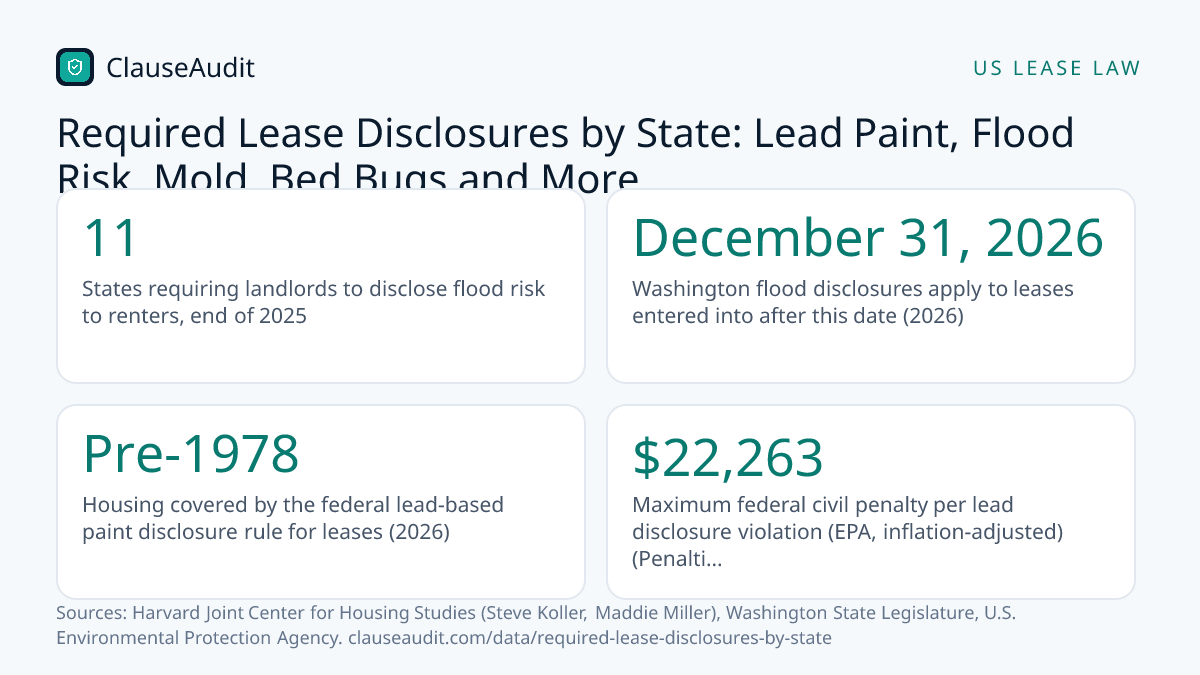
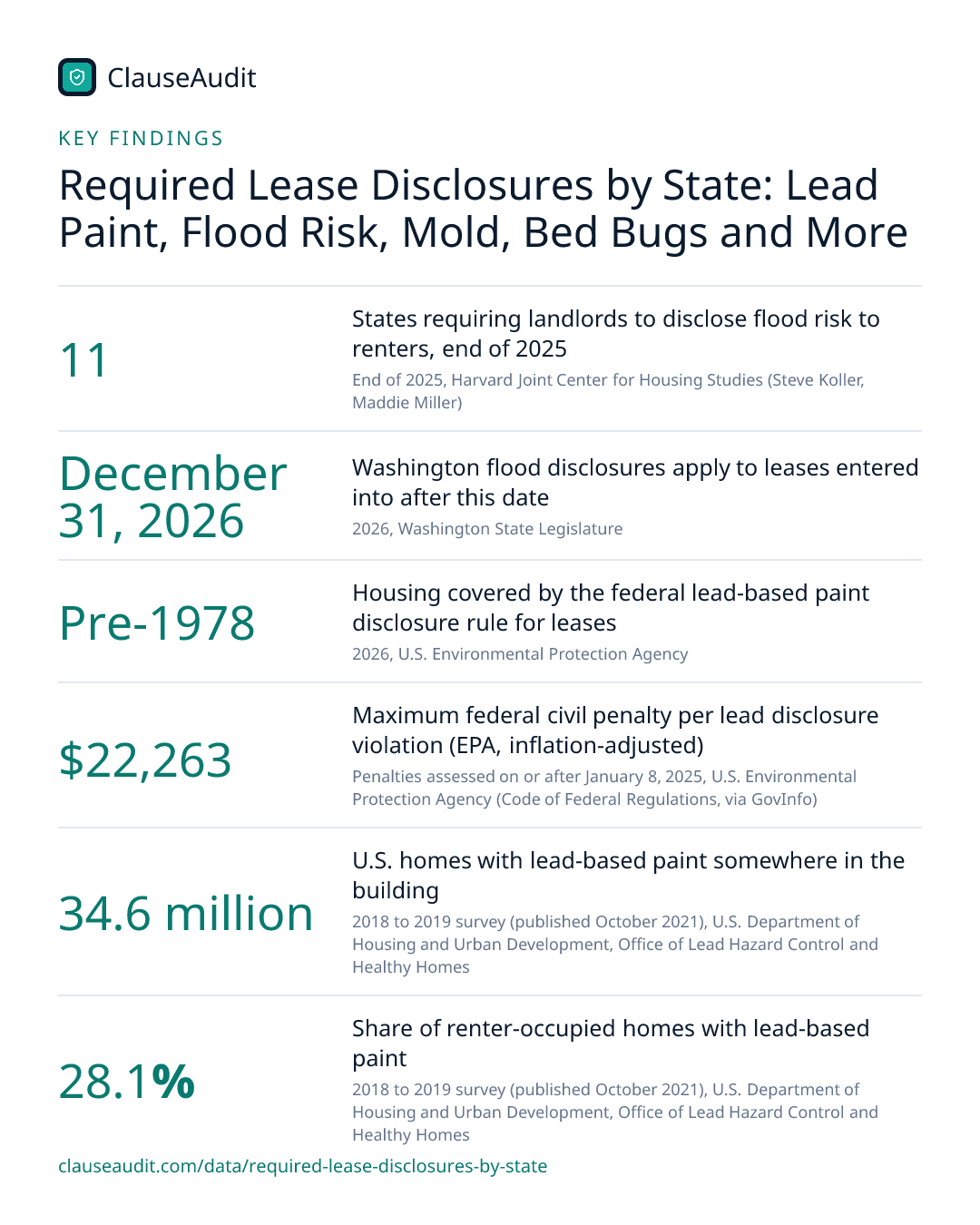
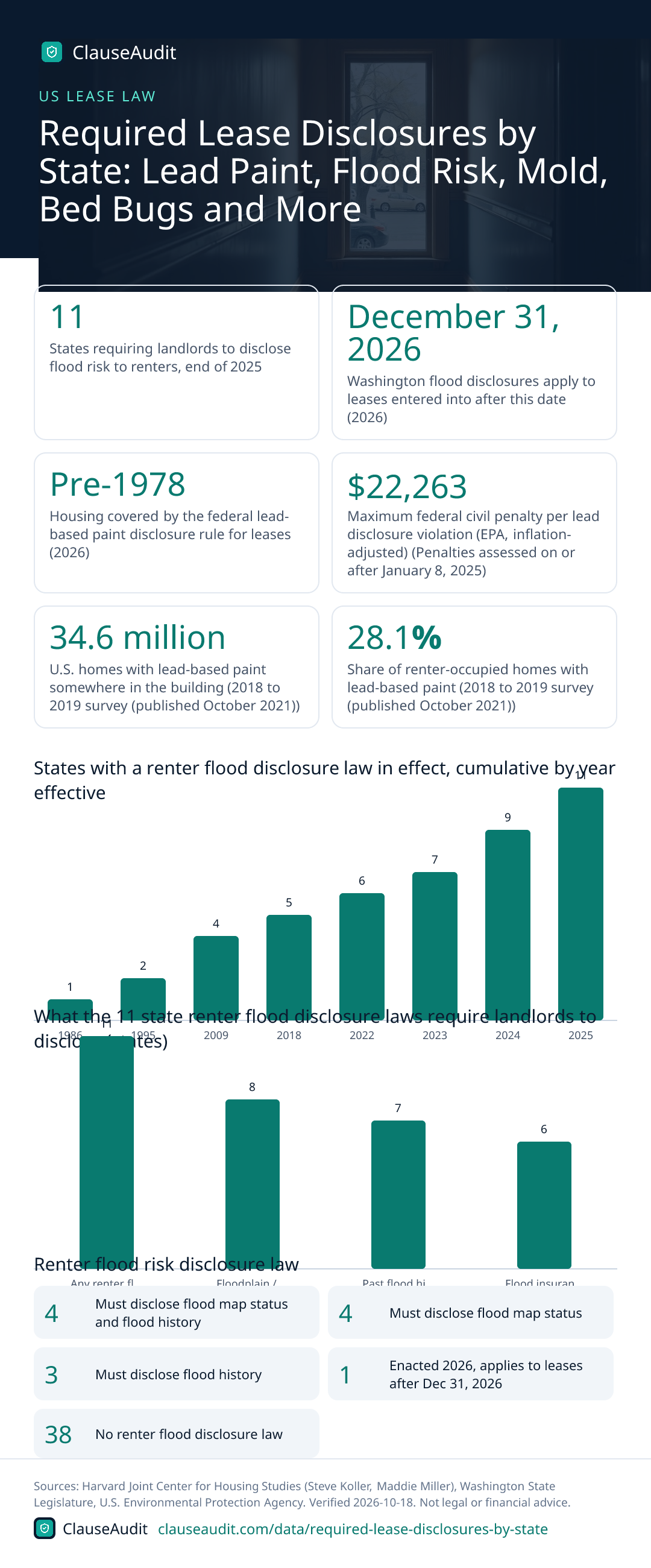
- States requiring landlords to disclose flood risk to renters, end of 2025 (End of 2025, Harvard Joint Center for Housing Studies (Steve Koller, Maddie Miller))
- 11
- Washington flood disclosures apply to leases entered into after this date (2026, Washington State Legislature)
- December 31, 2026
- Housing covered by the federal lead-based paint disclosure rule for leases (2026, U.S. Environmental Protection Agency)
- Pre-1978
- Maximum federal civil penalty per lead disclosure violation (EPA, inflation-adjusted) (Penalties assessed on or after January 8, 2025, U.S. Environmental Protection Agency (Code of Federal Regulations, via GovInfo))
- $22,263
- U.S. homes with lead-based paint somewhere in the building (2018 to 2019 survey (published October 2021), U.S. Department of Housing and Urban Development, Office of Lead Hazard Control and Healthy Homes)
- 34.6 million
- Share of renter-occupied homes with lead-based paint (2018 to 2019 survey (published October 2021), U.S. Department of Housing and Urban Development, Office of Lead Hazard Control and Healthy Homes)
- 28.1%
- Occupied rental units located in FEMA Special Flood Hazard Areas (Cited February 2026, Harvard Joint Center for Housing Studies (Steve Koller, Maddie Miller))
- 2.4 million
- Leases of 100 days or less with no possible renewal or extension are exempt from federal lead paint disclosure (2026, U.S. Environmental Protection Agency)
- 100 days
A lease is supposed to tell you what you are paying and for how long. Disclosures tell you what you are walking into. Some come from federal law and apply nearly everywhere. Others exist in only a few states, and they cover very different hazards.
This page pulls the main ones together: lead paint, flood risk, mold, bed bugs and radon. The map and tables show which states require what. Below them we explain what the rules mean in practice, where tenants and small landlords tend to get caught out, and what to check before anyone signs.
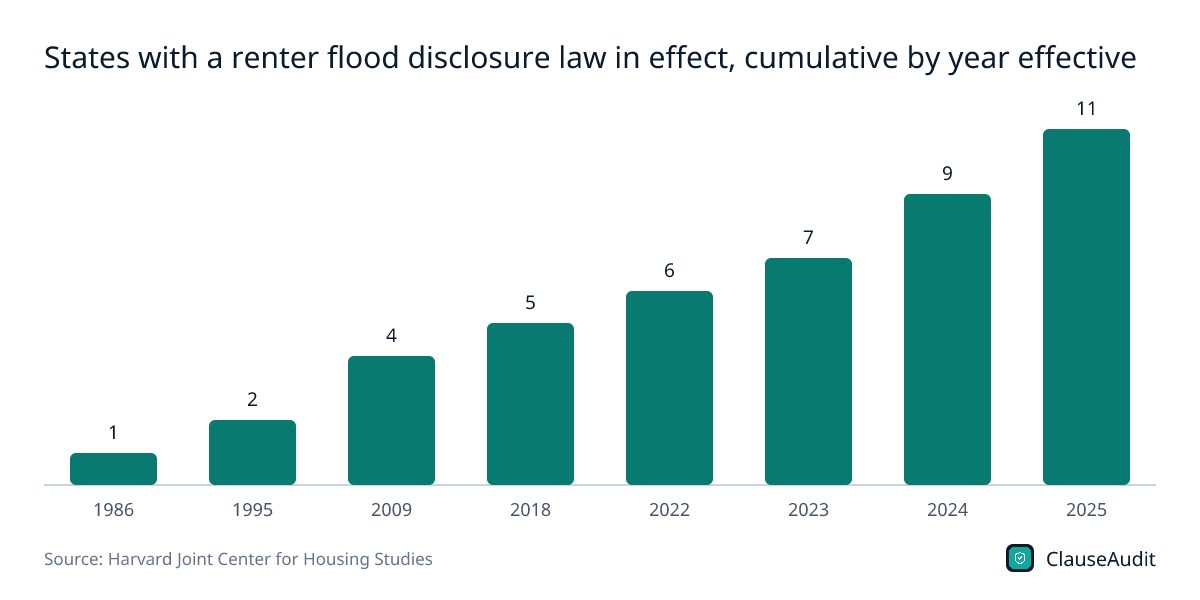
States with a renter flood disclosure law in effect, cumulative by year effective
Chart data
| Label | Value |
|---|---|
| 1986 | 1 |
| 1995 | 2 |
| 2009 | 4 |
| 2018 | 5 |
| 2022 | 6 |
| 2023 | 7 |
| 2024 | 9 |
| 2025 | 11 |
Most of the growth is recent. Oklahoma had a law in 1986, but the count only reached 11 after Florida and Illinois joined in 2025.
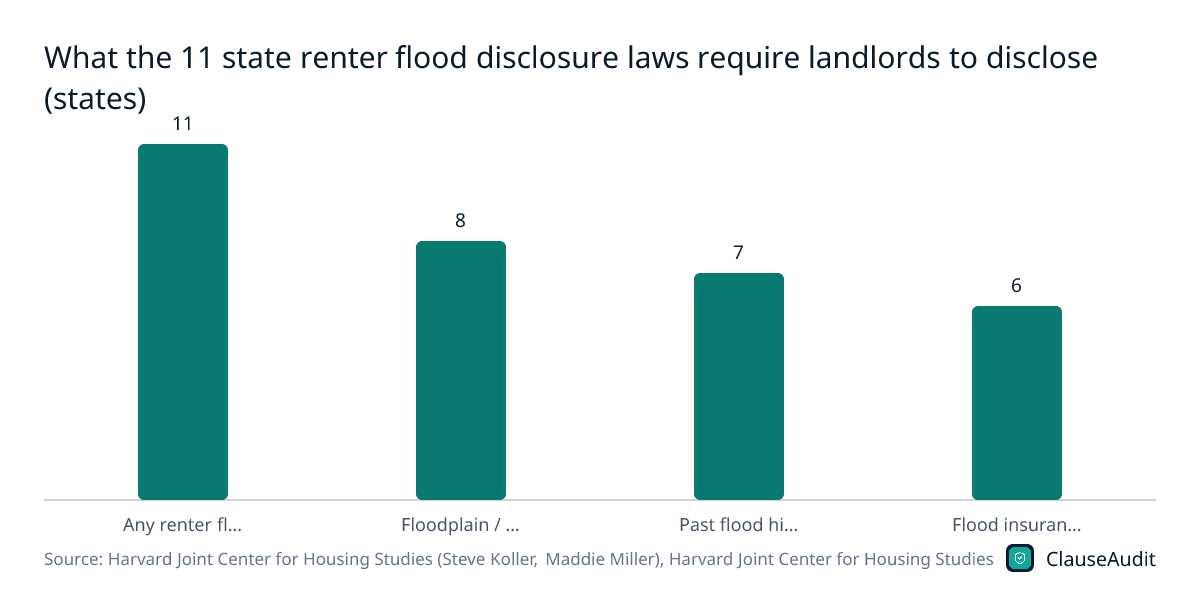
Download this chart (PNG)What the 11 state renter flood disclosure laws require landlords to disclose (states)
Chart data
| Label | Value (states) |
|---|---|
| Any renter flood disclosure | 11 |
| Floodplain / flood map status | 8 |
| Past flood history | 7 |
| Flood insurance information | 6 |
Having a law is not the same as getting the full picture. Only 6 of the 11 states require any flood insurance information, so a renter in the others may never hear that their belongings are not covered.
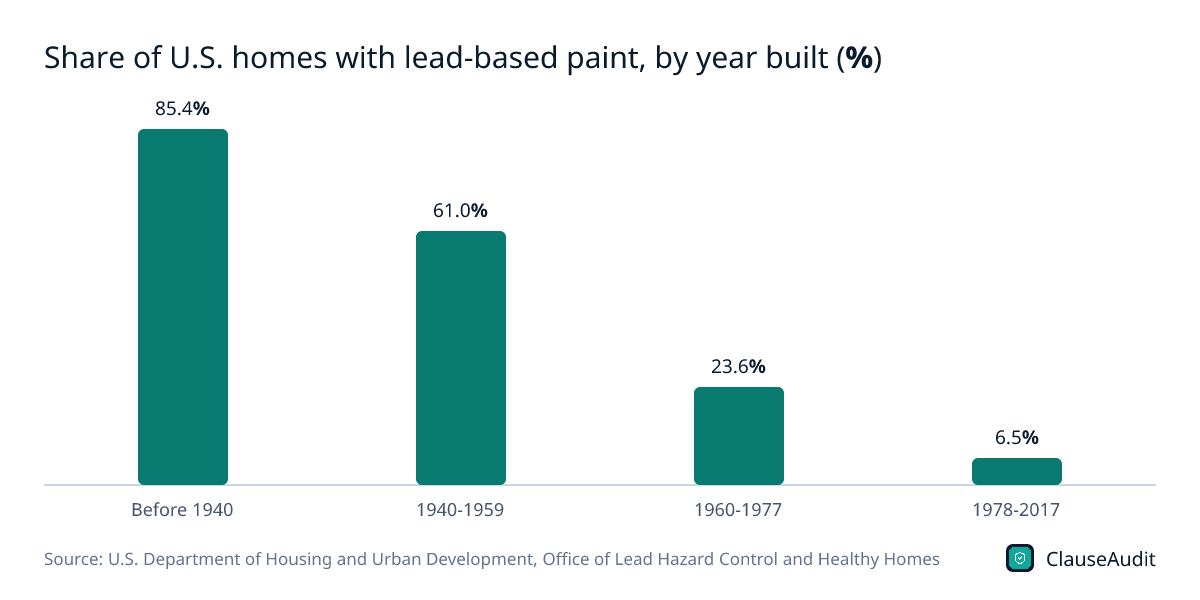
Download this chart (PNG)Share of U.S. homes with lead-based paint, by year built (%)
Chart data
| Label | Value (%) |
|---|---|
| Before 1940 | 85.4% |
| 1940-1959 | 61.0% |
| 1960-1977 | 23.6% |
| 1978-2017 | 6.5% |
Building age makes a big difference. In HUD's 2018 to 2019 survey, 85.4% of homes built before 1940 had lead paint somewhere, against 6.5% of homes built from 1978 to 2017.
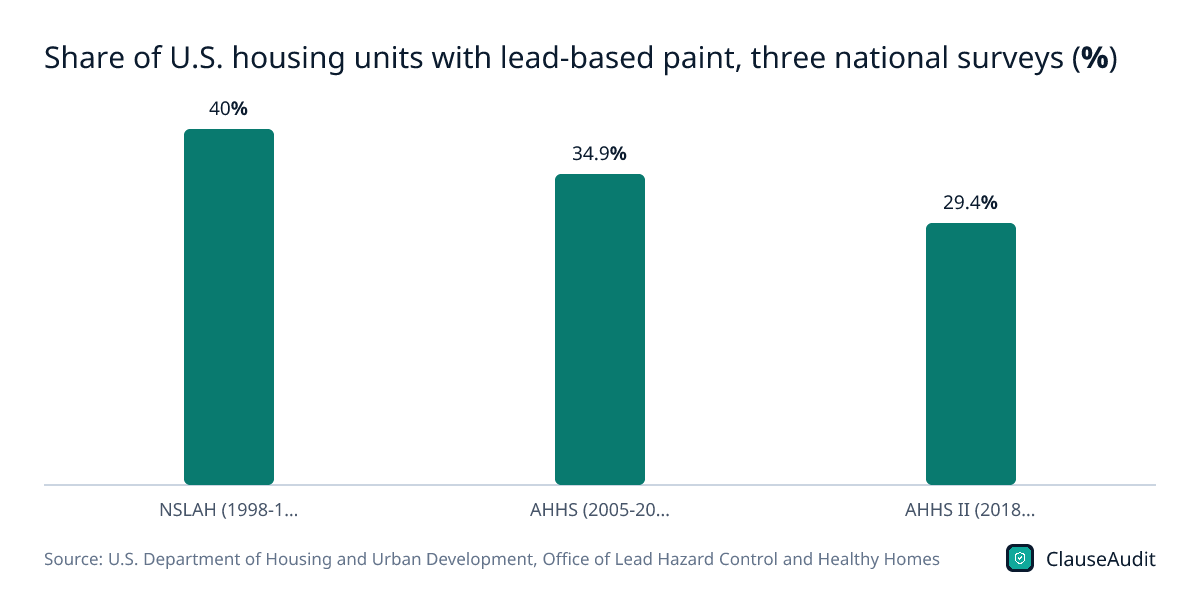
Download this chart (PNG)Share of U.S. housing units with lead-based paint, three national surveys (%)
Chart data
| Label | Value (%) |
|---|---|
| NSLAH (1998-1999) | 40% |
| AHHS (2005-2006) | 34.9% |
| AHHS II (2018-2019) | 29.4% |
The share has dropped in each of the three national surveys, but at 29.4% in the 2018 to 2019 survey it is still close to a third of the stock.
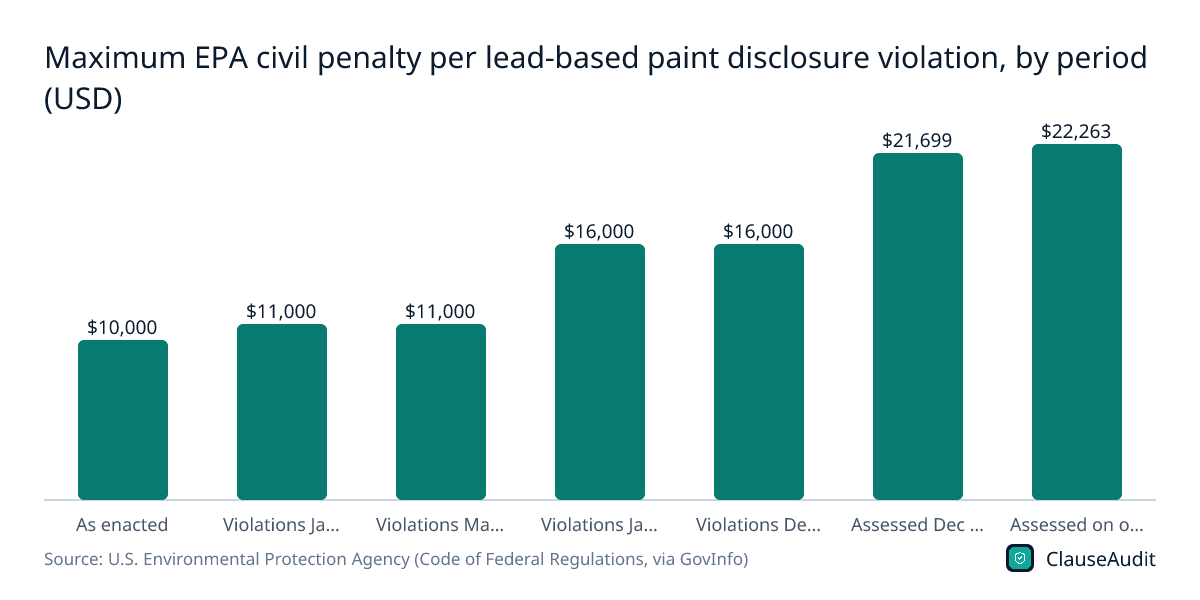
Download this chart (PNG)Maximum EPA civil penalty per lead-based paint disclosure violation, by period (USD)
Chart data
| Label | Value (USD) |
|---|---|
| As enacted | $10,000 |
| Violations Jan 30, 1997 to Mar 15, 2004 | $11,000 |
| Violations Mar 15, 2004 to Jan 12, 2009 | $11,000 |
| Violations Jan 12, 2009 to Dec 6, 2013 | $16,000 |
| Violations Dec 6, 2013 to Nov 2, 2015 | $16,000 |
| Assessed Dec 27, 2023 to Jan 8, 2025 | $21,699 |
| Assessed on or after Jan 8, 2025 | $22,263 |
The cap started at $10,000. After inflation adjustments it is $22,263 per violation for penalties assessed on or after January 8, 2025.
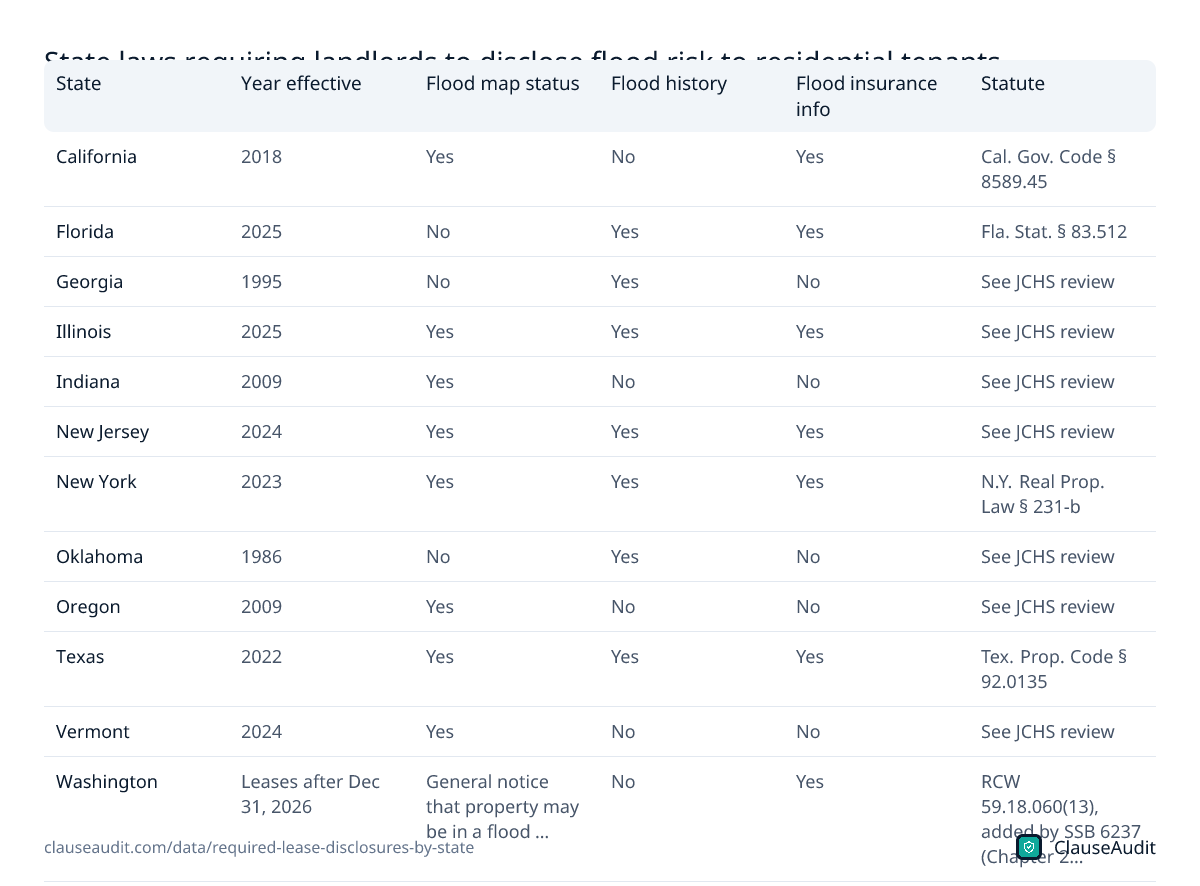
Download this chart (PNG)State laws requiring landlords to disclose flood risk to residential tenants
| State | Year effective | Flood map status | Flood history | Flood insurance info | Statute |
|---|---|---|---|---|---|
| California | 2018 | Yes | No | Yes | Cal. Gov. Code § 8589.45 |
| Florida | 2025 | No | Yes | Yes | Fla. Stat. § 83.512 |
| Georgia | 1995 | No | Yes | No | See JCHS review |
| Illinois | 2025 | Yes | Yes | Yes | See JCHS review |
| Indiana | 2009 | Yes | No | No | See JCHS review |
| New Jersey | 2024 | Yes | Yes | Yes | See JCHS review |
| New York | 2023 | Yes | Yes | Yes | N.Y. Real Prop. Law § 231-b |
| Oklahoma | 1986 | No | Yes | No | See JCHS review |
| Oregon | 2009 | Yes | No | No | See JCHS review |
| Texas | 2022 | Yes | Yes | Yes | Tex. Prop. Code § 92.0135 |
| Vermont | 2024 | Yes | No | No | See JCHS review |
| Washington | Leases after Dec 31, 2026 | General notice that property may be in a flood hazard area | No | Yes | RCW 59.18.060(13), added by SSB 6237 (Chapter 234, Laws of 2026) |
Source: Harvard Joint Center for Housing Studies, Renter Flood Disclosure Laws 2026 (Figure 1 interactive map and data); California Legislative Information, California Government Code § 8589.45; Texas Legislature, Texas Property Code § 92.0135, Notice for Dwelling Located in Floodplain; The Florida Legislature, Florida Statutes § 83.512, Disclosure of flood risks to prospective tenant of residential real property; New York State Senate, New York Real Property Law § 231-b, Flood disclosure in residential leases; Washington State Legislature, Substitute Senate Bill 6237, Rental Property: Flood Disclosures (Chapter 234, Laws of 2026), amending RCW 59.18.060. Download as image
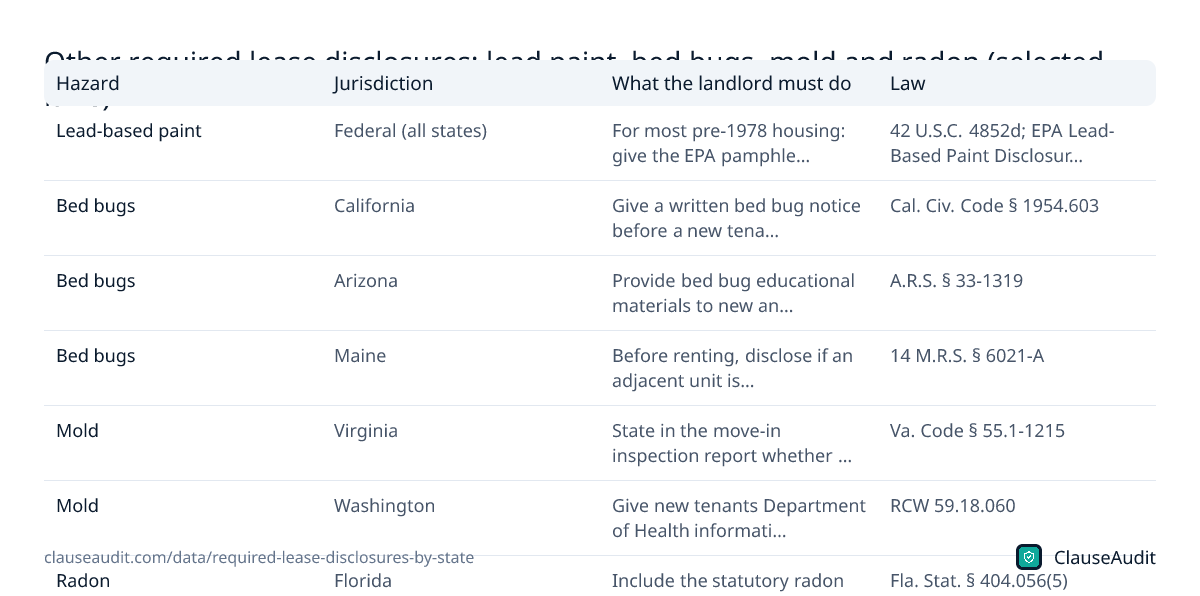
Other required lease disclosures: lead paint, bed bugs, mold and radon (selected laws)
| Hazard | Jurisdiction | What the landlord must do | Law |
|---|---|---|---|
| Lead-based paint | Federal (all states) | For most pre-1978 housing: give the EPA pamphlet, disclose known lead paint and hazards, provide records and a Lead Warning Statement, and keep signed disclosures for three years | 42 U.S.C. 4852d; EPA Lead-Based Paint Disclosure Rule |
| Bed bugs | California | Give a written bed bug notice before a new tenancy (on and after July 1, 2017), in at least 10-point type | Cal. Civ. Code § 1954.603 |
| Bed bugs | Arizona | Provide bed bug educational materials to new and existing tenants; do not lease a unit known to have a current infestation | A.R.S. § 33-1319 |
| Bed bugs | Maine | Before renting, disclose if an adjacent unit is infested or being treated; on request, disclose the last date the unit was inspected and found free of bed bugs | 14 M.R.S. § 6021-A |
| Mold | Virginia | State in the move-in inspection report whether there is visible evidence of mold; tenant may terminate if there is | Va. Code § 55.1-1215 |
| Mold | Washington | Give new tenants Department of Health information on indoor mold when the lease is signed | RCW 59.18.060 |
| Radon | Florida | Include the statutory radon gas notice on at least one document at or before signing a rental agreement | Fla. Stat. § 404.056(5) |
Source: U.S. Environmental Protection Agency, Real Estate Disclosures about Potential Lead Hazards; California Legislative Information, California Civil Code § 1954.603 (Bed Bug Infestations); Arizona State Legislature, Arizona Revised Statutes § 33-1319, Bedbug control; landlord and tenant obligations; Maine Legislature, Maine Revised Statutes Title 14, § 6021-A, Treatment of bedbug infestation; Virginia General Assembly (LIS), Code of Virginia § 55.1-1215, Disclosure of mold in dwelling units; Washington State Legislature, Substitute Senate Bill 6237, Rental Property: Flood Disclosures (Chapter 234, Laws of 2026), amending RCW 59.18.060; The Florida Legislature, Florida Statutes § 404.056(5), Notification on real estate documents (radon). Download as image
Renter flood risk disclosure law by state
- 4Must disclose flood map status and flood history
- 4Must disclose flood map status
- 3Must disclose flood history
- 1Enacted 2026, applies to leases after Dec 31, 2026
- 38No renter flood disclosure law
- Must disclose flood map status and flood history4
- Must disclose flood map status4
- Must disclose flood history3
- Enacted 2026, applies to leases after Dec 31, 20261
- No renter flood disclosure law38
- Not yet confirmed1
What disclosures does every landlord have to give?
Only one federal disclosure applies across the whole country: lead-based paint. If the home was built before 1978, the rule covers most leases. A downtown apartment counts. So does one half of a duplex owned by a retired teacher.
The landlord has to hand over the EPA lead pamphlet, tell you about any lead paint or hazards they know of, give you any reports or records they hold, and include a Lead Warning Statement in the lease. They must keep the signed disclosure for three years. Notice what is missing: the rule does not require testing. A landlord who never looked can truthfully say they know of nothing.
There is one exemption you will see in short-term rentals. Leases of 100 days or less, with no possible renewal or extension, are outside the rule. A month-to-month tenancy that can roll over is not short-term under this test.
The risk is not theoretical. HUD's latest survey (2018 to 2019) found lead paint in 28.1% of renter-occupied homes, and in 85.4% of homes built before 1940. If you have young children, ask for the year the building was built before you ask about parking.
Which states require landlords to disclose flood risk?
By the end of 2025, 11 states required landlords to tell renters something about flood risk. Washington passed a twelfth law in 2026, and it applies to leases entered into after December 31, 2026. That leaves most of the country with no renter flood rule at all, even though Harvard's Joint Center for Housing Studies cites an estimated 2.4 million occupied rental units in FEMA Special Flood Hazard Areas.
The laws differ a lot. Texas makes landlords say whether the unit is in a floodplain and whether it flooded at least once in the 5 years before the lease, though leases under 30 days are exempt. New York covers 100-year and 500-year floodplain status plus known prior flood damage. Florida's notice applies to rental agreements of 1 year or longer and must be a separate document. California's floodplain disclosure turns on what the owner actually knows.
Here is why it matters. Renters insurance usually excludes flood. If your landlord tells you the building sits in a flood zone, you can price a separate flood policy, pick a higher floor, or keep the home office equipment off the ground. If nobody tells you, you find out after the water comes in.
This hits harder if you work from home. A freelancer with a desktop, a printer and client files in a ground-floor unit can lose a month of income along with the furniture. Before you sign, ask the landlord directly whether the unit has ever flooded, and get the answer in writing. In a state with no flood law, that question is often the only disclosure you will get.
Do landlords have to disclose mold, bed bugs or radon?
Sometimes, depending on the state. These rules are scattered and specific, so read the exact wording for where you live.
On bed bugs, California has required a written notice before every new tenancy since July 1, 2017, printed in at least 10-point type. Arizona requires landlords to give educational materials and bars renting a unit they know is infested. Maine requires disclosure if a neighboring unit is infested or being treated, and on request the last date the unit was inspected and found clear.
Mold rules are thinner. Virginia requires the move-in inspection report to say whether there is visible mold, and the tenant can end the lease if there is. Washington requires landlords to hand new tenants state health department information on indoor mold. Florida takes a different route on radon: a statutory notice must appear on at least one document at or before signing.
In states with no specific law, general landlord-tenant rules on habitability and honest dealing still apply. A landlord who hides a known problem can still face a claim. A disclosure statute just makes the duty clearer.
What happens if a landlord skips a required disclosure?
For lead paint, the federal penalty can reach $22,263 per violation for penalties assessed on or after January 8, 2025. Tenants can also have private remedies under the federal statute. State penalties vary widely, and some laws give the tenant a specific right, like Virginia's option to terminate when mold is present at move-in.
If you rent out a unit yourself, even as a side business, treat disclosures as part of the lease package rather than an afterthought. Use the official forms, attach them to the lease, have the tenant sign, and keep copies well past the three-year federal minimum. Missing paperwork can sink a small landlord in a dispute that should have been easy.
If you are the tenant and something required is missing, ask for it in writing before you sign. A landlord who supplies it promptly has told you something useful. One who refuses has told you something too.
A short pre-signing checklist
- Ask when the building was built. If it is pre-1978, expect the lead pamphlet, a Lead Warning Statement and any known reports.
- Look your state up on the map above. If it has a flood law, check that the notice covers flood map status, flood history or insurance as the statute requires.
- Check the FEMA flood map for the address yourself, even in states with no renter flood rule.
- Read your renters insurance policy for a flood exclusion and decide whether you need a separate policy.
- In California, Arizona or Maine, look for the bed bug notice or materials. In Virginia, look at the mold line on the move-in report.
- Make sure the disclosures are signed and attached to your copy of the lease, not just mentioned in an email.
- Watch for lease wording that says you accept the unit as is or waive claims about its condition. Those clauses do not cancel a statutory disclosure duty.
How ClauseAudit helps
Disclosure rules live outside the lease, but the lease is where landlords try to shift the risk back to you. An as-is clause, a broad waiver or a repair clause can quietly undercut what the statute gives you.
Upload your lease and the automated review reads each clause, flags the risky ones, explains them in plain English and suggests changes you can ask for before signing.
- Disclosure attachments: does the lease reference the lead paint, flood or other required notices, and are they actually attached?
- As-is and condition waivers: does the lease say you accept the unit as is or give up claims about mold, pests or hidden defects?
- Repair and pest clauses: are you made responsible for mold cleanup or bed bug treatment the landlord should handle?
- Liability and indemnity: does the lease make you cover damage from flooding or building conditions you cannot control?
- Early termination: can you leave without penalty if a serious hazard shows up after move-in?
- Renters insurance requirements: does the lease require coverage that ignores the flood exclusion in most policies?
Frequently asked questions
Does the lead paint disclosure apply to my rental?
It applies to most housing built before 1978, including private, public and federally assisted housing. The main exemptions include leases of 100 days or less with no chance of renewal or extension. If your building is older than 1978 and you got no pamphlet or Lead Warning Statement, ask for them in writing before you sign.
Does a landlord have to test for lead paint?
No. The federal rule requires landlords to disclose lead paint and hazards they know about and to hand over any reports they have. It does not require a test. That is why the year the building was built matters so much: in HUD's 2018 to 2019 survey, 85.4% of homes built before 1940 had lead paint somewhere.
How many states require landlords to disclose flood risk?
Eleven states had a renter flood disclosure law by the end of 2025: California, Florida, Georgia, Illinois, Indiana, New Jersey, New York, Oklahoma, Oregon, Texas and Vermont. Washington passed a law in 2026 that applies to leases entered into after December 31, 2026. What each law requires varies a lot.
Does renters insurance cover flood damage?
Standard renters policies usually exclude flood, which is why flood disclosure laws matter. Only 6 of the 11 state laws require landlords to give tenants flood insurance information. If your unit is in a flood zone or has flooded before, ask your insurer about a separate flood policy for your belongings.
Do landlords have to tell you about bed bugs?
Only in some states. California requires a written bed bug notice before a new tenancy, Arizona requires educational materials and bans renting a unit known to be infested, and Maine requires disclosure if an adjacent unit is infested or being treated. Elsewhere, general habitability rules usually apply instead.
Is there a mold disclosure requirement for rentals?
A few states have one. Virginia requires the move-in inspection report to note visible mold, and a tenant can terminate if mold is present. Washington requires landlords to give new tenants state health department information about indoor mold. Most states rely on general repair and habitability law instead of a specific mold disclosure.
What is the penalty for not giving the lead disclosure?
The EPA can seek civil penalties of up to $22,263 per violation for penalties assessed on or after January 8, 2025. The figure started at $10,000 when the law passed and has risen with inflation. A tenant may also have a private claim, so landlords should keep signed copies for at least three years.
Can a lease waive required disclosures?
Generally no. A statutory disclosure duty belongs to the landlord, and a clause saying you accept the unit as is does not erase it. Those clauses can still cause trouble in a dispute, though, so it is worth asking the landlord to remove or narrow them before you sign.
Do these disclosure rules apply to commercial leases?
Mostly not. The flood, bed bug and mold rules on this page are written for residential tenants, and the federal lead rule covers housing. If you lease office or retail space, your protection comes mainly from the lease itself, so the condition, repair and indemnity clauses deserve a careful read.
Use this data
Every chart and card below is free to reuse under CC BY 4.0. Download what you need and link back to this page.
 Stat cards
 Key findings card
 Infographic
 States with a renter flood disclosure law in effect, cumulative by year effective
 What the 11 state renter flood disclosure laws require landlords to disclose (states)
 Share of U.S. homes with lead-based paint, by year built (%)
 Share of U.S. housing units with lead-based paint, three national surveys (%)
 Maximum EPA civil penalty per lead-based paint disclosure violation, by period (USD)
 State laws requiring landlords to disclose flood risk to residential tenants
 Other required lease disclosures: lead paint, bed bugs, mold and radon (selected laws)
Embed the infographic
Free to share on your site, blog or slides under CC BY 4.0. Please keep the credit link.
Sources and method
Every number on this page comes from the sources below, each opened and read on or before October 18, 2026. A second, independent review checked every figure against its source and corrected anything that did not match. 50 of 51 state entries were confirmed; any that could not be are marked "Not yet confirmed" and left out of every count and chart.
- Harvard Joint Center for Housing Studies (Steve Koller, Maddie Miller), More States Requiring Landlords to Disclose Flood Risk, but Laws Vary Nationwide (February 18, 2026)
- Harvard Joint Center for Housing Studies, Renter Flood Disclosure Laws 2026 (Figure 1 interactive map and data) (Map last updated February 17, 2026)
- Washington State Legislature, Substitute Senate Bill 6237, Rental Property: Flood Disclosures (Chapter 234, Laws of 2026), amending RCW 59.18.060 (Approved March 27, 2026; effective June 11, 2026)
- California Legislative Information, California Government Code § 8589.45 (Added by Stats. 2017, Ch. 502 (AB 646); current text read October 2026)
- Texas Legislature, Texas Property Code § 92.0135, Notice for Dwelling Located in Floodplain (Current text read October 2026)
- The Florida Legislature, Florida Statutes § 83.512, Disclosure of flood risks to prospective tenant of residential real property (Current text read October 2026)
- New York State Senate, New York Real Property Law § 231-b, Flood disclosure in residential leases (Current text read October 2026)
- U.S. Environmental Protection Agency, Real Estate Disclosures about Potential Lead Hazards (Last updated May 27, 2026)
- U.S. Environmental Protection Agency (Code of Federal Regulations, via GovInfo), 40 CFR 19.4, Statutory civil monetary penalties, as adjusted for inflation, and tables (CFR edition July 1, 2025 (amended 90 FR 1377, January 8, 2025))
- U.S. Department of Housing and Urban Development, Office of Lead Hazard Control and Healthy Homes, American Healthy Homes Survey II Lead Findings (October 29, 2021)
- California Legislative Information, California Civil Code § 1954.603 (Bed Bug Infestations) (Added by Stats. 2016, Ch. 599 (AB 551), effective January 1, 2017)
- Arizona State Legislature, Arizona Revised Statutes § 33-1319, Bedbug control; landlord and tenant obligations (Current text read October 2026)
- Maine Legislature, Maine Revised Statutes Title 14, § 6021-A, Treatment of bedbug infestation (PL 2009, c. 566; current text read October 2026)
- Virginia General Assembly (LIS), Code of Virginia § 55.1-1215, Disclosure of mold in dwelling units (Current text read October 2026)
- The Florida Legislature, Florida Statutes § 404.056(5), Notification on real estate documents (radon) (Current text read October 2026)
Cite this page
ClauseAudit, “Required Lease Disclosures by State: Lead Paint, Flood Risk, Mold, Bed Bugs and More”, updated October 18, 2026, https://clauseaudit.com/data/required-lease-disclosures-by-state. Free to reuse with a link back (CC BY 4.0).
This page summarises published data and law as checked on October 18, 2026. Figures are updated as new editions are released, and your own situation may differ. It is general information, not legal, tax or financial advice.