Mechanics Lien Deadlines by State: Preliminary Notice and Filing Windows
By ClauseAudit Research · 23 sources ·
What are the mechanics lien deadlines by state?
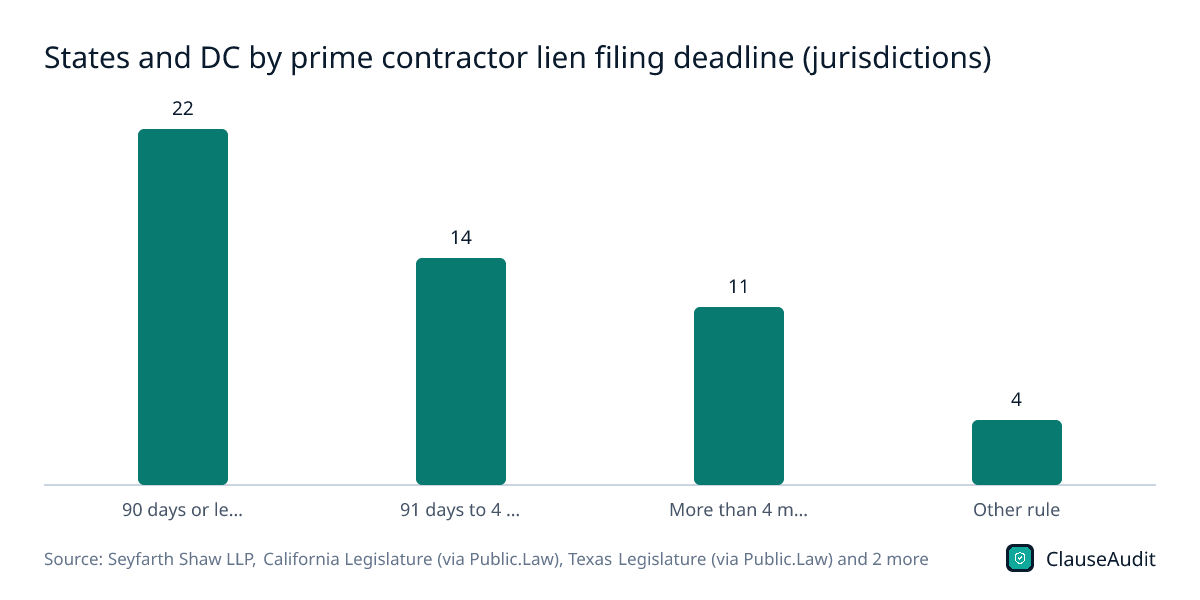
Most states give a prime contractor 4 months or less after the work ends to file a mechanics lien, and 22 of the 50 states and DC allow 90 days or less. Many also want a preliminary notice early. In California it is due 20 days after you first furnish work.

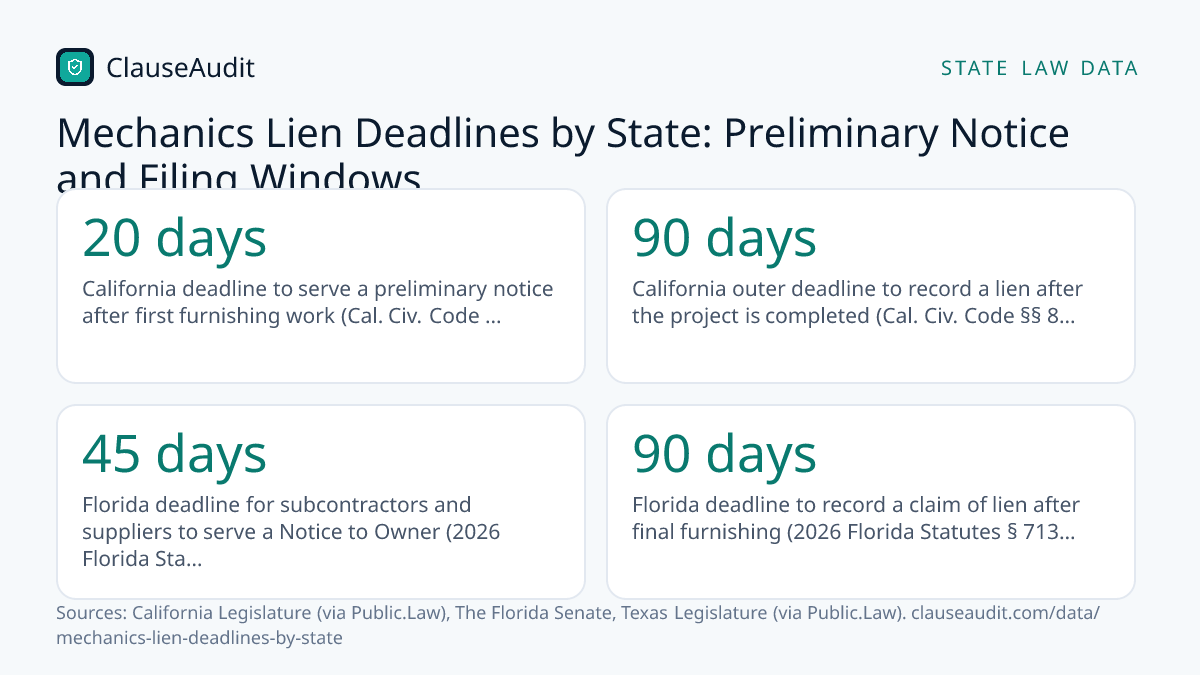
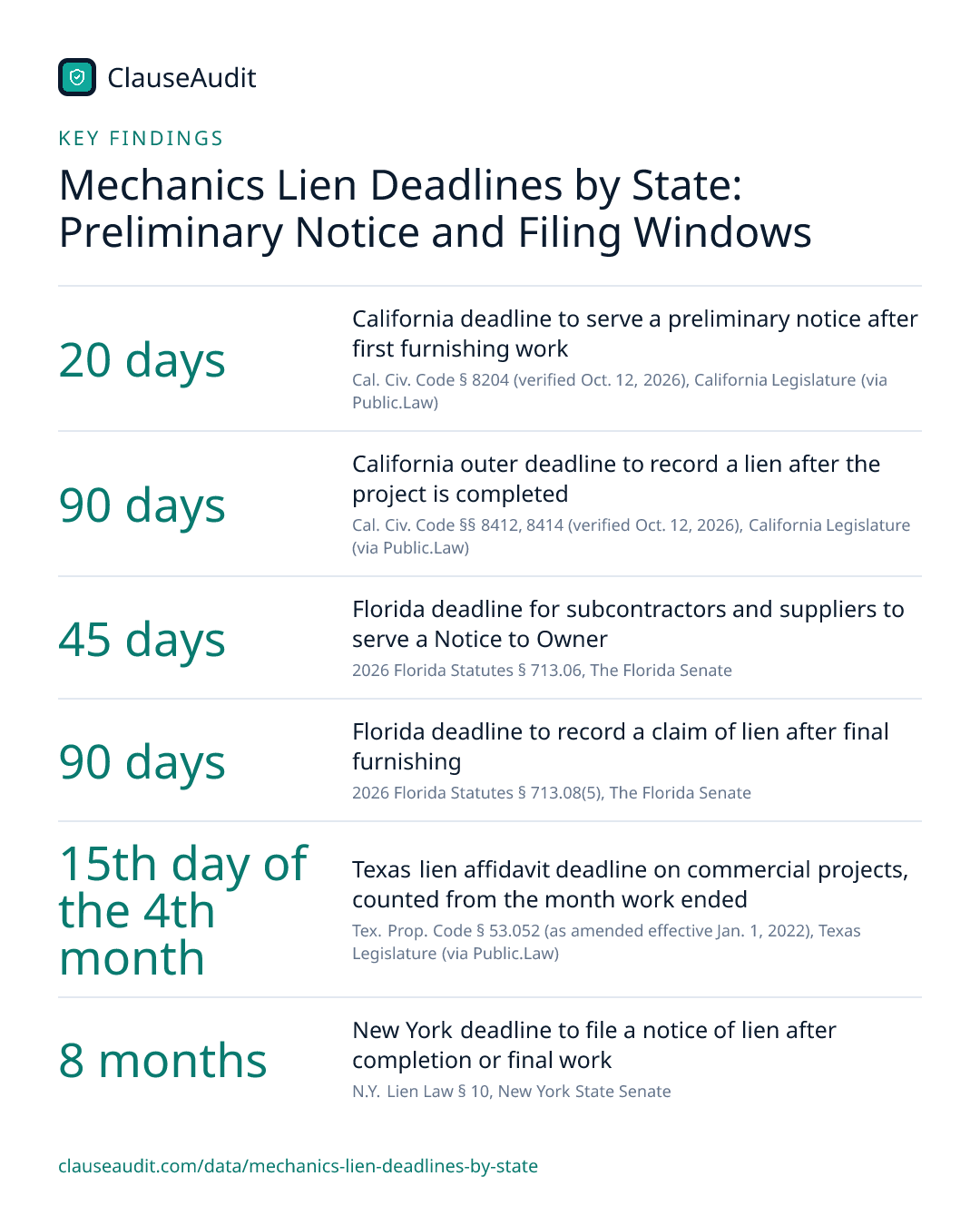
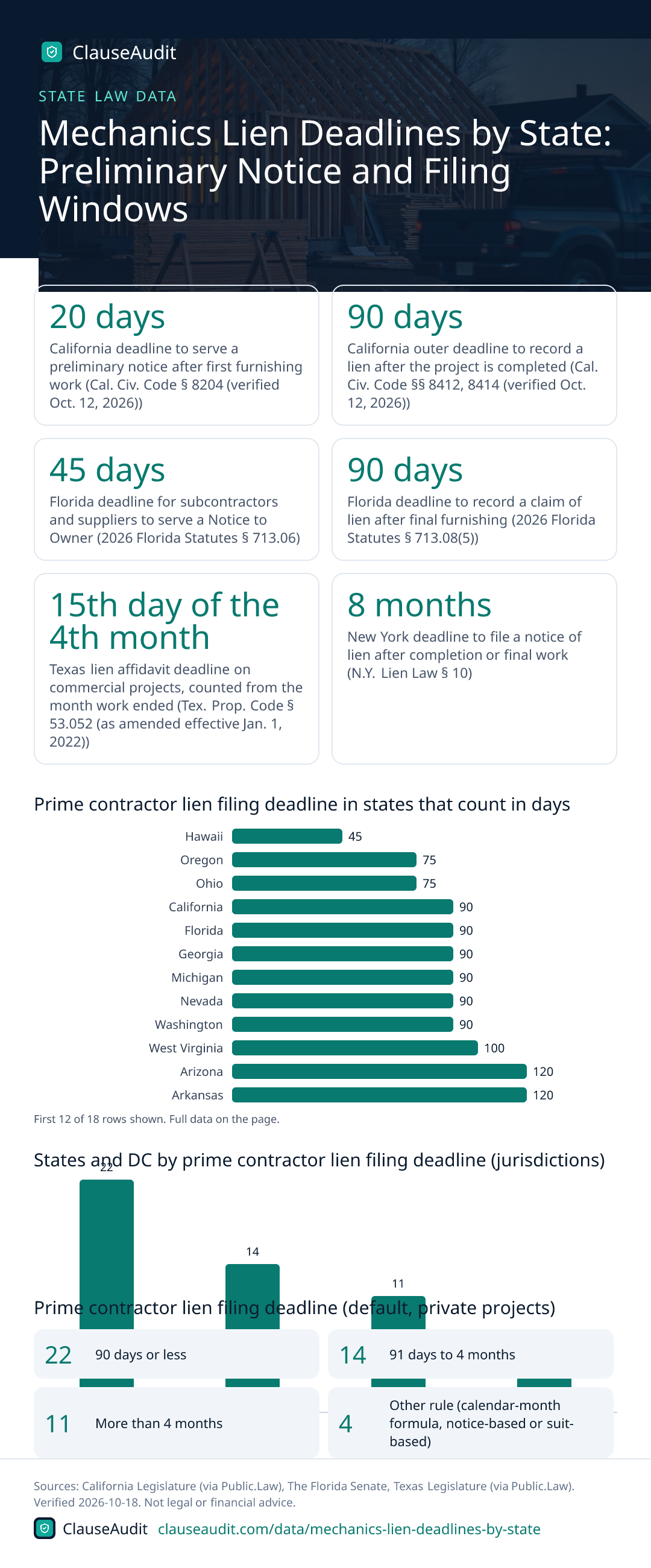
- California deadline to serve a preliminary notice after first furnishing work (Cal. Civ. Code § 8204 (verified Oct. 12, 2026), California Legislature (via Public.Law))
- 20 days
- California outer deadline to record a lien after the project is completed (Cal. Civ. Code §§ 8412, 8414 (verified Oct. 12, 2026), California Legislature (via Public.Law))
- 90 days
- Florida deadline for subcontractors and suppliers to serve a Notice to Owner (2026 Florida Statutes § 713.06, The Florida Senate)
- 45 days
- Florida deadline to record a claim of lien after final furnishing (2026 Florida Statutes § 713.08(5), The Florida Senate)
- 90 days
- Texas lien affidavit deadline on commercial projects, counted from the month work ended (Tex. Prop. Code § 53.052 (as amended effective Jan. 1, 2022), Texas Legislature (via Public.Law))
- 15th day of the 4th month
- New York deadline to file a notice of lien after completion or final work (N.Y. Lien Law § 10, New York State Senate)
- 8 months
- Oregon deadline to perfect a construction lien, one of the shortest day-based windows (Or. Rev. Stat. § 87.035 (current through early 2026 per source), Oregon Legislature (via Public.Law))
- 75 days
A mechanics lien is the strongest collection tool a contractor, sub or supplier has. It ties your unpaid bill to the property itself, so the owner cannot sell or refinance cleanly until you are paid. The catch is timing. Miss the window and the right is gone, no matter how good your invoice is.
Each state sets its own clock, and many run two of them: a preliminary notice that starts when you begin work, and a filing deadline that starts when the work ends. The map and table below show both for every state and DC. This page explains how to read them and what to put in your contract so the deadlines work for you.
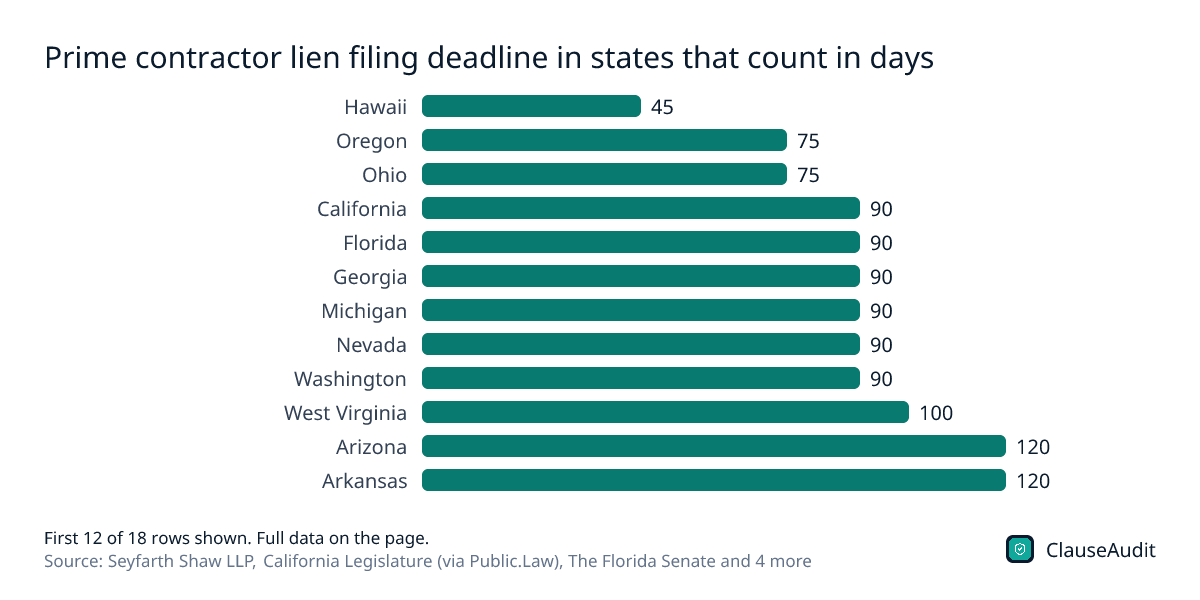
Prime contractor lien filing deadline in states that count in days
Chart data
| Label | Value |
|---|---|
| Hawaii | 45 |
| Oregon | 75 |
| Ohio | 75 |
| California | 90 |
| Florida | 90 |
| Georgia | 90 |
| Michigan | 90 |
| Nevada | 90 |
| Washington | 90 |
| West Virginia | 100 |
| Arizona | 120 |
| Arkansas | 120 |
| Minnesota | 120 |
| Nebraska | 120 |
| North Carolina | 120 |
| Delaware | 180 |
| Utah | 180 |
| Rhode Island | 200 |
Hawaii is the outlier at 45 days, and Oregon and Ohio follow at 75. If you work in more than one state, set your reminders by the shortest window, not the one you know best.
Download this chart (PNG)States and DC by prime contractor lien filing deadline (jurisdictions)
Chart data
| Label | Value (jurisdictions) |
|---|---|
| 90 days or less | 22 |
| 91 days to 4 months | 14 |
| More than 4 months | 11 |
| Other rule | 4 |
22 jurisdictions sit at 90 days or less. Only 11 give more than 4 months, so a slow-paying client can easily outlast your lien rights.
Download this chart (PNG)Days to file suit after recording a lien, states that count in days
Chart data
| Label | Value |
|---|---|
| Rhode Island | 40 |
| California | 90 |
| Massachusetts | 90 |
| Oregon | 120 |
| District of Columbia | 180 |
| Mississippi | 180 |
| Utah | 180 |
| Wyoming | 180 |
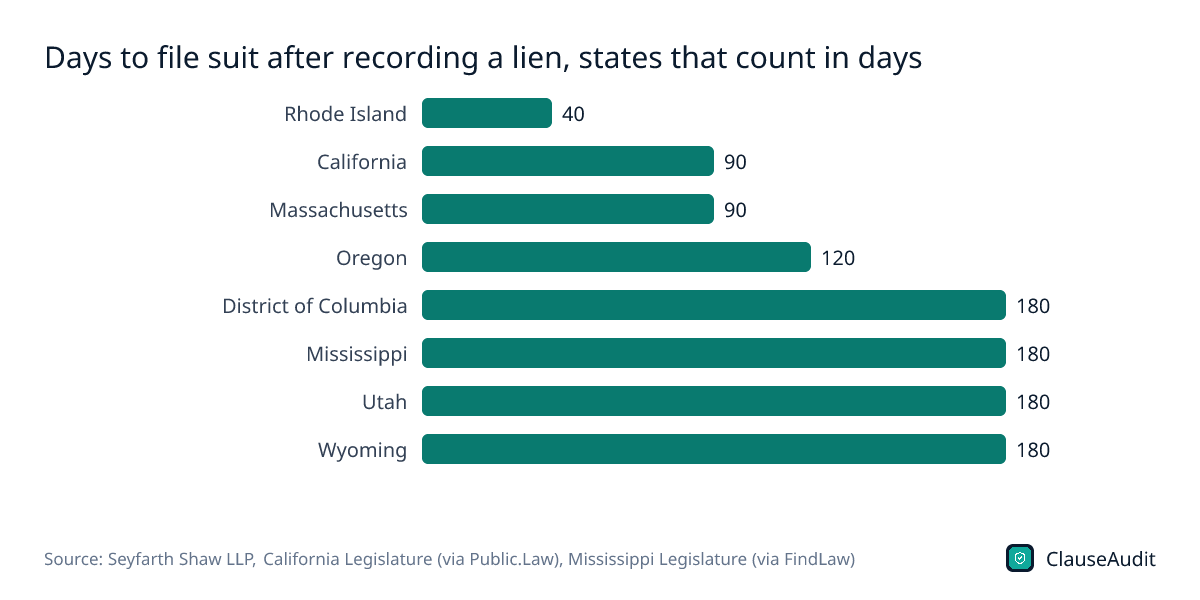
Filing the lien is not the finish line. Rhode Island gives 40 days to sue after the notice of intention, and California gives 90 days after recording.
Download this chart (PNG)Subcontractor preliminary notice deadline after first furnishing (days)
Chart data
| Label | Value |
|---|---|
| North Carolina | 15 |
| California | 20 |
| Arizona | 20 |
| Michigan | 20 |
| Montana | 20 |
| Utah | 20 |
| Ohio | 21 |
| Wyoming | 30 |
| Nevada | 31 |
| Florida | 45 |
| Minnesota | 45 |
| Washington | 60 |
| New Mexico | 60 |
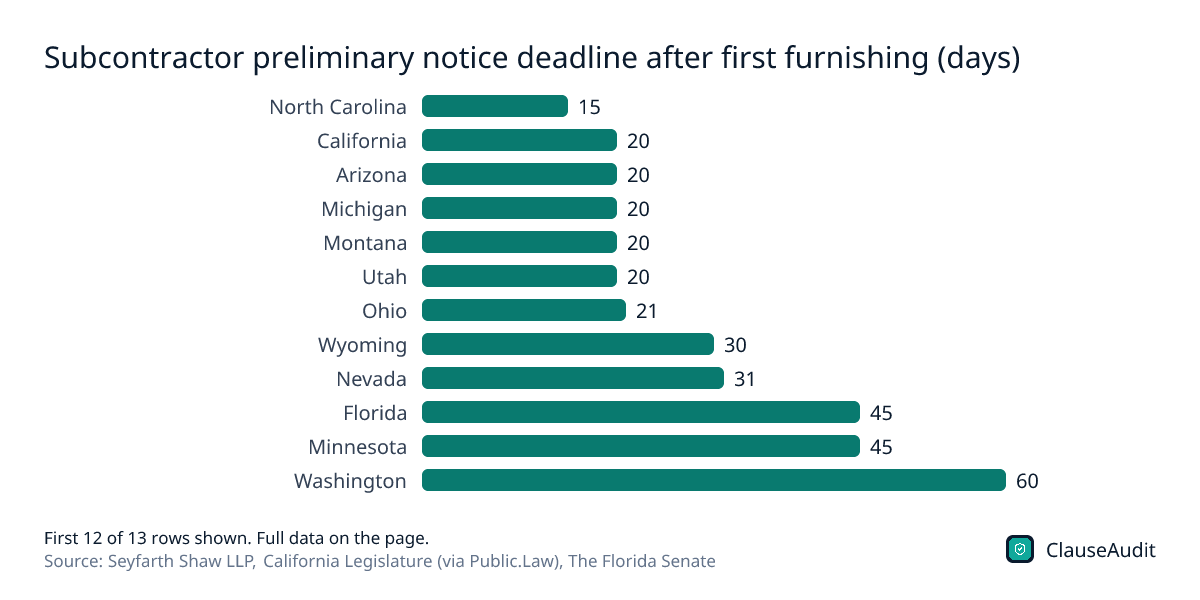
These notice clocks start on your first day, not your last. North Carolina's 15 days and the 20-day rule in California, Arizona, Michigan, Montana and Utah are easy to miss on a busy job.
Download this chart (PNG)How an owner's recorded notice of completion shortens the lien deadline
| State | Normal deadline | After a notice of completion |
|---|---|---|
| California | 90 days after completion | 60 days (prime) or 30 days (subs) after the notice is recorded |
| Arizona | 120 days after completion | 60 days after the notice is recorded |
| Nevada | 90 days after the latest of completion, last delivery or last work | 40 days after the notice is recorded |
| Alaska | 120 days after completing the contract or last furnishing | 15 days after the notice is recorded (for some claimants) |
| Utah | 180 days after final completion | 90 days after the notice is filed |
| Tennessee (prime) | 90 days after completion or abandonment | 30 days after the notice |
Source: California Legislature (via Public.Law), California Civil Code § 8412; California Legislature (via Public.Law), California Civil Code § 8414; Arizona State Legislature, Arizona Revised Statutes § 33-993; Nevada Legislature (via Public.Law), Nevada Revised Statutes § 108.226; Alaska Legislature (via FindLaw), Alaska Statutes § 34.35.068; Seyfarth Shaw LLP, 50 State Lien Law Notice Requirements, 2025 Update. Download as image
Prime contractor lien filing deadline (default, private projects) by state
- 2290 days or less
- 1491 days to 4 months
- 11More than 4 months
- 4Other rule (calendar-month formula, notice-based or suit-based)
- 90 days or less22
- 91 days to 4 months14
- More than 4 months11
- Other rule (calendar-month formula, notice-based or suit-based)4
| State | Preliminary notice | Lien deadline: prime contractor | Lien deadline: subcontractor | Deadline to sue to enforce | Source |
|---|---|---|---|---|---|
| Alabama | Prime: none. Subs: notice of intent to owner before filing; suppliers: before supplying materials | 6 months after last work or materials | 4 months after last work or materials (laborers 30 days) | 6 months after the debt matures (usually the last day of work) | Ala. Code § 35-11-210 et seq. |
| Alaska | Notice of right to lien recommended before work starts (affects deadline) | 120 days after completing the contract or last furnishing; 15 days after a recorded notice of completion for some claimants | Same as prime | 6 months after the claim of lien is recorded | Alaska Stat. §§ 34.35.068, 34.35.080 |
| Arizona | 20-day preliminary notice from every claimant, including the prime, within 20 days of first furnishing | 120 days after completion, or 60 days after a recorded notice of completion, whichever is earlier | Same as prime | 6 months after recording the claim of lien | Ariz. Rev. Stat. §§ 33-992.01, 33-993, 33-998 |
| Arkansas | Notice of intent at least 10 days before filing. Residential (4 units or fewer): prime gives owner notice before work; subs give notice of nonpayment within 75 days | 120 days after last labor or materials | Same as prime | 15 months after filing the lien | Ark. Code Ann. § 18-44-101 et seq. |
| California | 20-day preliminary notice within 20 days of first furnishing (prime to the lender; subs and suppliers to owner, prime and lender) | After completing the contract and before the earlier of 90 days after completion of the project or 60 days after a recorded notice of completion or cessation | Before the earlier of 90 days after completion of the project or 30 days after a recorded notice of completion or cessation | 90 days after recording the claim of lien | Cal. Civ. Code §§ 8204, 8412, 8414, 8460 |
| Colorado | None. Notice of intent to file served at least 10 days before filing | 4 months after last labor or materials (2 months after completion for day or piece labor without materials) | Same as prime | 6 months after completion of the improvement or last labor or materials | Colo. Rev. Stat. § 38-22-109 |
| Connecticut | Prime: none (optional affidavit within 15 days of starting work to receive notices). Subs: notice of intent no later than 90 days after work ends; serving the lien certificate can satisfy it | 90 days after last day of work; serve owners within 30 days of recording | Same as prime | 1 year after recording the lien | Conn. Gen. Stat. § 49-33 et seq. |
| Delaware | List of everyone who furnished labor or materials within 10 days of the owner's request | Statement of claim and suit filed together within 180 days after completion of the structure | Statement of claim and suit within 120 days after completing the sub's labor or last delivery | Filed with the statement of claim (same deadline) | Del. Code Ann. tit. 25, § 2701 et seq. |
| District of Columbia | None | During construction or within 90 days after the earlier of completion or termination of the project; serve owner within 5 business days | Same as prime | 180 days after filing the notice of lien | D.C. Code § 40-301.01 et seq. |
| Florida | Prime: statutory warning in contracts over $2,500. Subs and suppliers: Notice to Owner before or within 45 days after starting work | 90 days after final furnishing of labor, services or materials | Same as prime | 1 year after recording the claim of lien (60 days after an owner's notice of contest) | Fla. Stat. §§ 713.015, 713.06, 713.08, 713.22 |
| Georgia | Prime: none. Subs and suppliers without a direct contract: Notice to Contractor within 30 days of the later of the notice of commencement filing or first furnishing (when a notice of commencement is filed) | 90 days after last furnishing labor, services or materials | Same as prime | 365 days after filing the lien (60 days after an owner's notice of contest) | Ga. Code Ann. § 44-14-360 et seq. |
| Hawaii | None | Application for lien filed within 45 days after completion of the improvements | Same as prime | 3 months after the court order directing the lien to attach | Haw. Rev. Stat. § 507-41 et seq. |
| Idaho | None | 90 days after completion or cessation of labor, services or materials; serve owner within 5 business days | Same as prime | 6 months after filing the lien | Idaho Code § 45-501 et seq. |
| Illinois | Prime: none. Subs: notice to owner within 90 days after completing work; 60 days after first furnishing on owner-occupied single-family homes | 4 months after completion to bind owner and third parties (up to 2 years after completion against the original owner only) | Record within 4 months after completion (plus the 90-day notice) | 2 years after completion of the work (30 days after an owner's written demand) | 770 ILCS 60/0.01 et seq. |
| Indiana | Prime: none. Subs: only on owner-occupied residential work (30 days for repairs, 60 days for new homes) | 90 days after last labor or materials (60 days for Class 2 structures) | Same as prime | 1 year after recording the notice of intent to hold a lien | Ind. Code § 32-28-3-1 et seq. |
| Iowa | Residential: prime posts notice of commencement within 10 days of starting; subs post preliminary notice on the state lien registry. Commercial: sub-subs and suppliers to subs notify the prime within 30 days | Post on the mechanics' notice and lien registry within 90 days of last furnishing for full protection; later filings (up to 2 years and 90 days) are limited to the unpaid balance | Same as prime | 2 years after the 90-day filing period ends (30 days after an owner's written demand) | Iowa Code § 572.1 et seq. |
| Kansas | None for non-residential property | 4 months after last furnishing (extendable to 5 months on non-residential property by filing a notice of extension) | 3 months after last furnishing (extendable to 5 months on non-residential property) | 1 year after filing the lien statement | Kan. Stat. Ann. § 60-1101 et seq. |
| Kentucky | Prime: none. Subs: notice of intent within 75 days of last furnishing (claims of $1,000 or less, or owner-occupied homes) or 120 days (claims over $1,000) | 6 months after last furnishing labor or materials | Same as prime | 12 months after filing the statement of lien | Ky. Rev. Stat. Ann. § 376.010 et seq. |
| Louisiana | Notice of contract filed before work begins on contracts over $100,000 | Notice of contract filed: 60 days after an owner's notice of termination, or 7 months after substantial completion if none. No notice of contract: 60 days after notice of termination or substantial completion | Notice of contract filed: 30 days after notice of termination, or 6 months after substantial completion if none. No notice of contract: 60 days | 1 year after filing the statement of claim | La. Rev. Stat. Ann. § 9:4801 et seq. |
| Maine | None | No lien statement needed with a direct owner contract; must sue within 120 days after last labor or materials | Record lien statement within 90 days after last labor or materials | 120 days after last labor, services or materials | Me. Rev. Stat. tit. 10, § 3251 et seq. |
| Maryland | Prime: none. Subs: notice of intention to claim a lien within 120 days after last work or materials | Petition to establish the lien within 180 days after last work or materials | Same as prime | 1 year after filing the petition to establish the lien | Md. Code Ann., Real Prop. § 9-101 et seq. |
| Massachusetts | Lower-tier subs and suppliers: notice of identification to the prime within 30 days of starting work | Notice of contract by the earliest of 60 days after a notice of substantial completion, 90 days after a notice of termination, or 90 days after last furnishing; then statement of account by the earliest of 90, 120 or 120 days after the same events | Same two-step rule as prime | 90 days after filing the statement of account | Mass. Gen. Laws ch. 254, § 1 et seq. |
| Michigan | Prime: none. Subs and suppliers: notice of furnishing within 20 days after first furnishing | 90 days after last furnishing labor or material | Same as prime | 1 year after recording the claim of lien | Mich. Comp. Laws § 570.1101 et seq. |
| Minnesota | Prime: preliminary notice in the written contract, or within 10 days after the work is agreed. Subs: within 45 days of first furnishing (residential and commercial buildings of 5,000 sq ft or less) | 120 days after last furnishing labor or materials | Same as prime | 1 year after last furnishing labor, skill or material | Minn. Stat. § 514.01 et seq. |
| Mississippi | Single-family residential only: subs, suppliers and design professionals without a direct owner contract give a pre-lien notice at least 10 days before filing | 90 days after the claimant's last work, labor, services or materials | Same as prime | 180 days after filing the claim of lien | Miss. Code Ann. §§ 85-7-405, 85-7-409 |
| Missouri | Prime: statutory disclosure notice to owner before first payment. Subs: notice to owner at least 10 days before filing | 6 months after the debt accrues | Same as prime | 6 months after filing the lien statement | Mo. Rev. Stat. § 429.010 et seq. |
| Montana | Prime: none. Subs and suppliers: notice of right to claim a lien within 20 days of first furnishing (not required for some, including commercial projects) | 90 days after last furnishing services or materials (or after a notice of completion) | Same as prime | 2 years after filing the lien | Mont. Code Ann. § 71-3-521 et seq. |
| Nebraska | None required (advisable when the owner is a protected party) | 120 days after final furnishing; serve owner within 10 days of recording | Same as prime | 2 years after recording (30 days after an owner's recorded demand) | Neb. Rev. Stat. § 52-125 et seq. |
| Nevada | Prime: residential notice of intent 15 days before recording. Subs and suppliers: preliminary notice within 31 days of first furnishing | 90 days after the latest of project completion, last delivery or last work; 40 days after a recorded notice of completion | Same as prime | 6 months after recording the lien | Nev. Rev. Stat. § 108.226 |
| New Hampshire | Prime: none. Subs and suppliers: notice to owner, ideally before furnishing, plus an account every 30 days | Perfect by suing and recording an attachment within 120 days of last furnishing | Same as prime | Suit and attachment are the perfection step (120 days) | N.H. Rev. Stat. Ann. § 447:1 et seq. |
| New Jersey | Commercial: none. Residential: Notice of Unpaid Balance and Right to File Lien within 60 days of last work, then arbitration | Commercial: 90 days after last work. Residential: 120 days after last work and within 10 days of the arbitrator's decision | Same as prime | 1 year after last work (30 days after a written demand) | N.J. Stat. Ann. § 2A:44A-1 et seq. |
| New Mexico | Prime: none. Subs and suppliers without a direct prime contract: notice within 60 days of first furnishing if the lien exceeds $5,000 | 120 days after completing the contract | 90 days after substantial completion of the project | 2 years after filing the lien | N.M. Stat. Ann. § 48-2-1 et seq. |
| New York | None (non-notice state) | 8 months after completion or final work or materials (4 months for a single-family home) | Same as prime | 1 year after filing, unless a foreclosure action is started (with a notice of pendency) or an extension is filed with the county clerk; each extension adds up to 1 year (single-family homes: extension by court order only) | N.Y. Lien Law §§ 10, 17 |
| North Carolina | Notice to the owner's lien agent within 15 days after first furnishing | 120 days after last furnishing labor or materials | Same as prime (real property lien) | 180 days after last furnishing | N.C. Gen. Stat. § 44A-7 et seq. |
| North Dakota | Written notice of intent by certified mail at least 10 days before recording | 90 days after the claimant's work or materials are completed (no later than 3 years after first furnishing) | Same as prime | 3 years after recording (30 days after a written demand) | N.D. Cent. Code § 35-27-01 et seq. |
| Ohio | Prime: none. Subs and suppliers: notice of furnishing within 21 days of first furnishing if the owner filed a notice of commencement | 75 days after last work or materials (60 days for certain homes and condominiums; 120 days for oil and gas wells) | Same as prime | 6 years after filing (60 days after a notice to commence suit) | Ohio Rev. Code Ann. § 1311.01 et seq. |
| Oklahoma | Prime: none. Subs: pre-lien notice within 75 days after last furnishing | 4 months after last furnishing labor or materials | 90 days after last furnishing | 1 year after filing the lien statement | Okla. Stat. tit. 42, §§ 141-143 |
| Oregon | Prime: information notice to owner at contract signing on residential jobs. Subs and suppliers: notice of right to lien; it protects only work from 8 days (excluding weekends and holidays) before delivery | Earlier of 75 days after last furnishing or 75 days after completion of construction | Same as prime | 120 days after recording the claim of lien | Or. Rev. Stat. §§ 87.021, 87.035, 87.055 |
| Pennsylvania | Prime: none. Subs: notice of furnishing within 45 days of first work if a notice of commencement is posted (projects of $1.5 million or more); notice of intent 30 days before filing | 6 months after completing its work | Same as prime | Action within 2 years of filing the lien claim | 49 P.S. § 1101 et seq. |
| Rhode Island | Prime: Notice of Possible Mechanic's Lien in the contract or given before work starts | Notice of intention filed and served within 200 days after doing the work | Same as prime | Lis pendens and complaint within 40 days after recording the notice of intention | R.I. Gen. Laws § 34-28-1 et seq. |
| South Carolina | Subs and suppliers should notify the owner of furnishing before the lien attaches | 90 days after ceasing to furnish labor or materials | Same as prime | 6 months after ceasing to furnish labor or materials | S.C. Code Ann. § 29-5-10 et seq. |
| South Dakota | Prime: none. Second-tier subs and suppliers: notice within 60 days of last furnishing if a notice of project commencement was filed | 120 days after last work | Same as prime | 6 years after last work (30 days after an owner's demand) | S.D. Codified Laws § 44-9-1 et seq. |
| Tennessee | Prime: none on most projects. Subs: notice of nonpayment within 90 days of the last day of each month of work | Record within 90 days after the improvement is completed or abandoned (30 days after an owner's notice of completion) | 90 days after completion or abandonment | Prime: 1 year after work is finished. Subs: 90 days after recording | Tenn. Code Ann. § 66-11-101 et seq. |
| Texas | Prime: none. Subs and suppliers: notice by the 15th day of the 3rd month after each month of work (2nd month on residential) | 15th day of the 4th month after the month the work was completed, terminated or abandoned (3rd month on residential) | 15th day of the 4th month after the month of last labor or materials (3rd month on residential) | 1 year after the last day the lien affidavit could be filed | Tex. Prop. Code §§ 53.052, 53.056, 53.158 |
| Utah | Preliminary notice on the State Construction Registry within 20 days after starting work (all claimants, including the prime) | 180 days after final completion of the original contract; 90 days after a notice of completion (but no later than 180 days) | Same as prime | 180 days after recording the notice of lien | Utah Code Ann. § 38-1a-501 et seq. |
| Vermont | None (optional pre-lien notice sets priority) | Written notice of lien to owner; to last beyond 180 days after payment was due, also record a memorandum of lien with the town clerk | Same as prime | 180 days after recording the memorandum (if payment is due) or after payment becomes due | Vt. Stat. Ann. tit. 9, § 1921 et seq. |
| Virginia | None, except optional notice to a mechanic's lien agent on 1-2 family homes within 30 days of first furnishing | 90 days from the last day of the month of last work, and no later than 90 days after the structure is completed or work ends (covers only work from the prior 150 days, except retainage) | Same as prime | 6 months after recording, or 60 days after completion, whichever is later | Va. Code Ann. § 43-1 et seq. |
| Washington | Prime: generally none. Subs and suppliers without a direct contract: notice within 60 days of first furnishing (10 days on new single-family homes) | 90 days after ceasing to furnish labor, services, materials or equipment | Same as prime | 8 calendar months after recording the lien | Rev. Code Wash. § 60.04.091 |
| West Virginia | None (optional notice) | 100 days after completion of the contract | 100 days after last furnishing | 6 months after filing the notice of lien | W. Va. Code § 38-2-1 et seq. |
| Wisconsin | Residential (fewer than 4 units): prime notice in the contract or within 10 days; subs within 60 days of first furnishing. Notice of intent 30 days before filing | 6 months after last labor, services or materials | Same as prime | 2 years after filing the lien claim | Wis. Stat. § 779.01 et seq. |
| Wyoming | Prime: notice of lien rights to owner before any payment. Subs: notice within 30 days of first furnishing. Notice of intent 20 days before filing | 150 days after last work or substantial completion, whichever is earlier | 120 days after last work or substantial completion, whichever is earlier | 180 days after filing the lien statement | Wyo. Stat. Ann. § 29-1-201 et seq. |
How long do you have to file a mechanics lien?
For a prime contractor on a private project, the answer is usually short. Our tally of the 50 states and DC puts 22 jurisdictions at 90 days or less, 14 between 91 days and 4 months, and 11 at more than 4 months. The other 4, Louisiana, Maine, Texas and Vermont, use a different rule altogether.
Some windows are tight. Hawaii gives 45 days after completion. Oregon and Ohio give 75 days. California, Florida, Georgia, Michigan, Nevada and Washington sit at 90 days. At the long end, New York allows 8 months, but only 4 months on a single-family home, and Rhode Island allows 200 days for its notice of intention.
Texas counts in months, not days. On a commercial job the lien affidavit is due by the 15th day of the 4th month after the month your work ended. On residential work it is the 3rd month. So if you finish on the last day of a month, you lose most of a month compared with someone who finished on the first.
What is a preliminary notice and when is it due?
A preliminary notice tells the owner, and often the lender and prime contractor, that you are on the job and expect to be paid. Many states make it a condition of lien rights for subs and suppliers who did not sign with the owner. Skip it and the later lien may fail even if you file on time.
The deadlines are early. North Carolina wants notice to the owner's lien agent within 15 days of first furnishing. California, Arizona, Michigan, Montana and Utah use 20 days. Ohio uses 21 days when the owner filed a notice of commencement. Florida subs and suppliers get 45 days to serve a Notice to Owner, and Washington gives 60 days, or 10 days on a new single-family home.
California has a useful safety net. A late notice still counts, but it only covers work from 20 days before you served it. That means sending a notice on day 50 does not save the first month of work. The lesson is simple: send the notice in your first week, every time, even for clients you trust.
When does the lien clock start?
Most states count from your last day of furnishing labor or materials. California, Arizona, Hawaii, Delaware, Utah and West Virginia count from completion of the contract or the project instead. That difference matters if you finish your part early and the building keeps going for months.
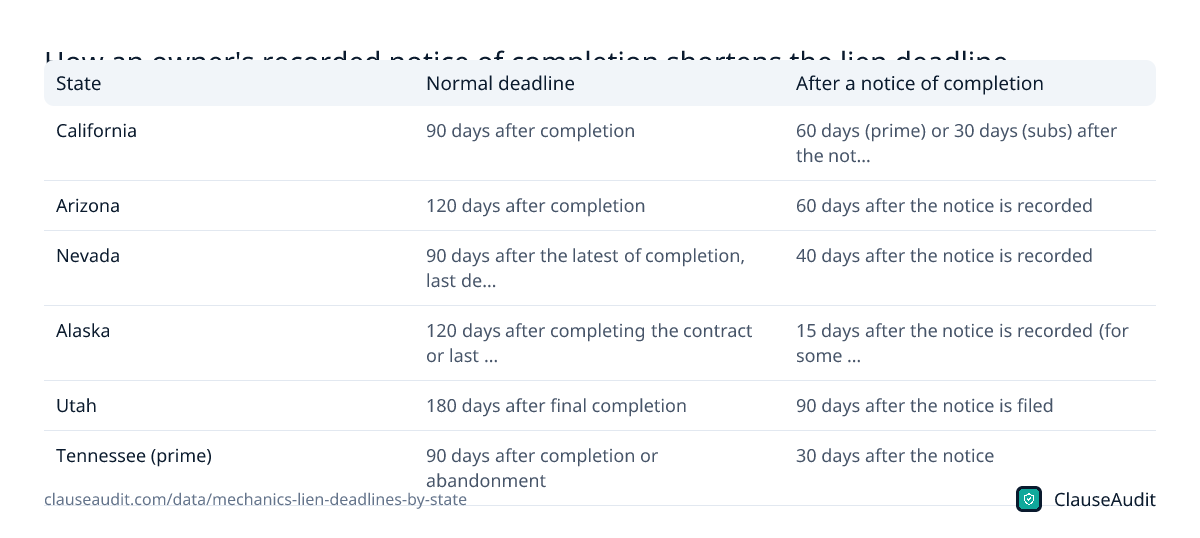
The owner can also shorten your window. In California a recorded notice of completion cuts the deadline to 60 days for a prime and 30 days for a sub. Arizona drops to 60 days. Nevada drops to 40 days. Alaska can drop to 15 days for some claimants, and Tennessee to 30 days for the prime.
Here is how that plays out. A drywall sub in California finishes in March. The project wraps in June, and the owner records a notice of completion. The sub now has 30 days from that recording, not 90 days from completion. Do not count on hearing about the notice in time. Ask in writing to be told when one is recorded, and check the county records yourself near the end of any job.
What happens after you record the lien?
A recorded lien does not last forever. You have to sue to enforce it, and that deadline can be short. In California you must file suit within 90 days of recording. Massachusetts also gives 90 days, counted from the statement of account. Rhode Island gives just 40 days after recording the notice of intention.
Other states are more relaxed. Florida keeps a lien alive for 1 year after recording unless you sue, though an owner's notice of contest can cut that to 60 days. Oregon allows 120 days, and DC, Mississippi, Utah and Wyoming allow 180 days.
In practice, recording the lien often gets the client to the table, because a title search will show it to any buyer or lender. If it does not, talk to a construction lawyer well before the enforcement date. A lien that lapses is worth nothing, and by then it is usually too late to record a new one for the same work.
What should you do the day you start a job?
- Look up the state in the table below and write both deadlines on the job file: the preliminary notice date and the last possible lien date.
- Get the owner's legal name, the property's legal description and the lender's details before you start. You need them for the notice and the lien.
- Serve the preliminary notice in the first week, by a method the statute allows, and keep proof of delivery.
- Track your last day of furnishing. Keep delivery tickets and timesheets so you can prove it later.
- Ask the owner or prime to tell you in writing if a notice of completion or commencement is recorded.
- Set calendar reminders well ahead of the lien deadline and the deadline to sue, not on the day itself.
Do lien rights cover freelancers and small trades?
They cover people who improve real property: prime contractors, subs, suppliers, laborers, and in some states design professionals. A freelance designer who only builds a website has no lien rights. A freelance carpenter, electrician or tile setter usually does.
Check which side of the job you sit on, too. A prime with a direct contract with the owner often has no preliminary notice duty, while a sub or supplier lower down the chain usually does. The rules for small residential jobs are often stricter. New York cuts its window to 4 months on a single-family home. Texas moves its deadline up by a month on residential work. Washington's notice drops to 10 days on new single-family homes. If most of your work is in homes, read the residential note for your state before you rely on the headline number.
How ClauseAudit helps
Lien rights are your backup plan. Your contract is the first line of defense, and it decides how fast you get paid, what counts as complete, and whether you can stop work when a payment is late.
Run your agreement through an automated review before you sign. It flags payment terms that push your money past the lien window, waivers of lien rights, and vague completion language that makes your deadline hard to pin down.
- Payment terms: due dates that fall well inside your state's lien deadline, not after it
- Lien waivers: any clause that gives up lien rights before you are paid, or unconditional waivers tied to progress payments
- Completion and acceptance: a clear definition of when your work is finished, so your clock is easy to prove
- Pay-when-paid or pay-if-paid language that ties your payment to the owner paying someone else
- Late fees and the right to stop work if an invoice goes unpaid
- Notice provisions: who must tell you when a notice of completion or commencement is recorded
Frequently asked questions
What is the shortest mechanics lien deadline in the US?
Among states that count in days, Hawaii is the shortest for a prime contractor, at 45 days after completion of the improvements. Oregon and Ohio follow at 75 days. A recorded notice of completion can make some windows even shorter, such as 15 days for some claimants in Alaska or 30 days for subs in California.
How long do I have to file a mechanics lien in California?
No more than 90 days after the project is completed. If the owner records a notice of completion or cessation, that drops to 60 days for a prime contractor and 30 days for a sub or supplier. You also need a preliminary notice within 20 days of first furnishing, and you must sue within 90 days of recording the lien.
What is the Florida Notice to Owner deadline?
Subcontractors and suppliers must serve a Notice to Owner before starting work or within 45 days after they start. The claim of lien itself is due within 90 days of final furnishing. Once recorded, the lien lasts 1 year unless you file suit, or 60 days if the owner serves a notice of contest.
How does the Texas lien deadline work?
Texas counts by calendar month. On commercial projects the lien affidavit is due by the 15th day of the 4th month after the month the work was completed, terminated or abandoned. On residential projects it is the 15th day of the 3rd month. Subs also send monthly notices on a similar month-based schedule.
How long do I have to file a mechanics lien in New York?
New York gives 8 months after completion or your final work or materials. On a single-family home the window is 4 months. New York does not require a preliminary notice, but the lien expires 1 year after filing unless you start a foreclosure action or file an extension.
Can I still file a lien if I missed the preliminary notice?
It depends on the state. In some, a missed notice ends your lien rights entirely. California is more forgiving: a late notice still works, but it only covers work from 20 days before you served it onward. Earlier unpaid work falls outside the lien, so serve notice early.
Does a lien last forever once it is recorded?
No. Every state sets a deadline to sue to enforce it. Rhode Island allows 40 days after the notice of intention, California and Massachusetts 90 days, Oregon 120 days, and DC, Mississippi, Utah and Wyoming 180 days. If you do not sue in time, the lien lapses and the property is cleared.
Should I sign a contract that waives my lien rights?
Be very careful. Many states limit advance waivers, but a broad waiver in your contract can still cause trouble and stall a collection. Ask to strike it, or swap it for conditional waivers that take effect only when each payment actually clears. Have a lawyer in your state look at any waiver before you sign.
Use this data
Every chart and card below is free to reuse under CC BY 4.0. Download what you need and link back to this page.
 Stat cards
 Key findings card
 Infographic
 Prime contractor lien filing deadline in states that count in days
 States and DC by prime contractor lien filing deadline (jurisdictions)
 Days to file suit after recording a lien, states that count in days
 Subcontractor preliminary notice deadline after first furnishing (days)
 How an owner's recorded notice of completion shortens the lien deadline
Embed the infographic
Free to share on your site, blog or slides under CC BY 4.0. Please keep the credit link.
Sources and method
Every number on this page comes from the sources below, each opened and read on or before October 18, 2026. A second, independent review checked every figure against its source and corrected anything that did not match. 51 of 51 state entries were confirmed; any that could not be are marked "Not yet confirmed" and left out of every count and chart.
- Seyfarth Shaw LLP, 50 State Lien Law Notice Requirements, 2025 Update (May 2025 (statutes in effect as of May 1, 2025))
- California Legislature (via Public.Law), California Civil Code § 8204 (Section updated Jan. 1, 2011; verified Oct. 12, 2026)
- California Legislature (via Public.Law), California Civil Code § 8412 (Section updated Jan. 1, 2011; verified Oct. 12, 2026)
- California Legislature (via Public.Law), California Civil Code § 8414 (Section updated Jan. 1, 2011; verified Oct. 12, 2026)
- California Legislature (via Public.Law), California Civil Code § 8460 (Section updated Jan. 1, 2011; verified Oct. 12, 2026)
- Texas Legislature (via Public.Law), Texas Property Code § 53.052 (As amended by H.B. 2237 (2021), effective Jan. 1, 2022; verified May 26, 2025)
- Texas Legislature (via Public.Law), Texas Property Code § 53.056 (Effective Jan. 1, 2022; verified May 26, 2025)
- Texas Legislature (via Public.Law), Texas Property Code § 53.158 (Verified May 26, 2025)
- The Florida Senate, Florida Statutes § 713.06 (2026 Florida Statutes)
- The Florida Senate, Florida Statutes § 713.08 (2026 Florida Statutes)
- The Florida Senate, Florida Statutes § 713.22 (2026 Florida Statutes)
- New York State Senate, New York Lien Law § 10 (Text as revised 2014-09-22)
- New York State Senate, New York Lien Law § 17 (Current text as accessed Oct. 2026)
- Arizona State Legislature, Arizona Revised Statutes § 33-993 (Current text as accessed Oct. 2026)
- Arizona State Legislature, Arizona Revised Statutes § 33-992.01 (Current text as accessed Oct. 2026)
- Washington State Legislature, Revised Code of Washington § 60.04.091 (Current text as accessed Oct. 2026)
- Colorado General Assembly (via Public.Law), Colorado Revised Statutes § 38-22-109 (2024 C.R.S.; site current through Fall 2025)
- Oregon Legislature (via Public.Law), Oregon Revised Statutes § 87.035 (2023 ORS with 2024 changes; current through early 2026)
- Oregon Legislature (via Public.Law), Oregon Revised Statutes § 87.021 (2023 ORS with 2024 changes; current through early 2026)
- Nevada Legislature (via Public.Law), Nevada Revised Statutes § 108.226 (Accessed by publisher May 26, 2025)
- Mississippi Legislature (via FindLaw), Mississippi Code § 85-7-405 (Current text as accessed Oct. 2026)
- Mississippi Legislature (via FindLaw), Mississippi Code § 85-7-409 (Current text as accessed Oct. 2026)
- Alaska Legislature (via FindLaw), Alaska Statutes § 34.35.068 (Current text as accessed Oct. 2026)
Cite this page
ClauseAudit, “Mechanics Lien Deadlines by State: Preliminary Notice and Filing Windows”, updated October 18, 2026, https://clauseaudit.com/data/mechanics-lien-deadlines-by-state. Free to reuse with a link back (CC BY 4.0).
This page summarises published data and law as checked on October 18, 2026. Figures are updated as new editions are released, and your own situation may differ. It is general information, not legal, tax or financial advice.