How Long Does It Take to Sell a Business? Days on Market by Industry and Deal Size
By ClauseAudit Research · 8 sources ·
How long does it take to sell a business?
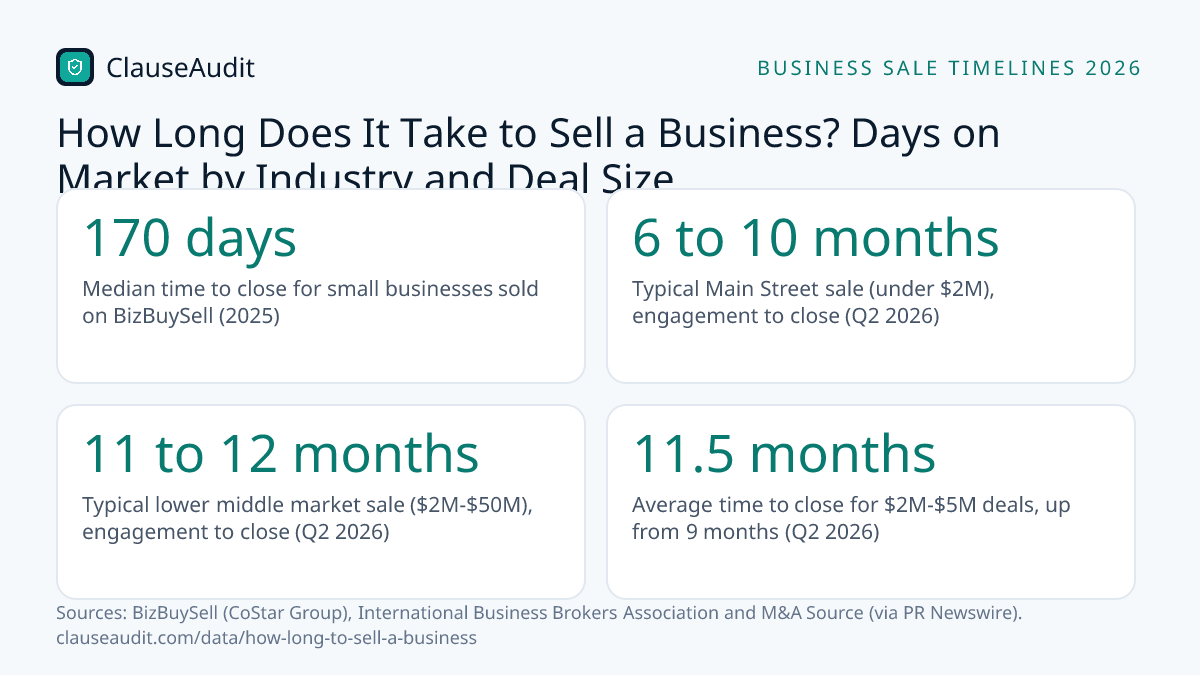
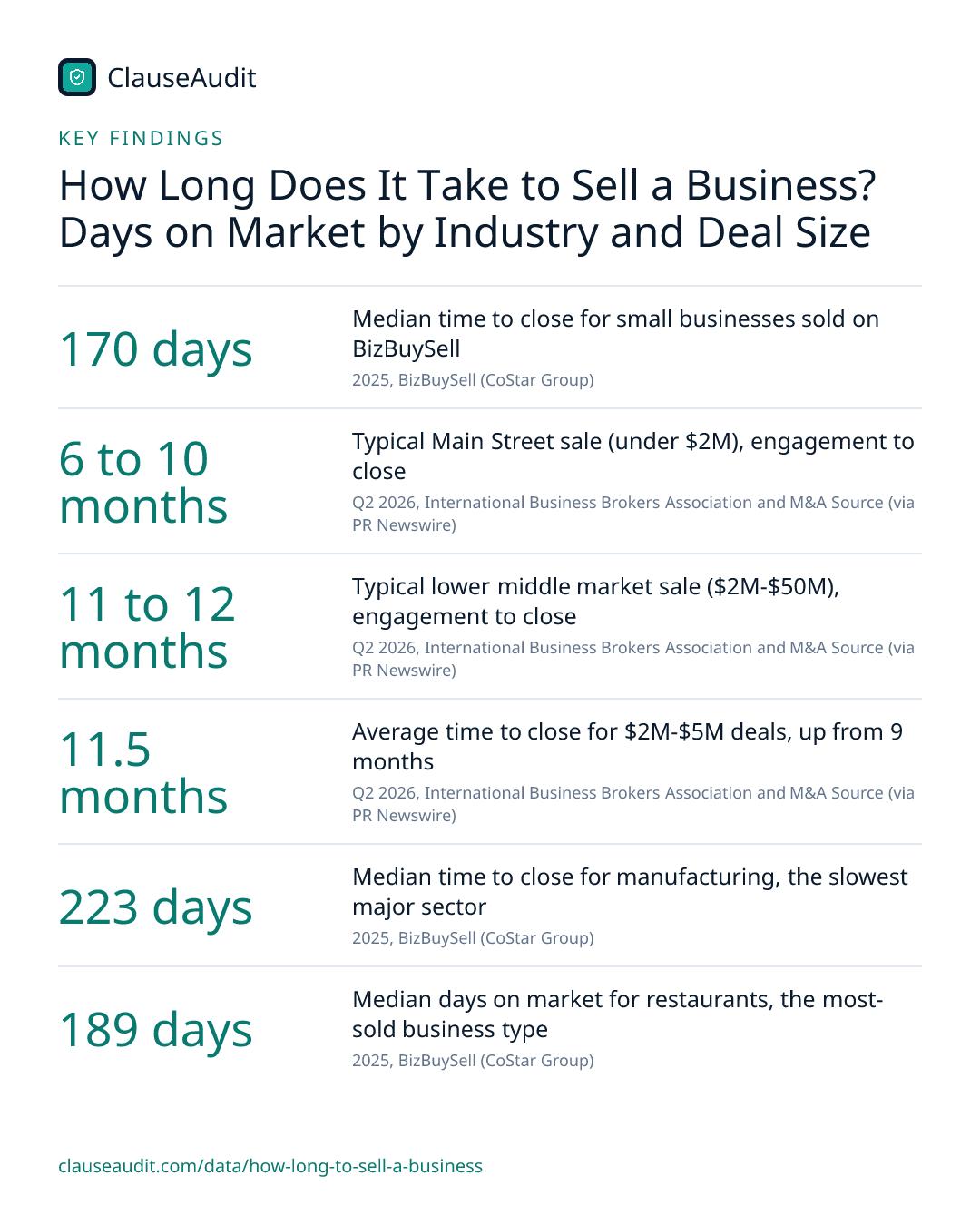
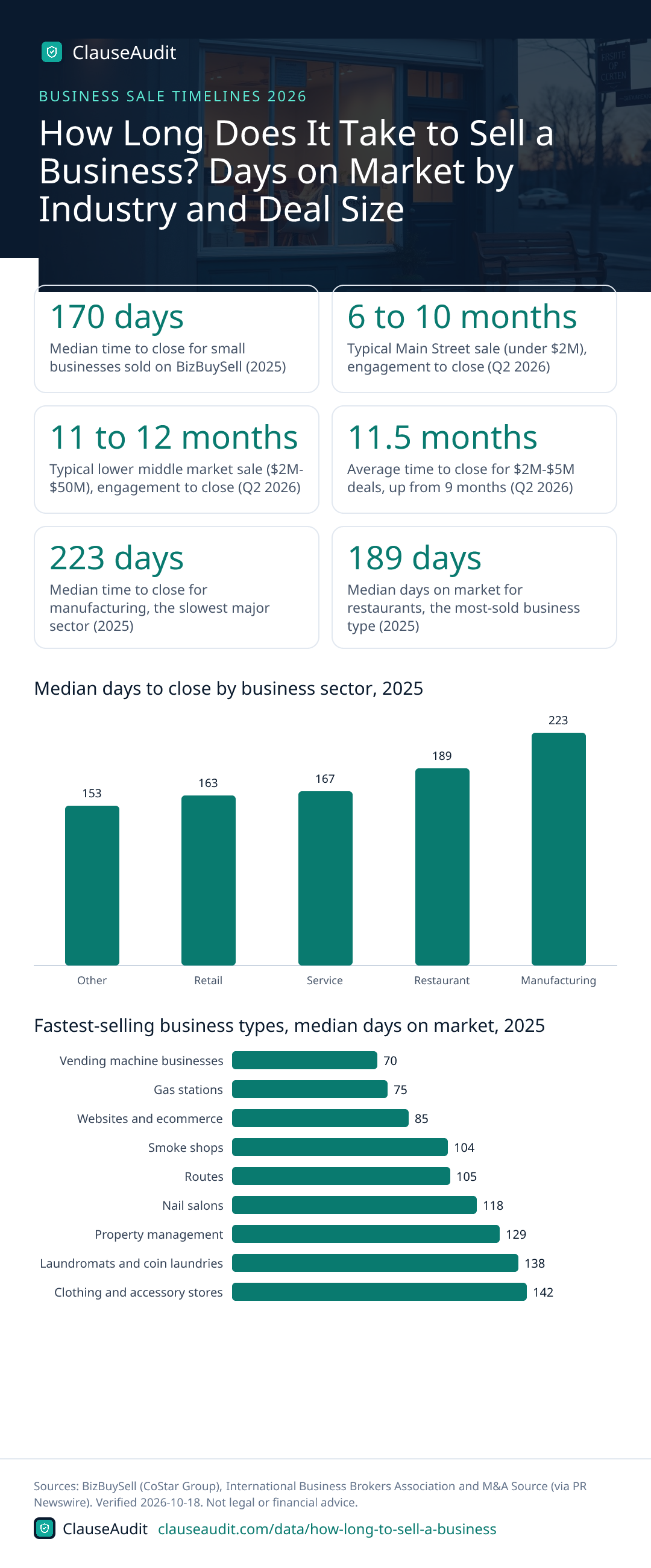
The median small business sold through BizBuySell took 170 days to close in 2025. Brokers say Main Street deals under $2 million usually run 6 to 10 months from engagement to close, while $2 million to $50 million deals take 11 to 12 months. Industry matters a lot: ecommerce sites sold in 85 days, manufacturers in 223.

- Median time to close for small businesses sold on BizBuySell (2025, BizBuySell (CoStar Group))
- 170 days
- Typical Main Street sale (under $2M), engagement to close (Q2 2026, International Business Brokers Association and M&A Source (via PR Newswire))
- 6 to 10 months
- Typical lower middle market sale ($2M-$50M), engagement to close (Q2 2026, International Business Brokers Association and M&A Source (via PR Newswire))
- 11 to 12 months
- Average time to close for $2M-$5M deals, up from 9 months (Q2 2026, International Business Brokers Association and M&A Source (via PR Newswire))
- 11.5 months
- Median time to close for manufacturing, the slowest major sector (2025, BizBuySell (CoStar Group))
- 223 days
- Median days on market for restaurants, the most-sold business type (2025, BizBuySell (CoStar Group))
- 189 days
- Median days on market in Q3 2025, fastest pace since 2017 (Q3 2025, BizBuySell (CoStar Group))
- 149 days
- Median days on market for websites and ecommerce businesses (2025, BizBuySell (CoStar Group))
- 85 days
If you plan to sell your business, give yourself more runway than you think you need. The typical small business sale closed in 170 days in 2025, and that clock only starts once the listing goes live. Getting your books, lease and paperwork ready can add weeks before a buyer ever sees it.
The spread is wide. A vending route or an online store can change hands in a few months, while an electrical contractor or a machine shop can sit for seven or eight months. Below we break the timeline down by sector, business type, metro and deal size, then cover what tends to drag a sale out and what you can do about it.
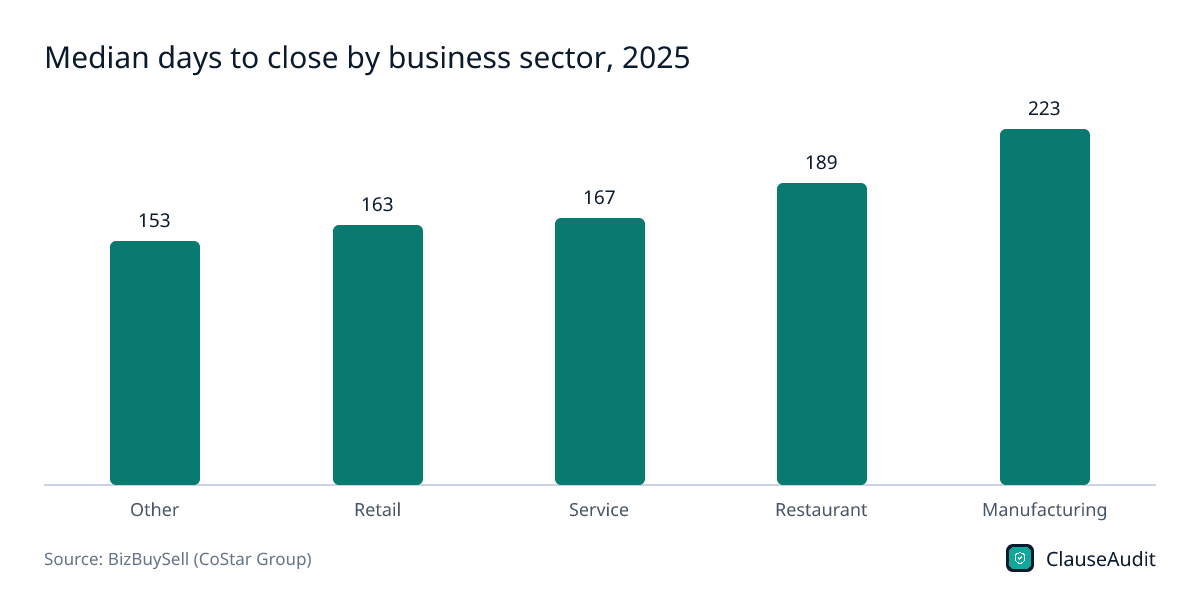
Median days to close by business sector, 2025
Chart data
| Label | Value |
|---|---|
| Other | 153 |
| Retail | 163 |
| Service | 167 |
| Restaurant | 189 |
| Manufacturing | 223 |
Manufacturing stands apart at 223 days, while retail closed in 163. Restaurants, the most-sold category, took 189 days, longer than the overall median of 170.
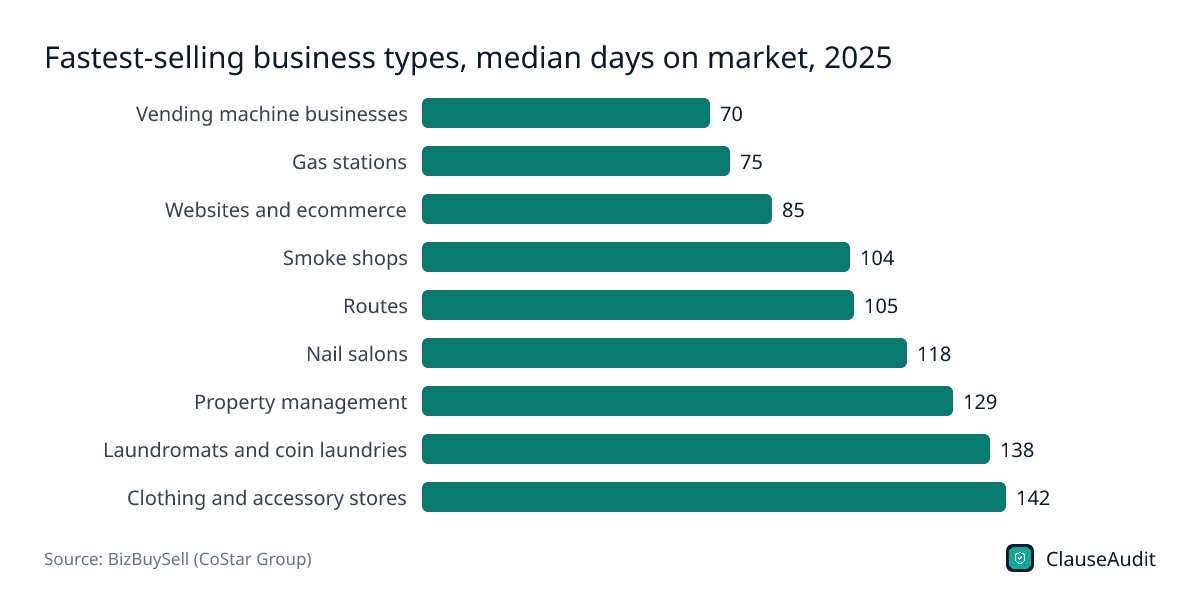
Download this chart (PNG)Fastest-selling business types, median days on market, 2025
Chart data
| Label | Value |
|---|---|
| Vending machine businesses | 70 |
| Gas stations | 75 |
| Websites and ecommerce | 85 |
| Smoke shops | 104 |
| Routes | 105 |
| Nail salons | 118 |
| Property management | 129 |
| Laundromats and coin laundries | 138 |
| Clothing and accessory stores | 142 |
The quickest sellers share simple operations and cash flow a buyer can verify fast. Vending machine businesses closed in 70 days and gas stations in 75.
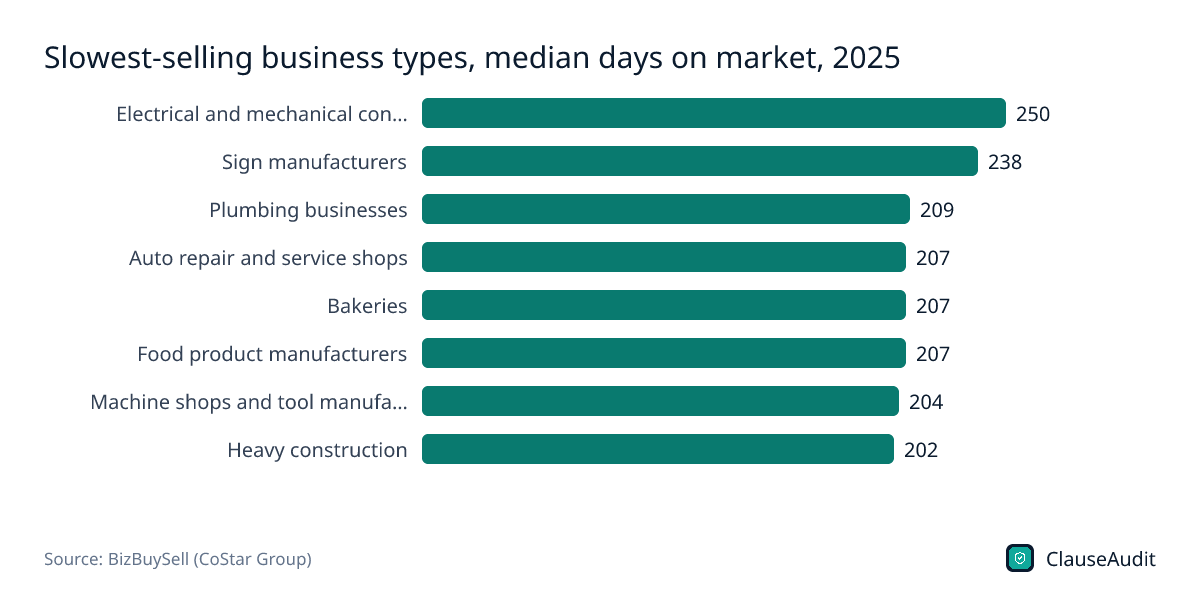
Download this chart (PNG)Slowest-selling business types, median days on market, 2025
Chart data
| Label | Value |
|---|---|
| Electrical and mechanical contracting | 250 |
| Sign manufacturers | 238 |
| Plumbing businesses | 209 |
| Auto repair and service shops | 207 |
| Bakeries | 207 |
| Food product manufacturers | 207 |
| Machine shops and tool manufacturers | 204 |
| Heavy construction | 202 |
Trades and specialized manufacturing take longest, led by electrical and mechanical contracting at 250 days. These deals tend to hinge on licenses, key staff and customer contracts.
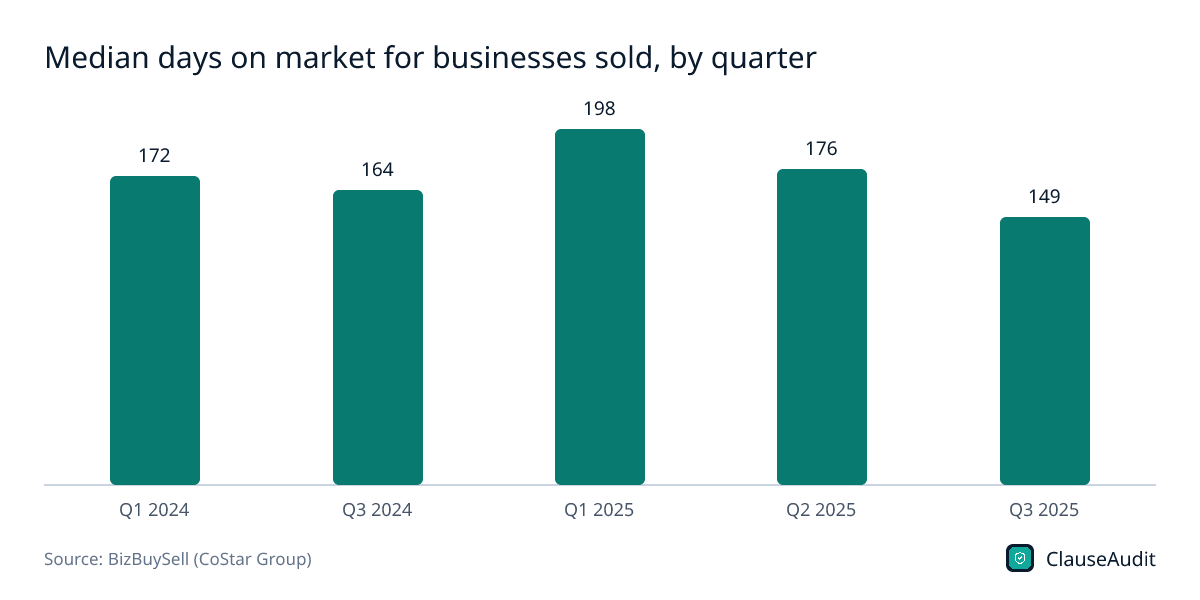
Download this chart (PNG)Median days on market for businesses sold, by quarter
Chart data
| Label | Value |
|---|---|
| Q1 2024 | 172 |
| Q3 2024 | 164 |
| Q1 2025 | 198 |
| Q2 2025 | 176 |
| Q3 2025 | 149 |
Timelines swing from quarter to quarter. Q1 2025 hit 198 days, then Q3 2025 dropped to 149, the fastest pace since 2017.
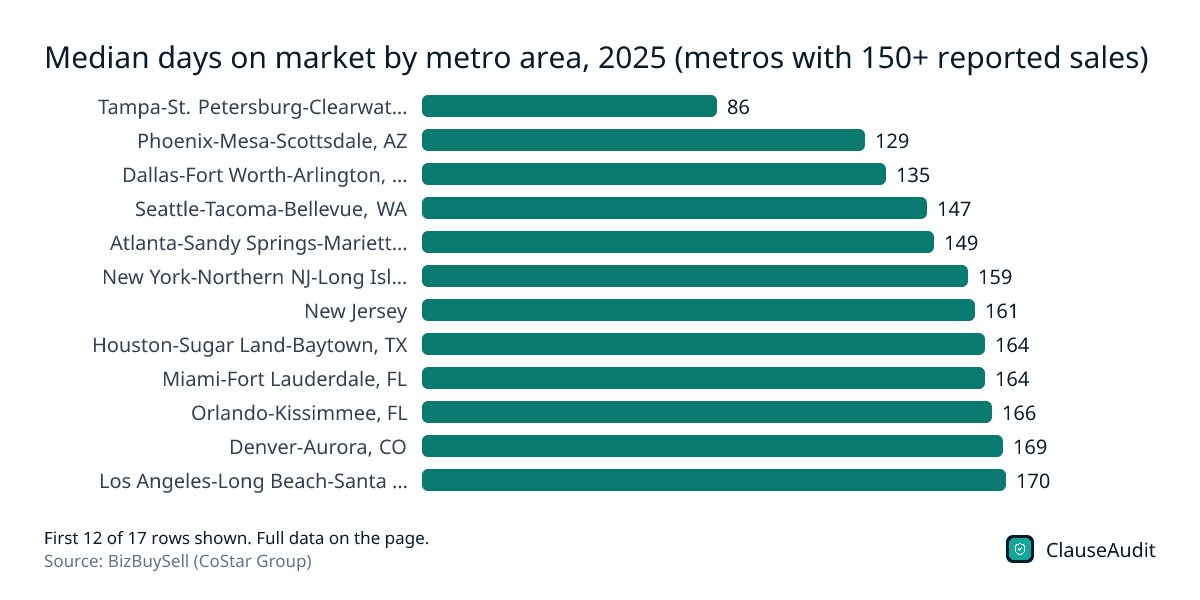
Download this chart (PNG)Median days on market by metro area, 2025 (metros with 150+ reported sales)
Chart data
| Label | Value |
|---|---|
| Tampa-St. Petersburg-Clearwater, FL | 86 |
| Phoenix-Mesa-Scottsdale, AZ | 129 |
| Dallas-Fort Worth-Arlington, TX | 135 |
| Seattle-Tacoma-Bellevue, WA | 147 |
| Atlanta-Sandy Springs-Marietta, GA | 149 |
| New York-Northern NJ-Long Island | 159 |
| New Jersey | 161 |
| Houston-Sugar Land-Baytown, TX | 164 |
| Miami-Fort Lauderdale, FL | 164 |
| Orlando-Kissimmee, FL | 166 |
| Denver-Aurora, CO | 169 |
| Los Angeles-Long Beach-Santa Ana, CA | 170 |
| Orange County, CA | 170 |
| Chicago-Naperville-Joliet, IL-IN-WI | 179 |
| Washington-Arlington-Alexandria, DC-VA-MD-WV | 197 |
| Boston-Cambridge-Quincy, MA-NH | 203 |
| Philadelphia-Camden-Wilmington, PA-NJ-DE-MD | 204 |
Location matters too. Tampa-area businesses closed in 86 days, while Philadelphia and Boston deals took 204 and 203 days.
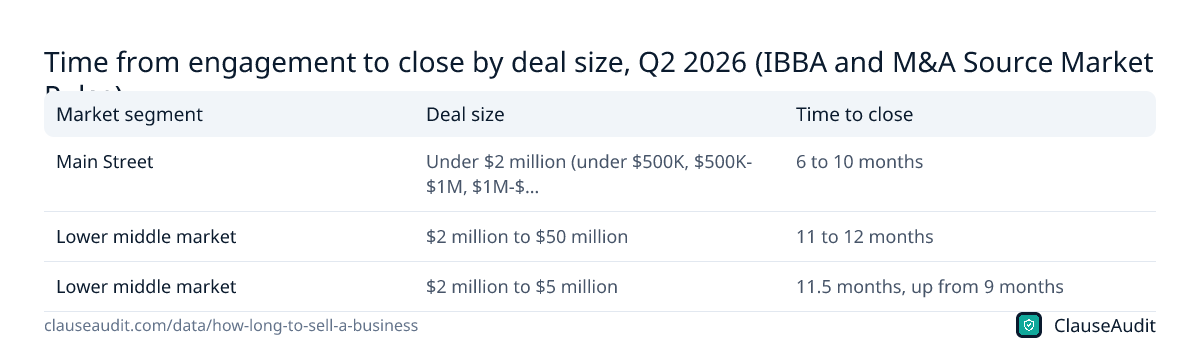
Download this chart (PNG)Time from engagement to close by deal size, Q2 2026 (IBBA and M&A Source Market Pulse)
| Market segment | Deal size | Time to close |
|---|---|---|
| Main Street | Under $2 million (under $500K, $500K-$1M, $1M-$2M) | 6 to 10 months |
| Lower middle market | $2 million to $50 million | 11 to 12 months |
| Lower middle market | $2 million to $5 million | 11.5 months, up from 9 months |
Source: International Business Brokers Association and M&A Source (via PR Newswire), The Market Pulse Survey Q2 2026 Reports the Latest Trends in Business Sales up to $50M; International Business Brokers Association, Market Pulse Q2 2026 Highlights (market segments studied). Download as image
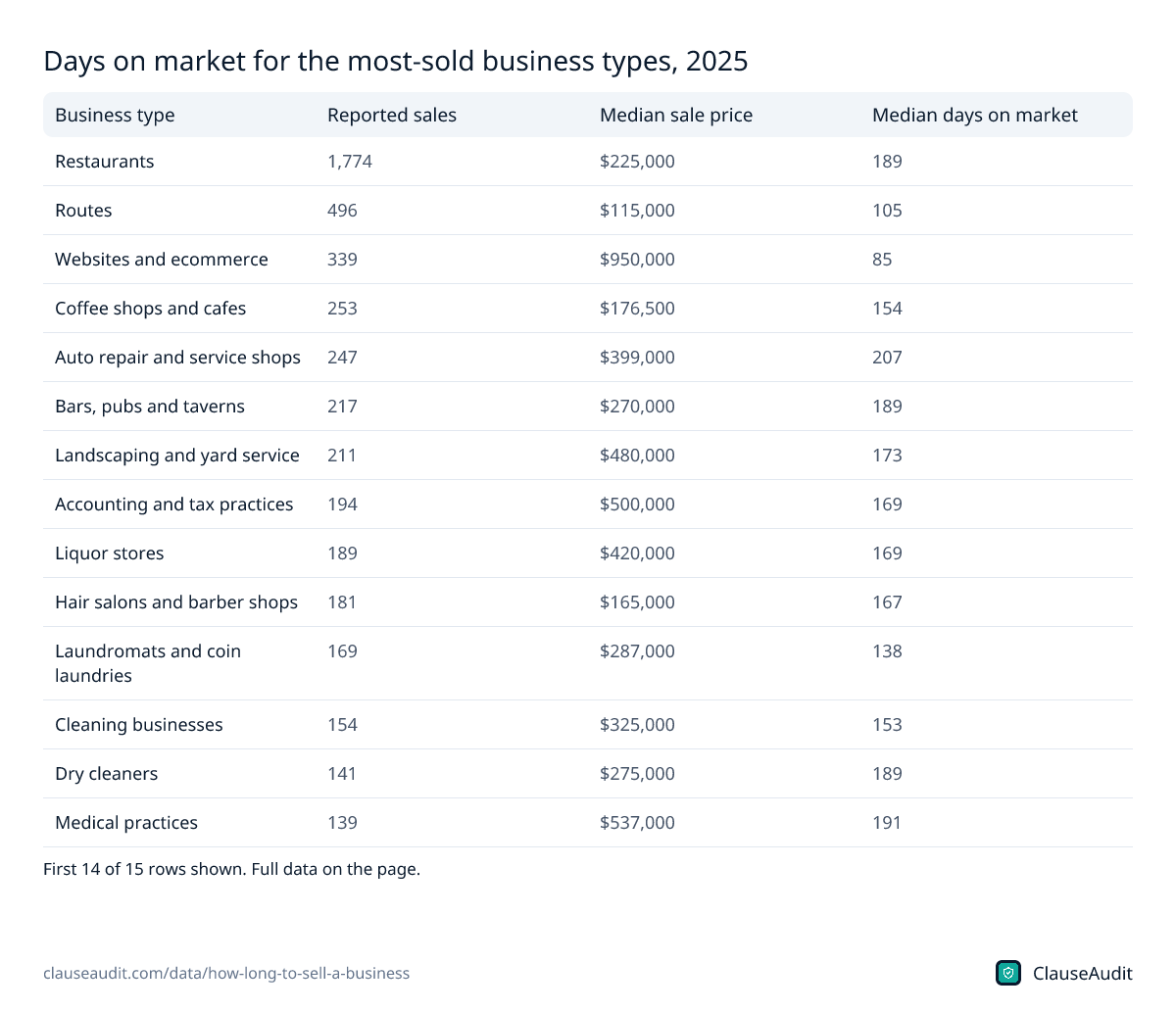
Days on market for the most-sold business types, 2025
| Business type | Reported sales | Median sale price | Median days on market |
|---|---|---|---|
| Restaurants | 1,774 | $225,000 | 189 |
| Routes | 496 | $115,000 | 105 |
| Websites and ecommerce | 339 | $950,000 | 85 |
| Coffee shops and cafes | 253 | $176,500 | 154 |
| Auto repair and service shops | 247 | $399,000 | 207 |
| Bars, pubs and taverns | 217 | $270,000 | 189 |
| Landscaping and yard service | 211 | $480,000 | 173 |
| Accounting and tax practices | 194 | $500,000 | 169 |
| Liquor stores | 189 | $420,000 | 169 |
| Hair salons and barber shops | 181 | $165,000 | 167 |
| Laundromats and coin laundries | 169 | $287,000 | 138 |
| Cleaning businesses | 154 | $325,000 | 153 |
| Dry cleaners | 141 | $275,000 | 189 |
| Medical practices | 139 | $537,000 | 191 |
| HVAC businesses | 123 | $800,000 | 181 |
Source: BizBuySell (CoStar Group), BizBuySell Insight Report Data Tables: Closed Small Business Transaction Metrics by Sector and by Geographic Market for the Full-Year 2025. Download as image
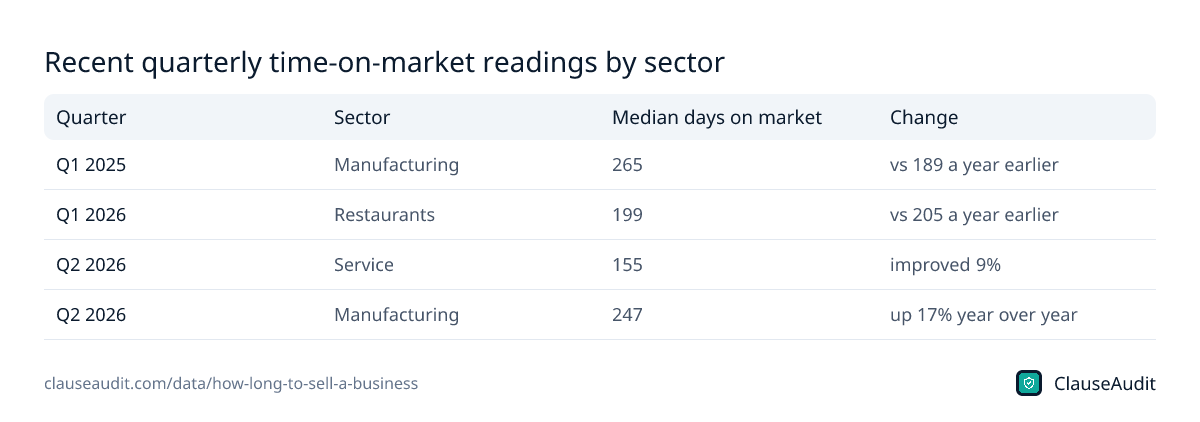
Recent quarterly time-on-market readings by sector
| Quarter | Sector | Median days on market | Change |
|---|---|---|---|
| Q1 2025 | Manufacturing | 265 | vs 189 a year earlier |
| Q1 2026 | Restaurants | 199 | vs 205 a year earlier |
| Q2 2026 | Service | 155 | improved 9% |
| Q2 2026 | Manufacturing | 247 | up 17% year over year |
Source: BizBuySell (CoStar Group), BizBuySell Insight Report, First Quarter 2025; BizBuySell (CoStar Group), BizBuySell Insight Report, First Quarter 2026; BizBuySell (CoStar Group), BizBuySell Insight Report, Second Quarter 2026. Download as image
How long does it take to sell a small business?
Plan on most of a year if you count from the day you hire a broker. The BizBuySell median of 170 days measures time on market for deals that actually closed. The IBBA and M&A Source broker survey measures the full run from engagement to close, and its Q2 2026 range for Main Street deals under $2 million is 6 to 10 months.
Those two numbers describe the same process from different starting points. Before a listing goes live, a broker values the business, builds a sales memo and screens buyers. After an offer comes in, the buyer still needs to check your books, line up financing and sign a purchase agreement. Each stage can stall.
Keep in mind these figures only cover businesses that sold. A listing that never closes doesn't show up in any median, so if your business has weak records or a price far above what the earnings support, your real timeline could be much longer than the averages suggest.
Which businesses sell the fastest, and which take the longest?
The fastest sellers in 2025 were businesses a buyer can understand in an afternoon. Vending machine businesses closed in a median of 70 days, gas stations in 75 and websites and ecommerce businesses in 85. An online store with clean traffic and sales reports lets a buyer verify the numbers from a laptop, and many of these deals skip the lease and staffing questions that slow a storefront sale.
At the other end are skilled trades and manufacturing. Electrical and mechanical contracting took 250 days, plumbing businesses 209 and auto repair shops 207. A buyer of a plumbing company is really buying licensed technicians, service contracts and a reputation that may be tied to the owner's name. All of that takes time to check, and lenders want to see it too.
Restaurants took 189 days, a bit slower than the overall median, but they make up the biggest share of sales, with 1,774 reported in 2025. If you own one, expect buyers to dig into the lease, health inspections and whether the staff will stay.
Why does a bigger deal take longer to close?
Larger deals carry more paperwork and more people. Brokers in the Q2 2026 survey put lower middle market deals, from $2 million to $50 million, at 11 to 12 months from engagement to close. Deals between $2 million and $5 million averaged 11.5 months, up from 9 months.
At that size, buyers usually bring a quality of earnings review, outside lawyers and bank or SBA financing. Each adds a review cycle. Sellers get asked for detailed reps and warranties, escrow holdbacks or an earnout, and every one of those terms gets negotiated line by line. A seller who agreed to a price in the letter of intent can still spend months working out how and when that price actually gets paid.
What slows a business sale after you accept an offer?
Most delays after the handshake come from a short list of problems. Knowing them ahead of time lets you fix them before a buyer finds them.
- Messy financials. If tax returns don't match your profit and loss statements, buyers and lenders will slow down or walk away.
- Lease trouble. Many leases require landlord consent to assign, and some landlords use that moment to raise rent or ask the buyer for a personal guarantee.
- Customer and supplier contracts. Key agreements may have change of control or anti-assignment clauses that need written consent.
- Financing. SBA and bank lenders run their own review and appraisal on their own schedule.
- Licenses and permits. Liquor licenses, contractor licenses and health permits often cannot transfer automatically.
- Owner dependence. If the business relies on you, buyers will push for a longer transition period or tie part of the price to future results.
How can you sell your business faster?
You can't control interest rates or buyer demand, but you can control how ready you are. Start well before you want to exit if you can. Cleaning up your records a year ahead is far easier than scrambling after a buyer asks.
Get several years of clean financials together, ideally reviewed by a CPA. Read your lease and every major contract for assignment and consent terms, and talk to your landlord early. Write down how the business runs so a buyer can see it works without you. Price it on real earnings, not on what you hope to retire on.
Finally, review the letter of intent and purchase agreement carefully before you sign. Exclusivity periods, vague due diligence windows and open-ended closing conditions are where months quietly disappear. A tight timeline with clear deadlines in the contract keeps both sides moving.
What does the timeline mean if you are buying a business?
Buyers should plan on the same long runway. Budget for months of due diligence and lender review, and don't quit your job or sign a new lease until the closing date is firm.
A long timeline also works in your favor. Use the time to test the seller's numbers, ask for a transition period in writing and make sure the purchase agreement lets you walk away if financing or landlord consent falls through. If the seller pushes to close fast, ask why. A slow, careful close beats a fast one that leaves you with a business you didn't expect, plus a loan payment due whether or not the customers stay.
How ClauseAudit helps when you buy or sell a business
Much of the time in a business sale goes into the contracts: the letter of intent, the purchase agreement, the lease assignment and any seller note. Terms that look routine can add months or shift risk onto you.
Upload your purchase agreement or letter of intent and the automated review flags the clauses that matter, explains them in plain English and suggests fixes you can bring to the other side.
- Exclusivity, due diligence and closing deadlines in the letter of intent
- Closing conditions such as financing, landlord consent and license transfers
- Purchase price terms, including escrow holdbacks, earnouts and seller financing
- Reps, warranties and indemnification caps, baskets and survival periods
- Seller non-compete and non-solicit scope, length and territory
- Transition and consulting duties the seller owes after closing
Frequently asked questions
What is the average time to sell a small business?
BizBuySell reported a median of 170 days to close for small businesses sold in 2025. That covers time on market for completed deals. If you count from the day you hire a broker, IBBA survey data puts Main Street sales under $2 million at 6 to 10 months, so plan for most of a year.
What type of business sells the fastest?
In 2025, vending machine businesses sold fastest at a median of 70 days, followed by gas stations at 75 days and websites and ecommerce businesses at 85 days. These businesses tend to have simple operations and numbers a buyer can verify quickly, with fewer staffing and licensing questions.
How long does it take to sell a restaurant?
Restaurants took a median of 189 days to sell in 2025, longer than the overall small business median of 170 days. They were also the most-sold business type, with 1,774 reported sales. Expect buyers to look closely at the lease, inspection history, staff and recent sales trends.
Why do manufacturing businesses take so long to sell?
Manufacturing had the slowest median of any major sector in 2025 at 223 days. These deals often involve equipment appraisals, customer concentration, environmental checks and larger loans. Buyers and lenders need more time to review all of it, and fewer buyers have the skills to run the business.
How long does it take to sell a business worth more than $2 million?
Brokers surveyed for Q2 2026 said lower middle market deals, from $2 million to $50 million, took 11 to 12 months from engagement to close. Deals between $2 million and $5 million averaged 11.5 months, up from 9 months.
Does location affect how long it takes to sell a business?
Yes. Among large metros in 2025, businesses in the Tampa-St. Petersburg area closed in a median of 86 days, while Philadelphia took 204 days and Boston 203. Local buyer demand, lending activity and the mix of businesses for sale all play a part.
Is it faster to sell a business now than a year ago?
It depends on the quarter you compare. BizBuySell's median hit 198 days in Q1 2025, then fell to 149 days in Q3 2025, the fastest pace since 2017. More recent quarterly reports give only sector-level figures, so check your own industry rather than relying on one headline number.
What can delay closing after I accept an offer?
The usual culprits are financing approval, landlord consent to assign the lease, contracts that need third-party consent, license transfers and financials that don't hold up in due diligence. Clear deadlines and closing conditions in your letter of intent and purchase agreement help keep the deal on schedule.
Use this data
Every chart and card below is free to reuse under CC BY 4.0. Download what you need and link back to this page.
 Stat cards
 Key findings card
 Infographic
 Median days to close by business sector, 2025
 Fastest-selling business types, median days on market, 2025
 Slowest-selling business types, median days on market, 2025
 Median days on market for businesses sold, by quarter
 Median days on market by metro area, 2025 (metros with 150+ reported sales)
 Time from engagement to close by deal size, Q2 2026 (IBBA and M&A Source Market Pulse)
 Days on market for the most-sold business types, 2025
 Recent quarterly time-on-market readings by sector
Embed the infographic
Free to share on your site, blog or slides under CC BY 4.0. Please keep the credit link.
Sources and method
Every number on this page comes from the sources below, each opened and read on or before October 18, 2026. A second, independent review checked every figure against its source and corrected anything that did not match. Figures that could not be confirmed were left out.
- BizBuySell (CoStar Group), 2025 Year in Review: BizBuySell Market Recap (January 30, 2026)
- BizBuySell (CoStar Group), BizBuySell Insight Report Data Tables: Closed Small Business Transaction Metrics by Sector and by Geographic Market for the Full-Year 2025 (Full-Year 2025 tables, as posted with the Q3 2026 Insight Report)
- International Business Brokers Association and M&A Source (via PR Newswire), The Market Pulse Survey Q2 2026 Reports the Latest Trends in Business Sales up to $50M (August 25, 2026 (Q2 2026, 57th edition))
- International Business Brokers Association, Market Pulse Q2 2026 Highlights (market segments studied) (Q2 2026 (file dated July 28, 2026))
- BizBuySell (CoStar Group), BizBuySell Insight Report, Third Quarter 2025 (Q3 2025)
- BizBuySell (CoStar Group), BizBuySell Insight Report, First Quarter 2025 (Q1 2025)
- BizBuySell (CoStar Group), BizBuySell Insight Report, First Quarter 2026 (Q1 2026)
- BizBuySell (CoStar Group), BizBuySell Insight Report, Second Quarter 2026 (Q2 2026)
Cite this page
ClauseAudit, “How Long Does It Take to Sell a Business? Days on Market by Industry and Deal Size”, updated October 18, 2026, https://clauseaudit.com/data/how-long-to-sell-a-business. Free to reuse with a link back (CC BY 4.0).
This page summarises published data and law as checked on October 18, 2026. Figures are updated as new editions are released, and your own situation may differ. It is general information, not legal, tax or financial advice.