Global Freelance Statistics by Country (2026)
By ClauseAudit Research · 8 sources ·
How many freelancers are there in the world?
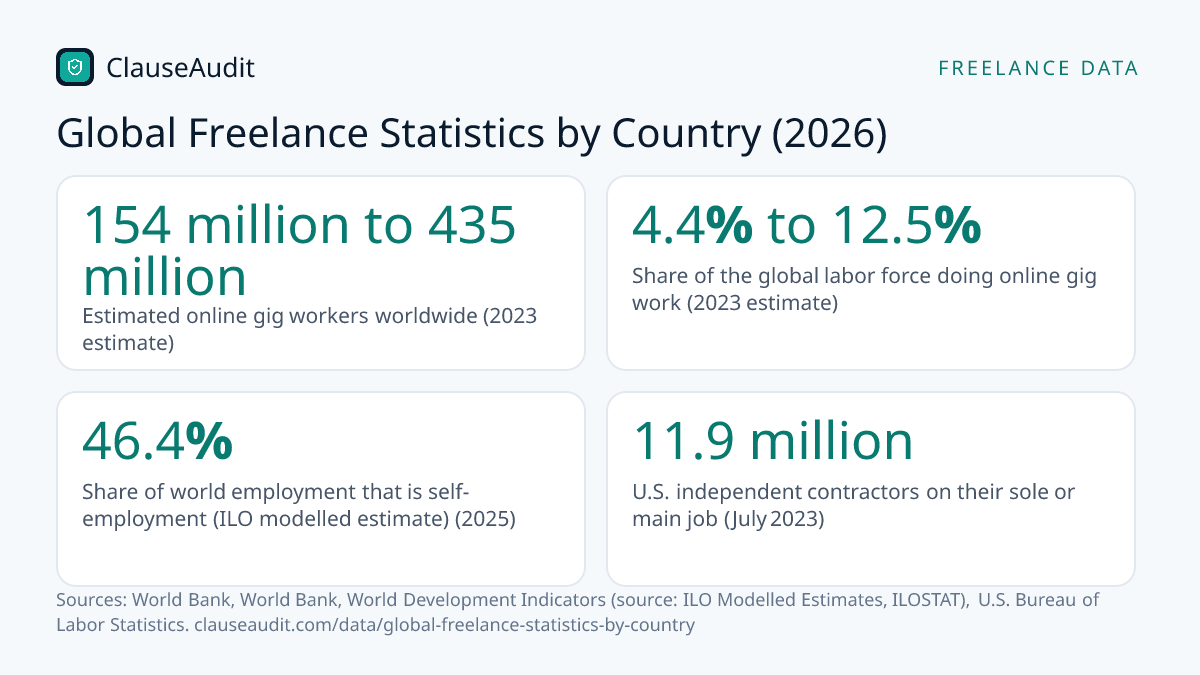
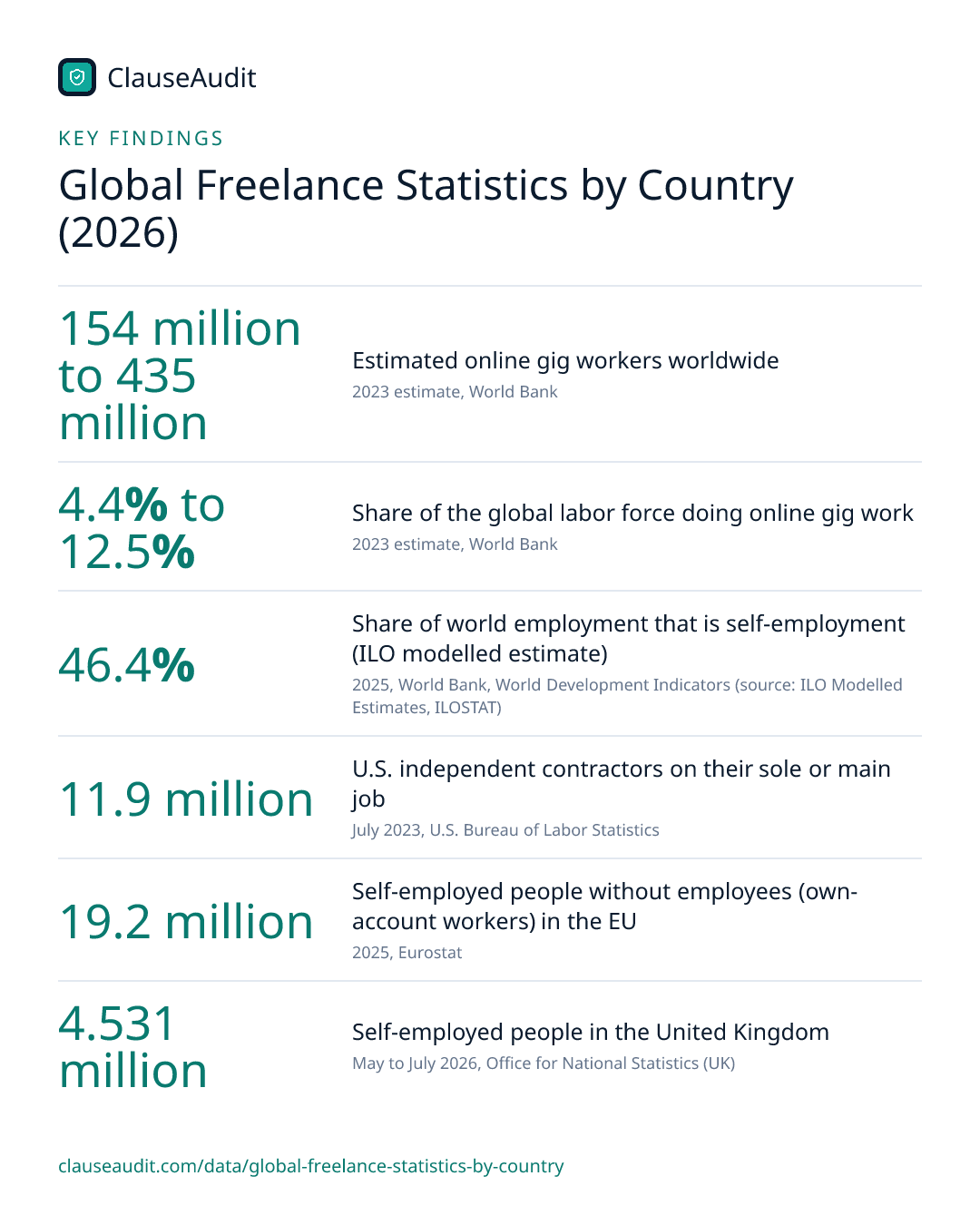
Roughly 154 million to 435 million people do online gig or freelance work worldwide, according to the World Bank's 2023 estimate. That equals 4.4% to 12.5% of the global labor force. No official single count exists, and broader self-employment, which includes farmers and shopkeepers, makes up 46.4% of world employment in 2025.

- Estimated online gig workers worldwide (2023 estimate, World Bank)
- 154 million to 435 million
- Share of the global labor force doing online gig work (2023 estimate, World Bank)
- 4.4% to 12.5%
- Share of world employment that is self-employment (ILO modelled estimate) (2025, World Bank, World Development Indicators (source: ILO Modelled Estimates, ILOSTAT))
- 46.4%
- U.S. independent contractors on their sole or main job (July 2023, U.S. Bureau of Labor Statistics)
- 11.9 million
- Self-employed people without employees (own-account workers) in the EU (2025, Eurostat)
- 19.2 million
- Self-employed people in the United Kingdom (May to July 2026, Office for National Statistics (UK))
- 4.531 million
- Gig workers in India, projected to reach 2.35 crore (23.5 million) by 2029-30 (2020-21, NITI Aayog, Government of India)
- 77 lakh (7.7 million)
- Active freelance platforms worldwide, out of at least 653 digital labour platforms (October 2025, International Labour Organization)
- 136
Ask five agencies how many freelancers there are and you get five different answers. That is not sloppiness. Each one counts something slightly different: online gig workers, independent contractors, own-account workers, or everyone who works for themselves.
This page lines up the most credible official numbers country by country, explains what each one actually measures, and shows what the totals mean if you sell your skills to clients in another country or hire people who do.
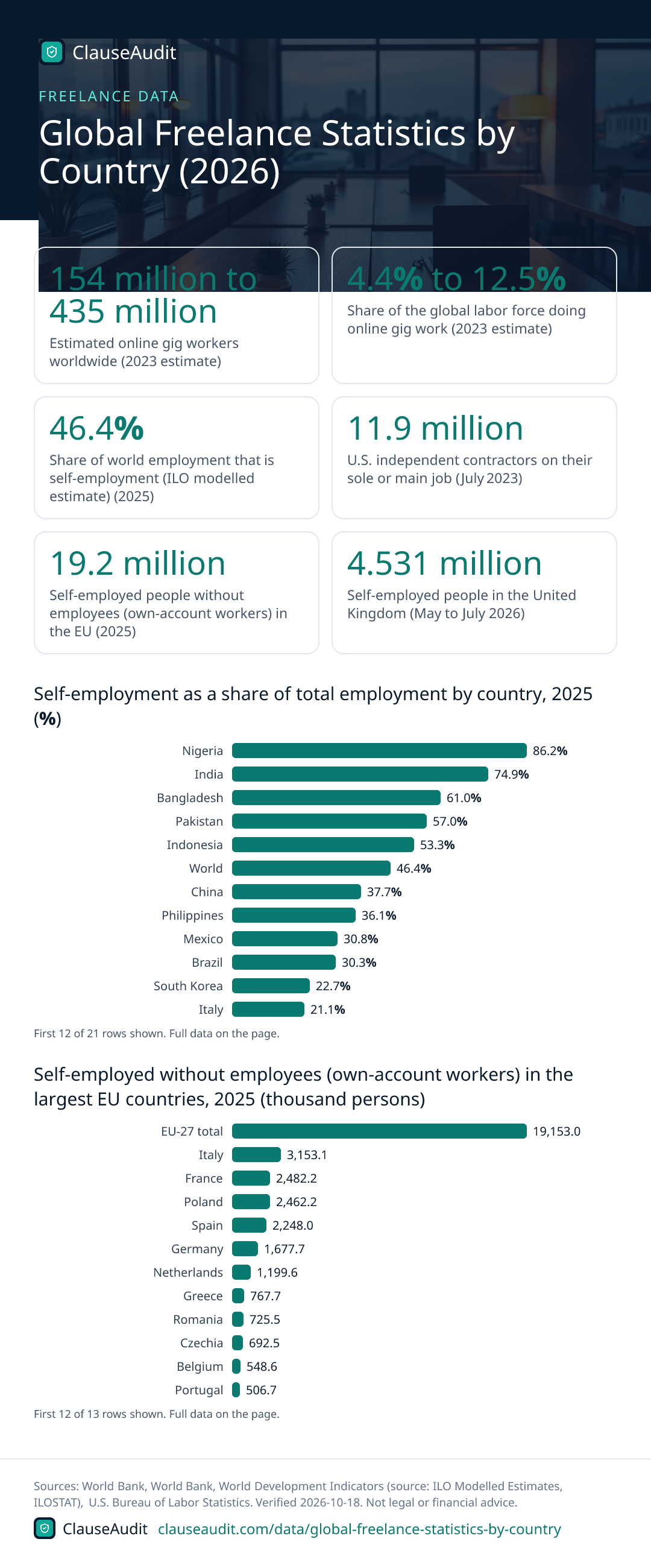
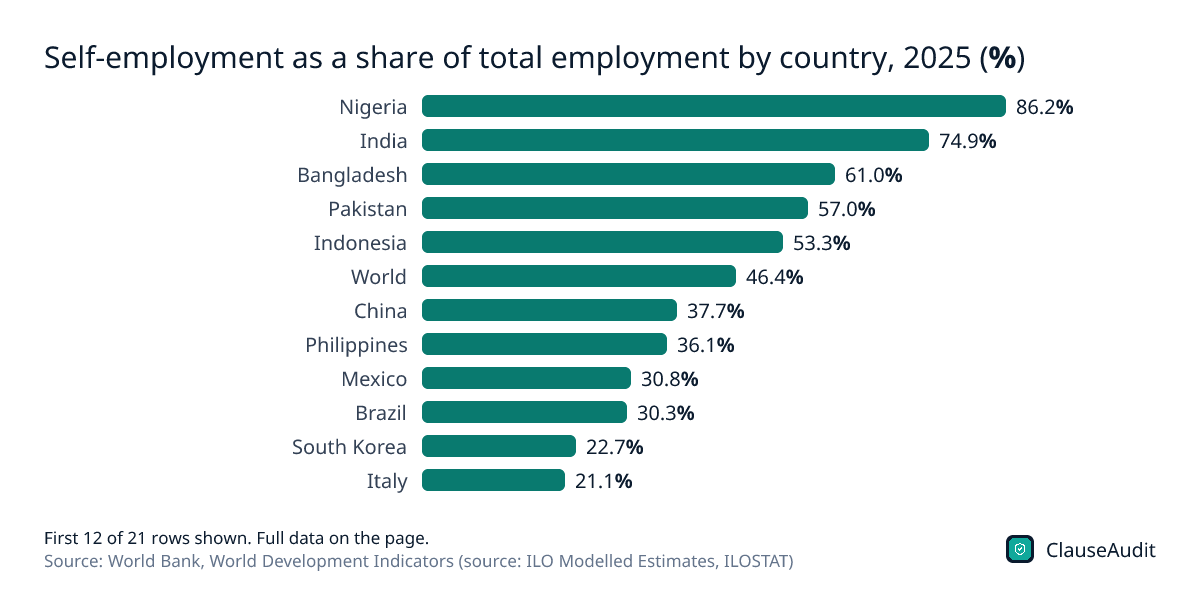
Self-employment as a share of total employment by country, 2025 (%)
Chart data
| Label | Value |
|---|---|
| Nigeria | 86.2% |
| India | 74.9% |
| Bangladesh | 61.0% |
| Pakistan | 57.0% |
| Indonesia | 53.3% |
| World | 46.4% |
| China | 37.7% |
| Philippines | 36.1% |
| Mexico | 30.8% |
| Brazil | 30.3% |
| South Korea | 22.7% |
| Italy | 21.1% |
| Poland | 18.9% |
| Australia | 16.1% |
| Spain | 14.5% |
| France | 13.3% |
| United Kingdom | 13.1% |
| Canada | 12.9% |
| Japan | 9.1% |
| Germany | 8.1% |
| United States | 6.1% |
High shares in Nigeria (86.2%) and India (74.9%) mostly reflect small farms and informal trade, not laptop freelancing. The United States has the lowest share on this list, at 6.1%.
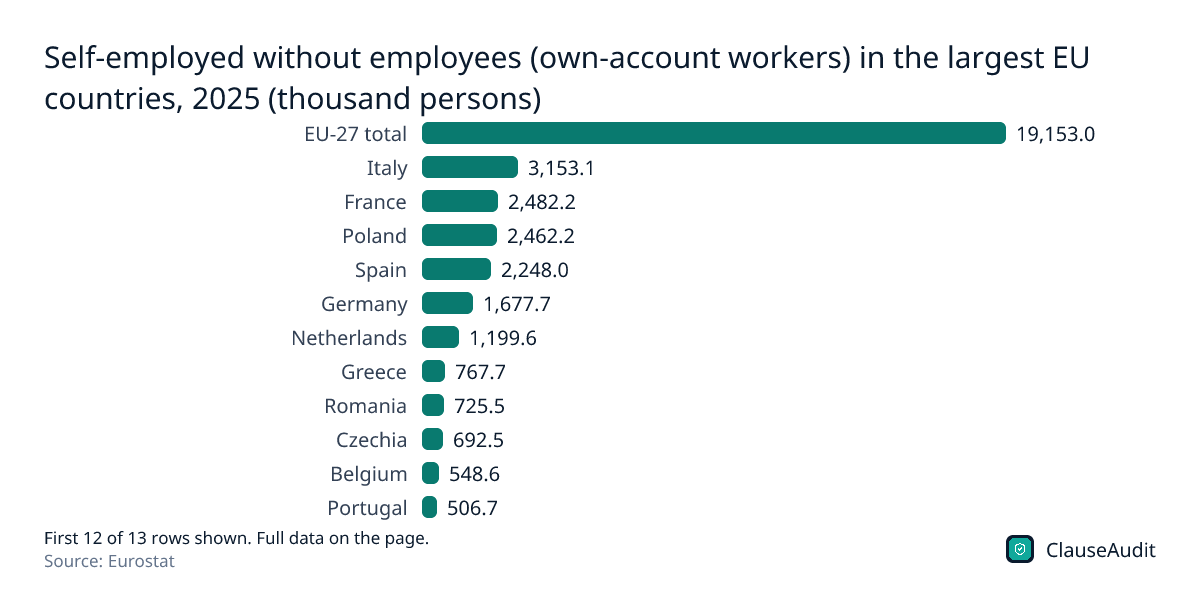
Download this chart (PNG)Self-employed without employees (own-account workers) in the largest EU countries, 2025 (thousand persons)
Chart data
| Label | Value |
|---|---|
| EU-27 total | 19,153.0 |
| Italy | 3,153.1 |
| France | 2,482.2 |
| Poland | 2,462.2 |
| Spain | 2,248.0 |
| Germany | 1,677.7 |
| Netherlands | 1,199.6 |
| Greece | 767.7 |
| Romania | 725.5 |
| Czechia | 692.5 |
| Belgium | 548.6 |
| Portugal | 506.7 |
| Hungary | 382.8 |
Italy leads the EU with 3,153.1 thousand own-account workers, ahead of France and Poland. Eurostat flags France and Spain because their definitions differ, so treat close rankings with care.
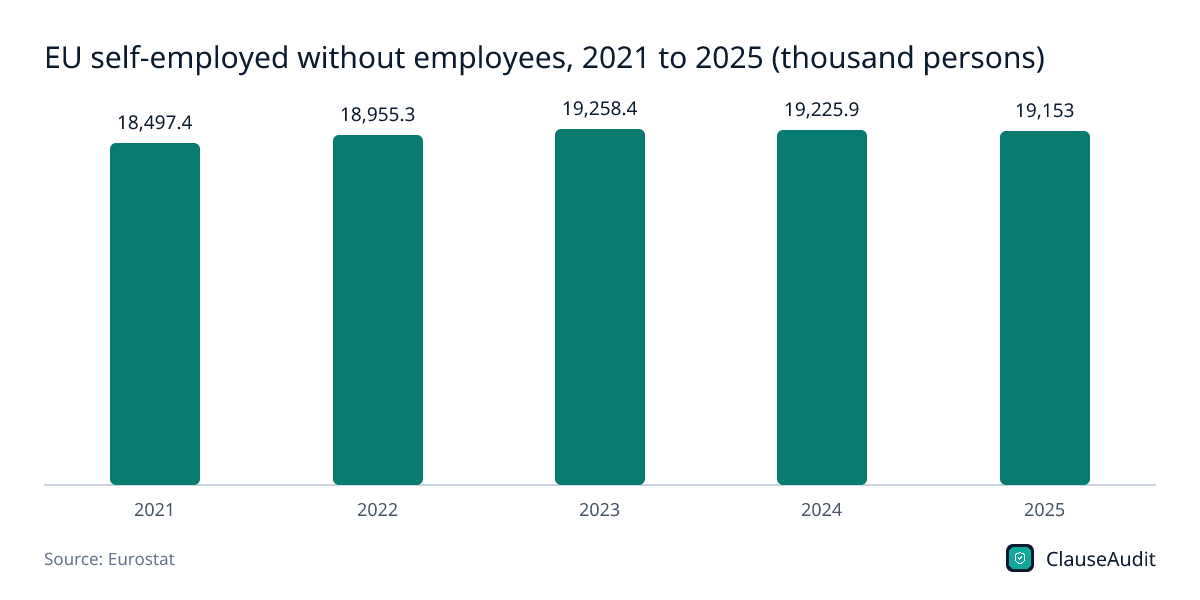
Download this chart (PNG)EU self-employed without employees, 2021 to 2025 (thousand persons)
Chart data
| Label | Value (thousand persons) |
|---|---|
| 2021 | 18,497.4 |
| 2022 | 18,955.3 |
| 2023 | 19,258.4 |
| 2024 | 19,225.9 |
| 2025 | 19,153 |
The EU total rose from 18,497.4 thousand in 2021 to a peak of 19,258.4 thousand in 2023, then eased slightly. Solo self-employment in Europe is flat, not booming.
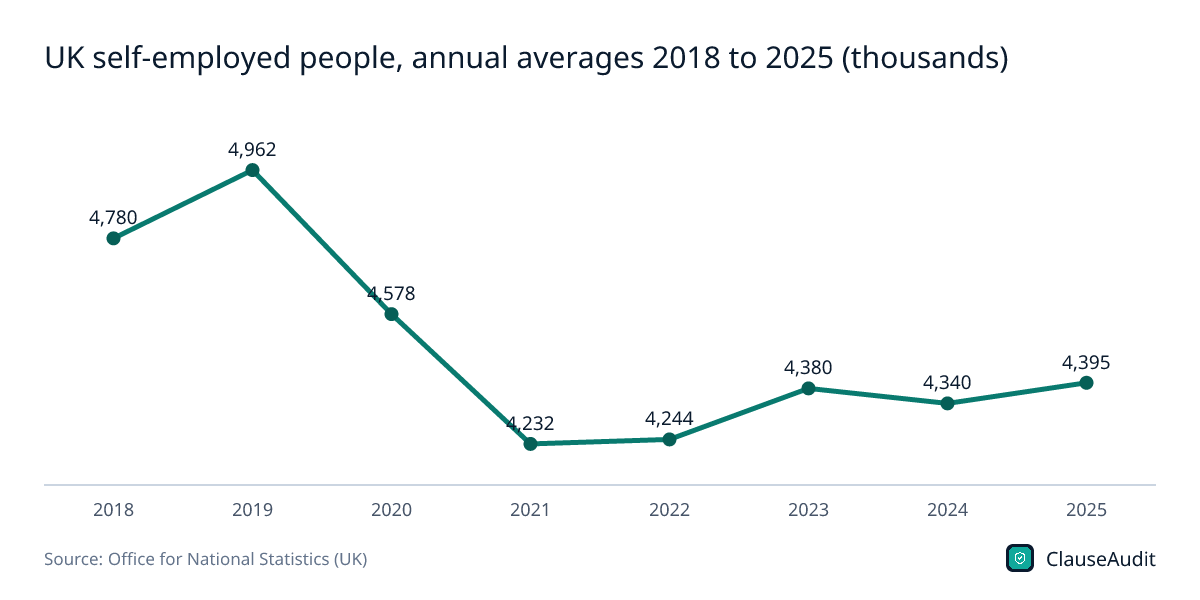
Download this chart (PNG)UK self-employed people, annual averages 2018 to 2025 (thousands)
Chart data
| Label | Value (thousands) |
|---|---|
| 2018 | 4,780 |
| 2019 | 4,962 |
| 2020 | 4,578 |
| 2021 | 4,232 |
| 2022 | 4,244 |
| 2023 | 4,380 |
| 2024 | 4,340 |
| 2025 | 4,395 |
UK self-employment fell from 4,962 thousand in 2019 to 4,232 thousand in 2021 and has only partly recovered. The 2025 average of 4,395 thousand is still well below the 2019 level.
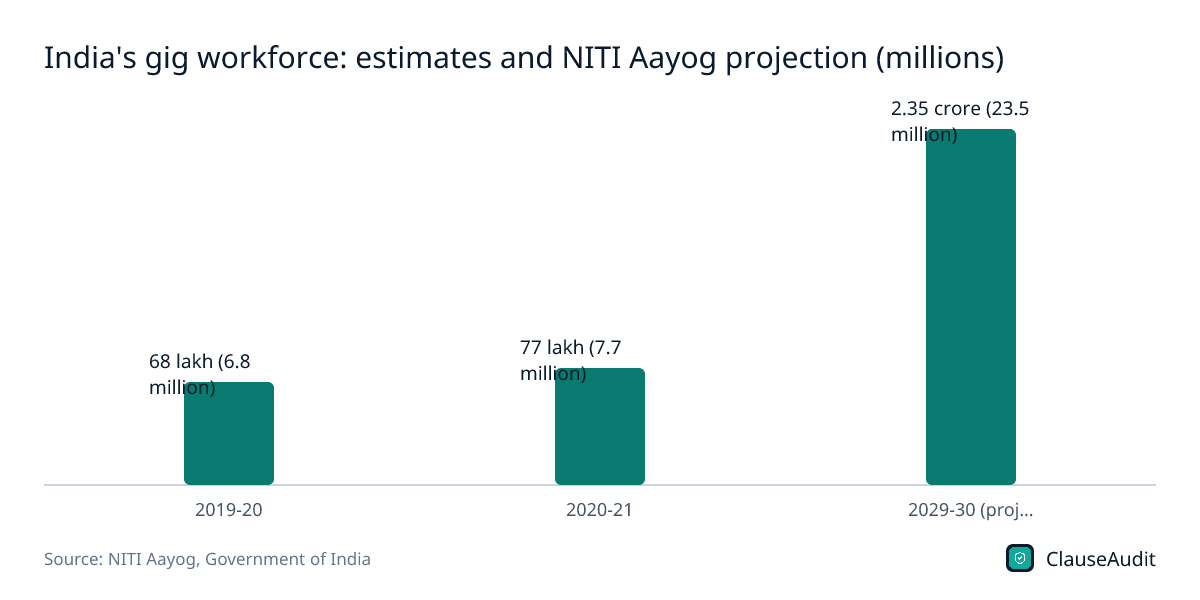
Download this chart (PNG)India's gig workforce: estimates and NITI Aayog projection (millions)
Chart data
| Label | Value (millions) |
|---|---|
| 2019-20 | 68 lakh (6.8 million) |
| 2020-21 | 77 lakh (7.7 million) |
| 2029-30 (projected) | 2.35 crore (23.5 million) |
NITI Aayog counted 77 lakh (7.7 million) gig workers in 2020-21 and projects 2.35 crore (23.5 million) by 2029-30. The later figure is a forecast, not a count.
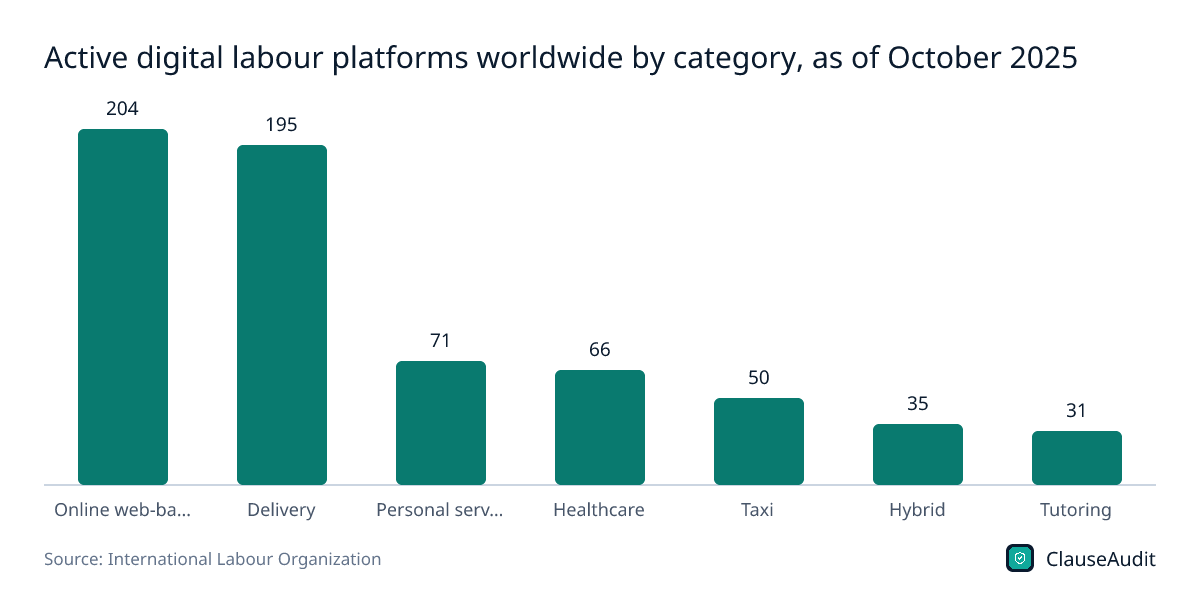
Download this chart (PNG)Active digital labour platforms worldwide by category, as of October 2025
Chart data
| Label | Value |
|---|---|
| Online web-based | 204 |
| Delivery | 195 |
| Personal services | 71 |
| Healthcare | 66 |
| Taxi | 50 |
| Hybrid | 35 |
| Tutoring | 31 |
Online web-based platforms (204) are the biggest group, edging out delivery (195). Within that group, freelance marketplaces account for 136 platforms.
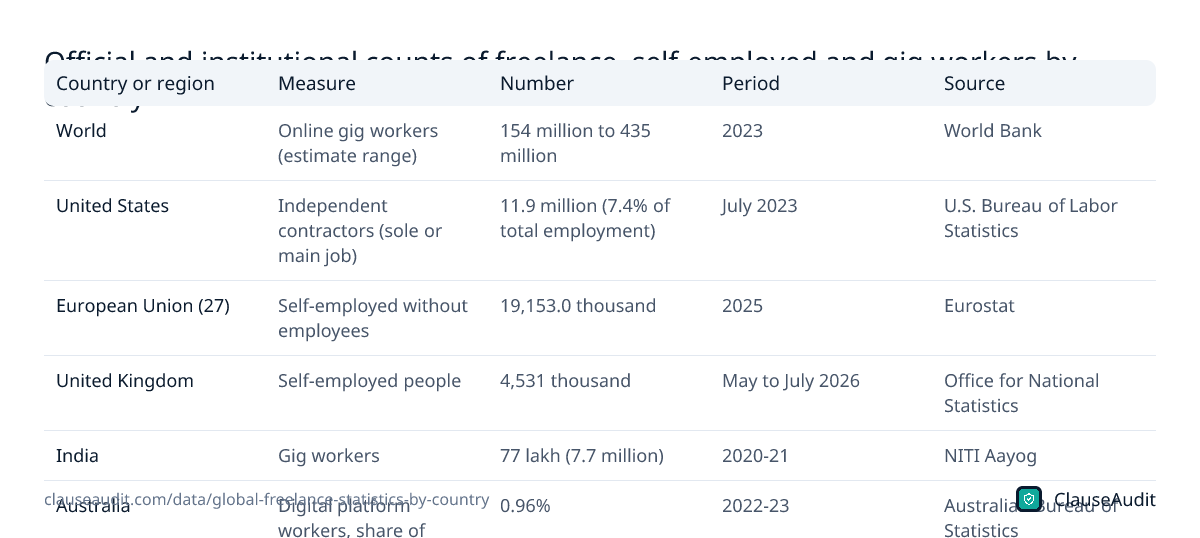
Download this chart (PNG)Official and institutional counts of freelance, self-employed and gig workers by country
| Country or region | Measure | Number | Period | Source |
|---|---|---|---|---|
| World | Online gig workers (estimate range) | 154 million to 435 million | 2023 | World Bank |
| United States | Independent contractors (sole or main job) | 11.9 million (7.4% of total employment) | July 2023 | U.S. Bureau of Labor Statistics |
| European Union (27) | Self-employed without employees | 19,153.0 thousand | 2025 | Eurostat |
| United Kingdom | Self-employed people | 4,531 thousand | May to July 2026 | Office for National Statistics |
| India | Gig workers | 77 lakh (7.7 million) | 2020-21 | NITI Aayog |
| Australia | Digital platform workers, share of employed | 0.96% | 2022-23 | Australian Bureau of Statistics |
Source: World Bank, Working Without Borders: The Promise and Peril of Online Gig Work (Overview); U.S. Bureau of Labor Statistics, Contingent and Alternative Employment Arrangements, July 2023 (USDL-24-2267); Eurostat, Employed persons by professional status (lfsa_egaps); Office for National Statistics (UK), LFS: Self-employed: UK: All: 000s: SA (series MGRQ); NITI Aayog, Government of India, India's Booming Gig and Platform Economy: Perspectives and Recommendations on the Future of Work; Australian Bureau of Statistics, Digital platform workers in Australia. Download as image
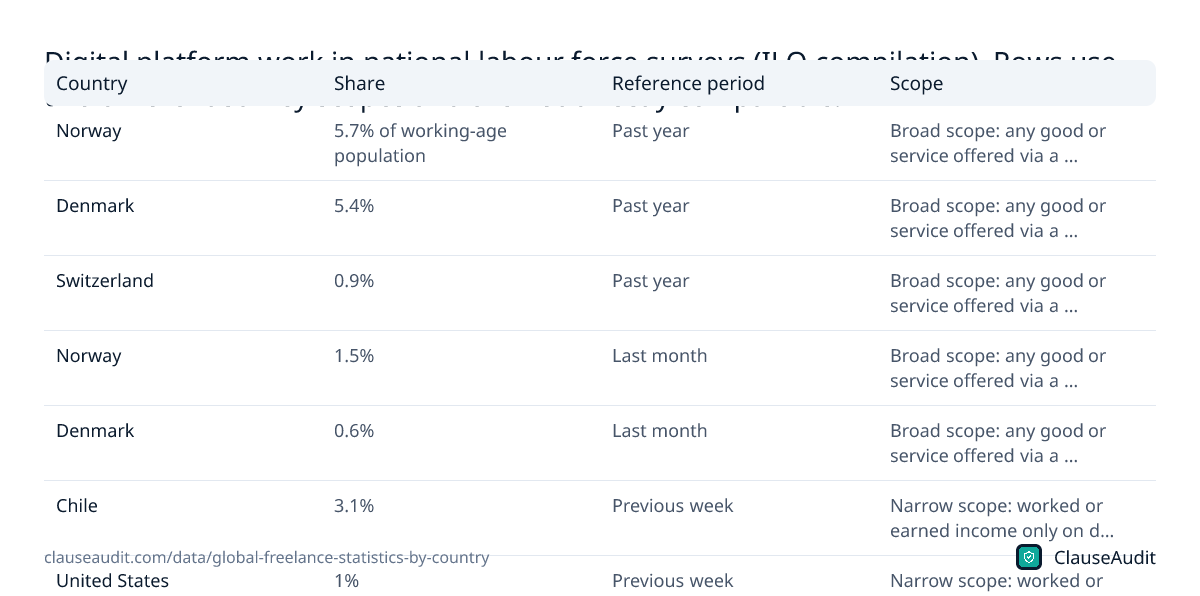
Digital platform work in national labour force surveys (ILO compilation). Rows use two different survey scopes and are not directly comparable.
| Country | Share | Reference period | Scope |
|---|---|---|---|
| Norway | 5.7% of working-age population | Past year | Broad scope: any good or service offered via a digital platform (incl. e-commerce, online rentals) |
| Denmark | 5.4% | Past year | Broad scope: any good or service offered via a digital platform (incl. e-commerce, online rentals) |
| Switzerland | 0.9% | Past year | Broad scope: any good or service offered via a digital platform (incl. e-commerce, online rentals) |
| Norway | 1.5% | Last month | Broad scope: any good or service offered via a digital platform (incl. e-commerce, online rentals) |
| Denmark | 0.6% | Last month | Broad scope: any good or service offered via a digital platform (incl. e-commerce, online rentals) |
| Chile | 3.1% | Previous week | Narrow scope: worked or earned income only on digital labour platforms |
| United States | 1% | Previous week | Narrow scope: worked or earned income only on digital labour platforms |
Source: International Labour Organization, Digital labour platforms: Number of platforms and workers (Research Brief). Download as image
Why is there no single count of freelancers in the world?
Because nobody agrees on what a freelancer is. A graphic designer in Lisbon billing three clients, a delivery rider in Jakarta, and a farmer in Lagos selling at market can all count as self-employed. Only the first one fits what most people mean by freelancing.
The World Bank tackled the narrowest version, online gig work, and still landed on a range of 154 million to 435 million people. Counting registered workers from platform and web traffic data gives the low end. An online survey that also counts people with gig work as a side job gives the high end. Both are defensible.
So when you see a single global number quoted with confidence, ask where it came from. Platform companies often publish their own counts, and those can reflect registered accounts rather than people earning a living.
For your own planning, the exact global total matters less than the trend in the markets you sell into. A client base in Germany behaves differently from one in Brazil, and the official data reflects that.
Which country has the most freelancers?
It depends on whether you mean share or headcount. By share of employment, lower-income countries lead the countries tracked here: Nigeria at 86.2%, India at 74.9% and Bangladesh at 61.0% in 2025. Most of that is informal or farm work.
For professional, client-based freelancing, the large official counts come from rich economies. The United States had 11.9 million independent contractors on their main job in July 2023, which was 7.4% of total employment. The EU had 19,153.0 thousand self-employed people without employees in 2025, and the UK had 4,531 thousand self-employed people in May to July 2026.
India is the one to watch. NITI Aayog estimated its gig workforce at 68 lakh (6.8 million) in 2019-20 and 77 lakh (7.7 million) in 2020-21, and the government's planning body expects it to roughly triple by the end of the decade.
Are freelancers growing or shrinking in rich countries?
Slower than the headlines suggest. Europe's solo self-employed total peaked at 19,258.4 thousand in 2023 and dipped to 19,153.0 thousand in 2025. The UK still sits below its 2019 level of 4,962 thousand.
The data does not explain the dip, and the causes likely differ by country. Either way, the pool of solo competitors in these markets is not exploding.
Platform work is also smaller than many people assume. In the ILO's compilation, about 1% of people in the United States did platform work in the previous week, using a narrow definition that counts only work on digital labour platforms. In Australia, digital platform workers made up 0.96% of the employed in 2022-23.
The takeaway: freelancing is steady and large, but it is not swallowing traditional jobs. Plan your business around that reality, not around hype.
How should you compare freelance numbers between countries?
Carefully. Every figure on this page answers a slightly different question, and mixing them leads to bad conclusions.
The US number counts independent contractors on their main job only. The EU number counts self-employed people without staff, which pulls in plumbers, taxi owners and corner shops. The UK number counts all self-employed people, with or without staff. India's number counts gig workers, which includes app-based delivery and ride-hailing alongside skilled freelancers.
Survey wording matters just as much. In the ILO's compilation, Norway reported 5.7% of its working-age population offering goods or services through a digital platform in the past year, but only 1.5% in the last month. Denmark showed the same pattern, 5.4% against 0.6%. That broad measure even includes online selling and rentals. Ask about a whole year and you catch people who sold one thing once. Ask about the last month and you get closer to the people who rely on it.
A practical rule: compare a country with itself over time, using the same source. Treat cross-country rankings as rough direction, not precise league tables.
What the numbers mean if you freelance across borders
The ILO counted 136 active freelance platforms in October 2025, part of at least 653 digital labour platforms worldwide. That is a lot of marketplaces, each with its own fees, dispute rules and payment timing. Your contract with a client often matters more than the platform's terms.
If you work for a client in another country, you are competing in a pool that could run into the hundreds of millions. Price on value, not on what the cheapest bidder charges. Write down scope and deliverables in plain language so a client in a different legal system reads them the same way you do.
Watch the governing law and venue clause closely. A clause that sends disputes to a court on the other side of the world can make an unpaid invoice impossible to chase. Ask for your own location, for arbitration online, or at least for a small-claims option.
Also settle currency and timing up front. Name the currency on every invoice, say who pays transfer and conversion fees, and set a due date with a late fee you would actually enforce. Small gaps here eat into your rate quietly, one invoice at a time.
What businesses hiring international freelancers should do
- Check worker status in the freelancer's country, not just yours. Labour rules on who counts as an employee differ widely, and the EU, UK and India all treat platform workers differently.
- Put IP assignment in writing. In the US, freelance work counts as work made for hire only if it falls into one of nine categories set by the Copyright Act and both sides sign a written agreement, so use an explicit assignment. Other countries have their own rules on moral rights.
- Agree on currency, payment method and who absorbs transfer fees before work starts.
- Set a clear acceptance process with a deadline, so payment does not hang on someone's mood.
- Keep confidentiality and data handling terms proportionate to the work. A logo project does not need the same terms as access to your customer database.
- Budget for longer onboarding. Time zones, bank checks and tax forms add friction, so build a buffer into the first milestone rather than squeezing the freelancer's schedule.
How ClauseAudit helps
With so many freelancers chasing the same clients, the contract is where you protect your rate and your time. Paste or upload your freelance agreement and the automated review flags the clauses that cost freelancers money most often, explained in plain English with a suggested fix.
It is built around US law, so it fits US agreements best, and it flags the governing law and venue terms that matter most when your client sits in another country.
- Payment terms: when you get paid, how late fees work, and whether payment depends on vague approval
- Kill fee and cancellation: what you are owed if the client stops the project halfway
- IP ownership: whether you hand over pre-existing tools, templates or unused concepts
- Revisions and scope: whether revisions are capped or open-ended
- Governing law and venue: where a dispute would be heard and whether that is realistic for you
- Liability and indemnity: whether your exposure is capped at the fee or unlimited
Frequently asked questions
How many freelancers are there in the world?
The World Bank estimates 154 million to 435 million online gig workers worldwide as of 2023, or 4.4% to 12.5% of the global labor force. The range is wide because counting registered platform workers and running surveys that include side gigs give very different results. There is no official single count.
How many freelancers are in the United States?
The Bureau of Labor Statistics counted 11.9 million independent contractors on their sole or main job in July 2023, which was 7.4% of total employment. That figure leaves out people who freelance on the side while holding a regular job, so the number of Americans doing some freelance work is higher.
How many self-employed people are there in the UK?
The Office for National Statistics put UK self-employment at 4,531 thousand, about 4.531 million people, in May to July 2026. The annual average was 4,395 thousand in 2025, still below the 2019 level of 4,962 thousand before the pandemic. Recovery since then has been slow.
How many freelancers are there in Europe?
Eurostat counted 19,153.0 thousand self-employed people without employees across the EU in 2025, roughly 19.2 million. Italy had the most at 3,153.1 thousand, followed by France and Poland. This measure also includes shop owners and tradespeople, so it is wider than creative or tech freelancing.
How many gig workers are there in India?
NITI Aayog estimated 77 lakh (7.7 million) gig workers in India in 2020-21, up from 68 lakh (6.8 million) in 2019-20. It projects the gig workforce will reach 2.35 crore (23.5 million) by 2029-30, though that is a forecast rather than a count.
Which country has the highest self-employment rate?
Among the countries in this dataset, Nigeria has the highest share at 86.2% of total employment in 2025, followed by India at 74.9% and Bangladesh at 61.0%. These figures mostly reflect farming and informal trade. The United States has the lowest share listed, at 6.1%.
How many freelance platforms are there?
The International Labour Organization counted 136 active freelance platforms as of October 2025, within a wider total of at least 653 digital labour platforms. Online web-based platforms made up 204 of those, and delivery platforms another 195. Each platform sets its own fees and payment rules, so read the terms before you sign up.
Is freelancing the same as self-employment?
No. Self-employment is broader. It covers employers, own-account workers, co-op members and family members helping in a business. Freelancers are a subset: usually solo workers selling services to several clients. That is why the global self-employment share of 46.4% is far higher than any freelance estimate.
Do I need a contract to freelance for a client abroad?
Yes, and arguably more than at home. A written agreement sets the currency, payment timing, IP ownership and which country's law applies. Without one, chasing an unpaid invoice across borders is slow and often not worth the cost. Keep the scope specific and the dispute process realistic.
Use this data
Every chart and card below is free to reuse under CC BY 4.0. Download what you need and link back to this page.
 Stat cards
 Key findings card
 Infographic
 Self-employment as a share of total employment by country, 2025 (%)
 Self-employed without employees (own-account workers) in the largest EU countries, 2025 (thousand persons)
 EU self-employed without employees, 2021 to 2025 (thousand persons)
 UK self-employed people, annual averages 2018 to 2025 (thousands)
 India's gig workforce: estimates and NITI Aayog projection (millions)
 Active digital labour platforms worldwide by category, as of October 2025
 Official and institutional counts of freelance, self-employed and gig workers by country
 Digital platform work in national labour force surveys (ILO compilation). Rows use two different survey scopes and are not directly comparable.
Embed the infographic
Free to share on your site, blog or slides under CC BY 4.0. Please keep the credit link.
Sources and method
Every number on this page comes from the sources below, each opened and read on or before October 18, 2026. A second, independent review checked every figure against its source and corrected anything that did not match. Figures that could not be confirmed were left out.
- World Bank, Working Without Borders: The Promise and Peril of Online Gig Work (Overview) (September 2023 (press release September 7, 2023))
- World Bank, World Development Indicators (source: ILO Modelled Estimates, ILOSTAT), Self-employed, total (% of total employment) (modeled ILO estimate), indicator SL.EMP.SELF.ZS (Last updated October 8, 2026 (2025 values))
- U.S. Bureau of Labor Statistics, Contingent and Alternative Employment Arrangements, July 2023 (USDL-24-2267) (November 8, 2024)
- Eurostat, Employed persons by professional status (lfsa_egaps) (Updated September 10, 2026 (2025 annual data))
- Office for National Statistics (UK), LFS: Self-employed: UK: All: 000s: SA (series MGRQ) (Labour market statistics release of September 15, 2026)
- NITI Aayog, Government of India, India's Booming Gig and Platform Economy: Perspectives and Recommendations on the Future of Work (June 2022)
- International Labour Organization, Digital labour platforms: Number of platforms and workers (Research Brief) (February 2026)
- Australian Bureau of Statistics, Digital platform workers in Australia (November 13, 2023 (2022-23 data))
Cite this page
ClauseAudit, “Global Freelance Statistics by Country (2026)”, updated October 18, 2026, https://clauseaudit.com/data/global-freelance-statistics-by-country. Free to reuse with a link back (CC BY 4.0).
This page summarises published data and law as checked on October 18, 2026. Figures are updated as new editions are released, and your own situation may differ. It is general information, not legal, tax or financial advice.