Freelance Rate vs Salary: How Much More a Freelancer Must Charge to Match a Job
By ClauseAudit Research · 10 sources ·
How does a freelance hourly rate compare to a salary?
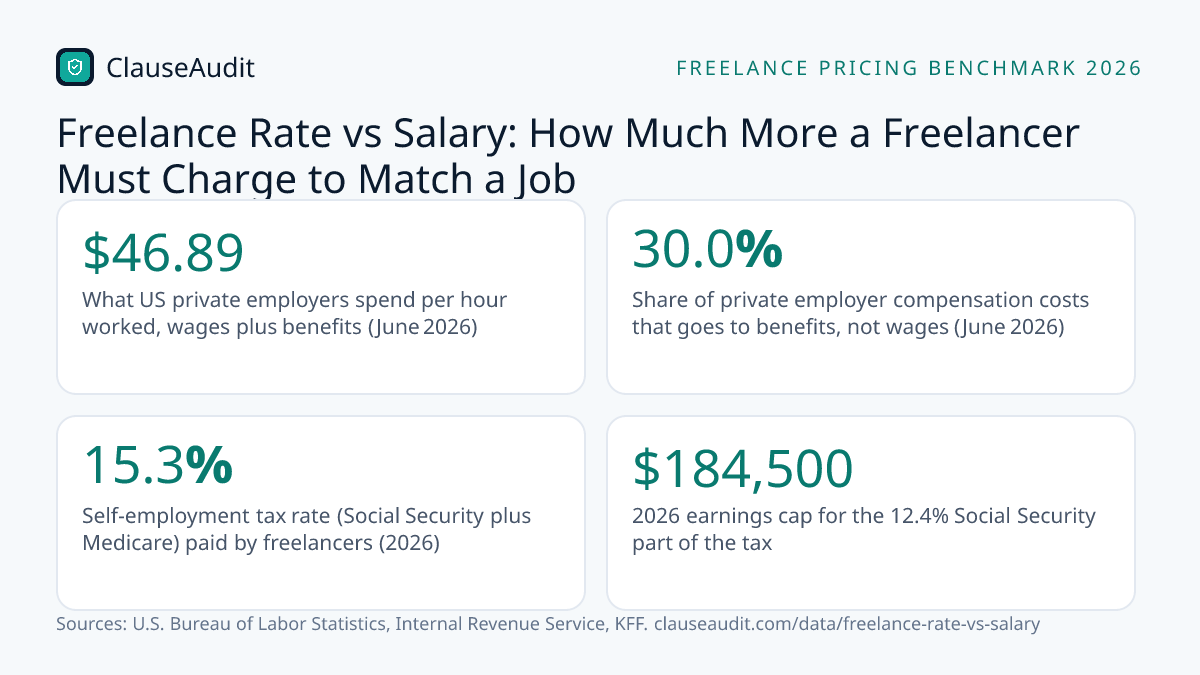
A freelancer has to charge well above an employee's hourly wage to break even. US private employers spent $46.89 per hour worked in June 2026, but only $32.82 of that was wages. The rest paid for benefits, and freelancers also owe the full 15.3% self-employment tax that employers normally split.

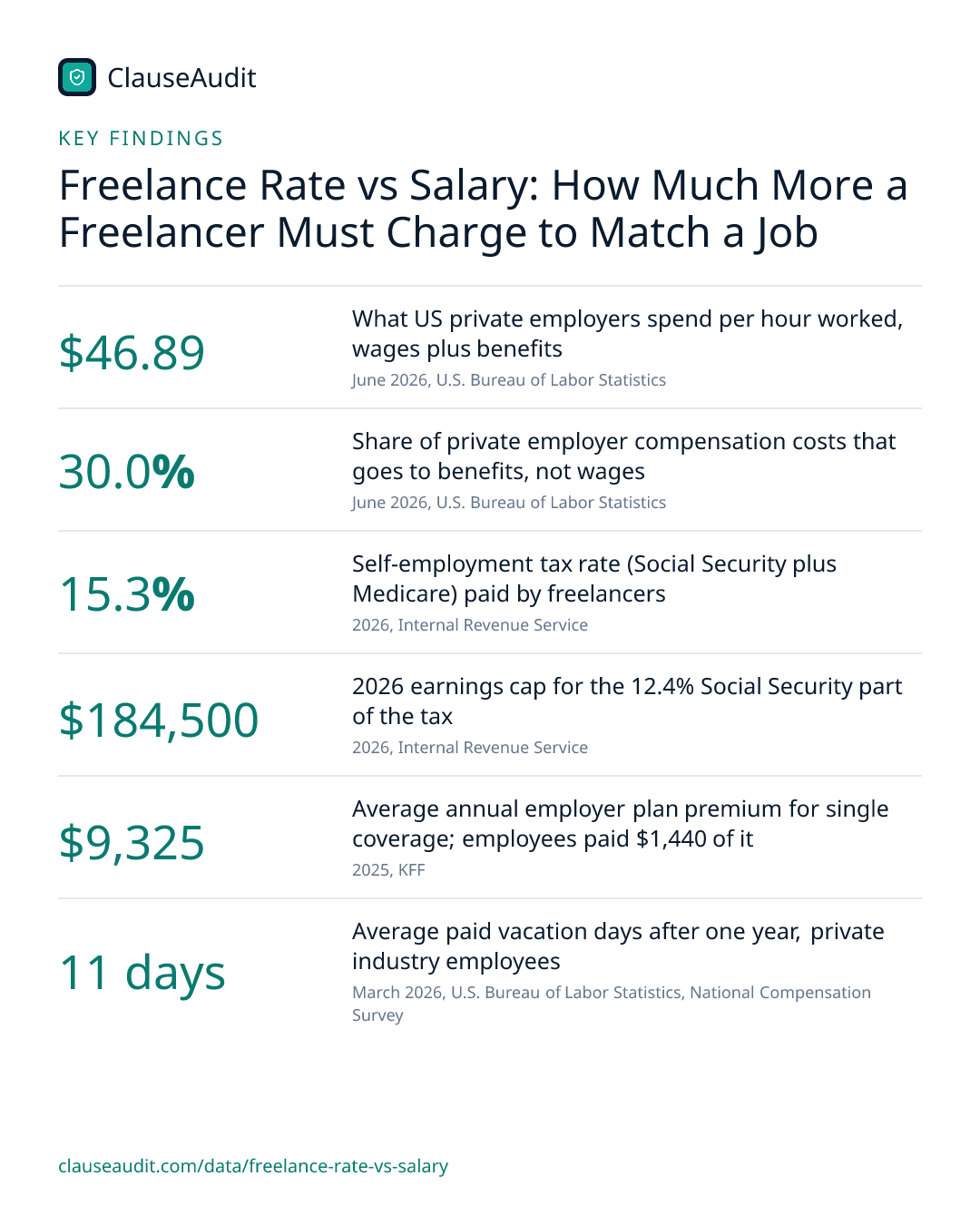
- What US private employers spend per hour worked, wages plus benefits (June 2026, U.S. Bureau of Labor Statistics)
- $46.89
- Share of private employer compensation costs that goes to benefits, not wages (June 2026, U.S. Bureau of Labor Statistics)
- 30.0%
- Self-employment tax rate (Social Security plus Medicare) paid by freelancers (2026, Internal Revenue Service)
- 15.3%
- 2026 earnings cap for the 12.4% Social Security part of the tax (2026, Internal Revenue Service)
- $184,500
- Average annual employer plan premium for single coverage; employees paid $1,440 of it (2025, KFF)
- $9,325
- Average paid vacation days after one year, private industry employees (March 2026, U.S. Bureau of Labor Statistics, National Compensation Survey)
- 11 days
- Median hourly wage, all US occupations (May 2025, U.S. Bureau of Labor Statistics)
- $24.51
- US independent professionals earning more than $100,000 a year (2026, MBO Partners)
- 5.8 million
Take a salary, divide it by the hours in a work year, and you get a number that feels like a fair freelance rate. It is not. That figure only covers the paycheck. It leaves out everything an employer quietly pays for on top: health cover, paid days off, retirement matches and half of your payroll taxes.
This page shows what those extras cost in real US data and how to build them back into your rate. If you are weighing a job offer against going independent, or a client is asking you to quote a number, start here.
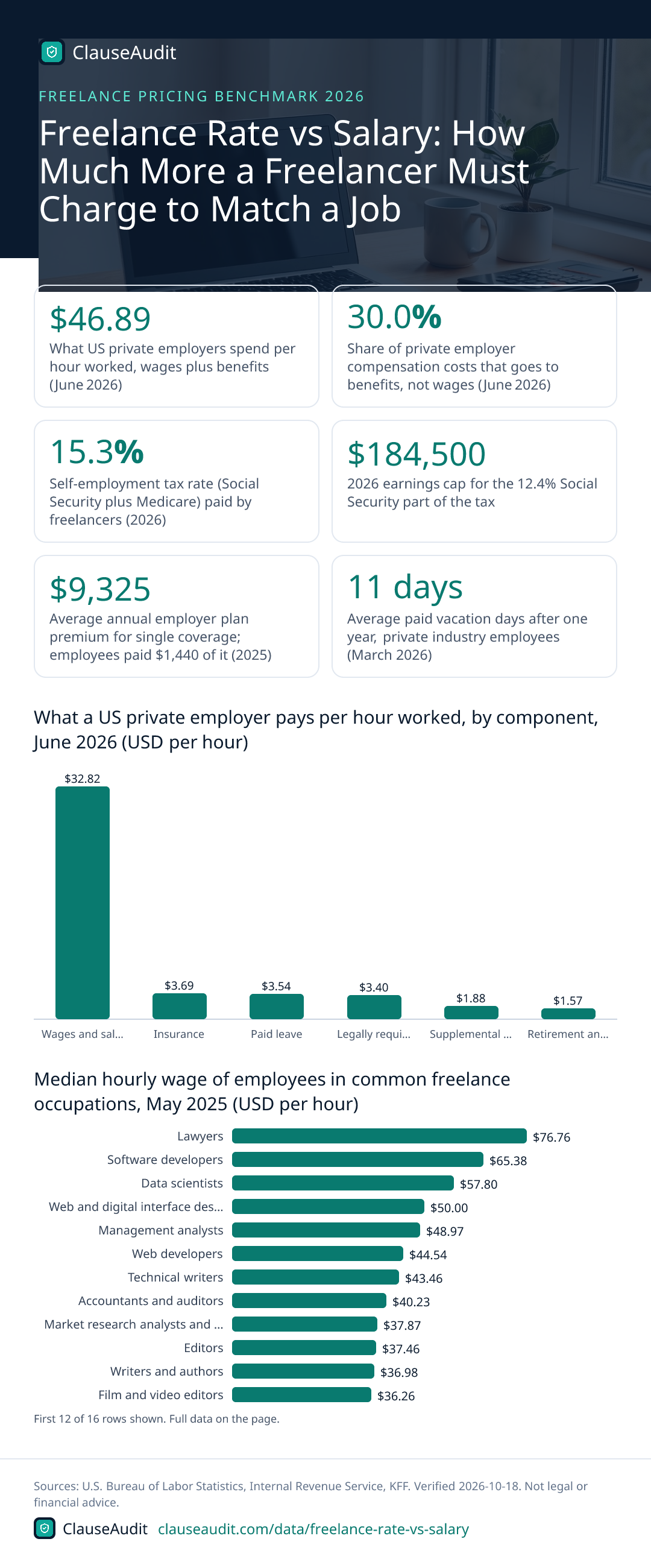
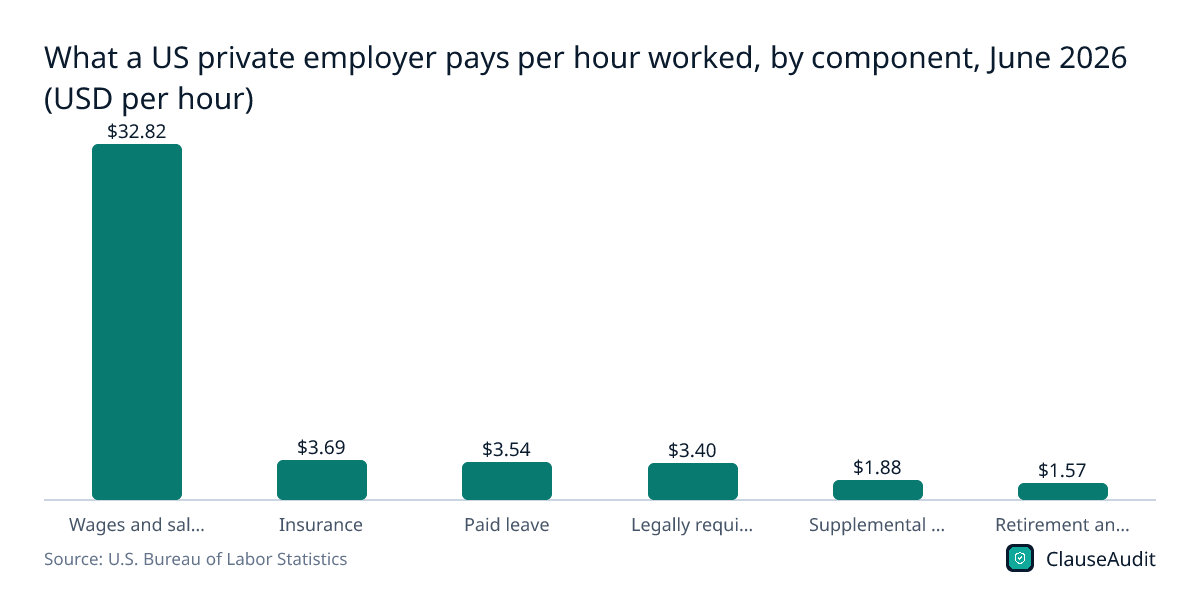
What a US private employer pays per hour worked, by component, June 2026 (USD per hour)
Chart data
| Label | Value (USD per hour) |
|---|---|
| Wages and salaries | $32.82 |
| Insurance | $3.69 |
| Paid leave | $3.54 |
| Legally required benefits | $3.40 |
| Supplemental pay | $1.88 |
| Retirement and savings | $1.57 |
Wages are the tallest bar. The five smaller bars are benefits, worth $14.07 an hour in total. That is the part of an employee's pay that never shows up on a pay stub, and the part freelancers forget to bill for.
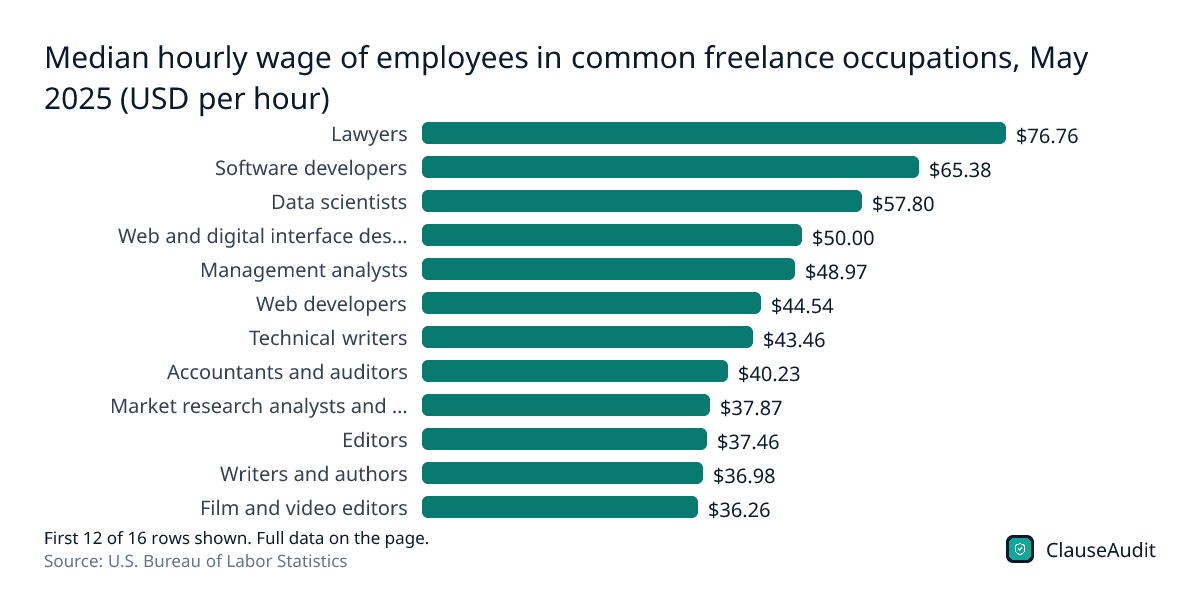
Download this chart (PNG)Median hourly wage of employees in common freelance occupations, May 2025 (USD per hour)
Chart data
| Label | Value |
|---|---|
| Lawyers | $76.76 |
| Software developers | $65.38 |
| Data scientists | $57.80 |
| Web and digital interface designers | $50.00 |
| Management analysts | $48.97 |
| Web developers | $44.54 |
| Technical writers | $43.46 |
| Accountants and auditors | $40.23 |
| Market research analysts and marketing specialists | $37.87 |
| Editors | $37.46 |
| Writers and authors | $36.98 |
| Film and video editors | $36.26 |
| Graphic designers | $30.27 |
| Interpreters and translators | $28.93 |
| All occupations | $24.51 |
| Photographers | $21.47 |
These are employee wages only, so treat each bar as a floor, not a target. A web developer quoting $44.54 an hour as a freelancer is pricing below what an employer would actually spend on the same person.
Download this chart (PNG)Average paid vacation days by years of service, US private industry employees, March 2026
Chart data
| Label | Value |
|---|---|
| After 1 year | 11 |
| After 5 years | 16 |
| After 10 years | 18 |
| After 20 years | 20 |
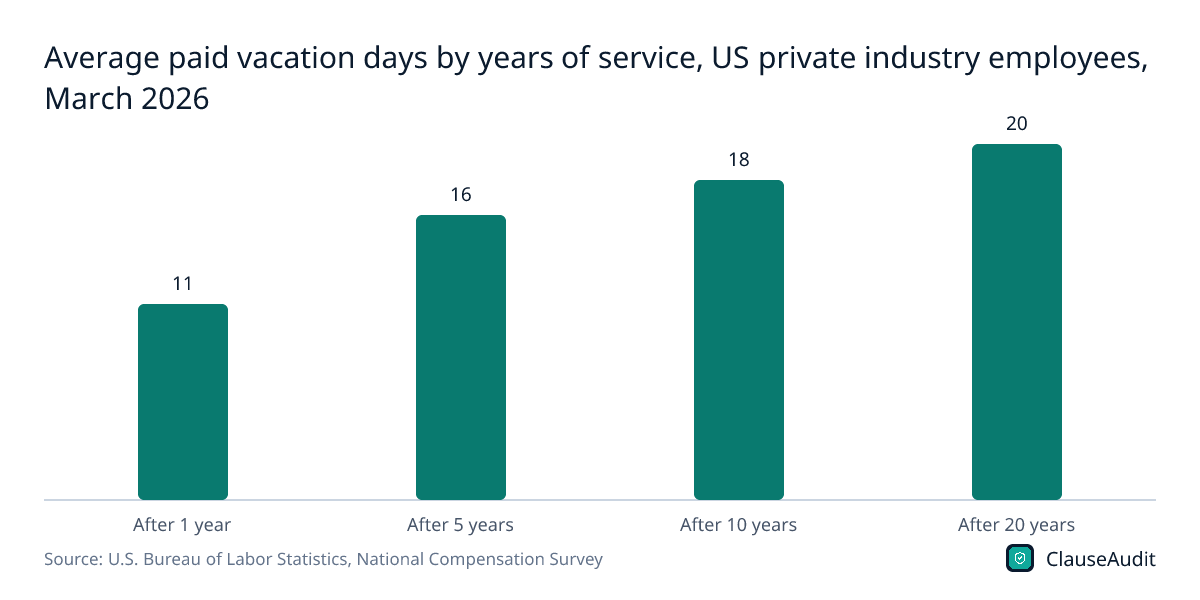
An employee with paid vacation averages 11 days after one year on the job, and that grows to 20 after two decades. As a freelancer, every one of those days is unpaid unless your rate covers it.
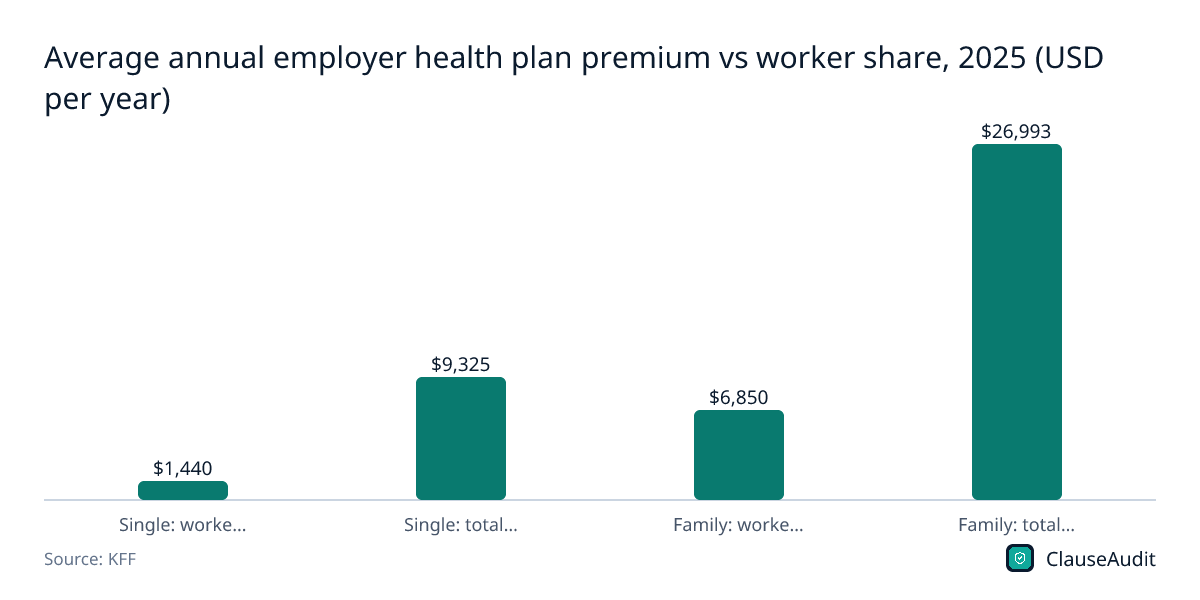
Download this chart (PNG)An employee with single coverage paid $1,440 toward a $9,325 premium in 2025. Go independent and the whole bill lands on you, which is why health cover is often the biggest line in a freelance rate.
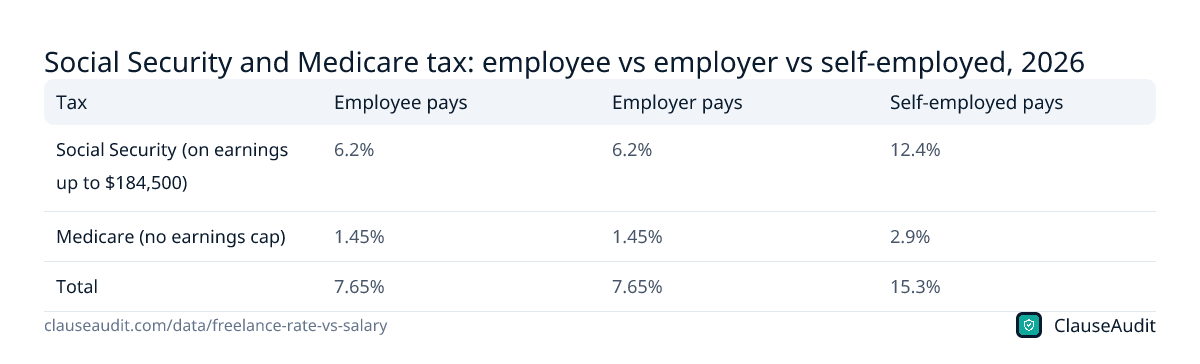
Download this chart (PNG)Social Security and Medicare tax: employee vs employer vs self-employed, 2026
| Tax | Employee pays | Employer pays | Self-employed pays |
|---|---|---|---|
| Social Security (on earnings up to $184,500) | 6.2% | 6.2% | 12.4% |
| Medicare (no earnings cap) | 1.45% | 1.45% | 2.9% |
| Total | 7.65% | 7.65% | 15.3% |
Source: Internal Revenue Service, Topic no. 751, Social Security and Medicare withholding rates; Internal Revenue Service, Self-employment tax (Social Security and Medicare taxes). Download as image
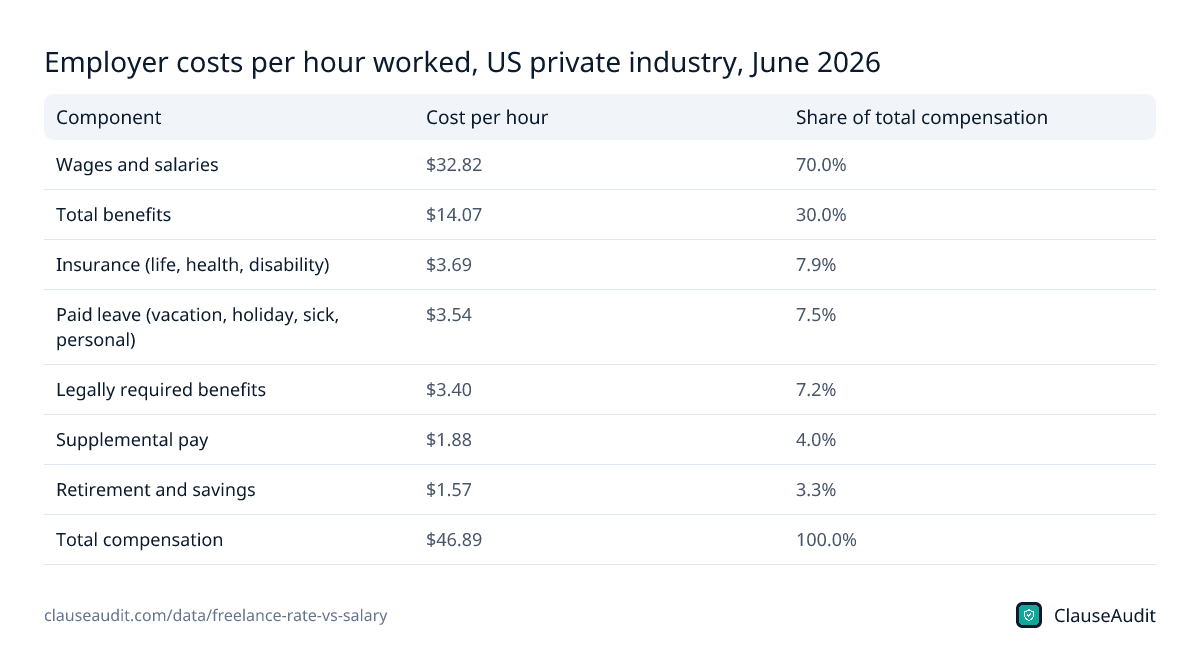
Employer costs per hour worked, US private industry, June 2026
| Component | Cost per hour | Share of total compensation |
|---|---|---|
| Wages and salaries | $32.82 | 70.0% |
| Total benefits | $14.07 | 30.0% |
| Insurance (life, health, disability) | $3.69 | 7.9% |
| Paid leave (vacation, holiday, sick, personal) | $3.54 | 7.5% |
| Legally required benefits | $3.40 | 7.2% |
| Supplemental pay | $1.88 | 4.0% |
| Retirement and savings | $1.57 | 3.3% |
| Total compensation | $46.89 | 100.0% |
Source: U.S. Bureau of Labor Statistics, Table 4. Employer Costs for Employee Compensation for private industry workers by occupational and industry group, June 2026. Download as image
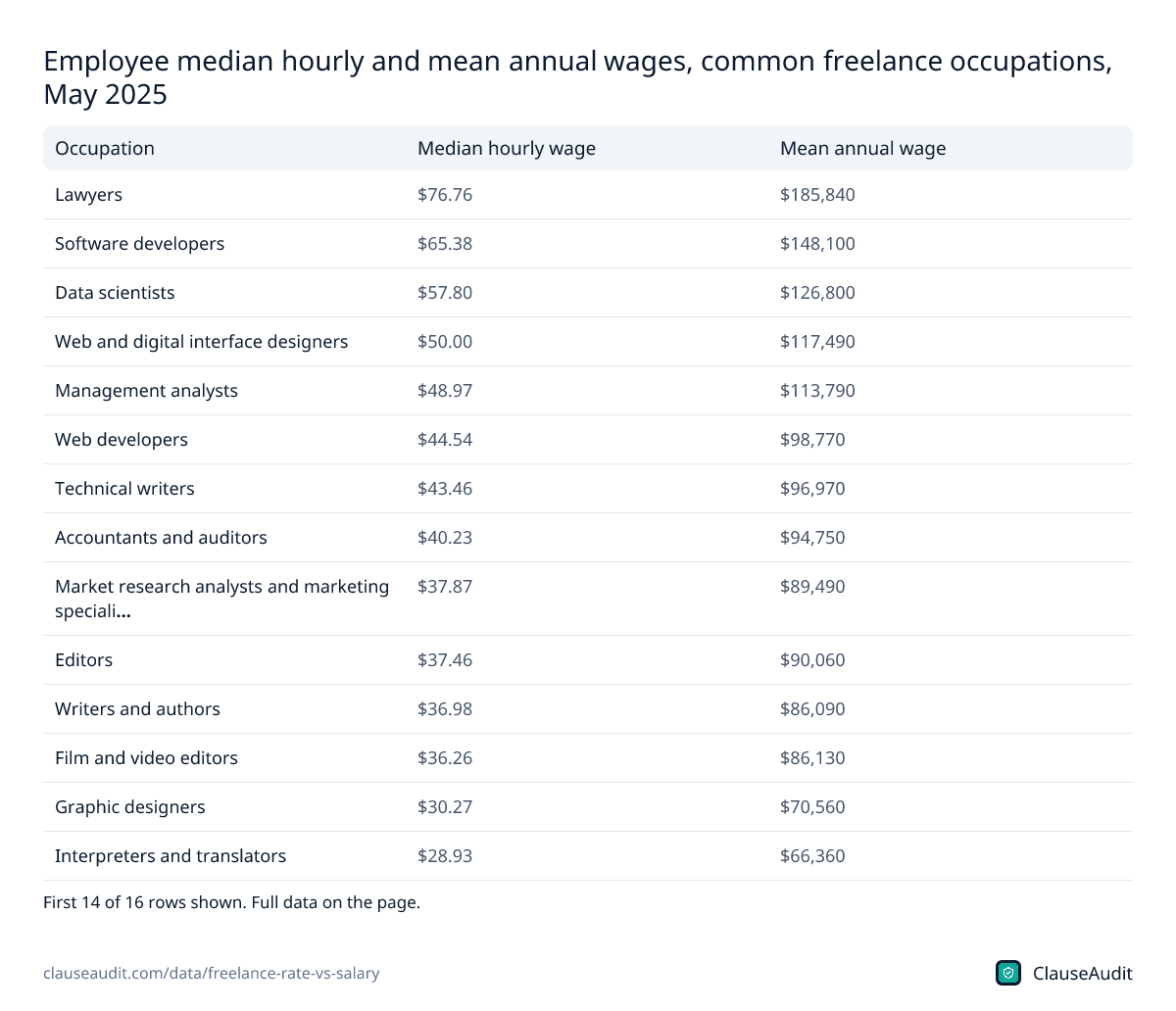
Employee median hourly and mean annual wages, common freelance occupations, May 2025
| Occupation | Median hourly wage | Mean annual wage |
|---|---|---|
| Lawyers | $76.76 | $185,840 |
| Software developers | $65.38 | $148,100 |
| Data scientists | $57.80 | $126,800 |
| Web and digital interface designers | $50.00 | $117,490 |
| Management analysts | $48.97 | $113,790 |
| Web developers | $44.54 | $98,770 |
| Technical writers | $43.46 | $96,970 |
| Accountants and auditors | $40.23 | $94,750 |
| Market research analysts and marketing specialists | $37.87 | $89,490 |
| Editors | $37.46 | $90,060 |
| Writers and authors | $36.98 | $86,090 |
| Film and video editors | $36.26 | $86,130 |
| Graphic designers | $30.27 | $70,560 |
| Interpreters and translators | $28.93 | $66,360 |
| All occupations | $24.51 | $69,770 |
| Photographers | $21.47 | $55,410 |
Source: U.S. Bureau of Labor Statistics, Table 1. National employment and wage data from the Occupational Employment and Wage Statistics survey by occupation, May 2025. Download as image
Why is a salary-to-hourly conversion the wrong starting point?
Dividing a salary by hours worked gives you the wage portion of what you cost an employer. In June 2026, that wage portion averaged $32.82 an hour for US private industry workers. The full cost to the employer was $46.89.
The gap is benefits, and it is not small. Benefits made up 30.0% of total compensation. That covers insurance, paid leave, legally required payroll costs, bonuses and other supplemental pay, and retirement contributions.
So if you leave a job and charge your old hourly wage, you have given yourself a large pay cut without noticing. You are doing the same work and funding all of those extras out of the same dollars.
How much more should a freelancer charge than an employee?
There is no single multiplier that fits everyone, because your costs depend on your health plan, how much time off you want and how many hours you can actually bill. But the data gives you the building blocks.
Start from the full employer cost, not the wage. The private industry average of $46.89 an hour already includes paid leave, insurance and the employer half of payroll taxes. Then add what an employer never had to think about: unpaid gaps between projects, time spent on sales and admin, and your own software, equipment and accounting.
Billable hours are the piece most people get wrong. An employee is paid for every hour at their desk, including meetings and slow afternoons. You get paid only for hours a client accepts on an invoice. If half your week goes to pitching, emails and bookkeeping, your rate has to carry that unbilled half too.
- Write down the salary you want to match.
- Add the benefits you would lose: health cover, paid vacation and sick days, retirement contributions.
- Add the employer half of Social Security and Medicare, since you now pay it.
- Add business costs such as software, insurance, equipment and a tax preparer.
- Divide the total by the hours you can realistically bill in a year, not the hours you plan to work.
What does self-employment tax add to a freelance rate?
An employee pays 7.65% in Social Security and Medicare tax and the employer pays a matching 7.65%. A freelancer pays both halves, for a self-employment tax rate of 15.3%.
The 12.4% Social Security part stops at $184,500 of earnings in 2026. The 2.9% Medicare part has no cap, and an extra 0.9% Medicare tax applies above $200,000 for single filers and $250,000 for married couples filing jointly.
One piece of relief: you can deduct the employer-equivalent half when you figure your adjusted gross income. That softens the hit on income tax, but it does not make the extra 7.65% disappear. Price it in.
What benefits do freelancers have to pay for themselves?
Health cover is often the biggest. In 2025 the average employer plan premium for single coverage was $9,325, and the worker paid just $1,440 of it. For family coverage the total premium averaged $26,993 and workers paid $6,850. As a freelancer, there is no employer share. Your plan may cost more or less than these averages, but the full premium is yours.
Paid time off is the one people forget. Private industry employees average 11 paid vacation days after one year and 7 paid sick days, plus paid holidays. Take a two-week vacation as a freelancer and you earn nothing for two weeks. Your rate during the other weeks has to cover that.
Retirement is the third. There is no automatic match when you work for yourself, so whatever an employer would have chipped in needs to come out of your rate and into a retirement account you set up.
Does a higher rate mean freelancing pays more?
Not by itself. A rate that looks generous next to a salary can still leave you behind once you subtract taxes, insurance and unbilled time. What matters is what you keep at the end of the year compared with what the job would have paid you in wages plus benefits.
Plenty of independents do come out ahead. MBO Partners counts 5.8 million US independent professionals earning more than $100,000 a year in 2026, out of an independent workforce of 74.9 million. That is an industry survey, not government data, but it shows the upside is real for people who price properly.
The ones who struggle tend to share a habit: they quote the hourly figure from their last pay stub. A graphic designer whose employee median is $30.27 an hour, for instance, is underpricing if that is the number on the proposal.
How to protect your rate once you set it
A good rate is only as good as the contract around it. Clients rarely argue with the number on the first page. The money leaks out through the clauses further down: payment terms that stretch for months, revisions with no limit, or a cancellation that pays you nothing for work already done.
Before you sign, read the payment section as carefully as the rate itself. Look for when you get paid, what happens if they are late and what counts as extra work. If a clause turns a fixed fee into open-ended labor, your real hourly rate drops with every round of changes.
Say you quote a flat fee for a website based on a set number of billable hours. The contract allows unlimited revisions and pays on final approval. Two extra rounds of changes and a client who takes months to sign off, and the rate you worked so hard to calculate has quietly shrunk. A revision cap and a firm payment date fix most of that.
How ClauseAudit helps
You did the math to set a rate that covers taxes, health cover and time off. The contract decides if you actually collect it. ClauseAudit's automated review reads a freelance or client agreement and flags the clauses that quietly cut into what you earn.
Upload the agreement or paste the text, and you get each risky clause explained in plain English with a suggested fix you can send back to the client.
- Payment terms: how many days the client has to pay, and whether payment depends on vague approval
- Late fees and interest: what you can charge when an invoice runs late
- Scope and revisions: whether unlimited changes can turn your rate into free labor
- Kill fee: what you are paid if the client cancels partway through
- Rate changes and renewal: if your rate is locked for years on an auto-renewing deal
- Liability and indemnity: any risk of owing more than the project is worth
Frequently asked questions
How do I convert my salary to a freelance hourly rate?
Start with the salary, then add the benefits you would lose, the employer half of payroll tax and your business costs. Divide that total by the hours you can actually bill in a year, not every hour you work. The result is your break-even rate. Add a margin on top for slow months and profit.
What share of an employee's pay goes to benefits?
In June 2026, benefits made up 30.0% of what US private employers spent on compensation, or $14.07 of the $46.89 total per hour worked. Wages and salaries were the other 70.0%. A freelancer pricing from wages alone skips that entire benefits share.
What is the self-employment tax rate in 2026?
It is 15.3%: 12.4% for Social Security and 2.9% for Medicare. The Social Security part applies to the first $184,500 of earnings in 2026. Employees pay half of this and their employer pays the other half, while freelancers pay all of it, though they can deduct the employer-equivalent portion.
Is a 1099 rate supposed to be higher than a W-2 rate?
Yes. A 1099 contractor pays both halves of Social Security and Medicare, buys their own health cover, gets no paid leave and receives no retirement match. A W-2 employee often gets most of those on top of wages. If a client offers the same hourly figure for both, the 1099 version pays less in real terms.
How much does health insurance add to a freelance rate?
It depends on your plan, but for a sense of scale, the average employer plan premium for single coverage was $9,325 in 2025, and employees paid only $1,440 of it. Family coverage averaged $26,993. Freelancers pay the whole premium, so spread that annual cost across your billable hours.
Should I base my freelance rate on the median wage for my job?
Use it as a floor, not a target. Median wages, such as $44.54 an hour for web developers in May 2025, cover employees only and leave out benefits, payroll tax and unbilled time. Charge that figure as a freelancer and you will likely earn less than a typical employee doing the same work.
How do I account for vacation in my freelance rate?
Decide how many weeks off you want, including holidays and sick days, and remove them from your billable time before you divide. For reference, private industry employees average 11 paid vacation days after one year and 7 paid sick days. Freelancers are paid for none of these, so the rate has to cover them.
Can a client contract lower my effective hourly rate?
Yes, and it happens often. Unlimited revisions, long payment terms, no kill fee and payment tied to vague approval all mean more unpaid hours or slower cash. Your quoted rate stays the same on paper while what you earn per hour drops. Read those clauses before you sign.
Use this data
Every chart and card below is free to reuse under CC BY 4.0. Download what you need and link back to this page.
 Stat cards
 Key findings card
 Infographic
 What a US private employer pays per hour worked, by component, June 2026 (USD per hour)
 Median hourly wage of employees in common freelance occupations, May 2025 (USD per hour)
 Average paid vacation days by years of service, US private industry employees, March 2026
 Average annual employer health plan premium vs worker share, 2025 (USD per year)
 Social Security and Medicare tax: employee vs employer vs self-employed, 2026
 Employer costs per hour worked, US private industry, June 2026
 Employee median hourly and mean annual wages, common freelance occupations, May 2025
Embed the infographic
Free to share on your site, blog or slides under CC BY 4.0. Please keep the credit link.
Sources and method
Every number on this page comes from the sources below, each opened and read on or before October 18, 2026. A second, independent review checked every figure against its source and corrected anything that did not match. Figures that could not be confirmed were left out.
- U.S. Bureau of Labor Statistics, Employer Costs for Employee Compensation, June 2026 (news release) (September 9, 2026 (June 2026 data))
- U.S. Bureau of Labor Statistics, Table 4. Employer Costs for Employee Compensation for private industry workers by occupational and industry group, June 2026 (September 9, 2026 (2026 Q2))
- U.S. Bureau of Labor Statistics, Table 1. National employment and wage data from the Occupational Employment and Wage Statistics survey by occupation, May 2025 (May 2025 estimates (released 2026))
- Internal Revenue Service, Self-employment tax (Social Security and Medicare taxes) (Last reviewed or updated June 27, 2026)
- Internal Revenue Service, Topic no. 751, Social Security and Medicare withholding rates (Last reviewed or updated September 24, 2026)
- KFF, 2025 Employer Health Benefits Survey (October 22, 2025 (2025 edition))
- U.S. Bureau of Labor Statistics, National Compensation Survey, Paid leave benefits: Average number of sick and vacation days by length of service requirement, March 2026 (March 2026 estimates (released September 25, 2026))
- U.S. Bureau of Labor Statistics, Employee Benefits in the United States, March 2026 (news release) (September 25, 2026)
- MBO Partners, Independent workforce reaches 74.9 million (State of Independence 2026 press release) (September 28, 2026)
- Internal Revenue Service, Topic no. 560, Additional Medicare Tax (Last reviewed or updated October 9, 2026)
Cite this page
ClauseAudit, “Freelance Rate vs Salary: How Much More a Freelancer Must Charge to Match a Job”, updated October 18, 2026, https://clauseaudit.com/data/freelance-rate-vs-salary. Free to reuse with a link back (CC BY 4.0).
This page summarises published data and law as checked on October 18, 2026. Figures are updated as new editions are released, and your own situation may differ. It is general information, not legal, tax or financial advice.