Employee Monitoring Laws by State: Where Employers Must Give Notice
By ClauseAudit Research · 11 sources ·
What are the employee monitoring laws by state?
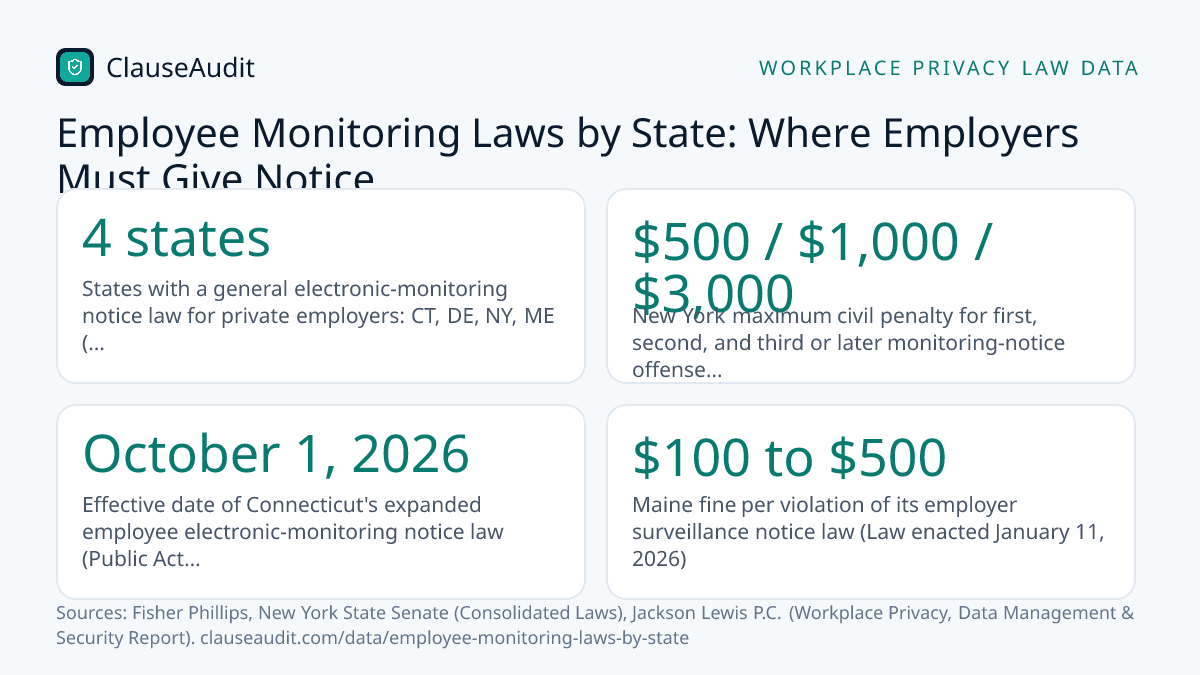
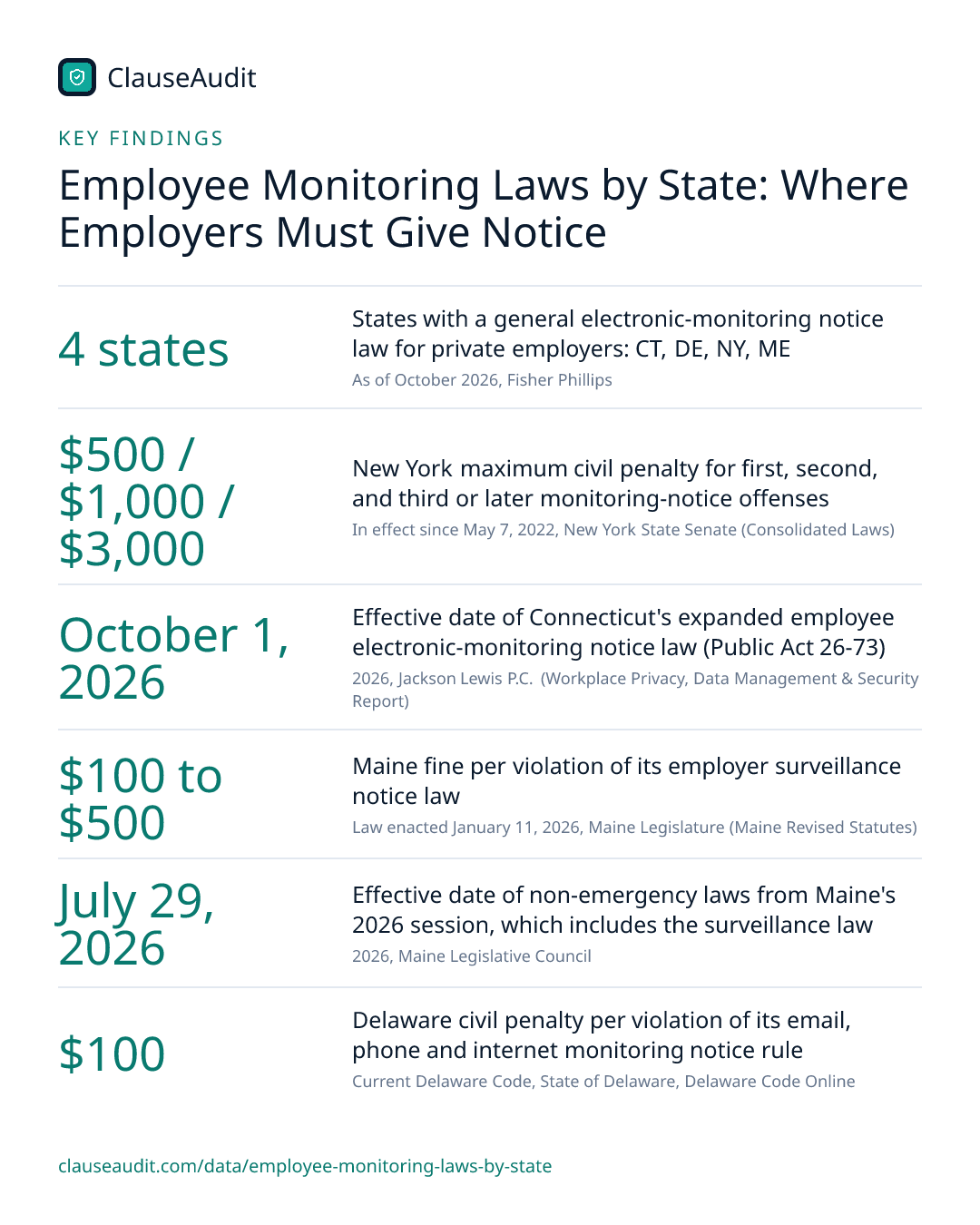
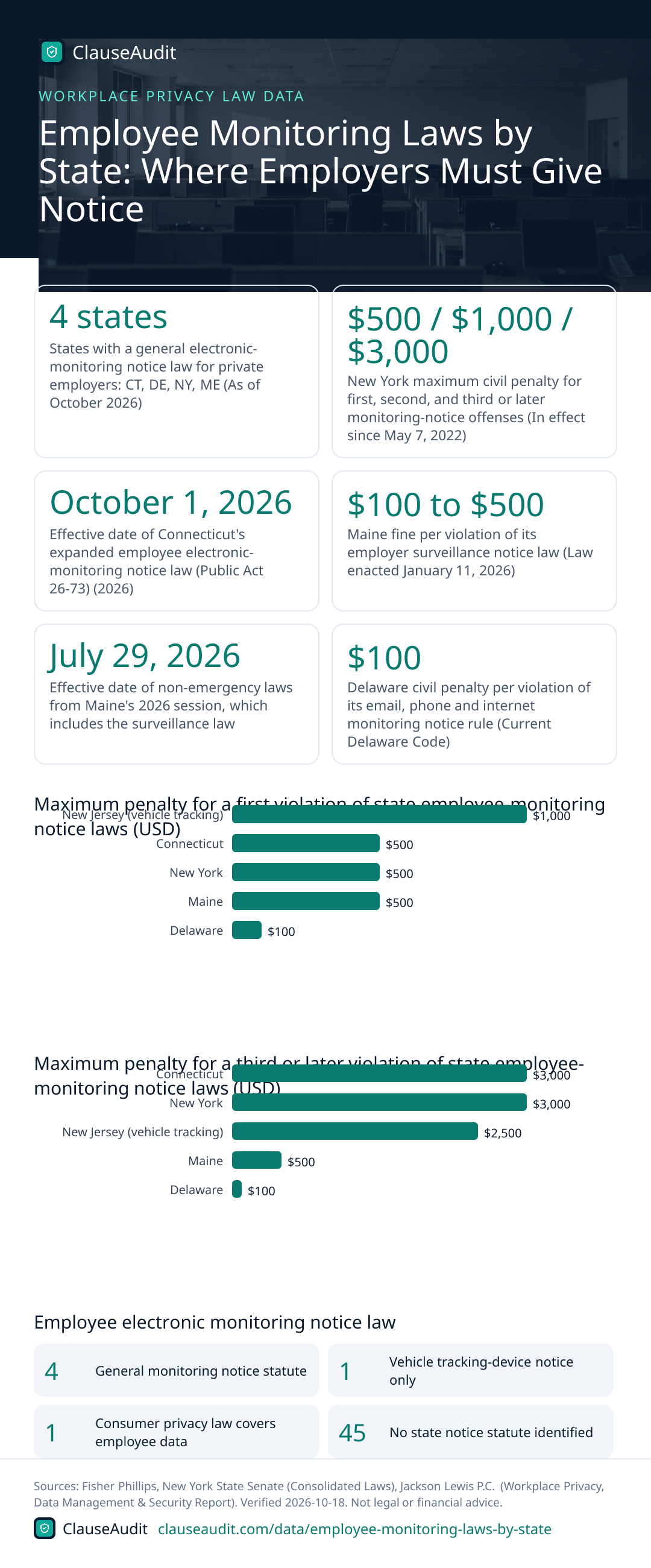
Most states let private employers monitor work devices and accounts without telling you first. As of October 2026, only 4 states have a general electronic monitoring notice law: Connecticut, Delaware, New York and Maine. New Jersey covers vehicle tracking only, and California reaches employee data through its consumer privacy law.

- States with a general electronic-monitoring notice law for private employers: CT, DE, NY, ME (As of October 2026, Fisher Phillips)
- 4 states
- New York maximum civil penalty for first, second, and third or later monitoring-notice offenses (In effect since May 7, 2022, New York State Senate (Consolidated Laws))
- $500 / $1,000 / $3,000
- Effective date of Connecticut's expanded employee electronic-monitoring notice law (Public Act 26-73) (2026, Jackson Lewis P.C. (Workplace Privacy, Data Management & Security Report))
- October 1, 2026
- Maine fine per violation of its employer surveillance notice law (Law enacted January 11, 2026, Maine Legislature (Maine Revised Statutes))
- $100 to $500
- Effective date of non-emergency laws from Maine's 2026 session, which includes the surveillance law (2026, Maine Legislative Council)
- July 29, 2026
- Delaware civil penalty per violation of its email, phone and internet monitoring notice rule (Current Delaware Code, State of Delaware, Delaware Code Online)
- $100
- New Jersey maximum penalties for first and later violations of vehicle tracking-device notice law (In effect since April 2022, RecordingLaw.com)
- $1,000 / $2,500
- Share of U.S. adults who oppose employers using face recognition to analyze facial expressions (Survey Dec. 12-18, 2022, Pew Research Center)
- 70%
Your employer can probably see more than you think. Email on the company account, websites visited on a work laptop, keystrokes, badge swipes, the GPS in a company van. In most of the country, none of that requires a heads-up.
A handful of states have changed that by requiring employers to tell workers about monitoring. Below we explain what those laws actually demand, what happens when an employer skips the notice, and what to look for in your offer letter, handbook or employment contract before you sign the acknowledgment form HR slides across the desk.
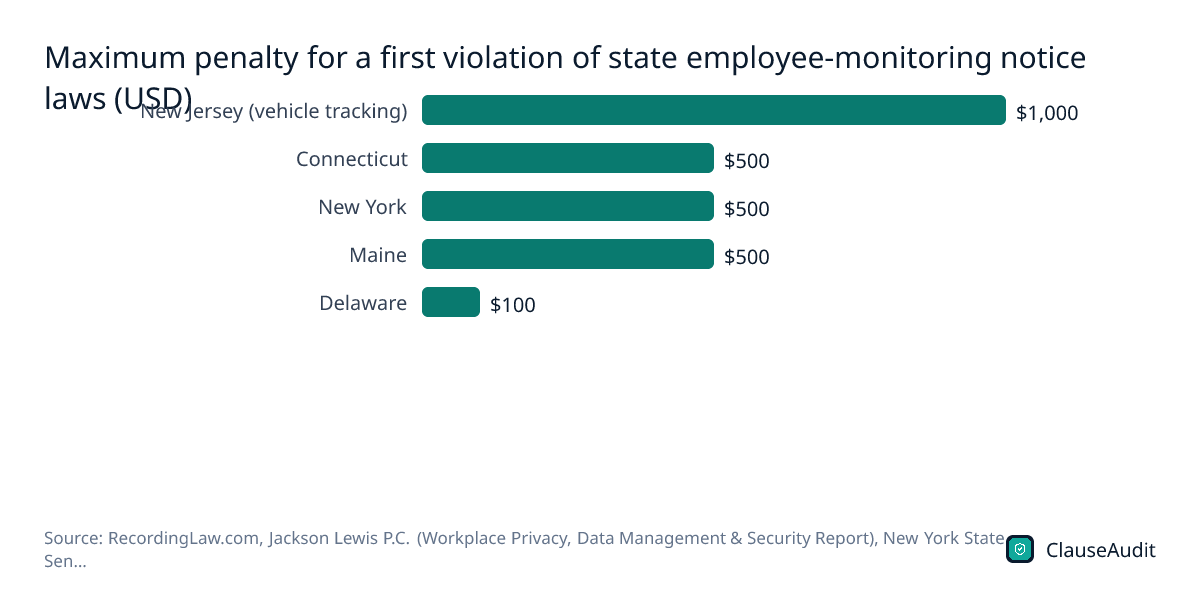
Maximum penalty for a first violation of state employee-monitoring notice laws (USD)
Chart data
| Label | Value |
|---|---|
| New Jersey (vehicle tracking) | $1,000 |
| Connecticut | $500 |
| New York | $500 |
| Maine | $500 |
| Delaware | $100 |
First violations are cheap almost everywhere. New Jersey's vehicle tracking law is the steepest at up to $1,000, and Delaware charges a flat $100 per violation.
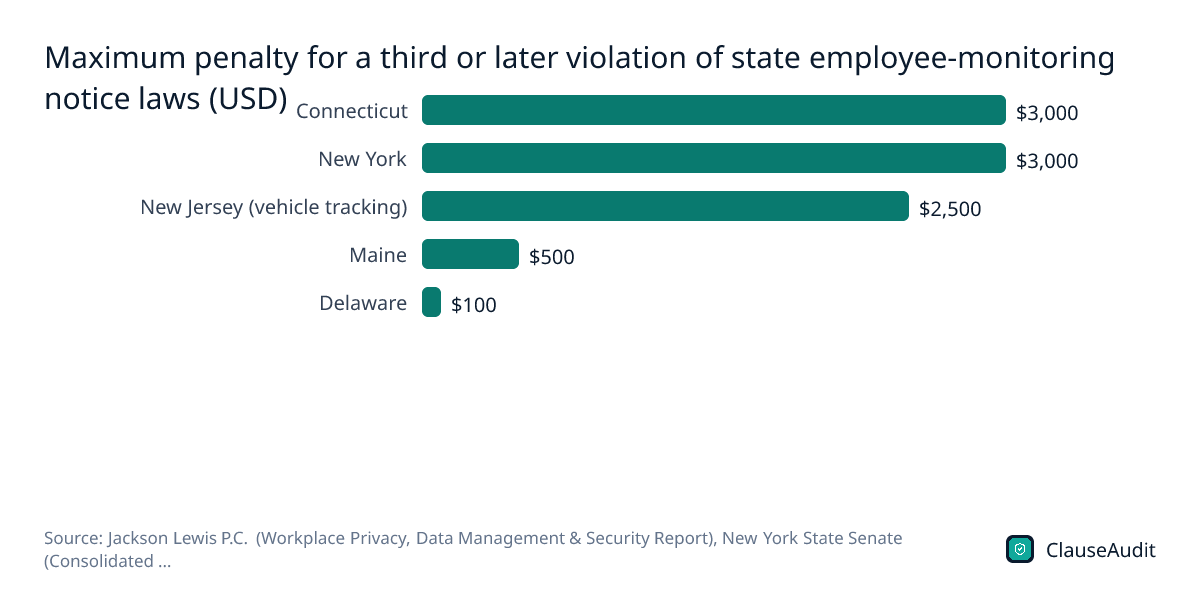
Download this chart (PNG)Maximum penalty for a third or later violation of state employee-monitoring notice laws (USD)
Chart data
| Label | Value |
|---|---|
| Connecticut | $3,000 |
| New York | $3,000 |
| New Jersey (vehicle tracking) | $2,500 |
| Maine | $500 |
| Delaware | $100 |
Connecticut and New York raise the cap to $3,000 for a third or later offense, and New Jersey's vehicle tracking law allows up to $2,500 for each violation after the first. Maine and Delaware do not raise the fine for repeat violations.
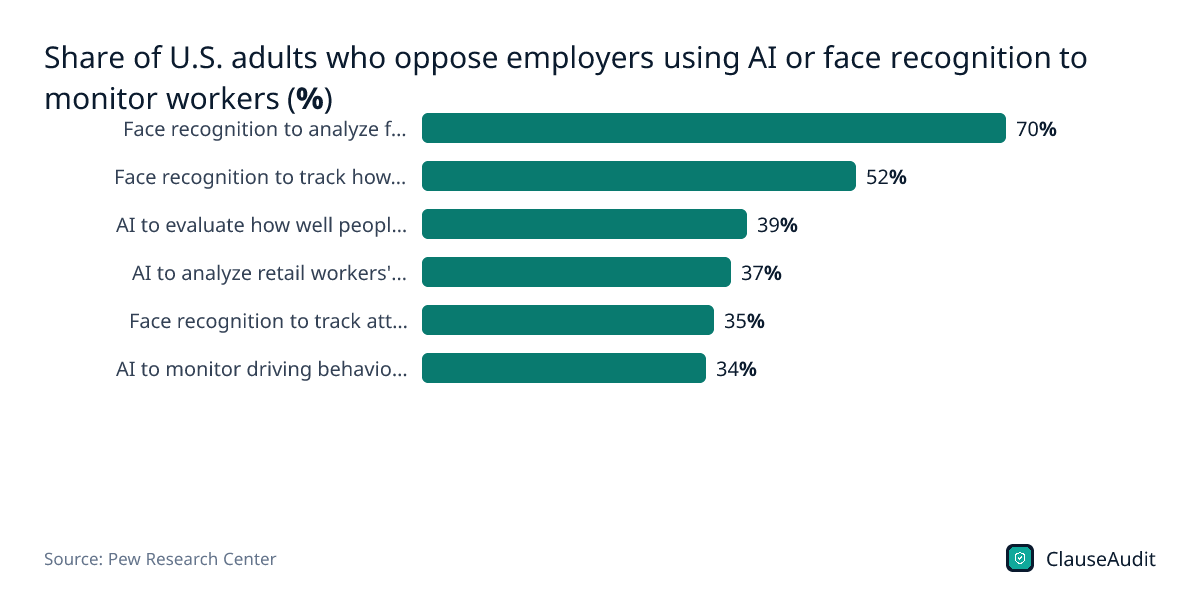
Download this chart (PNG)Share of U.S. adults who oppose employers using AI or face recognition to monitor workers (%)
Chart data
| Label | Value |
|---|---|
| Face recognition to analyze facial expressions | 70% |
| Face recognition to track how often workers take breaks | 52% |
| AI to evaluate how well people do their jobs | 39% |
| AI to analyze retail workers' interactions with customers | 37% |
| Face recognition to track attendance | 35% |
| AI to monitor driving behavior on company trips | 34% |
Opposition depends heavily on what the tool does. 70% oppose face recognition that reads facial expressions, while 35% oppose using it just to track attendance.
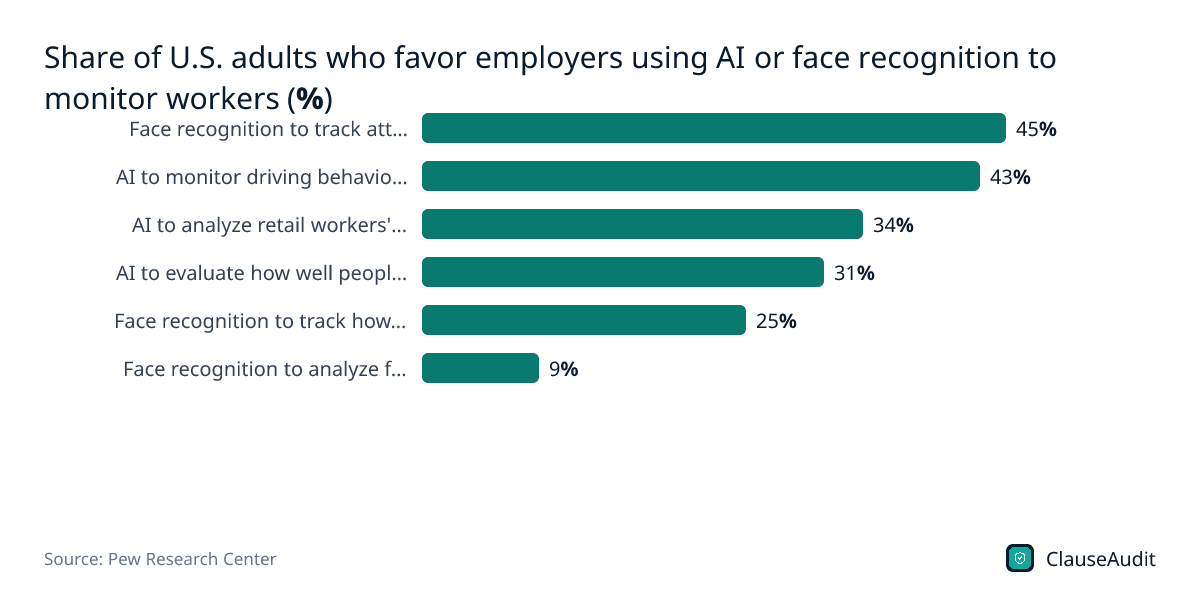
Download this chart (PNG)Share of U.S. adults who favor employers using AI or face recognition to monitor workers (%)
Chart data
| Label | Value |
|---|---|
| Face recognition to track attendance | 45% |
| AI to monitor driving behavior on company trips | 43% |
| AI to analyze retail workers' interactions with customers | 34% |
| AI to evaluate how well people do their jobs | 31% |
| Face recognition to track how often workers take breaks | 25% |
| Face recognition to analyze facial expressions | 9% |
Attendance tracking and monitoring driving on company trips draw the most support, at 45% and 43%. Reading facial expressions gets 9%, which suggests most people draw the line at judging emotions.
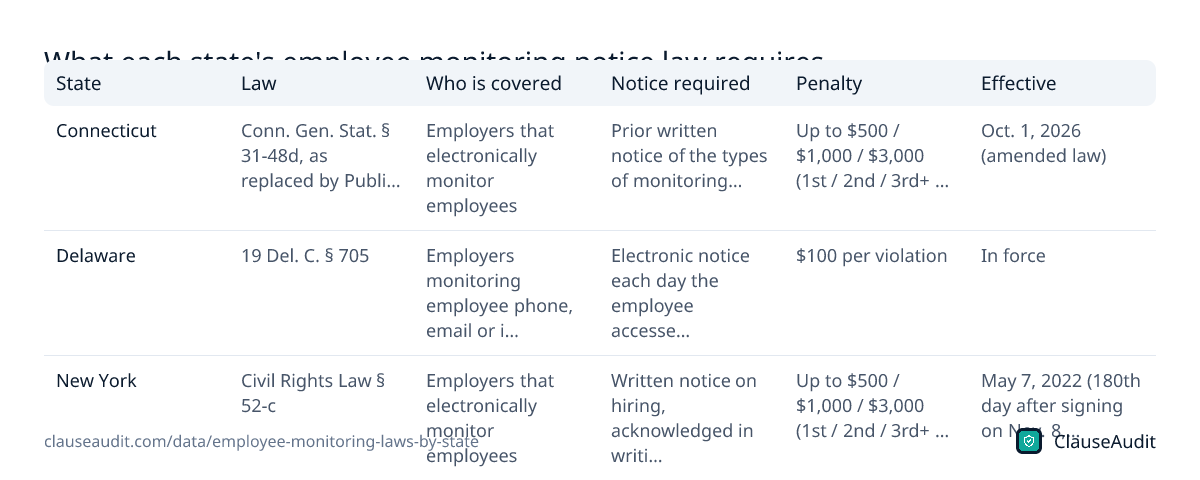
Download this chart (PNG)What each state's employee monitoring notice law requires
| State | Law | Who is covered | Notice required | Penalty | Effective |
|---|---|---|---|---|---|
| Connecticut | Conn. Gen. Stat. § 31-48d, as replaced by Public Act 26-73 | Employers that electronically monitor employees | Prior written notice of the types of monitoring, posted conspicuously. From Oct. 1, 2026 the notice must also name the specific locations that may be monitored, and new hires get a plain-language written statement before starting. | Up to $500 / $1,000 / $3,000 (1st / 2nd / 3rd+ offense), Labor Commissioner | Oct. 1, 2026 (amended law) |
| Delaware | 19 Del. C. § 705 | Employers monitoring employee phone, email or internet use | Electronic notice each day the employee accesses employer email or internet, or a one-time notice acknowledged in writing or electronically | $100 per violation | In force |
| New York | Civil Rights Law § 52-c | Employers that electronically monitor employees | Written notice on hiring, acknowledged in writing or electronically, plus a notice posted in a conspicuous place | Up to $500 / $1,000 / $3,000 (1st / 2nd / 3rd+ offense), Attorney General | May 7, 2022 (180th day after signing on Nov. 8, 2021) |
| Maine | 26 M.R.S. § 620-A (PL 2025, c. 524) | Employers using employer surveillance (security cameras and vehicle GPS/safety devices on employer-owned vehicles excluded) | Notice before surveillance begins, notice to applicants during interviews, and written notice to all current employees at least once per calendar year | $100 to $500 per violation, Dept. of Labor, no private right of action | July 29, 2026 per the Maine Legislature (some law firms say July 14, 2026) |
| New Jersey | N.J.S.A. 34:6B-22 | Employers using a tracking device in a vehicle an employee drives | Written notice before using the tracking device | Up to $1,000 for a first violation, $2,500 for each later one | April 2022 |
Source: Jackson Lewis P.C. (Workplace Privacy, Data Management & Security Report), Deadline Imminent for Connecticut's Expanded Electronic Monitoring Law; State of Delaware, Delaware Code Online, 19 Del. C. § 705, Notice of monitoring of telephone transmissions, electronic mail and Internet usage; New York State Senate (Consolidated Laws), New York Civil Rights Law § 52-c, Employers engaged in electronic monitoring; New York State Senate, Senate Bill S2628 (2021-2022), adding Civil Rights Law § 52-c; Maine Legislature (Maine Revised Statutes), 26 M.R.S. § 620-A, Employer surveillance; Maine Legislative Council, Legislative Digest of Bills and Summaries of Enacted Laws, 132nd Legislature, Second Regular Session; RecordingLaw.com, Maine's Employer Surveillance Law Takes Effect July 14: Notice Rules for Call Recording, GPS, and Cameras. Download as image
Employee electronic monitoring notice law by state
- 4General monitoring notice statute
- 1Vehicle tracking-device notice only
- 1Consumer privacy law covers employee data
- 45No state notice statute identified
- General monitoring notice statute4
- Vehicle tracking-device notice only1
- Consumer privacy law covers employee data1
- No state notice statute identified45
| State | Law | Notice required | Penalty | Effective | Source |
|---|---|---|---|---|---|
| Alabama | None identified | No general state notice statute for private-employer electronic monitoring | - | - | Jackson Lewis, Deadline Imminent for Connecticut's Expanded Electronic Monitoring Law (Sept. 10, 2026) |
| Alaska | None identified | No general state notice statute for private-employer electronic monitoring | - | - | Jackson Lewis, Deadline Imminent for Connecticut's Expanded Electronic Monitoring Law (Sept. 10, 2026) |
| Arizona | None identified | No general state notice statute for private-employer electronic monitoring | - | - | Jackson Lewis, Deadline Imminent for Connecticut's Expanded Electronic Monitoring Law (Sept. 10, 2026) |
| Arkansas | None identified | No general state notice statute for private-employer electronic monitoring | - | - | Jackson Lewis, Deadline Imminent for Connecticut's Expanded Electronic Monitoring Law (Sept. 10, 2026) |
| California | California Consumer Privacy Act (Civ. Code § 1798.100 et seq.); AB 1331 (workplace surveillance in bathrooms) and AB 1883 (AI workplace surveillance tools), both signed Sept. 30, 2026 | CCPA duties, including notice at collection, apply to employee and applicant personal information. AB 1331 bars employers from using a workplace surveillance tool to monitor employees in workplace bathrooms, with a narrow exception for access tools on locked bathrooms. AB 1883 bans AI workplace surveillance tools that infer or predict emotional state or collect neural data. These two are prohibitions, not notice rules. | CCPA enforcement; AB 1331 and AB 1883: up to $500 per violation | CCPA employee coverage: Jan. 1, 2023 (exemption expired Dec. 31, 2022). AB 1331 and AB 1883: not confirmed | Cal. Civ. Code § 1798.100 et seq. |
| Colorado | None identified | No general state notice statute for private-employer electronic monitoring | - | - | Jackson Lewis, Deadline Imminent for Connecticut's Expanded Electronic Monitoring Law (Sept. 10, 2026) |
| Connecticut | Conn. Gen. Stat. § 31-48d (replaced by Public Act 26-73) | Prior written notice of the types of monitoring, posted conspicuously; from Oct. 1, 2026 it must name the monitored locations, and new hires get a written statement before starting | Up to $500 / $1,000 / $3,000 | Oct. 1, 2026 (amended law) | Conn. Gen. Stat. § 31-48d; Public Act 26-73 (SB 472) |
| Delaware | 19 Del. C. § 705 | Daily electronic notice when the employee uses employer email or internet, or a one-time notice the employee acknowledges | $100 per violation | In force | 19 Del. C. § 705 |
| District of Columbia | None identified | No general state notice statute for private-employer electronic monitoring | - | - | Jackson Lewis, Deadline Imminent for Connecticut's Expanded Electronic Monitoring Law (Sept. 10, 2026) |
| Florida | None identified | No general state notice statute for private-employer electronic monitoring | - | - | Jackson Lewis, Deadline Imminent for Connecticut's Expanded Electronic Monitoring Law (Sept. 10, 2026) |
| Georgia | None identified | No general state notice statute for private-employer electronic monitoring | - | - | Jackson Lewis, Deadline Imminent for Connecticut's Expanded Electronic Monitoring Law (Sept. 10, 2026) |
| Hawaii | None identified | No general state notice statute for private-employer electronic monitoring | - | - | Jackson Lewis, Deadline Imminent for Connecticut's Expanded Electronic Monitoring Law (Sept. 10, 2026) |
| Idaho | None identified | No general state notice statute for private-employer electronic monitoring | - | - | Jackson Lewis, Deadline Imminent for Connecticut's Expanded Electronic Monitoring Law (Sept. 10, 2026) |
| Illinois | None identified | No general state notice statute for private-employer electronic monitoring | - | - | Jackson Lewis, Deadline Imminent for Connecticut's Expanded Electronic Monitoring Law (Sept. 10, 2026) |
| Indiana | None identified | No general state notice statute for private-employer electronic monitoring | - | - | Jackson Lewis, Deadline Imminent for Connecticut's Expanded Electronic Monitoring Law (Sept. 10, 2026) |
| Iowa | None identified | No general state notice statute for private-employer electronic monitoring | - | - | Jackson Lewis, Deadline Imminent for Connecticut's Expanded Electronic Monitoring Law (Sept. 10, 2026) |
| Kansas | None identified | No general state notice statute for private-employer electronic monitoring | - | - | Jackson Lewis, Deadline Imminent for Connecticut's Expanded Electronic Monitoring Law (Sept. 10, 2026) |
| Kentucky | None identified | No general state notice statute for private-employer electronic monitoring | - | - | Jackson Lewis, Deadline Imminent for Connecticut's Expanded Electronic Monitoring Law (Sept. 10, 2026) |
| Louisiana | None identified | No general state notice statute for private-employer electronic monitoring | - | - | Jackson Lewis, Deadline Imminent for Connecticut's Expanded Electronic Monitoring Law (Sept. 10, 2026) |
| Maine | 26 M.R.S. § 620-A | Notice before surveillance begins, notice to applicants during interviews, and written notice to current employees at least once a year | $100 to $500 per violation | July 29, 2026 | 26 M.R.S. § 620-A (PL 2025, c. 524) |
| Maryland | None identified | No general state notice statute for private-employer electronic monitoring | - | - | Jackson Lewis, Deadline Imminent for Connecticut's Expanded Electronic Monitoring Law (Sept. 10, 2026) |
| Massachusetts | None identified | No general state notice statute for private-employer electronic monitoring | - | - | Jackson Lewis, Deadline Imminent for Connecticut's Expanded Electronic Monitoring Law (Sept. 10, 2026) |
| Michigan | None identified | No general state notice statute for private-employer electronic monitoring | - | - | Jackson Lewis, Deadline Imminent for Connecticut's Expanded Electronic Monitoring Law (Sept. 10, 2026) |
| Minnesota | None identified | No general state notice statute for private-employer electronic monitoring | - | - | Jackson Lewis, Deadline Imminent for Connecticut's Expanded Electronic Monitoring Law (Sept. 10, 2026) |
| Mississippi | None identified | No general state notice statute for private-employer electronic monitoring | - | - | Jackson Lewis, Deadline Imminent for Connecticut's Expanded Electronic Monitoring Law (Sept. 10, 2026) |
| Missouri | None identified | No general state notice statute for private-employer electronic monitoring | - | - | Jackson Lewis, Deadline Imminent for Connecticut's Expanded Electronic Monitoring Law (Sept. 10, 2026) |
| Montana | None identified | No general state notice statute for private-employer electronic monitoring | - | - | Jackson Lewis, Deadline Imminent for Connecticut's Expanded Electronic Monitoring Law (Sept. 10, 2026) |
| Nebraska | None identified | No general state notice statute for private-employer electronic monitoring | - | - | Jackson Lewis, Deadline Imminent for Connecticut's Expanded Electronic Monitoring Law (Sept. 10, 2026) |
| Nevada | None identified | No general state notice statute for private-employer electronic monitoring | - | - | Jackson Lewis, Deadline Imminent for Connecticut's Expanded Electronic Monitoring Law (Sept. 10, 2026) |
| New Hampshire | None identified | No general state notice statute for private-employer electronic monitoring | - | - | Jackson Lewis, Deadline Imminent for Connecticut's Expanded Electronic Monitoring Law (Sept. 10, 2026) |
| New Jersey | N.J.S.A. 34:6B-22 | Written notice before using a tracking device in a vehicle an employee drives | Up to $1,000 for a first violation, $2,500 for later ones | April 2022 | N.J.S.A. 34:6B-22 |
| New Mexico | None identified | No general state notice statute for private-employer electronic monitoring | - | - | Jackson Lewis, Deadline Imminent for Connecticut's Expanded Electronic Monitoring Law (Sept. 10, 2026) |
| New York | Civil Rights Law § 52-c | Written notice on hiring, acknowledged by the employee, plus a notice posted in a conspicuous place | Up to $500 / $1,000 / $3,000 | May 7, 2022 | N.Y. Civ. Rights Law § 52-c |
| North Carolina | None identified | No general state notice statute for private-employer electronic monitoring | - | - | Jackson Lewis, Deadline Imminent for Connecticut's Expanded Electronic Monitoring Law (Sept. 10, 2026) |
| North Dakota | None identified | No general state notice statute for private-employer electronic monitoring | - | - | Jackson Lewis, Deadline Imminent for Connecticut's Expanded Electronic Monitoring Law (Sept. 10, 2026) |
| Ohio | None identified | No general state notice statute for private-employer electronic monitoring | - | - | Jackson Lewis, Deadline Imminent for Connecticut's Expanded Electronic Monitoring Law (Sept. 10, 2026) |
| Oklahoma | None identified | No general state notice statute for private-employer electronic monitoring | - | - | Jackson Lewis, Deadline Imminent for Connecticut's Expanded Electronic Monitoring Law (Sept. 10, 2026) |
| Oregon | None identified | No general state notice statute for private-employer electronic monitoring | - | - | Jackson Lewis, Deadline Imminent for Connecticut's Expanded Electronic Monitoring Law (Sept. 10, 2026) |
| Pennsylvania | None identified | No general state notice statute for private-employer electronic monitoring | - | - | Jackson Lewis, Deadline Imminent for Connecticut's Expanded Electronic Monitoring Law (Sept. 10, 2026) |
| Rhode Island | None identified | No general state notice statute for private-employer electronic monitoring | - | - | Jackson Lewis, Deadline Imminent for Connecticut's Expanded Electronic Monitoring Law (Sept. 10, 2026) |
| South Carolina | None identified | No general state notice statute for private-employer electronic monitoring | - | - | Jackson Lewis, Deadline Imminent for Connecticut's Expanded Electronic Monitoring Law (Sept. 10, 2026) |
| South Dakota | None identified | No general state notice statute for private-employer electronic monitoring | - | - | Jackson Lewis, Deadline Imminent for Connecticut's Expanded Electronic Monitoring Law (Sept. 10, 2026) |
| Tennessee | None identified | No general state notice statute for private-employer electronic monitoring | - | - | Jackson Lewis, Deadline Imminent for Connecticut's Expanded Electronic Monitoring Law (Sept. 10, 2026) |
| Texas | None identified | No general state notice statute for private-employer electronic monitoring | - | - | Jackson Lewis, Deadline Imminent for Connecticut's Expanded Electronic Monitoring Law (Sept. 10, 2026) |
| Utah | None identified | No general state notice statute for private-employer electronic monitoring | - | - | Jackson Lewis, Deadline Imminent for Connecticut's Expanded Electronic Monitoring Law (Sept. 10, 2026) |
| Vermont | None identified | No general state notice statute for private-employer electronic monitoring | - | - | Jackson Lewis, Deadline Imminent for Connecticut's Expanded Electronic Monitoring Law (Sept. 10, 2026) |
| Virginia | None identified | No general state notice statute for private-employer electronic monitoring | - | - | Jackson Lewis, Deadline Imminent for Connecticut's Expanded Electronic Monitoring Law (Sept. 10, 2026) |
| Washington | None identified | No general state notice statute for private-employer electronic monitoring | - | - | Jackson Lewis, Deadline Imminent for Connecticut's Expanded Electronic Monitoring Law (Sept. 10, 2026) |
| West Virginia | None identified | No general state notice statute for private-employer electronic monitoring | - | - | Jackson Lewis, Deadline Imminent for Connecticut's Expanded Electronic Monitoring Law (Sept. 10, 2026) |
| Wisconsin | None identified | No general state notice statute for private-employer electronic monitoring | - | - | Jackson Lewis, Deadline Imminent for Connecticut's Expanded Electronic Monitoring Law (Sept. 10, 2026) |
| Wyoming | None identified | No general state notice statute for private-employer electronic monitoring | - | - | Jackson Lewis, Deadline Imminent for Connecticut's Expanded Electronic Monitoring Law (Sept. 10, 2026) |
Can my employer monitor me without telling me?
In most states, yes, as long as the monitoring covers equipment and accounts the employer owns. No federal law requires a general notice before a private employer reviews work email, logs internet use or installs tracking software on a company laptop. The federal wiretap law has a business-use exception and a consent exception, and most employers lean on both.
Four states are the exception. Connecticut, Delaware, New York and Maine require private employers to tell workers about electronic monitoring. New Jersey requires written notice only before tracking a vehicle you drive. California has no monitoring notice statute, but since its employee data exemption expired on December 31, 2022, its consumer privacy law requires a notice at collection for employee personal information.
So if you work in Texas or Ohio and assumed the company would have to warn you, it probably does not. The notice you got, if any, is usually a line in the handbook you clicked through on day one.
What do the four notice states actually require?
The details differ more than the short list suggests.
- New York: written notice on hiring, acknowledged by you in writing or electronically, plus a notice posted where employees can see it. In effect since May 7, 2022 and enforced by the Attorney General.
- Connecticut: an expanded law signed June 4, 2026 took effect October 1, 2026. Notices must now name the specific places on the premises that may be monitored, and new hires get a plain-language written statement before they start.
- Delaware: covers phone, email and internet monitoring. The employer either shows an electronic notice each day you log in, or gets a one-time notice you acknowledge.
- Maine: the newest law requires notice before surveillance begins, notice to applicants during interviews and written notice to all current employees once a year. Security cameras and GPS on employer-owned vehicles are excluded. It also bars audiovisual monitoring in your home or personal car unless the job requires it.
What happens if an employer skips the notice?
Less than you might hope. The fines are small and go to the state, not to you. New York and Connecticut cap penalties at $500 for a first offense, $1,000 for a second and $3,000 for a third or later one. Maine fines run $100 to $500 per violation, enforced by its Department of Labor with no private right of action. Delaware's penalty is $100 per violation.
In practice, the usual consequence of a missing notice is a state fine. Connecticut and Maine give you no right to sue under their laws, and New York leaves enforcement to the Attorney General. What a missing notice can do is hand you a bargaining chip. If you are disciplined based on something pulled from a monitoring tool and the employer never gave the required notice, that gap is worth raising with HR or a lawyer, and worth reporting to the state agency.
For employers the math is different. A company with staff in New York that never collected acknowledgments faces separate violations, and the costs add up across a workforce. The fix is cheap: a one-page notice, a signature at onboarding, a poster in the break room.
Can my employer track my phone or personal car?
This is where people get caught out. Most notice laws focus on employer systems, but monitoring apps often land on personal phones through bring-your-own-device policies. If you install the company's mobile management app, it may be able to see location, installed apps or network traffic, depending on how it is set up.
New Jersey's law requires written notice before an employer uses a tracking device in a vehicle an employee drives, with penalties up to $1,000 for a first violation and $2,500 for each later one. Maine goes further on personal property by barring audiovisual monitoring of an employee's home or personal vehicle unless the job requires it.
Elsewhere, the rules come from older wiretap, recording consent and privacy laws rather than a monitoring statute. Before you put a work app on your own phone, ask in writing what it collects and whether it can wipe the device.
What workers think, and why it matters for employers
In December 2022, Pew Research Center asked 11,004 U.S. adults about specific monitoring tools. Tracking attendance with face recognition drew more support than opposition, 45% to 35%. Using face recognition to read facial expressions drew opposition from 70%.
That gap is useful for anyone writing a monitoring policy. Tools that measure what people do, such as hours or routes, are tolerated. Tools that try to judge mood or attitude are not. Those are also the tools most likely to draw complaints, and the kind lawmakers are starting to target. In September 2026, for example, California's governor signed AB 1883, which bans AI workplace surveillance tools that infer or predict emotional state. Employers who keep monitoring narrow and explain it plainly tend to avoid both the legal risk and the morale hit.
What to do before you sign
- Find the monitoring section. It may sit in the handbook, an IT acceptable use policy or a separate acknowledgment form, not the offer letter itself.
- Check what it covers: email, chat, screen captures, keystrokes, location, cameras, personal devices.
- Look for a clause saying you have no expectation of privacy on company systems. It is standard, but it means personal email and banking on a work laptop are fair game.
- If you work remotely, ask whether webcam or audio monitoring is ever used, and whether it can run outside working hours.
- Keep a copy of anything you sign. In New York the employer has to get your acknowledgment, so ask for a copy of the notice you acknowledged.
How ClauseAudit helps
Monitoring terms rarely sit where you expect them. They hide in IT policies, device agreements and broad consent language buried in an employment contract. Our automated review reads the whole document and flags the clauses that give an employer more reach than you realized.
Upload your offer letter, employment agreement or handbook acknowledgment and you get a plain-English list of what to question before you sign.
- Blanket consent to monitoring of all devices, including personal ones
- No expectation of privacy language covering personal accounts used at work
- Bring-your-own-device terms that allow remote wiping or location tracking
- Use of monitoring data for discipline, termination or performance pay
- Confidentiality and data clauses that let the employer keep your personal data after you leave
- Arbitration terms that would govern any privacy dispute
Frequently asked questions
Is it legal for my employer to read my work email?
In most states, yes. Employers generally own the email system and can review what passes through it, especially if a policy says so. Connecticut, Delaware, New York and Maine require notice first, and Delaware's law specifically covers email, phone and internet use. Even where notice is required, skipping it usually leads to a state fine, not money for you.
Which states require employers to disclose employee monitoring?
As of October 2026, four states have a general electronic monitoring notice law for private employers: Connecticut, Delaware, New York and Maine. New Jersey requires notice only for vehicle tracking devices. California covers employee data through its consumer privacy law, which requires notice at collection but is not a monitoring statute.
What are the penalties under New York's electronic monitoring law?
New York Civil Rights Law section 52-c sets maximum civil penalties of $500 for a first offense, $1,000 for a second and $3,000 for each later offense. The Attorney General enforces it. Employers must give written notice on hiring, get your acknowledgment and post a notice in a conspicuous place.
What changed in Connecticut's monitoring law in 2026?
Public Act 26-73, signed June 4, 2026, took effect October 1, 2026 and replaced the old notice statute. Notices must now name the specific locations on the premises that may be monitored, and new hires must get a plain-language written statement before starting. Employees still cannot sue under the law; the Labor Commissioner enforces it.
When does Maine's employer surveillance law take effect?
Maine's bill became law without the Governor's signature on January 11, 2026. The Maine Legislature's digest puts the effective date at July 29, 2026, though several law firms list July 14, 2026. Either way it is now in force. Fines run $100 to $500 per violation, and there is no private right of action.
Can my employer track the GPS in my company car?
Usually, yes. Most states have no specific rule for tracking employer-owned vehicles, and Maine's law excludes GPS on employer-owned vehicles. New Jersey is the main exception: an employer must give written notice before using a tracking device in a vehicle an employee drives, or face penalties up to $1,000, then $2,500 for later violations.
Do I have to sign a monitoring acknowledgment?
An employer in New York must ask for one, and refusing can cost you the job, since most employment is at will. Read what it covers first, ask questions about personal devices and keep a copy of what you signed.
Can my employer monitor me while I work from home?
On company equipment, generally yes, subject to any state notice rule. Maine bars audiovisual monitoring of an employee's home or personal vehicle unless the job requires it. In other states, check your remote work policy for webcam, audio or screen capture terms, and ask whether any tool runs outside working hours.
Use this data
Every chart and card below is free to reuse under CC BY 4.0. Download what you need and link back to this page.
 Stat cards
 Key findings card
 Infographic
 Maximum penalty for a first violation of state employee-monitoring notice laws (USD)
 Maximum penalty for a third or later violation of state employee-monitoring notice laws (USD)
 Share of U.S. adults who oppose employers using AI or face recognition to monitor workers (%)
 Share of U.S. adults who favor employers using AI or face recognition to monitor workers (%)
 What each state's employee monitoring notice law requires
Embed the infographic
Free to share on your site, blog or slides under CC BY 4.0. Please keep the credit link.
Sources and method
Every number on this page comes from the sources below, each opened and read on or before October 18, 2026. A second, independent review checked every figure against its source and corrected anything that did not match. 51 of 51 state entries were confirmed; any that could not be are marked "Not yet confirmed" and left out of every count and chart.
- Maine Legislature (Maine Revised Statutes), 26 M.R.S. § 620-A, Employer surveillance (PL 2025, c. 524, §1 (NEW); text as read October 2026)
- Maine Legislative Council, Legislative Digest of Bills and Summaries of Enacted Laws, 132nd Legislature, Second Regular Session (May 2026)
- State of Delaware, Delaware Code Online, 19 Del. C. § 705, Notice of monitoring of telephone transmissions, electronic mail and Internet usage (73 Del. Laws, c. 148, § 1; 73 Del. Laws, c. 403; text as read October 2026)
- New York State Senate (Consolidated Laws), New York Civil Rights Law § 52-c, Employers engaged in electronic monitoring (Most recent revision 2022-05-13)
- New York State Senate, Senate Bill S2628 (2021-2022), adding Civil Rights Law § 52-c (Signed November 8, 2021 (Chapter 583 of 2021))
- Jackson Lewis P.C. (Workplace Privacy, Data Management & Security Report), Deadline Imminent for Connecticut's Expanded Electronic Monitoring Law (September 10, 2026)
- Fisher Phillips, Maine Sets New Restrictions on Workplace Monitoring and Surveillance (February 4, 2026)
- RecordingLaw.com, Maine's Employer Surveillance Law Takes Effect July 14: Notice Rules for Call Recording, GPS, and Cameras (July 11, 2026)
- State of California Department of Justice, Office of the Attorney General, California Consumer Privacy Act (CCPA) FAQs (Updated August 28, 2026)
- Pew Research Center, AI in Hiring and Evaluating Workers: What Americans Think (April 20, 2023 (survey conducted Dec. 12-18, 2022, 11,004 U.S. adults))
- Ogletree Deakins (Danielle Ochs, Zachary V. Zagger), California Governor Signs 3 Bills Targeting AI and Workplace Surveillance (Oct. 1, 2026)
Cite this page
ClauseAudit, “Employee Monitoring Laws by State: Where Employers Must Give Notice”, updated October 18, 2026, https://clauseaudit.com/data/employee-monitoring-laws-by-state. Free to reuse with a link back (CC BY 4.0).
This page summarises published data and law as checked on October 18, 2026. Figures are updated as new editions are released, and your own situation may differ. It is general information, not legal, tax or financial advice.