AI in Hiring Laws by State and City (2026)
By ClauseAudit Research · 16 sources ·
Which states have AI employment laws for hiring?
Most states still have no law aimed at AI in hiring. Our review found rules in a handful of places: New York City, California, Colorado, New Jersey, Illinois, Maryland (facial recognition only) and Texas. The other 43 states and DC have none we could identify, though federal and state anti-discrimination law still applies everywhere.

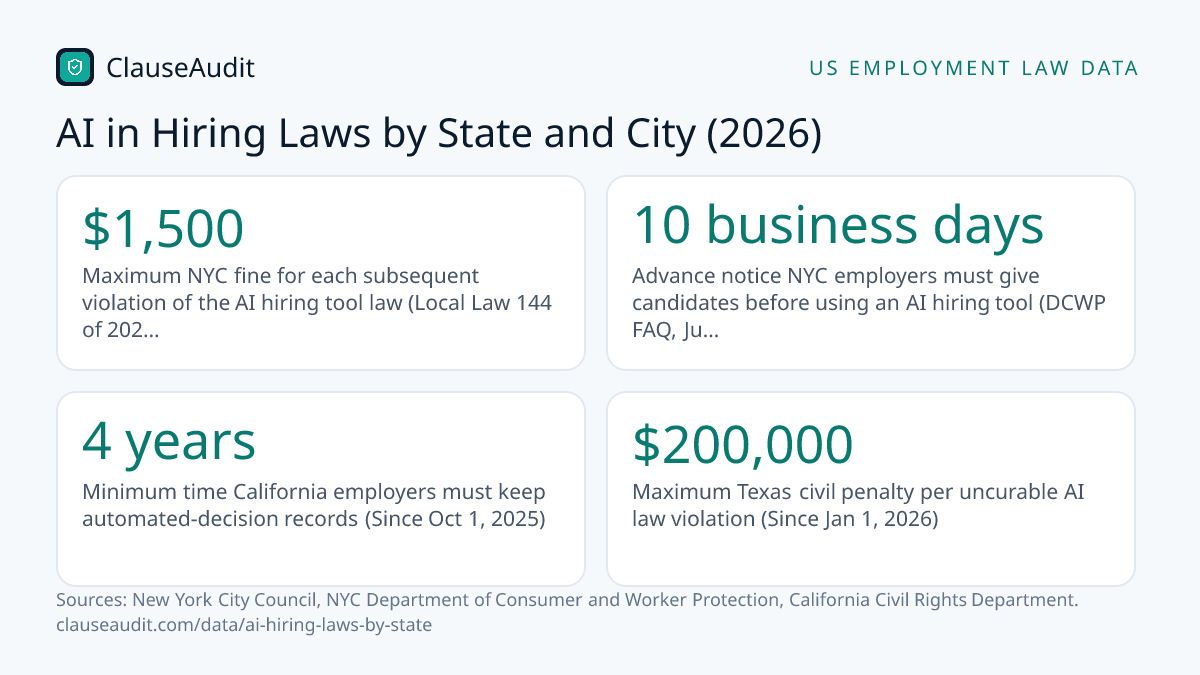
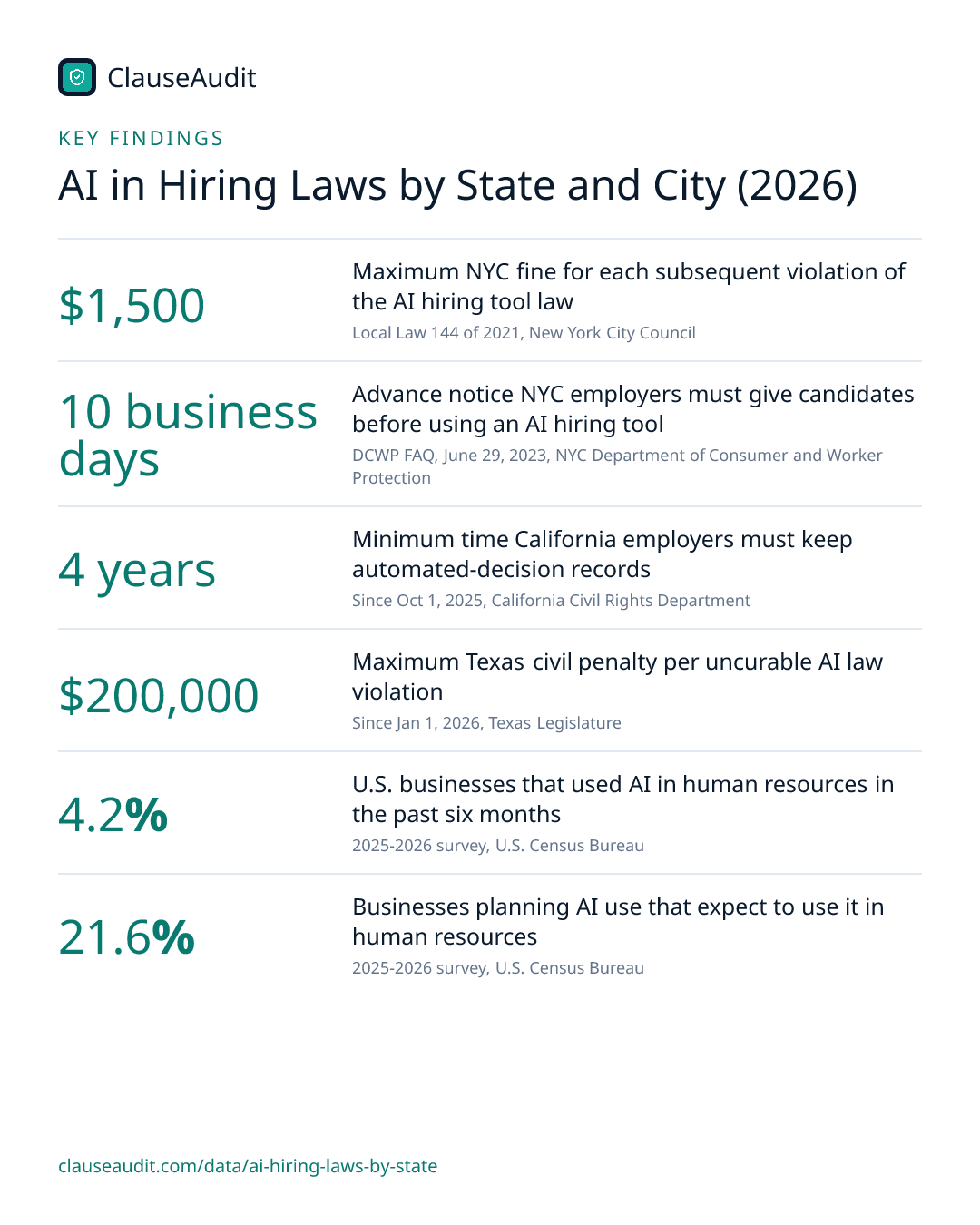
- Maximum NYC fine for each subsequent violation of the AI hiring tool law (Local Law 144 of 2021, New York City Council)
- $1,500
- Advance notice NYC employers must give candidates before using an AI hiring tool (DCWP FAQ, June 29, 2023, NYC Department of Consumer and Worker Protection)
- 10 business days
- Minimum time California employers must keep automated-decision records (Since Oct 1, 2025, California Civil Rights Department)
- 4 years
- Maximum Texas civil penalty per uncurable AI law violation (Since Jan 1, 2026, Texas Legislature)
- $200,000
- U.S. businesses that used AI in human resources in the past six months (2025-2026 survey, U.S. Census Bureau)
- 4.2%
- Businesses planning AI use that expect to use it in human resources (2025-2026 survey, U.S. Census Bureau)
- 21.6%
- U.S. adults who oppose AI making final hiring decisions (Dec 12-18, 2022 survey, Pew Research Center)
- 71%
If you use software to rank resumes, score video interviews or decide who gets a callback, the rules depend on where the job is and where your candidates live, not just where your company is registered. A Denver startup that fills a role at its Manhattan office has to follow New York City's law for that hire.
The map and tables below show which states and cities have acted and what each rule requires. The rest of this page covers what those rules mean in practice, who carries the risk when a vendor's tool gets it wrong, and what to put in the contract before you switch one on.
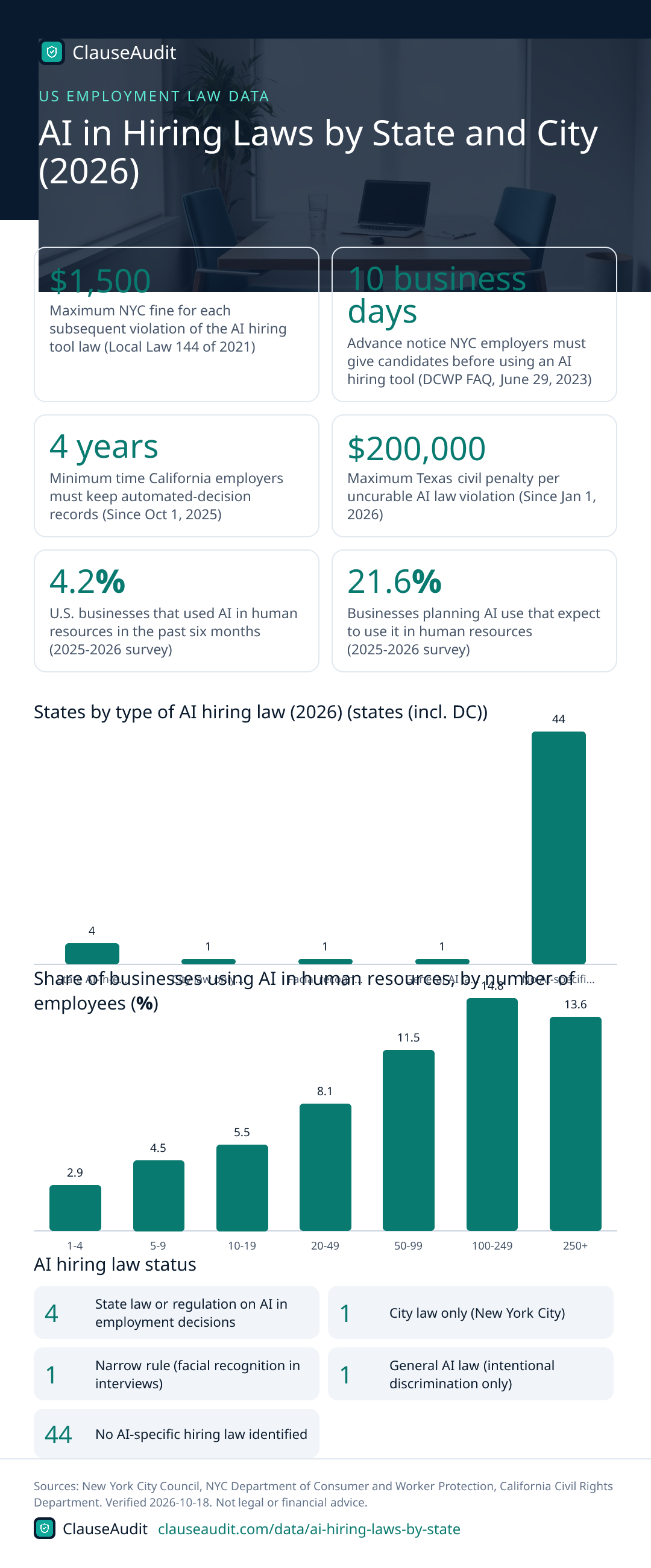
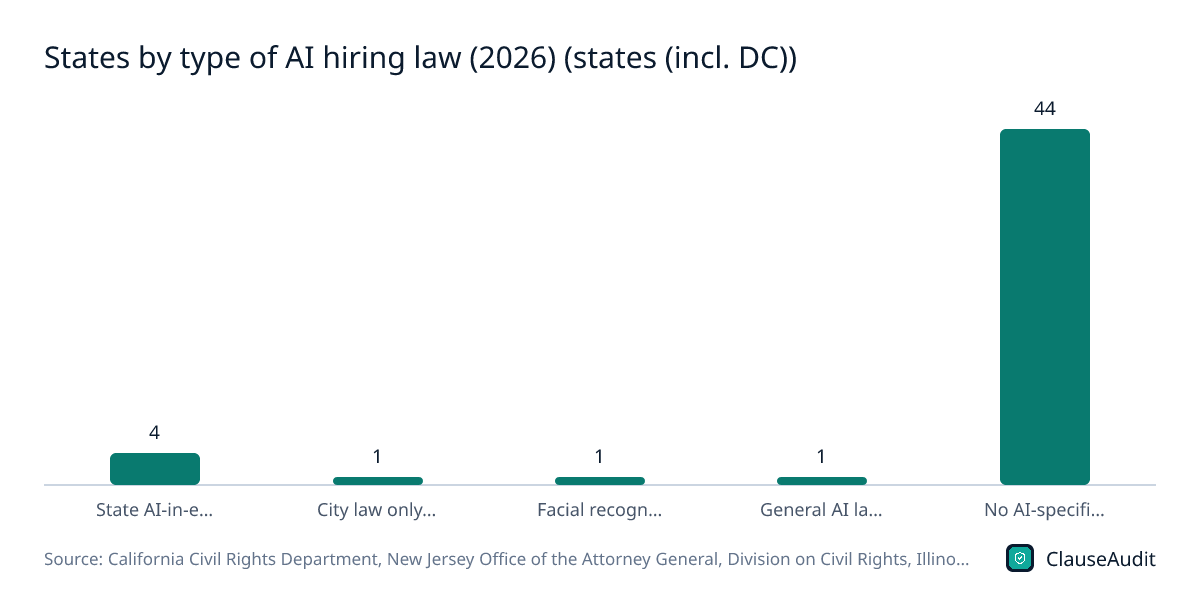
States by type of AI hiring law (2026) (states (incl. DC))
Chart data
| Label | Value (states (incl. DC)) |
|---|---|
| State AI-in-employment law or rule | 4 |
| City law only (NYC) | 1 |
| Facial recognition interview rule | 1 |
| General AI law (intent only) | 1 |
| No AI-specific hiring law identified | 44 |
Only four states have a law or rule written for AI in employment decisions. The 44 in the last column (43 states plus DC) have no specific rule we found. That is not the same as no risk: ordinary discrimination law covers biased software too.
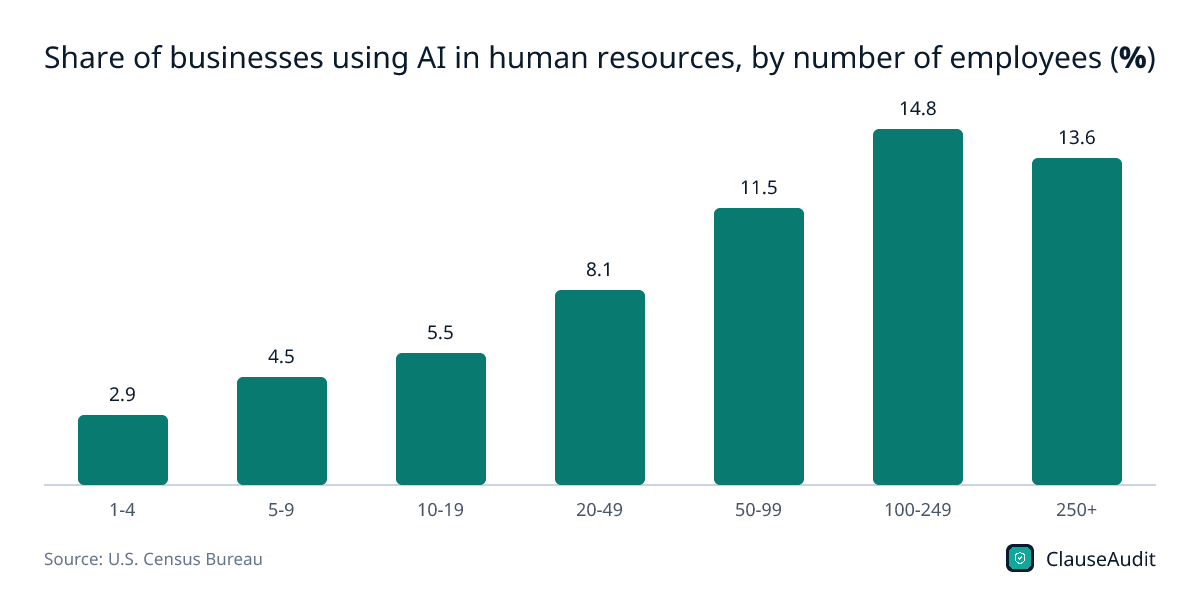
Download this chart (PNG)Share of businesses using AI in human resources, by number of employees (%)
Chart data
| Label | Value (%) |
|---|---|
| 1-4 | 2.9 |
| 5-9 | 4.5 |
| 10-19 | 5.5 |
| 20-49 | 8.1 |
| 50-99 | 11.5 |
| 100-249 | 14.8 |
| 250+ | 13.6 |
Use climbs with headcount, from 2.9% of the smallest firms to 14.8% of businesses with 100-249 employees, then dips slightly to 13.6% at 250 or more. The bigger the hiring volume, the more likely a screening tool is part of it.
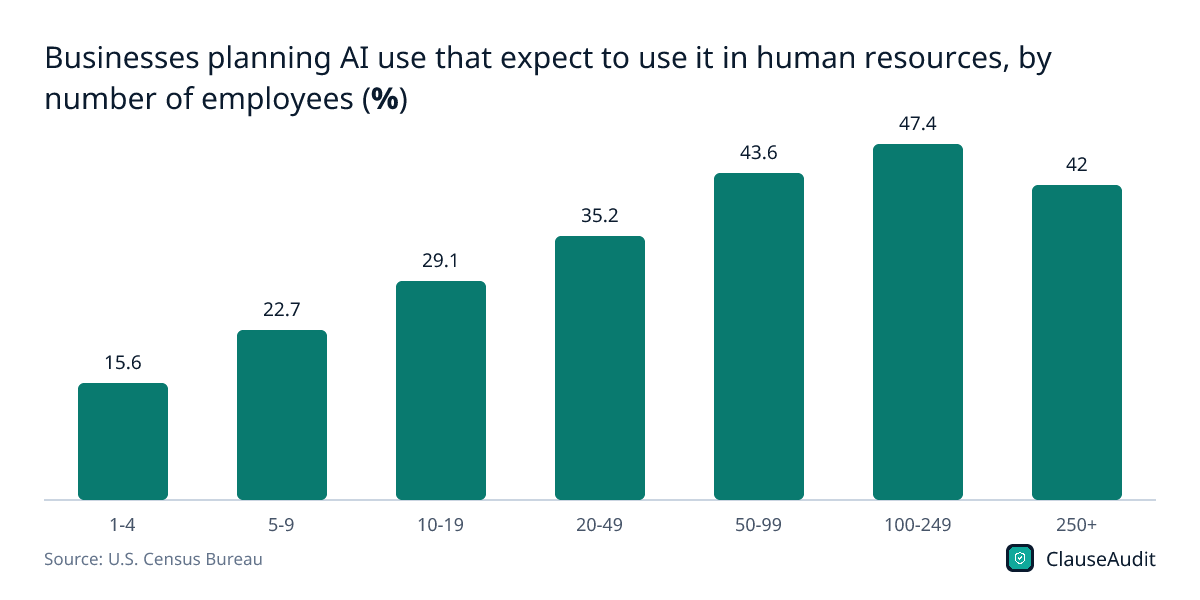
Download this chart (PNG)Businesses planning AI use that expect to use it in human resources, by number of employees (%)
Chart data
| Label | Value (%) |
|---|---|
| 1-4 | 15.6 |
| 5-9 | 22.7 |
| 10-19 | 29.1 |
| 20-49 | 35.2 |
| 50-99 | 43.6 |
| 100-249 | 47.4 |
| 250+ | 42 |
Planned use runs far ahead of current use. Among businesses with 100-249 employees that plan to use AI, 47.4% expect to apply it to HR. Plenty of employers will be reading their first hiring software contract soon.
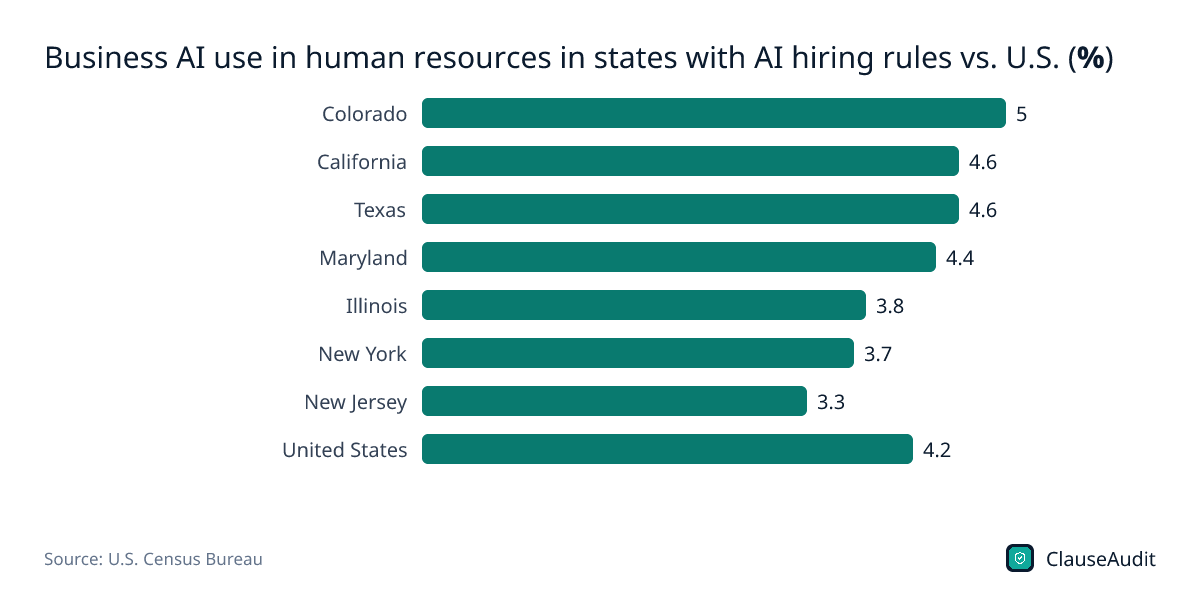
Download this chart (PNG)Business AI use in human resources in states with AI hiring rules vs. U.S. (%)
Chart data
| Label | Value |
|---|---|
| Colorado | 5 |
| California | 4.6 |
| Texas | 4.6 |
| Maryland | 4.4 |
| Illinois | 3.8 |
| New York | 3.7 |
| New Jersey | 3.3 |
| United States | 4.2 |
States with rules on the books sit close to the 4.2% national figure, from 3.3% in New Jersey to 5.0% in Colorado. These numbers can't show cause and effect, but they give no sign that the rules keep employers away. What changes is the paperwork that comes with the tool.
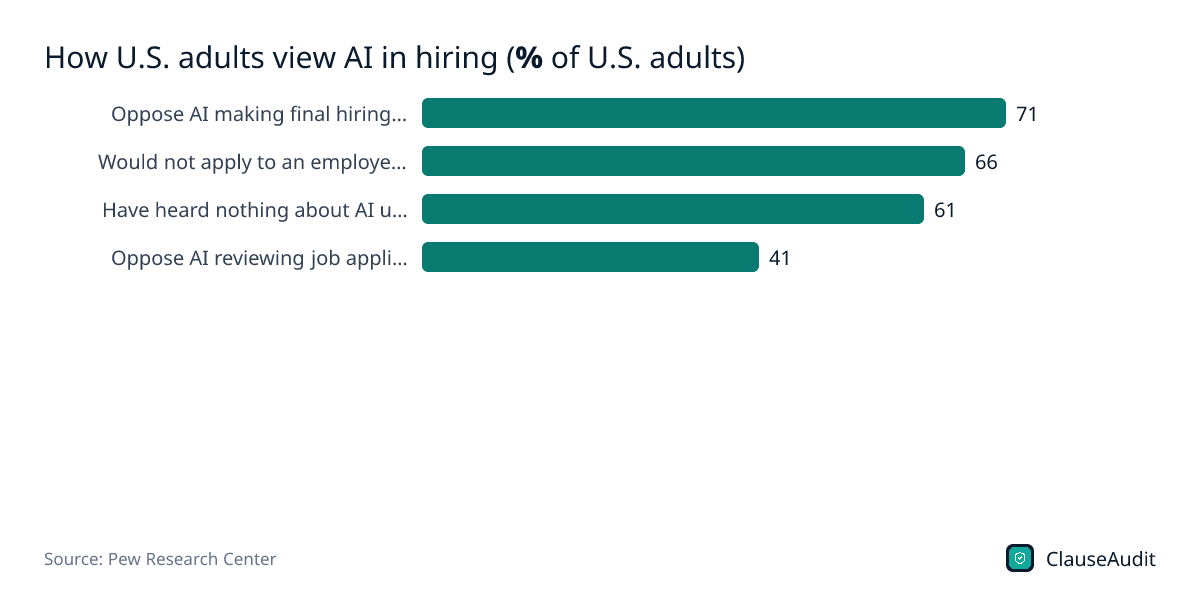
Download this chart (PNG)How U.S. adults view AI in hiring (% of U.S. adults)
Chart data
| Label | Value |
|---|---|
| Oppose AI making final hiring decisions | 71 |
| Would not apply to an employer using AI in hiring decisions | 66 |
| Have heard nothing about AI use in hiring | 61 |
| Oppose AI reviewing job applications | 41 |
In Pew's 2022 survey, 71% opposed AI making the final hiring call and 66% said they would not apply to an employer that used it for hiring decisions. That is a candidate-relations issue as much as a legal one, and it is why notice rules matter.
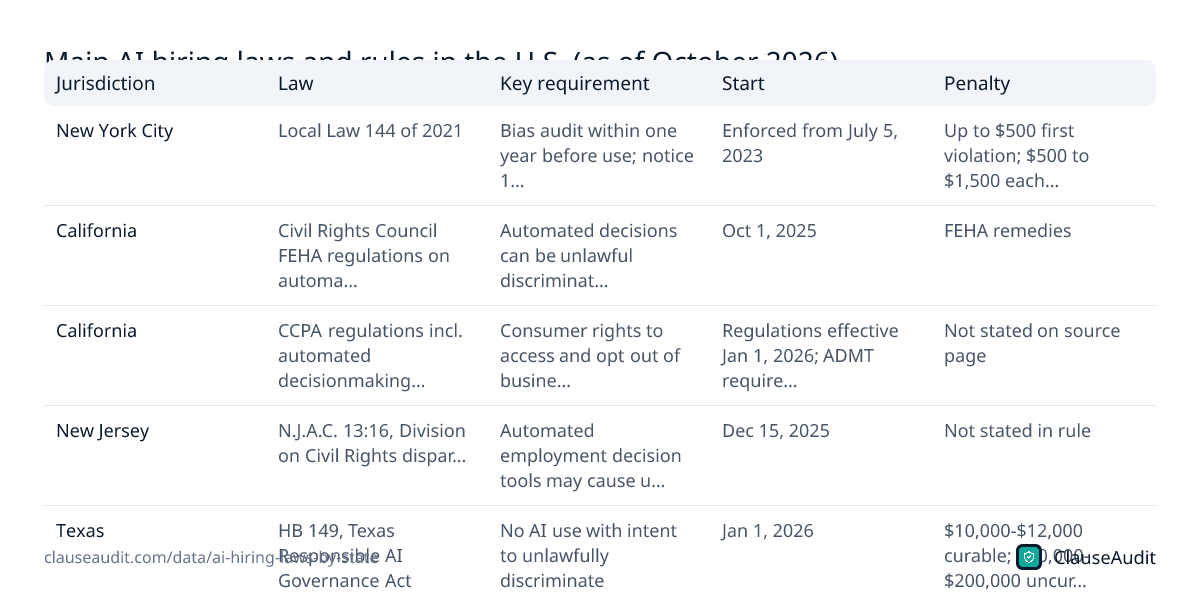
Download this chart (PNG)Main AI hiring laws and rules in the U.S. (as of October 2026)
| Jurisdiction | Law | Key requirement | Start | Penalty |
|---|---|---|---|---|
| New York City | Local Law 144 of 2021 | Bias audit within one year before use; notice 10 business days before use | Enforced from July 5, 2023 | Up to $500 first violation; $500 to $1,500 each later violation |
| California | Civil Rights Council FEHA regulations on automated-decision systems | Automated decisions can be unlawful discrimination; keep records at least 4 years | Oct 1, 2025 | FEHA remedies |
| California | CCPA regulations incl. automated decisionmaking technology (ADMT) | Consumer rights to access and opt out of business use of ADMT | Regulations effective Jan 1, 2026; ADMT requirements apply by Jan 1, 2027 | Not stated on source page |
| New Jersey | N.J.A.C. 13:16, Division on Civil Rights disparate impact rules (Law Against Discrimination) | Automated employment decision tools may cause unlawful disparate impact; schedule screens must allow accommodation requests; untested tools flagged as a risk | Dec 15, 2025 | Not stated in rule |
| Texas | HB 149, Texas Responsible AI Governance Act | No AI use with intent to unlawfully discriminate | Jan 1, 2026 | $10,000-$12,000 curable; $80,000-$200,000 uncurable; $2,000-$40,000 per day |
| Maryland | Lab. & Empl. § 3-717 | Signed waiver before facial recognition in interviews | In force | Not stated in section |
| Colorado | SB 26-189, Automated Decision-Making Technology (replaces SB 24-205) | Notice at point of interaction; explanation within 30 days of an adverse outcome; human review on request; 3-year records | Signed May 14, 2026; developer duties from Jan 1, 2027 | Attorney general under Colorado Consumer Protection Act; 60-day cure notice before Jan 1, 2030 |
Source: New York City Council, Local Law 144 of 2021 (automated employment decision tools), legislation detail and text; NYC Department of Consumer and Worker Protection, Automated Employment Decision Tools (AEDT); NYC Department of Consumer and Worker Protection, Automated Employment Decision Tools: Frequently Asked Questions; California Civil Rights Department, Civil Rights Council Secures Approval for Regulations to Protect Against Employment Discrimination Related to Artificial Intelligence; California Privacy Protection Agency, CCPA Updates, Cybersecurity Audits, Risk Assessments, Automated Decisionmaking Technology (ADMT), and Insurance Companies regulations; California Privacy Protection Agency, Text of Regulations: CCPA Updates, Cybersecurity Audits, Risk Assessments, ADMT and Insurance Companies (11 CCR § 7200); New Jersey Office of the Attorney General, Division on Civil Rights, N.J.A.C. 13:16, Disparate Impact Discrimination (R.2025 d.150); Texas Legislature, HB 149 enrolled text, Texas Responsible Artificial Intelligence Governance Act; Texas Legislature Online, HB 149 bill history; Maryland General Assembly, Maryland Code, Labor and Employment § 3-717 (facial recognition services in interviews); Colorado General Assembly, SB24-205 Consumer Protections for Artificial Intelligence; Colorado General Assembly, SB25B-004 (delays the effective date of SB24-205 requirements); Colorado General Assembly, SB26-189 Automated Decision-Making Technology. Download as image
AI hiring law status by state
- 4State law or regulation on AI in employment decisions
- 1City law only (New York City)
- 1Narrow rule (facial recognition in interviews)
- 1General AI law (intentional discrimination only)
- 44No AI-specific hiring law identified
- State law or regulation on AI in employment decisions4
- City law only (New York City)1
- Narrow rule (facial recognition in interviews)1
- General AI law (intentional discrimination only)1
- No AI-specific hiring law identified44
| State | Law | What it requires | In effect | Businesses using AI in HR (Census) | Source |
|---|---|---|---|---|---|
| Alabama | No AI-specific hiring law identified | General state and federal anti-discrimination law only | Not applicable | 3.1% (SE 0.62%) | U.S. Census Bureau, BTOS AI Supplement Table 2026 (HR figure only). No-law status reflects that our review found no statute or rule, not a cited source |
| Alaska | No AI-specific hiring law identified | General state and federal anti-discrimination law only | Not applicable | 3.8% (SE 1.12%) | U.S. Census Bureau, BTOS AI Supplement Table 2026 (HR figure only). No-law status reflects that our review found no statute or rule, not a cited source |
| Arizona | No AI-specific hiring law identified | General state and federal anti-discrimination law only | Not applicable | 3.9% (SE 0.32%) | U.S. Census Bureau, BTOS AI Supplement Table 2026 (HR figure only). No-law status reflects that our review found no statute or rule, not a cited source |
| Arkansas | No AI-specific hiring law identified | General state and federal anti-discrimination law only | Not applicable | 2.9% (SE 0.70%) | U.S. Census Bureau, BTOS AI Supplement Table 2026 (HR figure only). No-law status reflects that our review found no statute or rule, not a cited source |
| California | Civil Rights Council regulations on automated-decision systems under FEHA; CCPA regulations on automated decisionmaking technology (ADMT) | Using an automated-decision system can violate FEHA if it harms applicants or employees based on protected traits; employers must keep records, including automated-decision data, for at least 4 years | Oct 1, 2025 (Civil Rights Council rules); CCPA regulations effective Jan 1, 2026, with ADMT requirements applying by Jan 1, 2027 for businesses already using ADMT | 4.6% (SE 0.16%) | Cal. Civil Rights Council FEHA regulations (approved June 27, 2025); CCPA regulations (approved by OAL Sept 22, 2025) |
| Colorado | SB 26-189, Automated Decision-Making Technology (repeals and reenacts the 2024 Colorado AI Act, SB 24-205) | Employment is a consequential decision. Deployers must give notice at the point of interaction, explain the technology's role within 30 days after an adverse outcome, and allow data correction and human review. Records kept at least 3 years | Signed May 14, 2026; developer documentation duties start Jan 1, 2027 | 5.0% (SE 0.36%) | SB 26-189 (Session Law Ch. 131, 2026), repealing and reenacting SB 24-205 |
| Connecticut | No AI-specific hiring law identified | General state and federal anti-discrimination law only | Not applicable | 4.5% (SE 0.45%) | U.S. Census Bureau, BTOS AI Supplement Table 2026 (HR figure only). No-law status reflects that our review found no statute or rule, not a cited source |
| Delaware | No AI-specific hiring law identified | General state and federal anti-discrimination law only | Not applicable | 7.0% (SE 0.91%) | U.S. Census Bureau, BTOS AI Supplement Table 2026 (HR figure only). No-law status reflects that our review found no statute or rule, not a cited source |
| District of Columbia | No AI-specific hiring law identified | General state and federal anti-discrimination law only | Not applicable | 4.6% (SE 0.71%) | U.S. Census Bureau, BTOS AI Supplement Table 2026 (HR figure only). No-law status reflects that our review found no statute or rule, not a cited source |
| Florida | No AI-specific hiring law identified | General state and federal anti-discrimination law only | Not applicable | 4.0% (SE 0.19%) | U.S. Census Bureau, BTOS AI Supplement Table 2026 (HR figure only). No-law status reflects that our review found no statute or rule, not a cited source |
| Georgia | No AI-specific hiring law identified | General state and federal anti-discrimination law only | Not applicable | 4.3% (SE 0.47%) | U.S. Census Bureau, BTOS AI Supplement Table 2026 (HR figure only). No-law status reflects that our review found no statute or rule, not a cited source |
| Hawaii | No AI-specific hiring law identified | General state and federal anti-discrimination law only | Not applicable | 3.5% (SE 0.61%) | U.S. Census Bureau, BTOS AI Supplement Table 2026 (HR figure only). No-law status reflects that our review found no statute or rule, not a cited source |
| Idaho | No AI-specific hiring law identified | General state and federal anti-discrimination law only | Not applicable | 3.5% (SE 0.70%) | U.S. Census Bureau, BTOS AI Supplement Table 2026 (HR figure only). No-law status reflects that our review found no statute or rule, not a cited source |
| Illinois | Illinois Human Rights Act AI amendment (HB 3773, Public Act 103-0804); Artificial Intelligence Video Interview Act (820 ILCS 42) | Illinois Human Rights Act regulates employer use of artificial intelligence in employment decisions; separate act covers AI analysis of video interviews | In force (date not shown, see note) | 3.8% (SE 0.36%) | 775 ILCS 5/2-102 (as amended by P.A. 103-0804); 820 ILCS 42 |
| Indiana | No AI-specific hiring law identified | General state and federal anti-discrimination law only | Not applicable | 4.4% (SE 0.77%) | U.S. Census Bureau, BTOS AI Supplement Table 2026 (HR figure only). No-law status reflects that our review found no statute or rule, not a cited source |
| Iowa | No AI-specific hiring law identified | General state and federal anti-discrimination law only | Not applicable | 3.5% (SE 0.47%) | U.S. Census Bureau, BTOS AI Supplement Table 2026 (HR figure only). No-law status reflects that our review found no statute or rule, not a cited source |
| Kansas | No AI-specific hiring law identified | General state and federal anti-discrimination law only | Not applicable | 3.6% (SE 0.61%) | U.S. Census Bureau, BTOS AI Supplement Table 2026 (HR figure only). No-law status reflects that our review found no statute or rule, not a cited source |
| Kentucky | No AI-specific hiring law identified | General state and federal anti-discrimination law only | Not applicable | 3.1% (SE 0.54%) | U.S. Census Bureau, BTOS AI Supplement Table 2026 (HR figure only). No-law status reflects that our review found no statute or rule, not a cited source |
| Louisiana | No AI-specific hiring law identified | General state and federal anti-discrimination law only | Not applicable | 2.4% (SE 0.46%) | U.S. Census Bureau, BTOS AI Supplement Table 2026 (HR figure only). No-law status reflects that our review found no statute or rule, not a cited source |
| Maine | No AI-specific hiring law identified | General state and federal anti-discrimination law only | Not applicable | 3.8% (SE 0.46%) | U.S. Census Bureau, BTOS AI Supplement Table 2026 (HR figure only). No-law status reflects that our review found no statute or rule, not a cited source |
| Maryland | Facial recognition in job interviews (Labor and Employment Art. 3-717) | Employer may not use a facial recognition service to create a facial template during an applicant's interview unless the applicant signs a consent waiver | In force | 4.4% (SE 0.54%) | Md. Code, Lab. & Empl. § 3-717 |
| Massachusetts | No AI-specific hiring law identified | General state and federal anti-discrimination law only | Not applicable | 4.4% (SE 0.45%) | U.S. Census Bureau, BTOS AI Supplement Table 2026 (HR figure only). No-law status reflects that our review found no statute or rule, not a cited source |
| Michigan | No AI-specific hiring law identified | General state and federal anti-discrimination law only | Not applicable | 4.3% (SE 0.54%) | U.S. Census Bureau, BTOS AI Supplement Table 2026 (HR figure only). No-law status reflects that our review found no statute or rule, not a cited source |
| Minnesota | No AI-specific hiring law identified | General state and federal anti-discrimination law only | Not applicable | 5.0% (SE 0.47%) | U.S. Census Bureau, BTOS AI Supplement Table 2026 (HR figure only). No-law status reflects that our review found no statute or rule, not a cited source |
| Mississippi | No AI-specific hiring law identified | General state and federal anti-discrimination law only | Not applicable | 2.0% (SE 0.43%) | U.S. Census Bureau, BTOS AI Supplement Table 2026 (HR figure only). No-law status reflects that our review found no statute or rule, not a cited source |
| Missouri | No AI-specific hiring law identified | General state and federal anti-discrimination law only | Not applicable | 4.5% (SE 0.56%) | U.S. Census Bureau, BTOS AI Supplement Table 2026 (HR figure only). No-law status reflects that our review found no statute or rule, not a cited source |
| Montana | No AI-specific hiring law identified | General state and federal anti-discrimination law only | Not applicable | 3.3% (SE 0.81%) | U.S. Census Bureau, BTOS AI Supplement Table 2026 (HR figure only). No-law status reflects that our review found no statute or rule, not a cited source |
| Nebraska | No AI-specific hiring law identified | General state and federal anti-discrimination law only | Not applicable | 3.4% (SE 0.50%) | U.S. Census Bureau, BTOS AI Supplement Table 2026 (HR figure only). No-law status reflects that our review found no statute or rule, not a cited source |
| Nevada | No AI-specific hiring law identified | General state and federal anti-discrimination law only | Not applicable | 4.2% (SE 0.58%) | U.S. Census Bureau, BTOS AI Supplement Table 2026 (HR figure only). No-law status reflects that our review found no statute or rule, not a cited source |
| New Hampshire | No AI-specific hiring law identified | General state and federal anti-discrimination law only | Not applicable | 3.9% (SE 0.78%) | U.S. Census Bureau, BTOS AI Supplement Table 2026 (HR figure only). No-law status reflects that our review found no statute or rule, not a cited source |
| New Jersey | Division on Civil Rights disparate impact rules under the Law Against Discrimination (N.J.A.C. 13:16), including automated employment decision tools | Using automated employment decision tools in advertising, recruiting, screening, interviewing, hiring, compensation or other employment terms may be unlawful disparate impact. Schedule-based screens must offer a way to request a reasonable accommodation; tools not adequately tested before use may have a disparate impact | Dec 15, 2025 | 3.3% (SE 0.37%) | N.J.A.C. 13:16-1.3, 13:16-3.2(c) (R.2025 d.150) |
| New Mexico | No AI-specific hiring law identified | General state and federal anti-discrimination law only | Not applicable | 3.7% (SE 0.58%) | U.S. Census Bureau, BTOS AI Supplement Table 2026 (HR figure only). No-law status reflects that our review found no statute or rule, not a cited source |
| New York | No statewide law identified; New York City Local Law 144 of 2021 (automated employment decision tools) | NYC: bias audit within one year before use, public audit results, and notice to NYC-resident candidates 10 business days before use | NYC enforcement began July 5, 2023 | 3.7% (SE 0.27%) | NYC Local Law 144 of 2021 (enacted Dec 11, 2021) |
| North Carolina | No AI-specific hiring law identified | General state and federal anti-discrimination law only | Not applicable | 3.7% (SE 0.41%) | U.S. Census Bureau, BTOS AI Supplement Table 2026 (HR figure only). No-law status reflects that our review found no statute or rule, not a cited source |
| North Dakota | No AI-specific hiring law identified | General state and federal anti-discrimination law only | Not applicable | 2.8% (SE 0.70%) | U.S. Census Bureau, BTOS AI Supplement Table 2026 (HR figure only). No-law status reflects that our review found no statute or rule, not a cited source |
| Ohio | No AI-specific hiring law identified | General state and federal anti-discrimination law only | Not applicable | 4.5% (SE 0.34%) | U.S. Census Bureau, BTOS AI Supplement Table 2026 (HR figure only). No-law status reflects that our review found no statute or rule, not a cited source |
| Oklahoma | No AI-specific hiring law identified | General state and federal anti-discrimination law only | Not applicable | 3.3% (SE 0.38%) | U.S. Census Bureau, BTOS AI Supplement Table 2026 (HR figure only). No-law status reflects that our review found no statute or rule, not a cited source |
| Oregon | No AI-specific hiring law identified | General state and federal anti-discrimination law only | Not applicable | 4.9% (SE 0.53%) | U.S. Census Bureau, BTOS AI Supplement Table 2026 (HR figure only). No-law status reflects that our review found no statute or rule, not a cited source |
| Pennsylvania | No AI-specific hiring law identified | General state and federal anti-discrimination law only | Not applicable | 3.9% (SE 0.20%) | U.S. Census Bureau, BTOS AI Supplement Table 2026 (HR figure only). No-law status reflects that our review found no statute or rule, not a cited source |
| Rhode Island | No AI-specific hiring law identified | General state and federal anti-discrimination law only | Not applicable | 4.5% (SE 1.55%) | U.S. Census Bureau, BTOS AI Supplement Table 2026 (HR figure only). No-law status reflects that our review found no statute or rule, not a cited source |
| South Carolina | No AI-specific hiring law identified | General state and federal anti-discrimination law only | Not applicable | 3.9% (SE 0.50%) | U.S. Census Bureau, BTOS AI Supplement Table 2026 (HR figure only). No-law status reflects that our review found no statute or rule, not a cited source |
| South Dakota | No AI-specific hiring law identified | General state and federal anti-discrimination law only | Not applicable | 4.0% (SE 0.61%) | U.S. Census Bureau, BTOS AI Supplement Table 2026 (HR figure only). No-law status reflects that our review found no statute or rule, not a cited source |
| Tennessee | No AI-specific hiring law identified | General state and federal anti-discrimination law only | Not applicable | 4.8% (SE 0.41%) | U.S. Census Bureau, BTOS AI Supplement Table 2026 (HR figure only). No-law status reflects that our review found no statute or rule, not a cited source |
| Texas | Texas Responsible Artificial Intelligence Governance Act (HB 149) | Bars developing or deploying an AI system with intent to unlawfully discriminate against a protected class; disparate impact alone is not enough to show intent; attorney general enforces, no private right of action | Jan 1, 2026 | 4.6% (SE 0.31%) | HB 149, 89th Legislature (Sec. 552.056, Tex. Bus. & Com. Code) |
| Utah | No AI-specific hiring law identified | General state and federal anti-discrimination law only | Not applicable | 4.2% (SE 0.77%) | U.S. Census Bureau, BTOS AI Supplement Table 2026 (HR figure only). No-law status reflects that our review found no statute or rule, not a cited source |
| Vermont | No AI-specific hiring law identified | General state and federal anti-discrimination law only | Not applicable | 2.5% (SE 0.40%) | U.S. Census Bureau, BTOS AI Supplement Table 2026 (HR figure only). No-law status reflects that our review found no statute or rule, not a cited source |
| Virginia | No AI-specific hiring law identified | General state and federal anti-discrimination law only | Not applicable | 4.4% (SE 0.30%) | U.S. Census Bureau, BTOS AI Supplement Table 2026 (HR figure only). No-law status reflects that our review found no statute or rule, not a cited source |
| Washington | No AI-specific hiring law identified | General state and federal anti-discrimination law only | Not applicable | 5.0% (SE 0.28%) | U.S. Census Bureau, BTOS AI Supplement Table 2026 (HR figure only). No-law status reflects that our review found no statute or rule, not a cited source |
| West Virginia | No AI-specific hiring law identified | General state and federal anti-discrimination law only | Not applicable | 1.9% (SE 0.61%) | U.S. Census Bureau, BTOS AI Supplement Table 2026 (HR figure only). No-law status reflects that our review found no statute or rule, not a cited source |
| Wisconsin | No AI-specific hiring law identified | General state and federal anti-discrimination law only | Not applicable | 4.3% (SE 0.36%) | U.S. Census Bureau, BTOS AI Supplement Table 2026 (HR figure only). No-law status reflects that our review found no statute or rule, not a cited source |
| Wyoming | No AI-specific hiring law identified | General state and federal anti-discrimination law only | Not applicable | 3.3% (SE 0.72%) | U.S. Census Bureau, BTOS AI Supplement Table 2026 (HR figure only). No-law status reflects that our review found no statute or rule, not a cited source |
Which states have AI hiring laws in 2026?
Four states have rules written for automated decisions about workers: California, Colorado, New Jersey and Illinois. New York has no statewide law, but New York City's Local Law 144 has been enforced since July 5, 2023. Maryland covers one narrow use, facial recognition during interviews, and Texas has a general AI law that bans only intentional discrimination.
Each works differently. NYC requires a bias audit within one year before you use a tool, publication of the results, and notice to candidates 10 business days before use. Under California's rules, an automated decision can count as discrimination under FEHA, and employers must keep the related records for at least 4 years. New Jersey's rules, in force since December 15, 2025, say these tools can cause unlawful disparate impact and flag tools not tested before use as a risk. Colorado's SB 26-189, signed May 14, 2026, requires notice when someone interacts with the system and an explanation within 30 days after an adverse outcome.
Illinois is the least certain entry on this page. Its Human Rights Act now covers AI in employment decisions and a separate act covers AI analysis of video interviews, but we could not confirm the effective dates or detailed duties from the statute text.
Does an AI hiring law apply if my company is in another state?
It can. The rules follow the job and the candidate more than your headquarters. NYC's law applies when the job is tied to a New York City office, even a fully remote one, and its notice goes to candidates who live in the city. California's rules protect applicants and employees in California. A small company in Ohio with one office in Queens and a remote hire in Los Angeles has picked up two sets of rules.
The simplest fix is to decide up front where you will hire, and to turn on notice and audit features for the strictest place on that list. Running one process for everyone is cheaper than tracking which rule applies to which résumé. If a vendor charges extra for audit reports or notice templates, count that in the price before you sign.
What happens if an employer breaks these rules?
Penalties vary a lot. In New York City, a first violation costs up to $500 and each later one up to $1,500. That sounds small until you remember that each candidate who did not get notice can count separately.
Texas sits at the other end. Under its new AI law, an uncurable violation can bring a civil penalty of $80,000 to $200,000, though the state has to show you meant to discriminate. Colorado gives employers 60 days to cure a problem before the attorney general can sue, at least until January 1, 2030. California leaves enforcement to the normal FEHA remedies, which means a discrimination claim with back pay and damages on the table.
- NYC: up to $500 first violation, up to $1,500 each later one
- Texas: up to $200,000 per uncurable violation
- Colorado: attorney general enforcement, with a 60-day cure notice before 2030
- California and New Jersey: the same remedies as any discrimination claim
Who is liable when the vendor's tool is biased?
Mostly you. Nearly all the rules on this page put the main duties on the employer that uses the tool. A vendor may run the model, but your name is on the rejection email.
That is why the vendor contract matters more than the sales deck. Many software agreements cap the vendor's liability at a few months of fees, disclaim any promise that the output is accurate or fair, and say nothing about audits. If a rejected applicant files a claim, a clause like that leaves you paying for a defect you could not see.
Ask for the vendor's most recent bias audit before you sign. If you hire for NYC-based jobs, you need one done within the past year anyway. Ask too what data trained the model and whether your applicants' data will be used to train it further.
What should a small employer do before using AI screening?
Start with a plain inventory. List every tool that scores, ranks, filters or interviews candidates, including features buried inside your applicant tracking system. You may be using AI in hiring without ever having bought anything labeled AI.
Then work through a short routine for each one:
- Find out where each job is based and where applicants live, and which rules from the table apply
- Get the vendor's latest bias audit and the date it was done
- Send notice before the tool is used, using NYC's 10 business days as the safe default
- Keep a person in the loop for rejections, and offer human review when someone asks
- Keep records of inputs and decisions for at least 4 years to meet California's rule
- Offer a clear way to request an accommodation, which New Jersey now expects for schedule screens
What this means for job seekers
If you live in New York City and apply for a job tied to a city office, you are entitled to notice before an automated tool assesses you, and the employer has to publish its audit results. In Colorado, if the decision goes against you, you can ask how the technology was used and ask for a human to look again.
Elsewhere your rights are thinner, but general discrimination law still applies. If you are rejected within minutes of applying, or an interview platform asks to scan your face, it is fair to ask the employer what the tool does. In Maryland, they need your signed consent for that face scan first.
How ClauseAudit helps
Most of the legal risk in AI hiring lands on the employer, but the vendor contract decides who pays for it. Upload the subscription agreement for your screening or interview tool and our automated review flags the terms that leave you exposed, in plain English, with suggested changes to ask for.
- Liability cap: whether it covers discrimination claims or stops at a few months of fees
- Indemnification: whether the vendor will defend you if its model causes a biased outcome
- Bias audit cooperation: whether the vendor must supply audit data and results each year
- Data use: whether applicant data can be used to train the vendor's models
- Records and export: whether you can pull decision records for 4 years, even after you cancel
- Changes to terms: whether the vendor can change how the tool scores people without telling you
Frequently asked questions
Is it legal to use AI in hiring?
Yes, in every state. No state bans it outright. What the laws do is add duties: bias audits and advance notice in New York City, record keeping in California, explanations and human review in Colorado. And everywhere, if the tool screens out people based on race, sex, age or disability, that can be illegal discrimination under existing law.
What is NYC Local Law 144?
It is New York City's law on automated employment decision tools, enforced since July 5, 2023. It covers jobs tied to a city office. Before using a tool to screen candidates or employees, an employer needs a bias audit done within the past year, must publish the results, and must notify candidates who live in the city 10 business days ahead. Fines run up to $500 for a first violation and up to $1,500 after that.
Does California regulate AI in hiring?
Yes. Since October 1, 2025, Civil Rights Council regulations say an automated-decision system can violate FEHA if it harms applicants or employees based on protected traits. Employers must keep the related records for at least 4 years. Separate CCPA regulations add rights around automated decisionmaking, with those requirements applying by January 1, 2027 for businesses already using the technology.
What does Colorado's AI law require from employers?
Colorado's SB 26-189, signed May 14, 2026, replaced the earlier 2024 AI Act. Employment counts as a consequential decision. Employers using these systems must give notice when someone interacts with them, explain the technology's role within 30 days after an adverse outcome, allow data correction and human review, and keep records for at least 3 years.
Does the Texas AI law cover hiring?
Indirectly. The Texas Responsible AI Governance Act, in effect since January 1, 2026, bars using an AI system with intent to unlawfully discriminate. It is not hiring-specific, and disparate impact alone does not prove intent. The attorney general enforces it, with penalties up to $200,000 per uncurable violation. There is no private right to sue under it.
Can my employer use facial recognition in a job interview?
In Maryland, only if you sign a consent waiver first. That rule covers creating a facial template during an interview. Illinois also has a law on AI analysis of video interviews. In most other states there is no rule aimed at this, though biometric privacy laws in some states may still apply.
Is the employer or the software vendor responsible for a biased AI tool?
Mostly the employer, under the rules on this page. That is why the vendor agreement matters. Check whether the vendor's liability cap covers discrimination claims, whether it will indemnify you, and whether it must provide audit results. Without those terms, a biased model can become your problem alone.
Do small businesses need to worry about AI hiring laws?
Fewer of them use AI in HR so far: 2.9% of businesses with 1-4 employees, according to the Census Bureau. But NYC's law has no size cutoff, and California's anti-discrimination law reaches employers with five or more workers. A single NYC-based role or one remote employee in California can bring you under a rule even if your home state has none.
Will more states pass AI hiring laws?
Probably. Among businesses planning to use AI in the next six months, 21.6% expect to use it in HR, and Colorado rewrote its law this year. Check the effective dates in the table and recheck before each hiring round, since these rules change often.
Use this data
Every chart and card below is free to reuse under CC BY 4.0. Download what you need and link back to this page.
 Stat cards
 Key findings card
 Infographic
 States by type of AI hiring law (2026) (states (incl. DC))
 Share of businesses using AI in human resources, by number of employees (%)
 Businesses planning AI use that expect to use it in human resources, by number of employees (%)
 Business AI use in human resources in states with AI hiring rules vs. U.S. (%)
 How U.S. adults view AI in hiring (% of U.S. adults)
 Main AI hiring laws and rules in the U.S. (as of October 2026)
Embed the infographic
Free to share on your site, blog or slides under CC BY 4.0. Please keep the credit link.
Sources and method
Every number on this page comes from the sources below, each opened and read on or before October 18, 2026. A second, independent review checked every figure against its source and corrected anything that did not match. 51 of 51 state entries were confirmed; any that could not be are marked "Not yet confirmed" and left out of every count and chart.
- New York City Council, Local Law 144 of 2021 (automated employment decision tools), legislation detail and text (Enacted December 11, 2021)
- NYC Department of Consumer and Worker Protection, Automated Employment Decision Tools (AEDT) (Accessed October 2026; enforcement from July 5, 2023)
- NYC Department of Consumer and Worker Protection, Automated Employment Decision Tools: Frequently Asked Questions (June 29, 2023)
- California Civil Rights Department, Civil Rights Council Secures Approval for Regulations to Protect Against Employment Discrimination Related to Artificial Intelligence (June 30, 2025)
- California Privacy Protection Agency, CCPA Updates, Cybersecurity Audits, Risk Assessments, Automated Decisionmaking Technology (ADMT), and Insurance Companies regulations (Approved by OAL September 22, 2025; effective January 1, 2026)
- California Privacy Protection Agency, Text of Regulations: CCPA Updates, Cybersecurity Audits, Risk Assessments, ADMT and Insurance Companies (11 CCR § 7200) (Approved regulation text; effective January 1, 2026)
- New Jersey Office of the Attorney General, Division on Civil Rights, N.J.A.C. 13:16, Disparate Impact Discrimination (R.2025 d.150) (Effective December 15, 2025)
- Illinois Department of Human Rights, Legislative Updates (Accessed October 2026)
- Maryland General Assembly, Maryland Code, Labor and Employment § 3-717 (facial recognition services in interviews) (Current code, accessed October 2026)
- Texas Legislature, HB 149 enrolled text, Texas Responsible Artificial Intelligence Governance Act (89th Legislature, Regular Session, 2025)
- Texas Legislature Online, HB 149 bill history (Signed June 22, 2025; effective January 1, 2026)
- Colorado General Assembly, SB24-205 Consumer Protections for Artificial Intelligence (Approved by Governor May 17, 2024)
- Colorado General Assembly, SB25B-004 (delays the effective date of SB24-205 requirements) (Approved by Governor August 28, 2025)
- U.S. Census Bureau, Business Trends and Outlook Survey (BTOS) AI Supplement Table 2026 (national, state and employment size estimates) (2026 edition (BTOS 2025-2026 data))
- Pew Research Center, AI in Hiring and Evaluating Workers: What Americans Think (April 20, 2023 (survey Dec 12-18, 2022))
- Colorado General Assembly, SB26-189 Automated Decision-Making Technology (Governor signed May 14, 2026 (Session Law Ch. 131))
Cite this page
ClauseAudit, “AI in Hiring Laws by State and City (2026)”, updated October 18, 2026, https://clauseaudit.com/data/ai-hiring-laws-by-state. Free to reuse with a link back (CC BY 4.0).
This page summarises published data and law as checked on October 18, 2026. Figures are updated as new editions are released, and your own situation may differ. It is general information, not legal, tax or financial advice.