Biometric Privacy Laws by State (2026)
By ClauseAudit Research · 32 sources ·
What are the biometric privacy laws by state?
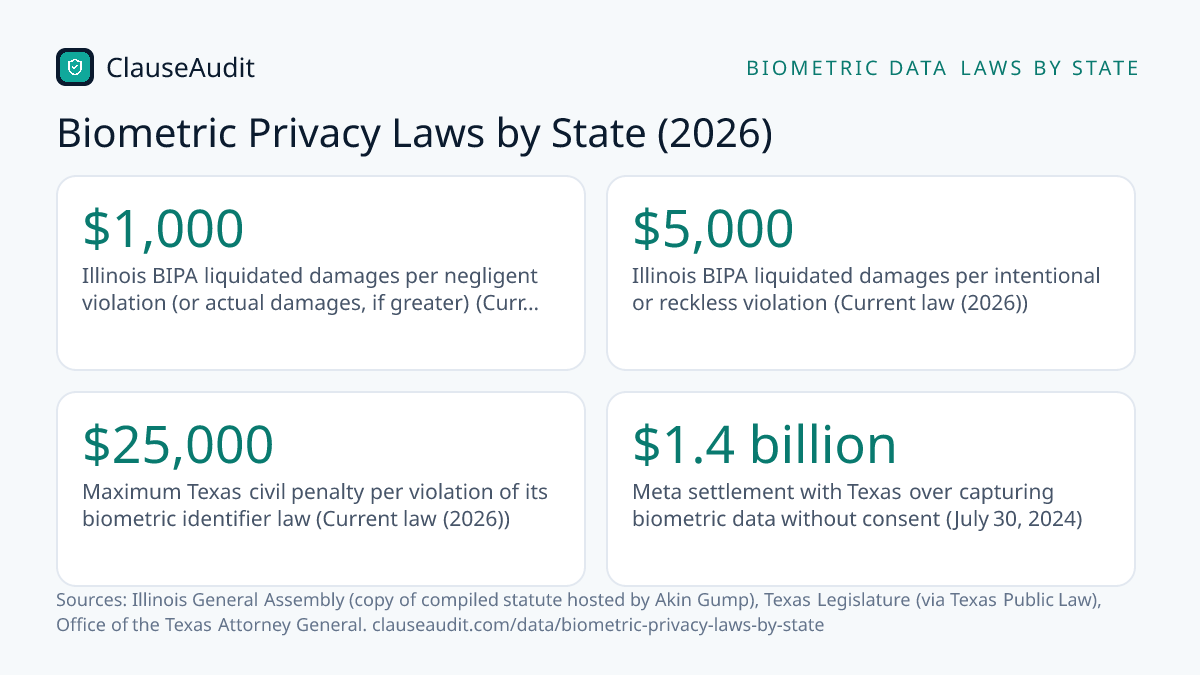
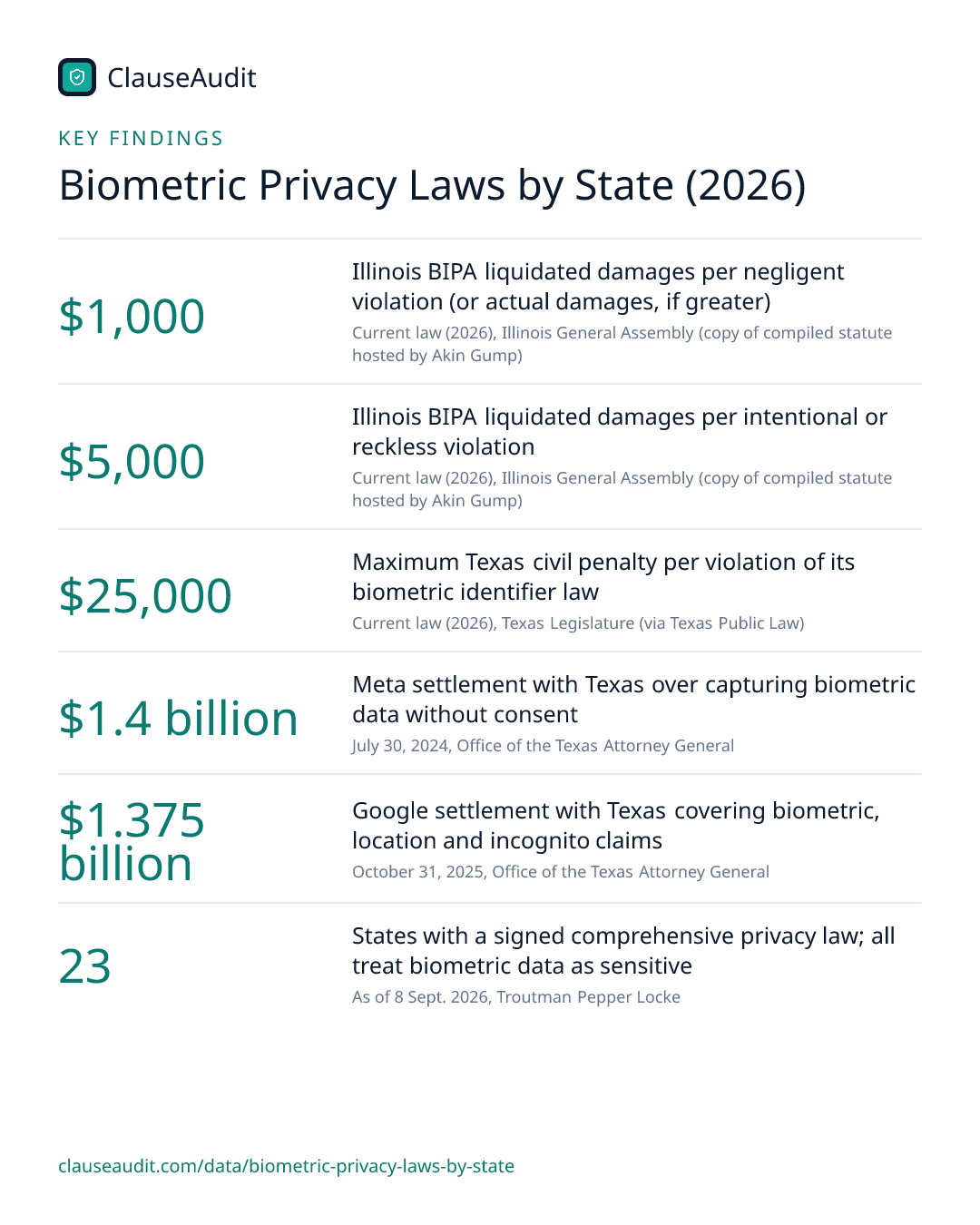
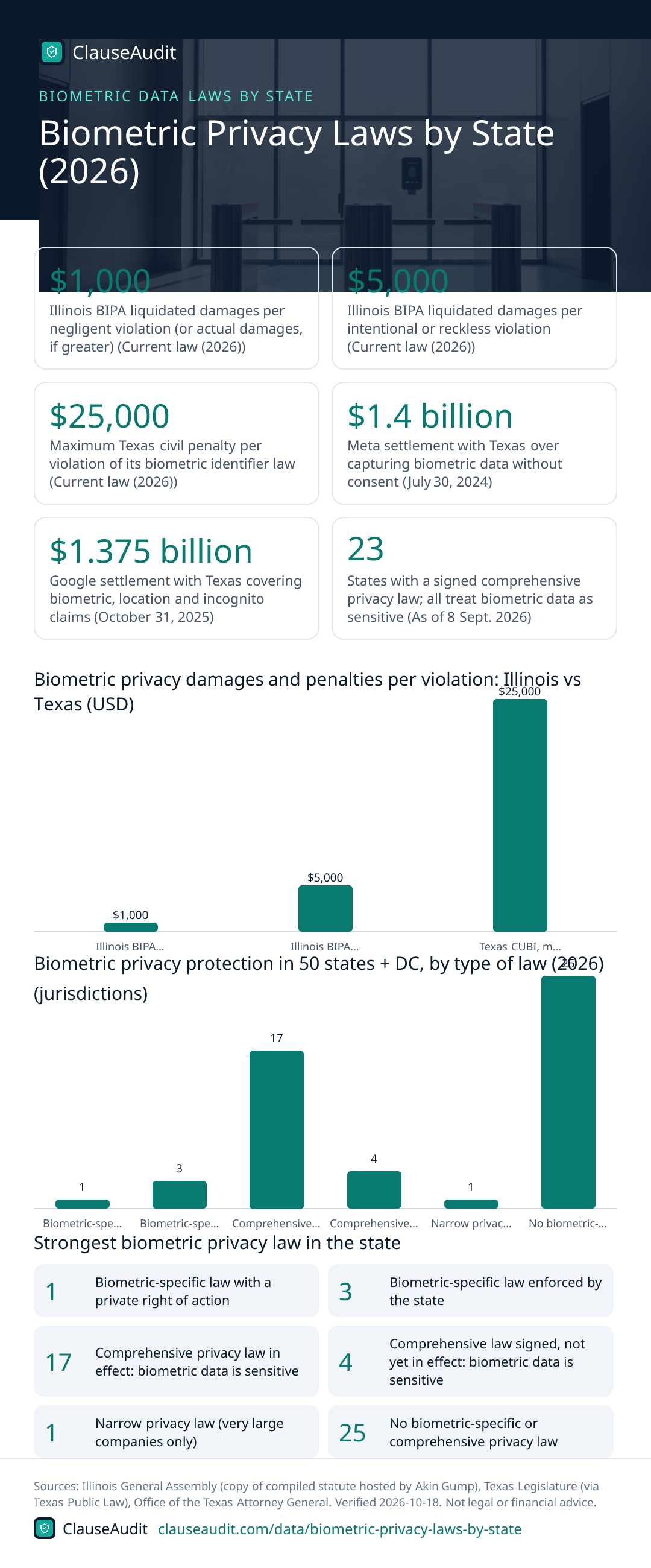
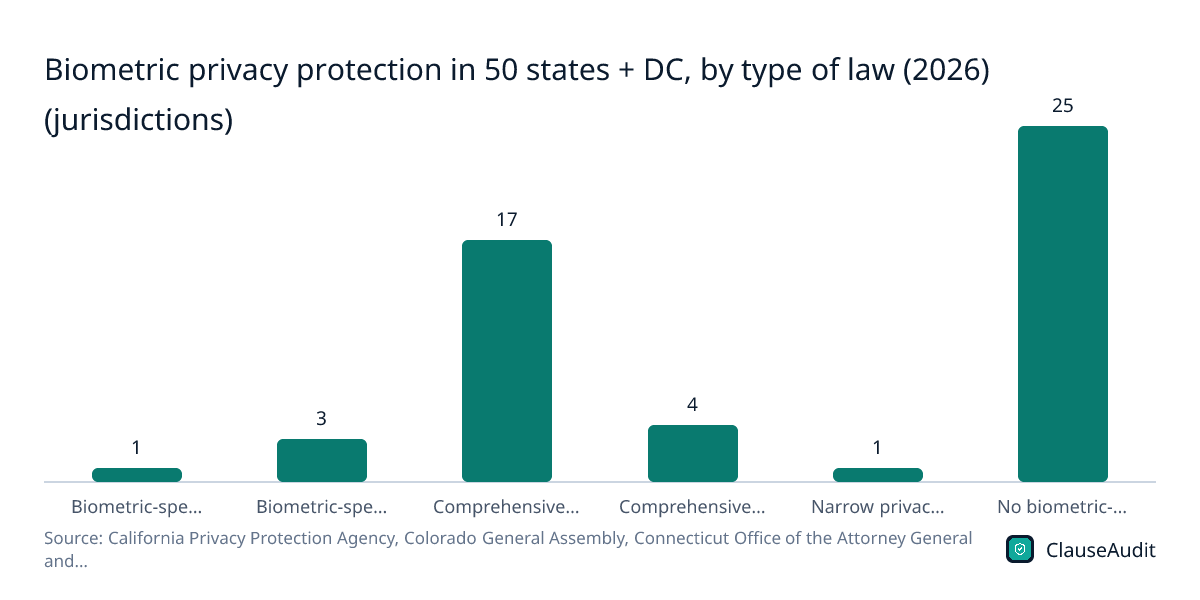
Only Illinois lets individuals sue under a biometric-specific law, with $1,000 per negligent and $5,000 per intentional violation. Texas, Washington and Colorado have biometric laws the state enforces. 23 states have signed broad consumer privacy laws that treat biometric data as sensitive, while 25 jurisdictions have neither kind of law.

- Illinois BIPA liquidated damages per negligent violation (or actual damages, if greater) (Current law (2026), Illinois General Assembly (copy of compiled statute hosted by Akin Gump))
- $1,000
- Illinois BIPA liquidated damages per intentional or reckless violation (Current law (2026), Illinois General Assembly (copy of compiled statute hosted by Akin Gump))
- $5,000
- Maximum Texas civil penalty per violation of its biometric identifier law (Current law (2026), Texas Legislature (via Texas Public Law))
- $25,000
- Meta settlement with Texas over capturing biometric data without consent (July 30, 2024, Office of the Texas Attorney General)
- $1.4 billion
- Google settlement with Texas covering biometric, location and incognito claims (October 31, 2025, Office of the Texas Attorney General)
- $1.375 billion
- States with a signed comprehensive privacy law; all treat biometric data as sensitive (As of 8 Sept. 2026, Troutman Pepper Locke)
- 23
- Illinois deadline to destroy biometric data after a person's last interaction (Current law (2026), Illinois General Assembly (copy of compiled statute hosted by Akin Gump))
- 3 years
- Texas deadline to destroy a biometric identifier after its purpose expires (Current law (2026), Texas Legislature (via Texas Public Law))
- 1 year
A fingerprint can't be reset like a password. That is the main reason a handful of states wrote laws aimed squarely at face scans, voiceprints, fingerprints and hand geometry. If a company leaks your password, you change it. If it leaks your face template, you are stuck with that face.
The map and table show the strongest rule in each state. This page explains what those rules ask of a business, why Illinois gets most of the headlines, and what to look for in the software contracts and job paperwork that quietly decide who collects your biometric data and who pays if it goes wrong.
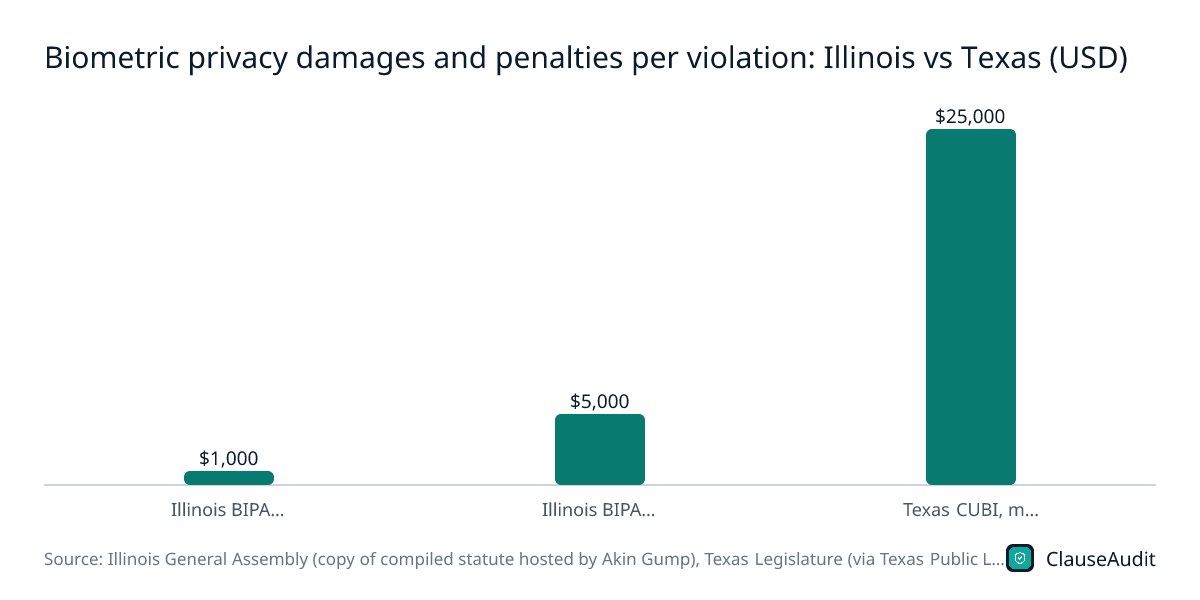
Biometric privacy damages and penalties per violation: Illinois vs Texas (USD)
Chart data
| Label | Value |
|---|---|
| Illinois BIPA, negligent | $1,000 |
| Illinois BIPA, intentional or reckless | $5,000 |
| Texas CUBI, maximum civil penalty | $25,000 |
The Texas cap is the biggest number here, but only the Attorney General can collect it. The Illinois figures are smaller per violation, yet any affected person can sue for them, which is why most biometric lawsuits are filed there.
Download this chart (PNG)Biometric privacy protection in 50 states + DC, by type of law (2026) (jurisdictions)
Chart data
| Label | Value (jurisdictions) |
|---|---|
| Biometric-specific law with a private right of action | 1 |
| Biometric-specific law enforced by the state | 3 |
| Comprehensive privacy law in effect: biometric data is sensitive | 17 |
| Comprehensive law signed, not yet in effect: biometric data is sensitive | 4 |
| Narrow privacy law (very large companies only) | 1 |
| No biometric-specific or comprehensive privacy law | 25 |
Illinois stands alone in the first bar. For most states the strongest rule is now a broad consumer privacy law: 17 have one in effect and 4 more have signed one. 25 jurisdictions still have neither kind of law.
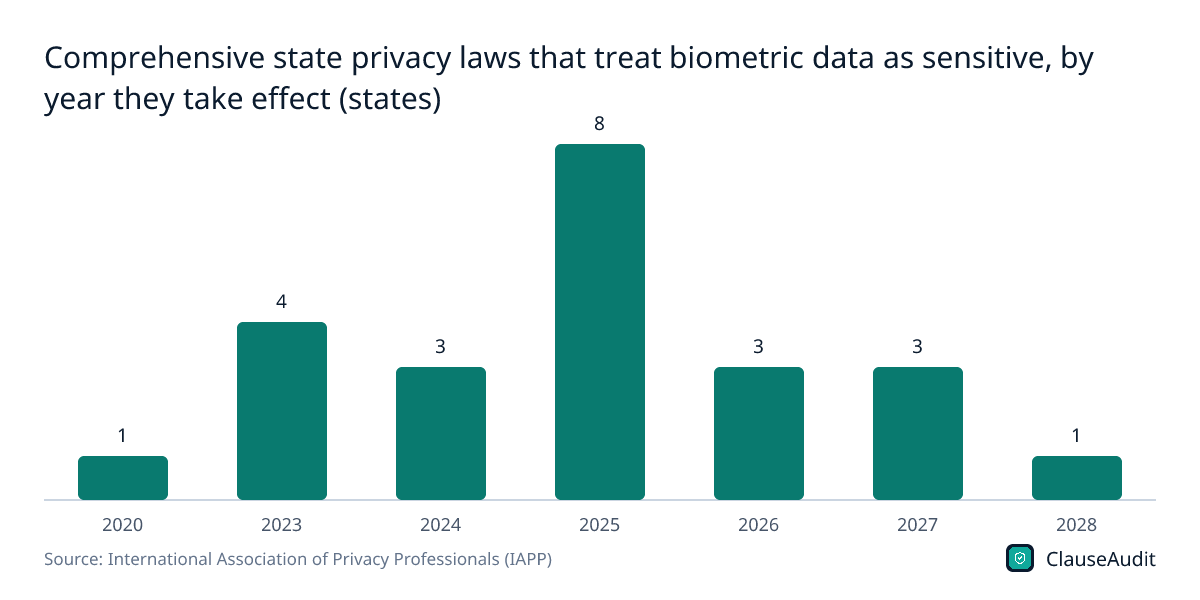
Download this chart (PNG)Comprehensive state privacy laws that treat biometric data as sensitive, by year they take effect (states)
Chart data
| Label | Value (states) |
|---|---|
| 2020 | 1 |
| 2023 | 4 |
| 2024 | 3 |
| 2025 | 8 |
| 2026 | 3 |
| 2027 | 3 |
| 2028 | 1 |
2025 was the peak, with 8 laws taking effect in one year. The 2027 and 2028 bars are laws already signed, so plan for them now.
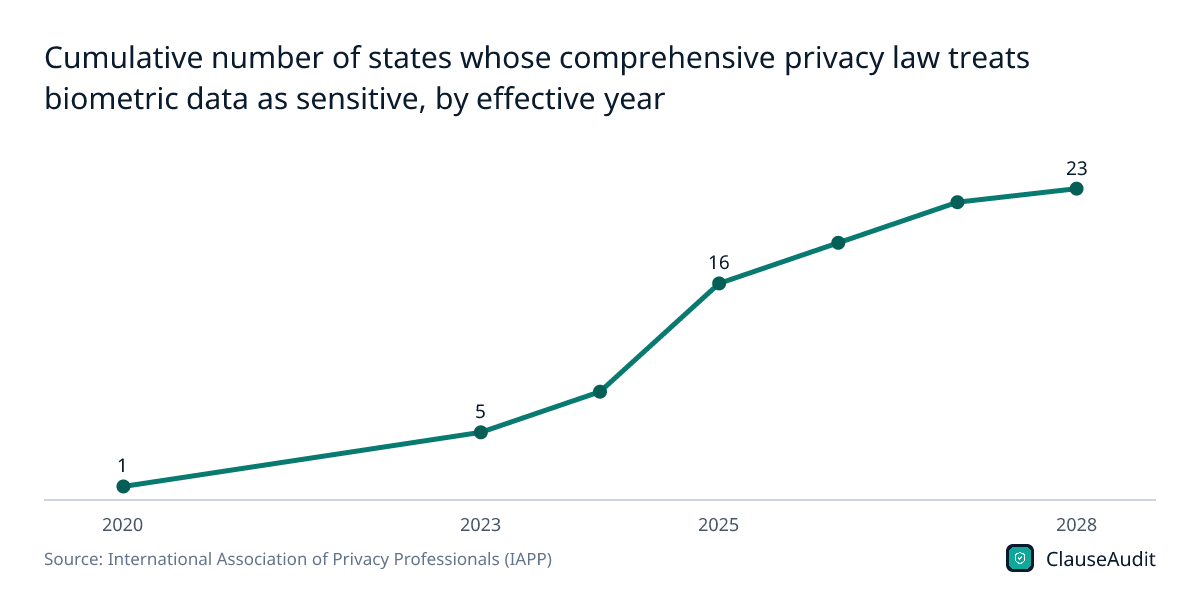
Download this chart (PNG)Cumulative number of states whose comprehensive privacy law treats biometric data as sensitive, by effective year
Chart data
| Label | Value |
|---|---|
| 2020 | 1 |
| 2023 | 5 |
| 2024 | 8 |
| 2025 | 16 |
| 2026 | 19 |
| 2027 | 22 |
| 2028 | 23 |
The count of broad privacy laws covering biometrics rose from 1 state in 2020 to 19 in 2026, and it reaches 23 once the signed laws kick in. A vendor that ignores biometric consent is running out of places to hide.
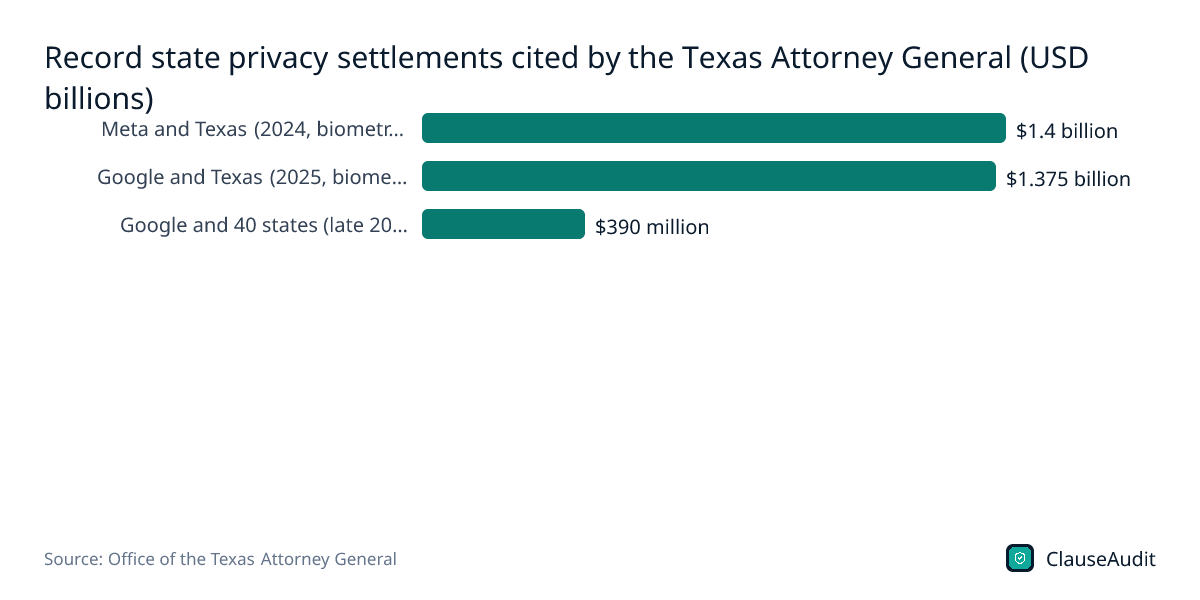
Download this chart (PNG)Record state privacy settlements cited by the Texas Attorney General (USD billions)
Chart data
| Label | Value |
|---|---|
| Meta and Texas (2024, biometric data) | $1.4 billion |
| Google and Texas (2025, biometric, location and incognito claims) | $1.375 billion |
| Google and 40 states (late 2022) | $390 million |
Both record Texas settlements came from state enforcement, not private suits. Note that the Google figure also covers location and incognito claims, so it is not a pure biometric number.
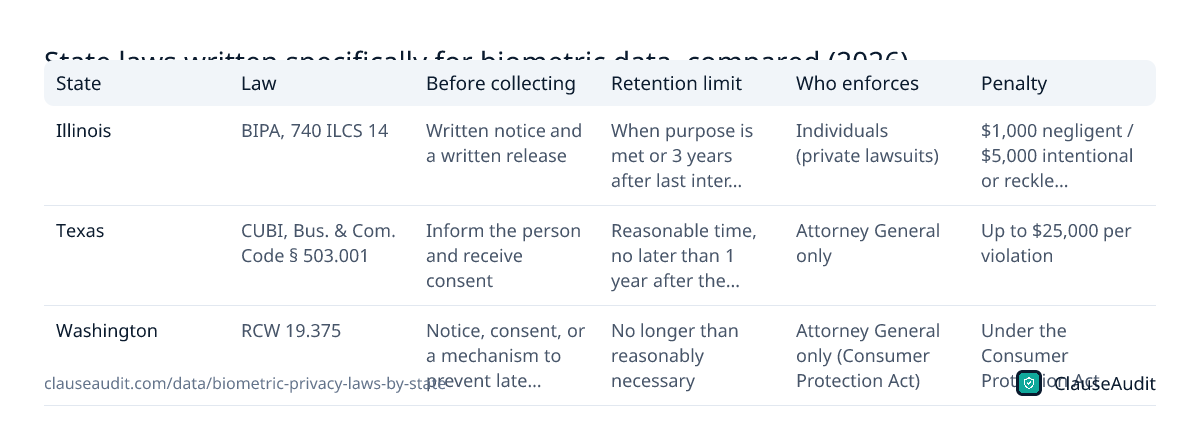
Download this chart (PNG)State laws written specifically for biometric data, compared (2026)
| State | Law | Before collecting | Retention limit | Who enforces | Penalty |
|---|---|---|---|---|---|
| Illinois | BIPA, 740 ILCS 14 | Written notice and a written release | When purpose is met or 3 years after last interaction, whichever is first | Individuals (private lawsuits) | $1,000 negligent / $5,000 intentional or reckless per violation, or actual damages |
| Texas | CUBI, Bus. & Com. Code § 503.001 | Inform the person and receive consent | Reasonable time, no later than 1 year after the purpose expires | Attorney General only | Up to $25,000 per violation |
| Washington | RCW 19.375 | Notice, consent, or a mechanism to prevent later commercial use | No longer than reasonably necessary | Attorney General only (Consumer Protection Act) | Under the Consumer Protection Act |
| Colorado | Colorado Privacy Act as amended by HB24-1130 | Sensitive-data consent under the Colorado Privacy Act; limits on reasons an employer can give when seeking employee consent | Written retention schedule and deletion guidelines required | State enforcement under the Colorado Privacy Act | Under the Colorado Privacy Act |
Source: Illinois General Assembly (copy of compiled statute hosted by Akin Gump), Biometric Information Privacy Act, 740 ILCS 14 (statute text); King & Spalding, Illinois BIPA Reform Takes Effect; Texas Legislature (via Texas Public Law), Tex. Bus. & Com. Code § 503.001, Capture or Use of Biometric Identifier; Washington State Legislature, RCW 19.375, Biometric Identifiers; Washington State Legislature, RCW 19.373, Washington My Health My Data Act; Washington State Office of the Attorney General, Protecting Washingtonians' Personal Health Data and Privacy (My Health My Data Act FAQ); Colorado General Assembly, HB24-1130, Privacy of Biometric Identifiers & Data; Colorado General Assembly (via Colorado Public Law), C.R.S. § 6-1-1303, Colorado Privacy Act definitions; International Association of Privacy Professionals (IAPP), US State Comprehensive Privacy Laws Report: 2024 Legislative Session. Download as image
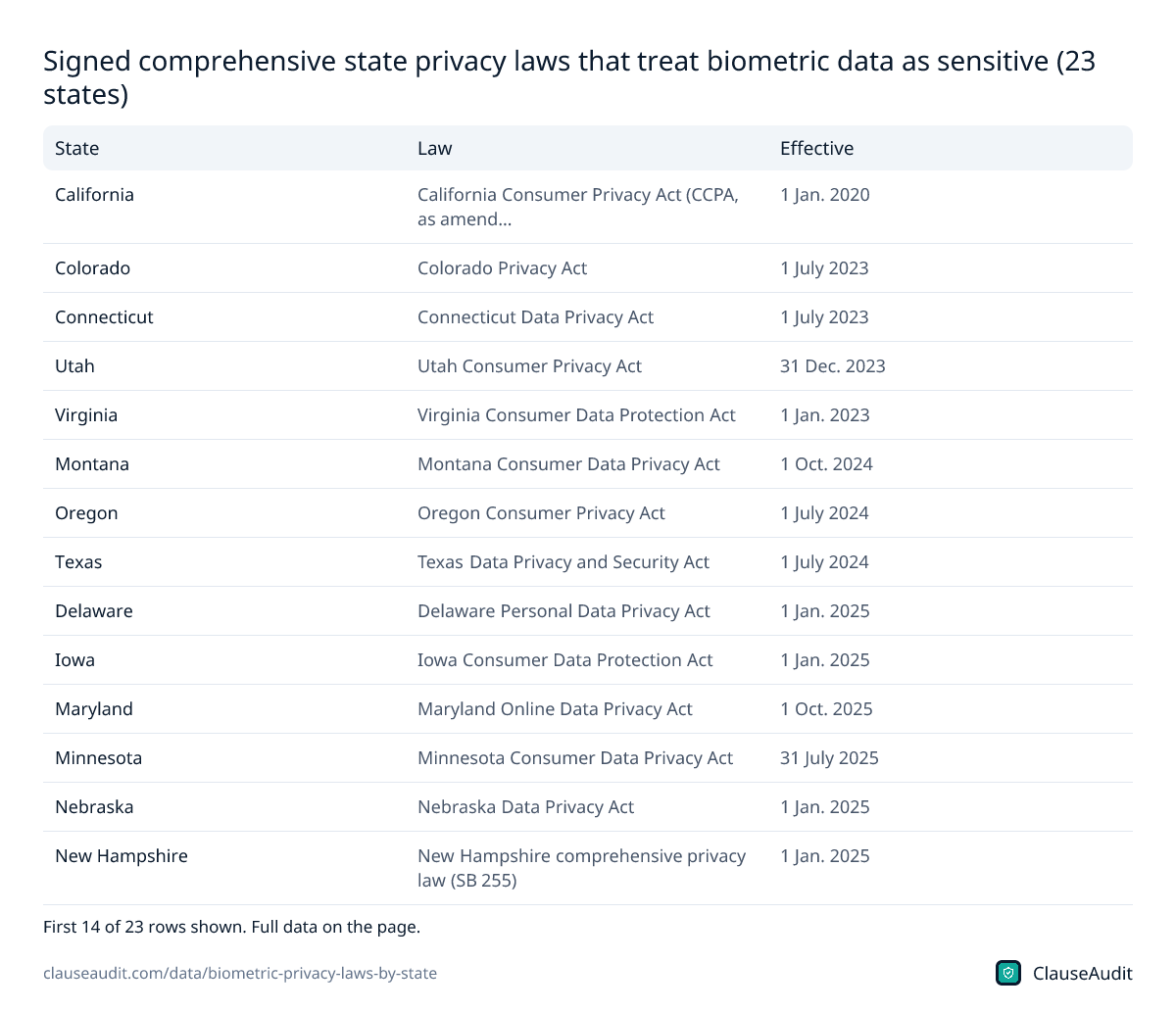
Signed comprehensive state privacy laws that treat biometric data as sensitive (23 states)
| State | Law | Effective |
|---|---|---|
| California | California Consumer Privacy Act (CCPA, as amended by CPRA) | 1 Jan. 2020 |
| Colorado | Colorado Privacy Act | 1 July 2023 |
| Connecticut | Connecticut Data Privacy Act | 1 July 2023 |
| Utah | Utah Consumer Privacy Act | 31 Dec. 2023 |
| Virginia | Virginia Consumer Data Protection Act | 1 Jan. 2023 |
| Montana | Montana Consumer Data Privacy Act | 1 Oct. 2024 |
| Oregon | Oregon Consumer Privacy Act | 1 July 2024 |
| Texas | Texas Data Privacy and Security Act | 1 July 2024 |
| Delaware | Delaware Personal Data Privacy Act | 1 Jan. 2025 |
| Iowa | Iowa Consumer Data Protection Act | 1 Jan. 2025 |
| Maryland | Maryland Online Data Privacy Act | 1 Oct. 2025 |
| Minnesota | Minnesota Consumer Data Privacy Act | 31 July 2025 |
| Nebraska | Nebraska Data Privacy Act | 1 Jan. 2025 |
| New Hampshire | New Hampshire comprehensive privacy law (SB 255) | 1 Jan. 2025 |
| New Jersey | New Jersey comprehensive privacy law (SB 332) | 15 Jan. 2025 |
| Tennessee | Tennessee Information Protection Act | 1 July 2025 |
| Indiana | Indiana Consumer Data Protection Act | 1 Jan. 2026 |
| Kentucky | Kentucky Consumer Data Protection Act | 1 Jan. 2026 |
| Rhode Island | Rhode Island Data Transparency and Privacy Protection Act | 1 Jan. 2026 |
| Alabama | Alabama Personal Data Protection Act (HB 351) | 1 May 2027 (signed 17 Apr. 2026) |
| Louisiana | Louisiana Data Privacy Act (SB 386) | 1 Jan. 2027 (signed 29 May 2026) |
| Oklahoma | Oklahoma consumer data privacy law (SB 546) | 1 Jan. 2027 (signed 20 Mar. 2026) |
| Vermont | Vermont Data Privacy and Online Surveillance Act (S.71) | 1 Jan. 2028 (signed 16 June 2026) |
Source: International Association of Privacy Professionals (IAPP), US State Privacy Legislation Tracker 2026 (map); International Association of Privacy Professionals (IAPP), US State Privacy Legislation Tracker 2026: Comprehensive Consumer Privacy Bills (chart); International Association of Privacy Professionals (IAPP), US State Comprehensive Privacy Laws Report: 2024 Legislative Session; Texas Legislature (via Texas Public Law), Tex. Bus. & Com. Code § 541.001, Texas Data Privacy and Security Act definitions; Colorado General Assembly (via Colorado Public Law), C.R.S. § 6-1-1303, Colorado Privacy Act definitions; Troutman Pepper Locke, Vermont Brings the Total to 23 State Comprehensive Privacy Laws; Mayer Brown, Vermont Enacts Comprehensive Consumer Privacy Law; Mayer Brown, Alabama Enacts Comprehensive Consumer Data Privacy Law; Davis Wright Tremaine, Louisiana Data Privacy Act (SB 386); Troutman Pepper Locke, Oklahoma Enacts Consumer Data Privacy Law; Oklahoma House of Representatives, SB546 data privacy protections signed into law. Download as image
Strongest biometric privacy law in the state by state
- 1Biometric-specific law with a private right of action
- 3Biometric-specific law enforced by the state
- 17Comprehensive privacy law in effect: biometric data is sensitive
- 4Comprehensive law signed, not yet in effect: biometric data is sensitive
- 1Narrow privacy law (very large companies only)
- 25No biometric-specific or comprehensive privacy law
- Biometric-specific law with a private right of action1
- Biometric-specific law enforced by the state3
- Comprehensive privacy law in effect: biometric data is sensitive17
- Comprehensive law signed, not yet in effect: biometric data is sensitive4
- Narrow privacy law (very large companies only)1
- No biometric-specific or comprehensive privacy law25
| State | Law | How biometric data is treated | Enforcement | In effect | Source |
|---|---|---|---|---|---|
| Alabama | Alabama Personal Data Protection Act (HB 351) | Sensitive data: genetic or biometric data used to identify an individual (consent required) | Attorney General; no private right of action (per IAPP) | 1 May 2027 (signed 17 Apr. 2026) | HB 351 (2026) |
| Alaska | None statewide | No statewide biometric consent statute or comprehensive privacy law identified | - | - | None identified |
| Arizona | None statewide | No statewide biometric consent statute or comprehensive privacy law identified | - | - | None identified |
| Arkansas | None statewide | No statewide biometric consent statute or comprehensive privacy law identified | - | - | None identified |
| California | California Consumer Privacy Act (CCPA, as amended by CPRA) | Sensitive personal information: processing of biometric information to uniquely identify a consumer | Private right of action limited to certain violations (per IAPP); otherwise government enforcement | 1 Jan. 2020 | Cal. Civ. Code § 1798.140 |
| Colorado | Colorado Privacy Act, as amended by HB24-1130 (biometric identifiers) | Written policy with a retention schedule required; covers employers' collection of employee biometric data. Biometric data that may identify a person is sensitive data | Colorado Privacy Act enforcement; no private right of action (per IAPP) | CPA since 1 July 2023; biometric amendment since 1 July 2025 | C.R.S. § 6-1-1303; HB24-1130 |
| Connecticut | Connecticut Data Privacy Act | Sensitive data: genetic and biometric data or information derived from it (opt-in consent) | Attorney General; no private right of action | 1 July 2023 | Conn. Gen. Stat. § 42-515 et seq. (SB 6) |
| Delaware | Delaware Personal Data Privacy Act | Sensitive data: genetic or biometric data (no separate processing-purpose test; biometric data is defined as characteristics used to identify a specific individual) | Attorney General; no private right of action | 1 Jan. 2025 | 6 Del. C. § 12D-102 |
| District of Columbia | None statewide | No statewide biometric consent statute or comprehensive privacy law identified | - | - | None identified |
| Florida | Florida Digital Bill of Rights | Sensitive data: biometric data processed to uniquely identify a person, but only for controllers with over $1 billion in global revenue that meet further tests | See statute | In force | Fla. Stat. § 501.702 |
| Georgia | None statewide | No statewide biometric consent statute or comprehensive privacy law identified | - | - | None identified |
| Hawaii | None statewide | No statewide biometric consent statute or comprehensive privacy law identified | - | - | None identified |
| Idaho | None statewide | No statewide biometric consent statute or comprehensive privacy law identified | - | - | None identified |
| Illinois | Biometric Information Privacy Act (BIPA) | Written release required before collection; public retention policy; destroy within 3 years of last interaction or when purpose is met | Private lawsuits: $1,000 (negligent) or $5,000 (intentional/reckless) per violation, or actual damages | Since P.A. 95-994 (2008) | 740 ILCS 14 |
| Indiana | Indiana Consumer Data Protection Act | Sensitive data: biometric data processed to uniquely identify a person (opt-in consent) | Attorney General; no private right of action | 1 Jan. 2026 | Ind. Code § 24-15 (SB 5) |
| Iowa | Iowa Consumer Data Protection Act | Sensitive data: biometric data processed to uniquely identify a person | Attorney General; no private right of action | 1 Jan. 2025 | Iowa Code § 715D.1 |
| Kansas | None statewide | No statewide biometric consent statute or comprehensive privacy law identified | - | - | None identified |
| Kentucky | Kentucky Consumer Data Protection Act | Sensitive data: biometric data processed to uniquely identify a person (opt-in consent) | Attorney General; no private right of action | 1 Jan. 2026 | KRS 367.3611 et seq. (HB 15) |
| Louisiana | Louisiana Data Privacy Act (SB 386) | Sensitive data: biometric data processed to uniquely identify a person (opt-in consent); sellers of biometric data must post a notice | Attorney General; no private right of action | 1 Jan. 2027 (signed 29 May 2026) | SB 386 (2026) |
| Maine | None statewide | No statewide biometric consent statute or comprehensive privacy law identified | - | - | None identified |
| Maryland | Maryland Online Data Privacy Act | Sensitive data: genetic data or biometric data (not limited to identification purposes) | Attorney General; no private right of action | 1 Oct. 2025 | Md. Code, Com. Law § 14-4701 |
| Massachusetts | None statewide | No statewide biometric consent statute or comprehensive privacy law identified | - | - | None identified |
| Michigan | None statewide | No statewide biometric consent statute or comprehensive privacy law identified | - | - | None identified |
| Minnesota | Minnesota Consumer Data Privacy Act | Sensitive data: biometric data processed to uniquely identify a person (opt-in consent) | Attorney General; no private right of action | 31 July 2025 | Minn. Stat. § 325M.11 |
| Mississippi | None statewide | No statewide biometric consent statute or comprehensive privacy law identified | - | - | None identified |
| Missouri | None statewide | No statewide biometric consent statute or comprehensive privacy law identified | - | - | None identified |
| Montana | Montana Consumer Data Privacy Act | Sensitive data: biometric data processed to uniquely identify a person (opt-in consent) | Attorney General; no private right of action | 1 Oct. 2024 | Mont. Code Ann. § 30-14-2802 |
| Nebraska | Nebraska Data Privacy Act | Sensitive data: biometric data processed to uniquely identify a person (opt-in consent) | Attorney General; no private right of action | 1 Jan. 2025 | Neb. Rev. Stat. § 87-1102 (LB 1074) |
| Nevada | Consumer health data law (SB 370, 2023); no comprehensive privacy law | No biometric-specific statute or comprehensive privacy law. Biometric data is covered as consumer health data under SB 370: consent required to process it unless necessary to provide a requested product or service (per Davis Wright Tremaine) | SB 370: Attorney General under the Nevada consumer protection law; no private right of action (per Davis Wright Tremaine) | SB 370 since 31 Mar. 2024 | Nev. Rev. Stat. §§ 603A.500 to 603A.590 (SB 370), as cited by Davis Wright Tremaine |
| New Hampshire | New Hampshire comprehensive privacy law (SB 255) | Sensitive data: biometric data processed to uniquely identify a person (opt-in consent) | Attorney General; no private right of action | 1 Jan. 2025 | RSA 507-H (SB 255) |
| New Jersey | New Jersey comprehensive privacy law (SB 332) | Sensitive data: biometric data processed to uniquely identify a person (opt-in consent) | Attorney General; no private right of action | 15 Jan. 2025 | N.J.S.A. 56:8-166.4 et seq. (SB 332) |
| New Mexico | None statewide | No statewide biometric consent statute or comprehensive privacy law identified | - | - | None identified |
| New York | None statewide | No statewide biometric consent statute or comprehensive privacy law identified | - | - | None identified |
| North Carolina | None statewide | No statewide biometric consent statute or comprehensive privacy law identified | - | - | None identified |
| North Dakota | None statewide | No statewide biometric consent statute or comprehensive privacy law identified | - | - | None identified |
| Ohio | None statewide | No statewide biometric consent statute or comprehensive privacy law identified | - | - | None identified |
| Oklahoma | Oklahoma consumer data privacy law (SB 546) | Sensitive data: biometric data processed to uniquely identify a person (opt-in consent) | Attorney General; no private right of action | 1 Jan. 2027 (signed 20 Mar. 2026) | SB 546 (2026) |
| Oregon | Oregon Consumer Privacy Act | Sensitive data: genetic or biometric data (not limited to identification purposes) | Attorney General; no private right of action | 1 July 2024 | ORS 646A.570 |
| Pennsylvania | None statewide | No statewide biometric consent statute or comprehensive privacy law identified | - | - | None identified |
| Rhode Island | Rhode Island Data Transparency and Privacy Protection Act | Sensitive data: biometric data processed to uniquely identify a person (opt-in consent) | Attorney General; no private right of action | 1 Jan. 2026 | R.I. Gen. Laws § 6-48.1 (H 7787) |
| South Carolina | None statewide | No statewide biometric consent statute or comprehensive privacy law identified | - | - | None identified |
| South Dakota | None statewide | No statewide biometric consent statute or comprehensive privacy law identified | - | - | None identified |
| Tennessee | Tennessee Information Protection Act | Sensitive data: biometric data processed to uniquely identify a person (opt-in consent) | Attorney General; no private right of action | 1 July 2025 | Tenn. Code § 47-18-3201 et seq. (HB 1181) |
| Texas | Capture or Use of Biometric Identifier Act (CUBI); also Texas Data Privacy and Security Act | Must inform and get consent before capture for a commercial purpose; destroy within 1 year after purpose expires. Also sensitive data under the TDPSA. Since 1 Jan. 2026 (HB 149), an image posted online does not count as consent unless the person made it public; added exemptions for some AI training uses | Attorney General only; civil penalty up to $25,000 per violation | CUBI in force; TDPSA since 1 July 2024 | Tex. Bus. & Com. Code § 503.001 (as amended by HB 149, 89th Leg., eff. 1 Jan. 2026); § 541.001 |
| Utah | Utah Consumer Privacy Act | Sensitive data: biometric data processed to uniquely identify a person | Attorney General; no private right of action | 31 Dec. 2023 | Utah Code § 13-61-101 (SB 227) |
| Vermont | Vermont Data Privacy and Online Surveillance Act (S.71) | Sensitive data: genetic or biometric data, not limited to identification purposes | Attorney General only; no private right of action (per IAPP) | 1 Jan. 2028 (signed 16 June 2026) | S.71 (2026) |
| Virginia | Virginia Consumer Data Protection Act | Sensitive data: biometric data processed to uniquely identify a person (opt-in consent) | Attorney General; no private right of action | 1 Jan. 2023 | Va. Code § 59.1-575 |
| Washington | RCW 19.375 (biometric identifiers); also My Health My Data Act | Notice, consent or an opt-out mechanism required before enrolling a biometric identifier for a commercial purpose; keep no longer than reasonably necessary | RCW 19.375: Attorney General only, under the Consumer Protection Act. My Health My Data Act: Attorney General and private lawsuits (per se Consumer Protection Act violation) | RCW 19.375 enacted 2017 | RCW 19.375.010-.030; RCW 19.373 |
| West Virginia | None statewide | No statewide biometric consent statute or comprehensive privacy law identified | - | - | None identified |
| Wisconsin | None statewide | No statewide biometric consent statute or comprehensive privacy law identified | - | - | None identified |
| Wyoming | None statewide | No statewide biometric consent statute or comprehensive privacy law identified | - | - | None identified |
Which states have biometric privacy laws?
Think of the map in three tiers. The top tier is states with a law written just for biometric data: Illinois, Texas, Washington and Colorado. Illinois is the only one where you, the person whose face was scanned, can file the lawsuit yourself.
The middle tier is the general consumer privacy laws. 23 states have signed one, and every one of them labels biometric data as sensitive. In practice that usually means a company needs your consent before it processes a fingerprint or face template. Four of those laws, in Oklahoma, Louisiana, Alabama and Vermont, take effect in 2027 or 2028.
The bottom tier is everyone else. 25 jurisdictions, including New York, Pennsylvania and DC, have neither a biometric-specific law nor a broad consumer privacy law. That doesn't make biometric data a free-for-all there. Employment, school and breach notification laws can still apply, and a business that serves customers in Illinois or Texas is bound by those states' rules no matter where its office sits.
What counts as biometric data?
Biometric data is a measurement of your body that can identify you. The usual list is fingerprints, face geometry, retina or iris scans, voiceprints and hand geometry. A plain photo or a voice recording on its own usually isn't covered. The trouble starts when software turns that photo into a face template or that recording into a voiceprint it can match later.
That line matters more than it sounds. A video call app that only records is one thing. The same app with a feature that recognizes speakers by voice is collecting biometric data, and the consent rules switch on. Many businesses cross that line when a vendor ships a new feature, without anyone on their side making a decision.
So the question to ask a vendor is not just "do you collect biometrics?" Ask whether any feature creates a template, a faceprint or a voiceprint, even as a background step for fraud checks or login.
Why is Illinois BIPA such a big deal?
BIPA stands apart for a couple of reasons. First, it demands written notice and a written release before collection. A line buried in a privacy policy rarely meets that bar. Since 2024 an electronic signature can count, but the person still has to sign a release. Second, it lets people sue directly for $1,000 per negligent violation or $5,000 per intentional or reckless one, or actual damages if those are higher.
Picture a warehouse where every worker clocks in with a finger scan and never signed a release. Even after the August 2, 2024 amendment, which limits recovery to one award per person for repeated scans by the same method, that is still at least one claim per worker. Multiply the per-violation amount by a full payroll and the exposure gets serious fast. A small business can face a demand bigger than its annual profit over a time clock it bought off the shelf.
BIPA also has a hard destruction rule. Data must be destroyed once its purpose is met or 3 years after the person's last interaction with the company, whichever comes first. A former employee's fingerprint template sitting on a vendor's server years later is a live risk.
How do Texas, Washington and Colorado differ?
Texas requires a business to tell you and get your consent before capturing a biometric identifier, and to destroy it within 1 year after the purpose expires. Only the Attorney General can sue, but the penalty runs up to $25,000 per violation. Texas has used that power: Meta settled for $1.4 billion in July 2024, and Google finalized a $1.375 billion settlement in October 2025 that covered biometric, location and incognito claims.
Washington's biometric law requires notice, consent or a way to block later commercial use before a business enrolls your biometric data for a commercial purpose. Only the Attorney General enforces it. Separately, its My Health My Data Act treats biometric data as consumer health data, and that law does allow private lawsuits.
Colorado folded biometric rules into its privacy act. Businesses need a written retention schedule and deletion guidelines, and employers face limits on why they can ask staff to consent.
The practical takeaway is that a missing private lawsuit right doesn't mean low risk. Illinois exposure comes from many small claims. Texas exposure comes from one very large one. Plan for both.
Does a biometric privacy law apply to my business?
Start with where the people are, not where you are. If you scan the faces of customers in Texas or the fingerprints of workers in Illinois, those states' laws reach you. Then list every tool that touches biometric data. Common ones include:
- Time clocks and door access systems that use fingerprints or palm scans
- Identity checks that match a selfie to a photo ID during signup
- Call center or voice assistant software that builds voiceprints
- Video tools that tag or recognize faces in recordings
- Phone apps that open with a face scan and send templates to a server
What should a freelancer, employer or worker do now?
If you run a business, get a written consent form in front of every person before collection, publish a retention schedule, and set a real deletion date. Use the strictest state you operate in as your baseline. Matching Illinois covers most of the ground, but Texas has a shorter deletion deadline: 1 year after the purpose expires.
If you buy software, ask the vendor where the biometric templates are stored, who can see them, and whether they are used to train other products. Get the answers into the contract, not a sales email.
If you're a freelancer building an app that captures faces or voices, your client may expect you to carry the legal risk. Push back on unlimited indemnity for privacy claims you have no control over.
Whatever your role, keep a paper trail. A signed consent, a dated retention policy and a deletion log are what you will want to show if a state office or a plaintiff's lawyer ever asks.
If you're a worker asked to scan in, you can ask for the written policy and how long your data is kept. In Illinois, a missing release is the employer's problem, not yours.
How ClauseAudit helps
Most biometric risk is settled in a software agreement long before anyone scans a face. The vendor's terms decide who is responsible for consent, how long templates are kept, and who pays when a lawsuit lands.
Upload your SaaS or vendor contract and the automated review flags the clauses that shift biometric risk onto you, in plain English.
- Who must collect and store written consent, the vendor or you
- Retention and deletion terms for biometric templates, and whether they match the strictest state you serve
- Whether the vendor can use your data to improve or train its products
- Liability caps that would leave you paying privacy claims the vendor caused
- Indemnity for biometric privacy lawsuits, and whether it runs both ways
- Data deletion and return when the contract ends
Frequently asked questions
Can I sue a company for scanning my fingerprint without consent?
Only in Illinois under a biometric-specific law. BIPA lets you sue for $1,000 per negligent violation or $5,000 per intentional or reckless one, or actual damages if higher. Under the Texas and Washington biometric laws, only the Attorney General can bring a case. Washington's My Health My Data Act does allow private suits when biometric data counts as consumer health data.
How much is a BIPA violation worth after the 2024 amendment?
The amounts didn't change: $1,000 for a negligent violation and $5,000 for an intentional or reckless one. What changed in the amendment signed August 2, 2024 is the counting. Repeated collection or disclosure of the same person's data by the same method now supports one award per person, not one award for every scan.
What is the penalty under the Texas biometric law?
Texas can seek a civil penalty of up to $25,000 for each violation. Only the Attorney General can sue, so individuals can't bring their own case. The state has used the law heavily, including the $1.4 billion Meta settlement announced July 30, 2024, the first under the Texas act.
How long can a company keep my biometric data?
It depends on the state. Illinois requires destruction once the purpose is met or 3 years after your last interaction, whichever is first. Texas requires destruction within 1 year after the purpose expires. Washington says no longer than reasonably necessary, and Colorado requires a written retention schedule.
Do general state privacy laws cover biometric data?
Yes. All 23 signed broad consumer privacy laws treat biometric data as sensitive, which generally means consent before processing. They are mostly enforced by the Attorney General, not private lawsuits. Oklahoma, Louisiana, Alabama and Vermont have signed laws that take effect in 2027 or 2028.
Is it legal for my employer to use a fingerprint time clock?
In most states, yes, as long as the employer follows the rules where you work. In Illinois that means written notice, a signed release and a retention policy. Colorado limits the reasons an employer can give when it asks staff to consent. Ask for the written policy if you were never shown one.
Does New York have a biometric privacy law?
New York has no statewide biometric-specific law or broad consumer privacy law, according to the state table on this page. Local and sector rules can still apply. New York City, for example, requires stores, restaurants and venues that collect biometric data to post a sign saying so, and bars them from selling it. Businesses that also serve people in Illinois, Texas or other covered states must follow those laws for those people.
Who is responsible for consent when a software vendor collects biometrics?
Usually the contract decides. Many vendor agreements say the customer must collect all consents, which puts the risk on you even though the vendor runs the system. Read the data processing terms, the indemnity clause and the liability cap before you sign, and push for shared responsibility.
Use this data
Every chart and card below is free to reuse under CC BY 4.0. Download what you need and link back to this page.
 Stat cards
 Key findings card
 Infographic
 Biometric privacy damages and penalties per violation: Illinois vs Texas (USD)
 Biometric privacy protection in 50 states + DC, by type of law (2026) (jurisdictions)
 Comprehensive state privacy laws that treat biometric data as sensitive, by year they take effect (states)
 Cumulative number of states whose comprehensive privacy law treats biometric data as sensitive, by effective year
 Record state privacy settlements cited by the Texas Attorney General (USD billions)
 State laws written specifically for biometric data, compared (2026)
 Signed comprehensive state privacy laws that treat biometric data as sensitive (23 states)
Embed the infographic
Free to share on your site, blog or slides under CC BY 4.0. Please keep the credit link.
Sources and method
Every number on this page comes from the sources below, each opened and read on or before October 18, 2026. A second, independent review checked every figure against its source and corrected anything that did not match. 51 of 51 state entries were confirmed; any that could not be are marked "Not yet confirmed" and left out of every count and chart.
- International Association of Privacy Professionals (IAPP), US State Privacy Legislation Tracker 2026 (map) (Last updated 8 Sept. 2026)
- International Association of Privacy Professionals (IAPP), US State Privacy Legislation Tracker 2026: Comprehensive Consumer Privacy Bills (chart) (Tracker last updated 8 Sept. 2026)
- International Association of Privacy Professionals (IAPP), US State Comprehensive Privacy Laws Report: 2024 Legislative Session (2024 Legislative Session edition (Dec. 2024))
- Illinois General Assembly (copy of compiled statute hosted by Akin Gump), Biometric Information Privacy Act, 740 ILCS 14 (statute text) (P.A. 95-994 text (sections 15 and 20(a) unchanged by the 2024 amendment))
- King & Spalding, Illinois BIPA Reform Takes Effect (August 12, 2024)
- Texas Legislature (via Texas Public Law), Tex. Bus. & Com. Code § 503.001, Capture or Use of Biometric Identifier (Text verified through May 26, 2025 (pre-HB 149); unamended subsections (c)-(d) still current)
- Texas Legislature (via Texas Public Law), Tex. Bus. & Com. Code § 541.001, Texas Data Privacy and Security Act definitions (Current statute (read 2026))
- Office of the Texas Attorney General, Attorney General Ken Paxton Secures $1.4 Billion Settlement with Meta Over Its Unauthorized Capture of Personal Biometric Data (July 30, 2024)
- Office of the Texas Attorney General, Attorney General Ken Paxton Finalizes Historic Settlement with Google and Secures $1.375 Billion (October 31, 2025)
- Washington State Legislature, RCW 19.375, Biometric Identifiers (Current RCW (2017 c 299))
- Washington State Legislature, RCW 19.373, Washington My Health My Data Act (Current RCW (2023 c 191))
- Washington State Office of the Attorney General, Protecting Washingtonians' Personal Health Data and Privacy (My Health My Data Act FAQ) (Current page (read Oct. 2026))
- Colorado General Assembly, HB24-1130, Privacy of Biometric Identifiers & Data (Approved May 31, 2024; effective July 1, 2025)
- Colorado General Assembly (via Colorado Public Law), C.R.S. § 6-1-1303, Colorado Privacy Act definitions (Current statute (read 2026))
- California Privacy Protection Agency, California Consumer Privacy Act of 2018 (Civ. Code § 1798.140) (Text effective 01/01/2026 (AB 137, AB 566 update), posted December 2025)
- Virginia General Assembly, Va. Code § 59.1-575, Consumer Data Protection Act definitions (Current Code of Virginia (read 2026))
- Connecticut Office of the Attorney General, The Connecticut Data Privacy Act (Current page (read Oct. 2026))
- Iowa Legislature, Iowa Code § 715D.1, Consumer Data Protection definitions (Iowa Code 2026)
- Montana Legislature, Mont. Code Ann. § 30-14-2802, Consumer Data Privacy Act definitions (Current MCA (read 2026))
- Oregon Legislature (via Oregon Public Law), ORS 646A.570, Oregon Consumer Privacy Act definitions (Current statute (read 2026))
- Delaware General Assembly, 6 Del. C. ch. 12D, Delaware Personal Data Privacy Act (Current Delaware Code (read 2026))
- Minnesota Office of the Revisor of Statutes, Minn. Stat. § 325M.11, Consumer Data Privacy Act definitions (Current statute (read 2026))
- Maryland General Assembly, Md. Code, Com. Law § 14-4701, Maryland Online Data Privacy Act definitions (Current statute (read 2026))
- Florida Legislature, Fla. Stat. § 501.702, Florida Digital Bill of Rights definitions (2026 Florida Statutes (read 2026))
- Mayer Brown, Alabama Enacts Comprehensive Consumer Data Privacy Law (April 28, 2026)
- Mayer Brown, Vermont Enacts Comprehensive Consumer Privacy Law (June 22, 2026)
- Troutman Pepper Locke, Vermont Brings the Total to 23 State Comprehensive Privacy Laws (June 18, 2026)
- Davis Wright Tremaine, Louisiana Data Privacy Act (SB 386) (June 25, 2026)
- Troutman Pepper Locke, Oklahoma Enacts Consumer Data Privacy Law (March 23, 2026)
- Oklahoma House of Representatives, SB546 data privacy protections signed into law (March 23, 2026)
- Davis Wright Tremaine LLP, State Privacy Laws Tracker: Nevada (SB 370 consumer health data law) (Undated tracker page (read 19 Oct. 2026))
- Texas Legislature, H.B. 149, 89th Legislature (Texas Responsible Artificial Intelligence Governance Act), enrolled text (Enrolled 2025; effective January 1, 2026)
Cite this page
ClauseAudit, “Biometric Privacy Laws by State (2026)”, updated October 18, 2026, https://clauseaudit.com/data/biometric-privacy-laws-by-state. Free to reuse with a link back (CC BY 4.0).
This page summarises published data and law as checked on October 18, 2026. Figures are updated as new editions are released, and your own situation may differ. It is general information, not legal, tax or financial advice.