AI Laws by State (2026): What Every State Has Enacted
By ClauseAudit Research · 18 sources ·
Which states have passed AI laws?
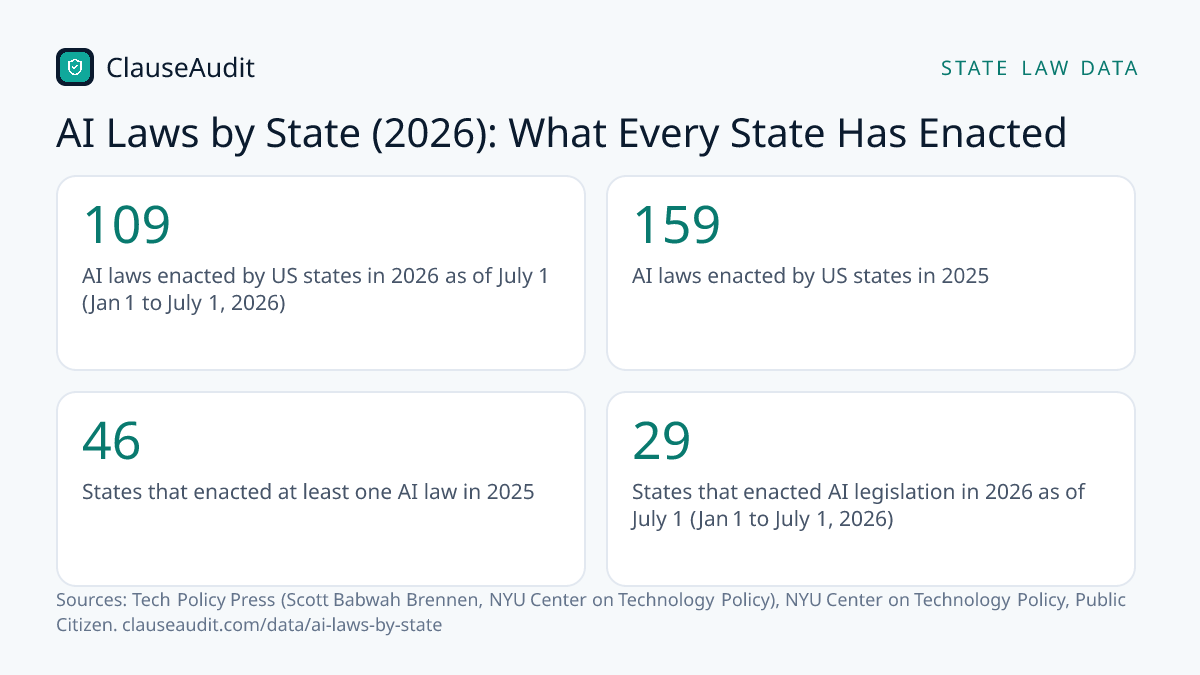
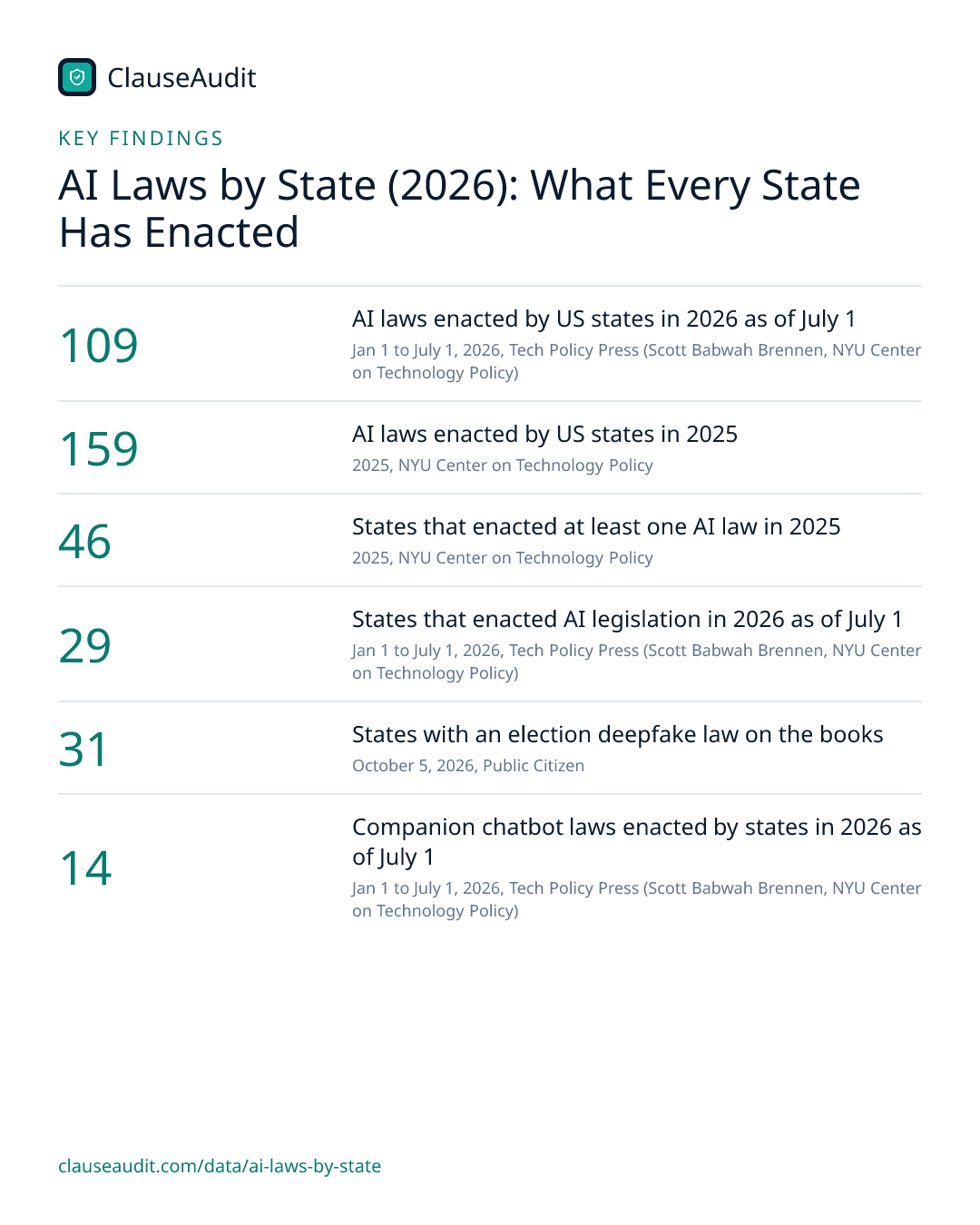
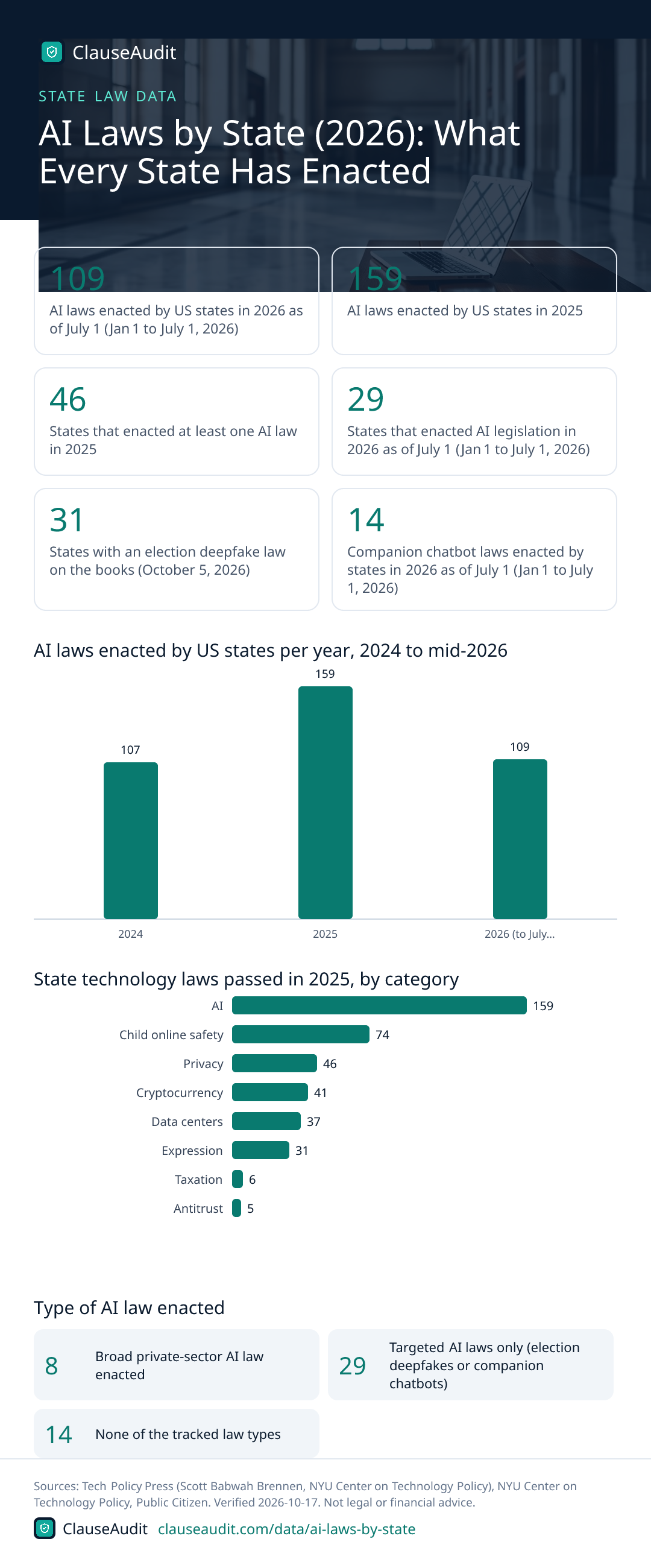
Almost every state now has some AI law, but few have broad ones. States enacted 159 AI laws in 2025, and 46 states passed at least one. By July 1, 2026, states had enacted another 109. Most are narrow: election deepfakes, chatbots, government use. Broad private-sector laws exist in only a handful of states.

- AI laws enacted by US states in 2026 as of July 1 (Jan 1 to July 1, 2026, Tech Policy Press (Scott Babwah Brennen, NYU Center on Technology Policy))
- 109
- AI laws enacted by US states in 2025 (2025, NYU Center on Technology Policy)
- 159
- States that enacted at least one AI law in 2025 (2025, NYU Center on Technology Policy)
- 46
- States that enacted AI legislation in 2026 as of July 1 (Jan 1 to July 1, 2026, Tech Policy Press (Scott Babwah Brennen, NYU Center on Technology Policy))
- 29
- States with an election deepfake law on the books (October 5, 2026, Public Citizen)
- 31
- Companion chatbot laws enacted by states in 2026 as of July 1 (Jan 1 to July 1, 2026, Tech Policy Press (Scott Babwah Brennen, NYU Center on Technology Policy))
- 14
- Date Colorado's rewritten AI law (SB 26-189) duties begin (2027, Colorado General Assembly)
- Jan 1, 2027
- Maximum NY RAISE Act penalty for a first violation ($3 million after) (Effective Jan 1, 2027, Office of the Governor of New York)
- $1 million
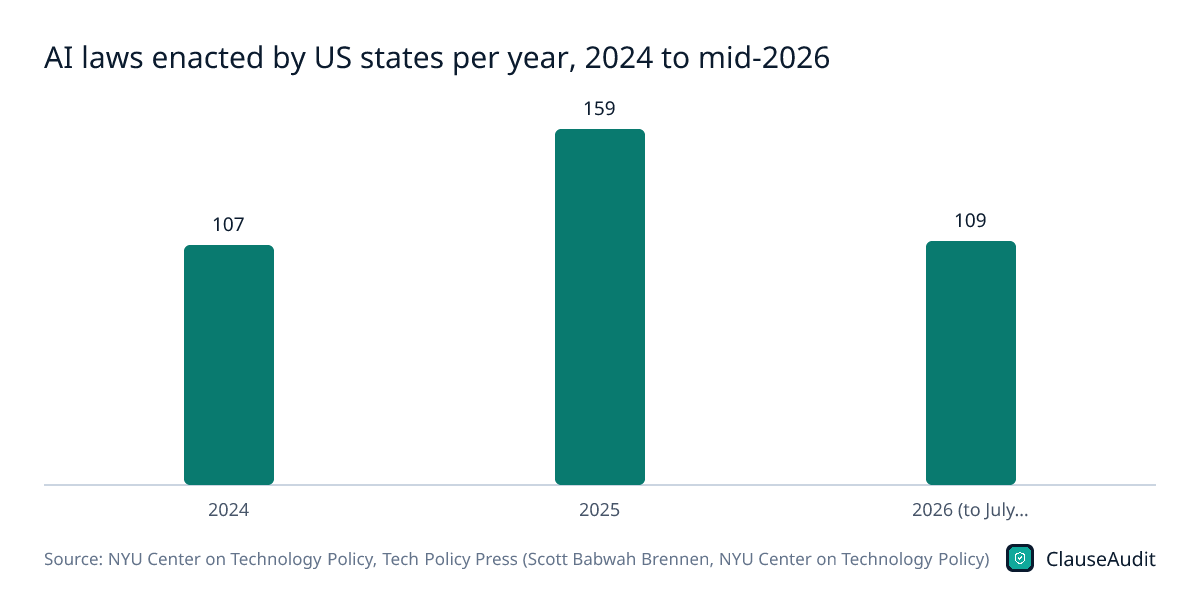
State lawmakers have been busy. The NYU Center on Technology Policy counted 159 AI laws enacted in 2025, up from 107 the year before, and 46 states passed at least one. The first half of 2026 added 109 more.
Most of those laws are small and specific. They cover election deepfakes, companion chatbots or how state agencies use the technology. Only a few states have passed broad rules that reach ordinary businesses, and several of the big ones don't take effect until 2027. This page sorts out which laws actually matter for your work and what to check in the contracts you sign.
AI laws enacted by US states per year, 2024 to mid-2026
Chart data
| Label | Value |
|---|---|
| 2024 | 107 |
| 2025 | 159 |
| 2026 (to July 1) | 109 |
The 2026 bar covers only January through July 1, so it isn't a full year. At the same point in 2025, states had enacted 121 AI laws, which means the pace slowed a little in 2026.
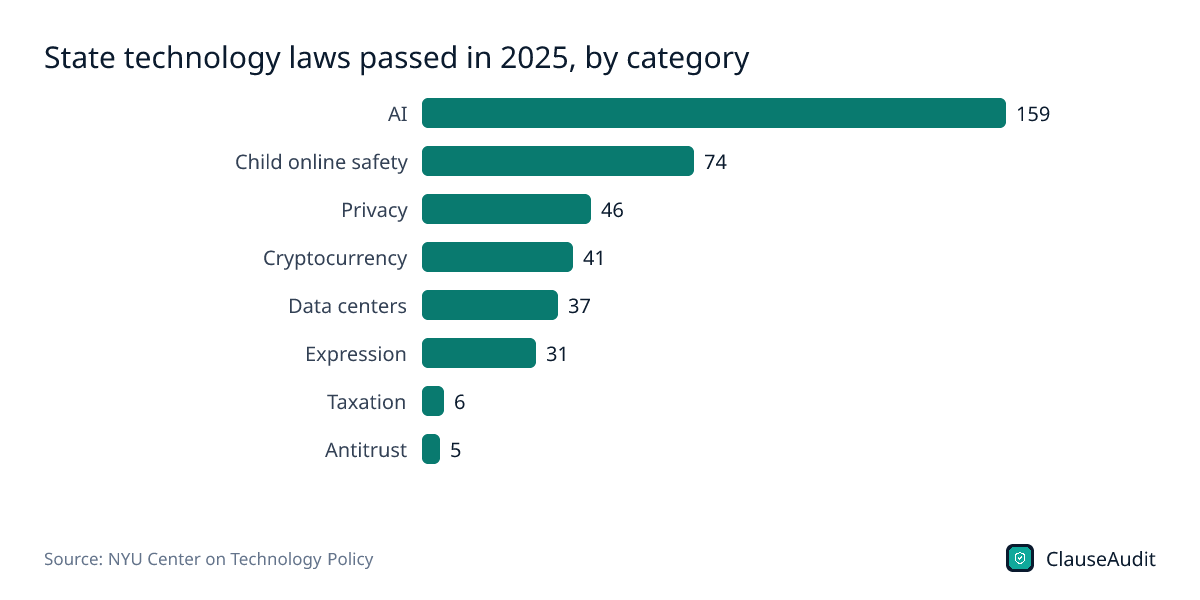
Download this chart (PNG)State technology laws passed in 2025, by category
Chart data
| Label | Value |
|---|---|
| AI | 159 |
| Child online safety | 74 |
| Privacy | 46 |
| Cryptocurrency | 41 |
| Data centers | 37 |
| Expression | 31 |
| Taxation | 6 |
| Antitrust | 5 |
AI was the busiest area of state tech lawmaking in 2025, with 159 laws against 74 on child online safety and 46 on privacy. Some laws land in more than one category.
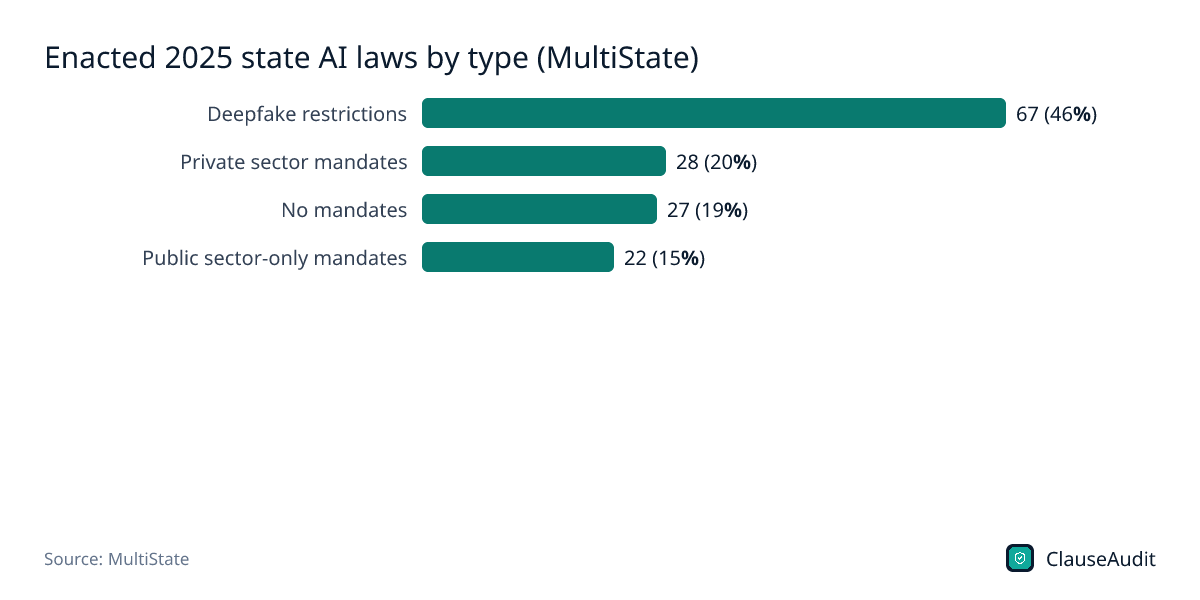
Download this chart (PNG)Enacted 2025 state AI laws by type (MultiState)
Chart data
| Label | Value |
|---|---|
| Deepfake restrictions | 67 (46%) |
| Private sector mandates | 28 (20%) |
| No mandates | 27 (19%) |
| Public sector-only mandates | 22 (15%) |
MultiState uses a narrower definition and counts 144 laws from 1,208 bills. Deepfake restrictions make up 46% of them, while laws that put duties on private companies are 20%.
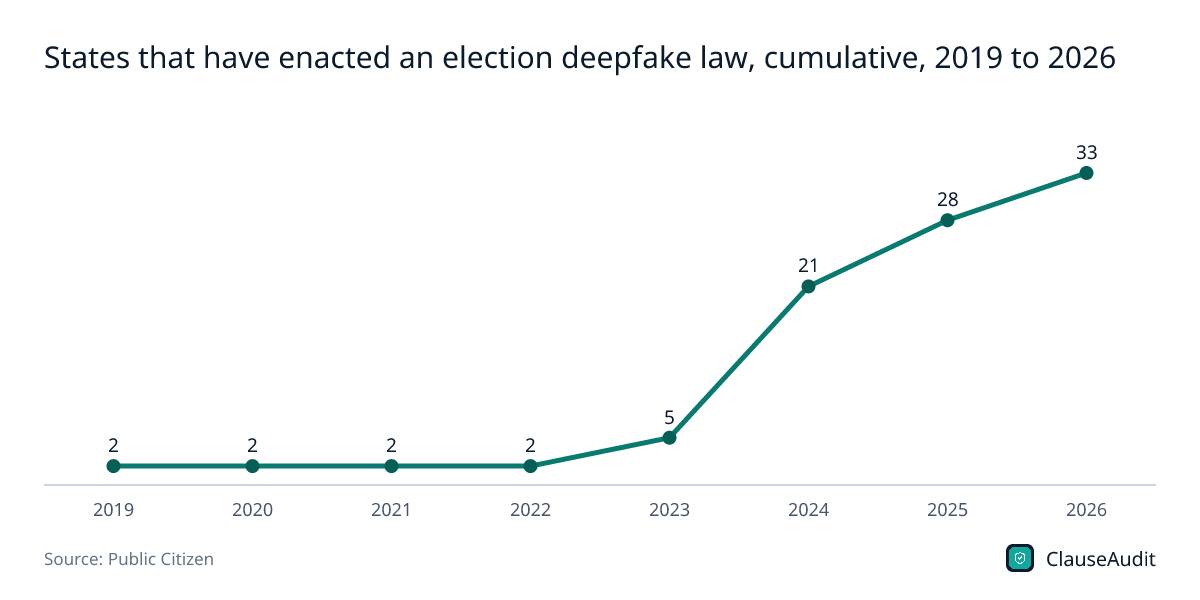
Download this chart (PNG)States that have enacted an election deepfake law, cumulative, 2019 to 2026
Chart data
| Label | Value |
|---|---|
| 2019 | 2 |
| 2020 | 2 |
| 2021 | 2 |
| 2022 | 2 |
| 2023 | 5 |
| 2024 | 21 |
| 2025 | 28 |
| 2026 | 33 |
Election deepfake laws took off in 2024, jumping from 5 states to 21. The total reached 33 in 2026, but Hawaii's was struck down and Massachusetts's expired, leaving 31 in force.
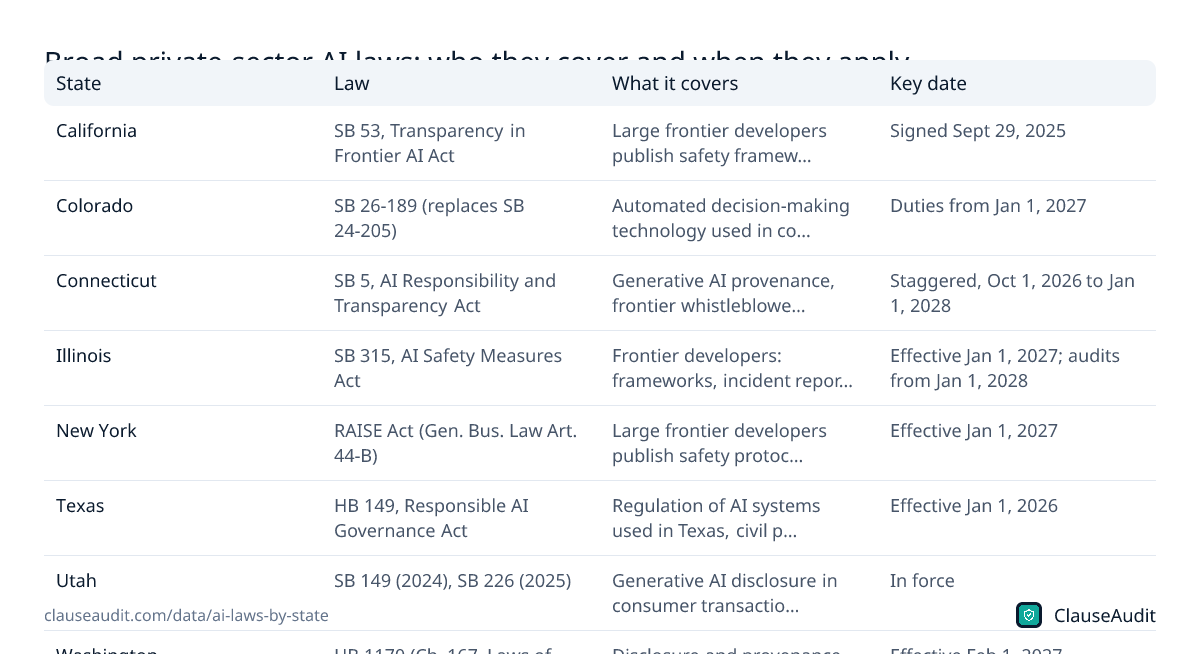
Download this chart (PNG)Broad private-sector AI laws: who they cover and when they apply
| State | Law | What it covers | Key date |
|---|---|---|---|
| California | SB 53, Transparency in Frontier AI Act | Large frontier developers publish safety frameworks and report critical safety incidents; whistleblower protections | Signed Sept 29, 2025 |
| Colorado | SB 26-189 (replaces SB 24-205) | Automated decision-making technology used in consequential decisions: notice, adverse-decision explanation within 30 days, correction and human review | Duties from Jan 1, 2027 |
| Connecticut | SB 5, AI Responsibility and Transparency Act | Generative AI provenance, frontier whistleblowers, companion chatbots, employment decision tools | Staggered, Oct 1, 2026 to Jan 1, 2028 |
| Illinois | SB 315, AI Safety Measures Act | Frontier developers: frameworks, incident reports, annual third-party audits (over $500 million revenue) | Effective Jan 1, 2027; audits from Jan 1, 2028 |
| New York | RAISE Act (Gen. Bus. Law Art. 44-B) | Large frontier developers publish safety protocols, report incidents within 72 hours | Effective Jan 1, 2027 |
| Texas | HB 149, Responsible AI Governance Act | Regulation of AI systems used in Texas, civil penalties | Effective Jan 1, 2026 |
| Utah | SB 149 (2024), SB 226 (2025) | Generative AI disclosure in consumer transactions and regulated occupations | In force |
| Washington | HB 1170 (Ch. 167, Laws of 2026) | Disclosure and provenance for AI-generated or modified content | Effective Feb 1, 2027 |
Source: Office of Governor Gavin Newsom, Governor Newsom signs SB 53, advancing California's world-leading artificial intelligence industry; Colorado General Assembly, SB26-189 Automated Decision-Making Technology; Kilpatrick Townsend, Connecticut Enacts New AI Legislation: What Businesses Need to Know About SB 5; Skadden, Arps, Slate, Meagher & Flom, Illinois Enacts AI Safety Law, Becoming First State to Mandate Independent Third-Party Audits of Frontier AI Developers; New York State Senate, General Business Law Article 44-B, Responsible AI Safety and Education (RAISE) Act; Office of the Governor of New York, Governor Hochul Signs Nation-Leading Legislation to Require AI Frameworks for AI Frontier Models; Texas Legislature Online, HB 149 (89th Legislature, Regular Session) bill history; IAPP, US State AI Governance Legislation Tracker 2026 (chart PDF); Washington State Legislature, HB 1170: Informing users when content is developed or modified by artificial intelligence. Download as image
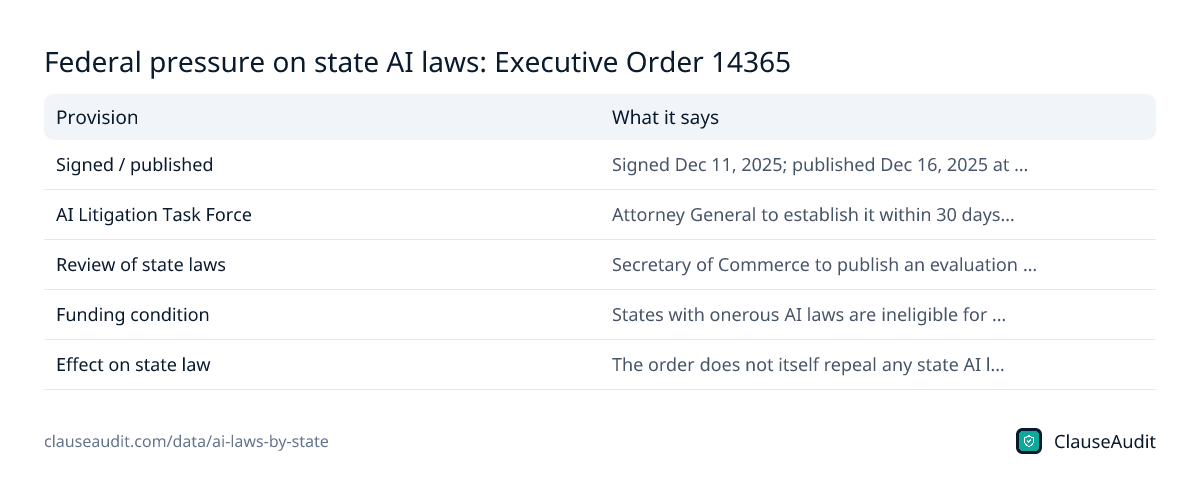
Federal pressure on state AI laws: Executive Order 14365
| Provision | What it says |
|---|---|
| Signed / published | Signed Dec 11, 2025; published Dec 16, 2025 at 90 FR 58499 |
| AI Litigation Task Force | Attorney General to establish it within 30 days to challenge state AI laws |
| Review of state laws | Secretary of Commerce to publish an evaluation of existing state AI laws within 90 days |
| Funding condition | States with onerous AI laws are ineligible for BEAD non-deployment funds, to the extent federal law allows |
| Effect on state law | The order does not itself repeal any state AI law |
Source: Federal Register / GovInfo, Executive Order 14365, Ensuring a National Policy Framework for Artificial Intelligence (90 FR 58499). Download as image
Type of AI law enacted by state
- 8Broad private-sector AI law enacted
- 29Targeted AI laws only (election deepfakes or companion chatbots)
- 14None of the tracked law types
- Broad private-sector AI law enacted8
- Targeted AI laws only (election deepfakes or companion chatbots)29
- None of the tracked law types14
How many states have AI laws in 2026?
Nearly all of them, if you count every law that mentions AI. In 2025, 46 states enacted at least one AI law, according to the NYU Center on Technology Policy. That count includes narrow laws, such as new rules on deepfakes in political ads.
The pace cooled in 2026. By July 1, 29 states had enacted AI legislation, compared with 39 at the same point in 2025. The law count followed the same path: 109 this year against 121 last year. A slower year still adds up to a lot of new rules, and the second half of the year isn't counted yet.
Be careful when you compare trackers. MultiState counted 144 enacted AI laws in 2025, not 159, because it draws the line differently. Neither number is wrong. They answer slightly different questions, so stick to one source when you compare years.
Which states have broad AI laws that cover private companies?
This is the short list that matters most for businesses: California, Colorado, Connecticut, Illinois, New York, Texas, Utah and Washington. Even these laws come in very different shapes.
Some only reach the companies that build the largest models. California's SB 53, New York's RAISE Act and Illinois's SB 315 require big frontier developers to publish safety frameworks and report serious incidents. New York gives them 72 hours to report, with penalties up to $1 million for a first violation and $3 million after that. Illinois adds annual third-party audits for developers with over $500 million in revenue. If you run a design studio or a small agency, these laws are not aimed at you.
Others reach any business that uses automated tools to make big decisions about people. Colorado is the clearest example. Its rewritten law, SB 26-189, signed May 14, 2026, covers automated decision-making technology used in consequential decisions. Starting Jan 1, 2027, people must get notice, an explanation of an adverse decision within 30 days, and a chance at correction and human review. The state attorney general enforces it, and there is no new private right to sue.
Then there are disclosure laws. Utah requires generative AI disclosure in consumer transactions and regulated occupations. Washington's HB 1170 requires disclosure and provenance for AI-generated or modified content, effective Feb 1, 2027. Connecticut's SB 5 bundles several of these ideas, with dates staggered from Oct 1, 2026 to Jan 1, 2028.
Does the federal executive order cancel state AI laws?
No. Executive Order 14365, signed Dec 11, 2025, tells the Attorney General to set up an AI Litigation Task Force to challenge state AI laws, and tells the Commerce Secretary to review existing state laws within 90 days. It also ties some federal broadband money to whether a state has what the order calls onerous AI laws.
But an executive order can't repeal a state statute. Every law in the table above stays on the books unless a court strikes it down or the state changes it. States do change them: Colorado rewrote its own law in 2026. So plan around the state rules as written, not around what a lawsuit might do someday.
What do state AI laws mean for your job, business or freelance work?
If you're an employee, the laws that touch you most are about automated decisions. Colorado's 2027 rules cover consequential decisions like hiring, and Connecticut's SB 5 includes employment decision tools. California's governor signed SB 947 on automated decision systems in employment on Sept 30, 2026. In practice, you may start seeing notices that software helped screen your application or score your performance, and you may gain the right to ask for an explanation.
If you run a business, the bigger exposure is usually your vendors. You probably don't build models, but you likely buy software that uses them to screen applicants, answer customers or help with lending decisions. Under a law like Colorado's, the business using the tool to make a consequential decision may have its own notice and explanation duties. So the question becomes: does your software contract promise the vendor will help you comply, and who pays if it doesn't?
If you freelance, watch for a few things. Disclosure laws in Utah and Washington may shape what clients ask you to label. And election deepfake laws, now in force in 31 states, matter if you make political ads or campaign content. If a client contract asks you to disclose AI tool use or makes you carry the risk for AI output, read that clause before you sign, not after a dispute.
Chatbots are the fastest-moving niche. States enacted 14 companion chatbot laws in the first half of 2026, out of more than 100 bills. If your business runs a customer-facing chatbot, check your vendor's terms on disclosures and safety features.
What to do before you sign a contract that touches AI
- Find out which states you, your customers and your workers are in. A state's AI law can matter to you because of who it protects, even if your company is based somewhere else.
- Mark the dates. Texas HB 149 took effect Jan 1, 2026. Colorado, New York and Illinois duties begin Jan 1, 2027, and Washington's disclosure law follows on Feb 1, 2027.
- Ask each software vendor in writing whether its product makes or helps make decisions about hiring, pay, housing, credit or services, and what notices it supports.
- Look for a compliance-with-laws clause that names AI and automated decision laws, not just a vague promise to follow applicable law.
- Check whether the vendor can use your data or your customers' data to train its models, and if you can opt out.
- If you're a freelancer, agree in writing on whether AI tools are allowed on the project and who is responsible for labeling AI-made content.
- Recheck every few months. State lists change quickly, and the federal task force may challenge some laws in court.
How ClauseAudit helps
Most state AI laws reach you through contracts, especially the software agreements you sign with vendors. A clause about data use or liability decides who pays when an automated tool gets a decision wrong.
Upload a SaaS or vendor agreement and the automated review flags the clauses that shift AI risk onto you, explains each one in plain English and suggests what to ask for instead.
- Data use and model training: can the vendor train on your data or your customers' data, and can you opt out?
- Compliance with laws: does the vendor commit to following AI, automated decision and privacy laws in your states?
- Liability cap: is the vendor's liability limited to a single month of fees, even for compliance failures?
- Indemnification: who covers fines and claims if the tool's output breaks a state law?
- Change of terms: can the vendor change how its product uses AI with short notice or by continued use?
- Auto-renewal: can you leave before renewal if the vendor's product stops meeting a new state rule?
Frequently asked questions
Which state has the strictest AI law?
It depends on who you are. For companies that build the largest models, New York's RAISE Act carries penalties up to $1 million for a first violation and $3 million after. For ordinary businesses that use automated tools to make decisions about people, Colorado's SB 26-189 reaches further, with notice, explanation and human review duties starting Jan 1, 2027.
Is the Colorado AI Act still happening?
Yes, in a new form. Colorado repealed and reenacted its 2024 law (SB 24-205) through SB 26-189, signed May 14, 2026. The new version focuses on automated decision-making technology used in consequential decisions. Duties begin Jan 1, 2027, and the attorney general must give a 60-day cure notice before Jan 1, 2030.
Does Texas have an AI law?
Yes. Texas HB 149, the Responsible AI Governance Act, took effect Jan 1, 2026. It regulates the use of AI systems in the state and provides civil penalties. Texas also has one of the oldest election deepfake laws, SB 751 from 2019.
Did the federal government ban state AI laws?
No. Executive Order 14365, signed Dec 11, 2025, created an AI Litigation Task Force to challenge state laws and tied some broadband funding to them. The order does not itself repeal any state AI law, so state rules stay in force unless a court or the state changes them.
How many states have deepfake laws?
For election deepfakes, 31 states have a law on the books as of Oct 5, 2026, based on Public Citizen's tracker. Thirty-three states enacted one, but Hawaii's was struck down and Massachusetts's expired. Some states also have separate laws on sexual deepfakes, which this count does not include.
Do small businesses have to follow state AI laws?
Some do. The frontier laws in California, New York and Illinois target large model developers. But disclosure laws in Utah and Washington and Colorado's automated decision law can reach smaller businesses that use these tools with customers or workers. Check what your software does and which states the affected people live in.
Why do AI law counts differ between trackers?
Each tracker defines an AI law differently. The NYU Center on Technology Policy counted 159 enacted in 2025, while MultiState counted 144 from 1,208 bills. Pick one source and use it consistently when comparing states or years.
Are there laws about AI chatbots?
Yes, and they're spreading fast. States enacted 14 companion chatbot laws in the first half of 2026, from more than 100 bills introduced. California and New York passed theirs in 2025. If you run a chatbot for customers, check your vendor's contract for disclosure and safety features.
Use this data
Every chart and card below is free to reuse under CC BY 4.0. Download what you need and link back to this page.
 Stat cards
 Key findings card
 Infographic
 AI laws enacted by US states per year, 2024 to mid-2026
 State technology laws passed in 2025, by category
 Enacted 2025 state AI laws by type (MultiState)
 States that have enacted an election deepfake law, cumulative, 2019 to 2026
 Broad private-sector AI laws: who they cover and when they apply
 Federal pressure on state AI laws: Executive Order 14365
Embed the infographic
Free to share on your site, blog or slides under CC BY 4.0. Please keep the credit link.
Sources and method
Every number on this page comes from the sources below, each opened and read on or before October 17, 2026. A second, independent review checked every figure against its source and corrected anything that did not match. 51 of 51 state entries were confirmed; any that could not be are marked "Not yet confirmed" and left out of every count and chart.
- Tech Policy Press (Scott Babwah Brennen, NYU Center on Technology Policy), Where State AI Legislation Stands Half Way Into 2026 (July 6, 2026 (counts as of July 1, 2026))
- NYU Center on Technology Policy, State Technology Policy Report 2025 (December 11, 2025)
- MultiState, 2025 State of State AI Policy (January 16 (year not printed on page; covers the 2025 sessions))
- Public Citizen, Tracker: State Legislation on Deepfakes in Elections (Last updated October 5, 2026)
- Public Citizen, 30 States Now Have Laws to Regulate Election Deepfakes (May 13, 2026)
- IAPP, US State AI Governance Legislation Tracker 2026 (chart PDF) (Last updated April 28, 2026)
- Squire Patton Boggs (Privacy World blog; Alan Friel, Julia Jacobson), U.S. AI Law: 2026 Midyear State Update (September 16, 2026)
- Colorado General Assembly, SB26-189 Automated Decision-Making Technology (Signed May 14, 2026 (2026 Regular Session))
- Texas Legislature Online, HB 149 (89th Legislature, Regular Session) bill history (Last action June 22, 2025)
- Washington State Legislature, HB 1170: Informing users when content is developed or modified by artificial intelligence (2025-26 biennium; Chapter 167, Laws of 2026)
- Washington State Legislature, HB 2225: Regulating artificial intelligence companion chatbots (2025-26 biennium; Chapter 168, Laws of 2026)
- New York State Senate, General Business Law Article 44-B, Responsible AI Safety and Education (RAISE) Act (Effective January 1, 2027)
- Office of the Governor of New York, Governor Hochul Signs Nation-Leading Legislation to Require AI Frameworks for AI Frontier Models (December 19, 2025)
- Office of Governor Gavin Newsom, Governor Newsom signs SB 53, advancing California's world-leading artificial intelligence industry (September 29, 2025)
- Office of Governor Gavin Newsom, California's nation-leading AI framework just got stronger, Governor Newsom signs more first-in-the-nation worker protections and more (September 30, 2026)
- Skadden, Arps, Slate, Meagher & Flom, Illinois Enacts AI Safety Law, Becoming First State to Mandate Independent Third-Party Audits of Frontier AI Developers (July 2026)
- Kilpatrick Townsend, Connecticut Enacts New AI Legislation: What Businesses Need to Know About SB 5 (June 29, 2026)
- Federal Register / GovInfo, Executive Order 14365, Ensuring a National Policy Framework for Artificial Intelligence (90 FR 58499) (Signed December 11, 2025; published December 16, 2025)
Cite this page
ClauseAudit, “AI Laws by State (2026): What Every State Has Enacted”, updated October 17, 2026, https://clauseaudit.com/data/ai-laws-by-state. Free to reuse with a link back (CC BY 4.0).
This page summarises published data and law as checked on October 17, 2026. Figures are updated as new editions are released, and your own situation may differ. It is general information, not legal, tax or financial advice.