AI Chatbot Disclosure Laws by State: Which States Make a Bot Say It Is Not Human
By ClauseAudit Research · 21 sources ·
Which states have chatbot disclosure laws?
Some states now require a chatbot to tell people it is not human. We confirmed 6 states with a disclosure statute: California, Colorado, Maine, New York, Texas and Washington. Companion bots face the strictest rules. New York requires a reminder at least every 3 hours, with penalties up to $15,000 per day.

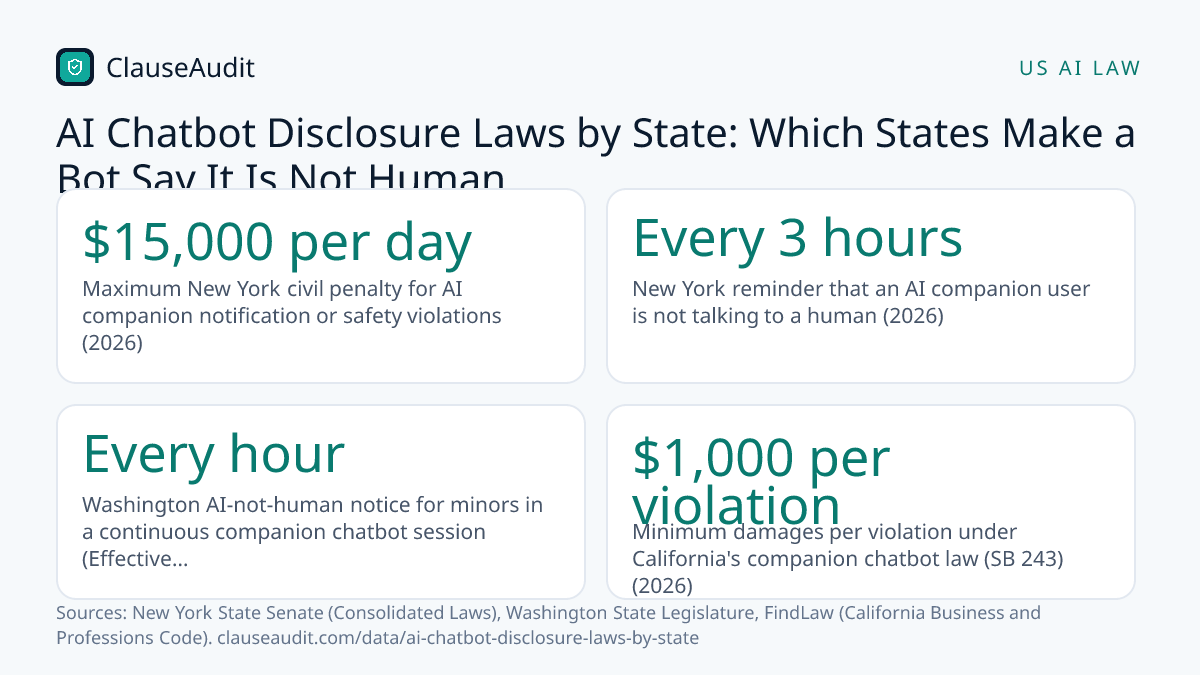
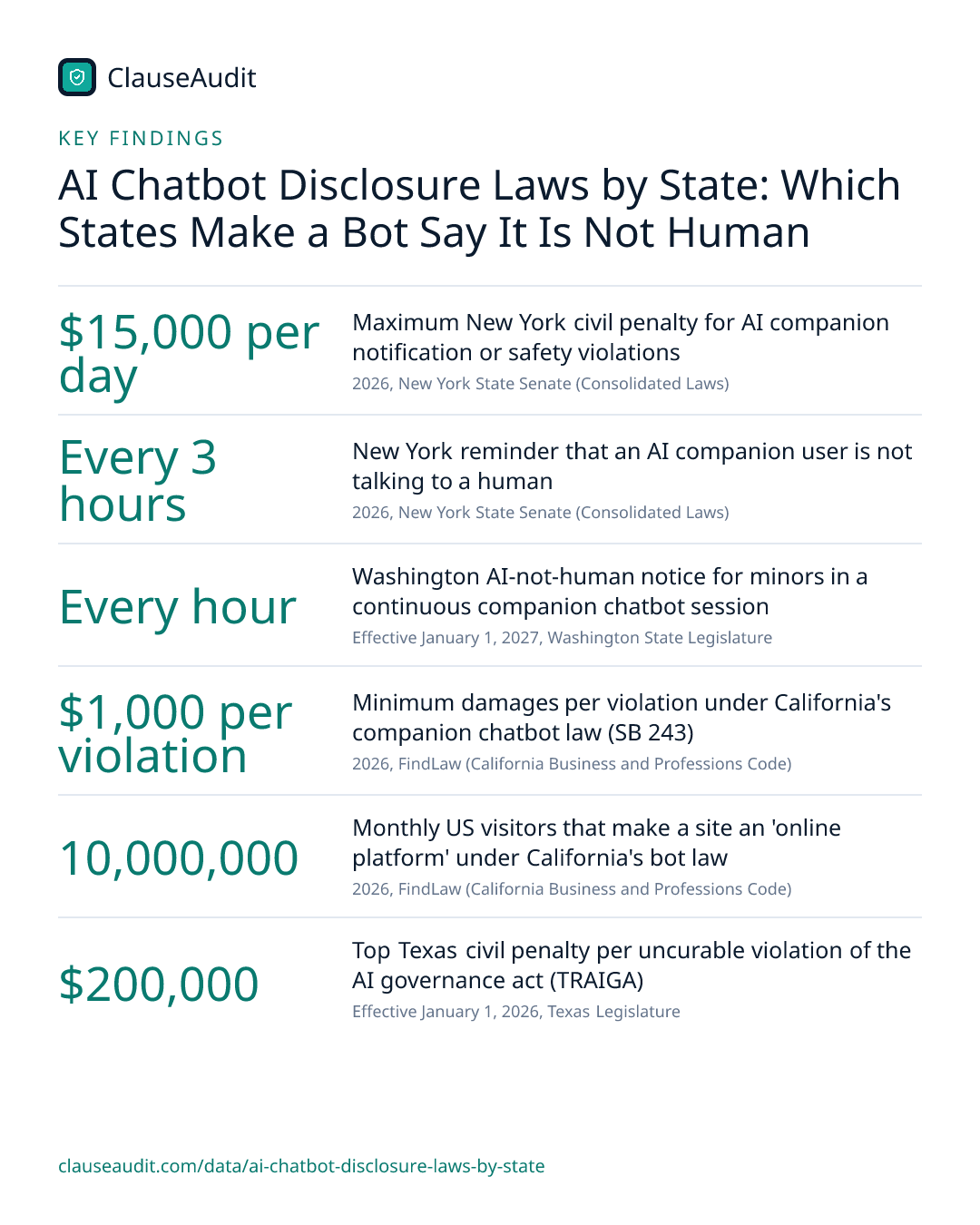
- Maximum New York civil penalty for AI companion notification or safety violations (2026, New York State Senate (Consolidated Laws))
- $15,000 per day
- New York reminder that an AI companion user is not talking to a human (2026, New York State Senate (Consolidated Laws))
- Every 3 hours
- Washington AI-not-human notice for minors in a continuous companion chatbot session (Effective January 1, 2027, Washington State Legislature)
- Every hour
- Minimum damages per violation under California's companion chatbot law (SB 243) (2026, FindLaw (California Business and Professions Code))
- $1,000 per violation
- Monthly US visitors that make a site an 'online platform' under California's bot law (2026, FindLaw (California Business and Professions Code))
- 10,000,000
- Top Texas civil penalty per uncurable violation of the AI governance act (TRAIGA) (Effective January 1, 2026, Texas Legislature)
- $200,000
- Maximum Maine civil penalty per intentional unfair trade practice violation (2026, Maine Legislature (Maine Revised Statutes))
- $10,000
- States with a confirmed AI chatbot or AI-interaction disclosure statute in our review (As of October 18, 2026, Washington State Legislature)
- 6
If your website, app or support line uses a chatbot, a handful of states now say the person on the other end has a right to know they are talking to software. The rules are not uniform. Some cover any business that sells to consumers. Others only reach companion bots built to act like a friend or partner, and Texas aims its disclosure duty at government agencies and health care providers.
We read the statutes and recorded who has to disclose, when, and what happens if you don't. The map and table cover every state. Below, we explain which rules are likely to touch a normal business, what a missed notice can cost, and what to put in the contract with whoever supplies your chatbot.
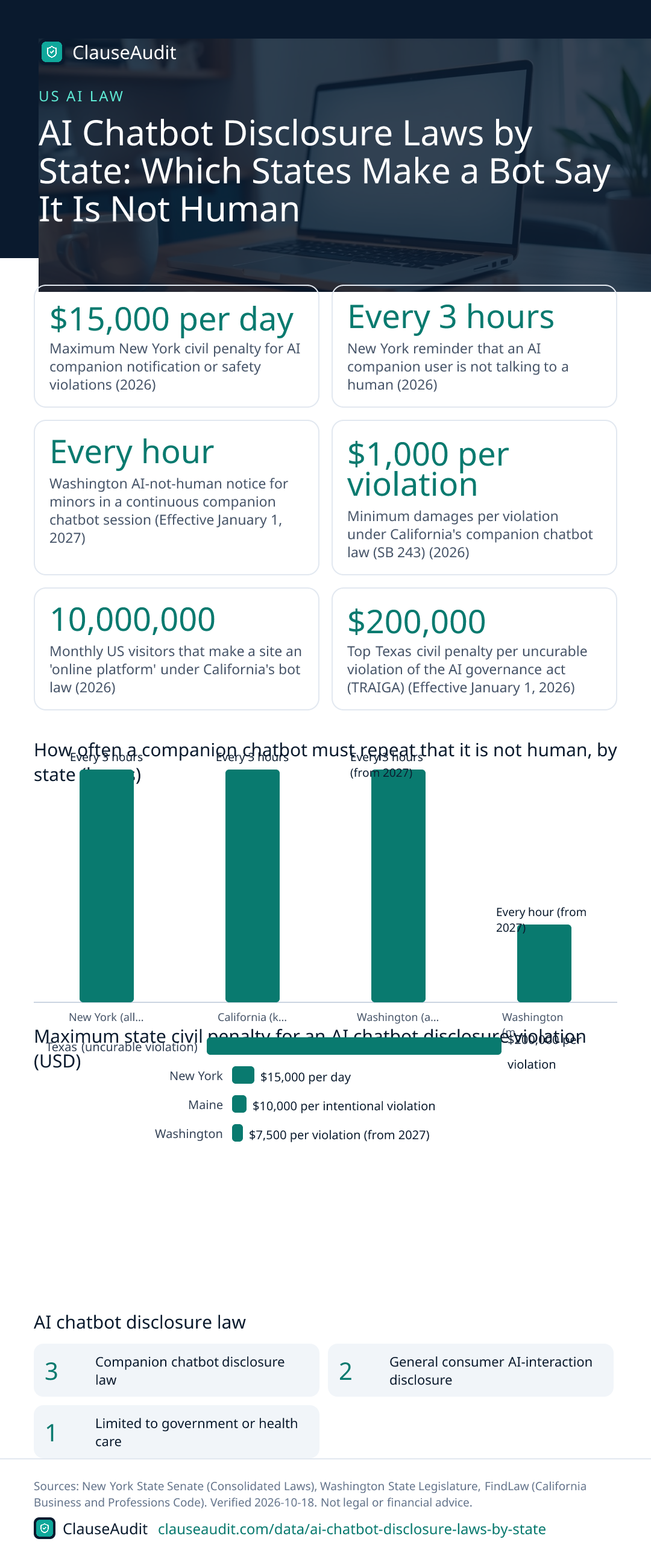
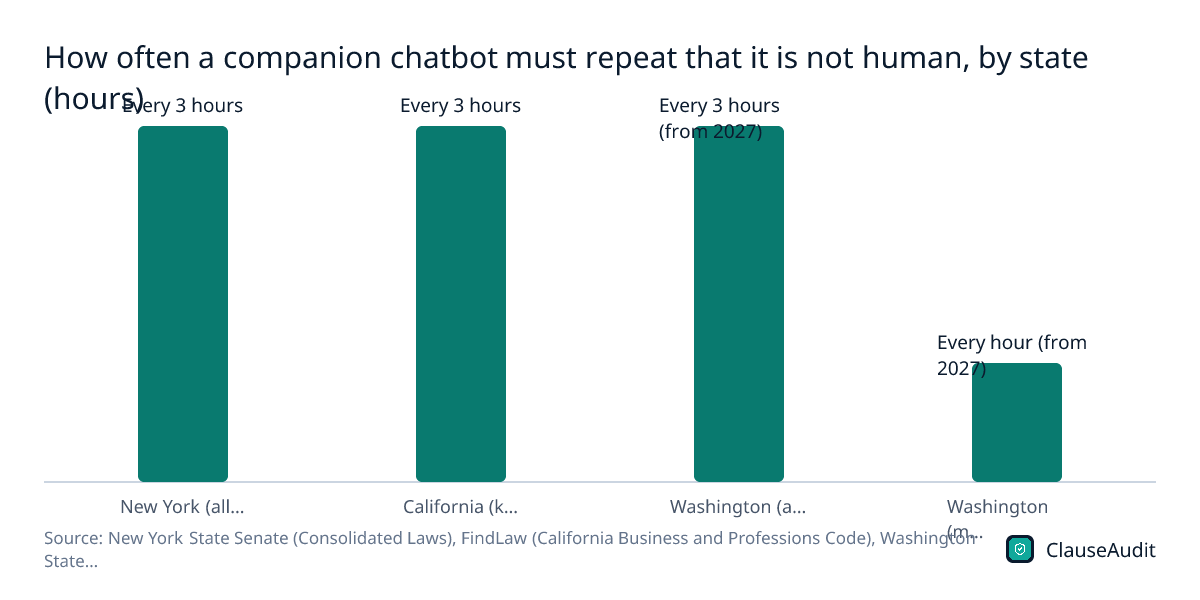
How often a companion chatbot must repeat that it is not human, by state (hours)
Chart data
| Label | Value |
|---|---|
| New York (all users) | Every 3 hours |
| California (known minors) | Every 3 hours |
| Washington (all users) | Every 3 hours (from 2027) |
| Washington (minors) | Every hour (from 2027) |
Repeat reminders are a companion bot rule, not a customer service rule. Washington is the strictest from January 1, 2027: minors must be told every hour during a continuous session.
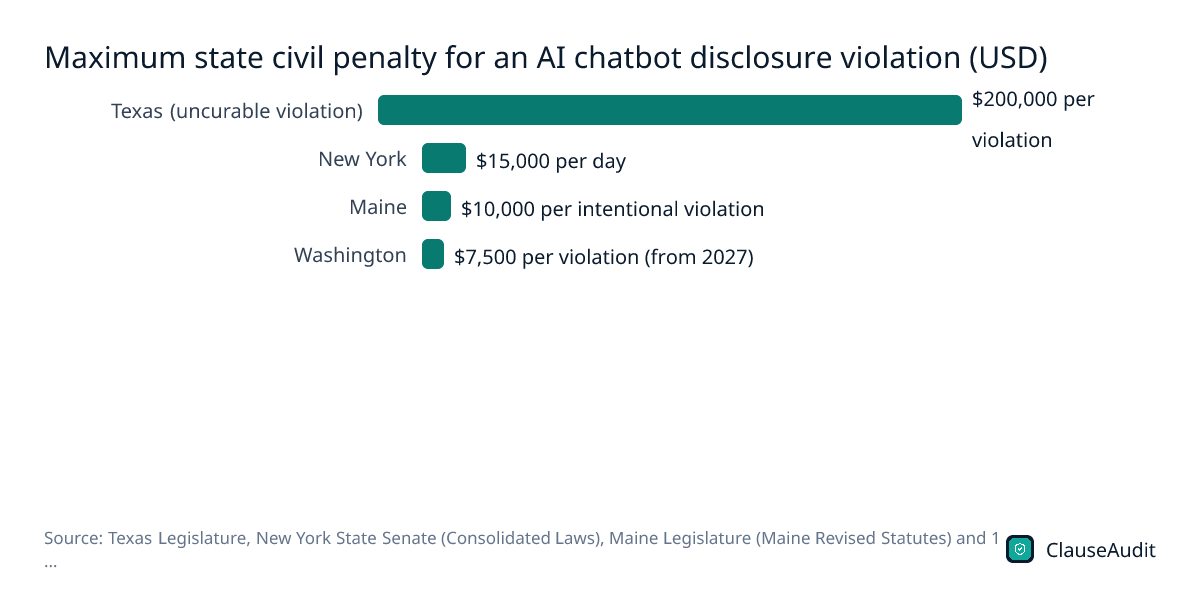
Download this chart (PNG)Maximum state civil penalty for an AI chatbot disclosure violation (USD)
Chart data
| Label | Value |
|---|---|
| Texas (uncurable violation) | $200,000 per violation |
| New York | $15,000 per day |
| Maine | $10,000 per intentional violation |
| Washington | $7,500 per violation (from 2027) |
The Texas figure looks scary, but its disclosure duty covers government agencies and health care providers. For an ordinary consumer business, Maine is the more realistic exposure. New York and Washington only reach companion bots, and New York's cap stacks up by the day.
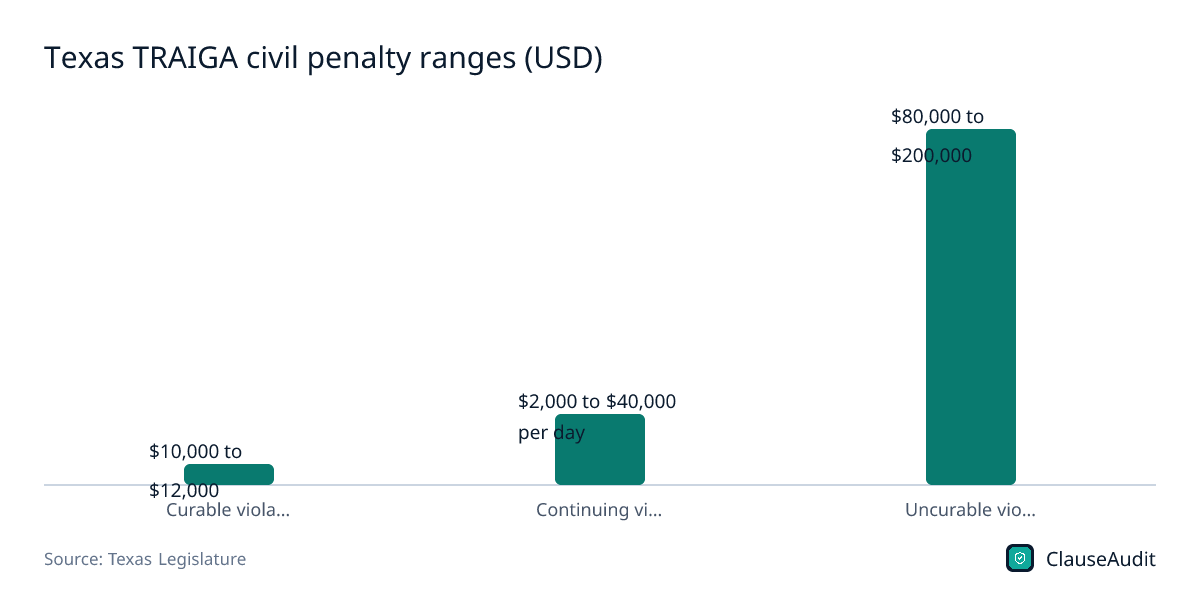
Download this chart (PNG)Texas TRAIGA civil penalty ranges (USD)
Chart data
| Label | Value |
|---|---|
| Curable violation (max) | $10,000 to $12,000 |
| Continuing violation, per day (max) | $2,000 to $40,000 per day |
| Uncurable violation (max) | $80,000 to $200,000 |
Texas separates mistakes you can fix from ones you can't. A curable violation tops out at $12,000, while an uncurable one can reach $200,000, so fixing a problem fast once you are notified matters a lot.
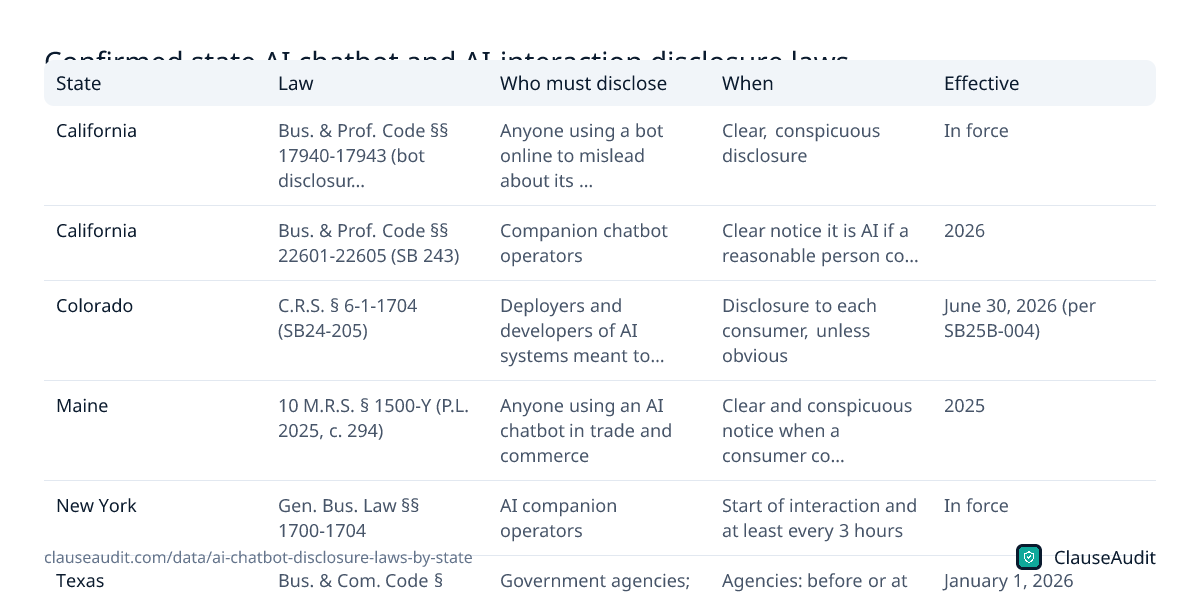
Download this chart (PNG)Confirmed state AI chatbot and AI-interaction disclosure laws
| State | Law | Who must disclose | When | Effective |
|---|---|---|---|---|
| California | Bus. & Prof. Code §§ 17940-17943 (bot disclosure) | Anyone using a bot online to mislead about its artificial identity to sell or influence an election | Clear, conspicuous disclosure | In force |
| California | Bus. & Prof. Code §§ 22601-22605 (SB 243) | Companion chatbot operators | Clear notice it is AI if a reasonable person could be misled; known minors every 3 hours | 2026 |
| Colorado | C.R.S. § 6-1-1704 (SB24-205) | Deployers and developers of AI systems meant to interact with consumers | Disclosure to each consumer, unless obvious | June 30, 2026 (per SB25B-004) |
| Maine | 10 M.R.S. § 1500-Y (P.L. 2025, c. 294) | Anyone using an AI chatbot in trade and commerce | Clear and conspicuous notice when a consumer could be misled | 2025 |
| New York | Gen. Bus. Law §§ 1700-1704 | AI companion operators | Start of interaction and at least every 3 hours | In force |
| Texas | Bus. & Com. Code § 552.051 (HB 149) | Government agencies; health care providers using AI | Agencies: before or at the time of interaction; health care: by the date service or treatment is first provided | January 1, 2026 |
| Washington | ESHB 2225, Ch. 168, Laws of 2026 | AI companion chatbot operators | Start, every 3 hours (minors: every hour) | January 1, 2027 |
Source: FindLaw (California Business and Professions Code), Cal. Bus. & Prof. Code § 17941, Bot disclosure; FindLaw (California Business and Professions Code), Cal. Bus. & Prof. Code § 22602 (companion chatbots, SB 243); FindLaw (Colorado Revised Statutes), C.R.S. § 6-1-1704, Disclosure of an artificial intelligence system to consumer; Colorado General Assembly, SB25B-004 Increase Transparency for Algorithmic Systems; Maine Legislature, Public Law 2025, chapter 294 (L.D. 1727), An Act to Ensure Transparency in Consumer Transactions Involving Artificial Intelligence; New York State Senate (Consolidated Laws), N.Y. Gen. Bus. Law § 1702, Notifications; Texas Legislature, HB 149 (89th Legislature), Texas Responsible Artificial Intelligence Governance Act, enrolled text; Texas Legislature Online, HB 149 (89R) bill history; Washington State Legislature, Engrossed Substitute House Bill 2225, Chapter 168, Laws of 2026 (Artificial Intelligence Companion Chatbots). Download as image
AI chatbot disclosure law by state
- 3Companion chatbot disclosure law
- 2General consumer AI-interaction disclosure
- 1Limited to government or health care
- Companion chatbot disclosure law3
- General consumer AI-interaction disclosure2
- Limited to government or health care1
- Not yet confirmed45
| State | Law | Who it covers | Disclosure timing | Enforcement and penalty | Effective | Source |
|---|---|---|---|---|---|---|
| Alabama | Not yet confirmed: check the source | Alabama Legislature (official site) | ||||
| Alaska | Not yet confirmed: check the source | Alaska Legislature (official site) | ||||
| Arizona | Not yet confirmed: check the source | Arizona Legislature (official site) | ||||
| Arkansas | Not yet confirmed: check the source | Arkansas Legislature (official site) | ||||
| California | Bot disclosure law (B&P §§ 17940-17943) and companion chatbot law SB 243 (B&P §§ 22601-22605) | Bots used to mislead for sales or elections; companion chatbot platforms (customer service bots excluded) | Clear and conspicuous notice it is AI if a reasonable person could be misled; known minors at least every 3 hours | Private suit: greater of actual damages or $1,000 per violation (SB 243) | SB 243 in effect 2026; annual reports from July 1, 2027 | Cal. Bus. & Prof. Code §§ 17941, 22602, 22605 |
| Colorado | Colorado AI Act, SB24-205 | Deployers and developers of AI systems intended to interact with consumers | Disclosure to each consumer, unless it would be obvious to a reasonable person | Attorney General only; unfair trade practice | June 30, 2026 (delayed from February 1, 2026 by SB25B-004) | C.R.S. §§ 6-1-1704, 6-1-1706 |
| Connecticut | Not yet confirmed: check the source | Connecticut Legislature (official site) | ||||
| Delaware | Not yet confirmed: check the source | Delaware Legislature (official site) | ||||
| District of Columbia | Not yet confirmed: check the source | Council of the District of Columbia | ||||
| Florida | Not yet confirmed: check the source | Florida Legislature (official site) | ||||
| Georgia | Not yet confirmed: check the source | Georgia Legislature (official site) | ||||
| Hawaii | Not yet confirmed: check the source | Hawaii Legislature (official site) | ||||
| Idaho | Not yet confirmed: check the source | Idaho Legislature (official site) | ||||
| Illinois | Not yet confirmed: check the source | Illinois Legislature (official site) | ||||
| Indiana | Not yet confirmed: check the source | Indiana Legislature (official site) | ||||
| Iowa | Not yet confirmed: check the source | Iowa Legislature (official site) | ||||
| Kansas | Not yet confirmed: check the source | Kansas Legislature (official site) | ||||
| Kentucky | Not yet confirmed: check the source | Kentucky Legislature (official site) | ||||
| Louisiana | Not yet confirmed: check the source | Louisiana Legislature (official site) | ||||
| Maine | P.L. 2025, c. 294 (L.D. 1727) | Any person using an AI chatbot in trade and commerce with consumers | Clear and conspicuous notice when a reasonable consumer could think it is human | Unfair Trade Practices Act; up to $10,000 per intentional violation | Approved June 12, 2025 | 10 M.R.S. § 1500-Y |
| Maryland | Not yet confirmed: check the source | Maryland Legislature (official site) | ||||
| Massachusetts | Not yet confirmed: check the source | Massachusetts Legislature (official site) | ||||
| Michigan | Not yet confirmed: check the source | Michigan Legislature (official site) | ||||
| Minnesota | Not yet confirmed: check the source | Minnesota Legislature (official site) | ||||
| Mississippi | Not yet confirmed: check the source | Mississippi Legislature (official site) | ||||
| Missouri | Not yet confirmed: check the source | Missouri Legislature (official site) | ||||
| Montana | Not yet confirmed: check the source | Montana Legislature (official site) | ||||
| Nebraska | Not yet confirmed: check the source | Nebraska Legislature (official site) | ||||
| Nevada | Not yet confirmed: check the source | Nevada Legislature (official site) | ||||
| New Hampshire | Not yet confirmed: check the source | New Hampshire Legislature (official site) | ||||
| New Jersey | Not yet confirmed: check the source | New Jersey Legislature (official site) | ||||
| New Mexico | Not yet confirmed: check the source | New Mexico Legislature (official site) | ||||
| New York | Gen. Bus. Law Art. 47, AI Companion Models | Operators of AI companions | Start of interaction and at least every 3 hours | Attorney General; up to $15,000 per day | In force | N.Y. Gen. Bus. Law §§ 1700-1704 |
| North Carolina | Not yet confirmed: check the source | North Carolina Legislature (official site) | ||||
| North Dakota | Not yet confirmed: check the source | North Dakota Legislature (official site) | ||||
| Ohio | Not yet confirmed: check the source | Ohio Legislature (official site) | ||||
| Oklahoma | Not yet confirmed: check the source | Oklahoma Legislature (official site) | ||||
| Oregon | Not yet confirmed: check the source | Oregon Legislature (official site) | ||||
| Pennsylvania | Not yet confirmed: check the source | Pennsylvania Legislature (official site) | ||||
| Rhode Island | Not yet confirmed: check the source | Rhode Island Legislature (official site) | ||||
| South Carolina | Not yet confirmed: check the source | South Carolina Legislature (official site) | ||||
| South Dakota | Not yet confirmed: check the source | South Dakota Legislature (official site) | ||||
| Tennessee | Not yet confirmed: check the source | Tennessee Legislature (official site) | ||||
| Texas | Texas Responsible AI Governance Act, HB 149 | Government agencies; health care providers using AI in service or treatment | Agencies: before or at the time of interaction; health care: not later than the date service or treatment is first provided (emergency: as soon as reasonably possible) | Attorney General; up to $200,000 per uncurable violation | January 1, 2026 | Tex. Bus. & Com. Code §§ 552.051, 552.105 |
| Utah | Not yet confirmed: check the source | Utah Code Title 13, Chapter 75 | ||||
| Vermont | Not yet confirmed: check the source | Vermont Legislature (official site) | ||||
| Virginia | Not yet confirmed: check the source | Virginia Legislature (official site) | ||||
| Washington | ESHB 2225, Chapter 168, Laws of 2026 | AI companion chatbot operators | Start and at least every 3 hours; minors at least every hour | Consumer Protection Act (RCW 19.86); AG penalty up to $7,500 per violation | January 1, 2027 | Chapter 168, Laws of 2026, secs. 3-6 |
| West Virginia | Not yet confirmed: check the source | West Virginia Legislature (official site) | ||||
| Wisconsin | Not yet confirmed: check the source | Wisconsin Legislature (official site) | ||||
| Wyoming | Not yet confirmed: check the source | Wyoming Legislature (official site) |
Do chatbots have to tell you they are AI?
In a growing number of states, yes. We confirmed 6 states with a statute that requires some kind of AI disclosure: California, Colorado, Maine, New York, Texas and Washington. That number is a floor, not a ceiling. Utah has its own AI disclosure law, but we could not confirm its current text from the official code site, so we left it out.
The laws fall into three groups. General consumer rules in Maine and Colorado reach almost any business whose bot talks to the public. Companion chatbot rules in California, New York and Washington target bots designed to build an ongoing relationship with the user. Texas sits apart, with a duty that applies to government agencies and to health care providers who use AI in service or treatment.
California also has an older bot law. It makes it unlawful to use a bot online to mislead someone about its artificial identity in order to sell something or sway a vote. The law mentions large online platforms, defined as sites with 10,000,000 or more monthly US visitors, but it puts no duty on those platforms. The duty falls on whoever uses the bot to mislead.
Does a customer service chatbot need a disclosure?
This is the question most small businesses actually have, and the honest answer is: it depends on the state and on how human your bot sounds.
Maine is the clearest example. If you use a chatbot in trade with consumers and a reasonable consumer could think it is a person, you need a clear and conspicuous notice. A violation is treated as an unfair trade practice, with civil penalties up to $10,000 per intentional violation. Colorado's AI Act takes a similar approach for AI systems meant to interact with consumers, unless it would be obvious to a reasonable person. Colorado pushed its start date from February 1, 2026 to June 30, 2026, and the date could move again, so check the current date before you rely on it.
California's companion chatbot law, SB 243, excludes bots used only for customer service. That does not mean a support bot is off the hook in California. If it pretends to be a person to close a sale, the older bot law can still apply.
The practical move is simple. Put a plain line at the top of every chat window, something like "You're chatting with an automated assistant. Ask for a person any time." It costs almost nothing and goes a long way toward the general consumer rules in Maine and Colorado. Companion bots need more, as the next section shows.
What counts as a companion chatbot, and why it matters
Companion bots are the ones built to hold an ongoing, personal conversation: virtual friends, coaches, romantic partners and similar apps. These laws are much stricter because lawmakers were worried about vulnerable users, especially minors and people in crisis.
New York requires a notice at the start of any AI companion interaction and at least every 3 hours in a continuing one. The Attorney General enforces it, and penalties run up to $15,000 per day, paid into the state's suicide prevention fund. California requires a clear notice that the bot is AI when a reasonable person could be misled, and a reminder at least every 3 hours for users the operator knows are minors. Anyone harmed can sue for actual damages or $1,000 per violation, whichever is greater.
Washington's law takes effect January 1, 2027. Adults get the notice at the start and at least every 3 hours. Minors get it every hour during a continuous session. Violations run through the state Consumer Protection Act, where the Attorney General can seek up to $7,500 per violation.
If you build or resell anything that chats with users about their lives, moods or relationships, assume these rules may apply and get advice on the definitions before launch.
What these laws mean if you build chatbots for clients
Freelance developers and agencies are in an awkward spot. The statutes put the duty on the operator or the business deploying the bot, but when something goes wrong, the client will look at your contract first.
Say you build a lead-capture bot for a home services company in Maine, and the client asks you to give it a human name and a friendly backstory. If a customer later complains, the client may point to an indemnity clause that makes you responsible for any claim arising from the deliverable. You wrote the persona, so you are now in the middle of an unfair trade practice dispute you never agreed to carry.
Protect yourself in writing. Make the client responsible for deciding where the bot is deployed and for legal compliance in those states. Spell out that the disclosure text is the client's call, and that you will build in a notice if asked. Cap your liability at the fees paid, and carve regulatory fines out of any indemnity you give.
What to check before you sign with a chatbot vendor
Most businesses don't build their own bot. They buy one as part of a help desk, CRM or website tool, then switch it on. That means your compliance depends on settings you may not control and terms you probably skimmed.
A few points deserve a close read:
- Who controls the disclosure. Can you edit the opening message, or does the vendor fix it? You need to be able to add a clear notice.
- Whether the vendor promises legal compliance. Many terms say the customer is solely responsible for how the tool is used. Ask for a promise that the product supports the disclosures the law requires.
- Liability caps. A cap equal to a month of fees will not go far against a penalty of $15,000 per day. Ask for regulatory fines caused by the vendor's product to sit outside the cap.
- Changes to the product. If the vendor can change features on short notice, a disclosure you rely on could disappear in an update. Ask for advance notice of changes that affect compliance.
- Minors. If your audience might include young users, find out whether the tool can flag or age-gate them, since California and Washington set stricter rules for minors.
- Exit rights. If a new state law makes the tool unusable for you, you want the right to terminate without paying out the rest of the term.
How ClauseAudit helps
Chatbot disclosure laws put the duty on your business, but the tools that create the risk usually come from a vendor contract. ClauseAudit's automated review reads that contract and flags the terms that decide who pays when a disclosure goes missing.
Upload the terms for your help desk, chat widget or AI platform and you get plain-English notes on each risky clause, plus suggested wording to ask for.
- Compliance clauses that leave all legal responsibility with you as the customer
- Liability caps too low to cover a state penalty, and whether fines are carved out
- Indemnities that make you cover claims caused by the vendor's own product
- Rights to change features or terms on short notice
- Termination rights if a new law makes the tool unusable
- Data and minors clauses that affect stricter companion chatbot rules
Frequently asked questions
Which states require chatbots to disclose they are AI?
We confirmed 6 states with a disclosure statute: California, Colorado, Maine, New York, Texas and Washington. Utah also has an AI disclosure law, but we could not confirm its current text from the official source, so it is not counted. Our review could not confirm the rest of the country either way, so treat this list as a minimum.
Is there a federal law requiring chatbot disclosure?
We did not find a federal statute that requires every chatbot to say it is AI. The current rules are state laws. Federal consumer protection law still bans deceptive practices, so a bot that pretends to be a human to sell something could create trouble even outside the states on this page.
How often does a companion chatbot have to remind users it is not human?
New York requires a notice at the start and at least every 3 hours in a continuing interaction. California requires a reminder at least every 3 hours for users the operator knows are minors. Washington, from January 1, 2027, requires a notice at the start and every 3 hours for adults, and every hour for minors.
What is the penalty for not disclosing a chatbot?
It depends on the state. New York allows up to $15,000 per day for AI companion violations. Maine allows up to $10,000 per intentional violation. Washington allows up to $7,500 per violation from 2027. In California, someone harmed by a companion chatbot can sue for actual damages or $1,000 per violation, whichever is greater.
Does California's SB 243 apply to my customer service bot?
SB 243 excludes bots used only for customer service, so a typical support bot falls outside it. California's older bot law is broader, though. If your bot misleads people about being a human to push a sale, that law can still apply. A clear notice at the start of the chat avoids both problems.
Does the Texas AI law apply to private businesses?
The Texas Responsible AI Governance Act, in effect since January 1, 2026, puts its AI interaction disclosure duty on government agencies and on health care providers using AI in service or treatment. It does not create a general disclosure duty for other private businesses' chatbots. Penalties for uncurable violations can reach $200,000.
When does Colorado's chatbot disclosure rule take effect?
Colorado's AI Act requires deployers of consumer-facing AI systems to tell each consumer they are dealing with AI, unless that would be obvious. A special session law moved the start date from February 1, 2026 to June 30, 2026. The date could move again, so confirm the current date before relying on it.
Who is responsible if my vendor's chatbot breaks the law?
Usually you are, at least as far as the state is concerned, because the laws focus on the business deploying the bot. Getting the cost back from the vendor depends on your contract. Look at the compliance promises, the indemnity, and whether regulatory fines sit inside or outside the liability cap.
Use this data
Every chart and card below is free to reuse under CC BY 4.0. Download what you need and link back to this page.
 Stat cards
 Key findings card
 Infographic
 How often a companion chatbot must repeat that it is not human, by state (hours)
 Maximum state civil penalty for an AI chatbot disclosure violation (USD)
 Texas TRAIGA civil penalty ranges (USD)
 Confirmed state AI chatbot and AI-interaction disclosure laws
Embed the infographic
Free to share on your site, blog or slides under CC BY 4.0. Please keep the credit link.
Sources and method
Every number on this page comes from the sources below, each opened and read on or before October 18, 2026. A second, independent review checked every figure against its source and corrected anything that did not match. 6 of 51 state entries were confirmed; any that could not be are marked "Not yet confirmed" and left out of every count and chart.
- New York State Senate (Consolidated Laws), New York General Business Law Article 47, Artificial Intelligence Companion Models (§§ 1700-1704) (Most recent revision 2025-11-07)
- New York State Senate (Consolidated Laws), N.Y. Gen. Bus. Law § 1702, Notifications (As read 2026-10-18)
- New York State Senate (Consolidated Laws), N.Y. Gen. Bus. Law § 1703, Enforcement (As read 2026-10-18)
- FindLaw (California Business and Professions Code), Cal. Bus. & Prof. Code § 22602 (companion chatbots, SB 243) (Current as of January 1, 2026)
- FindLaw (California Business and Professions Code), Cal. Bus. & Prof. Code § 22601, Definitions (companion chatbots) (Current as of January 1, 2026)
- FindLaw (California Business and Professions Code), Cal. Bus. & Prof. Code § 22603, Annual reports (Current as of January 1, 2026)
- FindLaw (California Business and Professions Code), Cal. Bus. & Prof. Code § 22605, Civil action (Current as of January 1, 2026)
- FindLaw (California Business and Professions Code), Cal. Bus. & Prof. Code § 17940, Definitions (bot disclosure, SB 1001) (As read 2026-10-18)
- FindLaw (California Business and Professions Code), Cal. Bus. & Prof. Code § 17941, Bot disclosure (As read 2026-10-18)
- Office of the Governor of California, Governor Newsom signs bills to further strengthen California's leadership in protecting children online (October 13, 2025)
- Washington State Legislature, Engrossed Substitute House Bill 2225, Chapter 168, Laws of 2026 (Artificial Intelligence Companion Chatbots) (Approved March 24, 2026)
- Washington State Legislature, HB 2225 (2025-26) bill summary and history (As read 2026-10-18)
- Washington State Legislature, RCW 19.86.140, Civil penalties (Consumer Protection Act) (As read 2026-10-18)
- Maine Legislature, Public Law 2025, chapter 294 (L.D. 1727), An Act to Ensure Transparency in Consumer Transactions Involving Artificial Intelligence (Approved June 12, 2025)
- Maine Legislature (Maine Revised Statutes), 5 M.R.S. § 209, Unfair Trade Practices Act civil penalty (As read 2026-10-18)
- Texas Legislature, HB 149 (89th Legislature), Texas Responsible Artificial Intelligence Governance Act, enrolled text (Enrolled version, 2025)
- Texas Legislature Online, HB 149 (89R) bill history (Signed June 22, 2025)
- Colorado General Assembly, SB24-205 Consumer Protections for Artificial Intelligence (Effective May 17, 2024)
- Colorado General Assembly, SB25B-004 Increase Transparency for Algorithmic Systems (Approved August 28, 2025)
- FindLaw (Colorado Revised Statutes), C.R.S. § 6-1-1704, Disclosure of an artificial intelligence system to consumer (As read 2026-10-18 (may not show the SB25B-004 date change))
- FindLaw (Colorado Revised Statutes), C.R.S. § 6-1-1706, Enforcement by attorney general (As read 2026-10-18)
Cite this page
ClauseAudit, “AI Chatbot Disclosure Laws by State: Which States Make a Bot Say It Is Not Human”, updated October 18, 2026, https://clauseaudit.com/data/ai-chatbot-disclosure-laws-by-state. Free to reuse with a link back (CC BY 4.0).
This page summarises published data and law as checked on October 18, 2026. Figures are updated as new editions are released, and your own situation may differ. It is general information, not legal, tax or financial advice.