Does Your SaaS Vendor Train AI on Your Data? 25 Major Vendors' Terms Compared
By ClauseAudit Research · 33 sources ·
Does Microsoft Copilot train on your data?
Not if you use Microsoft 365 Copilot through work. Microsoft says prompts, responses and Microsoft Graph data aren't used to train foundation LLMs. Consumer Copilot is a different product: conversations may be used to train generative models unless you opt out, and Microsoft stores that conversation activity for 18 months by default.

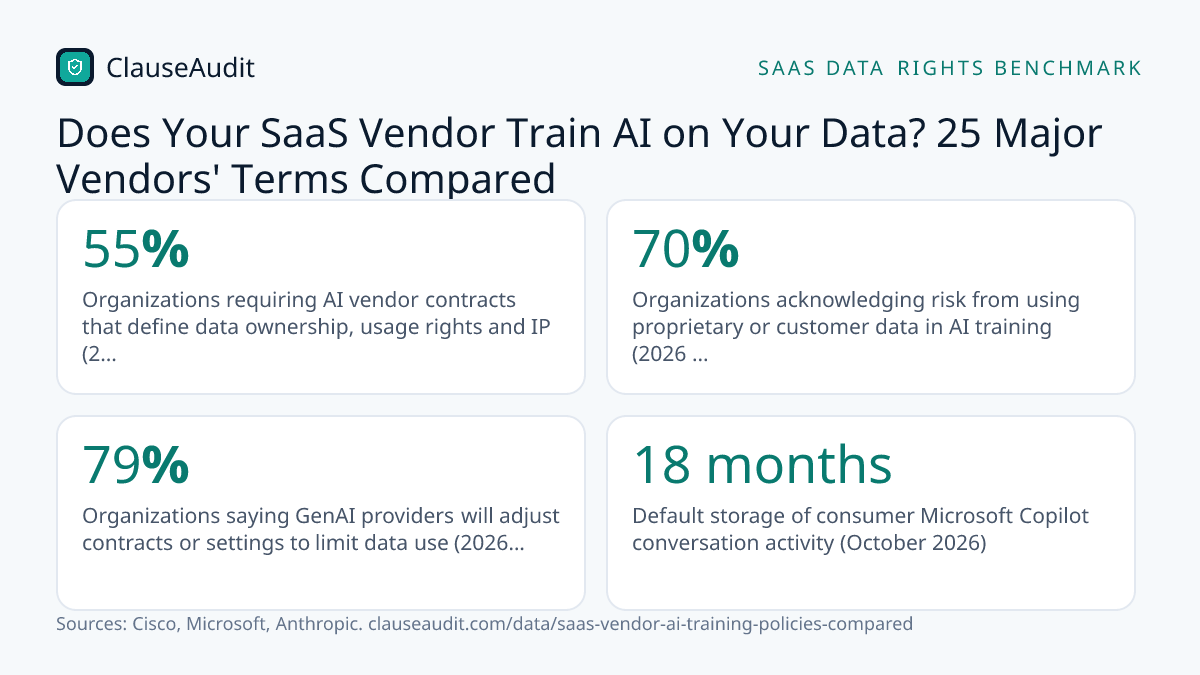
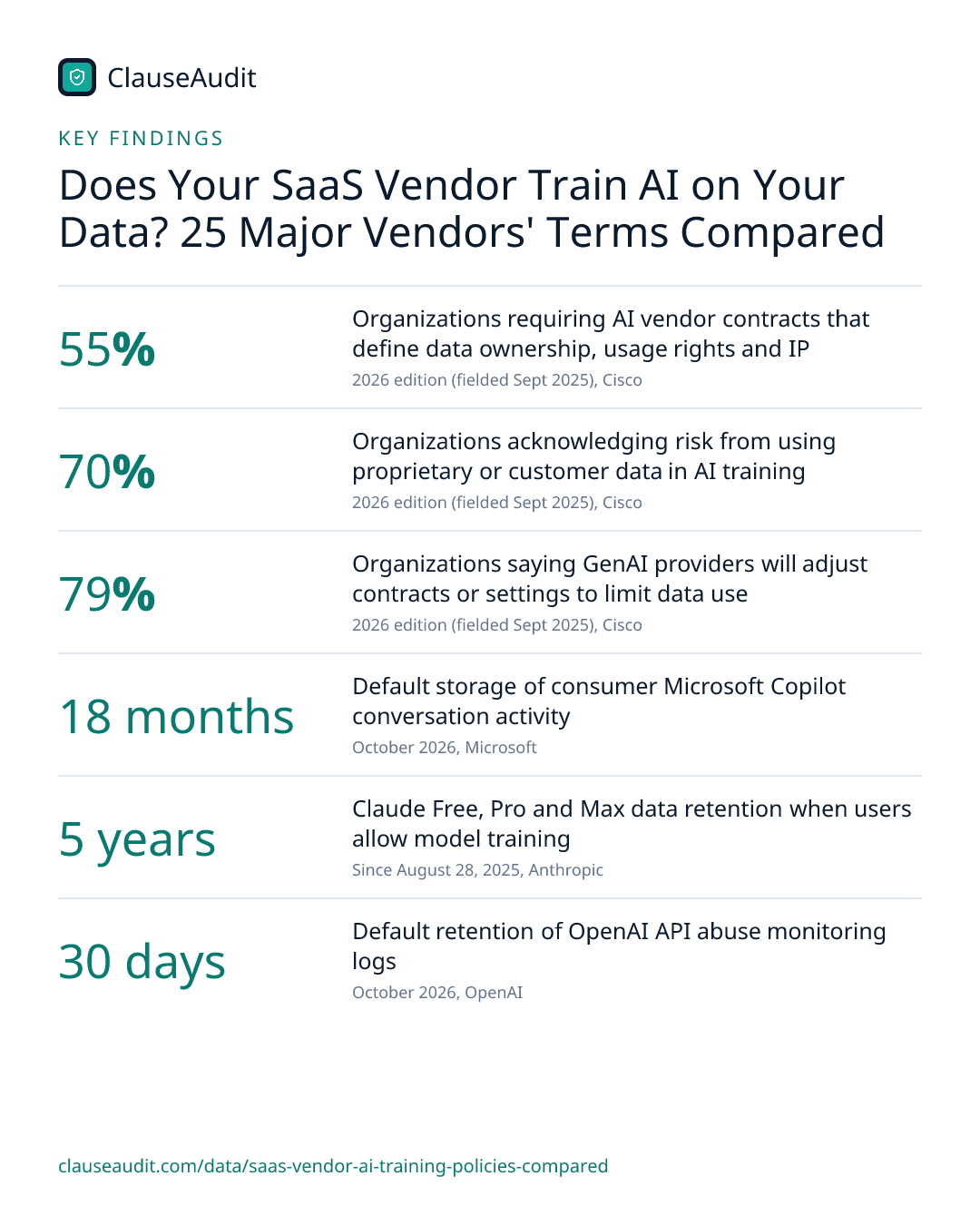
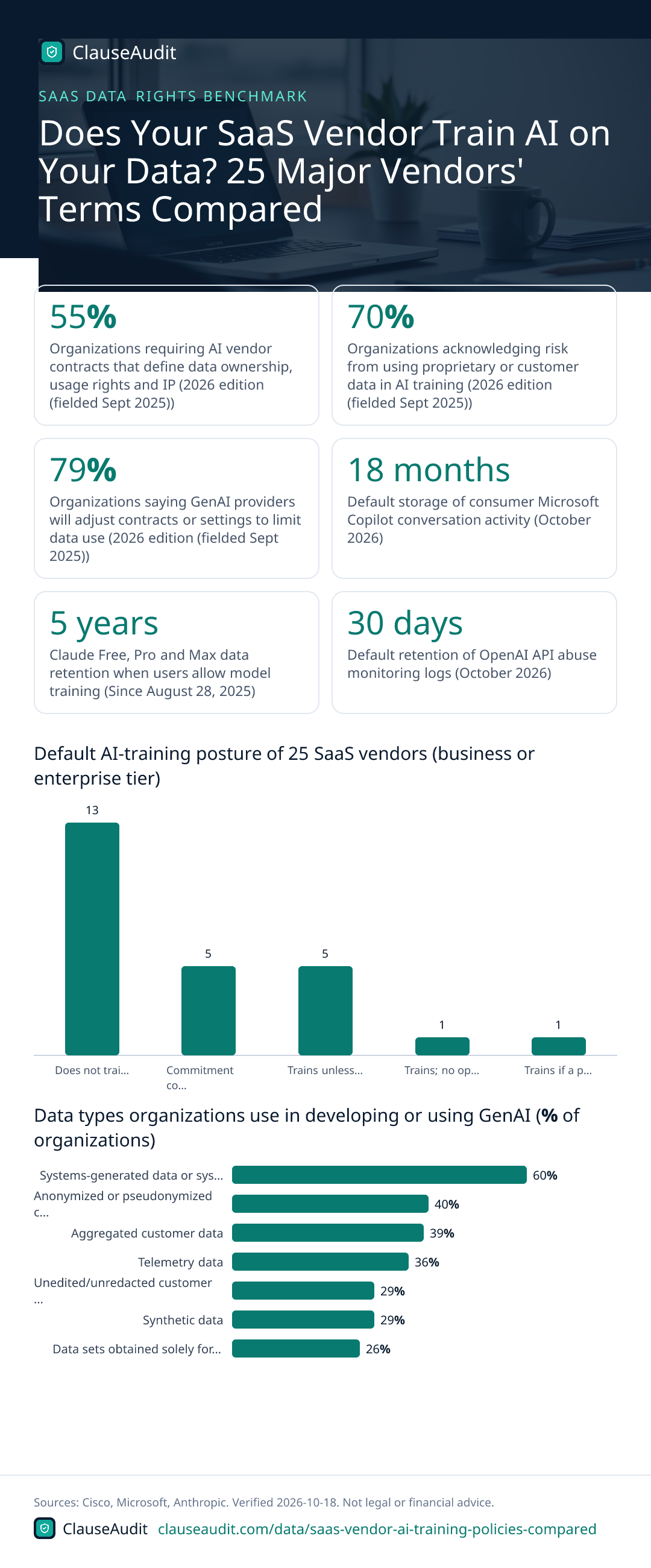
- Organizations requiring AI vendor contracts that define data ownership, usage rights and IP (2026 edition (fielded Sept 2025), Cisco)
- 55%
- Organizations acknowledging risk from using proprietary or customer data in AI training (2026 edition (fielded Sept 2025), Cisco)
- 70%
- Organizations saying GenAI providers will adjust contracts or settings to limit data use (2026 edition (fielded Sept 2025), Cisco)
- 79%
- Default storage of consumer Microsoft Copilot conversation activity (October 2026, Microsoft)
- 18 months
- Claude Free, Pro and Max data retention when users allow model training (Since August 28, 2025, Anthropic)
- 5 years
- Default retention of OpenAI API abuse monitoring logs (October 2026, OpenAI)
- 30 days
- GitHub starts training on Copilot Free, Pro and Pro+ data unless users opt out (April 24, 2026, GitHub)
- April 24, 2026
- U.S. adults aware of AI expecting companies to use collected data uncomfortably (May 2023, Pew Research Center)
- 81%
Most of the software you pay for now ships with AI features, and each vendor has its own rule about what happens when your files, chats and customer records meet its models. We read the published policy of 25 well-known vendors and sorted them by what happens on a business or enterprise plan if you never touch a setting.
The short version: 13 of the 25 say they don't train on customer content by default. Another 5 train unless you opt out or change a setting, 1 trains with no opt-out described, and 1 ties training to a privacy setting without saying what the default is. The last 5 make a promise that covers only part of the picture, such as generative models or outside model providers, and stay quiet about the rest.
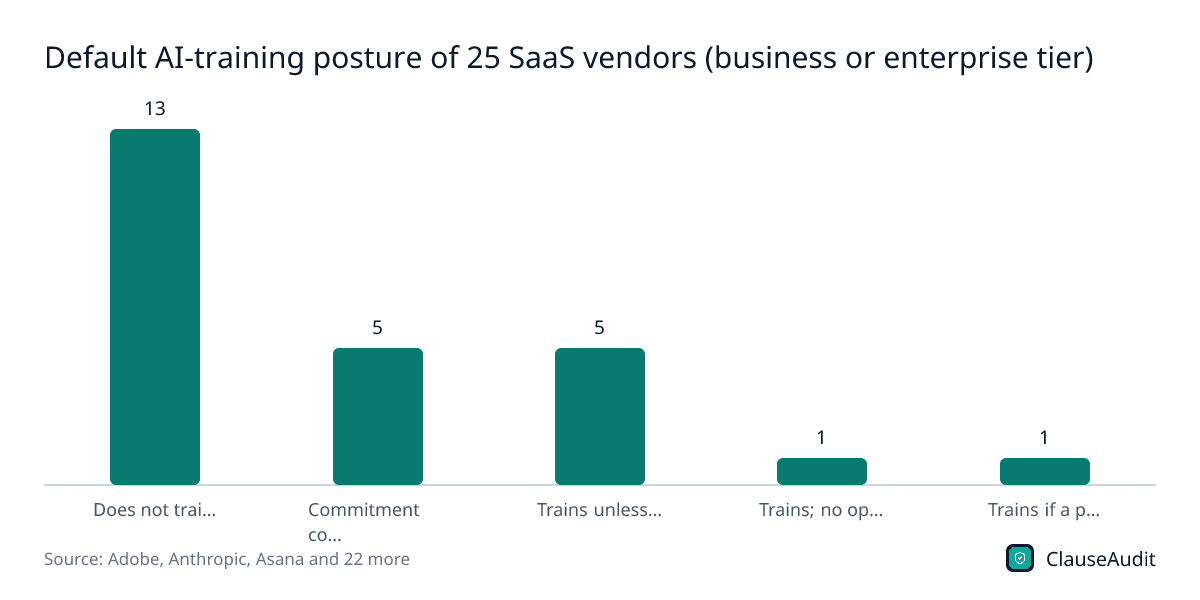
Default AI-training posture of 25 SaaS vendors (business or enterprise tier)
Chart data
| Label | Value |
|---|---|
| Does not train on customer content by default | 13 |
| Commitment covers only generative or third-party models | 5 |
| Trains unless you opt out or change a setting | 5 |
| Trains; no opt-out described | 1 |
| Trains if a privacy setting is off; default not stated | 1 |
A slim majority of vendors keep business content out of training by default, but 5 of 25 train unless someone flips a setting. If nobody on your team owns that setting, assume the default applies to you.
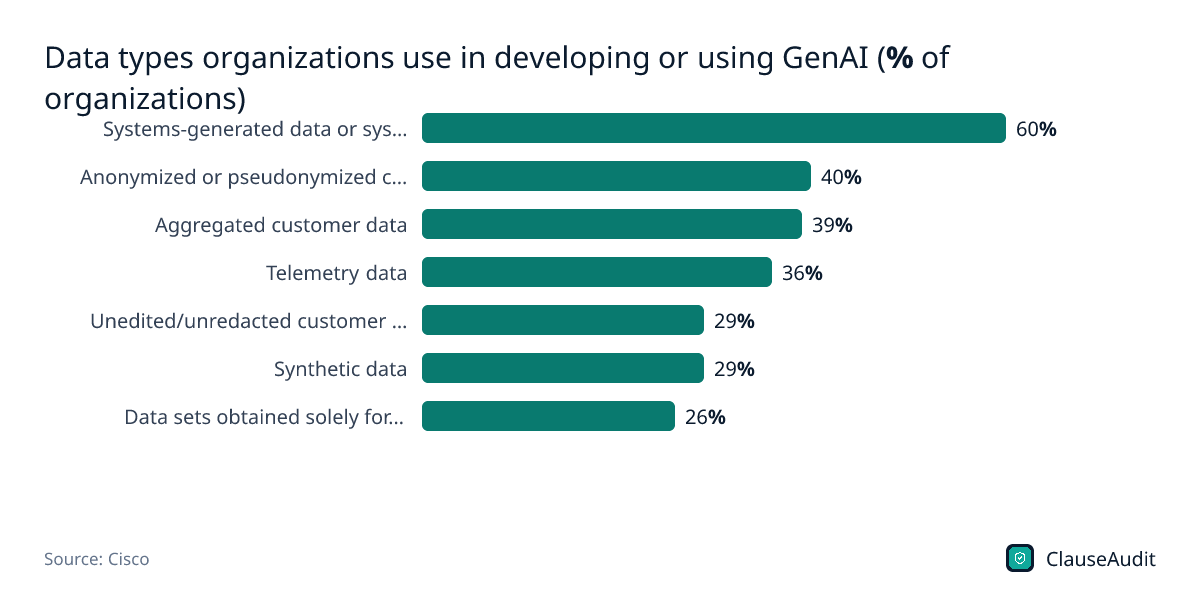
Download this chart (PNG)Data types organizations use in developing or using GenAI (% of organizations)
Chart data
| Label | Value |
|---|---|
| Systems-generated data or systems information | 60% |
| Anonymized or pseudonymized customer data | 40% |
| Aggregated customer data | 39% |
| Telemetry data | 36% |
| Unedited/unredacted customer data | 29% |
| Synthetic data | 29% |
| Data sets obtained solely for training GenAI | 26% |
Only 29% of organizations say they feed unedited customer data into generative AI, but 40% use anonymized or pseudonymized customer data. Some vendors in our set, including Intercom and Otter.ai, describe their training data the same way, so ask how they de-identify it.
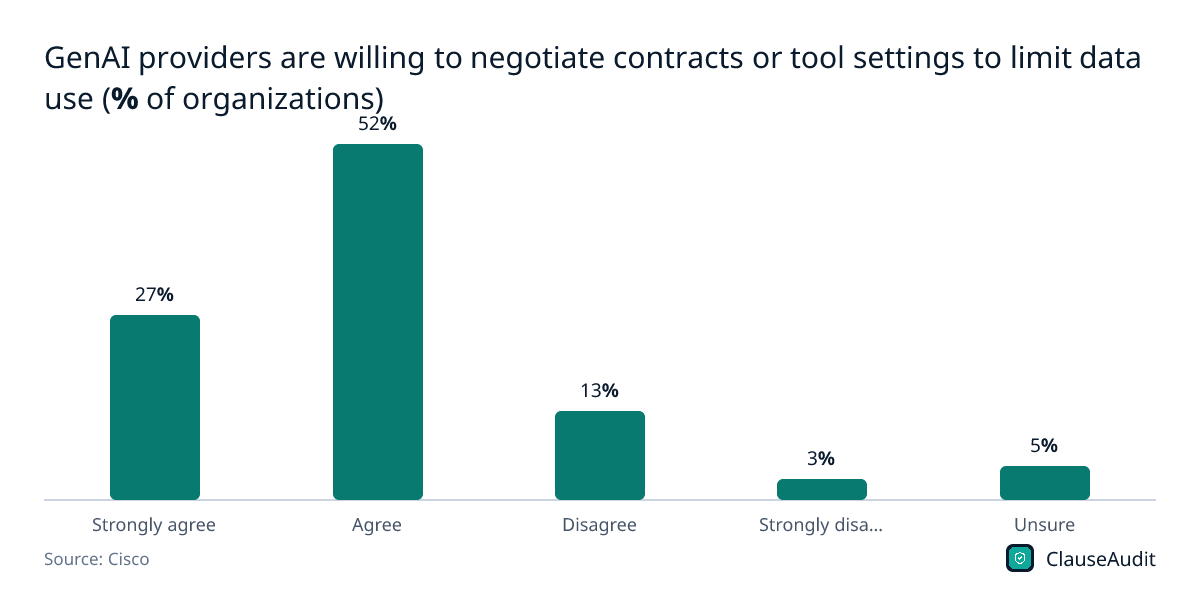
Download this chart (PNG)GenAI providers are willing to negotiate contracts or tool settings to limit data use (% of organizations)
Chart data
| Label | Value (% of organizations) |
|---|---|
| Strongly agree | 27% |
| Agree | 52% |
| Disagree | 13% |
| Strongly disagree | 3% |
| Unsure | 5% |
Combined, 79% of organizations say their generative AI providers agreed to adjust terms or settings to limit data use. Just 13% disagreed and 3% strongly disagreed, which suggests asking is usually worth the email.
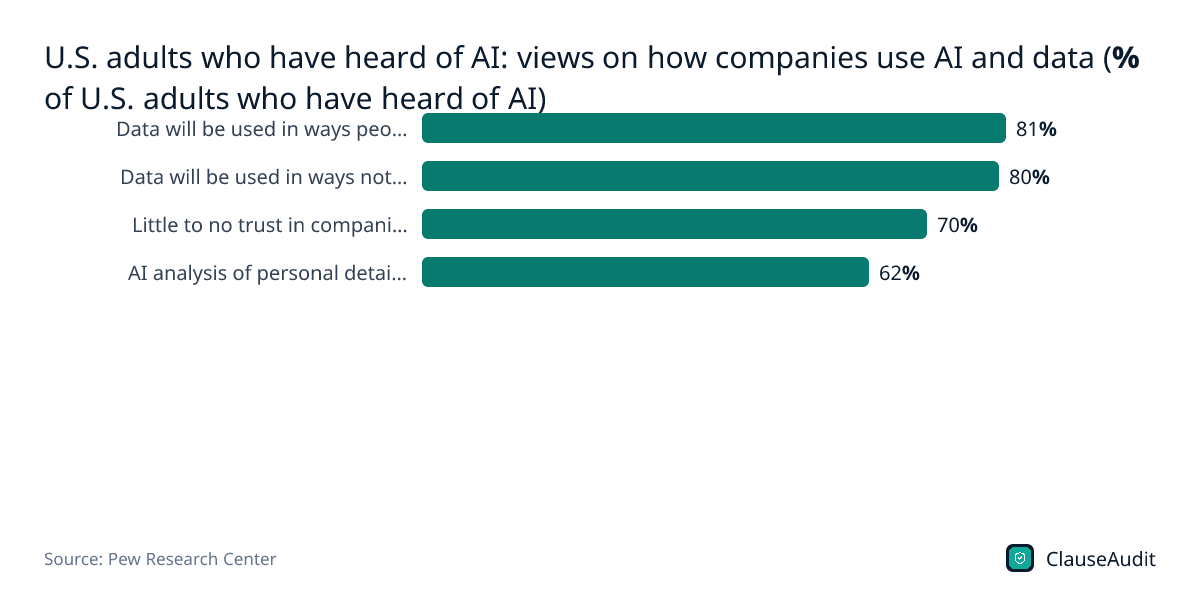
Download this chart (PNG)U.S. adults who have heard of AI: views on how companies use AI and data (% of U.S. adults who have heard of AI)
Chart data
| Label | Value |
|---|---|
| Data will be used in ways people are not comfortable with | 81% |
| Data will be used in ways not originally intended | 80% |
| Little to no trust in companies to use AI responsibly | 70% |
| AI analysis of personal details could make life easier | 62% |
In Pew's May 2023 survey, 81% of U.S. adults who had heard of AI expected companies to use collected data in ways people aren't comfortable with. Your own customers likely share that view about their data in your tools.
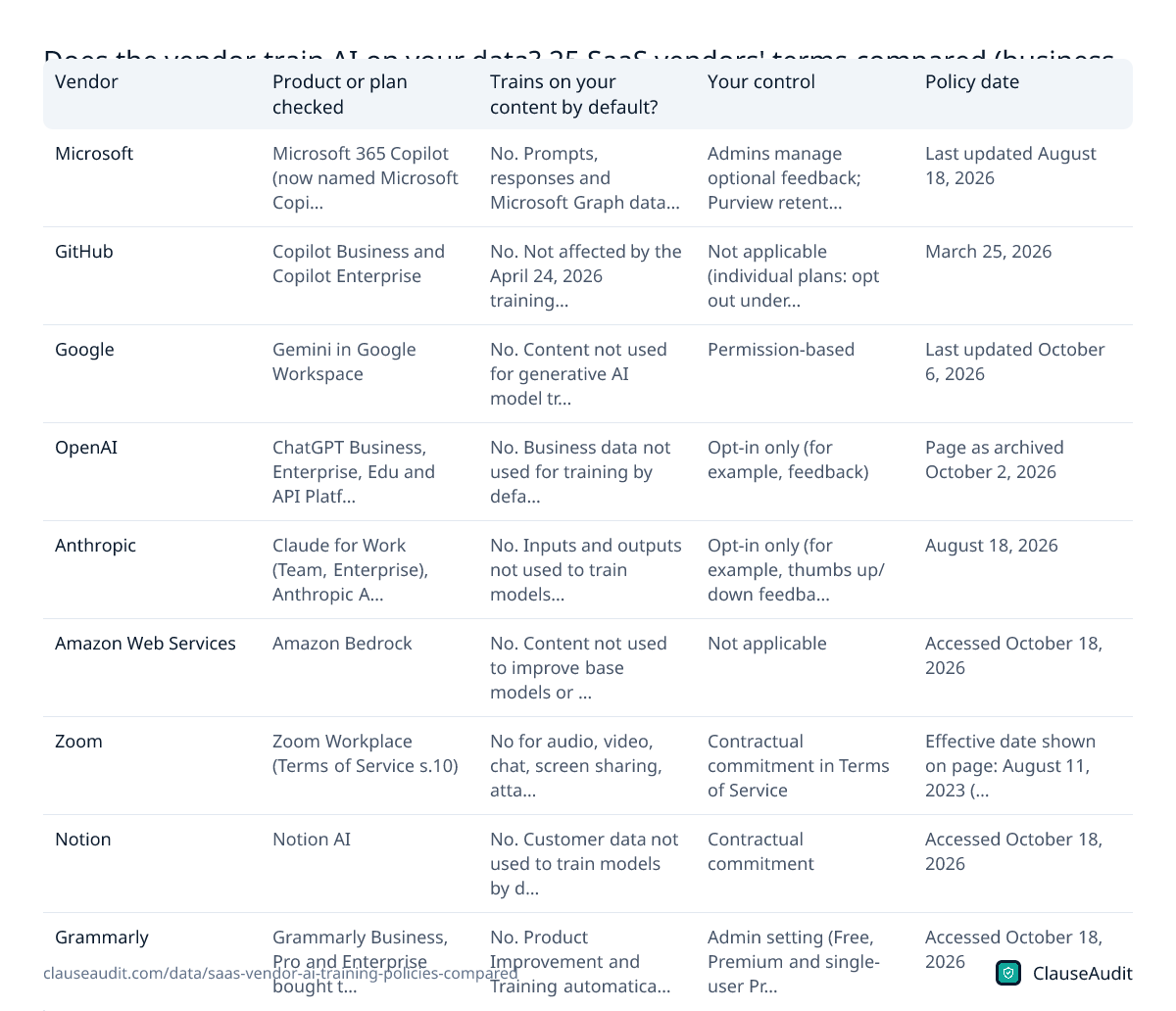
Download this chart (PNG)Does the vendor train AI on your data? 25 SaaS vendors' terms compared (business or enterprise tier)
| Vendor | Product or plan checked | Trains on your content by default? | Your control | Policy date |
|---|---|---|---|---|
| Microsoft | Microsoft 365 Copilot (now named Microsoft Copilot) | No. Prompts, responses and Microsoft Graph data aren't used to train foundation LLMs | Admins manage optional feedback; Purview retention policies | Last updated August 18, 2026 |
| GitHub | Copilot Business and Copilot Enterprise | No. Not affected by the April 24, 2026 training change | Not applicable (individual plans: opt out under Privacy settings) | March 25, 2026 |
| Gemini in Google Workspace | No. Content not used for generative AI model training outside your domain without permission | Permission-based | Last updated October 6, 2026 | |
| OpenAI | ChatGPT Business, Enterprise, Edu and API Platform | No. Business data not used for training by default | Opt-in only (for example, feedback) | Page as archived October 2, 2026 |
| Anthropic | Claude for Work (Team, Enterprise), Anthropic API, Claude Gov | No. Inputs and outputs not used to train models by default | Opt-in only (for example, thumbs up/down feedback) | August 18, 2026 |
| Amazon Web Services | Amazon Bedrock | No. Content not used to improve base models or shared with model providers | Not applicable | Accessed October 18, 2026 |
| Zoom | Zoom Workplace (Terms of Service s.10) | No for audio, video, chat, screen sharing, attachments and similar communications content | Contractual commitment in Terms of Service | Effective date shown on page: August 11, 2023 (accessed October 18, 2026) |
| Notion | Notion AI | No. Customer data not used to train models by default; AI providers contractually barred | Contractual commitment | Accessed October 18, 2026 |
| Grammarly | Grammarly Business, Pro and Enterprise bought through Sales; Education | No. Product Improvement and Training automatically off | Admin setting (Free, Premium and single-user Pro: on by default) | Accessed October 18, 2026 |
| Figma | Organization and Enterprise plans | No. Content training turned off by default | None; content training disabled and can't be turned on (Starter and Professional teams: on by default, admin can turn off) | Accessed October 18, 2026 |
| Adobe | Firefly and Adobe creative applications | No. Firefly never trained on customer content; app content not used to train generative AI | Not applicable | Undated page (accessed October 18, 2026) |
| Box | Box AI | No, unless the customer gives explicit authorization | Explicit authorization required | Effective November 4, 2025 |
| Asana | Asana AI | No. Asana does not use or let AI partners use Customer Data to train generative models for Asana AI | Contractual commitment | Last updated October 1, 2026 (effective October 5, 2026) |
| Miro | Miro AI | No. Customer data excluded; only opted-in, non-enterprise user data may be used | Opt-in for non-enterprise users | Accessed October 18, 2026 |
| Salesforce | Agentforce / Einstein Trust Layer | Third-party LLMs: no (zero data retention). Salesforce's own models: not addressed on this page | Trust Layer zero data retention | Accessed October 18, 2026 |
| Atlassian | Atlassian Intelligence and Rovo | Third-party LLM providers: no. Atlassian's own models: not addressed on this page | Contractual limits on LLM providers | Accessed October 18, 2026 |
| Slack | Slack and AI in Slack | Generative AI: no, unless affirmative opt-in. Global non-generative ML models: yes | Contact Slack to opt out of global ML models | Accessed October 18, 2026 |
| Zendesk | Zendesk AI | Generative features: no. Proprietary non-generative models: trained on sanitized customer data | Not stated on this page | Updated May 27, 2026 |
| HubSpot | HubSpot AI models (CRM deduplication, search, card scanner) | Yes. May train its own AI models on customer data; third-party AI providers barred | Super Admin opt-out in AI settings; Sensitive Data accounts auto-excluded | Last updated September 8, 2026 |
| Intercom | Fin AI Agent (fin-cx models) | Yes. Models trained on de-identified customer conversation data | Opt-out request in workspace security settings; processed within 30 days; some customers excluded | September 8, 2026 |
| Workday | Workday AI for UMSA customers | Yes. Data contributions automatically enabled for purchased AI features | Disallow Data Contribution setting; past contributions deleted within 30 days | Last updated June 26, 2026 |
| Docusign | IAM and CLM (MSA customers); IAM and eSignature bought on or after July 8, 2026 (web plans) | Yes. Customer grants a training licence to create AI Improvement Data | Go-forward opt-out toggle; data used before opt-out is kept | Version date July 8, 2026 |
| Cursor | Cursor editor (all plans) | Yes when Privacy Mode is off; default not stated on this page | Turn on Privacy Mode (user or team admin) | Last updated September 3, 2026 |
| LinkedIn member data (profiles, posts) | Yes for members 18+ unless the Data for Generative AI Improvement setting is off | Member setting; objection form | Accessed October 18, 2026 | |
| Otter.ai | Otter meeting transcription | Yes. Trains proprietary AI on de-identified audio recordings and on transcriptions (which may contain personal information) | No AI-training opt-out described in the privacy policy | Effective June 16, 2026 |
Source: Adobe, Adobe's approach to generative AI (Firefly); Anthropic, Is my data used for model training? (commercial products); Asana, Asana Product-Specific Terms; Atlassian, Atlassian Intelligence and Rovo trust page; Amazon Web Services, Amazon Bedrock FAQs; Box, Box AI Principles; Cursor (Anysphere), Data Use & Privacy Overview; Docusign, AI Attachment for Docusign Services; Figma, Manage AI settings and content training for your team or organization; GitHub, Updates to GitHub Copilot interaction data usage policy; Google, Generative AI in Google Workspace Privacy Hub; Grammarly, Product Improvement and Training Control; HubSpot, Understand HubSpot's AI model training; Intercom, AI model training and fine-tuning; LinkedIn, LinkedIn and generative AI (GAI) FAQs; Miro, Miro AI trust and ISO 42001; Microsoft, Data, Privacy, and Security for Microsoft Copilot (Microsoft 365 Copilot); Notion, Notion AI security practices; OpenAI, Enterprise privacy at OpenAI; Otter.ai, Otter.ai Privacy Policy; Salesforce, Trusted AI: Einstein Trust Layer; Slack, Privacy principles: search, learning and artificial intelligence; Workday, Concept: Workday AI for Universal Main Subscription Agreement Customers; Zendesk, Zendesk AI data use and privacy; Zoom, Zoom Terms of Service, Section 10. Download as image
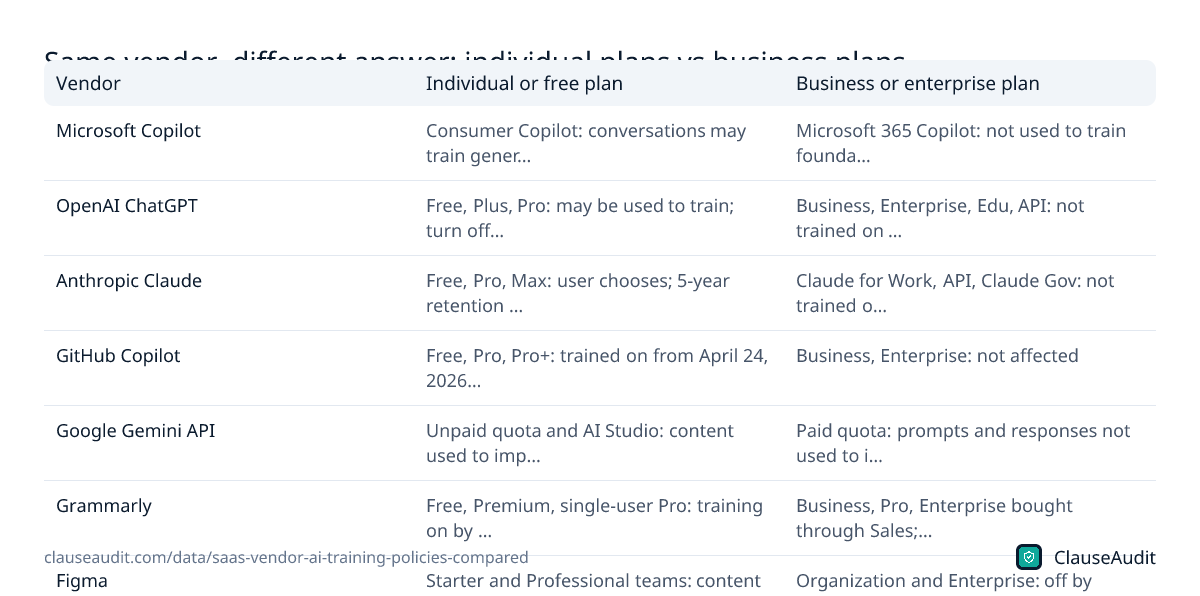
Same vendor, different answer: individual plans vs business plans
| Vendor | Individual or free plan | Business or enterprise plan |
|---|---|---|
| Microsoft Copilot | Consumer Copilot: conversations may train generative AI models; opt-out available | Microsoft 365 Copilot: not used to train foundation LLMs |
| OpenAI ChatGPT | Free, Plus, Pro: may be used to train; turn off 'Improve the model for everyone' | Business, Enterprise, Edu, API: not trained on by default |
| Anthropic Claude | Free, Pro, Max: user chooses; 5-year retention if training allowed, 30 days if not | Claude for Work, API, Claude Gov: not trained on by default |
| GitHub Copilot | Free, Pro, Pro+: trained on from April 24, 2026 unless user opts out | Business, Enterprise: not affected |
| Google Gemini API | Unpaid quota and AI Studio: content used to improve Google products | Paid quota: prompts and responses not used to improve products |
| Grammarly | Free, Premium, single-user Pro: training on by default | Business, Pro, Enterprise bought through Sales; Education: off by default |
| Figma | Starter and Professional teams: content training on by default | Organization and Enterprise: off by default |
Source: Microsoft, Privacy FAQ for Microsoft Copilot (consumer); Microsoft, Data, Privacy, and Security for Microsoft Copilot (Microsoft 365 Copilot); OpenAI, How your data is used to improve model performance; OpenAI, Enterprise privacy at OpenAI; Anthropic, Updates to Consumer Terms and Privacy Policy; Anthropic, Is my data used for model training? (commercial products); GitHub, Updates to GitHub Copilot interaction data usage policy; Google, Gemini API Additional Terms of Service; Grammarly, Product Improvement and Training Control; Figma, Manage AI settings and content training for your team or organization. Download as image
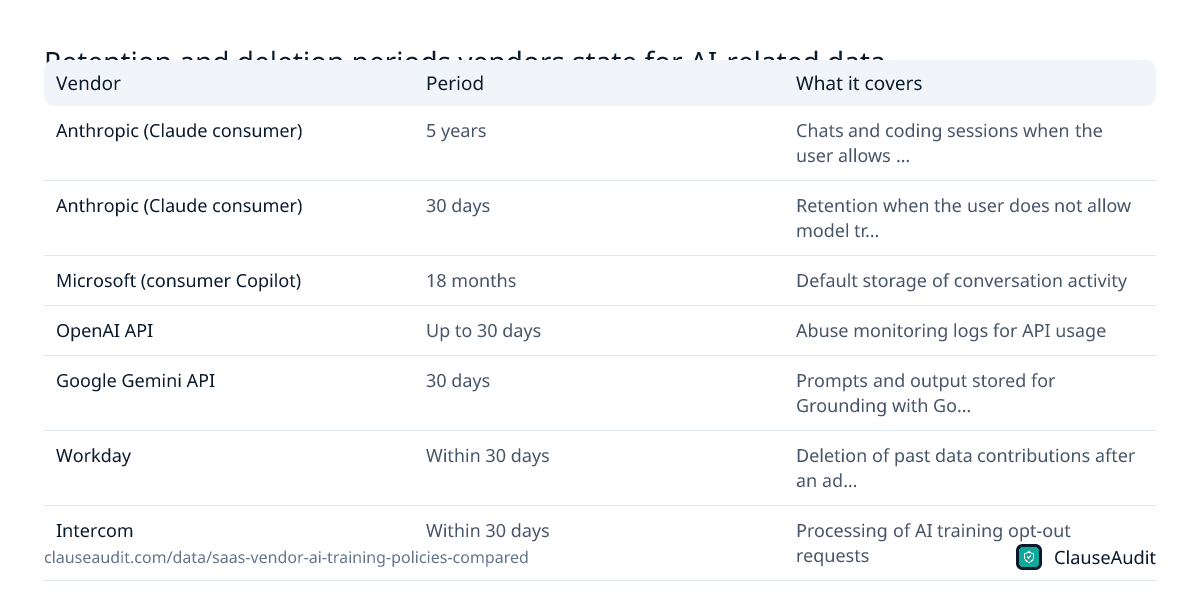
Retention and deletion periods vendors state for AI-related data
| Vendor | Period | What it covers |
|---|---|---|
| Anthropic (Claude consumer) | 5 years | Chats and coding sessions when the user allows model training |
| Anthropic (Claude consumer) | 30 days | Retention when the user does not allow model training |
| Microsoft (consumer Copilot) | 18 months | Default storage of conversation activity |
| OpenAI API | Up to 30 days | Abuse monitoring logs for API usage |
| Google Gemini API | 30 days | Prompts and output stored for Grounding with Google Search |
| Workday | Within 30 days | Deletion of past data contributions after an admin disallows contribution |
| Intercom | Within 30 days | Processing of AI training opt-out requests |
Source: Anthropic, Updates to Consumer Terms and Privacy Policy; Microsoft, Privacy FAQ for Microsoft Copilot (consumer); OpenAI, Data controls in the OpenAI platform (Your data); Google, Gemini API Additional Terms of Service; Workday, Manage Workday AI Data Contributions for UMSA Customers; Intercom, AI model training and fine-tuning. Download as image
Does Microsoft Copilot train on your data?
It depends on which Copilot you are using, and that confusion is where most people go wrong. Microsoft 365 Copilot, the version tied to a work account, does not use your prompts, responses or Microsoft Graph data to train foundation LLMs. Admins control optional feedback and can apply Purview retention policies.
Consumer Copilot, the one you sign into with a personal Microsoft account, works differently. Conversations may be used to train generative models, there is an opt-out, and Microsoft keeps conversation activity for 18 months by default.
So if an employee pastes a client contract into Copilot on a personal login, your company's enterprise promise doesn't cover it. The same split shows up at OpenAI, Anthropic, GitHub, Google, Grammarly and Figma. Check the plan, not the brand.
Which SaaS vendors train AI on customer data by default?
A smaller group in our set trains on business data by default or ties it to a setting nobody may have touched. HubSpot may train its own models on customer data, with a Super Admin opt-out. Intercom trains its Fin models on de-identified conversation data and takes up to 30 days to process an opt-out request. Workday turns data contributions on automatically for purchased AI features.
Docusign's terms grant it a training licence, and its opt-out only works going forward, so data used before you switch it off stays used. Otter.ai trains on de-identified audio and transcripts with no opt-out described in its privacy policy. Cursor trains when Privacy Mode is off, and its page doesn't say what the default is. LinkedIn uses member data unless you turn off a specific setting.
None of these is hidden. Each one is in the vendor's own published terms. The problem is that the person who signs up for the tool rarely reads them, and the admin who could change the setting often doesn't know it exists.
Here is what that looks like in practice. A sales team signs up for a CRM, connects its inbox and starts logging calls. Months later, nobody remembers that the AI settings page had a training switch. Every deal note, pricing discussion and customer complaint in that account may now be eligible for the vendor's own models. The fix took one click. Finding out it was needed took a policy page most people never open.
What does "we don't train on your data" leave out?
Read the promise word for word. Five vendors in our set made commitments that sound complete but cover only part of the picture. Here are four of them.
Slack won't use your data for generative AI unless you opt in, but it does use it for global non-generative machine learning models, and you have to contact Slack to opt out. Zendesk trains its proprietary non-generative models on sanitized customer data. Salesforce and Atlassian bar outside model providers from keeping or training on your data, but the pages we read don't address their own in-house models.
Other gaps to watch for: feedback buttons that count as opting in, retention periods for prompts and logs, and whether de-identified or aggregated data counts as "your data" at all. A thumbs-up on an answer can be all it takes to share that conversation.
This is why a vendor's marketing line is a starting point, not an answer. The line usually says the most comforting true thing. The detail sits in the product terms, an AI addendum or a trust center page, and those are the documents worth reading before you connect your customer data.
Why do free and paid plans get different answers?
Business plans get the stronger promises. One likely reason is that business buyers negotiate and individual users usually don't. GitHub began training on Copilot Free, Pro and Pro+ data on April 24, 2026 unless users opt out, while Business and Enterprise plans were not affected.
Anthropic lets Claude Free, Pro and Max users choose. If they allow training, data is kept for 5 years. If they don't, the 30-day retention period stays. Grammarly and Figma both switch training on by default for smaller plans and off for their organization tiers.
For a freelancer or a small agency, this matters a lot. You may be paying for an individual plan that trains on your client files while a larger competitor's enterprise plan of the same product doesn't. Either move client work onto a business tier or find the opt-out and screenshot it.
What should freelancers and small businesses do first?
Start with the tools that touch other people's data. Your clients' contracts, your customers' support tickets and your meeting recordings carry the most risk, because you may have promised confidentiality to someone else. If a vendor trains on that material, you could be the one breaching an NDA.
Meeting tools deserve special attention. A transcription app that joins a client call records everyone on it, not just you. Otter.ai's privacy policy describes training on de-identified audio and transcripts with no AI-training opt-out, so think twice before inviting it into a confidential meeting.
Then look at your own consent. Pew found that 81% of U.S. adults who had heard of AI expected companies to use collected data in uncomfortable ways. Your clients probably feel the same, and a short line in your own contracts saying which tools you use can head off a hard conversation later.
Can you negotiate AI training terms with a vendor?
Often, yes. In Cisco's 2026 benchmark, 79% of organizations said their generative AI providers were willing to adjust contract terms or tool settings to limit data exposure. Yet only 55% require contracts that spell out data ownership, usage rights and IP for AI vendors, even though 70% acknowledge risk from using proprietary or customer data in AI training.
Think about who actually holds the cards. Asking a vendor to confirm its existing policy in writing is the easy request, since it costs the vendor nothing. It is harder to get a vendor to change a default that its product depends on, like a support platform that trains on conversations. In that case, ask for a narrower clause: training only on de-identified data, no use of attachments, and deletion within a fixed period after you opt out.
That gap is the opportunity. You don't need enterprise spend to ask for a short AI addendum or a written confirmation that training is off for your account. Start with these steps:
- List every tool your team uses that has an AI feature, including free sign-ups on personal emails.
- For each one, find the vendor's AI or data use page and note which plan it covers.
- Switch off training settings at the admin level, then save a dated screenshot.
- Ask the vendor to confirm in writing that your content won't train any model, generative or not.
- Add a clause to renewals that requires notice before the vendor changes its AI data terms.
How ClauseAudit helps
Vendor policy pages change, but your signed agreement is what you can enforce. Upload your SaaS contract, order form or terms of service and ClauseAudit's automated review flags the clauses that decide what happens to your data.
You get a plain English summary of each risky clause and a suggested change to bring to the vendor before you sign or renew.
- Data use and licence grants that let the vendor use your content to improve or train its services
- Whether de-identified, aggregated or usage data is carved out of your ownership
- Terms that let the vendor change policies with short notice or continued-use acceptance
- Liability caps that leave you with little recourse if your data is misused
- Auto-renewal and cancellation notice windows, so you can leave if AI terms change
- Data deletion and export rights when the contract ends
Frequently asked questions
Does ChatGPT Enterprise train on your data?
No. OpenAI says business data from ChatGPT Business, Enterprise, Edu and the API Platform isn't used for training by default, and API data hasn't been used to train its models since March 1, 2023 unless the customer opts in. Free, Plus and Pro accounts are different. Those may be used for training unless you turn off the "Improve the model for everyone" setting.
Does GitHub Copilot train on my code?
On individual plans, it can. From April 24, 2026, GitHub trains on Copilot Free, Pro and Pro+ data unless the user opts out in Privacy settings. Copilot Business and Copilot Enterprise were not affected by that change. If you write client code on a personal plan, check that setting today or move the work to an organization seat.
Does Slack use my messages to train AI?
Slack says it doesn't use customer data for generative AI unless you opt in. It does use customer data for global non-generative machine learning models, such as features that rank or suggest content. To opt out of those, a workspace owner has to contact Slack. There is no simple toggle described on the page we reviewed.
Does Zoom use meeting recordings to train AI?
Zoom's Terms of Service say it doesn't use audio, video, chat, screen sharing, attachments or similar communications content to train AI models. That promise sits in the contract itself, which makes it stronger than a help page. It's still worth checking any third-party notetaker apps that join your calls, since their terms are separate.
Can I stop a vendor from using data it already trained on?
Usually not. Most opt-outs work going forward. Docusign says data used before you opt out is kept. Workday is an exception in our set: after an admin disallows data contribution, past contributions are deleted within 30 days. If historical data matters to you, ask the vendor in writing what happens to it before you sign.
Is de-identified data still my data?
Contracts often say no. Several vendors, including Intercom and Otter.ai, train on de-identified data, and many SaaS agreements carve aggregated or anonymized data out of what the customer owns. Removing names doesn't always remove what makes data sensitive, such as deal terms or pricing. Push for a clause that covers derived and de-identified data too.
How long do vendors keep AI prompts and chats?
It varies widely. Consumer Microsoft Copilot stores conversation activity for 18 months by default. Claude consumer accounts keep data for 5 years if training is allowed and 30 days if not. OpenAI keeps API abuse monitoring logs for up to 30 days. Check the retention period even when training is off, because stored data can still be exposed in a breach.
Do I need a contract clause if the vendor's website already promises no training?
Yes, if the data matters. Website policies can change, and many terms let vendors update them with short notice. A clause in your order form or a data processing addendum gives you something enforceable. Ask for language that covers all models, not just generative ones, and requires notice before any change.
Use this data
Every chart and card below is free to reuse under CC BY 4.0. Download what you need and link back to this page.
 Stat cards
 Key findings card
 Infographic
 Default AI-training posture of 25 SaaS vendors (business or enterprise tier)
 Data types organizations use in developing or using GenAI (% of organizations)
 GenAI providers are willing to negotiate contracts or tool settings to limit data use (% of organizations)
 U.S. adults who have heard of AI: views on how companies use AI and data (% of U.S. adults who have heard of AI)
 Does the vendor train AI on your data? 25 SaaS vendors' terms compared (business or enterprise tier)
 Same vendor, different answer: individual plans vs business plans
 Retention and deletion periods vendors state for AI-related data
Embed the infographic
Free to share on your site, blog or slides under CC BY 4.0. Please keep the credit link.
Sources and method
Every number on this page comes from the sources below, each opened and read on or before October 18, 2026. A second, independent review checked every figure against its source and corrected anything that did not match. Figures that could not be confirmed were left out.
- Cisco, Cisco 2026 Data and Privacy Benchmark Study (2026 edition (survey of 5,200+ professionals in 12 markets, fielded September 2025))
- Pew Research Center, Key findings about Americans and data privacy (October 18, 2023 (survey of 5,101 U.S. adults, May 15-21, 2023))
- Microsoft, Data, Privacy, and Security for Microsoft Copilot (Microsoft 365 Copilot) (Last updated August 18, 2026)
- Microsoft, Privacy FAQ for Microsoft Copilot (consumer) (Accessed October 18, 2026)
- GitHub, Updates to GitHub Copilot interaction data usage policy (March 25, 2026)
- Google, Generative AI in Google Workspace Privacy Hub (Last updated October 6, 2026)
- Google, Gemini API Additional Terms of Service (Last updated April 28, 2026)
- OpenAI, Enterprise privacy at OpenAI (Page as archived October 2, 2026)
- OpenAI, How your data is used to improve model performance (Page as archived October 18, 2026)
- OpenAI, Data controls in the OpenAI platform (Your data) (Accessed October 18, 2026)
- Anthropic, Updates to Consumer Terms and Privacy Policy (August 28, 2025)
- Anthropic, Is my data used for model training? (commercial products) (August 18, 2026)
- Amazon Web Services, Amazon Bedrock FAQs (Accessed October 18, 2026)
- Salesforce, Trusted AI: Einstein Trust Layer (Accessed October 18, 2026)
- Slack, Privacy principles: search, learning and artificial intelligence (Accessed October 18, 2026)
- Zoom, Zoom Terms of Service, Section 10 (Effective date shown on page: August 11, 2023 (accessed October 18, 2026))
- Atlassian, Atlassian Intelligence and Rovo trust page (Accessed October 18, 2026)
- Notion, Notion AI security practices (Accessed October 18, 2026)
- Figma, Manage AI settings and content training for your team or organization (Accessed October 18, 2026)
- Grammarly, Product Improvement and Training Control (Accessed October 18, 2026)
- Zendesk, Zendesk AI data use and privacy (Updated May 27, 2026)
- Intercom, AI model training and fine-tuning (September 8, 2026)
- HubSpot, Understand HubSpot's AI model training (Last updated September 8, 2026)
- Workday, Concept: Workday AI for Universal Main Subscription Agreement Customers (Last updated June 26, 2026)
- Workday, Manage Workday AI Data Contributions for UMSA Customers (Last updated June 26, 2026)
- Docusign, AI Attachment for Docusign Services (Version date July 8, 2026)
- Adobe, Adobe's approach to generative AI (Firefly) (Undated page (accessed October 18, 2026))
- Box, Box AI Principles (Effective November 4, 2025)
- Asana, Asana Product-Specific Terms (Last updated October 1, 2026; effective October 5, 2026)
- Miro, Miro AI trust and ISO 42001 (Accessed October 18, 2026)
- Otter.ai, Otter.ai Privacy Policy (Effective June 16, 2026)
- Cursor (Anysphere), Data Use & Privacy Overview (Last updated September 3, 2026)
- LinkedIn, LinkedIn and generative AI (GAI) FAQs (Accessed October 18, 2026)
Cite this page
ClauseAudit, “Does Your SaaS Vendor Train AI on Your Data? 25 Major Vendors' Terms Compared”, updated October 18, 2026, https://clauseaudit.com/data/saas-vendor-ai-training-policies-compared. Free to reuse with a link back (CC BY 4.0).
This page summarises published data and law as checked on October 18, 2026. Figures are updated as new editions are released, and your own situation may differ. It is general information, not legal, tax or financial advice.