Business Bankruptcy Statistics 2026: Chapter 11, Subchapter V and Chapter 7 Filings
By ClauseAudit Research · 7 sources ·
What do the latest business bankruptcy statistics show?
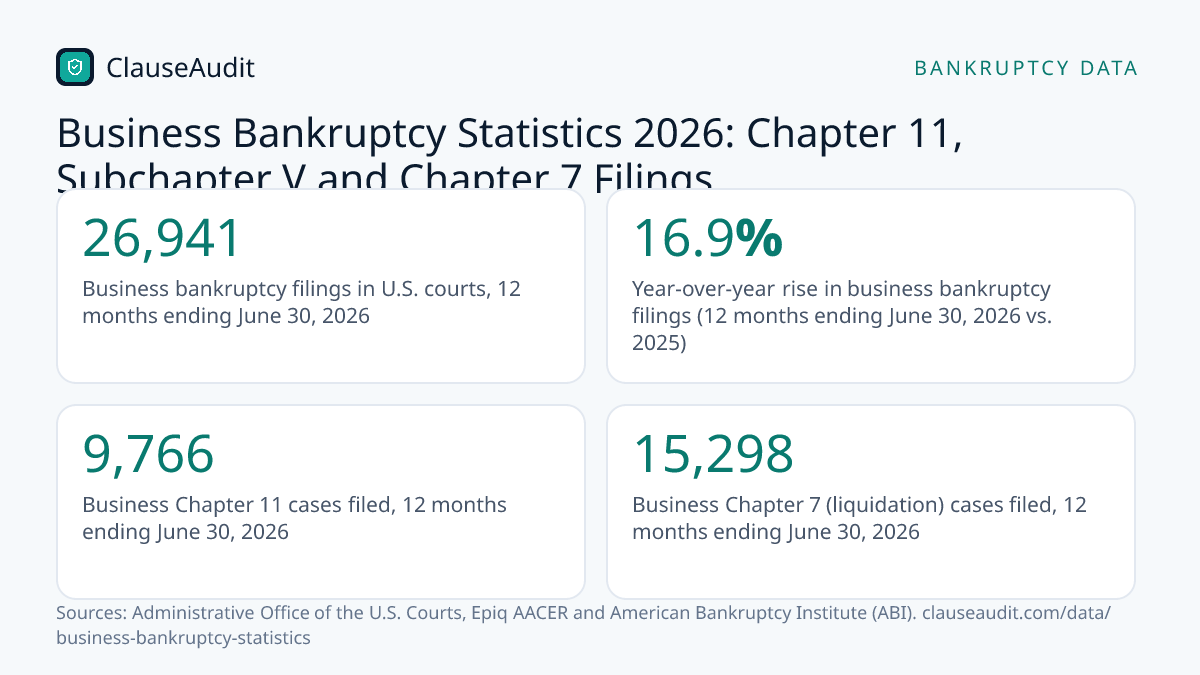
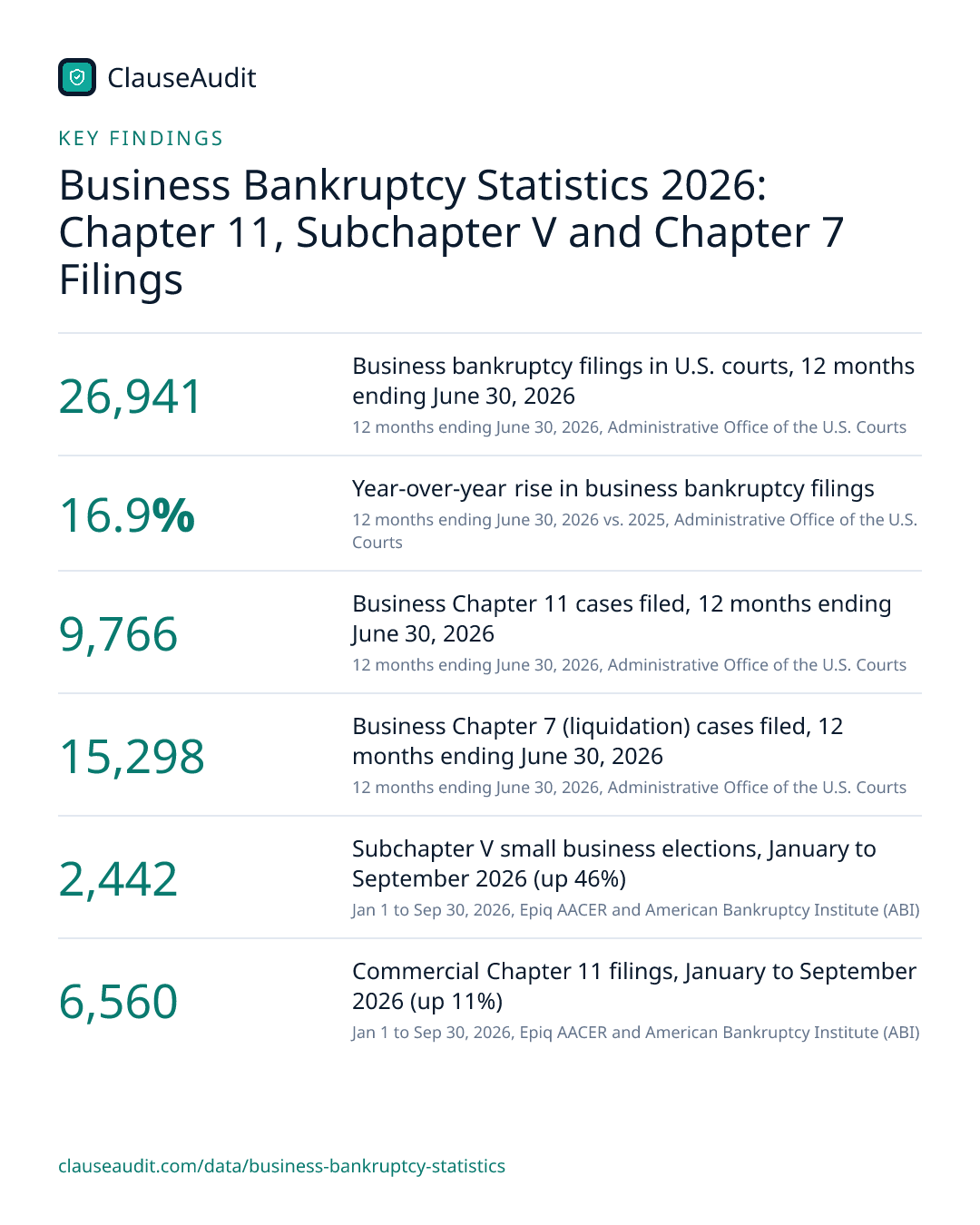
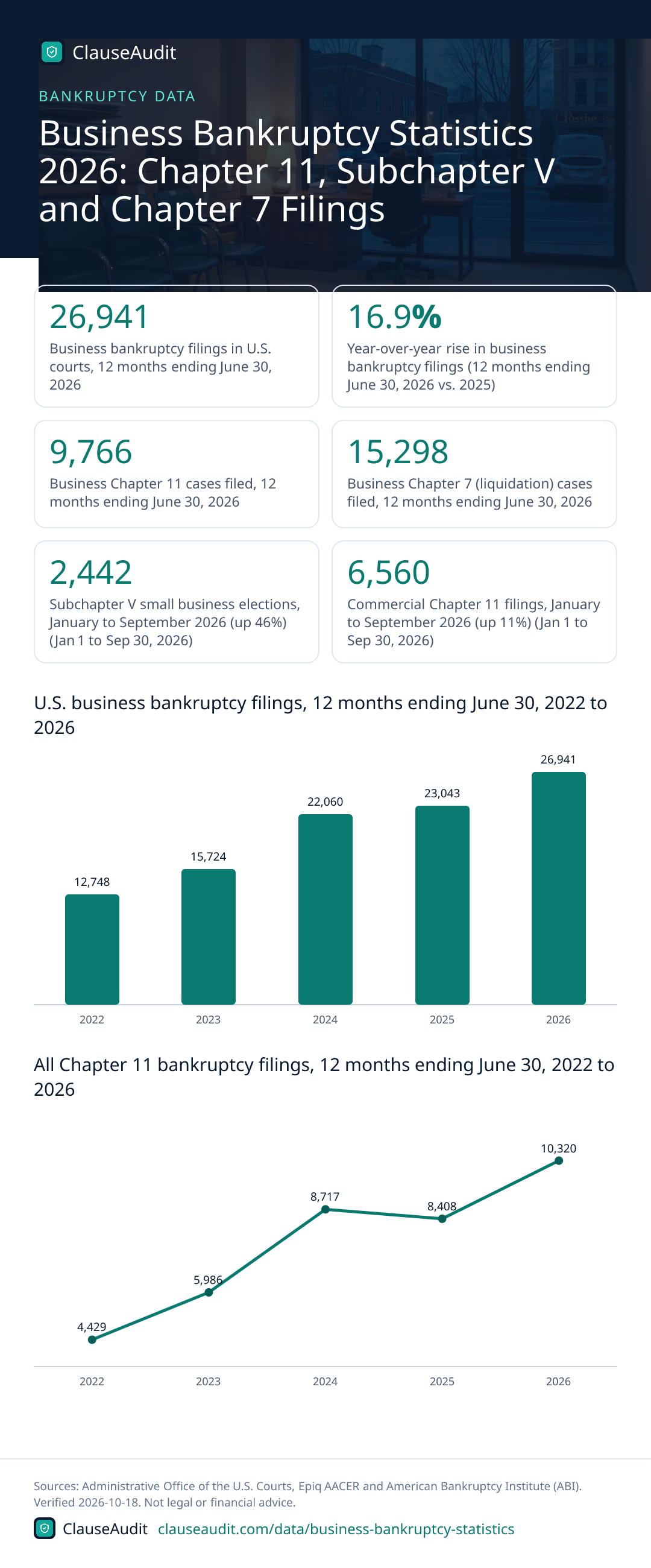
Business bankruptcies are climbing. U.S. courts logged 26,941 business filings in the 12 months ending June 30, 2026, up 16.9% from 23,043 a year earlier. Chapter 7 liquidations made up 15,298 of them and Chapter 11 cases 9,766. Small business Subchapter V elections reached 2,442 from January to September 2026, up 46%.

- Business bankruptcy filings in U.S. courts, 12 months ending June 30, 2026 (12 months ending June 30, 2026, Administrative Office of the U.S. Courts)
- 26,941
- Year-over-year rise in business bankruptcy filings (12 months ending June 30, 2026 vs. 2025, Administrative Office of the U.S. Courts)
- 16.9%
- Business Chapter 11 cases filed, 12 months ending June 30, 2026 (12 months ending June 30, 2026, Administrative Office of the U.S. Courts)
- 9,766
- Business Chapter 7 (liquidation) cases filed, 12 months ending June 30, 2026 (12 months ending June 30, 2026, Administrative Office of the U.S. Courts)
- 15,298
- Subchapter V small business elections, January to September 2026 (up 46%) (Jan 1 to Sep 30, 2026, Epiq AACER and American Bankruptcy Institute (ABI))
- 2,442
- Commercial Chapter 11 filings, January to September 2026 (up 11%) (Jan 1 to Sep 30, 2026, Epiq AACER and American Bankruptcy Institute (ABI))
- 6,560
- Subchapter V small business elections in calendar year 2025 (CY 2025, Epiq AACER and American Bankruptcy Institute (ABI))
- 2,446
- Maximum combined debt to qualify for Subchapter V small business Chapter 11 (Current as of October 2026, Administrative Office of the U.S. Courts)
- $3,424,000
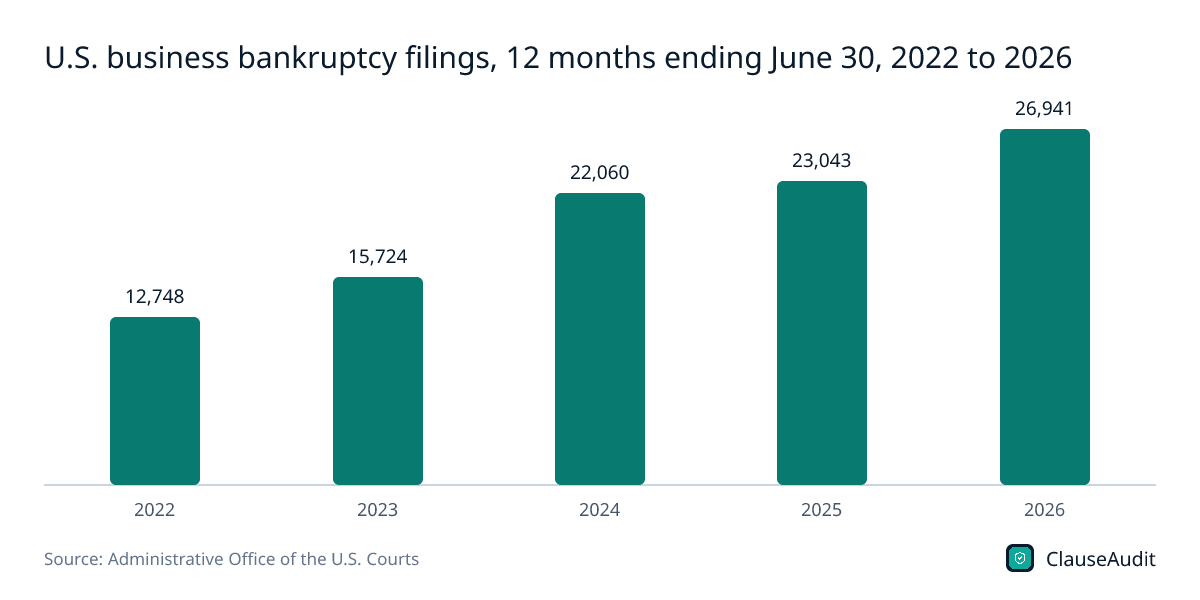
More American businesses are going to bankruptcy court than at any point in the last five years. Federal court data shows 26,941 business filings in the year ending June 30, 2026, against 12,748 in the year ending June 30, 2022. Every year in between went up.
For most readers the number that matters is not the total. It is the chance that a client who owes you money, a landlord, or a software vendor you depend on ends up in one of these cases. This page shows where the filings are, which chapters are growing, and what to put in your contracts so a stranger's bankruptcy does not become your loss.
U.S. business bankruptcy filings, 12 months ending June 30, 2022 to 2026
Chart data
| Label | Value |
|---|---|
| 2022 | 12,748 |
| 2023 | 15,724 |
| 2024 | 22,060 |
| 2025 | 23,043 |
| 2026 | 26,941 |
Business filings rose every year in this window, from 12,748 to 26,941. The jump between 2023 and 2024 was the steepest. Growth slowed in 2025, then picked up again in 2026.
Download this chart (PNG)All Chapter 11 bankruptcy filings, 12 months ending June 30, 2022 to 2026
Chart data
| Label | Value |
|---|---|
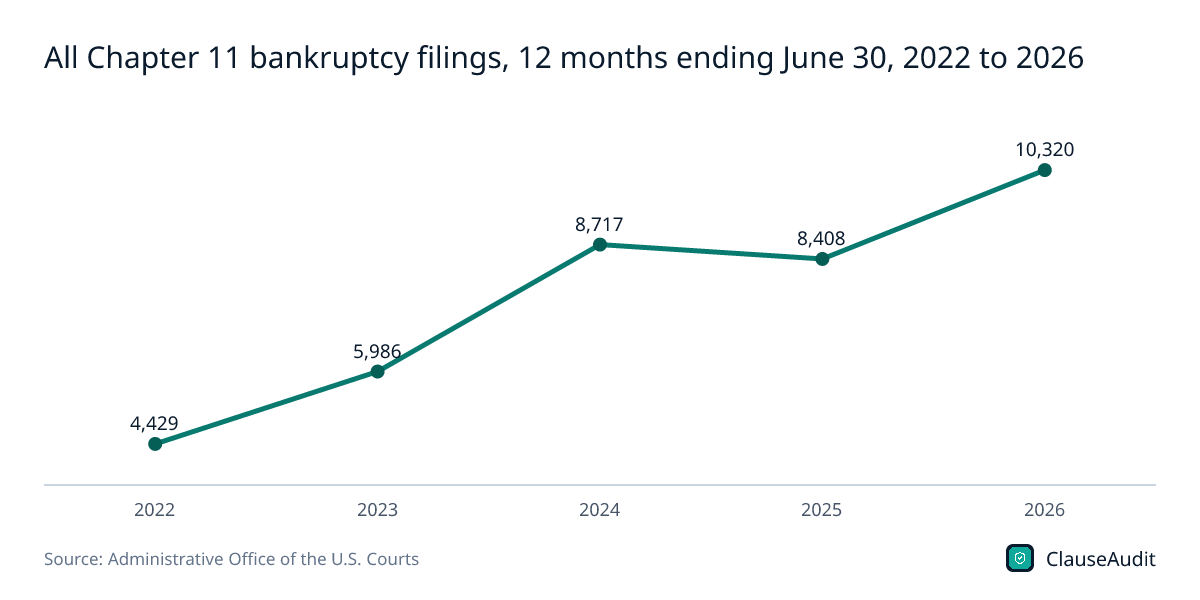
| 2022 | 4,429 |
| 2023 | 5,986 |
| 2024 | 8,717 |
| 2025 | 8,408 |
| 2026 | 10,320 |
Chapter 11 dipped slightly in 2025, to 8,408, then reached 10,320, the highest point in this series. Most of those cases are businesses: 9,766 of the 10,320.
Download this chart (PNG)Business bankruptcy filings by chapter, 12 months ending June 30, 2026
Chart data
| Label | Value |
|---|---|
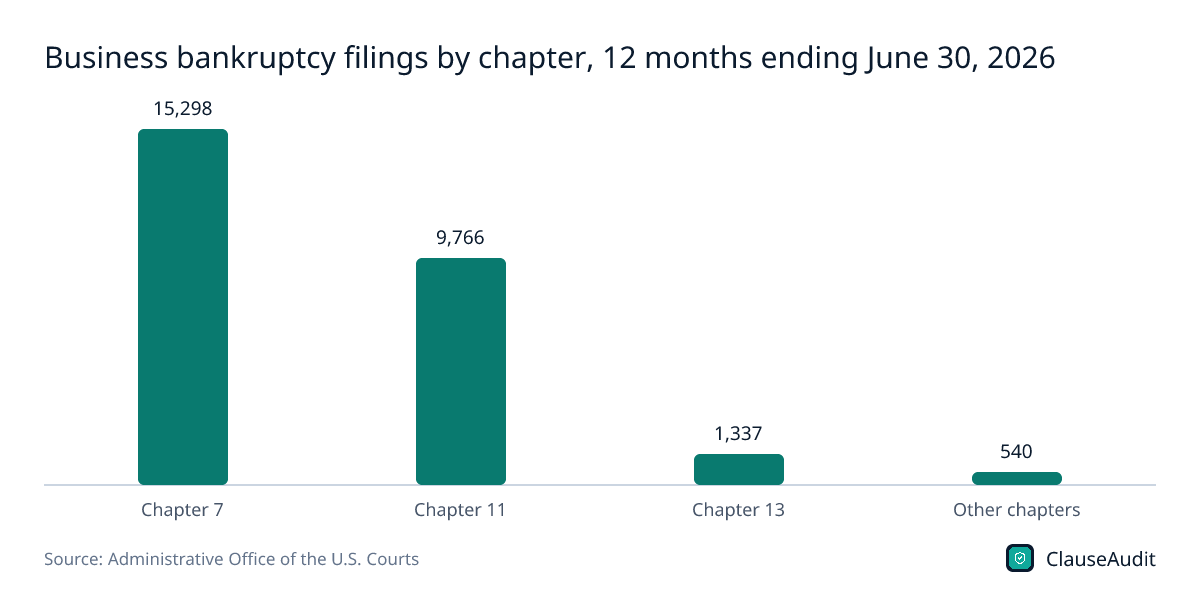
| Chapter 7 | 15,298 |
| Chapter 11 | 9,766 |
| Chapter 13 | 1,337 |
| Other chapters | 540 |
Liquidation still dominates. Chapter 7 accounts for 15,298 business cases, which means a company that files is more likely to close than to reorganize.
Download this chart (PNG)Business Chapter 11 filings by bankruptcy court district, top 10, 12 months ending June 30, 2026
Chart data
| Label | Value |
|---|---|
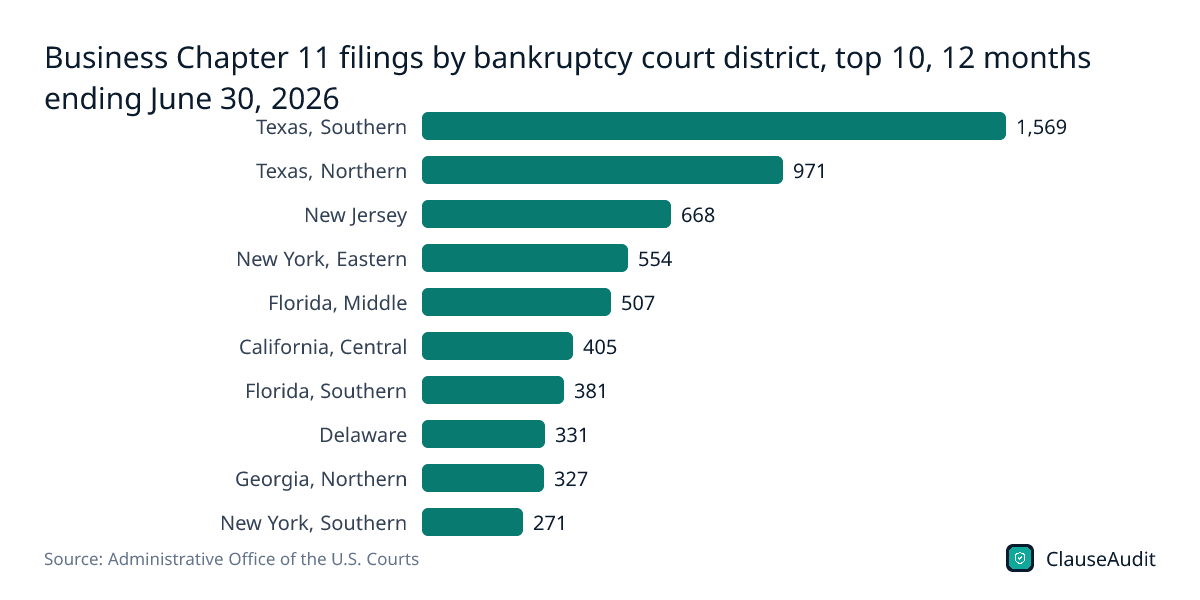
| Texas, Southern | 1,569 |
| Texas, Northern | 971 |
| New Jersey | 668 |
| New York, Eastern | 554 |
| Florida, Middle | 507 |
| California, Central | 405 |
| Florida, Southern | 381 |
| Delaware | 331 |
| Georgia, Northern | 327 |
| New York, Southern | 271 |
Texas, Southern leads with 1,569 business Chapter 11 cases. These are case counts, so one large company with dozens of affiliates can push a district up the list.
Download this chart (PNG)Subchapter V small business elections by calendar year, 2023 to 2025
Chart data
| Label | Value |
|---|---|
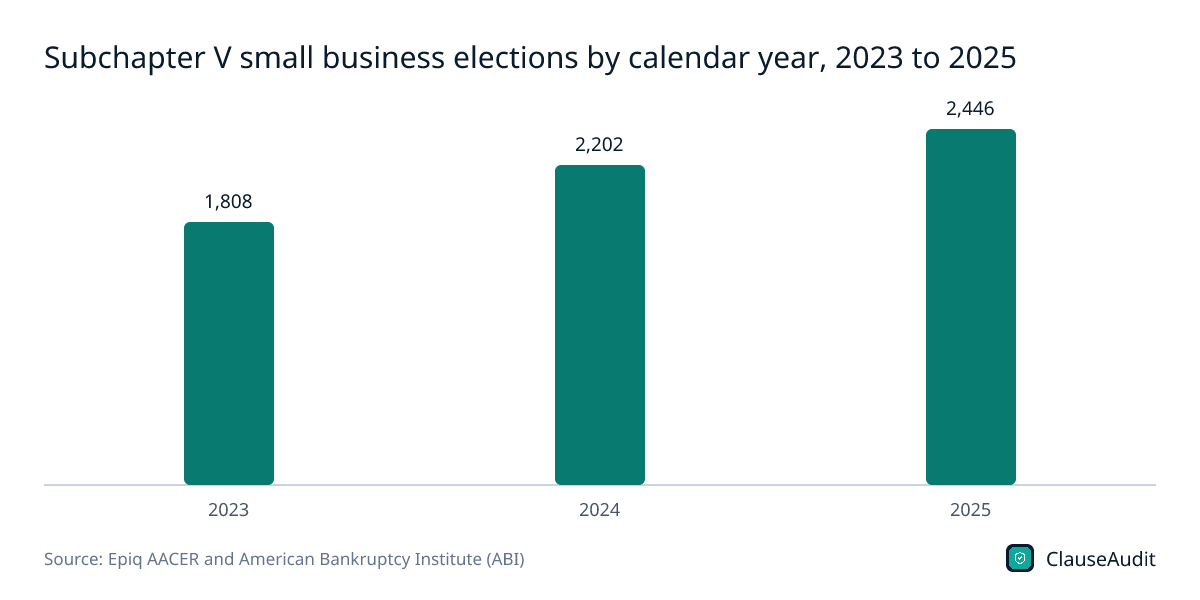
| 2023 | 1,808 |
| 2024 | 2,202 |
| 2025 | 2,446 |
Subchapter V elections rose from 2,202 in 2024 to 2,446 in 2025, and 2026 is already close to that full-year mark after nine months.
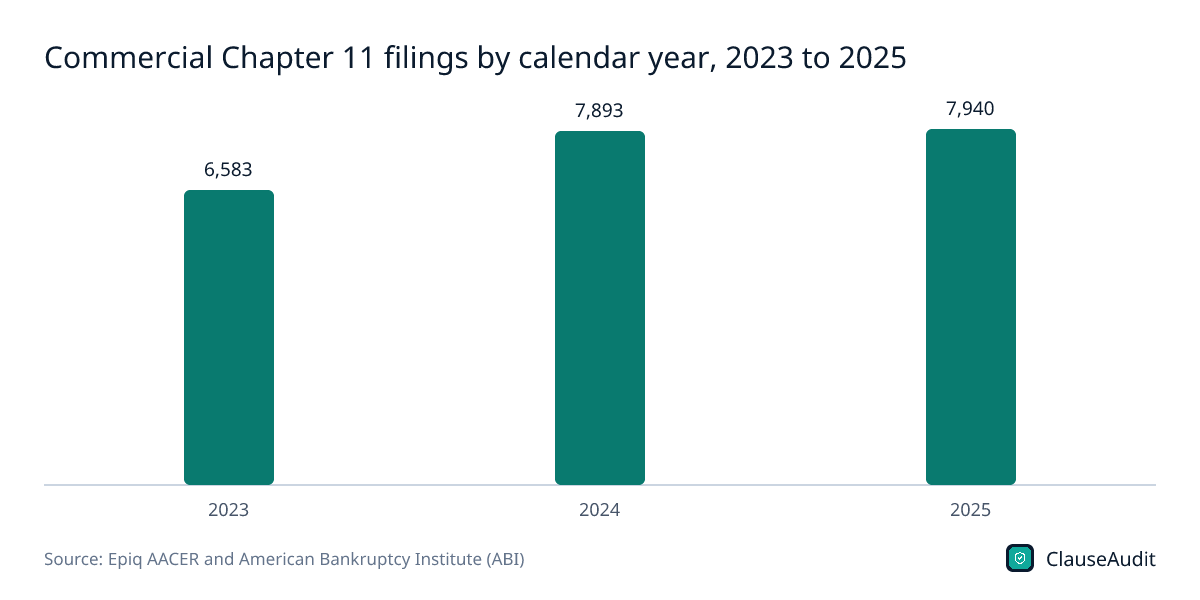
Download this chart (PNG)Commercial Chapter 11 filings by calendar year, 2023 to 2025
Chart data
| Label | Value |
|---|---|
| 2023 | 6,583 |
| 2024 | 7,893 |
| 2025 | 7,940 |
Commercial Chapter 11 counts were nearly flat between 2024 and 2025 at 7,893 and 7,940. The 2026 year-to-date figure of 6,560, up 11%, suggests that pause is over.
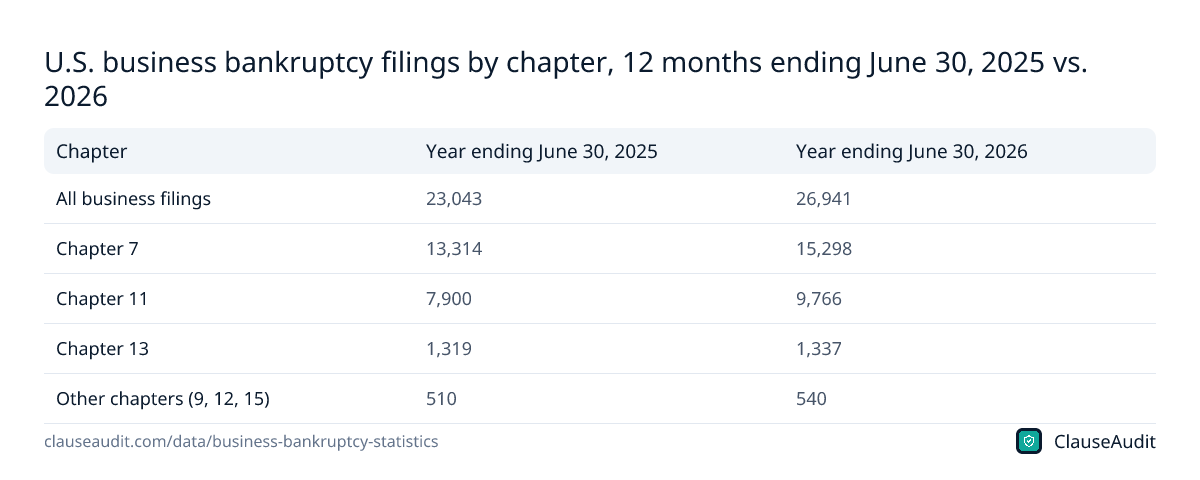
Download this chart (PNG)U.S. business bankruptcy filings by chapter, 12 months ending June 30, 2025 vs. 2026
| Chapter | Year ending June 30, 2025 | Year ending June 30, 2026 |
|---|---|---|
| All business filings | 23,043 | 26,941 |
| Chapter 7 | 13,314 | 15,298 |
| Chapter 11 | 7,900 | 9,766 |
| Chapter 13 | 1,319 | 1,337 |
| Other chapters (9, 12, 15) | 510 | 540 |
Source: Administrative Office of the U.S. Courts, Table F-2. U.S. Bankruptcy Courts, Business and Nonbusiness Cases Commenced, by Chapter, 12-Month Period Ending June 30, 2025; Administrative Office of the U.S. Courts, Table F-2. U.S. Bankruptcy Courts, Business and Nonbusiness Cases Commenced, by Chapter, 12-Month Period Ending June 30, 2026. Download as image
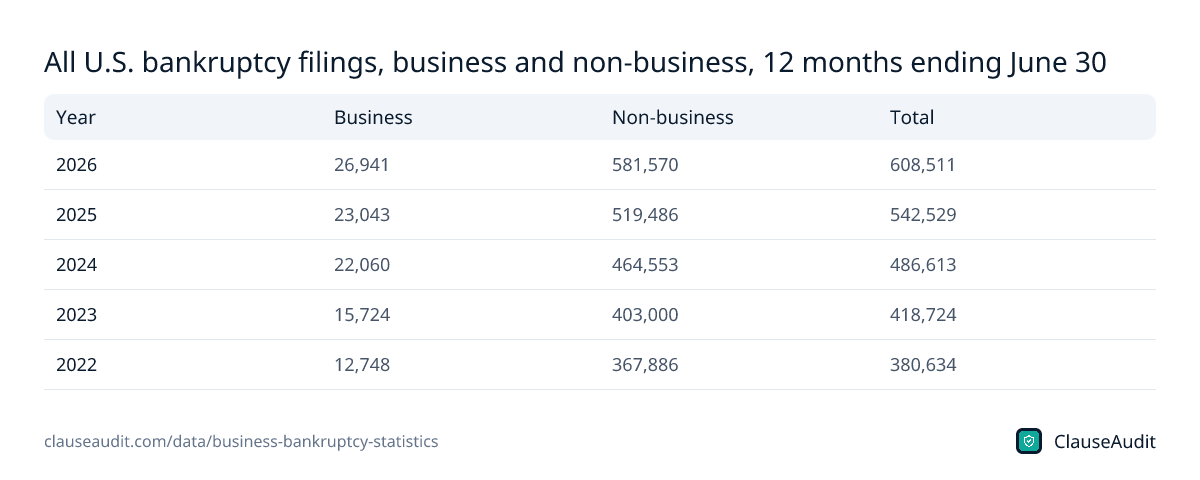
All U.S. bankruptcy filings, business and non-business, 12 months ending June 30
| Year | Business | Non-business | Total |
|---|---|---|---|
| 2026 | 26,941 | 581,570 | 608,511 |
| 2025 | 23,043 | 519,486 | 542,529 |
| 2024 | 22,060 | 464,553 | 486,613 |
| 2023 | 15,724 | 403,000 | 418,724 |
| 2022 | 12,748 | 367,886 | 380,634 |
Source: Administrative Office of the U.S. Courts, Bankruptcies Rise 12.2 Percent. Download as image
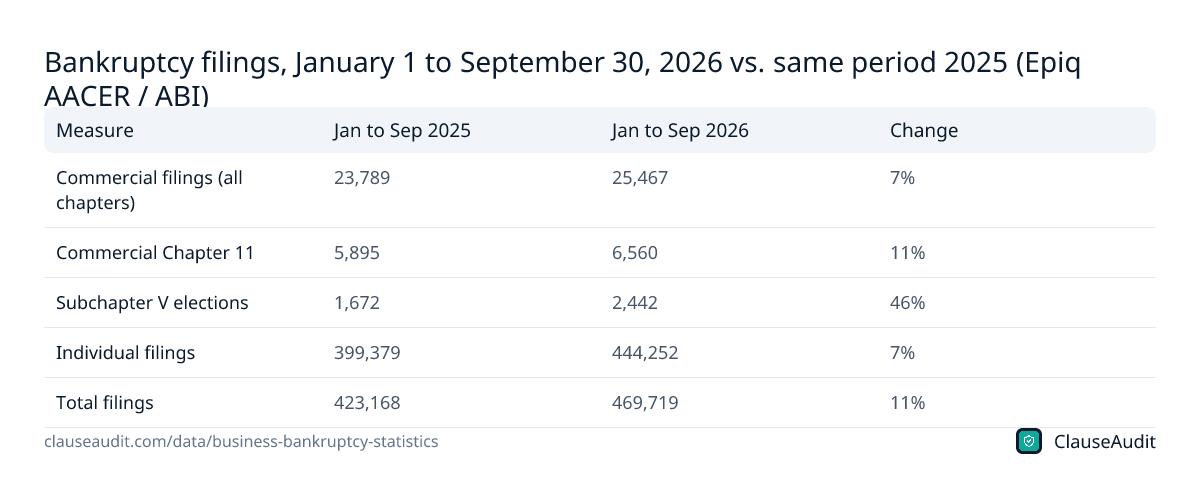
Bankruptcy filings, January 1 to September 30, 2026 vs. same period 2025 (Epiq AACER / ABI)
| Measure | Jan to Sep 2025 | Jan to Sep 2026 | Change |
|---|---|---|---|
| Commercial filings (all chapters) | 23,789 | 25,467 | 7% |
| Commercial Chapter 11 | 5,895 | 6,560 | 11% |
| Subchapter V elections | 1,672 | 2,442 | 46% |
| Individual filings | 399,379 | 444,252 | 7% |
| Total filings | 423,168 | 469,719 | 11% |
Source: Epiq AACER and American Bankruptcy Institute (ABI), Small Business Subchapter V Elections Increase 46% Compared to Last Year. Download as image
Are business bankruptcies going up in 2026?
Yes, and on two separate measures. The U.S. Courts count, which runs on a year ending June 30, shows 26,941 business filings, up 16.9% from 23,043. The Epiq AACER and ABI count, which runs on the calendar year, shows 25,467 commercial filings from January to September 2026, up 7% on the same months of 2025.
The two sources count differently, so do not add them together or compare one directly against the other. What matters is that both point the same way.
The mix is shifting too. Business Chapter 11 cases went from 7,900 to 9,766 in a year, and Subchapter V elections are up 46% so far in 2026. More small companies are choosing to restructure rather than close. For their creditors that is usually better news for their creditors than a liquidation, but it still means slower, smaller payments for anyone they owe.
What is the difference between Chapter 7, Chapter 11 and Subchapter V?
Chapter 7 is liquidation. A trustee sells what the business owns and splits the money among creditors in a set order. Unsecured creditors, such as a freelancer with an unpaid invoice, usually come near the back of that line and often get little or nothing.
Chapter 11 is reorganization. The business keeps running, proposes a plan to pay creditors over time, and asks the court to approve it. Contracts can be kept, renegotiated or rejected.
Subchapter V is a faster, cheaper version of Chapter 11 for smaller debtors. As of October 2026 a business qualifies if its combined debt is no more than $3,424,000 and at least half comes from business activity. Congress has passed a bill to raise that limit, but it was not signed as of mid-October 2026, so check the current figure before relying on it. Subchapter V cases are counted inside Chapter 11 in the court tables.
Why are so many Chapter 11 cases filed in Texas?
Large companies can often choose where to file, based on where they are incorporated, have their main office, or have an affiliate. Many pick districts with experienced bankruptcy judges and predictable procedures. That is why Texas, Southern recorded 1,569 business Chapter 11 cases and Texas, Northern 971, far ahead of any district in California, a state with a larger economy than Texas.
Delaware shows how quickly the map can move. It had 1,093 business Chapter 11 cases in the year ending June 30, 2025, and 331 a year later.
For you, the practical point is simple. If a large customer files, the case may be heard in a court hundreds or thousands of miles away. You will usually file your claim and watch the docket remotely, so read the notices you get in the mail and act on deadlines.
What happens when a client or vendor files for bankruptcy?
The moment a case is filed, an automatic stay kicks in. You must stop collection calls, demand letters and lawsuits against the debtor for money owed before the filing. Breaking the stay can expose you to penalties, even if the debt is real.
Say a marketing agency owes you for three months of design work and files Chapter 7. You become an unsecured creditor. You file a proof of claim and wait. Whatever you get comes after secured lenders, administrative costs and priority claims such as certain taxes and wages.
If the company files Chapter 11 instead, it may keep using your services while the case runs. Work you do after the filing is generally treated better than old invoices, but only if you get paid as you go. Do not let a new balance build up.
The same applies in reverse. If your SaaS vendor or equipment lessor files, it may reject your contract, cut support, or sell the business to a buyer with different terms. Your data, deposits and prepaid fees can get stuck in the process. A restaurant that prepaid a year of point-of-sale software, for example, may find itself filing a claim for the unused months while it pays a new vendor to replace the old one.
How to protect your business before a customer goes under
- Take a deposit or retainer before you start, and bill by milestone so no single unpaid invoice can hurt you badly.
- Keep payment windows short and charge a late fee in writing. A client that starts paying later and later is often giving you an early warning.
- Stop work when an invoice goes past due. Your contract should say you may pause without being in breach.
- Hold back ownership of your work until you are paid in full, so a buyer of the debtor's assets does not get your IP for free.
- Avoid prepaying a vendor for a full year unless the contract gives you a refund or data export if the vendor stops operating.
- When a customer files, stop collecting, read the court notice, and file your proof of claim before the deadline it names.
What if your own business is the one under pressure?
The rise in Subchapter V elections, 2,442 in the first nine months of 2026, shows how many small owners are using the courts to buy time. Bankruptcy can be a reasonable tool, but your loan documents decide a lot of what happens before you ever get there.
Many small business loans and merchant cash advances include a personal guarantee, so the debt follows you even if the company files. Some include a confession of judgment, cross-default terms or a blanket lien over everything the business owns. Read those clauses now, while you can still negotiate or refinance, and talk to a bankruptcy attorney before you miss a payment rather than after.
How ClauseAudit helps
Much of what a business bankruptcy costs you is settled by contracts signed long before the filing. ClauseAudit's automated review of your loan, financing or merchant cash advance agreement flags the terms that decide whether a bad year stays a business problem or becomes a personal one.
Each risky clause comes back in plain English with a suggested change you can raise with the lender before you sign.
- Personal guarantees, including unlimited and joint guarantees
- Default triggers and cross-default clauses that let one missed payment call every loan
- Acceleration terms that make the full balance due at once
- Confession of judgment clauses that waive your right to defend a lawsuit
- Blanket liens and collateral language covering all business assets
- Late fees, default interest and prepayment penalties
Frequently asked questions
How many businesses filed for bankruptcy in 2026?
U.S. courts recorded 26,941 business bankruptcy filings in the 12 months ending June 30, 2026. That is up 16.9% from 23,043 in the prior year. Separately, Epiq AACER and ABI counted 25,467 commercial filings from January to September 2026. The two sources use different methods and time periods, so treat them as separate measures.
How many Chapter 11 bankruptcies were filed in 2026?
There were 9,766 business Chapter 11 cases in the 12 months ending June 30, 2026, up from 7,900 a year earlier. Counting individuals as well, total Chapter 11 filings were 10,320. On a calendar basis, Epiq AACER and ABI counted 6,560 commercial Chapter 11 filings from January to September 2026, up 11%.
What is the Subchapter V debt limit?
As of October 2026, a business can elect Subchapter V if its combined debt is no more than $3,424,000 and at least half of that debt comes from business activity. Congress has passed a bill to raise the limit, but it had not been signed as of mid-October 2026. Check the current figure with a bankruptcy attorney before you plan around it.
How many Subchapter V cases were filed in 2025?
Epiq AACER and ABI counted 2,446 Subchapter V small business elections in calendar year 2025, up from 2,202 in 2024. From January to September 2026 there were already 2,442, up 46% on the same months of 2025, so 2026 is on track to pass the 2025 total.
Do more businesses liquidate or reorganize?
More liquidate. In the year ending June 30, 2026, there were 15,298 business Chapter 7 cases against 9,766 business Chapter 11 cases. Chapter 7 means the business closes and its assets are sold. Chapter 11, including Subchapter V, lets it keep operating while it works out a payment plan.
Can I still collect if a client files for bankruptcy?
Not directly. The automatic stay stops collection calls, letters and lawsuits for debts from before the filing. Instead, you file a proof of claim with the bankruptcy court by the deadline in the notice. Unsecured creditors are paid after secured lenders and priority claims, so recovery is often partial or nothing.
Which state has the most business bankruptcies?
For business Chapter 11 cases, Texas leads. The Southern District of Texas had 1,569 in the year ending June 30, 2026, and the Northern District had 971. New Jersey followed with 668. These are case counts, and big companies often file many affiliated cases in one court.
Does a personal guarantee survive business bankruptcy?
Usually, yes. When a company files, the lender can still pursue the person who signed the guarantee, because the guarantee is a separate promise. That is why it pays to read the guarantee language in any loan or lease before you sign, and to push for a cap or a time limit.
Use this data
Every chart and card below is free to reuse under CC BY 4.0. Download what you need and link back to this page.
 Stat cards
 Key findings card
 Infographic
 U.S. business bankruptcy filings, 12 months ending June 30, 2022 to 2026
 All Chapter 11 bankruptcy filings, 12 months ending June 30, 2022 to 2026
 Business bankruptcy filings by chapter, 12 months ending June 30, 2026
 Business Chapter 11 filings by bankruptcy court district, top 10, 12 months ending June 30, 2026
 Subchapter V small business elections by calendar year, 2023 to 2025
 Commercial Chapter 11 filings by calendar year, 2023 to 2025
 U.S. business bankruptcy filings by chapter, 12 months ending June 30, 2025 vs. 2026
 All U.S. bankruptcy filings, business and non-business, 12 months ending June 30
 Bankruptcy filings, January 1 to September 30, 2026 vs. same period 2025 (Epiq AACER / ABI)
Embed the infographic
Free to share on your site, blog or slides under CC BY 4.0. Please keep the credit link.
Sources and method
Every number on this page comes from the sources below, each opened and read on or before October 18, 2026. A second, independent review checked every figure against its source and corrected anything that did not match. Figures that could not be confirmed were left out.
- Administrative Office of the U.S. Courts, Bankruptcies Rise 12.2 Percent (July 28, 2026 (12 months ending June 30, 2026))
- Administrative Office of the U.S. Courts, Table F-2. U.S. Bankruptcy Courts, Business and Nonbusiness Cases Commenced, by Chapter, 12-Month Period Ending June 30, 2026 (12-month period ending June 30, 2026 (released July 2026))
- Administrative Office of the U.S. Courts, Table F-2. U.S. Bankruptcy Courts, Business and Nonbusiness Cases Commenced, by Chapter, 12-Month Period Ending June 30, 2025 (12-month period ending June 30, 2025 (file created July 21, 2025))
- Epiq AACER and American Bankruptcy Institute (ABI), Small Business Subchapter V Elections Increase 46% Compared to Last Year (October 8, 2026 (data through September 30, 2026))
- Epiq AACER and American Bankruptcy Institute (ABI), Total Bankruptcy Filings Increase 11% in Calendar Year 2025 (January 12, 2026)
- Epiq AACER and American Bankruptcy Institute (ABI), Commercial Chapter 11 Filings Increase 20 Percent in Calendar Year 2024 (January 3, 2025)
- Administrative Office of the U.S. Courts, Chapter 11 - Bankruptcy Basics (Undated web page, read October 18, 2026)
Cite this page
ClauseAudit, “Business Bankruptcy Statistics 2026: Chapter 11, Subchapter V and Chapter 7 Filings”, updated October 18, 2026, https://clauseaudit.com/data/business-bankruptcy-statistics. Free to reuse with a link back (CC BY 4.0).
This page summarises published data and law as checked on October 18, 2026. Figures are updated as new editions are released, and your own situation may differ. It is general information, not legal, tax or financial advice.