How Much Does a Franchise Cost? Initial Fees and Total Investment by Industry
By ClauseAudit Research · 6 sources ·
What is the average cost to open a franchise?
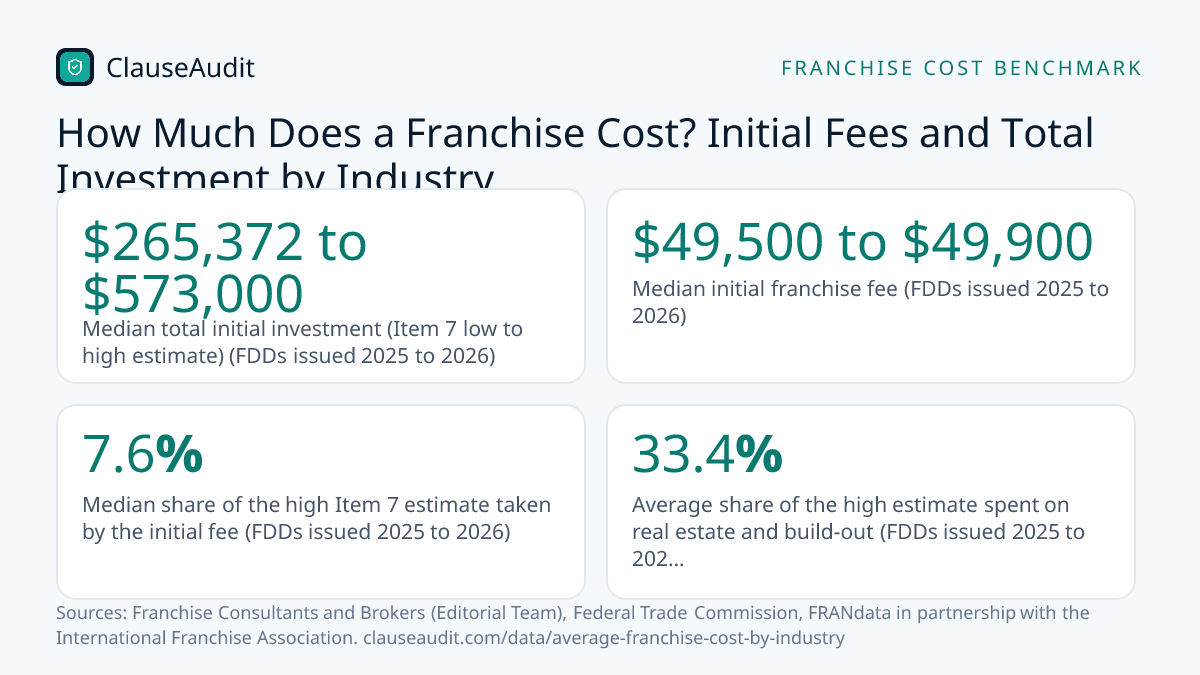
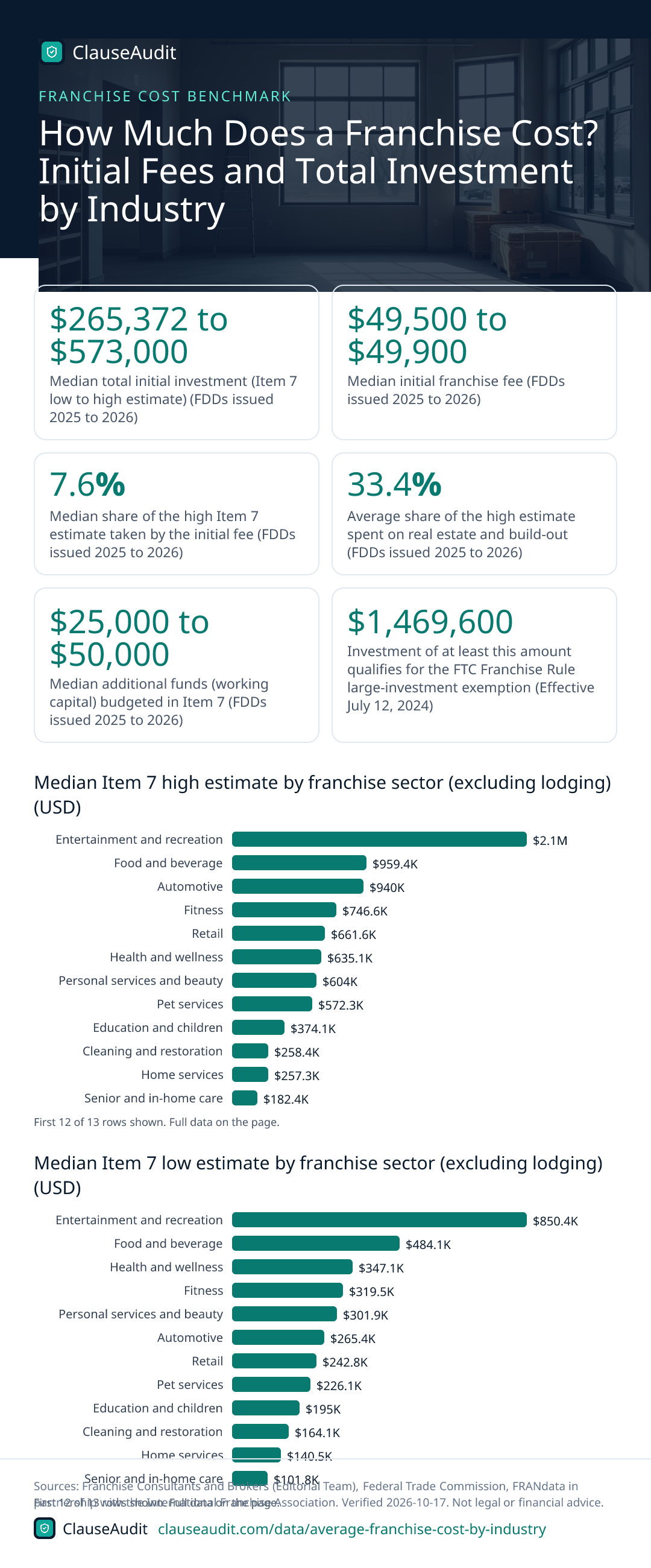
The median franchise costs $265,372 to $573,000 to open, based on the Item 7 estimates in 259 FDDs issued 2025 to 2026. The median initial franchise fee is only $49,500 to $49,900, or 7.6% of the high estimate. Build-out, equipment and working capital make up most of the bill, and the range by industry is huge.

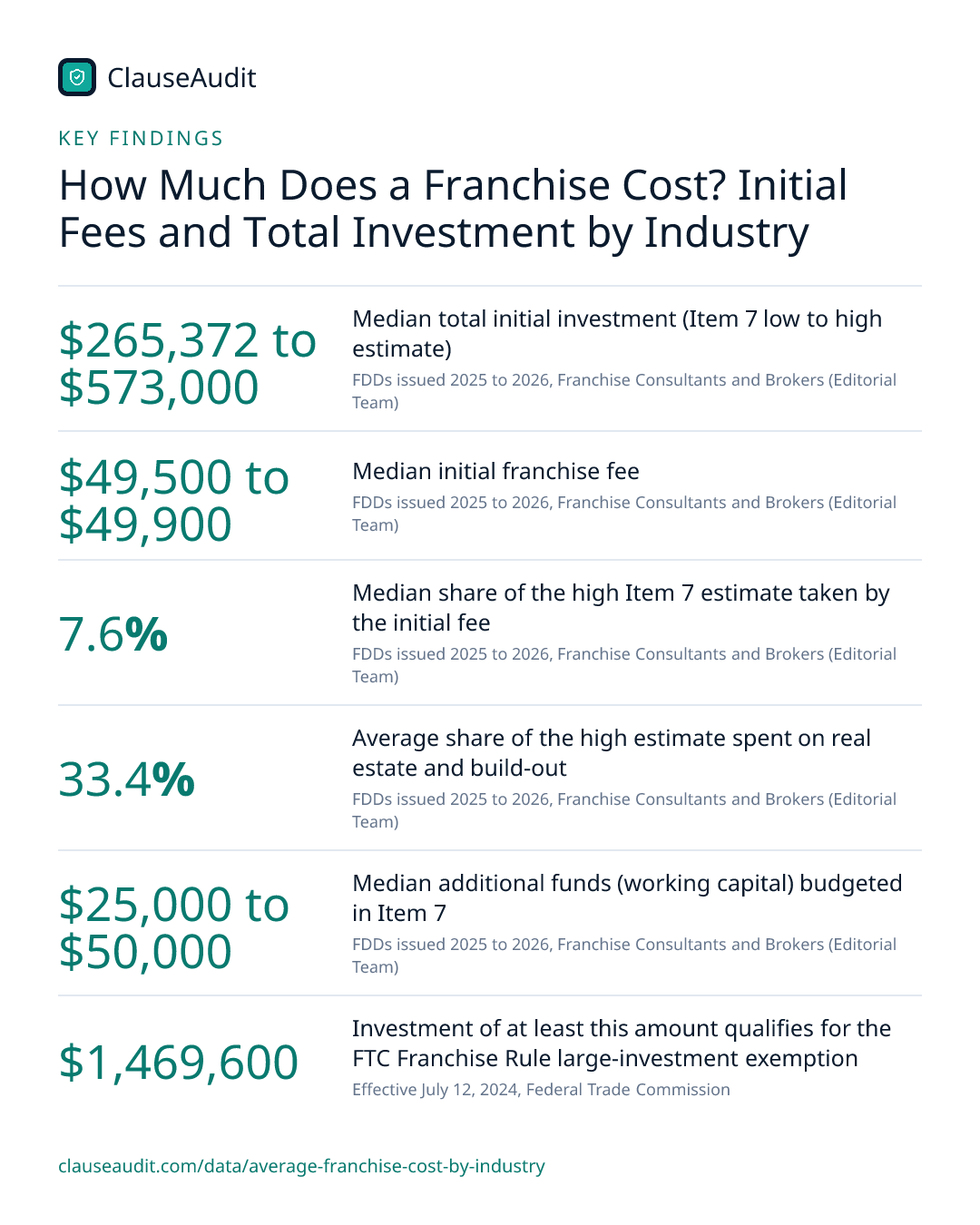
- Median total initial investment (Item 7 low to high estimate) (FDDs issued 2025 to 2026, Franchise Consultants and Brokers (Editorial Team))
- $265,372 to $573,000
- Median initial franchise fee (FDDs issued 2025 to 2026, Franchise Consultants and Brokers (Editorial Team))
- $49,500 to $49,900
- Median share of the high Item 7 estimate taken by the initial fee (FDDs issued 2025 to 2026, Franchise Consultants and Brokers (Editorial Team))
- 7.6%
- Average share of the high estimate spent on real estate and build-out (FDDs issued 2025 to 2026, Franchise Consultants and Brokers (Editorial Team))
- 33.4%
- Median additional funds (working capital) budgeted in Item 7 (FDDs issued 2025 to 2026, Franchise Consultants and Brokers (Editorial Team))
- $25,000 to $50,000
- Investment of at least this amount qualifies for the FTC Franchise Rule large-investment exemption (Effective July 12, 2024, Federal Trade Commission)
- $1,469,600
- Payments below this exempt a franchise sale from the FTC Franchise Rule (Effective July 12, 2024, Federal Trade Commission)
- $735
- Projected U.S. franchise establishments in 2026 (2026 (projection), FRANdata in partnership with the International Franchise Association)
- 845,009
Most people shopping for a franchise start with the franchise fee, because it is the number on the brochure. It is also the smallest piece of the decision. In the typical disclosure document, the fee covers a small slice of what you will actually spend before the doors open.
The figures below come from the Item 7 tables of 259 Franchise Disclosure Documents registered in Minnesota and issued 2025 to 2026, across 14 sectors. Item 7 is the franchisor's own estimate of your startup costs, so treat it as a starting point, not a quote. Here is how to read it and what to check before you sign.
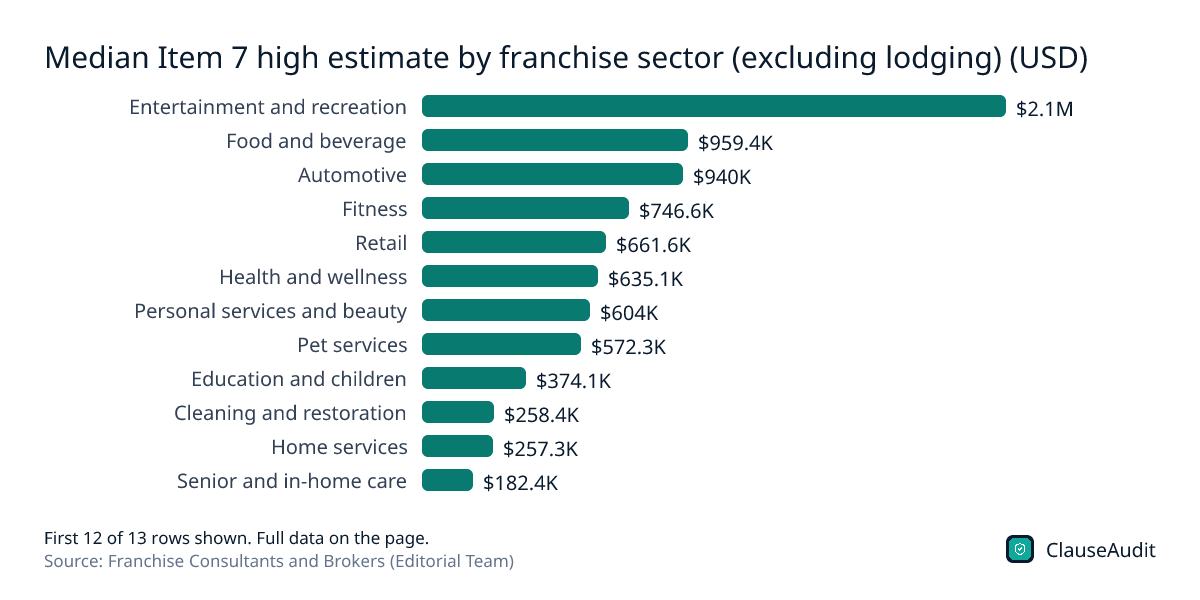
Median Item 7 high estimate by franchise sector (excluding lodging) (USD)
Chart data
| Label | Value |
|---|---|
| Entertainment and recreation | $2.1M |
| Food and beverage | $959.4K |
| Automotive | $940K |
| Fitness | $746.6K |
| Retail | $661.6K |
| Health and wellness | $635.1K |
| Personal services and beauty | $604K |
| Pet services | $572.3K |
| Education and children | $374.1K |
| Cleaning and restoration | $258.4K |
| Home services | $257.3K |
| Senior and in-home care | $182.4K |
| Business services | $125.6K |
The high estimate is the number to plan around. Entertainment and recreation tops out at a median of $2,104,350, while business services sits at $125,627, a gap wide enough that 'average franchise cost' means little until you pick a sector.
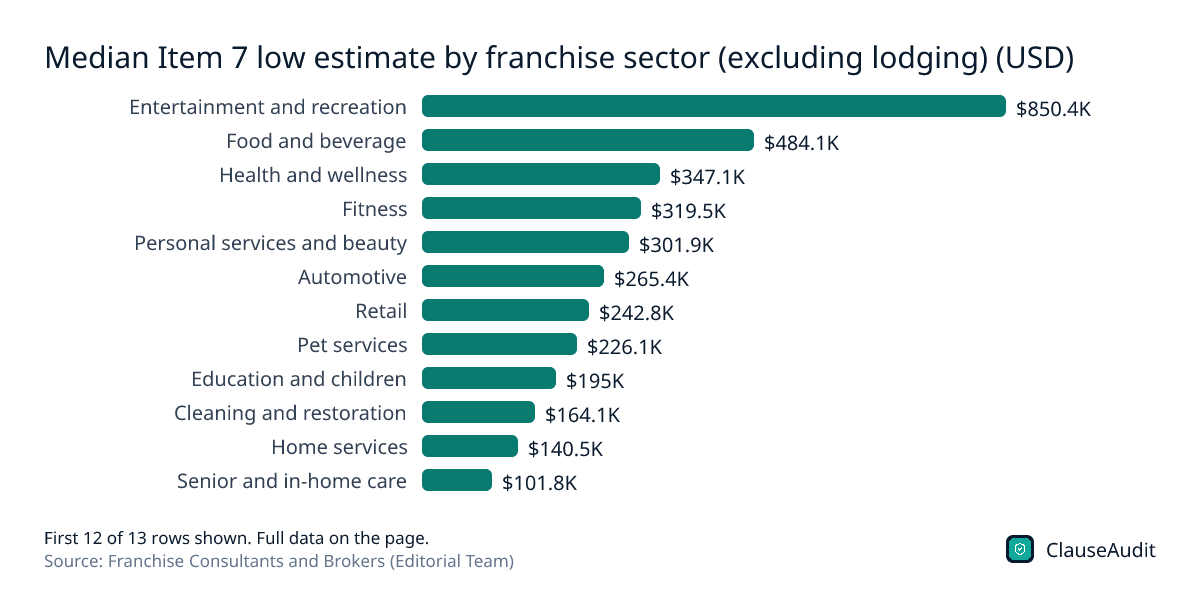
Download this chart (PNG)Median Item 7 low estimate by franchise sector (excluding lodging) (USD)
Chart data
| Label | Value |
|---|---|
| Entertainment and recreation | $850.4K |
| Food and beverage | $484.1K |
| Health and wellness | $347.1K |
| Fitness | $319.5K |
| Personal services and beauty | $301.9K |
| Automotive | $265.4K |
| Retail | $242.8K |
| Pet services | $226.1K |
| Education and children | $195K |
| Cleaning and restoration | $164.1K |
| Home services | $140.5K |
| Senior and in-home care | $101.8K |
| Business services | $58.9K |
The low estimate assumes everything goes your way: a cheap lease, a small space and no surprises. A food and beverage unit at $484,050 or a home services unit at $140,475 is the floor, not the likely bill.
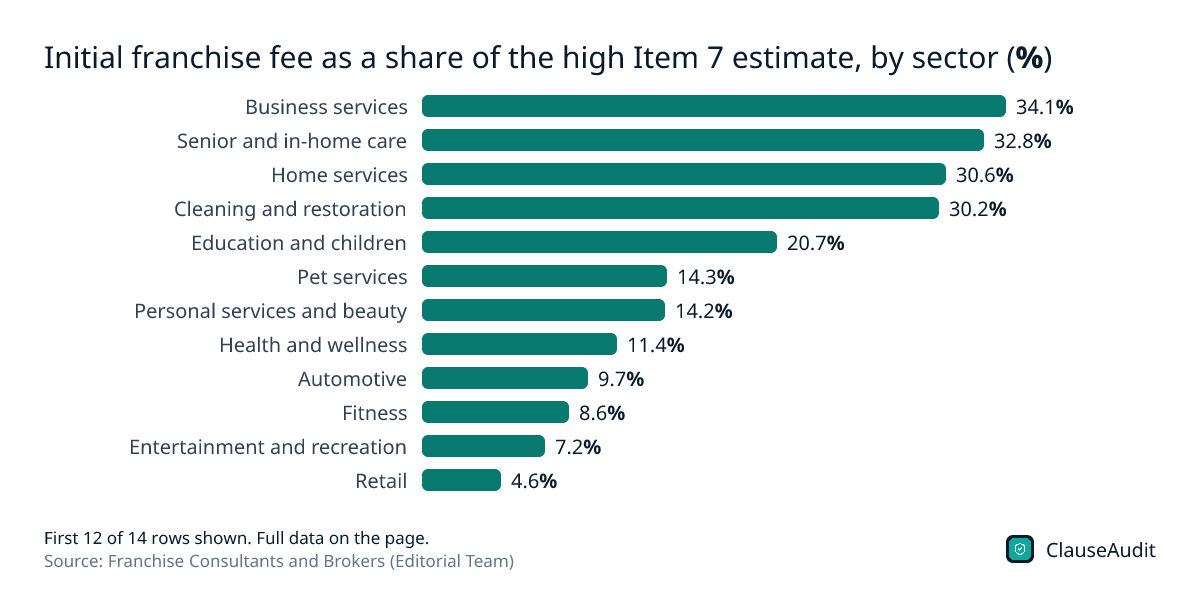
Download this chart (PNG)Initial franchise fee as a share of the high Item 7 estimate, by sector (%)
Chart data
| Label | Value |
|---|---|
| Business services | 34.1% |
| Senior and in-home care | 32.8% |
| Home services | 30.6% |
| Cleaning and restoration | 30.2% |
| Education and children | 20.7% |
| Pet services | 14.3% |
| Personal services and beauty | 14.2% |
| Health and wellness | 11.4% |
| Automotive | 9.7% |
| Fitness | 8.6% |
| Entertainment and recreation | 7.2% |
| Retail | 4.6% |
| Food and beverage | 3.7% |
| Lodging | 0.4% |
In business services the fee averages 34.1% of the high estimate, so the brand is a big part of what you buy. In food and beverage it drops to 3.7%, because the kitchen, the lease and the build-out swamp everything else.
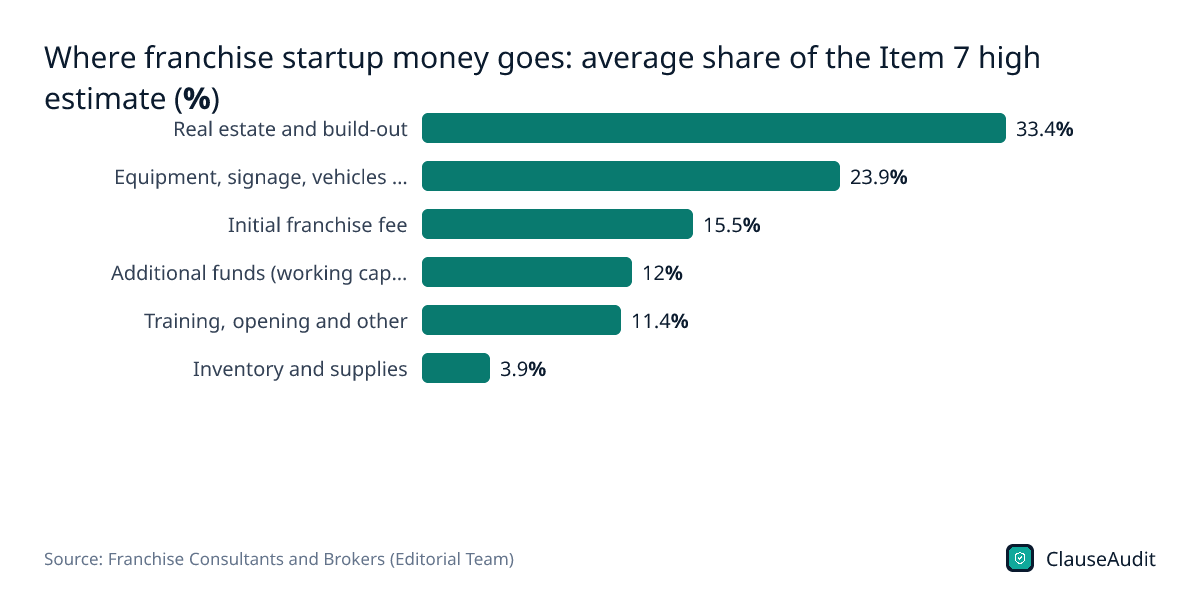
Download this chart (PNG)Where franchise startup money goes: average share of the Item 7 high estimate (%)
Chart data
| Label | Value |
|---|---|
| Real estate and build-out | 33.4% |
| Equipment, signage, vehicles and technology | 23.9% |
| Initial franchise fee | 15.5% |
| Additional funds (working capital) | 12% |
| Training, opening and other | 11.4% |
| Inventory and supplies | 3.9% |
Real estate and build-out takes 33.4% of the high estimate on average, more than the fee and working capital put together. It is also the line that depends most on your site, so get a local quote before you trust it.
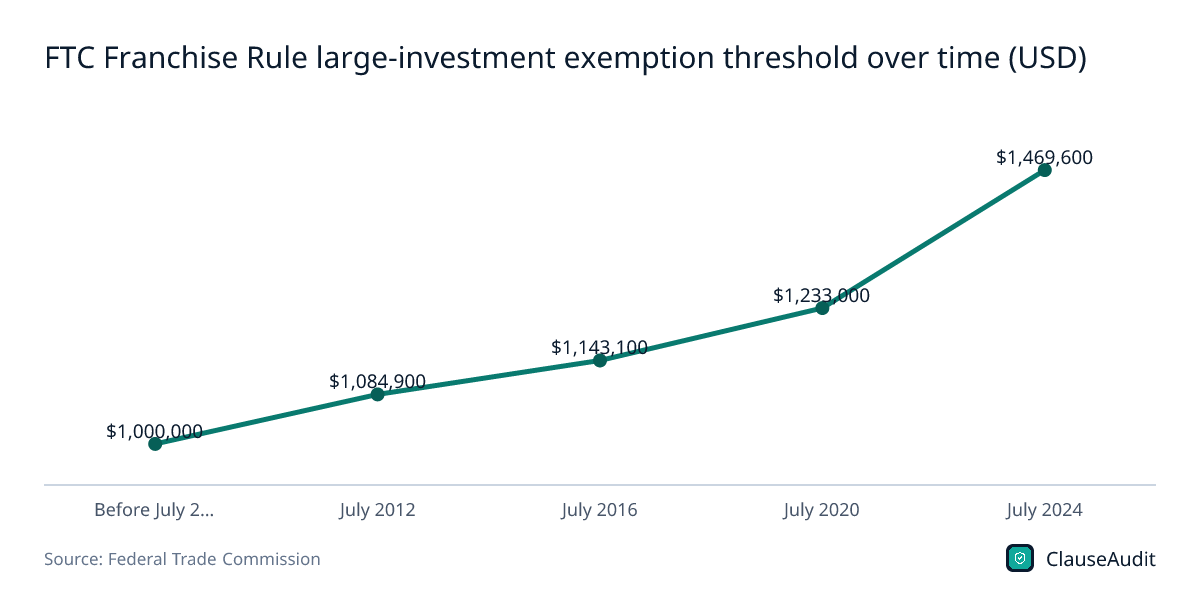
Download this chart (PNG)FTC Franchise Rule large-investment exemption threshold over time (USD)
Chart data
| Label | Value (USD) |
|---|---|
| Before July 2012 | $1,000,000 |
| July 2012 | $1,084,900 |
| July 2016 | $1,143,100 |
| July 2020 | $1,233,000 |
| July 2024 | $1,469,600 |
The FTC raises this threshold every four years for inflation. At $1,469,600 or more, not counting unimproved land or franchisor financing, a franchisor may be able to skip the federal disclosure document entirely.
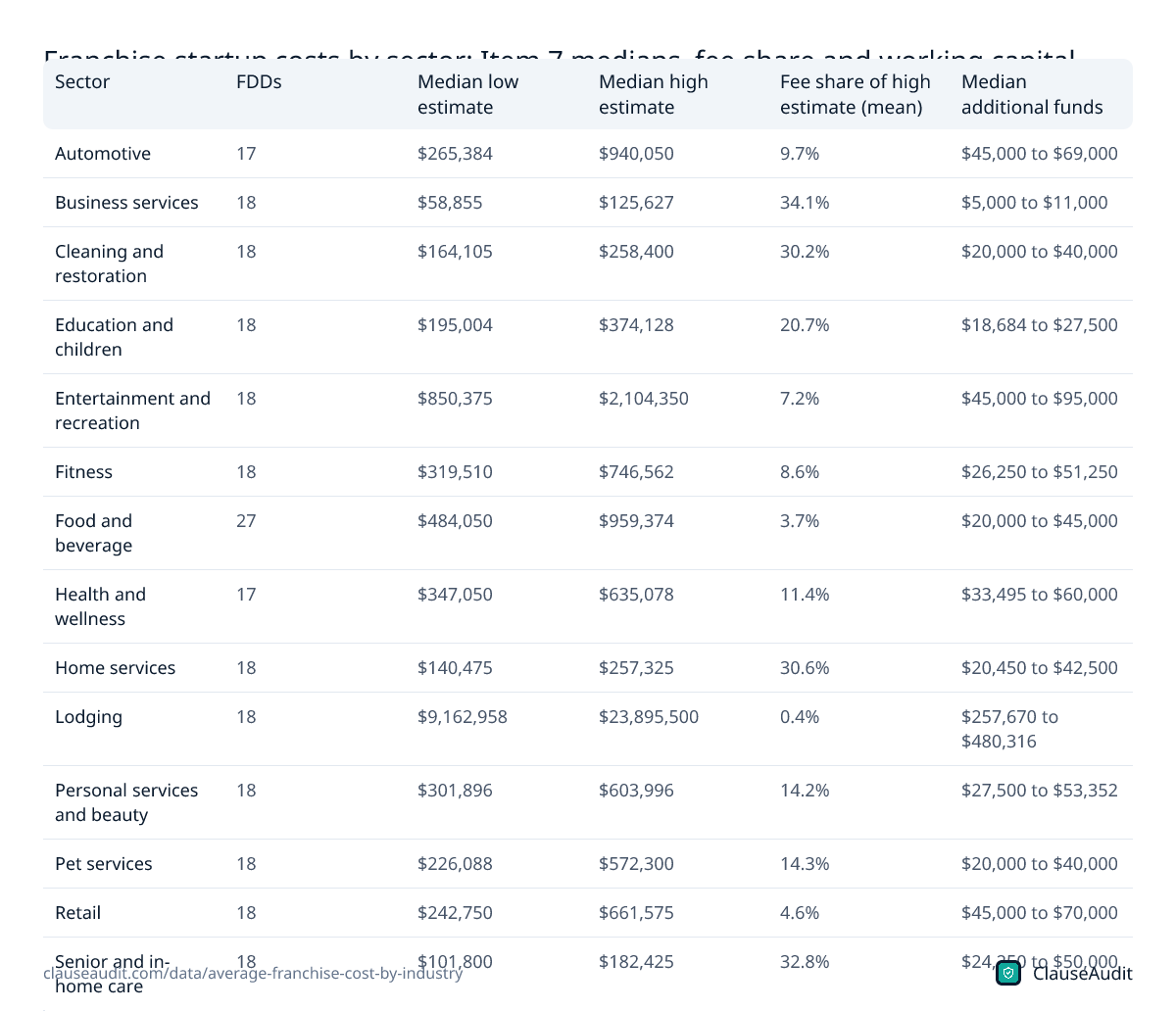
Download this chart (PNG)Franchise startup costs by sector: Item 7 medians, fee share and working capital (259 FDDs issued 2025 to 2026)
| Sector | FDDs | Median low estimate | Median high estimate | Fee share of high estimate (mean) | Median additional funds |
|---|---|---|---|---|---|
| Automotive | 17 | $265,384 | $940,050 | 9.7% | $45,000 to $69,000 |
| Business services | 18 | $58,855 | $125,627 | 34.1% | $5,000 to $11,000 |
| Cleaning and restoration | 18 | $164,105 | $258,400 | 30.2% | $20,000 to $40,000 |
| Education and children | 18 | $195,004 | $374,128 | 20.7% | $18,684 to $27,500 |
| Entertainment and recreation | 18 | $850,375 | $2,104,350 | 7.2% | $45,000 to $95,000 |
| Fitness | 18 | $319,510 | $746,562 | 8.6% | $26,250 to $51,250 |
| Food and beverage | 27 | $484,050 | $959,374 | 3.7% | $20,000 to $45,000 |
| Health and wellness | 17 | $347,050 | $635,078 | 11.4% | $33,495 to $60,000 |
| Home services | 18 | $140,475 | $257,325 | 30.6% | $20,450 to $42,500 |
| Lodging | 18 | $9,162,958 | $23,895,500 | 0.4% | $257,670 to $480,316 |
| Personal services and beauty | 18 | $301,896 | $603,996 | 14.2% | $27,500 to $53,352 |
| Pet services | 18 | $226,088 | $572,300 | 14.3% | $20,000 to $40,000 |
| Retail | 18 | $242,750 | $661,575 | 4.6% | $45,000 to $70,000 |
| Senior and in-home care | 18 | $101,800 | $182,425 | 32.8% | $24,250 to $50,000 |
| All sectors | 259 | $265,372 | $573,000 | 15.5% | $25,000 to $50,000 |
Source: Franchise Consultants and Brokers (Editorial Team), Franchise Initial Investment: 259 FDDs Analyzed (Item 7 tables from Minnesota CARDS registry, FDDs issued Jan 24, 2025 to Aug 18, 2026). Download as image
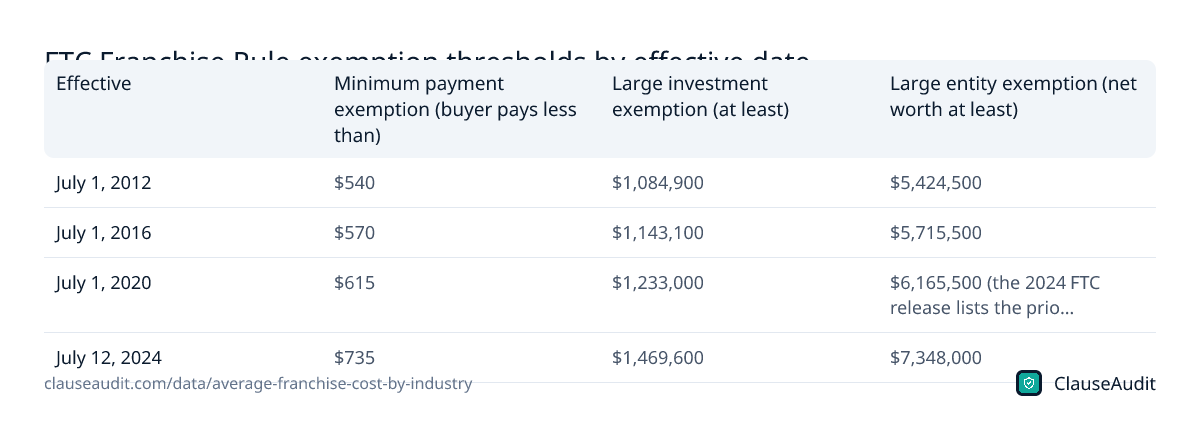
FTC Franchise Rule exemption thresholds by effective date
| Effective | Minimum payment exemption (buyer pays less than) | Large investment exemption (at least) | Large entity exemption (net worth at least) |
|---|---|---|---|
| July 1, 2012 | $540 | $1,084,900 | $5,424,500 |
| July 1, 2016 | $570 | $1,143,100 | $5,715,500 |
| July 1, 2020 | $615 | $1,233,000 | $6,165,500 (the 2024 FTC release lists the prior figure as $6,165,000) |
| July 12, 2024 | $735 | $1,469,600 | $7,348,000 |
Source: Federal Trade Commission, FTC Amends Franchise Rule to Revise Monetary Thresholds for Three Exemptions; Federal Trade Commission, FTC Adjusts Monetary Thresholds for Three Exemptions in Franchise Rule; Federal Trade Commission, FTC Adjusts Monetary Thresholds for Three Exemptions in Franchise Rule; Federal Trade Commission, FTC Publishes Inflation-Adjusted Monetary Thresholds for Three Exemptions in Franchise Rule. Download as image
How much does it cost to open a franchise?
For the median franchise in this set, plan on $265,372 at the low end and $573,000 at the high end. Those are the totals franchisors printed in Item 7, and they cover the fee, build-out, equipment, opening inventory, training costs and a cushion of working capital.
The spread inside one brand matters as much as the spread between brands. The low figure usually assumes a smaller site, a landlord who pays for some of the improvements, or used equipment. If you are opening in an expensive metro or a brand-new building, expect to land closer to the high number, and sometimes above it.
Also notice what Item 7 leaves out. Only 4 of the 259 FDDs included buying land or a building. If you plan to own your real estate, that cost sits entirely outside these numbers.
If you are financing the deal, build the loan request and your own cash injection around the high estimate, not the low one. A budget built on the low figure leaves no room for overruns, and going back to a lender for more money after closing is much harder than asking for enough up front.
What is the average initial franchise fee?
The median initial fee was $49,500 to $49,900 across the 258 FDDs that listed one. That sounds like a lot until you set it against the full budget. At the median it is 7.6% of the high estimate and 15.3% of the low one, and in 153 of 259 FDDs the fee was under 10% of the high estimate.
So a cheap fee does not mean a cheap franchise. Food and beverage brands had a median high estimate of $959,374, and the fee averaged just 3.7% of the high estimate. In business services the fee averaged 34.1%, so the same fee there can be one of your biggest costs.
Use the fee to compare value, not price. Ask what it buys: training, site selection help, a protected territory, opening support. Then read Item 6 and the franchise agreement for the fees that keep coming after you open.
Which franchise categories are cheapest to start?
Service businesses that run from a van, a home office or a small unit are the cheapest to get into. Business services had a median range of $58,855 to $125,627, senior and in-home care $101,800 to $182,425, and home services $140,475 to $257,325.
Lower startup cost has a tradeoff. In these sectors the fee is a much bigger share of the budget, 30.6% for home services and 32.8% for senior care, which means you are paying mostly for the brand, the system and the training. If the system is weak, there is less hard equipment or real estate to fall back on.
At the other end, entertainment and recreation ran $850,375 to $2,104,350, and lodging was in a different league at $9,162,958 to $23,895,500. Those are real estate businesses with a brand attached.
How much working capital does a franchise need?
The median Item 7 budgets $25,000 to $50,000 in additional funds, the money that covers rent, payroll and bills while sales ramp up. In 237 of 259 FDDs that cushion was sized for exactly three months.
Three months is a short runway. A new unit can take longer than that to break even, especially if the build-out runs late and you are paying rent before opening. Retail and automotive budgeted more, $45,000 to $70,000 and $45,000 to $69,000, and lodging budgeted $257,670 to $480,316.
A practical rule: build your own monthly cash burn from the lease, staff plan and royalty schedule, then hold enough to cover that for well beyond the franchisor's window.
Why do franchise costs vary so much by industry?
The short answer is real estate. The cost categories chart shows build-out at 33.4% of the high estimate on average, with equipment, signage, vehicles and technology adding 23.9%. A brand that needs a storefront, a kitchen or a gym floor carries those costs. A brand you run from a truck does not.
Look at fitness and automotive. Fitness ran $319,510 to $746,562, because you are fitting out a large open space and buying machines. Automotive ran $265,384 to $940,050, the widest low-to-high ratio in the table. When a range is that wide, ask the franchisor which kind of site each end assumes.
Food and beverage sits near the top for the same reason. Hoods, walk-in coolers, plumbing and seating add up fast, and a drive-thru or freestanding site tends to push you toward the $959,374 high estimate rather than the $484,050 low one.
For you, the useful question is not which industry is cheap. It is how much of the money goes into things you could resell or reuse if the unit struggles, and how much is sunk the day you open. Equipment has some resale value. Build-out inside a leased space mostly does not, and the fee never comes back.
What to do before you commit money
- Get the FDD and read Item 7 line by line. Note which rows are estimates, which are fixed payments to the franchisor, and which are paid to suppliers the franchisor picks. Ask why any row has an unusually wide range.
- Call existing franchisees listed in Item 20 and ask what they actually spent, and how long the money lasted before the unit paid its own bills.
- Price your build-out locally. Get a contractor quote and a lease proposal before you trust the franchisor's range, and ask the landlord about a tenant improvement allowance, which can pull your number toward the low estimate.
- Check whether the deal falls under an FTC exemption. A total investment of $1,469,600 or more, or total payments under $735 through your first six months of operation, can mean no disclosure document is required.
- Read the franchise agreement for costs that sit outside Item 7: remodel requirements, technology fees, transfer fees and renewal fees.
- Have the agreement reviewed before you sign or pay the fee. Once you sign, most of these terms are fixed for the length of the deal.
How ClauseAudit helps
Item 7 tells you what it costs to open. The franchise agreement tells you what it costs to stay open and to leave. Upload the agreement and ClauseAudit runs an automated review that flags the clauses that move your real total, in plain English.
You get a list of the terms worth negotiating or asking about before you pay the fee, so the budget you plan with is closer to the one you live with.
- Remodel and upgrade obligations, and how often the franchisor can require them
- Technology, marketing fund and other recurring fees that can rise during the term
- Whether the initial fee is refundable if you cannot find a site or open on time
- Personal guarantee scope, including your spouse or other owners
- Renewal and transfer fees, and the conditions attached to each
- Termination, default and post-term non-compete terms that put your investment at risk
Frequently asked questions
What is the average cost to buy a franchise?
Across 259 FDDs issued 2025 to 2026, the median Item 7 total ran from $265,372 at the low estimate to $573,000 at the high estimate. That includes the initial fee, build-out, equipment, inventory and working capital. It does not include buying land or a building, which only 4 of the 259 FDDs counted.
What is a typical franchise fee?
The median initial franchise fee was $49,500 to $49,900 across 258 FDDs that listed one. The fee is usually a small share of the total. At the median it was 7.6% of the high Item 7 estimate, and in 153 of 259 FDDs it was under 10%.
How much does a restaurant franchise cost?
Food and beverage franchises had a median Item 7 range of $484,050 to $959,374 in this set of 27 FDDs. The initial fee was only 3.7% of the high estimate on average, because kitchen equipment, build-out and the lease drive the cost. Budget for the high end if you are opening in a new building.
What is Item 7 in an FDD?
Item 7 is the section of the Franchise Disclosure Document where the franchisor estimates your initial investment. It lists each cost, such as the fee, real estate, equipment, inventory and additional funds, with a low and high range. These are the franchisor's estimates, not guaranteed prices, so check them against quotes and existing owners.
What are the cheapest franchise categories?
Business services had the lowest median range at $58,855 to $125,627. Senior and in-home care ran $101,800 to $182,425, and home services $140,475 to $257,325. These businesses need little real estate, but the fee makes up a much bigger share of the budget, about a third in several of them.
How much working capital do franchisors require?
The median FDD budgets $25,000 to $50,000 in additional funds, and 237 of 259 sized that cushion for exactly three months. That is often too short. Build your own monthly burn estimate from rent, payroll and royalties, and plan for a longer ramp than the franchisor shows.
Where does most franchise startup money go?
Real estate and build-out is the largest category, at an average 33.4% of the high Item 7 estimate. Equipment, signage, vehicles and technology come next at 23.9%, then the initial fee at 15.5% and working capital at 12%. Inventory and supplies are only 3.9%.
When does a franchisor not have to give me an FDD?
Under the FTC Franchise Rule thresholds effective July 12, 2024, a sale can be exempt if your total investment is at least $1,469,600, excluding unimproved land and franchisor financing, or if you pay less than $735 through your first six months of operation. State laws can still apply, so ask for the FDD either way.
Use this data
Every chart and card below is free to reuse under CC BY 4.0. Download what you need and link back to this page.
 Stat cards
 Key findings card
 Infographic
 Median Item 7 high estimate by franchise sector (excluding lodging) (USD)
 Median Item 7 low estimate by franchise sector (excluding lodging) (USD)
 Initial franchise fee as a share of the high Item 7 estimate, by sector (%)
 Where franchise startup money goes: average share of the Item 7 high estimate (%)
 FTC Franchise Rule large-investment exemption threshold over time (USD)
 Franchise startup costs by sector: Item 7 medians, fee share and working capital (259 FDDs issued 2025 to 2026)
 FTC Franchise Rule exemption thresholds by effective date
Embed the infographic
Free to share on your site, blog or slides under CC BY 4.0. Please keep the credit link.
Sources and method
Every number on this page comes from the sources below, each opened and read on or before October 17, 2026. A second, independent review checked every figure against its source and corrected anything that did not match. Figures that could not be confirmed were left out.
- Franchise Consultants and Brokers (Editorial Team), Franchise Initial Investment: 259 FDDs Analyzed (Item 7 tables from Minnesota CARDS registry, FDDs issued Jan 24, 2025 to Aug 18, 2026) (Updated October 7, 2026)
- Federal Trade Commission, FTC Publishes Inflation-Adjusted Monetary Thresholds for Three Exemptions in Franchise Rule (July 12, 2024)
- Federal Trade Commission, FTC Adjusts Monetary Thresholds for Three Exemptions in Franchise Rule (June 3, 2020)
- Federal Trade Commission, FTC Adjusts Monetary Thresholds for Three Exemptions in Franchise Rule (May 16, 2016)
- Federal Trade Commission, FTC Amends Franchise Rule to Revise Monetary Thresholds for Three Exemptions (June 13, 2012)
- FRANdata in partnership with the International Franchise Association, 2026 Franchising Economic Outlook (2026 edition)
Cite this page
ClauseAudit, “How Much Does a Franchise Cost? Initial Fees and Total Investment by Industry”, updated October 17, 2026, https://clauseaudit.com/data/average-franchise-cost-by-industry. Free to reuse with a link back (CC BY 4.0).
This page summarises published data and law as checked on October 17, 2026. Figures are updated as new editions are released, and your own situation may differ. It is general information, not legal, tax or financial advice.