Franchise Royalty and Marketing Fees: Averages by Industry (2026)
By ClauseAudit Research · 7 sources ·
What is the average franchise royalty fee?
The typical franchise royalty is 6% of sales, based on 239 disclosure documents issued from January 2025 to August 2026. The middle half of brands charged 5% to 7%. Add the marketing fund and other percentage fees and the median rises to 8% of sales, before fixed technology charges.
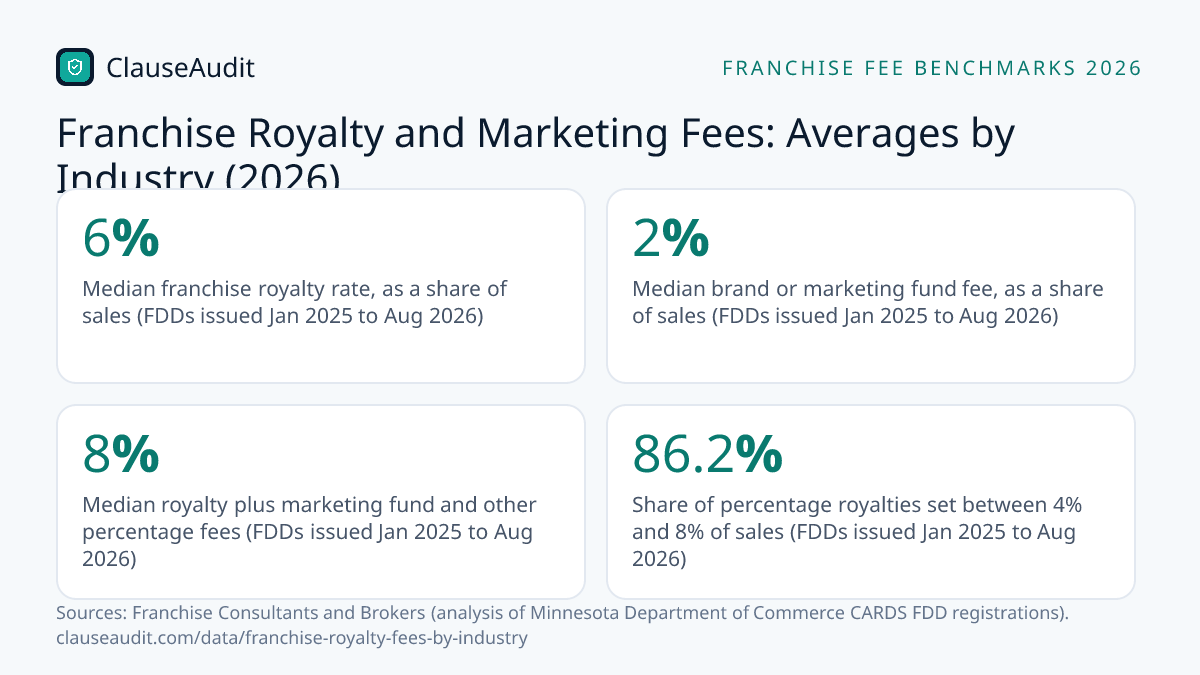
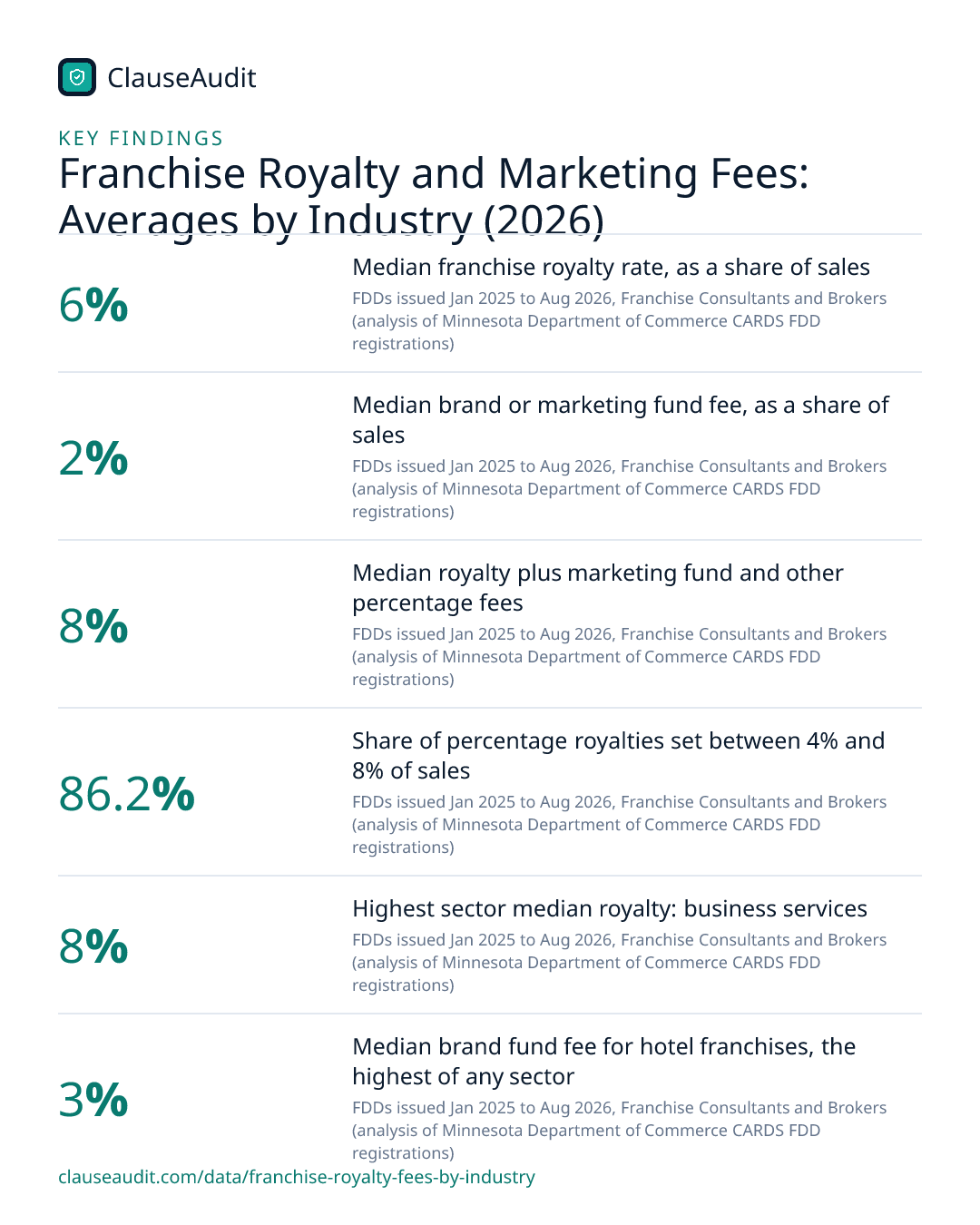
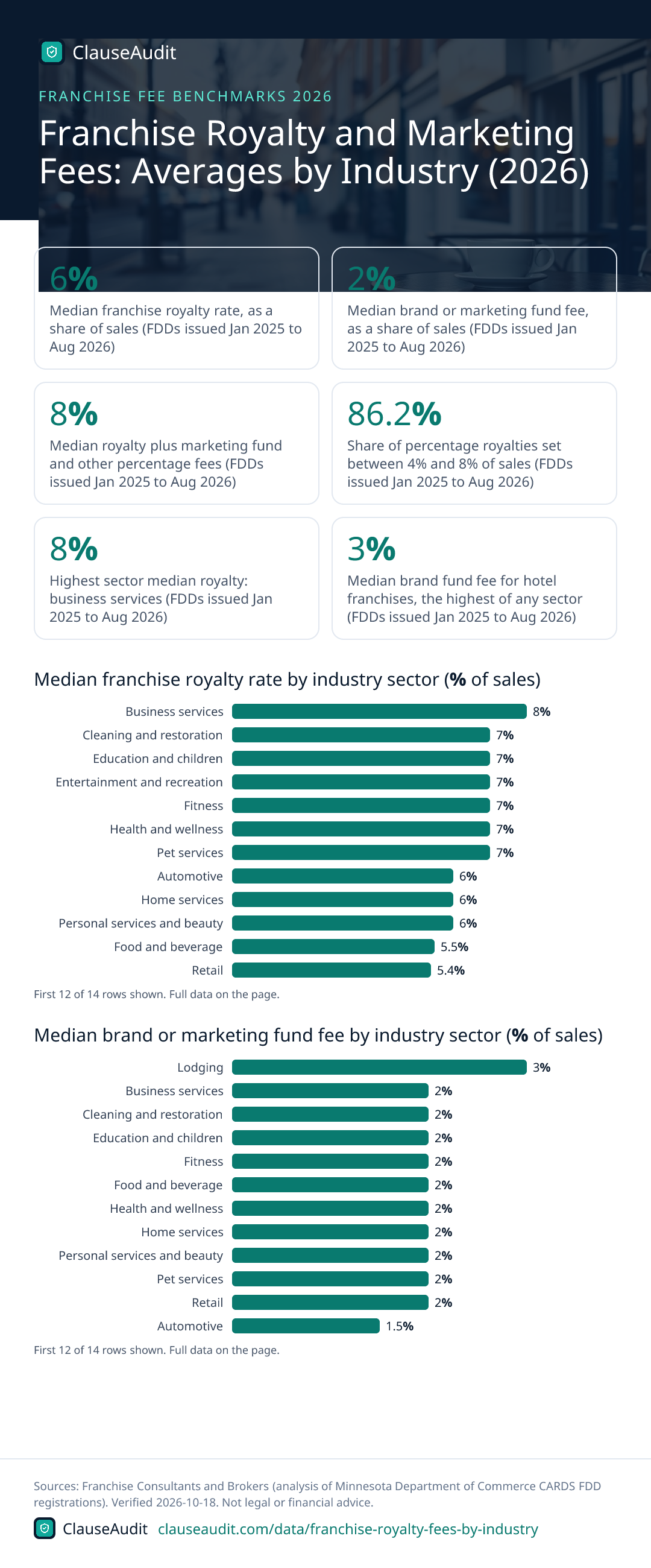
- Median franchise royalty rate, as a share of sales (FDDs issued Jan 2025 to Aug 2026, Franchise Consultants and Brokers (analysis of Minnesota Department of Commerce CARDS FDD registrations))
- 6%
- Median brand or marketing fund fee, as a share of sales (FDDs issued Jan 2025 to Aug 2026, Franchise Consultants and Brokers (analysis of Minnesota Department of Commerce CARDS FDD registrations))
- 2%
- Median royalty plus marketing fund and other percentage fees (FDDs issued Jan 2025 to Aug 2026, Franchise Consultants and Brokers (analysis of Minnesota Department of Commerce CARDS FDD registrations))
- 8%
- Share of percentage royalties set between 4% and 8% of sales (FDDs issued Jan 2025 to Aug 2026, Franchise Consultants and Brokers (analysis of Minnesota Department of Commerce CARDS FDD registrations))
- 86.2%
- Highest sector median royalty: business services (FDDs issued Jan 2025 to Aug 2026, Franchise Consultants and Brokers (analysis of Minnesota Department of Commerce CARDS FDD registrations))
- 8%
- Median brand fund fee for hotel franchises, the highest of any sector (FDDs issued Jan 2025 to Aug 2026, Franchise Consultants and Brokers (analysis of Minnesota Department of Commerce CARDS FDD registrations))
- 3%
- Share of franchise agreements with a minimum royalty clause (FDDs issued Jan 2025 to Aug 2026, Franchise Consultants and Brokers (analysis of Minnesota Department of Commerce CARDS FDD registrations))
- 40.2%
- Share of FDDs listing a recurring technology, software or POS charge (FDDs issued Jan 2025 to Aug 2026, Franchise Consultants and Brokers (analysis of Minnesota Department of Commerce CARDS FDD registrations))
- 87.3%
A franchise royalty is rent on the brand. You pay it every week or month for as long as the agreement runs, and it comes off sales, not profit. A slow month with a big payroll still sends the same share of revenue to the franchisor.
The figures here come from franchise disclosure documents registered in Minnesota, grouped by sector. Use them to see whether the brand you are weighing is ordinary or expensive, then go read the clauses that decide what you will actually pay.
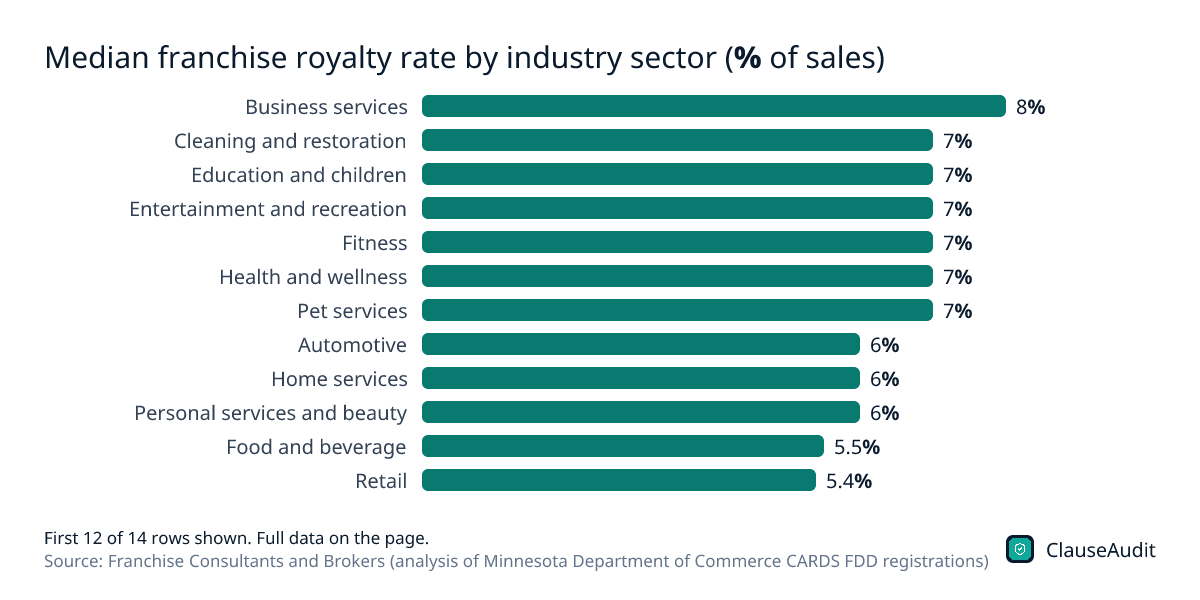
Median franchise royalty rate by industry sector (% of sales)
Chart data
| Label | Value |
|---|---|
| Business services | 8% |
| Cleaning and restoration | 7% |
| Education and children | 7% |
| Entertainment and recreation | 7% |
| Fitness | 7% |
| Health and wellness | 7% |
| Pet services | 7% |
| Automotive | 6% |
| Home services | 6% |
| Personal services and beauty | 6% |
| Food and beverage | 5.5% |
| Retail | 5.4% |
| Lodging | 5.25% |
| Senior and in-home care | 5% |
Service brands charge more than food and retail. Business services leads at 8% and senior and in-home care sits lowest at 5%, so compare a royalty against its own sector, not the overall median.
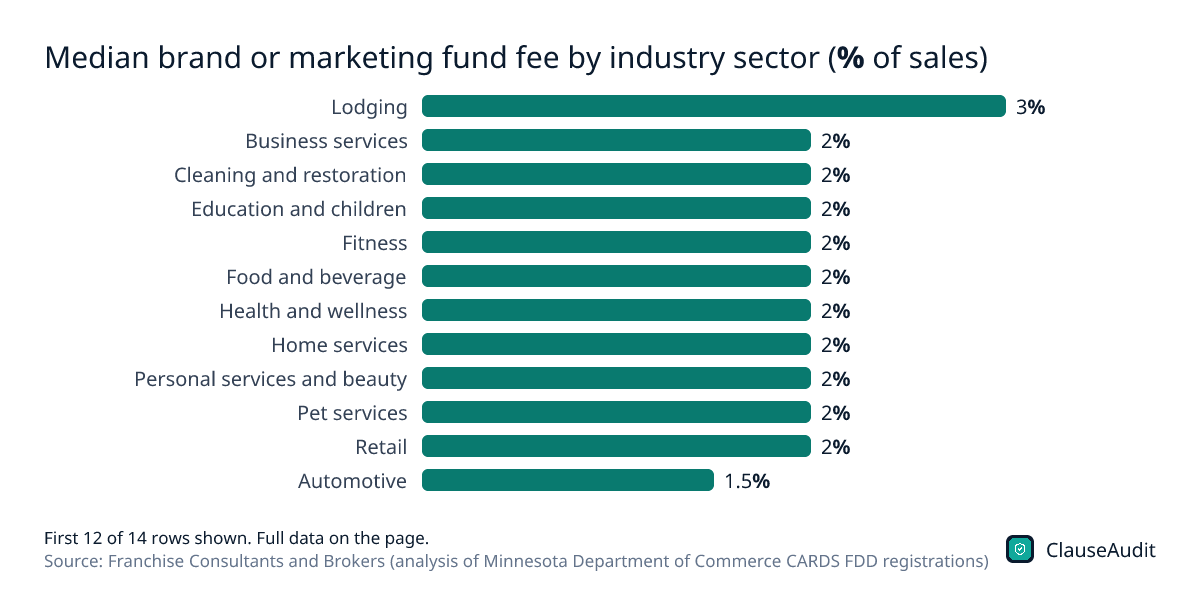
Download this chart (PNG)Median brand or marketing fund fee by industry sector (% of sales)
Chart data
| Label | Value |
|---|---|
| Lodging | 3% |
| Business services | 2% |
| Cleaning and restoration | 2% |
| Education and children | 2% |
| Fitness | 2% |
| Food and beverage | 2% |
| Health and wellness | 2% |
| Home services | 2% |
| Personal services and beauty | 2% |
| Pet services | 2% |
| Retail | 2% |
| Automotive | 1.5% |
| Entertainment and recreation | 1.5% |
| Senior and in-home care | 1% |
Nearly every sector lands on a 2% brand fund. Lodging is the exception at 3%, and senior and in-home care sits lowest at 1%.
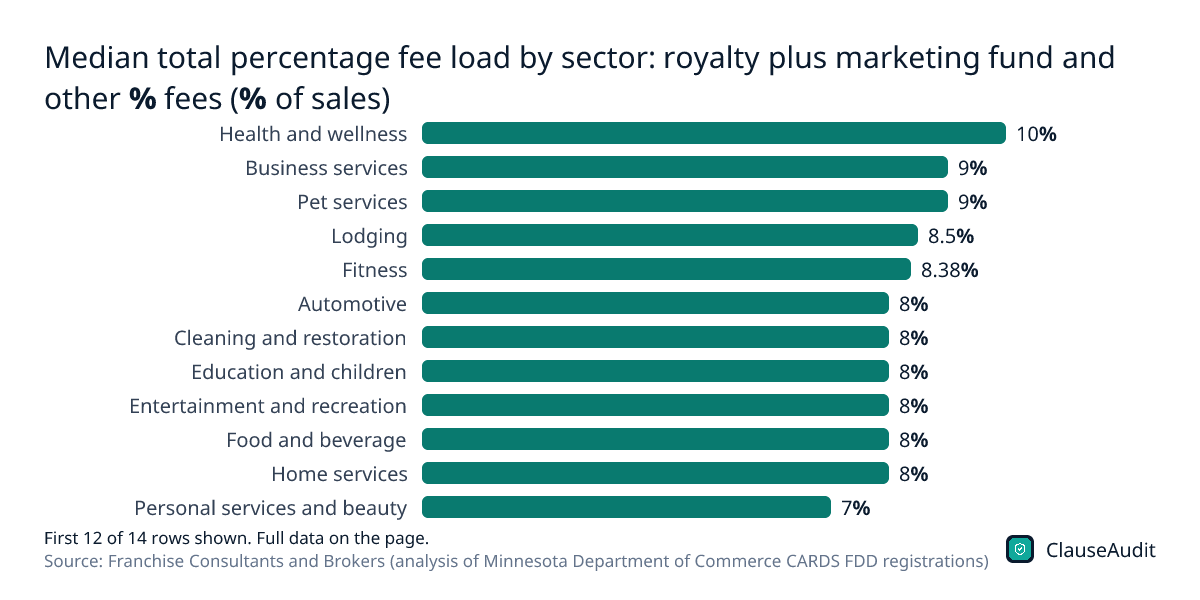
Download this chart (PNG)Median total percentage fee load by sector: royalty plus marketing fund and other % fees (% of sales)
Chart data
| Label | Value |
|---|---|
| Health and wellness | 10% |
| Business services | 9% |
| Pet services | 9% |
| Lodging | 8.5% |
| Fitness | 8.38% |
| Automotive | 8% |
| Cleaning and restoration | 8% |
| Education and children | 8% |
| Entertainment and recreation | 8% |
| Food and beverage | 8% |
| Home services | 8% |
| Personal services and beauty | 7% |
| Senior and in-home care | 7% |
| Retail | 6% |
This is the chart to budget from. Health and wellness reaches 10% of sales once every percentage fee is counted, while retail stays at 6%, a wider spread than the royalty chart suggests.
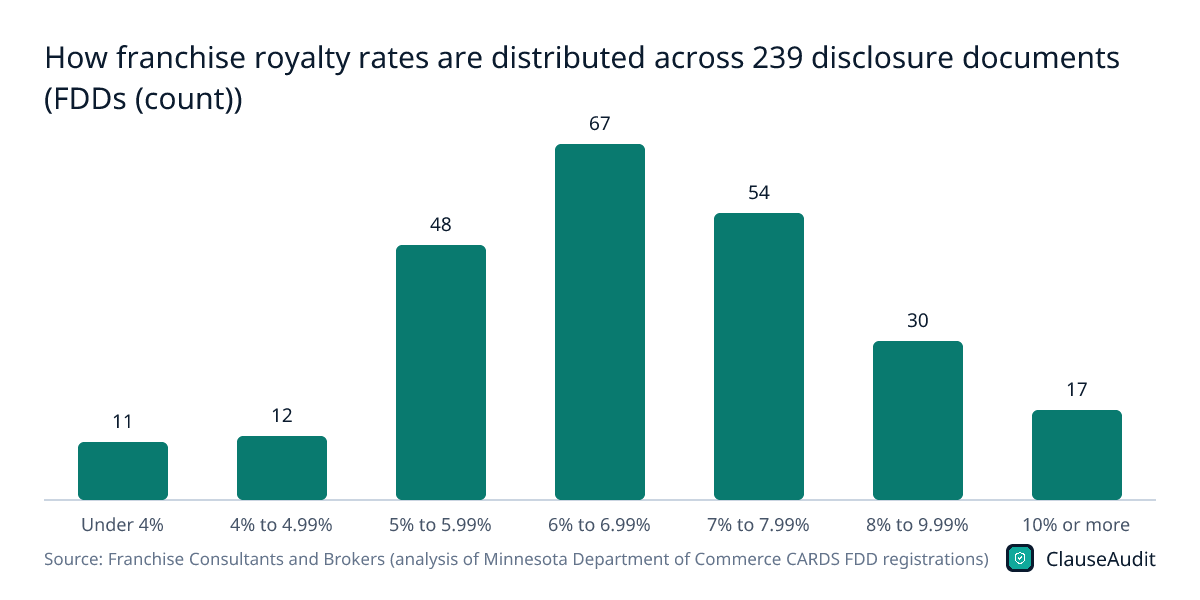
Download this chart (PNG)How franchise royalty rates are distributed across 239 disclosure documents (FDDs (count))
Chart data
| Label | Value (FDDs (count)) |
|---|---|
| Under 4% | 11 |
| 4% to 4.99% | 12 |
| 5% to 5.99% | 48 |
| 6% to 6.99% | 67 |
| 7% to 7.99% | 54 |
| 8% to 9.99% | 30 |
| 10% or more | 17 |
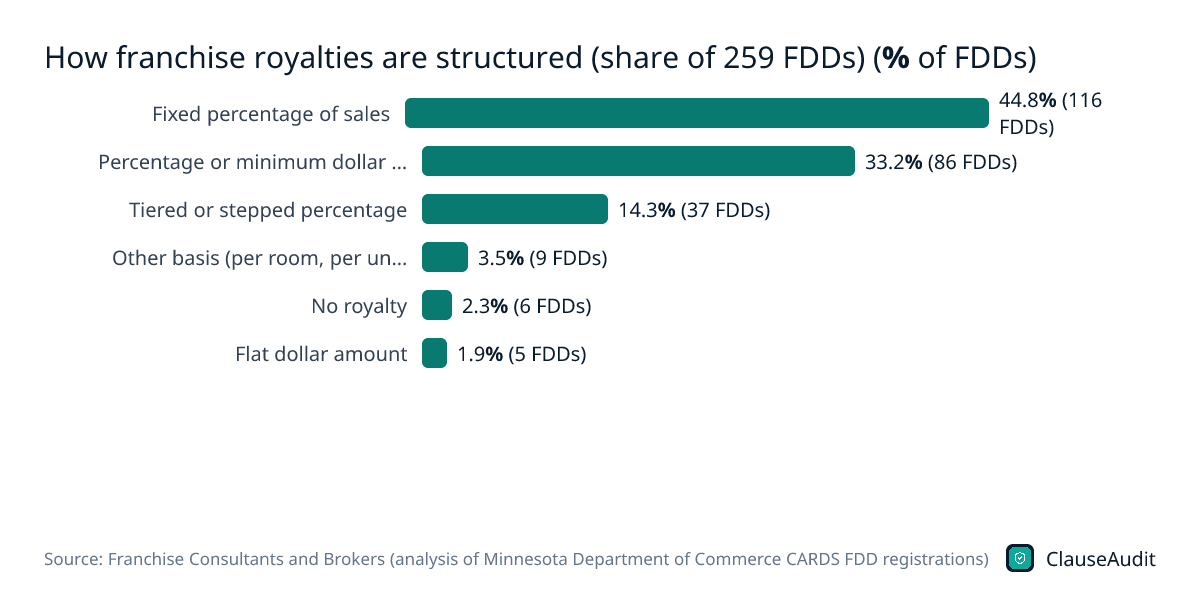
How franchise royalties are structured (share of 259 FDDs) (% of FDDs)
Chart data
| Label | Value |
|---|---|
| Fixed percentage of sales | 44.8% (116 FDDs) |
| Percentage or minimum dollar amount, whichever is greater | 33.2% (86 FDDs) |
| Tiered or stepped percentage | 14.3% (37 FDDs) |
| Other basis (per room, per unit, mixed) | 3.5% (9 FDDs) |
| No royalty | 2.3% (6 FDDs) |
| Flat dollar amount | 1.9% (5 FDDs) |
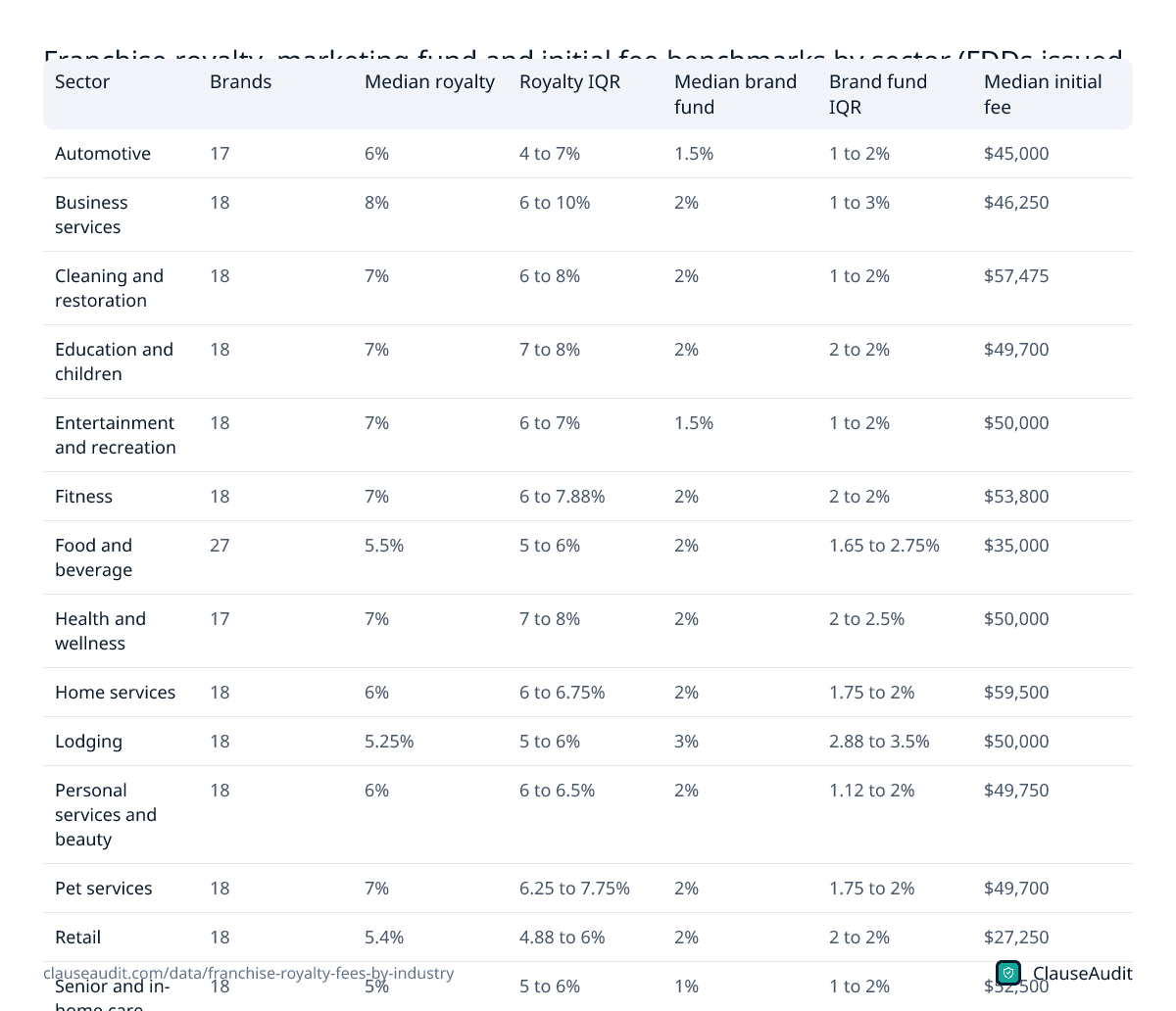
Franchise royalty, marketing fund and initial fee benchmarks by sector (FDDs issued 2025 to 2026)
| Sector | Brands | Median royalty | Royalty IQR | Median brand fund | Brand fund IQR | Median initial fee |
|---|---|---|---|---|---|---|
| Automotive | 17 | 6% | 4 to 7% | 1.5% | 1 to 2% | $45,000 |
| Business services | 18 | 8% | 6 to 10% | 2% | 1 to 3% | $46,250 |
| Cleaning and restoration | 18 | 7% | 6 to 8% | 2% | 1 to 2% | $57,475 |
| Education and children | 18 | 7% | 7 to 8% | 2% | 2 to 2% | $49,700 |
| Entertainment and recreation | 18 | 7% | 6 to 7% | 1.5% | 1 to 2% | $50,000 |
| Fitness | 18 | 7% | 6 to 7.88% | 2% | 2 to 2% | $53,800 |
| Food and beverage | 27 | 5.5% | 5 to 6% | 2% | 1.65 to 2.75% | $35,000 |
| Health and wellness | 17 | 7% | 7 to 8% | 2% | 2 to 2.5% | $50,000 |
| Home services | 18 | 6% | 6 to 6.75% | 2% | 1.75 to 2% | $59,500 |
| Lodging | 18 | 5.25% | 5 to 6% | 3% | 2.88 to 3.5% | $50,000 |
| Personal services and beauty | 18 | 6% | 6 to 6.5% | 2% | 1.12 to 2% | $49,750 |
| Pet services | 18 | 7% | 6.25 to 7.75% | 2% | 1.75 to 2% | $49,700 |
| Retail | 18 | 5.4% | 4.88 to 6% | 2% | 2 to 2% | $27,250 |
| Senior and in-home care | 18 | 5% | 5 to 6% | 1% | 1 to 2% | $52,500 |
| All sectors | 259 | 6% | 5 to 7% | 2% | 1.33 to 2% | $49,500 |
Source: Franchise Consultants and Brokers (analysis of Minnesota Department of Commerce CARDS FDD registrations), Franchise Royalty Rates and Fees: 259 Disclosure Documents by Sector (2025 to 2026). Download as image
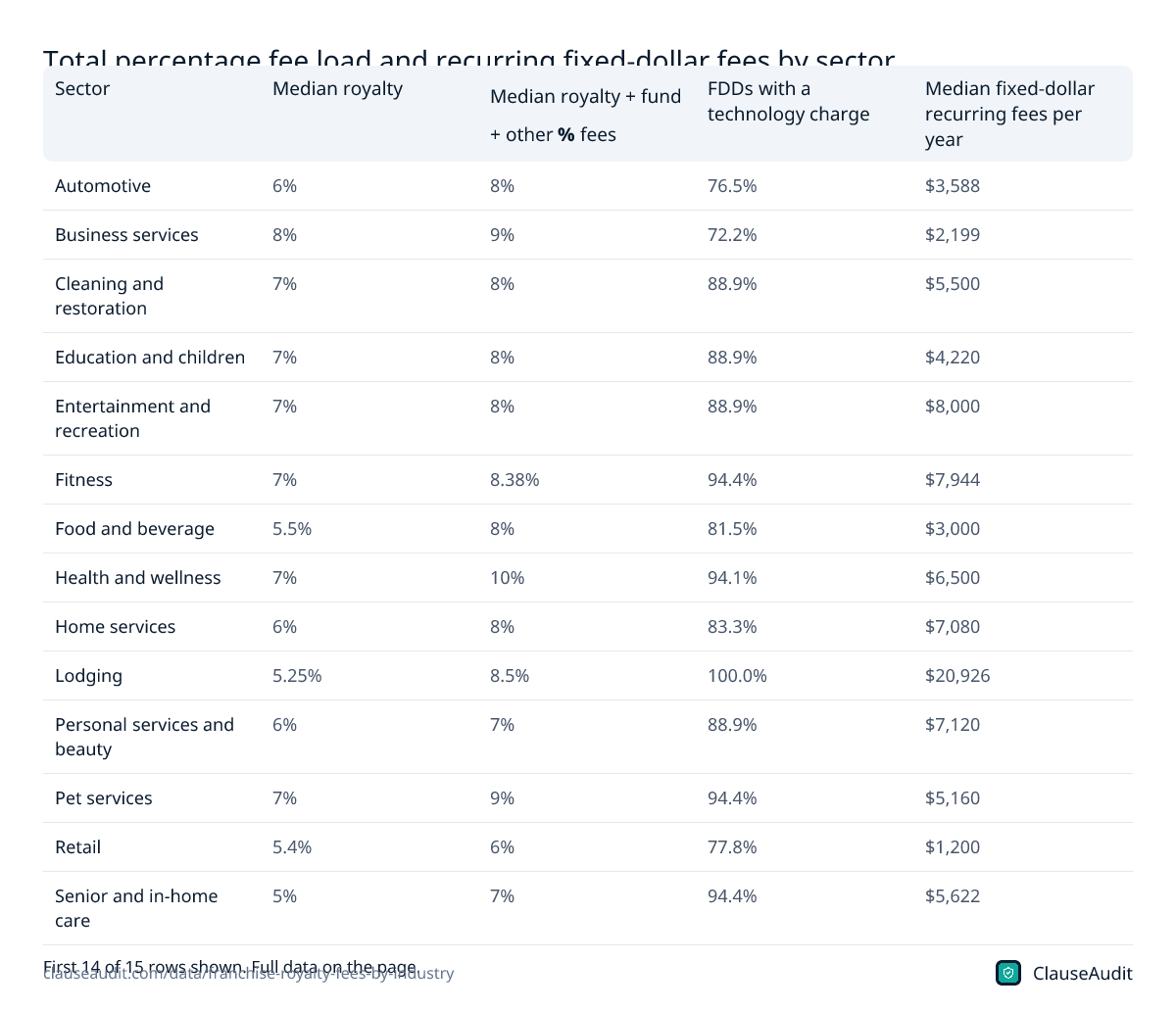
Total percentage fee load and recurring fixed-dollar fees by sector
| Sector | Median royalty | Median royalty + fund + other % fees | FDDs with a technology charge | Median fixed-dollar recurring fees per year |
|---|---|---|---|---|
| Automotive | 6% | 8% | 76.5% | $3,588 |
| Business services | 8% | 9% | 72.2% | $2,199 |
| Cleaning and restoration | 7% | 8% | 88.9% | $5,500 |
| Education and children | 7% | 8% | 88.9% | $4,220 |
| Entertainment and recreation | 7% | 8% | 88.9% | $8,000 |
| Fitness | 7% | 8.38% | 94.4% | $7,944 |
| Food and beverage | 5.5% | 8% | 81.5% | $3,000 |
| Health and wellness | 7% | 10% | 94.1% | $6,500 |
| Home services | 6% | 8% | 83.3% | $7,080 |
| Lodging | 5.25% | 8.5% | 100.0% | $20,926 |
| Personal services and beauty | 6% | 7% | 88.9% | $7,120 |
| Pet services | 7% | 9% | 94.4% | $5,160 |
| Retail | 5.4% | 6% | 77.8% | $1,200 |
| Senior and in-home care | 5% | 7% | 94.4% | $5,622 |
| All sectors | 6% | 8% | 87.3% | $5,500 |
Source: Franchise Consultants and Brokers (analysis of Minnesota Department of Commerce CARDS FDD registrations), Franchise Royalty Rates and Fees: 259 Disclosure Documents by Sector (2025 to 2026). Download as image
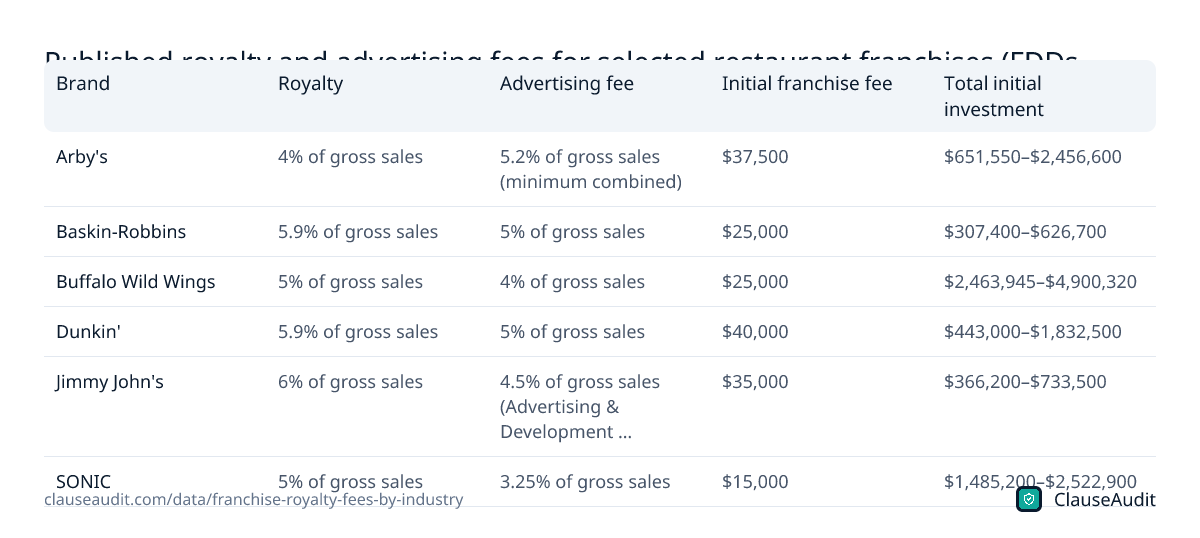
Published royalty and advertising fees for selected restaurant franchises (FDDs issued March 26, 2026)
| Brand | Royalty | Advertising fee | Initial franchise fee | Total initial investment |
|---|---|---|---|---|
| Arby's | 4% of gross sales | 5.2% of gross sales (minimum combined) | $37,500 | $651,550–$2,456,600 |
| Baskin-Robbins | 5.9% of gross sales | 5% of gross sales | $25,000 | $307,400–$626,700 |
| Buffalo Wild Wings | 5% of gross sales | 4% of gross sales | $25,000 | $2,463,945–$4,900,320 |
| Dunkin' | 5.9% of gross sales | 5% of gross sales | $40,000 | $443,000–$1,832,500 |
| Jimmy John's | 6% of gross sales | 4.5% of gross sales (Advertising & Development Fund) | $35,000 | $366,200–$733,500 |
| SONIC | 5% of gross sales | 3.25% of gross sales | $15,000 | $1,485,200–$2,522,900 |
Source: Inspire Brands, Arby's franchising: fees and investment; Inspire Brands, Baskin-Robbins franchising: fees and investment; Inspire Brands, Buffalo Wild Wings franchising: fees and investment; Inspire Brands, Dunkin' franchising: fees and investment; Inspire Brands, Jimmy John's franchising: fees and investment; Inspire Brands, SONIC franchising: fees and investment. Download as image
What is the average franchise royalty fee?
Across 239 disclosure documents with a percentage royalty, the median was 6% of sales. The middle half of brands charged between 5% and 7%, and 86.2% charged between 4% and 8%. That is a tight band, so a rate well outside it deserves a question.
Sector moves the number. Business services had the highest median at 8%. Cleaning and restoration, fitness, pet services and several other service categories sat at 7%. Food and beverage came in at 5.5%, retail at 5.4% and senior and in-home care at 5%.
The gaps roughly track the economics. A cleaning or tutoring business has low product costs, so the franchisor can take a bigger slice of each sale. A restaurant spends much of its revenue on food and labor before anyone sees a profit, so royalties there run lower.
One caution. These are medians from 17 to 27 brands per sector, all registered in Minnesota, not a weighted national average. They make a fair yardstick. A single brand can still sit well outside its sector and be a sound business, as long as it can explain why.
How much is a franchise marketing or brand fund fee?
Among the 187 documents that charge a percentage, the median brand fund was 2% of sales. Another 53 charged nothing or had not started a fund yet, and 18 charged a flat dollar amount instead.
Lodging was highest at 3%, and senior and in-home care lowest at 1%. Some big restaurant chains run far above the 2% food and beverage median. Dunkin' and Baskin-Robbins each list a 5% advertising fee on top of a 5.9% royalty. Arby's lists 5.2% for advertising against a 4% royalty, which means its marketing charge is bigger than its royalty.
Here is what people miss. The fund usually pays for brand-wide work: national ads, creative, the website and the app. Spending in your own town is often a separate requirement you fund yourself, and the franchisor normally decides how the fund money gets used.
So read Item 11 of the disclosure document, which must show how the fund's money was split last year between media, production, administration and other costs. Then ask whether you will get a yearly accounting after you sign. If they will not commit to one, that tells you something about the relationship ahead.
What is the total franchise fee load once you add it all up?
Stack the royalty, the brand fund and any other percentage fees and the median is 8% of sales, with the middle half between 7% and 9%. Put another way, about 8 cents of every dollar a typical unit takes in goes back to the franchisor before rent, wages or supplies.
Then come the fixed charges a percentage never shows. 87.3% of the documents list a recurring technology, software or point-of-sale charge, with a median low-end amount of $4,800 a year. Median fixed-dollar recurring fees across all sectors came to $5,500 a year. Lodging reached $20,926 while retail sat at $1,200.
Fixed fees bite hardest when sales are thin. A new location with modest volume pays the same software and system charges as a busy one, so those fixed costs take a much bigger share of its revenue in the first months. Put both in your cash-flow model, not just the headline rate.
To compare two brands, write down the total percentage load, then list every fixed annual charge next to it. A brand with a lower royalty and a heavy technology bill can cost you more in the early years than one with a higher rate and few extras.
What is a minimum royalty, and why does it matter?
A minimum royalty means you owe a set dollar amount even when your percentage would come to less. In this sample, 104 of 259 documents, or 40.2%, include one.
It turns a variable cost into a fixed one. If your opening runs late, road work blocks your entrance or a competitor opens across the street, the minimum keeps running. Some agreements also treat a missed minimum as a default that can lead to termination.
Run the numbers for a bad quarter, not a good one. If the minimum would take a bigger share of your sales than the stated rate during a slow stretch, you need enough cash in reserve to cover the gap.
Ask when the minimum starts, whether it steps up over time and whether there is a ramp-up period after opening. And check what the percentage is charged on. Hotel royalties, with a median of 5.25%, apply to room revenue rather than total sales, so the same rate can mean a different bill.
Can you negotiate franchise royalty and marketing fees?
Rarely on the headline rate. Franchisors file one disclosure document and try to treat similar buyers alike, so most will not cut the royalty for one person. The terms around the fee are a different story, especially for experienced operators or anyone opening several units.
Requests that often get a hearing:
- A reduced royalty or a short royalty holiday right after opening
- A delay before any minimum royalty applies
- A cap on how far the brand fund can rise during the term
- A yearly accounting of how brand fund money was spent
- A clear definition of gross sales that leaves out sales tax, refunds and unredeemed gift cards
- Lower fees on additional units if you plan to grow
What to do before you sign
Start with Item 6 of the disclosure document. It lists the recurring fees, how much each one is and when it is due. Hold each line up against your sector on this page and mark anything above the middle half.
Then read the franchise agreement itself, because that is what you sign. Look for language that lets the franchisor raise the brand fund, add new technology fees or redefine gross sales. Finally, call a handful of current owners and ask one plain question: what do you pay each month once every fee is in, and has that number grown since you signed?
If the answers do not line up with the documents, slow down. A fee that looked ordinary on paper can turn out to be one of several charges that land in the same month. Better to find that out now, while you can still ask for changes or walk away, than after you have signed the lease and started the build-out.
How ClauseAudit helps
The royalty rate is easy to find. The clauses that change what you owe are scattered through a long agreement. An automated review of your franchise agreement pulls out each fee term and flags the ones that shift cost or risk onto you.
- How gross sales is defined and what is left out of the royalty base
- Minimum royalty amounts, when they start and what happens if you miss one
- Whether the franchisor can raise the brand fund or add fees during the term
- Technology, software and point-of-sale charges and who controls increases
- Late fees and interest on unpaid royalties
- Default and termination rights tied to missed or late payments
Frequently asked questions
What is a normal franchise royalty fee?
The median is 6% of sales, based on 239 disclosure documents issued from January 2025 to August 2026. The middle half of brands charged between 5% and 7%, and 86.2% fell between 4% and 8%. A rate outside that range is not automatically a problem, but the franchisor should be able to explain what you get for it.
Is a franchise royalty charged on sales or profit?
Almost always on sales. You pay the same percentage whether the month made money or not. Read how the agreement defines gross sales, because whether taxes, refunds, discounts and gift cards count can move your bill as much as the stated rate.
What does the franchise marketing fund pay for?
It pays for brand-level advertising, creative work, the website and national promotions. The median fund was 2% of sales among documents that charge a percentage. It is usually separate from the local advertising you must pay for yourself, and the franchisor typically decides how the money is spent.
Which franchise industries charge the highest royalties?
Business services had the highest median royalty at 8% of sales. Several service sectors, including cleaning and restoration, fitness, health and wellness and pet services, came in at 7%. Senior and in-home care was lowest at 5%, with retail at 5.4% and food and beverage at 5.5%.
How much are restaurant franchise royalties?
The food and beverage median was 5.5% of sales, with a 2% brand fund. Big chains vary. Jimmy John's lists a 6% royalty and a 4.5% advertising fund, SONIC lists 5% and 3.25%, and Buffalo Wild Wings lists 5% and 4%. Always check the brand's current disclosure document before you budget.
What is a franchise technology fee?
It is a recurring charge for the software, point-of-sale system, apps or other tools the franchisor requires. 87.3% of the documents in this sample list one, with a median low-end amount of $4,800 a year. Check whether the franchisor can raise it or require new systems during the term.
Can a franchisor raise fees after I sign?
The royalty rate is usually fixed for the term, but many agreements let the franchisor raise the brand fund, add technology charges or require new systems at your cost. Renewal often means signing the then-current agreement, which may carry higher fees. Read the fee and renewal clauses closely.
How common is a minimum royalty?
Fairly common. 104 of 259 documents, or 40.2%, include a minimum royalty clause. It means you owe a set dollar amount even in a weak month, and some agreements treat missing it as a default. Ask when it starts and whether it is waived while a new location ramps up.
Use this data
Every chart and card below is free to reuse under CC BY 4.0. Download what you need and link back to this page.
 Stat cards
 Key findings card
 Infographic
 Median franchise royalty rate by industry sector (% of sales)
 Median brand or marketing fund fee by industry sector (% of sales)
 Median total percentage fee load by sector: royalty plus marketing fund and other % fees (% of sales)
 How franchise royalty rates are distributed across 239 disclosure documents (FDDs (count))
 How franchise royalties are structured (share of 259 FDDs) (% of FDDs)
 Franchise royalty, marketing fund and initial fee benchmarks by sector (FDDs issued 2025 to 2026)
 Total percentage fee load and recurring fixed-dollar fees by sector
 Published royalty and advertising fees for selected restaurant franchises (FDDs issued March 26, 2026)
Embed the infographic
Free to share on your site, blog or slides under CC BY 4.0. Please keep the credit link.
Sources and method
Every number on this page comes from the sources below, each opened and read on or before October 18, 2026. A second, independent review checked every figure against its source and corrected anything that did not match. Figures that could not be confirmed were left out.
- Franchise Consultants and Brokers (analysis of Minnesota Department of Commerce CARDS FDD registrations), Franchise Royalty Rates and Fees: 259 Disclosure Documents by Sector (2025 to 2026) (October 5, 2026)
- Inspire Brands, Arby's franchising: fees and investment (Accessed 2026-10-18 (cites FDD issued March 26, 2026))
- Inspire Brands, Baskin-Robbins franchising: fees and investment (Accessed 2026-10-18 (cites FDD issued March 26, 2026))
- Inspire Brands, Buffalo Wild Wings franchising: fees and investment (Accessed 2026-10-18 (cites FDD issued March 26, 2026))
- Inspire Brands, Dunkin' franchising: fees and investment (Accessed 2026-10-18 (cites FDD issued March 26, 2026))
- Inspire Brands, Jimmy John's franchising: fees and investment (Accessed 2026-10-18 (cites FDD issued March 26, 2026))
- Inspire Brands, SONIC franchising: fees and investment (Accessed 2026-10-18 (cites FDD issued March 26, 2026))
Cite this page
ClauseAudit, “Franchise Royalty and Marketing Fees: Averages by Industry (2026)”, updated October 18, 2026, https://clauseaudit.com/data/franchise-royalty-fees-by-industry. Free to reuse with a link back (CC BY 4.0).
This page summarises published data and law as checked on October 18, 2026. Figures are updated as new editions are released, and your own situation may differ. It is general information, not legal, tax or financial advice.