Stamp Duty and Registration Charges on Property by State in India (2026)
By ClauseAudit Research · 12 sources ·
What are the state wise stamp duty charges on property in India?
It depends heavily on the state. Among the states we checked, Kerala charges the most base stamp duty on a sale deed at 8%, and Gujarat the least at 3.5% before its 40% additional duty. Most sit between 5% and 6%, and the registration fee adds another 0.5% to 2% on top.

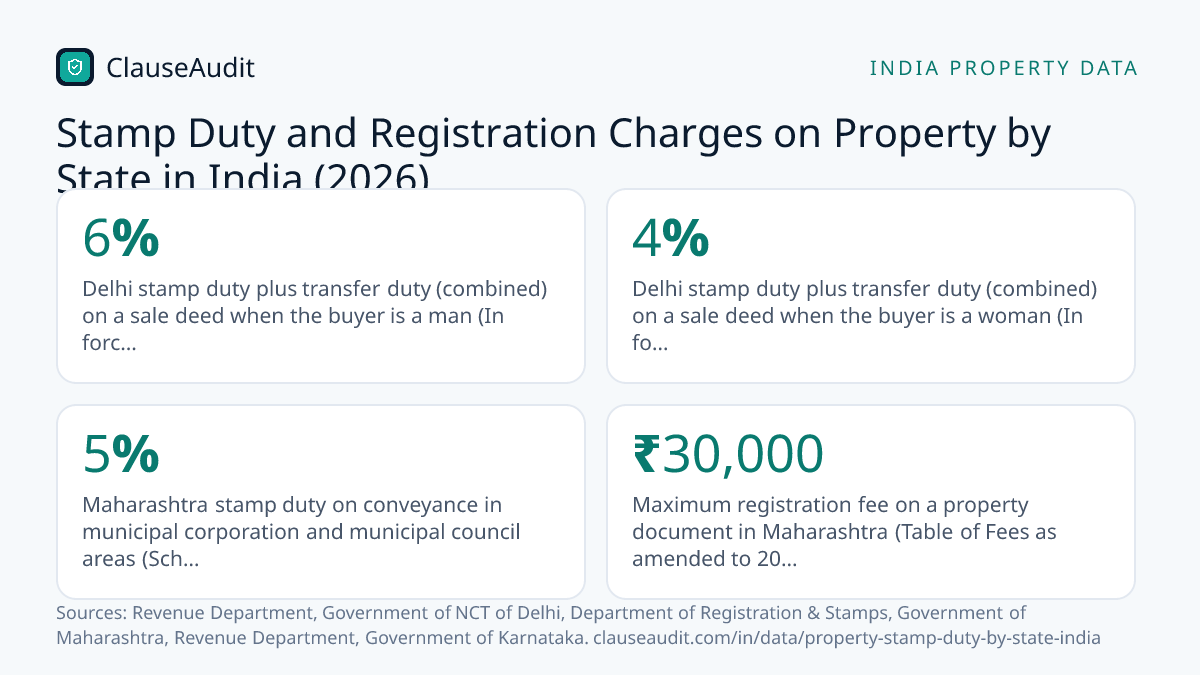
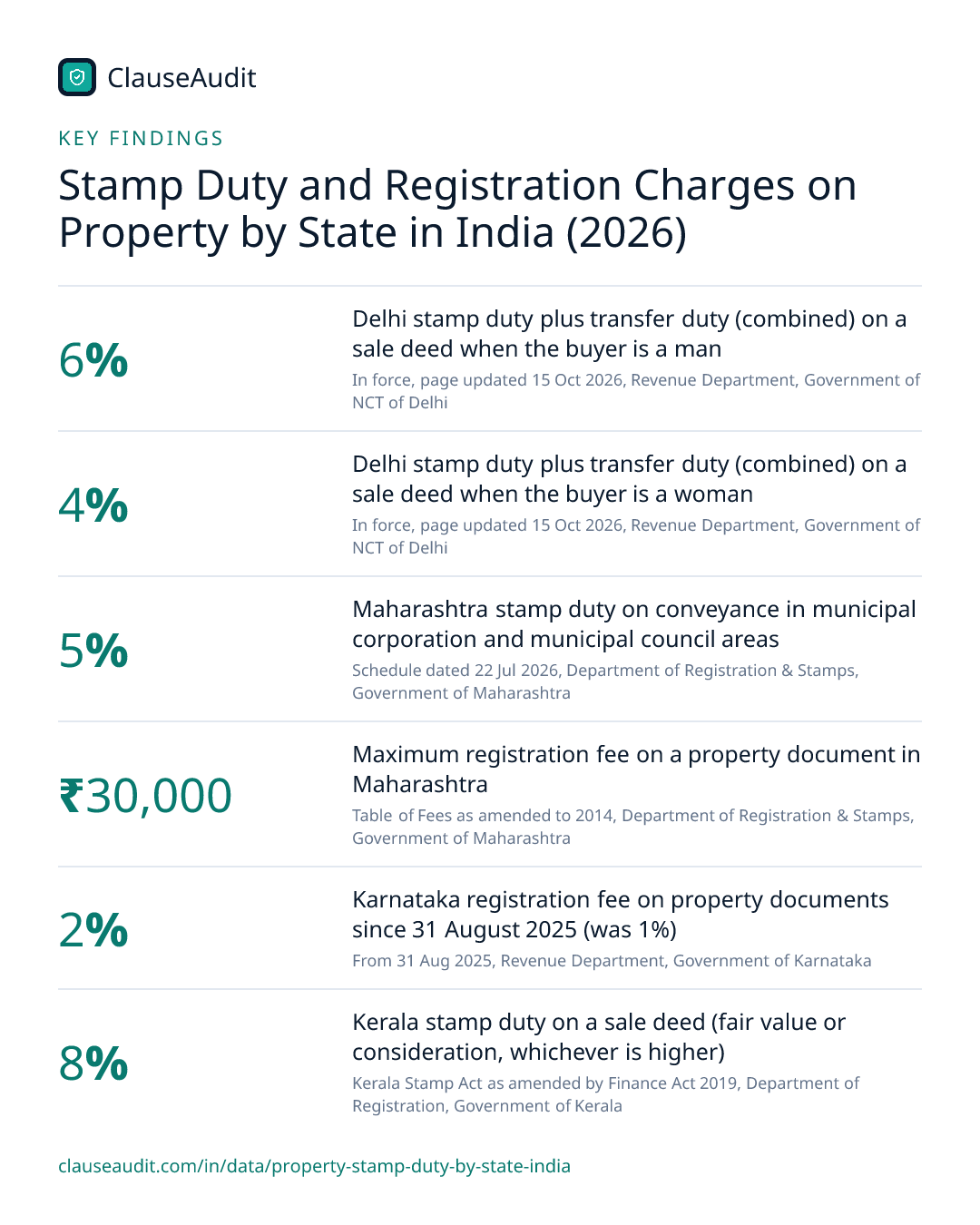
- Delhi stamp duty plus transfer duty (combined) on a sale deed when the buyer is a man (In force, page updated 15 Oct 2026, Revenue Department, Government of NCT of Delhi)
- 6%
- Delhi stamp duty plus transfer duty (combined) on a sale deed when the buyer is a woman (In force, page updated 15 Oct 2026, Revenue Department, Government of NCT of Delhi)
- 4%
- Maharashtra stamp duty on conveyance in municipal corporation and municipal council areas (Schedule dated 22 Jul 2026, Department of Registration & Stamps, Government of Maharashtra)
- 5%
- Maximum registration fee on a property document in Maharashtra (Table of Fees as amended to 2014, Department of Registration & Stamps, Government of Maharashtra)
- ₹30,000
- Karnataka registration fee on property documents since 31 August 2025 (was 1%) (From 31 Aug 2025, Revenue Department, Government of Karnataka)
- 2%
- Kerala stamp duty on a sale deed (fair value or consideration, whichever is higher) (Kerala Stamp Act as amended by Finance Act 2019, Department of Registration, Government of Kerala)
- 8%
- West Bengal additional stamp duty when market value exceeds ₹1 crore (Page updated 20 May 2025, Directorate of Registration & Stamp Revenue, Government of West Bengal)
- 1%
- Telangana sale deed outside gram panchayats: stamp duty, transfer duty, registration fee (Ready Reckoner, read Oct 2026, Registration & Stamps Department, Government of Telangana)
- 5.5% + 1.5% + 0.5%
Stamp duty is one of the largest costs of buying property on top of the price, and each state sets its own rate. On an urban sale deed bought by a man, the base rate ranges from 3.5% in Gujarat to 8% in Kerala. Then the registration fee, surcharges and cess pile on.
This page pulls the rates from official state government sources, read in October 2026. A few of those documents date from earlier years, so check the source notes for your state. Use it to budget, to check what your builder or seller quotes, and to spot the clauses in your sale agreement that decide who pays what.
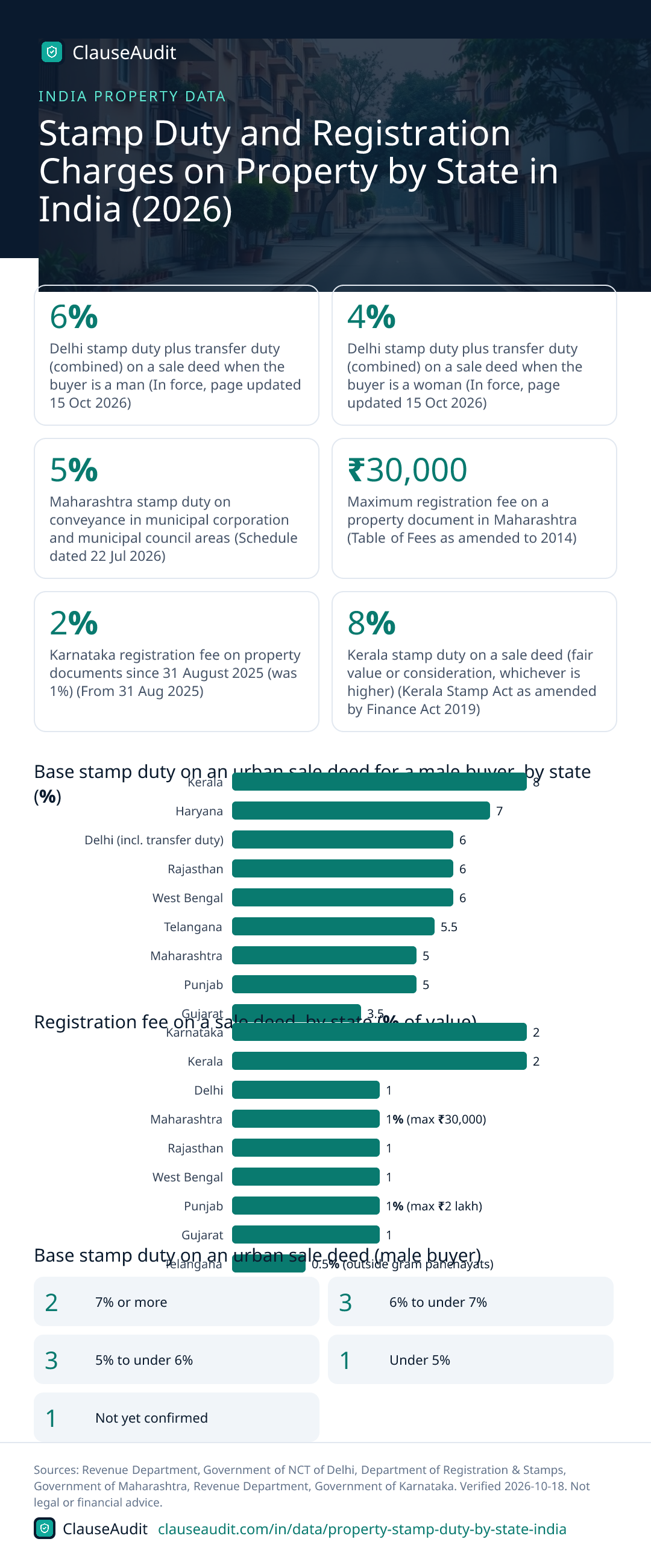
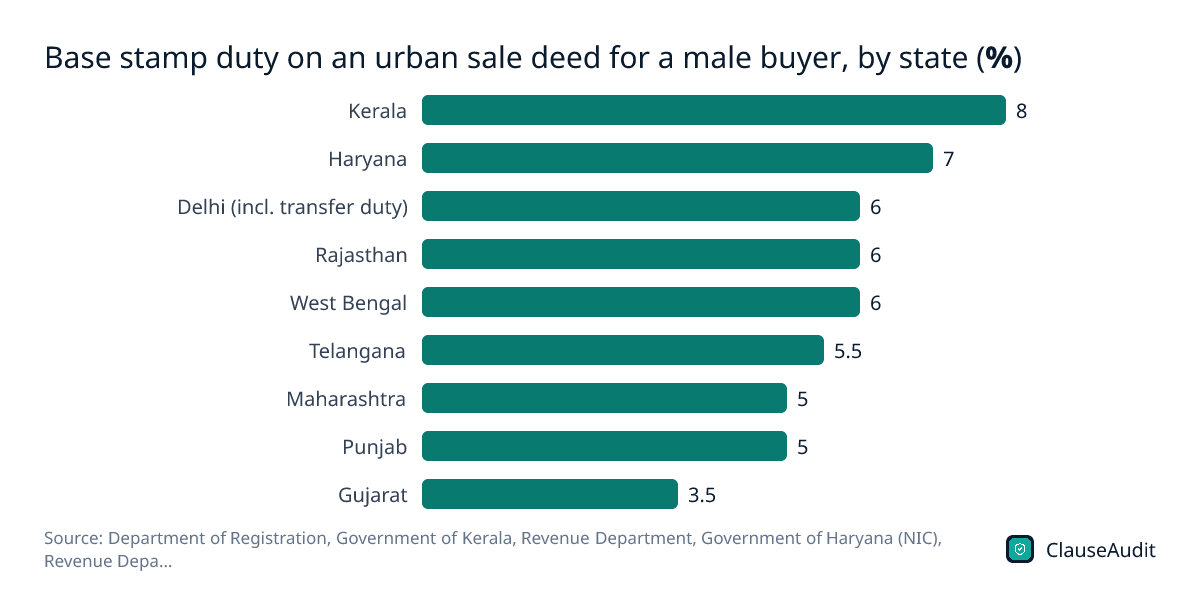
Base stamp duty on an urban sale deed for a male buyer, by state (%)
Chart data
| Label | Value |
|---|---|
| Kerala | 8 |
| Haryana | 7 |
| Delhi (incl. transfer duty) | 6 |
| Rajasthan | 6 |
| West Bengal | 6 |
| Telangana | 5.5 |
| Maharashtra | 5 |
| Punjab | 5 |
| Gujarat | 3.5 |
Kerala at 8% and Haryana at 7% top the list, while Gujarat's 3.5% looks lower than it is: its 1.4% additional duty brings the total to 4.9%. Delhi's 6% already includes transfer duty, so it is not a like-for-like bar.
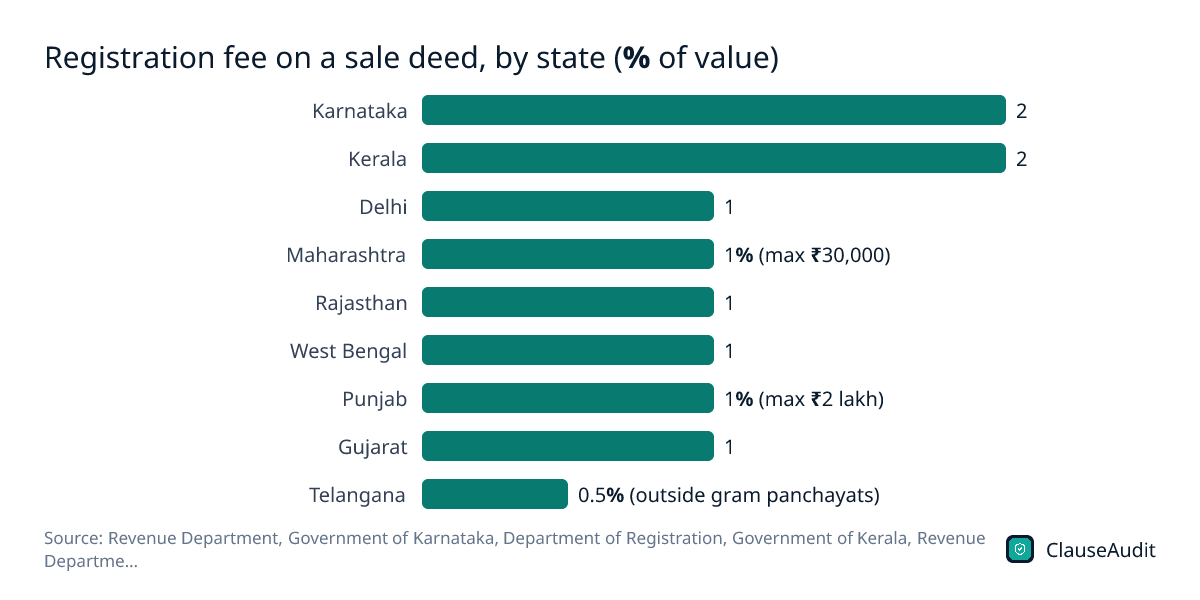
Download this chart (PNG)Registration fee on a sale deed, by state (% of value)
Chart data
| Label | Value |
|---|---|
| Karnataka | 2 |
| Kerala | 2 |
| Delhi | 1 |
| Maharashtra | 1% (max ₹30,000) |
| Rajasthan | 1 |
| West Bengal | 1 |
| Punjab | 1% (max ₹2 lakh) |
| Gujarat | 1 |
| Telangana | 0.5% (outside gram panchayats) |
Karnataka doubled its registration fee to 2% from 31 August 2025. Maharashtra and Punjab cap the fee at ₹30,000 and ₹2 lakh, which matters a lot on expensive property.
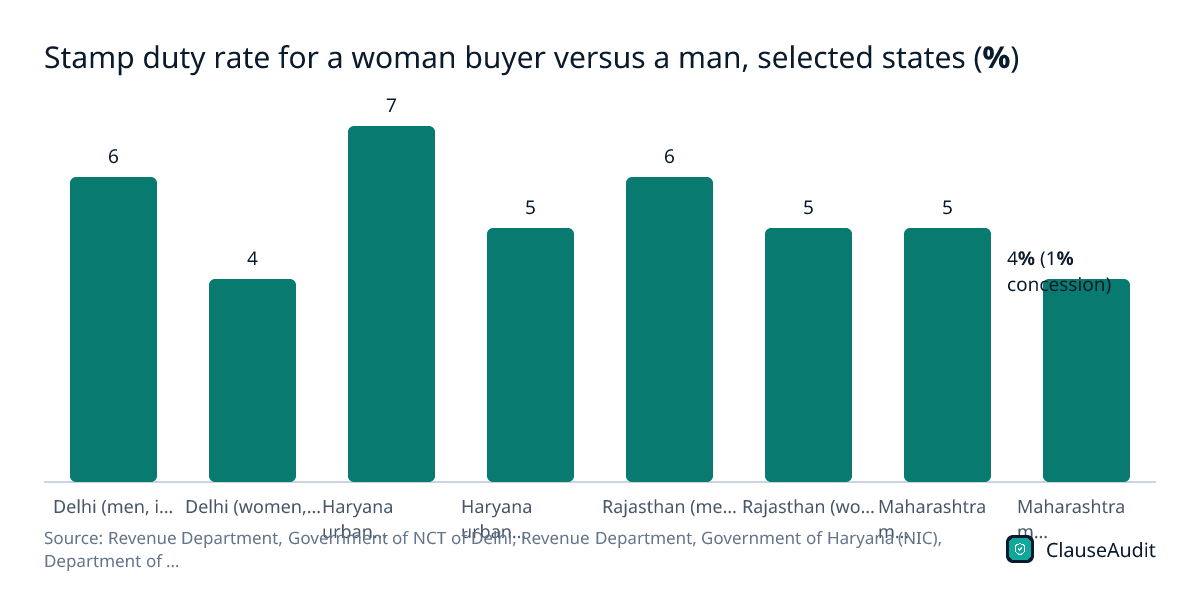
Download this chart (PNG)Stamp duty rate for a woman buyer versus a man, selected states (%)
Chart data
| Label | Value |
|---|---|
| Delhi (men, incl. transfer duty) | 6 |
| Delhi (women, incl. transfer duty) | 4 |
| Haryana urban (men) | 7 |
| Haryana urban (women) | 5 |
| Rajasthan (men) | 6 |
| Rajasthan (women) | 5 |
| Maharashtra municipal (men) | 5 |
| Maharashtra municipal (women) | 4% (1% concession) |
Registering in a woman's name lowers the rate in every state shown. Delhi and urban Haryana offer the widest gaps: 4% against 6%, and 5% against 7%.
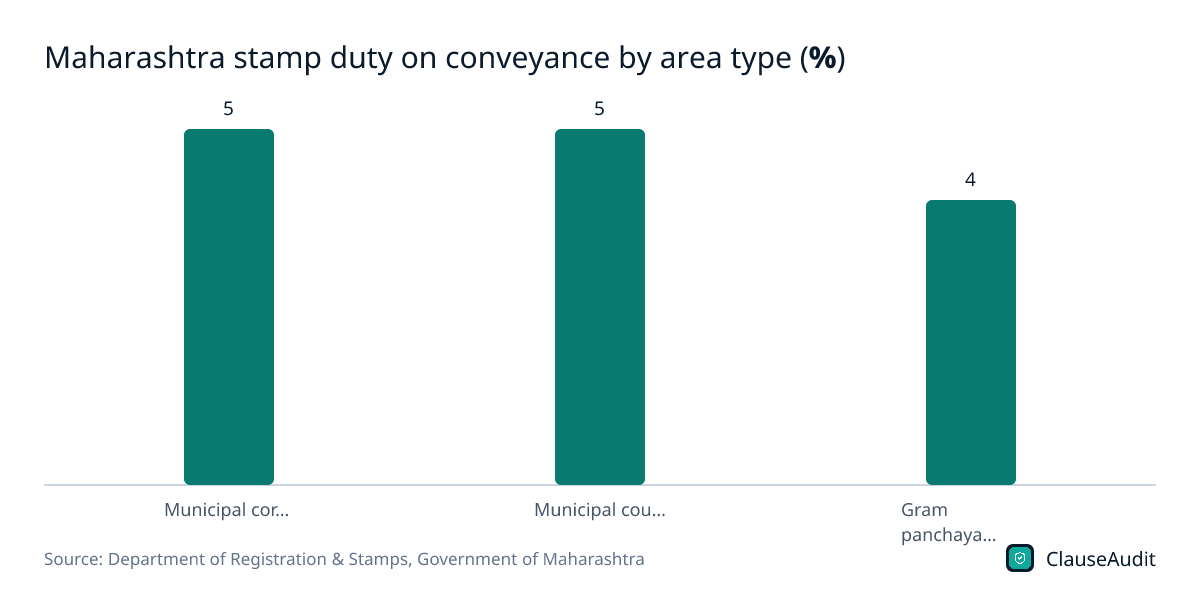
Download this chart (PNG)Maharashtra stamp duty on conveyance by area type (%)
Chart data
| Label | Value |
|---|---|
| Municipal corporation / cantonment / urban | 5 |
| Municipal council / nagar panchayat / MMRDA rural | 5 |
| Gram panchayat and other areas | 4 |
In Maharashtra the property's location changes the rate: 5% inside municipal limits, 4% in gram panchayat areas. Check which side of the line your plot sits on.
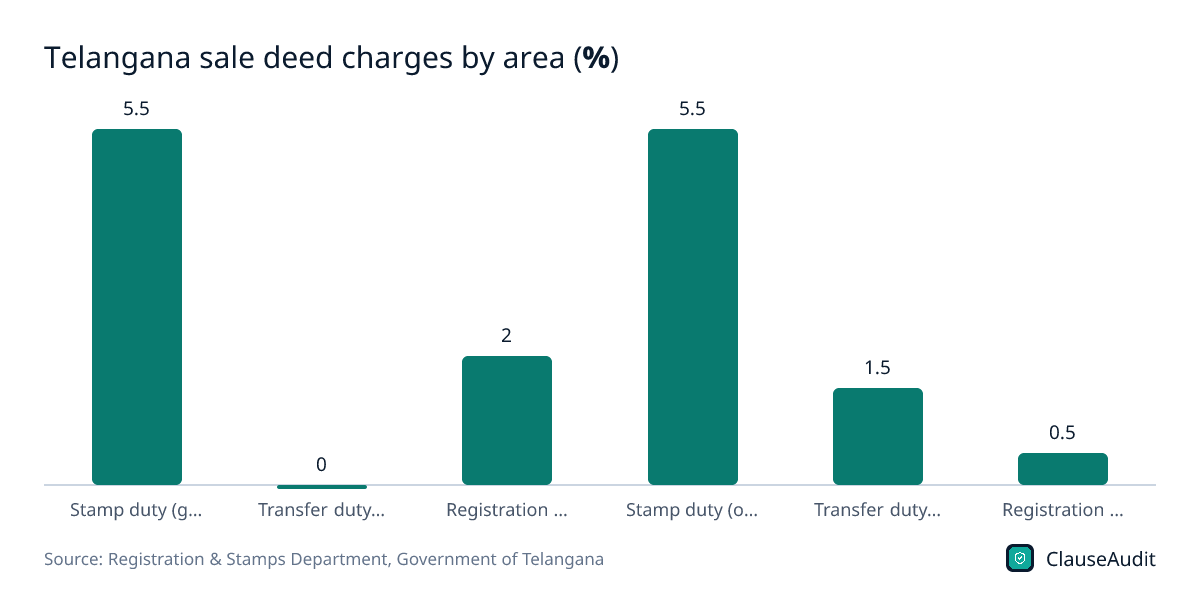
Download this chart (PNG)Telangana sale deed charges by area (%)
Chart data
| Label | Value |
|---|---|
| Stamp duty (gram panchayat) | 5.5 |
| Transfer duty (gram panchayat) | 0 |
| Registration fee (gram panchayat) | 2 |
| Stamp duty (other areas) | 5.5 |
| Transfer duty (other areas) | 1.5 |
| Registration fee (other areas) | 0.5 |
Telangana's stamp duty is 5.5% everywhere, but the split changes. Outside gram panchayats you pay 1.5% transfer duty and a 0.5% registration fee; inside them, no transfer duty but a 2% fee.
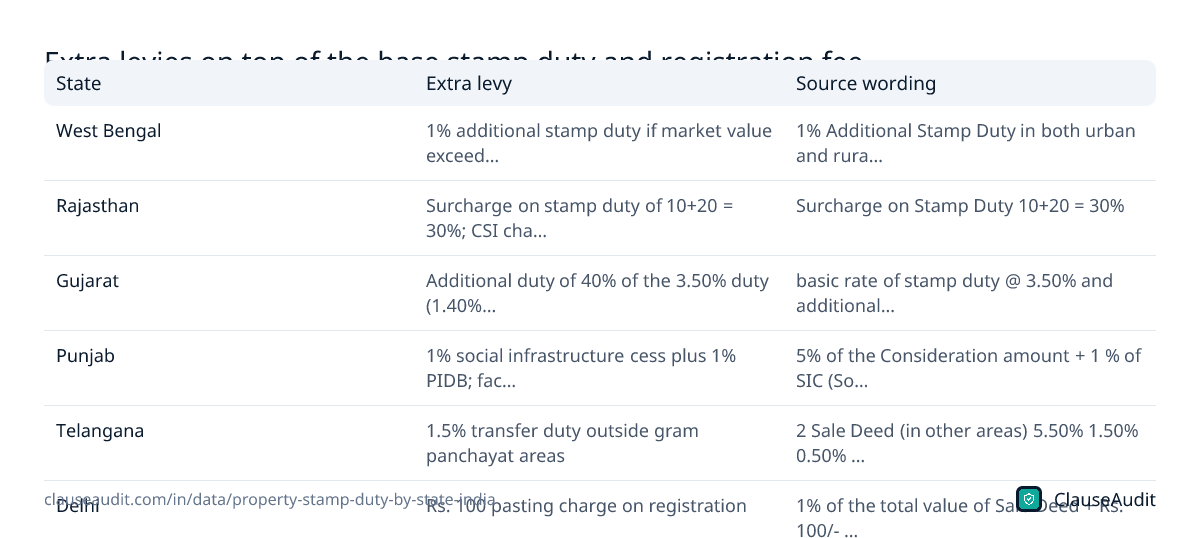
Download this chart (PNG)Extra levies on top of the base stamp duty and registration fee
| State | Extra levy | Source wording |
|---|---|---|
| West Bengal | 1% additional stamp duty if market value exceeds ₹1 crore | 1% Additional Stamp Duty in both urban and rural areas, if the market value exceeds rupees one crore. |
| Rajasthan | Surcharge on stamp duty of 10+20 = 30%; CSI charges Rs. 300 | Surcharge on Stamp Duty 10+20 = 30% |
| Gujarat | Additional duty of 40% of the 3.50% duty (1.40%), total 4.90% | basic rate of stamp duty @ 3.50% and additional duty @ 1.40% [i.e. 40% of 3.50%] |
| Punjab | 1% social infrastructure cess plus 1% PIDB; facilitation charge Rs. 1,000 to Rs. 5,000 | 5% of the Consideration amount + 1 % of SIC (Social Infrastructure Cess) |
| Telangana | 1.5% transfer duty outside gram panchayat areas | 2 Sale Deed (in other areas) 5.50% 1.50% 0.50% (table row; Transfer Duty column = 1.50%) |
| Delhi | Rs. 100 pasting charge on registration | 1% of the total value of Sale Deed + Rs. 100/- pasting charge |
Source: Directorate of Registration & Stamp Revenue, Government of West Bengal, Stamp Duty and Registration Fees; Department of Registration and Stamps, Government of Rajasthan (via Rajnivesh portal), Stamp Duty and Registration Fee Detail; Gujarat State Law Commission, 21st Report of Gujarat State Law Commission: Need to reduce the rate of stamp duty and that of registration fee; Department of Revenue, Rehabilitation and Disaster Management, Government of Punjab, Document wise detail of Stamp Duty, Registration Fee and Facilitation charges; Registration & Stamps Department, Government of Telangana, Ready Reckoner; Revenue Department, Government of NCT of Delhi, Property Registration (stamp duty and registration fee). Download as image
Base stamp duty on an urban sale deed (male buyer) by State
- 27% or more
- 36% to under 7%
- 35% to under 6%
- 1Under 5%
- 1Not yet confirmed
| State | Stamp duty (sale deed) | Women buyers | Registration fee | Surcharge / cess / other | Source |
|---|---|---|---|---|---|
| Delhi | 6% (stamp duty + transfer duty combined) | 4% (stamp duty + transfer duty combined) | 1% + Rs. 100 pasting charge | None listed on the page | Indian Stamp Act, 1899 as applied to Delhi; Registration Act, 1908 |
| Gujarat | 3.5% | Same duty; exempt from registration fee | 1% | Additional duty 40% of duty (1.4%), total 4.9% | Gujarat Stamp Act, 1958, Schedule I Article 20 and section 3A |
| Haryana | 7% urban; 5% rural | 5% urban; 3% rural | Not stated on source | Not stated on source | Indian Stamp Act, 1899 as applied to Haryana |
| Karnataka | Not confirmed from an official page read | Not confirmed | 2% (Rs. 20 per Rs. 1,000) from 31 Aug 2025 | Not confirmed | Registration Act, 1908, s.78; Notification RD/46/MNMU/2025 |
| Kerala | 8% of fair value or consideration, whichever is higher | No separate rate on source | 2% | None listed | Kerala Stamp Act, 1959, Schedule Articles 21 and 22 |
| Maharashtra | 5% (municipal corporation / council areas); 4% (gram panchayat) | 1% less on residential units (order of 31 Mar 2021) | 1% (Rs. 10 per Rs. 1,000), max ₹30,000 | Metro cess / local-body surcharge not covered by this source | Maharashtra Stamp Act, Schedule I, Article 25(b) |
| Punjab | 5% of consideration | No separate rate on source | 1% (max ₹2 lakh) | 1% social infrastructure cess + 1% PIDB; facilitation charge Rs. 1,000-5,000 | Indian Stamp Act, 1899 as applied to Punjab |
| Rajasthan | 6% of market value | 5% (4% for SC/ST/BPL women) | 1% | 30% surcharge on stamp duty; Rs. 300 CSI charge | Rajasthan Stamp Act, 1998, Schedule Article 21(i) |
| Tamil Nadu | Not yet confirmed: check the source | Registration Department, Government of Tamil Nadu (TNREGINET) | |||
| Telangana | 5.5% | No separate rate on source | 0.5% (2% in gram panchayat areas) | 1.5% transfer duty outside gram panchayats | Indian Stamp Act, 1899 as applied to Telangana; Registration Act, 1908 |
| Uttar Pradesh | Not yet confirmed: check the source | Stamp and Registration Department, Uttar Pradesh | |||
| West Bengal | 6% (municipal / corporation areas); 5% (panchayat areas) | No separate rate on source | 1% of market value, minimum Rs. 50 | 1% additional duty if market value exceeds ₹1 crore | Indian Stamp Act, 1899, Schedule IA Article 23 (West Bengal) |
Which state has the highest stamp duty on property?
Of the states with an official rate we could confirm, Kerala charges the most: 8% of the fair value or the sale price, whichever is higher. Haryana follows at 7% for men buying in urban areas. Delhi and Rajasthan sit at 6%, as does West Bengal in municipal and corporation areas.
The base rate is only the starting point, though. Rajasthan adds a 30% surcharge on the duty itself. West Bengal adds 1% more once market value crosses ₹1 crore. Punjab looks moderate at 5% until you add the 1% social infrastructure cess and 1% PIDB charge. Gujarat's 3.5% becomes 4.9% after the additional duty.
So a state with a lower headline rate can end up costing about the same as one with a higher rate. Compare the full stack, not the first number you see.
This matters most if you have a choice. Say you work remotely and are weighing a flat on the edge of Gurugram against one across the border in Delhi. The property prices may look close, but the duty, the fee and the concessions are set by different governments, and on a home loan budget that difference is real money you need in hand on registration day.
Do women pay less stamp duty in India?
In several states, yes. Delhi charges women 4% against 6% for men, both figures including transfer duty. Haryana charges women 5% in urban areas and 3% in rural ones, against 7% and 5% for men. Rajasthan charges women 5%, or 4% for SC, ST and BPL women. Maharashtra takes 1% off for women buying a residential unit, under an order dated 31 March 2021.
Gujarat works differently. Women pay the same duty as men but are exempt from the registration fee.
If you are buying with a spouse, ask your lawyer how a joint purchase is treated before you decide whose name goes first. The concession usually depends on who the buyer is on the deed, and the name on the sale agreement, the loan papers and the deed should match. A mismatch can mean delays at the sub-registrar's office, or a demand for the full rate.
How much is the registration fee, and is there a cap?
Registration fees are smaller than stamp duty but not trivial. Most states we checked charge 1% of value. Karnataka and Kerala charge 2%. Telangana charges just 0.5% outside gram panchayat areas but 2% inside them.
Caps make a real difference at the top end. Maharashtra's fee stops at ₹30,000 and Punjab's at ₹2 lakh, however expensive the property. Delhi adds a flat ₹100 pasting charge. Karnataka is the one to watch: its fee went from 1% to 2% on 31 August 2025, so any budget made from older figures is now short.
Why the rate you see is rarely the rate you pay
Three things move your actual bill away from the headline percentage.
First, the value it is charged on. Stamp duty is usually charged on the higher of the price you agreed and the government's market or circle value. Kerala says so plainly: fair value or consideration, whichever is higher. If you agree a low price on paper, you still pay duty on the official value.
Second, location. Maharashtra charges 5% in municipal areas and 4% in gram panchayats. West Bengal charges 6% in municipal and corporation areas and 5% in panchayat areas. Haryana charges men 5% in rural areas against 7% in urban ones.
Third, the extras. Surcharges, cess, transfer duty and facilitation charges sit outside the base rate. Maharashtra's figure on this page, for example, does not include any metro cess or local-body surcharge.
What should freelancers and small business owners do before registering?
If you are self-employed and buying a home or an office, stamp duty lands as a lump sum on registration day, on top of your down payment. It is easy to underestimate, so treat it as a separate line in your budget.
A few practical steps:
- Get the circle or market value for your exact location from the state registration portal, and budget duty on that figure, not just your agreed price.
- Add every extra levy for your state: surcharge, cess, transfer duty and registration fee. Use the table above as a checklist.
- Ask your lender early whether the loan will cover stamp duty and registration. Plan to pay them from your own funds if it will not.
- If you are buying office or shop space through your business, check whether the buyer should be you or your company. The name changes who signs, who pays and who owns the asset.
- Buy e-stamp paper or pay online through the official channel, and verify the certificate before anyone signs.
- Read the sale agreement for who bears duty, fees and penalties if the deed is delayed or undervalued.
Buying commercial space: what changes for a business
For a shop, studio or small office, you still pay duty on the sale deed, but check your state's schedule for the exact rate, and do not count on a women's concession. Maharashtra's 1% reduction, for instance, is for residential units only.
Value also tends to be higher, which is where caps and thresholds start to bite. West Bengal's extra 1% kicks in above ₹1 crore. Maharashtra's ₹30,000 fee cap and Punjab's ₹2 lakh cap work in your favour on larger deals. Karnataka's fee is ₹20 for every ₹1,000 of value, so budget for the full 2%.
Keep the stamp duty receipt and registered deed safe with your business records. Your accountant may ask for them later.
How ClauseAudit helps
Stamp duty is set by law, but who pays it, on what value, and what happens if registration slips are all decided by your agreement to sell. Those clauses are where buyers and sellers lose money.
Upload your sale agreement and the automated review flags the terms worth questioning before you pay a token amount or sign.
- Who pays stamp duty, registration fee and any surcharge or cess, written out clearly
- The sale price stated in the agreement, and who pays extra duty if the official value is higher
- A fixed date to execute and register the sale deed, and what happens if either side misses it
- Forfeiture of your advance if the deal falls through, and whether the seller faces a matching penalty
- Title, encumbrance and unpaid-dues promises from the seller, backed by an indemnity
- Buyer names that match across the agreement, loan papers and deed, so a women's concession is not lost
Frequently asked questions
Which state has the lowest stamp duty on property in India?
Among the states we confirmed, Gujarat has the lowest base rate at 3.5%. But it adds an additional duty of 40% of that amount, which takes the total to 4.9%. Maharashtra's gram panchayat areas charge 4%, and its municipal areas 5%. Always compare the full charge, including surcharges and cess, rather than the base rate alone.
What is the stamp duty in Delhi for women?
Delhi charges women buyers 4% on a sale deed, against 6% for men. Both figures combine stamp duty and transfer duty into one rate, as the Delhi Revenue Department publishes them. The registration fee is 1% of the sale deed value plus a ₹100 pasting charge, and it is the same for men and women.
What are stamp duty and registration charges in Maharashtra in 2026?
Maharashtra charges 5% stamp duty on conveyance in municipal corporation and council areas, and 4% in gram panchayat areas, according to the schedule dated 22 July 2026. Women buying a residential unit get 1% off. The registration fee is 1% of value, capped at ₹30,000. Any metro cess or local-body surcharge is extra and not covered here.
What is the registration fee in Karnataka now?
Karnataka raised its registration fee on property documents from 1% to 2%, effective 31 August 2025. That works out to ₹20 per ₹1,000 of value. If you planned your budget using older figures, revise it. We have not yet confirmed Karnataka's current stamp duty rate from an official page, so check that with the sub-registrar.
Is stamp duty charged on the agreed price or the government value?
Usually on whichever is higher. Kerala, for example, charges 8% on the fair value or the consideration, whichever is higher. Most states work the same way using their circle rate or ready reckoner value. Writing a lower price into the deed does not reduce the duty, and it can lead to a demand for the shortfall plus penalty.
Do I pay stamp duty on the agreement to sell or only on the sale deed?
The rates on this page are for the sale deed, which actually transfers ownership. Many states also charge stamp duty on an agreement to sell, sometimes adjusted against the final duty. The rules differ by state, so check your state's schedule. Our separate page on stamp duty for agreements covers that side.
Can a home loan cover stamp duty and registration charges?
Lenders generally fund the property cost, and policies on stamp duty and registration vary. Ask your lender in writing before you sign the agreement to sell. If they will not cover it, keep the amount ready in cash, because registration usually cannot happen until the duty is paid.
Why are Tamil Nadu, Uttar Pradesh and Karnataka stamp duty rates missing?
We only publish a rate when we can read it on an official government page. Tamil Nadu's official duty and fee page could not be read, and secondary sources conflict. Uttar Pradesh publishes its schedule as images we could not read reliably. For Karnataka, only the new registration fee is confirmed. Check the state registration portal or your sub-registrar's office for these states.
Who pays stamp duty, the buyer or the seller?
By default the buyer pays stamp duty and registration charges in most Indian states. But your agreement can say otherwise, and disputes often start when it is vague. Make sure the agreement names who pays duty, fees, surcharges and any penalty for undervaluation, so there is no argument on registration day.
Use this data
Every chart and card below is free to reuse under CC BY 4.0. Download what you need and link back to this page.
 Stat cards
 Key findings card
 Infographic
 Base stamp duty on an urban sale deed for a male buyer, by state (%)
 Registration fee on a sale deed, by state (% of value)
 Stamp duty rate for a woman buyer versus a man, selected states (%)
 Maharashtra stamp duty on conveyance by area type (%)
 Telangana sale deed charges by area (%)
 Extra levies on top of the base stamp duty and registration fee
Embed the infographic
Free to share on your site, blog or slides under CC BY 4.0. Please keep the credit link.
Sources and method
Every number on this page comes from the sources below, each opened and read on or before October 18, 2026. A second, independent review checked every figure against its source and corrected anything that did not match. 10 of 12 State entries were confirmed; any that could not be are marked "Not yet confirmed" and left out of every count and chart.
- Revenue Department, Government of NCT of Delhi, Property Registration (stamp duty and registration fee) (Last Updated: 15/10/2026)
- Department of Registration & Stamps, Government of Maharashtra, Schedule I and II to the Maharashtra Stamp Act (article-wise) (Dated 22.07.2026)
- Department of Registration & Stamps, Government of Maharashtra, Table of Fees under the Registration Act, 1908 (Maharashtra) (17 July 1961, as amended to 11/9/2014)
- Revenue Department, Government of Karnataka, Notification No. RD/46/MNMU/2025 substituting registration fees (Karnataka Gazette Part IVA No. 513) (29 August 2025 (in force from 31.08.2025))
- Registration & Stamps Department, Government of Telangana, Ready Reckoner (Undated page, read 2026-10-18)
- Department of Registration, Government of Kerala, Existing Rates of Stamp Duty and Registration Fees for Ready Reference (Stamp Act as last amended by Kerala Finance Act, 2019; fee table G.O.(P) No.113/2019/TD dated 24.07.2019)
- Department of Registration and Stamps, Government of Rajasthan (via Rajnivesh portal), Stamp Duty and Registration Fee Detail (As applicable on 01-05-2024)
- Directorate of Registration & Stamp Revenue, Government of West Bengal, Stamp Duty and Registration Fees (Last Updated: 20/05/2025)
- Department of Revenue, Rehabilitation and Disaster Management, Government of Punjab, Document wise detail of Stamp Duty, Registration Fee and Facilitation charges (Undated PDF, read 2026-10-18)
- Revenue Department, Government of Haryana (NIC), WEB-HALRIS Frequently Asked Questions (Q13, rate of stamp duty) (Undated page, read 2026-10-18)
- Gujarat State Law Commission, 21st Report of Gujarat State Law Commission: Need to reduce the rate of stamp duty and that of registration fee (January 2021)
- Government of Gujarat, Gujarat Stamp (Amendment) Act, 2025 (Gujarat Government Gazette Extraordinary No. 8) (2 April 2025)
Cite this page
ClauseAudit, “Stamp Duty and Registration Charges on Property by State in India (2026)”, updated October 18, 2026, https://clauseaudit.com/in/data/property-stamp-duty-by-state-india. Free to reuse with a link back (CC BY 4.0).
This page summarises published data and law as checked on October 18, 2026. Figures are updated as new editions are released, and your own situation may differ. It is general information, not legal, tax or financial advice.