Stamp Duty on Business Agreements by State in India: Service Agreements, MoUs, NDAs, Partnership Deeds
By ClauseAudit Research · 8 sources ·
What is the stamp duty on an agreement in India?
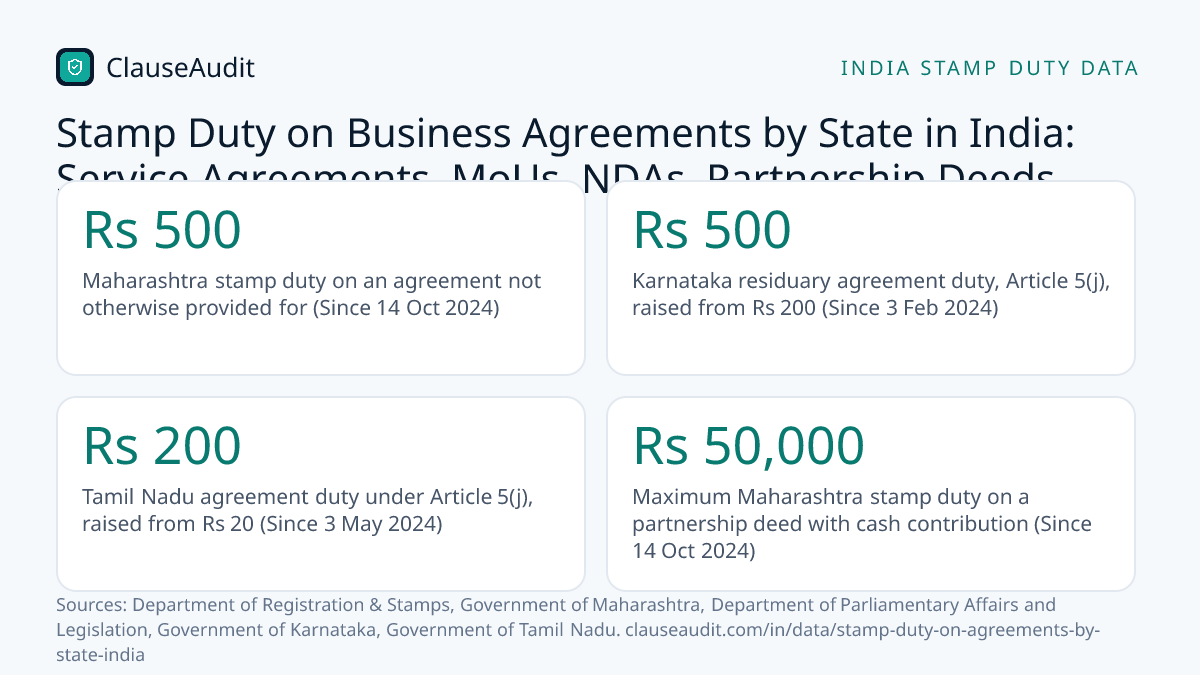
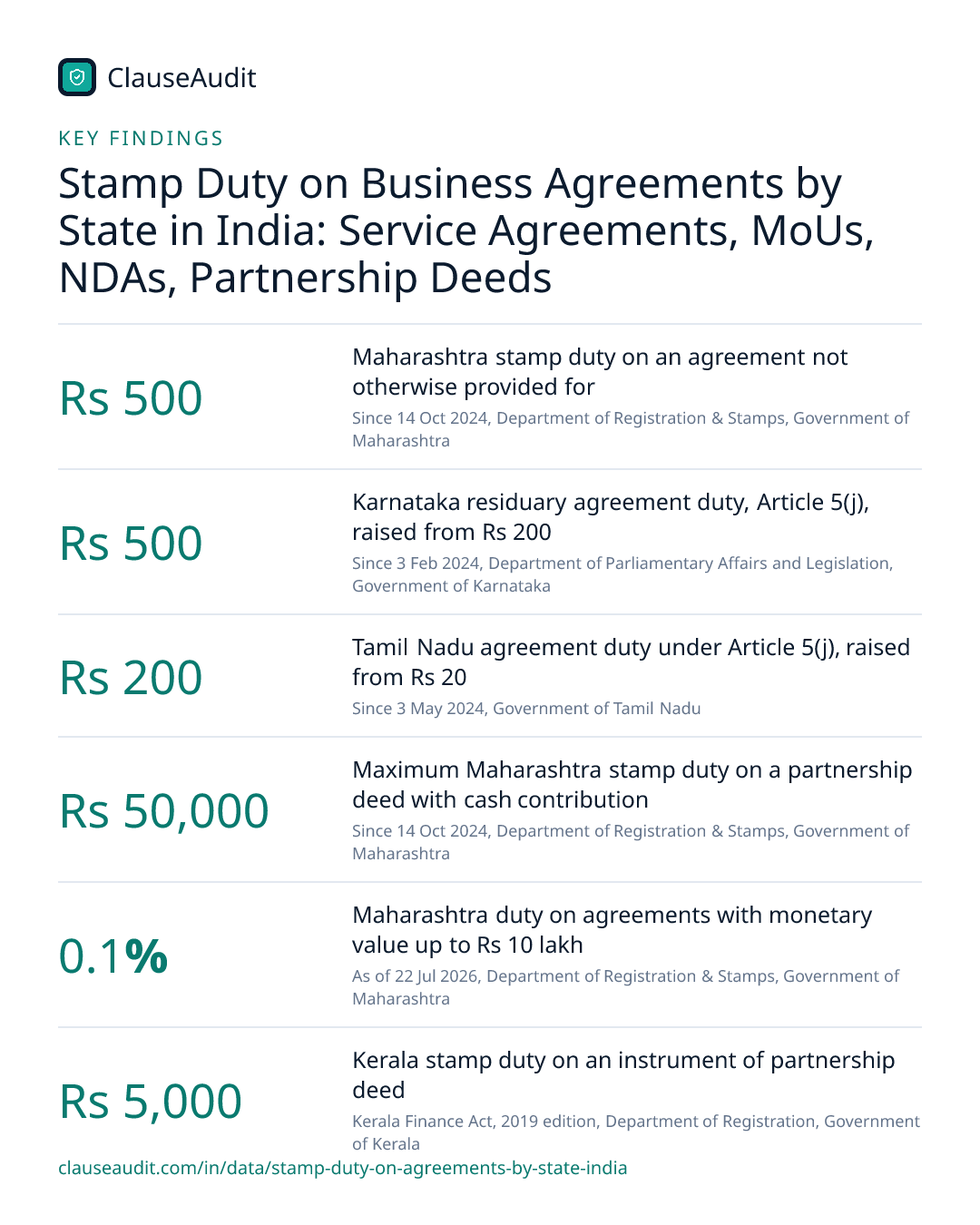
For an ordinary agreement such as an NDA, MoU or simple service contract, most states charge a small fixed duty. Maharashtra and Karnataka charge Rs 500, and Tamil Nadu charges Rs 200. In Maharashtra, an agreement with a money value instead pays 0.1% of the amount up to Rs 10 lakh, and 0.2% above that.

- Maharashtra stamp duty on an agreement not otherwise provided for (Since 14 Oct 2024, Department of Registration & Stamps, Government of Maharashtra)
- Rs 500
- Karnataka residuary agreement duty, Article 5(j), raised from Rs 200 (Since 3 Feb 2024, Department of Parliamentary Affairs and Legislation, Government of Karnataka)
- Rs 500
- Tamil Nadu agreement duty under Article 5(j), raised from Rs 20 (Since 3 May 2024, Government of Tamil Nadu)
- Rs 200
- Maximum Maharashtra stamp duty on a partnership deed with cash contribution (Since 14 Oct 2024, Department of Registration & Stamps, Government of Maharashtra)
- Rs 50,000
- Maharashtra duty on agreements with monetary value up to Rs 10 lakh (As of 22 Jul 2026, Department of Registration & Stamps, Government of Maharashtra)
- 0.1%
- Kerala stamp duty on an instrument of partnership deed (Kerala Finance Act, 2019 edition, Department of Registration, Government of Kerala)
- Rs 5,000
- Maximum Rajasthan stamp duty on a partnership deed with cash contribution (As applicable on 1 May 2024, Department of Registration and Stamps, Government of Rajasthan (via Rajnivesh portal))
- Rs 10,000
Every written business agreement in India is meant to carry stamp duty, and the rate depends on the state where it is signed or first brought in. For most NDAs, MoUs and plain service contracts the duty is a fixed amount under the residuary 'agreement not otherwise provided for' article. That figure went up sharply in several states during 2024.
Partnership deeds and agreements with a stated contract value follow different rules, and the gap between states is wide. This page explains which article your document probably falls under, what the recent increases mean for small businesses and freelancers, and how to avoid the common mistake of signing on a stamp paper that is too low.
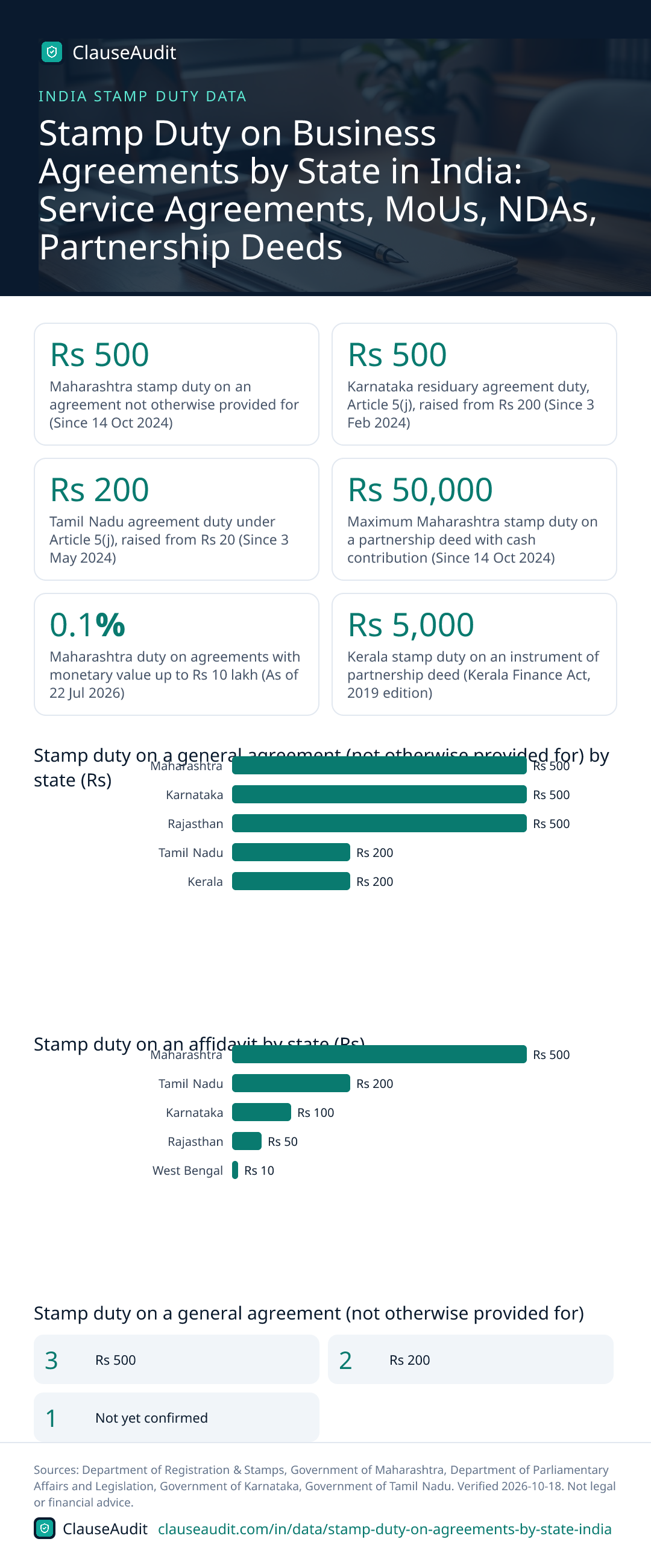
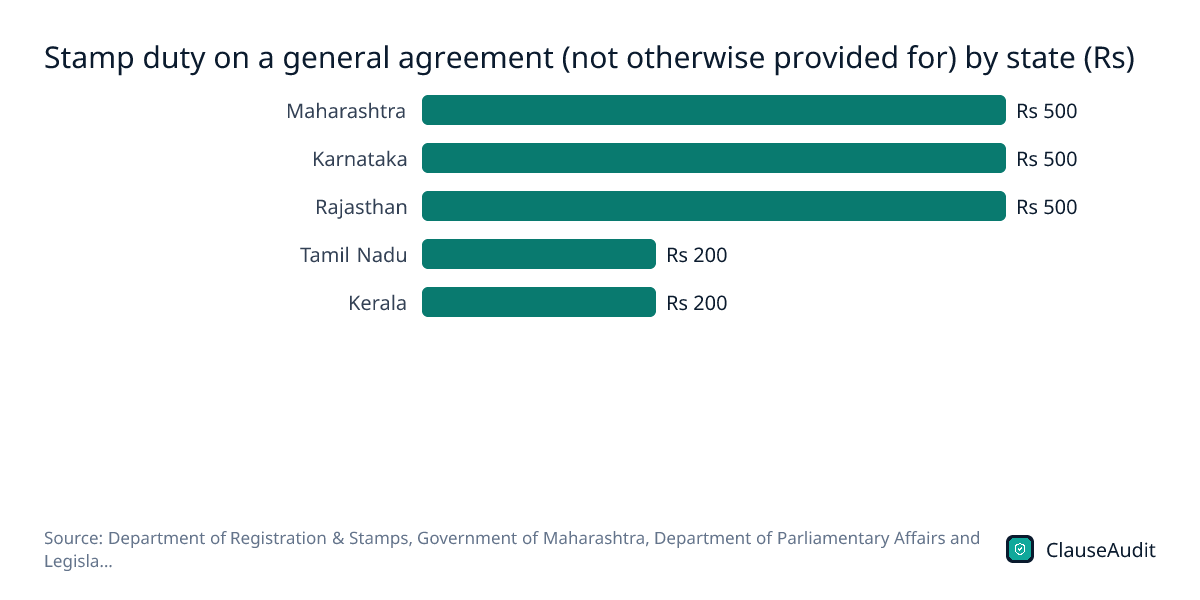
Stamp duty on a general agreement (not otherwise provided for) by state (Rs)
Chart data
| Label | Value |
|---|---|
| Maharashtra | Rs 500 |
| Karnataka | Rs 500 |
| Rajasthan | Rs 500 |
| Tamil Nadu | Rs 200 |
| Kerala | Rs 200 |
Maharashtra, Karnataka and Rajasthan sit at Rs 500 for a residuary agreement, while Tamil Nadu and Kerala charge Rs 200. Kerala and Rajasthan figures come from older official tables, so check for later changes.
Download this chart (PNG)Stamp duty on an affidavit by state (Rs)
Chart data
| Label | Value |
|---|---|
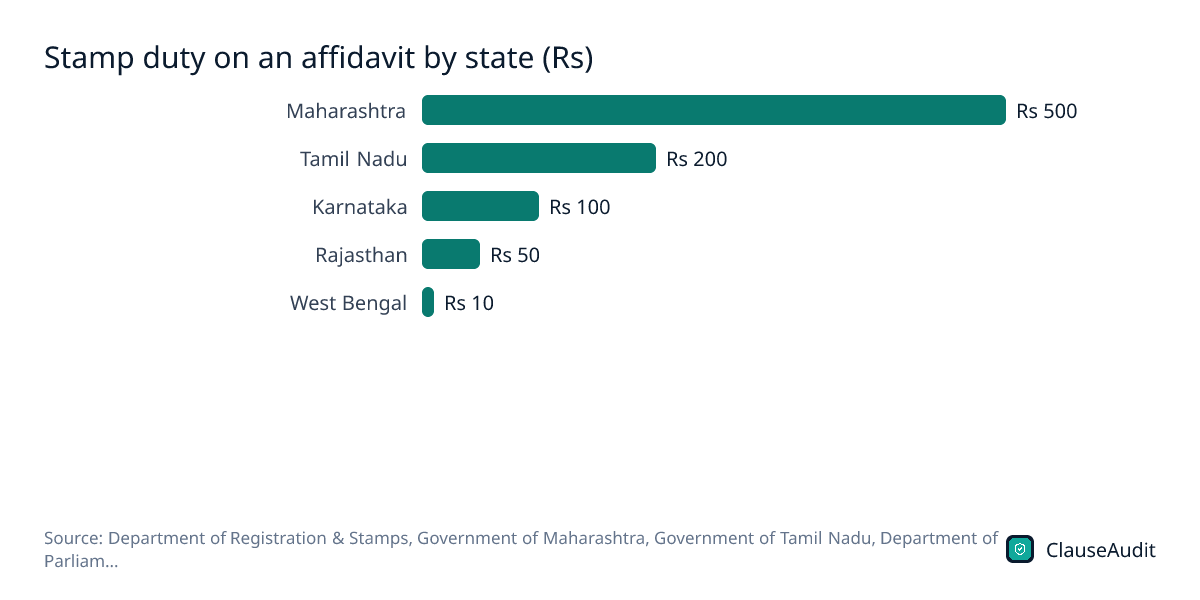
| Maharashtra | Rs 500 |
| Tamil Nadu | Rs 200 |
| Karnataka | Rs 100 |
| Rajasthan | Rs 50 |
| West Bengal | Rs 10 |
Affidavits show a much wider spread, from Rs 500 in Maharashtra to Rs 10 in West Bengal. If your contract needs a supporting affidavit, the state you execute it in matters more than you might expect.
Download this chart (PNG)Stamp duty on a partnership deed with Rs 5 lakh cash capital, by state
Chart data
| Label | Value |
|---|---|
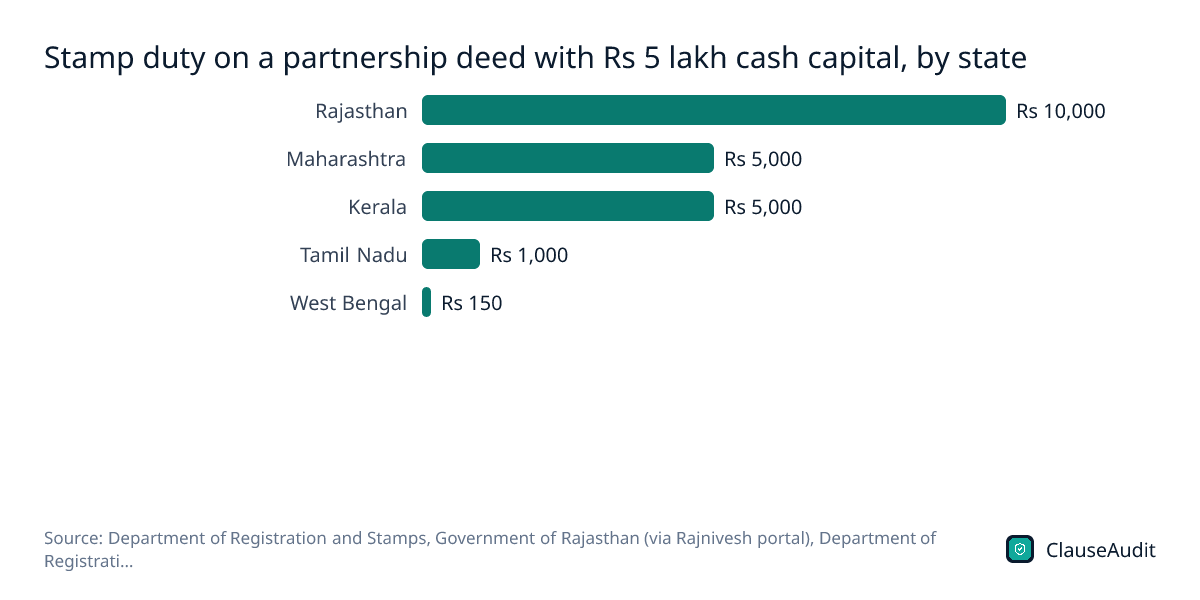
| Rajasthan | Rs 10,000 |
| Maharashtra | Rs 5,000 |
| Kerala | Rs 5,000 |
| Tamil Nadu | Rs 1,000 |
| West Bengal | Rs 150 |
On the same Rs 5 lakh cash capital, a Rajasthan firm pays Rs 10,000 and a West Bengal firm pays Rs 150. Partners who live in different states should think about where the deed is executed.
Download this chart (PNG)How many times the general agreement duty rose in the latest amendment
Chart data
| Label | Value |
|---|---|
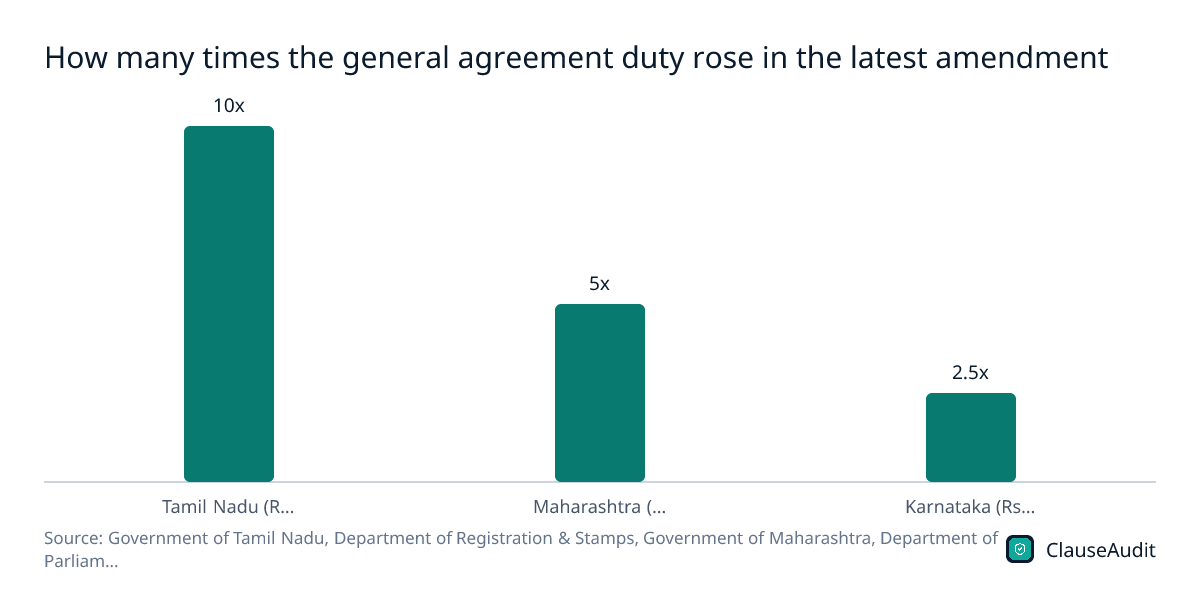
| Tamil Nadu (Rs 20 to Rs 200, 2024) | 10x |
| Maharashtra (Rs 100 to Rs 500, 2024) | 5x |
| Karnataka (Rs 200 to Rs 500, 2024) | 2.5x |
Tamil Nadu raised its agreement duty 10x, from Rs 20 to Rs 200. Templates and habits built around old stamp paper values are now out of date in all three states.
Download this chart (PNG)Recent changes to stamp duty on agreements, partnership deeds and affidavits
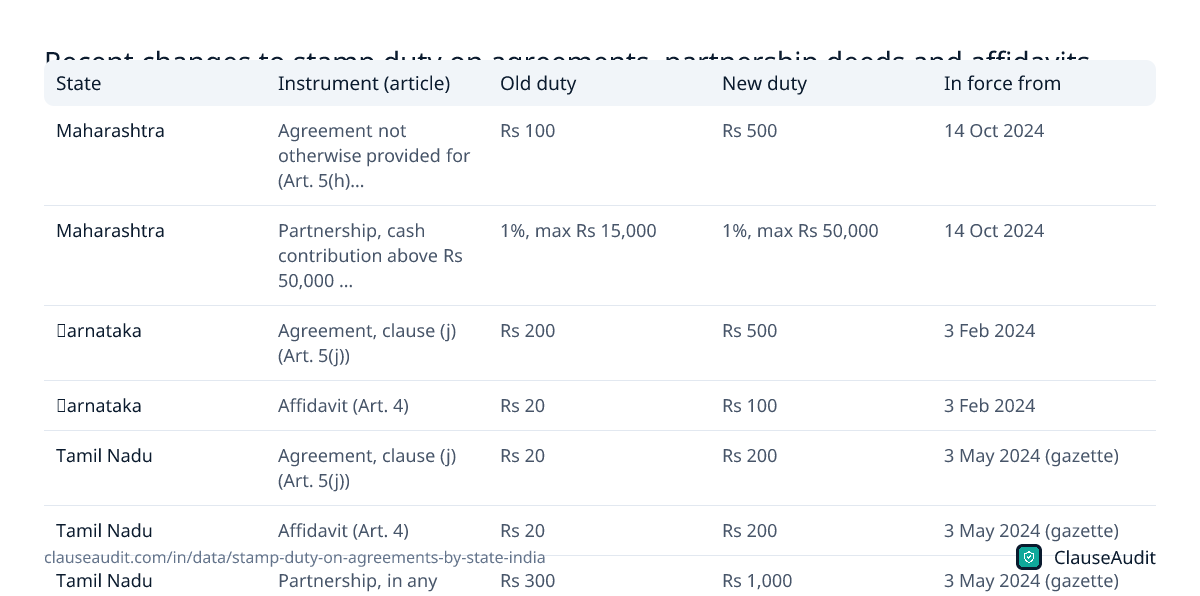
| State | Instrument (article) | Old duty | New duty | In force from |
|---|---|---|---|---|
| Maharashtra | Agreement not otherwise provided for (Art. 5(h)(B)) | Rs 100 | Rs 500 | 14 Oct 2024 |
| Maharashtra | Partnership, cash contribution above Rs 50,000 (Art. 47(1)(b)) | 1%, max Rs 15,000 | 1%, max Rs 50,000 | 14 Oct 2024 |
| Karnataka | Agreement, clause (j) (Art. 5(j)) | Rs 200 | Rs 500 | 3 Feb 2024 |
| Karnataka | Affidavit (Art. 4) | Rs 20 | Rs 100 | 3 Feb 2024 |
| Tamil Nadu | Agreement, clause (j) (Art. 5(j)) | Rs 20 | Rs 200 | 3 May 2024 (gazette) |
| Tamil Nadu | Affidavit (Art. 4) | Rs 20 | Rs 200 | 3 May 2024 (gazette) |
| Tamil Nadu | Partnership, in any other case (Art. 46 A(b)) | Rs 300 | Rs 1,000 | 3 May 2024 (gazette) |
Source: Department of Registration & Stamps, Government of Maharashtra, Schedule I and II to the Maharashtra Stamp Act (article-wise); Department of Parliamentary Affairs and Legislation, Government of Karnataka, The Karnataka Stamp (Amendment) Act, 2023 (Karnataka Act No. 04 of 2024), Karnataka Gazette Extraordinary Part IVA No. 58; Government of Tamil Nadu, The Indian Stamp (Tamil Nadu Amendment) Act, 2023 (Act No. 13 of 2024), Tamil Nadu Government Gazette Extraordinary No. 160. Download as image
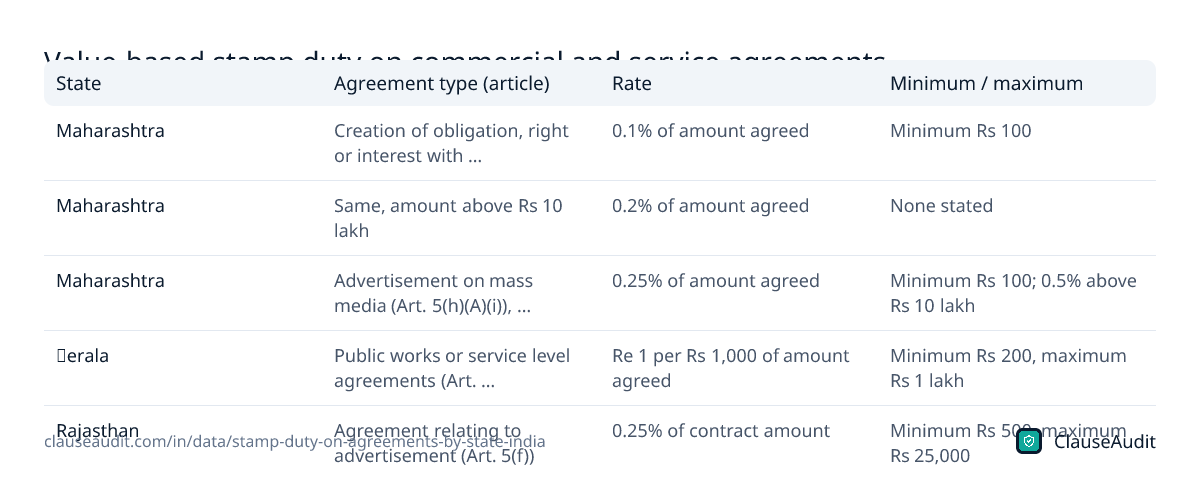
Value-based stamp duty on commercial and service agreements
| State | Agreement type (article) | Rate | Minimum / maximum |
|---|---|---|---|
| Maharashtra | Creation of obligation, right or interest with monetary value, not covered elsewhere (Art. 5(h)(A)(iv)), amount up to Rs 10 lakh | 0.1% of amount agreed | Minimum Rs 100 |
| Maharashtra | Same, amount above Rs 10 lakh | 0.2% of amount agreed | None stated |
| Maharashtra | Advertisement on mass media (Art. 5(h)(A)(i)), up to Rs 10 lakh | 0.25% of amount agreed | Minimum Rs 100; 0.5% above Rs 10 lakh |
| Kerala | Public works or service level agreements (Art. 5(f)) | Re 1 per Rs 1,000 of amount agreed | Minimum Rs 200, maximum Rs 1 lakh |
| Rajasthan | Agreement relating to advertisement (Art. 5(f)) | 0.25% of contract amount | Minimum Rs 500, maximum Rs 25,000 |
Source: Department of Registration & Stamps, Government of Maharashtra, Schedule I and II to the Maharashtra Stamp Act (article-wise); Department of Registration, Government of Kerala, Existing Rates of Stamp Duty and Registration Fees for Ready Reference; Department of Registration and Stamps, Government of Rajasthan (via Rajnivesh portal), Stamp Duty and Registration Fee Detail. Download as image
Stamp duty on a general agreement (not otherwise provided for) by State
- 3Rs 500
- 2Rs 200
- 1Not yet confirmed
| State | General agreement / MoU / NDA (residuary article) | Value-based commercial or service agreement | Partnership deed | Affidavit | Source |
|---|---|---|---|---|---|
| Karnataka | Rs 500 (Art. 5(j)) | Not confirmed | Not confirmed (Article 40(A) was not changed by Act 4 of 2024) | Rs 100 (Art. 4) | Karnataka Stamp Act, 1957, Schedule, Articles 4 and 5(j), as amended by Karnataka Act No. 04 of 2024 |
| Kerala | Rs 200 (Art. 5(g)) | Re 1 per Rs 1,000 of amount agreed, min Rs 200, max Rs 1 lakh, for public works or service level agreements (Art. 5(f)) | Rs 5,000 (Art. 43(a)); reconstitution or dissolution where a partner takes immovable property brought in by another partner: 8% of fair value, min Rs 1,000 (Art. 43(b),(c)); any other case Rs 1,000 (Art. 43(d)) | Not listed on the source | Kerala Stamp Act, 1959, Schedule, Articles 5 and 43 (Art. 43 as amended by Kerala Finance Act, 2024) |
| Maharashtra | Rs 500 (Art. 5(h)(B)) | 0.1% of amount agreed up to Rs 10 lakh (min Rs 100); 0.2% above (Art. 5(h)(A)(iv)) | Rs 500 if cash contribution is nil or up to Rs 50,000; 1% of contribution above that, max Rs 50,000 (Art. 47(1)) | Rs 500 (Art. 4) | Maharashtra Stamp Act, 1958, Schedule I, Articles 4, 5 and 47 |
| Rajasthan | Rs 500 (Art. 5(g), any agreement not covered under Art. 5(a) to 5(ff)) | Advertisement agreements: 0.25% of contract, min Rs 500, max Rs 25,000 (Art. 5(f)) | Rs 2,000 for every Rs 50,000 of cash contribution, max Rs 10,000 (Art. 43(1)) | Rs 50 (Art. 4) | Rajasthan Stamp Act, 1998, Schedule, Articles 4, 5 and 43 |
| Tamil Nadu | Rs 200 (Art. 5(j)) | Not confirmed | Rs 1,000 (Art. 46 A(b), in any other case) | Rs 200 (Art. 4) | Indian Stamp Act, 1899, Schedule I as amended by the Indian Stamp (Tamil Nadu Amendment) Act, 2023 (Act No. 13 of 2024) |
| West Bengal | Not listed on the source page | Not listed on the source page | Rs 20 (capital up to Rs 500); Rs 50 (up to Rs 10,000); Rs 100 (up to Rs 50,000); Rs 150 (above Rs 50,000) (Art. 46) | Rs 10 (Art. 4) | Indian Stamp Act, 1899, Schedule IA as applicable in West Bengal, Articles 4 and 46 |
Do NDAs, MoUs and service agreements need stamp duty in India?
Yes. A written agreement is an 'instrument' under the stamp laws, and an NDA or MoU is no exception. Unless a more specific article covers it, it falls under the residuary clause of Article 5, the catch-all for agreements not otherwise provided for. That is where the Rs 500 figure in Maharashtra and Karnataka and the Rs 200 figure in Tamil Nadu come from.
Stamp duty does not decide whether your agreement is valid. It decides how easily you can use it. An unstamped or under-stamped document generally cannot be relied on as evidence until the shortfall and a penalty are paid. So the cost of skipping it shows up at the worst moment: when a client refuses to pay and you need the contract in front of a court or arbitrator.
Watch for documents that look like a simple agreement but are really something else. A deed that assigns property, a lease, a loan with security or a document giving someone power to act for you each sit under their own article with their own rate. Calling it an MoU on the first page does not change the article that applies.
How much stamp duty is payable on a service agreement with a contract value?
This is where Maharashtra differs from the others. Its Article 5(h)(A)(iv) charges duty on agreements that create an obligation or right with a monetary value. The rate is 0.1% of the amount agreed up to Rs 10 lakh, with a minimum of Rs 100, and 0.2% above Rs 10 lakh. A Rs 5 lakh service contract at 0.1% works out to Rs 500, which matches the flat residuary rate anyway. Bigger contracts pay more.
Advertising deals are treated separately. Maharashtra charges 0.25% on mass media advertisement agreements up to Rs 10 lakh. Rajasthan charges 0.25% of the contract amount on advertisement agreements, with a minimum of Rs 500 and a maximum of Rs 25,000. Kerala has its own line for public works and service level agreements: Re 1 per Rs 1,000 of the amount agreed, between Rs 200 and Rs 1 lakh.
If you sign a retainer or a long project with a clear total fee, do not assume the flat rate applies. Work out whether your state has a value-based article and what the total consideration is over the full term.
What is the stamp duty on a partnership deed?
Partnership deeds have their own article, and this is where the biggest state differences sit. In Maharashtra the deed costs Rs 500 if cash contribution is nil or up to Rs 50,000. Above that it is 1% of the contribution, now capped at Rs 50,000. The cap was Rs 15,000 until 14 October 2024, so a well-funded firm formed today can pay far more than one formed a few years ago.
Rajasthan charges Rs 2,000 for every Rs 50,000 of cash contribution, capped at Rs 10,000. Kerala charges a flat Rs 5,000. Tamil Nadu charges Rs 1,000 in the ordinary case. West Bengal uses a slab that tops out at Rs 150 for capital above Rs 50,000.
One trap: if a partner brings in land or a building instead of cash, Maharashtra charges conveyance duty on its market value. Kerala charges 8% of fair value when a partner takes away property another partner brought in on reconstitution or dissolution. If property is involved, get the duty worked out before anyone signs.
Which state's stamp duty applies if parties are in different states?
As a working rule, duty is paid under the law of the state where the agreement is executed. If a document signed in one state is later brought into another state with a higher rate, that second state can ask for the difference. Many state Acts say this directly.
In practice this means a Chennai freelancer signing with a Mumbai client should ask where each side is signing and where any dispute is likely to be heard. Digital signing makes 'where' harder to pin down, so the safer course is to stamp at the higher of the likely rates. On a Rs 500 versus Rs 200 gap, the extra cost is small next to the risk of a document a court will not look at.
Also look at the governing law clause. It does not fix the stamp duty, but it signals where the document is likely to be produced, and that state can ask for any shortfall against its own rate.
How to stamp an agreement correctly
- Identify the article first. Is it a plain agreement, a value-based service agreement, a partnership deed or something with property in it?
- Check the current rate on your state's registration department site. Several rates on this page changed in 2024, and old templates still circulate.
- Buy e-stamp paper in the name of one of the parties, dated on or before the signing date. Stamping after signing can attract a penalty.
- For value-based duty, use the total consideration over the full term, not the first invoice.
- Keep the e-stamp certificate with the signed copy. Verify the certificate number online before you rely on it.
- If both parties sign on separate copies, ask whether each counterpart needs duty under your state's rules.
What the recent increases mean for small businesses
The amounts are still modest, but the direction is clear. Tamil Nadu raised its agreement duty from Rs 20 to Rs 200, Maharashtra from Rs 100 to Rs 500 and Karnataka from Rs 200 to Rs 500, all in 2024. Karnataka also raised its affidavit duty from Rs 20 to Rs 100.
If you run an agency or consulting business that signs many NDAs and work orders, add stamp duty to your onboarding cost and decide who pays it. Most contracts say nothing, which leads to small but annoying disputes. A single line stating that the client bears stamp duty, or that costs are split, settles it.
How ClauseAudit helps
A court or arbitrator will check stamping before relying on your contract, yet it rarely gets attention when the contract is drafted. ClauseAudit's automated review reads your service agreement, NDA or MoU and flags the clauses that decide what the paper is worth when something goes wrong.
Upload the draft before you buy the stamp paper, so any changes to fee, term or governing law are settled first.
- Total contract value and term, which can decide value-based duty
- Who bears stamp duty and registration costs
- Governing law, jurisdiction and seat of arbitration
- Payment terms, late fees and what happens if the client delays
- Liability cap and indemnity wording
- Renewal and termination terms that can change the total amount agreed
Frequently asked questions
What is the stamp duty on an agreement in Maharashtra?
For an agreement not otherwise provided for, Maharashtra charges Rs 500 under Article 5(h)(B), up from Rs 100 since 14 October 2024. If the agreement creates an obligation with a monetary value and no other article applies, duty is 0.1% of the amount agreed up to Rs 10 lakh, with a minimum of Rs 100, and 0.2% above that.
Is stamp duty required on an NDA in India?
Yes. An NDA is a written agreement and usually falls under the residuary agreement article. That means Rs 500 in Maharashtra and Karnataka and Rs 200 in Tamil Nadu. An unstamped NDA is still a contract, but you may have to pay the shortfall plus a penalty before you can use it as evidence.
How much stamp duty applies to an MoU?
An MoU is treated like any other agreement, so the residuary agreement rate applies unless its content puts it under a more specific article. If the MoU transfers property, grants a lease or sets a contract value in Maharashtra, a different article and a higher amount may apply. The label on the document does not decide the duty.
What is the stamp duty on a partnership deed in Maharashtra?
Rs 500 if the cash contribution is nil or up to Rs 50,000. Above that, 1% of the share contribution, with a maximum of Rs 50,000, up from Rs 15,000 before 14 October 2024. If a partner contributes property instead of cash, conveyance duty on its market value applies to that part.
Which state has the lowest stamp duty on a partnership deed?
Among the states on this page, West Bengal is the lowest. Its slab tops out at Rs 150 for capital above Rs 50,000. On a Rs 5 lakh cash contribution, Tamil Nadu charges Rs 1,000, Maharashtra and Kerala Rs 5,000, and Rajasthan Rs 10,000.
Can I sign an agreement first and stamp it later?
It is risky. Stamp paper is meant to be bought on or before the date of signing. Stamping afterwards usually means paying the duty plus a penalty, and until that is done the document may not be admitted as evidence. Buy e-stamp paper before anyone signs.
Does a service agreement need stamp duty based on its value?
In Maharashtra, often yes. Article 5(h)(A)(iv) charges 0.1% of the amount agreed up to Rs 10 lakh and 0.2% above it. Kerala charges Re 1 per Rs 1,000 on public works or service level agreements, between Rs 200 and Rs 1 lakh. Elsewhere a flat residuary rate is more common, so check your state's schedule.
What is the stamp duty on an affidavit?
It varies a lot. Maharashtra charges Rs 500, Tamil Nadu Rs 200, Karnataka Rs 100, Rajasthan Rs 50 and West Bengal Rs 10. Affidavits filed in court are exempt in several states, including Maharashtra. If your contract asks for a supporting affidavit, budget for it separately from the agreement itself and check where it will be executed.
Use this data
Every chart and card below is free to reuse under CC BY 4.0. Download what you need and link back to this page.
 Stat cards
 Key findings card
 Infographic
 Stamp duty on a general agreement (not otherwise provided for) by state (Rs)
 Stamp duty on an affidavit by state (Rs)
 Stamp duty on a partnership deed with Rs 5 lakh cash capital, by state
 How many times the general agreement duty rose in the latest amendment
 Recent changes to stamp duty on agreements, partnership deeds and affidavits
 Value-based stamp duty on commercial and service agreements
Embed the infographic
Free to share on your site, blog or slides under CC BY 4.0. Please keep the credit link.
Sources and method
Every number on this page comes from the sources below, each opened and read on or before October 18, 2026. A second, independent review checked every figure against its source and corrected anything that did not match. 6 of 6 State entries were confirmed; any that could not be are marked "Not yet confirmed" and left out of every count and chart.
- Department of Registration & Stamps, Government of Maharashtra, Schedule I and II to the Maharashtra Stamp Act (article-wise) (As modified up to 22 July 2026)
- Department of Parliamentary Affairs and Legislation, Government of Karnataka, The Karnataka Stamp (Amendment) Act, 2023 (Karnataka Act No. 04 of 2024), Karnataka Gazette Extraordinary Part IVA No. 58 (3 February 2024 (in force at once))
- PRS Legislative Research, The Karnataka Stamp Act, 1957 (compiled text with amendments appended) (Amendments appended up to Act 16 of 2015)
- Government of Tamil Nadu, The Indian Stamp (Tamil Nadu Amendment) Act, 2023 (Act No. 13 of 2024), Tamil Nadu Government Gazette Extraordinary No. 160 (3 May 2024 (in force at once))
- Department of Registration, Government of Kerala, Existing Rates of Stamp Duty and Registration Fees for Ready Reference (Stamp Act as last amended by Kerala Finance Act, 2019; fee table G.O.(P) No.113/2019/TD dated 24.07.2019)
- Department of Registration and Stamps, Government of Rajasthan (via Rajnivesh portal), Stamp Duty and Registration Fee Detail (As applicable on 01-05-2024)
- Directorate of Registration & Stamp Revenue, Government of West Bengal, Stamp Duties and Fees: Rate of Stamp Duty and Registration Fees on some important instruments (Last Updated: 20/05/2025)
- Government of Kerala (Kerala Gazette, via PRS Legislative Research), Kerala Finance Act, 2024 (Act 18 of 2024) (2024; section 2 deemed in force from 1 April 2024)
Cite this page
ClauseAudit, “Stamp Duty on Business Agreements by State in India: Service Agreements, MoUs, NDAs, Partnership Deeds”, updated October 18, 2026, https://clauseaudit.com/in/data/stamp-duty-on-agreements-by-state-india. Free to reuse with a link back (CC BY 4.0).
This page summarises published data and law as checked on October 18, 2026. Figures are updated as new editions are released, and your own situation may differ. It is general information, not legal, tax or financial advice.