Rent Agreement Stamp Duty and Registration Charges by State in India
By ClauseAudit Research · Verified against official sources ·
How much is stamp duty on an 11-month rent agreement in India?
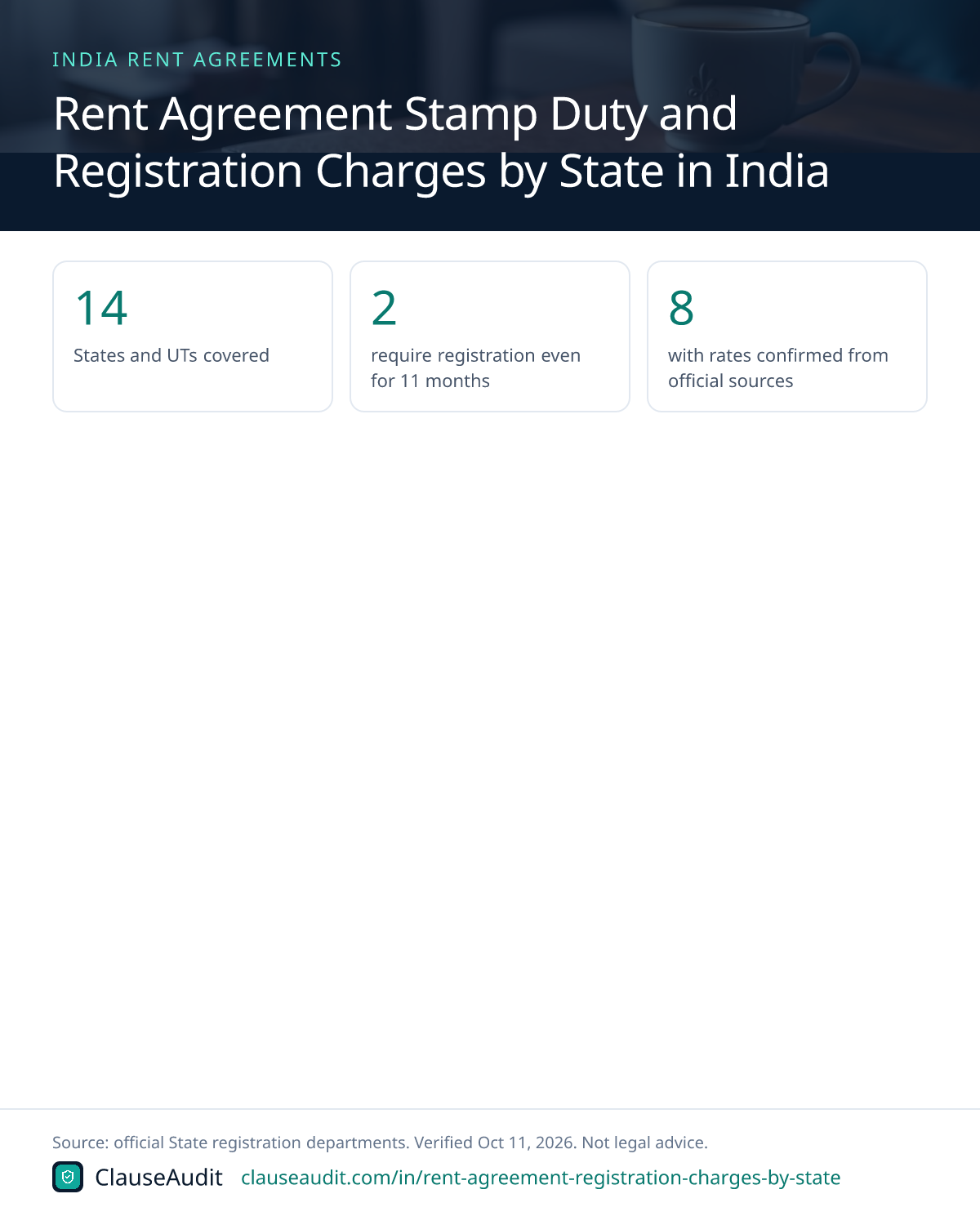
It depends on the State. Of the 14 States we tracked, 8 have rates confirmed from official sources: Kerala and Gujarat charge a flat ₹500 for homes, Karnataka charges 0.5% capped at ₹500, and Tamil Nadu charges 1% of total rent. 2 States still require registration for 11 months.

- States and UTs covered
- 14
- require registration even for 11 months
- 2
- with rates confirmed from official sources
- 8
Most Indian rent agreements run for 11 months for one reason: central registration law makes leases of more than a year compulsorily registrable, and staying under that line keeps costs and paperwork down. Stamp duty is a different matter. You owe it on almost every written rent agreement, and each State sets its own rate.
This page sets out what you actually pay in each State where we could read the current official rate, how to work out the figure on your own rent, and where the 11-month shortcut does not work. Maharashtra is the big exception, and Tamil Nadu has its own rule.
Rent agreement stamp duty and registration charges by State
| State | Stamp duty | Registration fee | Registration for 11 months | Where to pay |
|---|---|---|---|---|
| Andhra Pradesh | Not yet confirmed: check the statute linked in the sources | CARD PRIMME online portal, Registration and Stamps Department, Andhra Pradesh (registration.ap.gov.in) | ||
| Delhi | Not yet confirmed: check the statute linked in the sources | NGDRS Delhi (Sub-Registrar offices migrated from DORIS to NGDRS); e-stamp via SHCIL | ||
| Gujarat | Residential property: Rs 500; Commercial property: Rs 1,000 (lease under one year where rent is fixed and no premium is paid). Any fine, premium or money advanced adds conveyance duty under Art. 30(c). | 1% of the average lease amount (Art. 30(a), up to 1 year); 1% of any premium or money advanced | Optional | GARVI (garvi.gujarat.gov.in); e-stamping per Gujarat e-Stamping Rules |
| Haryana | Same duty as a Bond (Art. 15) on the whole amount payable: Rs 15 for the first Rs 1,000, plus Rs 7.50 for every further Rs 500 or part (about 1.5%) | Not stated for leases. The official table gives Rs 50 for optionally registrable documents "except leases" and slabs for compulsorily registrable documents "other than leases". | Optional | Web-HALRIS / jamabandi.nic.in; e-stamp via SHCIL |
| Karnataka | 0.5% on the average annual rent + advance + premium + fine, maximum Rs 500 (lease or licence up to 1 year, residential) | Rs 5 for every Rs 1,000 or part thereof, minimum Rs 200 | Optional | Kaveri Online Services (Department of Stamps and Registration, Karnataka) |
| Kerala | Rs 500 (lease for a period less than 1 year) | Rs 210 | Optional | Kerala Registration Department (keralaregistration.gov.in) |
| Madhya Pradesh | Not yet confirmed: check the statute linked in the sources | SAMPADA 2.0, Registration and Stamps, Madhya Pradesh | ||
| Maharashtra | 0.25% of (total licence fee for the term + 10% of any refundable deposit for each year or part of the term + any non-refundable deposit), minimum Rs 100. For an 11-month term the deposit part is 10% of the refundable deposit. | Rs 1,000 (urban) or Rs 500 (rural), plus a document handling charge of Rs 300 | Required | IGR Maharashtra e-Leave and Licence (leaveandlicense.igrmaharashtra.gov.in) |
| Punjab | 4% of the annual rent amount (lease of less than one year) | 1% of the annual rent amount, plus a Rs 500 facilitation charge | Optional | IGR Punjab / NGDRS Punjab; e-stamp via SHCIL |
| Rajasthan | Not yet confirmed: check the statute linked in the sources | e-Panjiyan, Department of Registration and Stamps, Rajasthan | ||
| Tamil Nadu | 1% of the total amount of rent, premium, fine etc. (lease below 30 years) | 1%, subject to a maximum of Rs 40,000 | Required | TNREGINET (tnreginet.gov.in); tenancy registration with the Rent Authority under the 2017 Act |
| Telangana | 0.4% of the total rent for a lease of less than 1 year, plus 2% on any fine, premium or money advanced in addition to rent | 0.2% of the total rent (Lease); 0.2% (License) | Optional | IGRS Telangana (registration.telangana.gov.in) |
| Uttar Pradesh | Not yet confirmed: check the statute linked in the sources | IGRSUP (igrsup.gov.in); e-stamp via SHCIL | ||
| West Bengal | Not yet confirmed: check the statute linked in the sources | IGR West Bengal (igr.wb.gov.in, formerly wbregistration.gov.in) |
Why are rent agreements made for 11 months?
Section 17(1)(d) of the Registration Act, 1908 makes registration compulsory for leases of immovable property from year to year, for any term exceeding one year, or reserving a yearly rent. An 11-month agreement sits below that line, so in most States you are not legally required to take it to the Sub-Registrar.
That saves you a registration fee, a visit to the office and, in some States, a percentage charge on the rent. It does not save you stamp duty. Stamp duty is charged on the document itself under the State Stamp Act, whether or not you register it.
The shortcut also has limits. A State can add its own registration rule on top of the central one, and 2 States in our data do exactly that.
Where 11-month agreements still need registration
Of the 14 States and UTs in our dataset, 2 require some form of registration even for an 11-month term.
Maharashtra is the clearest case. Leave and licence agreements must be registered there regardless of length, under section 55 of the Maharashtra Rent Control Act, 1999. You do it through the IGR Maharashtra e-Leave and Licence portal. The registration fee is ₹1,000 in urban areas or ₹500 in rural areas, plus a ₹300 document handling charge.
Tamil Nadu works differently. The requirement there is not Sub-Registrar registration. Under the Tamil Nadu Regulation of Rights and Responsibilities of Landlords and Tenants Act, 2017, a tenancy agreement must be informed to the local Rent Authority, which registers it. That applies whatever the term.
How to work out stamp duty on your rent agreement
The formula changes from State to State, so start with the rule for your State and then run the numbers. Take a flat in which the monthly rent is ₹25,000 for 11 months (₹2,75,000 in total) with a refundable deposit of ₹1,00,000.
- Maharashtra: 0.25% of a base made up of total rent plus 10% of the refundable deposit, for a term up to a year. The base here is ₹2,85,000, and 0.25% of that, or about ₹713. Add ₹1,000 registration and ₹300 handling in a city, for roughly ₹2,013.
- Karnataka: 0.5% on the average annual rent plus advance, with a ₹500 maximum for residential leases up to a year. At this rent you hit the cap, so stamp duty is ₹500. Registration is optional and starts at ₹200.
- Tamil Nadu: 1% of the total rent, premium and so on, which is ₹2,750. The registration fee is also 1%, capped at ₹40,000.
- Telangana: 0.4% of total rent for a lease under a year, so ₹1,100, plus 2% on any premium or money advanced in addition to rent. If the office treats your deposit as money advanced, that 2% would add ₹2,000, so ask before you pay. Registration, if you choose it, is 0.2% of total rent, or ₹550.
- Kerala: a flat ₹500 for a lease under one year, and ₹210 if you register it.
- Gujarat: a flat ₹500 for a residential lease under a year where rent is fixed and no premium is paid. Commercial premises pay ₹1,000.
Which States charge the most and the least?
Among the 8 States with confirmed rates, the gap is wide. Kerala, Gujarat and Karnataka keep a home rental cheap with a flat ₹500 or a ₹500 ceiling. Punjab sits at the other end: 4% of the annual rent, plus a 1% registration fee and a ₹500 facilitation charge if you register. Punjab's figures come from a 2020 official table, so check the current rate before you pay.
Haryana treats a lease under a year like a bond on the whole amount payable: ₹15 for the first ₹1,000 and ₹7.50 for every further ₹500, which works out to about 1.5%. That source is undated, so confirm it too.
Watch the deposit and any premium. Several States charge extra on money paid up front. Telangana adds 2% on an advance, Gujarat applies conveyance duty to any premium, and Gujarat's Act treats advance rent as a premium unless it is set off against the last instalments of rent.
How e-stamping and online payment work
You often do not need physical stamp paper now. Many States let you pay duty through an e-stamp certificate or an official portal, and the certificate is attached to the agreement as proof of payment.
- Find your State's portal. Maharashtra uses the IGR e-Leave and Licence system, Tamil Nadu uses TNREGINET, Karnataka uses Kaveri Online Services, Telangana uses IGRS Telangana and Gujarat uses GARVI. Haryana and Punjab both list e-stamping through SHCIL.
- Work out the duty on the right base. Use total rent for the term in percentage States, and remember to add any deposit share or premium your State counts.
- Buy the e-stamp in the name of the party paying the duty, with the property and the other party described correctly.
- Print or attach the certificate and sign the agreement after the stamp date, not before.
- Register it if your State requires it, or if you want the extra protection, and keep a copy of the receipt with your file.
What happens if the agreement is under-stamped or not registered?
An under-stamped agreement is not void, but it is weak. Under section 35 of the Indian Stamp Act, 1899, an instrument that is not duly stamped cannot be admitted in evidence until the duty is paid along with a penalty of ₹5 or ten times the missing duty, whichever is more. States with their own Stamp Acts, such as Maharashtra, set their own penalty rules, so the figure can differ. If you ever need to rely on the agreement in a dispute over the deposit or eviction, that penalty lands on whoever produces it.
A document that the law says must be registered, but was not, faces a separate problem. Section 49 of the Registration Act, 1908 says it cannot affect the property or be received as evidence of a transaction affecting it, though it can still be used for limited collateral purposes. In Maharashtra, an unregistered leave and licence agreement also breaks the State's own rule.
If you discover the stamp is short, the fix is usually simple: pay the deficit with the Collector or registration office before a dispute arises, rather than at the door of a court.
A quick example. Say you are renting in Chennai and the agreement was stamped at ₹500 because a broker said that was standard. Tamil Nadu charges 1% of total rent, so on ₹2,75,000 of rent the right figure is ₹2,750. The shortfall is ₹2,250. Settle it early through the Collector and the cost is usually far lower. Leave it until the agreement is needed as evidence and, under section 35, the penalty can reach ten times the shortfall.
Central law and the Model Tenancy Act
Two central statutes set the frame. The Registration Act, 1908 decides when a lease must be registered, and the Indian Stamp Act, 1899 is the base Stamp Act that many States have amended with their own schedules. Maharashtra, Karnataka, Gujarat and Kerala run their own Stamp Acts instead.
The Model Tenancy Act, 2021 is a template from the Centre, not a law that applies by itself. It only binds you once your State passes its own version. Tamil Nadu's 2017 Act, with its Rent Authority registration, shows the direction that kind of law takes: a written agreement filed with a local authority, whatever the term.
Frequently asked questions
Is it mandatory to register an 11-month rent agreement?
In most States, no. The Registration Act, 1908 only makes leases of more than a year, or year to year, compulsorily registrable. The exceptions in our data are Maharashtra, where leave and licence agreements must be registered for any term, and Tamil Nadu, where tenancy agreements must be informed to and registered by the Rent Authority.
How much stamp paper is needed for a rent agreement?
It depends on your State and your rent. Kerala charges a flat ₹500 for a lease under a year, and Gujarat charges ₹500 for a home with fixed rent and no premium. Karnataka charges 0.5% capped at ₹500 for residential leases. Tamil Nadu charges 1% of total rent, and Telangana 0.4%.
How is stamp duty calculated for leave and licence in Maharashtra?
The official IGR calculator charges 0.25% on the total licence fee for the term, plus 10% of any refundable deposit for each year or part of the term, plus any non-refundable deposit. The minimum is ₹100. For an 11-month agreement, the deposit part is simply 10% of the refundable deposit.
What is the registration fee for a rent agreement in Maharashtra?
The IGR Maharashtra calculator shows ₹1,000 for properties in urban areas and ₹500 in rural areas. A document handling charge of ₹300 is added on top. You pay these in addition to stamp duty, and registration is done through the e-Leave and Licence portal.
Is an unregistered rent agreement valid?
Where registration is optional, an unregistered but properly stamped 11-month agreement is still a valid contract between you and the landlord. Where registration is compulsory and skipped, section 49 of the Registration Act limits what the document can prove about the property. In Maharashtra it also breaches the State's registration rule.
Can I use e-stamp paper for a rent agreement?
Yes, in many States. Haryana and Punjab list e-stamping through SHCIL, and Gujarat has e-stamping rules alongside its GARVI portal. Maharashtra handles duty through its e-Leave and Licence system, and Tamil Nadu uses TNREGINET. Pay on the correct base and sign after the stamp date.
Who pays stamp duty on a rent agreement, landlord or tenant?
Under section 29 of the Indian Stamp Act, 1899, the tenant bears the duty on a lease unless the agreement says otherwise. States with their own Stamp Act may word this differently, so check yours. In practice the agreement decides, and some landlords split the cost. Put it in writing before you sign so there is no argument when the bill arrives.
Does the security deposit affect stamp duty?
In some States it does. Maharashtra adds 10% of the refundable deposit to the base. Karnataka counts advance along with rent, though the ₹500 cap limits the effect on homes. Telangana charges 2% on money advanced in addition to rent, and Gujarat treats a premium or unadjusted advance rent as attracting extra duty.
Check your rent agreement before you sign
Upload your rent or leave and licence agreement and see which clauses favour the landlord, what the deposit terms really say and what to ask to change.
Review my rent agreementUse this infographic
Free to share on your site, blog or slides under CC BY 4.0. Please keep the credit link.
How we built this data
We built this dataset from the law in each State, then had a second, independent review re-check every entry against primary sources and correct anything that did not match. Each row links to its source.
Of the 14 entries, 6 were confirmed directly against the official registration or stamps department, or the State Stamp Act. 2 rest on several secondary sources that agree, usually because the official site could not be reached or because there is no statute to read where the answer is that no law exists. 6 could not be confirmed; they are marked "Not yet confirmed" in the table and left out of every count and chart. Data verified on October 11, 2026.
Sources
- Andhra Pradesh: Registration and Stamps Department, Andhra Pradesh: Stamp Act Schedule I-A (with G.O.Ms.No.588 notes)
- Delhi: Department of Revenue, GNCTD: DORIS / NGDRS notice
- Gujarat: Legislative and Parliamentary Affairs Department, Gujarat: The Gujarat Stamp Act, 1958 (as modified up to 28 February 2026)
- Haryana: Revenue Department, Haryana: Schedule 1-A of Indian Stamp Act 1899 (for Haryana), updated stamp duty and registration fees
- Karnataka: Department of Stamps and Registration, Government of Karnataka: List of Stamp Duty and Registration Fees
- Kerala: Registration Department, Government of Kerala: Existing Rates of Stamp Duty and Registration Fees (as on 01.04.2024)
- Madhya Pradesh: Registration and Stamps, Commercial Taxes Department, Madhya Pradesh
- Maharashtra: Department of Registration and Stamps, Maharashtra: Leave and Licence stamp duty calculator
- Punjab: Department of Revenue, Punjab: Inspector General of Registration
- Rajasthan: Department of Registration and Stamps, Rajasthan
- Tamil Nadu: Registration Department, Government of Tamil Nadu (TNREGINET)
- Telangana: Registration and Stamps Department, Telangana: Table of Fees under s. 78 Registration Act (in force from 02.09.2021)
- Uttar Pradesh: Stamp and Registration Department, Uttar Pradesh
- West Bengal: Directorate of Registration and Stamp Revenue, West Bengal
Cite this data
ClauseAudit, “Rent Agreement Stamp Duty and Registration Charges by State in India”, updated October 11, 2026, https://clauseaudit.com/in/rent-agreement-registration-charges-by-state. Free to reuse with a link back (CC BY 4.0).
This page summarises the law as verified on October 11, 2026. Laws change, cities and counties can add their own rules, and the details of your situation matter. It is general information, not legal advice.