Freelancer Tax Thresholds in India (2026): 44ADA Presumptive Limits, GST Registration and LUT
By ClauseAudit Research · 6 sources ·
What is the Section 44ADA limit in India?
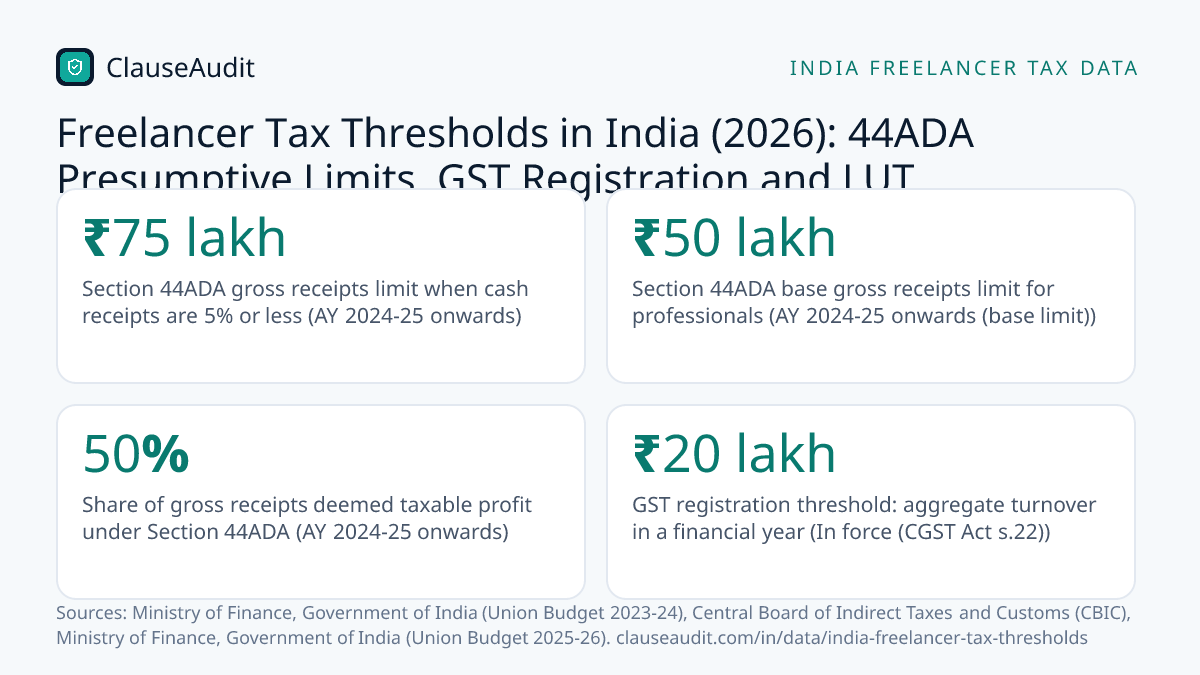
The Section 44ADA limit is ₹75 lakh of gross receipts if cash receipts are 5% or less of the total, and ₹50 lakh otherwise. It applies from AY 2024-25 onwards. Inside the scheme, 50% of your gross receipts is treated as taxable profit, and you can declare a higher figure if your real profit is higher.

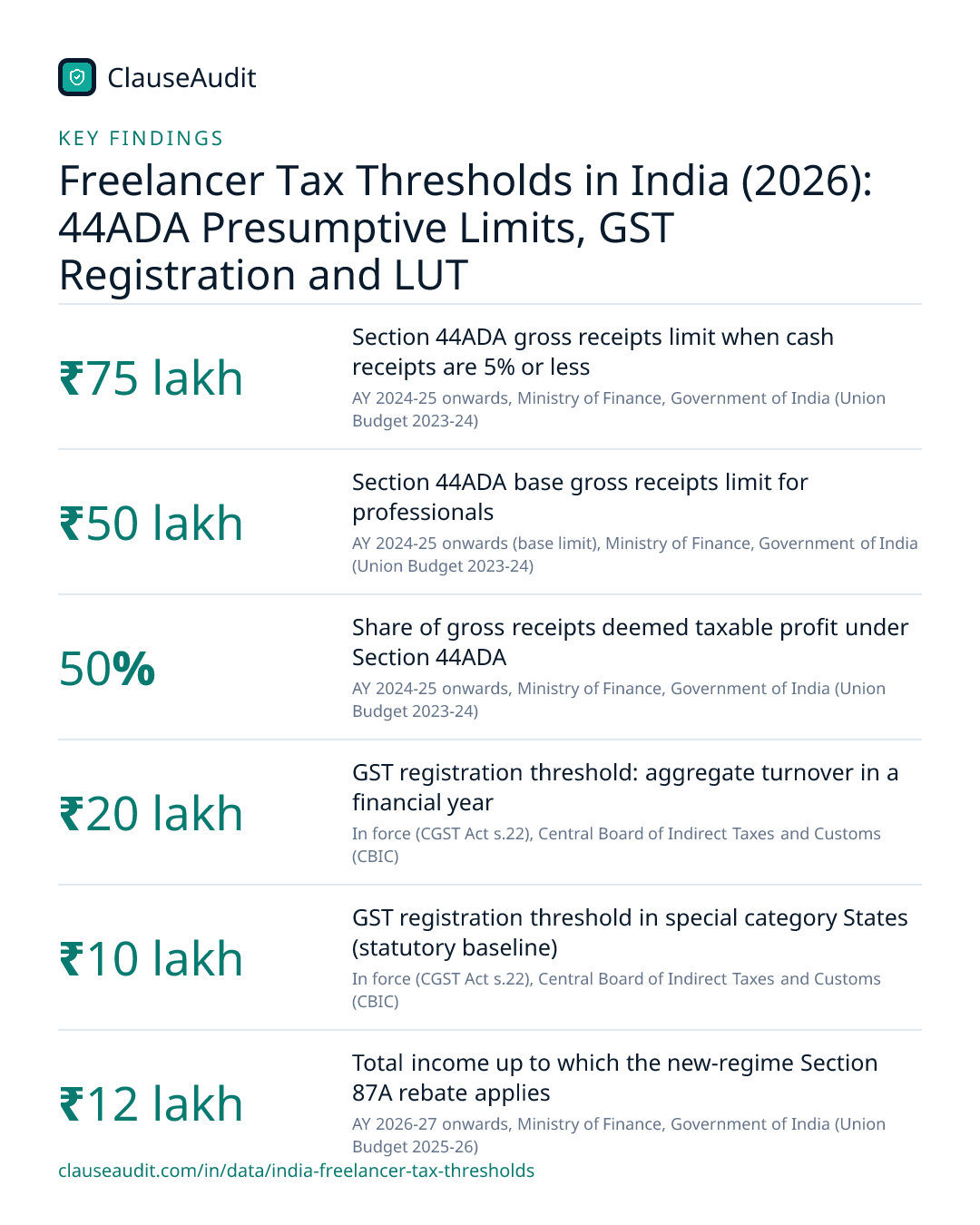
- Section 44ADA gross receipts limit when cash receipts are 5% or less (AY 2024-25 onwards, Ministry of Finance, Government of India (Union Budget 2023-24))
- ₹75 lakh
- Section 44ADA base gross receipts limit for professionals (AY 2024-25 onwards (base limit), Ministry of Finance, Government of India (Union Budget 2023-24))
- ₹50 lakh
- Share of gross receipts deemed taxable profit under Section 44ADA (AY 2024-25 onwards, Ministry of Finance, Government of India (Union Budget 2023-24))
- 50%
- GST registration threshold: aggregate turnover in a financial year (In force (CGST Act s.22), Central Board of Indirect Taxes and Customs (CBIC))
- ₹20 lakh
- GST registration threshold in special category States (statutory baseline) (In force (CGST Act s.22), Central Board of Indirect Taxes and Customs (CBIC))
- ₹10 lakh
- Total income up to which the new-regime Section 87A rebate applies (AY 2026-27 onwards, Ministry of Finance, Government of India (Union Budget 2025-26))
- ₹12 lakh
- Yearly fees threshold before clients must deduct TDS on professional services (From 1 April 2025, Ministry of Finance, Government of India (Union Budget 2025-26))
- ₹50,000
- How long a GST Letter of Undertaking (LUT) for zero-rated exports stays valid (In force since October 2017, Central Board of Indirect Taxes and Customs (CBIC))
- 1 financial year
Most Indian freelancers only need to know a handful of numbers. Where presumptive tax stops. When GST registration kicks in. When a client must deduct TDS. And how much income the new-regime rebate covers. Those four lines decide how you invoice, what you file and how much paperwork your year involves.
This page pulls the official thresholds from the Finance Bill memoranda, the CGST Act and CBIC circulars, then explains what each one means for a working freelancer. The tables and charts give you the raw figures. The sections below cover how they interact, with a worked example and a short checklist.
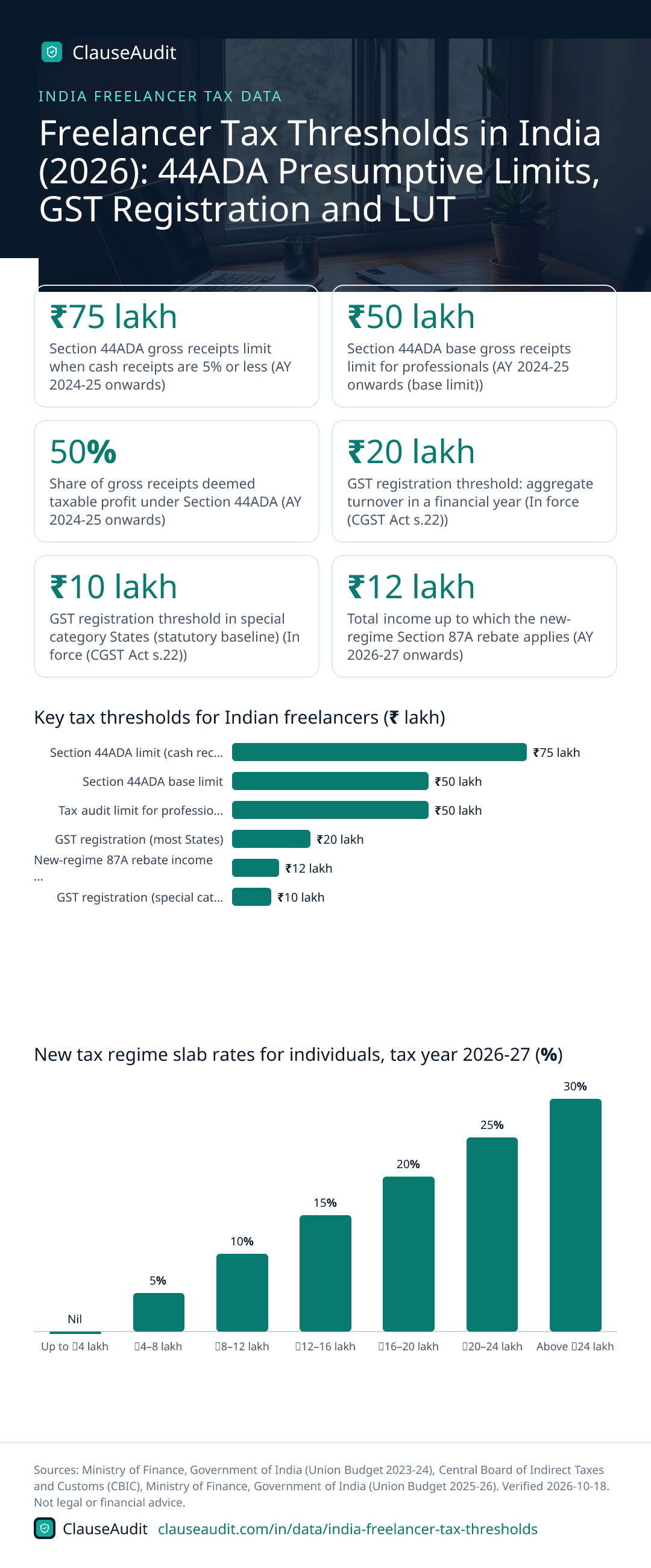
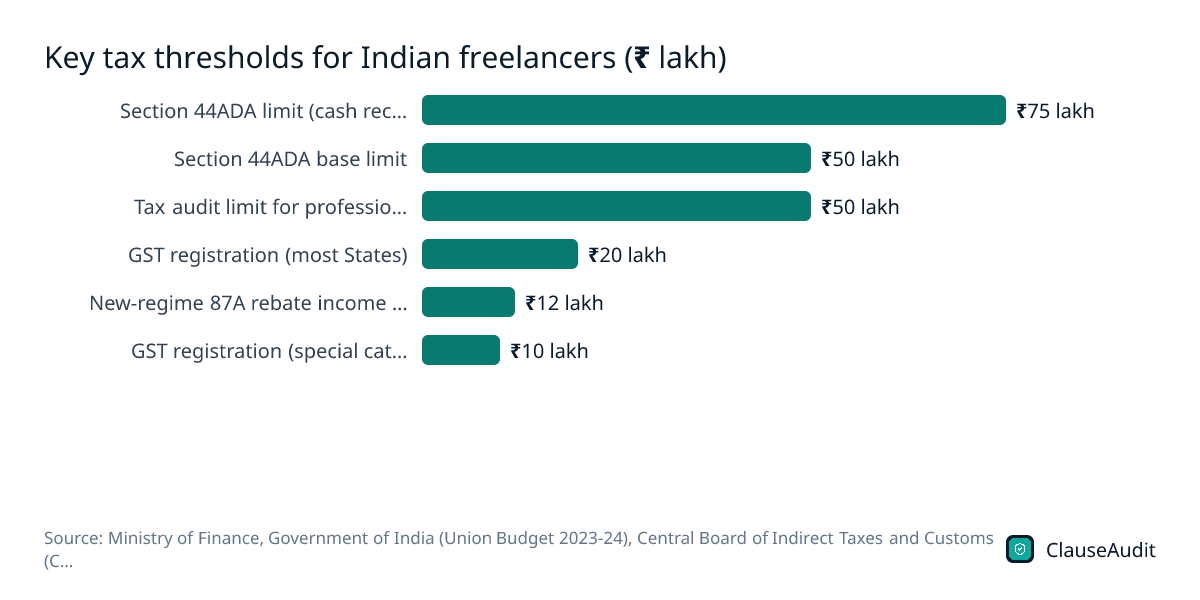
Key tax thresholds for Indian freelancers (₹ lakh)
Chart data
| Label | Value |
|---|---|
| Section 44ADA limit (cash receipts ≤ 5%) | ₹75 lakh |
| Section 44ADA base limit | ₹50 lakh |
| Tax audit limit for professionals (s.44AB) | ₹50 lakh |
| GST registration (most States) | ₹20 lakh |
| New-regime 87A rebate income limit | ₹12 lakh |
| GST registration (special category baseline) | ₹10 lakh |
These bars measure different things, so don't compare them directly. The 44ADA and audit limits count gross receipts, the GST limit counts aggregate turnover, and the rebate limit counts total income, which for a 44ADA freelancer starts from the 50% deemed profit.
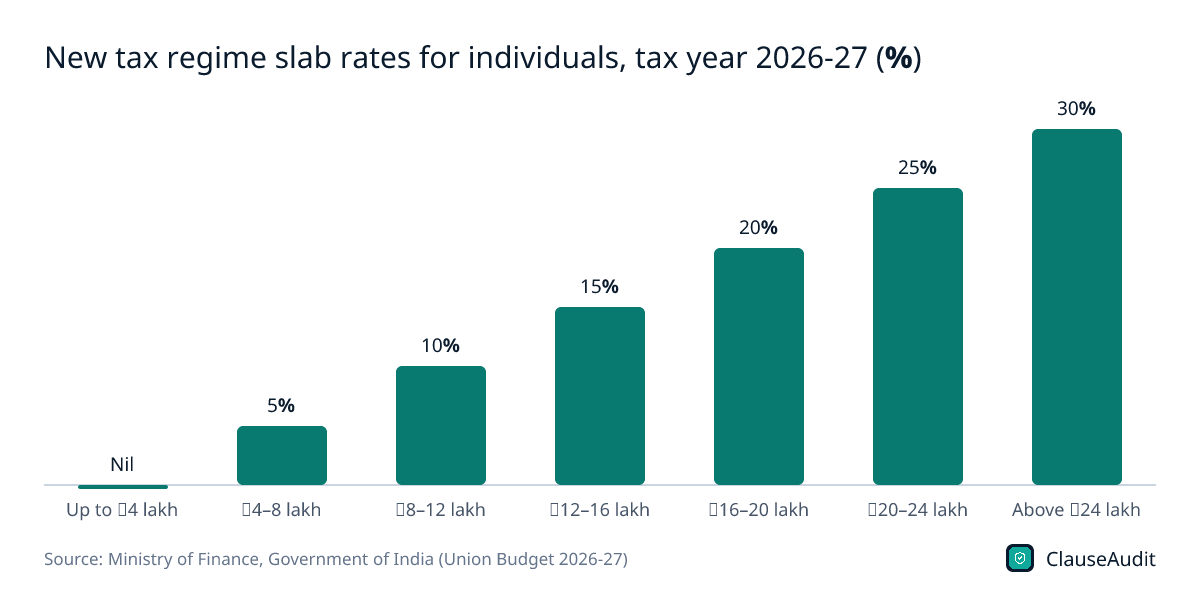
Download this chart (PNG)New tax regime slab rates for individuals, tax year 2026-27 (%)
Chart data
| Label | Value (%) |
|---|---|
| Up to ₹4 lakh | Nil |
| ₹4–8 lakh | 5% |
| ₹8–12 lakh | 10% |
| ₹12–16 lakh | 15% |
| ₹16–20 lakh | 20% |
| ₹20–24 lakh | 25% |
| Above ₹24 lakh | 30% |
Income up to ₹4 lakh is taxed at nil. Because the rebate covers total income up to ₹12 lakh, the 5% and 10% bands mostly matter to freelancers whose income lands just above that line. Add the 4% cess on top.
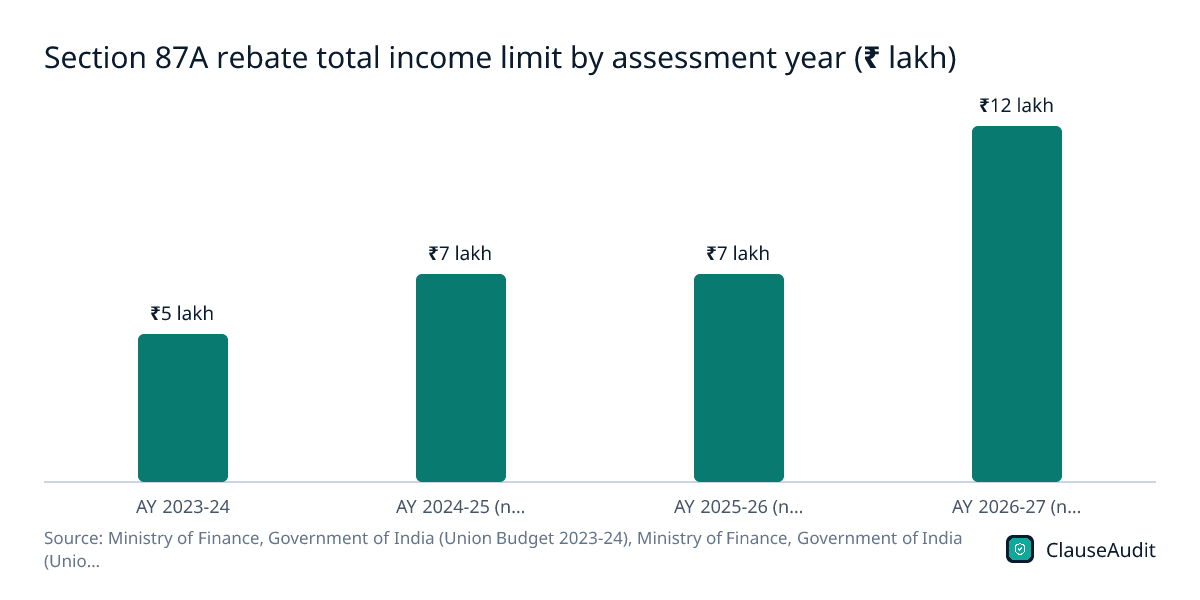
Download this chart (PNG)Section 87A rebate total income limit by assessment year (₹ lakh)
Chart data
| Label | Value |
|---|---|
| AY 2023-24 | ₹5 lakh |
| AY 2024-25 (new regime) | ₹7 lakh |
| AY 2025-26 (new regime) | ₹7 lakh |
| AY 2026-27 (new regime) | ₹12 lakh |
The rebate limit sat at ₹7 lakh for two years, then jumped to ₹12 lakh for AY 2026-27. For a freelancer on 44ADA, that jump changes the picture more than any slab change does.
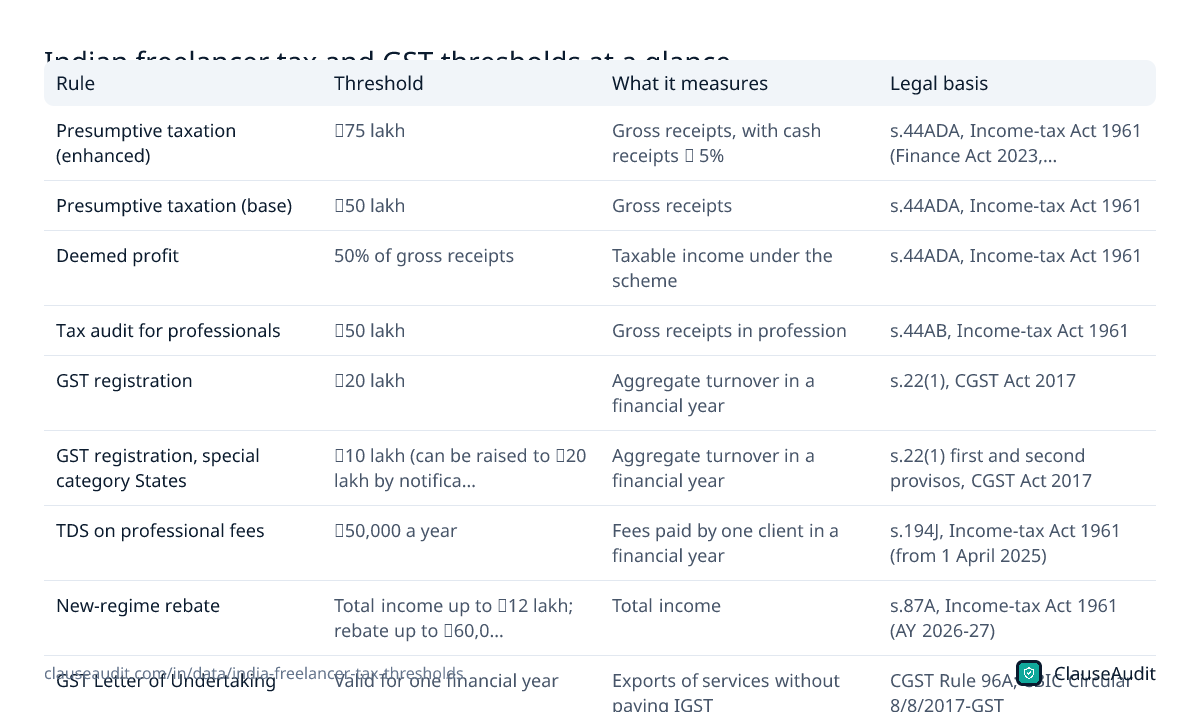
Download this chart (PNG)Indian freelancer tax and GST thresholds at a glance
| Rule | Threshold | What it measures | Legal basis |
|---|---|---|---|
| Presumptive taxation (enhanced) | ₹75 lakh | Gross receipts, with cash receipts ≤ 5% | s.44ADA, Income-tax Act 1961 (Finance Act 2023, AY 2024-25 onwards) |
| Presumptive taxation (base) | ₹50 lakh | Gross receipts | s.44ADA, Income-tax Act 1961 |
| Deemed profit | 50% of gross receipts | Taxable income under the scheme | s.44ADA, Income-tax Act 1961 |
| Tax audit for professionals | ₹50 lakh | Gross receipts in profession | s.44AB, Income-tax Act 1961 |
| GST registration | ₹20 lakh | Aggregate turnover in a financial year | s.22(1), CGST Act 2017 |
| GST registration, special category States | ₹10 lakh (can be raised to ₹20 lakh by notification) | Aggregate turnover in a financial year | s.22(1) first and second provisos, CGST Act 2017 |
| TDS on professional fees | ₹50,000 a year | Fees paid by one client in a financial year | s.194J, Income-tax Act 1961 (from 1 April 2025) |
| New-regime rebate | Total income up to ₹12 lakh; rebate up to ₹60,000 | Total income | s.87A, Income-tax Act 1961 (AY 2026-27) |
| GST Letter of Undertaking | Valid for one financial year | Exports of services without paying IGST | CGST Rule 96A; CBIC Circular 8/8/2017-GST |
Source: Ministry of Finance, Government of India (Union Budget 2023-24), Memorandum Explaining the Provisions in the Finance Bill, 2023; Central Board of Indirect Taxes and Customs (CBIC), Central Goods and Services Tax Act, 2017 (updated text), section 22; Ministry of Finance, Government of India (Union Budget 2025-26), Memorandum Explaining the Provisions in the Finance Bill, 2025; Central Board of Indirect Taxes and Customs (CBIC), Circular No. 8/8/2017-GST: Export under LUT or bond; Central Board of Indirect Taxes and Customs (CBIC) Tax Information portal, CGST Rules, 2017, Rule 96A: Export of goods or services under bond or Letter of Undertaking. Download as image
What is the Section 44ADA limit for freelancers?
Section 44ADA lets a resident professional skip detailed books and pay tax on a fixed share of receipts. Since AY 2024-25, the ceiling is ₹75 lakh of gross receipts, but only if cash receipts are 5% or less of the total. If more than 5% comes in cash, the older ₹50 lakh base limit applies.
Watch the definition of cash. A cheque or bank draft that is not account payee counts as cash for this test. Most freelancers paid by bank transfer, UPI or a platform payout clear the 5% test without trying. The trouble starts with the odd client who settles in cash or sends a bearer cheque.
Inside the scheme, 50% of gross receipts is deemed to be your profit. If your real margin is higher, you can declare more, and that higher figure is what gets taxed. You can't declare less than 50% and stay in the scheme.
One more change to keep on your radar. From 1 April 2026, the Income-tax Act, 2025 replaces the 1961 Act, so section numbers in forms and client paperwork are changing. The Finance Bill 2026 memorandum proposes no change to tax rates. Check the new section reference on your return rather than assuming the old number still appears.
When does a freelancer need GST registration?
You must register for GST once your aggregate turnover in a financial year exceeds ₹20 lakh. In special category States, the statutory baseline is ₹10 lakh, which the Government can raise to as much as ₹20 lakh at a State's request. Check the current notification for your State before relying on either figure.
You may have heard of a ₹40 lakh limit. That higher limit covers suppliers dealing only in goods. Freelance design, writing, coding and consulting are services, so the ₹20 lakh line is the one that applies to you.
Aggregate turnover is wider than many freelancers expect. Export invoices to foreign clients count toward it, even though those supplies can be zero-rated. So a freelancer billing mostly overseas can still cross the line and need to register.
How does an LUT help freelancers who bill foreign clients?
Once registered, you can export services without paying IGST up front by filing a Letter of Undertaking in FORM GST RFD-11 under CGST Rule 96A. Without an LUT or a bond, you pay the tax and then claim a refund, which ties up cash until it comes through.
An LUT is valid for the whole financial year in which you file it. That means you file a fresh one every year, ideally before the first export invoice of the year goes out. Put a reminder in your calendar for the start of April. Nearly every registered person can use it. The exception is anyone prosecuted for tax evasion above ₹250 lakh.
Your invoices should also say the supply is made under LUT without payment of IGST. Your contract matters here too. If a foreign client's agreement makes you responsible for "all applicable taxes" without saying which, you could end up absorbing a cost the law never put on you.
When must a client deduct TDS on your fees?
From 1 April 2025, a business client paying you for professional services must deduct TDS once its fees to you cross ₹50,000 in a year. Below that, no deduction is required. Individual clients generally fall outside this rule unless their own business is large enough to need a tax audit. From 1 April 2026, the provision sits in section 393(1) of the Income-tax Act, 2025, so expect clients to cite the new section on their certificates.
TDS isn't an extra tax. It's an advance on your own liability, and you claim it back against your final bill. The risk is practical. If a client deducts but never deposits the money or files its return, the credit won't show against your PAN. Ask for TDS certificates and match them to your annual statement before you file.
This is also why the ₹50,000 line matters for small, one-off jobs. A client whose total fees to you stay at or under ₹50,000 in the year owes no deduction, so the full fee should land in your account. If a client deducts anyway, ask which section it relied on before you accept a short payment.
A worked example: ₹24 lakh of receipts
Say you're a resident freelance developer and you receive ₹24 lakh in a year, all by bank transfer, with some of it from clients abroad. Here's how the thresholds stack up.
Change one fact and the result shifts. Take a bigger share of payments in cash and the 44ADA ceiling drops to ₹50 lakh. Move to a special category State and the GST line could be ₹10 lakh. Run the same check each year with your own figures.
- 44ADA: you're well under ₹75 lakh with zero cash, so you can opt in. Deemed profit is 50%, which is ₹12 lakh.
- Income tax: total income of ₹12 lakh sits at the edge of the new-regime rebate. The slab tax on it comes to ₹60,000, and the rebate covers up to ₹60,000, so the tax on this income falls to nil, provided you have no income taxed at special rates.
- Tax audit: receipts are below the ₹50 lakh base audit limit for professionals, and freelancers who opt for and meet the presumptive scheme are exempt from the s.44AB audit anyway.
- GST: ₹24 lakh is above the ₹20 lakh threshold, and export receipts count, so you must register.
- LUT: file one for the year so your foreign invoices go out without IGST.
- TDS: any Indian business client paying you more than ₹50,000 in the year should deduct TDS, which you then claim back.
What to do this year
- Track gross receipts monthly, not at year end, so you see the ₹20 lakh GST line coming.
- Keep cash and bearer cheques well under 5% of receipts if you want the ₹75 lakh 44ADA ceiling.
- Renew your LUT at the start of each financial year, before the first export invoice.
- Collect TDS certificates from every client who deducts, and reconcile them before filing.
- Write tax terms into your contracts: who pays GST, whether fees are inclusive or exclusive of tax, and how TDS is handled.
- Confirm the new Income-tax Act, 2025 section numbers on returns and client forms from 1 April 2026.
How ClauseAudit helps
Tax thresholds decide what you owe. Your contract decides who carries it. A fee quoted without saying whether GST is extra, or a clause that lets a client hold payment until "final approval", can wipe out the margin these rules leave you.
Upload your client agreement to the ClauseAudit freelance analyzer for India. The automated review flags the money clauses below and explains each one in plain English.
- Whether fees are stated exclusive of GST, so you can add tax once you're registered
- Who bears TDS and whether the client must issue certificates on time
- Payment terms and late-payment interest, including payment-on-approval triggers
- "All applicable taxes" clauses that shift the client's tax costs onto you
- Currency, conversion and bank charges on payments from foreign clients
- Liability caps and indemnities that could exceed what the project pays you
Frequently asked questions
Is the 44ADA limit ₹50 lakh or ₹75 lakh?
Both, depending on how you get paid. The limit is ₹75 lakh of gross receipts if cash receipts are 5% or less of the total. If more than 5% comes in cash, the ₹50 lakh base limit applies. A cheque or bank draft that is not account payee counts as cash for this test. The enhanced limit applies from AY 2024-25 onwards.
How much of my income is taxed under 44ADA?
Under the scheme, 50% of your gross receipts is deemed to be your profit, and that is the figure taxed at your slab rates. If your actual profit is higher, you can declare the higher amount, and that becomes taxable instead. You don't need to keep detailed books of expenses to support the 50% figure.
Do freelancers need GST registration below ₹20 lakh?
Not by law in most States. Registration becomes compulsory once aggregate turnover in a financial year exceeds ₹20 lakh. In special category States the statutory baseline is ₹10 lakh, though a State can ask for it to be raised to ₹20 lakh. Some freelancers register voluntarily because a client insists or to claim input tax credit.
Does the ₹40 lakh GST limit apply to freelancers?
No. The ₹40 lakh higher limit applies only to suppliers engaged exclusively in goods. Freelance services such as design, development, writing or consulting fall under the ₹20 lakh threshold, or the lower special category baseline where it applies. If you sell services, plan around ₹20 lakh.
Do export receipts from foreign clients count toward the GST threshold?
Yes. Aggregate turnover includes exports of services, even though those exports can be zero-rated. A freelancer who bills mostly overseas clients can still cross ₹20 lakh and need to register. Once registered, file an LUT so you can invoice foreign clients without paying IGST up front.
How long is a GST LUT valid?
An LUT is valid for the whole financial year in which you file it. You file it in FORM GST RFD-11 before making exports, under CGST Rule 96A, and you need a fresh one each financial year. Filing it early in April avoids a gap where export invoices would otherwise attract IGST.
At what amount must a client deduct TDS on my professional fees?
From 1 April 2025, the threshold is ₹50,000 of fees from one client in a year. Above that, the client must deduct TDS before paying you. From 1 April 2026, the rule sits in section 393(1) of the Income-tax Act, 2025. TDS is credited against your own tax, so collect certificates and check they match your annual statement.
Can a freelancer use the ₹12 lakh rebate?
Yes, under the new regime from AY 2026-27, if your total income is up to ₹12 lakh. The rebate is capped at ₹60,000 and doesn't cover tax at special rates such as capital gains. On 44ADA, total income is based on your deemed 50% profit, not your gross receipts, which is why many freelancers land under the line.
Do I need a tax audit as a freelancer?
The base tax audit limit for professionals is ₹50 lakh of gross receipts under s.44AB. Professionals who opt for and meet the presumptive scheme are exempt from that audit. So a freelancer within 44ADA, declaring at least 50% profit, generally doesn't need one. Leaving the scheme can change that, so check before you do.
Use this data
Every chart and card below is free to reuse under CC BY 4.0. Download what you need and link back to this page.
 Stat cards
 Key findings card
 Infographic
 Key tax thresholds for Indian freelancers (₹ lakh)
 New tax regime slab rates for individuals, tax year 2026-27 (%)
 Section 87A rebate total income limit by assessment year (₹ lakh)
 Indian freelancer tax and GST thresholds at a glance
Embed the infographic
Free to share on your site, blog or slides under CC BY 4.0. Please keep the credit link.
Sources and method
Every number on this page comes from the sources below, each opened and read on or before October 18, 2026. A second, independent review checked every figure against its source and corrected anything that did not match. Figures that could not be confirmed were left out.
- Ministry of Finance, Government of India (Union Budget 2023-24), Memorandum Explaining the Provisions in the Finance Bill, 2023 (1 February 2023)
- Ministry of Finance, Government of India (Union Budget 2025-26), Memorandum Explaining the Provisions in the Finance Bill, 2025 (1 February 2025)
- Ministry of Finance, Government of India (Union Budget 2026-27), Memorandum Explaining the Provisions in the Finance Bill, 2026 (Direct Taxes) (February 2026)
- Central Board of Indirect Taxes and Customs (CBIC), Central Goods and Services Tax Act, 2017 (updated text), section 22 (Updated to 30 September 2020)
- Central Board of Indirect Taxes and Customs (CBIC), Circular No. 8/8/2017-GST: Export under LUT or bond (4 October 2017)
- Central Board of Indirect Taxes and Customs (CBIC) Tax Information portal, CGST Rules, 2017, Rule 96A: Export of goods or services under bond or Letter of Undertaking (Current version as accessed 18 October 2026)
Cite this page
ClauseAudit, “Freelancer Tax Thresholds in India (2026): 44ADA Presumptive Limits, GST Registration and LUT”, updated October 18, 2026, https://clauseaudit.com/in/data/india-freelancer-tax-thresholds. Free to reuse with a link back (CC BY 4.0).
This page summarises published data and law as checked on October 18, 2026. Figures are updated as new editions are released, and your own situation may differ. It is general information, not legal, tax or financial advice.