GST Registration Thresholds and Rates for Freelancers in India (State-wise, 2026)
By ClauseAudit Research · 5 sources ·
How does GST work for freelancers in India?
You must register for GST once your aggregate turnover in a financial year crosses ₹20 lakh. In Manipur, Mizoram, Nagaland and Tripura the limit is ₹10 lakh. Most freelance services are then taxed at 18%, while work for foreign clients can be billed without IGST under an LUT that is valid for one financial year.

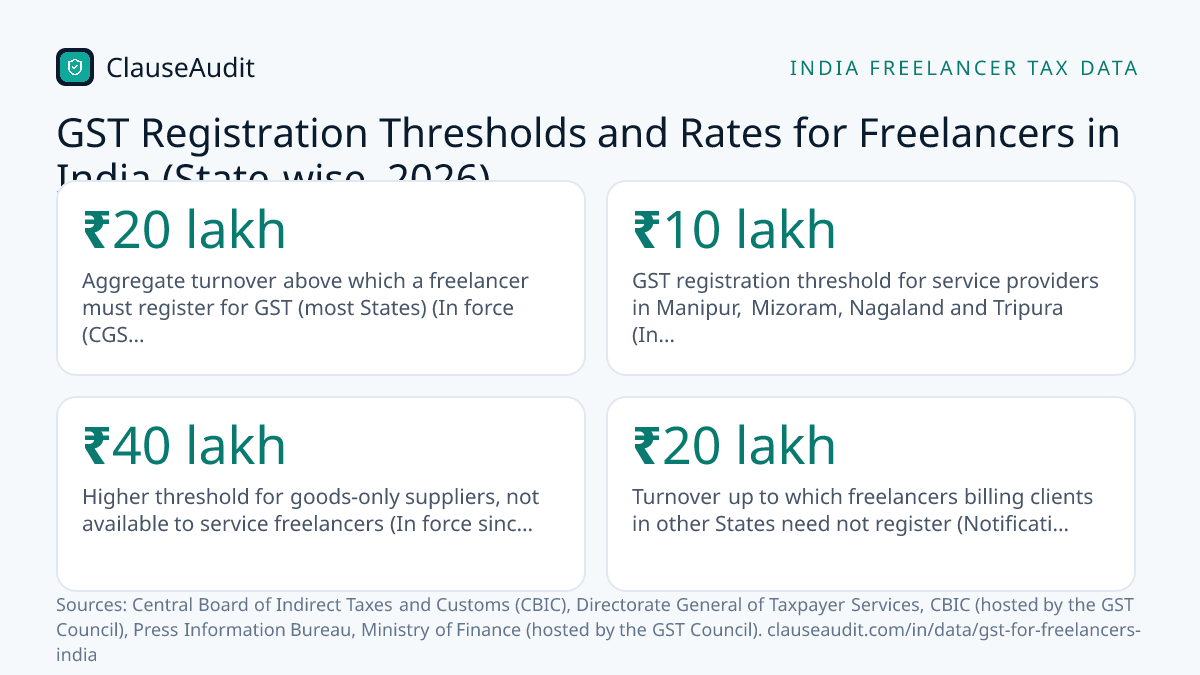
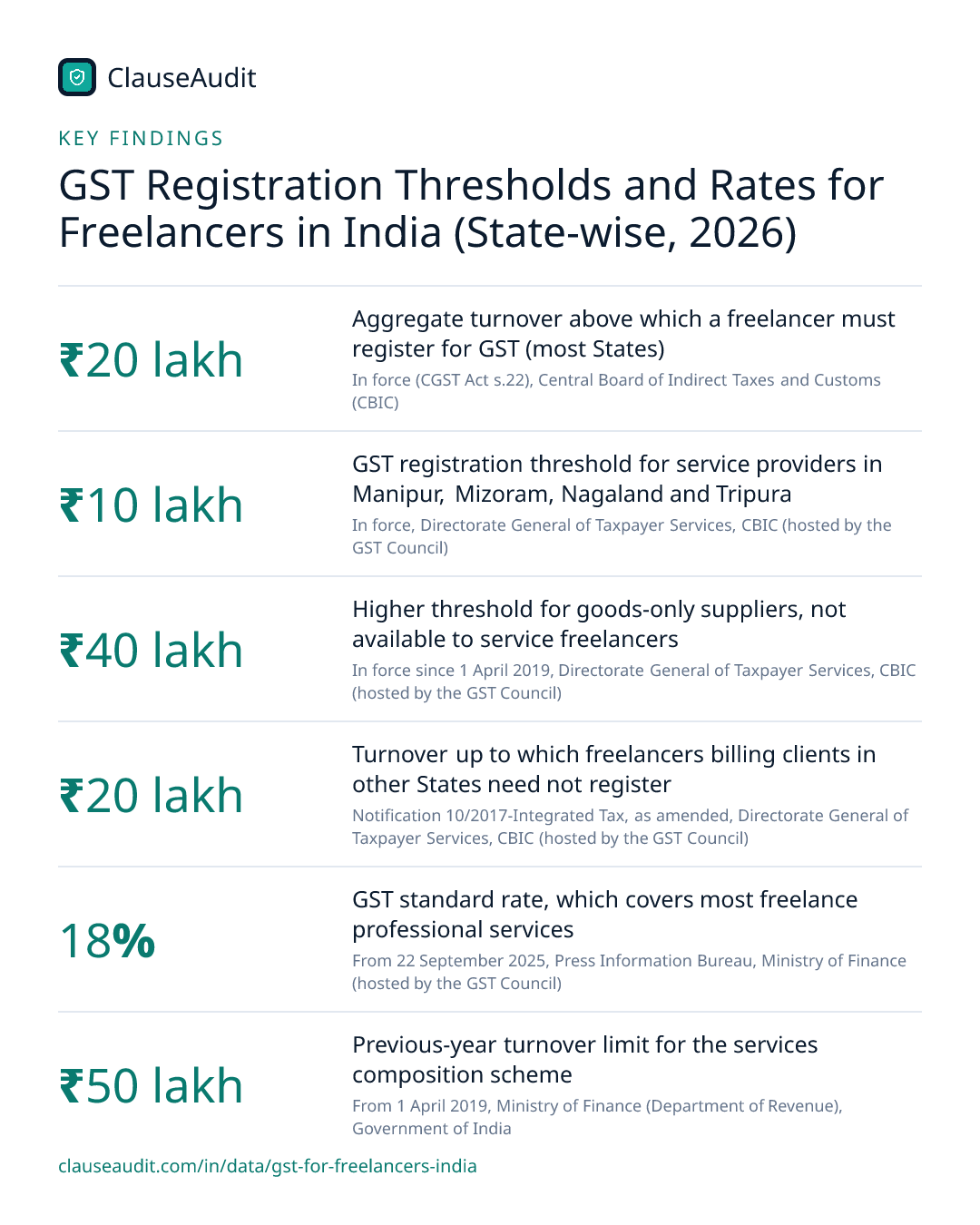
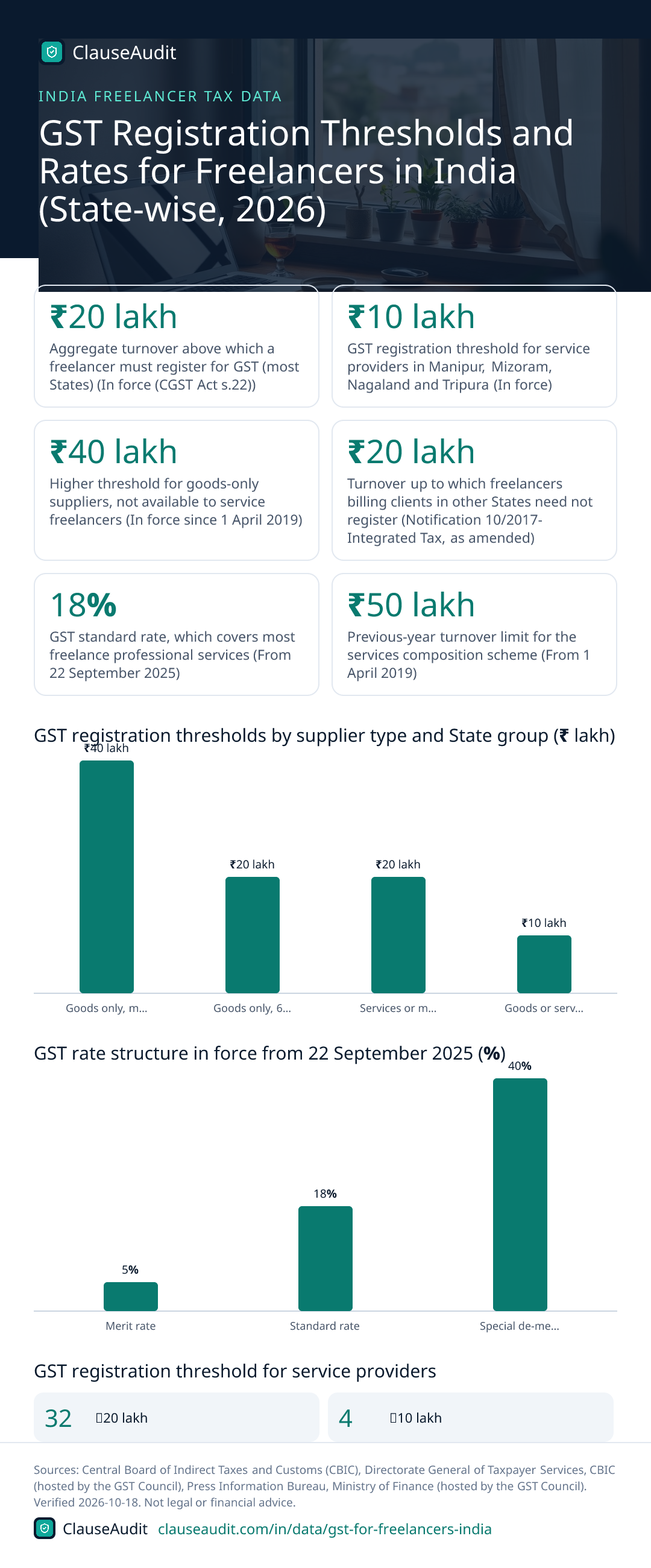
- Aggregate turnover above which a freelancer must register for GST (most States) (In force (CGST Act s.22), Central Board of Indirect Taxes and Customs (CBIC))
- ₹20 lakh
- GST registration threshold for service providers in Manipur, Mizoram, Nagaland and Tripura (In force, Directorate General of Taxpayer Services, CBIC (hosted by the GST Council))
- ₹10 lakh
- Higher threshold for goods-only suppliers, not available to service freelancers (In force since 1 April 2019, Directorate General of Taxpayer Services, CBIC (hosted by the GST Council))
- ₹40 lakh
- Turnover up to which freelancers billing clients in other States need not register (Notification 10/2017-Integrated Tax, as amended, Directorate General of Taxpayer Services, CBIC (hosted by the GST Council))
- ₹20 lakh
- GST standard rate, which covers most freelance professional services (From 22 September 2025, Press Information Bureau, Ministry of Finance (hosted by the GST Council))
- 18%
- Previous-year turnover limit for the services composition scheme (From 1 April 2019, Ministry of Finance (Department of Revenue), Government of India)
- ₹50 lakh
- How long a Letter of Undertaking for zero-rated exports of services stays valid (In force since October 2017, Central Board of Indirect Taxes and Customs (CBIC))
- 1 financial year
Many freelancers in India hear about GST from a client first. A new client asks for your GSTIN, or a finance team says it cannot pay an invoice without one. That is often the moment you start wondering whether you were supposed to register months ago.
The rules are simpler than they look. For a service freelancer, one turnover limit applies across almost every State, one rate covers most professional work, and exports run on their own track. This page sets out those figures, State by State, and explains what they mean for how you invoice and what you sign.
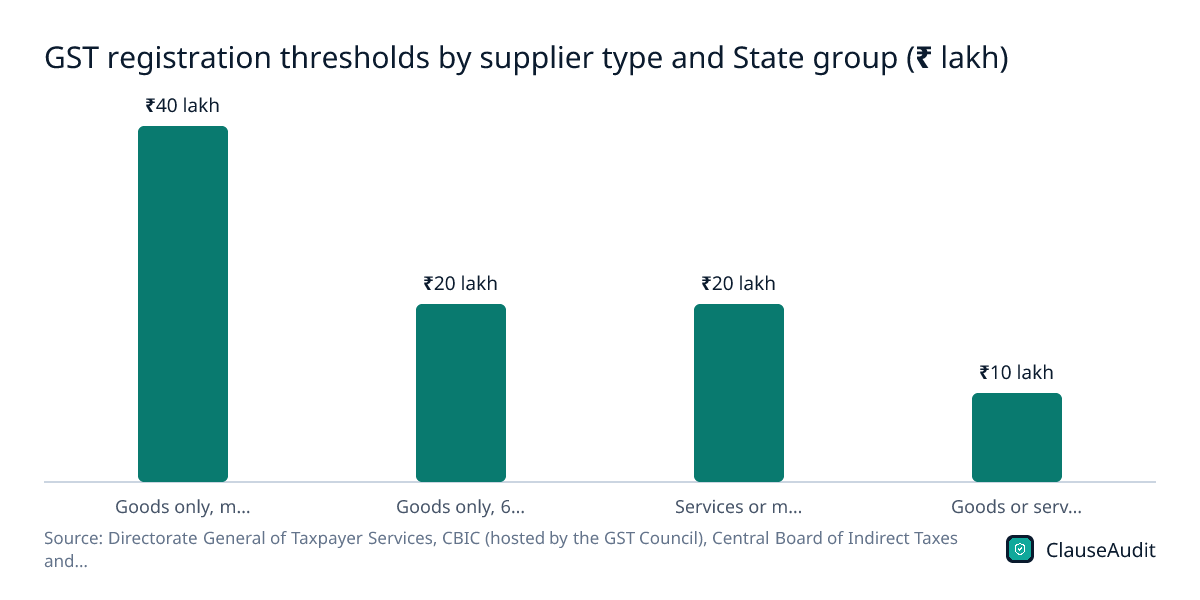
GST registration thresholds by supplier type and State group (₹ lakh)
Chart data
| Label | Value |
|---|---|
| Goods only, most States | ₹40 lakh |
| Goods only, 6 listed States/UTs | ₹20 lakh |
| Services or mixed, most States | ₹20 lakh |
| Goods or services, Manipur, Mizoram, Nagaland, Tripura | ₹10 lakh |
The ₹40 lakh bar applies only to suppliers of goods alone, so a designer, developer or writer selling services should read the ₹20 lakh bar, or ₹10 lakh in the four listed States.
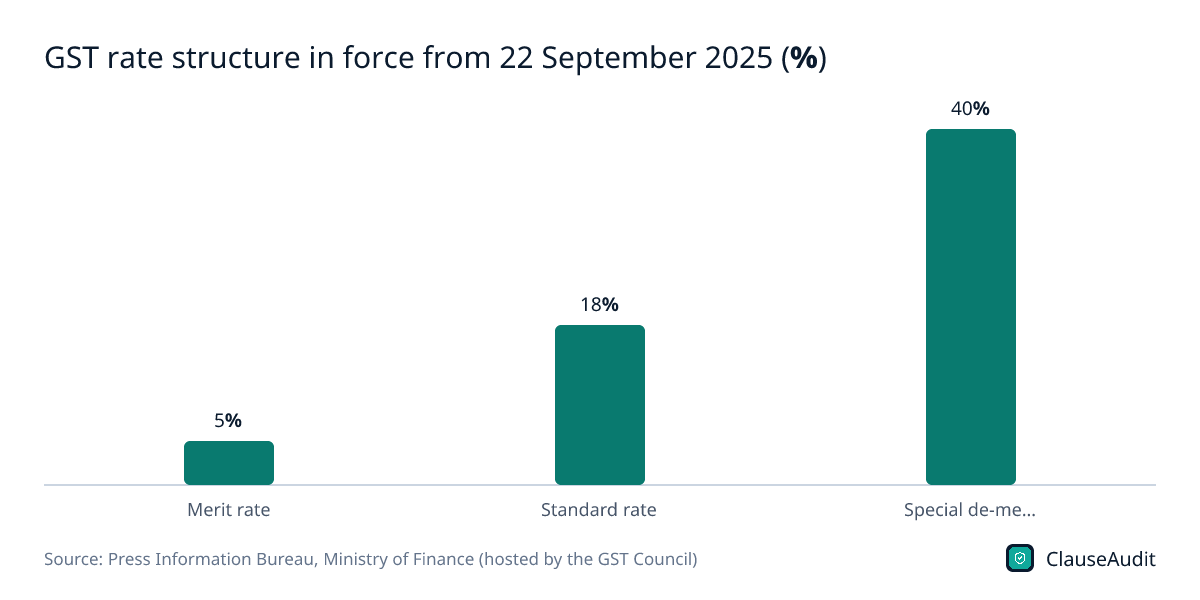
Download this chart (PNG)GST rate structure in force from 22 September 2025 (%)
Chart data
| Label | Value |
|---|---|
| Merit rate | 5% |
| Standard rate | 18% |
| Special de-merit rate | 40% |
Since 22 September 2025 most professional services sit in the 18% standard slab. Check the SAC heading for your service, because the rate follows the heading, not the job title.
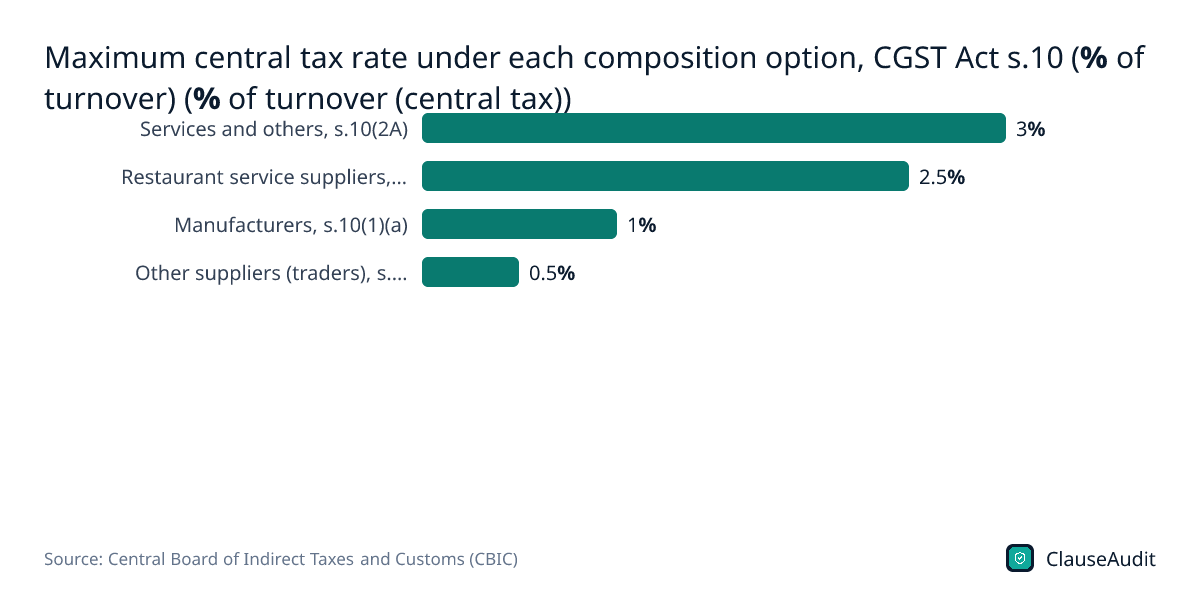
Download this chart (PNG)Maximum central tax rate under each composition option, CGST Act s.10 (% of turnover) (% of turnover (central tax))
Chart data
| Label | Value |
|---|---|
| Services and others, s.10(2A) | 3% |
| Restaurant service suppliers, s.10(1)(b) | 2.5% |
| Manufacturers, s.10(1)(a) | 1% |
| Other suppliers (traders), s.10(1)(c) | 0.5% |
Freelancers fall under the services option at 3% central tax. The lower ceilings are for traders, manufacturers and restaurants, so they are generally not open to a services freelancer.
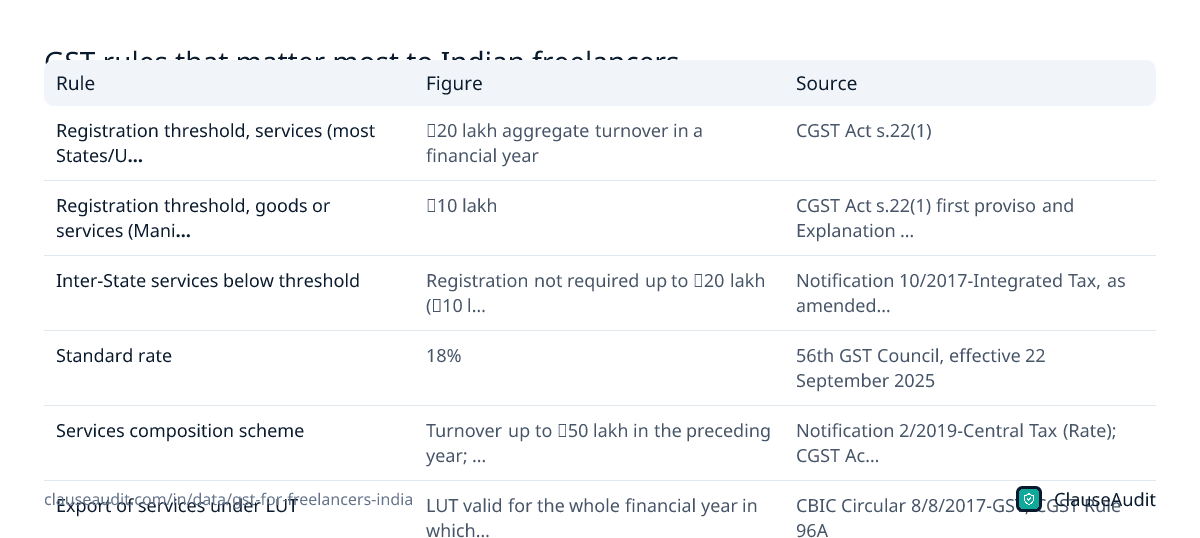
Download this chart (PNG)GST rules that matter most to Indian freelancers
| Rule | Figure | Source |
|---|---|---|
| Registration threshold, services (most States/UTs) | ₹20 lakh aggregate turnover in a financial year | CGST Act s.22(1) |
| Registration threshold, goods or services (Manipur, Mizoram, Nagaland, Tripura) | ₹10 lakh | CGST Act s.22(1) first proviso and Explanation (iii); CBIC flyer (services) |
| Inter-State services below threshold | Registration not required up to ₹20 lakh (₹10 lakh in the four States) | Notification 10/2017-Integrated Tax, as amended by 03/2019 |
| Standard rate | 18% | 56th GST Council, effective 22 September 2025 |
| Services composition scheme | Turnover up to ₹50 lakh in the preceding year; 3% central tax; no ITC; intra-State supplies only | Notification 2/2019-Central Tax (Rate); CGST Act s.10(2A) |
| Export of services under LUT | LUT valid for the whole financial year in which it is filed | CBIC Circular 8/8/2017-GST; CGST Rule 96A |
Source: Central Board of Indirect Taxes and Customs (CBIC), Central Goods and Services Tax Act, 2017 (updated text), sections 10 and 22; Directorate General of Taxpayer Services, CBIC (hosted by the GST Council), Registration under GST Law (taxpayer flyer); Press Information Bureau, Ministry of Finance (hosted by the GST Council), Recommendations of the 56th Meeting of the GST Council; Ministry of Finance (Department of Revenue), Government of India, Notification No. 2/2019-Central Tax (Rate); Central Board of Indirect Taxes and Customs (CBIC), Circular No. 8/8/2017-GST: Export under LUT or bond. Download as image
GST registration threshold for service providers by State
- 32₹20 lakh
- 4₹10 lakh
Do freelancers need GST registration in India?
Only once your aggregate turnover in a financial year crosses ₹20 lakh, or ₹10 lakh if you work from Manipur, Mizoram, Nagaland or Tripura. Below that, registration is optional.
Aggregate turnover is wider than most people expect. It counts all your taxable and exempt supplies, plus exports, under your PAN across India. So if you invoice Indian clients and a foreign client, both go into the same total. Freelancers who split work between a personal account and a side brand under the same PAN still have one number.
The ₹40 lakh limit you may have seen quoted is not for you. It applies only to a supplier engaged exclusively in supplying goods. If you sell any services at all, even alongside some goods, the services limit is the one that counts.
Billing clients in other States does not by itself force registration. Freelancers supplying services across State lines need not register until they cross ₹20 lakh, or ₹10 lakh in the four listed States. Selling goods across States is different and generally needs registration from the first sale, so a freelancer who also ships prints or merchandise should look at that part carefully.
What GST rate do freelancers charge?
Since 22 September 2025, GST runs on three main rates: 5% merit, 18% standard and 40% special de-merit, with some supplies exempt. Most freelance professional work, such as software development, design, consulting, writing and marketing, falls under the 18% standard rate.
How you show that 18% on an invoice depends on where the client is. For a client in your own State, you charge 9% CGST and 9% SGST. For a client in another State, you charge 18% IGST. The client pays the same total either way. What changes is how the tax is reported.
Do not assume 18% blindly. The rate follows the SAC heading for your service. Look up the heading once, note it on your invoice template, and you will not have to think about it again until the rules change.
How does GST work for freelancers with foreign clients?
Work for a client outside India usually counts as an export of services, which is zero-rated. You do not collect GST from the foreign client, but you can still claim input tax credit on the GST you paid on your own business costs.
The practical route is a Letter of Undertaking, or LUT. Once filed, it lets a registered freelancer invoice foreign clients without paying IGST up front. Without it, you would pay IGST first and claim a refund later, which ties up cash for no good reason.
An LUT stays valid for the financial year in which you file it. Put a reminder in your calendar for the start of each financial year, because an export billed after your LUT has lapsed may mean paying IGST up front and waiting for a refund.
Remember that export earnings still count toward your aggregate turnover. A freelancer who earns mostly from overseas can cross ₹20 lakh without a single Indian invoice.
Is the composition scheme worth it for a freelancer?
The services composition scheme is open if your turnover in the previous year was up to ₹50 lakh. You pay central tax at 3% of turnover, plus a matching State tax, instead of charging GST line by line.
It sounds simpler, but it rarely suits freelancers. You cannot collect tax from clients, so the tax comes out of your fee. You get no input tax credit on your laptop, software or co-working rent. And it is not available to anyone making inter-State outward supplies, which rules out most freelancers with clients in other cities and anyone exporting.
It can make sense for a freelancer who works only for local, unregistered clients in one State and has few business costs. For everyone else, regular registration is usually the better choice.
Should you register voluntarily below ₹20 lakh?
Sometimes, yes. Many larger companies prefer vendors with a GSTIN because they can claim credit for the GST you charge them. A registered client can usually claim back your 18%, so it costs them little in the end. If you are pitching to such clients, a GSTIN can make you easier to hire.
Registration also lets you claim input tax credit on your own purchases and file an LUT for exports. The cost is compliance: regular returns, proper tax invoices and some bookkeeping discipline.
Crossing the limit partway through a year is the situation that catches people out. Say you sign a long retainer quoting a flat monthly fee, and your turnover passes ₹20 lakh before it ends. From then on you need to charge GST, but the contract may not let you add it. If the fee was written as all-inclusive, the tax comes out of your income for the rest of the term. That is why the wording of the fee clause matters long before you register.
If most of your clients are individuals or small unregistered businesses, the picture flips. They cannot claim the credit, so an extra 18% simply makes you more expensive. Stay unregistered until you need to, and watch your turnover each month as you approach the limit.
What to do this month
- Add up your turnover for the current financial year across every client, Indian and foreign, under your PAN.
- Check which limit applies to you: ₹20 lakh in most States and Union Territories, ₹10 lakh in Manipur, Mizoram, Nagaland and Tripura.
- If you are close to the limit, register before you cross it, not after a client asks.
- Find the SAC heading for your main service and confirm the rate, which is 18% for most professional work.
- If you have foreign clients and a GSTIN, file or renew your LUT at the start of each financial year.
- Update your contracts so every fee says whether GST is included or added on top.
How ClauseAudit helps
GST mistakes rarely start in the tax return. They start in the contract, when a fee is quoted without saying whether tax is on top, or when nobody agrees who absorbs the cost if you register halfway through a project.
Upload your freelance or consulting agreement and the automated review flags the payment and tax terms that tend to cost Indian freelancers money, explains each one in plain English, and suggests wording you can send back to the client.
- Fee and tax: does the contract say "plus applicable GST", or is the fee silently inclusive, so tax comes out of your pocket?
- Mid-contract registration: if you cross the threshold during the engagement, can you add GST to later invoices?
- Payment terms: how many days does the client have to pay, and what counts as a valid invoice?
- Late fees: is there interest or a late fee if payment slips, and does it apply to the GST portion too?
- Foreign clients: is the currency, payment route and export status clear, so your LUT invoices hold up?
- Withholding and deductions: can the client deduct tax or other amounts from your fee, and must they give you the certificate?
Frequently asked questions
Is GST mandatory for freelancers in India?
Only once your aggregate turnover in a financial year crosses ₹20 lakh, or ₹10 lakh in Manipur, Mizoram, Nagaland and Tripura. Below that, registration is voluntary. Many freelancers register early anyway because larger clients prefer vendors who can issue a proper tax invoice and pass on input tax credit.
Does the ₹40 lakh GST limit apply to freelancers?
No. The ₹40 lakh limit is only for suppliers who deal exclusively in goods. Freelancers supply services, so the ₹20 lakh limit applies in most States, and ₹10 lakh in Manipur, Mizoram, Nagaland and Tripura. Even a small amount of service income keeps you on the services limit.
Do export earnings count toward the ₹20 lakh limit?
Yes. Aggregate turnover includes exports of services, along with taxable and exempt supplies, under the same PAN across India. A freelancer paid mainly by overseas clients can cross the limit without any Indian invoices, so track foreign receipts as carefully as domestic ones.
What GST rate applies to freelance services?
Most freelance professional services, such as development, design, consulting and writing, are taxed at the 18% standard rate in force since 22 September 2025. The exact rate depends on the SAC heading for your service, so confirm the heading once and use it on every invoice.
Do I charge GST to clients outside India?
Usually not. Services exported to a foreign client are zero-rated. If you are registered and have filed a Letter of Undertaking, you can invoice without paying IGST up front. The LUT is valid for one financial year, so it needs renewing every year.
Do I need GST registration to work for clients in other States?
Not below the threshold. Freelancers supplying services to clients in other States need not register until aggregate turnover crosses ₹20 lakh, or ₹10 lakh in the four listed north-eastern States. Inter-State supply of goods is treated differently and generally needs registration from the start.
Can freelancers use the GST composition scheme?
Service providers with previous-year turnover up to ₹50 lakh can opt in and pay 3% central tax plus State tax. But you cannot charge tax to clients, you lose input tax credit, and you cannot make inter-State outward supplies. That rules it out for most freelancers with out-of-State or foreign clients.
How is the 18% split on an invoice?
For a client in your own State, show 9% CGST and 9% SGST. For a client in another State, show 18% IGST. The total is the same. What matters is that the place of supply on the invoice is correct, since that decides which tax heads you report.
Use this data
Every chart and card below is free to reuse under CC BY 4.0. Download what you need and link back to this page.
 Stat cards
 Key findings card
 Infographic
 GST registration thresholds by supplier type and State group (₹ lakh)
 GST rate structure in force from 22 September 2025 (%)
 Maximum central tax rate under each composition option, CGST Act s.10 (% of turnover) (% of turnover (central tax))
 GST rules that matter most to Indian freelancers
Embed the infographic
Free to share on your site, blog or slides under CC BY 4.0. Please keep the credit link.
Sources and method
Every number on this page comes from the sources below, each opened and read on or before October 18, 2026. A second, independent review checked every figure against its source and corrected anything that did not match. 36 of 36 State entries were confirmed; any that could not be are marked "Not yet confirmed" and left out of every count and chart.
- Central Board of Indirect Taxes and Customs (CBIC), Central Goods and Services Tax Act, 2017 (updated text), sections 10 and 22 (CBIC consolidated text as amended up to 30 September 2020 (latest consolidated edition located as of 18 October 2026; later amendments by Finance Acts 2021 onward are not included, e.g. the Finance Act 2023 change to s.10(2)(d) and s.10(2A)(c) on e-commerce supplies; the s.10 rate ceilings and s.22 turnover limits cited here are as printed in this edition))
- Directorate General of Taxpayer Services, CBIC (hosted by the GST Council), Registration under GST Law (taxpayer flyer) (Undated edition, accessed 18 October 2026)
- Press Information Bureau, Ministry of Finance (hosted by the GST Council), Recommendations of the 56th Meeting of the GST Council (3 September 2025)
- Ministry of Finance (Department of Revenue), Government of India, Notification No. 2/2019-Central Tax (Rate) (7 March 2019)
- Central Board of Indirect Taxes and Customs (CBIC), Circular No. 8/8/2017-GST: Export under LUT or bond (4 October 2017)
Cite this page
ClauseAudit, “GST Registration Thresholds and Rates for Freelancers in India (State-wise, 2026)”, updated October 18, 2026, https://clauseaudit.com/in/data/gst-for-freelancers-india. Free to reuse with a link back (CC BY 4.0).
This page summarises published data and law as checked on October 18, 2026. Figures are updated as new editions are released, and your own situation may differ. It is general information, not legal, tax or financial advice.