Freelancer and Gig Economy Statistics in India (2026)
By ClauseAudit Research · 5 sources ·
What do the latest gig economy statistics for India show?
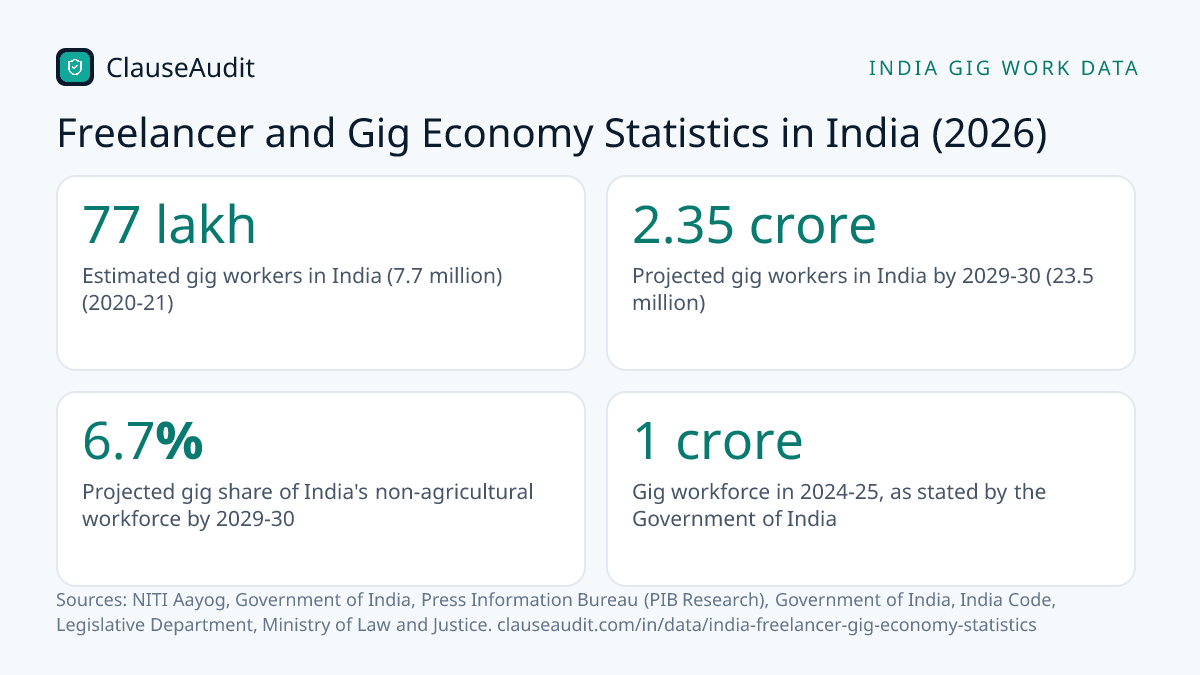
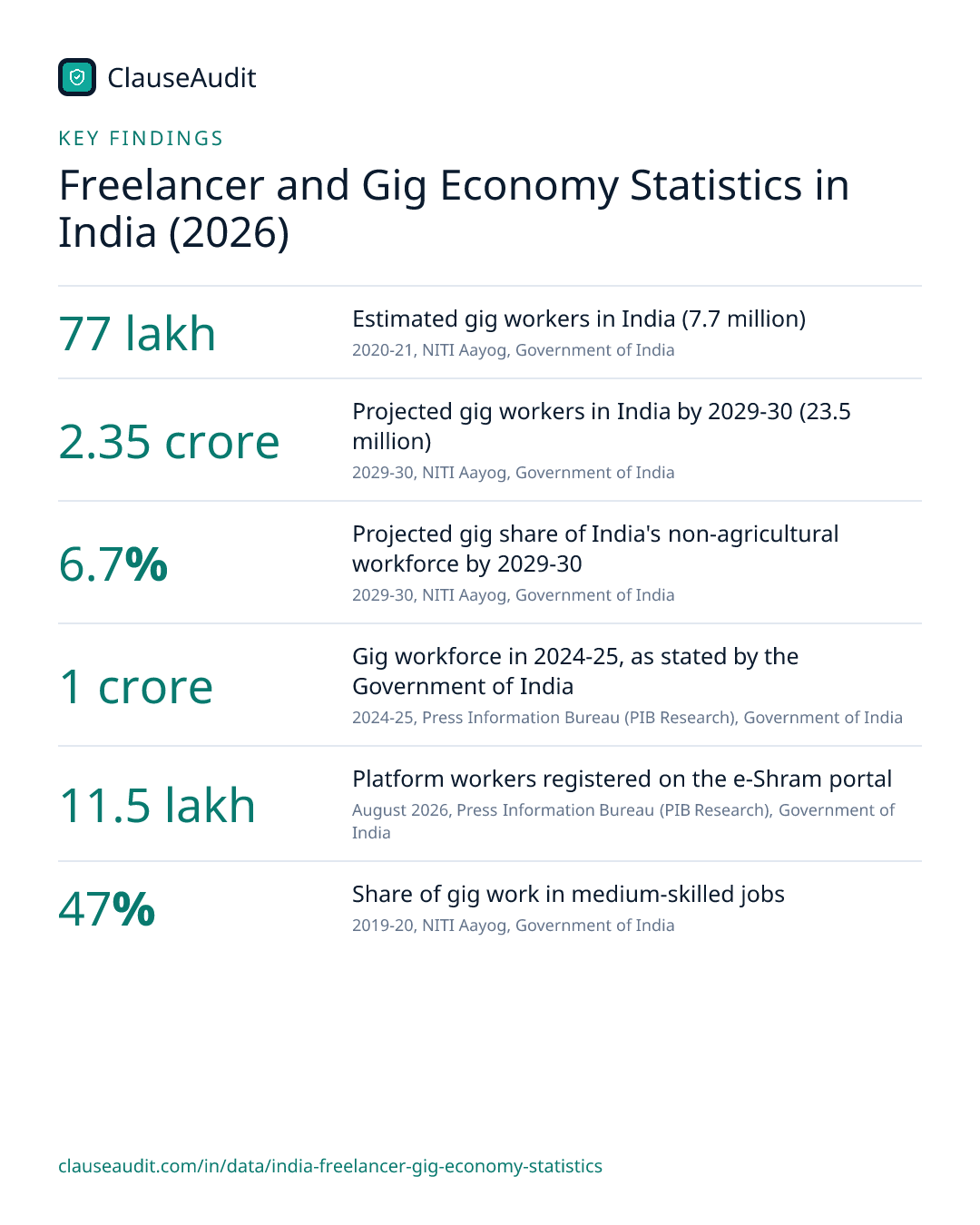
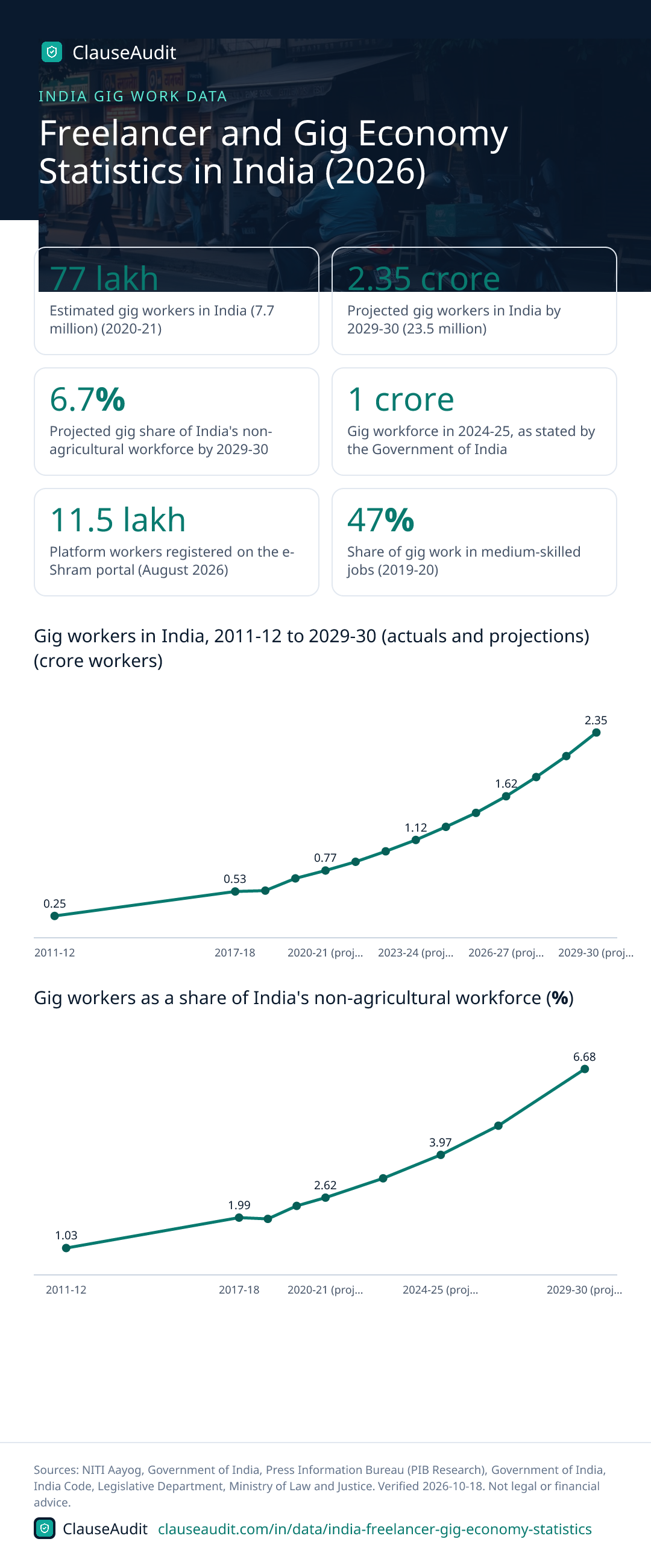
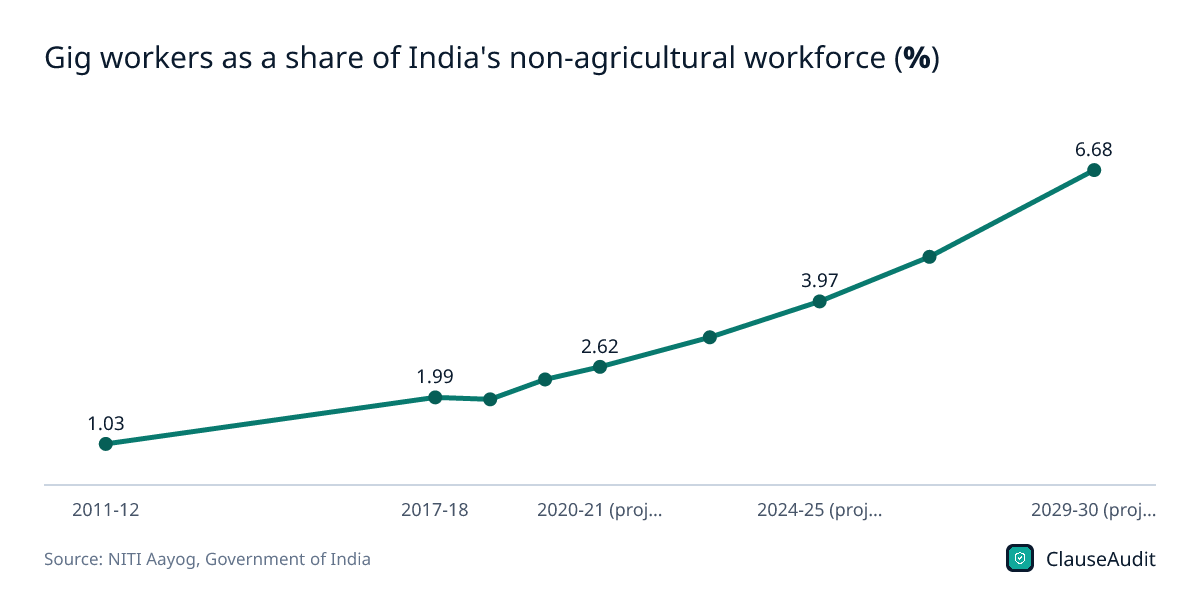
India's gig workforce is growing fast. NITI Aayog estimated about 77 lakh gig workers in 2020-21, around 2.6% of non-farm jobs, and projects 2.35 crore by 2029-30. The government put the 2024-25 figure at 1 crore. By August 2026, about 11.5 lakh platform workers had registered on e-Shram.

- Estimated gig workers in India (7.7 million) (2020-21, NITI Aayog, Government of India)
- 77 lakh
- Projected gig workers in India by 2029-30 (23.5 million) (2029-30, NITI Aayog, Government of India)
- 2.35 crore
- Projected gig share of India's non-agricultural workforce by 2029-30 (2029-30, NITI Aayog, Government of India)
- 6.7%
- Gig workforce in 2024-25, as stated by the Government of India (2024-25, Press Information Bureau (PIB Research), Government of India)
- 1 crore
- Platform workers registered on the e-Shram portal (August 2026, Press Information Bureau (PIB Research), Government of India)
- 11.5 lakh
- Share of gig work in medium-skilled jobs (2019-20, NITI Aayog, Government of India)
- 47%
- Aggregator contribution to gig worker welfare, as share of annual turnover (In force from 21 November 2025, India Code, Legislative Department, Ministry of Law and Justice)
- 1–2%
- Platform aggregators onboarded on e-Shram (August 2025, Press Information Bureau, Government of India)
- 12
India's gig economy has moved from a side story to a line item in labour law. NITI Aayog counted roughly 77 lakh gig workers in 2020-21 and expects about 2.35 crore by 2029-30. That is delivery riders, cab drivers, sales agents, designers, coders and tutors, all paid by the task rather than by the month.
The numbers below come from NITI Aayog, the Press Information Bureau, the e-Shram portal and the Code on Social Security, 2020. Most of the forward figures are projections made in 2022, so read them as a direction of travel, not a headcount. The rest of this page explains what the trend means if you freelance, hire freelancers or work through an app.
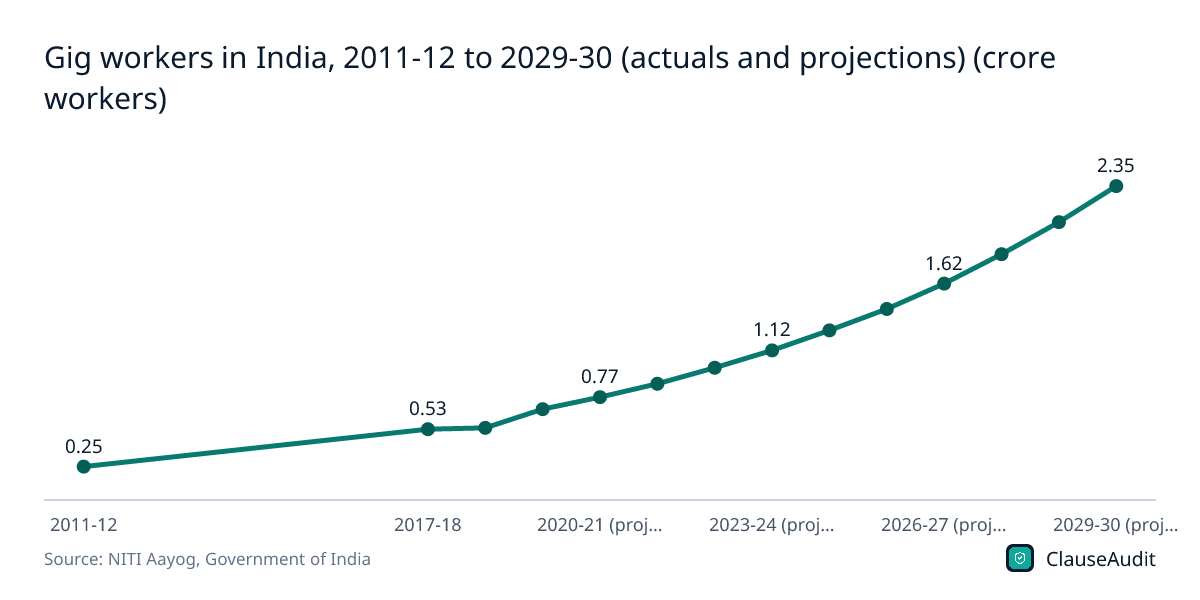
Gig workers in India, 2011-12 to 2029-30 (actuals and projections) (crore workers)
Chart data
| Label | Value (crore workers) |
|---|---|
| 2011-12 | 0.25 |
| 2017-18 | 0.53 |
| 2018-19 | 0.54 |
| 2019-20 | 0.68 |
| 2020-21 (proj.) | 0.77 |
| 2021-22 (proj.) | 0.87 |
| 2022-23 (proj.) | 0.99 |
| 2023-24 (proj.) | 1.12 |
| 2024-25 (proj.) | 1.27 |
| 2025-26 (proj.) | 1.43 |
| 2026-27 (proj.) | 1.62 |
| 2027-28 (proj.) | 1.84 |
| 2028-29 (proj.) | 2.08 |
| 2029-30 (proj.) | 2.35 |
Everything after 2019-20 is a projection published in 2022, and no newer NITI estimate exists yet. The slope matters more than any single year: the line climbs every year to 2.35 crore by 2029-30.
Download this chart (PNG)Gig work's share of non-farm jobs is projected to rise from 2.6% in 2020-21 to 6.7% by 2029-30. If that holds, gig work stops being a niche and becomes a normal way to earn in towns and cities.
Download this chart (PNG)Gig workers in India by industry, 2019-20 (lakh workers)
Chart data
| Label | Value |
|---|---|
| Retail trade | 26.5 |
| Transportation and storage | 13 |
| Financial and insurance | 6.3 |
| Manufacturing | 6.2 |
| Information and communication | 5 |
| Accommodation and food service | 4 |
| Real estate | 2.4 |
| Construction | 2.1 |
| Educational support services | 1.1 |
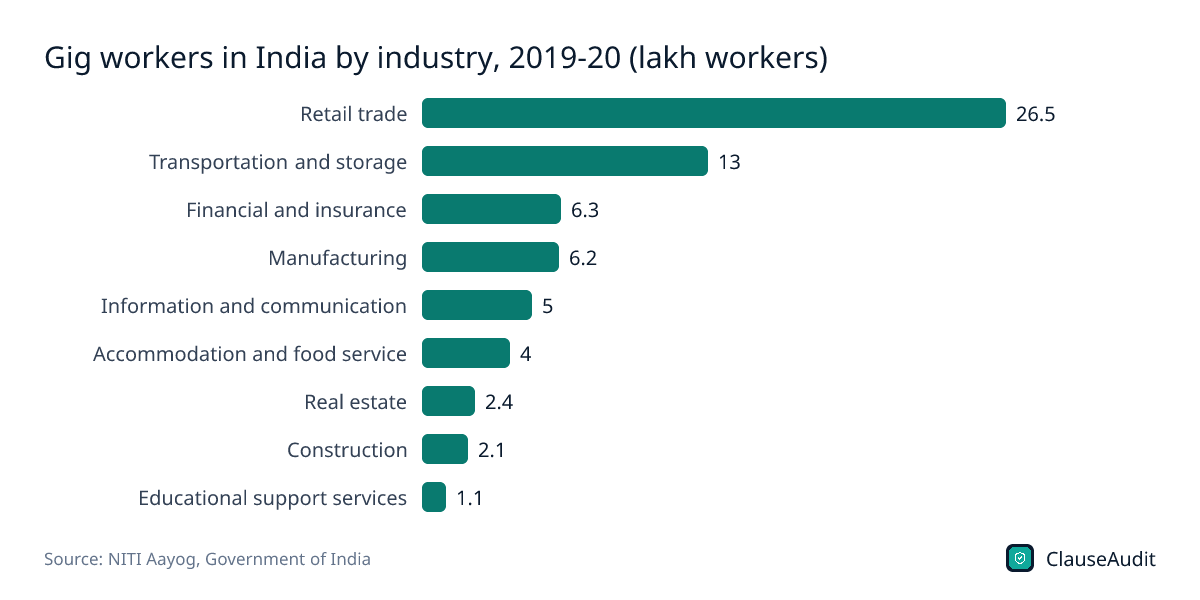
Retail trade led in 2019-20 with 26.5 lakh gig workers, ahead of transportation and storage at 13.0 lakh. Information and communication, where most desk-based freelancers sit, is a smaller slice than many people assume.
Download this chart (PNG)Share of gig work by skill level, 2019-20 vs projected 2029-30 (%)
Chart data
| Label | Value (%) |
|---|---|
| High skilled, 2019-20 | 21.9 |
| Medium skilled, 2019-20 | 46.9 |
| Low skilled, 2019-20 | 31.2 |
| High skilled, 2029-30 (proj.) | 27.5 |
| Medium skilled, 2029-30 (proj.) | 38.7 |
| Low skilled, 2029-30 (proj.) | 33.8 |
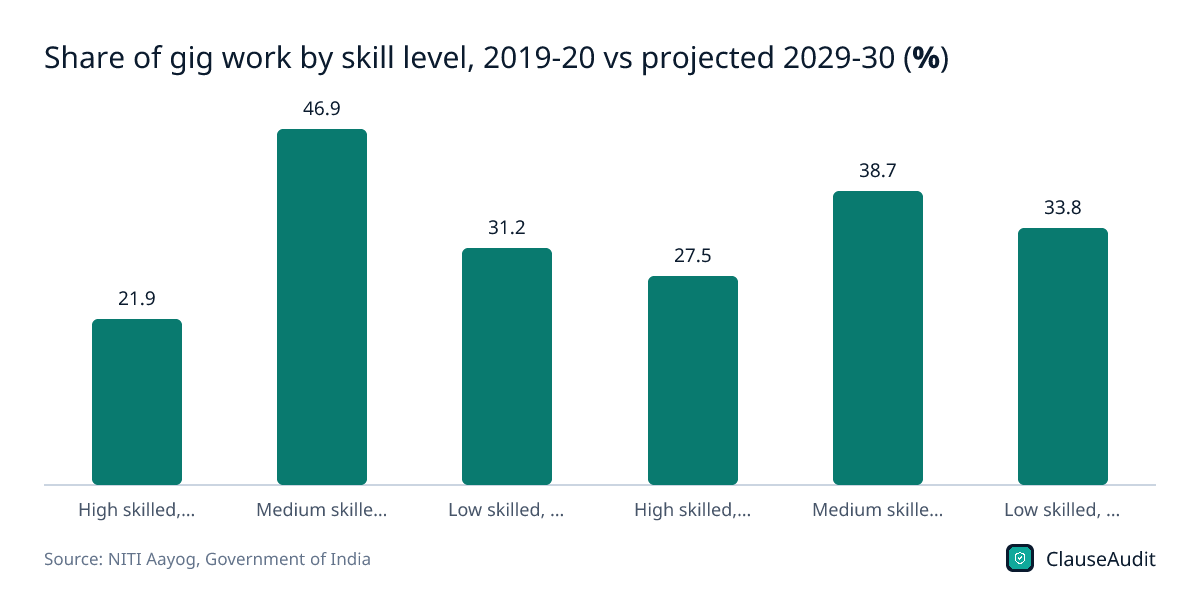
Medium-skilled work made up 47% of gig jobs in 2019-20. The projection shifts the mix toward high-skilled work by 2029-30, which means more contracts covering code, design, finance and content, where IP and payment terms carry real money.
Download this chart (PNG)Platform workers registered on e-Shram, top 10 States/UTs (5 August 2025)
Chart data
| Label | Value |
|---|---|
| Maharashtra | 80,332 |
| West Bengal | 32,274 |
| Andhra Pradesh | 26,690 |
| Uttar Pradesh | 23,379 |
| Gujarat | 18,764 |
| Tamil Nadu | 16,955 |
| Rajasthan | 16,087 |
| Bihar | 16,043 |
| Assam | 15,614 |
| Madhya Pradesh | 14,050 |
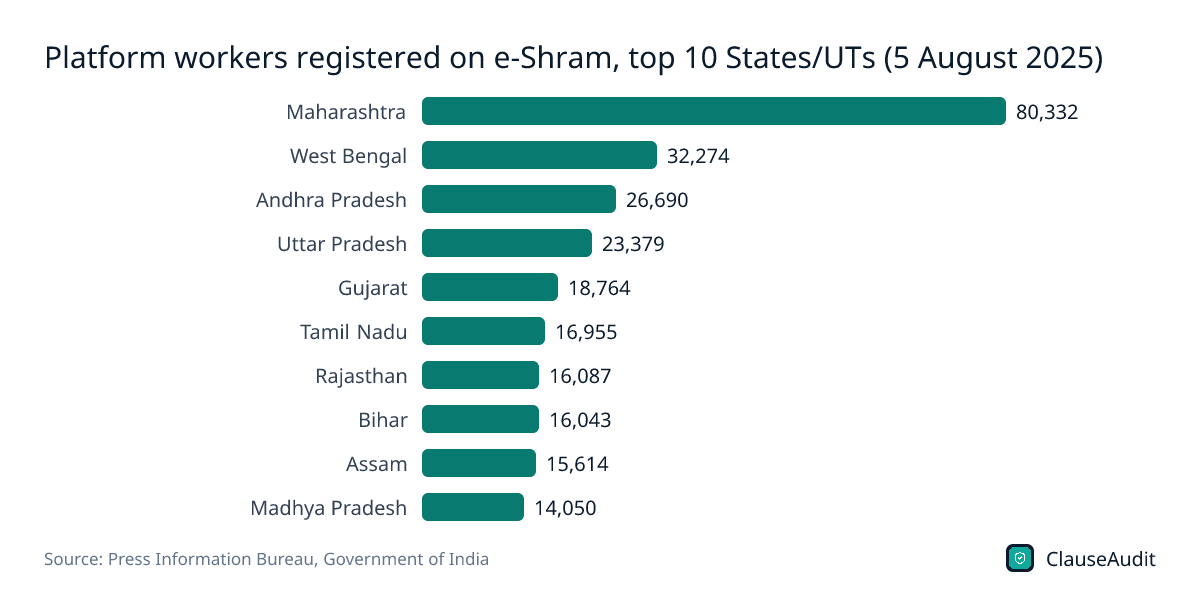
Maharashtra led registrations by a wide margin with 80,332 platform workers as of 5 August 2025. Registration is self-declared and voluntary, so this chart tracks sign-ups and awareness more than where gig work actually happens.
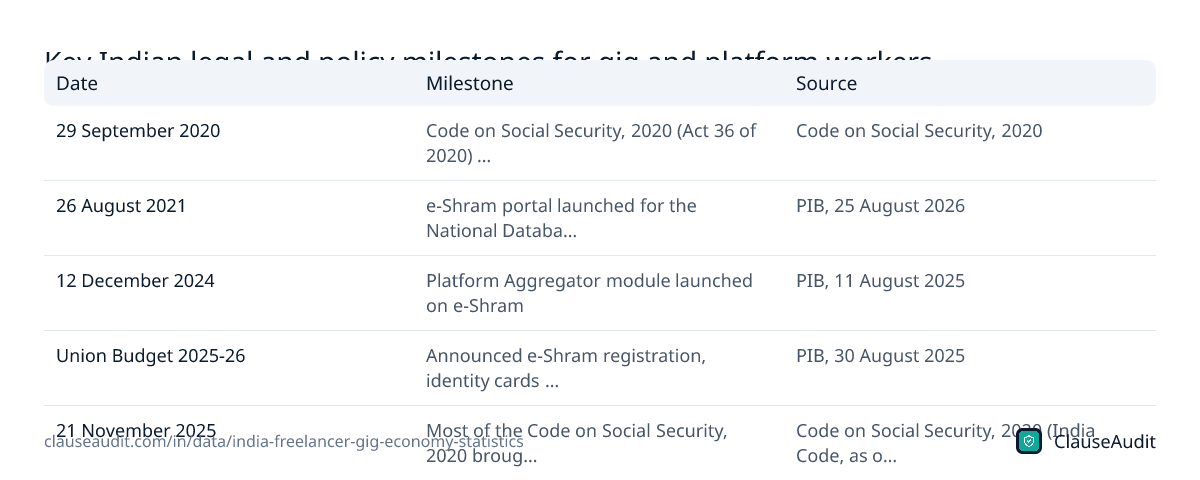
Download this chart (PNG)Key Indian legal and policy milestones for gig and platform workers
| Date | Milestone | Source |
|---|---|---|
| 29 September 2020 | Code on Social Security, 2020 (Act 36 of 2020) published; it defines gig workers, platform workers and aggregators | Code on Social Security, 2020 |
| 26 August 2021 | e-Shram portal launched for the National Database of Unorganised Workers, including platform workers | PIB, 25 August 2026 |
| 12 December 2024 | Platform Aggregator module launched on e-Shram | PIB, 11 August 2025 |
| Union Budget 2025-26 | Announced e-Shram registration, identity cards and AB-PMJAY health cover for online platform workers | PIB, 30 August 2025 |
| 21 November 2025 | Most of the Code on Social Security, 2020 brought into force (S.O. 5319(E)), including s.114 on aggregator contributions | Code on Social Security, 2020 (India Code, as on 21 November 2025) |
Source: India Code, Legislative Department, Ministry of Law and Justice, The Code on Social Security, 2020 (Act No. 36 of 2020), section 114; Press Information Bureau (PIB Research), Government of India, 5 Years of e-Shram Portal: Building an Inclusive Social Security Ecosystem; Press Information Bureau, Government of India, e-Shram Platform Enhancements (Lok Sabha written reply, Ministry of Labour & Employment); Press Information Bureau (PIB Research), Government of India, Social Security Boost for India's Gig Workers. Download as image
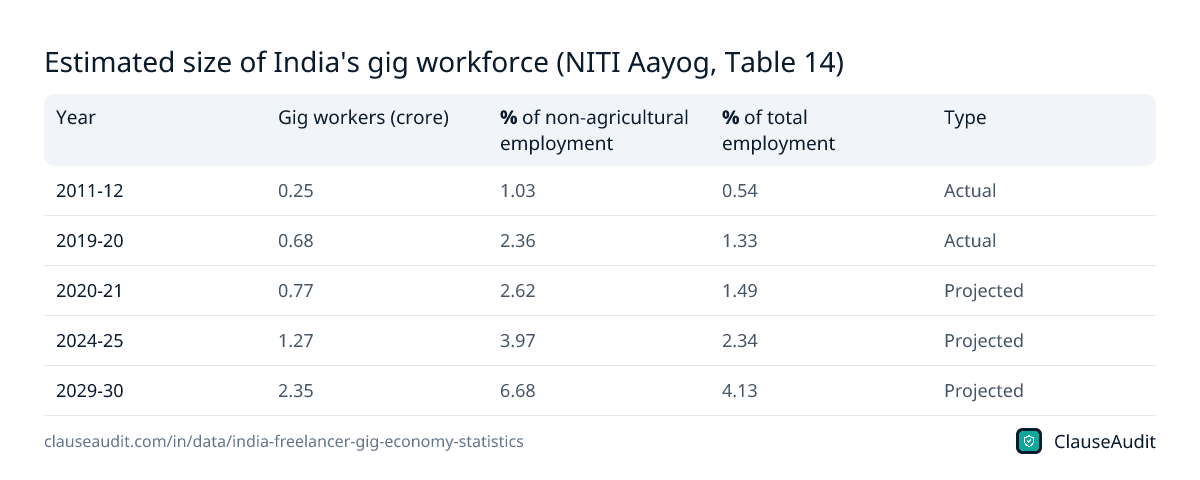
Estimated size of India's gig workforce (NITI Aayog, Table 14)
| Year | Gig workers (crore) | % of non-agricultural employment | % of total employment | Type |
|---|---|---|---|---|
| 2011-12 | 0.25 | 1.03 | 0.54 | Actual |
| 2019-20 | 0.68 | 2.36 | 1.33 | Actual |
| 2020-21 | 0.77 | 2.62 | 1.49 | Projected |
| 2024-25 | 1.27 | 3.97 | 2.34 | Projected |
| 2029-30 | 2.35 | 6.68 | 4.13 | Projected |
Source: NITI Aayog, Government of India, India's Booming Gig and Platform Economy: Perspectives and Recommendations on the Future of Work. Download as image
How many gig workers are there in India?
The most cited figure is NITI Aayog's: about 77 lakh gig workers in 2020-21, or 2.6% of the non-agricultural workforce. The government later said the gig workforce stood at 1 crore in 2024-25. NITI's own table projected 1.27 crore for that year, so the official figure is a rounded-down version of a 2022 projection, not a fresh survey.
That gap is worth keeping in mind. Nobody has a clean headcount of gig workers in India. Many people drive for an app in the evening, take design jobs on weekends, or switch between salaried and freelance work within a year. Surveys catch some of them and miss others.
The e-Shram portal gives a harder number, but a narrower one. About 11.5 lakh platform workers had registered by August 2026, up from 3.37 lakh in early August 2025. That is a count of people who chose to sign up, which is why it sits far below the estimates.
Is the gig economy in India growing?
On every measure available, yes. NITI Aayog projects 2.35 crore gig workers by 2029-30, about 6.7% of non-farm jobs and roughly 4.1% of all jobs. The skill mix is also changing. Medium-skilled work was 47% of gig jobs in 2019-20, while the projection gives a bigger share to high-skilled work by the end of the decade.
Look at where the work sits today. In 2019-20, retail trade had 26.5 lakh gig workers and transportation and storage had 13.0 lakh, out of 68.0 lakh in total. Those are the jobs most people picture: delivery, logistics, field sales. Desk-based freelancing in tech, finance and content is a smaller group, but it is the part the projection expects to grow as a share of the whole.
For you, growth cuts both ways. More companies will hire on a project basis, which means more work. It also means more competition, more standard-form contracts written by the client, and more pressure to accept whatever terms arrive with the purchase order. Volume rarely improves terms on its own. Reading the contract does.
What does the Code on Social Security mean for gig workers?
The Code on Social Security, 2020 was the first central law to define gig workers, platform workers and aggregators. Most of it came into force on 21 November 2025, including section 114. That section requires aggregators to contribute 1% to 2% of annual turnover toward gig worker welfare, capped at 5% of what they pay or owe to gig and platform workers.
There is a catch. The date contributions actually begin has to be notified separately, so the obligation exists on paper before the money flows. If you work through an app, register on e-Shram anyway. It is the database the welfare schemes will draw from, and the Union Budget 2025-26 tied identity cards and AB-PMJAY health cover to that registration.
If you run a platform, check whether you fall within the definition of an aggregator. Twelve aggregators had been onboarded on e-Shram by August 2025, and that list will grow as the rules settle.
What these numbers mean for independent freelancers
Most of the welfare law is aimed at platform work: delivery, ride-hailing, app-based services. If you invoice clients directly as a developer, writer or consultant, the Code gives you little day-to-day protection. Your contract is still the main thing standing between you and a client who pays late, changes the brief or claims more rights than they paid for.
Take a common case. A Pune-based designer signs a client's template for a brand refresh. The payment clause says fees are due "on final approval". The IP clause transfers every concept, including the rejected ones. There is no cap on revisions. None of this is unusual, and none of it is covered by any gig worker scheme. It has to be fixed before you sign.
The fix is usually a few lines. Change "on final approval" to a date or to approval within a set number of working days, with silence counting as acceptance. Limit the IP transfer to the final, paid-for deliverables. Add a revision cap and a kill fee. Many clients will accept these changes, especially when the request is specific and polite.
What should businesses hiring freelancers watch for?
If you hire on a project basis, the growth numbers are good news for you. There are more people to choose from, and more of them are skilled. The risk sits in the paperwork. Many Indian companies still use an employment-style template for contractors, or no written agreement at all.
Three problems come up again and again. First, ownership: under Indian copyright law a freelancer usually owns what they create unless the contract assigns it in writing, so a missing or vague IP clause can leave you without rights to work you paid for. Second, control: if you set hours, supply equipment and direct the work day to day, the person can start to look like an employee, with all the obligations that brings. Third, platforms: if your business runs an app that matches workers to customers, read the definition of aggregator in the Code on Social Security and plan for the contribution once the start date is notified.
A short, fair contract protects both sides. Clear deliverables, a payment date, a written IP assignment on payment, and a reasonable exit clause will avoid most disputes before they start.
What should you do before you sign a gig or freelance contract?
- Pin down the payment trigger. Tie payment to delivery or a fixed date, not to the client's approval with no deadline.
- Ask for a deposit on larger jobs, and say in writing what happens to it if the client cancels.
- Limit revisions to a stated number of rounds, with extra rounds billed at your rate.
- Keep ownership of your pre-existing tools, templates and code, and transfer only the final deliverables once you are paid in full.
- Check the termination clause for notice on both sides and pay for work already done.
- Read any non-solicit or non-compete. A clause that stops you working for a whole industry is a red flag.
- If you work through an app, register on e-Shram and keep copies of your earnings statements.
How ClauseAudit helps
Gig and freelance work in India is growing faster than the protections around it. The law now reaches app-based platform work, but the contract you sign with a client still decides when you get paid, what you hand over and how the job ends.
Upload the agreement and the automated review flags the clauses that usually cost Indian freelancers money, explains each in plain English and suggests wording you can send back.
- Payment terms: is payment tied to an open-ended "final approval" or to a clear date?
- Late payment: is there any interest or fee if the client pays late?
- Scope and revisions: is the number of revision rounds capped?
- IP transfer: does ownership pass only after full payment, and do you keep your pre-existing work?
- Termination and kill fee: are you paid for work done if the client walks away?
- Liability and non-solicit: is your liability capped, and is any restriction limited in time and scope?
Frequently asked questions
How many gig workers are there in India in 2026?
There is no 2026 headcount. NITI Aayog estimated about 77 lakh gig workers in 2020-21 and projects 2.35 crore by 2029-30. The government cited 1 crore for 2024-25. The firmest recent figure is e-Shram, where about 11.5 lakh platform workers had registered by August 2026, though that only counts people who signed up.
What is the difference between a gig worker and a platform worker?
Under the Code on Social Security, 2020, a gig worker earns outside a traditional employer-employee relationship. A platform worker is a gig worker who finds work through an online platform or app, such as delivery or ride-hailing. A freelancer billing clients directly is usually a gig worker but not a platform worker.
Which industries employ the most gig workers in India?
In 2019-20, retail trade had the most, with 26.5 lakh gig workers, followed by transportation and storage at 13.0 lakh. That year NITI Aayog counted 68.0 lakh gig workers in total. Retail and transport together account for the bulk, which is why delivery and logistics dominate the policy debate.
Do aggregators have to pay into a gig worker welfare fund?
Yes, on paper. Section 114 of the Code on Social Security, in force from 21 November 2025, sets a contribution of 1% to 2% of annual turnover, capped at 5% of the amount paid or payable to gig and platform workers. The date contributions start still has to be notified, so check for that notification.
Which state has the most platform workers registered on e-Shram?
Maharashtra, with 80,332 platform workers as of 5 August 2025, well ahead of West Bengal and Andhra Pradesh. These are voluntary registrations, so the ranking also reflects local awareness drives. No newer state breakdown has been published, even though national registrations reached about 11.5 lakh by August 2026.
Should freelancers register on e-Shram?
If you do platform work, yes. Registration links you to the national database that welfare schemes use, and the Union Budget 2025-26 tied identity cards and AB-PMJAY health cover to it for online platform workers. Registration is free. Independent freelancers should check current eligibility on the portal before applying.
Does the new law protect freelancers who bill clients directly?
Mostly not. The welfare rules focus on platform work and aggregator contributions. If you invoice a client directly, your protection comes from the contract: the payment trigger, late payment terms, IP transfer, revision limits and termination. That is why reading the agreement closely matters more than any scheme.
Is the gig economy in India a good place to build a career?
The demand is real. Gig work is projected to reach 6.7% of non-farm jobs by 2029-30, and the mix is shifting toward high-skilled work. The risk is income that depends on each contract. Build a client base, keep savings for slow months, and never sign terms that let a client delay payment indefinitely.
Use this data
Every chart and card below is free to reuse under CC BY 4.0. Download what you need and link back to this page.
 Stat cards
 Key findings card
 Infographic
 Gig workers in India, 2011-12 to 2029-30 (actuals and projections) (crore workers)
 Gig workers as a share of India's non-agricultural workforce (%)
 Gig workers in India by industry, 2019-20 (lakh workers)
 Share of gig work by skill level, 2019-20 vs projected 2029-30 (%)
 Platform workers registered on e-Shram, top 10 States/UTs (5 August 2025)
 Key Indian legal and policy milestones for gig and platform workers
 Estimated size of India's gig workforce (NITI Aayog, Table 14)
Embed the infographic
Free to share on your site, blog or slides under CC BY 4.0. Please keep the credit link.
Sources and method
Every number on this page comes from the sources below, each opened and read on or before October 18, 2026. A second, independent review checked every figure against its source and corrected anything that did not match. Figures that could not be confirmed were left out.
- NITI Aayog, Government of India, India's Booming Gig and Platform Economy: Perspectives and Recommendations on the Future of Work (June 2022 (latest edition; no newer NITI estimate published as of October 2026))
- Press Information Bureau (PIB Research), Government of India, Social Security Boost for India's Gig Workers (30 August 2025)
- Press Information Bureau (PIB Research), Government of India, 5 Years of e-Shram Portal: Building an Inclusive Social Security Ecosystem (25 August 2026)
- Press Information Bureau, Government of India, e-Shram Platform Enhancements (Lok Sabha written reply, Ministry of Labour & Employment) (11 August 2025)
- India Code, Legislative Department, Ministry of Law and Justice, The Code on Social Security, 2020 (Act No. 36 of 2020), section 114 (As on 21 November 2025)
Cite this page
ClauseAudit, “Freelancer and Gig Economy Statistics in India (2026)”, updated October 18, 2026, https://clauseaudit.com/in/data/india-freelancer-gig-economy-statistics. Free to reuse with a link back (CC BY 4.0).
This page summarises published data and law as checked on October 18, 2026. Figures are updated as new editions are released, and your own situation may differ. It is general information, not legal, tax or financial advice.