Workplace NDA Statistics: How Common NDAs Are and What Workers Are Asked to Sign
By ClauseAudit Research · 6 sources ·
What do the latest workplace NDA statistics show?
Workplace NDAs are the most common restriction in US job paperwork. In a 2024 survey of 947 job seekers, 45% said they were bound by one, ahead of class action waivers at 43% and non-competes at 22%. Older workers sign them most often: 58% of those 50 and over.

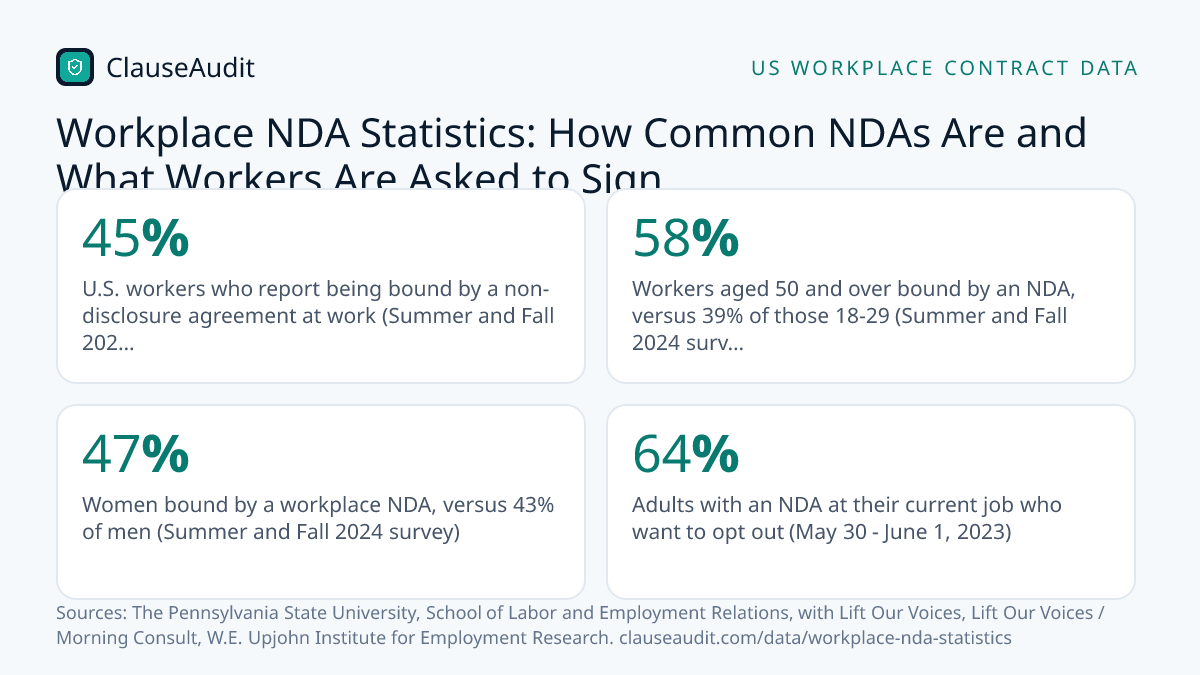
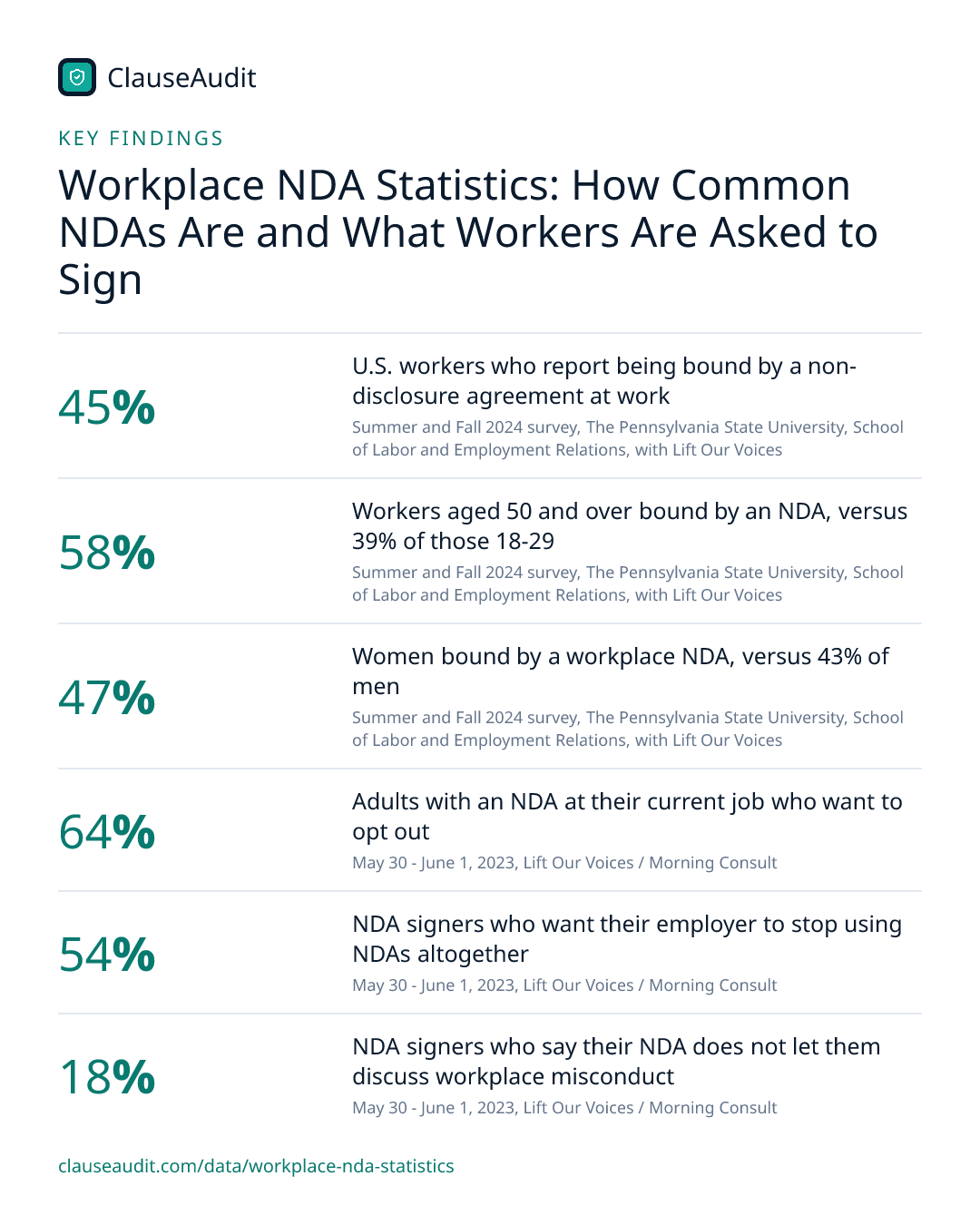
- U.S. workers who report being bound by a non-disclosure agreement at work (Summer and Fall 2024 survey, The Pennsylvania State University, School of Labor and Employment Relations, with Lift Our Voices)
- 45%
- Workers aged 50 and over bound by an NDA, versus 39% of those 18-29 (Summer and Fall 2024 survey, The Pennsylvania State University, School of Labor and Employment Relations, with Lift Our Voices)
- 58%
- Women bound by a workplace NDA, versus 43% of men (Summer and Fall 2024 survey, The Pennsylvania State University, School of Labor and Employment Relations, with Lift Our Voices)
- 47%
- Adults with an NDA at their current job who want to opt out (May 30 - June 1, 2023, Lift Our Voices / Morning Consult)
- 64%
- NDA signers who want their employer to stop using NDAs altogether (May 30 - June 1, 2023, Lift Our Voices / Morning Consult)
- 54%
- NDA signers who say their NDA does not let them discuss workplace misconduct (May 30 - June 1, 2023, Lift Our Voices / Morning Consult)
- 18%
- U.S. adults with a favorable view of the federal Speak Out Act (May 30 - June 1, 2023, Lift Our Voices / Morning Consult)
- 62%
- Rise in Glassdoor review mentions of harassment after state NDA restrictions (Research summary published July 7, 2026, W.E. Upjohn Institute for Employment Research)
- 24%
If you have taken a job in the last few years, there is a good chance a confidentiality clause came with it, whether in the offer letter, a separate agreement, or the severance papers on the way out. NDAs show up more often than non-competes, arbitration clauses, or non-solicits, yet they get far less attention from the people signing them.
The numbers below come from two worker surveys and a recent study of what happened after several states limited NDAs. Read together, they show who is being asked to sign, how many people do not know what their own NDA covers, and why the wording of one clause can matter years after you start.
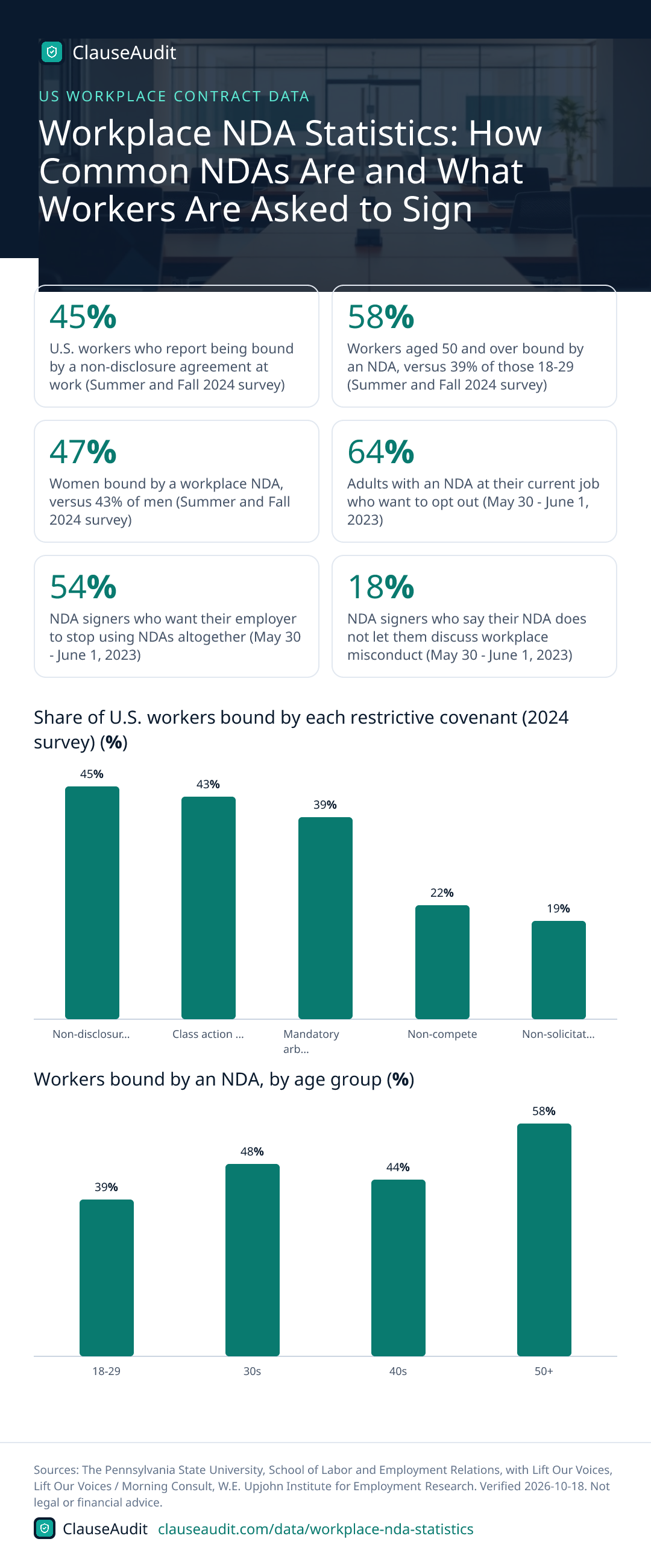
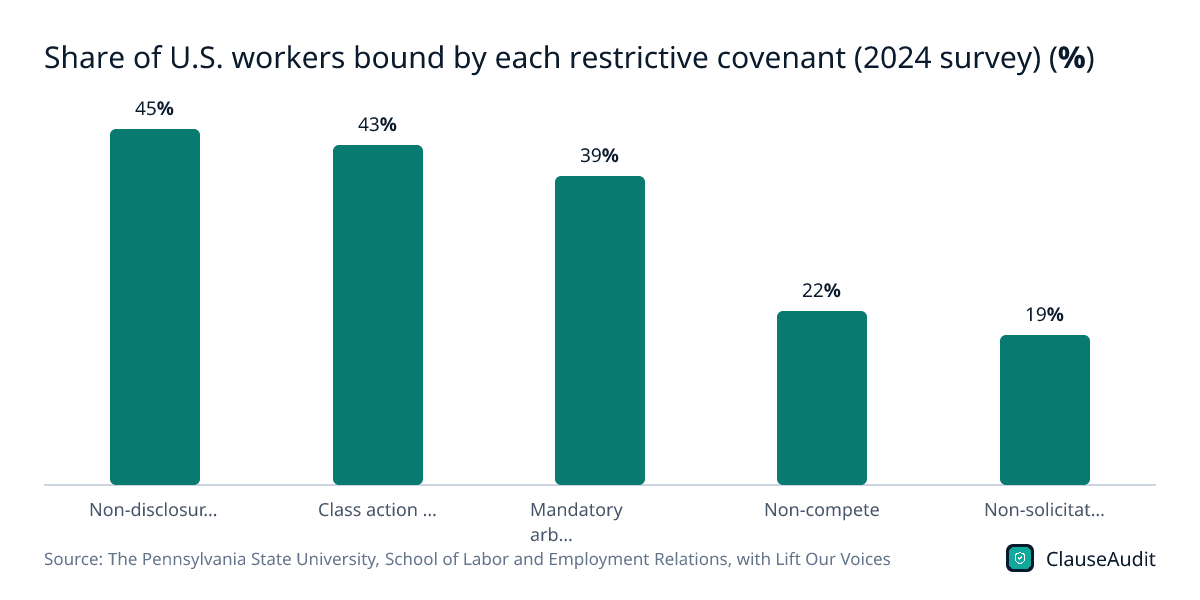
Share of U.S. workers bound by each restrictive covenant (2024 survey) (%)
Chart data
| Label | Value (%) |
|---|---|
| Non-disclosure agreement | 45% |
| Class action waiver | 43% |
| Mandatory arbitration | 39% |
| Non-compete | 22% |
| Non-solicitation | 19% |
The NDA leads, but look at how close class action waivers and arbitration clauses sit behind it. These clauses usually arrive in the same packet, so one review should cover all of them.
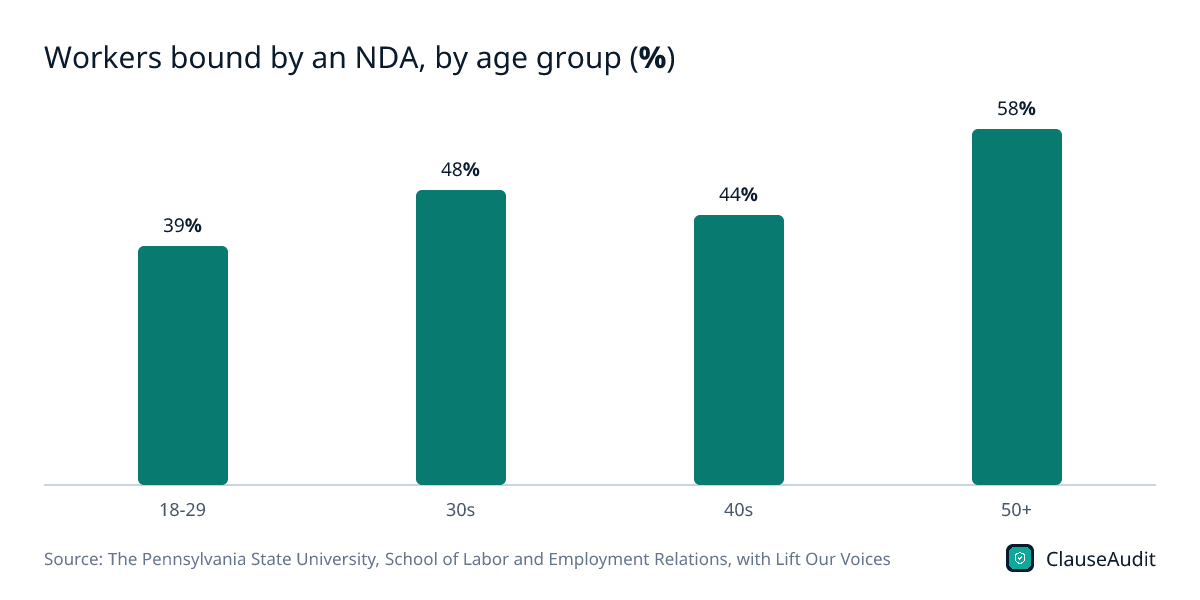
Download this chart (PNG)Workers bound by an NDA, by age group (%)
Chart data
| Label | Value (%) |
|---|---|
| 18-29 | 39% |
| 30s | 48% |
| 40s | 44% |
| 50+ | 58% |
The jump to 58% for workers 50 and over may reflect more senior roles and more exits with severance papers attached. Younger workers sign less often, but 39% is hardly rare, and it often starts with a first job offer that gets signed quickly.
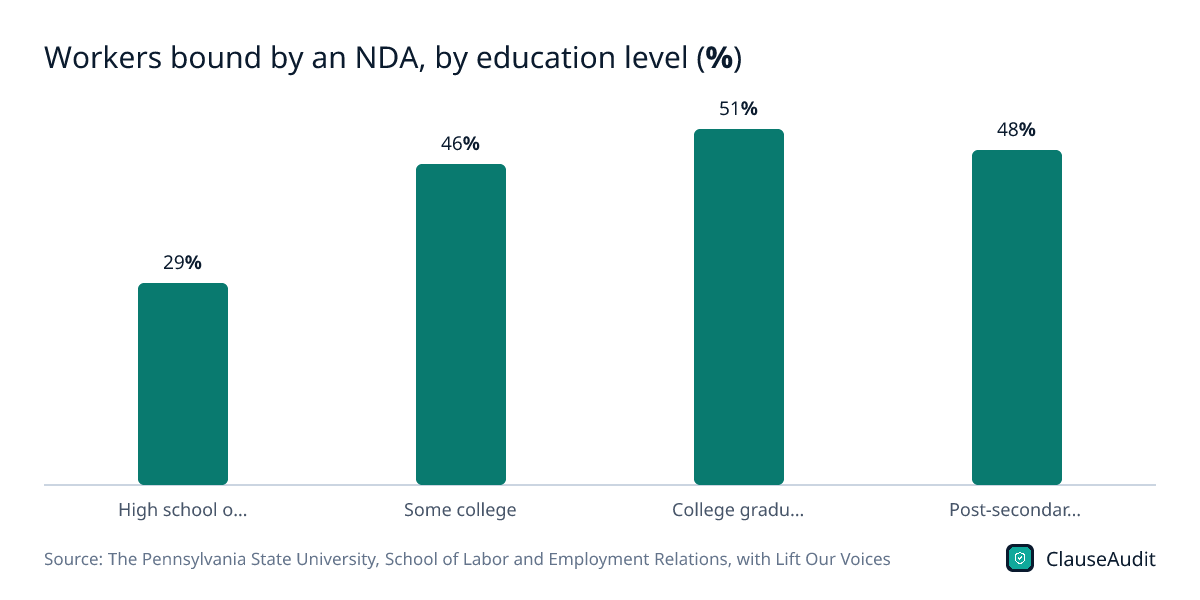
Download this chart (PNG)Workers bound by an NDA, by education level (%)
Chart data
| Label | Value (%) |
|---|---|
| High school or less | 29% |
| Some college | 46% |
| College graduate | 51% |
| Post-secondary education | 48% |
Workers with a high school education or less report NDAs at 29%, well below college graduates. The gap probably tracks the kind of jobs that involve sensitive information, not a difference in what the clauses say.
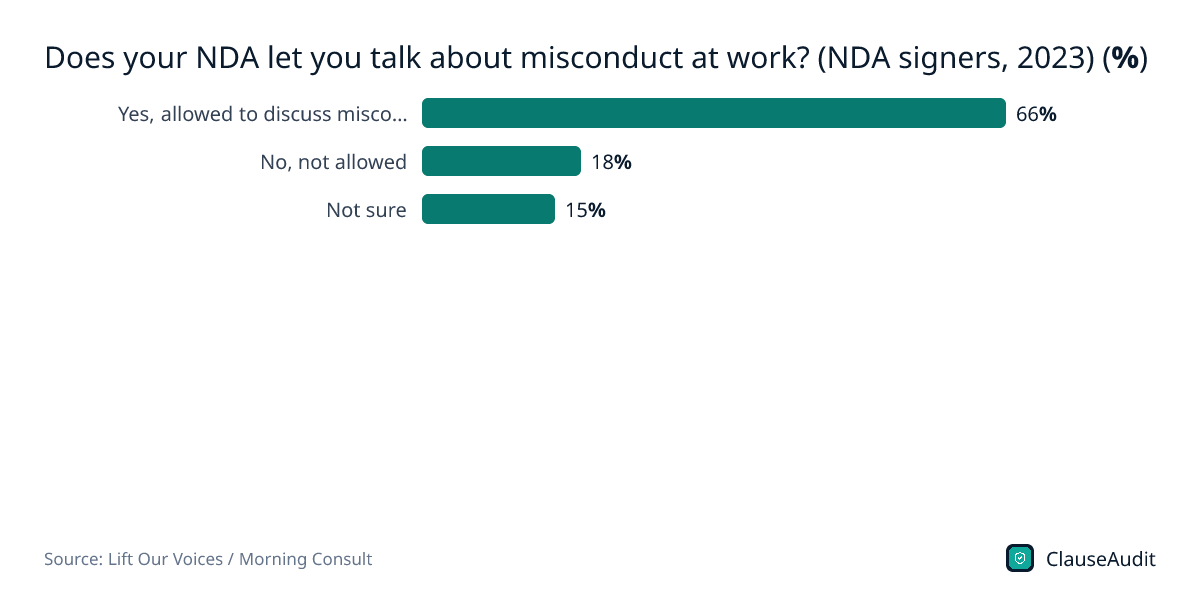
Download this chart (PNG)Does your NDA let you talk about misconduct at work? (NDA signers, 2023) (%)
Chart data
| Label | Value |
|---|---|
| Yes, allowed to discuss misconduct | 66% |
| No, not allowed | 18% |
| Not sure | 15% |
A real share of signers either cannot talk about misconduct or are not sure if they can. Not knowing is its own problem, because people tend to stay quiet when in doubt.
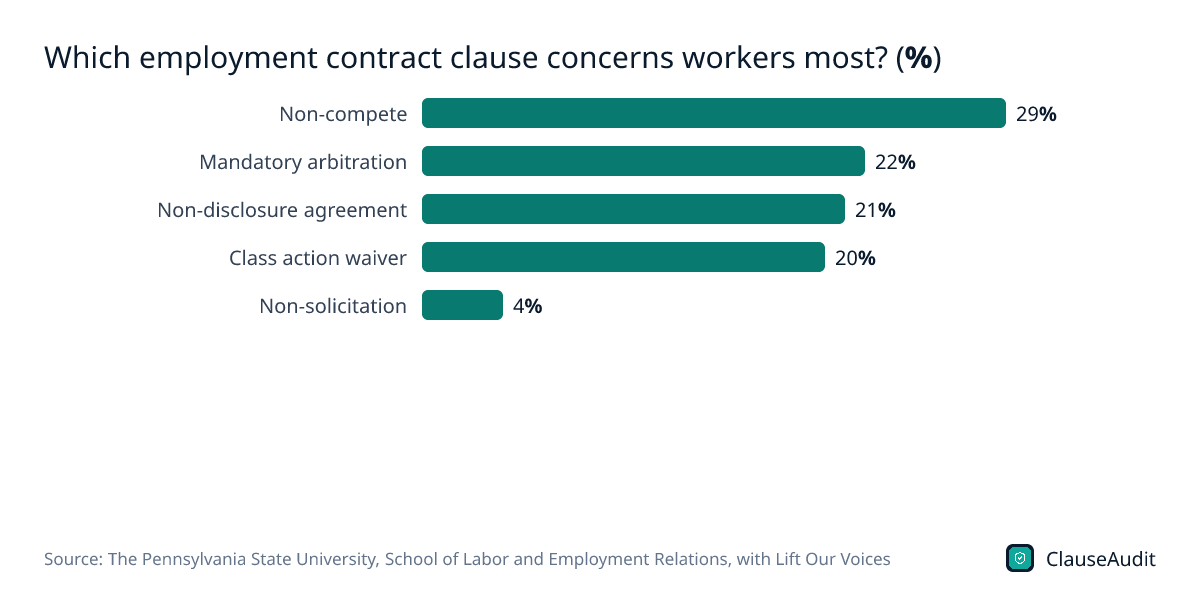
Download this chart (PNG)Which employment contract clause concerns workers most? (%)
Chart data
| Label | Value |
|---|---|
| Non-compete | 29% |
| Mandatory arbitration | 22% |
| Non-disclosure agreement | 21% |
| Class action waiver | 20% |
| Non-solicitation | 4% |
Only 21% named the NDA as their top worry, and 27% named it as the clause that concerns them least. Workers sign NDAs more than any other covenant yet rarely rank them as a top concern, which is how overly broad terms slip through.
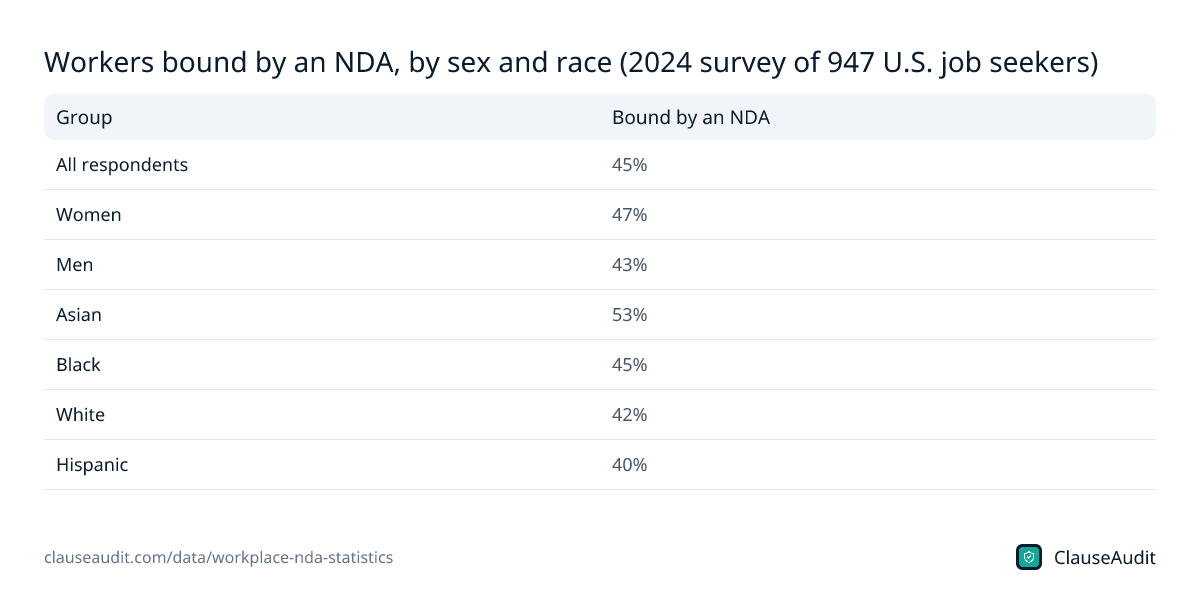
Download this chart (PNG)Workers bound by an NDA, by sex and race (2024 survey of 947 U.S. job seekers)
| Group | Bound by an NDA |
|---|---|
| All respondents | 45% |
| Women | 47% |
| Men | 43% |
| Asian | 53% |
| Black | 45% |
| White | 42% |
| Hispanic | 40% |
Source: The Pennsylvania State University, School of Labor and Employment Relations, with Lift Our Voices, Contracts That Bind: Untangling the Use of NDAs, Forced Arbitration and Other Restrictive Covenants in the U.S. Labor Market (Mark D. Gough). Download as image
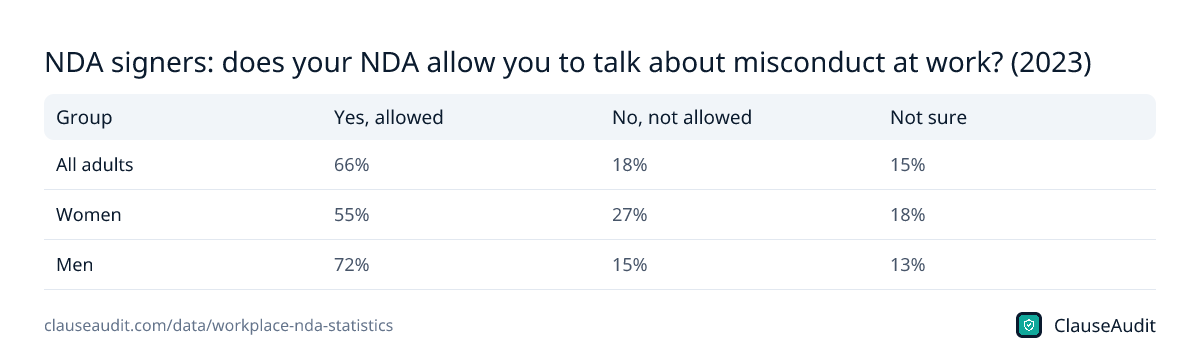
NDA signers: does your NDA allow you to talk about misconduct at work? (2023)
| Group | Yes, allowed | No, not allowed | Not sure |
|---|---|---|---|
| All adults | 66% | 18% | 15% |
| Women | 55% | 27% | 18% |
| Men | 72% | 15% | 13% |
Source: Lift Our Voices / Morning Consult, Lift Our Voices / Morning Consult Poll - June 2023 - Questions and Crosstabs. Download as image
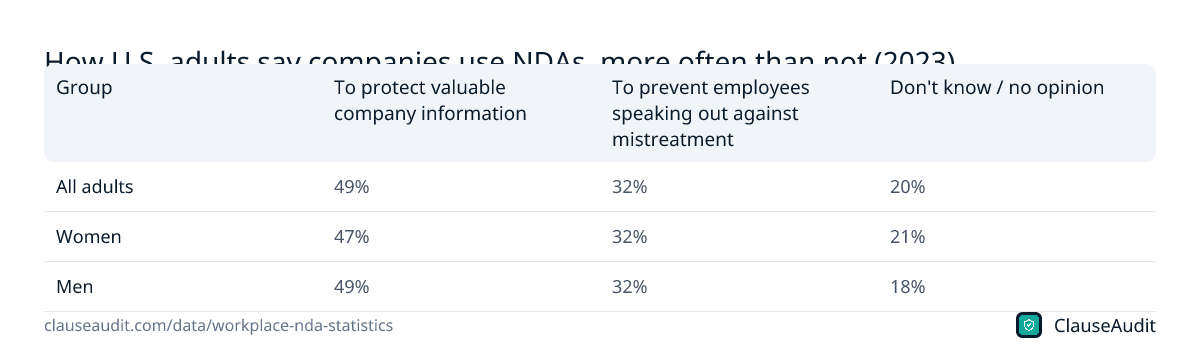
How U.S. adults say companies use NDAs, more often than not (2023)
| Group | To protect valuable company information | To prevent employees speaking out against mistreatment | Don't know / no opinion |
|---|---|---|---|
| All adults | 49% | 32% | 20% |
| Women | 47% | 32% | 21% |
| Men | 49% | 32% | 18% |
Source: Lift Our Voices / Morning Consult, Lift Our Voices / Morning Consult Poll - June 2023 - Questions and Crosstabs. Download as image
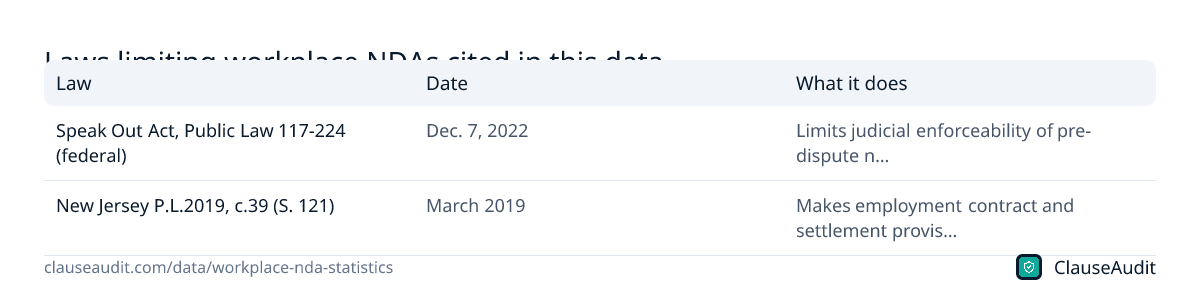
Laws limiting workplace NDAs cited in this data
| Law | Date | What it does |
|---|---|---|
| Speak Out Act, Public Law 117-224 (federal) | Dec. 7, 2022 | Limits judicial enforceability of pre-dispute nondisclosure and non-disparagement clauses in sexual assault and sexual harassment disputes |
| New Jersey P.L.2019, c.39 (S. 121) | March 2019 | Makes employment contract and settlement provisions that conceal details of discrimination, retaliation or harassment claims unenforceable against the employee |
Source: U.S. Government Publishing Office (govinfo), Speak Out Act, Public Law 117-224 (S. 4524), 136 Stat. 2290; The Pennsylvania State University, School of Labor and Employment Relations, with Lift Our Voices, Breaking the Silence: Stakeholder Experiences with New Jersey's Non-Disclosure Agreement Ban (Mark D. Gough). Download as image
How common are NDAs in employment contracts?
Very. In a Penn State survey of 947 job seekers, conducted in summer and fall 2024, 45% said their current or most recent job bound them to a non-disclosure agreement. That made the NDA the most common of the five covenants the researchers measured.
The survey was not a random sample of every worker in the country, so treat 45% as a strong signal rather than a census. Still, the pattern is clear. Women reported NDAs slightly more than men, 47% against 43%, and the share climbs with age, from 39% of workers aged 18 to 29 to 58% of those 50 and over.
Many people are bound by more than one restriction at once. A typical offer packet might hold an NDA, an arbitration agreement and a class action waiver, each signed in a minute on the first morning. Class action waivers came in at 43% and mandatory arbitration at 39%, both close behind the NDA, while non-competes sat at 22% and non-solicits at 19%.
That ranking surprises people, because non-competes get most of the headlines. But a non-compete limits where you work next. An NDA limits what you can say, sometimes for good, and it is far more likely to be in your file.
Can an NDA stop you from reporting harassment or misconduct?
For a lot of workers, the honest answer is that they do not know. In a 2023 Morning Consult poll of NDA signers, 66% said their agreement allowed them to discuss workplace misconduct, 18% said it did not, and 15% were not sure. Among women, 27% said their NDA barred that conversation.
Federal law now limits some of this. The Speak Out Act, signed Dec. 7, 2022, makes pre-dispute nondisclosure and non-disparagement clauses unenforceable in sexual assault and sexual harassment disputes. New Jersey went further in March 2019, making provisions that hide details of discrimination, retaliation or harassment claims unenforceable against the employee.
Picture a project manager who signed a standard NDA at onboarding and later sees a supervisor harass a coworker. If the agreement says she cannot disclose "any information concerning the company or its personnel," she may assume she has to stay quiet, even if a court would never enforce that line against her. The chilling effect works whether or not the clause is legal.
Those laws protect you after the fact. They do not stop an employer from putting broad language in the contract, and many people never test whether a clause would hold up. That is why the wording on the page still matters.
Do workers actually want to sign NDAs?
Most who have signed one would like a way out. In the same 2023 poll, 64% of people with an NDA at their current job said they would like to opt out, and 54% wanted their employer to stop using NDAs altogether. Public support for limits runs high too: 62% of US adults supported the Speak Out Act.
US adults are split on why companies use them. Asked how NDAs are used more often than not, 49% said to protect valuable company information and 32% said to keep employees from speaking out about mistreatment. Both uses exist, often in the same document, and you only find out which one you are dealing with by reading the definitions.
What happens when states limit NDAs?
Researchers looked at Glassdoor reviews after California, New Jersey and Illinois barred NDAs that conceal unlawful conduct. Mentions of harassment in reviews rose 24%, according to a July 2026 summary of the study.
The researchers' reading is not that harassment got worse. It is that workers felt freer to say what was already happening, and job seekers got information they could not see before. For you, that means a company's public reputation may reflect what its contracts allow people to say as much as what actually goes on inside.
What should employers and small businesses take from this?
If you run a business, the data cuts both ways. NDAs are normal and often necessary. Client lists, pricing, source code and product plans deserve protection, and a short, clear agreement is how you get it.
The trouble starts with templates that try to cover everything. A clause broad enough to silence talk about harassment can be unenforceable under the Speak Out Act or state law, and an overreaching agreement invites a court to cut it back or refuse to enforce it. Worse, the Glassdoor findings suggest that silence does not stay hidden forever. When the rules change, the reviews catch up.
A tighter NDA is easier to defend. Define what is confidential, list the standard exclusions, state plainly that nothing stops an employee from reporting unlawful conduct, and set a sensible end date for anything that is not a trade secret. Freelancers and contractors who sign client NDAs should push for the same shape, since a vague definition can make it hard to show your own past work.
What to do before you sign a workplace NDA
- Ask for the agreement before your start date so you can read it without a manager waiting at the desk.
- Find the definition of confidential information. If it covers everything you learn on the job, ask to limit it to marked or genuinely secret material.
- Check for the standard exclusions: public information, things you knew before, and anything you learn independently.
- Look for a clear carve-out that lets you report illegal conduct, file charges with agencies, and talk about harassment or discrimination.
- Note how long it lasts. Trade secrets can be protected for as long as they stay secret, but ordinary business information should have an end date.
- Read the severance agreement separately. Exit NDAs and non-disparagement clauses are often broader than the ones you signed when hired.
- Check whether the NDA hides a non-solicit or non-compete inside the confidentiality language.
How ClauseAudit helps
An NDA in an offer letter or severance agreement often looks routine. The risk sits in a few lines: how broadly confidential information is defined, what you are still allowed to say, and how long the duty lasts.
Upload or paste the agreement and the automated review flags each of those clauses, rates the risk, and explains in plain English what to ask your employer to change.
- Confidential information defined so broadly it covers your general skills and experience
- Missing exclusions for public, prior or independently developed information
- No carve-out for reporting illegal conduct, harassment or discrimination
- Perpetual duration for ordinary business information
- Non-solicit or non-compete terms buried inside the NDA
- Non-disparagement and return-of-materials terms in severance agreements
Frequently asked questions
What percentage of employees sign an NDA?
In a 2024 Penn State survey of 947 US job seekers, 45% said they were bound by a non-disclosure agreement at their current or most recent job. That was the most common of five restrictions measured, ahead of class action waivers, mandatory arbitration, non-competes and non-solicitation clauses. The sample was not random, so treat it as a strong indicator rather than an exact national figure.
Who is most likely to have a workplace NDA?
Older workers. The same survey found 58% of workers aged 50 and over were bound by an NDA, compared with 39% of those aged 18 to 29. Women reported NDAs slightly more often than men, 47% against 43%. College graduates also reported them more often than workers with a high school education or less.
Can my NDA stop me from talking about harassment?
If you signed it before any dispute arose, the federal Speak Out Act makes it unenforceable in sexual harassment and sexual assault disputes. Settlement NDAs signed after a dispute are not covered by that law, though several states, including New Jersey, go further. Even so, 18% of NDA signers in a 2023 poll said their agreement barred talk about misconduct, and 15% were not sure.
Is it normal to sign an NDA when starting a job?
Yes. NDAs are the single most common restrictive clause in US job paperwork. Normal does not mean every version is fair, though. Some cover only real trade secrets and client data. Others reach anything you learn, last forever, or quietly add a non-solicit. Read the definition and the exceptions before you sign.
Can I refuse to sign an NDA at work?
You can, but in most states an employer can also decline to hire you or keep you on if you refuse. A better approach is usually to negotiate the terms. Ask to narrow the definition of confidential information, add standard exclusions, set an end date, and include a clear right to report illegal conduct.
Do workers want to keep using NDAs?
Most who have one do not. In a 2023 Morning Consult poll, 64% of people with an NDA at their current job wanted to opt out, and 54% wanted their employer to stop using NDAs entirely. A separate question found 62% of US adults supported the Speak Out Act.
Are NDAs in severance agreements different?
Often, yes. Exit agreements tend to pair confidentiality with non-disparagement and a release of claims, and the language can be broader than what you signed on day one. Check what you are giving up, what you can still say, and whether the agreement keeps your right to talk to government agencies.
Did state NDA bans change anything?
A study of Glassdoor reviews found that after California, New Jersey and Illinois barred NDAs hiding unlawful conduct, mentions of harassment in reviews rose 24%. Researchers read this as workers speaking more openly, less afraid of retaliation, which gives job seekers a clearer view of employers before they accept an offer.
Use this data
Every chart and card below is free to reuse under CC BY 4.0. Download what you need and link back to this page.
 Stat cards
 Key findings card
 Infographic
 Share of U.S. workers bound by each restrictive covenant (2024 survey) (%)
 Workers bound by an NDA, by age group (%)
 Workers bound by an NDA, by education level (%)
 Does your NDA let you talk about misconduct at work? (NDA signers, 2023) (%)
 Which employment contract clause concerns workers most? (%)
 Workers bound by an NDA, by sex and race (2024 survey of 947 U.S. job seekers)
 NDA signers: does your NDA allow you to talk about misconduct at work? (2023)
 How U.S. adults say companies use NDAs, more often than not (2023)
 Laws limiting workplace NDAs cited in this data
Embed the infographic
Free to share on your site, blog or slides under CC BY 4.0. Please keep the credit link.
Sources and method
Every number on this page comes from the sources below, each opened and read on or before October 18, 2026. A second, independent review checked every figure against its source and corrected anything that did not match. Figures that could not be confirmed were left out.
- The Pennsylvania State University, School of Labor and Employment Relations, with Lift Our Voices, Contracts That Bind: Untangling the Use of NDAs, Forced Arbitration and Other Restrictive Covenants in the U.S. Labor Market (Mark D. Gough) (January 2025 (original PDF dated Jan. 23, 2025; survey fielded Summer and Fall 2024). Live rebranded edition linked from liftourvoices.org/research, 18 pages, same text and figures; checked 2026-10-20.)
- Lift Our Voices / Morning Consult, New Poll: Majority of Americans Support Federal Legislation to Combat Toxic Workplace Behavior (Morning Consult survey) (July 11, 2023 (fielded May 30 - June 1, 2023). Original page now returns 404; archived copy read.)
- Lift Our Voices / Morning Consult, Lift Our Voices / Morning Consult Poll - June 2023 - Questions and Crosstabs (June 2023 (released July 2023))
- W.E. Upjohn Institute for Employment Research, How broad non-disclosure agreements leave job seekers in the dark (summary of Sockin, Sojourner and Starr, 'Nondisclosure Agreements and Externalities from Silence', PNAS vol. 123, issue 23) (July 7, 2026)
- U.S. Government Publishing Office (govinfo), Speak Out Act, Public Law 117-224 (S. 4524), 136 Stat. 2290 (Dec. 7, 2022)
- The Pennsylvania State University, School of Labor and Employment Relations, with Lift Our Voices, Breaking the Silence: Stakeholder Experiences with New Jersey's Non-Disclosure Agreement Ban (Mark D. Gough) (October 2023 (PDF dated Oct. 21, 2023))
Cite this page
ClauseAudit, “Workplace NDA Statistics: How Common NDAs Are and What Workers Are Asked to Sign”, updated October 18, 2026, https://clauseaudit.com/data/workplace-nda-statistics. Free to reuse with a link back (CC BY 4.0).
This page summarises published data and law as checked on October 18, 2026. Figures are updated as new editions are released, and your own situation may differ. It is general information, not legal, tax or financial advice.