NDA Laws by State: Where Employers Cannot Gag Harassment, Discrimination and Wage Talk (2026)
By ClauseAudit Research · 28 sources ·
What are the NDA laws by state?
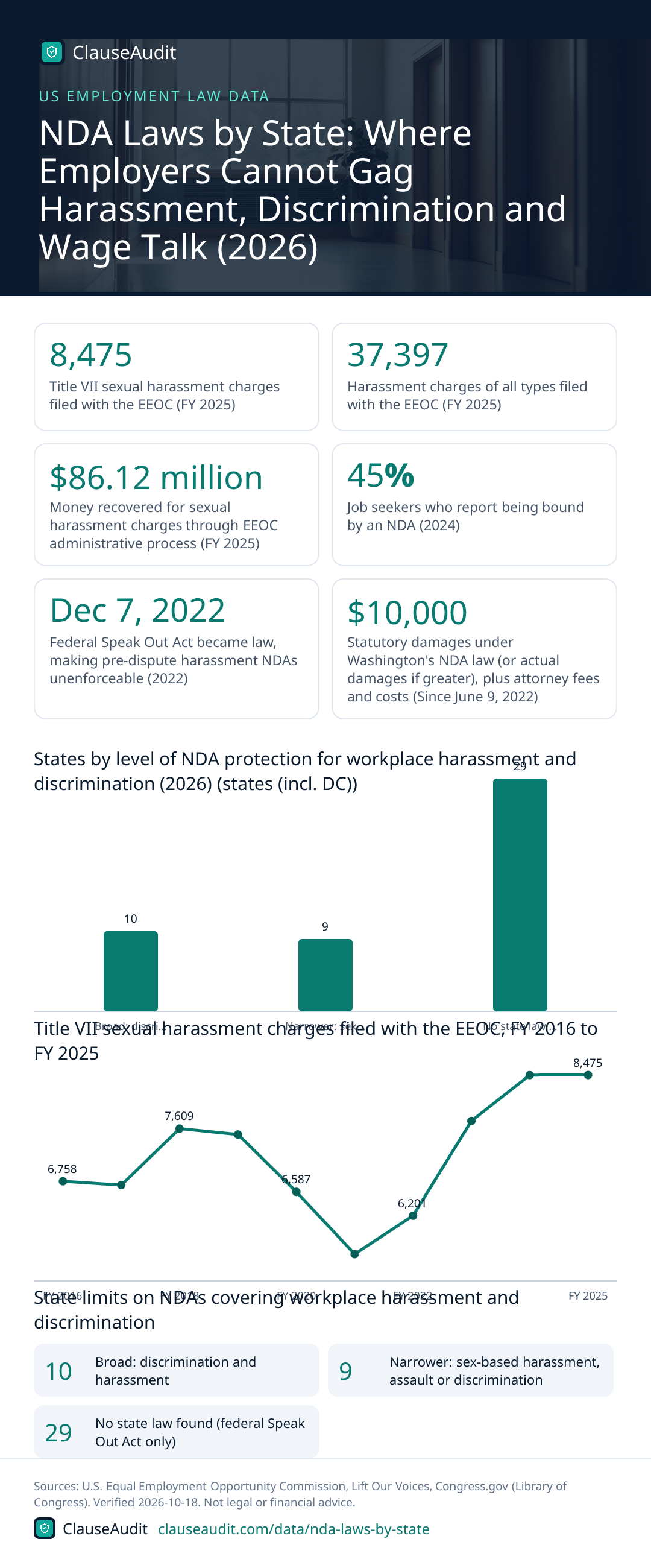
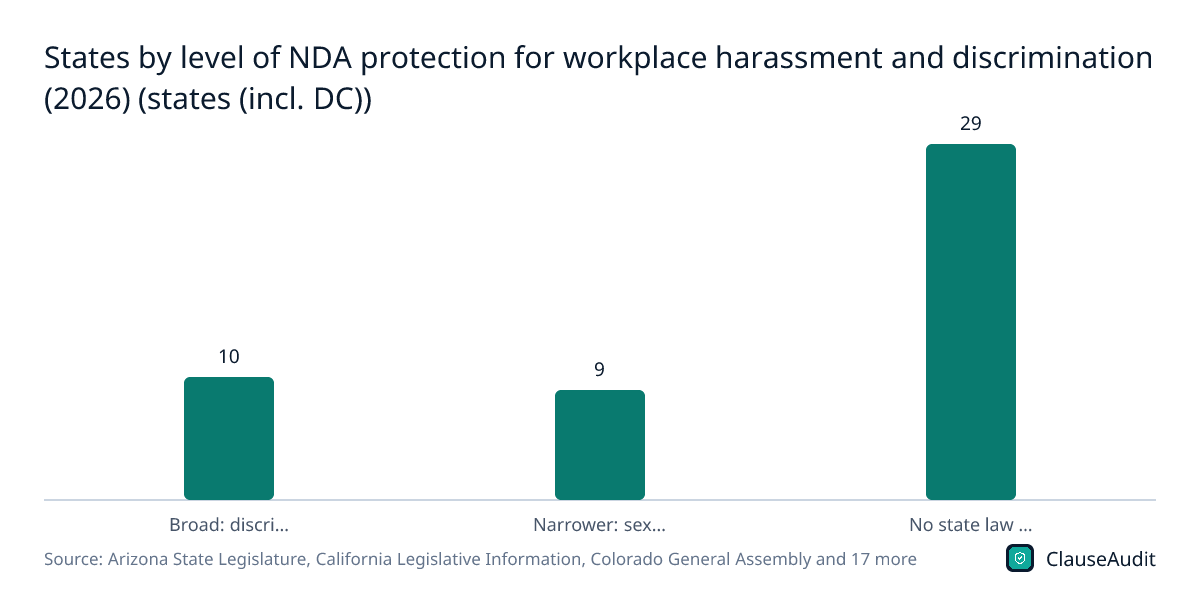
Most states still rely on the federal Speak Out Act alone. As of 2026, 10 states broadly limit NDAs covering workplace discrimination and harassment, 9 more limit them only for sex-based misconduct, and 29 have no state law we could find. Washington goes furthest, also covering wage and hour violations, with $10,000 in statutory damages.

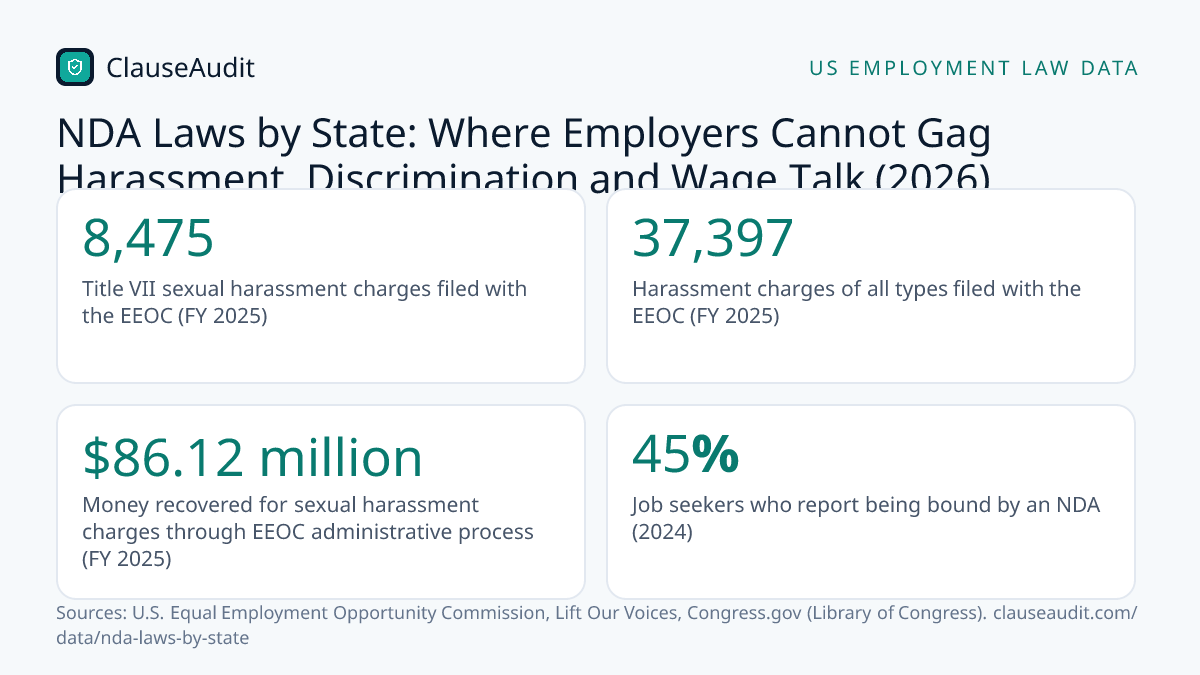
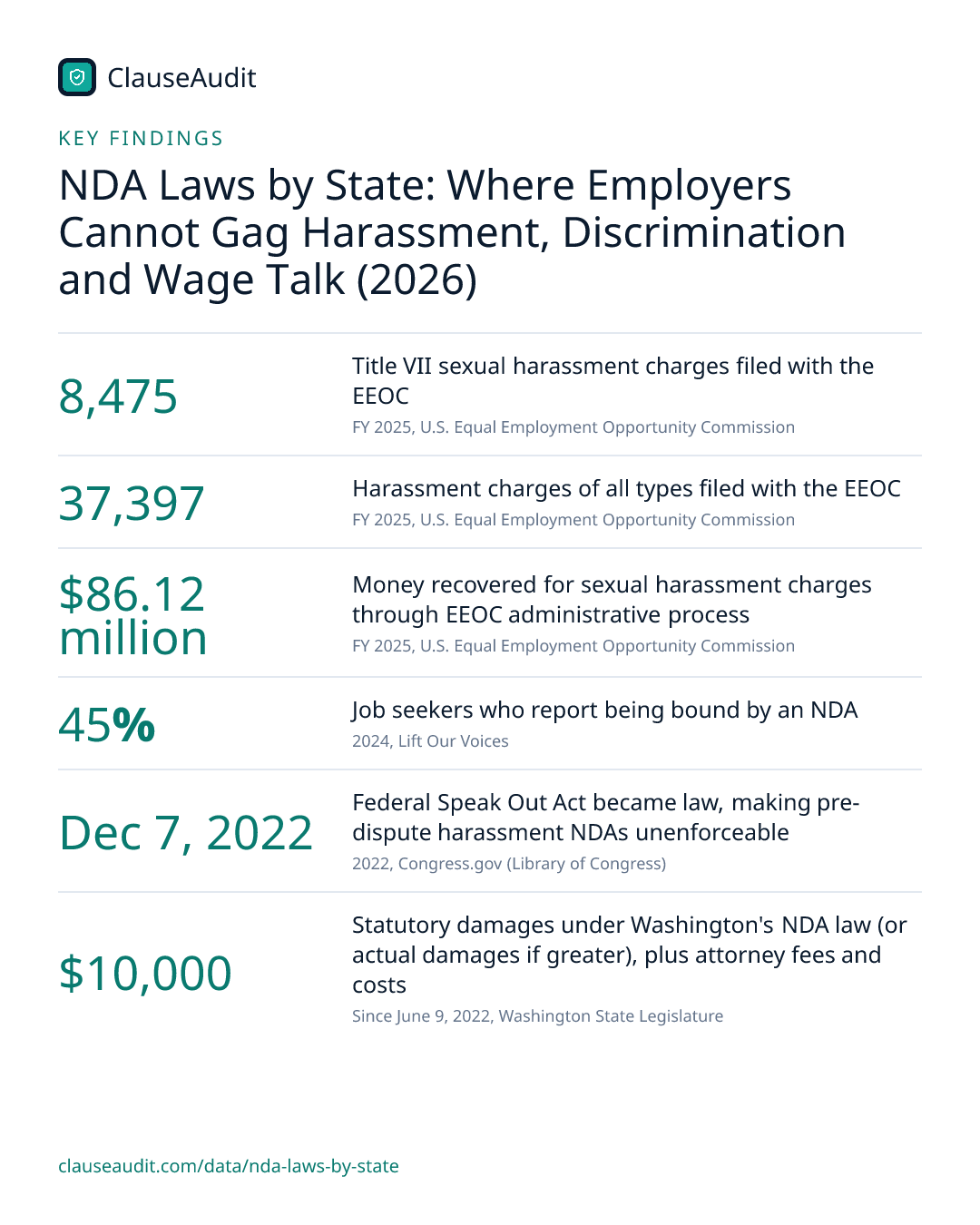
- Title VII sexual harassment charges filed with the EEOC (FY 2025, U.S. Equal Employment Opportunity Commission)
- 8,475
- Harassment charges of all types filed with the EEOC (FY 2025, U.S. Equal Employment Opportunity Commission)
- 37,397
- Money recovered for sexual harassment charges through EEOC administrative process (FY 2025, U.S. Equal Employment Opportunity Commission)
- $86.12 million
- Job seekers who report being bound by an NDA (2024, Lift Our Voices)
- 45%
- Federal Speak Out Act became law, making pre-dispute harassment NDAs unenforceable (2022, Congress.gov (Library of Congress))
- Dec 7, 2022
- Statutory damages under Washington's NDA law (or actual damages if greater), plus attorney fees and costs (Since June 9, 2022, Washington State Legislature)
- $10,000
- New York voters who support outlawing NDAs on abuse, harassment or discrimination (December 2024, Morning Consult / Lift Our Voices)
- 68%
- Gen Z non-students less likely to take a job that bars speaking about discrimination (November 2025, Morning Consult / Lift Our Voices)
- 47%
An NDA is supposed to protect trade secrets, client lists and product plans. For years it also kept people quiet about harassment, discrimination and unpaid wages. A growing group of states now says that second use is off limits, but the rules differ a lot from one border to the next.
This page maps where those limits stand in 2026, what kind of agreement each state reaches, and what an employer can still keep private. Use it to check a job offer, a severance deal or a settlement before you sign, or to clean up the template your company has used for years.
States by level of NDA protection for workplace harassment and discrimination (2026) (states (incl. DC))
Chart data
| Label | Value (states (incl. DC)) |
|---|---|
| Broad: discrimination and harassment | 10 |
| Narrower: sex-based harassment, assault or discrimination | 9 |
| No state law found (federal only) | 29 |
The 29 states with no law of their own are not a free pass. The Speak Out Act still voids pre-dispute NDAs on sexual assault and sexual harassment everywhere, so the real gap in those states is discrimination, retaliation, pay and settlements signed after a dispute.
Download this chart (PNG)Title VII sexual harassment charges filed with the EEOC, FY 2016 to FY 2025
Chart data
| Label | Value |
|---|---|
| FY 2016 | 6,758 |
| FY 2017 | 6,696 |
| FY 2018 | 7,609 |
| FY 2019 | 7,514 |
| FY 2020 | 6,587 |
| FY 2021 | 5,581 |
| FY 2022 | 6,201 |
| FY 2023 | 7,732 |
| FY 2024 | 8,474 |
| FY 2025 | 8,475 |
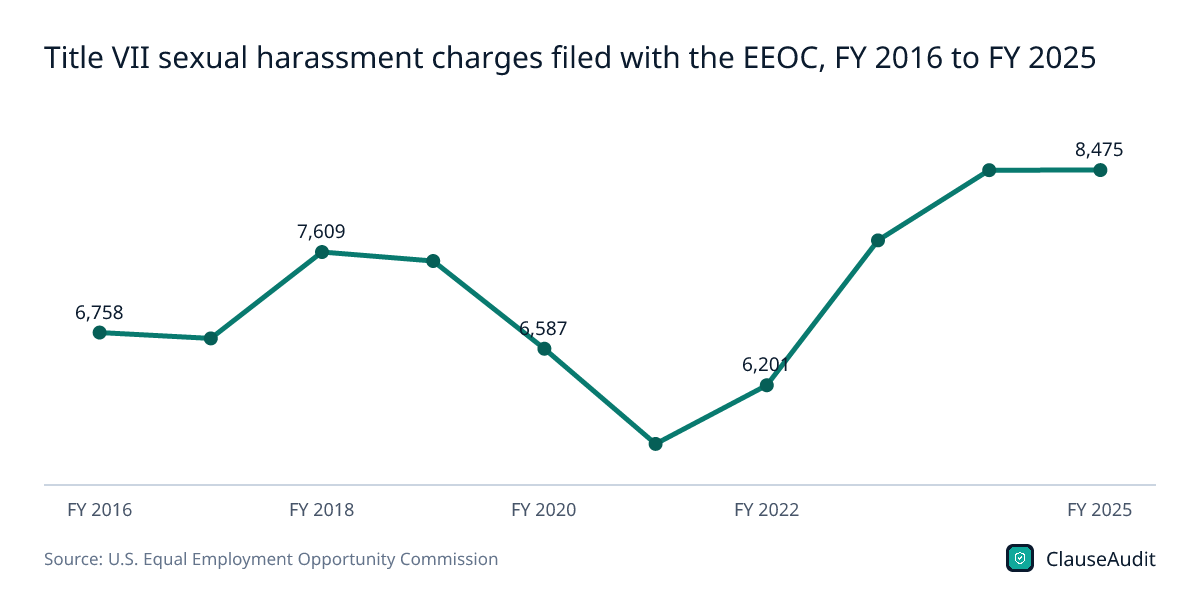
Sexual harassment charges dipped to 5,581 in FY 2021 and climbed back to 8,475 in FY 2025, the highest point in this ten-year window. Each charge is a case that can end in a settlement, often with confidentiality terms to read.
Download this chart (PNG)Money recovered for all harassment charges through the EEOC administrative process, FY 2016 to FY 2025 (USD millions)
Chart data
| Label | Value (USD millions) |
|---|---|
| FY 2016 | 125.5 |
| FY 2017 | 125.5 |
| FY 2018 | 134 |
| FY 2019 | 139.6 |
| FY 2020 | 137.3 |
| FY 2021 | 142.2 |
| FY 2022 | 144.1 |
| FY 2023 | 202.2 |
| FY 2024 | 211.8 |
| FY 2025 | 261.9 |
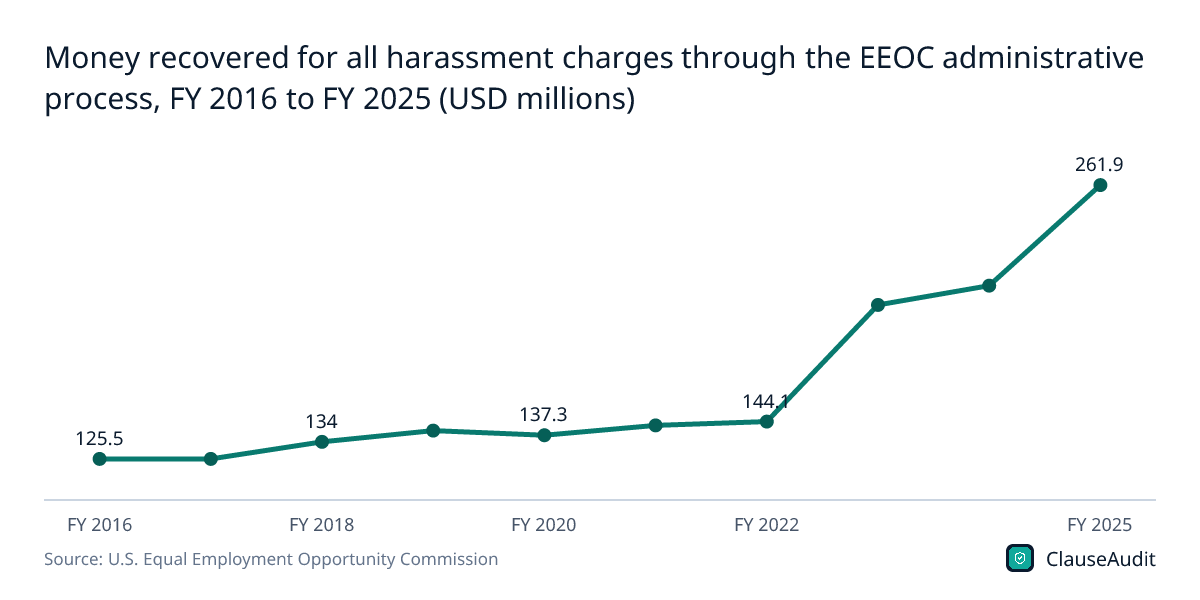
Money recovered for harassment charges rose from $125.5 million in FY 2016 to $261.9 million in FY 2025. These are administrative recoveries only, so lawsuits and private settlements come on top.
Download this chart (PNG)Share of job seekers who report each restrictive clause in their job (2024) (%)
Chart data
| Label | Value |
|---|---|
| Non-disclosure agreement | 45 |
| Class action waiver | 43 |
| Mandatory arbitration | 39 |
| Non-compete | 22 |
| Non-solicitation | 19 |
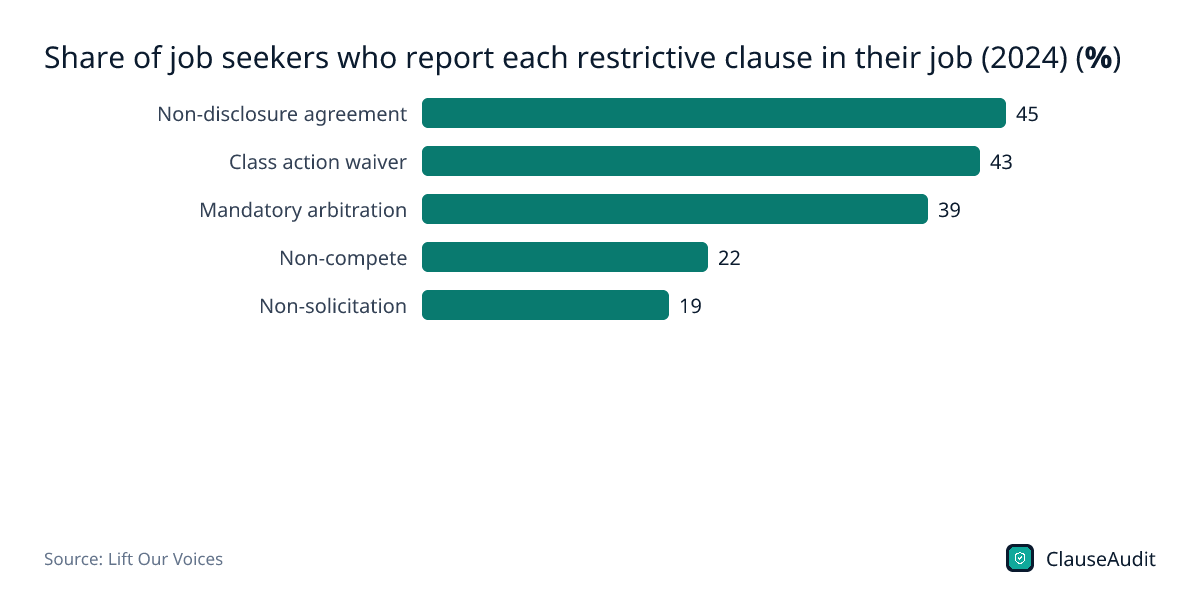
NDAs are the most common restrictive clause job seekers report, at 45%, ahead of class action waivers and mandatory arbitration. With each of the top three showing up in roughly two of every five jobs or more, it pays to read the whole packet and not just the NDA.
Download this chart (PNG)Money exposure for employers that break state NDA laws (USD)
Chart data
| Label | Value |
|---|---|
| Washington (statutory damages, or actual damages if greater) | $10,000 |
| Oregon (civil penalty, up to) | $5,000 |
| Maine (fine, up to) | $1,000 |
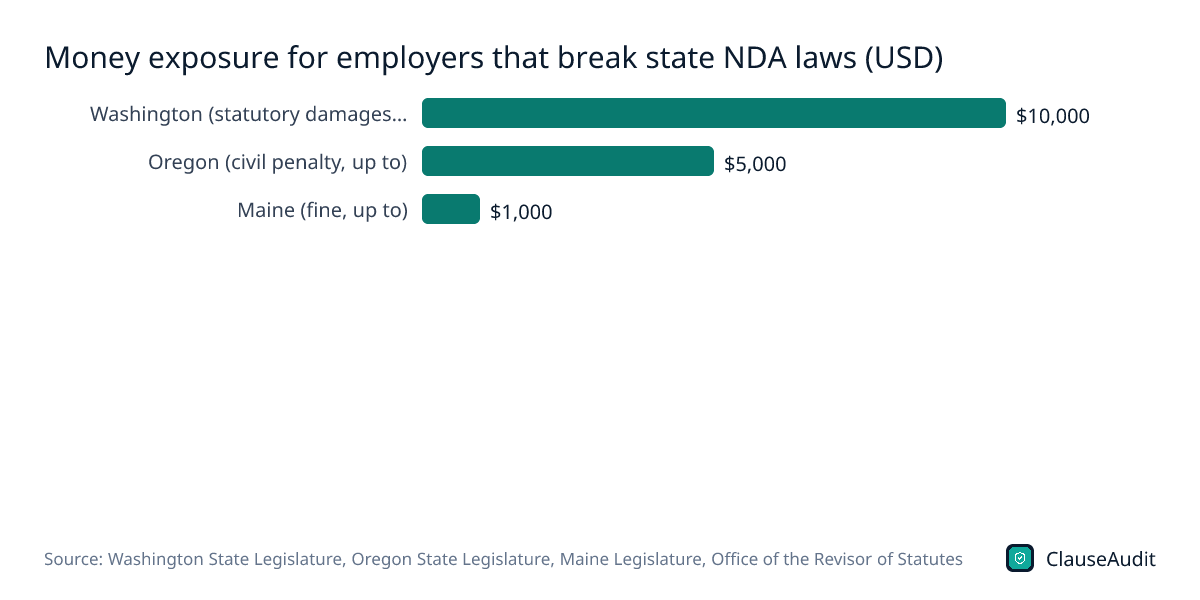
These are three different remedies, so do not rank them against each other. What matters is that Washington lets the worker sue for the money directly, while Oregon and Maine rely on penalties and fines.
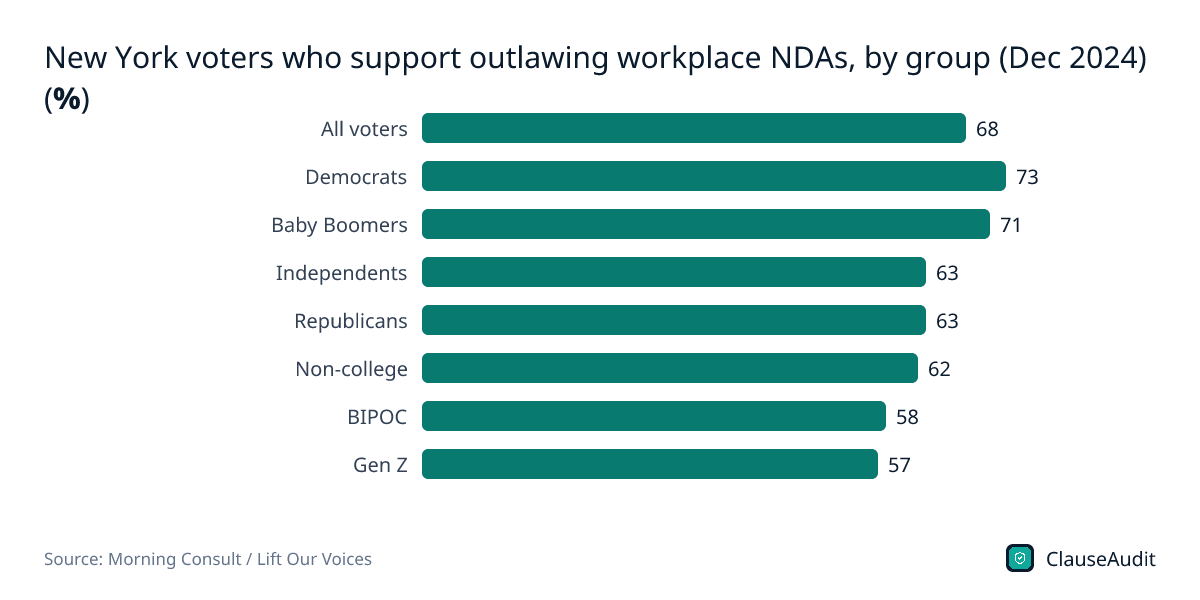
Download this chart (PNG)New York voters who support outlawing workplace NDAs, by group (Dec 2024) (%)
Chart data
| Label | Value |
|---|---|
| All voters | 68 |
| Democrats | 73 |
| Baby Boomers | 71 |
| Independents | 63 |
| Republicans | 63 |
| Non-college | 62 |
| BIPOC | 58 |
| Gen Z | 57 |
Support for outlawing these NDAs runs above half in every group shown, from 57% of Gen Z voters to 73% of Democrats. New York already has a bill, S5404, pending in committee that would go further than its current law.
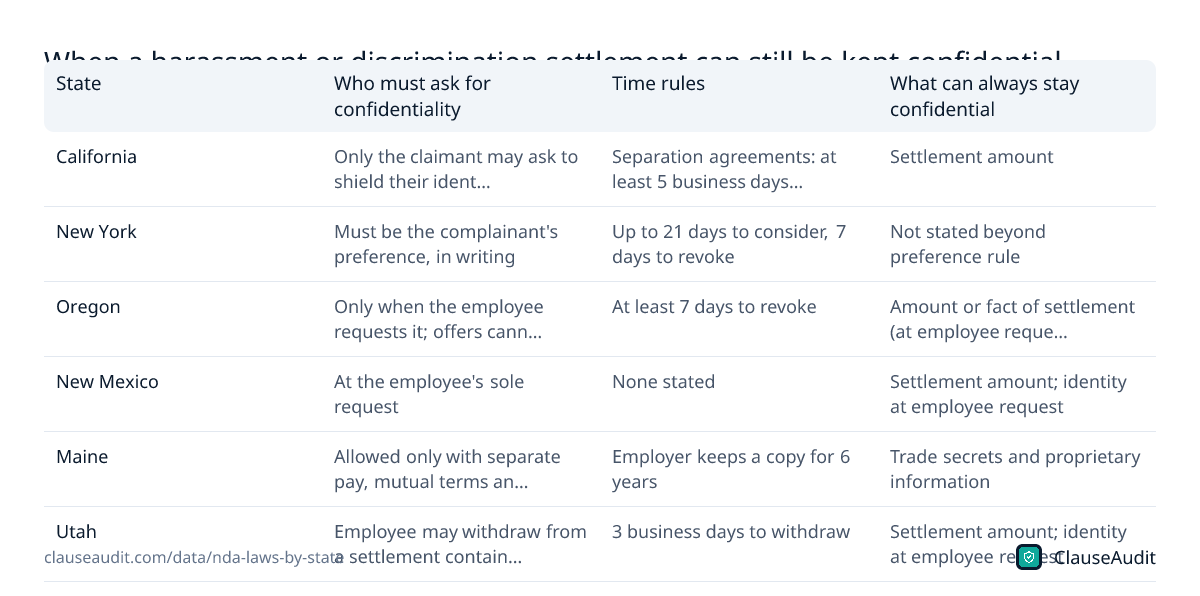
Download this chart (PNG)When a harassment or discrimination settlement can still be kept confidential
| State | Who must ask for confidentiality | Time rules | What can always stay confidential |
|---|---|---|---|
| California | Only the claimant may ask to shield their identity; facts cannot be hidden | Separation agreements: at least 5 business days to consult a lawyer | Settlement amount |
| New York | Must be the complainant's preference, in writing | Up to 21 days to consider, 7 days to revoke | Not stated beyond preference rule |
| Oregon | Only when the employee requests it; offers cannot be conditioned on the request | At least 7 days to revoke | Amount or fact of settlement (at employee request) |
| New Mexico | At the employee's sole request | None stated | Settlement amount; identity at employee request |
| Maine | Allowed only with separate pay, mutual terms and agency carve-outs | Employer keeps a copy for 6 years | Trade secrets and proprietary information |
| Utah | Employee may withdraw from a settlement containing such a clause | 3 business days to withdraw | Settlement amount; identity at employee request |
| Washington | Pre-dispute and settlement NDAs on covered conduct are barred | None stated | Settlement amount |
Source: California Legislative Information, California Code of Civil Procedure § 1001 (as amended by SB 331, Stats. 2021, Ch. 638); California Legislative Information, California Government Code § 12964.5 (as amended by SB 331, Stats. 2021, Ch. 638); New York State Senate, New York General Obligations Law § 5-336, Nondisclosure agreements; Oregon State Legislature, ORS 659A.370, Employer prohibited from entering into agreements that prevent employee from discussing certain unlawful conduct; New Mexico Legislature, New Mexico House Bill 21 (2020), as passed: workplace sexual harassment, discrimination and retaliation claims, nondisclosure agreements; Maine Legislature, Office of the Revisor of Statutes, Maine Revised Statutes Title 26, § 599-C, Nondisclosure agreements (PL 2021, c. 760); Utah State Legislature, Utah HB 55 (2024), Employment Confidentiality Amendments, enacting Utah Code § 34A-5-114; Washington State Legislature, RCW 49.44.211, Nondisclosure and nondisparagement provisions (2022 c 133 s 2). Download as image
State limits on NDAs covering workplace harassment and discrimination by state
- 10Broad: discrimination and harassment
- 9Narrower: sex-based harassment, assault or discrimination
- 29No state law found (federal Speak Out Act only)
- Broad: discrimination and harassment10
- Narrower: sex-based harassment, assault or discrimination9
- No state law found (federal Speak Out Act only)29
- Not yet confirmed3
| State | Law | Conduct covered | Agreements restricted | Source |
|---|---|---|---|---|
| Alabama | No state statute identified | Federal Speak Out Act only (sexual assault and sexual harassment) | Pre-dispute NDAs and non-disparagement clauses (federal rule) | No state statute identified |
| Alaska | No state statute identified | Federal Speak Out Act only (sexual assault and sexual harassment) | Pre-dispute NDAs and non-disparagement clauses (federal rule) | No state statute identified |
| Arizona | A.R.S. § 12-720 | Sexual offenses (criminal matters) | Any NDA: cannot bar answering police or prosecutors; no public money for sexual assault/harassment NDAs | A.R.S. § 12-720 |
| Arkansas | No state statute identified | Federal Speak Out Act only (sexual assault and sexual harassment) | Pre-dispute NDAs and non-disparagement clauses (federal rule) | No state statute identified |
| California | Code Civ. Proc. § 1001; Gov. Code § 12964.5 (SB 331) | Sexual assault, sexual harassment, workplace harassment, discrimination and retaliation | Settlement agreements (filed claims) and employment, raise/bonus and separation agreements | Cal. Code Civ. Proc. § 1001; Cal. Gov. Code § 12964.5 |
| Colorado | SB23-172 (POWR Act) | Discriminatory or unfair employment practices | NDAs between employer and employee or applicant enforceable only if they meet set requirements | SB23-172 (POWR Act) |
| Connecticut | Not yet confirmed: check the source | Not confirmed | ||
| Delaware | No state statute identified | Federal Speak Out Act only (sexual assault and sexual harassment) | Pre-dispute NDAs and non-disparagement clauses (federal rule) | No state statute identified |
| District of Columbia | Not yet confirmed: check the source | Not confirmed | ||
| Florida | No state statute identified | Federal Speak Out Act only (sexual assault and sexual harassment) | Pre-dispute NDAs and non-disparagement clauses (federal rule) | No state statute identified |
| Georgia | No state statute identified | Federal Speak Out Act only (sexual assault and sexual harassment) | Pre-dispute NDAs and non-disparagement clauses (federal rule) | No state statute identified |
| Hawaii | HRS ch. 378 (Act 17, 2020) | Sexual harassment and sexual assault | NDAs required as a condition of employment | HRS ch. 378 (Act 17, 2020) |
| Idaho | No state statute identified | Federal Speak Out Act only (sexual assault and sexual harassment) | Pre-dispute NDAs and non-disparagement clauses (federal rule) | No state statute identified |
| Illinois | Workplace Transparency Act, 820 ILCS 96 | Unlawful discrimination, harassment or retaliation (Illinois Human Rights Act, Title VII and related laws) | Unilateral conditions of employment; settlement and termination agreements | Workplace Transparency Act, 820 ILCS 96 |
| Indiana | No state statute identified | Federal Speak Out Act only (sexual assault and sexual harassment) | Pre-dispute NDAs and non-disparagement clauses (federal rule) | No state statute identified |
| Iowa | No state statute identified | Federal Speak Out Act only (sexual assault and sexual harassment) | Pre-dispute NDAs and non-disparagement clauses (federal rule) | No state statute identified |
| Kansas | No state statute identified | Federal Speak Out Act only (sexual assault and sexual harassment) | Pre-dispute NDAs and non-disparagement clauses (federal rule) | No state statute identified |
| Kentucky | No state statute identified | Federal Speak Out Act only (sexual assault and sexual harassment) | Pre-dispute NDAs and non-disparagement clauses (federal rule) | No state statute identified |
| Louisiana | La. R.S. 9:2717.3 (Act 781, 2024) | Sexual harassment and hostile work environment | Employer-required NDAs signed before a dispute; post-dispute confidential settlements still allowed | La. R.S. 9:2717.3 (Act 781, 2024) |
| Maine | 26 M.R.S. § 599-C (PL 2021, c. 760) | Unlawful employment discrimination, including harassment and retaliation | Pre-employment and employment agreements; settlement, separation and severance agreements | 26 M.R.S. § 599-C (PL 2021, c. 760) |
| Maryland | Md. Code, Lab. & Empl. § 3-715 | Future claims of sexual harassment and related retaliation | Employment contracts, policies or agreements that waive rights or remedies | Md. Code, Lab. & Empl. § 3-715 |
| Massachusetts | Not yet confirmed: check the source | Not confirmed | ||
| Michigan | No state statute identified | Federal Speak Out Act only (sexual assault and sexual harassment) | Pre-dispute NDAs and non-disparagement clauses (federal rule) | No state statute identified |
| Minnesota | No state statute identified | Federal Speak Out Act only (sexual assault and sexual harassment) | Pre-dispute NDAs and non-disparagement clauses (federal rule) | No state statute identified |
| Mississippi | No state statute identified | Federal Speak Out Act only (sexual assault and sexual harassment) | Pre-dispute NDAs and non-disparagement clauses (federal rule) | No state statute identified |
| Missouri | No state statute identified | Federal Speak Out Act only (sexual assault and sexual harassment) | Pre-dispute NDAs and non-disparagement clauses (federal rule) | No state statute identified |
| Montana | No state statute identified | Federal Speak Out Act only (sexual assault and sexual harassment) | Pre-dispute NDAs and non-disparagement clauses (federal rule) | No state statute identified |
| Nebraska | No state statute identified | Federal Speak Out Act only (sexual assault and sexual harassment) | Pre-dispute NDAs and non-disparagement clauses (federal rule) | No state statute identified |
| Nevada | NRS 10.195 | Felony sexual offenses, sex discrimination by an employer or landlord, and related retaliation | Settlement agreements in civil or administrative actions (on or after July 1, 2019) | NRS 10.195 |
| New Hampshire | No state statute identified | Federal Speak Out Act only (sexual assault and sexual harassment) | Pre-dispute NDAs and non-disparagement clauses (federal rule) | No state statute identified |
| New Jersey | N.J.S.A. 10:5-12.8 (P.L.2019, c.39) | Discrimination, retaliation and harassment | Employment contracts and settlement agreements (non-disclosure provisions unenforceable against the employee) | N.J.S.A. 10:5-12.8 (P.L.2019, c.39) |
| New Mexico | HB 21 (2020) | Sexual harassment, discrimination and retaliation | Settlement agreements with private employers | HB 21 (2020) |
| New York | Gen. Oblig. Law § 5-336 | Discrimination, harassment and retaliation | Settlements and other resolutions; employment contracts (from January 1, 2020) | Gen. Oblig. Law § 5-336 |
| North Carolina | No state statute identified | Federal Speak Out Act only (sexual assault and sexual harassment) | Pre-dispute NDAs and non-disparagement clauses (federal rule) | No state statute identified |
| North Dakota | No state statute identified | Federal Speak Out Act only (sexual assault and sexual harassment) | Pre-dispute NDAs and non-disparagement clauses (federal rule) | No state statute identified |
| Ohio | No state statute identified | Federal Speak Out Act only (sexual assault and sexual harassment) | Pre-dispute NDAs and non-disparagement clauses (federal rule) | No state statute identified |
| Oklahoma | No state statute identified | Federal Speak Out Act only (sexual assault and sexual harassment) | Pre-dispute NDAs and non-disparagement clauses (federal rule) | No state statute identified |
| Oregon | ORS 659A.370 | Discrimination (including sexual assault) | Agreements made as a condition of employment, promotion, pay or benefits; settlements only at employee request | ORS 659A.370 |
| Pennsylvania | No state statute identified | Federal Speak Out Act only (sexual assault and sexual harassment) | Pre-dispute NDAs and non-disparagement clauses (federal rule) | No state statute identified |
| Rhode Island | R.I. Gen. Laws § 28-5-7(1)(vi) | Alleged violations of civil rights | NDAs and non-disparagement agreements required as a condition of employment | R.I. Gen. Laws § 28-5-7(1)(vi) |
| South Carolina | No state statute identified | Federal Speak Out Act only (sexual assault and sexual harassment) | Pre-dispute NDAs and non-disparagement clauses (federal rule) | No state statute identified |
| South Dakota | No state statute identified | Federal Speak Out Act only (sexual assault and sexual harassment) | Pre-dispute NDAs and non-disparagement clauses (federal rule) | No state statute identified |
| Tennessee | Pub. Ch. 965 (2018), Tenn. Code Title 50, Ch. 1, Part 1 | Sexual harassment in the workplace | NDAs required as a condition of employment (new or renewed) | Pub. Ch. 965 (2018), Tenn. Code Title 50, Ch. 1, Part 1 |
| Texas | No state statute identified | Federal Speak Out Act only (sexual assault and sexual harassment) | Pre-dispute NDAs and non-disparagement clauses (federal rule) | No state statute identified |
| Utah | Utah Code § 34A-5-114 (HB 55, 2024) | Sexual assault and sexual harassment | NDAs and non-disparagement clauses as a condition of employment | Utah Code § 34A-5-114 (HB 55, 2024) |
| Vermont | 21 V.S.A. § 495h(g)-(h) | Sexual harassment | Agreements required as a condition of employment; settlement agreements must state carve-outs | 21 V.S.A. § 495h(g)-(h) |
| Virginia | Va. Code § 40.1-28.01 | Sexual assault and sexual harassment | NDAs and non-disparagement provisions as a condition of employment | Va. Code § 40.1-28.01 |
| Washington | RCW 49.44.211 (Silenced No More, 2022) | Discrimination, harassment, retaliation, wage and hour violations, sexual assault | Employment, contractor and settlement agreements | RCW 49.44.211 (Silenced No More, 2022) |
| West Virginia | No state statute identified | Federal Speak Out Act only (sexual assault and sexual harassment) | Pre-dispute NDAs and non-disparagement clauses (federal rule) | No state statute identified |
| Wisconsin | No state statute identified | Federal Speak Out Act only (sexual assault and sexual harassment) | Pre-dispute NDAs and non-disparagement clauses (federal rule) | No state statute identified |
| Wyoming | No state statute identified | Federal Speak Out Act only (sexual assault and sexual harassment) | Pre-dispute NDAs and non-disparagement clauses (federal rule) | No state statute identified |
Which states limit NDAs on harassment and discrimination in 2026?
Ten states have broad laws that reach discrimination and harassment claims, not just sexual misconduct: California, Colorado, Illinois, Maine, New Jersey, New Mexico, New York, Oregon, Rhode Island and Washington. Nine more have narrower laws focused on sex-based harassment, assault or discrimination, including Tennessee, Virginia, Utah and Vermont.
The narrower group is uneven. Louisiana also covers hostile work environment claims. Nevada covers sex discrimination by employers and landlords. Arizona's law is about criminal sexual offenses and mainly protects your right to answer police and prosecutors. Maryland targets waivers of future sexual harassment claims rather than NDAs as such.
We could not confirm the status in Connecticut, Massachusetts or DC, so the map leaves them uncounted. If you work there, check with a local employment lawyer before you rely on any answer.
Does the federal Speak Out Act protect me in every state?
Partly. The Speak Out Act became law on Dec 7, 2022. It makes NDAs and non-disparagement clauses signed before a dispute unenforceable when the dispute involves sexual assault or sexual harassment. That rule applies in every state.
Two limits matter. First, it only covers clauses you agreed to before the dispute arose, such as the NDA in your offer letter. A confidentiality term in a settlement you sign after raising a complaint is outside it. Second, it does not cover race, age or disability discrimination, retaliation or unpaid wages. In the 29 states without their own law, those claims can still be wrapped in a valid NDA unless another statute steps in.
Federal labor law separately protects most private-sector, non-supervisory employees who talk with coworkers about pay and working conditions, so a blanket clause banning wage talk is risky for employers everywhere.
Can an employer still ask for a confidential settlement?
Often yes, but on the worker's terms. In several broad states, including New York, Illinois, Oregon and New Mexico, confidentiality is allowed only if the employee asks for it. New York requires it to be the complainant's written preference, with up to 21 days to consider and 7 days to revoke. Illinois uses the same 21 and 7 day windows. Oregon gives at least 7 days to revoke, and an offer cannot be conditioned on the request.
Some states set floors in other ways. California separation agreements must allow at least 5 business days to talk to a lawyer. Utah lets an employee walk away from a settlement with a gag clause within 3 business days. Maine allows a settlement NDA only with separate pay, mutual terms and carve-outs that let you still talk to agencies and courts.
One thing employers can usually keep private is the dollar amount. California, Washington, New Mexico and Utah all allow it. So a clause hiding the payout is normal. A clause hiding what happened is the one to question.
Why are more states limiting workplace NDAs?
Part of it is volume. Workers filed 37,397 harassment charges of all types with the EEOC in FY 2025, and 8,475 of them were Title VII sexual harassment charges. Sexual harassment charges alone brought in $86.12 million through the EEOC administrative process that year, before counting anything won in court. Each of those cases can end in an agreement, and a confidentiality term can keep a repeat problem at the same company out of view.
Part of it is public pressure. In a December 2024 poll, 68% of New York voters supported outlawing NDAs on abuse, harassment or discrimination. Younger workers say it affects their job choices too: 47% of Gen Z non-students said in November 2025 they would be less likely to take a job that bars them from speaking about discrimination.
For employers, that last number matters as much as any statute. A broad gag clause in an offer letter can cost you candidates before it ever costs you a lawsuit.
What does this mean if you are a worker or contractor?
Say you are a marketing manager in Washington leaving after a pay dispute, and the severance agreement says you may never discuss "any matter relating to your employment." Washington's Silenced No More law covers wage and hour violations and reaches contractor agreements too. A clause like that cannot stop you talking about the pay issue, and the employer faces $10,000 in statutory damages or actual damages if greater, plus fees.
Now move the same clause to Texas. There is no state law on point, and the Speak Out Act does not reach pay disputes. The clause has a much better chance of holding there, unless federal labor law protects you as a non-supervisory employee.
- Find the confidentiality, non-disparagement and "cooperation" sections, not just the one labeled NDA.
- Check whether the definition of confidential information mentions workplace conduct, complaints or pay.
- Look for a carve-out that lets you talk to the EEOC, a state agency, police or your own lawyer. If it is missing, ask for one.
- In a settlement, ask whether confidentiality is your choice and how long you have to revoke.
- Keep a copy of everything you sign. Maine employers must keep theirs for 6 years, and you should too.
What should a business do with its NDA templates?
If you hire in more than one state, assume your strictest state sets the floor. A single offer-letter NDA used across offices will often be void in part in California, New York or Washington, and a bad clause can cost you more than the clause itself: damages in Washington, the release in New York.
Rewrite the definition of confidential information so it covers what you actually need to protect: trade secrets, customer data, pricing, source code. Add a plain carve-out stating that nothing in the agreement stops the employee from discussing or reporting harassment, discrimination, retaliation, wage issues or other unlawful conduct. Drop liquidated damages and clawbacks tied to talking about those topics. In New York they void the release you paid for.
For settlements, build in the review and revocation windows from the state table and get the employee's preference in writing. That paperwork is cheap compared with losing the release.
How ClauseAudit helps
Gag terms rarely sit in one tidy paragraph. They hide in definitions, non-disparagement promises and clawback language spread across an offer letter or settlement. Upload your agreement and our automated review flags each one in plain English, explains why it matters, and suggests wording to ask for.
- Definition of confidential information: whether it sweeps in workplace conduct, complaints or pay
- Carve-outs: whether you can still talk to agencies, police, courts and your own lawyer
- Non-disparagement: whether it blocks you from describing harassment or discrimination
- Clawbacks and liquidated damages: whether you must repay money for speaking up
- Settlement timing: whether you get the review and revocation days your state requires
- Duration and scope: whether the NDA runs forever or covers far more than trade secrets
Frequently asked questions
Is an NDA about sexual harassment enforceable?
Usually not if you signed it before the dispute. The federal Speak Out Act makes pre-dispute NDAs and non-disparagement clauses unenforceable for sexual assault and sexual harassment claims in every state. A confidentiality term in a later settlement is different and depends on state law. In states like New York or Oregon, it generally needs to be your choice.
Can my employer stop me from talking about my pay?
In most cases, no. Federal labor law protects most private-sector, non-supervisory employees who discuss pay with coworkers. Washington goes further and voids NDAs covering wage and hour violations, including in contractor agreements, with $10,000 in statutory damages or actual damages if greater. Elsewhere, a clause on pay may still be challenged, so ask before you sign.
Which state has the strongest NDA law?
Washington is the broadest on this page. Its Silenced No More law covers discrimination, harassment, retaliation, wage and hour violations and sexual assault, and it reaches employment, contractor and settlement agreements. It also lets workers recover $10,000 in statutory damages or actual damages, whichever is more, plus attorney fees and costs.
Does the Speak Out Act cover discrimination?
No. It only covers sexual assault and sexual harassment disputes, and only clauses agreed before the dispute. Race, age, disability and other discrimination claims depend on state law. The 10 states with broad laws on this page cover discrimination too, but the 29 with no state law leave that gap open.
Can a settlement keep the amount secret?
Yes, in most states. California, Washington, New Mexico and Utah all let the settlement amount stay confidential even where the facts cannot be hidden. If an employer wants silence about what happened, several broad states, such as New York and Illinois, require that to be your documented preference, with time to think it over and a window to change your mind.
I am a freelancer. Do these laws protect me?
Sometimes. Washington's law reaches contractor agreements directly. Many other states write their rules around employees, applicants or conditions of employment, so a 1099 contractor may fall outside them. The Speak Out Act is not limited to employees, so pre-dispute sexual harassment NDAs are still unenforceable for contractors.
What happens to an employer that breaks these laws?
It varies by state. Washington allows $10,000 in statutory damages or actual damages if greater. Oregon can impose a civil penalty of up to $5,000, and Maine a fine of up to $1,000. In New York, liquidated damages or clawbacks for breaking an NDA can void the whole release, which can cost an employer far more.
How common are NDAs in jobs?
Very common. In a 2024 survey of 947 job seekers, 45% said they were bound by an NDA at their current or most recent job. That was the most common restrictive clause reported, ahead of class action waivers at 43% and mandatory arbitration at 39%.
Use this data
Every chart and card below is free to reuse under CC BY 4.0. Download what you need and link back to this page.
 Stat cards
 Key findings card
 Infographic
 States by level of NDA protection for workplace harassment and discrimination (2026) (states (incl. DC))
 Title VII sexual harassment charges filed with the EEOC, FY 2016 to FY 2025
 Money recovered for all harassment charges through the EEOC administrative process, FY 2016 to FY 2025 (USD millions)
 Share of job seekers who report each restrictive clause in their job (2024) (%)
 Money exposure for employers that break state NDA laws (USD)
 New York voters who support outlawing workplace NDAs, by group (Dec 2024) (%)
 When a harassment or discrimination settlement can still be kept confidential
Embed the infographic
Free to share on your site, blog or slides under CC BY 4.0. Please keep the credit link.
Sources and method
Every number on this page comes from the sources below, each opened and read on or before October 18, 2026. A second, independent review checked every figure against its source and corrected anything that did not match. 48 of 51 state entries were confirmed; any that could not be are marked "Not yet confirmed" and left out of every count and chart.
- California Legislative Information, California Code of Civil Procedure § 1001 (as amended by SB 331, Stats. 2021, Ch. 638) (Amended effective January 1, 2022 (text read from Internet Archive copy of the official page))
- California Legislative Information, California Government Code § 12964.5 (as amended by SB 331, Stats. 2021, Ch. 638) (Amended effective January 1, 2022 (text read from Internet Archive copy dated September 2025))
- New York State Senate, New York General Obligations Law § 5-336, Nondisclosure agreements (Entry published 2023-11-26 (read from Internet Archive copy dated December 2025))
- New York State Senate, New York Senate Bill S5404 (2025-2026 session) (Status as of October 2026: in Senate Judiciary Committee)
- Washington State Legislature, RCW 49.44.211, Nondisclosure and nondisparagement provisions (2022 c 133 s 2) (2022 c 133, current RCW)
- Washington State Legislature, RCW 49.44.210 disposition (repealed by 2022 c 133 § 4) (Current RCW dispositions)
- Oregon State Legislature, ORS 659A.370, Employer prohibited from entering into agreements that prevent employee from discussing certain unlawful conduct (2025 edition of ORS (2019 c.343; 2022 c.107); read from Internet Archive copy dated September 2026)
- Maine Legislature, Office of the Revisor of Statutes, Maine Revised Statutes Title 26, § 599-C, Nondisclosure agreements (PL 2021, c. 760) (Data extracted 10/05/2026)
- New Mexico Legislature, New Mexico House Bill 21 (2020), as passed: workplace sexual harassment, discrimination and retaliation claims, nondisclosure agreements (2020 Regular Session; applies to agreements on or after May 20, 2020)
- Utah State Legislature, Utah HB 55 (2024), Employment Confidentiality Amendments, enacting Utah Code § 34A-5-114 (2024 General Session enrolled bill; retrospective to January 1, 2023)
- Virginia General Assembly, Legislative Information System, Code of Virginia § 40.1-28.01 (2019, c. 131; 2023, c. 511) (Code of Virginia as displayed 10/19/2026)
- Maryland General Assembly, Maryland Code, Labor and Employment § 3-715 (Current statute text, accessed October 2026)
- Vermont General Assembly, Vermont Statutes Title 21, § 495h(g)-(h), Sexual harassment (Current statutes (read from Internet Archive copy dated June 2026))
- Tennessee Secretary of State, Tennessee Public Chapter No. 965 (House Bill 2613), 2018 (Approved May 2018 (passed House April 23, 2018))
- Hawaii State Legislature, Hawaii Session Laws 2020, Act 17 (H.B. No. 2054), adding a section to HRS chapter 378 (Approved September 15, 2020)
- Louisiana State Legislature, Louisiana Act No. 781 of 2024 (House Bill 161), enacting R.S. 9:2717.3 (2024 Regular Session, enrolled act)
- Arizona State Legislature, Arizona Revised Statutes § 12-720, Nondisclosure agreements; applicability; use of public monies (Current statute, accessed October 2026)
- State of Rhode Island General Assembly, Rhode Island General Laws § 28-5-7(1)(vi), Unlawful employment practices (Current statute (history through P.L. 2023, ch. 252); read from Internet Archive copy dated February 2026)
- Colorado General Assembly, Colorado SB23-172, Protecting Opportunities and Workers' Rights (POWR) Act (Approved June 6, 2023; effective August 7, 2023)
- New Jersey Legislature, New Jersey P.L.2019, c.39 (S121), N.J.S.A. 10:5-12.8 (Approved March 18, 2019 (read from Internet Archive copy dated December 2025))
- Illinois General Assembly, Illinois Public Act 101-0221 (SB 75), Article 1: Workplace Transparency Act, 820 ILCS 96 (Effective January 1, 2020 (enacted text read from Internet Archive copy))
- Nevada Legislature, Nevada Revised Statutes 10.195, settlement agreements (Added to NRS by 2019 (read from Internet Archive copy dated 2025))
- Congress.gov (Library of Congress), S.4524 - Speak Out Act, Public Law 117-224 (Became Public Law 12/07/2022)
- U.S. Equal Employment Opportunity Commission, Table E2c. Title VII Sexual Harassment Charge Receipts and Resolutions by Type of Resolution FY 2010 - FY 2025 (FY 2025 edition, posted March 2026)
- U.S. Equal Employment Opportunity Commission, Table E2a. Charges Alleging Harassment Charge Receipts and Resolutions by Type (All Statutes) FY 2010 - FY 2025 (FY 2025 edition, posted March 2026)
- Lift Our Voices, Contracts That Bind: Untangling the Use of NDAs, Forced Arbitration and Other Restrictive Covenants in the U.S. Labor Market (Mark D. Gough, Penn State) (Survey of 947 job seekers, Summer and Fall 2024 (report undated))
- Morning Consult / Lift Our Voices, New York Voters Want Action on NDAs (Morning Consult memo for Lift Our Voices) (January 2025 (fielded December 19-26, 2024, n=1,004))
- Morning Consult / Lift Our Voices, Gen Z Attitudes Towards Workplace Rights and Transparency (Morning Consult memo for Lift Our Voices) (November 2025 (fielded November 14-20, 2025))
Cite this page
ClauseAudit, “NDA Laws by State: Where Employers Cannot Gag Harassment, Discrimination and Wage Talk (2026)”, updated October 18, 2026, https://clauseaudit.com/data/nda-laws-by-state. Free to reuse with a link back (CC BY 4.0).
This page summarises published data and law as checked on October 18, 2026. Figures are updated as new editions are released, and your own situation may differ. It is general information, not legal, tax or financial advice.