Repair and Deduct and Rent Withholding Laws by State (Plus Retaliation Protections)
By ClauseAudit Research · 99 sources ·
What are the repair and deduct laws by state?
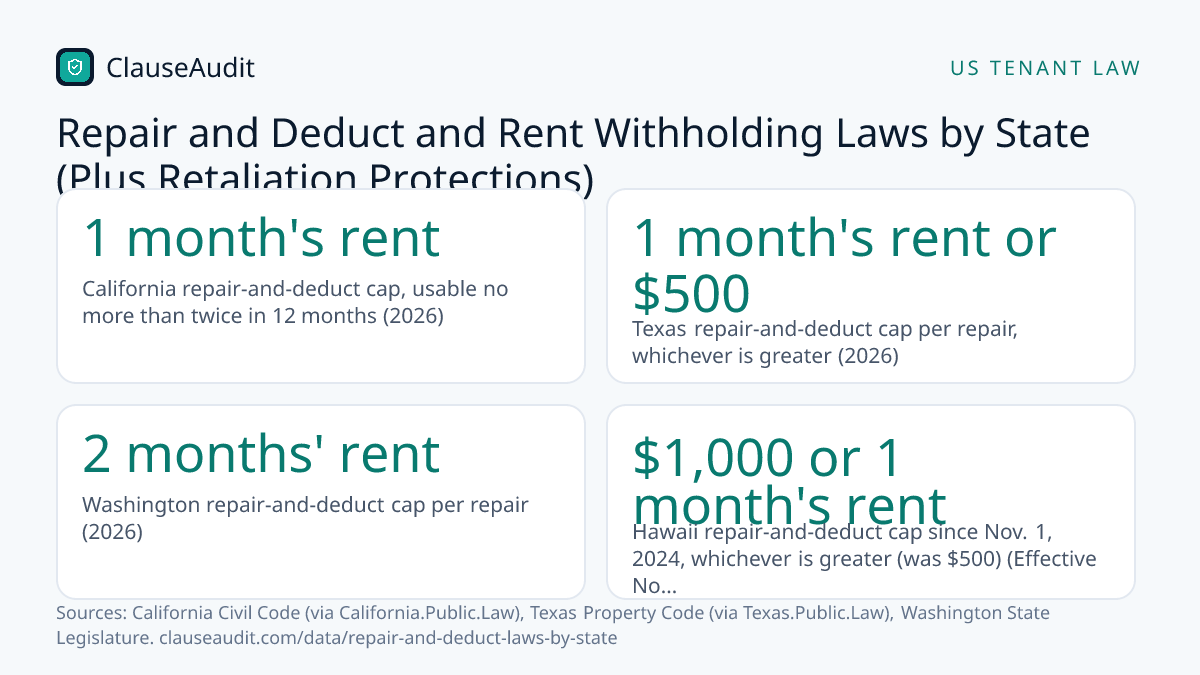
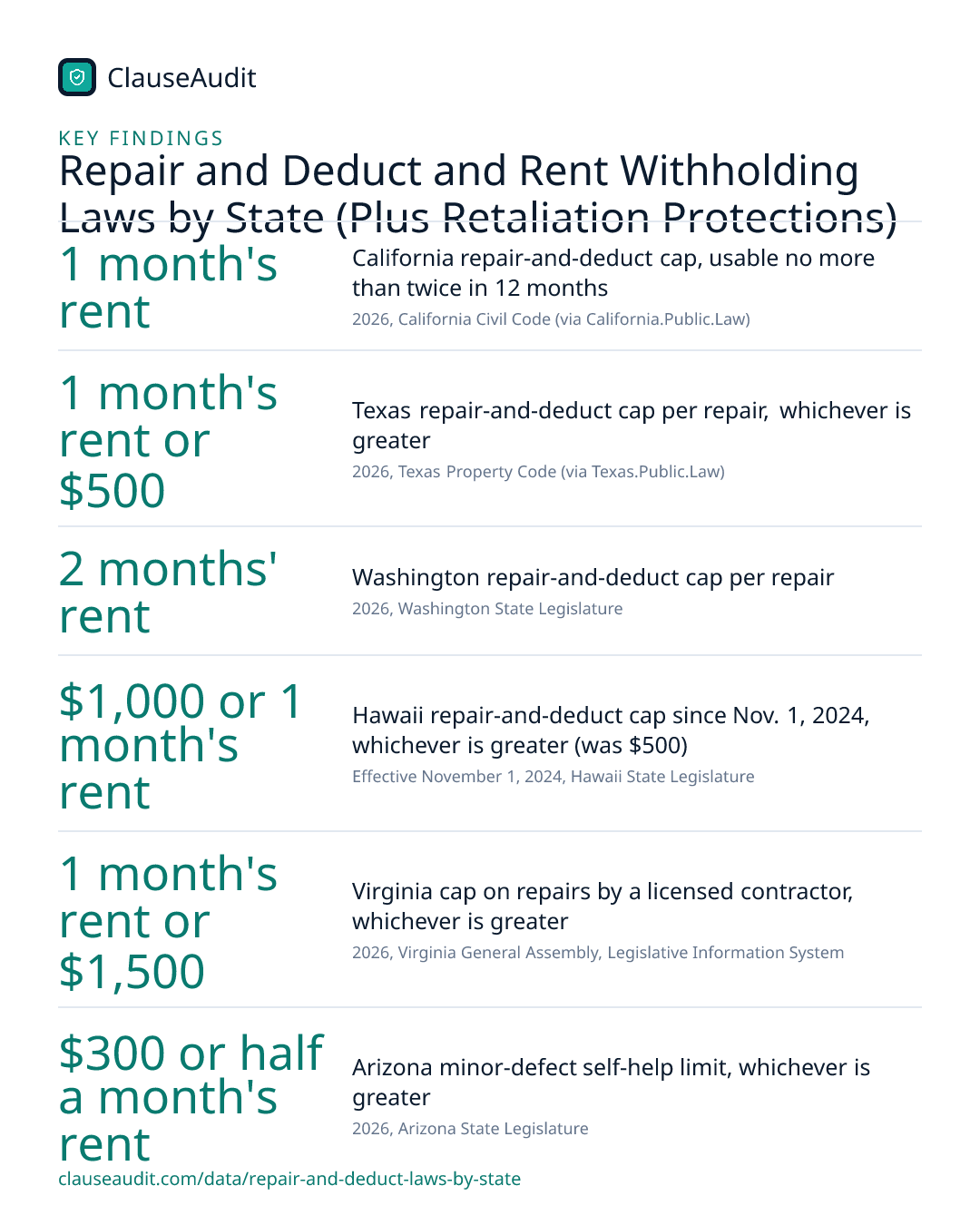
Many states let a tenant pay for a repair and take it off the rent, usually within a cap and only after notice. California allows up to 1 month's rent, no more than twice in 12 months. Texas allows 1 month's rent or $500, whichever is greater. Some states allow no self-help at all.
- California repair-and-deduct cap, usable no more than twice in 12 months (2026, California Civil Code (via California.Public.Law))
- 1 month's rent
- Texas repair-and-deduct cap per repair, whichever is greater (2026, Texas Property Code (via Texas.Public.Law))
- 1 month's rent or $500
- Washington repair-and-deduct cap per repair (2026, Washington State Legislature)
- 2 months' rent
- Hawaii repair-and-deduct cap since Nov. 1, 2024, whichever is greater (was $500) (Effective November 1, 2024, Hawaii State Legislature)
- $1,000 or 1 month's rent
- Virginia cap on repairs by a licensed contractor, whichever is greater (2026, Virginia General Assembly, Legislative Information System)
- 1 month's rent or $1,500
- Arizona minor-defect self-help limit, whichever is greater (2026, Arizona State Legislature)
- $300 or half a month's rent
- California window after a repair request when retaliation is barred (2026, California Civil Code (via California.Public.Law))
- 180 days
- New York rebuttable presumption of retaliation after a good-faith complaint (2026, New York Real Property Law (via NewYork.Public.Law))
- 1 year
Your heater dies in January, you send the landlord a message, and nothing happens. Your right to hire someone and subtract the bill from rent depends almost entirely on your state. Some states write the remedy into statute with a clear cap. Others only allow it for heat and water. A few give you no self-help at all, just a lawsuit.
This page maps three tools tenants reach for when repairs stall: repair and deduct, rent withholding or escrow, and protection from retaliation after you complain. The caps, waiting periods and protection windows below come from state statutes, official guides and legal aid sources. Read the rules for your state before you spend a dollar or hold back a payment.
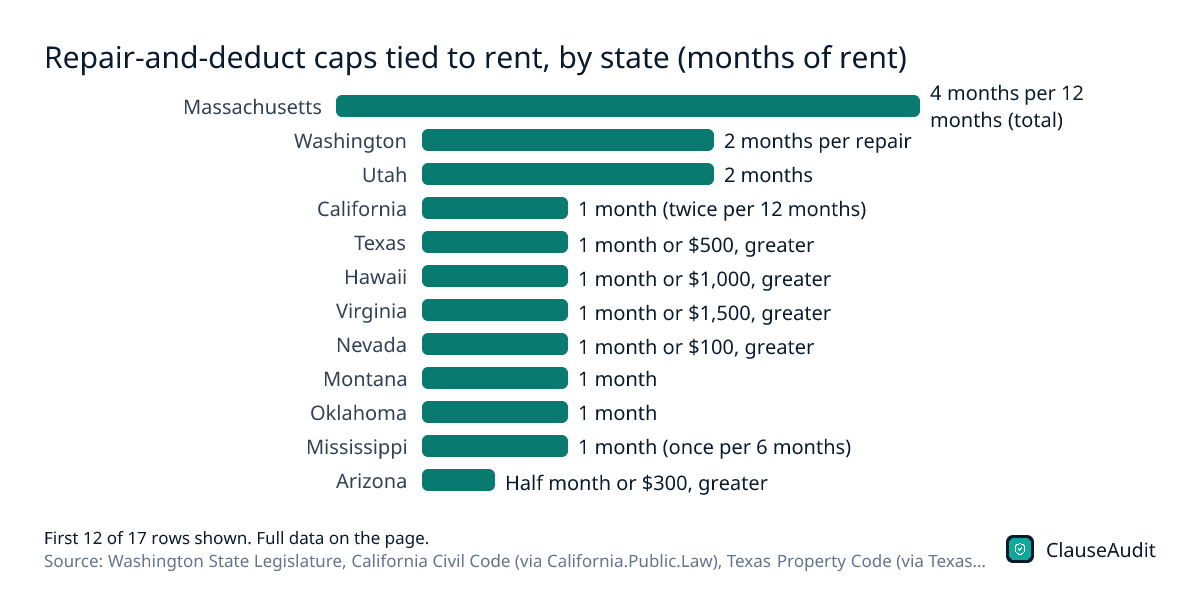
Repair-and-deduct caps tied to rent, by state (months of rent)
Chart data
| Label | Value |
|---|---|
| Massachusetts | 4 months per 12 months (total) |
| Washington | 2 months per repair |
| Utah | 2 months |
| California | 1 month (twice per 12 months) |
| Texas | 1 month or $500, greater |
| Hawaii | 1 month or $1,000, greater |
| Virginia | 1 month or $1,500, greater |
| Nevada | 1 month or $100, greater |
| Montana | 1 month |
| Oklahoma | 1 month |
| Mississippi | 1 month (once per 6 months) |
| Arizona | Half month or $300, greater |
| Maine | Half month or $500, greater |
| Missouri | Half month or $300, greater |
| Delaware | Half month or $400, lesser |
| Kentucky | Half month or $100, greater |
| Vermont | Half month |
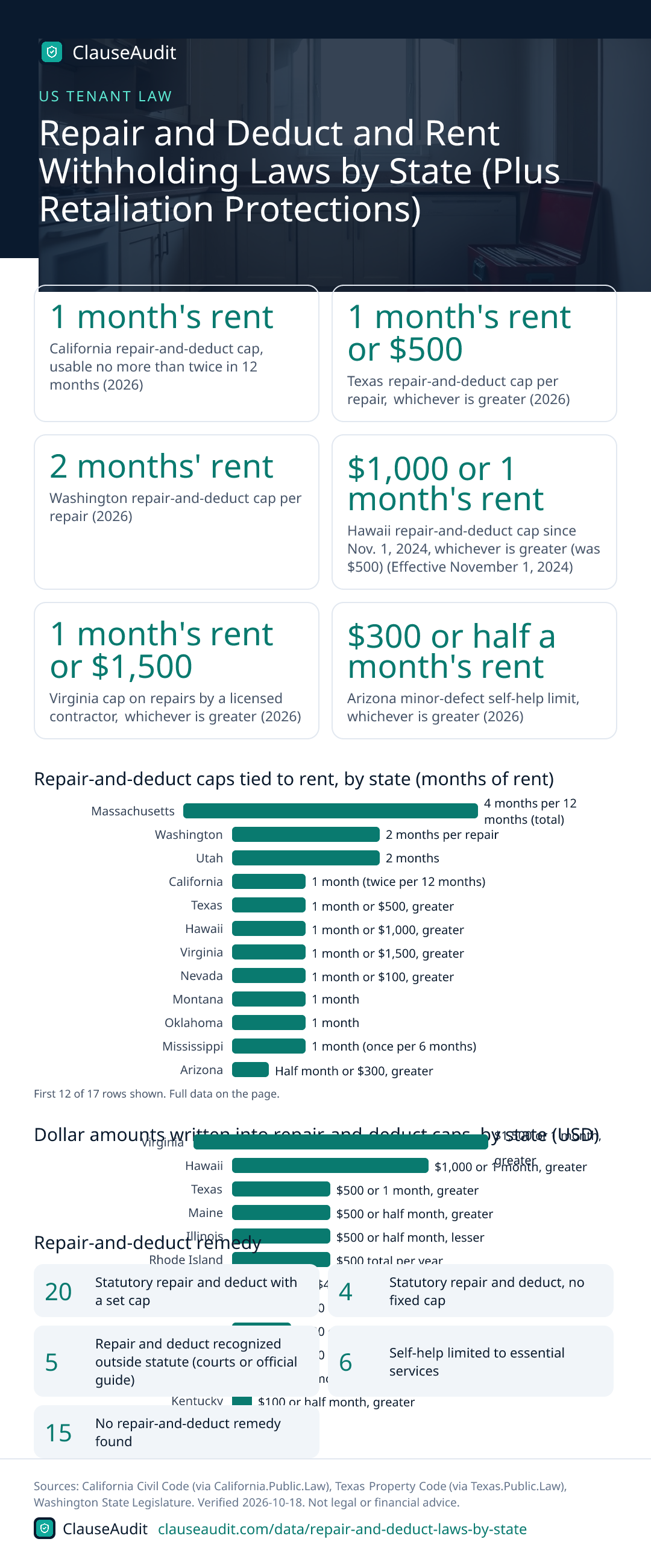
Massachusetts is the outlier at up to 4 months' rent across a 12-month period, while Washington and Utah allow 2 months. Most capped states land at 1 month or half a month, which covers a plumber or a water heater but rarely a roof.
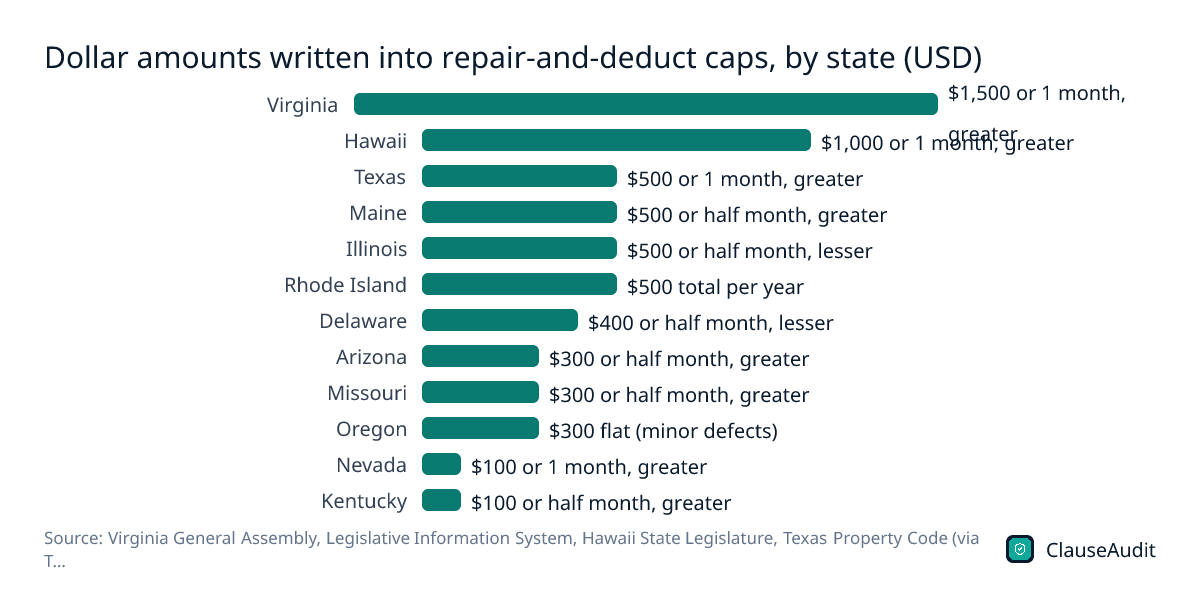
Download this chart (PNG)Dollar amounts written into repair-and-deduct caps, by state (USD)
Chart data
| Label | Value |
|---|---|
| Virginia | $1,500 or 1 month, greater |
| Hawaii | $1,000 or 1 month, greater |
| Texas | $500 or 1 month, greater |
| Maine | $500 or half month, greater |
| Illinois | $500 or half month, lesser |
| Rhode Island | $500 total per year |
| Delaware | $400 or half month, lesser |
| Arizona | $300 or half month, greater |
| Missouri | $300 or half month, greater |
| Oregon | $300 flat (minor defects) |
| Nevada | $100 or 1 month, greater |
| Kentucky | $100 or half month, greater |
Read the word after the dollar figure. In Virginia, Hawaii and Texas the cap is the greater of the dollar amount or a month's rent, while Delaware and Illinois use whichever is less, so a high rent does not raise the ceiling there.
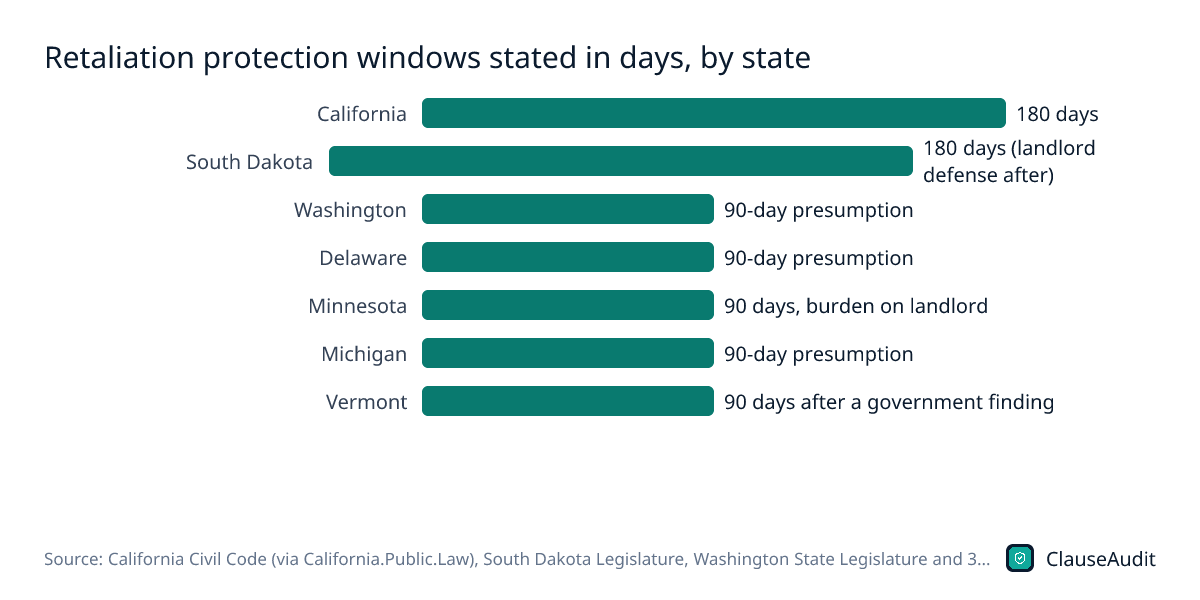
Download this chart (PNG)Retaliation protection windows stated in days, by state
Chart data
| Label | Value |
|---|---|
| California | 180 days |
| South Dakota | 180 days (landlord defense after) |
| Washington | 90-day presumption |
| Delaware | 90-day presumption |
| Minnesota | 90 days, burden on landlord |
| Michigan | 90-day presumption |
| Vermont | 90 days after a government finding |
California and South Dakota share the longest window stated in days, 180. A presumption means the landlord has to explain a rent hike or eviction notice that follows your complaint, not that you win automatically.
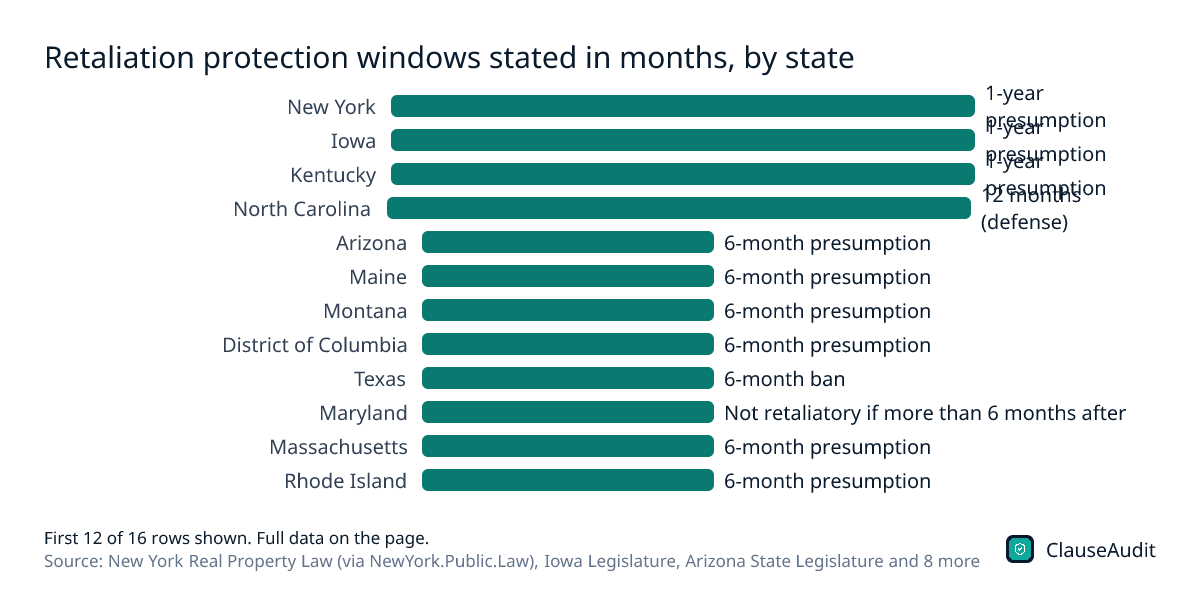
Download this chart (PNG)Retaliation protection windows stated in months, by state
Chart data
| Label | Value |
|---|---|
| New York | 1-year presumption |
| Iowa | 1-year presumption |
| Kentucky | 1-year presumption |
| North Carolina | 12 months (defense) |
| Arizona | 6-month presumption |
| Maine | 6-month presumption |
| Montana | 6-month presumption |
| District of Columbia | 6-month presumption |
| Texas | 6-month ban |
| Maryland | Not retaliatory if more than 6 months after |
| Massachusetts | 6-month presumption |
| Rhode Island | 6-month presumption |
| Connecticut | 6-month ban |
| New Mexico | 6-month ban |
| New Hampshire | 6-month presumption |
| Georgia | 3 months (prima facie case) |
New York, Iowa and Kentucky presume retaliation for a full year after a complaint, and 6 months is the most common window. Georgia's 3 months is the shortest listed here.
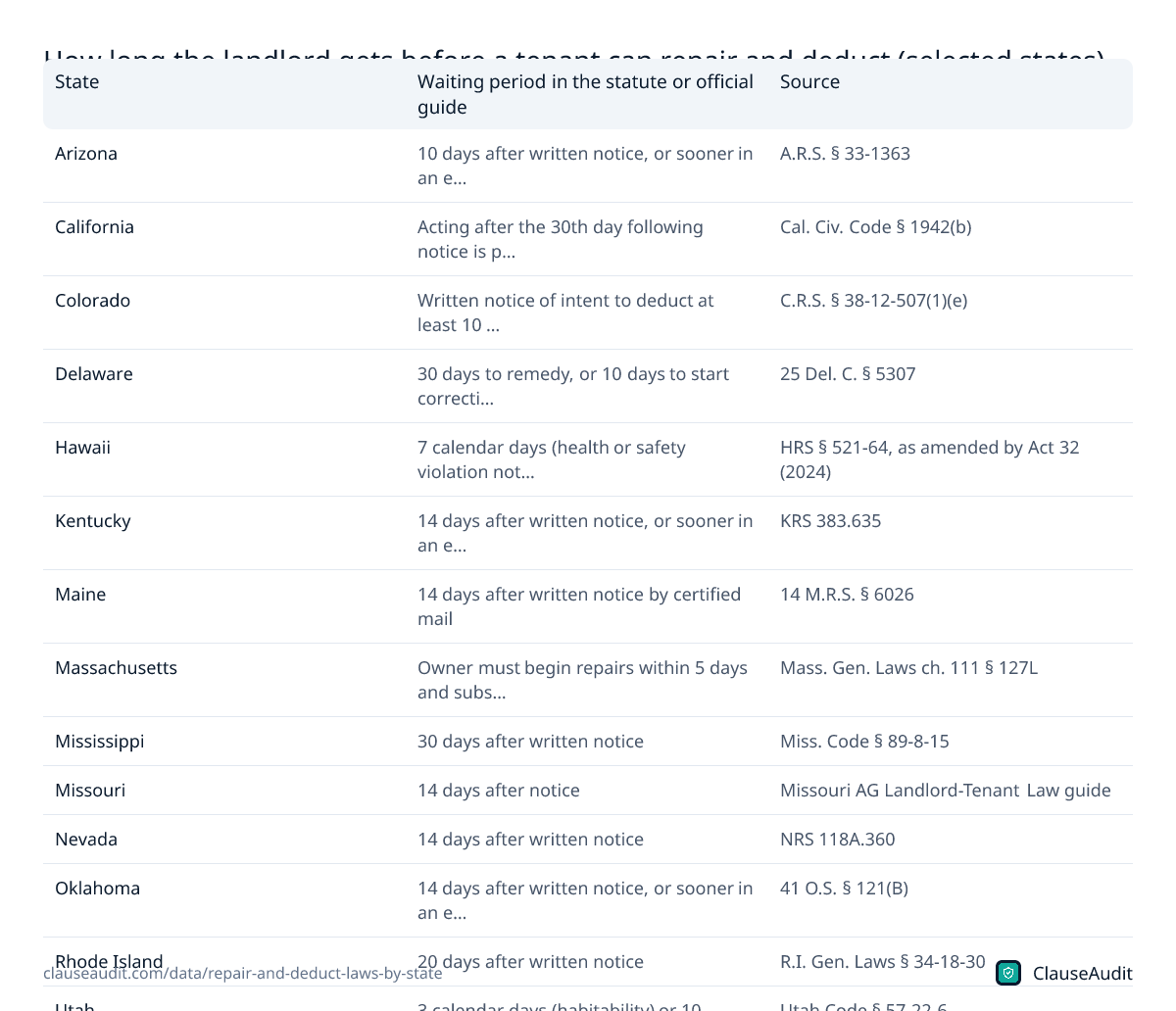
Download this chart (PNG)How long the landlord gets before a tenant can repair and deduct (selected states)
| State | Waiting period in the statute or official guide | Source |
|---|---|---|
| Arizona | 10 days after written notice, or sooner in an emergency | A.R.S. § 33-1363 |
| California | Acting after the 30th day following notice is presumed reasonable | Cal. Civ. Code § 1942(b) |
| Colorado | Written notice of intent to deduct at least 10 days before deducting, with a professional estimate | C.R.S. § 38-12-507(1)(e) |
| Delaware | 30 days to remedy, or 10 days to start corrective measures | 25 Del. C. § 5307 |
| Hawaii | 7 calendar days (health or safety violation notice) or 12 business days (tenant notice) to start repairs | HRS § 521-64, as amended by Act 32 (2024) |
| Kentucky | 14 days after written notice, or sooner in an emergency | KRS 383.635 |
| Maine | 14 days after written notice by certified mail | 14 M.R.S. § 6026 |
| Massachusetts | Owner must begin repairs within 5 days and substantially complete them within 14 days of notice | Mass. Gen. Laws ch. 111 § 127L |
| Mississippi | 30 days after written notice | Miss. Code § 89-8-15 |
| Missouri | 14 days after notice | Missouri AG Landlord-Tenant Law guide |
| Nevada | 14 days after written notice | NRS 118A.360 |
| Oklahoma | 14 days after written notice, or sooner in an emergency | 41 O.S. § 121(B) |
| Rhode Island | 20 days after written notice | R.I. Gen. Laws § 34-18-30 |
| Utah | 3 calendar days (habitability) or 10 calendar days (lease terms) | Utah Code § 57-22-6 |
| Vermont | 30 days after notice | 9 V.S.A. § 4459 |
Source: Arizona State Legislature, Arizona Revised Statutes § 33-1363 (self-help for minor defects); California Civil Code (via California.Public.Law), California Civil Code § 1942 (repair and deduct); Colorado Revised Statutes (via Colorado.Public.Law), Colorado Revised Statutes § 38-12-507 (breach of warranty of habitability, tenant's remedies); Delaware General Assembly, Delaware Code Online, Delaware Code Title 25, Chapter 53 (§ 5307 repair and deduction; § 5308 essential services); Hawaii State Legislature, Act 32, Session Laws of Hawaii 2024 (S.B. 2132), amending HRS § 521-64; Maine Legislature, Maine Revised Statutes Title 14 § 6026 (warranty of fitness for human habitation); Missouri Attorney General's Office, Landlord-Tenant Law (consumer guide); Nevada Revised Statutes (via Nevada.Public.Law), NRS 118A.360 (repair of minor defects by tenant); FindLaw (Thomson Reuters) state code text, Kentucky Revised Statutes § 383.635 (tenant's self-help for minor defects); FindLaw (Thomson Reuters) state code text, Massachusetts General Laws ch. 111 § 127L (tenant repairs, deduction from rent); FindLaw (Thomson Reuters) state code text, Mississippi Code § 89-8-15 (tenant's repair of defects; reimbursement); Oklahoma Legislature, Enrolled House Bill 3409 (2022), amending 41 O.S. § 121; FindLaw (Thomson Reuters) state code text, Rhode Island General Laws § 34-18-30 (self-help for minor defects); FindLaw (Thomson Reuters) state code text, Utah Code § 57-22-6 (renter's notice and remedies, repair and deduct); FindLaw (Thomson Reuters) state code text, Vermont Statutes Title 9 § 4459 (minor defects, repair and deduct). Download as image
Repair-and-deduct remedy by state
- 20Statutory repair and deduct with a set cap
- 4Statutory repair and deduct, no fixed cap
- 5Repair and deduct recognized outside statute (courts or official guide)
- 6Self-help limited to essential services
- 15No repair-and-deduct remedy found
- 0Not yet confirmed
- Statutory repair and deduct with a set cap20
- Statutory repair and deduct, no fixed cap4
- Repair and deduct recognized outside statute (courts or official guide)5
- Self-help limited to essential services6
- No repair-and-deduct remedy found15
- Not yet confirmed0
- Not yet confirmed1
| State | Repair and deduct | Rent withholding or escrow | Retaliation protection | Source |
|---|---|---|---|---|
| Alabama | No repair-and-deduct remedy described in the 2006 Act summary | No; the Act has no provision letting tenants withhold rent | Yes; bars rent increases, service cuts or eviction threats after complaints | Ala. Code § 35-9A-101 et seq. (Act 2006-316) |
| Alaska | Only for essential services (heat, water, hot water, sanitary facilities): procure and deduct actual cost | Not confirmed | Yes; no fixed time window in the statute | AS 34.03.180, 34.03.310 |
| Arizona | Yes, minor defects under $300 or half a month's rent, whichever is greater; licensed contractor required | Not confirmed | Yes; 6-month presumption after a complaint | A.R.S. §§ 33-1363, 33-1381 |
| Arkansas | No; termination is the tenant's sole remedy under Act 1052 (2021) | No; nothing lets a tenant offset or withhold rent | Not confirmed | Ark. Code § 18-17-501 et seq. as amended by Act 1052 of 2021 |
| California | Yes, up to 1 month's rent; no more than twice in any 12-month period | Not confirmed | Yes; 180 days after a repair request or complaint | Cal. Civ. Code §§ 1942, 1942.5 |
| Colorado | Yes, cost of a professional's estimate, deducted from one or more rent payments; 10 days' written notice first | Court can limit rent to the unit's reasonable rental value until repairs are done | Yes (C.R.S. § 38-12-509) | C.R.S. §§ 38-12-507, 38-12-509 |
| Connecticut | Only for essential services (heat, hot water, running water, electric, gas): procure and deduct cost | Yes; rent paid to the court clerk after a municipal complaint at least 21 days earlier | Yes; 6 months after a complaint or repair request | Conn. Gen. Stat. §§ 47a-13, 47a-14h, 47a-20 |
| Delaware | Yes, up to $400 or half a month's rent, whichever is less | For lost heat, hot water, water or electricity: tenant may keep 2/3 of per diem rent (§ 5308) | Yes; 90-day presumption after a complaint | 25 Del. C. §§ 5307, 5308, 5516 |
| District of Columbia | Not yet confirmed: check the source | D.C. Code § 42-3505.02 | ||
| Florida | No statutory repair and deduct found | Yes; may withhold after 7 days' written notice of intent (habitability defense) | Yes (§ 83.64); no fixed time window | Fla. Stat. §§ 83.60, 83.64 |
| Georgia | Yes, per the state handbook: licensed professional, written notice first; no statutory cap | Not provided; handbook says tenants generally must keep paying rent | Yes; landlord action within 3 months of a protected act | O.C.G.A. § 44-7-24 |
| Hawaii | Yes, up to $1,000 or 1 month's rent, whichever is greater; total capped at 3 months' rent per 6 months | Not confirmed | Not confirmed | HRS § 521-64 (Act 32, 2024) |
| Idaho | No general remedy; only smoke detectors (install after 72 hours' notice and deduct) | No; remedy is a lawsuit after 3 days' written notice | Not confirmed | Idaho Code § 6-320 |
| Illinois | Yes, statewide: up to $500 or half a month's rent, whichever is less (local rules differ) | Not confirmed | Not confirmed | 765 ILCS 742/5 |
| Indiana | No statutory repair and deduct found; remedy is a court action after notice | Not confirmed | Yes (IC 32-31-8.5); no presumption window in the statute | IC 32-31-8-6, 32-31-8.5-5 |
| Iowa | Only for essential services (heat, water, hot water): procure and deduct actual cost | Not confirmed | Yes; 1-year presumption after a good-faith complaint | Iowa Code §§ 562A.23, 562A.36 |
| Kansas | No; the Act's tenant remedies are termination, damages and injunctive relief | No; in a nonpayment case the court may order rent paid into court with the tenant's counterclaim | Yes; bars rent increases or service cuts after protected complaints | K.S.A. 58-2559, 58-2561, 58-2572 |
| Kentucky | Yes, under $100 or half a month's rent, whichever is greater; 14 days' written notice | Not confirmed | Yes; 1-year presumption after a complaint | KRS 383.635, 383.705 |
| Louisiana | Yes; after the lessor fails to repair within a reasonable time, lessee may repair and get reimbursed or apply cost to rent; no fixed cap | Not confirmed | Not confirmed | La. Civ. Code art. 2694 |
| Maine | Yes, repairs under $500 or half a month's rent, whichever is greater; 14 days' notice by certified mail | Not confirmed | Yes; 6-month presumption before an eviction filing | 14 M.R.S. §§ 6026, 6001 |
| Maryland | No statutory repair and deduct found | Yes; rent escrow action paying rent into court | Yes; action more than 6 months after the protected act is not deemed retaliatory | Md. Code, Real Prop. §§ 8-211, 8-208.1 |
| Massachusetts | Yes, up to 4 months' rent in any 12-month period; owner gets 5 days to begin and 14 days to finish repairs | Yes; withholding is a defense when the landlord knew of code violations; court may order rent paid to the clerk | Yes; 6-month rebuttable presumption | Mass. Gen. Laws ch. 111 § 127L; ch. 239 § 8A; ch. 186 § 18 |
| Michigan | Yes, per Michigan Legal Help: pay for repairs and deduct the cost after the landlord fails to respond; no statutory cap | Yes; rent may be put in an escrow account | Yes; 90-day presumption for the retaliatory eviction defense | MCL 600.5720 |
| Minnesota | No statutory repair and deduct found | Yes; rent escrow deposited with the court administrator | Yes; 90 days after a protected act, landlord must prove notice was not retaliatory | Minn. Stat. §§ 504B.385, 504B.285 |
| Mississippi | Yes, up to 1 month's rent after 30 days' written notice; once per 6 months; tenant must be current on rent | Not confirmed | Limited; a rent increase after a tenancy ends must not be for retaliation | Miss. Code §§ 89-8-15, 89-8-17 |
| Missouri | Yes, code violations under $300 or half a month's rent, whichever is greater; 14 days' notice | Not confirmed | Not confirmed | Mo. Rev. Stat. § 441.234 |
| Montana | Yes, repairs costing no more than 1 month's rent after notice and a reasonable time | Not confirmed | Yes; 6-month presumption after a complaint | Mont. Code Ann. §§ 70-24-406, 70-24-431 |
| Nebraska | Only for essential services (hot water, running water, heat): procure and deduct cost | Not confirmed | Yes; no presumption window in the statute | Neb. Rev. Stat. §§ 76-1427, 76-1439 |
| Nevada | Yes, repairs under $100 or 1 month's rent, whichever is greater; 14 days' written notice | Yes, while essential items or services are not supplied (§ 118A.380) | Yes (NRS 118A.510) | NRS 118A.360, 118A.380, 118A.510 |
| New Hampshire | No statutory repair and deduct found | Yes; defense to nonpayment eviction if a habitability violation is not fixed within 14 days of written notice | Yes; 6-month presumption | RSA 540:13-d, 540:13-a, 540:13-b |
| New Jersey | Yes, by case law for defects in vital facilities, after notice | Yes, rent withholding or abatement by case law (Marini v. Ireland; Berzito v. Gambino) | Yes (N.J.S.A. 2A:42-10.10) | N.J.S.A. 2A:42-10.10; case law |
| New Mexico | No statutory repair and deduct found | Yes; abate one-third of daily rent (100% if uninhabitable) after 7 days' written notice | Yes; 6 months after a protected act | NMSA §§ 47-8-27.2, 47-8-39 |
| New York | Yes, in extenuating circumstances, per the Attorney General (warranty of habitability) | Yes, but the landlord may sue for nonpayment; court or DHCR may reduce rent | Yes; rebuttable presumption for 1 year after a good-faith complaint | N.Y. Real Prop. Law §§ 235-b, 223-b |
| North Carolina | No statutory repair and deduct found | No; tenant may not withhold rent before a court rules | Yes; defense if protected acts occurred within 12 months | N.C. Gen. Stat. §§ 42-44, 42-37.1 |
| North Dakota | Yes, lessee may repair and deduct after notice and a reasonable time; no dollar cap stated | Not confirmed | No general retaliation provision found in N.D.C.C. ch. 47-16 | N.D.C.C. § 47-16-13 |
| Ohio | Generally no, per Ohio Legal Help | Yes; deposit rent with the court clerk if not fixed within a reasonable time or 30 days after written notice | Yes (ORC 5321.02); no fixed time window | Ohio Rev. Code §§ 5321.07, 5321.02 |
| Oklahoma | Yes, up to 1 month's rent after 14 days' written notice (was $100 before Nov. 1, 2022) | Only for essential services: substitute housing excuses rent | No statewide statute found; anti-retaliation bills have stalled | 41 O.S. § 121 (HB 3409, 2022) |
| Oregon | Yes, minor habitability defects, up to $300 (not mold, radon, asbestos or lead paint) | Not confirmed | Yes (ORS 90.385) | ORS 90.368, 90.385 |
| Pennsylvania | Yes, by case law (Pugh v. Holmes) for habitability repairs | Yes; withheld rent kept in escrow; Rent Withholding Act for units certified unfit | Not confirmed | Pugh v. Holmes (1979); 35 P.S. § 1700-1 |
| Rhode Island | Yes, minor defects costing under $500 in total per year; 20 days' written notice | Not confirmed | Yes; 6-month presumption after a complaint | R.I. Gen. Laws §§ 34-18-30, 34-18-46 |
| South Carolina | Only for essential services: procure and deduct actual and reasonable cost | Not confirmed | Yes (§ 27-40-910) | S.C. Code §§ 27-40-630, 27-40-910 |
| South Dakota | Yes, after notice and a reasonable time; no dollar cap stated | If repairs exceed 1 month's rent, rent may be withheld into a separate account for repairs | Yes; landlord defense if notice to vacate comes more than 180 days later | SDCL 43-32-9, 43-32-27 |
| Tennessee | Only for essential services: procure and deduct actual cost | Only via substitute housing for lost essential services | Yes; no presumption window in the statute | Tenn. Code §§ 66-28-502, 66-28-514 |
| Texas | Yes, up to 1 month's rent or $500, whichever is greater | Not confirmed | Yes; 6 months after the tenant's protected action | Tex. Prop. Code §§ 92.0561, 92.331 |
| Utah | Yes, up to 2 months' rent; 3 calendar days (habitability) or 10 days (lease terms) to correct | Rent abatement option ends the lease | Not confirmed | Utah Code § 57-22-6 |
| Vermont | Yes, minor defects up to half of one month's rent after 30 days' notice | Yes, for conditions materially affecting health and safety after actual notice | Yes; 90-day presumption after a government finding of health or safety noncompliance | 9 V.S.A. §§ 4459, 4458, 4465 |
| Virginia | Yes, licensed contractor repairs up to 1 month's rent or $1,500, whichever is greater | Yes; rent escrow (§ 55.1-1244) | Yes (§ 55.1-1258); new version takes effect January 1, 2027 | Va. Code §§ 55.1-1244.1, 55.1-1244, 55.1-1258 |
| Washington | Yes, up to 2 months' rent per repair, with a 12-month total limit | Yes; escrow for certified substandard and dangerous conditions | Yes; 90-day presumption | RCW 59.18.100, 59.18.115, 59.18.250 |
| West Virginia | No statutory repair and deduct found | Not confirmed | Yes, by case law (Imperial Colliery Co. v. Fout, 1988) | W. Va. Code § 37-6-30 |
| Wisconsin | No statutory repair and deduct found | Rent abates to the extent the tenant loses full use of untenantable premises | Yes (§ 704.45); no fixed time window | Wis. Stat. §§ 704.07, 704.45 |
| Wyoming | No; renter's remedy is a court action after notice | No; court can award damages including rent improperly retained | No provision found in the residential rental article | Wyo. Stat. §§ 1-21-1203, 1-21-1206 |
Can I fix something myself and deduct it from rent?
Often yes, but the statute decides the steps, and skipping one can turn a lawful deduction into unpaid rent. The pattern is similar across states: the defect has to affect health, safety or habitability, you have to give written notice, the landlord gets a set time to act, and the cost has to stay under a cap.
The waiting periods vary a lot. Utah gives the landlord 3 calendar days for a habitability problem. Kentucky, Maine, Nevada and Oklahoma use 14 days after written notice. Mississippi and Vermont make you wait 30 days. California does not set a hard deadline, but acting after the 30th day following notice is presumed reasonable.
Where the remedy exists only in case law or an official guide, the rules are looser and less certain. New Jersey and Pennsylvania recognize repair and deduct through court decisions. Georgia's state handbook describes it with a licensed professional and written notice first, but no statutory cap. Michigan Legal Help says you can deduct after the landlord fails to respond. In these states, keep your deduction modest and your paperwork thick, because a judge will decide what was reasonable after the fact.
Some states add conditions that trip people up. Arizona and Virginia want a licensed contractor. Maine wants notice by certified mail. Colorado wants written notice of your intent to deduct at least 10 days ahead, with a professional estimate attached. Mississippi only allows the remedy if you are current on rent, and only once every 6 months.
How much can a tenant deduct for repairs?
The caps are smaller than most people expect. Washington allows up to 2 months' rent per repair, with a 12-month total limit. Hawaii raised its cap to $1,000 or 1 month's rent, whichever is greater, effective November 1, 2024. Virginia allows 1 month's rent or $1,500, whichever is greater, for licensed contractor work.
At the low end, Oregon caps minor defects at $300 flat and excludes mold, radon, asbestos and lead paint. Delaware stops at $400 or half a month's rent, whichever is less. Kentucky allows $100 or half a month's rent, whichever is greater, and only where the local government has adopted the uniform landlord-tenant act.
A handful of states limit self-help to essential services. In Alaska, Connecticut, Iowa, Nebraska, South Carolina and Tennessee you can procure heat, water or hot water yourself and deduct the cost, but you cannot use the same route for a broken dishwasher or a sagging cabinet. Connecticut adds electricity and gas to that list.
If the repair costs more than your cap, repair and deduct is the wrong tool. Look at rent escrow, a code complaint, or a court action instead. Paying a big invoice and deducting the full amount is the fastest way to end up defending a nonpayment eviction.
Can I withhold rent if my landlord won't make repairs?
Withholding is riskier than repair and deduct, because you are holding back the whole payment rather than spending it on the fix. Several states only allow it through a formal process. Maryland and Minnesota use rent escrow paid into court. Connecticut has tenants pay the court clerk after a municipal complaint made at least 21 days earlier. Ohio lets you deposit rent with the clerk once the landlord misses a reasonable time or 30 days after notice.
Other states give a direct reduction. New Mexico allows a tenant to abate one-third of daily rent, or 100% if the unit is uninhabitable, after 7 days' written notice. Florida allows withholding after 7 days' written notice of intent. North Carolina goes the other way: you may not withhold before a court rules.
The safe habit is to set the withheld money aside in a separate account so you can pay it into court, or to the landlord, the moment the court or the statute says to. A tenant who withheld rent and spent it has very little to stand on.
What counts as landlord retaliation, and how long am I protected?
Retaliation laws stop a landlord from raising rent, cutting services or starting an eviction because you complained or used a repair remedy. Many of them create a presumption for a set window after your complaint. California bars retaliation for 180 days after a repair request. New York presumes retaliation for 1 year after a good-faith complaint. Texas bans it for 6 months after a protected action.
Not every state has this protection. Oklahoma has no statewide anti-retaliation statute, and none was found in Wyoming's residential rental article or in North Dakota's chapter 47-16. In those states the dated paper trail of your repair request matters even more.
What to do before you use any of these remedies
- Put the repair request in writing and keep a copy with the date. Photos and videos of the problem belong in the same file.
- Find your state's waiting period and count it from the day the landlord received notice, not the day you wrote it.
- Get a written estimate and, where your state requires it, use a licensed contractor.
- Check the cap before you book the work. If the job will exceed it, switch to escrow, a code inspection or a court filing.
- Hand over receipts with the reduced rent payment and a short note explaining the deduction and the statute you relied on.
- Watch the calendar for a retaliation window. If a rent increase or eviction notice arrives inside it, raise the presumption right away.
Does a lease clause waiving these rights hold up?
Leases often say the tenant handles all repairs, waives repair and deduct, or agrees never to offset rent. In many states a residential tenant cannot waive habitability protections, so the clause may be void even though you signed it. In others, especially where the remedy comes only from case law, the lease wording carries more weight.
Commercial tenants should assume less protection. Most of these remedies are written for residential tenancies, so a business lease usually decides who repairs what and whether rent can ever be offset. Read that section closely before you sign, because there may be no statute to fall back on.
How ClauseAudit helps
Most repair fights start with a lease that is vague about who fixes what and how fast. Some leases go further and try to shift every repair to the tenant or waive rights your state may not let you give up.
Upload your lease and the automated review flags the repair, rent and remedy clauses, explains each in plain English, and points out wording that may conflict with your state's rules so you can raise it before you sign or renew.
- Repair responsibility: does the lease make you pay for appliances, plumbing or heating that your state puts on the landlord?
- Waiver of remedies: does it say you give up repair and deduct, rent withholding or habitability rights?
- Notice method: how must repair requests be sent, and to whom, so your notice counts under state law?
- Response time: does the lease set a deadline for the landlord to start or finish repairs?
- Late fees and default: would a lawful deduction be treated as late or unpaid rent and trigger fees or eviction?
- Rent increases and nonrenewal: are there terms that could be used against you shortly after a complaint?
Frequently asked questions
Is repair and deduct legal in California?
Yes. California Civil Code section 1942 lets a tenant spend up to 1 month's rent on repairs the landlord failed to make, but no more than twice in any 12-month period. You must give notice first, and acting after the 30th day following notice is presumed reasonable. The defect should affect habitability, not cosmetic issues.
How does repair and deduct work in Texas?
Texas caps each repair at 1 month's rent or $500, whichever is greater. The statute has detailed notice steps, so follow them exactly before hiring anyone. Texas also bars landlord retaliation for 6 months after a protected action, such as a good-faith repair request, which helps if a rent increase or eviction notice follows.
Which states do not allow repair and deduct?
Several states have no general remedy. Alabama, Arkansas, Indiana, Kansas, Wyoming and others leave tenants with lease termination or a lawsuit. Idaho only allows it for smoke detectors. Some states, such as Connecticut, Iowa and Tennessee, limit self-help to essential services like heat and water. Check the state table before you act.
What happens if I deduct more than the cap?
The extra amount is usually treated as unpaid rent. That can lead to late fees and a nonpayment eviction case, and the landlord may argue you lost the protection of the statute altogether. If a repair will cost more than your state allows, use rent escrow, a housing code complaint or a court action instead of a larger deduction.
Can I stop paying rent until repairs are made?
Only where your state allows it, and usually through a set process. Maryland and Minnesota use court rent escrow. Florida requires 7 days' written notice of intent before withholding. North Carolina does not let tenants withhold before a court rules. Simply stopping payment without following the statute often ends in an eviction filing.
How long do I have to wait before repairing it myself?
It depends on the state. Utah gives the landlord 3 calendar days for habitability problems, Arizona 10 days after written notice, Kentucky and Nevada 14 days, Rhode Island 20 days, and Mississippi and Vermont 30 days. Emergencies can shorten the wait in some states. Count from when the landlord received your notice.
Can my landlord raise my rent after I complain about repairs?
Not as payback in most states. Retaliation laws bar or presume retaliation when a rent hike or eviction follows a complaint within a set window, such as 180 days in California, 1 year in New York and 6 months in Massachusetts. The landlord can still rebut it with a legitimate reason, so keep records.
Can a lease make me waive repair and deduct?
Many states do not let residential tenants waive habitability protections, so a waiver clause may be unenforceable even if you signed it. The answer is less clear where the remedy comes from case law rather than a statute. Commercial leases are different, and the written terms usually control there.
Use this data
Every chart and card below is free to reuse under CC BY 4.0. Download what you need and link back to this page.
 Stat cards
 Key findings card
 Infographic
 Repair-and-deduct caps tied to rent, by state (months of rent)
 Dollar amounts written into repair-and-deduct caps, by state (USD)
 Retaliation protection windows stated in days, by state
 Retaliation protection windows stated in months, by state
 How long the landlord gets before a tenant can repair and deduct (selected states)
Embed the infographic
Free to share on your site, blog or slides under CC BY 4.0. Please keep the credit link.
Sources and method
Every number on this page comes from the sources below, each opened and read on or before October 18, 2026. A second, independent review checked every figure against its source and corrected anything that did not match. 50 of 51 state entries were confirmed; any that could not be are marked "Not yet confirmed" and left out of every count and chart.
- California Civil Code (via California.Public.Law), California Civil Code § 1942 (repair and deduct) (Current code, accessed October 2026)
- California Civil Code (via California.Public.Law), California Civil Code § 1942.5 (retaliation) (Current code, accessed October 2026)
- Texas Property Code (via Texas.Public.Law), Texas Property Code § 92.0561 (tenant's repair and deduct remedies) (Current code, accessed October 2026)
- Texas Property Code (via Texas.Public.Law), Texas Property Code § 92.331 (retaliation by landlord) (Current code, accessed October 2026)
- Washington State Legislature, RCW 59.18.100 (landlord's failure to remedy defective condition, repair and deduct) (Current code, accessed October 2026)
- Washington State Legislature, RCW 59.18.115 (substandard and dangerous conditions, escrow account) (Current code, accessed October 2026)
- Washington State Legislature, RCW 59.18.250 (reprisals or retaliatory actions, presumptions) (Current code, accessed October 2026)
- Hawaii State Legislature, Act 32, Session Laws of Hawaii 2024 (S.B. 2132), amending HRS § 521-64 (Approved May 28, 2024; effective November 1, 2024)
- New York Real Property Law (via NewYork.Public.Law), New York Real Property Law § 223-b (retaliation by landlord) (Current code, accessed October 2026)
- Virginia General Assembly, Legislative Information System, Code of Virginia § 55.1-1244.1 (tenant's remedy by repair) (Current code, accessed October 2026)
- Virginia General Assembly, Legislative Information System, Code of Virginia § 55.1-1244 (tenant's assertion; rent escrow) (Current code, accessed October 2026)
- Virginia General Assembly, Legislative Information System, Code of Virginia § 55.1-1258 (retaliatory conduct prohibited) (Current code, accessed October 2026)
- Arizona State Legislature, Arizona Revised Statutes § 33-1363 (self-help for minor defects) (Current code, accessed October 2026)
- Arizona State Legislature, Arizona Revised Statutes § 33-1381 (retaliatory conduct prohibited) (Current code, accessed October 2026)
- Colorado Revised Statutes (via Colorado.Public.Law), Colorado Revised Statutes § 38-12-507 (breach of warranty of habitability, tenant's remedies) (Current through Fall 2025)
- Delaware General Assembly, Delaware Code Online, Delaware Code Title 25, Chapter 53 (§ 5307 repair and deduction; § 5308 essential services) (Current code, accessed October 2026)
- Delaware General Assembly, Delaware Code Online, Delaware Code Title 25, Chapter 55 (§ 5516 retaliatory acts prohibited) (Current code, accessed October 2026)
- Council of the District of Columbia, D.C. Law Library, D.C. Code § 42-3505.02 (retaliatory action) (Current code, accessed October 2026)
- Florida Legislature, Florida Statutes § 83.60 (defenses to action for rent or possession) (2026 Florida Statutes)
- Florida Legislature, Florida Statutes § 83.64 (retaliatory conduct) (2026 Florida Statutes)
- Georgia Department of Community Affairs, Georgia Landlord Tenant Handbook (Revised 8-29-24)
- Office of the Governor of Georgia (signed legislation), House Bill 346 (2019), creating O.C.G.A. § 44-7-24 (retaliation) (2019 session)
- Iowa Legislature, Iowa Code § 562A.23 (failure to deliver essential services) (Iowa Code 2026)
- Iowa Legislature, Iowa Code § 562A.36 (retaliatory conduct prohibited) (Iowa Code 2026)
- Illinois Legal Aid Online, Rental repair rights and landlord access (Last full review March 25, 2026)
- Kansas Office of Revisor of Statutes, K.S.A. 58-2572 (retaliatory actions by landlord prohibited) (Current code, accessed October 2026)
- Maine Legislature, Maine Revised Statutes Title 14 § 6026 (warranty of fitness for human habitation) (Current code, accessed October 2026)
- Maine Legislature, Maine Revised Statutes Title 14 § 6001 (presumption of retaliation) (Current code, accessed October 2026)
- Maryland General Assembly, Maryland Real Property § 8-211 (rent escrow) (Current code, accessed October 2026)
- Maryland General Assembly, Maryland Real Property § 8-208.1 (retaliatory actions) (Current code, accessed October 2026)
- Minnesota Office of the Revisor of Statutes, Minnesota Statutes § 504B.385 (rent escrow action) (Current code, accessed October 2026)
- Minnesota Office of the Revisor of Statutes, Minnesota Statutes § 504B.285 (eviction; retaliation defense) (Current code, accessed October 2026)
- Missouri Attorney General's Office, Landlord-Tenant Law (consumer guide) (PDF dated September 2025)
- Montana Legislature, Montana Code Annotated § 70-24-406 (tenant's remedies for landlord's noncompliance) (Current code, accessed October 2026)
- Montana Legislature, Montana Code Annotated § 70-24-431 (retaliatory conduct prohibited) (Current code, accessed October 2026)
- Nevada Revised Statutes (via Nevada.Public.Law), NRS 118A.360 (repair of minor defects by tenant) (Current code, accessed October 2026)
- Nevada Revised Statutes (via Nevada.Public.Law), NRS 118A.380 (failure of landlord to supply essential items or services) (Current code, accessed October 2026)
- Nevada Revised Statutes (via Nevada.Public.Law), NRS 118A.510 (retaliatory conduct prohibited) (Current code, accessed October 2026)
- New Jersey Department of Community Affairs, Truth in Renting: A guide to the rights and responsibilities of residential tenants and landlords in New Jersey (PDF last modified August 2025)
- North Dakota Legislative Branch, North Dakota Century Code Chapter 47-16 (leases), incl. § 47-16-13 (PDF dated December 2025)
- Oregon Revised Statutes (via Oregon.Public.Law), ORS 90.368 (repair of minor habitability defect) (Current through early 2026)
- Oregon Revised Statutes (via Oregon.Public.Law), ORS 90.385 (retaliatory conduct by landlord) (Current through early 2026)
- South Carolina Legislature, South Carolina Code Title 27, Chapter 40 (Residential Landlord and Tenant Act) (Current code, accessed October 2026)
- South Dakota Legislature, SDCL 43-32-9 (failure of lessor to repair premises, lessee's remedies) (Current code, accessed October 2026)
- South Dakota Legislature, SDCL 43-32-27 (cause of action for retaliatory conduct) (Current code, accessed October 2026)
- Wyoming Legislature, Wyoming Statutes Title 1, Article 12 (§§ 1-21-1201 to 1-21-1211, residential rental property) (PDF dated May 2026)
- FindLaw (Thomson Reuters) state code text, Massachusetts General Laws ch. 111 § 127L (tenant repairs, deduction from rent) (Current as of January 1, 2025)
- FindLaw (Thomson Reuters) state code text, Massachusetts General Laws ch. 186 § 18 (reprisal against tenants) (Current as of January 1, 2025)
- FindLaw (Thomson Reuters) state code text, Massachusetts General Laws ch. 239 § 8A (rent withholding defense and counterclaims) (Current as of January 1, 2025)
- FindLaw (Thomson Reuters) state code text, Kentucky Revised Statutes § 383.635 (tenant's self-help for minor defects) (Current as of January 1, 2025)
- FindLaw (Thomson Reuters) state code text, Kentucky Revised Statutes § 383.705 (retaliatory conduct prohibited) (Current as of January 1, 2025)
- FindLaw (Thomson Reuters) state code text, Kentucky Revised Statutes § 383.500 (local adoption of the Uniform Residential Landlord and Tenant Act) (Current as of January 1, 2025)
- FindLaw (Thomson Reuters) state code text, Alaska Statutes § 34.03.180 (wrongful failure to supply heat, water, or essential services) (Current as of January 1, 2025)
- FindLaw (Thomson Reuters) state code text, Alaska Statutes § 34.03.310 (retaliatory conduct prohibited) (Current as of January 1, 2025)
- FindLaw (Thomson Reuters) state code text, Utah Code § 57-22-6 (renter's notice and remedies, repair and deduct) (Current as of January 1, 2025)
- FindLaw (Thomson Reuters) state code text, Rhode Island General Laws § 34-18-30 (self-help for minor defects) (Current as of January 1, 2026)
- FindLaw (Thomson Reuters) state code text, Rhode Island General Laws § 34-18-46 (retaliatory conduct prohibited) (Current as of January 1, 2026)
- FindLaw (Thomson Reuters) state code text, Vermont Statutes Title 9 § 4459 (minor defects, repair and deduct) (Current as of January 1, 2024)
- FindLaw (Thomson Reuters) state code text, Vermont Statutes Title 9 § 4458 (habitability; tenant remedies, rent withholding) (Current as of January 1, 2024)
- FindLaw (Thomson Reuters) state code text, Vermont Statutes Title 9 § 4465 (retaliatory conduct prohibited) (Current as of January 1, 2024)
- FindLaw (Thomson Reuters) state code text, Nebraska Revised Statutes § 76-1427 (failure to supply essential services) (Current as of January 1, 2024)
- FindLaw (Thomson Reuters) state code text, Nebraska Revised Statutes § 76-1439 (retaliatory conduct prohibited) (Current as of January 1, 2024)
- FindLaw (Thomson Reuters) state code text, New Mexico Statutes § 47-8-39 (retaliation prohibited) (Current as of January 1, 2024)
- FindLaw (Thomson Reuters) state code text, New Mexico Statutes § 47-8-27.2 (resident's remedies, rent abatement) (Current as of January 1, 2024)
- FindLaw (Thomson Reuters) state code text, North Carolina General Statutes § 42-37.1 (defense of retaliatory eviction) (Current as of January 1, 2023)
- FindLaw (Thomson Reuters) state code text, North Carolina General Statutes § 42-44 (general remedies; no unilateral rent withholding) (Current as of January 1, 2023)
- FindLaw (Thomson Reuters) state code text, Tennessee Code § 66-28-502 (failure to supply essential services) (Current as of January 2, 2024)
- FindLaw (Thomson Reuters) state code text, Tennessee Code § 66-28-514 (retaliatory conduct prohibited) (Current as of January 2, 2024)
- FindLaw (Thomson Reuters) state code text, Tennessee Code § 66-28-102 (counties where the URLTA applies) (Current as of January 2, 2024)
- FindLaw (Thomson Reuters) state code text, Connecticut General Statutes § 47a-13 (failure to supply essential services) (Current as of January 1, 2025)
- FindLaw (Thomson Reuters) state code text, Connecticut General Statutes § 47a-14h (tenant action to enforce landlord duties; rent paid into court) (Current as of January 1, 2025)
- FindLaw (Thomson Reuters) state code text, Connecticut General Statutes § 47a-20 (retaliatory action prohibited) (Current as of January 1, 2025)
- FindLaw (Thomson Reuters) state code text, Indiana Code § 32-31-8-6 (tenant's action to enforce landlord obligations) (Current as of January 1, 2026)
- FindLaw (Thomson Reuters) state code text, Indiana Code § 32-31-8.5-5 (retaliatory acts prohibited) (Current as of January 1, 2026)
- FindLaw (Thomson Reuters) state code text, Ohio Revised Code § 5321.07 (tenant remedies; deposit of rent with the court) (Current as of January 1, 2026)
- FindLaw (Thomson Reuters) state code text, Ohio Revised Code § 5321.02 (retaliation prohibited) (Current as of January 1, 2026)
- Ohio Legal Help, Repairs (tenant guide) (Accessed October 2026 (page copyright 2026))
- FindLaw (Thomson Reuters) state code text, Mississippi Code § 89-8-15 (tenant's repair of defects; reimbursement) (Current as of January 1, 2025)
- FindLaw (Thomson Reuters) state code text, Mississippi Code § 89-8-17 (expiration of tenancy; rent increase not for retaliation) (Current as of January 1, 2025)
- FindLaw (Thomson Reuters) state code text, Michigan Compiled Laws § 600.5720 (retaliatory eviction defense) (Current as of January 1, 2025)
- Michigan Legal Help, Tenant Rights and Responsibilities (Accessed October 2026 (page copyright 2026))
- FindLaw (Thomson Reuters) state code text, Wisconsin Statutes § 704.07 (repairs; untenantability; rent abatement) (Current as of January 1, 2025)
- FindLaw (Thomson Reuters) state code text, Wisconsin Statutes § 704.45 (retaliatory conduct in residential tenancies prohibited) (Current as of January 1, 2025)
- FindLaw (Thomson Reuters) state code text, Louisiana Civil Code art. 2694 (lessee's right to make repairs) (Current as of January 1, 2023)
- FindLaw (Thomson Reuters) state code text, Idaho Code § 6-320 (tenant's action for damages; 3-day notice) (Current as of January 1, 2024)
- Oklahoma Legislature, Enrolled House Bill 3409 (2022), amending 41 O.S. § 121 (Enrolled 2022; effective November 1, 2022)
- KGOU / Oklahoma Watch, Oklahoma's Landlord-Tenant Act has seldom changed in its nearly 50-year history (April 16, 2026)
- Kansas Office of Revisor of Statutes, K.S.A. 58-2559 (material noncompliance by landlord; tenant remedies) (Current code, accessed October 2026)
- Kansas Office of Revisor of Statutes, K.S.A. 58-2561 (counterclaim; rent paid into court) (Current code, accessed October 2026)
- Arise Citizens' Policy Project, Alabama's 2006 Landlord-Tenant Law (fact sheet, hosted by the Alabama Department of Public Health) (May 19, 2006)
- Mitchell, Williams, Selig, Gates & Woodyard, P.L.L.C., Act 1052: An Update to Landlord-Tenant Law in Arkansas (August 10, 2021)
- New Hampshire Supreme Court (via FindLaw Caselaw), Hutchins v. Peabody, No. 2003-368 (N.H. Supreme Court), quoting RSA 540:13-d (Decided May 25, 2004)
- Dartmouth Graduate Student Council, Know Your NH Tenant Rights (brochure summarizing RSA 540, 540-A) (February 2023)
- Office of the New York State Attorney General, Legal services and code enforcement (warranty of habitability) (Accessed October 2026 (page copyright 2026))
- Spotlight PA, Renters' rights in Reading: what to know (July 17, 2026)
- The Philadelphia Inquirer, Withholding rent, repair and deduct and the warranty of habitability in Pennsylvania (September 10, 2020)
- FindLaw (Thomson Reuters) state code text, West Virginia Code § 37-6-30 (landlord duties, residential property) (Current as of January 1, 2024)
- Casebriefs, Imperial Colliery Co. v. Fout, 179 W. Va. 776 (1988), case brief (Case decided 1988; brief accessed October 2026)
- Legal Aid DC, Housing Conditions Handbook (Accessed October 2026 (page copyright 2026))
Cite this page
ClauseAudit, “Repair and Deduct and Rent Withholding Laws by State (Plus Retaliation Protections)”, updated October 18, 2026, https://clauseaudit.com/data/repair-and-deduct-laws-by-state. Free to reuse with a link back (CC BY 4.0).
This page summarises published data and law as checked on October 18, 2026. Figures are updated as new editions are released, and your own situation may differ. It is general information, not legal, tax or financial advice.