Notary Fees by State (2026): Maximum Fee Per Signature
By ClauseAudit Research · 47 sources ·
What are the notary fees by state?
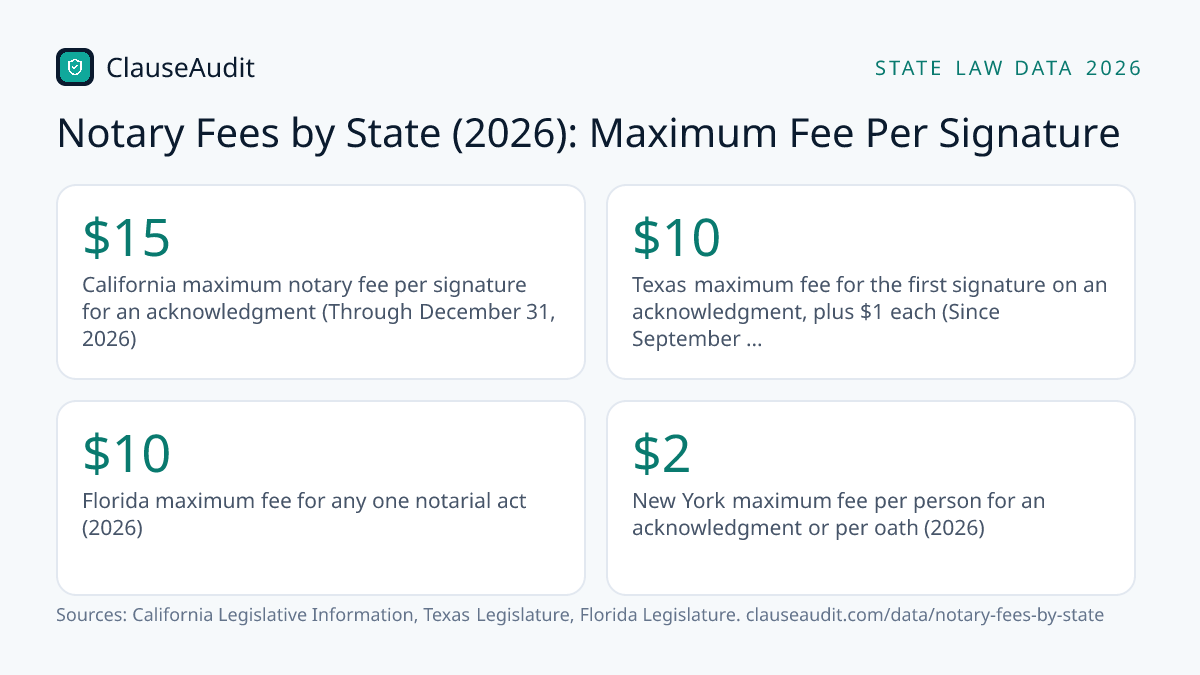
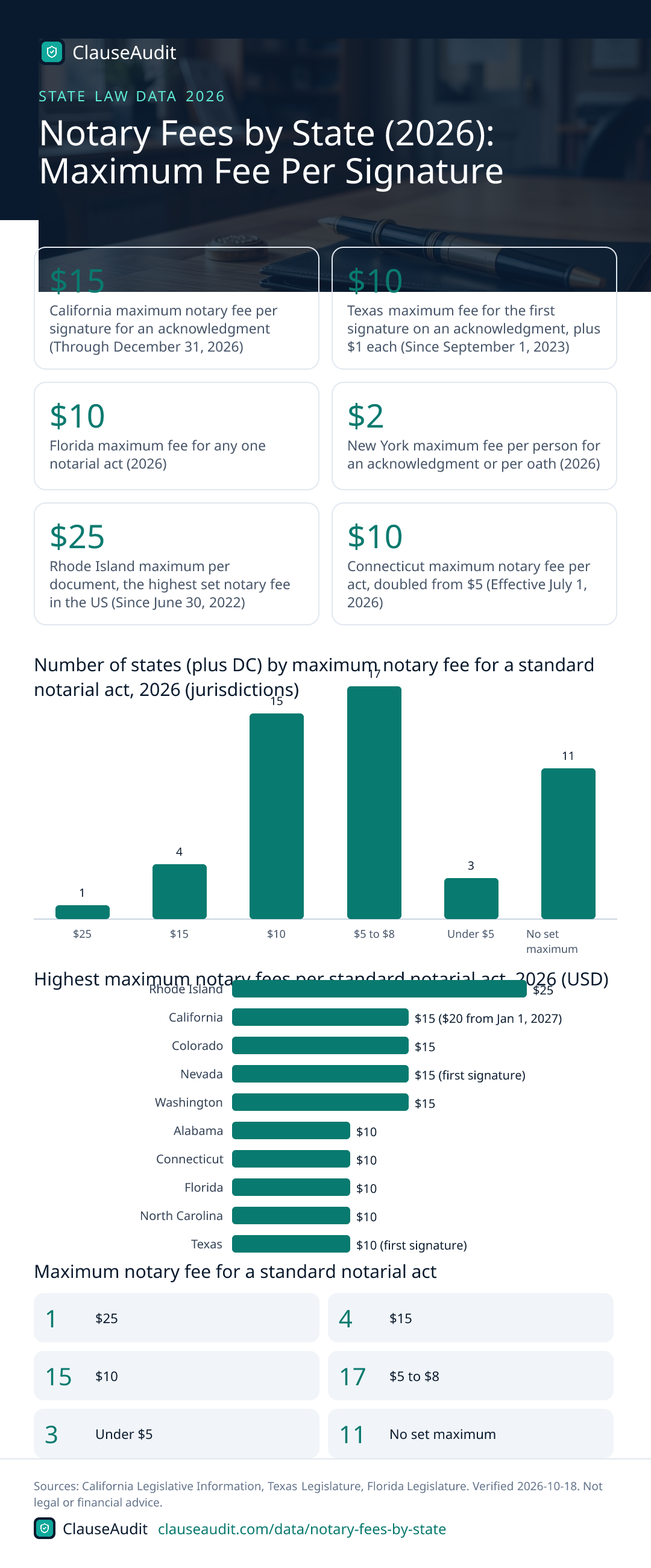
Most states cap what a notary can charge for a standard act. Rhode Island allows the most at $25 per document, while New York and Georgia cap it at $2. Fifteen states sit at $10, and 11 set no maximum at all. California's $15 limit rises to $20 on January 1, 2027.

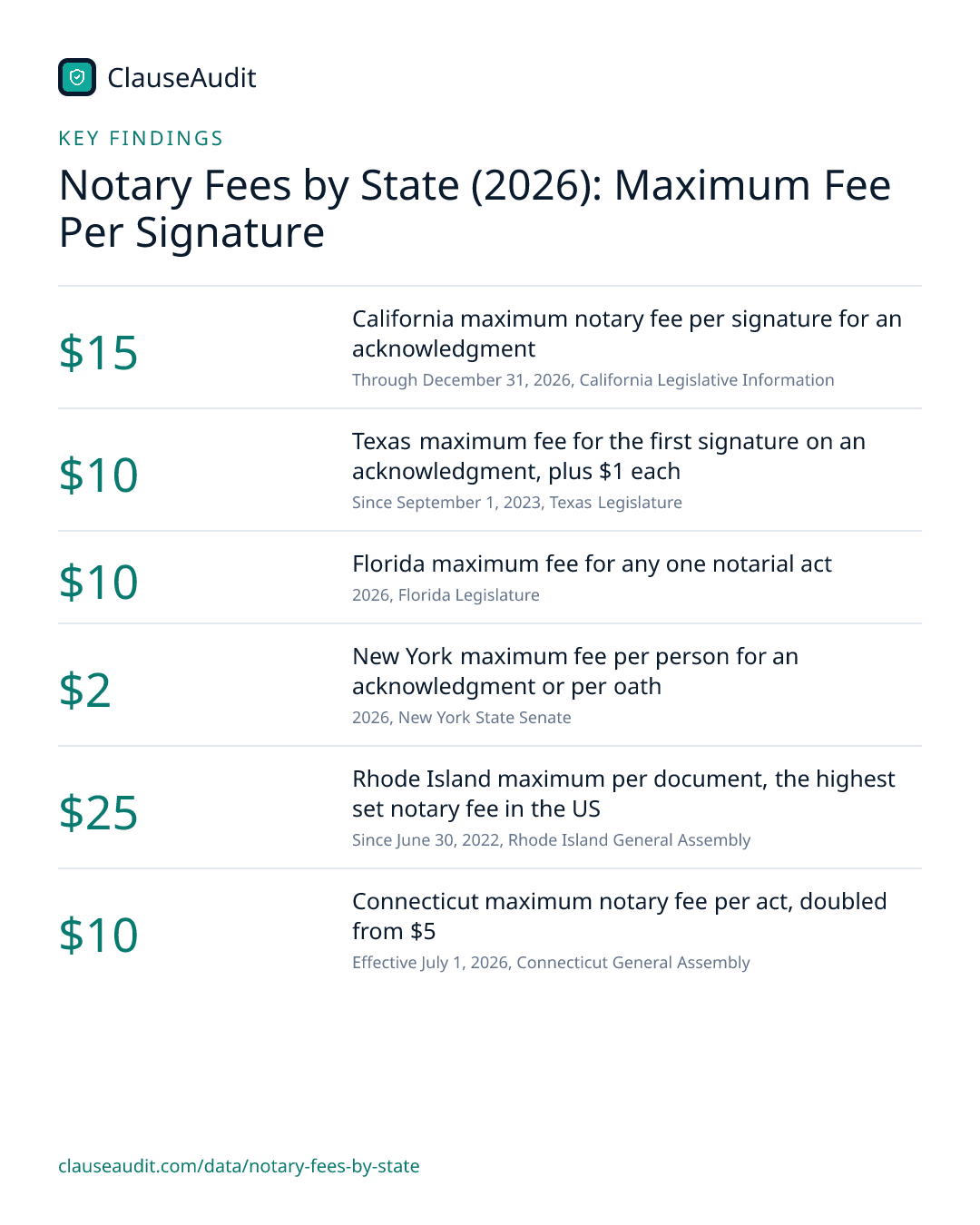
- California maximum notary fee per signature for an acknowledgment (Through December 31, 2026, California Legislative Information)
- $15
- Texas maximum fee for the first signature on an acknowledgment, plus $1 each (Since September 1, 2023, Texas Legislature)
- $10
- Florida maximum fee for any one notarial act (2026, Florida Legislature)
- $10
- New York maximum fee per person for an acknowledgment or per oath (2026, New York State Senate)
- $2
- Rhode Island maximum per document, the highest set notary fee in the US (Since June 30, 2022, Rhode Island General Assembly)
- $25
- Connecticut maximum notary fee per act, doubled from $5 (Effective July 1, 2026, Connecticut General Assembly)
- $10
- Georgia maximum notary fee per notarial act (2026, Georgia Superior Court Clerks' Cooperative Authority)
- $2
- Ohio maximum fee for an online notarization, plus up to $10 technology fee (2026, Ohio Legislative Service Commission)
- $30
A notary stamp is cheap in most states. But the price is set by state law, not by the notary, and the rules differ more than most people expect. Some states charge per signature, some per act, some per document.
This page shows the legal maximum in every state plus DC for 2026, what remote and travel charges look like, and which states have raised their caps recently. If a contract makes you pay for notarization, or you are hiring a mobile notary for a closing, start here.
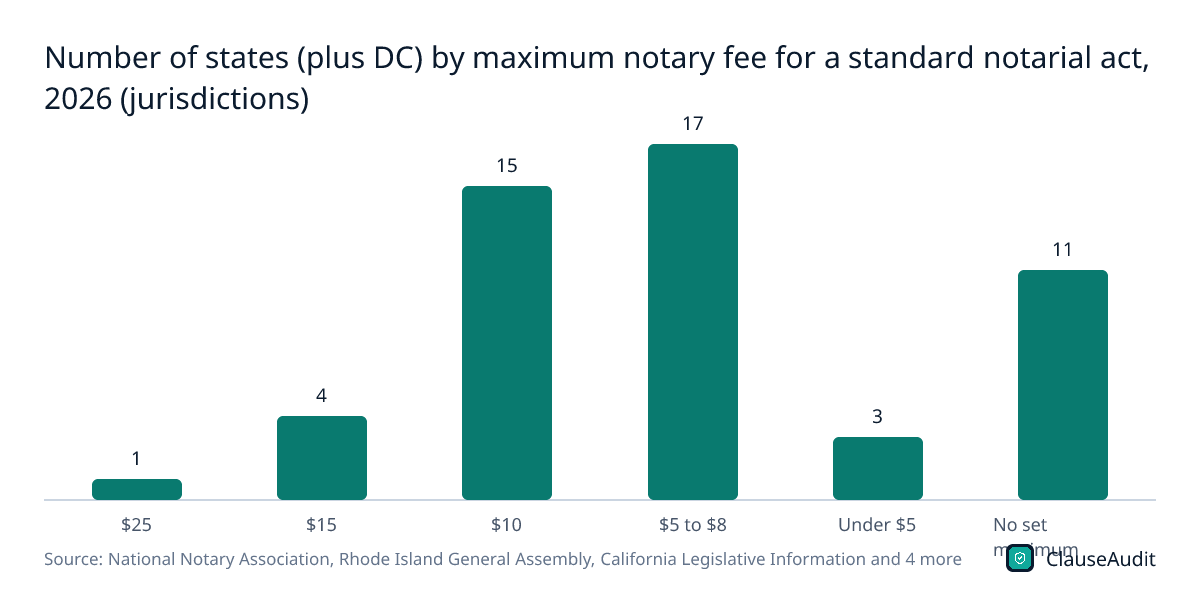
Number of states (plus DC) by maximum notary fee for a standard notarial act, 2026 (jurisdictions)
Chart data
| Label | Value (jurisdictions) |
|---|---|
| $25 | 1 |
| $15 | 4 |
| $10 | 15 |
| $5 to $8 | 17 |
| Under $5 | 3 |
| No set maximum | 11 |
Most caps are low: 17 jurisdictions cap a standard act at $5 to $8, and only 1 goes above $15. The 11 with no set maximum are the ones where you should ask for the price before the appointment.
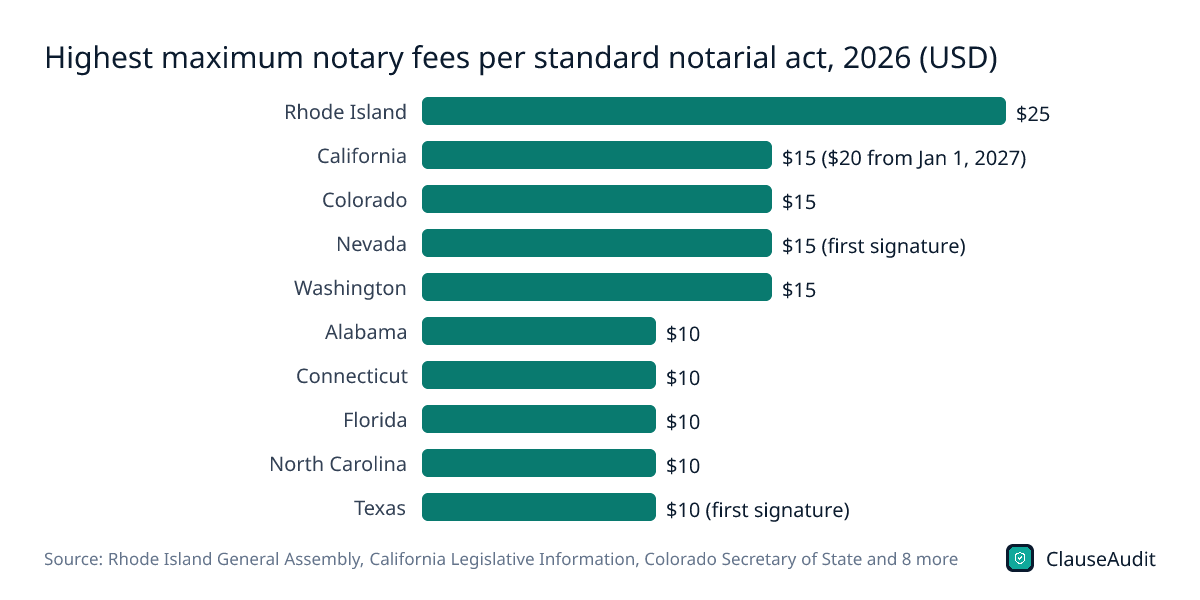
Download this chart (PNG)Highest maximum notary fees per standard notarial act, 2026 (USD)
Chart data
| Label | Value |
|---|---|
| Rhode Island | $25 |
| California | $15 ($20 from Jan 1, 2027) |
| Colorado | $15 |
| Nevada | $15 (first signature) |
| Washington | $15 |
| Alabama | $10 |
| Connecticut | $10 |
| Florida | $10 |
| North Carolina | $10 |
| Texas | $10 (first signature) |
Rhode Island stands alone at $25, but it counts per document, while Nevada and Texas price the first signature and charge less for each one after. Compare how the fee is counted, not just the headline figure.
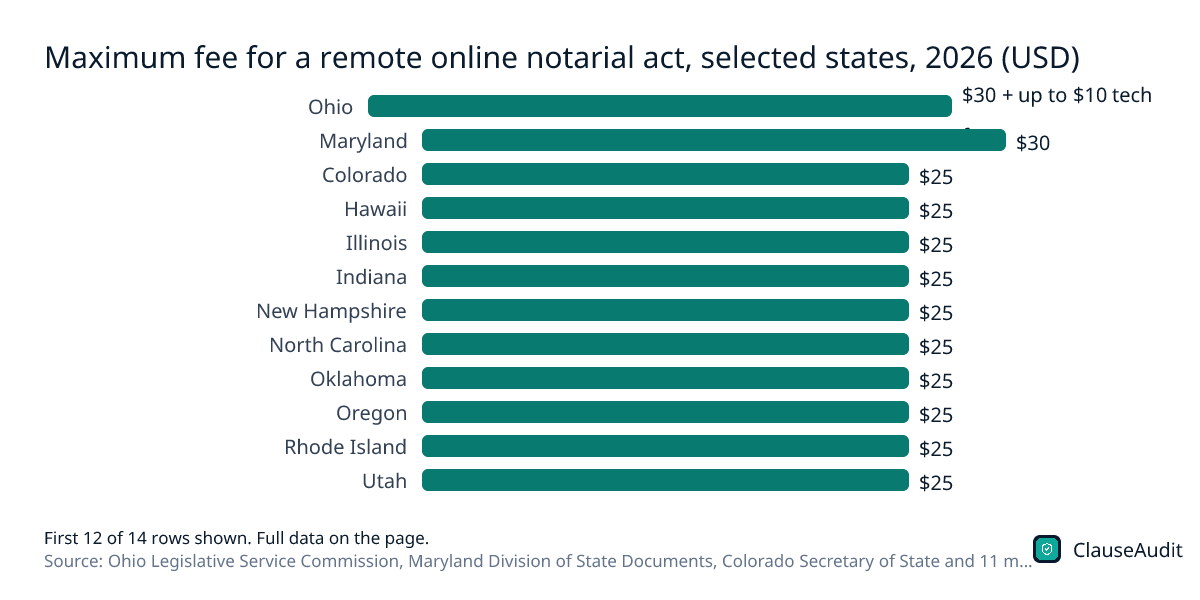
Download this chart (PNG)Maximum fee for a remote online notarial act, selected states, 2026 (USD)
Chart data
| Label | Value |
|---|---|
| Ohio | $30 + up to $10 tech fee |
| Maryland | $30 |
| Colorado | $25 |
| Hawaii | $25 |
| Illinois | $25 |
| Indiana | $25 |
| New Hampshire | $25 |
| North Carolina | $25 |
| Oklahoma | $25 |
| Oregon | $25 |
| Rhode Island | $25 |
| Utah | $25 |
| Washington | $25 |
| Pennsylvania | +$20 on top of regular fee |
Remote online notarization costs more than a paper act in every state on this chart. Ohio allows $30 plus a technology fee of up to $10, and a long list of states settle at $25 per remote act.
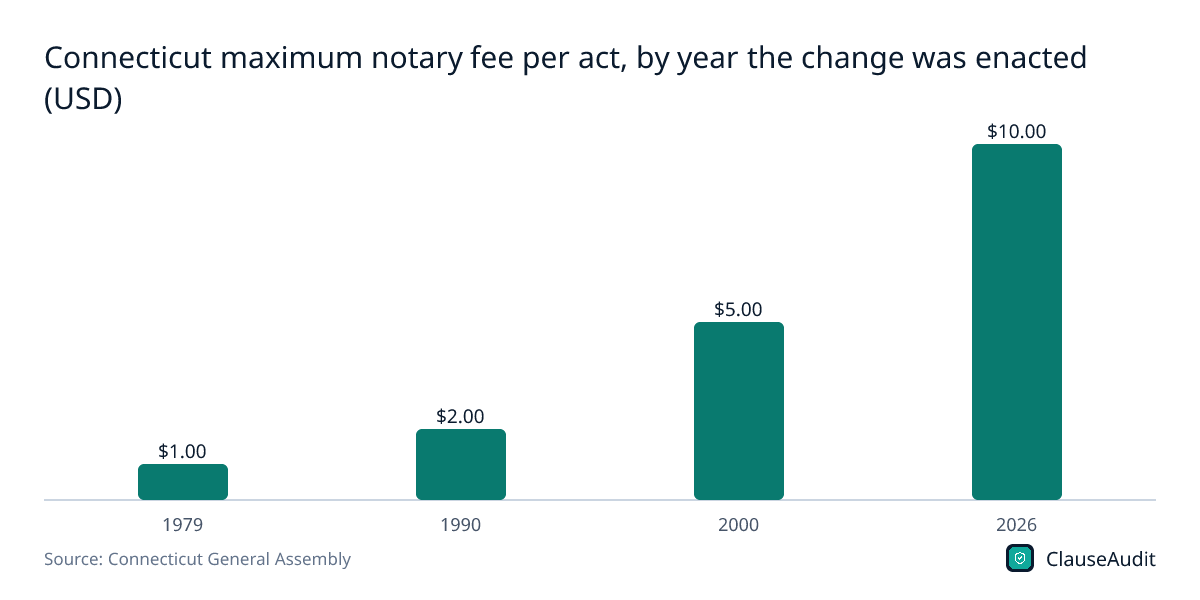
Download this chart (PNG)Connecticut maximum notary fee per act, by year the change was enacted (USD)
Chart data
| Label | Value (USD) |
|---|---|
| 1979 | $1.00 |
| 1990 | $2.00 |
| 2000 | $5.00 |
| 2026 | $10.00 |
Connecticut's cap went from $1 in 1979 to $10 in 2026. The latest jump, from $5 to $10 on July 1, 2026, was the first change since the 2000 increase.
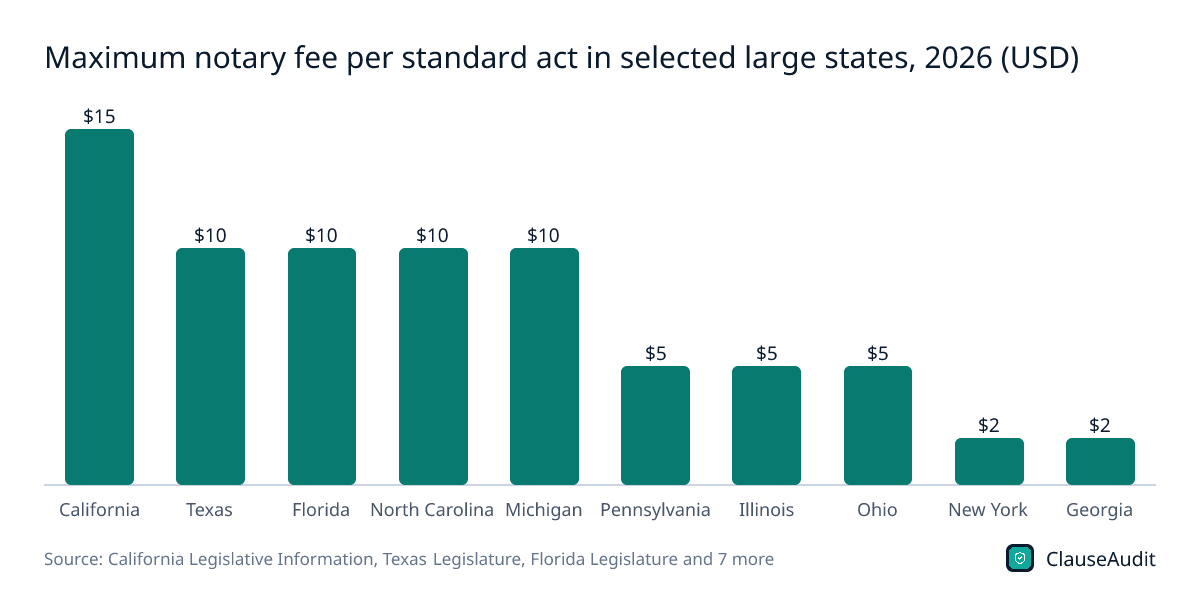
Download this chart (PNG)Maximum notary fee per standard act in selected large states, 2026 (USD)
Chart data
| Label | Value (USD) |
|---|---|
| California | $15 |
| Texas | $10 |
| Florida | $10 |
| North Carolina | $10 |
| Michigan | $10 |
| Pennsylvania | $5 |
| Illinois | $5 |
| Ohio | $5 |
| New York | $2 |
| Georgia | $2 |
Population does not predict price. California allows $15 and Texas and Florida $10, while New York holds at $2, the same as Georgia.
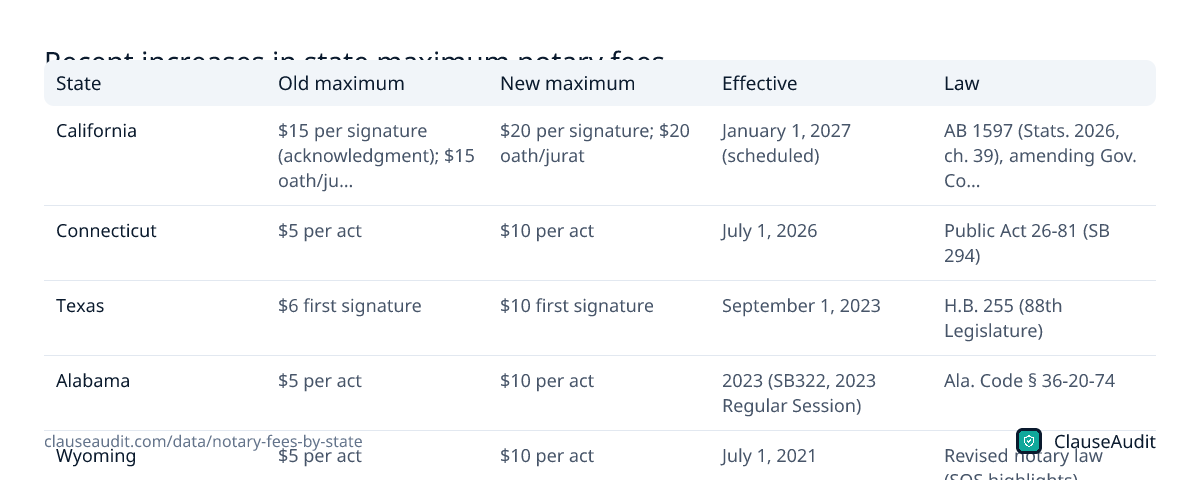
Download this chart (PNG)Recent increases in state maximum notary fees
| State | Old maximum | New maximum | Effective | Law |
|---|---|---|---|---|
| California | $15 per signature (acknowledgment); $15 oath/jurat | $20 per signature; $20 oath/jurat | January 1, 2027 (scheduled) | AB 1597 (Stats. 2026, ch. 39), amending Gov. Code § 8211 |
| Connecticut | $5 per act | $10 per act | July 1, 2026 | Public Act 26-81 (SB 294) |
| Texas | $6 first signature | $10 first signature | September 1, 2023 | H.B. 255 (88th Legislature) |
| Alabama | $5 per act | $10 per act | 2023 (SB322, 2023 Regular Session) | Ala. Code § 36-20-74 |
| Wyoming | $5 per act | $10 per act | July 1, 2021 | Revised notary law (SOS highlights) |
Source: California Legislative Information (bill text); chaptered status via GovBuddy, AB 1597 (Castillo), Notary public: service fees, amending Gov. Code § 8211; Chapter 39, Statutes of 2026; Connecticut General Assembly, Public Act No. 26-81 (Substitute Senate Bill No. 294), Sec. 13 amending § 3-95; Texas Legislature, H.B. No. 255, 88th Legislature (amending Gov. Code § 406.024), enrolled; Alabama Legislature, SB322 (2023 Regular Session), enrolled, amending Ala. Code § 36-20-74; Wyoming Secretary of State, New Notary Law Highlights, Effective 07.01.2021. Download as image
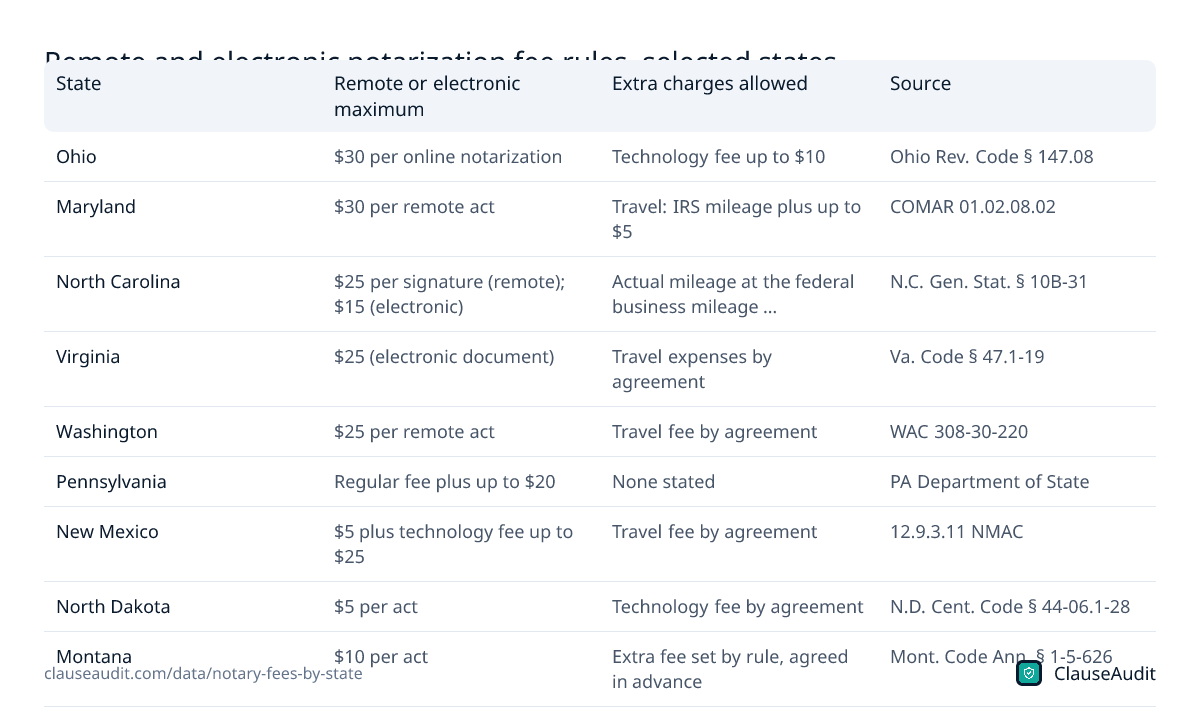
Remote and electronic notarization fee rules, selected states
| State | Remote or electronic maximum | Extra charges allowed | Source |
|---|---|---|---|
| Ohio | $30 per online notarization | Technology fee up to $10 | Ohio Rev. Code § 147.08 |
| Maryland | $30 per remote act | Travel: IRS mileage plus up to $5 | COMAR 01.02.08.02 |
| North Carolina | $25 per signature (remote); $15 (electronic) | Actual mileage at the federal business mileage rate, if agreed by the principal in writing before travel | N.C. Gen. Stat. § 10B-31 |
| Virginia | $25 (electronic document) | Travel expenses by agreement | Va. Code § 47.1-19 |
| Washington | $25 per remote act | Travel fee by agreement | WAC 308-30-220 |
| Pennsylvania | Regular fee plus up to $20 | None stated | PA Department of State |
| New Mexico | $5 plus technology fee up to $25 | Travel fee by agreement | 12.9.3.11 NMAC |
| North Dakota | $5 per act | Technology fee by agreement | N.D. Cent. Code § 44-06.1-28 |
| Montana | $10 per act | Extra fee set by rule, agreed in advance | Mont. Code Ann. § 1-5-626 |
Source: Ohio Legislative Service Commission, Ohio Revised Code § 147.08 (fees); Maryland Division of State Documents, COMAR 01.02.08.02 Charges and Fees; North Carolina General Assembly, N.C. Gen. Stat. § 10B-31 (fees for notarial acts); Virginia Legislative Information System, Code of Virginia § 47.1-19 (fees); Washington State Legislature, WAC 308-30-220 Fees for notarial acts; Pennsylvania Department of State, Notary Public Fees; New Mexico State Records Center and Archives, 12.9.3.11 NMAC Technology Fees (New Mexico Register Vol. XXXII, Issue 22); New Mexico Secretary of State, New Mexico Notary Public Handbook; North Dakota Legislative Branch, North Dakota Century Code § 44-06.1-28 (fees for notarial acts); Montana Legislature, Montana Code Annotated § 1-5-626 (fees for notarial acts). Download as image
Maximum notary fee for a standard notarial act by state
- 1$25
- 4$15
- 15$10
- 17$5 to $8
- 3Under $5
- 11No set maximum
- $251
- $154
- $1015
- $5 to $817
- Under $53
- No set maximum11
| State | Maximum fee | How the fee is counted | Source |
|---|---|---|---|
| Alabama | $10 | Per notarial act | Ala. Code § 36-20-74 |
| Alaska | No set maximum | Notary sets fee | National Notary Association, 2026 Notary Fees By State |
| Arizona | $10 | Per notary signature (acknowledgment or jurat); per act (oath) | A.A.C. R2-12-1102 |
| Arkansas | No set maximum | Notary sets fee | National Notary Association, 2026 Notary Fees By State |
| California | $15 through Dec 31, 2026; $20 from Jan 1, 2027 | Per signature (acknowledgment); per person (oath and jurat) | Cal. Gov. Code § 8211 |
| Colorado | $15 | Per document | Colorado Secretary of State, Notary Public FAQs: Fees |
| Connecticut | $10 | Per notarial act | Conn. Gen. Stat. § 3-95, as amended by Public Act 26-81 |
| Delaware | $5 | Per notarial act on a tangible record | 29 Del. C. § 4311 |
| District of Columbia | $5 | Per notarial act | DC Office of the Secretary, Frequently Asked Questions: Office of Notary Commissions and Authentications |
| Florida | $10 | Per notarial act | Fla. Stat. § 117.05(2)(a) |
| Georgia | $2 | Per notarial act | O.C.G.A. § 45-17-11 |
| Hawaii | $5 | Per party signing (acknowledgment); per oath | Haw. Rev. Stat. § 456-17 |
| Idaho | $5 | Per notarial act | Idaho Secretary of State, Notary Public (FAQ: What fees may I charge?) |
| Illinois | $5 | Per notarial act (non-electronic) | 5 ILCS 312/3-104 |
| Indiana | $10 | Per individual notarization | Ind. Code § 33-42-14-1 |
| Iowa | No set maximum | Not set in Iowa Code ch. 9B | Iowa Code ch. 9B |
| Kansas | No set maximum | Notary sets fee | K.A.R. 7-43-16 |
| Kentucky | No set maximum | Notary sets fee | National Notary Association, 2026 Notary Fees By State |
| Louisiana | No set maximum | Notary sets fee | National Notary Association, 2026 Notary Fees By State |
| Maine | No set maximum | Notary sets fee | National Notary Association, 2026 Notary Fees By State |
| Maryland | $8 | Per notarial act | COMAR 01.02.08.02 |
| Massachusetts | No set maximum | Notary sets fee | National Notary Association, 2026 Notary Fees By State |
| Michigan | $10 | Per individual transaction or notarial act | MCL 55.285(7) |
| Minnesota | $5 (oath) | Per oath; acknowledgments use fees allowed other officers | Minn. Stat. § 357.17 |
| Mississippi | $5 | Per signature (acknowledgment, jurat, witnessing); per person (oath) | Secretary of State rule under Miss. Code § 25-34-51 et seq. |
| Missouri | $5 | Per signature | RSMo § 486.685 |
| Montana | $10 | Per notarial act | Mont. Code Ann. § 1-5-626 |
| Nebraska | $5 | Per acknowledgment | Neb. Rev. Stat. § 33-133 |
| Nevada | $15 | First signature of each signer (acknowledgment); per signature (jurat) | NRS 240.100 |
| New Hampshire | $10 | Per oath, witness, service or certification | RSA 455:11 |
| New Jersey | $2.50 | Per act; flat $15 or $25 for real estate closings | N.J.S.A. 22A:4-14; N.J.A.C. 17:50-1.18 |
| New Mexico | $5 | Per acknowledgment or jurat; per person (oath) | NMSA 1978, § 14-14A-28 |
| New York | $2 | Per person (acknowledgment); per oath | N.Y. Exec. Law § 136 |
| North Carolina | $10 | Per notarized principal signature | N.C. Gen. Stat. § 10B-31 |
| North Dakota | $5 | Per notarial act | N.D. Cent. Code § 44-06.1-28 |
| Ohio | $5 | Per notarial act, not per signature | Ohio Rev. Code § 147.08 |
| Oklahoma | $5 | Per notarial act | 49 O.S. § 5; 49 O.S. § 209 |
| Oregon | $10 | Per notarial act | OAR 160-100-0400; ORS 194.400 |
| Pennsylvania | $5 | First name on an acknowledgment; $2 each additional name | Fees set by Department of State regulation |
| Rhode Island | $25 | Per document or notarization | R.I. Gen. Laws § 42-30.1-20.1 |
| South Carolina | $5 | Per signature (acknowledgment, jurat, witnessing); per person (oath) | S.C. Code § 26-1-100 |
| South Dakota | No set maximum | Fee per instrument, amount not set | South Dakota Secretary of State, South Dakota Notary Public Handbook |
| Tennessee | No set maximum | Notary sets fee | National Notary Association, 2026 Notary Fees By State |
| Texas | $10 | First signature; $1 each additional signature | Tex. Gov't Code § 406.024 |
| Utah | $10 | Per signature (acknowledgment, jurat); per person (oath) | Utah Code § 46-1-12 |
| Vermont | No set maximum | Notary sets fee | National Notary Association, 2026 Notary Fees By State |
| Virginia | $10 | Per notarial act (paper) | Va. Code § 47.1-19 |
| Washington | $15 | Per notarial act | WAC 308-30-220 |
| West Virginia | $10 | Per signature notarized | W. Va. Code § 39-4-30 |
| Wisconsin | $5 | Per document (acknowledgment) | Wis. Stat. § 140.02(9)(e) |
| Wyoming | $10 | Per notarial act | Wyoming Secretary of State, New Notary Law Highlights, Effective 07.01.2021 |
How much can a notary charge per signature?
The honest answer is that it depends on what your state counts. California's $15 applies to each signature on an acknowledgment. Texas allows $10 for the first signature and $1 for each one after that. Florida caps any one notarial act at $10. Rhode Island's $25 is counted per document or notarization. Ohio is explicit that its $5 is per act, not per signature.
So a mortgage packet with a long run of signature lines can cost very different amounts in two states with the same headline cap. If you are signing a stack of papers, ask the notary how many acts they will count before they start stamping. A per-document state like Rhode Island or Colorado treats that stack very differently from a per-signature state like California or West Virginia.
Pennsylvania shows how fine the rules can get: $5 for the first name on an acknowledgment and $2 for each additional name. New Jersey keeps ordinary acts at $2.50 but sets flat fees for real estate closings, $15 for all grantor services and $25 for mortgagor services in a financing.
Which state has the highest notary fees?
Rhode Island, at $25 per document or notarization since June 30, 2022. After that comes a group at $15: California, Colorado, Nevada and Washington. Colorado counts per document, Nevada counts the first signature of each signer, and Washington counts per act.
The bigger story is the direction of travel. Caps are going up. Connecticut doubled its fee from $5 to $10 effective July 1, 2026. Texas raised its first-signature fee from $6 to $10 on September 1, 2023. Alabama went from $5 to $10 in 2023, and Wyoming did the same on July 1, 2021.
California is next. AB 1597 raises the acknowledgment fee and the oath and jurat fee from $15 to $20 starting January 1, 2027. If you sign a long contract in California late in 2026 that has you paying notary costs in 2027 and beyond, expect the higher number.
Can a notary charge for travel or a mobile visit?
Usually yes, and this is where the bill grows. The per-act cap covers the stamp. Travel is handled separately, and several states only allow it if you agree first.
Nevada caps travel at $15 an hour during the day and $30 an hour at night. Maryland allows IRS mileage plus up to $5. Connecticut now ties travel to the IRS business mileage rate. North Carolina lets a notary charge actual mileage only if the signer agrees in writing before the trip. Michigan, Washington, Virginia, Montana and North Dakota also allow travel fees by agreement.
In the 11 places with no set maximum, the notary sets the price. Kansas is a good model of what fair dealing looks like there: a fee is allowed only if it is disclosed as not required by law, agreed before the notarization, collected at the time and written in the journal. Wherever you live, get the full price, travel included, in a text or email before anyone drives over.
How much does remote online notarization cost?
More than a standard paper act. Ohio allows up to $30 per online notarization plus a technology fee of up to $10. Maryland caps remote acts at $30. Colorado, Hawaii, Illinois, Indiana, New Hampshire, North Carolina, Oklahoma, Oregon, Rhode Island, Utah and Washington all land at $25.
Some states stack charges instead. Pennsylvania lets electronic and remote notaries add up to $20 on top of the regular fee. New Mexico allows the $5 base fee plus a technology fee of up to $25. North Dakota and Montana allow extra fees for technology if you agree in advance.
The trade is usually worth it for a signer across the country or a business closing on a tight timeline. Before you book, ask whether the platform adds its own charge on top of the notary's fee.
What notary fees mean for freelancers and small businesses
On one document, notary fees are small. They add up when notarization is built into how a deal works. Think of a contractor who has to notarize lien waivers with every payment draw, a landlord who wants a notarized guaranty from each new commercial tenant, or a lender who sends a signing agent to every member of an LLC.
The question your contract should answer is who pays. Many agreements say nothing, and the cost lands on whoever happens to be holding the pen. A freelancer asked to notarize an IP assignment or a sworn statement for a client is doing paperwork for that client's benefit. It is fair to ask the client to cover the notary, the travel and any remote platform fee.
Watch for vague wording like "all closing costs" or "costs of execution" in a loan or purchase agreement. That can quietly include signing-agent fees above the state cap for the act itself, because the agent charges for the service and the travel, not just the stamp.
A simple fix is to name it. Add a sentence saying the party that requires notarization pays for it, including travel and any remote platform fee. It costs nothing to ask for, and many clients and landlords will agree because the amount is small to them. If you sign the same kind of contract often, put that sentence in your own template so you never have to argue about it again.
How to keep notary costs fair
- Look up your state's cap and how it counts, per signature, per act or per document.
- Ask for the full price in writing, including travel and any technology fee, before the appointment.
- In a no-maximum state, ask whether the notary records fees in a journal and get a receipt.
- Ask your bank, credit union or employer if it offers notarization to customers or staff.
- Put a line in your contract that names who pays notarization, travel and remote platform fees.
- If your state's cap is changing, as California's is on January 1, 2027, check the date of the signing.
How ClauseAudit helps
Notary costs rarely show up by name in a contract. They hide inside clauses about closing costs, execution, deliverables and expenses. ClauseAudit's automated review reads those clauses and flags the ones that shift paperwork costs onto you.
Upload the agreement before you sign and you will see, in plain English, what you are agreeing to pay for and what to ask the other side to change.
- Expense and cost clauses that make you pay notary, travel or remote platform fees
- Closing cost language broad enough to include signing-agent charges
- Requirements to notarize lien waivers, affidavits or assignments with every payment
- Personal guaranty clauses that must be notarized and signed by you as an individual
- Signature and execution clauses that require wet ink when e-signatures would do
- Reimbursement terms that say when, and whether, the other side pays you back
Frequently asked questions
How much does it cost to get something notarized?
In most states the legal cap for a standard act is between $5 and $15. Rhode Island allows the most at $25 per document, and New York and Georgia allow just $2. Travel, remote platform fees and multiple signatures can push the total higher, so ask for the full price before the appointment.
Can a notary charge whatever they want?
Not in most states. Only 11 states have no set maximum for a standard notarial act. Everywhere else, charging more than the cap for the act itself breaks state law. Travel and technology fees are often handled separately and may be allowed if you agree to them in advance.
How much is a notary in California in 2026?
Up to $15 per signature on an acknowledgment, and $15 per person for an oath or jurat, through December 31, 2026. AB 1597 raises both to $20 starting January 1, 2027. If several people sign, each signature on the acknowledgment can be charged separately.
How much does a notary charge in Texas?
Texas allows $10 for the first signature on an acknowledgment and $1 for each additional signature. An oath or affirmation with certificate and seal is also $10. The first-signature fee went up from $6 on September 1, 2023, under H.B. 255.
What is the notary fee in Florida?
Florida caps the fee at $10 for any one notarial act. There are separate rules for marriages and online notarization, and a notary may not charge a fee to witness a vote-by-mail ballot. Before you sign, ask if your documents count as one act or several.
Why is a notary only $2 in New York?
New York's Executive Law sets the fee at $2 per person for an acknowledgment and $2 per oath, with $2 for each additional person and each witness sworn. That covers the act itself. A mobile notary or signing agent may still bill you for travel or other services, so get the total in writing.
Is a mobile notary allowed to charge a travel fee?
In many states, yes, if you agree first. Nevada caps travel at $15 an hour by day and $30 an hour at night. Maryland allows IRS mileage plus up to $5. North Carolina requires your written agreement before the notary travels. Always confirm the travel charge before booking.
Who pays notary fees in a contract?
Whoever the contract says, and if it says nothing, usually the person who needs the document notarized. In loans and property deals, notary and signing-agent costs are often folded into closing costs. Read the expenses clause and ask to have the other side cover notarization they require.
Use this data
Every chart and card below is free to reuse under CC BY 4.0. Download what you need and link back to this page.
 Stat cards
 Key findings card
 Infographic
 Number of states (plus DC) by maximum notary fee for a standard notarial act, 2026 (jurisdictions)
 Highest maximum notary fees per standard notarial act, 2026 (USD)
 Maximum fee for a remote online notarial act, selected states, 2026 (USD)
 Connecticut maximum notary fee per act, by year the change was enacted (USD)
 Maximum notary fee per standard act in selected large states, 2026 (USD)
 Recent increases in state maximum notary fees
 Remote and electronic notarization fee rules, selected states
Embed the infographic
Free to share on your site, blog or slides under CC BY 4.0. Please keep the credit link.
Sources and method
Every number on this page comes from the sources below, each opened and read on or before October 18, 2026. A second, independent review checked every figure against its source and corrected anything that did not match. 51 of 51 state entries were confirmed; any that could not be are marked "Not yet confirmed" and left out of every count and chart.
- National Notary Association, 2026 Notary Fees By State (Last updated Jul 1, 2026 (read via Internet Archive snapshot of 2026-08-25))
- California Legislative Information, California Government Code § 8211 (notary fees) (Section in force through December 31, 2026 (as captured 2024-06-12); amended by AB 1597 effective January 1, 2027)
- Texas Legislature, H.B. No. 255, 88th Legislature (amending Gov. Code § 406.024), enrolled (Enrolled 2023; effective September 1, 2023)
- Florida Legislature, Florida Statutes § 117.05 (use of notary commission; fees) (2026 Florida Statutes)
- New York State Senate, New York Executive Law § 136 (notarial fees) (Page revision dated 2023-02-10)
- Virginia Legislative Information System, Code of Virginia § 47.1-19 (fees) (Accessed 2026-10-18)
- Minnesota Office of the Revisor of Statutes, Minnesota Statutes § 357.17 (notaries public fees) (2025 Minnesota Statutes)
- Delaware Code Online, Delaware Code Title 29 § 4311 (fees for services) (Accessed 2026-10-18)
- South Carolina Legislature, South Carolina Code § 26-1-100 (fees for notary acts) (Accessed 2026-10-18)
- Montana Legislature, Montana Code Annotated § 1-5-626 (fees for notarial acts) (Accessed 2026-10-18)
- North Dakota Legislative Branch, North Dakota Century Code § 44-06.1-28 (fees for notarial acts) (Accessed 2026-10-18)
- Oklahoma Senate, Oklahoma Statutes Title 49 (§ 5 and § 209) (Compilation posted 2019-12, includes Laws 2019 c. 338 eff. Jan. 1, 2020)
- Washington State Legislature, WAC 308-30-220 Fees for notarial acts (WSR 24-11-162, effective 6/22/24)
- Nebraska Legislature, Nebraska Revised Statutes § 33-133 (notaries public; fees) (As captured 2026-06-06)
- North Carolina General Assembly, N.C. Gen. Stat. § 10B-31 (fees for notarial acts) (As captured 2026-06-17)
- Ohio Legislative Service Commission, Ohio Revised Code § 147.08 (fees) (As captured 2026-07-08)
- Illinois General Assembly, 5 ILCS 312/3-104 (maximum fee) (As captured 2025-08-06)
- Hawaii State Legislature, Hawaii Revised Statutes § 456-17 (fees) (As amended L 2021, c 230; captured 2025-03-10)
- Connecticut General Assembly, Public Act No. 26-81 (Substitute Senate Bill No. 294), Sec. 13 amending § 3-95 (Approved May 26, 2026; Sec. 13 effective July 1, 2026)
- Connecticut General Assembly, Connecticut General Statutes Chapter 33, § 3-95 (fees of notary), history note (As captured 2026-10-04 (text before PA 26-81 was codified))
- Colorado Secretary of State, Notary Public FAQs: Fees (Accessed 2026-10-18)
- Maryland Division of State Documents, COMAR 01.02.08.02 Charges and Fees (Accessed 2026-10-18)
- Pennsylvania Department of State, Notary Public Fees (Accessed 2026-10-18)
- Arizona Secretary of State, Notary Public Rules, A.A.C. R2-12-1102 (Notary Public Fees) and Exhibit 1 (2018 rule; PDF as captured 2024-04-13)
- Alabama Legislature, SB322 (2023 Regular Session), enrolled, amending Ala. Code § 36-20-74 (2023 Regular Session)
- Idaho Secretary of State, Notary Public (FAQ: What fees may I charge?) (Accessed 2026-10-18)
- Georgia Superior Court Clerks' Cooperative Authority, Georgia Notary Law (Fees of Notaries) (Accessed 2026-10-18)
- Rhode Island General Assembly, R.I. Gen. Laws § 42-30.1-20.1 (fees to perform notarial acts) (P.L. 2022, ch. 438 and 439, effective June 30, 2022; captured 2025-03-26)
- Missouri Revisor of Statutes, RSMo § 486.685 (fees) (Effective 8/28/2020; captured 2026-09-23)
- Nevada Legislature, NRS 240.100 (fees for services) (As captured 2026-04-13)
- Michigan Legislature, MCL 55.285 (Michigan Notary Public Act) (Am. 2018, Act 330; captured 2025-07-15)
- West Virginia Legislature, W. Va. Code § 39-4-30 (maximum fees) (As captured 2025-10-18)
- New Hampshire General Court, RSA 455:11 Notarial Fees (Amended 2021, 206:2, eff. Feb. 6, 2022; captured 2024-05-15)
- Mississippi Secretary of State, Notary rules, Part 5 Chapter 9 (Fees), Rule 9.1 (Administrative Code filing (proposed-rule filing); accessed 2026-10-18)
- Wyoming Secretary of State, New Notary Law Highlights, Effective 07.01.2021 (Effective July 1, 2021)
- Oregon Secretary of State, Traditional, Electronic and Remote Notarization Comparison (PDF modified July 2023)
- New Mexico Secretary of State, New Mexico Notary Public Handbook (Handbook dated 10/02/2023)
- New Mexico State Records Center and Archives, 12.9.3.11 NMAC Technology Fees (New Mexico Register Vol. XXXII, Issue 22) (November 30, 2021; effective 1/1/2022)
- Utah State Legislature, Utah Code § 46-1-12 (fees and notice), 2019 version effective November 1, 2019 (Text read from the Utah Lt. Governor post of November 6, 2019 quoting § 46-1-12 (Internet Archive capture 2020-02-12; live post returns 404 as of 2026-10-18). le.utah.gov showed the 2019 version as current in a 2025-07-07 snapshot; le.utah.gov unreachable 2026-10-18.)
- Indiana Secretary of State, Business Services Division, Indiana Notary Public Guide (Revised May 20, 2024)
- Wisconsin Legislature, Wisconsin Statutes Chapter 140, § 140.02(9) Fees (2023-24 Wis. Stats., published 3-7-25)
- DC Office of the Secretary, Frequently Asked Questions: Office of Notary Commissions and Authentications (Accessed 2026-10-18)
- Kansas Secretary of State, Notary Public (Notary Fee, K.A.R. 7-43-16) (Accessed 2026-10-18)
- South Dakota Secretary of State, South Dakota Notary Public Handbook (PDF dated May 2025)
- Iowa Legislature, Iowa Code Chapter 9B, Notarial Acts (2026 Iowa Code (PDF generated December 2025))
- Legal Information Institute (Cornell) reproduction of the New Jersey Administrative Code, N.J.A.C. 17:50-1.18 Fees for notarial services (Adopted by 54 N.J.R. 268(b), effective 2/7/2022)
- California Legislative Information (bill text); chaptered status via GovBuddy, AB 1597 (Castillo), Notary public: service fees, amending Gov. Code § 8211; Chapter 39, Statutes of 2026 (Introduced January 16, 2026; approved by Governor and chaptered June 30, 2026 (status per https://www.govbuddy.com/california/bills/ab-1597/, last verified there August 17, 2026); operative January 1, 2027)
Cite this page
ClauseAudit, “Notary Fees by State (2026): Maximum Fee Per Signature”, updated October 18, 2026, https://clauseaudit.com/data/notary-fees-by-state. Free to reuse with a link back (CC BY 4.0).
This page summarises published data and law as checked on October 18, 2026. Figures are updated as new editions are released, and your own situation may differ. It is general information, not legal, tax or financial advice.