Late Payment Interest Laws by Country: What Freelancers Can Legally Charge on Overdue Invoices
By ClauseAudit Research · 14 sources ·
What interest can you charge on a late payment?
Where the law sets a rate, it's high. In October 2026 UK businesses can add 8% plus the Bank of England base rate, or 11.75% a year. EU rates run from 10.00% to 14.50%, and India's small-business rule works out to 17.25%. US private clients have no federal rate, so your contract decides.

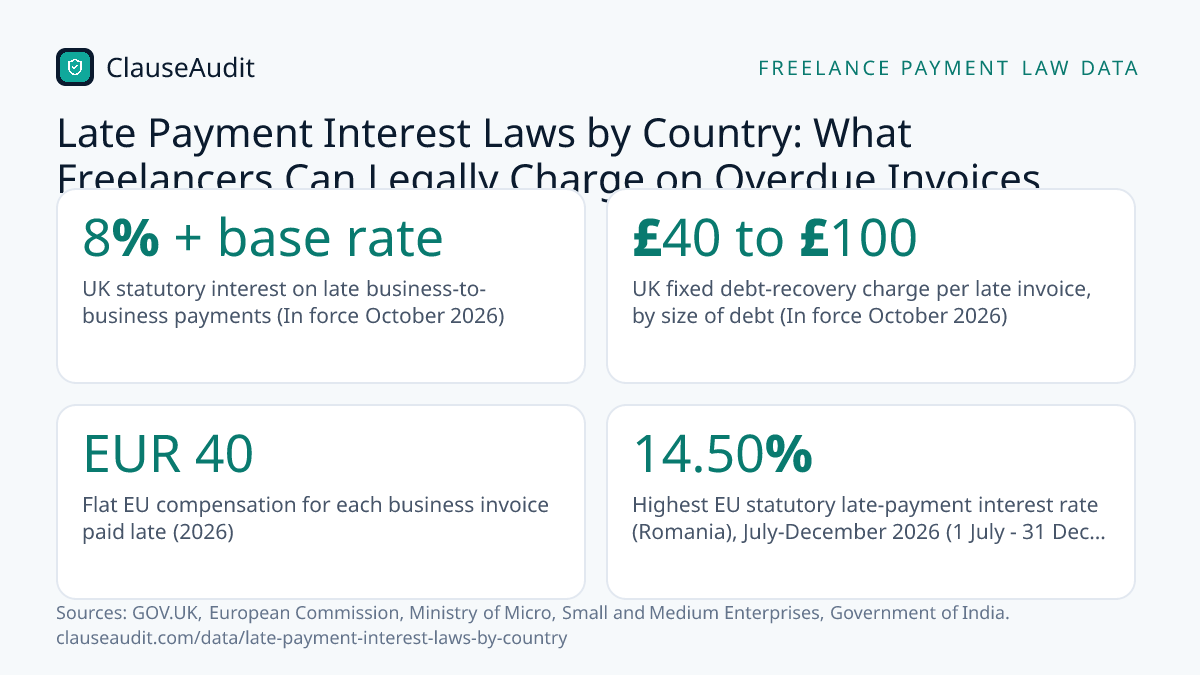
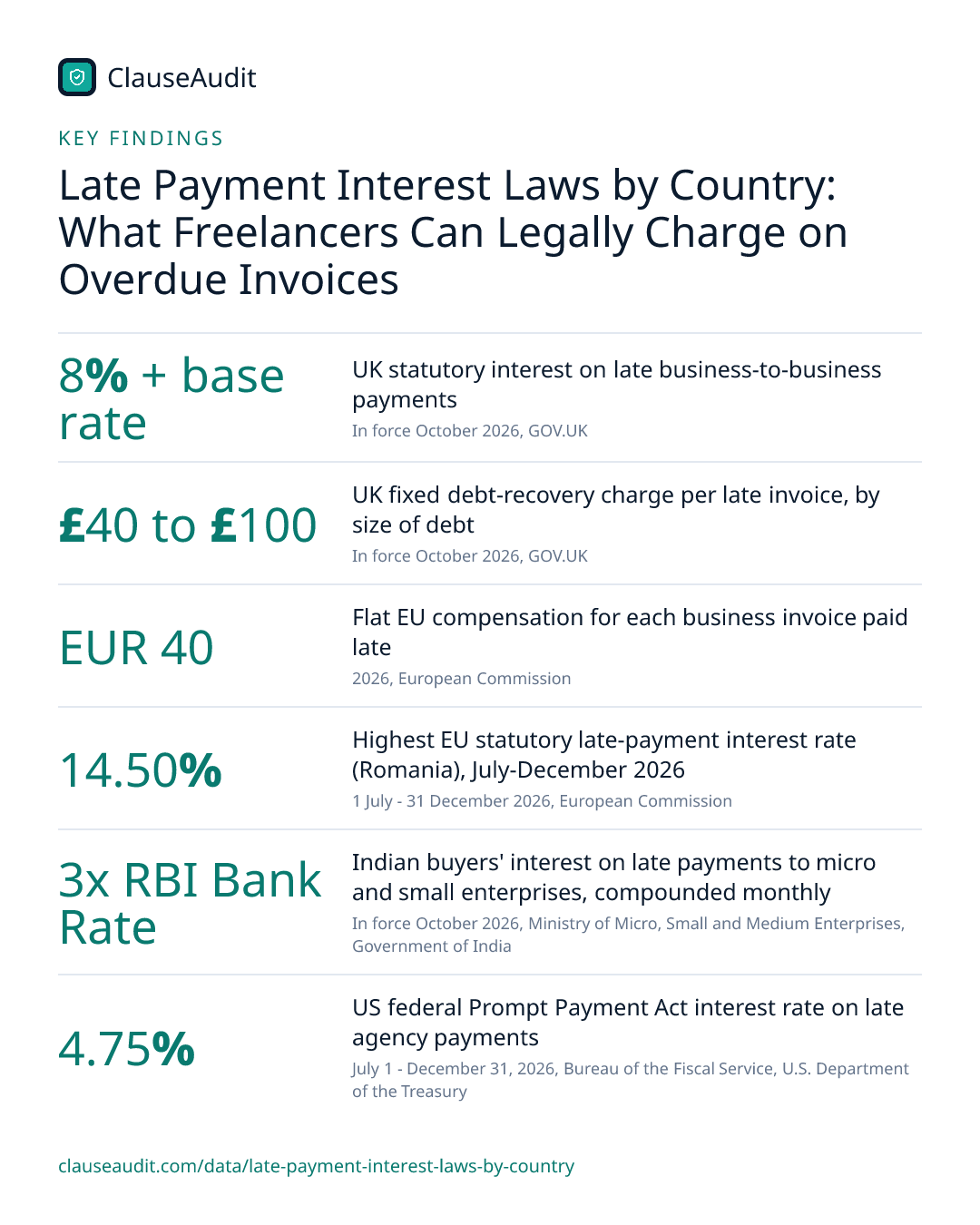
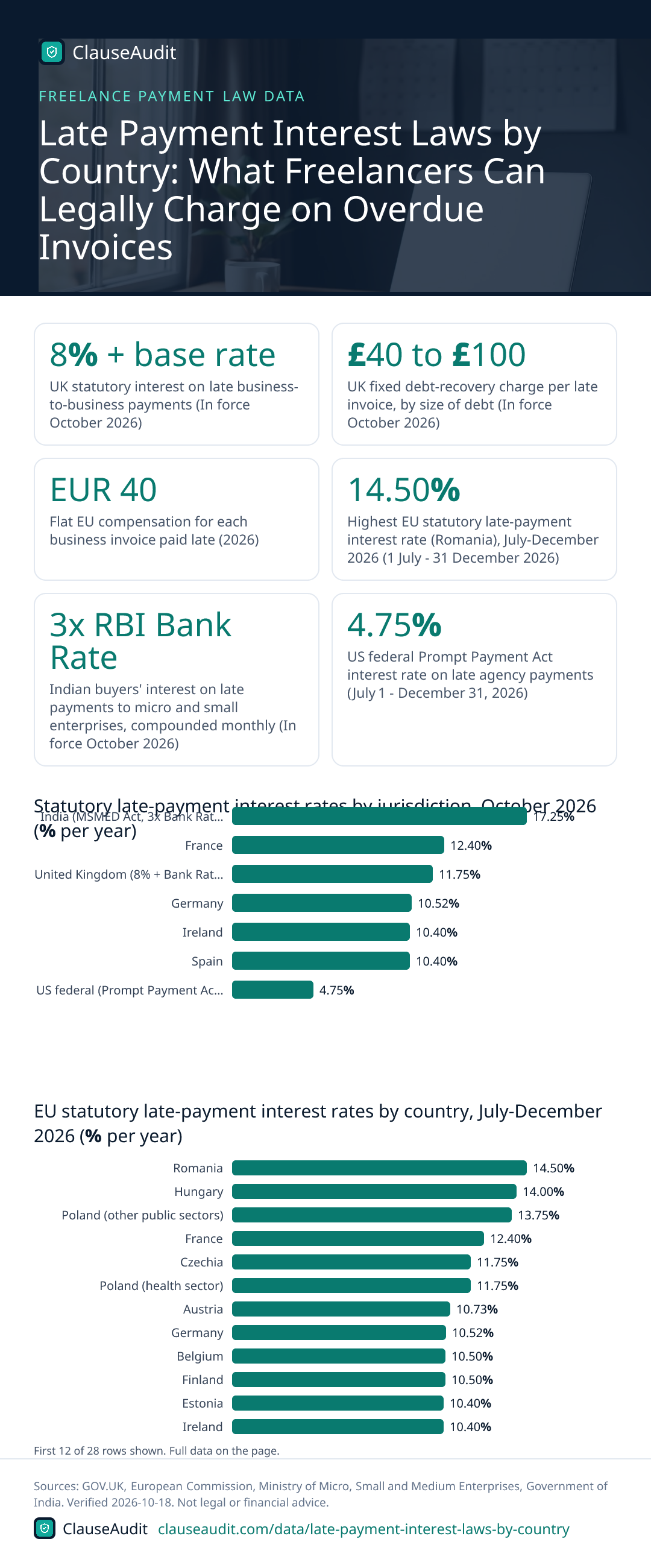
- UK statutory interest on late business-to-business payments (In force October 2026, GOV.UK)
- 8% + base rate
- UK fixed debt-recovery charge per late invoice, by size of debt (In force October 2026, GOV.UK)
- £40 to £100
- Flat EU compensation for each business invoice paid late (2026, European Commission)
- EUR 40
- Highest EU statutory late-payment interest rate (Romania), July-December 2026 (1 July - 31 December 2026, European Commission)
- 14.50%
- Indian buyers' interest on late payments to micro and small enterprises, compounded monthly (In force October 2026, Ministry of Micro, Small and Medium Enterprises, Government of India)
- 3x RBI Bank Rate
- US federal Prompt Payment Act interest rate on late agency payments (July 1 - December 31, 2026, Bureau of the Fiscal Service, U.S. Department of the Treasury)
- 4.75%
- New York freelancers' award when a client breaks the state payment rule (In force October 2026, New York State Senate)
- Double damages
- Delayed-payment applications filed by Indian micro and small enterprises on MSME Samadhaan (Cumulative, read 19 October 2026, Ministry of Micro, Small and Medium Enterprises, Government of India)
- 2,56,892
A client who pays you weeks late is borrowing your money for free. In a lot of countries that's not actually true, because the law already gives you a right to interest and a fixed charge on top. Plenty of freelancers never claim it because they don't know the right is there.
This page compares the statutory rules in the UK, the EU, India and the US as of October 2026. The tables and charts show the rates. The sections below explain which rule applies to you, how a contract clause can replace it, and what to put in writing so you're not relying on a statute you'd rather not cite to a client.
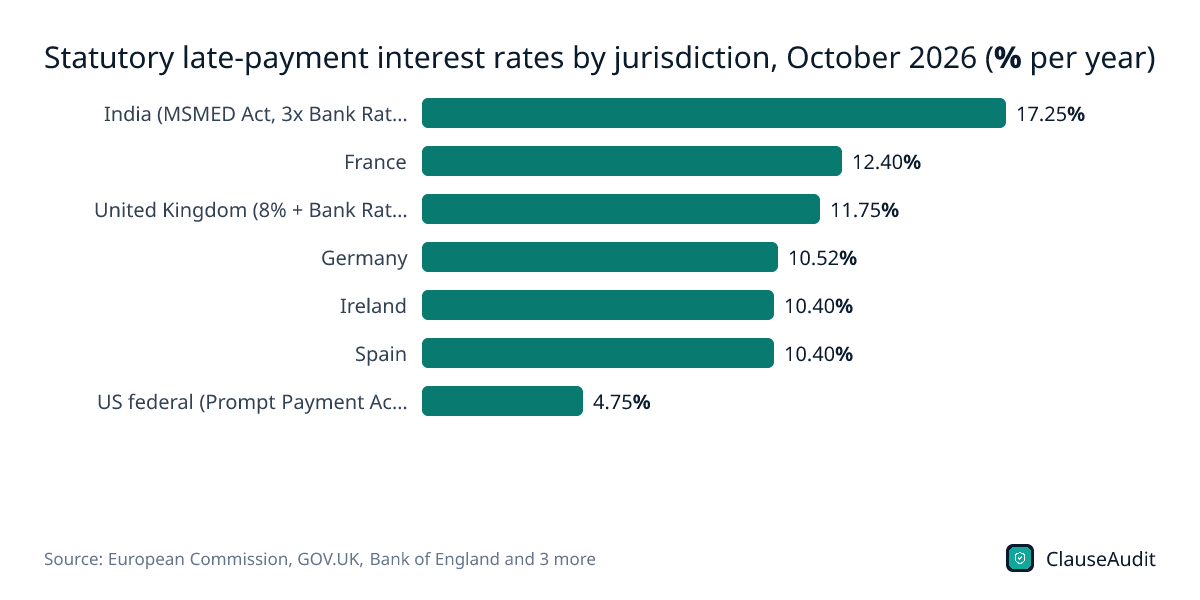
Statutory late-payment interest rates by jurisdiction, October 2026 (% per year)
Chart data
| Label | Value |
|---|---|
| India (MSMED Act, 3x Bank Rate) | 17.25% |
| France | 12.40% |
| United Kingdom (8% + Bank Rate) | 11.75% |
| Germany | 10.52% |
| Ireland | 10.40% |
| Spain | 10.40% |
| US federal (Prompt Payment Act) | 4.75% |
India's MSMED Act rate is the highest here at 17.25%, and it compounds monthly. The US figure of 4.75% only covers federal agencies paying vendors, so it says nothing about what a private US client owes you.
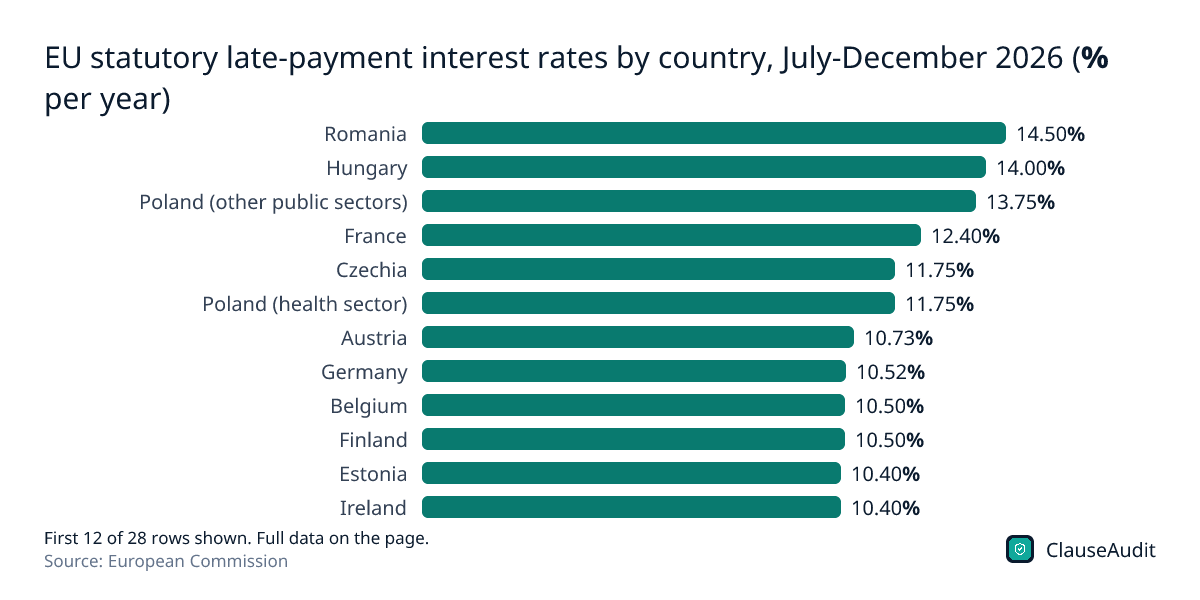
Download this chart (PNG)EU statutory late-payment interest rates by country, July-December 2026 (% per year)
Chart data
| Label | Value |
|---|---|
| Romania | 14.50% |
| Hungary | 14.00% |
| Poland (other public sectors) | 13.75% |
| France | 12.40% |
| Czechia | 11.75% |
| Poland (health sector) | 11.75% |
| Austria | 10.73% |
| Germany | 10.52% |
| Belgium | 10.50% |
| Finland | 10.50% |
| Estonia | 10.40% |
| Ireland | 10.40% |
| Latvia | 10.40% |
| Malta | 10.40% |
| Slovenia | 10.40% |
| Spain | 10.40% |
| Bulgaria | 10.15% |
| Croatia | 10.15% |
| Cyprus | 10.15% |
| Greece | 10.15% |
| Italy | 10.15% |
| Lithuania | 10.15% |
| Luxembourg | 10.15% |
| Netherlands | 10.15% |
| Portugal | 10.15% |
| Slovakia | 10.15% |
| Denmark | 10.00% |
| Sweden | 10.00% |
Every EU country on the list sits at 10.00% or above for July to December 2026, with Romania top at 14.50%. Even the lowest rate on the list is 10.00% a year on a late business invoice.
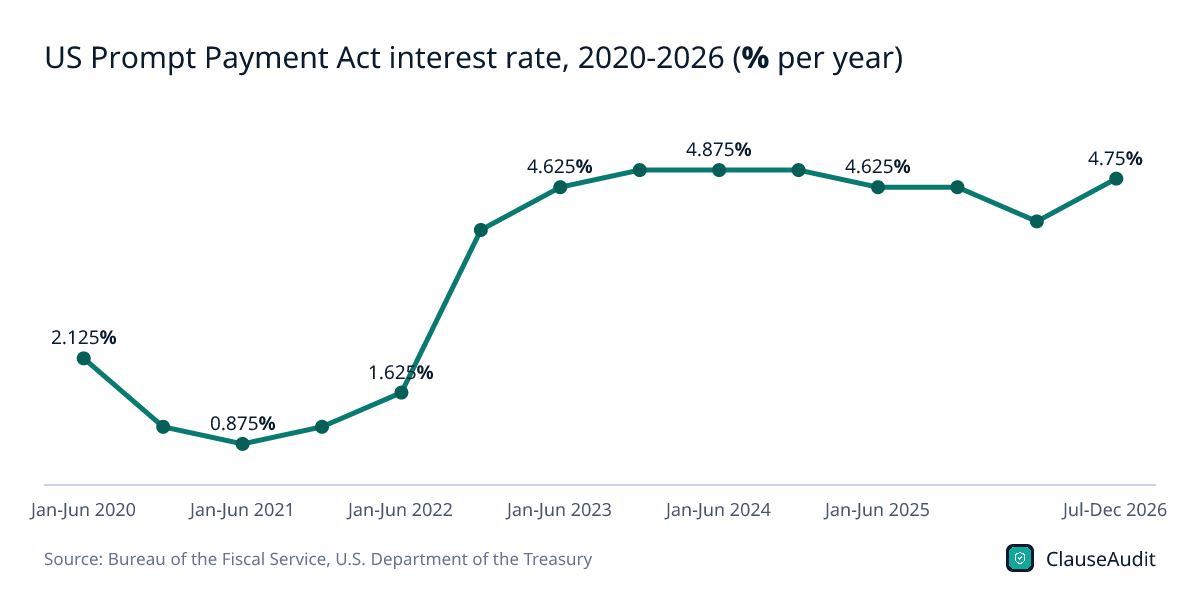
Download this chart (PNG)US Prompt Payment Act interest rate, 2020-2026 (% per year)
Chart data
| Label | Value (% per year) |
|---|---|
| Jan-Jun 2020 | 2.125% |
| Jul-Dec 2020 | 1.125% |
| Jan-Jun 2021 | 0.875% |
| Jul-Dec 2021 | 1.125% |
| Jan-Jun 2022 | 1.625% |
| Jul-Dec 2022 | 4.00% |
| Jan-Jun 2023 | 4.625% |
| Jul-Dec 2023 | 4.875% |
| Jan-Jun 2024 | 4.875% |
| Jul-Dec 2024 | 4.875% |
| Jan-Jun 2025 | 4.625% |
| Jul-Dec 2025 | 4.625% |
| Jan-Jun 2026 | 4.125% |
| Jul-Dec 2026 | 4.75% |
The federal rate fell as low as 0.875% in early 2021 and has stayed between 4.125% and 4.875% since January 2023. It moves every six months, so check the current figure before quoting it.
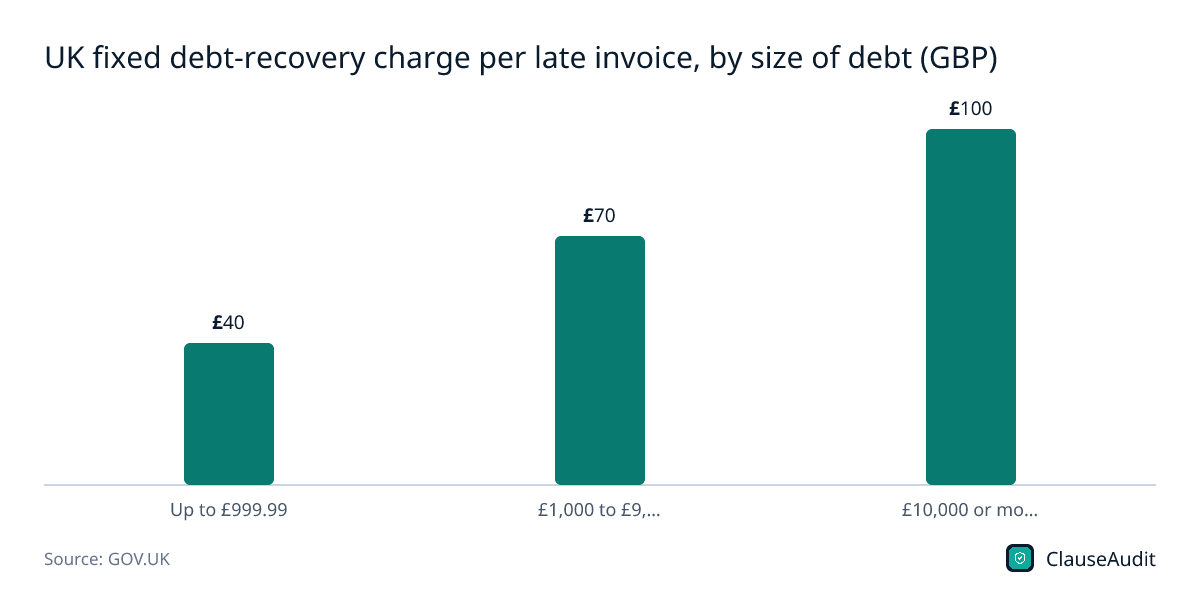
Download this chart (PNG)UK fixed debt-recovery charge per late invoice, by size of debt (GBP)
Chart data
| Label | Value (GBP) |
|---|---|
| Up to £999.99 | £40 |
| £1,000 to £9,999.99 | £70 |
| £10,000 or more | £100 |
The fixed charge is per invoice, not per client. On small invoices it can be worth more than the interest itself.
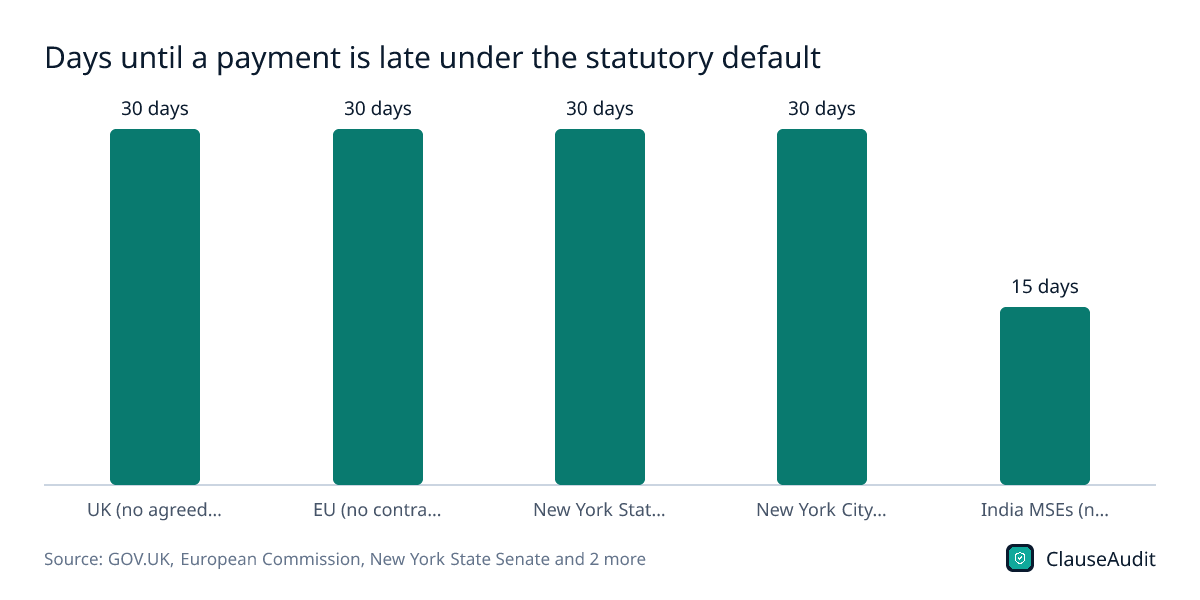
Download this chart (PNG)Days until a payment is late under the statutory default
Chart data
| Label | Value |
|---|---|
| UK (no agreed date) | 30 days |
| EU (no contract term) | 30 days |
| New York State freelancers | 30 days |
| New York City freelancers | 30 days |
| India MSEs (no written agreement, from acceptance) | 15 days |
Thirty days is the common default when no date is agreed. India is stricter: without a written agreement, a payment to a micro or small enterprise is late 15 days after acceptance.
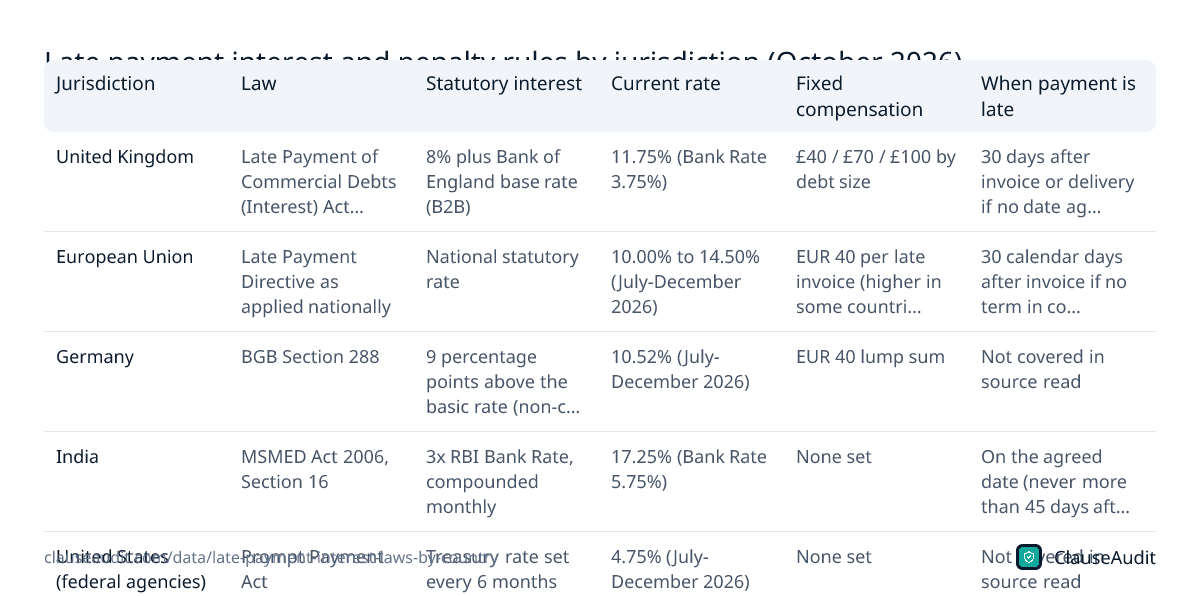
Download this chart (PNG)Late payment interest and penalty rules by jurisdiction (October 2026)
| Jurisdiction | Law | Statutory interest | Current rate | Fixed compensation | When payment is late |
|---|---|---|---|---|---|
| United Kingdom | Late Payment of Commercial Debts (Interest) Act 1998 | 8% plus Bank of England base rate (B2B) | 11.75% (Bank Rate 3.75%) | £40 / £70 / £100 by debt size | 30 days after invoice or delivery if no date agreed |
| European Union | Late Payment Directive as applied nationally | National statutory rate | 10.00% to 14.50% (July-December 2026) | EUR 40 per late invoice (higher in some countries) | 30 calendar days after invoice if no term in contract |
| Germany | BGB Section 288 | 9 percentage points above the basic rate (non-consumer) | 10.52% (July-December 2026) | EUR 40 lump sum | Not covered in source read |
| India | MSMED Act 2006, Section 16 | 3x RBI Bank Rate, compounded monthly | 17.25% (Bank Rate 5.75%) | None set | On the agreed date (never more than 45 days after acceptance), or 15 days after acceptance if there is no written agreement |
| United States (federal agencies) | Prompt Payment Act | Treasury rate set every 6 months | 4.75% (July-December 2026) | None set | Not covered in source read |
| New York State | Freelance Isn't Free Act, GBL Art. 44-A | No interest rate; double damages | Double the unpaid amount | None set | 30 days after work is completed if no date in contract |
| New York City | NYC Freelance Isn't Free Act | No interest rate; double damages | Double the unpaid amount | Not stated on source | 30 days after work is completed if no date in contract |
Source: GOV.UK, Late commercial payments: charging interest and debt recovery; Bank of England, Interest rates and Bank Rate; European Commission, Late payment (Your Europe business portal); German Federal Ministry of Justice (gesetze-im-internet.de), German Civil Code (BGB), Section 288: Default interest (English translation); Ministry of Micro, Small and Medium Enterprises, Government of India, MSME Samadhaan - Delayed Payment Monitoring System; Reserve Bank of India, Monetary Policy Statement, 2026-27: Resolution of the Monetary Policy Committee, October 5 to 7, 2026; Bureau of the Fiscal Service, U.S. Department of the Treasury, Prompt Payment; New York State Senate, New York General Business Law §1410: Definitions; New York State Senate, New York General Business Law §1411: Contracted compensation payments; New York State Senate, New York General Business Law §1414: Violations; NYC Department of Consumer and Worker Protection, Freelance Workers; New York State Department of Labor, Freelance Isn't Free Act; Development Commissioner (MSME), Ministry of Micro, Small and Medium Enterprises, Government of India, The Micro, Small and Medium Enterprises Development Act, 2006 (No. 27 of 2006), sections 2(b), 15 and 16. Download as image
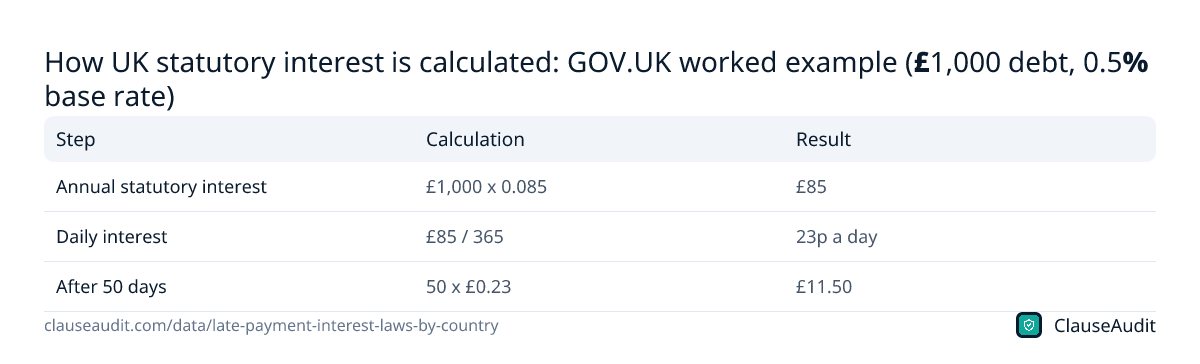
How UK statutory interest is calculated: GOV.UK worked example (£1,000 debt, 0.5% base rate)
| Step | Calculation | Result |
|---|---|---|
| Annual statutory interest | £1,000 x 0.085 | £85 |
| Daily interest | £85 / 365 | 23p a day |
| After 50 days | 50 x £0.23 | £11.50 |
Source: GOV.UK, Late commercial payments: charging interest and debt recovery. Download as image
How much interest can I charge on a late invoice?
That depends on where your client is based and what your contract says. If neither the contract nor a statute gives you a rate, interest usually comes down to what a court will award, and that's slow.
In the UK, the Late Payment of Commercial Debts (Interest) Act gives you 8% plus the Bank of England base rate on business-to-business debts. With Bank Rate at 3.75%, that's 11.75% a year. You also get a fixed sum of £40, £70 or £100 per invoice depending on its size, plus reasonable extra recovery costs.
Across the EU, the Late Payment Directive works the same way through national law. Rates for July to December 2026 run from 10.00% in Denmark and Sweden to 14.50% in Romania. Germany sits at 10.52% and France at 12.40%. You can also claim EUR 40 for each invoice paid late, and some countries set a higher amount for bigger invoices.
India is the outlier. Under the MSMED Act, a buyer who pays a registered micro or small enterprise late owes 3x the RBI Bank Rate, compounded monthly. With the Bank Rate at 5.75%, that's 17.25% a year before compounding.
Is there a late payment interest law for US freelancers?
Not at the federal level for private clients. The Prompt Payment Act sets a rate, 4.75% for July to December 2026, but it only applies when a federal agency pays a vendor late. If your client is a startup in Austin or an agency in Chicago, that rate doesn't reach them.
New York is the main exception. The state's Freelance Isn't Free Act doesn't set an interest rate. Instead, a client who breaks the payment rule can owe you double damages, meaning double the unpaid amount. The rule covers contracts of $800 or more, counted alone or combined with the same client over 120 days. If your contract has no payment date, the client must pay within 30 days of the work being completed. New York City has its own version with the same double-damages remedy.
Everywhere else in the US, your contract does the heavy lifting. A clear late fee or interest clause is what turns an overdue invoice into a claim with a number attached. Some states limit how much interest or late fees a contract can charge, so keep your rate reasonable and check your state's rules before you pick one.
A good US clause names the rate, says when it starts (for example, the day after the due date), and adds that the client pays your collection costs. Put the same terms on your invoices. A rate the client signed is far easier to enforce than one you add to an invoice after the fact.
What happens if my contract sets a different rate?
In the UK, a rate written into the contract replaces statutory interest. That cuts both ways. A client's template that says late invoices carry no interest, or a token rate, can quietly take away a right you'd otherwise have. The law does let courts set aside a term that isn't a substantial remedy, but you don't want to argue that over one invoice.
In the EU, the contract usually sets the payment term, and the 30-day default only kicks in when it's silent. Watch for long terms pushed by bigger clients. A long term doesn't break any rule on its face, but it pushes back the date interest starts. The directive also limits how far terms can stretch, and grossly unfair ones can be challenged, but that's a fight you'd rather avoid by negotiating the term up front.
In India, the contract can't stretch things past 45 days after acceptance for a micro or small enterprise. A clause promising payment months later doesn't override the Act. Interest still runs from the legal deadline.
Which country's law applies when your client is abroad?
Generally, the governing law clause decides. If you're a UK freelancer and your contract says it's governed by the law of England and Wales, you can rely on the UK Act even with a client overseas. If the client's template picks their own state or country, their rules apply, and those may give you nothing.
A few other limits matter. These laws cover business-to-business invoices. The EU's EUR 40 compensation, for example, can't be claimed against consumers. And India's protection only helps if you're a registered micro or small enterprise, which makes Udyam registration worth doing before you invoice a large buyer. If you can't get your own governing law, at least make sure the contract has its own interest clause, so you're covered whichever law ends up applying.
Is it worth charging interest on a late invoice?
Often the interest itself is small. The GOV.UK worked example shows a £1,000 debt earning about 23p a day, or £11.50 after 50 days, at an older and much lower base rate. The fixed charge of £40 or EUR 40 usually matters more than the interest on a small invoice.
The real value is the pressure it adds at the right moment. A polite reminder that names the statute and the amount tends to move your invoice to the top of the pile. Indian micro and small enterprises have filed 2,56,892 delayed-payment applications on MSME Samadhaan, which tells you plenty of people do use these rules when a buyer stops answering.
- Put the interest rate, the fixed charge and the due date on every invoice, not just in the contract.
- Send a reminder the day after the due date, and quote the exact amount owed with interest.
- Keep records of acceptance or delivery dates, since that's when the clock starts in India and under the UK default.
- Decide in advance when you'll waive interest for a good client, so it's a choice and not a habit.
- If a client is weeks late with no reply, send a formal demand that cites the law before going further.
How ClauseAudit helps
Statutory interest is a backstop. The terms that decide when you get paid, and what a late payment costs the client, live in your contract. ClauseAudit's automated review reads the payment section of a freelance or service agreement and flags terms that delay payment or quietly waive your rights.
Upload the client's draft before you sign, and you'll see in plain English which clauses to push back on and what to ask for instead.
- Payment terms: a clear due date, counted from invoice or delivery rather than from vague client approval
- Late fee or interest clause: whether one exists, and whether the rate is reasonable for your state
- Waivers: language that removes statutory interest or limits your recovery costs
- Governing law: whose late payment rules will apply if the client pays late
- Acceptance terms: deemed acceptance after a set period so the payment clock actually starts
- Suspension rights: your right to pause work while invoices are overdue
Frequently asked questions
Can I charge interest on a late invoice if my contract doesn't mention it?
In the UK and EU, yes, for business-to-business invoices. Statutory interest and the fixed charge apply automatically when the contract is silent. In India, registered micro and small enterprises get interest under the MSMED Act regardless. In most of the US, there's no automatic rate for private clients, so without a clause you'd usually need a court to award interest.
What is the UK statutory interest rate on late payments in 2026?
It's 8% plus the Bank of England base rate for business-to-business debts. With Bank Rate held at 3.75% at the September 2026 decision, that comes to 11.75% a year. You calculate it daily on the unpaid amount and can add a fixed charge of £40, £70 or £100 per invoice depending on its size.
How much is the EU late payment compensation?
You can claim a flat EUR 40 for each business invoice paid late, on top of interest. Some EU countries set a higher amount for larger invoices. The fee can't be claimed from consumers, only from business or public-sector clients.
What interest does an Indian buyer owe on late payment to an MSME?
Under section 16 of the MSMED Act, 3x the RBI Bank Rate, compounded monthly. With the RBI raising the Bank Rate to 5.75% on 7 October 2026, that's 17.25% a year before compounding. It applies to registered micro and small enterprises, and runs from the agreed date or 15 days after acceptance if there's no written agreement.
Does the Prompt Payment Act apply to private clients?
No. The Prompt Payment Act only covers federal agencies that pay vendors late. Its rate for July to December 2026 is 4.75%. If you work for a private company, your interest rights come from your contract and your state's law, not from this Act.
What can New York freelancers claim if a client pays late?
Under the state Freelance Isn't Free Act, a client who breaks the payment rule can owe double damages. It covers contracts of $800 or more, alone or combined over 120 days. If the contract has no payment date, payment is due within 30 days of finishing the work. New York City has a similar law.
Can a client contract out of statutory late payment interest?
Partly. In the UK, a contract rate replaces statutory interest, though courts can set aside a term that doesn't give a substantial remedy. In India, a payment term longer than 45 days after acceptance doesn't hold up for micro and small enterprises. Read the payment clause closely before signing, because a single line can remove rights you'd otherwise have.
Is a late fee the same as late payment interest?
Not quite. Interest grows with time on the unpaid amount. A late fee is usually a flat charge. The UK and EU give you both: daily interest plus a fixed sum per invoice. In the US, a contract can include either, but a fee far beyond your real costs may be treated as an unenforceable penalty.
Use this data
Every chart and card below is free to reuse under CC BY 4.0. Download what you need and link back to this page.
 Stat cards
 Key findings card
 Infographic
 Statutory late-payment interest rates by jurisdiction, October 2026 (% per year)
 EU statutory late-payment interest rates by country, July-December 2026 (% per year)
 US Prompt Payment Act interest rate, 2020-2026 (% per year)
 UK fixed debt-recovery charge per late invoice, by size of debt (GBP)
 Days until a payment is late under the statutory default
 Late payment interest and penalty rules by jurisdiction (October 2026)
 How UK statutory interest is calculated: GOV.UK worked example (£1,000 debt, 0.5% base rate)
Embed the infographic
Free to share on your site, blog or slides under CC BY 4.0. Please keep the credit link.
Sources and method
Every number on this page comes from the sources below, each opened and read on or before October 18, 2026. A second, independent review checked every figure against its source and corrected anything that did not match. Figures that could not be confirmed were left out.
- GOV.UK, Late commercial payments: charging interest and debt recovery (Last updated 10 August 2016 (read 18 October 2026))
- Bank of England, Interest rates and Bank Rate (Decision of 17 September 2026 (Bank Rate 3.75%, set 18 December 2025))
- European Commission, Late payment (Your Europe business portal) (Last checked 05/08/2026; rates for 01/07/2026 - 31/12/2026)
- German Federal Ministry of Justice (gesetze-im-internet.de), German Civil Code (BGB), Section 288: Default interest (English translation) (Current translation, read October 2026)
- Ministry of Micro, Small and Medium Enterprises, Government of India, MSME Samadhaan - Delayed Payment Monitoring System (Live dashboard, read 19 October 2026)
- Development Commissioner (MSME), Ministry of Micro, Small and Medium Enterprises, Government of India, The Micro, Small and Medium Enterprises Development Act, 2006 (No. 27 of 2006), sections 2(b), 15 and 16 (Act of 16 June 2006, official gazette text, read 19 October 2026)
- Reserve Bank of India, Monetary Policy Statement, 2026-27: Resolution of the Monetary Policy Committee, October 5 to 7, 2026 (October 7, 2026)
- Bureau of the Fiscal Service, U.S. Department of the Treasury, Prompt Payment (Last updated June 30, 2026)
- Bureau of the Fiscal Service, U.S. Department of the Treasury, Prompt Payment Interest Rates (January 2020 - December 2026) (Last updated September 29, 2026)
- New York State Senate, New York General Business Law §1411: Contracted compensation payments (Article 44-A, added August 28, 2024 (read October 2026))
- New York State Senate, New York General Business Law §1414: Violations (Article 44-A, added August 28, 2024 (read October 2026))
- New York State Senate, New York General Business Law §1410: Definitions (Article 44-A, added August 28, 2024 (read October 2026))
- New York State Department of Labor, Freelance Isn't Free Act (Read October 2026)
- NYC Department of Consumer and Worker Protection, Freelance Workers (Read October 2026)
Cite this page
ClauseAudit, “Late Payment Interest Laws by Country: What Freelancers Can Legally Charge on Overdue Invoices”, updated October 18, 2026, https://clauseaudit.com/data/late-payment-interest-laws-by-country. Free to reuse with a link back (CC BY 4.0).
This page summarises published data and law as checked on October 18, 2026. Figures are updated as new editions are released, and your own situation may differ. It is general information, not legal, tax or financial advice.