Freelance Writing and Editing Rates 2026: Per Word, Per Hour and Per Project
By ClauseAudit Research · 20 sources ·
What are freelance writer rates per word?
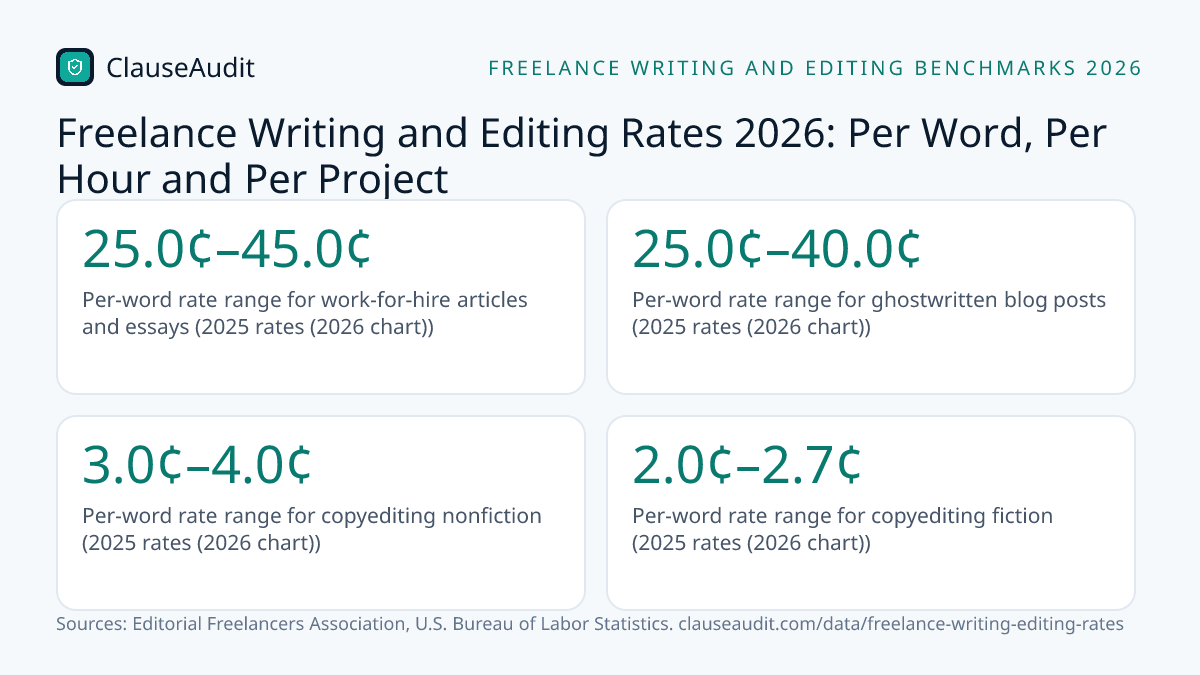
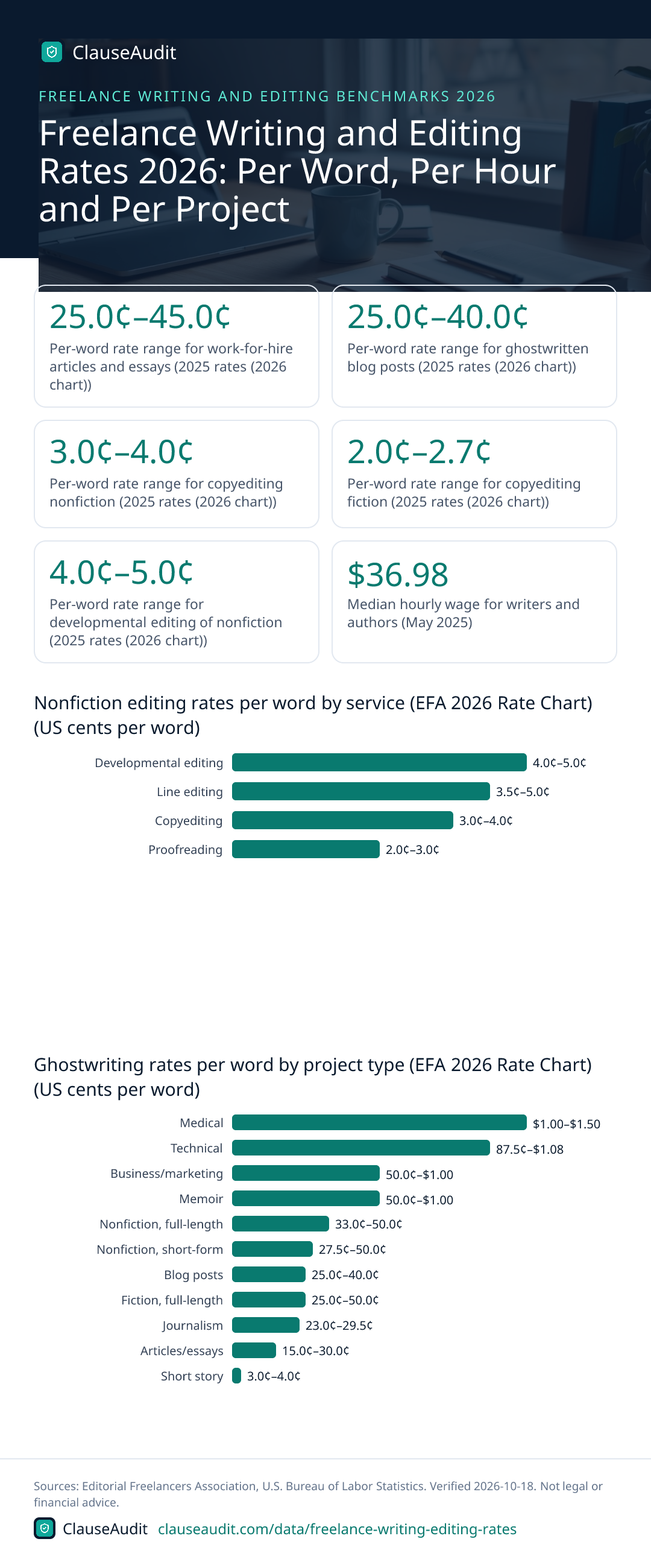
Freelance writers in the Editorial Freelancers Association report 25.0¢ to 45.0¢ per word for work-for-hire articles and essays, according to its 2026 Rate Chart. Ghostwritten blog posts run 25.0¢ to 40.0¢. Specialist work pays far more: medical ghostwriting starts at $1.00 a word.

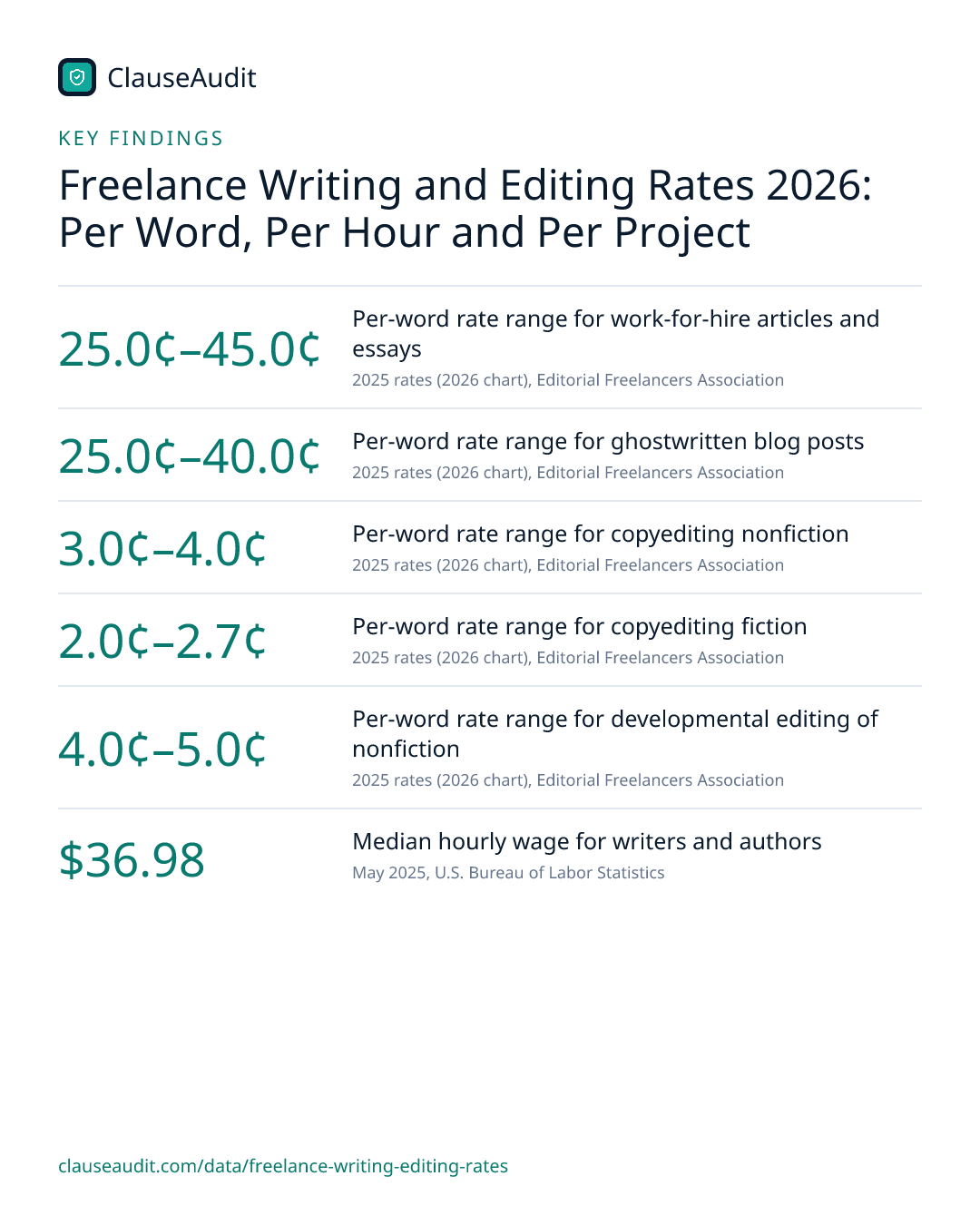
- Per-word rate range for work-for-hire articles and essays (2025 rates (2026 chart), Editorial Freelancers Association)
- 25.0¢–45.0¢
- Per-word rate range for ghostwritten blog posts (2025 rates (2026 chart), Editorial Freelancers Association)
- 25.0¢–40.0¢
- Per-word rate range for copyediting nonfiction (2025 rates (2026 chart), Editorial Freelancers Association)
- 3.0¢–4.0¢
- Per-word rate range for copyediting fiction (2025 rates (2026 chart), Editorial Freelancers Association)
- 2.0¢–2.7¢
- Per-word rate range for developmental editing of nonfiction (2025 rates (2026 chart), Editorial Freelancers Association)
- 4.0¢–5.0¢
- Median hourly wage for writers and authors (May 2025, U.S. Bureau of Labor Statistics)
- $36.98
- Share of writers and authors who are self-employed (2025, U.S. Bureau of Labor Statistics)
- 65%
- Median hourly wage for editors (May 2025, U.S. Bureau of Labor Statistics)
- $37.46
Ask a room of freelance writers what they charge and you will hear a different answer from each, some in cents per word, some per hour, some as a flat project fee. That makes it hard to know if a client's offer is fair, or if your own quote is leaving money on the table.
The figures on this page come from the Editorial Freelancers Association's 2026 Rate Chart, which reports what members actually charged for work done in 2025, plus federal wage data for staff writers and editors. Use them as a reference point when you set rates, quote a project or read the payment section of a contract.
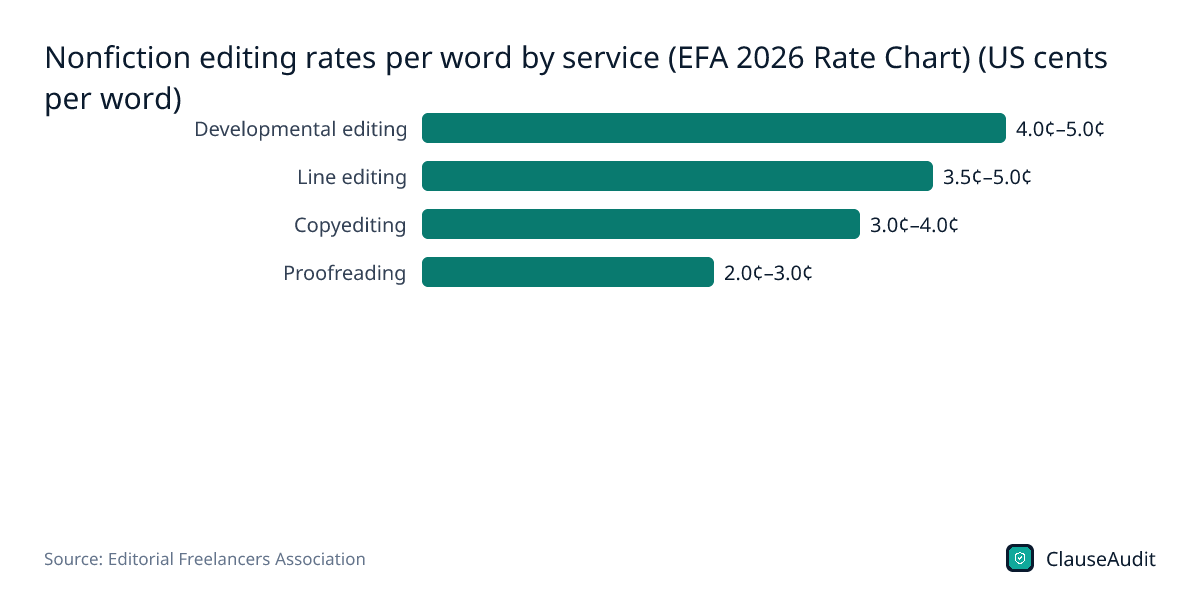
Nonfiction editing rates per word by service (EFA 2026 Rate Chart) (US cents per word)
Chart data
| Label | Value |
|---|---|
| Developmental editing | 4.0¢–5.0¢ |
| Line editing | 3.5¢–5.0¢ |
| Copyediting | 3.0¢–4.0¢ |
| Proofreading | 2.0¢–3.0¢ |
The deeper the edit, the higher the rate. Nonfiction proofreading starts at 2.0¢ a word while developmental editing starts at 4.0¢, because a developmental edit means rethinking structure, not fixing commas.
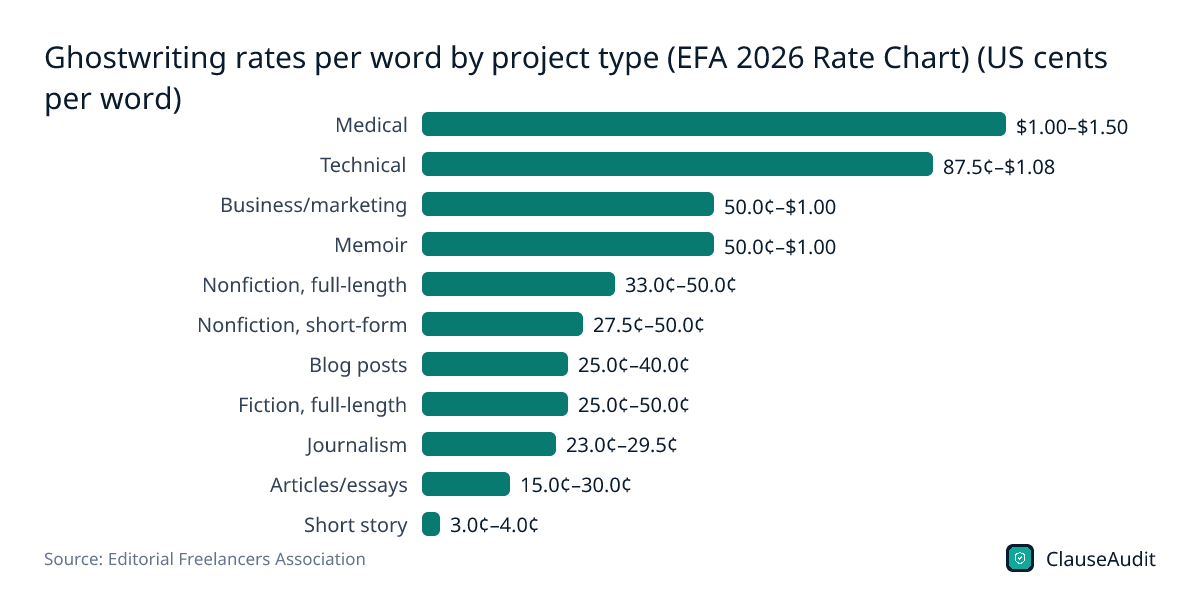
Download this chart (PNG)Ghostwriting rates per word by project type (EFA 2026 Rate Chart) (US cents per word)
Chart data
| Label | Value |
|---|---|
| Medical | $1.00–$1.50 |
| Technical | 87.5¢–$1.08 |
| Business/marketing | 50.0¢–$1.00 |
| Memoir | 50.0¢–$1.00 |
| Nonfiction, full-length | 33.0¢–50.0¢ |
| Nonfiction, short-form | 27.5¢–50.0¢ |
| Blog posts | 25.0¢–40.0¢ |
| Fiction, full-length | 25.0¢–50.0¢ |
| Journalism | 23.0¢–29.5¢ |
| Articles/essays | 15.0¢–30.0¢ |
| Short story | 3.0¢–4.0¢ |
Subject expertise drives the top of this chart. Medical ghostwriting runs $1.00 to $1.50 a word and technical work 87.5¢ to $1.08, while journalism and short articles sit far lower.
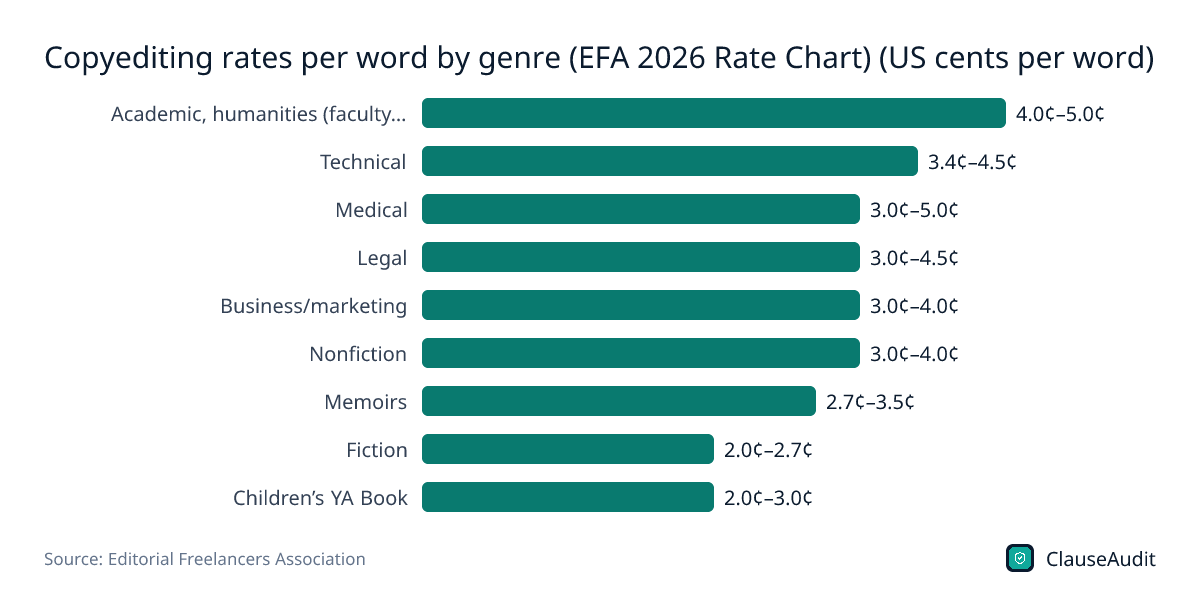
Download this chart (PNG)Copyediting rates per word by genre (EFA 2026 Rate Chart) (US cents per word)
Chart data
| Label | Value |
|---|---|
| Academic, humanities (faculty, publication) | 4.0¢–5.0¢ |
| Technical | 3.4¢–4.5¢ |
| Medical | 3.0¢–5.0¢ |
| Legal | 3.0¢–4.5¢ |
| Business/marketing | 3.0¢–4.0¢ |
| Nonfiction | 3.0¢–4.0¢ |
| Memoirs | 2.7¢–3.5¢ |
| Fiction | 2.0¢–2.7¢ |
| Children’s YA Book | 2.0¢–3.0¢ |
Genre matters even for the same service. Copyediting fiction runs 2.0¢ to 2.7¢ a word, while academic humanities work reaches 4.0¢ to 5.0¢.
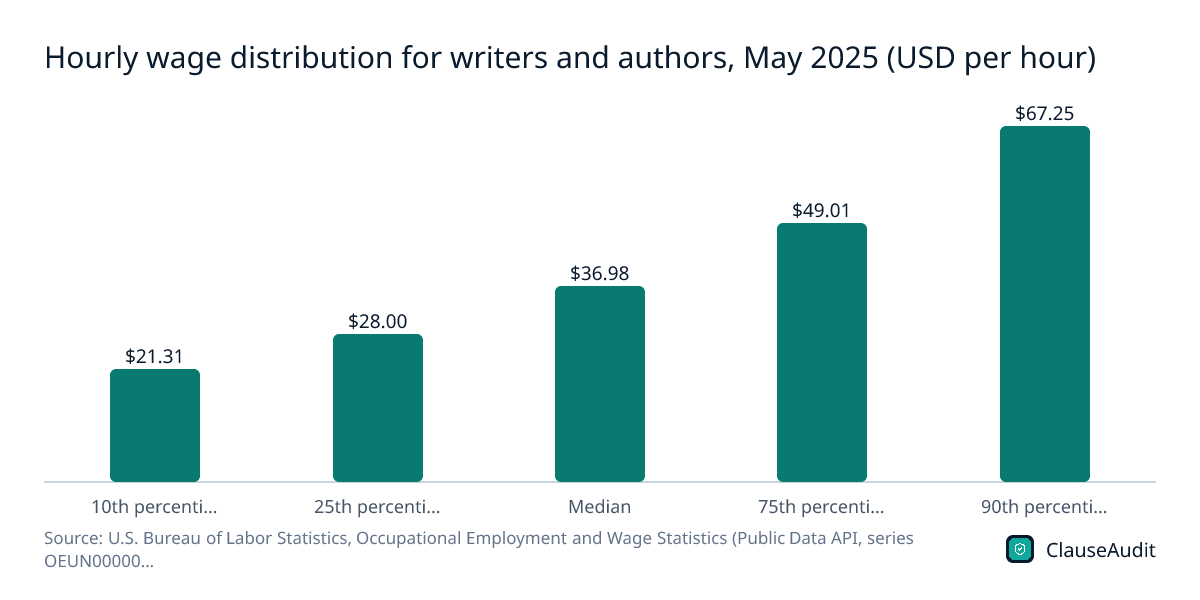
Download this chart (PNG)Hourly wage distribution for writers and authors, May 2025 (USD per hour)
Chart data
| Label | Value (USD per hour) |
|---|---|
| 10th percentile | $21.31 |
| 25th percentile | $28.00 |
| Median | $36.98 |
| 75th percentile | $49.01 |
| 90th percentile | $67.25 |
These are wages for salaried writers, not freelance rates. The median of $36.98 an hour is a floor to compare against, since a freelancer also pays for self-employment tax, software, health cover and unbilled time.
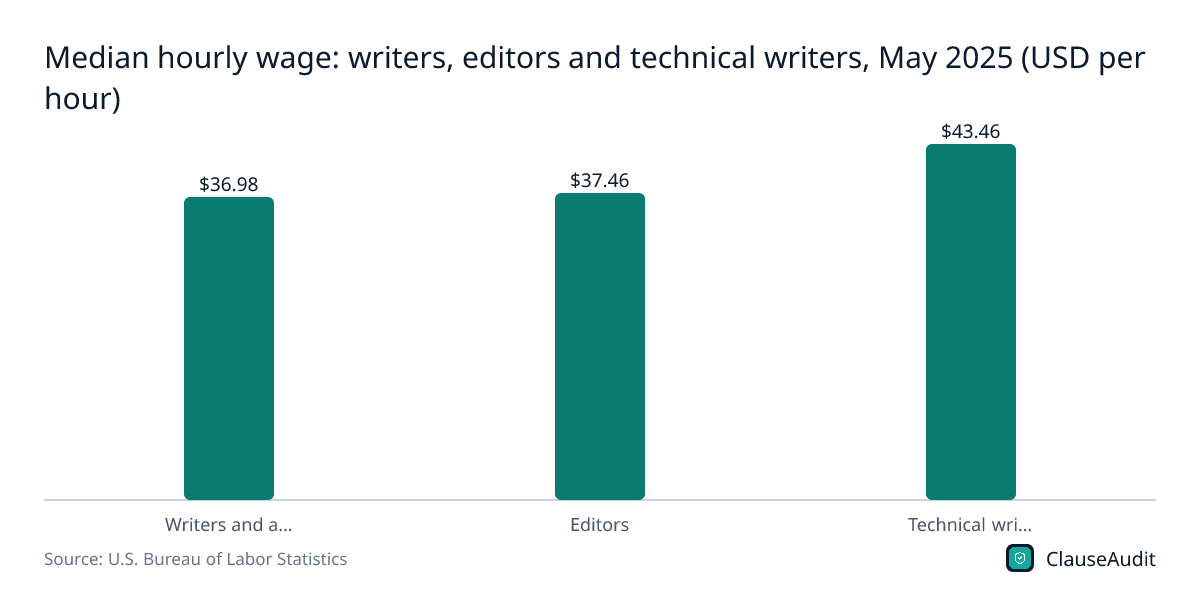
Download this chart (PNG)Median hourly wage: writers, editors and technical writers, May 2025 (USD per hour)
Chart data
| Label | Value (USD per hour) |
|---|---|
| Writers and authors | $36.98 |
| Editors | $37.46 |
| Technical writers | $43.46 |
Technical writers earn the most of the three groups on staff at $43.46 an hour. Writers and editors sit close together at $36.98 and $37.46.
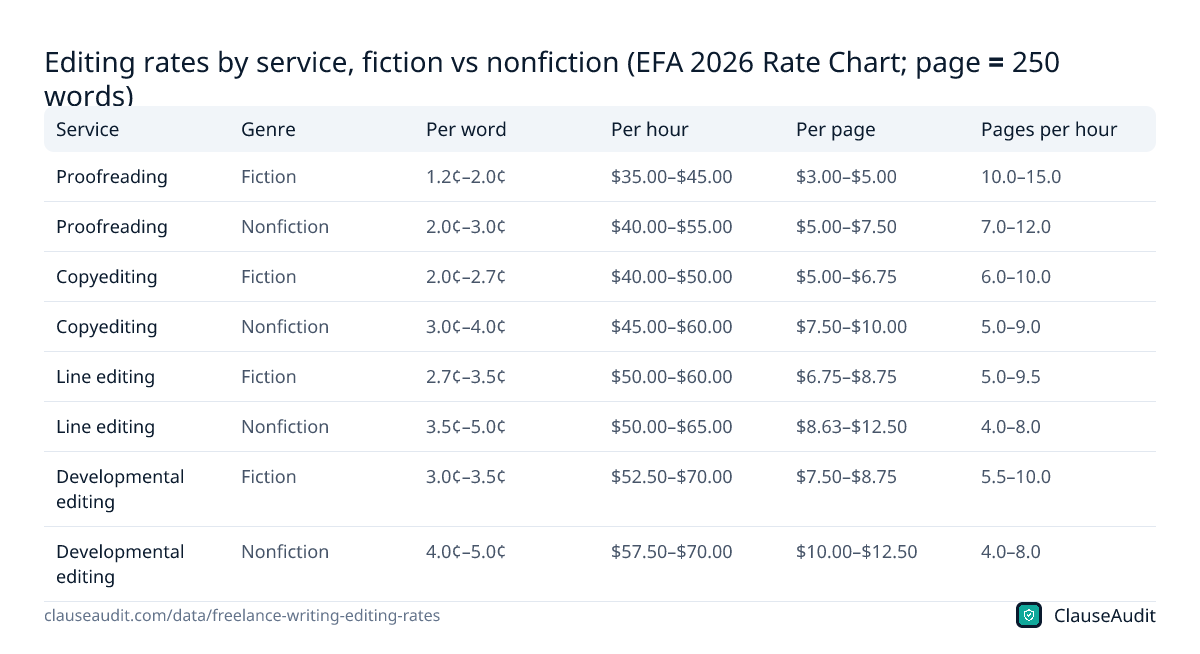
Download this chart (PNG)Editing rates by service, fiction vs nonfiction (EFA 2026 Rate Chart; page = 250 words)
| Service | Genre | Per word | Per hour | Per page | Pages per hour |
|---|---|---|---|---|---|
| Proofreading | Fiction | 1.2¢–2.0¢ | $35.00–$45.00 | $3.00–$5.00 | 10.0–15.0 |
| Proofreading | Nonfiction | 2.0¢–3.0¢ | $40.00–$55.00 | $5.00–$7.50 | 7.0–12.0 |
| Copyediting | Fiction | 2.0¢–2.7¢ | $40.00–$50.00 | $5.00–$6.75 | 6.0–10.0 |
| Copyediting | Nonfiction | 3.0¢–4.0¢ | $45.00–$60.00 | $7.50–$10.00 | 5.0–9.0 |
| Line editing | Fiction | 2.7¢–3.5¢ | $50.00–$60.00 | $6.75–$8.75 | 5.0–9.5 |
| Line editing | Nonfiction | 3.5¢–5.0¢ | $50.00–$65.00 | $8.63–$12.50 | 4.0–8.0 |
| Developmental editing | Fiction | 3.0¢–3.5¢ | $52.50–$70.00 | $7.50–$8.75 | 5.5–10.0 |
| Developmental editing | Nonfiction | 4.0¢–5.0¢ | $57.50–$70.00 | $10.00–$12.50 | 4.0–8.0 |
Source: Editorial Freelancers Association, 2026 Rate Chart (PDF); Editorial Freelancers Association, Editorial Rates: 2026 Rate Chart. Download as image
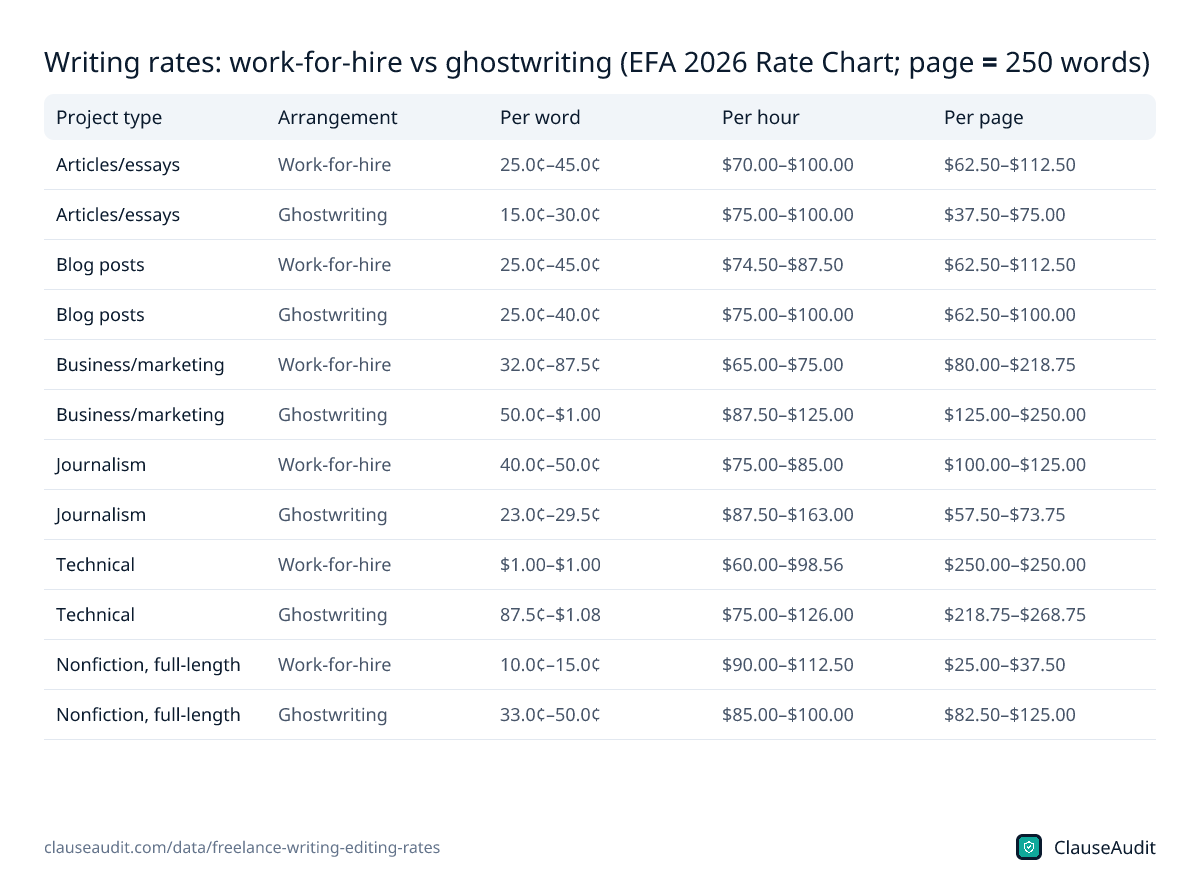
Writing rates: work-for-hire vs ghostwriting (EFA 2026 Rate Chart; page = 250 words)
| Project type | Arrangement | Per word | Per hour | Per page |
|---|---|---|---|---|
| Articles/essays | Work-for-hire | 25.0¢–45.0¢ | $70.00–$100.00 | $62.50–$112.50 |
| Articles/essays | Ghostwriting | 15.0¢–30.0¢ | $75.00–$100.00 | $37.50–$75.00 |
| Blog posts | Work-for-hire | 25.0¢–45.0¢ | $74.50–$87.50 | $62.50–$112.50 |
| Blog posts | Ghostwriting | 25.0¢–40.0¢ | $75.00–$100.00 | $62.50–$100.00 |
| Business/marketing | Work-for-hire | 32.0¢–87.5¢ | $65.00–$75.00 | $80.00–$218.75 |
| Business/marketing | Ghostwriting | 50.0¢–$1.00 | $87.50–$125.00 | $125.00–$250.00 |
| Journalism | Work-for-hire | 40.0¢–50.0¢ | $75.00–$85.00 | $100.00–$125.00 |
| Journalism | Ghostwriting | 23.0¢–29.5¢ | $87.50–$163.00 | $57.50–$73.75 |
| Technical | Work-for-hire | $1.00–$1.00 | $60.00–$98.56 | $250.00–$250.00 |
| Technical | Ghostwriting | 87.5¢–$1.08 | $75.00–$126.00 | $218.75–$268.75 |
| Nonfiction, full-length | Work-for-hire | 10.0¢–15.0¢ | $90.00–$112.50 | $25.00–$37.50 |
| Nonfiction, full-length | Ghostwriting | 33.0¢–50.0¢ | $85.00–$100.00 | $82.50–$125.00 |
Source: Editorial Freelancers Association, 2026 Rate Chart (PDF); Editorial Freelancers Association, Editorial Rates: 2026 Rate Chart. Download as image
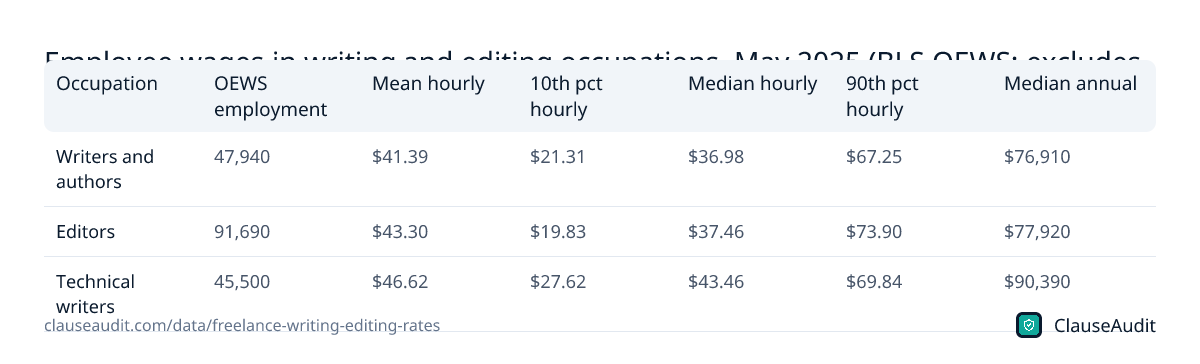
Employee wages in writing and editing occupations, May 2025 (BLS OEWS; excludes self-employed)
| Occupation | OEWS employment | Mean hourly | 10th pct hourly | Median hourly | 90th pct hourly | Median annual |
|---|---|---|---|---|---|---|
| Writers and authors | 47,940 | $41.39 | $21.31 | $36.98 | $67.25 | $76,910 |
| Editors | 91,690 | $43.30 | $19.83 | $37.46 | $73.90 | $77,920 |
| Technical writers | 45,500 | $46.62 | $27.62 | $43.46 | $69.84 | $90,390 |
Source: U.S. Bureau of Labor Statistics, Occupational Employment and Wage Statistics (Public Data API, series OEUN000000000000027304301), Writers and Authors (27-3043), employment, national; U.S. Bureau of Labor Statistics, Occupational Employment and Wage Statistics (Public Data API, series OEUN000000000000027304303), Writers and Authors (27-3043), hourly mean wage, national; U.S. Bureau of Labor Statistics, Occupational Employment and Wage Statistics (Public Data API, series OEUN000000000000027304306), Writers and Authors (27-3043), hourly 10th percentile wage, national; U.S. Bureau of Labor Statistics, Occupational Employment and Wage Statistics (Public Data API, series OEUN000000000000027304308), Writers and Authors (27-3043), hourly median wage, national; U.S. Bureau of Labor Statistics, Occupational Employment and Wage Statistics (Public Data API, series OEUN000000000000027304310), Writers and Authors (27-3043), hourly 90th percentile wage, national; U.S. Bureau of Labor Statistics, Occupational Employment and Wage Statistics (Public Data API, series OEUN000000000000027304101), Editors (27-3041), employment, national; U.S. Bureau of Labor Statistics, Occupational Employment and Wage Statistics (Public Data API, series OEUN000000000000027304103), Editors (27-3041), hourly mean wage, national; U.S. Bureau of Labor Statistics, Occupational Employment and Wage Statistics (Public Data API, series OEUN000000000000027304106), Editors (27-3041), hourly 10th percentile wage, national; U.S. Bureau of Labor Statistics, Occupational Employment and Wage Statistics (Public Data API, series OEUN000000000000027304110), Editors (27-3041), hourly 90th percentile wage, national; U.S. Bureau of Labor Statistics, Occupational Employment and Wage Statistics (Public Data API, series OEUN000000000000027304201), Technical Writers (27-3042), employment, national; U.S. Bureau of Labor Statistics, Occupational Employment and Wage Statistics (Public Data API, series OEUN000000000000027304203), Technical Writers (27-3042), hourly mean wage, national; U.S. Bureau of Labor Statistics, Occupational Employment and Wage Statistics (Public Data API, series OEUN000000000000027304206), Technical Writers (27-3042), hourly 10th percentile wage, national; U.S. Bureau of Labor Statistics, Occupational Employment and Wage Statistics (Public Data API, series OEUN000000000000027304210), Technical Writers (27-3042), hourly 90th percentile wage, national; U.S. Bureau of Labor Statistics, Occupational Outlook Handbook: Writers and Authors; U.S. Bureau of Labor Statistics, Occupational Outlook Handbook: Editors; U.S. Bureau of Labor Statistics, Occupational Outlook Handbook: Technical Writers. Download as image
How much should a freelance writer charge per word?
If you write articles, essays or blog posts for clients who will own the work, the EFA's members report 25.0¢ to 45.0¢ per word. That range sits around the median, so it is a fair middle of the market, not a ceiling.
Specialty pushes the number up fast. Business and marketing writing done as work-for-hire runs 32.0¢ to 87.5¢ per word. Technical writing sits at $1.00. On the ghostwriting side, memoir and business work run 50.0¢ to $1.00, and medical ghostwriting runs $1.00 to $1.50.
Two warnings before you copy these numbers into a quote. First, EFA members lean toward book and editorial work, and the chart does not cover content mills or platform gigs, where pay is often much lower. Second, a per-word rate only works when the word count is fixed. If the client can expand the scope, you need a per-hour or per-revision fallback in writing.
Say a software company asks you for a product explainer. That is technical or business writing, not a general blog post, and the chart puts it in a much higher band. Name the category in your quote so the client sees why your number is higher than the last writer they hired.
What do freelance editors charge for copyediting, line editing and proofreading?
Editing rates are lower per word than writing rates, but editors move faster through the text. For nonfiction, members report 2.0¢ to 3.0¢ per word for proofreading, 3.0¢ to 4.0¢ for copyediting, 3.5¢ to 5.0¢ for line editing and 4.0¢ to 5.0¢ for developmental editing.
Fiction pays a little less at each level. Copyediting fiction runs 2.0¢ to 2.7¢ a word, against 3.0¢ to 4.0¢ for nonfiction. Hourly, a nonfiction copyedit lands at $45.00 to $60.00, and the EFA reports a pace of 5.0 to 9.0 pages of 250 words per hour.
That pace figure is useful. Before you quote a flat fee for a manuscript, edit a sample of a few pages and time yourself. If you are slower than the typical pace because the writing is rough, your per-word quote should rise, or you should quote hourly instead.
Clients often ask for "a quick edit" when they really need a line edit or a developmental pass. Read the first chapter or section before you agree to a service level. If the problems are structural, say so in your proposal and price the deeper service. Selling a copyedit and then doing developmental work is the fastest way to underprice a job.
Per word, per hour or per project: which pricing works best?
Each method shifts risk to someone. Per-word pricing protects the client from slow work but punishes you for heavy research or tight word limits. Hourly pricing protects you from scope creep but makes clients nervous about open-ended bills. A flat project fee is easiest to sell and easiest to lose money on.
A practical approach is to work out your target hourly rate, estimate the hours, and then present the result as a project fee with clear limits. For example, a ghostwritten blog post priced at the EFA range of 25.0¢ to 40.0¢ a word should also fit within the hourly band of $75.00 to $100.00 once you count research, interviews and edits. If it does not, the brief is bigger than the word count suggests.
Hourly billing makes the most sense for open-ended editing, consulting calls and projects where the client keeps changing direction. Per-word pricing suits short pieces with a firm word count. Flat fees fit packaged work like a monthly set of blog posts, as long as the package spells out how many pieces, how long each runs and what counts as a new request.
Whatever you choose, write down what the fee covers: number of drafts, rounds of revisions, research calls and turnaround time. The rate is only as good as the scope behind it.
How do freelance rates compare with staff writer and editor pay?
Federal data show the median salaried writer earned $36.98 an hour in May 2025, editors earned $37.46 and technical writers $43.46. Those numbers leave out the self-employed, and that matters here: 65% of writers and authors work for themselves.
A freelance hourly rate of $70.00 to $100.00 for article work looks like double a staff wage, but it is not double the income. You pay both halves of payroll tax, buy your own health insurance and equipment, and spend unbilled hours pitching, invoicing and chasing payment. If your effective rate after overhead drops near the staff median, you are earning less than an employee doing the same work.
Use the staff wage figures as a sanity check, not a target. If a client offers a rate that would barely match what an in-house writer earns after you cover your own costs, push back or walk away. Most writers and authors freelance, so clients have options. So do you.
Why do some clients pay so much less than these rates?
Content mills, bidding platforms and agencies that resell your work fall outside the EFA survey, and many pay well below its ranges. Part of the gap is the market they serve. Part of it is terms buried in the contract: payment only after final approval, unlimited revisions, no kill fee and broad rights to anything you draft.
Those terms lower your real rate even when the headline number looks fine. A post priced at the bottom of the 25.0¢ to 45.0¢ range that goes through round after round of changes pays far less per hour than the same post with one revision round. Read the contract as closely as you read the rate.
What to do before you send a quote
- Pick the closest line on the EFA chart for the work type and genre, then decide where in the range you sit based on experience and turnaround.
- Time a short sample so your per-word or flat quote reflects the real pace of the job.
- Check whether the client wants work-for-hire or ghostwriting, since rates for the same project type differ between the two.
- Put revision limits, a deposit and a kill fee in writing before you start.
- Set a payment deadline and a late fee, and agree who owns drafts and unused material.
- Revisit your rates whenever the EFA publishes a new chart.
How ClauseAudit helps
A good rate means little if the contract lets the client delay payment, demand endless revisions or keep work they never paid for. Upload your freelance writing or editing agreement and the automated review flags the clauses that quietly cut what you earn.
You get each risky clause in plain English with a suggested fix you can send back to the client.
- Rate and scope: whether the fee is tied to a fixed word count, number of drafts and a revision limit
- Payment terms: when you get paid, whether payment depends on vague client approval, and any deposit
- Late fees: whether the contract charges interest or a fee when the client pays late
- Kill fee: what you are owed if the client cancels midway
- Rights and ownership: work-for-hire language, transfer of unused drafts and whether rights pass only after payment
- Liability and indemnity: if you are on the hook for claims about content the client supplied or approved
Frequently asked questions
What is a good per-word rate for a beginner freelance writer?
The EFA figures are a range around the median rate its members charge, so newer writers often start below the 25.0¢ to 45.0¢ range reported for articles and essays. Treat the low end as a goal to work toward, and raise rates as you build samples. Avoid locking yourself into long contracts at a low rate with no review date.
How much do freelance proofreaders charge?
EFA members report 2.0¢ to 3.0¢ per word for nonfiction proofreading and 1.2¢ to 2.0¢ for fiction. Hourly, nonfiction proofreading runs $40.00 to $55.00. Proofreading is the final check for typos and formatting, so it costs less than copyediting, which fixes grammar, consistency and clarity.
What does developmental editing cost?
For nonfiction, developmental editing runs 4.0¢ to 5.0¢ per word or $57.50 to $70.00 per hour. For fiction it runs 3.0¢ to 3.5¢ per word. It is the most expensive editing service because it deals with structure, argument and pacing rather than sentence-level fixes.
Do ghostwriters charge more than bylined writers?
Not always. For business and marketing work, ghostwriting runs 50.0¢ to $1.00 per word against 32.0¢ to 87.5¢ for work-for-hire. For articles and essays it is the reverse: ghostwriting runs 15.0¢ to 30.0¢ while work-for-hire runs 25.0¢ to 45.0¢. Check the specific line for your project type.
Who publishes the EFA rate chart and how is it built?
The Editorial Freelancers Association surveys its members about what they actually charged. The 2026 chart covers rates charged in calendar year 2025 and shows a range around the median for each service. The EFA does not set rates, so treat the chart as a market snapshot.
How many words does a page mean in editing quotes?
The EFA chart uses a standard page of 250 words. So a nonfiction copyedit at $7.50 to $10.00 per page lines up with the per-word range of 3.0¢ to 4.0¢. If a client defines a page differently, confirm the word count before you agree to a per-page fee.
Should I charge per hour or per project for freelance writing?
Per project is easier for clients to approve, but only if the scope is tight. Estimate your hours first, using the EFA hourly ranges as a check, then turn that into a flat fee with a set number of drafts and revisions. Add an hourly rate for work beyond that scope.
What should a freelance writing contract say about payment?
It should name the fee, a deposit, the payment deadline and what happens if the client pays late. It should also say payment does not depend on subjective approval, set a kill fee if the project is cancelled, and state that rights transfer only after you are paid in full.
Use this data
Every chart and card below is free to reuse under CC BY 4.0. Download what you need and link back to this page.
 Stat cards
 Key findings card
 Infographic
 Nonfiction editing rates per word by service (EFA 2026 Rate Chart) (US cents per word)
 Ghostwriting rates per word by project type (EFA 2026 Rate Chart) (US cents per word)
 Copyediting rates per word by genre (EFA 2026 Rate Chart) (US cents per word)
 Hourly wage distribution for writers and authors, May 2025 (USD per hour)
 Median hourly wage: writers, editors and technical writers, May 2025 (USD per hour)
 Editing rates by service, fiction vs nonfiction (EFA 2026 Rate Chart; page = 250 words)
 Writing rates: work-for-hire vs ghostwriting (EFA 2026 Rate Chart; page = 250 words)
 Employee wages in writing and editing occupations, May 2025 (BLS OEWS; excludes self-employed)
Embed the infographic
Free to share on your site, blog or slides under CC BY 4.0. Please keep the credit link.
Sources and method
Every number on this page comes from the sources below, each opened and read on or before October 18, 2026. A second, independent review checked every figure against its source and corrected anything that did not match. Figures that could not be confirmed were left out.
- Editorial Freelancers Association, Editorial Rates: 2026 Rate Chart (2026 Rate Chart (survey Nov 2025 to mid-Jan 2026; rates charged in calendar year 2025); page updated 2026-05-04)
- Editorial Freelancers Association, 2026 Rate Chart (PDF) (2026 edition (uploaded March 2026))
- U.S. Bureau of Labor Statistics, Occupational Outlook Handbook: Writers and Authors (Last modified August 27, 2026 (May 2025 wage data))
- U.S. Bureau of Labor Statistics, Occupational Outlook Handbook: Editors (Last modified August 27, 2026 (May 2025 wage data))
- U.S. Bureau of Labor Statistics, Occupational Outlook Handbook: Technical Writers (Last modified August 27, 2026 (May 2025 wage data))
- U.S. Bureau of Labor Statistics, Occupational Employment and Wage Statistics (Public Data API, series OEUN000000000000027304306), Writers and Authors (27-3043), hourly 10th percentile wage, national (May 2025 estimates (OEWS release of 2026))
- U.S. Bureau of Labor Statistics, Occupational Employment and Wage Statistics (Public Data API, series OEUN000000000000027304307), Writers and Authors (27-3043), hourly 25th percentile wage, national (May 2025 estimates (OEWS release of 2026))
- U.S. Bureau of Labor Statistics, Occupational Employment and Wage Statistics (Public Data API, series OEUN000000000000027304308), Writers and Authors (27-3043), hourly median wage, national (May 2025 estimates (OEWS release of 2026))
- U.S. Bureau of Labor Statistics, Occupational Employment and Wage Statistics (Public Data API, series OEUN000000000000027304309), Writers and Authors (27-3043), hourly 75th percentile wage, national (May 2025 estimates (OEWS release of 2026))
- U.S. Bureau of Labor Statistics, Occupational Employment and Wage Statistics (Public Data API, series OEUN000000000000027304310), Writers and Authors (27-3043), hourly 90th percentile wage, national (May 2025 estimates (OEWS release of 2026))
- U.S. Bureau of Labor Statistics, Occupational Employment and Wage Statistics (Public Data API, series OEUN000000000000027304301), Writers and Authors (27-3043), employment, national (May 2025 estimates (OEWS release of 2026))
- U.S. Bureau of Labor Statistics, Occupational Employment and Wage Statistics (Public Data API, series OEUN000000000000027304303), Writers and Authors (27-3043), hourly mean wage, national (May 2025 estimates (OEWS release of 2026))
- U.S. Bureau of Labor Statistics, Occupational Employment and Wage Statistics (Public Data API, series OEUN000000000000027304101), Editors (27-3041), employment, national (May 2025 estimates (OEWS release of 2026))
- U.S. Bureau of Labor Statistics, Occupational Employment and Wage Statistics (Public Data API, series OEUN000000000000027304103), Editors (27-3041), hourly mean wage, national (May 2025 estimates (OEWS release of 2026))
- U.S. Bureau of Labor Statistics, Occupational Employment and Wage Statistics (Public Data API, series OEUN000000000000027304106), Editors (27-3041), hourly 10th percentile wage, national (May 2025 estimates (OEWS release of 2026))
- U.S. Bureau of Labor Statistics, Occupational Employment and Wage Statistics (Public Data API, series OEUN000000000000027304110), Editors (27-3041), hourly 90th percentile wage, national (May 2025 estimates (OEWS release of 2026))
- U.S. Bureau of Labor Statistics, Occupational Employment and Wage Statistics (Public Data API, series OEUN000000000000027304201), Technical Writers (27-3042), employment, national (May 2025 estimates (OEWS release of 2026))
- U.S. Bureau of Labor Statistics, Occupational Employment and Wage Statistics (Public Data API, series OEUN000000000000027304203), Technical Writers (27-3042), hourly mean wage, national (May 2025 estimates (OEWS release of 2026))
- U.S. Bureau of Labor Statistics, Occupational Employment and Wage Statistics (Public Data API, series OEUN000000000000027304206), Technical Writers (27-3042), hourly 10th percentile wage, national (May 2025 estimates (OEWS release of 2026))
- U.S. Bureau of Labor Statistics, Occupational Employment and Wage Statistics (Public Data API, series OEUN000000000000027304210), Technical Writers (27-3042), hourly 90th percentile wage, national (May 2025 estimates (OEWS release of 2026))
Cite this page
ClauseAudit, “Freelance Writing and Editing Rates 2026: Per Word, Per Hour and Per Project”, updated October 18, 2026, https://clauseaudit.com/data/freelance-writing-editing-rates. Free to reuse with a link back (CC BY 4.0).
This page summarises published data and law as checked on October 18, 2026. Figures are updated as new editions are released, and your own situation may differ. It is general information, not legal, tax or financial advice.