Business Personal Property Tax on Equipment by State (2026)
By ClauseAudit Research · 12 sources ·
Do you pay personal property tax on business equipment?
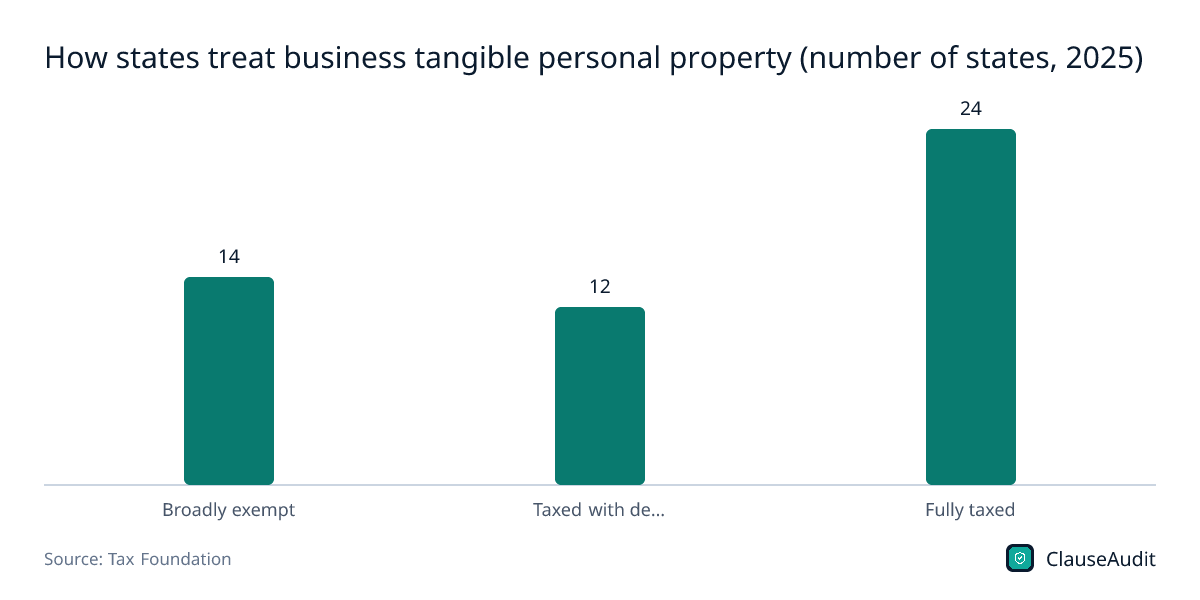
In most states, yes. Equipment you own for a business usually counts as taxable tangible personal property. The Tax Foundation's 2025 count found 14 states broadly exempt it, 12 tax it with a small-business exemption, and 24 tax it with no meaningful one. Texas now exempts $125,000 per location from 2026.
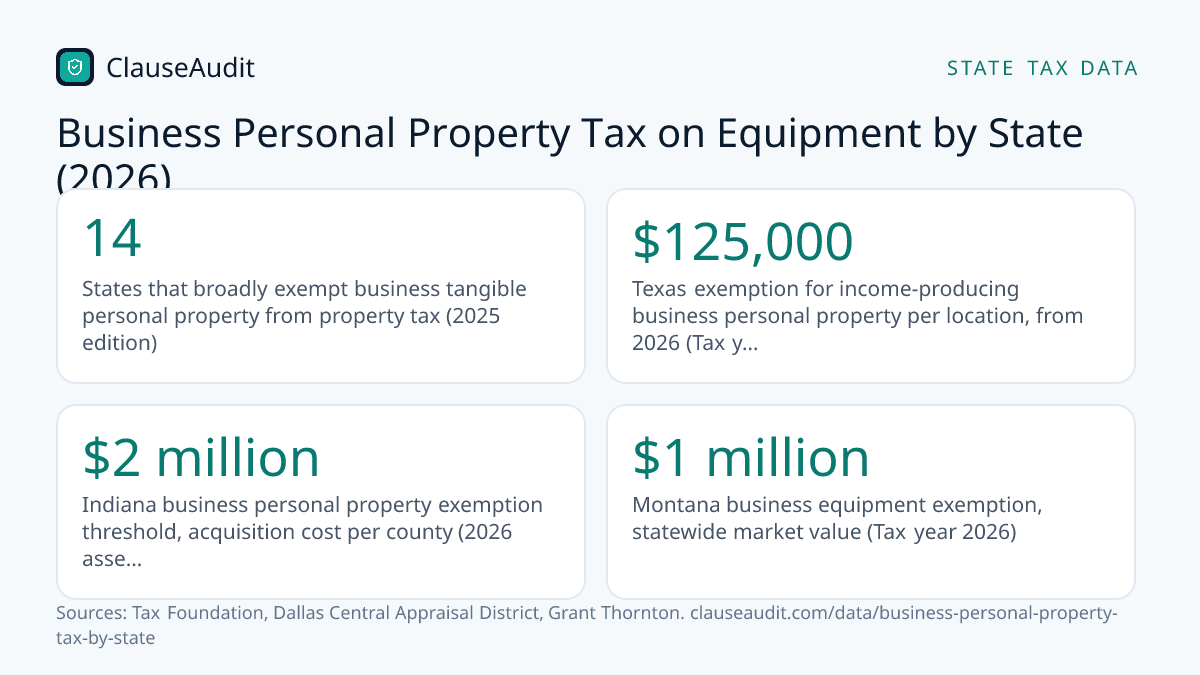
- States that broadly exempt business tangible personal property from property tax (2025 edition, Tax Foundation)
- 14
- Texas exemption for income-producing business personal property per location, from 2026 (Tax year 2026, Dallas Central Appraisal District)
- $125,000
- Indiana business personal property exemption threshold, acquisition cost per county (2026 assessment date and after, Grant Thornton)
- $2 million
- Montana business equipment exemption, statewide market value (Tax year 2026, Montana Department of Revenue)
- $1 million
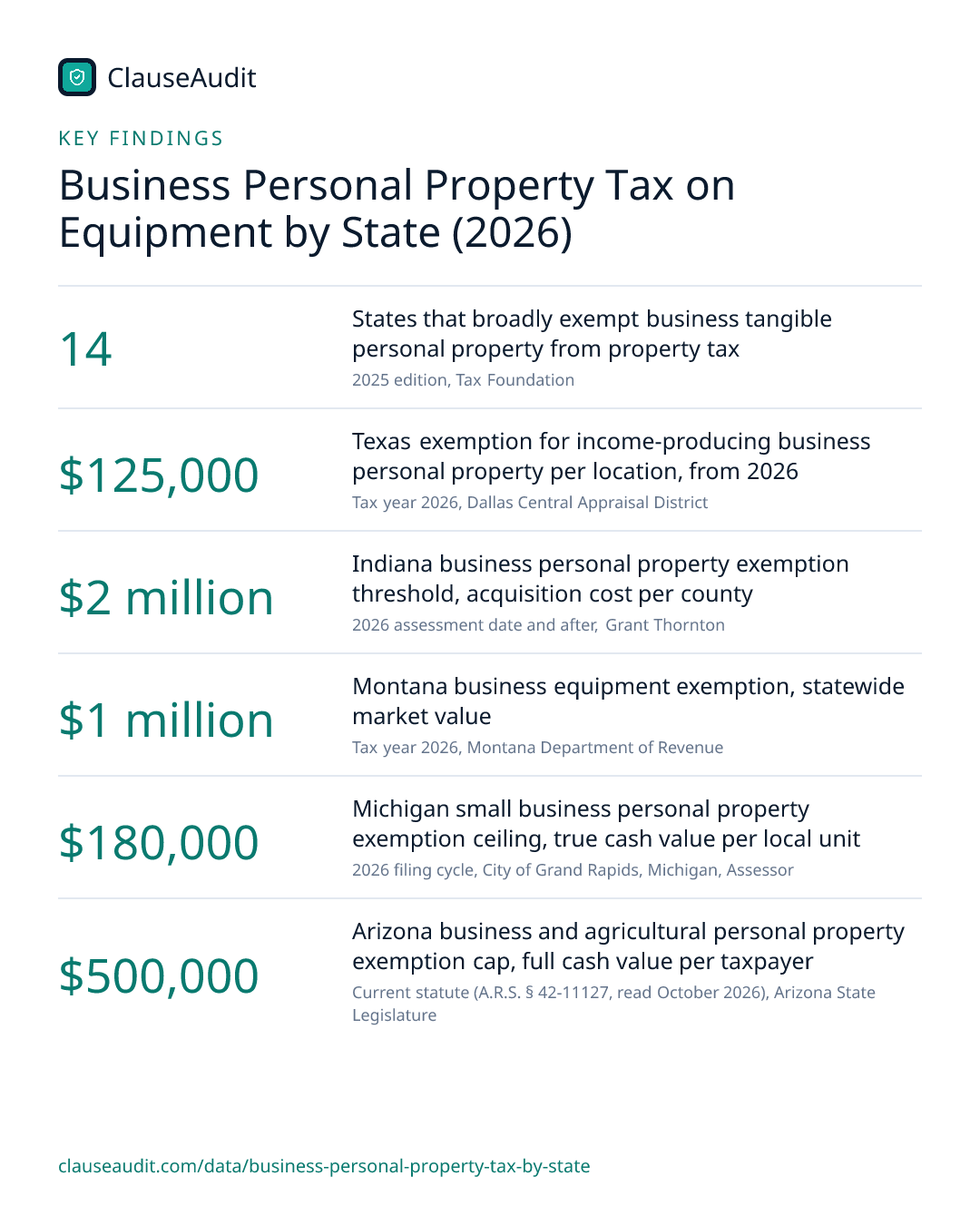
- Michigan small business personal property exemption ceiling, true cash value per local unit (2026 filing cycle, City of Grand Rapids, Michigan, Assessor)
- $180,000
- Arizona business and agricultural personal property exemption cap, full cash value per taxpayer (Current statute (A.R.S. § 42-11127, read October 2026), Arizona State Legislature)
- $500,000
- Florida tangible personal property exemption if the return is filed by April 1 (Current (2026), Florida Department of Revenue)
- $25,000
- Florida penalty for not filing a tangible personal property return, per year (Current (2026), Florida Department of Revenue)
- 25%
Your house gets a property tax bill. So, in many states, do your laptop, your espresso machine, your dental chair and the forklift in the back. Business personal property tax is a yearly local tax on the movable things a business owns and uses, and it catches a lot of new owners off guard because the process usually starts with a return you file, not a bill that shows up on its own.
The rules change at the state line and, lately, from year to year. Texas, Indiana and Wyoming all raised their small-business exemptions for 2026, and Arizona's cap has gone up too. Below we explain who still owes, how the exemptions work, what happens if you skip the return, and why your equipment lease may quietly hand this tax to you.
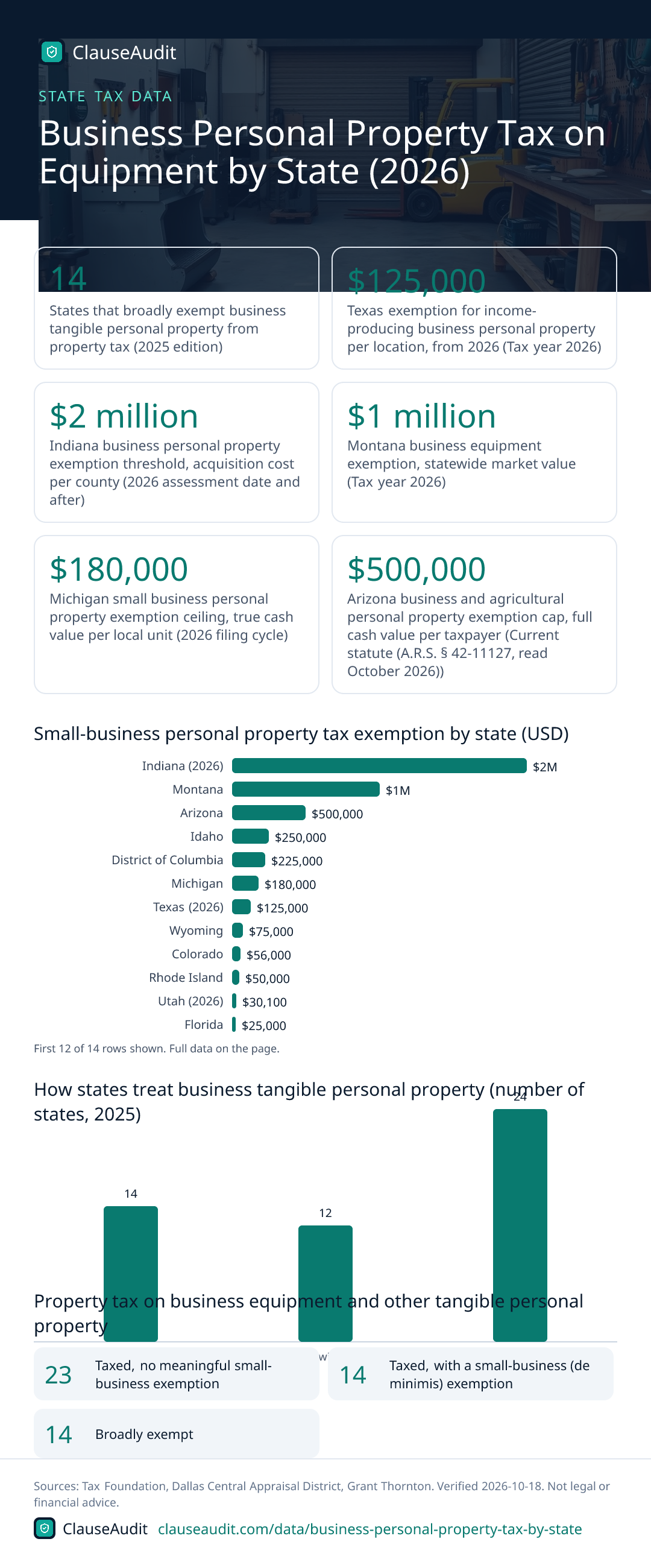
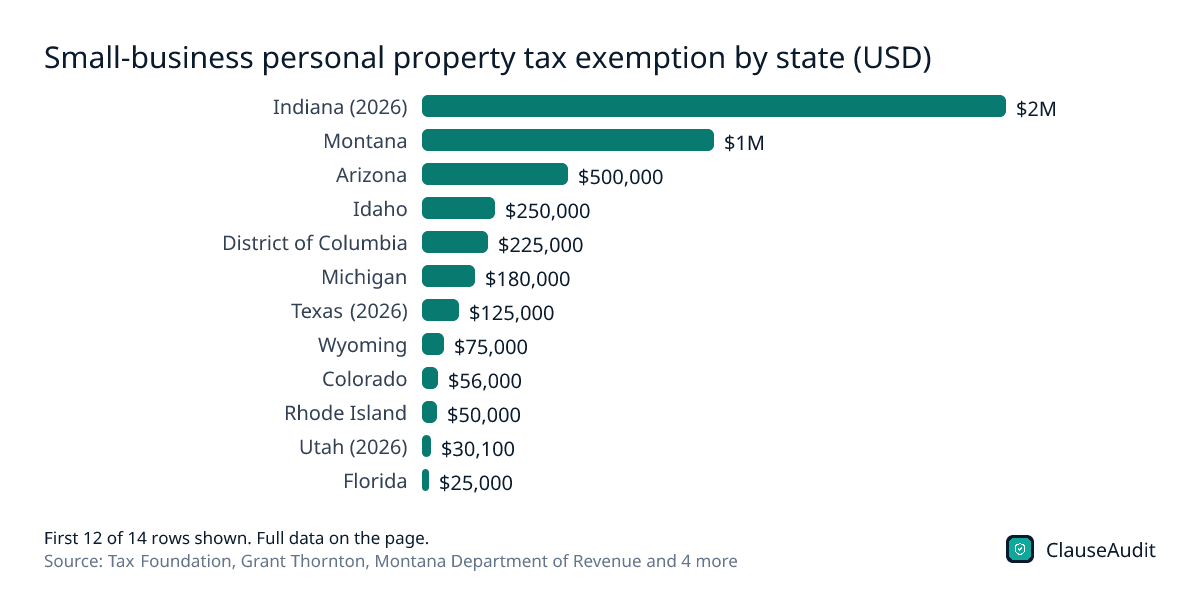
Small-business personal property tax exemption by state (USD)
Chart data
| Label | Value |
|---|---|
| Indiana (2026) | $2M |
| Montana | $1M |
| Arizona | $500,000 |
| Idaho | $250,000 |
| District of Columbia | $225,000 |
| Michigan | $180,000 |
| Texas (2026) | $125,000 |
| Wyoming | $75,000 |
| Colorado | $56,000 |
| Rhode Island | $50,000 |
| Utah (2026) | $30,100 |
| Florida | $25,000 |
| Georgia | $20,000 |
| Maryland | $20,000 |
A bigger number does not always mean a bigger break, because states measure differently. Indiana counts acquisition cost per county, Montana counts market value statewide, and Texas applies its $125,000 per location, so a business with several sites may get more than one exemption.
Download this chart (PNG)How states treat business tangible personal property (number of states, 2025)
Chart data
| Label | Value |
|---|---|
| Broadly exempt | 14 |
| Taxed with de minimis exemption | 12 |
| Fully taxed | 24 |
Nearly half the states in the 2025 table, 24 in all, tax business equipment with no meaningful exemption. Texas has since moved into the de minimis group, so the fully taxed column is a little shorter for 2026.
Download this chart (PNG)Florida tangible personal property return penalties (% of tax levied)
Chart data
| Label | Value |
|---|---|
| Not filed (per year) | 25 |
| Property left off return | 15 |
| Late (per month, max 25%) | 5 |
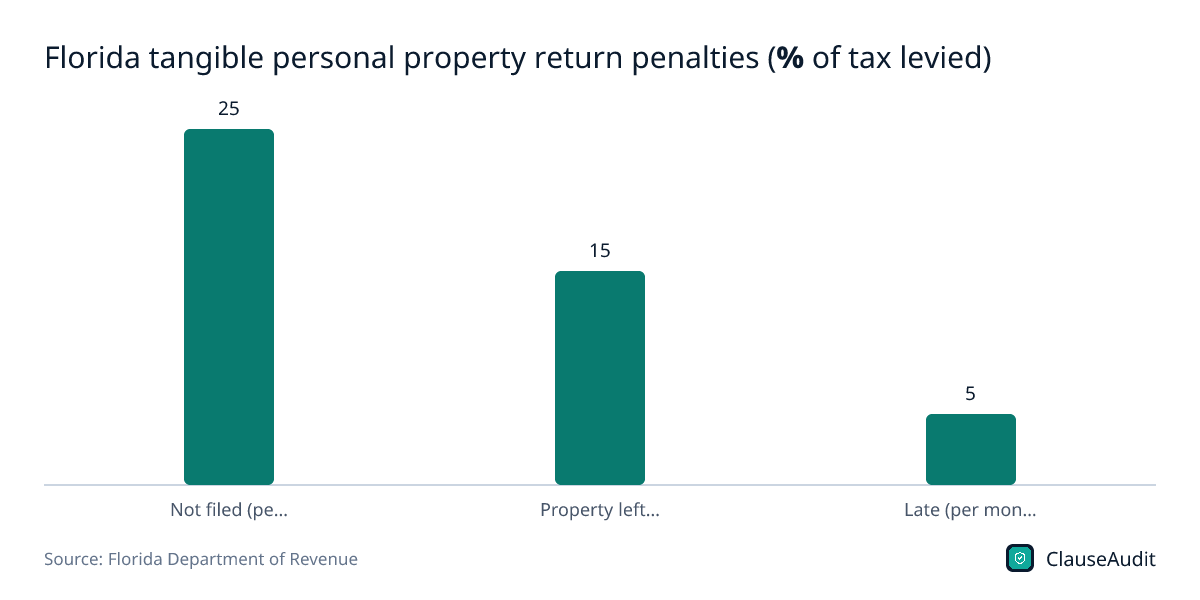
In Florida, skipping the return costs 25% of the tax each year. A late return runs 5% a month up to the same 25% cap, and leaving property off the return costs 15%. Filing on time with a complete list keeps you clear of all three.
Download this chart (PNG)Colorado business personal property assessment ratio by year (%)
Chart data
| Label | Value |
|---|---|
| 2025 | 27 |
| 2026 | 26 |
| 2027 | 25 |
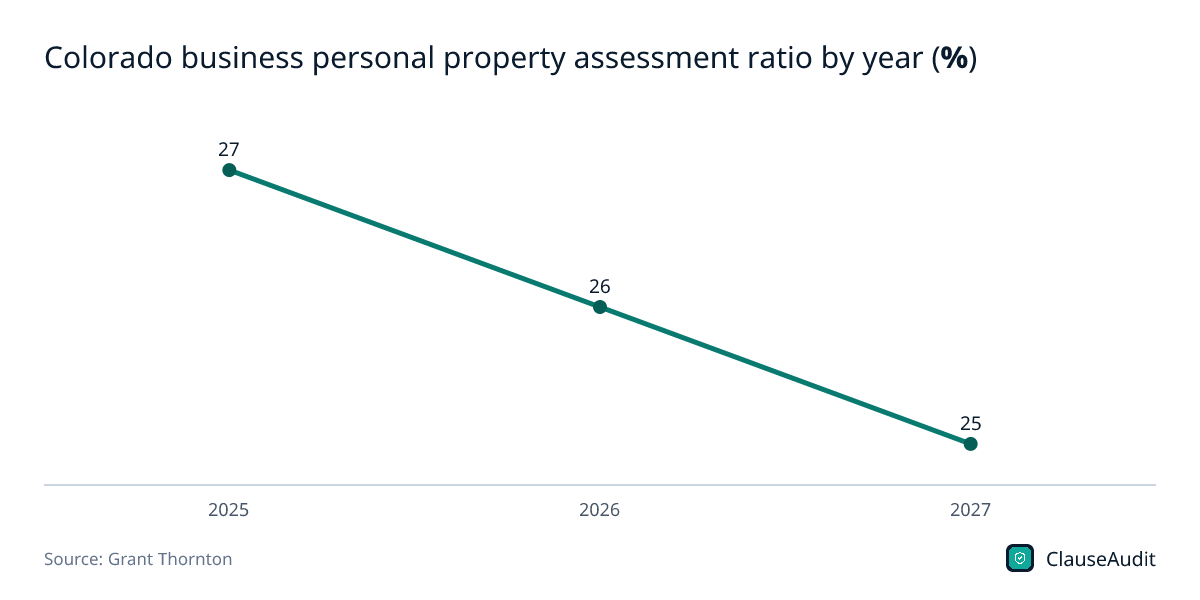
Colorado taxes only a share of business equipment value, and that share is falling: 27% in 2025, 26% in 2026 and 25% from 2027. The drop trims the bill a little each year without any action from you.
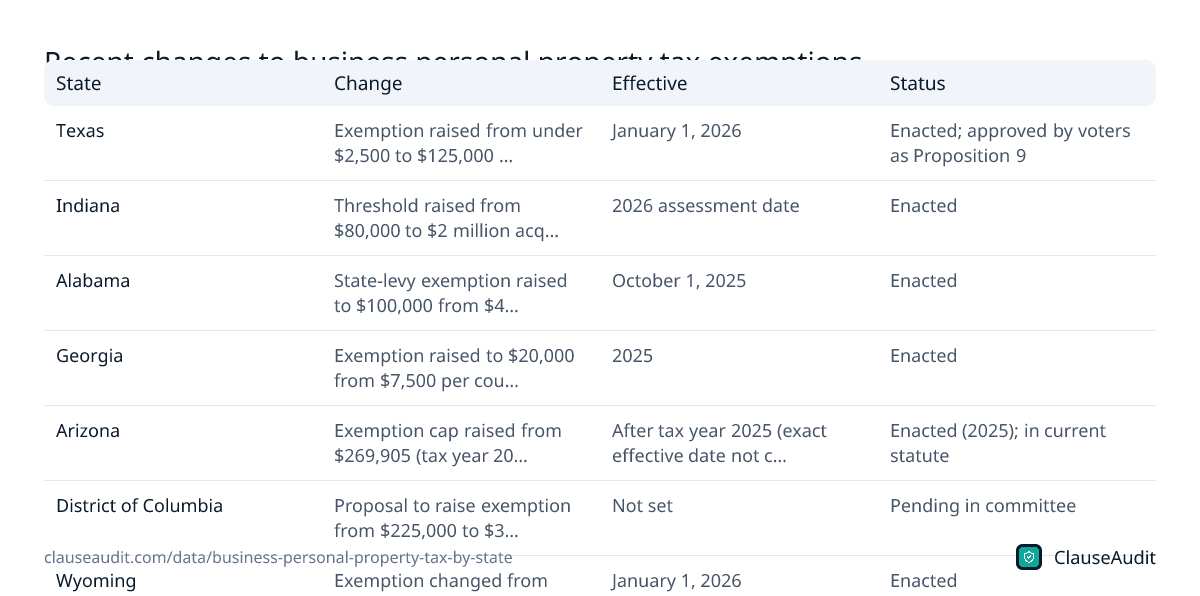
Download this chart (PNG)Recent changes to business personal property tax exemptions
| State | Change | Effective | Status |
|---|---|---|---|
| Texas | Exemption raised from under $2,500 to $125,000 of appraised value per location (H.B. 9) | January 1, 2026 | Enacted; approved by voters as Proposition 9 |
| Indiana | Threshold raised from $80,000 to $2 million acquisition cost (S.B. 1, H.E.A. 1427) | 2026 assessment date | Enacted |
| Alabama | State-levy exemption raised to $100,000 from $40,000 (Act 344, H.B. 543) | October 1, 2025 | Enacted |
| Georgia | Exemption raised to $20,000 from $7,500 per county (H.B. 808) | 2025 | Enacted |
| Arizona | Exemption cap raised from $269,905 (tax year 2025) to $500,000 of full cash value per taxpayer (A.R.S. § 42-11127) | After tax year 2025 (exact effective date not confirmed from a primary source) | Enacted (2025); in current statute |
| District of Columbia | Proposal to raise exemption from $225,000 to $325,000 (B26-0229) | Not set | Pending in committee |
| Wyoming | Exemption changed from property worth $2,400 or less to the first $75,000 of fair market value per person per county (S.F. 48) | January 1, 2026 | Enacted |
Source: Grant Thornton, States focus on personal property tax relief; Dallas Central Appraisal District, HB 9, Business Personal Property Exemption (rendition insert); Texas Legislature, H.B. 9, 89th Legislature, Regular Session (enrolled text); Arizona State Legislature, A.R.S. § 42-11127, Exemption of agricultural and trade or business personal property; Wyoming Legislature, Enrolled Act, S.F. 48 (2025), Business personal property exemption. Download as image
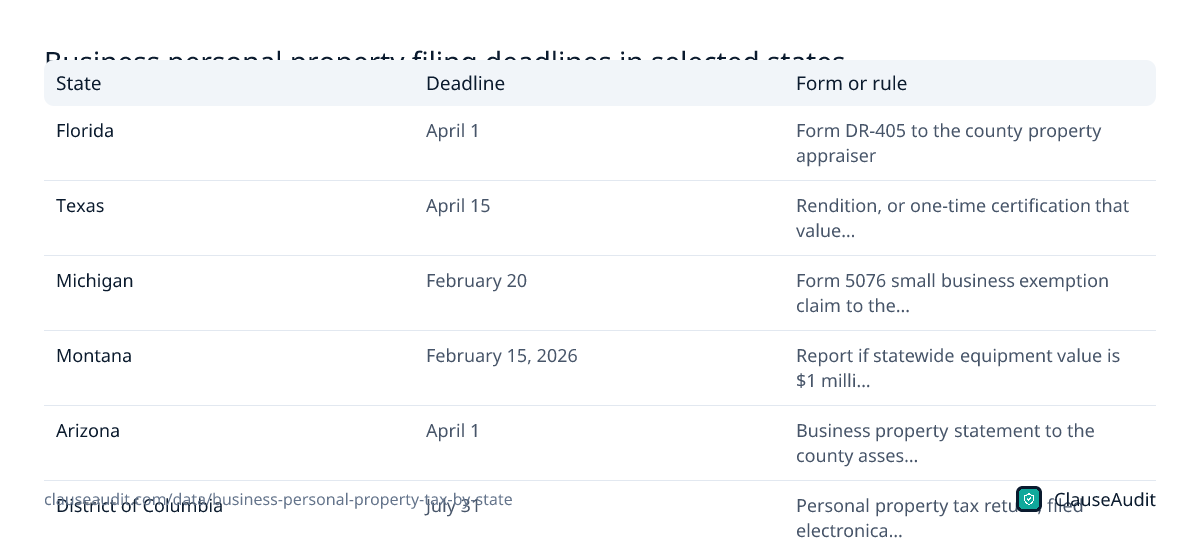
Business personal property filing deadlines in selected states
| State | Deadline | Form or rule |
|---|---|---|
| Florida | April 1 | Form DR-405 to the county property appraiser |
| Texas | April 15 | Rendition, or one-time certification that value is $125,000 or less |
| Michigan | February 20 | Form 5076 small business exemption claim to the local assessor |
| Montana | February 15, 2026 | Report if statewide equipment value is $1 million or more |
| Arizona | April 1 | Business property statement to the county assessor |
| District of Columbia | July 31 | Personal property tax return, filed electronically on MyTax.DC.gov |
Source: Florida Department of Revenue, Tangible Personal Property Tax; Dallas Central Appraisal District, HB 9, Business Personal Property Exemption (rendition insert); City of Grand Rapids, Michigan, Assessor, Apply for a Small Business Property Tax Exemption; Montana Department of Revenue, Reminder of Personal Property Reporting Requirement; Mohave County, Arizona, 2025 Arizona Agricultural/Business Personal Property Filing Instructions; DC Office of Tax and Revenue, Personal Property Tax. Download as image
Property tax on business equipment and other tangible personal property by state
- 23Taxed, no meaningful small-business exemption
- 14Taxed, with a small-business (de minimis) exemption
- 14Broadly exempt
- Taxed, no meaningful small-business exemption23
- Taxed, with a small-business (de minimis) exemption14
- Broadly exempt14
Do I have to pay property tax on business equipment?
Start with your state. If you operate in one of the 14 states that broadly exempt business tangible personal property, such as Ohio, Pennsylvania, Illinois or New York, you generally have nothing to file for ordinary equipment. Some of those states still tax certain centrally assessed property, like utility assets, but a consultant's laptop is not on that list.
Everywhere else, the starting point is that equipment, furniture, tools, computers and sometimes supplies are taxable. Then check for a small-business exemption. In a state like Michigan, a shop whose personal property is under $180,000 in true cash value per local unit can claim the exemption and owe nothing on it. In California, Washington or North Carolina, no meaningful exemption was identified, so even a modest setup is on the roll.
Freelancers working from home are not automatically off the hook. If you bought a camera kit, a large-format printer or a studio setup for the business, many counties expect it on a return. The exemption, if your state has one, is what usually keeps the bill at zero.
How do the small-business exemptions actually work?
They are thresholds, and the details matter more than the headline. Four questions decide if you qualify.
First, what value counts. Indiana uses acquisition cost, which is what you paid, while Montana uses market value and Michigan uses true cash value. Older equipment looks much smaller under a market value test than under a cost test.
Second, the unit. Texas applies its $125,000 per location. Colorado's $56,000 and Georgia's $20,000 apply per county. Montana's $1 million is measured statewide, and Arizona's $500,000 is per taxpayer. A business with sites in two Georgia counties is measured twice; the same business in Montana is measured once.
Third, whether it is a floor or a cliff. Wyoming's new rule exempts the first $75,000 of fair market value per county, so a larger business still gets that slice. Under a cliff-style test, crossing the line can make the whole amount taxable.
Fourth, do you have to claim it? Michigan wants Form 5076 by February 20. Texas lets you file a one-time certification that your value is $125,000 or less instead of a full rendition each year. Miss the claim and you can be assessed as if no exemption existed.
What changed for 2026?
This is a moving target, and mostly in your favor. Texas jumped from an exemption that covered only property worth under $2,500 to one worth $125,000 per location. Indiana raised its threshold from $80,000 to $2 million of acquisition cost per county starting with the 2026 assessment date. Wyoming replaced its old $2,400 cutoff with the first $75,000 of value per county.
Arizona's cap went from $269,905 for tax year 2025 to $500,000 in the current statute, and it is indexed each year. Utah's indexed figure rose to $30,100 for 2026. Alabama raised its exemption to $100,000, though only for the state portion of the levy, so local taxes may still apply. As of early 2026, a District of Columbia bill to lift its $225,000 exemption to $325,000 was still pending in committee.
If you set up your books or signed an equipment lease before these changes, your current paperwork may assume a tax you no longer owe. That is worth a look at renewal time.
What happens if you never file a return?
Assessors do not need your cooperation to send a bill. When a business skips the return, many counties estimate the value themselves, and that estimate can easily come in higher than your real number. On top of that come penalties.
Florida shows how steep they can be. The return is Form DR-405, due April 1 to the county property appraiser. Not filing at all costs 25% of the tax per year. Filing late costs 5% a month, capped at 25%. Leaving property off the return costs 15%. Florida's $25,000 exemption also depends on filing a timely return, at least in the first year, so a small business that ignores the form can lose a break it would otherwise qualify for.
Keep a simple asset list: what you bought, when, what you paid, and where it sits. That one spreadsheet covers most of what any state's return will ask.
Who pays the tax on leased or financed equipment?
Legally, the assessor usually looks to the owner. On a true lease, that is the leasing company. In practice, most equipment leases shift the cost to you through a tax clause, and the lessor adds it to your invoice, often with an admin fee on top.
That surprises people in two ways. You may pay tax on a copier even though your state exempts small businesses, because the lessor owns it, and the threshold is measured against the lessor's much larger holdings, not yours. And the charge often shows up months after the assessment, as a lump sum you did not budget for.
On a financed purchase or a nominal buyout lease, you are usually treated as the owner and file the return yourself. Either way, the contract decides who carries the cost.
- Ask the lessor whether it files the return or expects you to.
- Ask for last year's tax charge on similar equipment in your county.
- Check whether an admin fee is added on top of the tax, and how much.
- In an exempt state, ask why any personal property tax line would appear at all.
What should a small business do this year?
- Look up your state on the map above and note whether it is exempt, de minimis or fully taxed.
- If there is an exemption, find out what value it uses and whether it applies per county, per location or statewide.
- Put the deadline in your calendar now: April 1 in Florida and Arizona, April 15 in Texas, February 20 for Michigan's exemption claim, July 31 in the District of Columbia.
- File even if you expect to owe nothing, when your state requires a return or a claim to get the exemption.
- Read the tax clause in every equipment lease, finance agreement and commercial lease before you sign, not after the first surprise invoice.
How ClauseAudit helps
Personal property tax rarely appears in an equipment contract by name. It hides inside a broad clause that makes you pay "all taxes, fees and charges" tied to the equipment, often with the lessor's own fee stacked on top.
Upload your equipment lease or vendor agreement and the automated review flags who owes the tax, how it gets billed and what else rides along with it, in plain English.
- Tax pass-through clauses that make you pay all taxes on the equipment, including property tax
- Admin or processing fees added on top of tax reimbursements
- Which party, you or the lessor, must file the personal property return, and who pays any penalty
- Buyout terms that decide if you are treated as the owner for tax purposes
- Late fees and default triggers if a tax invoice goes unpaid
- Automatic renewal terms that keep tax charges running after the base term ends
Frequently asked questions
Which states do not tax business personal property?
The Tax Foundation's 2025 table lists 14 states that broadly exempt it: Delaware, Hawaii, Illinois, Iowa, Minnesota, New Hampshire, New Jersey, New Mexico, New York, North Dakota, Ohio, Pennsylvania, South Dakota and Wisconsin. Some of them still tax limited classes such as centrally assessed utility property, but ordinary office or shop equipment is generally not taxed.
How much is the Texas business personal property exemption in 2026?
Starting January 1, 2026, Texas exempts $125,000 of appraised value of income-producing business personal property per location, under H.B. 9. Before that, only property worth less than $2,500 was exempt. You can file a one-time certification that your value is $125,000 or less instead of a full rendition, which is normally due April 15.
Do I need to file a Florida tangible personal property return if I owe nothing?
Usually yes. Florida's $25,000 exemption generally depends on filing Form DR-405 by April 1, at least in the first year. If you do not file, the county can assess you and add a penalty of 25% of the tax per year. Late filing costs 5% a month, up to 25%.
Does a home-based freelancer owe personal property tax?
It depends on the state and the size of your setup. In an exempt state, no. In a state with a small-business exemption, like Michigan at under $180,000 or Arizona at $500,000, a typical freelancer's computers and gear fall below the line, though you may still need to file a claim. In a fully taxed state, your county may expect a return.
Who pays property tax on leased equipment?
The owner is usually assessed, which on a true lease is the leasing company. But most leases pass that tax back to you, often with an admin fee added. On a nominal buyout lease or financed purchase, you are typically treated as the owner and file yourself. Your contract's tax clause decides who pays.
What is a de minimis personal property tax exemption?
It is a threshold below which a business owes no personal property tax, meant to spare small firms the paperwork and the bill. In the 2025 Tax Foundation table, 12 states had one. Among the states charted above, amounts run from $20,000 in Georgia and Maryland to $2 million of acquisition cost per county in Indiana from the 2026 assessment date.
Is the Michigan small business exemption automatic?
No. You claim it on Form 5076, filed with your local assessor by February 20. It covers businesses whose combined personal property in that local unit is under $180,000 in true cash value. Michigan also has a separate exemption for eligible manufacturing personal property, which works differently.
Did Colorado lower its business personal property tax?
Somewhat. Colorado exempts $56,000 per county, and it is cutting the assessment ratio for business personal property from 27% in 2025 to 26% in 2026 and 25% from 2027. A lower ratio means a smaller slice of your equipment's value is taxed, so the same equipment produces a smaller bill.
Use this data
Every chart and card below is free to reuse under CC BY 4.0. Download what you need and link back to this page.
 Stat cards
 Key findings card
 Infographic
 Small-business personal property tax exemption by state (USD)
 How states treat business tangible personal property (number of states, 2025)
 Florida tangible personal property return penalties (% of tax levied)
 Colorado business personal property assessment ratio by year (%)
 Recent changes to business personal property tax exemptions
 Business personal property filing deadlines in selected states
Embed the infographic
Free to share on your site, blog or slides under CC BY 4.0. Please keep the credit link.
Sources and method
Every number on this page comes from the sources below, each opened and read on or before October 18, 2026. A second, independent review checked every figure against its source and corrected anything that did not match. 51 of 51 state entries were confirmed; any that could not be are marked "Not yet confirmed" and left out of every count and chart.
- Tax Foundation, Tangible Personal Property De Minimis Exemptions by State, 2025 (April 29, 2025 (2025 edition))
- Grant Thornton, States focus on personal property tax relief (February 16, 2026)
- Dallas Central Appraisal District, HB 9, Business Personal Property Exemption (rendition insert) (2026 rendition season)
- Texas Legislature, H.B. 9, 89th Legislature, Regular Session (enrolled text) (2025)
- Montana Department of Revenue, Reminder of Personal Property Reporting Requirement (January 6, 2026)
- City of Grand Rapids, Michigan, Assessor, Apply for a Small Business Property Tax Exemption (Accessed October 2026)
- Mohave County, Arizona, 2025 Arizona Agricultural/Business Personal Property Filing Instructions (Tax Year 2025)
- Florida Department of Revenue, Tangible Personal Property Tax (Accessed October 2026)
- DC Office of Tax and Revenue, Personal Property Tax (Accessed October 2026)
- Arizona State Legislature, A.R.S. § 42-11127, Exemption of agricultural and trade or business personal property (Accessed October 2026)
- Weber County, Utah, Assessor, Personal Property Information (Accessed October 2026)
- Wyoming Legislature, Enrolled Act, S.F. 48 (2025), Business personal property exemption (2025 General Session)
Cite this page
ClauseAudit, “Business Personal Property Tax on Equipment by State (2026)”, updated October 18, 2026, https://clauseaudit.com/data/business-personal-property-tax-by-state. Free to reuse with a link back (CC BY 4.0).
This page summarises published data and law as checked on October 18, 2026. Figures are updated as new editions are released, and your own situation may differ. It is general information, not legal, tax or financial advice.