Equipment Leasing and Finance Industry Statistics 2026: Growth, Approvals and Credit Quality
By ClauseAudit Research · 12 sources ·
What do the latest equipment leasing statistics show?
Equipment finance is large and still growing. ELFA puts the U.S. industry at $1.3 trillion, with new business volume up 6.8% in 2025 after 3.1% in 2024. Most buyers finance: 82% of U.S. companies use loans, leases or credit lines to acquire equipment, and lenders report 98.5% of portfolios current.
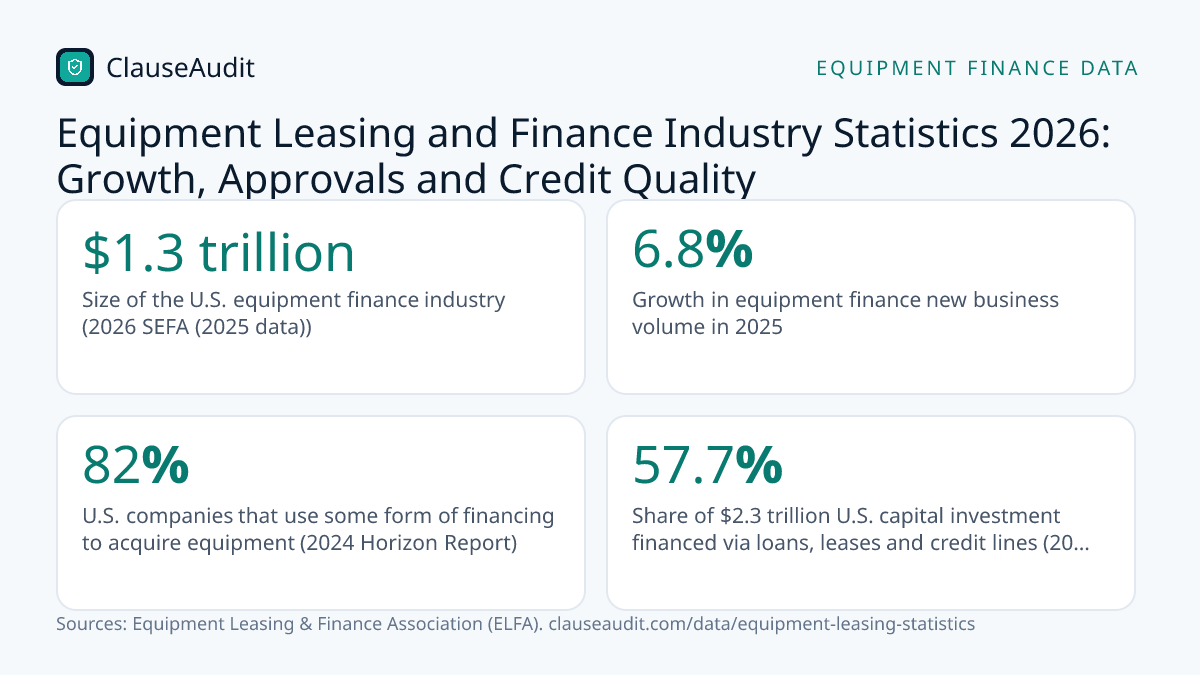
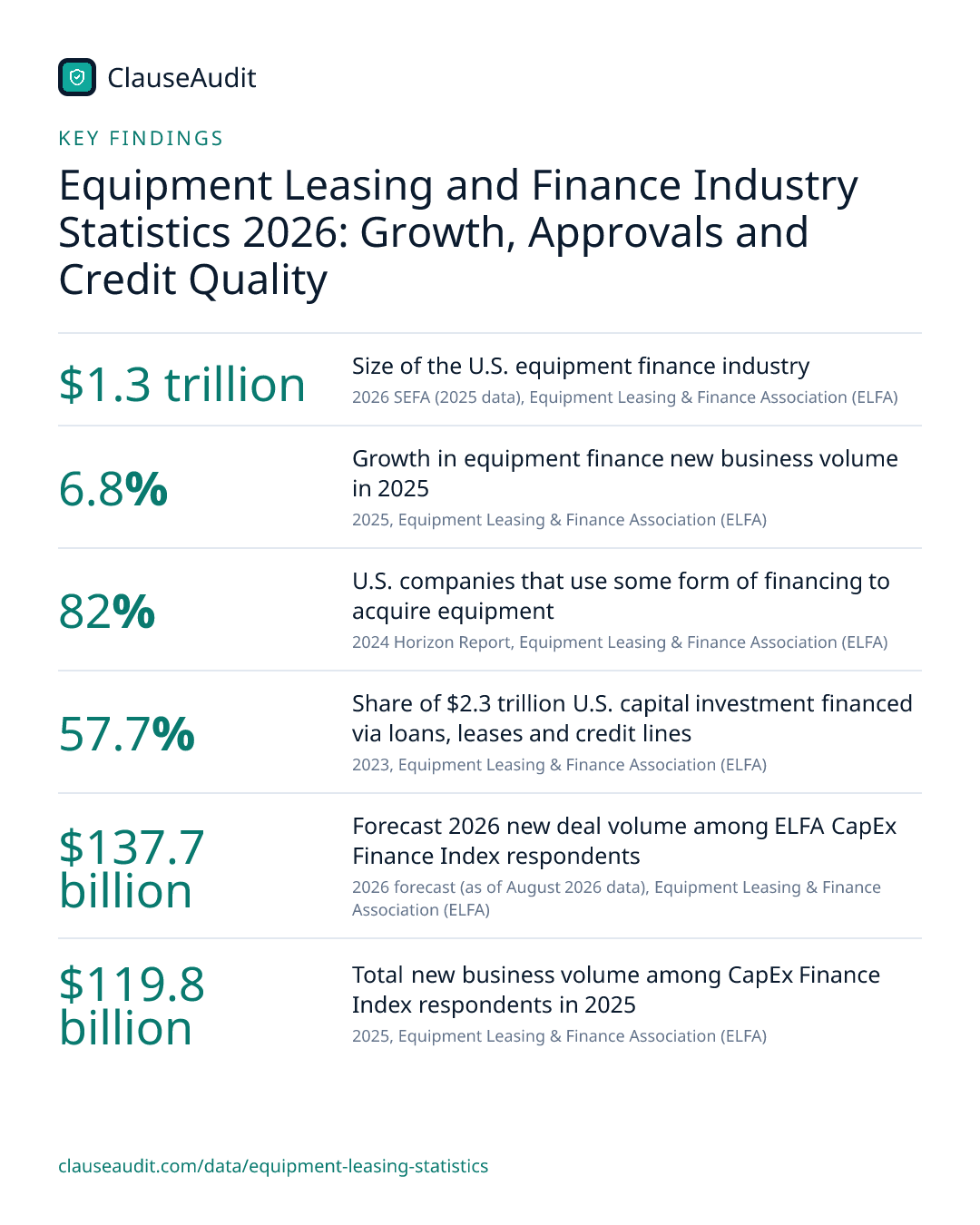
- Size of the U.S. equipment finance industry (2026 SEFA (2025 data), Equipment Leasing & Finance Association (ELFA))
- $1.3 trillion
- Growth in equipment finance new business volume in 2025 (2025, Equipment Leasing & Finance Association (ELFA))
- 6.8%
- U.S. companies that use some form of financing to acquire equipment (2024 Horizon Report, Equipment Leasing & Finance Association (ELFA))
- 82%
- Share of $2.3 trillion U.S. capital investment financed via loans, leases and credit lines (2023, Equipment Leasing & Finance Association (ELFA))
- 57.7%
- Forecast 2026 new deal volume among ELFA CapEx Finance Index respondents (2026 forecast (as of August 2026 data), Equipment Leasing & Finance Association (ELFA))
- $137.7 billion
- Total new business volume among CapEx Finance Index respondents in 2025 (2025, Equipment Leasing & Finance Association (ELFA))
- $119.8 billion
- Year-to-date growth in new business volume through August 2026 (January to August 2026, Equipment Leasing & Finance Association (ELFA))
- 17.3%
- Equipment finance portfolios reported as current (under 30 days past due) (2025, Equipment Leasing & Finance Association (ELFA))
- 98.5%
Most businesses do not pay cash for trucks, machines or servers. They lease or finance them, and the numbers show that habit getting stronger. ELFA's annual survey found new business volume grew 6.8% in 2025, more than double the pace of the year before, and lenders tracked in its monthly index were up 17.3% year to date through August 2026.
Growth is good news if you need equipment, because lenders want your deal. It also means more contracts are being signed quickly, often on the lessor's standard form. Below we explain what the figures say about who lends, how picky they are getting, and which terms in an equipment lease deserve a slow read.
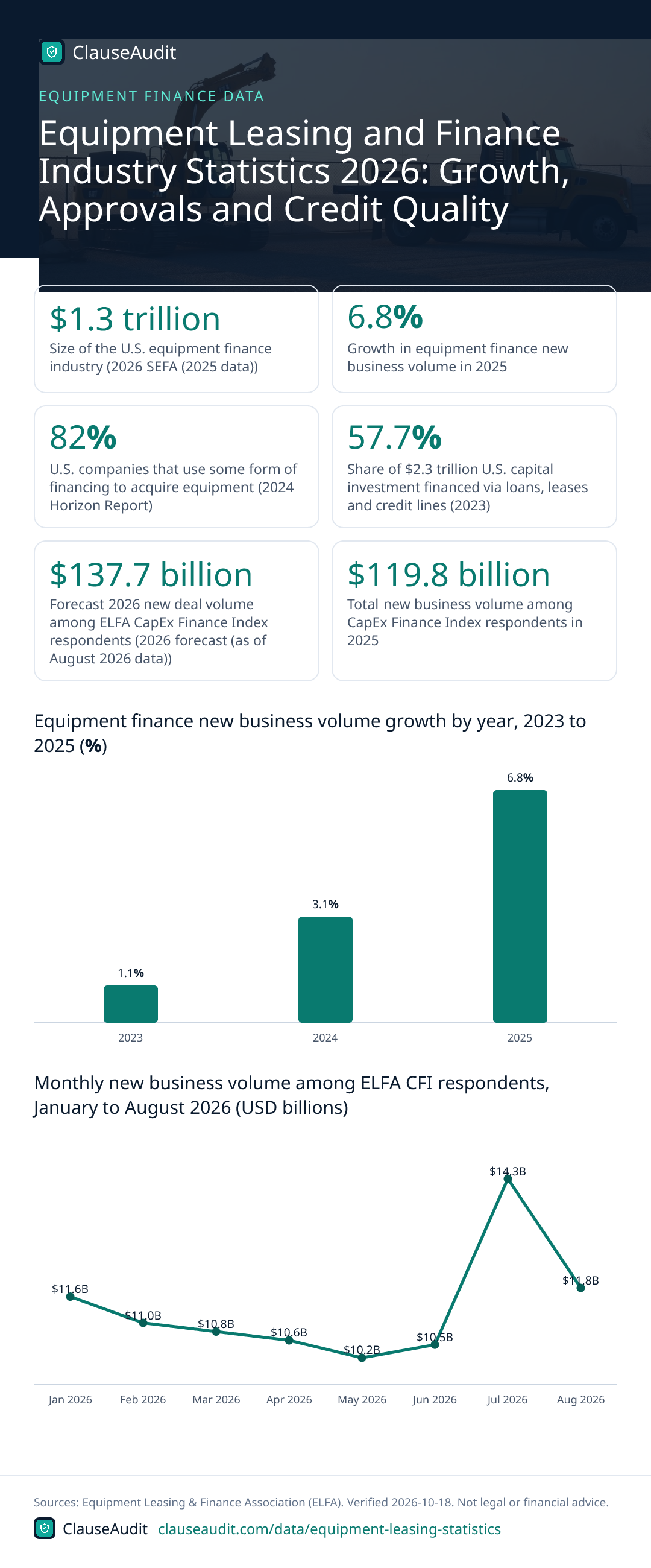
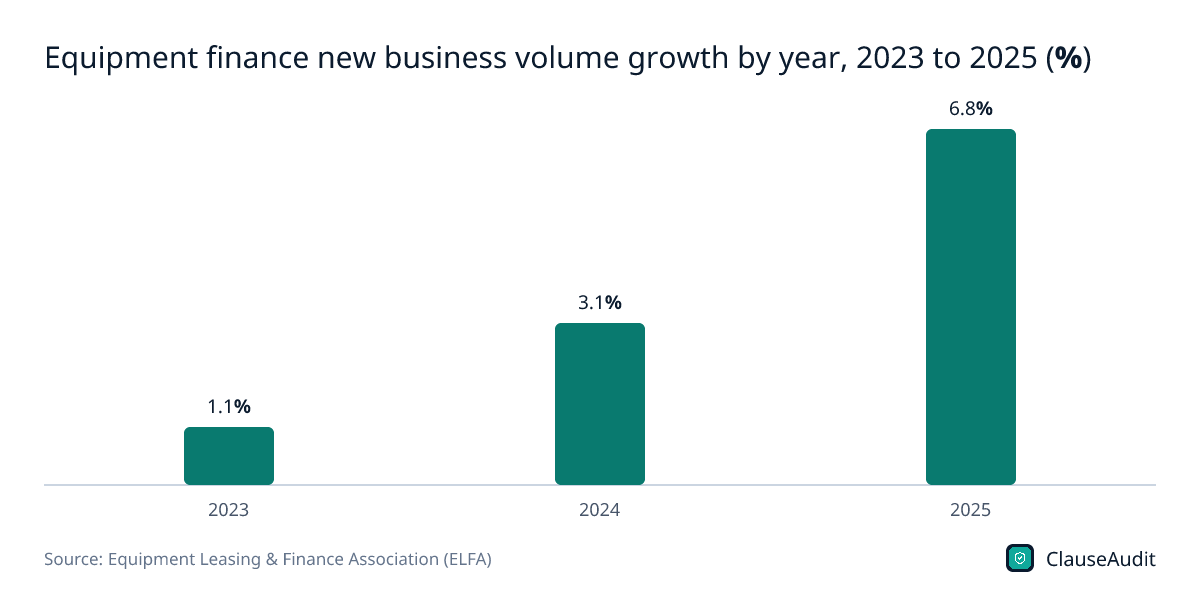
Equipment finance new business volume growth by year, 2023 to 2025 (%)
Chart data
| Label | Value (%) |
|---|---|
| 2023 | 1.1% |
| 2024 | 3.1% |
| 2025 | 6.8% |
Growth picked up in each of the last two years, from 1.1% in 2023 to 3.1% in 2024 and 6.8% in 2025. Each figure comes from a survey of about 100 lenders, so treat it as a trend, not a census.
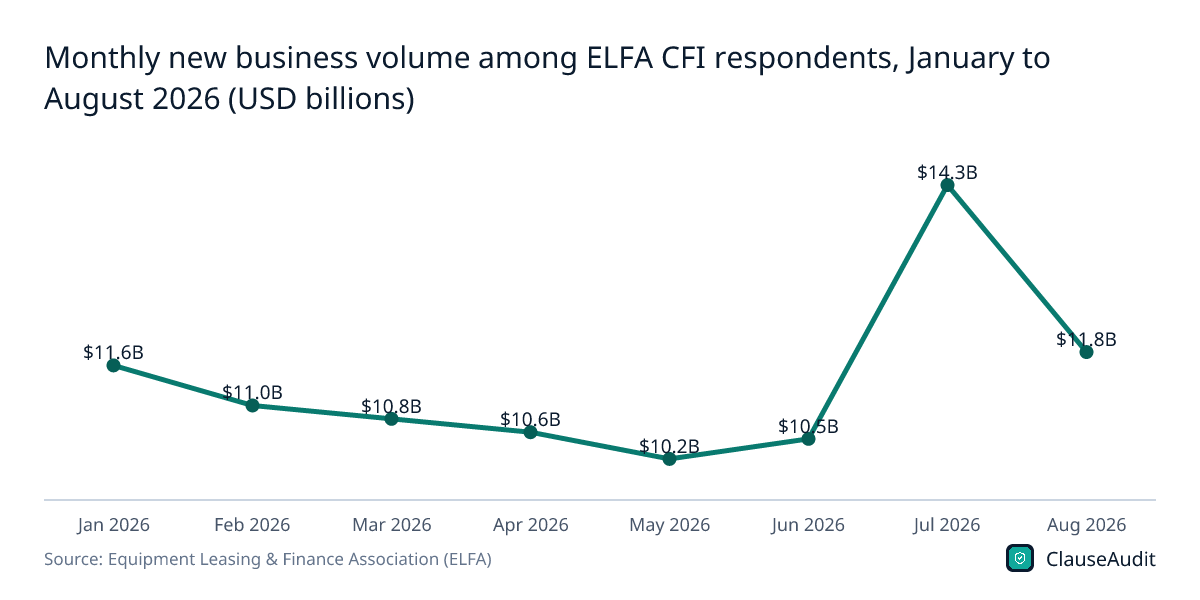
Download this chart (PNG)Monthly new business volume among ELFA CFI respondents, January to August 2026 (USD billions)
Chart data
| Label | Value (USD billions) |
|---|---|
| Jan 2026 | $11.6B |
| Feb 2026 | $11.0B |
| Mar 2026 | $10.8B |
| Apr 2026 | $10.6B |
| May 2026 | $10.2B |
| Jun 2026 | $10.5B |
| Jul 2026 | $14.3B |
| Aug 2026 | $11.8B |
Monthly volume stayed between $10.2 billion and $11.8 billion in every month from January to August 2026 except July, when it jumped to $14.3 billion. ELFA revises earlier months as it updates seasonal factors, so small gaps between months matter less than the overall level.
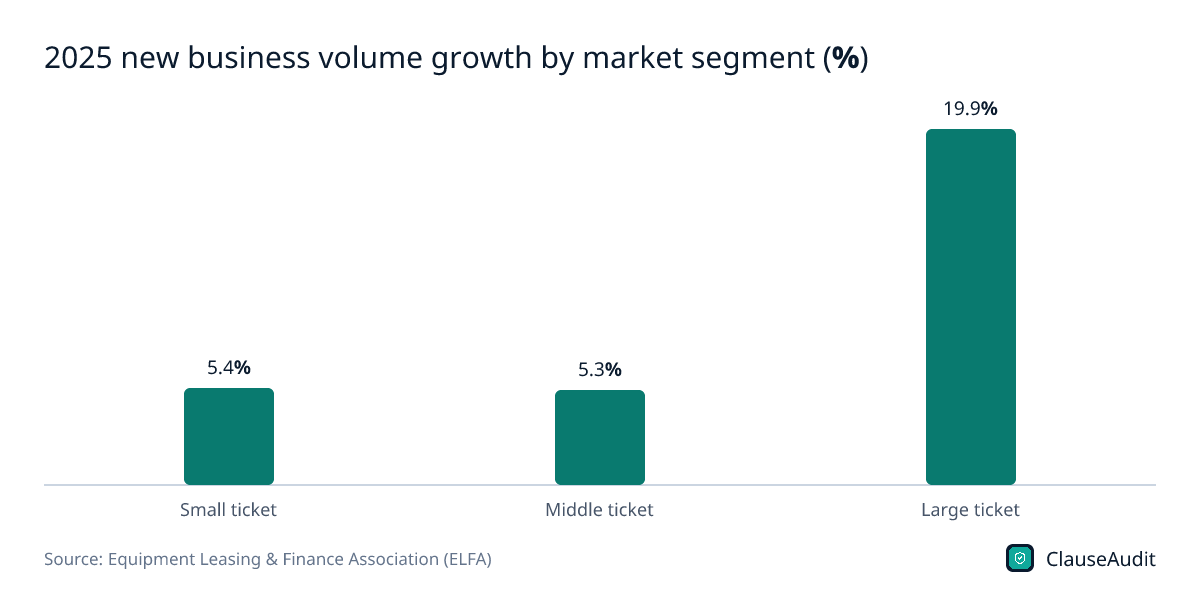
Download this chart (PNG)2025 new business volume growth by market segment (%)
Chart data
| Label | Value (%) |
|---|---|
| Small ticket | 5.4% |
| Middle ticket | 5.3% |
| Large ticket | 19.9% |
Large ticket deals grew 19.9% in 2025, far ahead of small ticket (5.4%) and middle ticket (5.3%). Small businesses mostly live in the small ticket segment, where growth was steady rather than dramatic.
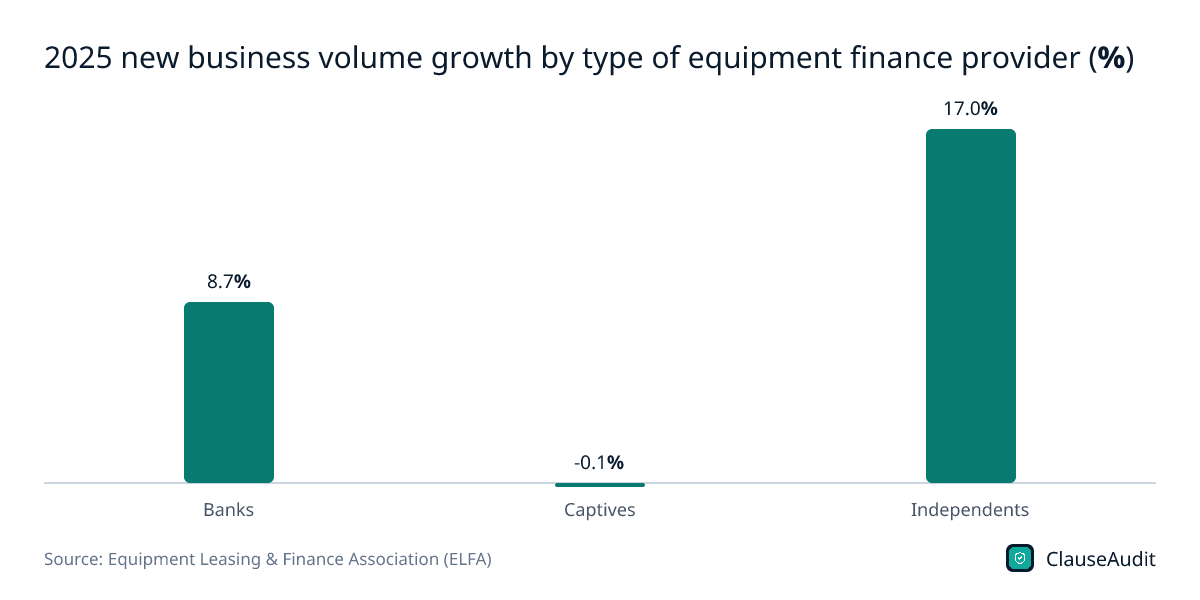
Download this chart (PNG)2025 new business volume growth by type of equipment finance provider (%)
Chart data
| Label | Value (%) |
|---|---|
| Banks | 8.7% |
| Captives | -0.1% |
| Independents | 17.0% |
Independent lessors grew 17.0% and banks 8.7%, while captive finance arms were flat at -0.1%. Independents are a much smaller group, so a strong percentage there adds less total volume.
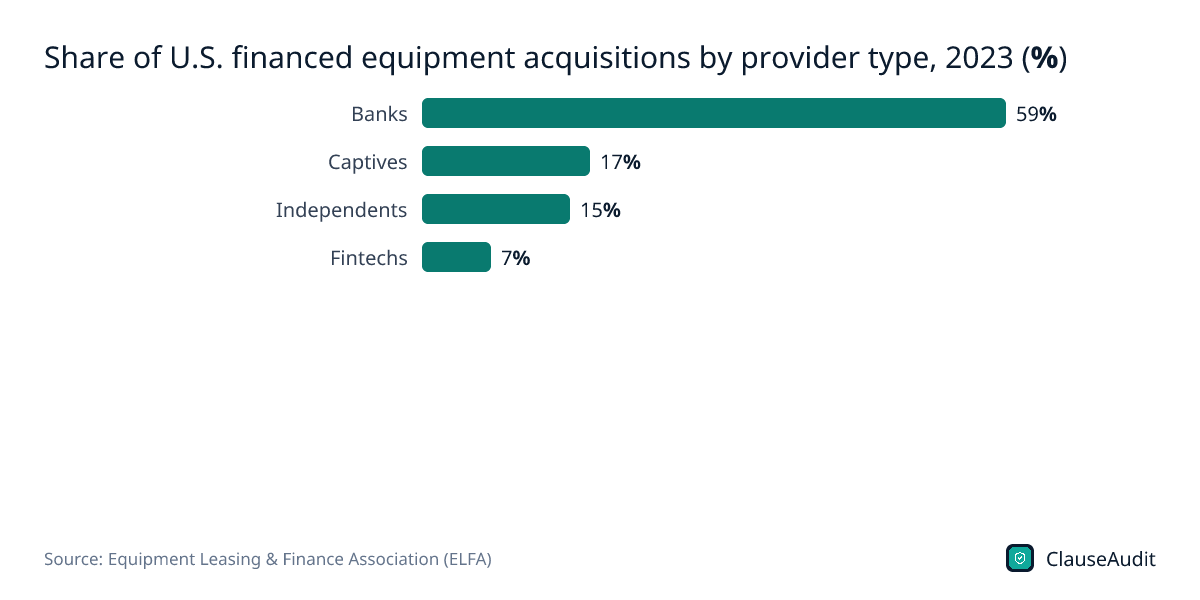
Download this chart (PNG)Share of U.S. financed equipment acquisitions by provider type, 2023 (%)
Chart data
| Label | Value |
|---|---|
| Banks | 59% |
| Captives | 17% |
| Independents | 15% |
| Fintechs | 7% |
Banks handled 59% of financed equipment acquisitions in 2023, ahead of captives at 17%, independents at 15% and fintechs at 7%. Different lenders use very different contract forms, which is one reason two quotes for the same machine can read so differently.
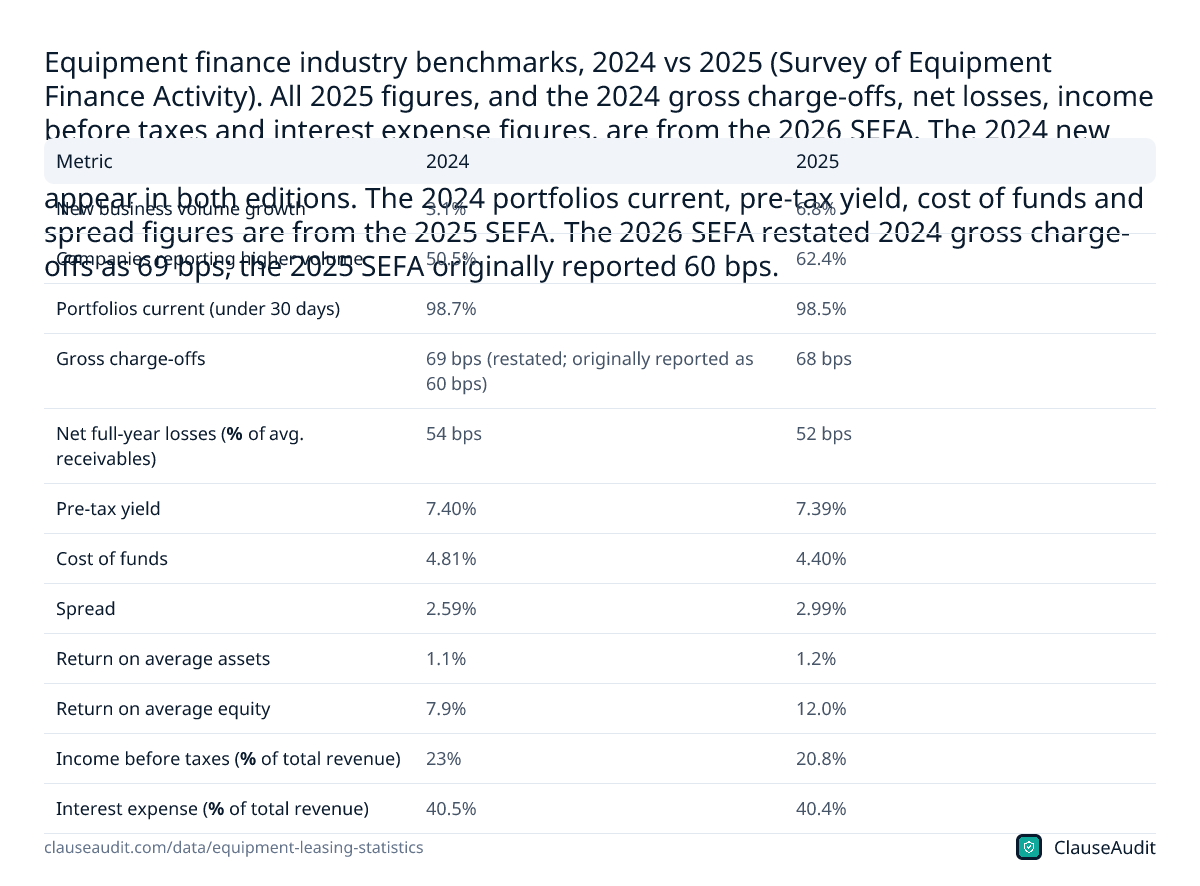
Download this chart (PNG)Equipment finance industry benchmarks, 2024 vs 2025 (Survey of Equipment Finance Activity). All 2025 figures, and the 2024 gross charge-offs, net losses, income before taxes and interest expense figures, are from the 2026 SEFA. The 2024 new business volume growth, share reporting higher volume, ROA and ROE figures appear in both editions. The 2024 portfolios current, pre-tax yield, cost of funds and spread figures are from the 2025 SEFA. The 2026 SEFA restated 2024 gross charge-offs as 69 bps; the 2025 SEFA originally reported 60 bps.
| Metric | 2024 | 2025 |
|---|---|---|
| New business volume growth | 3.1% | 6.8% |
| Companies reporting higher volume | 50.5% | 62.4% |
| Portfolios current (under 30 days) | 98.7% | 98.5% |
| Gross charge-offs | 69 bps (restated; originally reported as 60 bps) | 68 bps |
| Net full-year losses (% of avg. receivables) | 54 bps | 52 bps |
| Pre-tax yield | 7.40% | 7.39% |
| Cost of funds | 4.81% | 4.40% |
| Spread | 2.59% | 2.99% |
| Return on average assets | 1.1% | 1.2% |
| Return on average equity | 7.9% | 12.0% |
| Income before taxes (% of total revenue) | 23% | 20.8% |
| Interest expense (% of total revenue) | 40.5% | 40.4% |
Source: Equipment Leasing & Finance Association (ELFA), Survey of Equipment Finance Activity Reports 6.8% Growth in New Business Volume in 2025 (2026 SEFA news release); Equipment Leasing & Finance Association (ELFA), Equipment Finance Industry Sees 3.1% Growth in New Business Volume Amid Tightening Credit in 2024 (2025 SEFA news release). Download as image
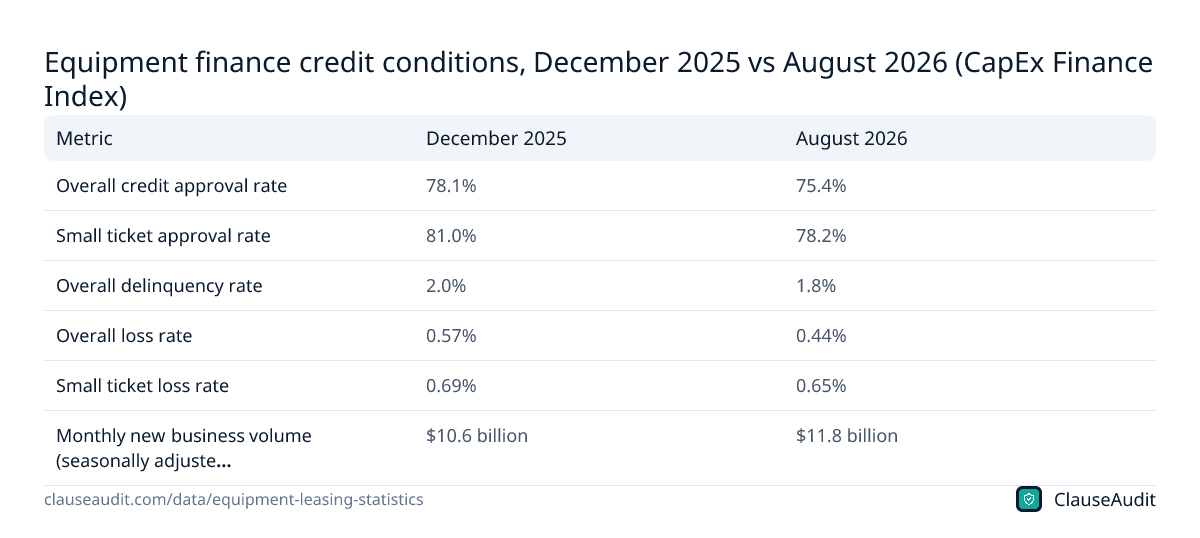
Equipment finance credit conditions, December 2025 vs August 2026 (CapEx Finance Index)
| Metric | December 2025 | August 2026 |
|---|---|---|
| Overall credit approval rate | 78.1% | 75.4% |
| Small ticket approval rate | 81.0% | 78.2% |
| Overall delinquency rate | 2.0% | 1.8% |
| Overall loss rate | 0.57% | 0.44% |
| Small ticket loss rate | 0.69% | 0.65% |
| Monthly new business volume (seasonally adjusted) | $10.6 billion | $11.8 billion |
Source: Equipment Leasing & Finance Association (ELFA), CapEx Finance Index, December 2025: Equipment Demand in 2025 Reached All-Time Second Highest Level; Equipment Leasing & Finance Association (ELFA), CapEx Finance Index, August 2026: Demand Cools from Record High and Financial Conditions Improve. Download as image
How big is the equipment leasing industry in 2026?
ELFA sizes the U.S. equipment finance industry at $1.3 trillion. That figure covers leases, loans and lines of credit used to acquire equipment, from a single copier to a fleet of aircraft.
A smaller, more current slice comes from the CapEx Finance Index, which tracks a panel of ELFA member companies each month. Those lenders booked $119.8 billion in new business in 2025, and the forecast for 2026 sits at $137.7 billion. Through August 2026, their volume was running 17.3% ahead of the same months in 2025.
The wider economy leans on this market too. In 2023, 57.7% of the $2.3 trillion that U.S. businesses, nonprofits and government agencies invested in plant, equipment and software was financed through loans, leases and credit lines. More than half of that spending was borrowed or leased, not paid in cash.
For you, the size matters for one reason: equipment finance is a mature, competitive market. There are many lenders chasing the same deals, so the first quote you get is rarely the only one available.
Is it getting harder to get approved for an equipment lease?
A little. The overall credit approval rate among index respondents slipped from 78.1% in December 2025 to 75.4% in August 2026. Small ticket approvals followed the same path, from 81.0% to 78.2%.
That is not a lockout. Roughly three in four applications still get approved. But it does mean lenders are reading files more carefully, and a thin credit history or a new business may see more conditions attached to a yes.
Those conditions usually show up in the contract, not the quote. Watch for a personal guarantee, a larger security deposit, extra advance payments, or a shorter cure period before default. If you are a newer company, expect at least one of these and decide in advance which one you can live with.
Timing helps too. Apply when your latest financial statements look their best, have a clear quote from the vendor in hand, and know the exact model and price. A clean, complete file gets better terms than a rushed one, even in a tighter market.
Why are lenders doing so well, and what does that mean for your rate?
Equipment finance portfolios are healthy. Lenders reported 98.5% of their portfolios current in 2025. In the monthly index, the overall delinquency rate fell from 2.0% to 1.8% between December 2025 and August 2026, and the loss rate dropped from 0.57% to 0.44%.
Margins improved as well. Cost of funds fell from 4.81% in 2024 to 4.40% in 2025, while pre-tax yield barely moved at 7.39%. The spread widened from 2.59% to 2.99%, and return on average equity climbed from 7.9% to 12.0%.
In plain terms, lenders' borrowing costs went down and the prices they charge customers mostly did not. If your lessor's funding got cheaper, there is room to push on your rate, your fees or your end-of-term terms. Get at least two quotes and ask each lessor to state the implicit rate in writing.
Be careful with low monthly payments. A lessor can make a payment look cheap by stretching the term, adding a large balloon at the end, or charging interim rent from the delivery date until the first scheduled payment. None of those show up in the headline number, and all of them show up in the contract.
Who are you actually signing with?
Banks did 59% of financed equipment acquisitions in 2023. Captives, the finance arms of manufacturers and dealers, did 17%. Independents did 15% and fintechs 7%.
The type of lender changes the paperwork. A captive may bundle maintenance or software into the lease and tie your warranty to the finance deal. A bank form may be stricter about default and cross-default. A fintech may offer a fast online approval with an automatic payment authorization buried in the signature page.
Captive volume was flat in 2025 while independents grew 17.0%. If a dealer steers you to its in-house financing, compare it against at least one outside offer before you sign.
Also check who you will be paying after the deal closes. Leases are often sold or assigned to another funder, and your contract may let the lessor do that without telling you first. The new owner inherits every right in the paperwork, including the strict ones.
What a small business should do before signing an equipment lease
- Ask for the total of all payments, fees and the buyout in one number, then compare that to the cash price.
- Find out whether the buyout is a fixed amount or fair market value, and who decides fair market value.
- Read the default section for cross-default, acceleration of every remaining payment, and repossession without notice.
- Look for a hell or high water clause, which keeps you paying even if the equipment breaks or the vendor disappears.
- Check the end-of-term notice window. Many leases renew month to month or for a full extra term if you miss it.
- Confirm who carries insurance, maintenance and property tax, and whether the lessor can add fees for any of them later.
- Ask if a personal guarantee is required, and if so, whether it can be capped or released after a clean payment history.
What the growth means if you sell or use equipment for a living
Contractors, truckers, medical practices and restaurants all run on financed gear. When 82% of companies finance their equipment, the lease is part of your cost structure, not a side detail. A bad end-of-term clause can cost you more than a quarter point of rate ever would.
If you sell equipment, vendor finance programs are a selling tool. Read the program agreement as closely as your customers should read their leases, especially any recourse terms that put you on the hook when a customer stops paying.
Workers feel this too. If your employer leases the trucks or tools you use, a lease that ends badly can mean equipment pulled from a job site with little warning. Owners who read their leases closely keep that from happening.
How ClauseAudit helps
The industry numbers tell you lenders are busy and profitable. Your own contract tells you how much of that profit comes from you. ClauseAudit's automated review reads an equipment lease or finance agreement and flags the clauses that drive real cost and risk, in plain English.
Upload the lease or paste the text, and you get a risk score, the exact clause language, and a suggested change you can bring to the lessor before you sign.
- Buyout terms: fixed amount versus fair market value, and who sets it
- Hell or high water and non-cancellable payment obligations
- Default, acceleration, cross-default and repossession rights
- Automatic renewal and end-of-term notice windows
- Personal guarantee scope and any release conditions
- Late fees, interim rent, documentation fees and other add-on charges
Frequently asked questions
How big is the U.S. equipment finance industry?
ELFA estimates the U.S. equipment finance industry at $1.3 trillion. That includes leases, loans and lines of credit used to acquire equipment. Its 2026 Survey of Equipment Finance Activity found new business volume grew 6.8% in 2025, up from 3.1% in 2024.
What percentage of businesses lease or finance equipment?
According to the Equipment Leasing & Finance Foundation's 2024 Horizon Report, cited by ELFA, 82% of U.S. companies use some form of financing to acquire equipment. That covers leases, loans and credit lines together, so it is not a figure for leasing alone.
Is equipment leasing growing in 2026?
Yes. Lenders in ELFA's CapEx Finance Index reported new business volume up 17.3% year to date through August 2026. ELFA's forecast for the full year among those respondents is $137.7 billion, compared with $119.8 billion in 2025. That would be the highest yearly total since the index began in 2006.
What is the approval rate for equipment financing?
Among CapEx Finance Index respondents, the overall credit approval rate was 75.4% in August 2026, down from 78.1% in December 2025. Small ticket deals, the size most small businesses apply for, had a 78.2% approval rate in August 2026. Expect more conditions, such as a guarantee or deposit, when approvals tighten.
Who provides most equipment financing?
Banks. They handled 59% of financed U.S. equipment acquisitions in 2023, according to figures ELFA cites. Captive finance companies tied to manufacturers had 17%, independent lessors 15% and fintechs 7%. In 2025, independents grew volume 17.0% while captives were flat.
Are equipment lease defaults rising?
Not according to the latest data. Lenders reported 98.5% of portfolios current in 2025. In the monthly index, the overall delinquency rate fell from 2.0% in December 2025 to 1.8% in August 2026, and the loss rate fell from 0.57% to 0.44%.
Should I lease or buy equipment for my business?
It depends on how long you will keep the equipment, your cash position and your tax situation. Leasing preserves cash and can make upgrades easier. Buying often costs less overall if you keep the asset for most of its useful life. Compare the total of all lease payments and the buyout against the cash price before deciding.
What clauses should I check in an equipment lease?
Start with the buyout option, the default and acceleration terms, and any hell or high water clause. Then check the end-of-term notice window, since a missed deadline can trigger automatic renewal. Finally, read the personal guarantee and every fee that can be added after signing.
Use this data
Every chart and card below is free to reuse under CC BY 4.0. Download what you need and link back to this page.
 Stat cards
 Key findings card
 Infographic
 Equipment finance new business volume growth by year, 2023 to 2025 (%)
 Monthly new business volume among ELFA CFI respondents, January to August 2026 (USD billions)
 2025 new business volume growth by market segment (%)
 2025 new business volume growth by type of equipment finance provider (%)
 Share of U.S. financed equipment acquisitions by provider type, 2023 (%)
 Equipment finance industry benchmarks, 2024 vs 2025 (Survey of Equipment Finance Activity). All 2025 figures, and the 2024 gross charge-offs, net losses, income before taxes and interest expense figures, are from the 2026 SEFA. The 2024 new business volume growth, share reporting higher volume, ROA and ROE figures appear in both editions. The 2024 portfolios current, pre-tax yield, cost of funds and spread figures are from the 2025 SEFA. The 2026 SEFA restated 2024 gross charge-offs as 69 bps; the 2025 SEFA originally reported 60 bps.
 Equipment finance credit conditions, December 2025 vs August 2026 (CapEx Finance Index)
Embed the infographic
Free to share on your site, blog or slides under CC BY 4.0. Please keep the credit link.
Sources and method
Every number on this page comes from the sources below, each opened and read on or before October 18, 2026. A second, independent review checked every figure against its source and corrected anything that did not match. Figures that could not be confirmed were left out.
- Equipment Leasing & Finance Association (ELFA), Survey of Equipment Finance Activity Reports 6.8% Growth in New Business Volume in 2025 (2026 SEFA news release) (October 14, 2026 (2026 edition, covering 2025))
- Equipment Leasing & Finance Association (ELFA), Equipment Finance Industry Sees 3.1% Growth in New Business Volume Amid Tightening Credit in 2024 (2025 SEFA news release) (August 4, 2025 (2025 edition, covering 2024))
- Equipment Leasing & Finance Association (ELFA), Industry Overview (citing Equipment Leasing & Finance Foundation 2024 Horizon Report) (2024 Horizon Report edition; page read 2026-10-18)
- Equipment Leasing & Finance Association (ELFA), CapEx Finance Index, December 2025: Equipment Demand in 2025 Reached All-Time Second Highest Level (January 27, 2026)
- Equipment Leasing & Finance Association (ELFA), CapEx Finance Index, January 2026: New Equipment Demand Hit an All-Time High (February 24, 2026)
- Equipment Leasing & Finance Association (ELFA), CapEx Finance Index, February 2026: New Equipment Demand Remained Elevated (March 31, 2026)
- Equipment Leasing & Finance Association (ELFA), CapEx Finance Index, March 2026: Q1 New Equipment Demand at Record High (April 28, 2026)
- Equipment Leasing & Finance Association (ELFA), CapEx Finance Index, April 2026: Demand Eased, but Is Still on Pace for a Record Year (May 26, 2026)
- Equipment Leasing & Finance Association (ELFA), CapEx Finance Index, May 2026: Demand Cools, But Remains Healthy (June 30, 2026)
- Equipment Leasing & Finance Association (ELFA), CapEx Finance Index, June 2026: Demand Rebounds and Continues Upward Trend (July 28, 2026)
- Equipment Leasing & Finance Association (ELFA), CapEx Finance Index, July 2026: Demand Surges on AI Investment (August 25, 2026)
- Equipment Leasing & Finance Association (ELFA), CapEx Finance Index, August 2026: Demand Cools from Record High and Financial Conditions Improve (September 29, 2026)
Cite this page
ClauseAudit, “Equipment Leasing and Finance Industry Statistics 2026: Growth, Approvals and Credit Quality”, updated October 18, 2026, https://clauseaudit.com/data/equipment-leasing-statistics. Free to reuse with a link back (CC BY 4.0).
This page summarises published data and law as checked on October 18, 2026. Figures are updated as new editions are released, and your own situation may differ. It is general information, not legal, tax or financial advice.