Section 179 and Bonus Depreciation Limits for 2026 (Equipment Buyers and Lessees)
By ClauseAudit Research · 13 sources ·
What is the Section 179 limit for 2026?
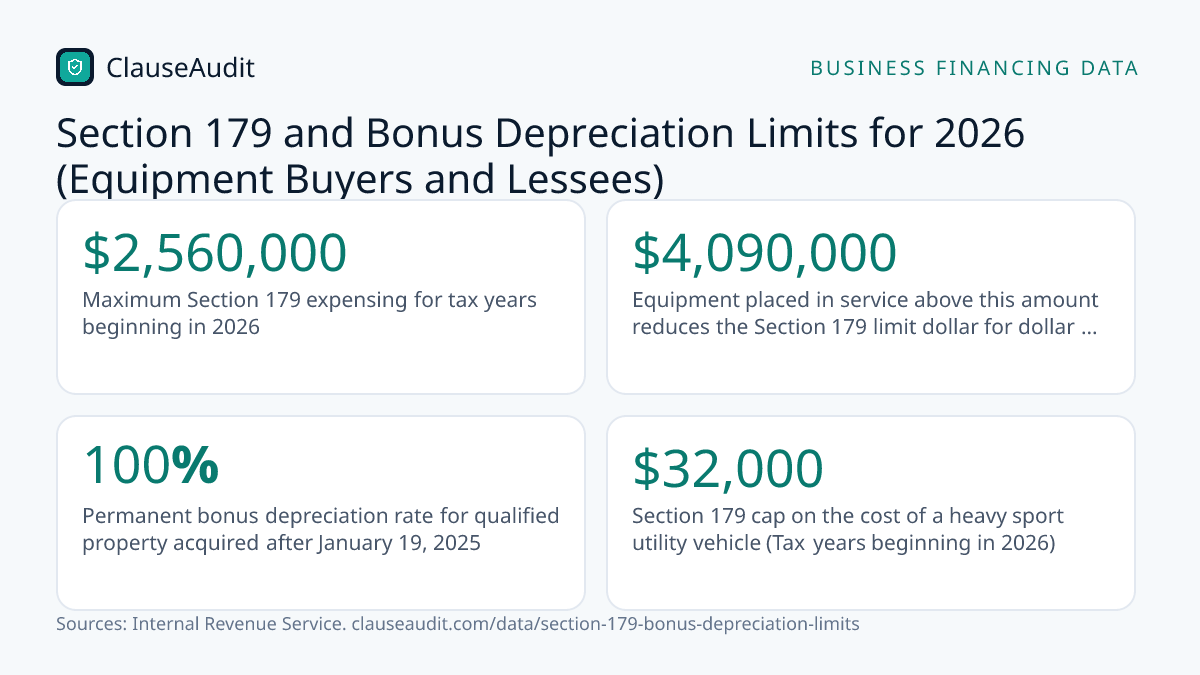
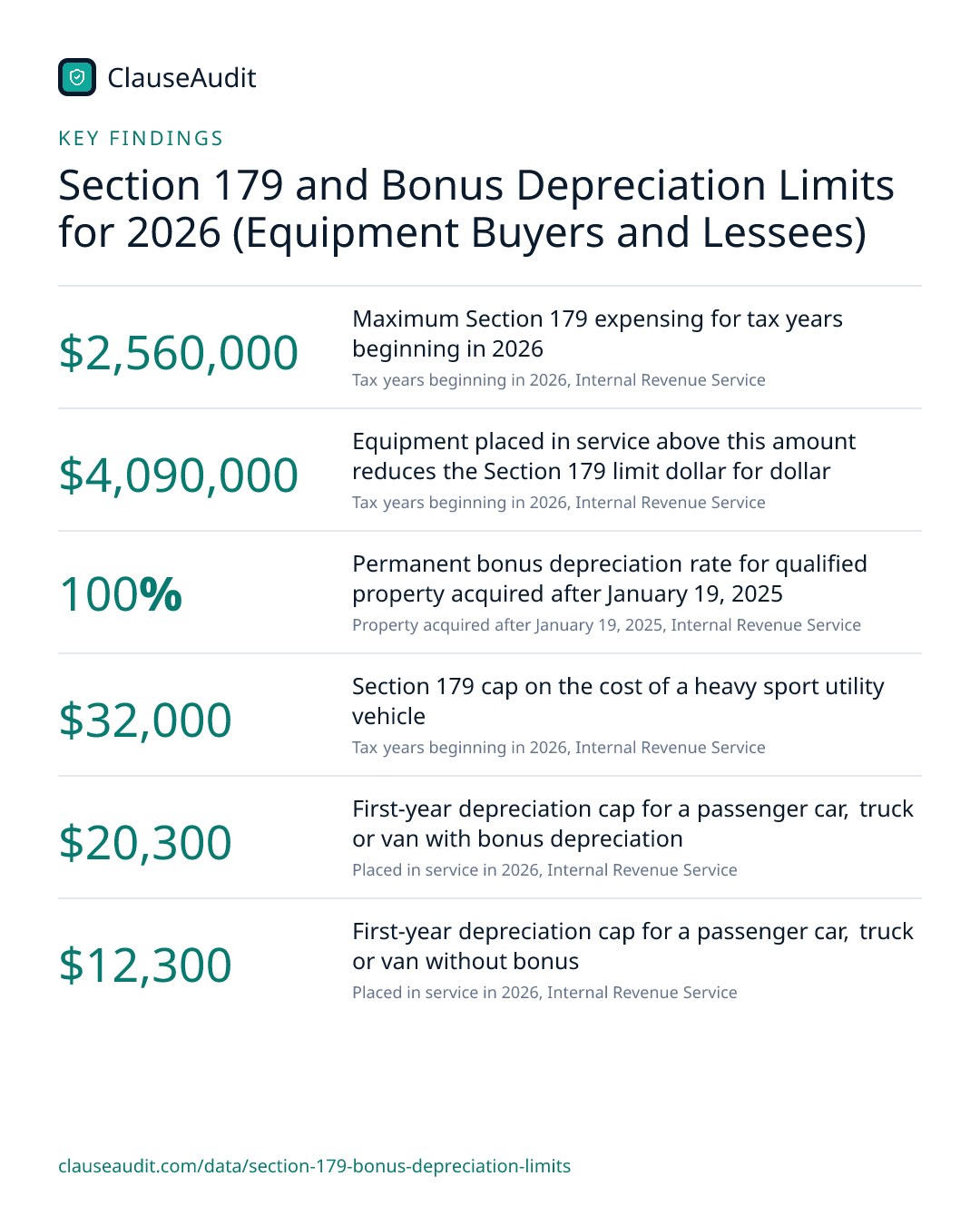
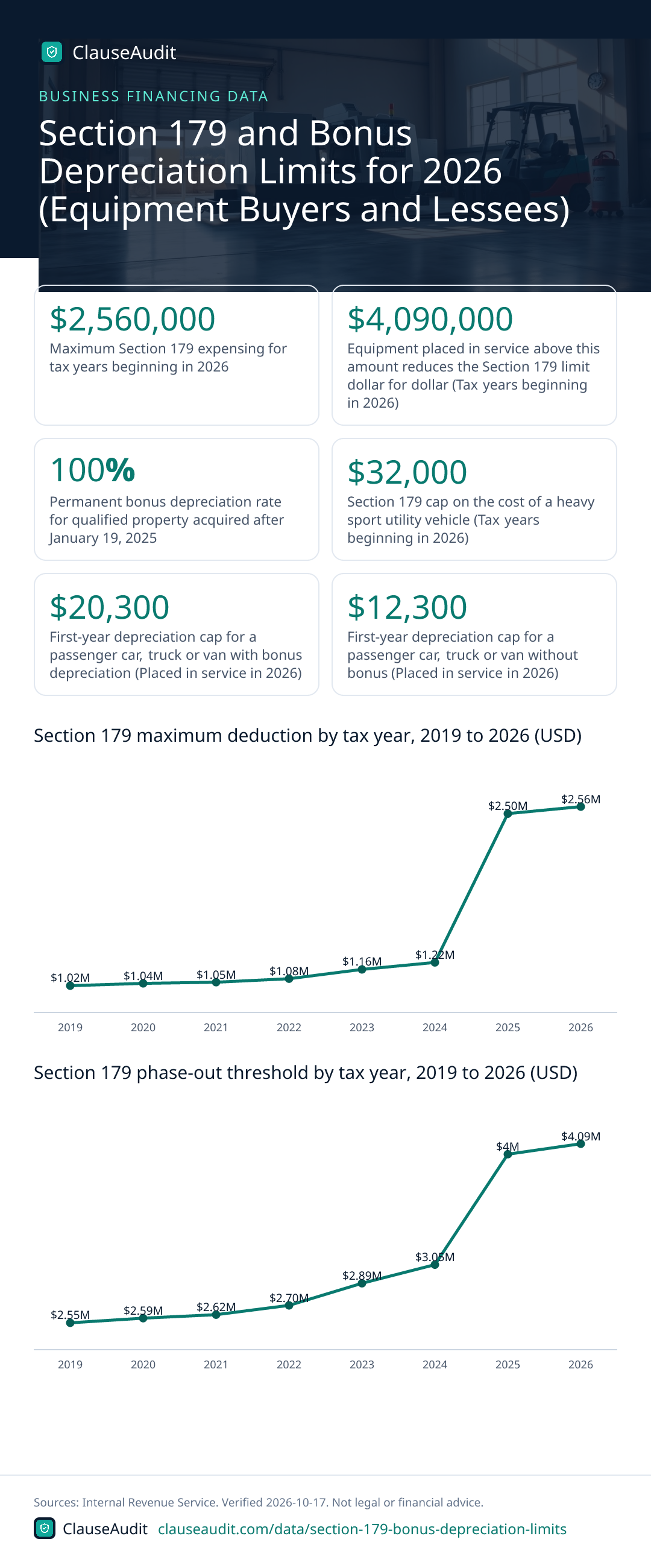
For tax years beginning in 2026, you can expense up to $2,560,000 of qualifying equipment under Section 179. The limit shrinks dollar for dollar once purchases placed in service pass $4,090,000. Bonus depreciation sits at a permanent 100% for property acquired after January 19, 2025, and heavy SUVs are capped at $32,000.
- Maximum Section 179 expensing for tax years beginning in 2026 (Tax years beginning in 2026, Internal Revenue Service)
- $2,560,000
- Equipment placed in service above this amount reduces the Section 179 limit dollar for dollar (Tax years beginning in 2026, Internal Revenue Service)
- $4,090,000
- Permanent bonus depreciation rate for qualified property acquired after January 19, 2025 (Property acquired after January 19, 2025, Internal Revenue Service)
- 100%
- Section 179 cap on the cost of a heavy sport utility vehicle (Tax years beginning in 2026, Internal Revenue Service)
- $32,000
- First-year depreciation cap for a passenger car, truck or van with bonus depreciation (Placed in service in 2026, Internal Revenue Service)
- $20,300
- First-year depreciation cap for a passenger car, truck or van without bonus (Placed in service in 2026, Internal Revenue Service)
- $12,300
- Section 179 limit for 2025 after the One Big Beautiful Bill Act, up from $1,250,000 (Tax years beginning in 2025, Internal Revenue Service)
- $2,500,000
- Leased car fair market value above which lessees must report an income inclusion (Lease terms beginning in 2026, Internal Revenue Service)
- $62,000
The 2026 numbers are the biggest Section 179 has ever offered. The One Big Beautiful Bill Act doubled the cap in 2025, from $1,250,000 to $2,500,000, and inflation nudged it to $2,560,000 for 2026. Bonus depreciation, which had been shrinking every year since 2023, is back to 100% for property acquired after January 19, 2025, and this time Congress made it permanent.
For most small businesses, the cap itself won't be the problem. The harder questions are which deal structure qualifies, when the equipment counts as acquired, and how vehicle caps cut into the write-off. A lot of that comes down to what your purchase or lease contract actually says. Below we cover what the limits mean in practice and what to check before you sign.
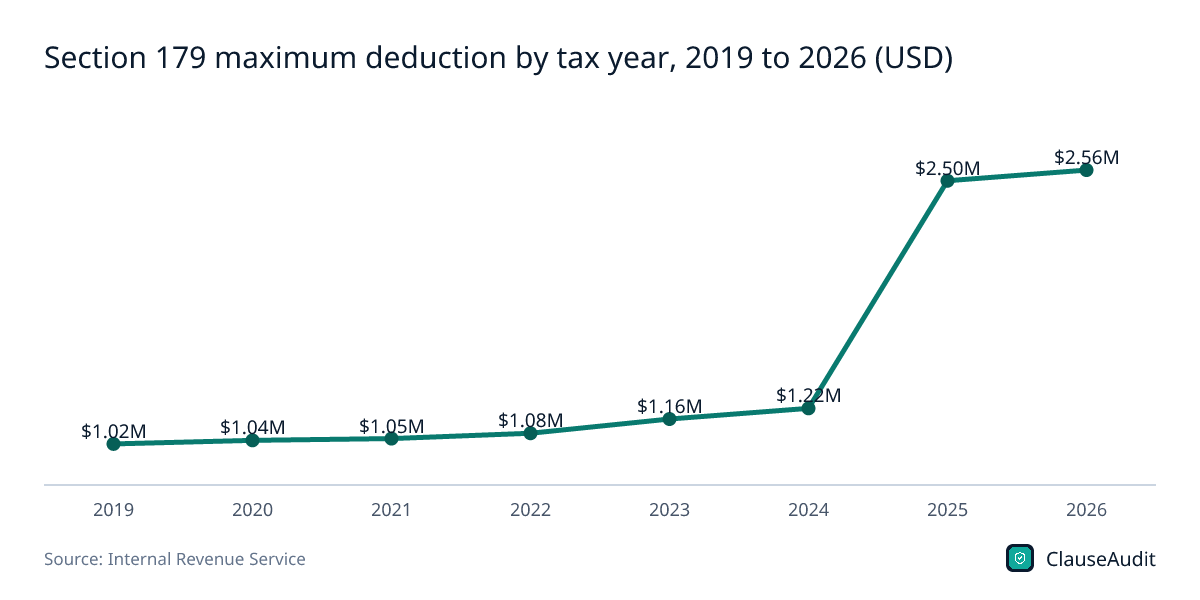
Section 179 maximum deduction by tax year, 2019 to 2026 (USD)
Chart data
| Label | Value (USD) |
|---|---|
| 2019 | $1.02M |
| 2020 | $1.04M |
| 2021 | $1.05M |
| 2022 | $1.08M |
| 2023 | $1.16M |
| 2024 | $1.22M |
| 2025 | $2.50M |
| 2026 | $2.56M |
The cap crept up by inflation for years, from $1.02M in 2019 to $1.22M in 2024, then jumped to $2.5M when the OBBBA took effect for 2025. The 2026 figure of $2.56M is that new base adjusted for inflation.
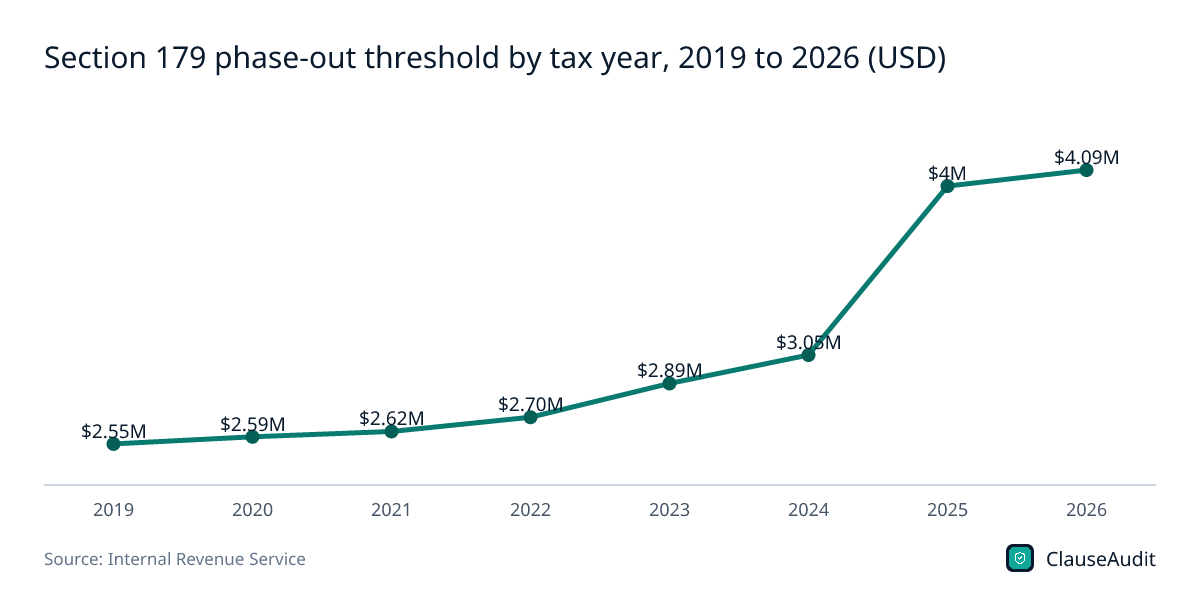
Download this chart (PNG)Section 179 phase-out threshold by tax year, 2019 to 2026 (USD)
Chart data
| Label | Value (USD) |
|---|---|
| 2019 | $2.55M |
| 2020 | $2.59M |
| 2021 | $2.62M |
| 2022 | $2.70M |
| 2023 | $2.89M |
| 2024 | $3.05M |
| 2025 | $4M |
| 2026 | $4.09M |
The phase-out threshold matters only to heavy buyers. Once equipment placed in service in a year passes $4.09M in 2026, every extra dollar spent takes a dollar off your Section 179 limit.
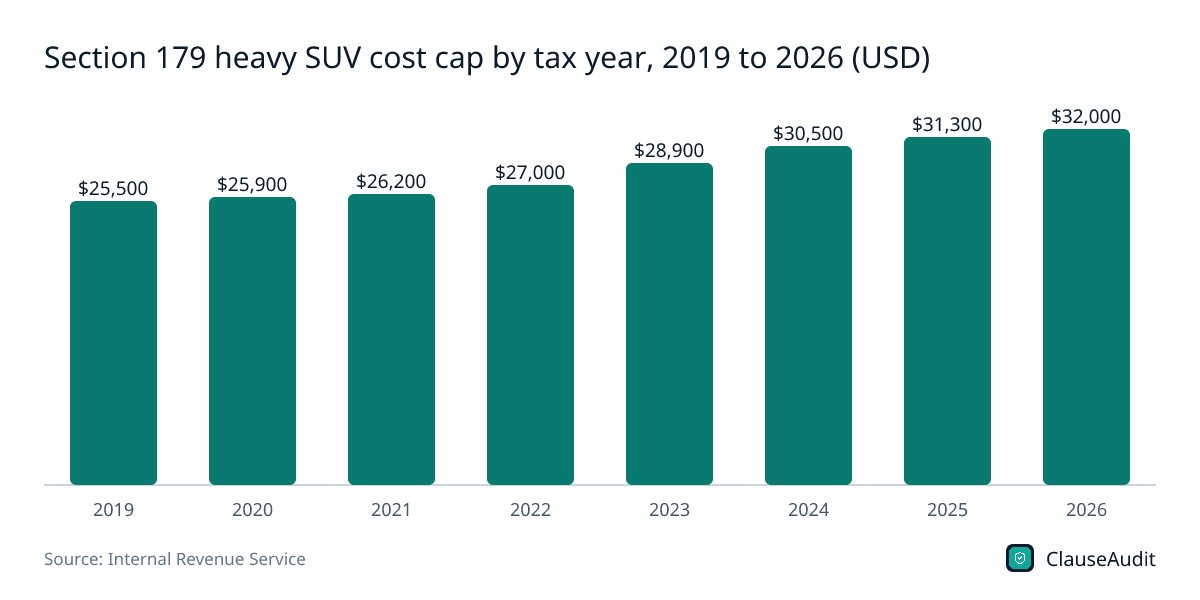
Download this chart (PNG)Section 179 heavy SUV cost cap by tax year, 2019 to 2026 (USD)
Chart data
| Label | Value (USD) |
|---|---|
| 2019 | $25,500 |
| 2020 | $25,900 |
| 2021 | $26,200 |
| 2022 | $27,000 |
| 2023 | $28,900 |
| 2024 | $30,500 |
| 2025 | $31,300 |
| 2026 | $32,000 |
The heavy SUV cap has grown slowly, from $25,500 in 2019 to $32,000 in 2026. It limits only the Section 179 piece, so bonus depreciation can still cover more of the cost.
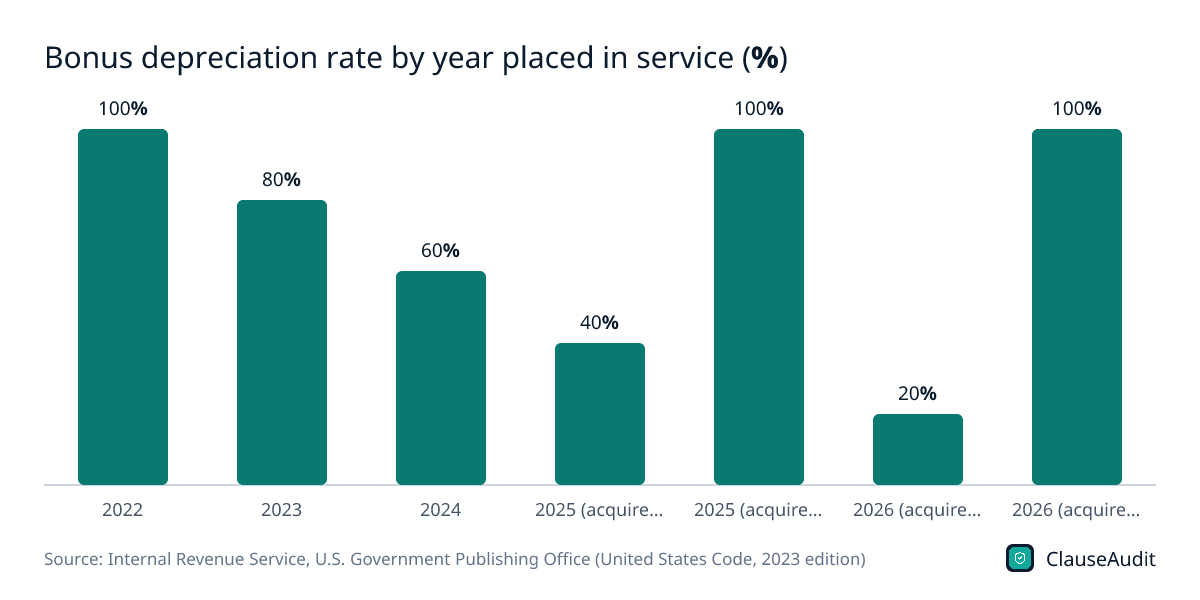
Download this chart (PNG)Bonus depreciation rate by year placed in service (%)
Chart data
| Label | Value (%) |
|---|---|
| 2022 | 100% |
| 2023 | 80% |
| 2024 | 60% |
| 2025 (acquired before Jan 20, 2025) | 40% |
| 2025 (acquired after Jan 19, 2025) | 100% |
| 2026 (acquired before Jan 20, 2025) | 20% |
| 2026 (acquired after Jan 19, 2025) | 100% |
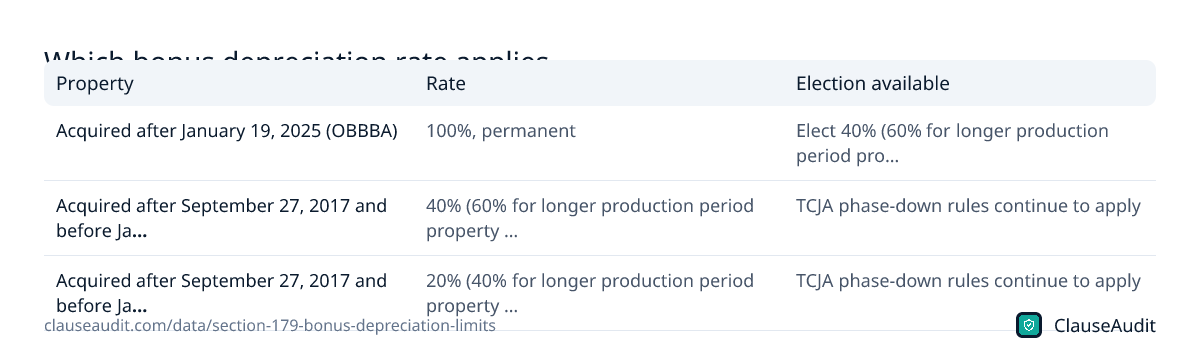
Two schedules now run side by side. Property acquired after September 27, 2017 and before January 20, 2025 follows the old phase-down to 20% in 2026, while property acquired after January 19, 2025 gets 100%. The acquisition date, not the delivery date, decides which one you're on.
Download this chart (PNG)2026 depreciation caps for passenger cars, trucks and vans by tax year (USD)
Chart data
| Label | Value (USD) |
|---|---|
| Year 1 (with bonus) | $20,300 |
| Year 1 (no bonus) | $12,300 |
| Year 2 | $19,800 |
| Year 3 | $11,900 |
| Each later year | $7,160 |
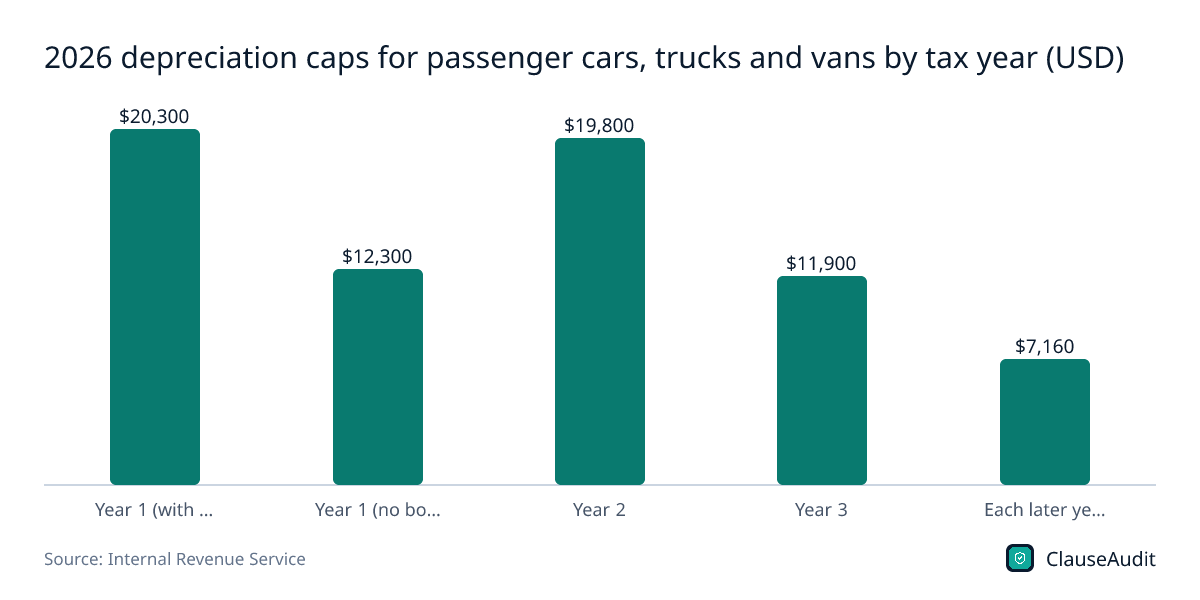
Ordinary cars, trucks and vans are capped at $20,300 in year one with bonus, or $12,300 without. After that the schedule is the same either way, so most of a pricey car's cost gets spread over several years.
Download this chart (PNG)Section 179 limits by tax year (IRS)
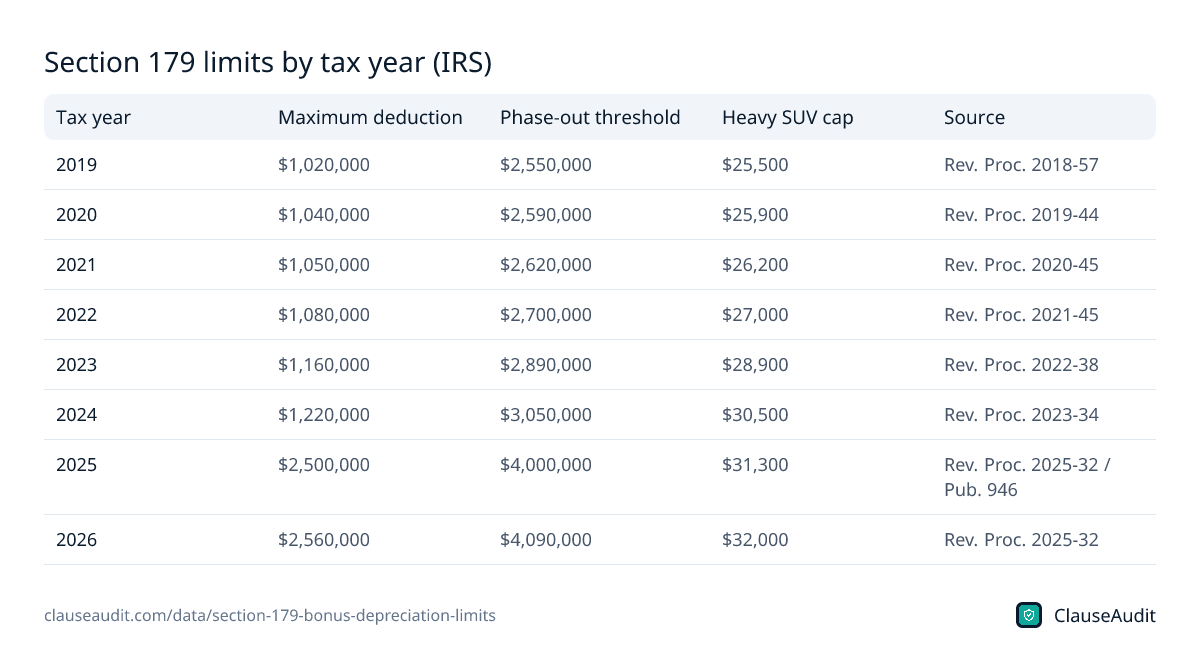
| Tax year | Maximum deduction | Phase-out threshold | Heavy SUV cap | Source |
|---|---|---|---|---|
| 2019 | $1,020,000 | $2,550,000 | $25,500 | Rev. Proc. 2018-57 |
| 2020 | $1,040,000 | $2,590,000 | $25,900 | Rev. Proc. 2019-44 |
| 2021 | $1,050,000 | $2,620,000 | $26,200 | Rev. Proc. 2020-45 |
| 2022 | $1,080,000 | $2,700,000 | $27,000 | Rev. Proc. 2021-45 |
| 2023 | $1,160,000 | $2,890,000 | $28,900 | Rev. Proc. 2022-38 |
| 2024 | $1,220,000 | $3,050,000 | $30,500 | Rev. Proc. 2023-34 |
| 2025 | $2,500,000 | $4,000,000 | $31,300 | Rev. Proc. 2025-32 / Pub. 946 |
| 2026 | $2,560,000 | $4,090,000 | $32,000 | Rev. Proc. 2025-32 |
Source: Internal Revenue Service, Rev. Proc. 2018-57 (inflation-adjusted items for tax year 2019); Internal Revenue Service, Rev. Proc. 2019-44 (inflation-adjusted items for tax year 2020); Internal Revenue Service, Rev. Proc. 2020-45 (inflation-adjusted items for tax year 2021); Internal Revenue Service, Rev. Proc. 2021-45 (inflation-adjusted items for tax year 2022); Internal Revenue Service, Rev. Proc. 2022-38 (inflation-adjusted items for tax year 2023); Internal Revenue Service, Rev. Proc. 2023-34 (inflation-adjusted items for tax year 2024); Internal Revenue Service, Publication 946, How To Depreciate Property (for 2025 returns); Internal Revenue Service, Rev. Proc. 2025-32 (2026 inflation-adjusted items, incl. OBBBA amendments); Internal Revenue Service, Rev. Proc. 2025-32 (2026 inflation-adjusted items, incl. OBBBA amendments). Download as image
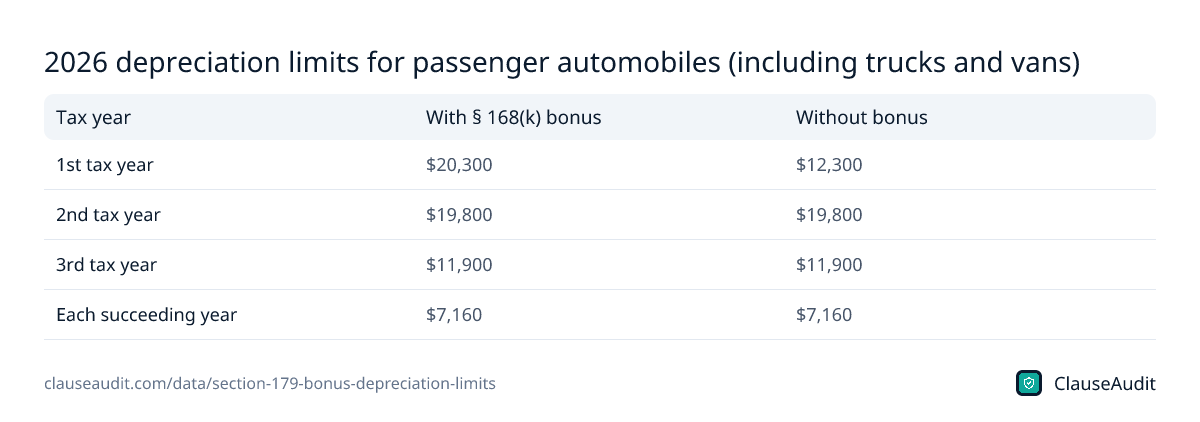
2026 depreciation limits for passenger automobiles (including trucks and vans)
| Tax year | With § 168(k) bonus | Without bonus |
|---|---|---|
| 1st tax year | $20,300 | $12,300 |
| 2nd tax year | $19,800 | $19,800 |
| 3rd tax year | $11,900 | $11,900 |
| Each succeeding year | $7,160 | $7,160 |
Source: Internal Revenue Service, Rev. Proc. 2026-15 (2026 depreciation limits for passenger automobiles and lessee inclusion amounts). Download as image
Which bonus depreciation rate applies
| Property | Rate | Election available |
|---|---|---|
| Acquired after January 19, 2025 (OBBBA) | 100%, permanent | Elect 40% (60% for longer production period property or certain aircraft) for the first tax year ending after January 19, 2025, or elect out |
| Acquired after September 27, 2017 and before January 20, 2025, placed in service in 2025 | 40% (60% for longer production period property or certain aircraft) | TCJA phase-down rules continue to apply |
| Acquired after September 27, 2017 and before January 20, 2025, placed in service in 2026 | 20% (40% for longer production period property or certain aircraft) | TCJA phase-down rules continue to apply |
Source: Internal Revenue Service, Notice 2026-11, Interim guidance on the § 168(k) additional first year depreciation deduction; Internal Revenue Service, IR-2026-06: Treasury, IRS issue guidance on the additional first year depreciation deduction amended as part of the One, Big, Beautiful Bill; U.S. Government Publishing Office (United States Code, 2023 edition), 26 U.S.C. § 168(k)(6) (applicable percentage, as in effect before the OBBBA amendments). Download as image
What is the Section 179 limit for 2026?
For tax years beginning in 2026, you can deduct up to $2,560,000 of qualifying equipment, software and certain other business property in the year you place it in service, instead of depreciating it over its useful life. That is a small step up from $2,500,000 in 2025 and more than double the $1,220,000 allowed in 2024.
The phase-out starts at $4,090,000. If your business places more than that in service during the year, the limit drops by the amount you went over. A regional contractor replacing a whole fleet of machines could hit it. A dental practice buying a new chair and imaging gear will not come close.
Two catches apply to everyone. Section 179 can't create a loss: the deduction is limited to your taxable business income, and any extra carries forward to later years. And the equipment has to be used more than half the time for business. Drop below that in a later year and part of the deduction gets recaptured as income.
If you freelance or run a one-person shop, think of the cap as a ceiling you will never touch. Say you're a video editor who buys a new workstation, cameras and editing software this year. You can likely expense all of it in 2026, as long as your net business income covers the deduction. If it doesn't, the unused part simply waits for next year's return.
Is bonus depreciation 100% in 2026?
Yes, for qualified property acquired after January 19, 2025. The OBBBA restored 100% bonus depreciation and removed the scheduled phase-out, so there is no sunset date to plan around anymore. If you sign and take delivery of a new machine in 2026, you can generally write off the full cost in year one.
The word that trips people up is acquired. If you signed a binding contract for equipment before January 20, 2025 and it only arrives in 2026, you are on the old schedule, which drops to 20% for 2026. A delayed delivery on an older purchase order can cost you most of the first-year write-off.
Bonus depreciation works differently from Section 179 in ways that matter. It has no dollar cap and no income limit, so it can create or deepen a loss. It also applies by class of property unless you elect out. For the first tax year ending after January 19, 2025, you can choose 40% instead of 100% (60% for some longer production period property and certain aircraft), which helps if a huge deduction would only create a loss you can't use well, or you'd rather save some of the write-off for higher-income years.
What are the 2026 vehicle limits?
Vehicles have their own rules, and this is where a lot of small business owners get surprised. A heavy SUV rated over 6,000 pounds gross vehicle weight can take up to $32,000 under Section 179 in 2026. Bonus depreciation can then apply to the remaining cost.
Ordinary passenger cars, and trucks and vans that fall under the luxury auto rules, face a much tighter cap. The first-year limit is $20,300 with bonus depreciation and $12,300 without. Year two allows $19,800, year three $11,900, and $7,160 for each year after that. So if you buy an expensive sedan for client visits, most of its cost will be deducted slowly no matter how much bonus depreciation is available.
Leased cars carry a parallel rule. For lease terms beginning in 2026, if the car's fair market value is over $62,000, you add a small inclusion amount to income each year. That keeps leasing from becoming a way around the purchase caps.
Can you take Section 179 on leased equipment?
It depends on what the contract really is, not what it's called. The IRS looks at substance. A true lease, often called a fair market value or FMV lease, leaves ownership with the lessor. You deduct the lease payments as a business expense as you make them, and the lessor claims the depreciation. No Section 179 for you.
A one-dollar buyout lease or an equipment finance agreement is usually treated as a purchase financed by the lender. You are the tax owner from day one, so you can take Section 179 or bonus depreciation on the full cost in the year the equipment is placed in service, even though you've paid only a few installments.
That gap can be large. On a machine you plan to keep for its whole life, a financed purchase can front-load years of deductions into the first return. On a machine you'll swap out in a few years, a true lease may still be the better deal, since you skip the residual risk and the payments are steady expenses. Run both numbers with your tax preparer before you pick the paperwork.
What to do before you buy or sign
- Confirm the acquisition date. Check when the binding contract was signed, not just when the equipment ships, since that decides whether you get 100% or a phased-down rate.
- Make sure the equipment is placed in service in the tax year you want the deduction. Equipment sitting in a crate at year end usually doesn't count.
- Ask your lessor or lender in writing whether the deal is structured as a true lease or a financed purchase, and match that to how you plan to file.
- Keep a mileage or use log for vehicles and mixed-use gear. Without one, you have no proof you passed the more-than-half business use test.
- Compare Section 179 and bonus depreciation for your situation. Section 179 lets you pick items one by one; bonus applies by class unless you elect out.
- Check your state. Many states do not follow the federal bonus depreciation rules, so a full write-off on your federal return may be spread out on your state return.
How ClauseAudit helps
Whether you get Section 179 at all often comes down to a few lines in the equipment contract. An agreement labeled a lease can work like a purchase for tax purposes, and the reverse happens too. Our automated review reads the agreement and flags the terms that decide ownership and your real cost.
Upload the lease, finance agreement or purchase order before you sign, and you'll get plain English notes on each risky clause and what to ask the lender or vendor to change.
- End-of-term buyout: a nominal or fixed price points to a financed purchase, while fair market value points to a true lease
- Title and ownership language, including who holds title during the term and when it passes to you
- Delivery, acceptance and in-service dates that could push the deduction into the wrong tax year
- Hell-or-high-water payment terms, late fees and default remedies that apply even if the equipment fails
- Automatic renewal or holdover rent if you miss the notice window at the end of the lease
- Tax indemnity clauses that make you pay the lessor if its expected tax benefits fall through
Frequently asked questions
What is the maximum Section 179 deduction for 2026?
The maximum is $2,560,000 for tax years beginning in 2026. It applies to qualifying equipment, off-the-shelf software and certain other property placed in service during the year. The deduction is also limited to your taxable business income, so a business with a thin profit may not be able to use the full amount this year and will carry the rest forward.
When does the Section 179 phase-out start in 2026?
The phase-out begins at $4,090,000 of qualifying property placed in service during the tax year. Above that amount, the $2,560,000 limit falls by one dollar for every dollar of property placed in service over the threshold. Most small and midsize businesses never get near it, but companies that buy large fleets or production lines should track their total purchases through the year.
Is bonus depreciation permanent now?
Yes. The One Big Beautiful Bill Act made 100% bonus depreciation permanent for qualified property acquired after January 19, 2025. Property acquired earlier under a binding contract still follows the old phase-down, which is 20% for property placed in service in 2026. Always check the date you signed, since that, not the delivery date, decides the rate.
Can I use Section 179 and bonus depreciation together?
Yes. Section 179 is applied first, up to the limit and your business income. Bonus depreciation then applies to whatever cost is left. This matters most for heavy SUVs, where Section 179 tops out at $32,000 in 2026 but bonus depreciation can cover the remaining cost. Your tax preparer can decide the mix that fits your income for the year.
Does a $1 buyout lease qualify for Section 179?
Usually yes. A lease that ends with a nominal buyout is generally treated as a financed purchase, so you are considered the owner and can claim Section 179 or bonus depreciation in the year the equipment is placed in service. Read the contract closely, though. Ownership, title and buyout wording decide how the deal is treated, not the name printed at the top.
Can I deduct an FMV lease instead of using Section 179?
With a true fair market value lease, you deduct the lease payments as ordinary business expenses as you pay them. You don't claim Section 179 or depreciation because the lessor owns the equipment. That spreads the deduction over the lease term instead of front-loading it, which can still make sense for gear you expect to replace before it wears out.
What is the 2026 depreciation limit for a regular business car?
For a passenger car, truck or van placed in service in 2026 that falls under the luxury auto caps, first-year depreciation is capped at $20,300 with bonus depreciation or $12,300 without. The cap is $19,800 in year two, $11,900 in year three and $7,160 in each later year. Heavier vehicles over 6,000 pounds fall under different rules.
Do I have to report income on a leased car?
Only if the car is expensive. For leases beginning in 2026, a lessee must add an inclusion amount to income when the car's fair market value is over $62,000. The amount is small each year and comes from an IRS table, but it offsets part of your lease payment deduction. It is meant to treat costly leased cars about the same as purchased ones.
Use this data
Every chart and card below is free to reuse under CC BY 4.0. Download what you need and link back to this page.
 Stat cards
 Key findings card
 Infographic
 Section 179 maximum deduction by tax year, 2019 to 2026 (USD)
 Section 179 phase-out threshold by tax year, 2019 to 2026 (USD)
 Section 179 heavy SUV cost cap by tax year, 2019 to 2026 (USD)
 Bonus depreciation rate by year placed in service (%)
 2026 depreciation caps for passenger cars, trucks and vans by tax year (USD)
 Section 179 limits by tax year (IRS)
 2026 depreciation limits for passenger automobiles (including trucks and vans)
 Which bonus depreciation rate applies
Embed the infographic
Free to share on your site, blog or slides under CC BY 4.0. Please keep the credit link.
Sources and method
Every number on this page comes from the sources below, each opened and read on or before October 17, 2026. A second, independent review checked every figure against its source and corrected anything that did not match. Figures that could not be confirmed were left out.
- Internal Revenue Service, Rev. Proc. 2025-32 (2026 inflation-adjusted items, incl. OBBBA amendments) (October 9, 2025 (IR-2025-103))
- Internal Revenue Service, Notice 2026-11, Interim guidance on the § 168(k) additional first year depreciation deduction (January 14, 2026 (IR-2026-06); 2026-6 I.R.B. 491)
- Internal Revenue Service, IR-2026-06: Treasury, IRS issue guidance on the additional first year depreciation deduction amended as part of the One, Big, Beautiful Bill (January 14, 2026)
- Internal Revenue Service, Rev. Proc. 2026-15 (2026 depreciation limits for passenger automobiles and lessee inclusion amounts) (March 2026)
- Internal Revenue Service, Publication 946, How To Depreciate Property (for 2025 returns) (2025 edition)
- Internal Revenue Service, Rev. Proc. 2024-40 (inflation-adjusted items for tax year 2025) (2024)
- Internal Revenue Service, Rev. Proc. 2023-34 (inflation-adjusted items for tax year 2024) (2023)
- Internal Revenue Service, Rev. Proc. 2022-38 (inflation-adjusted items for tax year 2023) (2022)
- Internal Revenue Service, Rev. Proc. 2021-45 (inflation-adjusted items for tax year 2022) (2021)
- Internal Revenue Service, Rev. Proc. 2020-45 (inflation-adjusted items for tax year 2021) (2020)
- Internal Revenue Service, Rev. Proc. 2019-44 (inflation-adjusted items for tax year 2020) (2019)
- Internal Revenue Service, Rev. Proc. 2018-57 (inflation-adjusted items for tax year 2019) (2018)
- U.S. Government Publishing Office (United States Code, 2023 edition), 26 U.S.C. § 168(k)(6) (applicable percentage, as in effect before the OBBBA amendments) (2023 edition)
Cite this page
ClauseAudit, “Section 179 and Bonus Depreciation Limits for 2026 (Equipment Buyers and Lessees)”, updated October 17, 2026, https://clauseaudit.com/data/section-179-bonus-depreciation-limits. Free to reuse with a link back (CC BY 4.0).
This page summarises published data and law as checked on October 17, 2026. Figures are updated as new editions are released, and your own situation may differ. It is general information, not legal, tax or financial advice.