Average Salary Increase 2026 (US): Raise and Merit Budget Benchmarks
By ClauseAudit Research · 11 sources ·
What is the average raise in 2026?
The average US raise in 2026 was about 3.5%. Employer surveys put actual 2026 salary increase budgets between 3.4% (Mercer) and 3.6% (WorldatWork), with merit raises alone averaging 3.1%. Most surveys project 3.5% for 2027, so expect another year of steady, modest increases rather than a jump.

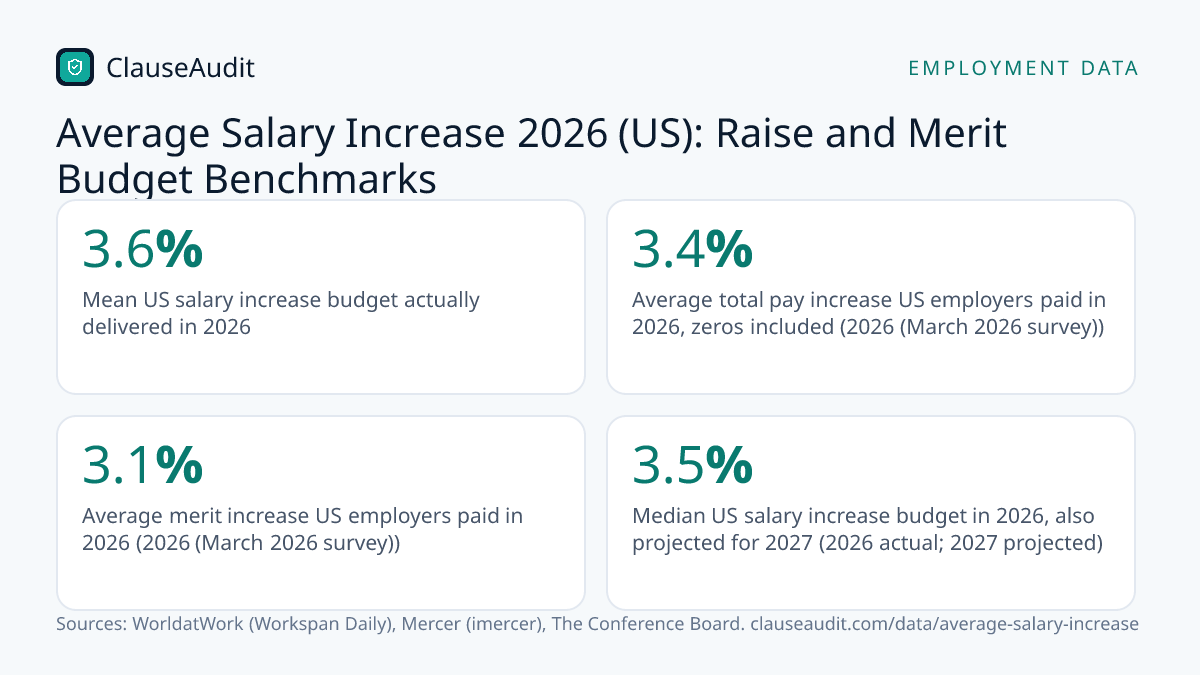
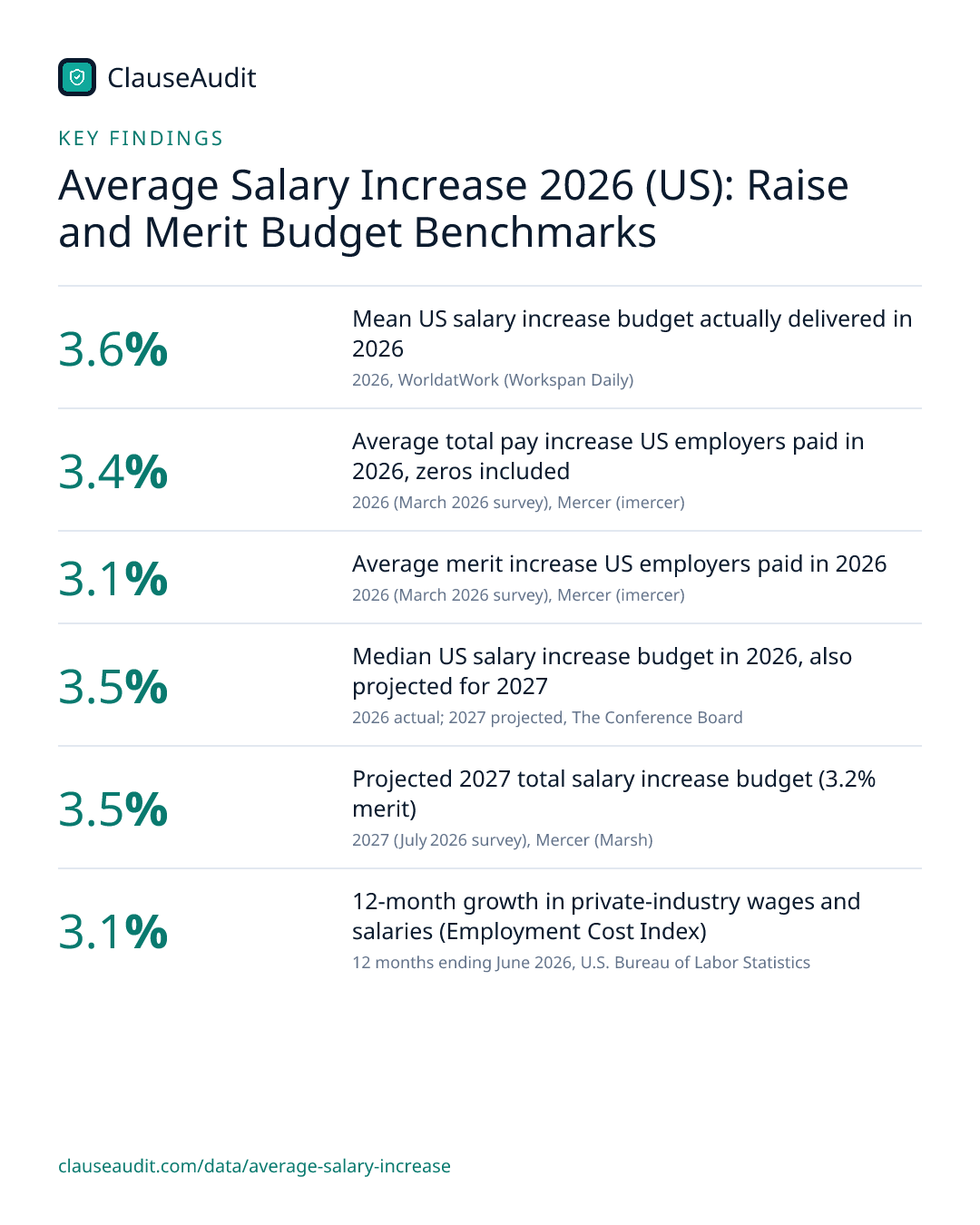
- Mean US salary increase budget actually delivered in 2026 (2026, WorldatWork (Workspan Daily))
- 3.6%
- Average total pay increase US employers paid in 2026, zeros included (2026 (March 2026 survey), Mercer (imercer))
- 3.4%
- Average merit increase US employers paid in 2026 (2026 (March 2026 survey), Mercer (imercer))
- 3.1%
- Median US salary increase budget in 2026, also projected for 2027 (2026 actual; 2027 projected, The Conference Board)
- 3.5%
- Projected 2027 total salary increase budget (3.2% merit) (2027 (July 2026 survey), Mercer (Marsh))
- 3.5%
- 12-month growth in private-industry wages and salaries (Employment Cost Index) (12 months ending June 2026, U.S. Bureau of Labor Statistics)
- 3.1%
- Consumer price inflation (CPI-U), 12 months ending September 2026 (September 2026, U.S. Bureau of Labor Statistics)
- 3.7%
- Share of employers giving equal, across-the-board raises in 2026 (2026, Mercer (imercer))
- 4%
Pay raises in 2026 settled into a narrow band. Five major employer surveys put the 2026 increase budget between 3.4% and 3.6%, and the projections for 2027 sit in almost the same spot. The big catch-up years of 2022 and 2023 are over.
A budget is not your raise, though. It is the pool your employer splits across everyone, and some people get nothing from it. Below we explain what the averages really say, how they stack up against prices, and how to use them when you ask for more or sign a new offer.
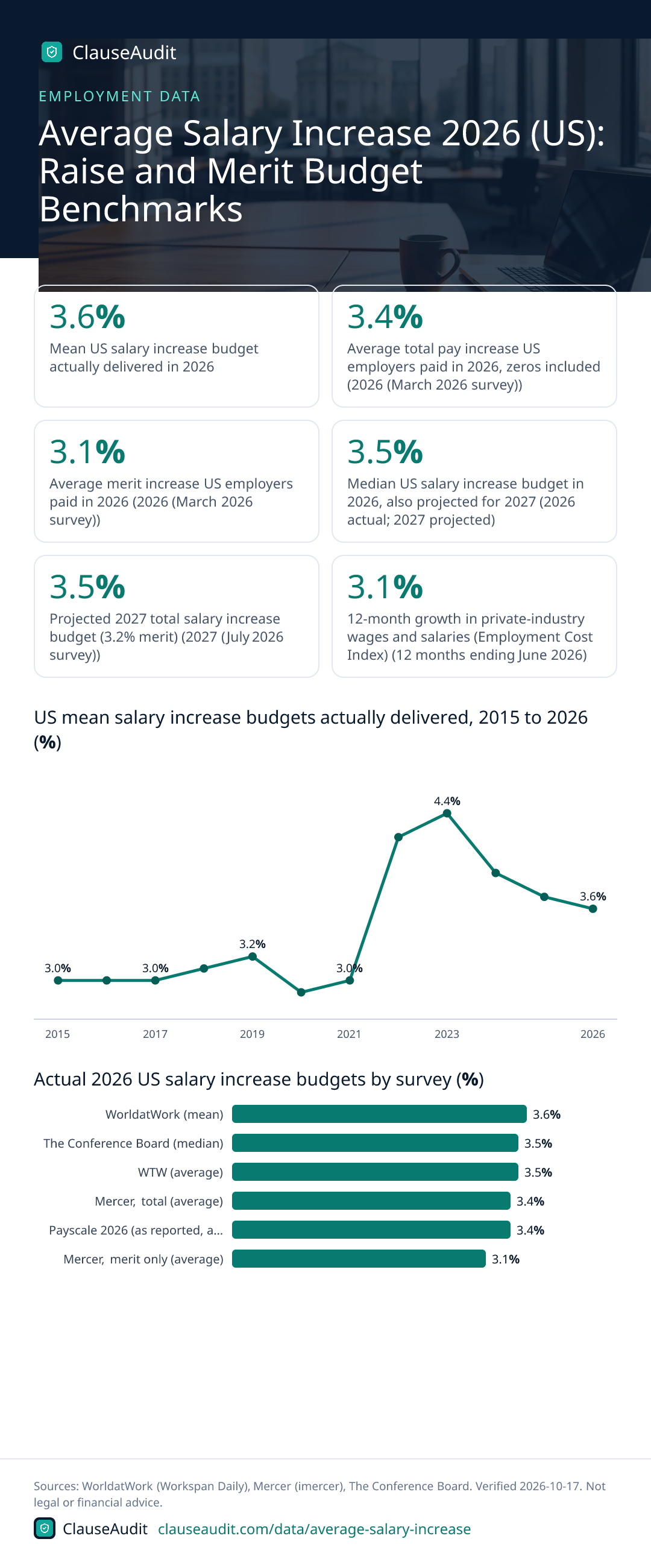
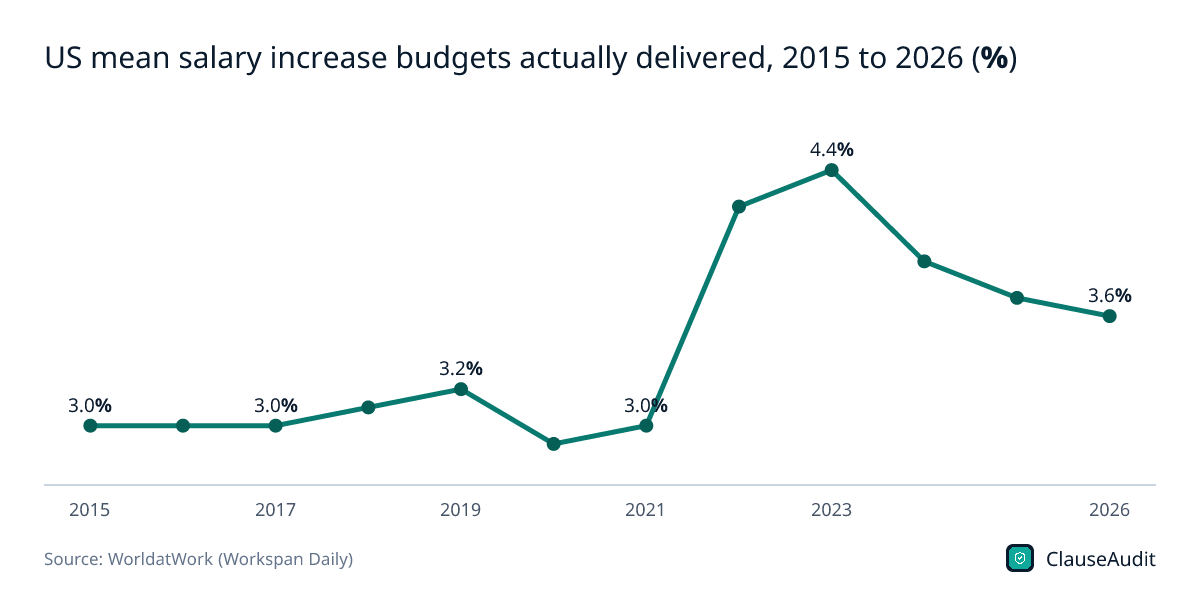
US mean salary increase budgets actually delivered, 2015 to 2026 (%)
Chart data
| Label | Value (%) |
|---|---|
| 2015 | 3.0% |
| 2016 | 3.0% |
| 2017 | 3.0% |
| 2018 | 3.1% |
| 2019 | 3.2% |
| 2020 | 2.9% |
| 2021 | 3.0% |
| 2022 | 4.2% |
| 2023 | 4.4% |
| 2024 | 3.9% |
| 2025 | 3.7% |
| 2026 | 3.6% |
Budgets sat near 3.0% from 2015 through 2021, spiked to 4.4% in 2023, and have eased every year since. The 2026 figure of 3.6% is still above the pre-2022 norm.
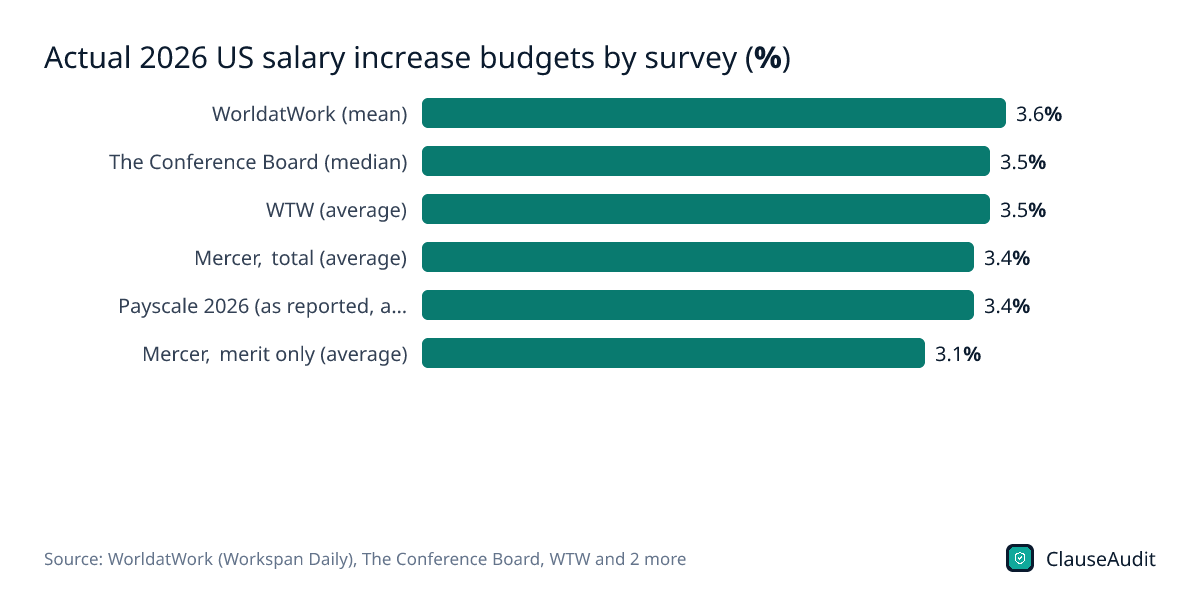
Download this chart (PNG)Actual 2026 US salary increase budgets by survey (%)
Chart data
| Label | Value |
|---|---|
| WorldatWork (mean) | 3.6% |
| The Conference Board (median) | 3.5% |
| WTW (average) | 3.5% |
| Mercer, total (average) | 3.4% |
| Payscale 2026 (as reported, average) | 3.4% |
| Mercer, merit only (average) | 3.1% |
The spread between surveys is only half a point, so pick any of them and you get the same story. Mercer's 3.1% is merit only, which is why it sits lowest.
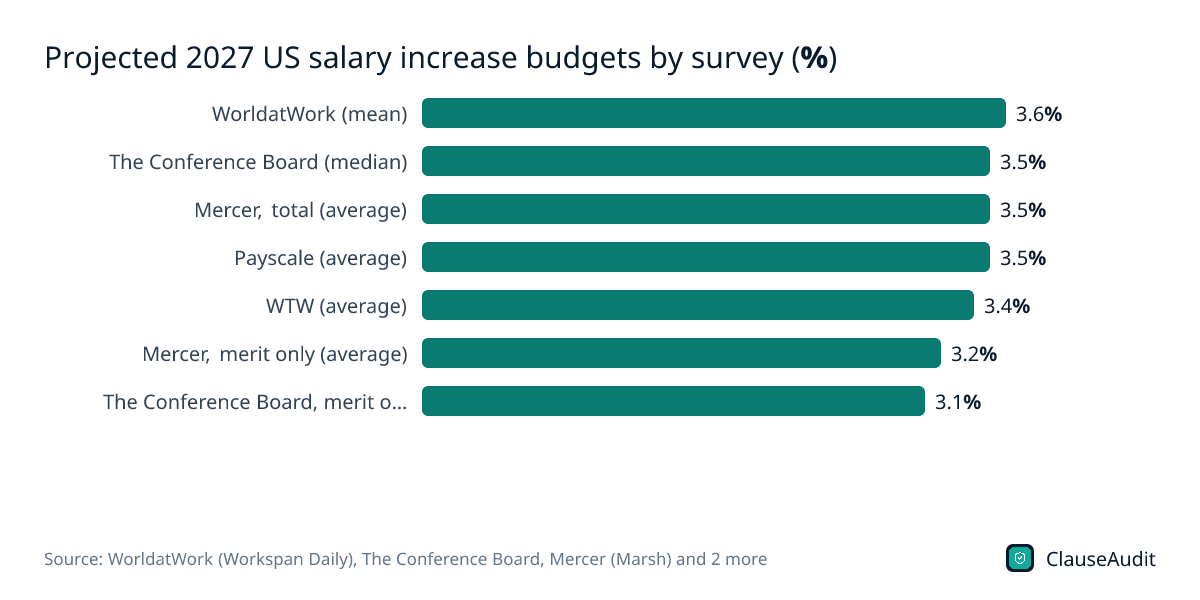
Download this chart (PNG)Projected 2027 US salary increase budgets by survey (%)
Chart data
| Label | Value |
|---|---|
| WorldatWork (mean) | 3.6% |
| The Conference Board (median) | 3.5% |
| Mercer, total (average) | 3.5% |
| Payscale (average) | 3.5% |
| WTW (average) | 3.4% |
| Mercer, merit only (average) | 3.2% |
| The Conference Board, merit only (median) | 3.1% |
Employers are planning 2027 almost exactly like 2026. If your company tells you budgets are tight next year, that is the market talking, not just your manager.
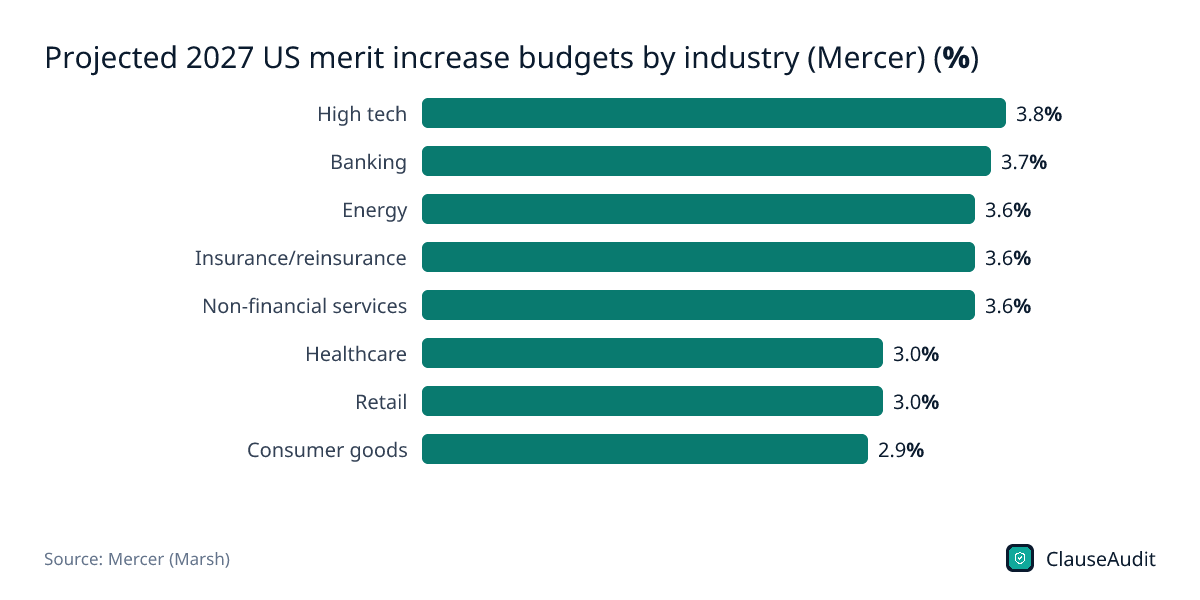
Download this chart (PNG)Projected 2027 US merit increase budgets by industry (Mercer) (%)
Chart data
| Label | Value |
|---|---|
| High tech | 3.8% |
| Banking | 3.7% |
| Energy | 3.6% |
| Insurance/reinsurance | 3.6% |
| Non-financial services | 3.6% |
| Healthcare | 3.0% |
| Retail | 3.0% |
| Consumer goods | 2.9% |
Where you work moves the number. High tech leads at 3.8% for 2027 merit budgets, while consumer goods trails at 2.9%.
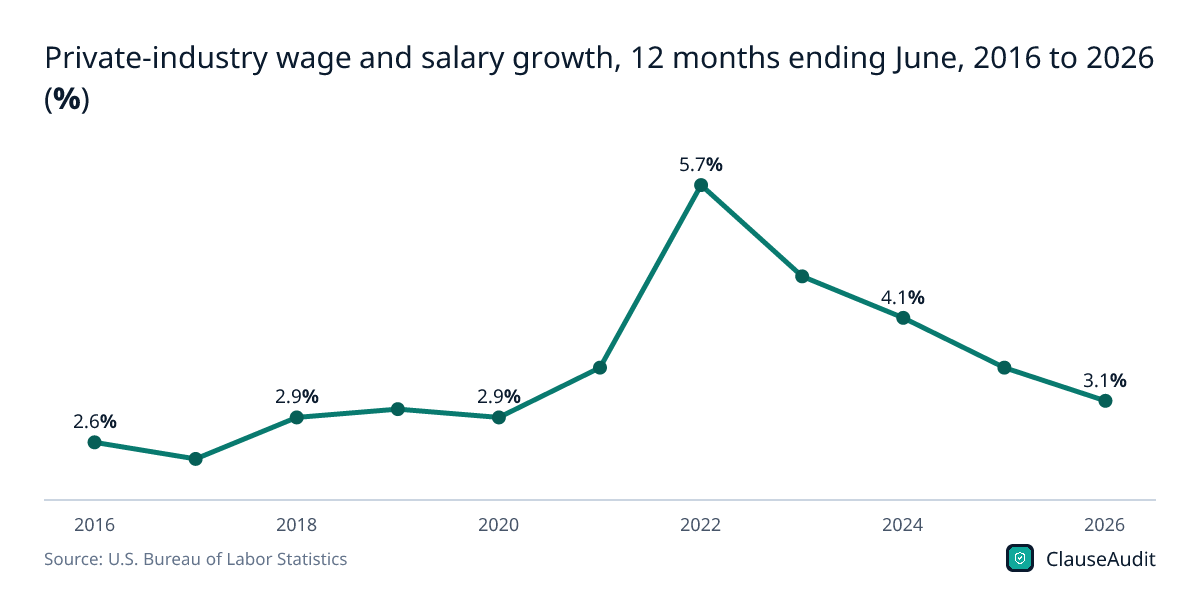
Download this chart (PNG)Private-industry wage and salary growth, 12 months ending June, 2016 to 2026 (%)
Chart data
| Label | Value (%) |
|---|---|
| 2016 | 2.6% |
| 2017 | 2.4% |
| 2018 | 2.9% |
| 2019 | 3.0% |
| 2020 | 2.9% |
| 2021 | 3.5% |
| 2022 | 5.7% |
| 2023 | 4.6% |
| 2024 | 4.1% |
| 2025 | 3.5% |
| 2026 | 3.1% |
This is what wages actually did, not what employers planned. Private-sector wage growth peaked at 5.7% in 2022 and slowed to 3.1% in the year to June 2026.
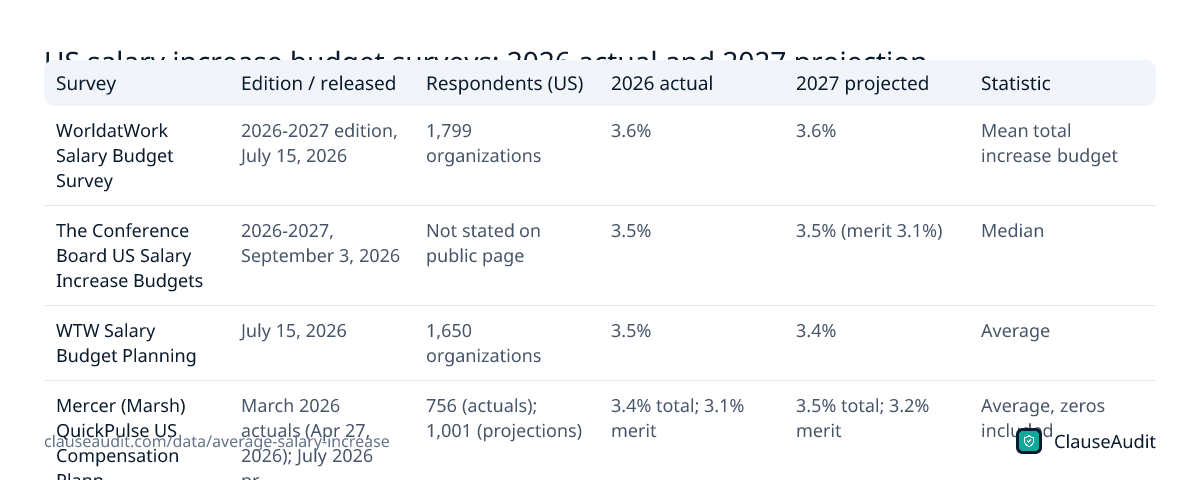
Download this chart (PNG)US salary increase budget surveys: 2026 actual and 2027 projection
| Survey | Edition / released | Respondents (US) | 2026 actual | 2027 projected | Statistic |
|---|---|---|---|---|---|
| WorldatWork Salary Budget Survey | 2026-2027 edition, July 15, 2026 | 1,799 organizations | 3.6% | 3.6% | Mean total increase budget |
| The Conference Board US Salary Increase Budgets | 2026-2027, September 3, 2026 | Not stated on public page | 3.5% | 3.5% (merit 3.1%) | Median |
| WTW Salary Budget Planning | July 15, 2026 | 1,650 organizations | 3.5% | 3.4% | Average |
| Mercer (Marsh) QuickPulse US Compensation Planning | March 2026 actuals (Apr 27, 2026); July 2026 projections (Aug 31, 2026) | 756 (actuals); 1,001 (projections) | 3.4% total; 3.1% merit | 3.5% total; 3.2% merit | Average, zeros included |
| Payscale Salary Budget Survey | 2026-2027, August 4, 2026 | 1,266 usable submissions | 3.4% (2026 as reported; not labeled actual) | 3.5% | Average total base-pay increase |
Source: WorldatWork (Workspan Daily), WorldatWork: Employers' 2027 Pay Budget Projections Point to Stability (2026-2027 Salary Budget Survey topline); The Conference Board, US Salary Increase Budgets 2026-2027; WTW, Employers shift from bigger pay budgets to smarter pay strategies, WTW finds (Salary Budget Planning survey, GlobeNewswire release); Mercer (imercer), 2026 Actual Increase Budgets: US (March 2026 QuickPulse US Compensation Planning Survey); Mercer (Marsh), US employers stick with moderate pay increases for 2027 (July 2026 QuickPulse survey); Payscale, Peanut Butter Pay is Losing Its Spread: Payscale 2026-2027 Salary Budget Survey press release. Download as image
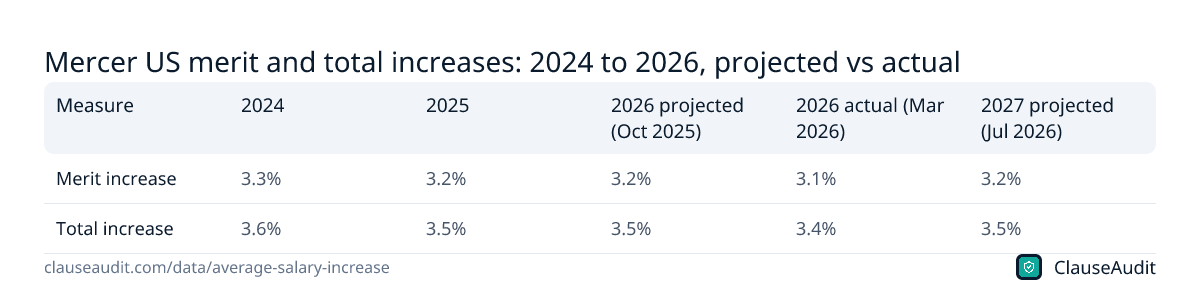
Mercer US merit and total increases: 2024 to 2026, projected vs actual
| Measure | 2024 | 2025 | 2026 projected (Oct 2025) | 2026 actual (Mar 2026) | 2027 projected (Jul 2026) |
|---|---|---|---|---|---|
| Merit increase | 3.3% | 3.2% | 3.2% | 3.1% | 3.2% |
| Total increase | 3.6% | 3.5% | 3.5% | 3.4% | 3.5% |
Source: WorldatWork (Workspan Daily), Shrinkage Sign? Mercer Says Actual Pay Increases Trailed Predictions; Mercer (imercer), 2026 Actual Increase Budgets: US (March 2026 QuickPulse US Compensation Planning Survey); Mercer (Marsh), US employers stick with moderate pay increases for 2027 (July 2026 QuickPulse survey). Download as image
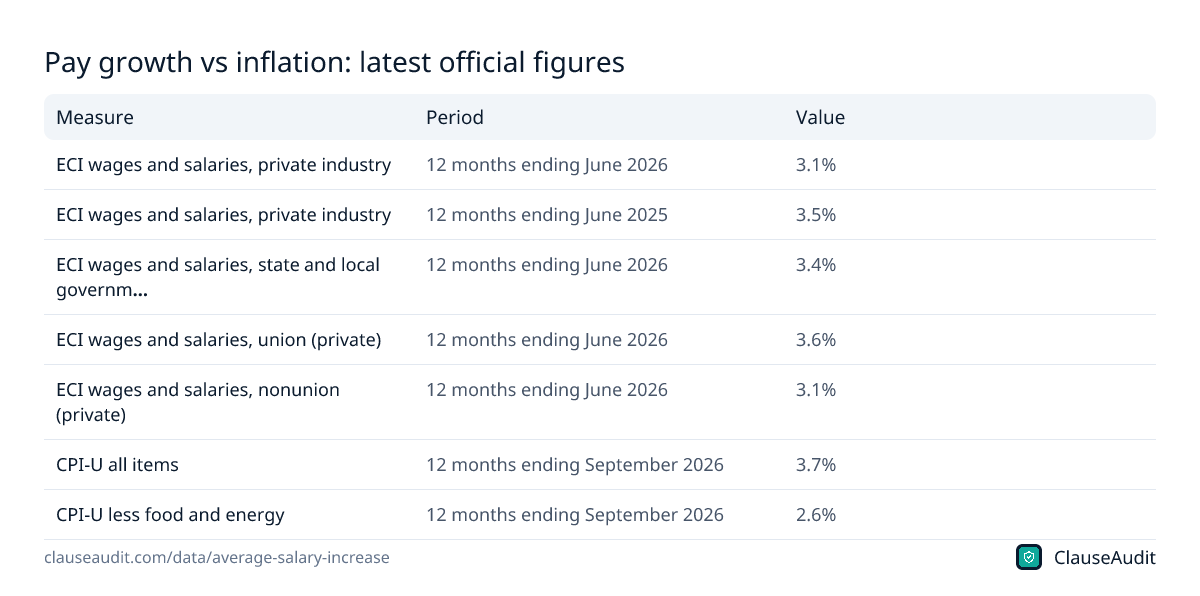
Pay growth vs inflation: latest official figures
| Measure | Period | Value |
|---|---|---|
| ECI wages and salaries, private industry | 12 months ending June 2026 | 3.1% |
| ECI wages and salaries, private industry | 12 months ending June 2025 | 3.5% |
| ECI wages and salaries, state and local government | 12 months ending June 2026 | 3.4% |
| ECI wages and salaries, union (private) | 12 months ending June 2026 | 3.6% |
| ECI wages and salaries, nonunion (private) | 12 months ending June 2026 | 3.1% |
| CPI-U all items | 12 months ending September 2026 | 3.7% |
| CPI-U less food and energy | 12 months ending September 2026 | 2.6% |
Source: U.S. Bureau of Labor Statistics, Employment Cost Index, June 2026 (news release); U.S. Bureau of Labor Statistics, Consumer Price Index, September 2026 (news release). Download as image
What is the average raise in 2026?
Call it 3.5%. WorldatWork, which surveyed 1,799 organizations, reports a mean of 3.6%. The Conference Board's median is 3.5%. Mercer says employers actually paid 3.4% in total and 3.1% in merit increases.
Those figures describe whole budgets, not individual raises, and Mercer's include people who got a zero. So if your employer had a 3.4% budget, a strong performer might get well above that and an average performer a bit below. A raise near the budget usually means you were rated somewhere in the middle.
One more pattern to know: actual raises can come in a little under the forecasts. Mercer projected 3.5% total and 3.2% merit for 2026 back in October 2025. What employers reported actually paying, in a March 2026 survey, was 3.4% and 3.1%. When a company quotes you its planned budget, treat it as a ceiling, not a promise.
Is a 3.1% raise good in 2026?
It is roughly average for a merit increase. Mercer's 3.1% merit figure for 2026 lines up with it exactly, and private-sector wages grew by the same 3.1% in the twelve months ending June 2026, according to the Employment Cost Index.
Average is not the same as keeping up, though. Consumer prices rose 3.7% in the twelve months ending September 2026. A raise at the budget average would leave you slightly behind on what your paycheck buys. Core inflation, which strips out food and energy, was lower at 2.6%, so how far behind you fell depends a lot on what you spend money on.
If you got the average and your reviews were strong, you have a fair case to ask why. If you got the average after a so-so year, you did fine by market standards.
Why were raises bigger in 2022 and 2023?
Because prices and quitting both spiked. Employers who had handed out 3.0% budgets for years suddenly faced workers leaving for better offers, and they responded. WorldatWork's mean budget jumped to 4.2% in 2022 and 4.4% in 2023. Actual private-sector wage growth ran even hotter, at 5.7% in the year to June 2022.
Since then, things have cooled one step at a time: 3.9% in 2024, 3.7% in 2025 and 3.6% in 2026. Employers are not cutting budgets hard. They are easing back toward the old normal while keeping a small cushion above it.
Who you work for still shapes the result. In the year to June 2026, union workers in private industry saw wages grow 3.6%, compared with 3.1% for nonunion workers. State and local government workers came in at 3.4%. If you are in a sector that bargains collectively, your raise is probably set by a contract, not a manager's discretion.
How should workers use these numbers?
Raise budgets are set months in advance, so timing matters more than people think. Many companies set next year's pool in the late summer or fall. Asking for more in February, after the pool is already allocated, is much harder than raising it before review season.
- Find out your company's budget. Ask your manager directly what the merit pool is for the year. Some will tell you if asked plainly.
- Compare with your industry. A 3.0% raise in healthcare or retail matches Mercer's 2027 merit plan for those sectors. The same raise in high tech is below it.
- Separate merit from promotion. A promotion usually comes from a different pot, so a promotion with a small bump is worth questioning.
- Look past the base salary. Bonuses, equity refreshes and title changes can be easier for a manager to approve than a bigger raise.
- Get the outcome in writing. If your manager agrees to revisit pay later in the year, ask for that in an email you can point to.
- Weigh a job change honestly. Outside offers are usually where bigger jumps come from, but a new offer letter can quietly drop protections your current job gives you, so read it before you accept.
What does this mean for freelancers?
Freelancers do not get a merit pool, but clients do have one in their heads. When a client's own staff are getting around 3.5%, a rate increase of similar size is easy for them to approve. Ask for much more and you will need to show more value.
The bigger risk is a contract that freezes your rate. A one-year or multi-year retainer with a fixed rate and no review date means you absorb every price increase. With prices rising 3.7% over the year to September 2026, two years at a flat rate is a real pay cut.
Build a rate review into your agreement. A simple clause that lets you adjust rates once a year with advance written notice keeps you in line with what employees are getting, without a hard renegotiation every time.
Time the ask well. Send rate notices in the fall, when clients are setting their own budgets for the next year. A new rate that is already in the plan gets approved. One that shows up in March has to fight for money that is already spoken for.
How should businesses plan raises for 2027?
Most surveys land at 3.5% for 2027, with WorldatWork at 3.6% and WTW at 3.4%. Matching that keeps you in line with the market. Going well under it invites turnover from your best people, who are the ones most likely to have other offers.
Fewer employers are spreading raises evenly. Only 4% gave equal, across-the-board raises in 2026, according to Mercer. The rest generally pay top performers more and average performers less within the same budget, which means your review process needs to hold up when someone asks why they got what they got.
Check what your offer letters and handbooks promise. Language that guarantees an annual raise, or ties a raise to a specific inflation measure, can turn a planning choice into a contract obligation.
How ClauseAudit helps
Raise averages tell you what is normal. Your offer letter or employment agreement decides what you are actually owed. An automated review reads the pay terms and flags the ones that give the employer room to cut, freeze or skip raises, in plain English.
Upload the document before you sign, or before your next review, and you will see each risky clause with what it means and what to ask for instead.
- Clauses saying salary may be adjusted at the employer's discretion, including downward
- Whether any annual raise or salary review is promised, or left entirely discretionary
- Bonus terms with undefined criteria or a requirement to be employed on the payout date
- Promotion or title language that is not tied to any pay change
- Repayment or clawback terms on signing bonuses and relocation money
- Fixed-rate terms in freelance or consulting agreements with no rate review date
Frequently asked questions
What is the average merit increase for 2026?
Mercer reports that US employers paid an average merit increase of 3.1% in 2026, down slightly from the 3.2% they projected in October 2025. That figure includes employees who received no increase. Total increases, which add other types of increases on top of merit, averaged 3.4%.
What is the projected average salary increase for 2027?
Most surveys project 3.5% for 2027. The Conference Board, Mercer and Payscale all land there, WorldatWork projects 3.6%, and WTW projects 3.4%. Mercer expects merit budgets of 3.2%. These are preliminary plans, and actual raises have recently come in slightly under forecasts.
Did raises keep up with inflation in 2026?
Not quite. Consumer prices rose 3.7% in the twelve months ending September 2026, while salary increase budgets ran between 3.4% and 3.6%. Private-sector wages grew 3.1% in the year to June 2026. Core inflation, excluding food and energy, was lower at 2.6%.
Which industries are giving the biggest raises?
For 2027, Mercer projects the highest merit budgets in high tech at 3.8% and banking at 3.7%. Energy, insurance and non-financial services sit at 3.6%. Healthcare and retail are at 3.0%, and consumer goods is lowest at 2.9%. All other industries fall between those ends.
Why do the surveys give different numbers?
They sample different employers, ask at different times and use different statistics. WorldatWork reports a mean, The Conference Board a median, and Mercer an average that counts zeros. Some report merit only, others total increases. The gap between them for 2026 is half a point at most.
Can my employer skip my raise entirely?
Usually, yes. Unless your contract or offer letter promises a raise, most annual increases are discretionary. Read your agreement for language about salary reviews. If it says pay will be reviewed annually, that typically means reviewed, not raised. A clear written commitment is the surest way to make a raise enforceable.
Can my employer lower my salary instead?
In an at-will job, an employer can generally reduce pay for future work, as long as it gives any advance notice your state requires. It cannot cut pay for hours already worked or go below minimum wage. Some contracts make this easier with a clause saying salary may be adjusted at the company's discretion. Check for that wording before you sign, and ask to limit it to increases.
How much should a freelancer raise rates in 2026?
A raise in line with what employees are getting, around 3.5%, is easy for most clients to accept. With consumer prices up 3.7% over the year to September 2026, holding a flat rate means losing ground. Put an annual rate review clause in long contracts so you are not stuck.
Use this data
Every chart and card below is free to reuse under CC BY 4.0. Download what you need and link back to this page.
 Stat cards
 Key findings card
 Infographic
 US mean salary increase budgets actually delivered, 2015 to 2026 (%)
 Actual 2026 US salary increase budgets by survey (%)
 Projected 2027 US salary increase budgets by survey (%)
 Projected 2027 US merit increase budgets by industry (Mercer) (%)
 Private-industry wage and salary growth, 12 months ending June, 2016 to 2026 (%)
 US salary increase budget surveys: 2026 actual and 2027 projection
 Mercer US merit and total increases: 2024 to 2026, projected vs actual
 Pay growth vs inflation: latest official figures
Embed the infographic
Free to share on your site, blog or slides under CC BY 4.0. Please keep the credit link.
Sources and method
Every number on this page comes from the sources below, each opened and read on or before October 17, 2026. A second, independent review checked every figure against its source and corrected anything that did not match. Figures that could not be confirmed were left out.
- WorldatWork (Workspan Daily), WorldatWork: Employers' 2027 Pay Budget Projections Point to Stability (2026-2027 Salary Budget Survey topline) (July 16, 2026 (topline released July 15, 2026))
- WorldatWork (Workspan Daily), WorldatWork 2026 Salary Increase Budgets Project U.S., Global Caution (2025-2026 Salary Budget Survey) (July 17, 2025)
- The Conference Board, US Salary Increase Budgets 2026-2027 (September 3, 2026)
- WTW, Employers shift from bigger pay budgets to smarter pay strategies, WTW finds (Salary Budget Planning survey, GlobeNewswire release) (July 15, 2026)
- Mercer (imercer), 2026 Actual Increase Budgets: US (March 2026 QuickPulse US Compensation Planning Survey) (April 27, 2026)
- Mercer (Marsh), US employers stick with moderate pay increases for 2027 (July 2026 QuickPulse survey) (August 31, 2026)
- WorldatWork (Workspan Daily), Shrinkage Sign? Mercer Says Actual Pay Increases Trailed Predictions (May 7, 2026)
- Payscale, Peanut Butter Pay is Losing Its Spread: Payscale 2026-2027 Salary Budget Survey press release (August 4, 2026)
- U.S. Bureau of Labor Statistics, Employment Cost Index, June 2026 (news release) (July 31, 2026)
- U.S. Bureau of Labor Statistics, ECI wages and salaries, private industry workers, 12-month percent change (series CIU2020000000000A) (Data through Q2 2026, retrieved October 15, 2026)
- U.S. Bureau of Labor Statistics, Consumer Price Index, September 2026 (news release) (October 14, 2026)
Cite this page
ClauseAudit, “Average Salary Increase 2026 (US): Raise and Merit Budget Benchmarks”, updated October 17, 2026, https://clauseaudit.com/data/average-salary-increase. Free to reuse with a link back (CC BY 4.0).
This page summarises published data and law as checked on October 17, 2026. Figures are updated as new editions are released, and your own situation may differ. It is general information, not legal, tax or financial advice.