Salary Negotiation Statistics: How Often People Negotiate Offers and What They Get
By ClauseAudit Research · 6 sources ·
What do the latest salary negotiation statistics show?
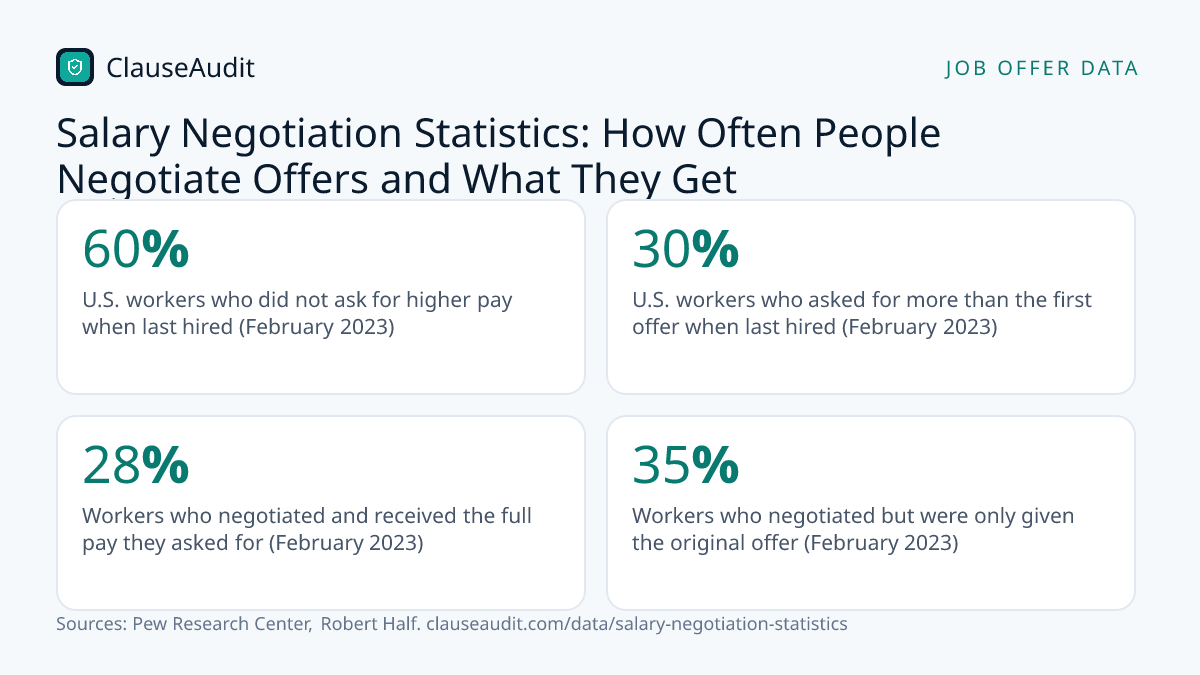
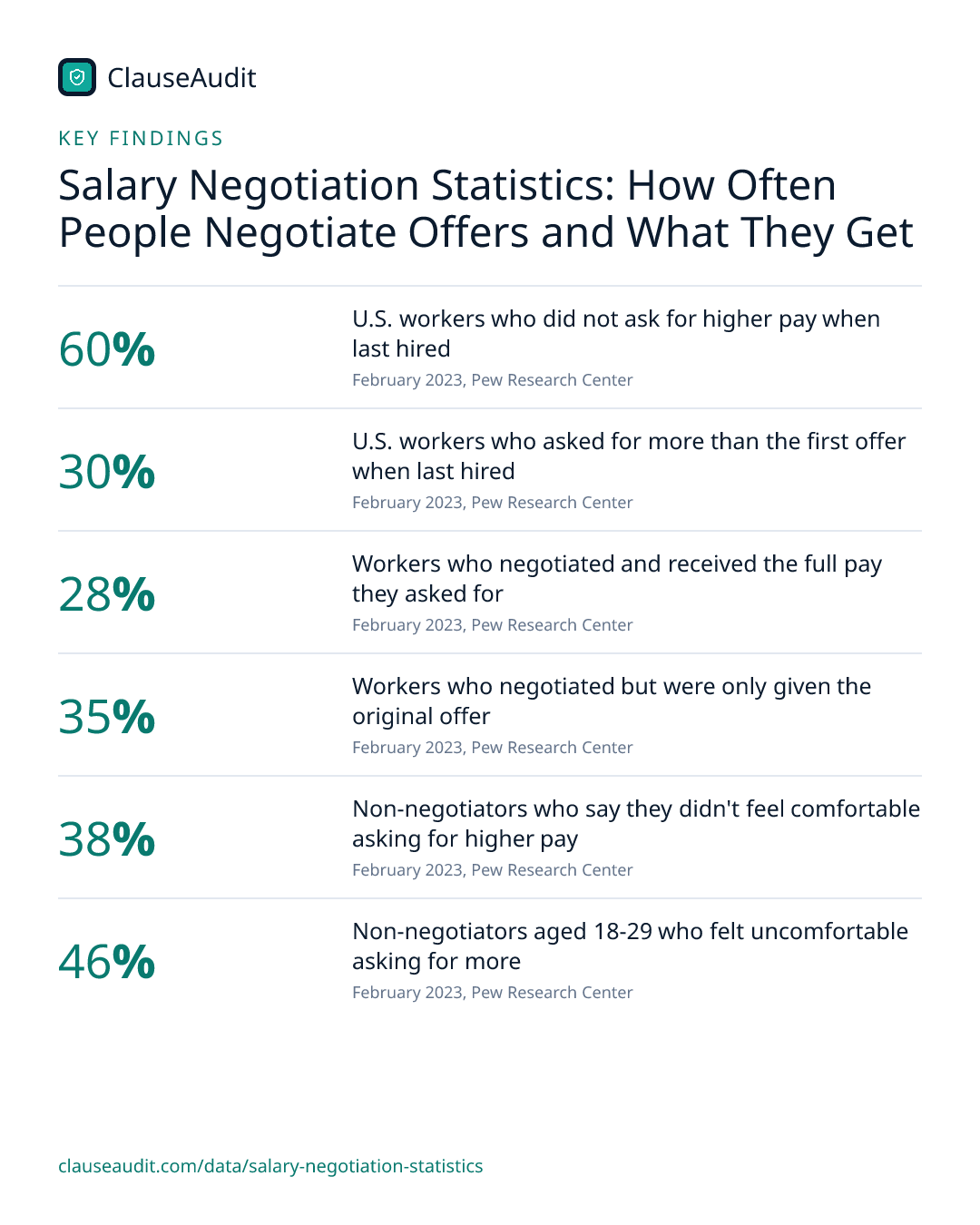
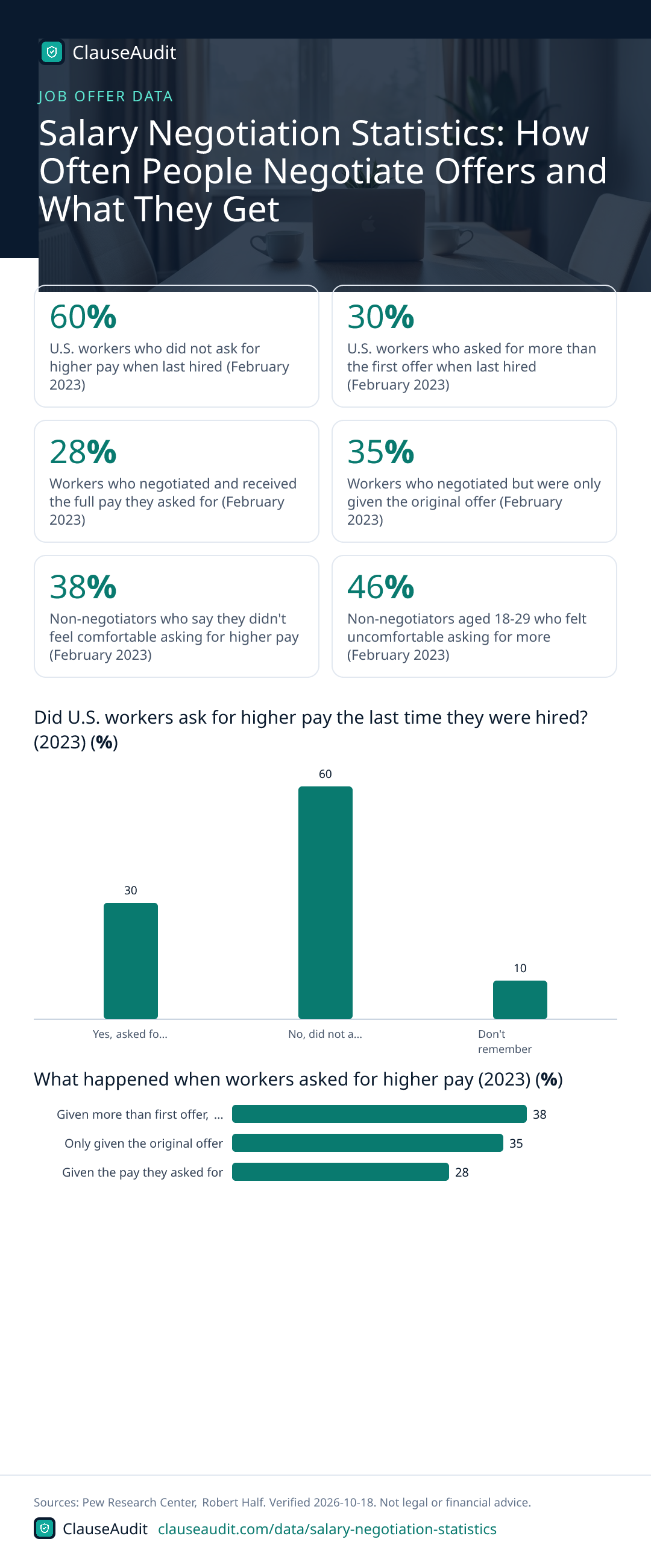
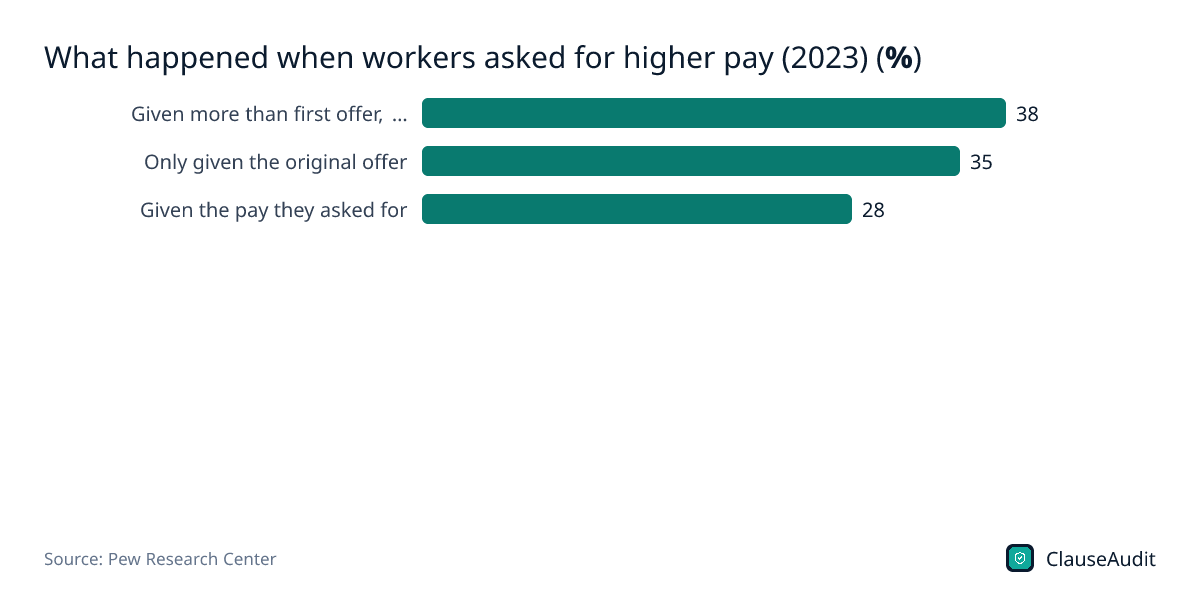
Most U.S. workers don't negotiate. In Pew's February 2023 survey, 60% did not ask for higher pay when last hired and 30% did. Asking usually helped: 28% got the full amount they wanted, 38% got more than the first offer but less than asked, and only 35% were held to the original number.

- U.S. workers who did not ask for higher pay when last hired (February 2023, Pew Research Center)
- 60%
- U.S. workers who asked for more than the first offer when last hired (February 2023, Pew Research Center)
- 30%
- Workers who negotiated and received the full pay they asked for (February 2023, Pew Research Center)
- 28%
- Workers who negotiated but were only given the original offer (February 2023, Pew Research Center)
- 35%
- Non-negotiators who say they didn't feel comfortable asking for higher pay (February 2023, Pew Research Center)
- 38%
- Non-negotiators aged 18-29 who felt uncomfortable asking for more (February 2023, Pew Research Center)
- 46%
- U.S. professionals who say they feel confident negotiating salary offers (April 2025, Robert Half)
- 88%
- U.S. managers offering new hires higher-than-planned salaries (2026, Robert Half)
- 57%
If you have ever stared at an offer email wondering whether pushing back would cost you the job, you are in the majority. Pew Research Center asked employed Americans about the last time they were hired, and 60% said they took the first number without asking for more.
The surprise is what happened to the people who did ask. Most of them walked away with more money than they were first offered. This page puts those survey results in context, shows where the gaps are by age and gender, and explains what to check in the offer letter before you sign it.
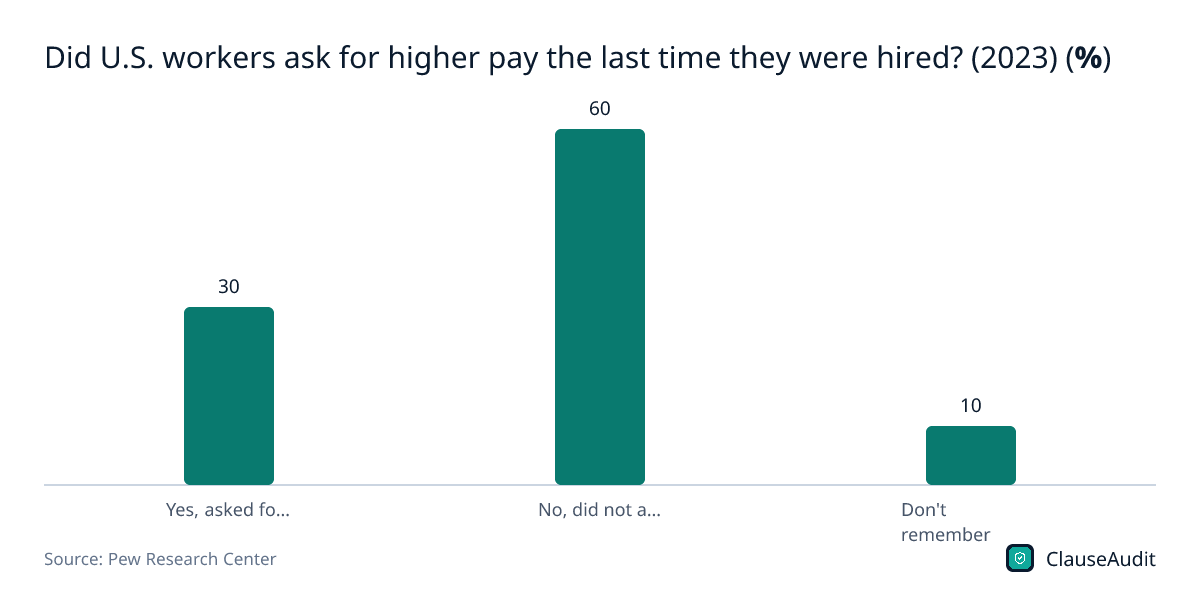
Did U.S. workers ask for higher pay the last time they were hired? (2023) (%)
Chart data
| Label | Value (%) |
|---|---|
| Yes, asked for higher pay | 30 |
| No, did not ask | 60 |
| Don't remember | 10 |
Only 30% of workers asked for more than the first offer. Twice as many, 60%, did not ask, and the other 10% don't remember.
Download this chart (PNG)What happened when workers asked for higher pay (2023) (%)
Chart data
| Label | Value |
|---|---|
| Given more than first offer, but less than asked | 38 |
| Only given the original offer | 35 |
| Given the pay they asked for | 28 |
35% got nothing extra. Everyone else came out ahead: 28% got their full ask and 38% met in the middle, so about two in three people who asked got more money.
Download this chart (PNG)Why workers didn't ask for higher pay (2023) (%)
Chart data
| Label | Value |
|---|---|
| Satisfied with the pay offered | 39 |
| Didn't feel comfortable asking | 38 |
| Some other reason | 23 |
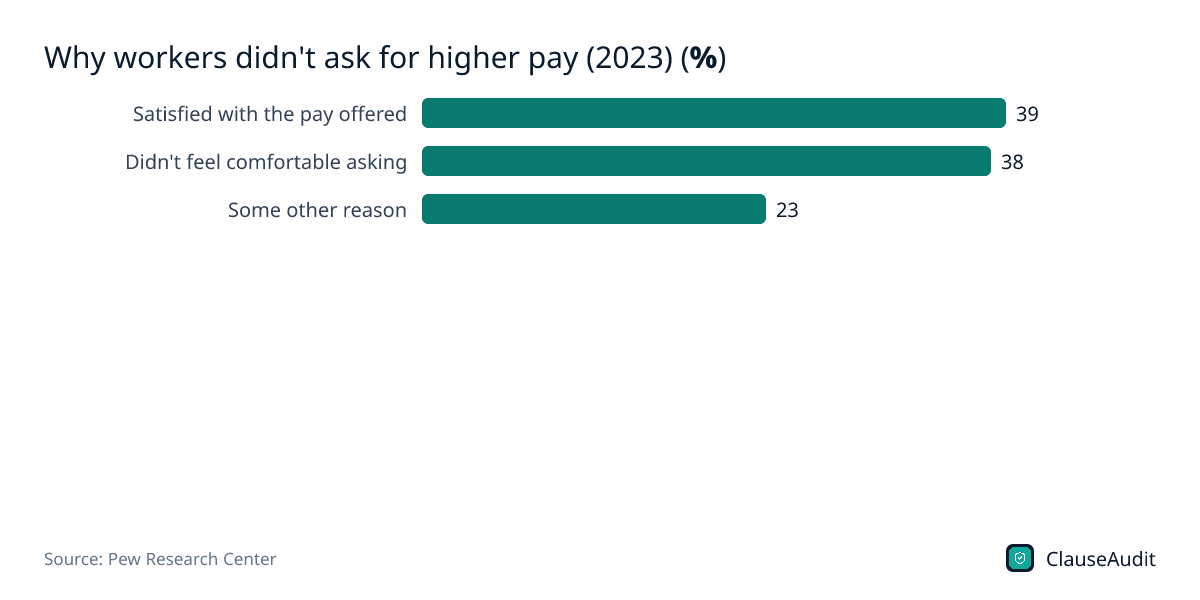
Being satisfied (39%) and feeling uncomfortable (38%) are nearly tied. The first is a choice. The second is a cost you can do something about.
Download this chart (PNG)Non-negotiators who didn't feel comfortable asking for higher pay, by age (2023) (%)
Chart data
| Label | Value (%) |
|---|---|
| 18-29 | 46 |
| 30-49 | 37 |
| 50-64 | 34 |
| 65+ | 19 |
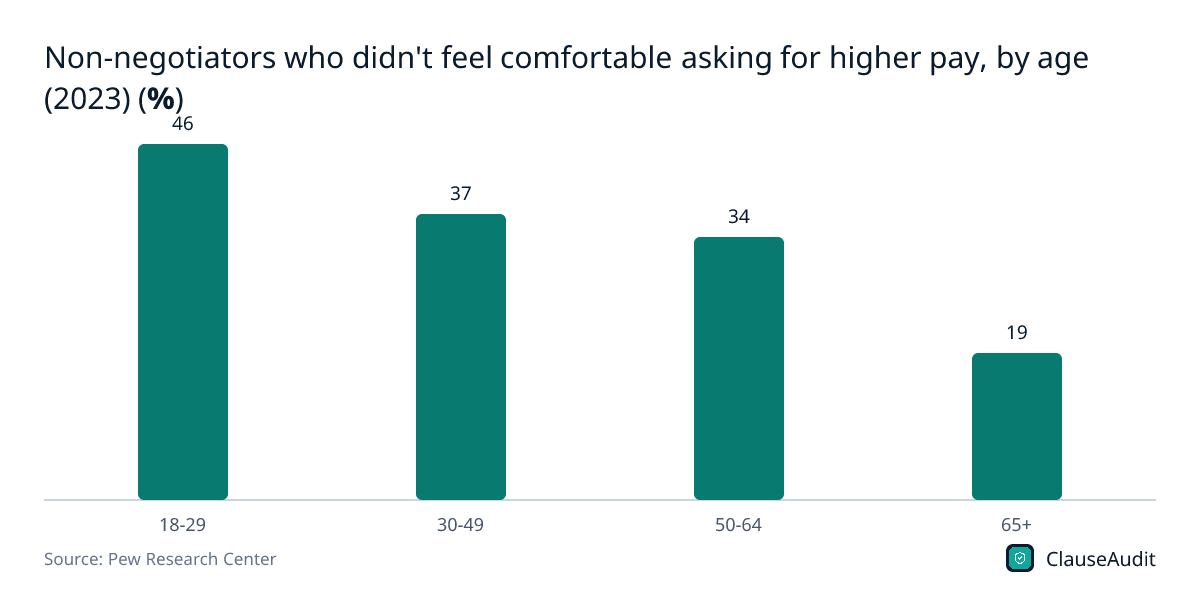
Discomfort falls with age, from 46% of non-negotiators aged 18-29 to 19% of those 65 and older. Early-career offers set the base for every raise after them, so this is where silence costs the most.
Download this chart (PNG)Salary negotiation challenges cited by U.S. professionals (2025) (%)
Chart data
| Label | Value |
|---|---|
| Knowing what is negotiable | 41 |
| Being able to justify requests | 36 |
| Determining their market value | 29 |
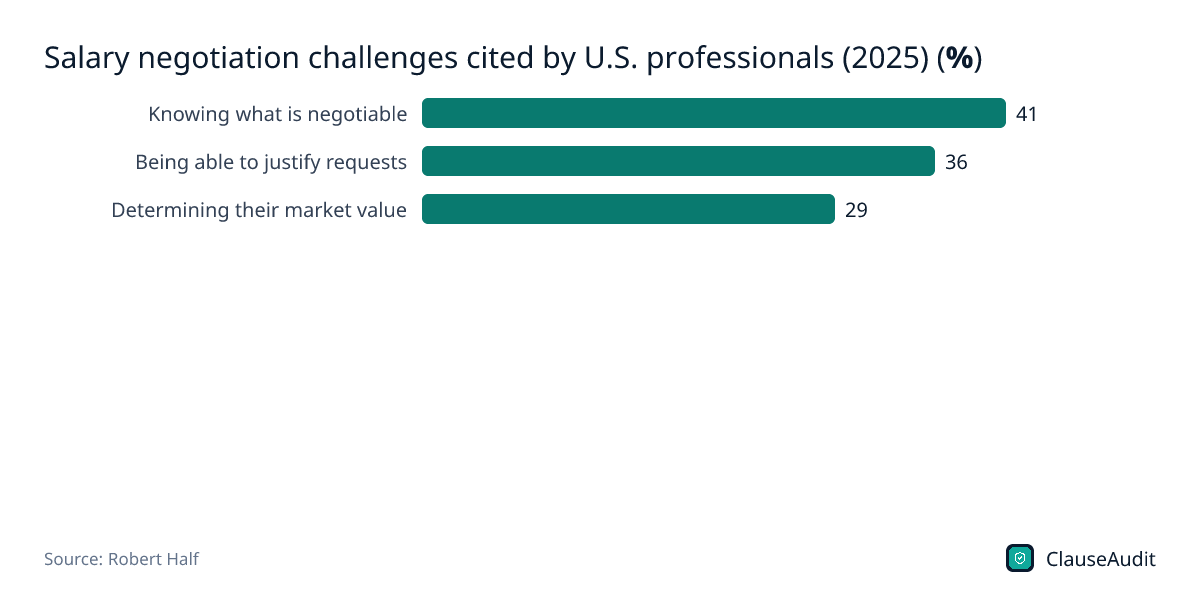
The top hurdle is not nerve. It is information: 41% of professionals said they struggle to know what is negotiable, and 29% struggle to pin down their market value.
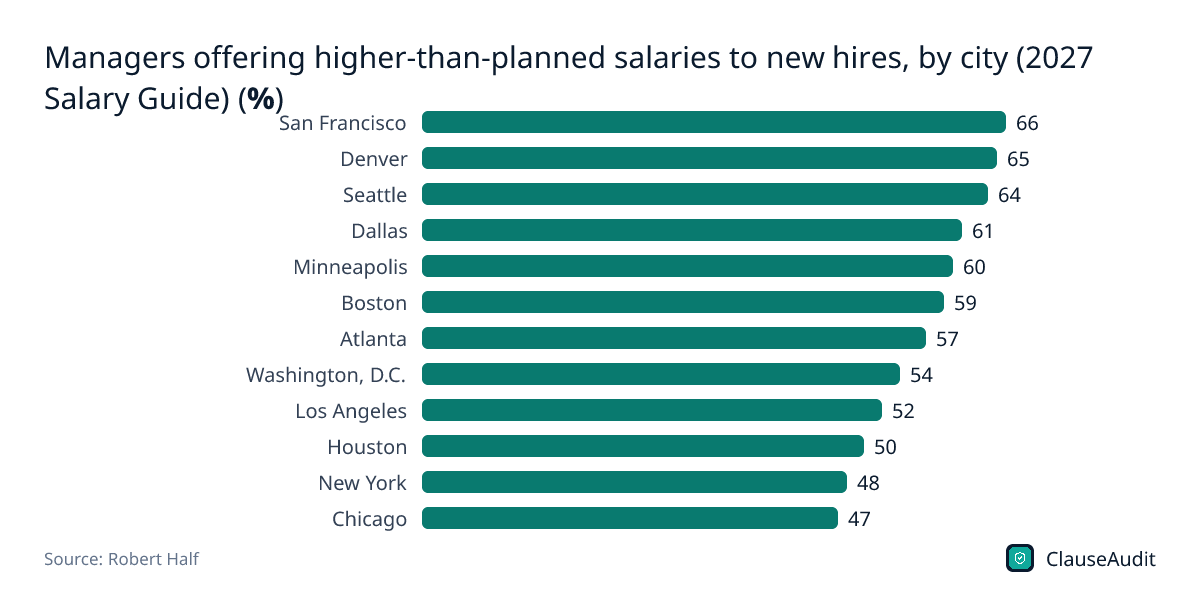
Download this chart (PNG)Managers offering higher-than-planned salaries to new hires, by city (2027 Salary Guide) (%)
Chart data
| Label | Value |
|---|---|
| San Francisco | 66 |
| Denver | 65 |
| Seattle | 64 |
| Dallas | 61 |
| Minneapolis | 60 |
| Boston | 59 |
| Atlanta | 57 |
| Washington, D.C. | 54 |
| Los Angeles | 52 |
| Houston | 50 |
| New York | 48 |
| Chicago | 47 |
Nationally, 57% of managers say they are offering new hires more than they planned. The range runs from 66% in San Francisco to 47% in Chicago, so your city changes how much room you likely have.
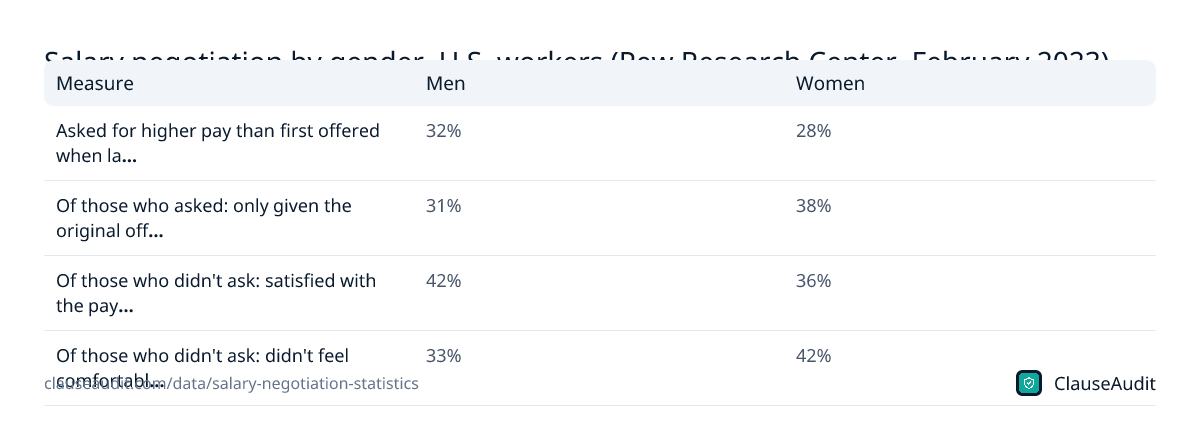
Download this chart (PNG)Salary negotiation by gender, U.S. workers (Pew Research Center, February 2023)
| Measure | Men | Women |
|---|---|---|
| Asked for higher pay than first offered when last hired | 32% | 28% |
| Of those who asked: only given the original offer | 31% | 38% |
| Of those who didn't ask: satisfied with the pay offered | 42% | 36% |
| Of those who didn't ask: didn't feel comfortable asking | 33% | 42% |
Source: Pew Research Center, When negotiating starting salaries, most U.S. women and men don't ask for higher pay. Download as image
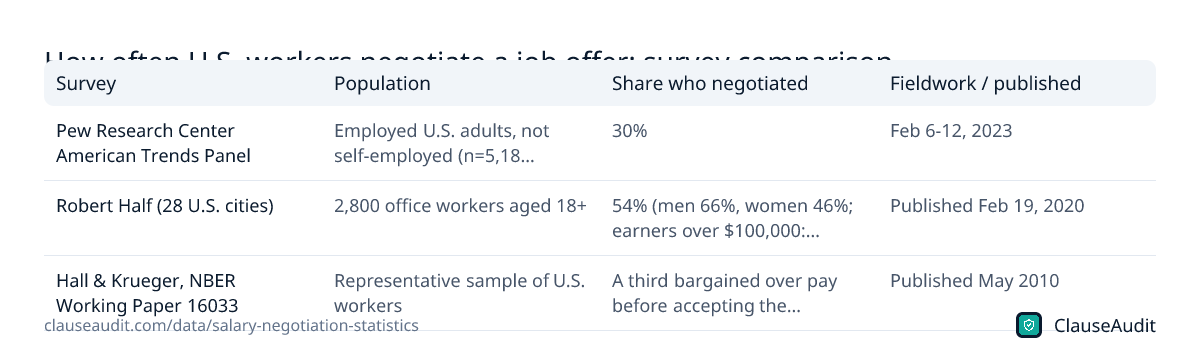
How often U.S. workers negotiate a job offer: survey comparison
| Survey | Population | Share who negotiated | Fieldwork / published |
|---|---|---|---|
| Pew Research Center American Trends Panel | Employed U.S. adults, not self-employed (n=5,188) | 30% | Feb 6-12, 2023 |
| Robert Half (28 U.S. cities) | 2,800 office workers aged 18+ | 54% (men 66%, women 46%; earners over $100,000: 64%) | Published Feb 19, 2020 |
| Hall & Krueger, NBER Working Paper 16033 | Representative sample of U.S. workers | A third bargained over pay before accepting their current job | Published May 2010 |
Source: Pew Research Center, 2023 American Trends Panel Survey of U.S. Workers, Wave 121 Final Topline (salary negotiation questions); Robert Half, More Than Half Of Workers Negotiated Pay With Last Job Offer, Survey Finds; National Bureau of Economic Research (Robert E. Hall and Alan B. Krueger), Evidence on the Determinants of the Choice between Wage Posting and Wage Bargaining (Working Paper 16033). Download as image
What percentage of people negotiate their salary?
It depends on who you ask and how. Pew's survey of employed adults who are not self-employed found that 30% asked for higher pay the last time they were hired. A 2020 Robert Half survey of office workers put the figure at 54%. An older NBER paper by Hall and Krueger found that a third of workers bargained over pay before taking their current job.
Those numbers don't contradict each other as much as they look. Robert Half surveyed office workers in 28 U.S. cities, a group where pay is less likely to be fixed by a posted rate or a union scale. Pew covered a much broader sample of employed adults, including jobs where the wage is set before anyone walks in the door.
So the honest answer is that somewhere between a third and just over half of people push back, and the share is higher in better-paid roles. In the Robert Half survey, 64% of people earning over $100,000 negotiated. If you work in a salaried, professional job, there is a good chance the employer expects a counter.
Does negotiating salary actually work?
For most people who try, yes. Among Pew respondents who asked for more, 28% got everything they asked for and 38% got something in between. Only 35% left with the original offer.
Think about the downside in plain terms. In Pew's survey, the worst result people reported was keeping the offer they already had. An employer can still pull an offer, but you lower that risk when you ask politely, back the request with a reason and stay open to a middle number.
Employers also seem to be leaving room. In Robert Half's 2027 Salary Guide, 57% of U.S. managers said they were offering new hires higher-than-planned salaries. When the hiring side is already stretching its budget, a well-supported ask has a reasonable chance of landing.
Why do so many people skip the ask?
Pew's non-negotiators split into two groups. 39% were satisfied with the pay offered, which is a fair reason. 38% said they didn't feel comfortable asking, which is the group that leaves money behind.
Discomfort is highest among the young. 46% of non-negotiators aged 18-29 said they felt uncomfortable, compared with 37% of those 30-49 and 34% of those 50-64. That matters because your starting salary becomes the baseline for future raises and can shape what the next employer offers.
Confidence and action don't line up neatly either. In an April 2025 Robert Half survey, 88% of professionals said they feel confident negotiating salary offers. Yet the same group named real obstacles: 41% struggle to know what is negotiable and 36% struggle to justify a request. Feeling ready is not the same as having a plan.
Do women negotiate salary less than men?
Slightly less often, and with worse results when they do. In Pew's data, 32% of men and 28% of women asked for higher pay. Among those who asked, 38% of women got only the original offer, compared with 31% of men.
The reasons for not asking also differ. 42% of women who didn't negotiate said they were uncomfortable, versus 33% of men. Men who didn't ask were more likely to say they were simply satisfied with the offer (42% against 36% of women).
The 2020 Robert Half survey showed a wider split, 66% of men versus 46% of women, though it covered a narrower group of office workers. Either way, a small gap at the offer stage can compound over a career, because each raise is usually a percentage of the pay you already have.
How to negotiate a job offer without risking it
- Thank them first and ask for the offer in writing before you counter. You can't negotiate a number you haven't seen spelled out.
- Name a specific figure and give one or two reasons: the market rate for the role, a competing offer, or a skill they said they need.
- If base pay is fixed, ask about the pieces around it: signing bonus, start date, title, remote days, review timing or extra paid time off.
- Get any change confirmed in the revised offer letter. A recruiter's verbal promise about a bonus or a review is hard to enforce later.
- Read the conditions attached to the extra money. A bigger signing bonus with a repayment clause can cost you more than it pays if you leave early.
- Stay polite and leave room for a middle number. In Pew's data, meeting in the middle was the single most common result of asking.
What employers and hiring managers should take from this
If you run a small business or hire for a team, these numbers cut both ways. Most candidates won't push, so the first offer often becomes the final salary. That can feel like a win until a quiet hire learns what the person at the next desk makes and starts looking elsewhere.
The gaps by age and gender are worth a look too. If younger workers and women are less comfortable asking, a pay system that rewards whoever negotiates hardest will drift toward unequal pay for the same work. Setting a clear range for each role and sticking to it is simpler and easier to defend.
Finally, put the final terms in writing. A clean offer letter that matches what was discussed saves you disputes about bonuses, start dates and repayment terms later.
What a negotiated offer should look like on paper
Winning the number is half the job. The other half is making sure the written offer matches what you agreed. People often negotiate salary, then sign a letter that lets the employer adjust pay at its discretion, ties the bonus to targets nobody defined, or claws back the signing bonus on terms they never discussed.
Before you sign, compare the final document line by line with the emails or notes from your conversation. If anything you agreed is missing, ask for it to be added. That request is far easier to make before your start date than after it.
How ClauseAudit helps
Once the salary talk is done, the offer letter or employment agreement is what actually binds you. ClauseAudit's automated review reads the document and flags the terms that can quietly undo a good negotiation, with plain-English explanations and suggested wording to ask for.
Upload the offer before you sign and check these clauses in particular.
- Base salary and pay changes: whether the employer can cut or adjust pay without your consent
- Bonus terms: whether targets, timing and payout are defined or left to discretion
- Signing bonus and relocation repayment: how much you owe back and for how long if you leave
- Equity vesting: the cliff, the schedule and what happens if you are let go
- Non-compete and non-solicit clauses, and whether your state enforces them
- Notice periods and severance, including whether the terms are the same for both sides
Frequently asked questions
What percentage of people negotiate salary?
About 30% of U.S. workers asked for higher pay when last hired, according to Pew Research Center's February 2023 survey, while 60% did not and 10% didn't remember. Surveys of office workers find higher rates: a 2020 Robert Half survey put it at 54%. Higher earners ask more often: in that same survey, 64% of people earning over $100,000 negotiated.
What are the chances of getting more money if I negotiate?
Good, based on Pew's data. Of workers who asked for more pay, 28% got exactly what they requested and 38% got more than the first offer but less than their ask. That leaves 35% who received only the original offer. Put another way, most people who asked came out ahead of where they started.
Can an employer withdraw a job offer because I negotiated?
Yes. In most U.S. states employment is at will, and an employer can usually withdraw an offer for any lawful reason, including a counteroffer it dislikes. You lower the risk by keeping the tone friendly, giving a reason for your number and making clear you want the job. Among Pew respondents who asked, the worst reported outcome was keeping the original offer.
Why don't more people negotiate their salary?
Among Pew respondents who didn't ask, 39% were satisfied with the offer and 38% didn't feel comfortable asking. Robert Half's April 2025 survey points to a lack of information: 41% of professionals struggle to know what is negotiable, 36% to justify their requests and 29% to determine their market value. Research and a short script solve most of that.
Do younger workers negotiate less?
Younger workers are the most likely to hold back out of discomfort. In Pew's 2023 survey, 46% of non-negotiators aged 18-29 said they didn't feel comfortable asking for more pay, compared with 19% of those 65 and older. Because a starting salary shapes future raises, the first few job offers are where speaking up tends to matter most.
Is there a gender gap in salary negotiation?
Yes, though it is narrower than many people assume. Pew found 32% of men and 28% of women asked for higher pay when last hired. The bigger difference was in results: 38% of women who asked got only the original offer, against 31% of men. Women who didn't ask were also more likely to cite discomfort, 42% versus 33%.
Is now a good time to negotiate a job offer?
The latest employer data suggests there is room. Robert Half's 2027 Salary Guide, released in October 2026, found 57% of U.S. managers offering new hires higher-than-planned salaries. The share was higher in cities like San Francisco (66%), Denver (65%) and Seattle (64%), and lower in Chicago (47%) and New York (48%).
What else can I negotiate besides base salary?
Plenty. Signing bonuses, start dates, job title, remote work, paid time off, the timing of your first pay review and equity are all common asks. Whatever you agree, make sure it appears in the written offer, and read any strings attached, such as a requirement to repay a signing bonus if you leave within a set period.
Use this data
Every chart and card below is free to reuse under CC BY 4.0. Download what you need and link back to this page.
 Stat cards
 Key findings card
 Infographic
 Did U.S. workers ask for higher pay the last time they were hired? (2023) (%)
 What happened when workers asked for higher pay (2023) (%)
 Why workers didn't ask for higher pay (2023) (%)
 Non-negotiators who didn't feel comfortable asking for higher pay, by age (2023) (%)
 Salary negotiation challenges cited by U.S. professionals (2025) (%)
 Managers offering higher-than-planned salaries to new hires, by city (2027 Salary Guide) (%)
 Salary negotiation by gender, U.S. workers (Pew Research Center, February 2023)
 How often U.S. workers negotiate a job offer: survey comparison
Embed the infographic
Free to share on your site, blog or slides under CC BY 4.0. Please keep the credit link.
Sources and method
Every number on this page comes from the sources below, each opened and read on or before October 18, 2026. A second, independent review checked every figure against its source and corrected anything that did not match. Figures that could not be confirmed were left out.
- Pew Research Center, When negotiating starting salaries, most U.S. women and men don't ask for higher pay (April 5, 2023)
- Pew Research Center, 2023 American Trends Panel Survey of U.S. Workers, Wave 121 Final Topline (salary negotiation questions) (Fieldwork February 6-12, 2023; released April 2023)
- Robert Half, Robert Half Releases 2026 Salary Guide Highlighting Key Compensation Trends Amid a Complex Job Market (September 29, 2025 (2026 Salary Guide; survey April 2025))
- Robert Half, 2027 Salary Guide From Robert Half finds employers are paying more for candidates with specialized skills (October 1, 2026 (2027 Salary Guide))
- Robert Half, More Than Half Of Workers Negotiated Pay With Last Job Offer, Survey Finds (February 19, 2020)
- National Bureau of Economic Research (Robert E. Hall and Alan B. Krueger), Evidence on the Determinants of the Choice between Wage Posting and Wage Bargaining (Working Paper 16033) (May 2010)
Cite this page
ClauseAudit, “Salary Negotiation Statistics: How Often People Negotiate Offers and What They Get”, updated October 18, 2026, https://clauseaudit.com/data/salary-negotiation-statistics. Free to reuse with a link back (CC BY 4.0).
This page summarises published data and law as checked on October 18, 2026. Figures are updated as new editions are released, and your own situation may differ. It is general information, not legal, tax or financial advice.