AI and Freelancers: Statistics on How AI Is Changing Freelance Work and Pay (2026)
By ClauseAudit Research · 10 sources ·
What is the impact of AI on freelancers?
AI is splitting freelance work in two. On Upwork, freelancers doing AI work earn 34% more per hour than those who don't use it. But per-contract earnings in generative AI and creative production fell 13% as contract volume rose, and Fiverr lost 21.9% of its active buyers in a year.

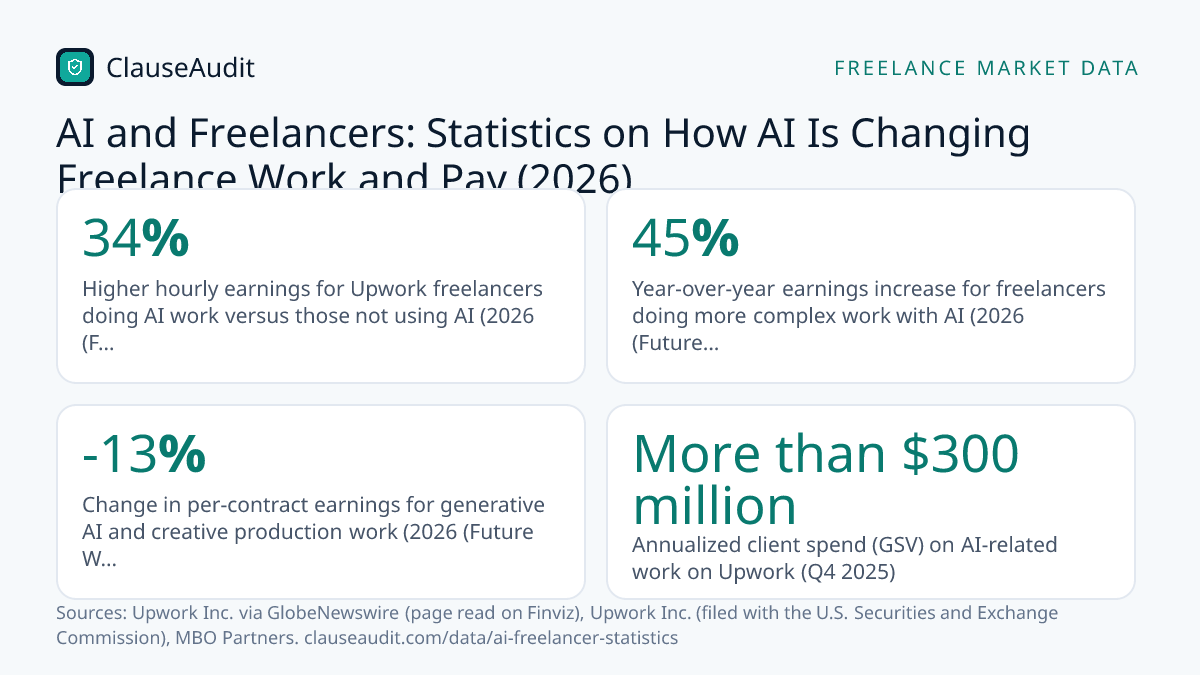
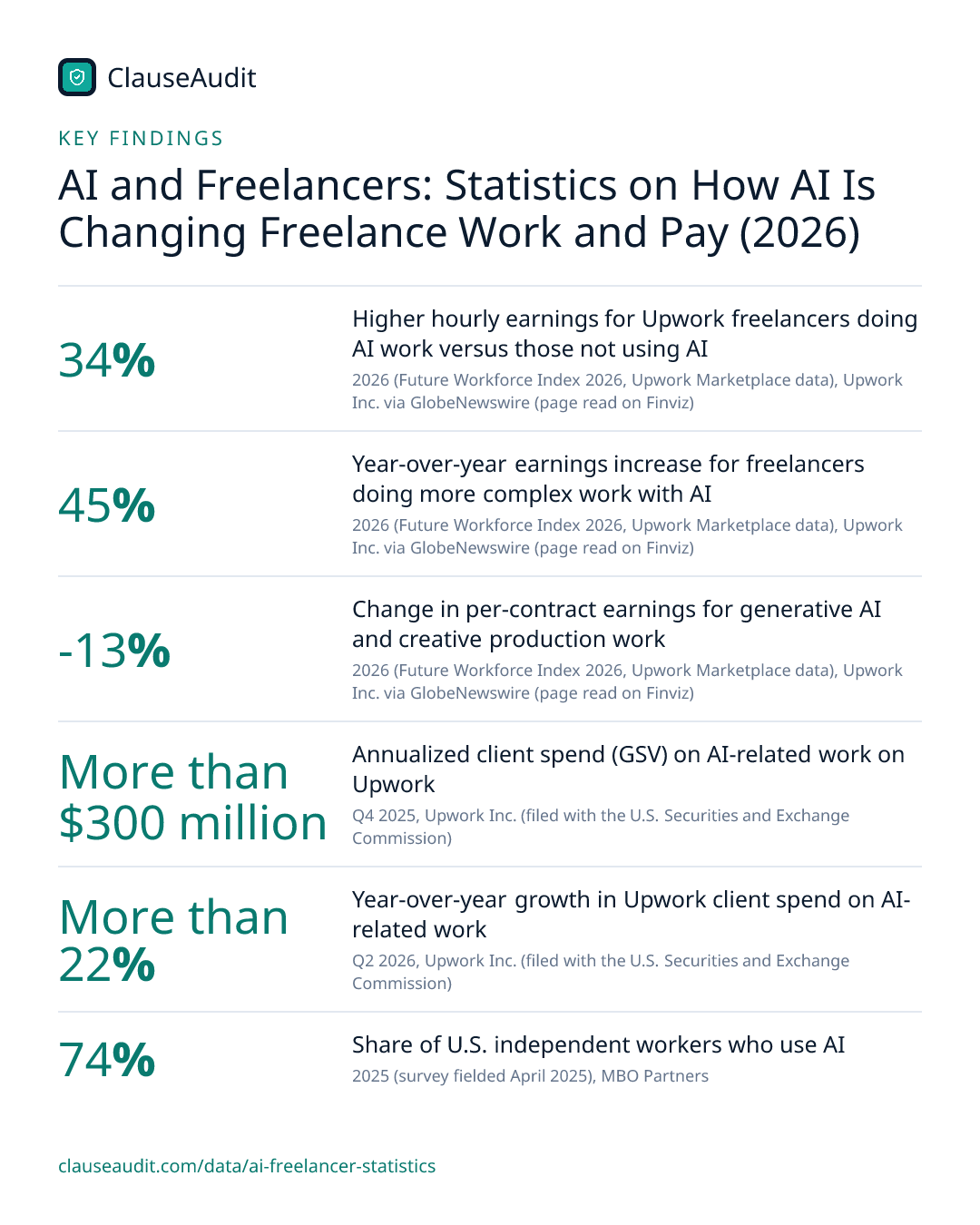
- Higher hourly earnings for Upwork freelancers doing AI work versus those not using AI (2026 (Future Workforce Index 2026, Upwork Marketplace data), Upwork Inc. via GlobeNewswire (page read on Finviz))
- 34%
- Year-over-year earnings increase for freelancers doing more complex work with AI (2026 (Future Workforce Index 2026, Upwork Marketplace data), Upwork Inc. via GlobeNewswire (page read on Finviz))
- 45%
- Change in per-contract earnings for generative AI and creative production work (2026 (Future Workforce Index 2026, Upwork Marketplace data), Upwork Inc. via GlobeNewswire (page read on Finviz))
- -13%
- Annualized client spend (GSV) on AI-related work on Upwork (Q4 2025, Upwork Inc. (filed with the U.S. Securities and Exchange Commission))
- More than $300 million
- Year-over-year growth in Upwork client spend on AI-related work (Q2 2026, Upwork Inc. (filed with the U.S. Securities and Exchange Commission))
- More than 22%
- Share of U.S. independent workers who use AI (2025 (survey fielded April 2025), MBO Partners)
- 74%
- Average time saved by independent professionals who use generative AI (2026 (survey fielded April 2026), MBO Partners)
- Nearly 10 hours per week
- Year-over-year drop in Fiverr annual active buyers, as AI absorbs transactional tasks (As of June 30, 2026, Fiverr International Ltd. (filed with the U.S. Securities and Exchange Commission))
- 21.9%
Ask ten freelancers how AI has changed their business and you'll get ten different answers. The numbers explain why. Some kinds of work pay more than they did a year ago. Other kinds pay less per job, even though there's more of it.
This page pulls together platform filings and large surveys of U.S. independent workers. Below the charts, you'll find what the split means for your rates and your client mix, and which contract terms matter more now that clients expect work to go faster.
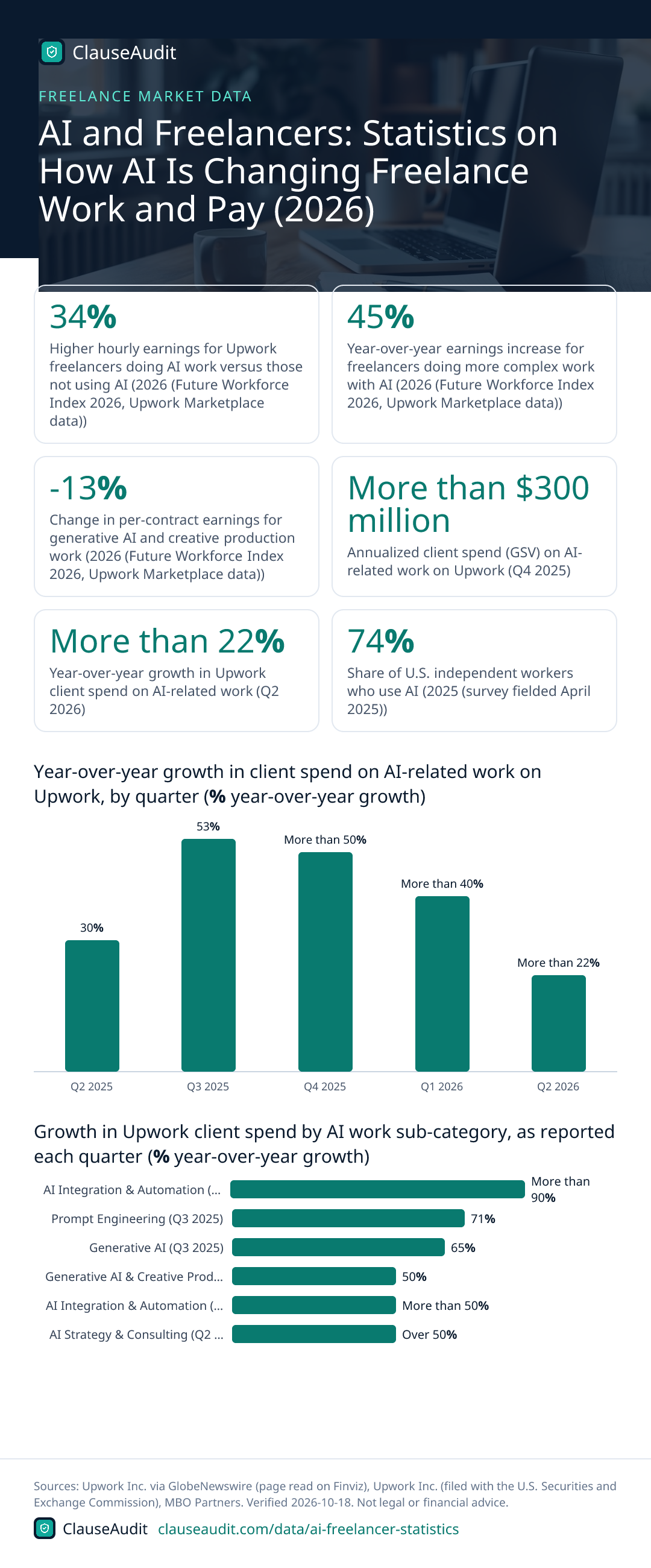
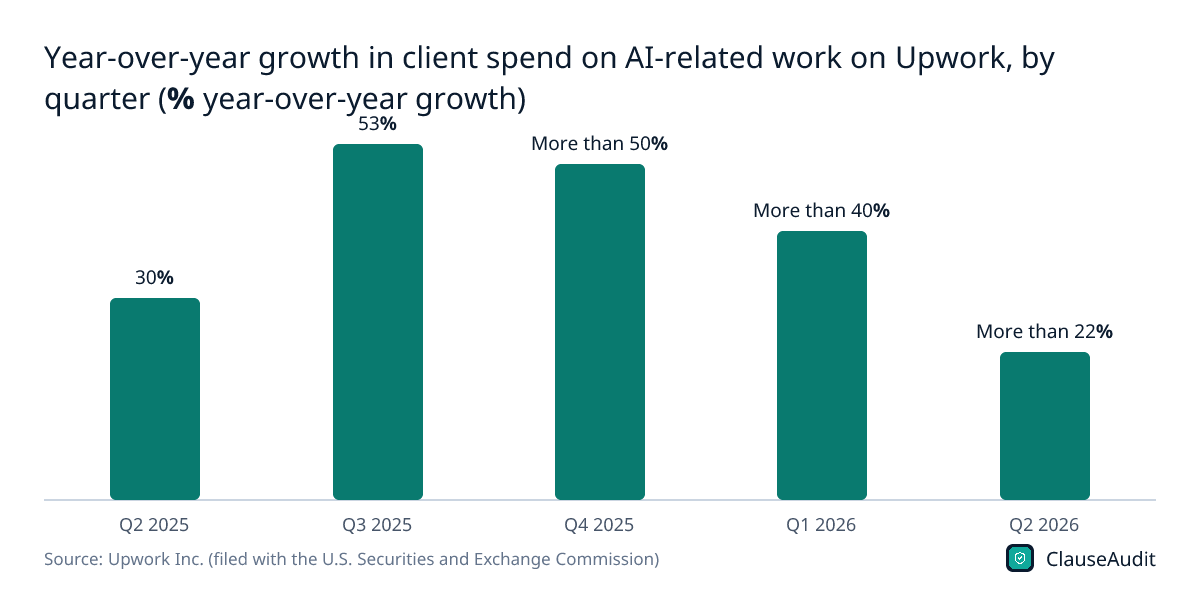
Year-over-year growth in client spend on AI-related work on Upwork, by quarter (% year-over-year growth)
Chart data
| Label | Value (% year-over-year growth) |
|---|---|
| Q2 2025 | 30% |
| Q3 2025 | 53% |
| Q4 2025 | More than 50% |
| Q1 2026 | More than 40% |
| Q2 2026 | More than 22% |
Client spend on AI work is still growing, but the pace has cooled from 53% in Q3 2025 to more than 22% in Q2 2026. Demand hasn't dried up, but the steep early growth has slowed quarter after quarter.
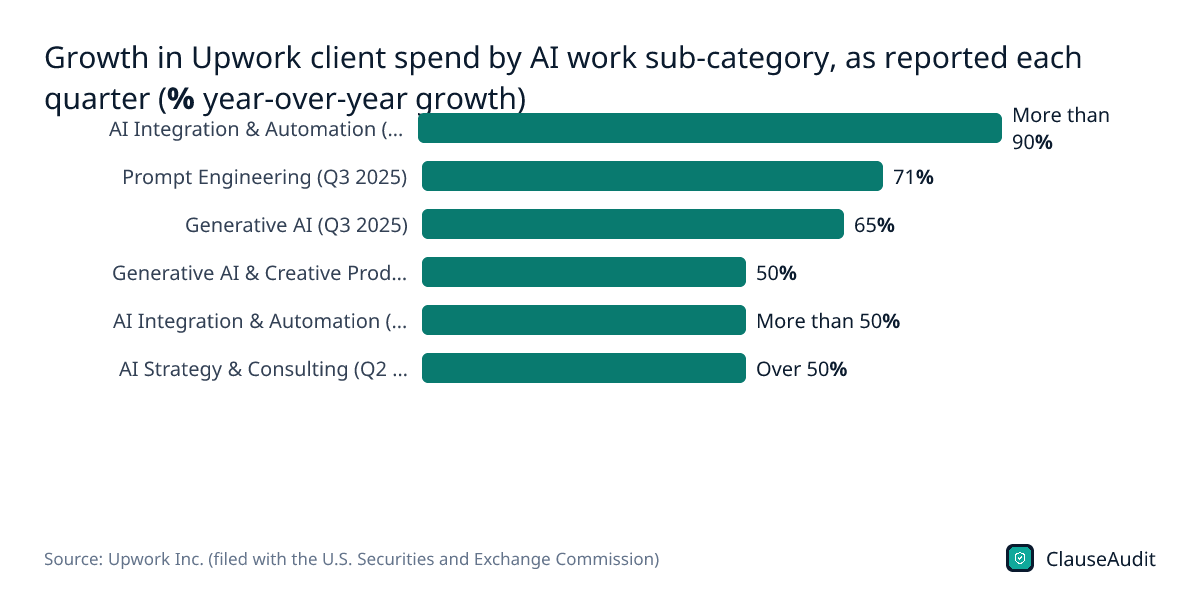
Download this chart (PNG)Growth in Upwork client spend by AI work sub-category, as reported each quarter (% year-over-year growth)
Chart data
| Label | Value |
|---|---|
| AI Integration & Automation (Q4 2025) | More than 90% |
| Prompt Engineering (Q3 2025) | 71% |
| Generative AI (Q3 2025) | 65% |
| Generative AI & Creative Production (Q4 2025) | 50% |
| AI Integration & Automation (Q1 2026) | More than 50% |
| AI Strategy & Consulting (Q2 2026) | Over 50% |
The fastest-growing categories involve plugging AI into a client's actual business, such as AI Integration & Automation at more than 90% in Q4 2025. Upwork names different categories each quarter, so read this as a list of hot spots rather than a ranking.
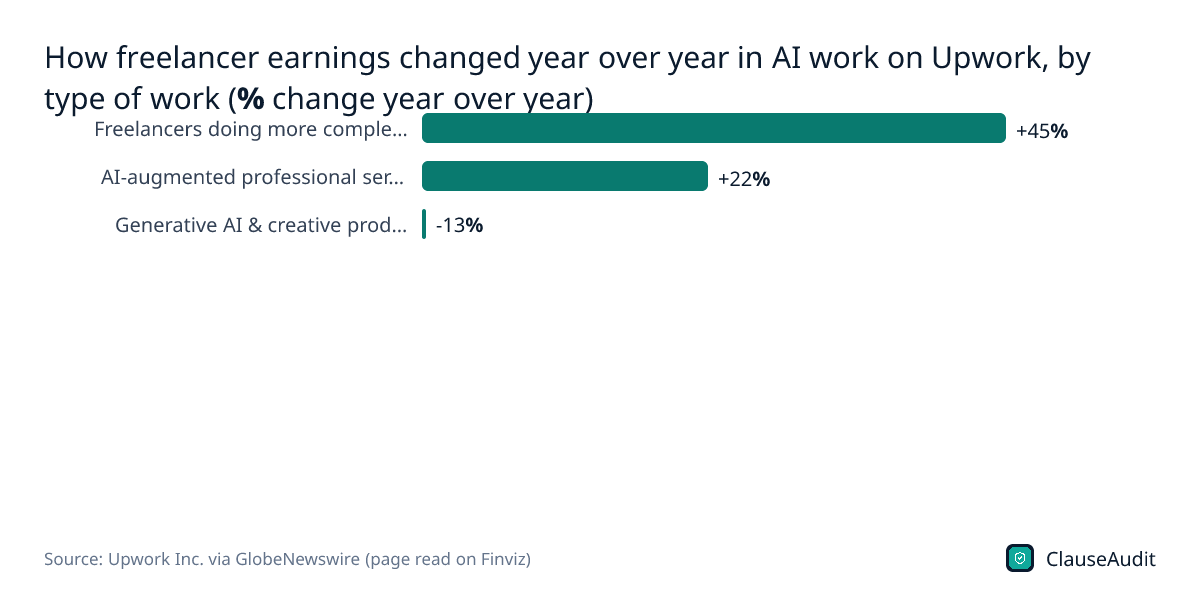
Download this chart (PNG)How freelancer earnings changed year over year in AI work on Upwork, by type of work (% change year over year)
Chart data
| Label | Value |
|---|---|
| Freelancers doing more complex work with AI (earnings) | +45% |
| AI-augmented professional services (earnings) | +22% |
| Generative AI & creative production (per-contract earnings) | -13% |
This is the split in one chart. Freelancers doing more complex work with AI earned 45% more, while generative AI and creative production lost 13% per contract.
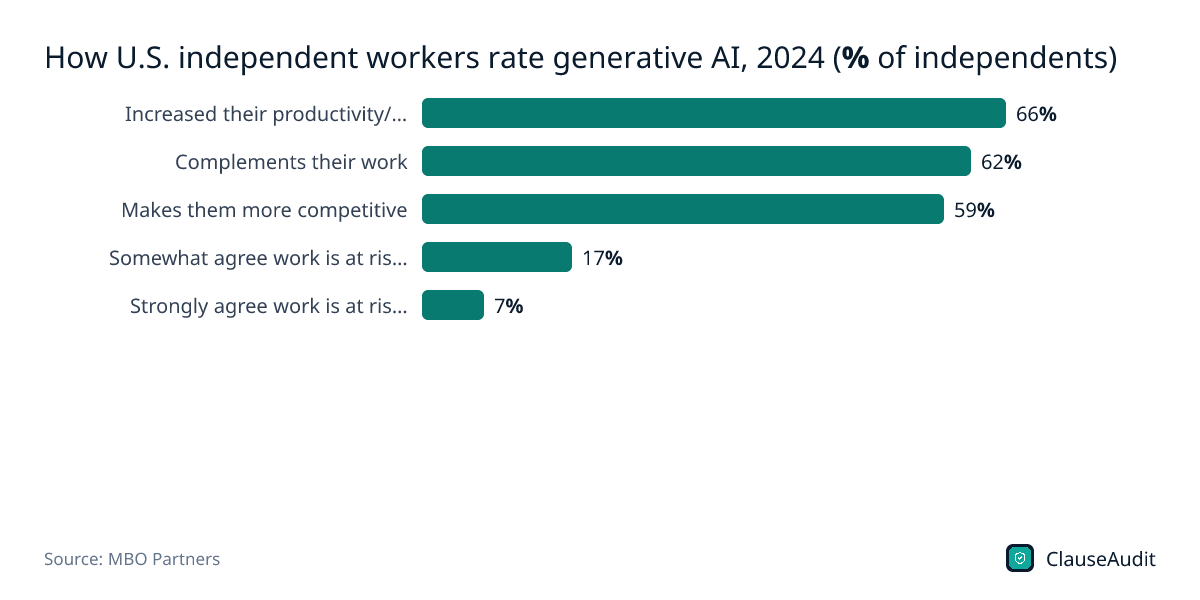
Download this chart (PNG)How U.S. independent workers rate generative AI, 2024 (% of independents)
Chart data
| Label | Value |
|---|---|
| Increased their productivity/efficiency | 66% |
| Complements their work | 62% |
| Makes them more competitive | 59% |
| Somewhat agree work is at risk of AI replacement within 3 years | 17% |
| Strongly agree work is at risk of AI replacement within 3 years | 7% |
Most independents saw AI as a help, not a threat. Only 7% strongly agreed their work could be replaced within 3 years.
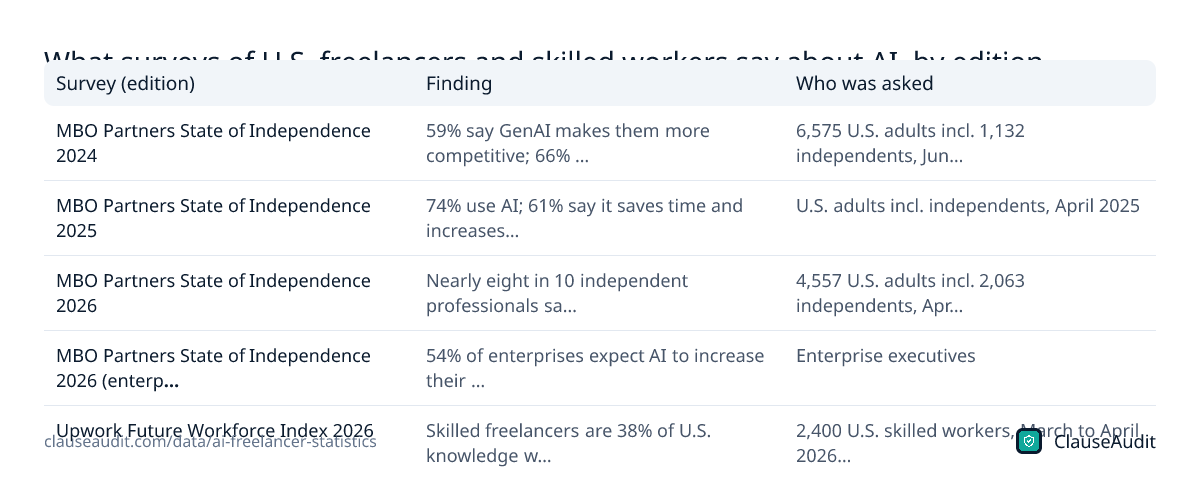
Download this chart (PNG)What surveys of U.S. freelancers and skilled workers say about AI, by edition
| Survey (edition) | Finding | Who was asked |
|---|---|---|
| MBO Partners State of Independence 2024 | 59% say GenAI makes them more competitive; 66% say it increased productivity/efficiency; 7% strongly and 17% somewhat agree their work is at risk of AI replacement within 3 years | 6,575 U.S. adults incl. 1,132 independents, June 2024 |
| MBO Partners State of Independence 2025 | 74% use AI; 61% say it saves time and increases output | U.S. adults incl. independents, April 2025 |
| MBO Partners State of Independence 2026 | Nearly eight in 10 independent professionals say AI complements their work and improves productivity; GenAI users save nearly 10 hours per week | 4,557 U.S. adults incl. 2,063 independents, April 2026 |
| MBO Partners State of Independence 2026 (enterprise report) | 54% of enterprises expect AI to increase their use of independent talent over the next two years | Enterprise executives |
| Upwork Future Workforce Index 2026 | Skilled freelancers are 38% of U.S. knowledge workers, up from 28% the prior year; 58% of full-time employees are considering freelancing, up from 36% | 2,400 U.S. skilled workers, March to April 2026 (margin of error 2%) |
Source: MBO Partners, State of Independence in America 2024; MBO Partners, State of Independence in America 2025; MBO Partners, Independent Workforce Reaches 74.9 Million (State of Independence 2026 press release); MBO Partners, State of Independence research (2026 edition: The Enterprise Perspective); Upwork Inc. via GlobeNewswire (page read on Finviz), Upwork's Future Workforce Index 2026: How AI is Redefining the Value of Work as Skilled Freelancing Accelerates (press release). Download as image
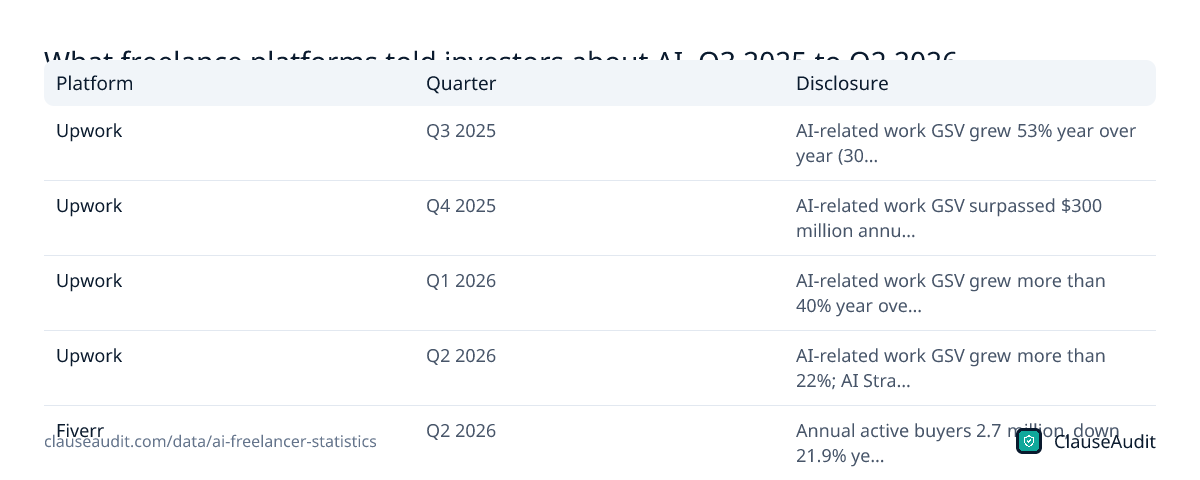
What freelance platforms told investors about AI, Q3 2025 to Q2 2026
| Platform | Quarter | Disclosure |
|---|---|---|
| Upwork | Q3 2025 | AI-related work GSV grew 53% year over year (30% in Q2 2025); Prompt Engineering GSV grew 71% |
| Upwork | Q4 2025 | AI-related work GSV surpassed $300 million annualized, up more than 50%; AI Integration & Automation grew more than 90% |
| Upwork | Q1 2026 | AI-related work GSV grew more than 40% year over year |
| Upwork | Q2 2026 | AI-related work GSV grew more than 22%; AI Strategy & Consulting grew over 50% |
| Fiverr | Q2 2026 | Annual active buyers 2.7 million, down 21.9% year over year; guidance cut citing persistent weakness across categories most exposed to AI automation |
Source: Upwork Inc. (filed with the U.S. Securities and Exchange Commission), Upwork Reports Third Quarter 2025 Financial Results (Form 8-K, Exhibit 99.1); Upwork Inc. (filed with the U.S. Securities and Exchange Commission), Upwork Reports Fourth Quarter and Full Year 2025 Financial Results (Form 8-K, Exhibit 99.1); Upwork Inc. (filed with the U.S. Securities and Exchange Commission), Upwork Reports First Quarter 2026 Financial Results (Form 8-K, Exhibit 99.1); Upwork Inc. (filed with the U.S. Securities and Exchange Commission), Upwork Reports Second Quarter 2026 Financial Results (Form 8-K, Exhibit 99.1); Fiverr International Ltd. (filed with the U.S. Securities and Exchange Commission), Fiverr Announces Second Quarter 2026 Results (Form 6-K, Exhibit 99.1). Download as image
Do freelancers who use AI earn more?
On Upwork, yes, and by a wide margin. Freelancers doing AI work earn 34% more per hour than those who don't bring AI into their work. Freelancers doing more complex work with AI saw earnings rise 45% year over year.
Keep the source in mind, though. These figures come from Upwork's own marketplace data in a company press release. Upwork also doesn't say what counts as "complex." So read them as a strong signal about where client money is going, not as an audited pay scale.
The pattern makes sense once you picture the jobs. A client paying someone to connect a support inbox to an automated triage system is buying judgment and technical setup. Those skills are scarce, and scarce skills get paid. The tool itself is not what earns the premium. What you build with it is.
So if you want the premium, put the skill in your proposal and your contract, not just your toolkit. Describe the deliverable as a working system or a finished decision, not a pile of drafts. A client who signs a scope like "set up and test the workflow" is paying for an outcome, and outcomes are much harder to haggle down than hours.
Why is creative freelance pay falling?
Generative AI and creative production work is the clearest case of more work at lower pay. Contract starts in that category grew 90% year over year, but per-contract earnings fell 13%.
Think about a designer who used to quote a full brand package. Now the client shows up with logo drafts they made themselves and wants a cleanup and a style guide. The job is smaller, so the invoice is smaller, even if the designer is busier than ever.
If that sounds like your month, the fix isn't only to raise prices. It's to stop letting a smaller job keep the old scope. Smaller contracts tend to arrive with the same open-ended revision language and the same vague sign-off rules as the big ones. That's how a lower fee turns into a much lower hourly rate.
Is AI taking work away from freelance platforms?
Some of it, depending on the platform and the task. Fiverr's annual active buyers fell 21.9% year over year to 2.7 million as of June 30, 2026. The company pointed to weakness in categories most exposed to AI automation, though it didn't say how much of the drop AI caused.
Upwork tells a different story on the AI side. Client spend on AI-related work passed $300 million annualized in Q4 2025 and was still growing more than 22% in Q2 2026. Upwork's total client spend was down year over year in Q2 2026, though, so AI work is growing inside a market that isn't.
Put together, the lesson is fairly plain. Quick, transactional gigs like a short product description or a single social graphic are the easiest for a client to do themselves now. Work that needs context, judgment or setup inside a client's systems is holding up better.
How many freelancers actually use AI?
Most of them. MBO Partners found 74% of U.S. independent workers used AI in 2025. In its 2026 survey of 4,557 U.S. adults, including 2,063 independents, generative AI users reported saving nearly 10 hours per week.
That time saving is where many freelancers get squeezed. If you bill hourly and finish faster, you earn less unless your rate goes up. If you bill a flat fee, clients start asking why the price hasn't dropped. Both sides know the work got quicker, and the contract decides who keeps the gain.
Attitudes are mostly positive. In 2024, 66% of independents said generative AI increased their productivity and 59% said it made them more competitive. Only 7% strongly agreed their work was at risk of being replaced by AI within 3 years.
Are companies hiring more freelancers because of AI?
The demand side looks healthier than the headlines suggest. In MBO Partners' 2026 enterprise research, 54% of enterprises said they expect AI to increase their use of independent talent over the next two years.
Upwork's 2026 survey of 2,400 U.S. skilled workers points the same way. Skilled freelancers made up 38% of U.S. knowledge workers, up from 28% the year before. And 58% of full-time employees said they were thinking about freelancing, up from 36%.
That second number cuts both ways for you. More companies want outside talent for AI projects, which is good news. But more people are also getting ready to compete for the same clients. Expect more proposals on every posting and more clients who compare quotes line by line.
In a crowded market, the freelancers who do well tend to be specific. "I write blog posts" competes with every new entrant and every client's own tools. "I set up and maintain automated reporting for small accounting firms" competes with very few people. A narrow offer is easier to price, easier to defend and easier to put into a clear statement of work.
What to do about it this year
- Price the outcome, not the hours. If AI cuts your production time, a project fee or value-based quote keeps the savings with you instead of handing them to the client.
- Move toward integration and advisory work. The fastest-growing Upwork categories, like AI Integration & Automation and AI Strategy & Consulting, sit closer to the client's operations than to raw content production.
- Cap revisions in writing. Smaller creative jobs need tighter scope, or the lower fee eats your margin.
- Say how you use AI tools in the contract. Some clients ban them, some require disclosure, and some ask you to promise the work is fully original. Find out before you sign, not after delivery.
- Watch the IP and warranty language. A clause that says you guarantee the work infringes nothing gets riskier when part of it came from a tool trained on material you've never seen.
- Spread your client base. If a platform is losing buyers, having direct clients and a second channel protects your income.
How ClauseAudit helps
Clients who know AI tools exist tend to expect faster turnaround and worry more about who owns the result. Both show up in contracts. A client who expects faster turnaround often adds unlimited revisions or vague approval rules, and a client nervous about AI often adds broad IP warranties that put the risk on you.
Run the client's agreement through an automated review before you sign. ClauseAudit flags the clauses that cost freelancers money, explains each one in plain English, and suggests wording you can send back.
- AI tool use: does the contract ban, limit or require you to disclose AI tools?
- IP ownership and warranties: do you promise the work is fully original or free of any third-party claim?
- Payment terms: do you get paid on delivery, or only after a vague "final approval"?
- Revisions and scope: are revisions capped, or open-ended on a smaller fee?
- Rate and pricing: can the client cut a fixed fee because the work seemed to take less time?
- Liability and indemnity: could you owe damages far above what the project pays?
Frequently asked questions
Will AI replace freelancers?
Not across the board, based on current data. Simple, transactional tasks are under the most pressure. Fiverr lost 21.9% of its active buyers in a year and pointed to weakness in the categories most exposed to AI automation. But client spend on AI-related work on Upwork is still growing, and only 7% of independents in 2024 strongly agreed their work was at risk of AI replacement within 3 years.
How much more do freelancers who use AI earn?
Upwork reports that freelancers doing AI work on its marketplace earn 34% more per hour than those not using AI. Freelancers doing more complex work with AI saw earnings rise 45% year over year. Both figures are Upwork's own platform data from a 2026 press release, not an independent audit.
Why are freelance designers and writers earning less per project?
In generative AI and creative production work on Upwork, contract starts grew 90% year over year while per-contract earnings fell 13%. Clients are handing out more jobs, but smaller ones. Upwork doesn't break down why, but if a client can make a rough draft with a tool, what's left to hire out is often the finishing work.
What percentage of freelancers use AI?
MBO Partners found that 74% of U.S. independent workers used AI in 2025. In its 2026 survey, nearly eight in 10 independent professionals said AI complements their work and improves productivity, and generative AI users said they saved nearly 10 hours per week.
Which AI freelance skills are growing fastest?
On Upwork, AI Integration & Automation grew more than 90% in Q4 2025, Prompt Engineering grew 71% in Q3 2025, and AI Strategy & Consulting grew over 50% in Q2 2026. The common thread is work that connects AI to a client's real systems and decisions.
Should I tell clients I use AI tools?
Check your contract first. Some agreements ban AI tools outright, some require disclosure, and some include warranties that the work is entirely original. If yours says nothing, a short line agreeing on how tools may be used protects you both and avoids a dispute after delivery.
Should I lower my rates because AI makes me faster?
Not automatically. Generative AI users report saving nearly 10 hours per week, but that time saving belongs to you if you price by project or outcome. Hourly billing hands the gain to the client. That's why flat or value-based fees often make more sense for work that AI speeds up.
Are companies hiring more freelancers because of AI?
Many expect to. MBO Partners' 2026 enterprise research found 54% of enterprises expect AI to increase their use of independent talent over the next two years. Upwork's 2026 survey also found skilled freelancers make up 38% of U.S. knowledge workers, up from 28% the year before.
Use this data
Every chart and card below is free to reuse under CC BY 4.0. Download what you need and link back to this page.
 Stat cards
 Key findings card
 Infographic
 Year-over-year growth in client spend on AI-related work on Upwork, by quarter (% year-over-year growth)
 Growth in Upwork client spend by AI work sub-category, as reported each quarter (% year-over-year growth)
 How freelancer earnings changed year over year in AI work on Upwork, by type of work (% change year over year)
 How U.S. independent workers rate generative AI, 2024 (% of independents)
 What surveys of U.S. freelancers and skilled workers say about AI, by edition
 What freelance platforms told investors about AI, Q3 2025 to Q2 2026
Embed the infographic
Free to share on your site, blog or slides under CC BY 4.0. Please keep the credit link.
Sources and method
Every number on this page comes from the sources below, each opened and read on or before October 18, 2026. A second, independent review checked every figure against its source and corrected anything that did not match. Figures that could not be confirmed were left out.
- Upwork Inc. (filed with the U.S. Securities and Exchange Commission), Upwork Reports Second Quarter 2026 Financial Results (Form 8-K, Exhibit 99.1) (August 10, 2026)
- Upwork Inc. (filed with the U.S. Securities and Exchange Commission), Upwork Reports First Quarter 2026 Financial Results (Form 8-K, Exhibit 99.1) (Form 8-K filed May 7, 2026)
- Upwork Inc. (filed with the U.S. Securities and Exchange Commission), Upwork Reports Fourth Quarter and Full Year 2025 Financial Results (Form 8-K, Exhibit 99.1) (February 9, 2026)
- Upwork Inc. (filed with the U.S. Securities and Exchange Commission), Upwork Reports Third Quarter 2025 Financial Results (Form 8-K, Exhibit 99.1) (Form 8-K filed November 3, 2025)
- Upwork Inc. via GlobeNewswire (page read on Finviz), Upwork's Future Workforce Index 2026: How AI is Redefining the Value of Work as Skilled Freelancing Accelerates (press release) (July 14, 2026 (survey of 2,400 U.S. skilled workers, March to April 2026, plus Upwork Marketplace data))
- MBO Partners, Independent Workforce Reaches 74.9 Million (State of Independence 2026 press release) (September 28, 2026 (survey fielded April 2026))
- MBO Partners, State of Independence research (2026 edition: The Enterprise Perspective) (2026 edition (16th year of the study))
- MBO Partners, State of Independence in America 2025 (2025 edition (survey fielded April 2025))
- MBO Partners, State of Independence in America 2024 (2024 edition (survey fielded June 2024))
- Fiverr International Ltd. (filed with the U.S. Securities and Exchange Commission), Fiverr Announces Second Quarter 2026 Results (Form 6-K, Exhibit 99.1) (July 29, 2026)
Cite this page
ClauseAudit, “AI and Freelancers: Statistics on How AI Is Changing Freelance Work and Pay (2026)”, updated October 18, 2026, https://clauseaudit.com/data/ai-freelancer-statistics. Free to reuse with a link back (CC BY 4.0).
This page summarises published data and law as checked on October 18, 2026. Figures are updated as new editions are released, and your own situation may differ. It is general information, not legal, tax or financial advice.